Since 1970, a total of twelve famous people have graced the back of the banknotes issued by the Bank of England. Over the last week I've written about each of them and their many connections to the city of London. Phew. It was a much bigger task than I first thought, and I've only scratched the surface of some of their famous lives. But you can find out more, if you like, by clicking on the various links scattered throughout each post. And maybe next time you spend a fiver, or a tenner, or something rather bigger, you'll have a better understanding of why that strange historical character on the back is truly noteworthy.
Londoners of note
£50: Christopher Wren(1632-1723) In the spring of 1666 a young architect named Christopher Wren returned from Europe with plans for the rebuilding of St Paul's Cathedral. And then, only a few months later, the entire medieval cathedral burnt to the ground in the Great Fire of London. But this was no suspicious coincidence, it was just precisely the right man in precisely the right place at precisely the right time. The wholesale destruction of two-thirds of the City by fire gave Wren his big chance, and earned him an everlasting reputation. Wren's initial plans for regeneration were grand and geometric, based on the ordered elegance of Renaissance European cities. But landowners were reluctant to sell up their blaze-gutted plots, so the roads of post-Fire London retained the original medieval street pattern. In 1669 Wren was appointed the King's Surveyor of Works and took control of the rebuilding of St Paul's Cathedral. Several designs were proposed, and refused, and it was nearly 40 years before the great building we see today was complete. When Wren died he was buried in a vault in the cathedral's crypt, inscribed with the epitaph (in Latin) "Reader, if you seek his monument,look around you". The crypt's cafe, gift shop and toilets are, today, thankfully tucked just out of sight.
Wren'sdome is truly one of the iconic sights of London. Stump up nine quid to enter the cathedral and you too can climb up inside to admire the views both within and without. It's 259 steps up to the WhisperingGallery, although the legendary acoustics didn't work for me when I visited. Another 119 steps are needed to reach the Stone Gallery, this time on the exterior of the building immediately beneath the dome. And then, good grief, the last 152 steps ascend a succession of spiralmetal staircases inside the hollow void between inner and outer domes. If that doesn't give you vertigo, the view from the Golden Gallery probably will. You're on the tip of St Paul's nipple here, with just enough space to shuffle precariously round a narrow parapet and look down across the city. It used to be possible to ascend even further, right up inside the golden ball (holds 10), but health and safety rules put paid to this particular treat several years ago.
St Paul's is only one of Wren's great London buildings. The eastern wing of Hampton Court Palace, that's one of his, and the Monument, and Temple Bar, and the Royal Naval Hospital and Royal Observatory at Greenwich. He was also the architect responsible for the rebuilding of more than 50 ofthe City's churches. Few of these have survived intact to the modern day, although both St Clement Dane's in the Strand and St Clement's (of Oranges & Lemons fame) are welcome exceptions. Several of today's other 'Wren' churches are really post-WW2 rebuilds, damaged by a second City firestorm, including St Bride's in Fleet Street and St Mary-le-Bow in Cheapside. But several more of Wren's mini masterpieces have been wiped away by later redevelopment. The church at St Christopher-le-Stocks in Threadneedle Street, for example, was sacrificed in 1781 to make way for an expanding financial institution. Courtesy of the other fifty quid bloke...
Londoners of note
£50: John Houblon(1632-1712) John who? He's a nobody in comparison to the other 11 notables on my list, but the Bank of England thought him important enough to slap on the back of their highest value banknote. And that's because JohnHoublon was their very first governor, back in 1694, and because the Bank cared about him 300 years later even if we didn't. John was a rich merchant from a rich family of merchants, although they'd started out a century earlier as a bunch of persecuted Belgian immigrants. He was one of a group of City gentlemen whose ready cash helped to establish London's first public bank in temporary accommodation in Lincoln's Inn Fields. John got to be Lord Mayor, and he was MP for Bodmin, and he was a friend of Samuel Pepys, and sorry, he really wasn't a terribly interesting chap. But he had a nice house in Threadneedle Street which the Bank bought after his death to use as their new permanent headquarters. As the Bank grew in importance they also grew in size, gradually buying up all the surrounding land. In 1791 they knocked down the church nextdoor, this being St Christopher-le-Stocks, in whose grounds Sir John had been buried. Today a seven storey economic fortress covers the entire block, and the first Governor's remains lay somewhere beneath the world-renowned financial institution he helped to create.
If you've ever wanted to see inside the Bank of England for yourself, they organise free public tours twice a year. I can highly recommend the experience, especially if you fancy standing in Merv the Governor's office or the octagonal room where the Monetary Policy Committee met yesterday to raise interest rates to 5%. Your next opportunity is in July as part of the City of London Festival, or else you can wait for Open House in September. But the bank also contains a permanent museum, open every weekday (and specially tomorrow for the Lord Mayor's Show), and entrance is free. The exhibits will tell you a bit more about Sir John Houblon and a lot more about the history of the nation's banknotes. Assuming you're still interested, that is.
Londoners of note
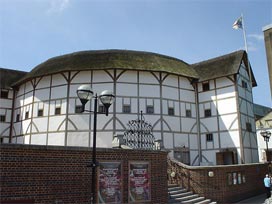
£20: William Shakespeare(1564-1616) Like many an ambitious twenty-something, William Shakespeare was strangely drawn from the shire counties to the bright lights of London. Nobody's quite certain when he arrived, but by 1592 he had a career of sorts as an actor and emerging playwright. Will joined up with a company of players called The Lord Chamberlain's Men and helped establish a theatre (called, originally enough, The Theatre) just outside the City boundaries in Shoreditch. Tax records catalogue a succession of London lodgings beginning in nearby Bishopsgate, later crossing the river to Bankside and then back again closer to St Paul's. In 1599 the increasingly successful Mr Shakespeare became a one-eighth shareholder in the Globe Theatre. Such classic plays as Julius Caesar, Macbeth and Hamlet were first performed here (to packed crowds of appreciative Londoners and not to bored field-trip GCSE students). A second winter-only theatre opened rather later at Blackfriars, where William bought up the old monastery gatehouse as his final London residence. The Blackfriars Theatre lingers on only as a streetname (Playhouse Yard), but the reconstructed Globe lives again as a thatched tourist magnet very close to its original site. Those who flock to Shakespeare's birthplace in Stratford are somehow missing the point.
Londoners of note
£20: Michael Faraday(1791-1867) At long last in this series of banknote characters, a Londoner born and bred. MichaelFaraday grew up in Newington Butts (better known today as "just south of Elephant and Castle"). At the age of 14 he was apprenticed to a bookseller and bookbinder in Blandford Street, just off Baker Street, and started to take an interest in matters scientific. A customer's chance gift of four Royal Institution lecture tickets drew young Michael to the attention of Sir Humphrey Davy, who promptly took him on as his laboratory assistant. Faraday rose through the ranks at the RI to become a Professor of Chemistry, discovering electrolysis and inventing the Bunsen burner along the way. But it's for his pioneering work on electricity that he's best remembered. Ooh look, moving this wire through that magnetic field creates an electric current, as does moving the magnet instead of the wire. Hey presto - the electric motor, the dynamo and the entire modern science of electromagnetism. The fulllist of Faraday's accomplishments is astonishing, and all this from a very humble, religious man.
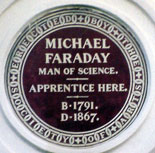
Unfortunately the Royal Institution in Albermarle Street is closed for major refurbishment at the moment, so the Faraday Museum inside is closed too. But Michael spent his entire life based in London, so there's a lot more elsewhere still to track down. Southwark council have erected a blue plaque on a library in Walworth Road close to the site of his birth (although Southwark council are renowned for slapping a blue plaque on anything for almost anyone). More impressive, though less well-known, is this striking steel-box sculpture in the middle of the Elephant & Castle roundabout. Most passers-by probably think it's an electricity substation (which, in fact, it is, for the Northern line below), but it's also the official MichaelFaradayMemorial. It beats the usual bog-standard statue, although there are a couple of those around the town as well. The bookshop in Marylebone where Michael served his apprenticeship is marked by a brown 'blue plaque', and the building is currently occupied by an estate agents named Faradays. Over in the East End, beside the mouth to Bow Creek, is TrinityBuoyWharf lighthouse where Faraday experimented at great length to improve offshore illumination. At Hampton Court is the grace and favour house where he lived out the last two decades of his life. And to see his grave you'll have to travel to the evocative Highgate Cemetery. Faraday's current legacy is everywhere.
Londoners of note
£20: Edward Elgar(1857-1934) Elgar was born, and lived out most of his life, in the idyllic surroundings of rural Worcestershire. He was a man who found even the hustle and bustle of a market town like Malvern too distracting and preferred to compose his work in rented country cottages. So it's perhaps surprising to discover that, of the 25-or-so different residences in which he lived during his life, four were in London. Elgar's need to move to the capital was forced after works such as the Enigma Variations and the Pomp and Circumstance marches caused his fame to grow. In 1912 he moved into an expensive Queen Anne mansion in Netherhall Gardens, Hampstead, and named it Severn House. But a stream of visitors, and the onset of the First World War, led to a marked decline in his creative output and eventually a return to the Worcestershire countryside beckoned. Elgar's Hampstead home has long since been demolished, and only one of his London residences remains standing. It's this five storey townhouse in Avonmore Road, close to the Olympia exhibition centre, and now converted into flats. Edward lived here for just one year during an early abortive attempt to establish himself in the capital. But I bet he wouldn't have left overflowing binbags, a roll of manky carpet and an old TV set out on the steps in front of his house. A blue plaque is no longer a guarantee of class.
Londoners of note
£20: Adam Smith(1723-1790) Next year's new addition to the banknote hall of fame may be a Scot, but even DrAdamSmith spent a couple of years of his life in London hobnobbing with the literary hoi polloi. Today his political and economic outlook lives on in the capital in the form of the Adam Smith Institute, currently housed in temporary accommodation round the back of Westminster Abbey above an obscure timbered shop selling ecclesiastical vestments. As Adam's not yet officially noteworthy, I shan't say any more... but his libertarian disciples blog regularly on his behalf, if you're interested to dig deeper.
Londoners of note
£10: Florence Nightingale(1820-1910) You probably know Florence Nightingale as "the Lady with the lamp", or "that brave nurse from the Crimea". You might even associate her with the famous anagram "Flit on, cheering angel". But there's a lot more to Florence than her talent with bandages, and all is explained in one of London's least known museums hidden away beside the Thames in Lambeth.
The Florence Nightingale Museum is tucked beneath St Thomas's Hospital at the eastern end of Westminster Bridge [map]. No tourist is ever going to stumble upon it by mistake, so I was pleasantly surprised not to be the only visitor wandering around inside last weekend. It costs about half a tenner to get in, and for that you get a fairly traditional "cases and displays" walkround which leads you through the 90 years of Ms Nightingale's life. Florence was born in a certain north Italian city (you can guess which) while her well-travelled parents were on extended honeymoon. She had a privileged academic upbringing in Hampshire, but secretly hankered after an unfashionable career in nursing. The museum showcases many of her early belongings, as well as her pet owl Athena (now stuffed) who died of neglect when Flo rushed abroad to assist in the Crimean War. She wasn't so much a nurse as an administrator, and her in-depth background knowledge and logistical skills were precisely what was required to improve the horrific conditions for thousands of battleworn British soldiers. On her return to England Florence was rightly hailed as a national hero, but she shunned all such adulation in favour of continuing her reforming crusade. Her story is well told in the museum, and in the obligatory 20 minute audio-visual presentation, although (from what I saw) adults may want to linger inside rather longer than any accompanying children.
For the last half of her life Florence resided at 10 South Street, just off Park Lane, and spent her days meeting with the great, the good and the medically important. I attempted to track down her terraced townhouse by hunting for a blue plaque somewhere along the street. A tall Georgian cornerhouse looked a likely candidate, but the plaque beside the front door revealed that the famous occupant here was only "Skittles, the last Victorian Courtesan". Florence's plaque was on the opposite side of the street, high on a very ordinary concrete wall beside a suspiciously modern office entrance. The original house was long gone - her drawing room, her parlour, and the bedroom in which the frail, blind and bedridden Ms Nightingale spent her final decade. But the modern nursing profession still stands in testament to her achievements to this day.
Londoners of note
£10: Charles Dickens(1812-1870) £10: Charles Darwin(1809-1882) And then there are the two Charlies. One an acclaimed novelist, the other a renowned naturalist. One turned his spotlight on the human character, the other on the nature of man himself. And what do you know, I visited both of their London houses lastmonth, so there's no need for me to go into detail here again. Hurrah! Charles Dickens in particular spent so much time living in and writing about the capital that I could easily write a full week of posts about his literary London. Maybe I will one day. In the meantime you can investigate Dickens' London on this interactive map, or pay a virtual visit to Darwin's study.
Londoners of note
£5: Duke of Wellington(1769-1852) Poor old Arthur Wellesley didn't even get his name on the back of the old blue fiver, just his title. Arthur earned his fame stomping round Spain and Portugal during the Peninsular War, first becoming Viscount Wellington (because the name sounded a bit like Wellesley) and later the Duke. Only then did he cap a successful military career by defeating Napoleon at the battle of Waterloo, with the resultant adulation eventually propelling him to the giddy heights of Prime Minister. And in 1817 he moved into a grand town house on the edge of Hyde Park, where his successor lives to this day in private apartments on the third floor.
You've probably seen Apsley House, at least in passing, because it looks out over the six-lane gyratory system at Hyde Park Corner. But you may never have taken the time to go inside, which would be a pity because this is a top class stately home slap bang in the centre of London. I ventured inside "No. 1 London" for the first time last weekend, and was impressed to discover a bubble of grandeur and opulence in the traffic-choked heart of the West End. There's drawing room after drawing room after drawing room, as well as a huge dining room and the lavish Waterloo Gallery. Here the Duke held famed candlelit soirées, and here still hangs his impressive collection of European art. One room on the ground floor is given over to gifts of plate and china given by the crowned heads of Europe - far more impressive than any modern collection of Oscars or Nobel Prizes. But the most unexpected original feature of the house, and the most striking, is the 11 foot tall nude statue of Napoleon which stands at the foot of the main stairwell. Wellington had a grudging respect for his greatest adversary, and was pleased to accept the statue following the Battle of Waterloo when the French decided they no longer wanted it. But it's still a very odd experience to discover the mighty emperor, his dignity covered only by a figleaf, scaring old lady tourists at the foot of the main staircase.
Across the (very busy) road stands the WellingtonArch, upon which once stood a vastly oversized statue of the Duke. Now there's a magnificent winged statue of "The Angel of Peace Descending on the Chariot of War" on top instead, to which you can get right up close by paying a bit more money and taking the lift to the third floor [photo]. The suite of rooms inside the arch once housed London's second smallest police station with a staff of 10 constables, two sergeants and a cat. Now there's just a bit of an exhibition to see, but the visit's really only worthwhile for the view. You can stare across into Hyde Park, you can look down at the traffic circling Hyde Park Corner, and best of all you can peer high over the walls into the back garden of Buckingham Palace. Just the bottom of the garden, mind, but I can exclusively reveal that the Queen wasn't out at the weekend playing tennis or doing the gardening in her wellingtons.
Londoners of note
£5: George Stephenson(1781-1848) Here's the one banknote bloke who never lived in London. The father of railways was born in Northumberland and spent his working life linking the northern industrial heartlands. He never lived anywhere further south than Chesterfield, but today his greatest invention resides in the capital. In 1825 George engineered the world's first steam passenger railway between Stockton and Darlington, but fame came only with his next commission building the Liverpool and Manchester Railway. A competition was held to design the line's new locomotives, and Stephenson entered a revolutionary engine named Rocket. It had a top speed of 30mph, but easily beat the other entries when they all failed to work. At the opening of the railway in 1830, Rocket had the dubious honour of knocking down and killing the local MP who thereby became the world's first railway casualty. It's a lot safer to stand in front of Rocket today, down at the Science Museum in South Kensington, although you still have to watch out for rampaging crowds of schoolchildren running amok with clipboards. The shape is instantly recognisable, with a long thin chimney perched high above a stocky iron boiler. At the rear is a narrow footplate below a hinged door concealing the coal-fired furnace, and above one of the wooden-spoked wheels is affixed an understated brass nameplate. The modern train which brought you to the museum may look nothing like it, but your journey owes everything to Stephenson's Rocket.
Londoners of note
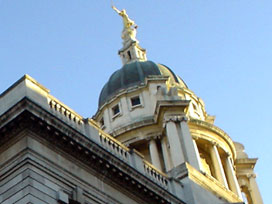
£5: Elizabeth Fry(1780-1845) Elizabeth would no doubt have been mortified to imagine that her portrait would one day appear on several million English banknotes. She was a modest Quaker who grew up in a religious community in Norwich, but her life changed in 1799 when she met wealthy East End merchant Joseph Fry. On marriage she moved to the Fry family home in Plashet (now East Ham) where she eventually decided that there was more to life than giving birth eleven times over. She started to visit the women inmates in Newgate Prison, bringing warm clothing for them and their babies, and eventually persuaded the governors to let her start up a prison school. Her influence grew and spread to other penal institutions across the country, with her undaunting emphasis always on respect and reform for female prisoners. After a pious and illustrious life she was buried in the Quaker cemetery in Barking, although no gravestone now marks the spot. And Newgate Prison, which she fought so long to reform, has also long gone - replaced by the Central Criminal Court of the Old Bailey(pictured). Justice at last.
Since 1970, a total of twelve famous people have graced the back of the banknotes issued by the Bank of England. It's a very exclusive list. And, with one exception, each of these people lived in London for at least some of their life. So I've been out to track down these noteworthy celebrities, to see where they lived, worked and/or died. Join me this week on the trail of twelve Londoners of note.
You have to be a bit special to be celebrated on an Englishbanknote. It's not everybody whose portrait is deemed worthy of being stuffed into millions of wallets, purses and piggy banks. You have to be British, you have to be dead, you have to be fairly non-controversial, and apparently it helps if you have a beard because that makes your portrait harder to counterfeit. Several potential candidates are considered, but it's down to the Bank of England's Governor to make the final decisions. Here are the twelve who've made the grade so far, distributed across three separate series of banknotes.
Series D £1 Isaac Newton (1978-1988) £5 Duke of Wellington (1971-1991) £10 Florence Nightingale (1975-1994) £20 William Shakespeare (1970-1993) £50 Christopher Wren (1981-1996)
Series E £5 George Stephenson (1990-2003) £10 Charles Dickens (1992-2003) £20 Michael Faraday (1991-2001) £50 John Houblon (1994-)
Series E(revised) £5 Elizabeth Fry (2002-) £10 Charles Darwin (2000-) £20 Edward Elgar (1999-)
So far that's ten men and only two women. So far that's four from the arts (two writers, a composer and an architect) and four from the sciences (three scientists and an engineer). So far that's ten properly famous and two just 'worthy'. And so far everyone has been English (although the surprise choice of Scottish economist Adam Smith for the £20 note from next spring breaks the pattern). With 'Series F' now on its way, I wonder who'll be next. Apparently the Bank already have a female shortlist including novelist Jane Austen, poet Elizabeth Barrett Browning and Octavia Hill, founder of the National Trust. I reckon Isambard Kingdom Brunel must be a prime candidate, and perhaps William Wilberforce. But who would you choose?

Londoners of note
Londoners of note
In the spring of 1666 a young architect named Christopher Wren returned from Europe with plans for the rebuilding of St Paul's Cathedral. And then, only a few months later, the entire medieval cathedral burnt to the ground in the Great Fire of London. But this was no suspicious coincidence, it was just precisely the right man in precisely the right place at precisely the right time. The wholesale destruction of two-thirds of the City by fire gave Wren his big chance, and earned him an everlasting reputation. Wren's initial plans for regeneration were grand and geometric, based on the ordered elegance of Renaissance European cities. But landowners were reluctant to sell up their blaze-gutted plots, so the roads of post-Fire London retained the original medieval street pattern. In 1669 Wren was appointed the King's Surveyor of Works and took control of the rebuilding of St Paul's Cathedral. Several designs were proposed, and refused, and it was nearly 40 years before the great building we see today was complete. When Wren died he was buried in a vault in the cathedral's crypt, inscribed with the epitaph (in Latin) "Reader, if you seek his monument, look around you". The crypt's cafe, gift shop and toilets are, today, thankfully tucked just out of sight.
Wren's dome is truly one of the iconic sights of London. Stump up nine quid to enter the cathedral and you too can climb up inside to admire the views both within and without. It's 259 steps up to the Whispering Gallery, although the legendary acoustics didn't work for me when I visited. Another 119 steps are needed to reach the Stone Gallery, this time on the exterior of the building immediately beneath the dome. And then, good grief, the last 152 steps ascend a succession of spiral metal staircases inside the hollow void between inner and outer domes. If that doesn't give you vertigo, the view from the Golden Gallery probably will. You're on the tip of St Paul's nipple here, with just enough space to shuffle precariously round a narrow parapet and look down across the city. It used to be possible to ascend even further, right up inside the golden ball (holds 10), but health and safety rules put paid to this particular treat several years ago.
John who? He's a nobody in comparison to the other 11 notables on my list, but the Bank of England thought him important enough to slap on the back of their highest value banknote. And that's because John Houblon was their very first governor, back in 1694, and because the Bank cared about him 300 years later even if we didn't. John was a rich merchant from a rich family of merchants, although they'd started out a century earlier as a bunch of persecuted Belgian immigrants. He was one of a group of City gentlemen whose ready cash helped to establish London's first public bank in temporary accommodation in Lincoln's Inn Fields. John got to be Lord Mayor, and he was MP for Bodmin, and he was a friend of Samuel Pepys, and sorry, he really wasn't a terribly interesting chap. But he had a nice house in Threadneedle Street which the Bank bought after his death to use as their new permanent headquarters. As the Bank grew in importance they also grew in size, gradually buying up all the surrounding land. In 1791 they knocked down the church nextdoor, this being St Christopher-le-Stocks, in whose grounds Sir John had been buried. Today a seven storey economic fortress covers the entire block, and the first Governor's remains lay somewhere beneath the world-renowned financial institution he helped to create.
Like many an ambitious twenty-something, William Shakespeare was strangely drawn from the shire counties to the bright lights of London. Nobody's quite certain when he arrived, but by 1592 he had a career of sorts as an actor and emerging playwright. Will joined up with a company of players called The Lord Chamberlain's Men and helped establish a theatre (called, originally enough, The Theatre) just outside the City boundaries in Shoreditch. Tax records catalogue a succession of London lodgings beginning in nearby Bishopsgate, later crossing the river to Bankside and then back again closer to St Paul's. In 1599 the increasingly successful Mr Shakespeare became a one-eighth shareholder in the Globe Theatre. Such classic plays as Julius Caesar, Macbeth and Hamlet were first performed here (to packed crowds of appreciative Londoners and not to bored field-trip GCSE students). A second winter-only theatre opened rather later at Blackfriars, where William bought up the old monastery gatehouse as his final London residence. The Blackfriars Theatre lingers on only as a streetname (Playhouse Yard), but the reconstructed Globe lives again as a thatched tourist magnet very close to its original site. Those who flock to Shakespeare's birthplace in Stratford are somehow missing the point.
At long last in this series of banknote characters, a Londoner born and bred. Michael Faraday grew up in Newington Butts (better known today as "just south of Elephant and Castle"). At the age of 14 he was apprenticed to a bookseller and bookbinder in Blandford Street, just off Baker Street, and started to take an interest in matters scientific. A customer's chance gift of four Royal Institution lecture tickets drew young Michael to the attention of Sir Humphrey Davy, who promptly took him on as his laboratory assistant. Faraday rose through the ranks at the RI to become a Professor of Chemistry, discovering electrolysis and inventing the Bunsen burner along the way. But it's for his pioneering work on electricity that he's best remembered. Ooh look, moving this wire through that magnetic field creates an electric current, as does moving the magnet instead of the wire. Hey presto - the electric motor, the dynamo and the entire modern science of electromagnetism. The full list of Faraday's accomplishments is astonishing, and all this from a very humble, religious man.
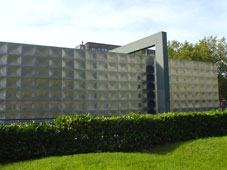
Unfortunately the Royal Institution in Albermarle Street is closed for major refurbishment at the moment, so the Faraday Museum inside is closed too. But Michael spent his entire life based in London, so there's a lot more elsewhere still to track down. Southwark council have erected a blue plaque on a library in Walworth Road close to the site of his birth (although Southwark council are renowned for slapping a blue plaque on anything for almost anyone). More impressive, though less well-known, is this striking steel-box sculpture in the middle of the Elephant & Castle roundabout. Most passers-by probably think it's an electricity substation (which, in fact, it is, for the Northern line below), but it's also the official Michael Faraday Memorial. It beats the usual bog-standard statue, although there are a couple of those around the town as well. The bookshop in Marylebone where Michael served his apprenticeship is marked by a brown 'blue plaque', and the building is currently occupied by an estate agents named Faradays. Over in the East End, beside the mouth to Bow Creek, is Trinity Buoy Wharf lighthouse where Faraday experimented at great length to improve offshore illumination. At Hampton Court is the grace and favour house where he lived out the last two decades of his life. And to see his grave you'll have to travel to the evocative Highgate Cemetery. Faraday's current legacy is everywhere.
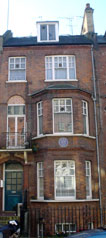
Elgar was born, and lived out most of his life, in the idyllic surroundings of rural Worcestershire. He was a man who found even the hustle and bustle of a market town like Malvern too distracting and preferred to compose his work in rented country cottages. So it's perhaps surprising to discover that, of the 25-or-so different residences in which he lived during his life, four were in London. Elgar's need to move to the capital was forced after works such as the Enigma Variations and the Pomp and Circumstance marches caused his fame to grow. In 1912 he moved into an expensive Queen Anne mansion in Netherhall Gardens, Hampstead, and named it Severn House. But a stream of visitors, and the onset of the First World War, led to a marked decline in his creative output and eventually a return to the Worcestershire countryside beckoned. Elgar's Hampstead home has long since been demolished, and only one of his London residences remains standing. It's this five storey townhouse in Avonmore Road, close to the Olympia exhibition centre, and now converted into flats. Edward lived here for just one year during an early abortive attempt to establish himself in the capital. But I bet he wouldn't have left overflowing binbags, a roll of manky carpet and an old TV set out on the steps in front of his house. A blue plaque is no longer a guarantee of class.
The Florence Nightingale Museum is tucked beneath St Thomas's Hospital at the eastern end of Westminster Bridge [map]. No tourist is ever going to stumble upon it by mistake, so I was pleasantly surprised not to be the only visitor wandering around inside last weekend. It costs about half a tenner to get in, and for that you get a fairly traditional "cases and displays" walkround which leads you through the 90 years of Ms Nightingale's life. Florence was born in a certain north Italian city (you can guess which) while her well-travelled parents were on extended honeymoon. She had a privileged academic upbringing in Hampshire, but secretly hankered after an unfashionable career in nursing. The museum showcases many of her early belongings, as well as her pet owl Athena (now stuffed) who died of neglect when Flo rushed abroad to assist in the Crimean War. She wasn't so much a nurse as an administrator, and her in-depth background knowledge and logistical skills were precisely what was required to improve the horrific conditions for thousands of battleworn British soldiers. On her return to England Florence was rightly hailed as a national hero, but she shunned all such adulation in favour of continuing her reforming crusade. Her story is well told in the museum, and in the obligatory 20 minute audio-visual presentation, although (from what I saw) adults may want to linger inside rather longer than any accompanying children.
For the last half of her life Florence resided at 10 South Street, just off Park Lane, and spent her days meeting with the great, the good and the medically important. I attempted to track down her terraced townhouse by hunting for a blue plaque somewhere along the street. A tall Georgian cornerhouse looked a likely candidate, but the plaque beside the front door revealed that the famous occupant here was only "Skittles, the last Victorian Courtesan". Florence's plaque was on the opposite side of the street, high on a very ordinary concrete wall beside a suspiciously modern office entrance. The original house was long gone - her drawing room, her parlour, and the bedroom in which the frail, blind and bedridden Ms Nightingale spent her final decade. But the modern nursing profession still stands in testament to her achievements to this day.
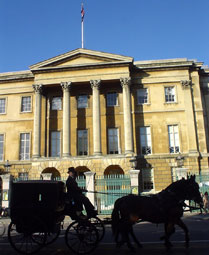
You've probably seen Apsley House, at least in passing, because it looks out over the six-lane gyratory system at Hyde Park Corner. But you may never have taken the time to go inside, which would be a pity because this is a top class stately home slap bang in the centre of London. I ventured inside "No. 1 London" for the first time last weekend, and was impressed to discover a bubble of grandeur and opulence in the traffic-choked heart of the West End. There's drawing room after drawing room after drawing room, as well as a huge dining room and the lavish Waterloo Gallery. Here the Duke held famed candlelit soirées, and here still hangs his impressive collection of European art. One room on the ground floor is given over to gifts of plate and china given by the crowned heads of Europe - far more impressive than any modern collection of Oscars or Nobel Prizes. But the most unexpected original feature of the house, and the most striking, is the 11 foot tall nude statue of Napoleon which stands at the foot of the main stairwell. Wellington had a grudging respect for his greatest adversary, and was pleased to accept the statue following the Battle of Waterloo when the French decided they no longer wanted it. But it's still a very odd experience to discover the mighty emperor, his dignity covered only by a figleaf, scaring old lady tourists at the foot of the main staircase.
Across the (very busy) road stands the Wellington Arch, upon which once stood a vastly oversized statue of the Duke. Now there's a magnificent winged statue of "The Angel of Peace Descending on the Chariot of War" on top instead, to which you can get right up close by paying a bit more money and taking the lift to the third floor [photo]. The suite of rooms inside the arch once housed London's second smallest police station with a staff of 10 constables, two sergeants and a cat. Now there's just a bit of an exhibition to see, but the visit's really only worthwhile for the view. You can stare across into Hyde Park, you can look down at the traffic circling Hyde Park Corner, and best of all you can peer high over the walls into the back garden of Buckingham Palace. Just the bottom of the garden, mind, but I can exclusively reveal that the Queen wasn't out at the weekend playing tennis or doing the gardening in her wellingtons.
The father of railways was born in Northumberland and spent his working life linking the northern industrial heartlands. He never lived anywhere further south than Chesterfield, but today his greatest invention resides in the capital. In 1825 George engineered the world's first steam passenger railway between Stockton and Darlington, but fame came only with his next commission building the Liverpool and Manchester Railway. A competition was held to design the line's new locomotives, and Stephenson entered a revolutionary engine named Rocket. It had a top speed of 30mph, but easily beat the other entries when they all failed to work. At the opening of the railway in 1830, Rocket had the dubious honour of knocking down and killing the local MP who thereby became the world's first railway casualty. It's a lot safer to stand in front of Rocket today, down at the Science Museum in South Kensington, although you still have to watch out for rampaging crowds of schoolchildren running amok with clipboards. The shape is instantly recognisable, with a long thin chimney perched high above a stocky iron boiler. At the rear is a narrow footplate below a hinged door concealing the coal-fired furnace, and above one of the wooden-spoked wheels is affixed an understated brass nameplate. The modern train which brought you to the museum may look nothing like it, but your journey owes everything to Stephenson's Rocket.
Elizabeth would no doubt have been mortified to imagine that her portrait would one day appear on several million English banknotes. She was a modest Quaker who grew up in a religious community in Norwich, but her life changed in 1799 when she met wealthy East End merchant Joseph Fry. On marriage she moved to the Fry family home in Plashet (now East Ham) where she eventually decided that there was more to life than giving birth eleven times over. She started to visit the women inmates in Newgate Prison, bringing warm clothing for them and their babies, and eventually persuaded the governors to let her start up a prison school. Her influence grew and spread to other penal institutions across the country, with her undaunting emphasis always on respect and reform for female prisoners. After a pious and illustrious life she was buried in the Quaker cemetery in Barking, although no gravestone now marks the spot. And Newgate Prison, which she fought so long to reform, has also long gone - replaced by the Central Criminal Court of the Old Bailey (pictured). Justice at last.

 In the spring of 1666 a young architect named

 John who? He's a nobody in comparison to the other 11 notables on my list, but the Bank of England thought him important enough to slap on the back of their highest value banknote. And that's because
 At long last in this series of banknote characters, a
 The
 For the last half of her life Florence resided at
 The father of railways was born in