And so ends diamond geezer's local history month. I wasn't sure when I started if I'd be able to find thirty-plus places in Bow to write about, or even whether I'd still have any readers left by the time the month was over. I'm relieved to see I needn't have worried on either count. A few people even tried doing the same for the place wherethey live. I've found it quite fascinating trying to research everything, and to visit parts of my local neighbourhood I didn't even realise existed a month ago. Maybe the local vicar would be interested in publishing it all as one of those spiral-bound booklets they leave at the back of their church for visitors to steal. Hope you've enjoyed reading it as much as I've enjoyed putting it together... but if not, don't worry, it's back to normal on here next month. Whatever normal is.
The best of Augustwithin 15 minutes walk of my house
(My monthly arts review has a very local flavour this month, as you might expect)
Album of the month: Boy In Da Corner by Dizzee Rascal. It's nominated for the Mercury Music Prize, it's a hugely acclaimed album, and it's all written by an 18-year-old from just down the road on a Bow housing estate. Dizzee - real name Dylan Mills - was regularly excluded from lessons at nearby Langdon Park school, but good old Mr Smith the music teacher took him under his wing and helped him to develop his talents. And what talents. This debut album defies pigeonholing, not quite hip-hop, not quite dance, not quite garage. I guess it's English rap, more East End than East Side, with DR's frenzied vocals peppering an inspired range of claustrophobic beats. Favourite track is Fix Up Look Sharp, currently number 17 in the charts, but I enjoyed the whole album far more than I expected. Check out somemorereviewshere, or just go buy a slice of urban E3 for yourself.
Book of the month: Truecrime by Jake Arnott. This is the third book in Arnott's East End crime trilogy, carefully blending realistic fictional characters with real life post-war criminals. This is GeezerLit. Truecrime opens at Ronnie Kray's funeral, backtracks through the orbital rave underworld and climaxes with the shooting of a film that sounds suspiciously like Lock Stock and Two Smoking Barrels. There's an uncomfortable encounter in Mile End Park on page 86, a flat in the Roman Road on page 247 - in fact the book probably namechecks half the places I've featured in the last month. It's a darned good story too. Highly recommended.
Another book of the month: Full Dark House by Christopher Fowler. The latest dark thriller from a well-established London author, and one of very few writers whose every novel I rush out and buy on publication. Mr Fowler likes to base most of his books within 15 minutes walk of Mornington Crescent, but his two main characters here are an octogenarian detective duo with the distinctly Bow-inspired names of Bryant and May. This story looks back to the Blitz and an investigation into a series of mysterious theatreland deaths. Good, but not his best book (only because Spanky back in 1994 was sooooo excellent).
Not the book of the month: Dead Air by Iain Banks. This novel opens in a red-brick loft apartment in a unnamed converted eight-storey Victorian factory "in the not-yet fashionable bit of London's East End north of Canary Wharf". Well, if that isn't Bow Quarter (or maybe Spratt's dog biscuit factory) then I'll be mighty surprised. Sadly the book is all froth and no plot, all conversation and no action, and I gave up on it part way through. What this is doing high up the bestseller list is completely beyond me. Prime candidate for disposal I think.
Single of the month: Four Minute Warning by Mark Owen. The end of the world never sounded so good. The former Take That pin-up has penned a supremely catchy ode to Armageddon, with a chorus whose half-life deep inside your brain must be longer than that of uranium. Could have been written, and a hit, at any time during the last twenty years. I didn't mean to love this track, I just do. Is this the end, then?
Famous places within 15 minutes walk of my house Numbers 11, 12, 13, 14 and 15
11)Tredegar Square - Georgian architectural jewel 12)House - Rachel Whiteread's Turner Prize-winning concrete cast 13) The Widow's Son - the pub with the buns 14)Tower Hamlets Cemetery - the dead centre of Bow 15)Spratt's - once the largest dog biscuit factory in the world
Famous places within 15 minutes walk of my house Number 10 - Mile End Park
It may look yellow from below, but that bridge in the photograph is the famous Green Bridge at Mile End. Underneath - the A11, one of London's busiest trunk roads. Over the top - a millennium-funded tree-topped bridge joining the two halves of Mile End Park. And very close by, slightly to the south, probably the most famous of all the places within 15 minutes of my house...
One particular Friday in June 1381, Mile End was swarming with revolting peasants. They'd come from the villages of Essex and Kent, roughly sixty thousand of them, to protest against the new poll tax and the general unfairness of feudal life. This was people power in action on a massive scale, and London's first ever flash mob. In an attempt to defuse this potentially explosive situation, the teenage king Richard II rode out from the Tower of London to meet the peasants here at Mile End Green. "Oi you lot!" he shouted, "I'm your king." Or some other historic words to that effect. Richard was canny enough to listen and then agree to all their demands, verbally at least. Some of the men were appeased and headed for home, but many could not be bought so easily.
The next day the remaining peasants met the King again, this time at Smithfield just outside the city of London. Their spokesman was Kentish bloke Wat Tyler who presented (and upped) the list of demands. When Wat didn't get his way an argument broke out, quickly escalating to a scuffle in which Tyler was fatally wounded. The crowd rose up and threatened the King, but young Richard bravely raised his hand and agreed to become their leader instead. Clever lad. The mob was shepherded out of town, the Peasants Revolt was over, and Mile End Green went back to being just common.
Violence returned six centuries later when Mile End was hit by London's first ever flying bomb. It was just one week after D-Day when the first V1 rocket appeared in the dawn sky over East London. Local people heard the low drone suddenly splutter to a halt, followed by an eerie silence. This being the very first doodlebug, nobody was prepared for two thousand pounds of explosives to suddenly fall from the sky, killing three people and destroying a railway bridge. So began London's doodlebug summer, with more than 2000 flying bombs launched from occupied France creating sudden havoc and destruction, especially across the south and east of the city.
After the war, East London was pock-marked by desolate bombsites. Government planners saw their chance to clear the remaining slums and rebuild. The Abercrombie plan proposed a massive increase in urban parkland, including a 90 acre strip of land alongside a mile of the Regents Canal. Houses were knocked down and industry removed to make way for the new Mile End Park. Initial enthusiasm floundered over the decades, the park suffering both from lack of facilities and lack of visitors. It took an imaginative £12 million lottery bid to bring the park back to life, the centrepiece of which is the unique GreenBridge, linking the park together at last. Mile End now boasts an open space fit for the 21st century, with themed areas for art, sport, play and ecology, and it's beautifully done. Now an oasis of calm, you'd never believe a king once nearly lost his life here at the hands of an angry mob.
(In)famous places within 15 minutes walk of my house Number 9 - the Krays' manor
1933: Identical twins Reggie and Ronnie Kray are born ten minutes apart. 1939: The family move from Shoreditch to 178 Vallance Road, Bethnal Green. 1951: Both twins appear in a middleweight boxing match at the Albert Hall. 1952: The twins desert their National Service on day 1 after decking the NCO. 1953: They buy the Regal, a run-down snooker club in Bethnal Green. The empire begins. 1956: The Kray's manor stretches from Bethnal Green to Bow and from Stepney to Hackney. 1957: When Ronnie is sent to prison, Reggie opens the 'Double R Club' on Bow Road. 1960: When Reggie is sent to prison. Ronnie takes control of a large Knightsbridge casino. 1964: The Daily Mirror retracts claims that Ronnie has been having sex with a Tory peer. 1965: Reggie marries Frances Shea, who two years later takes an overdose and dies. 1966: Ronnie walks into the Blind Beggar pub and shoots George Cornell dead. 1968: Reggie stabs Jack 'The Hat' McVitie to death in a house in Stoke Newington. 1969: Both twins are found guilty of murder and sentenced to life imprisonment. 1995: Ronnie dies and his funeral cortege brings East London to a halt. 2000: Reggie dies and is buried alongside his brother in Chingford cemetery.
For a few years in the late Fifties a club in Bow was at the centre of the Kray brothers' legitimate business empire. Reggie snapped up a cheap derelict shop here while his brother was in prison, determined to open "the finest drinking club the East End’s ever known." Ronnie was not forgotten - the place was named the 'Double R' club. A gym was built on the first floor and Henry Cooper was invited to officially open the premises. It wasn't long before the club was attracting showbiz celebrities seeking an authentic East End atmosphere. Reggie's love affair with the rich and famous began here. He also opened a gambling club just down the road in Wellington Way, behind Bow Police Garage, and the money came rolling in. The Krays were in control.
I think that's the Double R Club in the photograph, the white building on the corner of Mile End Road and Burdett Road. It's proved impossible to do any 100% conclusive research on the club's exact location though, so if you should know any better please let me know.
The club is now split into two halves, with the front and first floor currently occupied by the garagetastic Purple E3 nightclub (previously Benjy's). The entire outside of the building is lit up every night in a disturbingly bright shade of aubergine. Meanwhile at the back can be found the Backstreet leather bar, catering to a rather different clientele. Reggie would no doubt have enjoyed the bling-bling glamour of the upstairs club, while Ronnie would have preferred it round the rear. Allegedly. You have to be so careful round here. Those Kray Brothers are still held in high esteem in this manor. Dead, but by no means forgotten.
Since when did autumn start in August? It seems like only a fortnight ago it was high summer - hot sweaty summer - but now all of a sudden it's autumn. How on earth did that happen? It's become almost traditional recently for autumn to be late, not early. Blame global warming or whatever, but trees have been keeping their leaves several days longer, migrating birds hanging around weeks later and lawns still needing cutting in November. Not in 2003. This year looks like being an exception.
The signs have been there for a while. Argos stand accused of switching to their autumn catalogue a number of weeks ago ("You want a sun lounger? Sorry madam, but we can do you an 8ft Inflatable Light-up Snowman instead"). Then last week Tesco sent me a copy of their latest promotional magazine. This glossy publication namechecked 'autumn' eight times in the first four pages, encouraging me to cook with berries, curl up with a mug of hot chocolate, stock up on brown cardigans and generally keep 'warm and cosy'. Given that I was overheating in a t-shirt and shorts on the day it arrived, that went straight into the bin. And now this week I've been sitting at work watching the leaves on the plane trees in Green Park start to change colour. In August? It won't be long before we have to rename the place 'Yellow Park' instead. Maybe it's just the first signs of drought, but it's all very unnatural, I tell you.
Keeping an eye on all these changes is a branch of science called phenology, the study of the dates of annually-recurring natural phenomena. In other words a nationwide band of amateurs who watch the landscape for signs of seasonal change - the first cuckoo, the first frogspawn, the first conker, that sort of thing. Their overall results are anything but amateur, and so it's possible to plot the changing changing seasons across the country. For example, back in 1999 your average UK oak tree was completely brown by October 30th, whereas in 2001 the corresponding date was November 11th instead. 2001 had a particularly late autumn, with horse chestnut leaves not starting to change colour until September 21st and beech leaves not starting to fall until November 4th. See the fascinating full seven-tree four-year database here. Bet all those dates are earlier this year. You couldsign up and become a phenologist yourself to help find out. Or just look out of the window and watch the early fall.
Famous places within 15 minutes walk of my house Number 8 - Victoria Park
Victoria Park is the green lung of East London, nearly 300 acres of pleasure sandwiched between Bow, Hackney and Bethnal Green. Laid out in the 1840s and named after the new queen, the park is split into two halves. To the west the ornamental gardens complete with boating lake, all encircled by a lamplit carriage drive. Rather gorgeous. To the east the larger half with bandstand, memorialfountain (pictured) and tons of space to run around in. You can find an excellent interactive map of Victoria Park (then and now) here.
The park was conceived as a healthy open space for the unhealthy residents of Victorian East London. Not that the poor actually needed somewhere to drive a horse-drawn carriage, neither did the rich who owned carriages want to live anywhere near the slums of the East End either. It took 150 years for the middle classes to move in beside the park, attracted by the canalside location and the recent gentrification of glamorous South Hackney. Better late than never. Recent murders don't appear to have put people off, so expect Vicky Park to remain a much-loved destination for many generations of East Enders (and EastEnders) to come.
You've never been closer to the planet Mars. Nobody has. Not for more than fifty thousand years, not since the only people on Earth were Neanderthal. The red and blue planets line up with the Sun this morning at 10:51am BST, and it's the closest they've been to one other for exactly 59,619 years. Since 12th September 57,617 BC in fact. That may sound like an unbelievably accurate figure, but it's typical of an exact science like astronomy where computers can warn us to watch out for a doomsday asteroid on Saturday 16th March 2880 and probably predict Jesus's birthday as an encore.
Today Mars is only 34,646,418 miles away from the Earth. Or, to put it another way, a mere 186 light seconds distant. The two planets actually pass fairly close quite often. Both race round the Sun on separate orbits, with the inner Earth catching up with Mars roughly every 26 months. This time, however, the celestial overtaking manoeuvre happens when Mars is almost at its very closest to the Sun (that's tomorrow), so the two planets are especially close together. It's called perihelial opposition. We're also only a few weeks past the Earth's furthest point from the Sun, and this and other wobbles over time in the two orbits make today's approach record-breakingly close. It's all explained here and here if you need the finer details, and here's a map showing the planets in their orbits.
A few facts about Mars. It's the seventh largest planet in the solar system (it's quite small), it's the fourth in line from the Sun, the Romans named it after the god of war, it weighs one tenth as much as the Earth but has roughly the same area of dry land, it has only two known moons, it has a highly elliptical orbit (another reason for today's close approach), it spins on its axis once every 24 hours 37 minutes (about the same as us), it's not full of little green men, it's home to the largest mountain in the solar system, and Gustav Holst wrote a stirring piece of music about it. The first probe to reach Mars flew past in 1964, the Viking lander touched down here in 1976, the ill-fated Mars Explorer of 1992 disappeared without trace wasting $980 million, and British probe Beagle 2 is on its way at the moment, due to arrive on Christmas Day.
Mars should now be visible in the southern sky around midnight, glowing red and brighter than any star. That's so long as there aren't any clouds even nearer to Mars than you are. At magnitude -2.9 this is your best chance to see the red planet for many years. But don't worry if you miss it because Mars will be even closer on Monday 29th August 2287, which is still well before that asteroid hits.
Famous places within 15 minutes walk of my house Number 7 - the old Big Breakfast house
(except I've already written about the old lockkeeper's cottages, here. Now being renovated as a family home, you remember...)
Famous places within 15 minutes walk of my house Number 6 - Roman Road
It'll come as no surprise to you to hear that Roman Road used to be a Roman road. It was the main road from London to Colchester, until Bow Bridge opened in the 1300s and diverted the main road half a mile to the south.
Roman Road is now a prime shopping street, or so I was told by some of my more well-to-do female colleagues when I used to work in Suffolk. On moving to London I was most disappointed to discover instead that the market was merely home to cheap dishcloths, dodgy batteries and pirated videos, much like many other local markets in the area (but still not as awful as Walthamstow). I guess, not being female, I wasn't attracted by Roman Road's bijou collection of swish boutiques selling top fashion castoffs at knockdown prices.
Roman Road boasts a very out-of-place-looking Wetherspoons pub, and also some traditional East End pie and mash shops (though for fresh-baked quality you can't beat Goddard's in Greenwich). And the local library here was recently transformed into an award-winning Idea Store, a primary-coloured palace of lifelong learning. It's an impressive addition to the community, and visitors have trebled in the year that the new library has been open, but alas I suspect that figure has been boosted by the hordes of seven year-olds to be found rampaging round the bookshelves as if the place were an adventure playground.
Twice as many digits to remember as before, which is why we've been bombarded by expensive advertising campaigns trying hard to punch each number deep into our subconscious memory. What the adverts aren't so hot at telling us however is how much each service actually costs. There's a bewildering range of connection charges, costs per minute and minimum charges, and I doubt that most people using the new services will have any idea just how much they're being stung for. There's a very useful summary of all the services and charges here. Or why not just check out the diamond geezer consumer guide below?
Cheapest for a 30 second call: 118 247 (Yellow Pages) and 11 88 88(both 20p) ...and the most expensive: 118 000 (Orange), 118 118 (The Number) (both 49p) Cheapest for a one minute call: 11 88 88(20p) ...and the most expensive: 118 118 (The Number) (58p) Cheapest for a two minute call118 811 (One) (30p) ...and the most expensive: 118 119, 118 180, 118 499(all £1.75)
The one number to remember: 11 88 88(20p per minute), the one with the cartoon superhero digits advert. Best value on all calls up to 1½ minutes.
The one number to avoid: 118 118(49p + 9p per minute), the one with the 70s hairstyled runners. Probably the most successful ad campaign, but worst value on all calls up to 1 minute 9 seconds.
The most devious con-trick: BT is running two different numbers. It's heavily promoting the expensive 118 500(30p + 25p per minute) and keeping distinctly quiet about the much cheaper flat-rate 118 707(35p).
The cheapest alternatives: BT again, this time online where you're allowed ten free directory searches a day on their website. Or, of course, why not use one of those paper-based phone directories you have lying around at home (free).
The extra hidden charge: If you allow the operator to put you straight through to your desired number, it'll cost you more. BT's 118 500 charges 30p a minute for the duration of your new call, and 118 247 (Yellow Pages) as much as 40p a minute. Cheapest this time is 118 118 which charges 'only' 9p a minute.
The biggest rip-off: All of the charges above are for landlines only. If you want to use Directory Enquiries from your mobile (and, to be honest, that's when you're most likely to need to use it) then you may need to remortgage your house. All of the mobile companies have upped the price of calling anything 118 from their networks and are keeping very quiet about how nightmarishly expensive it is. Here's the geezer guide:
O2: The cheapest is 118 811 (One) (25p per minute), but most other services cost 65p per minute.
Vodafone: The cheapest is 118 500 (BT) (40p per minute), but for short calls avoid 118 118(70p + 20p per minute).
Virgin: The cheapest is 11 88 88(40p per minute), but both 118 500 and 118 118 will bleed you dry at 75p a minute instead.
T-mobile: No service costs less than 65p a minute (40p per minute), with 118 118 at 75p a minute and 118 000 (Orange) £1 a minute.
Orange: The cheapest is 118 000 (Orange) (surprise surprise) (59p + 30p per minute). Every other service costs at least 60p a minute for monthly contract customers, or £1 a minute if you're on pay-as-you-go.
Is it really worth us all suffering this confusing deregulated rip-off merely so that BT's 192 monopoly can be broken? I think we should all complain to Oftel. Why not ring them now on... erm...
(In)famous places within 15 minutes walk of my house Number 5 - the Block
This innocent looking building with the blacked-out windows used to be home to The Block, one of London's dodgiest clubs. Adventurous gentlemen would dress up in their finest fetishwear and pop down to Bromley-by-Bow to enjoy an evening of poorly-lit hardcore interactive entertainment. So I'm told. At the end of the night, after they'd had their fill of the place, many of the booted revellers would then nip over the road to the 24-hour Tesco supermarket and frighten the locals.
Last year, acting on a tip-off, the police decided to check out exactly what went on within The Block's darkened rooms (well, what did they expect, it was in all the adverts). No doubt the punters were thrilled by the arrival of a gang of close-cropped men in tight fitting black uniforms wielding handcuffs, but this particular visit was no reason to get excited. The police moved rapidly to close the club down, hell for leather, soon rubber-stamped. The management attempted to limp on with an 'oh no, nobody has sex here honest' policy but the clientele just stopped coming. Within a month the Block was closed for good.
Or so it seemed until last week. All of a sudden there's a flurry of activity here because the decorators are in. Not that they know why the place is being done up (I asked) but it appears that the cellar has a new buyer. I wonder what they're intending to reopen the place as. And I wonder if they'll remember to fix that dodgy lightbulb in the urinals.
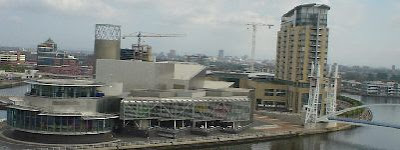
0) Salford Quays: A thriving Docklands-style redevelopment (i.e. a lot of lottery money, a few designer retail outlets and ever-growing numbers of overpriced apartments). 1) The Lowry: An award-winning new building containing two theatres and some art galleries, one of which is devoted to matchstalk men and matchstalk cats and dogs. 2) Manchester Ship Canal: Historic waterway built in 1894 to link the thriving industrial city of Manchester to the Mersey, thereby avoiding exorbitant harbour taxes in Liverpool. 3) Imperial War Museum: A startling aluminium-clad structure, cleverly telling the story of global 20th century warfare. Once an hour there's a spectacular video show in which images are projected onto the walls and floor of the main gallery. Very well done, recommended, and free. 4) Old Trafford: Home to little known football team currently languishing behind Arsenal in the Premiership.
Famous places within 15 minutes walk of my house Number 4 - the original Big Brother house
(except I've already written about all that's left of the place, here. Now just an empty field, you remember...)
Famous places within 15 minutes walk of my house Number 3 - Three Mills
There are, of course, two mills at Three Mills. There used to be three in medieval times, but go back to the Domesday Book and there were as many as eight. You'll remember that Bow used to be the bakery of London, so it was here on the tidal part of the River Lea that the most important mills were built to grind the flour for the capital's bread. The mills have also been used for distilling gin and grinding gunpowder. Here's an clever interactive map showing how the area around Three Mills has built up since Norman times.
The two mills you can see in the photo (the House Mill on the left and the Clock Mill on the right) date from 1776 and 1817 respectively. The House Mill is the largest tidal mill in the country, stretching 45 feet across four internal mill races and two waterways. Grain arrived by barge or cart and was then lifted by the sack hoist to be stored on the uppermost of the five floors. At high tide a sluice was closed and the water then left to flow back at a controlled rate to operate the mill wheels. Here's a flash illustration of how it all worked, and here's a much better history of the site.
The mills closed over fifty years ago but have recently been restored as a working museum, open to the public on Sunday afternoons in the summer. Here's a slideshow, here's a map, and here's a photo-heavy page showing what you can see on the tour.
...and Bugs. The classic mid-90s BBC adventure series Bugs was based here, 40 episodes of hi-tech hokum with location filming all over Docklands. Here are threefinefansites devoted to the series. Ahh, Ed, Ros and Beckett! Oooh, the theme tune! One particular episode ends with Ed trying to escape from a warehouse before it explodes - that warehouse was Clock Mill. Look, here are pictures! And here's the script! Don't you just love what you can find on the internet?
Famous places within 15 minutes walk of my house Number 2 - the Greenwich meridian
Yes, that is exactly the same photograph of Abbey Mills that appeared here yesterday, snapped from atop the Northern Outfall Sewer. What you won't have spotted yesterday, however, was one of the most important lines in the world slicing the building in two. It's an imaginary line that heads north from here through Stratford bus station, Leyton, Chingford and Cleethorpes, and south through East India station, the Dome, a powerstation, Peacehaven, Burkina Faso and Ghana. It's the Greenwich meridian.
That imaginary line is a relatively modern invention. Nobody really cared about longitude until it became the key to successful ocean-going trade. Charles II established a royal observatory at Greenwich in 1675, hoping to boost Britain's chances on the high seas by plotting the positions of various heavenly bodies as accurately as possible. Key amongst the equipment here was the transit telescope, angled to move only up and down, and from 1750 it was this telescope that defined Britain's prime meridian. A new transit telescope was built at Greenwich in 1850 by the Astronomer Royal George Airy. It was positioned a short distance away from the original, and this resulted in the Greenwich Meridian being moved nineteen feet eastwards.
Nobody other than seafarers and astronomers would have realised that this line existed, neither did they need to know. Local noon was just whenever the sun was overhead, which was easy because people never travelled very far away from home in those days. Then came the railways, and suddenly it mattered that noon in London was five minutes later than noon in Norwich but nine minutes earlier than noon in Bristol. Railway time soon became Greenwich time, and clocks in towns and villages across Britain were quick to follow suit.
In 1884 the International Meridian Conference was convened in Washington DC. Representatives of 25 countries met to establish a single meridian so that time and dates could be standardised across the globe. Almost everybody supported Greenwich, except for the French who had established their own meridien through Paris. But it was Airy's meridian in Greenwich that was confirmed as the world's official line of zero longitude and the basis of the new International Time Zone system.
In the 21st century global navigation now relies on the satellite technology of GPS. Accurate measurements from space have led to another slight shift of the globe's most important line, and the GPS meridian now lies 102.48 metres east of the old Greenwich meridian. This page has a go at explaining exactly why this difference exists, but it's mighty complicated. (And ah, so that's why my own little GPSdevice has been giving me what looked like dodgy readings in the Greenwich area).
After dark a green laser beam shines out from the Greenwich observatory along the meridian. It marks a very special line, and yet a completely arbitrary one. This is the benchmark of both time and space, the line from which all days begin and the only line on earth on which local noon is still noon. In the eyes of the world, Greenwich means time.
The sky above Aldwych may have been almost cloudless, but there were a suspicious number of people carrying umbrellas walking the streets in the area earlier this evening. This was the second (official) London flash mob, or at least it was one of them. The organisers had been careful to split us up into at least two different mobs according to starsign and dispersed us around the Embankment. I was in the smaller group, instructed to turn up with an umbrella at one of four pubs off Aldwych by 6:10pm, precisely.
The bar staff in the George IV pub were overwhelmed by brolly-carrying punters. Us potential mobsters stood around waiting to get served, gulped down our drinks and waited for further instructions. At 6:10pm precisely one of the organisers entered the pub and handed out the tiny flyers to everyone carrying an umbrella. On one side, the words to Gene Kelly's classic Singing in the Rain. On the other side was our mission statement. We were to take our umbrellas to the public courtyard of Somerset House by 6:25pm precisely, text someone asking them to ring us at 6:30pm precisely, and click our fingers every (click) time anyone (click) used the letter Y (click).
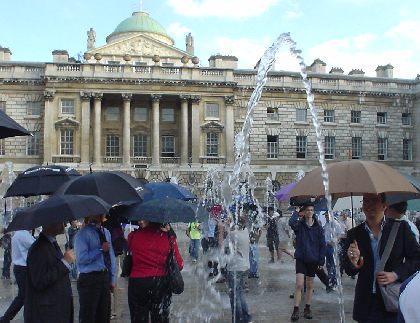
If you've ever been to Somerset House before (and I have) you'll know that the centre of the courtyard contains 55 water jets which spring from the flagstones. On a hot summer's day it's a damp four year-old's paradise. It's also a lot of fun for a bunch of over 100 twenty-and thirty-somethings armed with umbrellas. At 6:25pm the mobsters from each of the four Aldwych pubs arrived right on time and strode into the middle of the fountains, brollies raised. Just as happened at the last flash mob, everyone suddenly looked at each other as if to say "Are we really doing this? Excellent!" And then we started acting like damp four year-olds.
It soon became apparent that the organisers had omitted one crucial piece of information from their instructions. They hadn't told us what to do when while we were standing in the middle of the fountains. Perhaps it was supposed to be obvious that we should dance round the fountains like famous Hollywood movie stars, but they'd forgotten to tell us that. Eventually one group was brave enough to start singing Singing in the Rain and everyone joined in, but they skipped a chunk of the first verse which sort of threw the rest of us partway through. It still sounded good though.
A number of the mobsters were really enjoying splashing in the water, running through the fountains and getting their suits wet. As the jets shot up into the air sometimes they caught the underside of an umbrella and water shot out across the crowd. Some wished they'd not brought their laptops, videophones and digital cameras with them. Ten minutes we stood there, getting slowly wetter, until at 6:35pm precisely it was time to leave. As we vanished out into the Strand the three security guards stood and watched the departing crowds, scratching their heads and mulling over what it was they might just have witnessed.
There was one last finale, a "Bonus Mob", as our group were then directed to pop up onto nearby Waterloo Bridge and face upstream. There in the distance across the Thames was tonight's other flash mob, spread out across the new Hungerford pedestrian bridge, doing goodness knows what. (Ahh, report here, photos here) We waved. They may have waved back, it was hard to tell. And then, trainers still squelching, it was time for everyone to disperse.
I think Flash Mob ##2 worked rather better than Flash Mob ##1 a fortnight ago, not least because we were in a public place and not apparently hounded by the press. Perhaps the organisers should give up on their fixation with mobile phones and letters of the alphabet, because I have yet to see those ideas work in practice. Just standing in the middle of a fountain with an umbrella was quite surreal enough for most participants. And the chances of there being a successful Flash Mob ##3? Odds on, I reckon.
Famous places within 15 minutes walk of my house Number 1 - Abbey Mills pumping station
(except I've already written about Abbey Mills, here. Raw sewage and Big Brother, you remember...)
And finally for local history month it's famous places within 15 minutes walk of my house. That's nearly two square miles (well, a circle actually) so I'll only be picking out the more important places. Expect medieval rebellion, a couple of gangsters, a line you can't see, two large green spaces and quite a bit of Channel 4. Oh, and while I remember, they're opening up Bow Church for an art exhibition for the next month. Take a look inside here.
Places within 10 minutes walk of my house that people think are famous but in fact aren't Number 7 - Bow Street
OK, so there isn't a Bow Street within 10 minutes walk of my house, with or without four houses and a hotel. There's just a Bow Road. You've probably got the hang of this fact by now, so tomorrow I'll move on to some places within 15 minutes of here that really are famous. In the meantime, here are ten fascinating facts about the board game of Monopoly.
• Monopoly evolved from The Landlord's Game, the invention of Maryland resident Lizzie Magie. Her game was intended to teach players about the property ownership system, the object being 'to obtain as much wealth or money as possible'. Original 1904 patent here, rules here and board here.
• The game of Monopoly was first patented by Charles Darrow in 1933. Folklore tells how, jobless and destitute, he thought up the rules one night in a flash of inspiration, hand-painted the board on a tablecloth and used old trinkets around the house for game pieces. Rather more likely is that Charles already worked for Parker Brothers and merely nicked the idea from homemade versions of Lizzie's original game. Conspiracy theories abound.
• Darrow, who was from Pennsylvania, based his version of Monopoly on the properties of Atlantic City, New Jersey. This supposedly reminded him of happy family holidays he had spent there before the Great Depression. Or else he stole the idea again. The street names in the American version of the game are still based on Atlantic City, from Mediterranean Avenue ($60) right round to Boardwalk ($400).
• Monopoly remains the best-selling board game in the world, licensed or sold in 80 countries and produced in 26 languages. Over 200 million games have been sold worldwide, containing more than five billion little green houses.
• The London version of the game was licensed to Waddingtons in 1935. Managing Director Victor Watson and his secretary Marjorie made a special trip from Leeds to London to decide which streets in the capital would be used on the UK board. They concentrated on the West End, with only the light blues located to the north and the cheap old browns to the east. The story of the London board is well told in the book Do Not Pass Go by Tim Moore, a capital travelogue and one of last year's bestsellers.
• Each UK Monopoly set comes with 20 £500 notes (orange), 20 £100 notes (beige), 30 £50 notes (green), 50 £20 notes (blue), 40 £10 notes (yellow), 40 £5 notes (pink) and 40 £1 notes (white). Total amount of money per game = £15,140.
• There are 16 Chance cards, ten of which move you elsewhere, two of which give you money and three of which take money away. There are 16 Community Chest cards, nine of which give you money, four of which take money away and two of which move you elsewhere. Each pack contains one legendary Get out of Jail free card.
• The most landed-on square in Monopoly is the jail, whether you're banged up or just visiting. The best cards in the game to own are the stations, which players tend to land on roughly one in every ten throws. And the best properties to own are the orange set, including good old Bow Street (or St James Place, to American readers). Orange earns the highest rate of return because it lies, on average, exactly one dice throw further round the board than the jail. All the statistics you could ever want here, here, here and here (in the Strategy Wizard in the Tips and Tricks section).
• As for me, I can't ever remember winning a game of Monopoly. Or finishing one for that matter.
London Flash Mob ##2: I've just received my instructions for London's second Flash Mob, tomorrow. The organisers appear to be splitting us into three separate mobs according to starsign. One group are to assemble on the South Bank, another in pubs near CharingCross station and my group in pubs around Aldwych. Where we get sent after that and what we're asked to do is anybody's guess, but all of my group have been asked to bring an umbrella ("and no, you will not be doing anything daft with it"). See you in (blimey) Bow Street, 6:10pm tomorrow...
Re: Wicked screensaver I've been spam-virused. Re: Your application Over the last twelve hours 115 separate copies of the Sobig F worm have ended up in my inbox. Re: Re: My details My anti-virus software has digested every single one of them, and I'm not infected myself, but I hope I don't have to spend the rest of my life deleting this rubbish from my email. Re: That movie Every six minutes. See the attached file for details.
Six months ago my lovely digital radio stopped working. I took it back to Dixons who immediately offered me a full refund, there being no more Pure Evoke Is in stock. Never mind, they said, the super stereo Pure Evoke II will be out soon, maybe you'd like to wait for one of those. So I did. The launch date for the new radio was originally at the end of May, then pushed to the start of July, then the middle of July, then into August. I began to wonder if I'd ever be able to listen to radio free from pirate interference again. But, joy, today the new Pure Evoke II was finally released, and I duly trotted down to Oxford Street to collect mine. First one out of the shop it was too.
I've always suffered from appalling reception in my flat (TV, radio and mobile) but now I can get 39 different digital stations, just so long as I position my new radio the right way round balanced on top of the CD rack beside the television. I can now listen to all 11 BBCstations (that 6Music is a bit of class isn't it, and there are some comedy gems tucked away on BBC7) plus a whole lot of commercial stuff that, rather wonderfully, isn't quite commercial enough to be interrupted by commercials. I can go clubbing, I can go indie, I can vegetate to what appears to be the Simply Red station, and there even appears to be a channel solely devoted to the sound of distant birdsong. Sadly the scrolling text doesn't tell me whether I'm listening to a thrush or a starling.
A few years ago the imminent death of radio was being predicted. Not any more. A whole new world of digital services has opened up, on the telly, on your mobile, online and on demand. Computer-playlisted radio risks becoming very bland indeed, but the mass availability of new digital technology should hopefully lead to a outbreak of innovation and diversity instead. Whatever you want to listen to, it's probably going to be out there somewhere. Or, of course, you could just stick a good CD on...
Diamond puzzle: Arrange sixteen different playing cards so that each row, column and diagonal contains an Ace, King, Queen and Jack, and also a Club, Diamond, Heart and Spade.
Places within 10 minutes walk of my house that people think are famous but in fact aren't Number 6 - Bow Street magistrates court
It may be London's premier magistrates court, scene of the legendary trials of DrCrippen and John Leslie, but alas Bow Street magistrates court isn't here either. This doesn't stop defendants, witnesses and jurors turning up at Bow Road tube by mistake though, and then looking very embarrassed when they discover they should have gone to Covent Garden instead. I try very hard not to smile out loud when this happens.
Bow isn't even home to the significantly less famous Bow County Court, because they moved that up the road to Stratford 20 years ago and forgot to change its name. No, we just have the remarkably dull Thames Magistrates Court instead, pictured here. Footballer Lee Bowyer was once fined £4500 here for being very naughty in McDonalds with a chair. Somehow I suspect Bow Street gets all the good cases.
Places within 10 minutes walk of my house that people think are famous but in fact aren't Number 5 - Bow Street police station
Bow Street in Covent Garden was home to London's first ever police station and remains the most famous lock-up in the capital. The street had been home to the Bow Street Runners for over a century before the formation of the MetropolitanPolice here in 1829 by good old Sir Robert Peel. Historic stuff indeed.
But this isn't Bow Street, it's Bow Road. The police station here (closed Sundays) was built in 1912, just in time for all those Suffragette protests that were about to break out down the road. Sylvia Pankhurst liked smashing the windows of the police station so much that she spent many a night here, but she spent far more nights over at the realBow Street. So, Bow Road copshop's not really that famous, relatively speaking. They have some nice police horses there though.
Famous places within 10 minutes walk of the obscure Norfolk village I'm currently staying in Number 2 - Old Buckenham
Old Buckenham is a picturesque village in South Norfolk hidden far from the well-trodden tourist trails. The monthly village newsletter will tell you all you could ever want to know about local events, including details of the thrilling Country Fayre at the end of the month. But is there any famous local history, you ask? Oh yes.
• Old Buckenham Mere is the site of the earliest archaeological find of the cultivation of cannabis in Britain, dating back to the 5th century AD.
• William d'Albini, butler to William the Conqueror, built a stone castle in the parish in 1146, around which grew up the village of New Buckenham. Only a few ruins remain, but Buckenham Castle keep is the largest in diameter in England.
• All Saints'Church dates back at least 750 years, and is one of only six churches in Norfolk with an octagonal tower.
• Old Buckenham windmill, built in 1818, has the widest tower of any windmill in the country. One of the first owners was James Colman who went on to found the famous mustard business in Norwich. The mill was recently renovated and is open to visitors on the second Sunday of the month.
• The Australian cricketer Lionel Robinson lived at Old Buckenham Hall where he created a unique cricket ground with special Australian turf. In the spring of 1919 ten thousand spectators turned up to watch the Australian national team draw against an English XII (yes, really, this was the only time an Australian team ever played twelve-a-side).
• Old Buckenham Airfield was built in 1942/3 and became home to the 453rdBombGroup of the US Army Air Force. They flew 259 missions over enemy territory before the end of the war, losing 58 aircraft and 366 crew. Hollywood actor James Stewart was an Executive Officer and flew over 20 missions from 'Old Buck', while Walter Matthau also served here as a sergeant and radioman/gunner.
• The village green is reputed to be the largest in England, covering 40 acres. The sheep seem to like it too.
Places within 10 minutes walk of my house that people think are famous but in fact aren't Number 4 - Walford East tube station
Ever wondered where EastEnders is set? Walford E20, sure, but that's merely a fictitious place and postcode. Ever wondered whereabouts in London Walford is really meant to be? Some have said Wanstead, because it sounds a bit similar. Some have said Stratford, because they have an Albert Square there. Even more convincing is the idea that Walford should be a crossing on the river Walbrook, a long lost stream which flowed from Moorgate to the Thames, dividing Roman London in two. But no, it's none of these.
The answer's on the tube map outside WalfordEaststation (and thanks to the Observer for printing a Shane Richie centrefold last weekend to confirm this). Walford East lies on the District Line and it's the station between Bow Road and West Ham, replacing Bromley-by-Bow. Just round the corner from my house then. Not that Bromley-by-Bow looks anything like Albert Square. It's all modern council housing and dual carriageways down there, and one of the most deprived council wards in the entire country. There are some allotments, and there's a Queen Victoria pub across the road, but other than that any illusion of Walford is purely fictional.
Bromley-by-Bow station definitely has more trains than Walford East. We have one every three minutes or so, whereas Albert Square is lucky to see one a year. The EastEnders train is a large model pushed along the viaduct over Bridge Street by stage-hands. It can only go in one direction, and even then the fine details have to be painted in during post-production. We also have less murders and unwanted pregnancies in E3 than they seem to have in E20, and some of us go to work more than 100 yards away from our homes.
The real inspiration for Albert Square isn't in Bow at all, but in Hackney, E8. Fassett Square is a quiet Victorian square tucked away close to Dalston Junction, and it was here that producers Tony Holland and Julia Smith found their inspiration for BBC1's first soap opera. Little did they know when they shot the pilot episode on location here that East 8, as it was nearly called, would soon become one of the biggest programmes in the country.
As you can see, the design of Albert Square owes a lot to the architecture of Fassett Square, pictured right. The terraced houses in Fassett Square were built in the early 1860s, with bay windows on the ground floor and the front door set back behind a decorated arch. In the centre of the square (well, rectangle actually) is a communal garden, still well-kept and tidy in a way that Arthur Fowler would have been proud of.
The BBC considered filming all the exterior shots for EastEnders here in Fassett Square, but eventually decided against. Cost and disruption to residents' lives were the main reasons, but also because there was the most enormous modern wing of the nearby GermanHospital on one side of the square and it would have been too difficult to keep it out of shot. The BBC built a permanent outdoor set for EastEnders at Elstree studios instead and left the local residents in peace.
Fassett Square itself has gone upmarket since 1985. Now only the odd soap obsessive intrudes on life there, aiming their digital camera at what looks uncannily like Pauline's house, just round the corner from what must be the Slaters' front door. Now you can visit Walford E8 virtually instead thanks to this tasteful and informative website constructed by games designer and local resident JonathanBoakes. I bet Dot's already logged in and had a snoop around.

And so ends diamond geezer's local history month. I wasn't sure when I started if I'd be able to find thirty-plus places in Bow to write about, or even whether I'd still have any readers left by the time the month was over. I'm relieved to see I needn't have worried on either count. A few people even tried doing the same for the place where they live. I've found it quite fascinating trying to research everything, and to visit parts of my local neighbourhood I didn't even realise existed a month ago. Maybe the local vicar would be interested in publishing it all as one of those spiral-bound booklets they leave at the back of their church for visitors to steal. Hope you've enjoyed reading it as much as I've enjoyed putting it together... but if not, don't worry, it's back to normal on here next month. Whatever normal is.
The best of August within 15 minutes walk of my house

Violence returned six centuries later when Mile End was hit by London's first ever flying bomb. It was just one week after D-Day when the first V1 rocket appeared in the dawn sky over East London. Local people heard the low drone suddenly splutter to a halt, followed by an eerie silence. This being the very first doodlebug, nobody was prepared for two thousand pounds of explosives to suddenly fall from the sky, killing three people and destroying a railway bridge. So began London's doodlebug summer, with more than 2000 flying bombs launched from occupied France creating sudden havoc and destruction, especially across the south and east of the city.
After the war, East London was pock-marked by desolate bombsites. Government planners saw their chance to clear the remaining slums and rebuild. The Abercrombie plan proposed a massive increase in urban parkland, including a 90 acre strip of land alongside a mile of the Regents Canal. Houses were knocked down and industry removed to make way for the new Mile End Park. Initial enthusiasm floundered over the decades, the park suffering both from lack of facilities and lack of visitors. It took an imaginative £12 million lottery bid to bring the park back to life, the centrepiece of which is the unique Green Bridge, linking the park together at last. Mile End now boasts an open space fit for the 21st century, with themed areas for art, sport, play and ecology, and it's beautifully done. Now an oasis of calm, you'd never believe a king once nearly lost his life here at the hands of an angry mob.
For a few years in the late Fifties a club in Bow was at the centre of the Kray brothers' legitimate business empire. Reggie snapped up a cheap derelict shop here while his brother was in prison, determined to open "the finest drinking club the East End’s ever known." Ronnie was not forgotten - the place was named the 'Double R' club. A gym was built on the first floor and Henry Cooper was invited to officially open the premises. It wasn't long before the club was attracting showbiz celebrities seeking an authentic East End atmosphere. Reggie's love affair with the rich and famous began here. He also opened a gambling club just down the road in Wellington Way, behind Bow Police Garage, and the money came rolling in. The Krays were in control.
The club is now split into two halves, with the front and first floor currently occupied by the garagetastic Purple E3 nightclub (previously Benjy's). The entire outside of the building is lit up every night in a disturbingly bright shade of aubergine. Meanwhile at the back can be found the Backstreet leather bar, catering to a rather different clientele. Reggie would no doubt have enjoyed the bling-bling glamour of the upstairs club, while Ronnie would have preferred it round the rear. Allegedly. You have to be so careful round here. Those Kray Brothers are still held in high esteem in this manor. Dead, but by no means forgotten.
Victoria Park is the green lung of East London, nearly 300 acres of pleasure sandwiched between Bow, Hackney and Bethnal Green. Laid out in the 1840s and named after the new queen, the park is split into two halves. To the west the ornamental gardens complete with boating lake, all encircled by a lamplit carriage drive. Rather gorgeous. To the east the larger half with bandstand, memorial fountain (pictured) and tons of space to run around in. You can find an excellent interactive map of Victoria Park (then and now) here.
The Martian Chronicles
It'll come as no surprise to you to hear that Roman Road used to be a Roman road. It was the main road from London to Colchester, until Bow Bridge opened in the 1300s and diverted the main road half a mile to the south.
This innocent looking building with the blacked-out windows used to be home to The Block, one of London's dodgiest clubs. Adventurous gentlemen would dress up in their finest fetishwear and pop down to Bromley-by-Bow to enjoy an evening of poorly-lit hardcore interactive entertainment. So I'm told. At the end of the night, after they'd had their fill of the place, many of the booted revellers would then nip over the road to the 24-hour Tesco supermarket and frighten the locals.
There are, of course, two mills at Three Mills. There used to be three in medieval times, but go back to the Domesday Book and there were as many as eight. You'll remember that Bow used to be the bakery of London, so it was here on the tidal part of the River Lea that the most important mills were built to grind the flour for the capital's bread. The mills have also been used for distilling gin and grinding gunpowder. Here's an clever interactive map showing how the area around Three Mills has built up since Norman times.
Yes, that is exactly the same photograph of Abbey Mills that appeared here yesterday, snapped from atop the Northern Outfall Sewer. What you won't have spotted yesterday, however, was one of the most important lines in the world slicing the building in two. It's an imaginary line that heads north from here through Stratford bus station, Leyton, Chingford and Cleethorpes, and south through East India station, the Dome, a power station, Peacehaven, Burkina Faso and Ghana. It's the Greenwich meridian.
If you've ever been to Somerset House before (and I have) you'll know that the centre of the courtyard contains 55 water jets which spring from the flagstones. On a hot summer's day it's a damp four year-old's paradise. It's also a lot of fun for a bunch of over 100 twenty-and thirty-somethings armed with umbrellas. At 6:25pm the mobsters from each of the four Aldwych pubs arrived right on time and strode into the middle of the fountains, brollies raised. Just as happened at the last flash mob, everyone suddenly looked at each other as if to say "Are we really doing this? Excellent!" And then we started acting like damp four year-olds.
Places within 10 minutes walk of my house that people think are famous but in fact aren't
OK, so there isn't a Bow Street within 10 minutes walk of my house, with or without four houses and a hotel. There's just a Bow Road. You've probably got the hang of this fact by now, so tomorrow I'll move on to some places within 15 minutes of here that really are famous. In the meantime, here are ten fascinating facts about the board game of Monopoly.
Diamond puzzle: Arrange sixteen different playing cards so that each row, column and diagonal contains an Ace, King, Queen and Jack, and also a Club, Diamond, Heart and Spade.
It may be London's premier magistrates court, scene of the legendary trials of Dr Crippen and John Leslie, but alas Bow Street magistrates court isn't here either. This doesn't stop defendants, witnesses and jurors turning up at Bow Road tube by mistake though, and then looking very embarrassed when they discover they should have gone to Covent Garden instead. I try very hard not to smile out loud when this happens.
Bow Street in Covent Garden was home to London's first ever police station and remains the most famous lock-up in the capital. The street had been home to the Bow Street Runners for over a century before the formation of the Metropolitan Police here in 1829 by good old Sir Robert Peel. Historic stuff indeed.
The answer's on the tube map outside Walford East station (and thanks to the Observer for printing a Shane Richie centrefold last weekend to confirm this). Walford East lies on the District Line and it's the station between Bow Road and West Ham, replacing Bromley-by-Bow. Just round the corner from my house then. Not that Bromley-by-Bow looks anything like Albert Square. It's all modern council housing and dual carriageways down there, and one of the most deprived council wards in the entire country. There are some allotments, and there's a Queen Victoria pub across the road, but other than that any illusion of Walford is purely fictional.
The real inspiration for Albert Square isn't in Bow at all, but in Hackney, E8. Fassett Square is a quiet Victorian square tucked away close to Dalston Junction, and it was here that producers Tony Holland and Julia Smith found their inspiration for BBC1's first soap opera. Little did they know when they shot the pilot episode on location here that East 8, as it was nearly called, would soon become one of the biggest programmes in the country.
As you can see, the design of Albert Square owes a lot to the architecture of Fassett Square, pictured right. The terraced houses in Fassett Square were built in the early 1860s, with bay windows on the ground floor and the front door set back behind a decorated arch. In the centre of the square (well, rectangle actually) is a communal garden, still well-kept and tidy in a way that Arthur Fowler would have been proud of.