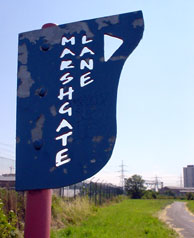
My mp3 player's battery ran out during my journey to work yesterday, so I was forced to listen to my fellow commuters instead... • [Bow Road → Mile End] The train grinds to an unexpected halt inbetween stations. The all-enveloping silence in the carriage is suddenly punctuated by a loud snore. Sprawled across two seats is a well-fed bloke in oversized overalls, his head tipped back and his eyes firmly closed. His boots are splattered with dirty white paint, and his lunch dangles from one arm in a blue plastic bag. A second disturbingly loud snort fills the air, causing several nearby passengers to peer up from their newspapers. Intermittent snoring continue, reverberating in all directions as the train goes nowhere. The assembled audience begin to smile and glance at one another in guilty pleasure, relieved not to be the snoozing sideshow themselves. This unintended entertainment continues for three increasingly uncomfortable minutes. And then the train starts forward with a jolt, and one pair of heavy eyelids flick open. The semi-conscious traveller gathers his belongings and prepares to disembark at the next station, blissfully unaware of all the embarrassment he never felt. • [Liverpool Street → Bank] The carriage is rammed. Desperate commuters barge aboard from the platform. An off-duty London Underground employee in bulging blue uniform pushes past me to stake his claim to two square feet of spare floorspace. His over-thick head of grey speckled hair is somewhat unconvincing. A bulky laptop bag packed with official paperwork grazes my leg. As the doors clang shut, the newly-arrived tube worker taps the dreadlocked gentleman beside me on the shoulder. "Can you turn that down?" A hand emerges and pulls half a Sony headphone from one ear. No sound whatsoever can be heard. "Can you turn that down please?" Humiliated, the tapped man fiddles with an unseen volume knob and plugs himself back in. Tubebloke smiles, and looks to the rest of the carriage for implicit approval. Only one lady returns his gaze and smiles back. I feel a sudden urge to bash this sycophantic self-satisfied jobsworth over the head with a rolled up copy of the Daily Express for his totally unnecessary public intrusion, but I resist. The train screeches on through the noisiest tunnel on the entire tube network, far louder than any headphone bassbeat. Nobody utters another word.
threelinks • The London 2012 team have started up their own 2012 Olympic project blog. It's a bit serious, because official blogs have to be, and relentlessly upbeat, because official blogs have to be. But it's also surprisingly comprehensive, refreshingly broad-ranging, revealingly in-depth and unexpectedly interesting. Go read it now, before some of the more depressingly-negative political bloggers discover it and start leaving smug comments. • Do you have The Knowledge to become a London taxi driver? Test yourself out in a series of online tests at the WizAnn website. In what street is Birkbeck College? What route would you take from Hackney Downs to Finsbury Circus? Where on a roadmap is the Trellick Tower? I failed miserably. (Be warned that the final 'map' section of the test works in IE but not Firefox) • The Met Office has just relaunched its website, with increased access to detailed weather data. You can now type in your postcode to see a local five day forecast. You can view local weather observations over the last 24 hours in graphicalformat. You can watch the British Isles rainfall radar. Plus lots of other meteorological nuggets.
I've never liked the way I look in photographs. My smile's twisted, my eyes are vacant and my face looks all wrong. I often look startled, usually look uncomfortable, and always look plain unnatural. I hate my work mugshot and I despise my holiday snaps. In short, photographs of me don't look like me at all. Or so I think. Everybody else, however, always comments on how lifelike my photographs look ("Cor, that's such a good likeness.") ("Oooh, that's very you!") as if they think I really do look like the inane boggle-eyed gimp in the picture. Because (and this is the hard part to come to terms with), I really do look like that.
Every day since I was small I've looked in the mirror whilst cleaning my teeth or brushing my hair and assumed I was looking at an image of myself. I've grown used to every blemish on my skin, every curve of my face and every slightly wayward eyelash. My entire self-image has been generated from this daily reflection, because it makes sense to think that I look like what I see. But, of course, I've been deluding myself. The face I see in the mirror is a reflected fake, reversed from reality. What I see as my left eye is really my right, and that mole on my right cheek is really on my left. My face is truly asymmetrical, and I'm viewing it the wrong way round. However hard I try, I am not who I think I am.
I'm sure I'm not alone in this. You don't look like your photographs either, neither do you appear to others as you appear to yourself in a mirror. And you all know this, deep down, but it's a hard thought to shift.
Here, as an example, are two images of Prince Charles. One of these is the real Prince Charles, as printed in photographs and as seen by Camilla when she wakes up each morning. And the other is the reflected Prince Charles, as seen by His Royal Highness as he peers into the mirror above the royal sink. One's real, one's an illusion. Is it the left Charlie, or the right Charlie? I bet you've already spotted which is which, because one image somehow looks 'right' and the other doesn't. Unless of course you're Prince Charles himself, in which case Sir will instinctively have plumped for the incorrect image because it's the image with which Sir is most familiar.
Annoyingly, I prefer my reflection to the view everyone else sees. I may be wrong, but I think my mirror image looks slightly more handsome than reality. Not by much, you understand - I'm not being smug here - but to my mind I look better through the looking-glass. Maybe I've become conditioned over the years to tolerate the view I see every day, or maybe I genuinely have been asymmetrically unfortunate. Whatever the case, it's probably no bad thing that I'm comfortable with my looks, even if they are merely a visual deception.
And don't get me started on what I sound like to other people. Recordings of my voice always sound completely wrong, and nothing at all like the voice that I hear in my head. Again I know I'm wrong, deceived by vibrations travelling along my jawbone, but that doesn't make listening to my true voice any easier to bear. I mean, did you hear me talking on the video podcast yesterday. Sounded nothing like me, honest. (damn)
Words are dead. The future lies instead in sound and pictures. And that's bad news for blogs like mine which rely on words. People can't be bothered to read words any more, not when they can be spoonfed moving images with an accompanying soundtrack instead. Could be a music video, could be a film trailer, could be a TV snippet, could be two spotty teenagers shouting into a webcam in their bedroom. Whatever the content, sitting back and soaking in a visual experience requires far less effort than having to decode a long string of written sentences. Words are dead.
If I want to survive in the cut-throat online world, I need to evolve. I need to follow the herd and abandon verbal content in favour of embedded YouTube videos. Because, like, you know, they're hilarious, and they're what the public really wants.
So I've had a go at making my very own diamond geezer video podcast. That's me you can hear in the audio, and that's me you can see in the video. I'm a bit new to this, so please forgive me if it's a bit amateur. Until last night I'd never tried recording either sound or vision on my laptop, let alone marrying the two together in a perfectly crafted simultaneous broadcast. I'm not sure I did very well. But it's a start. Because the future's audio-visual. And the written word is dead.
Although, actually, sound and pictures aren't that great, are they? You can read words online much quicker than you can listen to them. You can skim a written post in seconds whereas you might end up wasting five minutes of your life watching rubbish. And if you don't have audio enabled, or if there's too much ambient noise and you can't hear anything, then what good is a post where all the meaning comes from sound? Maybe the written word has a future after all. I hope so. I don't think I'm cut out for video.
I was forced to travel on public transport recently because my car was in for a service. Little did I know that my journey would soon become the bus ride from hell! As I sat on my slightly soiled seat I could feel the squalor of the working classes assaulting my senses on all fronts, but I stared manfully out of the window and tried hard to blot it out. Oh how I longed for a heavily pregnant woman to board the bus so that I could offer her my seat and then stand smugly for the rest of the journey, but no such luck.
As I flicked through your excellent headline article about the continuing mystery surrounding Princess Diana's suspicious death, my ears were suddenly assaulted by the tinny drone of what passes for music these days. It was most off-putting, and I found myself looking over to see which teenage asbo whore might be responsible for this cacophony. Imagine my surprise to see instead a pigtailed blond girl, no more than ten years old, clutching an offensive pink mobile phone from which some cheap digital tune was now blaring. And there beside her sat her disinterested mother, blissfully unaware of the aural damage her daughter was wreaking.
I was not just disgusted, I was appalled. This miserable child was unable to survive a short bus journey without the need for anti-social entertainment. My fellow passengers and I were being forced to endure some blaring R&B nonsense so that this poor little moppet didn't get bored during her ten minute bus journey. Worse still, this council estate urchin had clearly been brought up to have total disregard for her elders and betters by a thoughtless mother. I wanted to beat some sense into this woman's tiny head with my rolled up copy of the Daily Express. I'll give her good manners, traditional values and good clean fun. Somehow I resisted.
This is not the Britain my grandparents fought for. This is a nightmare society where discourtesy and insolence are commonplace. What our young people need is a bit of respect drummed into them, and fast. So I'd like to suggest the return of the death penalty for people who play music out loud on public transport. It's the very least they deserve. And life imprisonment for anyone who has the volume on their headphones up so loud that the person sitting next to them can hear it. That'd show 'em.
What we need is a gibbet on every bus and a gallows on every train. Let's stand up for law and order and good old fashioned morality. I'm not afraid to say what I think. I'm crusading for a better Britain. That's why I read the Daily Express.
Yours enraged, Mr Silent Majority (retd)
P.S. And let's bring back flogging for children who forget to say please and thank you, and teenagers who drop litter in the streets, and company managers who relocate their call centres to India, and neighbours whose bonfire smoke blows across your washing line, and people who let their dogs foul the footpath, and illegal asylum seekers, and gum chewers, and freeloaders, and shop assistants who look at you in a funny way, and...
Most Londoners probably think that their nearest beach is in Southend, or maybe Brighton, but they'd be wrong. There are several beaches (or at least bits of foreshore masquerading as beaches) along the Thames, even through the middle of Central London. When the tide's high you can't see them at all, and many tourists probably never even realise that they exist. But as the river level falls, up to 6½m every twelve hours, so the river ebbs away to reveal long stretches of rock and mud. It may not be golden Mediterranean sand, but if you fancy a bit of beachcombing it's a darned sight more convenient to get to. • watch the Thames rise and fall
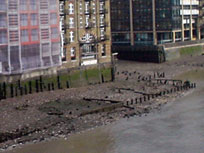
This is the beach at Bankside [photo], just below the Tate Modern [photo]. It's one of the longer stretches and, if you time it right, also one of the widest. With a bit of luck somebody will have unlocked the gate in the railings along the river's edge [map] and you can make your way down the low stone steps onto the sand. Yes, that's definitely sand at the top of the beach, although it soon gives way to rock and muddy shingle further down. Eroded half-bricks and pebbles litter the exposed river bed, some dark and jagged, others bleached white and smooth. Decaying wooden stumps stick up from the ground, the remnants of some old wall or Tudor jetty. Dark brown rusty pipes snake half-covered beneath the shingle, thankfully no longer dribbling ooze into the river. There's not as much washed-up litter and glass as you might fear, nor as much green slime as you might expect.
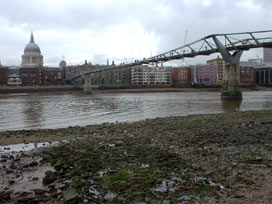
Best of all, you've probably got the whole quarter mile of beach to yourself, all the way from Blackfriars Bridge [photo] to Bankside Pier [photo]. Well, just you and a ragbag collection of feral pigeons, swooping seagulls and big black crows. Try picking your way across the rocks directly underneath the non-wobbly Millennium Bridge and looking across the river towards St Paul's Cathedral on the opposite bank [photo]. You might even spot some fragments of pottery or an old sailor's clay pipe in the mud, although I suspect that most of these were spotted and nabbed long ago. Don't stand too near the water's edge, or the backwash from a passing speedboat or Thames cruiser might overflow your boots. And ignore the funny looks you're getting from tourists wandering along the South Bank above you. Perhaps they can't work out how you got down there, or maybe they simply can't imagine why anyone would want to slum it on a low rocky shelf. But they're the ones missing out. Just make sure you get back up the steps before the beach disappears from view beneath the rising tide.
You can tell an awful lot about the history of London from its maps. Not that there were many London maps to begin with, because they weren't needed. But the British Library has amassed an enormous collection of London maps from the last 500 years or so, and their new cartographic exhibition makes for fascinating viewing. I thought I'd better visit on the first day before it gets too popular, because it surely will.
The exhibition is divided into eight sections, from the old walled City to postwar suburban sprawl. Inbetween you get to watch the capital expand, gradually at first, then with increasing speed towards the docks in the east and the prestigious estates to the west. See how quickly ye olde London was wiped from the map by the Great Fire, only to be rebuilt in ten years flat. Watch the fields north of Piccadilly sprout streets and squares and mansions. You can even track the River Fleet as it evolves from stream to ditch to underground sewer... or maybe that was just me. Some of the maps are bloody huge, which is great because it means you can get up close and inspect the really small detail. Many of the earlier maps are more pictorial than planar, but they're all equally beautiful and intricate in their own way.
What many visitors seem to do (and I'll confess to being no exception) is to pay extra special attention to the place where they live. It helps if you live somewhere fairly central, of course, and I'm fortunate that Bow often crept onto the very easternmost edge of certain maps. I was able to trace Bow first as a medieval village on the banks of the Lea, then a tiny 'town' surrounded by grassy meadowland, and finally a suburb swallowed whole by expanding London. If you'd have been wandering around the exhibition with me I'd probably have bored you silly by pointing out every time I spotted precisely where my house now stands, and you'd probably have done the same.
It's just my sort of exhibition, filled with frame after frame of cartographic porn to salivate over. I'm sure I'll be back for another visit at a later date, just so I can stare again at the million and one details I overlooked the first time. But in the meantime there's plenty to view from home. The free exhibition guide folds out to reveal a high quality print of Richard Newcourt's pre-Fire London map of 1658, which is gorgeous. I was also inspired to buy a copy of the book accompanying the exhibition, as did a surprisingly high proportion of departing visitors. At £15 a time (£25 hardback) the British Library have a worthwhile moneyspinner here, and very lovely the book is too. And if you can't get to the exhibition yourself, or can't get there yet, there's an excellent website to explore complete with images of several of the maps. It's based on a virtual Google map, of course, and there are some real gems tucked away on there. You've got three months to get your A-Z out and find your way to the British Library to see for yourself.
ninelinks (and one repeat from last Saturday just in case you missed it) • Ever needed an email address to sign up for something but not wanted to give your real one? Now you can get a temporary email address from Spambox, which lasts just long enough for you to get your registration email through and then disappears. I've just used Spambox to sign up for 12 free Krispy Kreme doughnuts, safe in the knowledge that a "Buy 12 get 12 free" voucher is the only email they'll ever send me. Fab. • Hurrah, Smoke #9 is just about to hit the shops. Just £2.50 will buy you this highly engaging "London peculiar" crammed with words and images inspired by the city. Probably the only quarterly magazine to be published sort-of every five months-ish. [4pm update: I've managed to track down a copy, and yes it's as good as ever] • Ever wondered what tube drivers see as they chug around beneath London? Wonder no more, because the latest fad on YouTube is tube driver's cab videos. How do you fancy a journeyround theCircle line, or a trip out from Paddington to Hammersmithand back, or even Moor Park to Croxley? • You may not have splashed out on the latest NOW 65 album, but I bet you've bought at least one from the Now That's What I Call Music series. TV Cream has a special nostalgic page remembering NOWs 1 to 20, back in the 80s. • Check out Flickr's latest London photos in more than 100 different categories at Pimp My London Group. I'm sure you'll want to keep up with The Feral Children of Bermondsey and London Graffiti groups, for example. Or add your own. • Is your secondary school in Wikipedia? I had a look via the Schools in England page, and mine's included. Can you beat a wealthy porn baron as an ex-pupil? • If there was a General Election tomorrow, who would win? (Answer: The Conservatives would be just ahead in a hung parliament). It's all based on the latest opinion polls, of course, and don't forget it's just a bit of fun... • Share your memories of the capital with Map My London. See where Mrs M took her favourite greyhound for a walk and where tamsin found a lost mattress. Satisfyingly mundane. [via ian and rashbre] • Did you know that one pound 500 years ago had the same purchasing power as £447.11 today? Or that our cash has halved in value over the last 20 years? Check out the Purchasing Power of British Pounds from 1264 to 2005. • If the programs on your Windows Taskbar aren't in the right order, Taskbar Shuffle is a tiny program which allows you to rearrange them. Very useful if, like me, you prefer everything set out 'just so'. Why doesn't Windows do this by default?
A very happy Thanksgiving to all of my readers in the United States. As every Briton knows, Thanksgiving is that special day of the year when Americans eat turkey and pretend they're all descended from pilgrims. Or is it the day when you eat pumpkin pie and dress up in traditional native American headgear? Or is it the day when you fly long distances to eat pecan pie with their families? Or is it the day when you eat cranberries and start their Christmas shopping. See, nobody in Britain really knows, or cares. We've all got to go to work today, and your traditional family celebrations pass us by unnoticed. It's not bitterness, you understand. We don't care that in 1620 a few joyless Britons sailed across the Atlantic to found a nation who would later subjugate us in global influence (honestly, we don't). Your quaint day of Thanksgiving is just another Americanism which plays no part whatsoever in our lives.
Except on television. We watch a lot of your television, partly because you make so much of it. And your television series often feature aspects of American culture which are relatively alien to the rest of the world. Like, for example, those annual Thanksgiving episodes of Friends packed with unintelligible turkey-based nuances. Here are some other bewildering slices of American life which, to us Brits at least, exist only on screen:
• "The Prom": Every American teenage TV series must, by law, contain one "Prom" episode. On their last day at school, all the characters dress up in posh suits and elegant ballgowns and then spend the evening dancing and trying not to kiss each other. Surely it would be more fun to dress down and get pissed on lager instead, and a lot cheaper? • "Little League": To the best of my knowledge, all tousle-haired American ten-year-old boys spend their weekends being whipped into line playing a version of institutionalised rounders. If I'm wrong, sorry, but that's how it always looks on children's TV. • "Vietnam": I know our film industry made far too many films about 'plucky valiant Brits' battling through World War Two, but Hollywood's still churning out far too many films about the agonies of Vietnam. We lost interest after the first fifty, OK? • "Football": But, but, but, that game on the screen's not football! That's lots of burger-fed teenagers dressing up in padded clothing and helmets and standing around in the middle of a big field occasionally running three yards before being jumped on. But there again, we invented cricket, so we're not much better. • "The First Amendment": There are lots of amendments, apparently, on such diverse topics as having to be nice to slaves, giving women the vote and being allowed to gun people down in cold blood. But the First is the most important one... whatever in God's name it is (and I believe I have the freedom to say that). • "Junior High": Sorry American scriptwriters, but when you set a TV series in a 'Junior High', I have no idea how old the children are supposed to be. 7? 12? 15? It's not easy to tell from the actors' faces anyway, because they all look 23. • "The Pledge of Allegiance": Usually seen as a mawkish conclusion to a particularly moral-filled half hour, with rows of gap-toothed kids chanting in reverence beneath a big stripy flag. It might tug at the heartstrings in the States, but it lacks all emotional punch outside the homeland. • "Yearbooks": In every college, so TV tells us, a bunch of do-gooding senior students go round taking photographs of everybody else and pasting them into expensive scrapbooks which they then distribute at the end of the year. I'm so pleased nobody tried that at my secondary school - my 1982 haircut is not something I want to relive.
Friday update: You've also suggested... "the World Series", "Spring Break", having a "den" at home, "Varsity", "Fraternities", "Sororities", "Semesters", "the Super Bowl", "Homecoming Queen", "The DA's Office", "NASCAR", "Cheerleaders", "Restrooms", "Peanut Butter & Jelly sandwiches", "Ballparks", "Summer camp", "Condos", "the backyard", "going to the Drive-in" and "taking out the trash". Any more?
Post a post on your blog and, if you're lucky, comments will appear. There might be a lot, or there might not. But what seems to be the case is that most of these comments will appear fairly soon, and then there'll be fewer and fewer new comments as time goes by. The older a post is, the fewer comments it attracts. OK, that's not rocket science. But the drop-off seems to be quite dramatic, and yesterday's comments on this blog were no exception. So I thought I'd do some research to investigate my rate of comment decline. I've selected 10 typical posts, and then I've looked at your comments and the time at which you made them. Results follow.
[For analytical purposes I've only considered posts posted on this blog at 7am on a weekday, and I've selected the ten most recent of these. That's more than 250 of your comments under consideration altogether. I'm aware that I'm very fortunate to have this many comments, so thank you. I'm aware that most bloggers don't post a new post every day, instantly demoting yesterday's post to obscurity. And I'm aware that most bloggers don't post at the same time every day, with readers expecting a fresh post every morning. In fact I'm aware that my blog isn't typical in any way. But I still think the data's interesting.]
elapsed time
comments
the first 6 hours
50%
the first 12 hours
75%
the first 24 hours
90%
Half of the comments on my blog are posted within 6 hours of a post appearing, while it's still fresh and new. Three out of four comments are made in the first 12 hours, by which time most regular readers have checked out the page to see what today's post is. And all but 10% of comments are made during the first day, while the post is at the top of the page. After that I stick another daily post on top, and the old post is relegated down the page, and the comments dry up. All of which suggests that if you lot have anything to say, you say it quickly. Here are the results in more detail:
time comment made
comments
7am → 9am
17%
9am → 12 noon
28%
12 noon → 3pm
15%
3pm → 6pm
13%
6pm → 9pm
10%
9pm → midnight
4%
day 2
8%
days 3 and 4
5%
later than day 4
1%
When I post a new post at 7am, most UK blog readers are still asleep (or otherwise occupied). But some of you are very quick off the mark and get in with an early comment. My busiest hour for comments is usually 8:30-9:30am, presumably just after many of you have arrived in the office for work, and while the post is still fresh. The rest of the morning is also relatively busy, comments-wise, but by lunchtime this interactive activity is already starting to fade. There's another slight peak at the end of the working day, around 5pm, and then commenting drops off fairly sharply after 8pm as the evening progresses. Presumably you're all busy being sociable by then and have no time to comment, or maybe everything's already been said. During the early hours, UK time, I receive only a handful of occasional comments (usually from either nightowls or Antipodeans). Then there's barely a flicker of interest as the second day dawns, and passes, because now there's something more recent to comment on. And very few people stumble across an 'old' post after more than four days and feel they have to add to the debate. Conversation by then is essentially dead and buried, and even if you do write a comment it's unlikely that anybody else is still going to be around to read it.
So, there you have it. If today's post is typical I'll get a quarter of my total comments by 10am, half of my comments by 1pm, three quarters of my comments by 7pm and nigh all of them by 7am tomorrow morning. But I bet you prove me wrong deliberately.
I just wondered, because some people do, and some people don't. I don't mean whiffy body odour smells like that unwashed bloke with stinky armpits who insists on standing next to you on the train in the summer. I mean perfume and and cologne and aftershave and stuff. Some people sprinkle themselves with it, and some don't. So, which are you?
Yes, I smell: No, I don't smell:
Some people smell. They have bottles of aromatic stuff littering their bathrooms, and they splash it on all over every morning. It might be some subtle fragrance, or it might be a volatile chemical which reeks from a distance of fifty yards. It might smell of lemon, it might smell of rose petals or it might smell of some other exotic bouquet, but the whole point is that it smells of something because there's no point in wearing it otherwise. Some people smell a little, but some people smell a lot. It's as if they somehow need to be noticed, striding through their everyday lives in clouds of wafting whiff. Still, at least it's easy to buy these people a Christmas present. One well-wrapped bottle of their favourite scent and they're happy. Be it something expensive from the grinning girls at the front of Debenhams or just the latest from the Avon catalogue, you can't go wrong with a smelly bottle. Even if it is tiny, and holds only a few thimblefuls, and costs a fortune, its contents will still be appreciated. By smelly people.
I’ve never been a smelly person. I never quite saw the advantage of dousing my body in musk or citrus or whatever. But there was a time back in my teens when I dabbled. I won a squeezy green tube of Brut 33 talcum powder in a local town hall raffle, and brought it home excitedly to experiment with. A few squirts and I smelt like the proverbial tart's boudoir, all stinky and sickly sweet. So the Brut sat unused on my shelf, where it was eventually joined by some Old Spice, Hai Karate and Drakkar Noir which well-meaning relatives had bought as unwanted gifts. And now I'm more than happy to drift through life untainted. Sure I mask my natural odour with a lightly-perfumed anti-perspirant, but nothing you'd notice from more than three inches away. I don't want you to smell me before you see me. I have no need to reek of ambergris, ylang-ylang and sandalwood. I'm not a smelly person.
As of yesterday, if you travel on the tube using a pay-as-you-go Oyster card and fail to touch in or touch out, you'll now be charged a "maximum cash fare". To assist you in understanding the new penalty system, Transport for London have helpfully provided a detailed online FAQ explaining all the changes. It's only 2600 words long, and is therefore easily assimilated by any Londoner. Come on, this is important, because if you don't know these rules inside out you might end up paying extra for your ignorance. Just in case you can't spare the time to read the full rules in depth, allow me to present my own simplified Oyster FAQ below:
Q: How much is the new "maximum cash fare"? A: It's £4 per journey. Which is a bit sneaky, because the maximum Oyster fare for the longest possible Zone 1-6 journey is only £3.50.
Q: Is it always £4? A: No, it's £5 if you're using National Rail from certain mainline stations (Blackfriars, City Thameslink, Elephant & Castle, Euston, Fenchurch Street, Liverpool Street, London Bridge and Marylebone). Apparently £5 is the "average fare" from these stations, so you deserve to be charged more. Here's a map showing the (not many) National Rail routes where use of Oyster is permitted.
Q: Surely this "maximum penalty fare" only affects miscreants and barrier jumpers? A: Not at all. Life would be simple if all Oyster journeys started and finished at a ticket barrier, but they don't. Exit the tube at Finsbury Park without swiping and you'll be fined. Start your journey on the DLR without swiping and you'll be fined. Change onto National Rail at Farringdon without swiping and you'll be fined. It's all too easy to forget, and to end up paying for your mistake.
Q: How does this new system penalise you for not touching in? A: If you didn't touch in, then when you eventually touch out at the other end the system assumes you've made the longest possible journey (eg from Heathrow Airport) and slaps down a maximum fare Exit Charge of £4.
Q: How does the system penalise you for not touching out? A: Every time you touch in at the start of a journey, an Entry Charge of £4 is automatically applied to your Oyster. If you don't touch out at the end of your journey, then this £4 is automatically deducted. If you do later touch out, like you're meant to, then the correct fare is charged instead.
Q: So, pay-as-you-go travellers are assumed to be "guilty until proven innocent"? A: Yes, although the £4 Entry Charge is never actually deducted while you're travelling, so you can have less than £4 pay-as-you-go and still be able to travel.
Q: How does the system know that I haven't touched out? A: You're allowed up to two hours to complete your journey, but take any longer and a penalty fare applies. Even a tube journey from Epping to Chesham on a Sunday evening allegedly only takes 1 hour 58 minutes, so anybody taking longer than two hours is clearly a criminal.
Q: What if my journey is delayed? A: If your journey exceeds two hours because of service disruption, you should seek assistance from a helpful member of staff or call the Oyster helpline. Calls cost only 3½p per minute, unless you're calling from your mobile (which, given the circumstances, you probably will be).
Q: And what if I don't touch in and I don't touch out? Do I get to travel for free? A: Yes, you do. Unless an inspector catches you along the way, in which case you'll be charged £4. Or maybe prosecuted.
Q: Is it ever cheaper not to touch out? A: Yes, but only for Metropolitan line passengers travelling beyond Rickmansworth. For example, if you travel from Baker Street to Chorleywood and exit through the car park on the westbound platform, then you'll pay a fare of £4.50 if you touch out but a penalty of only £4 if you don't.
Q: Are there any special rules about Wimbledon station? A: Funny you should ask. Yes, Wimbledon is an Oyster-user's tram/train/tube charging nightmare. Please read this scarily complicated list of extra instructions.
Q: I have a season ticket on my Oyster card, not pay-as-you-go, so I'm OK aren't I? A: Not if you venture outside your paid-for zones. If you touch in at a station outside your chosen zones but fail to touch in later, then you'll be charged an extension fare of either £1 or £1.50. But if you touch in at a station inside your chosen zones and later fail to touch out at a station outside your chosen zones, then the system won't notice and you won't be charged extra.
Q: What if there's major disruption and I get turfed off my usual tube route onto a bus? A: In these circumstances you shouldn't touch out when leaving the station, but you must touch in on the bus, but only if you've been told that buses are accepting tube tickets, otherwise you might be overcharged. Simple.
Q: What if there's an accident or something and I get carted off the tube network on a stretcher without touching out? A: No problem, they'll refund your £4 Entry charge later, so long as you don't go catching a bus before you get back on the tube again in which case the £4 won't have been refunded yet and you might be refused entry until you top your card up again. Honest.
Q: The Oyster system is full of over-complex badly thought-out inconsistencies, isn't it? A: Yes, but please try not to mention them because it frightens people.
Q: So, to summarise, please? A: Expect to be charged £4 at the start of your journey for not touching out, or £4 at the end of your journey for not touching in.
Q: I am new to London and my English it is poor. Can you please be explaining these rule again? A: No, sorry. Just pay up.
Q: I don't understand what an Oyster card is. A: My apologies for wasting your time.
Bow Creek: The most impressive meander in London isn't the wiggle on the Thames around Docklands, although that is close by. It's the final meander on the River Lea, which twists and turns right back on itself (twice) before exiting into the Thames immediately opposite the Millennium Dome. This lower part of the Lea is called Bow Creek, and the area around the mouth of the Lea is called (with typical medieval originality) Leamouth. The best views of curving Bow Creek can be seen from a train, looking down from the DLR viaduct between East India and Canning Town. But if you're willing to explore on foot, these strangely remote riverside lands are well worth a wander.
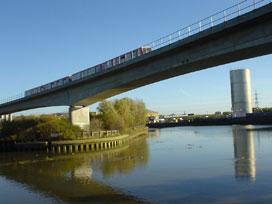
Bow Creek Ecology Park The meandering Lea sandwiches two very long and very thin interlocking tongues of land. The easternmost of these is a sprawl of rundown industrial units, and will remain so until property developers move in and build scores of new apartments instead. But the western peninsula is something more natural, and rather more special. 150 years ago there was a coal wharf here, supplying the nearby Thames Iron Works (they built ships, and founded West Ham football club). In 1960s the docks closed down and the site fell into disrepair, along with much of the surrounding area. And then the Docklands Light Railway came along, and engineers spotted that this thin strip of land was the perfect route for new tracks to Canning Town. A viaduct was built straight up the middle, and the land beneath tidied up to form an ecology park. But health and safety issues got in the way, and the park was only finally opened to the public this summer, 10 years late.
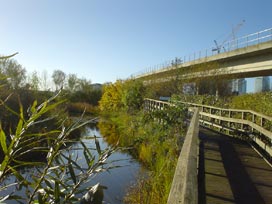
You enter Bow CreekEcology Park over a modern footbridge, along an expensive unused road, through some arty gates. There's just one main path down to the tip of the peninsula, and another up the other side, with the DLR rumbling away through the centre. Passing passengers are probably the only people you'll see here, and they're no doubt looking out wondering what on earth you're doing in this isolated spot. Well, you'll be enjoying such delights as the artificial water meadow, the squelchy reedbeds and the tree-lined pond in this brand new nature reserve. There are several rare plant species on site, and some elusive otters, and even some relocated lizards (although I didn't spot any). There's also a large wooden platform where schoolkids can try their hand at pond-dipping, plus a special outdoor classroom tucked beneath the railway. For a bit of peace, sit down on one of the twisty metal benches and take in the view across the river (or, if the tide's out, across the mud). You can easily see Canary Wharf and the Dome in the near distance, but at the same time it's rather hard to ignore the vegetable oil refinery and building works in the foreground. It may not be truly beautiful looking out, but it's quite charming looking in.
East India Dock Basin The EastIndiaDocks were opened exactly 200 years ago in 1806 by (who else) The East India Company. The docks were extremely successful, with an entrance wide enough to accommodate the larger tea clippers and merchant ships which plied the Far Eastern trade routes. Spices, silks and Persian carpets were unladen here, as well as millions of pounds of imported tea. But trade declined steadily during the 20th century and, in 1967, these were the first London docks to be closed. Today only the entrance basin remains, surrounded by new residential and office developments, and redesignated as a bird and wildlife sanctuary. Big black waterfowl flap and glide across the water, retiring (if disturbed) to perch on wooden rafts in the middle of the mud. Around the perimeter of the basin are patches of reed bed, woodland and meadow, as well as one of the big black beacons erected by British Gas to celebrate the Millennium. The dock gates have been refurbished and can be walked across, while from the riverfront there's a perfect view of the Dome on the opposite side of the Thames. Barges and speedboats chug by, planes from City Airport swoop overhead and in the distance the DLR rattles by. It's a lovely spot, and yet every time I've visited I've had the whole place to myself. Well, just me and a bunch of birds. • aerial view / map
fivelinks • Picto is a very simple game where 100 coloured shapes appear, one at a time, and you have to spot the latest one each time. I spotted 40 before I blew it by clicking on an old one. Beat that. [via in4mador] • Britain's male youth seem to have taken to gelled spiky haystack hair in a big way. Jacks Style Guide lets you see the latest sculpted designs and rate them out of 5. I found the results quite depressing, but then I'm not target audience. • If the programs on your Windows Taskbar aren't in the right order, Taskbar Shuffle is a tiny program which allows you to rearrange them. Very useful if, like me, you prefer everything set out 'just so'. Why doesn't Windows do this by default? [via lifehacker] • The Map of Early Modern London is a late 16th century visualisation of the capital with hundreds of places, buildings and locations marked. Not technologically cutting-edge, but agreeable simple. [via things magazine] • Rob Smith has created an online 'artwork' entitled Stopped Clocks which displays a photograph of a stopped clock for one minute at the appropriate time each day. But finding 1440 different clocks is proving quite challenging, so at the moment it only works for 32 minutes a day (and don't bother looking after 1pm).
You know how it is when you build something new. A new kitchen, or a new conservatory, or a new extension, or something. You get a quote in from the builders and they give you a reasonably tolerable estimate. But when the project's finally completed it always ends up having cost you far more. There were all those unforeseen extras and unexpected delays and sudden price hikes, and the final total is always unpleasantly astronomical. But the new kitchen's a great improvement on the old, and the new conservatory becomes a much-loved place to sit, and the new extension is well worth the effort in the end. If we never built anything because it might cost more than we expected, we'd never build anything. Even if it sometimes does turn out a bit rubbish and leaves us in debt, it's always worth a try.
The increasing cost of the London Olympics £3.4bn Original cost outlined in Olympic Bid £0.3bn Unexpected VAT bill courtesy of EU regulation £1.3bn Big number added by UK media to bring original total up to a scarily round five billion £3bn Installation of ten million extra CCTV cameras throughout south-east England to prevent unexpected terrorist attack £0.7bn Erection of electric security barricade around fifty acres of duck-infested marshland £1bn 'Cash-for-Olympic-honours' slush fund £0.036bn Ken Livingstone's holiday fund £1.2bn Cost of redesigning the stadium after David Cameron refuses to sanction Gordon Brown's chosen design £0.4bn Projected losses after government Obesity Tsar Jamie Oliver enforces "healthy-only" Olympic refreshment policy £0.2bn Bureaucratic uplift created by over-excessive health and safety legislation £0.2bn Bureaucratic uplift created by over-excessive quality assurance procedures £1bn Accumulated losses when 24992 spectators' seats are left empty once Leyton Orient take over the main stadium in 2013 £0.9bn Erection of 20-foot tall gold statue of Tony Blair in Stratford High Street £0.8bn Contingency fund for construction of extra arena in case the IOC suddenly decide to reintroduce naked mud wrestling as an Olympic sport £0.5bn Spurious Daily Mail addition attributed to "migrant workers" £1.4bn Cost of building 5000 affordable homes throughout the Thames Gateway £1.3bn Cost of building 50000 affordable homes in marginal constituencies elsewhere throughout the UK, renamed "Thames Gateway Gateway" £0.08bn Cost of sending Tessa Jowell on monthly roadtrips to try to persuade northerners that the Olympics really will be beneficial for them, honest £1.50 Six-pack of green glowsticks to liven up the Olympic opening ceremony 27p Box of matches to light Olympic torch £0.5bn Amount of working time lost over the next five years by Olympic pessimists ringing up talk radio and shouting "You know how many NHS nurses we could get for this money, don't you?" £0.5bn Amount of working time lost over the next five years by Olympic pessimists leaving comments on internet talkboards reading "And who will be paying for this fiasco, eh? The British taxpayer, that's who!" £–20bn Long-term regeneration benefits to some of Britain'spoorestboroughs
Silver discs(November 1981)
A monthly look back at the top singles of 25 years ago
The three best records from the Top 10 (10th November 1981) Police - Every Little Thing She Does Is Magic: There are some song titles you can't read without humming, albeit subconsciously, and this is one of them. Gordon Sumner wrote more than his fair share. A jolly bright melody with a Caribbean feel, and a fourth chart topper for the blond tousled ones. The rest of the Ghost In The Machine album was rather darker, but this bittersweet tale of not-yet-requited love (actually written five years earlier) still bubbles beautifully. [video]
"Though I've tried before to tell her of the feelings I have for her in my heart. Every time that I come near her I just lose my nerve as I've done from the start" Altered Images - Happy Birthday: You go 20 years without a single single named Happy Birthday, and then in 1981 two come along at once. And how much better than Stevie Wonder's version was this? A breathless nursery rhyme, quirky and fresh, which introduced the nation to Clare Grogan's impish grin. John Peel, of course, had known about Glasgow's finest musical talent for several months (ahh, the quirky delights of Dead Pop Stars). But only now did Clare find herself pinned across many an adolescent bedroom wall, and all this shortly before celluloid immortality in Gregory's Girl. As for Happy Birthday, it's taken me 25 years to finally decipher the lyrics and, erm, maybe it's just as well I never made them out at the time. [video]
"Happy, happy birthday, in a hot bath to those nice nice nights. I remember always, always, I got such a fright. Seeing them in my dark cupboard with my great big cake." Haircut 100 - Favourite Shirts (Boy Meets Girl): The most successful chart hit ever written about shirts, from a bunch of clean cut guys in chunky Arran sweaters. Girls longed to go out with one of the Hundred, while mums hoped their daughters might bring one home. Few boys, however, modelled themselves on lead singer Nick Heyward's cheese-grin couture. At least Haircut 100 wrote their own stuff, putting them head and shoulders above most modern pre-packaged boybands, and this track wasn't half bad. Like many of their early 80s contemporaries they've recently been tempted back for a one-off reunion concert, but photos suggest that their favourite shirts have aged somewhat. [video]
"Time can't afford no time, can't afford the rhyme, nevermind, someday maybe. Boy meets girl and love, love is on it's way."
My favourite record from November 1981 (at the time) Animal Magnet - Welcome To The Monkey House: Here's a rarity - a criminally overlooked record which later became a cult underground favourite. It's a sort of tribal synthpop anthem, with a driving guitar pulse and wildly energetic vocals, and perfect for going ape on the dancefloor. If webcams and YouTube had been around in the early 80s, teenagers would no doubt have stripped to the waist and filmed themselves leaping around their living room to this song like a blurry crazed beast. Oh look, somebody's actually done that, rather more recently [YouTube monkeyboy]. As for band member Paul Caplin, he soon left the music business (after a brief spell with Haysi Fantayzee) in favour of the swiftly developing 80s computer industry. 25 years on Paul now runs his own hugely successful City company providing the financial software keeping Reuters and the New York Stock Exchange afloat. Who are the monkeys now, I wonder?
"Here we are in the monkey house, we've taken all our clothes off. Here we are in a soundproof room, making all the noise we want to here."
Who was on Topof thePops 25 years ago this week? (hosted by DLT) Kool and the Gang - Steppin Out: The show kicked off with falsetto voices, false horns, and hateful false soul of the blandest kind. Here's the actual TotP performance for you to relive, if you dare. Orchestral Manoeuvres in the Dark - Joan of Arc: Not to be confused with Maid of Orleans, which would be released in the new year. Olivia Newton John - Physical: Olivia didn't fly over from America to make an appearance in the TotP studio, they only showed her sweaty gym video with leotards. Quite racy for the time, though. The Fureys featuring Davey Arthur - When She Was Sweet 16: Frighteningly laid-back Irish folk tune from Westlife's grandparents. Haircut 100 - Favourite Shirts: An off-the-cuff performance from Nick & Co.
• Jonathan King then counted down the American Top 20, because he assumed we were interested. We weren't. How are the mighty fallen. Ultravox - The Voice: Great semi-choral track... but, oh Midge, was that dead caterpillar 'tache ever fashionable? Earth Wind and Fire - Let's Groove: Maybe not the summit of 80s disco, but a mighty high peak all the same. Dance group Zoo, in only their second week on TotP, interpreted this song rather more suggestively than Legs & Co would ever have done. Rod Stewart - Tonight I'm Yours: No thanks Rod, if you don't mind. Police - Every Little Thing She Does Is Magic: And now here's this week's new number one! (cue rabid applause from an audience of startled teens in stripy sweaters and party dresses) Altered Images - Happy Birthday: (but just a verse and a chorus to play out to and run the credits over)
10 other hits from 25 years ago: Labelled With Love (Squeeze), My Girl (Four Tops), Tears Are Not Enough (ABC), Hold Me (BA Robertson and Maggie Bell), Keep It Dark (Genesis), Why Do Fools Fall In Love (Diana Ross), Visions of China (Japan), The Lunatics Have Taken Over The Asylum (Funboy Three), Paint Me Down (Spandau Ballet), Me and Mr Sanchez (Blue Rondo A La Turk) ...which hit's your favourite? ...which one would you pick?
I'm sure this sort of thing never happens where you work
On 15/11/06 @ 11:59, Chris <csmith@youroffice.co.uk> wrote: *** Chris is out of the office at the moment - and might be back from lunch by half past two ***
On 15/11/06 @ 11:59, Kelly <kjones@youroffice.co.uk> wrote: see you down at the sandwich bar in five, i've got so much to tell you
On 15/11/06 @ 11:56, Chris <csmith@youroffice.co.uk> wrote: what do you think of the new office temp? i think he's well fit. i'd do him
On 15/11/06 @ 11:54, Kelly <kjones@youroffice.co.uk> wrote: that is well good!! i'm going to play it all afternoon instead of writing reports
On 15/11/06 @ 11:43, Kelly <kjones@youroffice.co.uk> wrote: sorry, the boss just walked past and i had to pretend i was looking at a spreadsheet
On 15/11/06 @ 11:36, Chris <csmith@youroffice.co.uk> wrote: yeah, it's Mike from Finance. did you not see she arrived one minute behind him this morning, it was SO obvious. apparently they spent the weekend in a motel somewhere outside Basingstoke, and they never left the room, and he's well tiny, and SHE ended up paying
On 15/11/06 @ 11:33, Kelly <kjones@youroffice.co.uk> wrote: is she seeing someone? ohmigod ohmigod gimme the goss now!!!!
On 15/11/06 @ 11:31, Chris <csmith@youroffice.co.uk> wrote: her new boyfriend bought it - he thinks it's nice. i think it's a pair of curtains with a zip
On 15/11/06 @ 11:29, Kelly <kjones@youroffice.co.uk> wrote: what's Nikki got on? is she wearing that for a bet?
On 15/11/06 @ 11:26, Chris <csmith@youroffice.co.uk> wrote: yeah, i've got nothing to do either, my next deadline is in January
On 15/11/06 @ 11:24, Kelly <kjones@youroffice.co.uk> wrote: i can't at the moment, i'm pretending to be busy
On 15/11/06 @ 11:21, Chris <csmith@youroffice.co.uk> wrote: i'm bored, do you fancy a coffee?
As environmental concerns push increasingly to the fore of global consciousness, so we've all started taking a much greater responsibility for the effects of our own actions. It's amazing how recently and rapidly this tipping point of public opinion has been reached. Not so long ago people like Prince Charles were being ridiculed as eco-fruitcakes and lunatic obsessives, but not any more. Activities we used to consider as normal, proper and even desirable have suddenly been deemed unacceptable. And not a moment too soon. But with this shift of opinion comes an unwelcome new breed of eco-bully. These self-righteous neo-environmentalists enjoy nothing better than showering accusations on others whose lives they now judge to be anything less than 100% ethical. How dare other people fly/shop/drive/eat/exhale in a globally detrimental manner. And nothing can stop their sanctimonious tirades of smug verbal abuse. Have you been bashed by the Big Green Stick recently?
"We're flying to Australia on holiday next week." "You selfish uncaring bastards. How dare you fly abroad and see the world when every aeroplane flight hastens the end of civilisation as we know it? I think everyone should be banned from flying abroad purely for pleasure, even if that means our children and grandchildren never travel any further afield than Blackpool or maybe Paris. OK, so, I've already been to the Great Barrier Reef and the Grand Canyon and Rio de Janeiro and the Pyramids myself, but I don't see why anybody else should get the chance."
"We've just bought a brand new car." "You selfish uncaring bastards. I don't care that you've got four children, you should cram them all into the back of an electric smart vehicle instead, or buy them all bicycles. Do you not realise that every car journey you make hastens the flooding of south east England by a few minutes and causes a small child in Africa to drop dead of carbon monoxide poisoning. And yes I know that I still drive a Landrover myself, but that's because there are a lot of steep hills in Croydon, and Waitrose is too far away to walk."
"We're having a dinner party on Saturday." "You selfish uncaring bastards. Do you not realise how far the food you'll be serving up has travelled? Those out-of-season courgettes were all grown in South Africa and those sundried tomatoes have been flown in from Mexico. You should serve up a nice simple potato soup instead using spuds dug up from your own garden, maybe with some knobbly home-grown carrots and using milk from your own cow. Just don't expect me to come round for dinner myself, I'm allergic to anything organic so I'm staying in with a microwaved curry."
"We're buying a new fridge." "You selfish uncaring bastards. How dare you artificially lower the temperature of your food by artificially increasing the temperature of the rest of the world? And I bet that's an import from a developing country too. We should be demanding that these emerging nations forgo industrialisation and economic progress for the greater good of the planet. And yes, I know that I live in a country which has been polluting the atmosphere for the last 200 years and is largely responsible for the ecological mess we find ourselves in today, but we didn't find out until it was too late so I reckon we might as well carry on."
"We're planning a lovely family Christmas." "You selfish uncaring bastards. Those wholly unnecessary presents you purchase will end up in landfill, those illuminations on your roof will devour the Earth's fossil fuels minute by minute, and those sprouts on your Christmas dinnerplate could punch a hole in the ozone layer all by themselves. Baby Jesus didn't have much of a carbon footprint did he, although yours is the size of a Norwegian pine forest. And yes, I know that I'm planning to party from the start of December until Twelfth Night, but I'll not notice the damage my conspicuous consumption is doing to the planet because I'll be permanently drunk."
"We're expecting twins." "You selfish uncaring bastards. Not satisfied with polluting the planet with one greedy resource-hungry baby, you're inflicting double the environmental damage on the world. Think of all the nappies they'll use, and all the petrol they'll burn, and all the mobile phone chargers they'll leave on stand-by, and all the carbon dioxide they'll breathe out. And yes, I know I have three children myself, but I'll need them to look after me when I'm older. And anyway, if the rest of you all stop breeding wasteful offspring, my handful of kids have got a great future ahead of them."

Here, as an example, are two images of Prince Charles. One of these is the real Prince Charles, as printed in photographs and as seen by Camilla when she wakes up each morning. And the other is the reflected Prince Charles, as seen by His Royal Highness as he peers into the mirror above the royal sink. One's real, one's an illusion. Is it the left Charlie, or the right Charlie? I bet you've already spotted which is which, because one image somehow looks 'right' and the other doesn't. Unless of course you're Prince Charles himself, in which case Sir will instinctively have plumped for the incorrect image because it's the image with which Sir is most familiar.
Low tide London
This is the beach at Bankside [photo], just below the Tate Modern [photo]. It's one of the longer stretches and, if you time it right, also one of the widest. With a bit of luck somebody will have unlocked the gate in the railings along the river's edge [map] and you can make your way down the low stone steps onto the sand. Yes, that's definitely sand at the top of the beach, although it soon gives way to rock and muddy shingle further down. Eroded half-bricks and pebbles litter the exposed river bed, some dark and jagged, others bleached white and smooth. Decaying wooden stumps stick up from the ground, the remnants of some old wall or Tudor jetty. Dark brown rusty pipes snake half-covered beneath the shingle, thankfully no longer dribbling ooze into the river. There's not as much washed-up litter and glass as you might fear, nor as much green slime as you might expect.
Best of all, you've probably got the whole quarter mile of beach to yourself, all the way from Blackfriars Bridge [photo] to Bankside Pier [photo]. Well, just you and a ragbag collection of feral pigeons, swooping seagulls and big black crows. Try picking your way across the rocks directly underneath the non-wobbly Millennium Bridge and looking across the river towards St Paul's Cathedral on the opposite bank [photo]. You might even spot some fragments of pottery or an old sailor's clay pipe in the mud, although I suspect that most of these were spotted and nabbed long ago. Don't stand too near the water's edge, or the backwash from a passing speedboat or Thames cruiser might overflow your boots. And ignore the funny looks you're getting from tourists wandering along the South Bank above you. Perhaps they can't work out how you got down there, or maybe they simply can't imagine why anyone would want to slum it on a low rocky shelf. But they're the ones missing out. Just make sure you get back up the steps before the beach disappears from view beneath the rising tide.
What many visitors seem to do (and I'll confess to being no exception) is to pay extra special attention to the place where they live. It helps if you live somewhere fairly central, of course, and I'm fortunate that Bow often crept onto the very easternmost edge of certain maps. I was able to trace Bow first as a medieval village on the banks of the Lea, then a tiny 'town' surrounded by grassy meadowland, and finally a suburb swallowed whole by expanding London. If you'd have been wandering around the exhibition with me I'd probably have bored you silly by pointing out every time I spotted precisely where my house now stands, and you'd probably have done the same.
• Hurrah, Smoke #9 is just about to hit the shops. Just £2.50 will buy you this highly engaging "London peculiar" crammed with words and images inspired by the city. Probably the only quarterly magazine to be published sort-of every five months-ish. [4pm update: I've managed to track down a copy, and yes it's as good as ever]
Bow Creek: The most impressive meander in London isn't the wiggle on the Thames around Docklands, although that is close by. It's the final meander on the River Lea, which twists and turns right back on itself (twice) before exiting into the Thames immediately opposite the Millennium Dome. This lower part of the Lea is called Bow Creek, and the area around the mouth of the Lea is called (with typical medieval originality) Leamouth. The best views of curving Bow Creek can be seen from a train, looking down from the DLR viaduct between East India and Canning Town. But if you're willing to explore on foot, these strangely remote riverside lands are well worth a wander.
The meandering Lea sandwiches two very long and very thin interlocking tongues of land. The easternmost of these is a sprawl of rundown industrial units, and will remain so until property developers move in and build scores of new apartments instead. But the western peninsula is something more natural, and rather more special. 150 years ago there was a coal wharf here, supplying the nearby Thames Iron Works (they built ships, and founded West Ham football club). In 1960s the docks closed down and the site fell into disrepair, along with much of the surrounding area. And then the Docklands Light Railway came along, and engineers spotted that this thin strip of land was the perfect route for new tracks to Canning Town. A viaduct was built straight up the middle, and the land beneath tidied up to form an ecology park. But health and safety issues got in the way, and the park was only finally opened to the public this summer, 10 years late.
You enter Bow Creek Ecology Park over a modern footbridge, along an expensive unused road, through some arty gates. There's just one main path down to the tip of the peninsula, and another up the other side, with the DLR rumbling away through the centre. Passing passengers are probably the only people you'll see here, and they're no doubt looking out wondering what on earth you're doing in this isolated spot. Well, you'll be enjoying such delights as the artificial water meadow, the squelchy reedbeds and the tree-lined pond in this brand new nature reserve. There are several rare plant species on site, and some elusive otters, and even some relocated lizards (although I didn't spot any). There's also a large wooden platform where schoolkids can try their hand at pond-dipping, plus a special outdoor classroom tucked beneath the railway. For a bit of peace, sit down on one of the twisty metal benches and take in the view across the river (or, if the tide's out, across the mud). You can easily see Canary Wharf and the Dome in the near distance, but at the same time it's rather hard to ignore the vegetable oil refinery and building works in the foreground. It may not be truly beautiful looking out, but it's quite charming looking in.
The East India Docks were opened exactly 200 years ago in 1806 by (who else) The East India Company. The docks were extremely successful, with an entrance wide enough to accommodate the larger tea clippers and merchant ships which plied the Far Eastern trade routes. Spices, silks and Persian carpets were unladen here, as well as millions of pounds of imported tea. But trade declined steadily during the 20th century and, in 1967, these were the first London docks to be closed. Today only the entrance basin remains, surrounded by new residential and office developments, and redesignated as a bird and wildlife sanctuary. Big black waterfowl flap and glide across the water, retiring (if disturbed) to perch on wooden rafts in the middle of the mud. Around the perimeter of the basin are patches of reed bed, woodland and meadow, as well as one of the big black beacons erected by British Gas to celebrate the Millennium. The dock gates have been refurbished and can be walked across, while from the riverfront there's a perfect view of the Dome on the opposite side of the Thames. Barges and speedboats chug by, planes from City Airport swoop overhead and in the distance the DLR rattles by. It's a lovely spot, and yet every time I've visited I've had the whole place to myself. Well, just me and a bunch of birds.
The 2012 Olympics will cost money
£3.4bn Original cost outlined in Olympic Bid
Silver discs (November 1981)
Police - Every Little Thing She Does Is Magic: There are some song titles you can't read without humming, albeit subconsciously, and this is one of them. Gordon Sumner wrote more than his fair share. A jolly bright melody with a Caribbean feel, and a fourth chart topper for the blond tousled ones. The rest of the Ghost In The Machine album was rather darker, but this bittersweet tale of not-yet-requited love (actually written five years earlier) still bubbles beautifully. [video]
Bashing away with the Big Green Stick

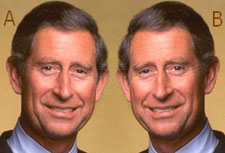 Here, as an example, are two images of Prince Charles. One of these is the real Prince Charles, as printed in photographs and as seen by Camilla when she wakes up each morning. And the other is the reflected Prince Charles, as seen by His Royal Highness as he peers into the mirror above the royal sink. One's real, one's an illusion. Is it the left Charlie, or the right Charlie? I bet you've already spotted which is which, because one image somehow looks 'right' and the other doesn't. Unless of course you're Prince Charles himself, in which case Sir will instinctively have plumped for the incorrect image because it's the image with which Sir is most familiar.
 Low tide London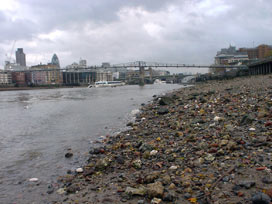



 The meandering Lea sandwiches two very long and very thin interlocking tongues of land. The easternmost of these is a sprawl of rundown industrial units, and will remain so until property developers move in and build scores of new apartments instead. But the western peninsula is something more natural, and rather more special. 150 years ago there was a coal wharf here, supplying the nearby
  You enter
  The
The