I think you'll enjoy the historical treat I have planned for you this year, but I'm offering no clues yet as to precisely where I'm heading. Come back in August and (hopefully) enjoy...
I recently received a letter from my broadband provider telling me that they plan to upgrade my connection speed in the near future, for free. I'm set for speeds of up to 8MBps, apparently, which is about quadruple what I'm getting now. Excellent. And about time too, because don't things take ages to download these days? That blog with all the photos in it, that takes ages. That website with the Flash adverts, that takes ages too. And that pdf file, that takes even longer. <taps fingers> <waits>
Which is strange, because five years ago even my current 2MBps broadband speed would have seemed utterly fantastical. Like you I was on dial-up back then, and thought nothing of waiting several seconds for even the simplest webpage to load. Opening a pdf file meant I had time to go make a cup of tea, while attempting to receive a large photo by email often brought my online session to a grinding halt. Some of the worst offenders were those show-off sites with Flash-designed homepages - the designers thought they were being clever, but would-be users usually couldn't be arsed waiting and moved on. And yet we survived, not least because most webpages recognised the limitations of slow download speeds and weren't over-fancy as a result.
But as connection speeds have rocketed, so webpage features have increased to take full advantage. Blogs now regularly contain several plugins and an albumful of images. MySpace thrives in 2006 because tunes and streaming media now download faster than they play. We expect more from our online browsing experience, and we get it. But on the downside we're forced to download more just because we can. New embedded Flash adverts are flourishing only because most of us can now receive them in seconds, not minutes. And aren't those extra seconds annoying? Downloading may be faster, but the end result remains as slow to appear as ever.
I fear that, before long, even 8MBps isn't going to be enough. I'd be happy enough with superfast text and images, but what I'm going to be forcefed is an increasing diet of streaming video with interactive java-enabled adverts. So long as most of us have the speed and functionality, content providers will rise up to exploit and fill it. We're always promised better, but all we get is more. And for those of you attached to the internet via slower connections (or even, heaven forbid, dial-up) sorry, you're completely buggered. Maybe you could come back and read tomorrow's post in three years time - it might load quicker then.
The Top 10 reasons why Top of the Pops dies tonight(aged 42½)
[10] The pop chart used to be released on a Tuesday lunchtime. If you missed it on the radio there was no internet or Ceefax to help you to catch up, there was just the chart rundown on Top of the Pops two days later. So everybody watched, just to see who was Number One, what they looked like and whether they could mime or not. Today's records (and videos and pop charts) are over-exposed. [9] The whole family used to be able to watch TotP. Your dad could enjoy Pan's People, your mum could ask you what that terrible racket was, your gran could wait for Barry Manilow to appear and you could thrill to the live performance of some top secret new band that only you and a million other teenagers knew about. Nowadays your dad watches for Fearne Cotton, your mum only watches when Ronan Keating's on, your gran is watching ITV and you're out having a life. [8] Andi Peters should have been watching the show, not producing it. [7] TotP went downhill as soon as they stopped letting Radio 1 DJs present the show. These DJs may generally have been idiots but at least they had screen presence. Compare Jimmy Saville, DLT and JohnPeel&KidJensen to whoever the anonymous grinners are who've compered the show more recently. No contest. [6] TotP's true home is on Thursday night. When Top of the Pops was on a Thursday night, the following morning every school playground in the country would be buzzing with chatter about who'd been on, what they'd sung and what they were wearing. Once TotP shifted to a Friday night ten years ago there was nobody left to share your opinions with the following morning, and the 'must see' televisual event of the week died. [5] The traditional home of the charts has always been Sunday evening. Radio's highest audience of the week used to tune in at teatime to hear the full Top 40 rundown delivered by Alan Freeman, Tony Blackburn, Bruno Brooks or some other broadcasting demi-god. Moving Top of the Pops to Sunday evening would have been a masterstroke a decade or two ago. But nowadays the Top 40 radio countdown is an embarrassment, more a chatshow with records for two egos to talk over, and the Sunday audience is watching Emmerdale and the Antiques Roadshow instead. God help us. [4] TotP is a show about singles. Alas, the single is dead (or at least fatally wounded) and nobody has ever successfully produced a show called Top of the Albums (imagine the Melua/Cullum/Anastacia hell of it all). [3] TotP used to only play records that were climbing the chart (or at least not falling). If you fell, you weren't on. If you hadn't released your record yet, you weren't on. It was a simple but brutal format, and if that meant watching the Smurfs followed by the Boomtown Rats followed by James Galway then so be it. This worked because the British public picked the playlist, not the producer. Nowadays the producer picks the playlist weeks in advance, and quite frankly we don't care who he picks any more. [2] Top of the Pops used to be the route through which mainstream UK consumers discovered the music they liked. You'd hear this week's new entries, choose your favourites, then pop down to Woolworths on Saturday and add them to your collection. But downloads, ringtones and the internet allow modern consumers to find their music wherever they choose, bypassing traditional media altogether. We don't discover our favourite records from TV or radio any more, they're recommended to us by friends. [1] Pop music is no longer the shared consciousness of the nation. 25 years ago everybody knew who Shakin Stevens was and could sing along to his Number One hit Green Door. No so today's bland chart-toppers. Our record industry has fractured to the point where audiences prefer to interact with one of 50 separate digital video channels rather than watch one all-encompassing half hour show. We all have different favourites now, more personal but wholly lacking in zeitgeist. Pops used to be short for Popular, and nothing is any more.
Her Majesty the Queen invites you, her royal subjects, to join together to celebrate 25 years of wedded bliss between her eldest son and her most favourite daughter-in-law. A right royal hurrah is planned.
This is a most auspicious occasion worthy of widespread commemoration. Throughout the week souvenir portraits, mugs and teatowels have been on sale at royal palaces across the nation. Street parties have been held in almost six villages, and Commonwealth leaders have posted messages of congratulation on their MySpace profiles.
Today, as a fitting climax to the festivities, two non-overlapping ceremonial parades will pass through the streets of London. The Prince of Wales will depart from St James's Palace at 10am in the State Coach, proceeding with due care and reverence towards St Paul's Cathedral. The People's Princess will depart from Kensington Palace at 10.30am in a red Alfa Romeo Spider, speeding recklessly (but not calamitously) towards Westminster Abbey.
At 11am two services of national commemoration will be held. In St Paul's Cathedral the Prince of Wales will give thanks for a quarter of a century of marriage in a service led by the Archisbishop of Canterbury. In attendance will be the Queen, Prince Philip and all of Charles's polo-playing mates, huzzah. Proceedings will be screened live on BBC4, and a two-page photographic spread will appear in next week's Horse and Hound. At Westminster Abbey the Princess of Wales will give thanks for a quarter of a century of media attention in a chatshow hosted by Ant and Dec. In attendance will be Peace Ambassador William, Playboy Harry and the lovely Princess Kayleigh. Video footage will be downloaded direct to all Vodafone mobile subscribers, and an exclusive 36-page photo essay will appear in next week's Heat magazine.
Charles will then return to Buckingham Palace for a royal banquet featuring organic food sourced from his Highgrove estate. During the meal he will sneak out for a quick snog with the horse-faced woman nobody realises he's having an affair with. He will then return in time to deliver a speech on the importance of the Prince's Trust and architecture, just to prove he's still relevant in the 21st century. Meanwhile Diana will head to a club in Mayfair for a reception featuring organic powder sourced from a Venezuelan plantation. Once the paparazzi have been satisfied she will sneak out to throw up into a convenient sink. She will then return in time to attend a Botox booster session with a Harley Street consultant, just to prove she still looks ten years younger than 45.
The day ends with a firework display above the Serpentine which both parties will watch from opposite sides of Hyde Park. Charles and Diana will then depart and retire to bed (exact location to be confirmed). Long live their Royal Highnesses, and here's to another 25 years of happy marriage.
One of the unexpected side effects of this current heatwave is that my journey to work is taking longer every morning. And it's not London Underground's fault either. The additional delay is occurring outside Bow Road station, at the newsagent's kiosk, as local commuters stop and queue to buy a cold drink before travelling.
"Hmm, bottled water please. Er, no, actually, do you have any Sprite? Or maybe some Coke Zero? No, not reached here yet? OK. What else have you go then? Uh-uh... right... yeah... oh go on then, just a bottle of water. Still please, not sparkling. Yeah, still. Thanks. Now then, I've got a £20 note here somewhere, hang on while I find it..."
These seasonal shoppers really aren't used to buying things in the morning, and it shows. Some of us only want to buy a newspaper, like we do every day, and we know exactly which one we want and we've even got the right money. But these people just stand there dithering, as if the rest of us have all the time in the world, attempting to buy something they could easily have brought from home instead. Have they never considered the practicalities of filling an old bottle with tapwater and leaving it in the fridge or freezer overnight? It's free, you know, and much better for the environment. Useless planet-murdering tossers.
Then when they finally pay up and move out of the way I swoop in like a falcon, hand over my ready cash and depart with my newspaper in seconds... only to find the same idiots blocking my entrance into the station as they slow down to pick up a copy of Metro from the rack behind the door. Honestly, can't they buy a newspaper like anyone else...?
London's Olympic opening ceremony will be held six years from today, but as yet I can see no sign of the stadium in which it will be held. This is partly because the view north from my window is currently blocked by trees, but mostly because nobody's started building anything yet. Thankfully this week the Olympic Delivery Authority have finally published 'Infrastructure Project Milestones' detailing how and when the stadium's construction will be staged [pdf]. If 'procurement deadlines' run to time then a Compulsory Purchase Order will be slapped on the remaining land by the end of the year, allowing 'remediation', 'vacant posession' and 'demolition' to follow soon after. Which makes this the Lower Lea Valley's last ordinary summer. Last chance to see.
Here's the Olympic Stadium timeline in summary:
July 2005: London wins Olympics. Marshgate Lane's existing industry and wildlife instantly doomed. [photos] July 2006: Procurement begins. Lawyers get rich. Stadium site still physically untouched. July 2007: 'Land preparation' begins. Local area fenced off. Local businesses move out. Local trees bulldozed. July 2008: Proper construction work begins. Stadium starts to take shape, very slowly. July 2009: Evening Standard runs first of many "Stadium Deadline Crisis" headlines. July 2010: Stadium now recognisable but incomplete. Original industrial estate now unrecognisable. July 2011: Stadium ready. Practice events held (maybe a local school sports day, maybe not). July 2012:Opening ceremony (assuming nobody's buggered up the entire timeline by then). July 201?: Local residents allowed back into the new slightly-sanitised Olympic Park. Hurrah?
Zigazig ah! • It's 10 years this week since the Spice Girls reached number 1 with Wannabe. • The Spice Girls were formed in 1994 after responding to the following advert in The Stage: "R U 18-23 with the ability to sing/dance? R U streetwise, ambitious, outgoing and determined?" • The Spice Girls were Melanie Chisholm, Geri Halliwell, Melanie Brown, Victoria Adams and Michelle Stephenson (the latter rapidly replaced by Emma Bunton). • The Spice Girls gained their nicknames Sporty, Ginger, Scary, Posh and Baby from an article in "Top of the Pops" magazine. • Wannabe was written in what is now my BestMate's flat in East London. Honest it was. It's a very ordinary two-bedroom flat in deepest Plaistow. Sadly there isn't a blue plaque on the wall outside, yet. • The lyrics to Wannabe were, quite frankly, crap (Yo, I'll tell you what I want, what I really want; So tell me what you want, what you really really want; I'll tell you what I want, what I really really want; So tell me what you want, what you really really want; I wanna (huh), I wanna (huh), I wanna (huh), I wanna (huh), I wanna really really really wanna zigazig ah!) But that didn't seem to matter. • The video for Wannabe[watch here] was filmed inside the derelict Midland Hotel at St Pancras station. (Although it looks like one continuous shot, there are in fact two minor edits) • Wannabe spent seven weeks at Number 1 (only Gnarls Barkley has stayed longer since) and hung around the UK Top 40 for six months. • Wannabe sold 1,269,841 copies and remains the UK's bestselling single by a female group. • Slam your body down and zigazig ah. If you wanna be my lover.
Silver discs(July 1981)
A monthly look back at the top singles of 25 years ago
The three best records from the Top 10 (21st July 1981) Specials - Ghost Town: Was ever a number 1 record better matched to its time? As Terry and Lynval burned up the charts with this hymn to urban despair, so the inhabitants of Handsworth, Toxteth and other disaffected inner city flashpoints arose to set their estates ablaze. With its haunting windswept intro and wailing chorus, the song spoke volumes on behalf of an increasingly forgotten generation. The B-side (Friday Night, Saturday Morning) was damned good too, mainly for its simplistic drunken logic ("I go out on Friday night and I come home on Saturday morning"). And then, just in time for the false dawn of Charles & Di's sham wedding day, the record was knocked unceremoniously from its perch by an upbeat Shakin' Stevens cover. The Specials split acrimoniously three months later, but their place in history was assured. [video]
"This place, is coming like a ghost town, no job to be found in this country, can't go on no more, the people getting angry" Tom Tom Club - Wordy Rappinghood: Was it insane, was it kooky, or was it just years ahead of its time. Bassist Tina and drummer Chris took time out from Talking Heads to create this avant garde literary rap. Set to the staccato beat of a typewriter they rhymed, warbled and experimented their way into the hearts of those with a modicum of musical wit. Today's sixth form keyboardists could probably knock out something similar in minutes, but back in 1981 such intelligent innovation was a revelation. (Note to today's sixth form keyboardists: a typewriter was an ancient writing instrument a bit like a computer but with no delete key, no LCD monitor and no broadband interactivity)[watch]
"Words in papers, words in books, words on TV, words for crooks, words of comfort, words of peace, words to make the fighting cease, words to tell you what to do, words are working hard for you" Stevie Wonder - Happy Birthday: He's written better than this sugary polemic, but few other songs have had quite such an impact on modern US society. Everybody remembers the catchy 'Happy Birthday' chorus, but fewer noticed the one-track ranting verses Mr Wonder slipped inbetween. Why, insisted Stevie, did Americans not commemorate the life of civil rights leader Martin Luther King by enjoying a day off work and becoming a little more tolerant of one another? How could they be so blind? A 6 million signature petition riding on the back of this record finally persuaded Congress that the US should take another holiday every January. It's not quite the 'world partee' that Stevie wanted, but I suspect Dr King would be well chuffed anyway.
"I just never understood how a man who died for good could not have a day that would be set aside for his recognition, because it should never be just because some cannot see"
My favourite three records from July 1981 (at the time) Barry Andrews - Rossmore Road: But I told you all about this musical gem six months ago. A quirky and desperately obscure song (which I still adore) about an insignificant North London sideroad (just north of Marylebone station). Go read my tribute blogpost here, or relive the song through the medium of photography here.
"The 159 runs along it, round the corner from Baker Street. There's a dolls house shop on the corner of Lisson Grove and Rossmore Road" Kim Wilde - Water On Glass: Listening back now, it's not easy to tell why this was my favourite of all of Kim's singles. It has neither the innocence of Kids in America nor the energy of Chequered Love, neither does it display the polished professionalism of most of Kim's later songs. But the melody is still deeply-engrained in my subconscious even after all these years, so it must have some hidden magic. Smashing. [watch]
"Cascading down there's a sound vaporising into vision, it's a sound in my head that I feel and it shuts me in a prison" The Royal Philharmonic Orchestra - Hooked on Classics: Take a handful of the greatest classical tunes ever made, slice them up into 30 second snippets and glue the lot together over a heavy synthesised drumbeat. Louis Clark's orchestral collage may not have been original but it was incredibly commercial (surely the Classic FM of its era). Medley records were all the rage in the summer of 1981. You can blame Dutch novelty act Starsound for kicking it all off with a Beatles melange, then an Abba tribute, at which point the deluge started. Tight Fit went Back to the 60s, Lobo brought us the Caribbean Disco Show and Gidea Park (a well-known suburb of Romford) delivered Beachboy Gold. With one of Britain's foremost orchestras jumping on the bandwagon the end of the phenomenon was clearly near, and thankfully it would be another eight years before Jive Bunny would risk anything similar. [listen, with kittens]
"...thump ... clap ...thump ... clap ...thump ... clap ...thump ...clap"
20 other hits from 25 years ago: Can Can (Bad Manners), Stars on 45 Volume II (Starsound), Body Talk (Imagination), Lay All Your Love On Me (Abba), Memory (Elaine Paige), Razzamatazz (Quincy Jones), Motorhead (Motorhead), You Might Need Somebody (Randy Crawford), Chant Number 1 (Spandau Ballet), There's A Guy Works Down The Chip Shop Swears He's Elvis (Kirsty MacColl), Throw Away The Key (Linx), Can't Happen Here (Rainbow), Me No Pop I (Kid Creole & The Coconuts), Take It On The Run (REO Speedwagon), I'm In Love (Evelyn 'Champagne' King), Visage (Visage), Never Surrender (Saxon), Computer Love (Kraftwerk), She's A Bad Mama Jama (Carl Carlton), Dancin' The Night Away (Voggue) ...which hit's your favourite? ...which one would you pick?
Pledge banked: You may remember that three months ago our beloved Prime Minister, in a show of selfless humility, signed up to a special online Olympic-related pledge:
The deadline on Tony's Pledgebank promise expires today and, what do you know, he's reached his target. It wasn't looking promising just a few weeks ago, with the number of signees still 40 short of the necessary 100. But then, surprise surprise, numbers started picking up and the target's been exceeded by 7, just in time. I wonder how that happened. Have Tony's pals been chivvied to prevent him losing face (the list does have a particularly political bent)? Or have his online opponents signed up to embarrass the PM into action (Tim Ireland rushed in straight away, which is usually a sign of mischief)?
As a man of honour, all Tony has to do now is select a London community sports club to support. Something East-London-y would be appropriate, I think. Here are a few suggestions. I wonder which one he'll choose...
Cost of renewing a UK passport • October 2002: £30 • November 2002: £33 (↑10%) • October 2003: £42 (↑27%) • December 2005: £51 (↑21%) • October 2006: £66 (↑29%)
Cost of buying a TV licence • April 2002: £112 • April 2003: £116 (↑3½%) • April 2004: £121 (↑4%) • April 2005: £126.50 (↑4½%) • April 2006: £131.50 (↑4%)
If current rates of increase continue, a passport will cost more than a TV licence by 2010
What is it with the increasing number of automated audio announcements on board trains? On behalf of Blogger Southeast welcome aboard the 0700 blogpost from diamond geezer. I'm sure there didn't used to be quite so many of them. This post calls at Paragraph One, Paragraph Two and Paragraph Three, and will be arriving at Paragraph Four in approximately three minutes. Nowadays an annoying inanimate voice interrupts our travels at every available opportunity to tell us the bleeding obvious. Safety instructions are set out in the sidebar. Please familiarise yourself with these every time you travel. We used to be able to travel by train in peace without these constant interruptions. The next paragraph is Paragraph Two. Change here for alternative blogs. But no longer. Please remember to take all your belongings with you when leaving this blogpost.
Welcome to readers joining this blogpost at Paragraph Two. And is this never-ending succession of announcements really necessary? This is Monday's blogpost from... diamond geezer... Most of this information is already scrolling across a display panel attached to the roof of the carriage. ...calling at Paragraph Three and Paragraph Four. But accessibility legislation means that visually impaired passengers must also be offered an aural alternative. Please give up your seat if required by an elderly, disabled or pregnant person. The other 99% of us can only sit patiently and endure the noise, or take drastic action to block it out. Please open your eyes, unplug your headphones and listen to this very important information, damn you. And what's the point of introducing 'quiet' mobile-free carriages on trains if our ears are still going to be assaulted by these constant interruptions anyway? The next paragraph is Paragraph Three. Whatever happened to silence? If you are leaving this blogpost at the next paragraph, please remember to take all your belongings with you.
Welcome to readers joining this blogpost at Paragraph Three. And then they run through all the announcements again for the benefit of the handful of additional passengers who've just got on at the last station. Safety instructions are set out in the sidebar. Imagine the legal consequences if the train had an accident and these few passengers had not previously been given due warning of basic safety advice. Please familiarise yourself with these every time you travel. Better to annoy all your passengers than to risk a single one of them suing you. Please remember to keep your baggage with you at all times. But endless repetition of patronising advice breeds complacency. Please remember to keep your baggage with you at all times. The impact of these supposedly important security announcements is being diminished as they become so utterly commonplace. The next paragraph is Paragraph Four. The more they tell us, the less we hear. If you are leaving this blogpost here, please remember to take all your belongings with you.
Welcome to readers joining this blogpost at Paragraph Four. Sigh, here we go yet again, over and over and over. This is still Monday's blogpost at diamond geezer, as you'd already know if you'd boarded earlier. I suppose these announcements can be useful for people who've never travelled the line before, and for those unable to see out of the window. We're approaching the next station, the one you want to get off at, so you'd better start getting your things together. But surely just a brief rundown of destination, next stop and intermediate stops should be sufficient, with the driver chipping in if any additional updates are required. We apologise for the late running of this train, which is completely Network Rail's fault and nothing to do with us. In the meantime, regular commuters and those with an IQ above 80 are being patronised, over and over, by an increasing stream of unneccessary announcements. You're on a train dear, yes, you're on a train. Still, at least they haven't started bombarding us with adverts inbetween the travel information, yet. Why not buy an over-priced coffee from the nice lady wheeling her trolley down the aisle? It can only be a matter of time. This blogpost terminates here. Please remember to leave a comment when leaving this blogpost. Sigh. All change, all change please.
The morning sunshine has brought a crowd of eager shoppers to Merton Abbey Mills. That and the alluring combination of craft stalls, arty shops and mildly ethnic foodstuffs laid out across the historic setting of Liberty's former silk-printing works. But the sun is long gone, the clouds have opened and the courtyard is suddenly empty. Quick, move those second-hand books undercover and drape the homemade birthday cards in plastic. A tropical downpour beats down on drooping awnings, beneath which damp shoppers anxiously wait. They stare hesitantly at the wares spread across whichever stall they've taken refuge at, aware that the storm may continue for some time. There's only so long you can stare at embroidered boots, or ribbon-tied satin cushions, before stepping back out into the rainstorm starts to look appealing.
On the far side of the courtyard a solitary lady in a pink blouse sits patiently behind a trestle table laden with jams, pickles and curry sauces. Water bounces off the green canvas above her head as she stares resignedly forward, chin in hand. Each raindrop might as well be a laser beam given the impenetrable exclusion zone now established in front of her stall. Her weekend business plan is in tatters, at least temporarily. Somewhere up the road a bride's big day is being ruined.
Beneath the central clocktower a motley crew of local musicians attempts to entertain the crowd with a succession of tame guitar songs. The first distant rumble of thunder suddenly halts this free concert, leaving stranded shoppers alone with their thoughts. Time passes. After fifteen long minutes one guitarist risks electrocution by plugging himself back into the amplifier and treats his trapped audience to a cheery rendition of U2's One. Patrons of the Commonwealth Café, safely tucked away beneath orange striped awnings, look up from their Cottage Pie and Chips and show their appreciation with warm applause. Not so the fearsome manageress who strides out into the deluge in her bulging blue apron and demands that the volume be turned down. "That'll be our last song then, thanks for listening." Somehow the atmosphere is dampened further.
A grinning child runs out to stand in the torrent of water now pouring from the corner of the clocktower roof, drenching his already-soaked hair in this impromptu waterfall. A well-protected biker and his girlfriend pass the time by flicking through a rail of slightly-too-lively clothes. A bottle-blond mother dashes out across the courtyard towards the safety of the Wheelhouse pottery, just for a change of scene. Maybe the monsoon is easing just a little, enough to brave stepping out into the open again. Pink blouse lady at last has an audience, however tiny, to sell her chutney to. No heavy shower is going to stop these South Londoners from shopping, not for long anyway.
It used to be easy taking the tube at the weekend. You turned up at your local station, caught a train, changed where necessary and duly arrived at the other end. Not any more. London Underground insist on shutting down large chunks of the tube network every weekend 'due to planned engineering works', and every weekend it's a different selection of track. What may look like a simple journey across town can become a nightmare diversionary trek via rail replacement bus services once various line segments have been erased from service.
It's particularly bad this weekend, with track replacement work affecting eight different lines and sufficient alternative travel arrangements to fill a 16-page TfL leaflet. The Circle, Metropolitan and Hammersmith and City lines are closing down yet again between Edgware Road and Liverpool Street, and the good people of Finchley, Barnet and Wanstead have been severed from the network. Tomorrow it gets even worse with additional closures on the Bakerloo and Jubilee lines, as well as Arsenal station going offline for a fortnight. I know that these engineering works have to take place sometime, and that the tube network should be slightly better once they're completed, but do we really need to endure quite so many simultaneous shutdowns?
To assist forward-looking Londoners, the tube website now kindly lists all the planned network closures for the next six months (all 104 of them). It's a rather scary list, so I've thoughtfully summarised it for you in this easy-to-swallow table of weekend tube shutdowns. Every coloured blob indicates a planned weekend closure along part (or all) of a particular line. Now you can arrange to be elsewhere as required (or maybe stick to travelling on the East London line, just to be on the safe side).
First of all let me congratulate everybody on another successful year here at Blogger Primary. We've all worked really hard together as a community, and I think we can be justly proud of everything we've achieved. Well done everybody. And now the last day of term has rolled round again. In a few short hours the summer holidays will begin (I'm sure I don't have to remind you not to go picnicking on railway tracks or throwing grannies into the canal or setting fire to your neighbour's cat with a magnifying glass). But there's still lots to be done here before we break up this afternoon.
First of all there's our Leavers' Assembly. This is where we say goodbye to the senior members of our community by pretending we've liked working with them over the years. Lots of Mummies and Daddies are coming in, and they'll be having a good blub at the thought of their offspring finally growing up. The recorder group will be playing Morning Has Broken, and they've been practising this all term so don't forget to clap afterwards. We'll also be awarding the Sports Day trophies. Special thanks to Ms Jenkinson for organising our very first non-competitive Sports Day, so there'll be egg-and-spoon certificates for absolutely everybody, even those of you who are too obese to run.
Then we're sending you back to your rooms for the rest of the morning. I hope you've all brought games with you, because it's the last day of term and we can't be arsed to teach you anything. Somebody's probably brought Twister - please collect a health and safety waiver form from the secretary before you start playing. Somebody's probably brought Mastermind - but nobody likes a geek so don't forget to hide all their pegs down the back of the radiator. And lots of you have probably brought something electronic that beeps - which is a shame because we'll end up confiscating it and you'll have to play Mastermind after all.
We hope you've bought a present for your teacher to show your appreciation for all the spelling tests they've given you over the year. This term we've introduced recycling bins in every classroom so that your gift baskets of soap, novelty ties and cuddly animals can be disposed of in safety before your teacher has to suffer the embarrassment of opening them in public. Please do not throw away anything chocolate-based. Your mother also probably forced you to waste valuable pocket money on a disturbingly cheesy "Thank you" card, but please chuck that in the bin too before we realise that, despite our best intentions, you still can't spell.
At the end of the afternoon we'll be giving you back all the project work you've done over the year so that it can clog up your bedroom over the summer and not our store cupboards. We'll also be giving you a very important newsletter which you must, repeat must, give to a parent or guardian as soon as you get home (even though we know you'll forget, or fold it into a paper aeroplane instead). And then at half past three you'll head off for a summer of over-eating, asbo-collecting and annoying the hell out of your parents, and we'll just sit here and play with all the games we confiscated earlier. Remind me again what game you brought in, will you...?
"Travel" (it's that Hugh Laurie bloke, sounding relentlessly glib after just one word) "Now clouds know how to travel, in perfect ease" (no they don't, you idiot, clouds aren't sentient are they?) "Just like us" (don't be so stupid, holidaying humans don't float blissfully along hundreds of feet up in the air, they fly squashed aboard DVT-inducing charter flights) "Sometimes, if they know exactly where they want to be, they're off" (oh for heaven's sake, clouds are just inanimate wisps of water vapour, they know nothing) "Or they can narrow down their choices from a whole world of options" (what sort of choices do you think clouds have, you twat? "Shall I become an altostratus or a cumulonimbus?" "Shall I go and rain on Bolton or Biarritz?" Not very likely, is it?) "Or if they're looking for some inspiration, it's easy" (so, clouds are physically able to interact with the Expedia website to book package holidays, are they? Which overpaid copywriter wrote this nonsensical drivel?) "Why not make your travelling easier?" (sorry, I'm still not quite seeing where clouds come into this. Especially not the unconvincing computer-generated blob of cotton wool you've cut-and-pasted into the sky above New York and Venice in this miserable advert) "expedia dot co dot uk" (still, I suppose it's better than thatFrostiesnightmare)
Nobody is attempting to fry an egg on the pavement, but this would be the afternoon to try. The queue for the Oasis swimming pool stretches out of the front door, down the steps and round the corner into a sidestreet. Potential punters bathe not in refreshing chlorine but in sunlight and sweat. It's Dress Down Wednesday, although for many this means only a slightly loosened tie rather than a t-shirt and shorts. Freckles, tattoos and cellulite are willingly exposed for further charring. An unexpectedly refreshing breeze rustles the trees down Shaftesbury Avenue. In the Soho Fire Station a fiery red engine stands by with all doors thrown open wide. A tired mother saunters along beneath a yellow parasol, trailing two toddlers left exposed to the sun's direct glare.
In Piccadilly Circus a large placard points potential punters towards "½ PRICE TANNING". Business is not brisk. Tourists flop down in the shadow of Eros, occasionally dipping body parts into the cooling fountain. A double decker number 19 sauna trundles past. It's hot as hell at the foot of Regent Street, and SinnerWinnerMan is here to save your flaming soul. He stands bare-chested on the traffic island, megaphone in hand, beckoning passers-by to Jesus. Nobody stops for conversation or conversion, but few have the energy to speed past. A bewildered old lady emerges up the stairs from the sweltering underworld, dressed in cottage-style floppy hat and long grey socks. She gently perspires, while London sweats.
If you think today is hot, remember what it was like on 10th August 2003 instead... (full details and temperature contour map here)
• 38.5°C Brogdale (near Faversham, Kent) [New UK record high temperature]
• 38.1°C Gravesend (Kent)
• 38.1°C Kew Gardens
• 37.9°C Heathrow
• 37.8°C Wisley (Surrey)
• 37.7°C Northolt
• 37.6°C Met Office roof (London) [overnight minimum temperature 23.7°C]
• 37.6°C St James's Park
• 37.5°C Cambridge Guildhall
• 32.9°C Greycrook (Roxburghshire, the day before) [New Scottish record hightemperature]
(and if you don't think today is hot, probably because you live somewhere far from UK shores encased in permanent air conditioning, please allow us pasty-legged Brits our overblown lethargic moaning, just this once. Thanks)
Everybody's heading for the local convenience store on Bow Road.
There's a big Tesco ten minutes down the road, but it's hot and nobody can be bothered to walk that far. It's worth paying over the odds for basic foodstuffs just to avoid hiking down the arterial road and sweating like a pig.
Somebody's tied a mangy dog to the handrail on the shallow concrete ramp outside the front door. A couple of schoolkids hang around waiting for their mate to emerge with a pocketful of sweets, maybe nicked while nobody was looking, maybe not. Bow's local beggarwoman accosts every passer-by for the small change they will never offer.
The door opens with a blaring electronic fanfare. Not far inside is the rack of lottery playslips - could this be your ticket out of here? In the first aisle you'll find several varieties of plastic bread, just beyond the mostly full-fat milk. Don't expect any of these to last long beyond their sell-by date - you'll be back soon enough to stock up again. Deeper inside the shop are the not-quite ripe bananas, the over-priced packets of cereal and the grainy photocopier. Many of the products never change, but it's not quite the old Co-Op it used to be.
Security cameras train their eye along the shelves, with random aisles flashing up on the big screen above the tills in glorious black and white. There's a Bow Quarter resident flicking through the ready meals, and there's a Bromley-by-Bow mother hunting down the cheapest rice. But many customers need never venture down into the farthest recesses of the shop. Everything they require is stocked up front, just behind the counter.
"60 Benson and Hedges" "Bottle of Johnny Walker" "12-pack of weak own-brand lager" "Litre of cheap generic alcoholic throat-burner"
A beery tracksuited lout leans across the counter and harangues the shopkeeper, eyeing up his turban with poorly-concealed disgust. He repeats the same ill-judged racist insult over and over, his lager-soaked mind seemingly incapable of independent thought. Yes, prices in here are steep, but white pays no more than any other colour of skin. The Costcutter family edge closer for protection, dignified in their silence. Eventually their verbal assailant departs, confident of moral victory, but he'll be back again tomorrow for another bottle or three.
Everybody has come to see the refurbished village shop.
Last week the shop was full of half-dressed workmen looking half-busy ripping out all the shelves, counters and chiller cabinets. Tins of mulligatawny soup and packets of bran flakes were available only in NearbyTown - a three mile drive away. This morning NASK is sweeping rubbish on the pavement outside. A new reality is restored.
Local people poke and peek inside with no intention of actually buying anything. They walk around the interior, peering at every last bottle and jar to get their revised bearings. There are magazines in the corner where the Post Office used to be. All the packet mixes and cook-in sauces have been reshuffled into new positions on fresh shelves. The old wooden floorboards have been covered by fresh grey lino. There are cabinets full of milk and Lambrusco where the cash desk once stood. A lonely electronic balance on the shop counter is the only indication of the new 'open-plan' Post Office.
A queue has built up at the till where NASW is smiling broadly. A small child stares blankly over her mother's shoulder, unaware that anything is different. A blonde lady with over-sized sunglasses waits patiently to buy her Daily Mail. At the counter a pensioner hunts for change to pay for her half-weekly shopping. The conversation is lightly sprinkled with approving mutterings.
Barely a breeze disturbs the unmown hay standing tall across the village green. White clouds streak the sky like smudges of flowing horsehair. Another car turns off the lane and pulls up on the gravel outside the shop. Three old freezer units and a greetings card rack stand forlornly beside the postbox, awaiting new owners.
NASK looks up from his sweeping to greet the arriving shoppers. Yes, it's very different here to the business he used to run back in North London. No, you don't normally get tattooed Sri Lankans running village shops in rural Norfolk. And yes, it'll probably take a decade (or two) to earn back the tens of thousands of pounds he's just forked out on this upgrade. But at least they completed it on time.
The emerging villagers smile politely. The new shopkeeper may not be one of them, but now at least they can buy stamps and Marmite again. Maybe one day NASK and his wife might even know all of their customers by name, just like the old owners did. And NASK smiles back. The shop's clientele haven't all deserted him for the big supermarket in NearbyTown. He hopes his new village empire will survive long enough for him to recoup his investment... and perhaps, just maybe, long enough for him to be accepted.
NASK - New Asian Shop Keeper NASW - New Asian Shopkeeper's Wife
I SPY LONDON the definitive DG guide to London sights-worth-seeing Part 10:Theatre Museum
Location: Russell Street, Covent Garden, WC2E 7PR [map] Open: 10am - 6pm (closed Sunday and Monday) Admission: free 5-word summary: a staged history of greasepaint Website:www.theatremuseum.org Time to set aside: an hour or two
It's right next to Covent Garden Market so I must have walked past the Theatre Museum on scores, possibly hundreds, of occasions. But I'd never previously been inside, not until I finally spotted the key phrase "free admission" on a poster outside. And it really was free - the lady on the admission desk didn't blink as I walked straight past her into the semi-darkness. The audience walking around inside seemed pitifully small for a weekend matinee performance but hey, the show must go on.
The ground floor tells the story of Theatreland and the West End. Not much of the story, admittedly, but a hint at the local transformation from rows of slums to palaces of popular entertainment. There are historic prints, plans, posters and props, as well as a big screen at the rear showing highlights from glitzy long-running musicals. There's even an exhibit of theatre seating, in case you fancy a sit down. The rows used to be only 28 inches apart, which is even more squashed than a modern economy flight, but patrons were 4 inches shorter back then so maybe nobody got DVT and sued. One of Camelot's original National Lottery machines is on display, representing the millions of pounds gamblers have pumped into modernising West End theatres over the last decade. A bit rich, then, that the Heritage Lottery Fund recently placed the future of the museum under serious threat by turning down two bids for a development grant.
There's more to this museum than first meets the eye. A long twisty ramp leads down into the main galleries in the basement. In one room an optimistic amount of seating has been set out for watching selected excerpts from the National Video Archive of Performance (which is probably a collection of Sir John Gielgud's best bits). A maze of gloomy corridors tells the story of British performing arts and some of its more famous players (like, for example, more than everything you ever wanted to know about the Redgrave family). The presentation isn't especially dramatic, more a load of wall-to-floor display cases with tons of information to read. Younger visitors will no doubt be more interested in the costume and theatrical make-up demonstrations, so families should time their visit carefully. But next time you're passing (and one day you will be) why not pop in? After all it's a heck of a lot cheaper than paying through the nose to see the Lion King (and, dare I say it, rather more interesting). by tube: Covent Gardenby bus: RV1
Sport Relief: Where did all the sport go? We've been spoilt for weeks, even months, with an embarrassment of sporting events, and suddenly it all dries up. After five weekends packed with World Cup football matches (and embarrassingly random penalty shootouts), suddenly there are none. After a full fortnight of Wimbledon, the grass courts of SW19 have fallen silent. You'd think that in the height of summer, with perfect weather and maximum daylight, there'd be tons of sport going on. But no, nothing major. So it's the perfect weekend for the charity pantomime of Sport Relief to take place, because there's virtually no sport to interrupt.
OK, so there's England v Pakistan in the cricket, but these days test matches have been banished to Sky, out of sight, out of mind. OK, so there's athletics, but that's just a lot of Britons we've never heard of trying to qualify for some European championships we don't really care about. OK so there's a Rugby League final, but you try convincing anybody living more than 50 miles from the M62 that this game has any relevance in their life. OK, so there's cycling, but that's merely a bunch of men in lycra swapping jerseys on a month-long French holiday. OK so there's the French Grand Prix, but that's just a lot of expensive cars failing to overtake one another in a circuitous traffic jam. OK, so there's racing, but then there's always racing and it's not called the 'flat' season for nothing. And OK, so there's golf, but the Scottish Open isn't exactly the most high profile tournament... sorry, are you still awake there? Roll on August.
I'm sensing a musical trend across the ocean (and not a good one). Without checking, can you tell which of these one-off attention-seeking musical partnerships is not in the US Billboard Hot 100?
1) Nelly Furtado Featuring Timbaland 4) Shakira Featuring Wyclef Jean 5) The Mack Krew Featuring Debra Graham 8) Lil Jon Featuring E-40 & Sean Paul Of The YoungBloodZ 9) Chamillionaire Featuring Krayzie Bone 11) Field Mob Featuring Ciara 12) The Pussycat Dolls Featuring Snoop Dogg 16) Cherish Featuring Sean Paul Of The YoungBloodZ 17) Young Dro Featuring T.I. 19) Kelis Featuring Too $hort 20) Fort Minor Featuring Holly Brook
[phew, a quick check reveals only three such double-headers in the UK top 20]
Leçon française une What gender is your country? 20 male: le Botswana, le Canada, le Cuba, le Danemark, les États-Unis, l'Iran, l'Iraq, le Japon, le Liechtenstein, le Luxembourg, le Mexique, le Monaco, le Portugal, le Royaume-Uni, le Swaziland, le Tchad, le Togo, le Vatican, le Zaïre, le Zimbabwe 20 female: l'Allemagne, l'Australie, l'Autriche, la Belgique, la Chine, la Côte d'Ivoire, l'Égypte, l'Espagne, la France, la Hongrie, l'Indonésie, l'Irlande, la Nouvelle-Zélande, la Norvège, la Papouasie-Nouvelle-Guinée, la Russie, les Seychelles, la Suède, la Suisse, la Zambie
Leçon française deux Name some French cheeses with 'Protected Designation of Origin' 15 genuine: Abondance, Bleu d'Auvergne, Brie de Meaux, Cancoillotte, Chevrotin, Emmental de Savoie, Laguiole, Livarot, Morbier, Neufchâtel, Pont-l'Évêque, Rocamadour, Selles-sur-Cher, Tomme de Savoie, Valençay 10 fake: Aromalot, Fouleniffe, Pongeaux, Odourais, Rançide, Reeque, Smelliér, Stenche, la Stinquoire, Whiffé
Starting next month, the Government intends to make public the level of threat to UK national security by displaying the current alert status on the Home Office and MI5 websites. The proposed five-point scale might, but probably won't, appear online like this:
SECURITY ALERT LEVEL
Oh how useful to be able to check this key information 24 hours a day, just in case. Going to the shops? Check first with MI5 to see whether it might be advisable to buy tinned food and extra batteries. Heading into London? The Home Office homepage can advise you whether it might be safer to stay indoors and whitewash your windows instead. Feeling nervous? Better refresh that webpage just in case national security's gone belly-up during the last 30 seconds. This simple online alert will undoubtedly reassure the public and help to dampen collective community paranoia (unless we're on 'critical', in which case it may cause us all to run around with paper bags over our heads, screaming and accidentally shooting innocent Brazilians). This is not so much freedom of information as information of freedom.
Although I think the scale could perhaps be a little more honest:
SECURITY ALERT LEVEL (translation)
And hey, if the Government can introduce useful warnings on its own websites, why can't us bloggers follow suit? By incorporating a similar caution box on our own blogs, we could alert readers to imminent themes, posts and rhetoric which might disturb them. Here are three possible 5-point scales you might like to consider for your own blog:
When I started this blog four years ago I didn't write much about London. Not as much as I do now, anyway. I didn't think people would be particularly interested in hearing all about the places I'd visited in the capital, because that wasn't what blogging was about. Blogging was about what I'd done and what I thought and what links I'd spotted. And then one day, on the throw of a dice, I ended up going to Putney to watch the Boat Race merely so that I could write about the experience when I got home. Ever since that day my blog's evolved into a bit of a London travelog, on and off, right up to my pointless random visit to the City last weekend. Because I find it interesting. Because I get to go to places I'd never otherwise have seen. And because blogging can be about whatever I want it to be. If I have nothing better to do at the weekend than to visit places and then write about them, then so be it.
Anyway, it seems that some people do like reading what I write about London. Which is nice. And this morning a few hundred thousand more people are reading my stuff than usual. Ulp. Londoners flicking through this week's edition of Time Out magazine are about to find 800 words that I wrote, in print, in black and white, on page 12. Ulp. They're in the Big Smoke section, up front before all the listings start, where you'll usually find an eclectic mix of facts, history and observations. My article's all about the grimy underworld of the WoolwichFootTunnel, and it's appearing under the heading of "London journeys". The magazine's even used one of my photographs to cover a large proportion of the page, a fact which would amaze anybody who's ever seen my extremely amateur low-res digital camera.
The tunnel article has been written especially for Time Out, so you won't be reading it here, sorry. If you're very lucky then they might stick it up on their revamped website, somewhere here. If not then you're going to have to buy (or scrounge) a copy of the magazine, or wait until next week and go grubbing through the capital's recycling bins instead. My particular apologies to all those of you living outside London because your local newsagent won't be stocking Time Out (unless they're particularly stupid). You could always spend £2.35 to read the entire magazine online, although I'm not sure why anyone in Stornoway would want to know what's on at the Peckham Multiplex, or why readers in America would care that there's a community festival at Spitalfields City Farm this Sunday. But it might be worth forking out because Time Out's a good read these days (and not just because I'm in it).
Don't worry, I'm not planning on writing any less on my blog. Indeed yesterday's post about the Barbican was longer than my Time Out piece, and you got that for free. And hey, even if I can't bring you the article, I can at least show you the strapline:
"London journeys: In the first of our new series of alternative routes round the capital, London blogger diamond geezer braves the tiled terror of the Woolwich Foot Tunnel"
Oh boy, did they say 'series'? I'd better get busy researching and writing a second article, I guess...
Somewhere random: the Barbican estate Every time I visit the Barbican I try ever so hard not to get lost, and every time I fail. I'm sure the 1950s architects didn't mean for their concrete community to be quite so impenetrable, quite the opposite in fact, but somehow the walkways and stairwells create an illogicallabyrinth that even Theseus might have found tricky to navigate around. Getting into the estate in the first place isn't easy - there are only a few 'gates' around the perimeter of the site, most of these cunningly disguised as uninviting stairwells. To move from place to place you have to follow long concrete walkways six metres above the ground, which pass around and beneath various identikit apartment blocks. The famous Barbican 'yellow line' is painted on the floor for you to follow [photo], but it leads you on without ever explicitly stating where you might be heading. There are signs everywhere, but your final destination tends to remain tantalisingly out of reach. I love the place.
The Barbican estate was constructed in the 1960s and 70s to reclaim one of the most heavily bombed parts of the City. Arguments had raged for years as to exactly what to do with the site, with all proposals having to combine maximum open space with maximum accommodation. The final solution was a collection of tower and terrace blocks, raised up on concrete stilts surrounding a central lake and gardens. There are precisely 2014 flats here, in a variety of shapes and sizes from studio to penthouse - most minimalist but all modernist. I looked into renting a flat here when I first moved to London, but only for a couple of minutes once I'd discovered the price. If you want to know what it's like to live here or to find out more about the history of the place, then I can heartily recommend the Barbican Living website for a fascinatingly in-depth read. Check out the multitude of side menus for maximum information. What do the kitchens look like?What's it like living at the top of Shakespeare Tower?Which blocks get the most sunshine? It's all there.
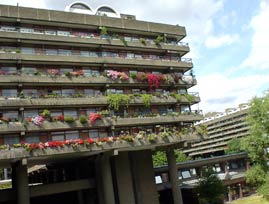
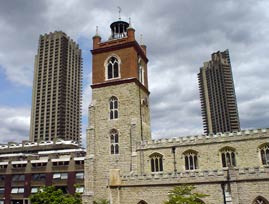
There's plenty for the casual visitor to enjoy around the Barbican, even if you never quite know where or what you might stumble upon next. The church in the middle comes as a bit of a shock on your first visit [photo]. Look, there are jagged relics of the old City Wall beside the southern lake, and even the last semi-circular remnants of a defensive tower [photo]. Rows of parallel balconies drip with colourful hanging plants [photo]. On closer inspection a large leaking pipe turns out to be a gutter-shaped waterfall[photo]. And something I'd never seen before and was amazed to discover - there's a vast glass conservatory here filled with tropical plants (alas only open for visitors on Sunday afternoons) [photo].
And then, of course, there's the famous Barbican Arts Centre[photo]. If you thought finding your way around outside was difficult, somehow this feels harder. You probably won't enter on the level you require and so may end up in the art gallery, cinema or library by mistake. Where are the stairs to get you from up here to just down there? It's not always obvious. An innocent looking corridor may turn out to be a long curving exhibition space. Trying to negotiate your way to the toilets during a concert interval requires time, and maybe a compass. And yet there's a bold simplicity to the entire design, complete with sweeping surfaces and chunky graphics [photo], and the split-level foyers sort of make sense eventually. There's always an intriguing selection of events being staged here too, which the estate's residents are fortunate enough to have on their doorstep. But you probably couldn't afford to live here, not least because of the exorbitant service charges, so you'll have to make do with the occasional visit. Good luck finding your way out. by tube: Barbican, Moorgate by bus: 153
Somewhere historic: London Wall I was spoilt for choice when searching for historic sites in the City of London. The whole place is built on history, two millennia of the stuff, so it's hard to miss. I decided to head for the structure which defined the perimeter of the City from its earliest days - the LondonWall. This defensive fortification has long outlived Roman London, but over the centuries most of its stone has either crumbled or been nicked for use in buildings elsewhere. Just three main fragments remain - on Tower Hill, in the grounds of the Barbican and close to the Museum of London. I made tracks to the latter.
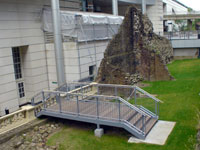
Thesephotographs show what's left of London's Roman Wall along Noble Street - a few chunks of stonework rising up from a shallow grassy moat. It's not much to see really, more fascinating for what it is than for how it looks. But what's that non-Roman structure in the background? It's one of EC2's newest office blocks - onelondonwall - that's what. The lettings brochure describes this as "a new City landmark that simultaneously complements and eclipses its neighbours" but it's really just another pretentious pile of steel and glass squeezed into a recently-demolished corner plot. Apparently this Foster-designed building "sits naturally on the 2,000-year-old London Wall, effortlessly blending into its historic environment". Bollocks it does. A metal staircase emerges from the basement a few inches behind the old Roman wall, instantly detracting from the unique nature of this ancient site. Blocks of white Portland Stone protrude from the main building like a set of modern Lego bricks. A nasty low ornamental wall (complete with birdbaths), of the type that Essex garden centres churn out in their hundreds, has been erected inbetween two Roman segments. And, most hideous of all, someone's dumped a metal footbridge across the moat so that corporate delegates attending functions in the ground floor suites can walk out onto the grass for a fag and a natter. This latter monstrosity belongs not to the new offices but to one of the Livery Companies whose hall has been updated and upgraded on the site. Of all the 107 Guilds, this DIY nightmare can only be the fault of the Plasterers. Bosh bosh wallop. What price history, eh? by tube: Barbican by bus: 100

Court Circular - 29th July 2006
One of the unexpected side effects of this current heatwave is that my journey to work is taking longer every morning. And it's not London Underground's fault either. The additional delay is occurring outside Bow Road station, at the newsagent's kiosk, as local commuters stop and queue to buy a cold drink before travelling.
6 years and counting
Zigazig ah!
Silver discs (July 1981)
Specials - Ghost Town: Was ever a number 1 record better matched to its time? As Terry and Lynval burned up the charts with this hymn to urban despair, so the inhabitants of Handsworth, Toxteth and other disaffected inner city flashpoints arose to set their estates ablaze. With its haunting windswept intro and wailing chorus, the song spoke volumes on behalf of an increasingly forgotten generation. The B-side (Friday Night, Saturday Morning) was damned good too, mainly for its simplistic drunken logic ("I go out on Friday night and I come home on Saturday morning"). And then, just in time for the false dawn of Charles & Di's sham wedding day, the record was knocked unceremoniously from its perch by an upbeat Shakin' Stevens cover. The Specials split acrimoniously three months later, but their place in history was assured. [video]
The morning sunshine has brought a crowd of eager shoppers to Merton Abbey Mills. That and the alluring combination of craft stalls, arty shops and mildly ethnic foodstuffs laid out across the historic setting of Liberty's former silk-printing works. But the sun is long gone, the clouds have opened and the courtyard is suddenly empty. Quick, move those second-hand books undercover and drape the homemade birthday cards in plastic. A tropical downpour beats down on drooping awnings, beneath which damp shoppers anxiously wait. They stare hesitantly at the wares spread across whichever stall they've taken refuge at, aware that the storm may continue for some time. There's only so long you can stare at embroidered boots, or ribbon-tied satin cushions, before stepping back out into the rainstorm starts to look appealing.
Weekend tube closures
Central London, Wednesday 2:30pm
I SPY LONDON
It's right next to Covent Garden Market so I must have walked past the Theatre Museum on scores, possibly hundreds, of occasions. But I'd never previously been inside, not until I finally spotted the key phrase "free admission" on a poster outside. And it really was free - the lady on the admission desk didn't blink as I walked straight past her into the semi-darkness. The audience walking around inside seemed pitifully small for a weekend matinee performance but hey, the show must go on.
Every time I visit the Barbican I try ever so hard not to get lost, and every time I fail. I'm sure the 1950s architects didn't mean for their concrete community to be quite so impenetrable, quite the opposite in fact, but somehow the walkways and stairwells create an illogical labyrinth that even Theseus might have found tricky to navigate around. Getting into the estate in the first place isn't easy - there are only a few 'gates' around the perimeter of the site, most of these cunningly disguised as uninviting stairwells. To move from place to place you have to follow long concrete walkways six metres above the ground, which pass around and beneath various identikit apartment blocks. The famous Barbican 'yellow line' is painted on the floor for you to follow [photo], but it leads you on without ever explicitly stating where you might be heading. There are signs everywhere, but your final destination tends to remain tantalisingly out of reach. I love the place.
There's plenty for the casual visitor to enjoy around the Barbican, even if you never quite know where or what you might stumble upon next. The church in the middle comes as a bit of a shock on your first visit [photo]. Look, there are jagged relics of the old City Wall beside the southern lake, and even the last semi-circular remnants of a defensive tower [photo]. Rows of parallel balconies drip with colourful hanging plants [photo]. On closer inspection a large leaking pipe turns out to be a gutter-shaped waterfall [photo]. And something I'd never seen before and was amazed to discover - there's a vast glass conservatory here filled with tropical plants (alas only open for visitors on Sunday afternoons) [photo].


 The morning sunshine has brought a crowd of eager shoppers to
  I SPY LONDON
 It's right next to