diamond geezer

 Wednesday, August 31, 2005

Reviewing the Fleet
Fleet's end


And so my month-long journey along London's hidden river Fleet is complete. It's been a fascinating trip through a cross section of historic (and not so historic) London, proving that you can still follow the course of a subterranean river by following the clues on the surface (and proving that it is possible to tackle and complete a nigh-impossible cross-capital multimedia project just by chopping the journey up into 31 manageable stages). As a final flourish (and a final treat) I've plotted my entire route on a map, with photos. Zoom in, have a click around and you can see where I've been, and exactly where the Fleet used to flow. Buried, but not forgotten.

All my Fleet posts on one page with no interruptions
All 170 of my Fleet photos in five flickr galleries (NE NW upper middle lower)
Follow the Fleet across a modern map of London (NEW)

Reviewing the Fleet
Entering the Thames


Here it is, the very spot I've been tracking down for the last month - the mouth of the River Fleet. Look carefully, in the gloom underneath Blackfriars Bridge, there where the left bank meets the grey waters of the ebbing Thames. That arched hole in the wall, just behind the rusty ladder leading down from the Embankment into the river, that's where the Fleet storm drain flows out into the Thames. My journey is complete.

HOW TO FIND THE MOUTH OF THE RIVER FLEET
1) Take advice from an expert: I learnt how to find the mouth of the River Fleet from Sue, the guide who runs the "Lost World of the River Fleet" guided walk. Thanks Sue. [nb If you fancy going on the same walk it's running just once more in the next few months, on Saturday 16th September - departs Blackfriars station, exit 1, 2:30pm] [photo]
2) Wait for low tide: It's no good visiting the river at high tide, or even at medium tide, because everything will be hidden beneath up to seven metres of water [photo]. Wait for low tide or, even better, one of the especially low spring tides that happen around the time of the full or new moon (tide tables here). [nb There should be a pretty good view at 7am or 7pm this Saturday, for example]
3) Stand in the right place: Because the Fleet empties into the Thames beneath Blackfriars Bridge, in the dark space between the Embankment and the northernmost arch, your viewing options are very limited. Very limited indeed. In fact there are only three places (on land) from which the Fleet outfall can be seen:
a) Stand on Paul's Walk, the dingy passageway beneath Blackfriars Bridge, about halfway under the main span just to the left of the locked-up ladder. Hold your camera out above the water and take a photo looking straight down. [nb this method produces very unsatisfactory results] [photo]
b) Stand on the jetty at Blackfriars Millennium Pier, next to the ramshackle mustard coloured hut (opposite the top of the ramp) and look east [this photo shows you where]. [nb You'll need your binoculars/zoom lens] [photo]
c) Stand at the bottom of the steps leading down from exit 5 of the Blackfriars subway system [these photos show you where]. Hang out precariously over the parapet and look into the murky gloom under the bridge. Take a photograph or three. [nb Don't expect anything stunning - it's just a hole in the river wall criss-crossed by a couple of chains] [photo]

Reviewing the Fleet
Blackfriars Bridge


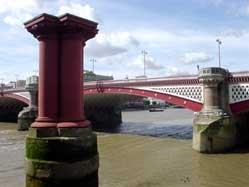
The first Blackfriars Bridge was opened in 1769, at about the same time that the lowest reach of the Fleet was covered over and renamed New Bridge Street. This nine-arch span made of Portland stone survived exactly 100 years before being replaced by the present wrought iron structure. [photo] Busy old Queen Victoria spent 6th November 1869 opening first Holborn Viaduct and then popping down Farringdon Street to open the new Blackfriars Bridge. A statue was erected in her honour on the north side of the bridge a few years later. Four equestrian sculptures were also planned, one to stand in each recess above the piers of the bridge, but they never materialised. The bridge has since been widened and is now the busiest of all the road bridges leading south from the City (although it's bloody dangerous on a bike). The view upstream is impressive, taking in the OXO Tower, Eye and Embankment, but the view downstream is blocked by a less than glamorous railway bridge. Two parallel railway bridges were built here in the late 19th century, but the westernmost bridge proved too weak for modern trains and was part-demolished in 1969. You can still see its peach-painted supporting pillars sticking up out of the Thames today, beheaded by progress, although they may be reused if the Thameslink 2000 project is ever resuscitated. [photo]

www.flickr.com: Fleet lower - Holborn to Blackfriars
(there are 50 photos in this bumper bonus selection)

 Tuesday, August 30, 2005

Reviewing the Fleet
the Embankment


200 years ago it wasn't just the River Fleet that stank, it was the whole city. One million Londoners produced a heck of a lot of sewage, most of which ended up in the capital's two hundred thousand cesspits, or in the street, or floating down towards the Thames. Conditions were at their worst close to rivers, such as the Fleet, where domestic water-closets often discharged directly into the stream. As the 19th century progressed outbreaks of cholera became more common, sometimes killing thousands of people, and the smell of the city on a hot day became intolerable. The situation came to a head during the 'Great Stink' of 1858 when the Thames became heavily polluted during a particularly hot summer. Lime-soaked curtains were hung from the windows of the House of Commons in a vain attempt to keep out the stench. Thankfully a solution was at hand.

Enter Joseph Bazalgette - an engineer with a vision. He believed (rightly, as it turned out) that London's stinky problems could be solved by a series of giant intercepting sewers which would divert brown waste safely away from the rivers in the centre of town. These sewers used gravity (and 318 million bricks) to deliver their cargo to two pumping stations at Crossness and Abbey Mills, both suitably downstream of the capital, where sewage was stored in reservoirs until the ebb tide and then released into the Thames. Three east-west sewers converged at Abbey Mills (just down the road from my house, so I've written about it before). The northernmost sewer fed down from Kentish Town and Hampstead, intercepting the waters of the upper Fleet along the way, while the middle sewer passed from Notting Hill through Clerkenwell. But when it came to constructing the Northern Low Level sewer, there was nowhere else for it to go except along the banks of the river Thames itself.

The Victoria Embankment, constructed by Bazalgette between 1864 and 1870, provided a new waterfront for central London and solved four important problems. Firstly it hid a giant sewer pipe, safely transporting the effluent of west London towards less affluent east London. Secondly it provided the perfect location for the construction of a new underground railway - today the District Line between Westminster and Blackfriars. Thirdly by reclaiming land from the Thames it narrowed the river and produced stronger defences against potential flooding. And fourthly a new four-lane road built on top of the Embankment relieved growing traffic congestion along Fleet Street and the Strand. Drivers whizzing along the current riverside dual carriageway probably don't realise that all of Chelsea's excrement still flows along beneath them.

Bazalgette's sewer system also finally demoted the Fleet from a buried river to an underground storm relief drain. Where once a babbling brook flowed into a navigable inlet, now sludgy brown liquid flows through a network of subterranean brick tunnels. Several connecting branch sewers converge on this dank Stygian puddleway, and one of the chambers lower down is as big as a cathedral with great vaulted ceilings. This is not somewhere that most people would choose to visit, but JD and Stoop specialise in underground drain exploration and they've made two journeys down the Fleet sewer during the last year. Their last, and most dangerous, expedition was back in June when they (and a daring Time Out journalist) made it nearly all the way down from St Pancras to the Thames.
"Stoop took out his big ass torch, which he'd been reserving for photos, so that we could get a look further down the tunnel. The beam stretched out ahead of us through the vapour and mist, "That's it!", I had caught a glimpse of the huge end chamber looking just as I'd seen it in an archive picture. Just ahead was the end of our journey down River, we strode ahead and using two iron rails set into the tunnel wall we climbed over the diverting wall which sends the flow into the intercepting sewer. The chamber beyond was free from any water flow, having just a thin layer of Thames sludge, it was an impressive array of iron gates, walkways, brickwork and ladders." (sub-urban Fleet sewer exploration, 2005)
Down in the sewers you're always at the mercy of the weather, or some waterworks operative diverting the flow from a channel above, so the trio's journey back up the sewer was rather more treacherous as the water level increased.
"A previously sealed hole in my waders had given up the ghost and one of my feet now weighed in at a good three kg more than the other. "I’m telling you it’s practically full up" - they both looked a little unconvinced until I emptied out about three litres of poo cocktail."
Read more here (or in last week's edition of Time Out). Oh, and they don't recommend you try following in their footsteps, just enjoy their photographs of the Fleet sewer instead. [More (slightly illegal) Urban Exploration links here]

 Monday, August 29, 2005

Reviewing the Fleet
Blackfriars


As you might suspect from its name, Blackfriars was once a monastery. The black-robed Dominican Friars moved in beside the Fleet in 1278, right down near the river's mouth into the Thames where the inlet was still deep, wide and navigable. In 1382 religious reformer John Wycliffe was brought to Blackfriars by the Archbishop of Canterbury to stand trial for his beliefs. Towards the end of the hearing London was struck by a sudden earthquake (honest - even St Paul's was damaged) which Wycliffe took as a sign of God's displeasure, although the Archbishop disagreed and found him guilty anyway. In 1529 a court met at Blackfriars to hear the divorce proceedings of King Henry VIII and his first wife Catherine of Aragon. The consequences were equally seismic, and England split with the Church of Rome followed four years later.

By 1540 Blackfriars, along with all the other monasteries in England, had been dissolved. Some of the old buildings were converted into a private theatre which in 1608 was acquired by Richard Burbage for the use of his company of actors, the King's Men. Richard and his mate William Shakespeare used this indoor playhouse during the winter months, while continuing to perform Will's latest plays across the Thames at the Globe during the summer. Local residents weren't pleased by the regular disruption that raucous theatre crowds created on their doorstep. However, this didn't stop Shakespeare from buying the old Blackfriars monastery gatehouse in Ireland Yard [photo] as his London residence in 1613. The theatre lingers on only as a streetname (Playhouse Yard), but there's still one tiny segment of the old monastery wall to be seen hidden in a quiet courtyard here amidst the old medieval lanes [pictured].

Blackfriars is now better known as a mainline railway station (for trains to Bedford, Brighton, Sutton and Sevenoaks). It's not impressive and it's not big, but it does have platforms that extend out across the River Thames (and from which the view along the river is pretty outstanding [photo]). Meanwhile the monastery of Blackfriars is still commemorated by the Art Nouveau flat-iron pub over the road [photo]. It's 100 years old this year but was almost pulled down in the 1960s before being saved by a Betjeman-led campaign. Fight your way through the City drinkers spilt out across the pavement outside The Black Friar and look up at the big mosaic above the entrance [pictured]. There you'll see two dark-clad monks (one with giant fish in hand) standing in front of the old turreted friary beside the blue waters of the river Fleet - how it used to be here, many centuries ago.

(I really ought to stop here, because the river Fleet only ever flowed as far as Blackfriars, but nowadays there's still another 20 metres to go...)

The best of August

TV programme of the month: Still BBC2's marvellous Coast, which has been taking an eclectic wander around the UK coastline similar to my current amblings down the Fleet. The final part of the journey was last night, zipping around fast-eroding East Anglia, and there's a compilation of highlights next weekend.
Local TV programme of the month: Danny Wallace's series How To Run Your Own Country has been an entertaining and informative romp through the key issues any national leader needs to consider when establishing his or her own democracy. Danny's kingdom consists solely of his tiny loft apartment, which just happens to be in Bow and is (during the winter when the intervening trees are leafless) within sight of where I'm now sitting. I just hope that he (and his 30000 citizens) aren't planning on expanding his country at any time in the near future, otherwise I'm in danger of being annexed.
Album of the month: All the hype this month has rightly been aimed at Goldfrapp's Supernature, not just for the curvaceous cover art but more importantly for its luscious sensual melodies. This is 70s Bolan meets 80s electronica meets 90s chic, and it all makes for a 21st century mainstream classic with several standout tracks. Buy it now, before everybody else catches on.
Film of the month: I was expecting the worst when I was summoned to watch Unleashed, a Glasgow-based action movie featuring martial arts icon Jet Li. Sure enough the opening half hour was an orgasm of raw violence as Bob Hoskins ordered Danny, his human dog, to beat the crap out of everyone in sight. And then, when I least expected it, a wholly tangential piano tuner wandered on screen introducing themes of hope, self-discovery and redemption. The resulting action/romantic mishmash should have been corny B-movie tripe, but actually proved oddly endearing and unexpectedly watchable.

 Sunday, August 28, 2005

Other London stuff I've not mentioned while I've been wittering on about the Fleet:
• The London Transport Museum in Covent Garden closes at the end of this week for an 18-month-long upgrade. I thought I'd better take a look round, having somehow never visited the place (not since it was based in an old bus garage in Clapham, anyway), so I popped in last Friday. The collection is extensive and impressive, although now a little out of date (apparently the Jubilee Line is due to open in 1999). I enjoyed the selection of historic buses, the informative displays, the chance to stand in an old Metropolitan tube carriage and all the carefully-collected ephemera. There was even a 3D cross-section of Stockwell underground station, back in the days when gents could wear a top-hat and dress coat on the platform without being shot. One elderly visitor hobbling round the tram exhibit told me that as a boy he had been on the very last tram to descend into the Kingsway subway, and you could see the nostalgia in his eyes. There are just seven days left to visit (and maybe raid the shop's relocation sale), before something more modern emerges in 2007.
• Two anonymous faces can be seen staring out from advertising posters on many of London's buses and tubes this month. The "Casual Passer-by" is an eccentric project by Russian artist Braco Dimitrijevic in which he takes very occasional black and white photographs of random people and then exhibits them as art. Braco's 2005 London portrait is of an almost-elegant Chelsea woman, whereas his 1972 image features an ever-so-seventies gent with Brylcreemed hair and arched glasses. See them both now at Sadlers Wells Theatre or at the Tate Modern (or all over London).
• Have you ever dined out at the S&M cafe? I hadn't until last week but I can now thoroughly recommend meat-munching at any of their three London outlets (it stands for sausage and mash, by the way).
• The Tube Relief charity challenge took place last Thursday, raising cash for the victims of last month's tube bombings by attempting to visit as many of London's underground stations as possible in one day. Some of the participants even managed all 274. More here, here, here, here and (much more) here.

Reviewing the Fleet
Bridewell


1515-1520: After the Royal Apartments at Whitehall are destroyed by fire, Henry VIII spends £39000 establishing a royal palace on the western bank of the Fleet, close to its mouth with the Thames. The palace is named Bridewell after the nearby well of St Bride, and is opulent enough to host a visit by Holy Roman Emperor Charles V.
1528: Henry invites papal representatives to Bridewell to discuss divorcing his wife, Catherine of Aragon. UK religion will never be the same again.
1531-39: Bridewell is leased by the French Ambassador - later immortalised in Holbein's most famous (and dead clever) painting.
1553: Henry's son Edward VI gives the palace over to the City of London, becoming a school for homeless children and a workhouse for the poor. Bridewell slowly evolves into a house of correction and prison for petty offenders, and other jails start to become known as 'Bridewells'.
1666: Great Fire Of London - burnt down - rebuilt (you know the drill by now)
1732: The fourth plate of Hogarth's Harlot's Progress is set in the Bridewell Prison (where Moll is imprisoned for prostitution).
1863: The old prison is demolished, and the Royal Hospital School moves to deepest Surrey. A new building is constructed on the site, retaining the 1802 gatehouse (which still stands and is occupied by Bark & Co Solicitors). Above the door is a keystone commemorating young King Edward (pictured).
2005: Don't bother visiting - Bridewell's a bit dull, the theatre's closed, and the rest of New Bridge Street is bland and featureless.

 Saturday, August 27, 2005

Reviewing the Fleet
Fleet Street


London grew up around the twin centres of Westminster and the City, and medieval Fleet Street helped to link the two together. Initially the street led down from Aldwych into the Fleet valley to a wide ford across the (still navigable) river, but by 1197 a stone bridge had been built to span the waters. From here the road ascended Ludgate Hill, climbing through Ludgate into the City (close to St Paul's Cathedral).

I thought I'd show Ludgate Hill rather than Fleet Street in today's photograph because the view's better. In fact this view of St Paul's from Fleet Street is one of London's few protected views, and all modern skyscraper development is restricted along this particular line of sight. Richard Rogers's new Leadenhall Building, for example, has to taper towards the top so that it can't be seen from Fleet Street when it's topped out in a few year's time. It's just a pity that the buildings on either side of Ludgate Hill are so ugly.

Here's a map of the local area:
Fleet Street's association with the printed word began when William Caxton's apprentice Wynkyn de Worde set up a press at the eastern end of the street in the late 15th century. Newspapers moved in from the 18th century onwards, this location being perfectly situated between London's political and financial centres, until the very name 'Fleet Street' became synonymous with the national press. Most imposing of the various newspaper offices were those of the Daily Telegraph (pillared stone monolith) and Daily Express (black glass and chrome). With the advent of digital publishing all the UK's newspapers have now relocated elsewhere, notably eastwards towards Docklands, and presumably takings at local Fleet Street pubs are considerably lower as a result.FARRINGDON STREET
Former site of the Fleet Market
Some of the narrow lanes leading off Farringdon Road have names which echo the area's dockside past. Old Seacoal Lane and Newcastle Close are reminders that coal barges from Tyneside once sailed up the River Fleet as far as Ludgate. For many years this was also an industrial area. Above the Fleet you can still find Limeburner Lane, and over the road is Stonecutter Lane where masons satisfied London's growing need for paving slabs.

On this corner in 1702 was born the Daily Courant, England's first daily newspaper. This single sheet of newsprint, published by Edward and Elizabeth Mallett, aimed to provide news 'daily and impartially'. The Courant ceased production in 1735, which is why you can't wrap chips in a copy today.
FLEET STREET
Aldwych, Westminster
LUDGATE CIRCUS
Former site of the Fleet Bridge
LUDGATE HILL
St Paul's Cathedral, City
St Bride's Church towers (or rather spires) high above the eastern end of Fleet Street. The first church on this site was built in the 6th century, named in honour of Irish nun St Bridget. The medieval church was destroyed in the Great Fire of London (the flames "rushed like a torrent down Ludgate Hill", according to one observer, then leapt the river in the strong east wind). Sir Christopher Wren's replacement is famous for its layered steeple (the tallest he ever built), which is said to have inspired a local 18th century pastrycook to design the first wedding cake. Wren's masterpiece had to be rebuilt after the destruction wreaked by a firebomb during the Blitz, although thankfully the steeple survived pretty much intact.
[Read a complete history of St Bride's here.]
NEW BRIDGE STREET
Former site of the Fleet Canal
Four concave façades surround Ludgate Circus, constructed in the mid 19th century to form an elegant circular crossroads. The roadway here has since been raised, giving the illusion that surrounding shops are sinking. There were also once two pedestrian islands in the centre, each complete with its own obelisk, but now there's just a giant (faded) yellow box junction.

The view up Ludgate Hill is much improved since the removal of a railway viaduct, which since 1874 had carried trains from Holborn Viaduct past Blackfriars and across the Thames to South London. The line was buried underground in 1990 as part of the Thameslink Snow Hill Tunnel project. [link to abandoned station here]

 Friday, August 26, 2005

Reviewing the Fleet
Fleetway comics


The best comics in the world came out of Fleetway House on Farringdon Street, or so I thought back in the 1970s. The Amalgamated Press building has now been replaced by yet another very ordinary office block, but this was once somewhere quite extraordinary. My brother and I were avid consumers of Fleetway's finest, and one of my biggest regrets is not keeping a few more back issues to nostalge over in my second childhood. Here are five favourites, followed by a few other comic gems from the period.
(Warning to comic connoisseurs: every blue link is worth a click, especially the first four above)

1) Krazy (1976-78): Quite the best comic ever, whatever you lot might think. Witty, clever, offbeat, and renowned for its cunning 'back cover disguises'. The most inventive material was to be found inbetween the comic strips, and I found Krazy's quirky humour to be wild, wacky and inspirational. Characters included: The Krazy Gang, The Buytonic Boy, Handy Andy, Paws, Ray Presto, Scaredy Cat, Birdman And Chicken
2) Monster Fun (1975-76): Few things appeal to pre-teenage boys as much as monsters, and this short-lived comic had monster appeal. The very best feature was the pull-out Badtime Bedtime Storybook in every issue, often illustrated by comic god Leo Baxendale (most of which I have been sensible enough to hoard keep). Characters included: Art's Gallery, Cinders, Creature Teacher, Draculass, Kid Kong, Tom Thumbscrew
3) Whizzer and Chips (1969-90): Were you a Whizz-Kid (led by Sid and his big snake, Slippy) or a Chip-ite (led by black-eyed Shiner)? Probably, secretly, both. Characters included: Fuss Pot, Odd Ball, Sweeney Toddler
See also: Whoopee! (long stayer, lasting from 74 to 85), 2000AD (might still be your favourite), Oink (a junior Viz), Shiver and Shake (precursor to Monster Fun), Buster (great granddaddy to all the Fleetway comics, into which all the others were eventually consumed, and which survived from 1960 to 2000)

Reviewing the Fleet
the Fleet Prison


Here's a site you don't see every day. They're building a new office block on Farringdon Street, on the site of what used to be the notorious Fleet Prison. Come back in a couple of years and there'll be a very shiny office block (called Ludgate West) here instead. But for the time being, if the blue gates in Old Fleet Lane are unlocked and open, you can peer in and see men in fluorescent yellow jackets at work where the ne'erdowells, debtors and petty bankrupts of London were once locked away. This brief period of reconstruction is a rare window into the past, except with JCB diggers where there ought to be tiny cell windows and wailing convicts. Here's a quick (and unexpectedly fascinating) history of the Fleet prison site:

1197: The first Fleet prison is built on a small eyot in the River Fleet, just outside the city walls. The prison has a square tower with four polygonal turrets, and the river provides a protective moat. [archaeological details here]
1381: The prison is burnt to the ground by Wat Tyler and his revolting peasants (and later rebuilt).
1666: The prison is burnt to the ground during the Great Fire of London (and later rebuilt). [map here]
1667-1754: 'Fleet marriages' were semi-official weddings conducted by clergymen incarcarated in the Fleet Prison. These priests made a living by solemnising vows for couples without parental consent or for those who wanted to avoid tax and licence costs. During the 1740s it is estimated that 15% of all the marriages in England were held within the 'Rules of the Fleet'.
1735: Plate 7 of William Hogarth's famous series of paintings The Rake's Progress sees upper crust debtor Tom Rakewell locked away in the Fleet, surrounded by desperate women and lunatics.
1780: The prison is burnt to the ground during the Gordon Riots (and later rebuilt). [map here]
1837: Charles Dickens, whose parents were themselves condemned to a debtors' prison, casts fictional Mr Pickwick away in the Fleet.
1842: The Fleet prison is finally closed, and is pulled down four years later.
1865: A railway line is constructed down the Fleet valley from Farringdon to Blackfriars, through the rear of the old prison site. Holborn Viaduct station survives until 1969. [network maps from 1899, 1905, 1935 and 1969]
1872: The Congregational Memorial Hall is built on the site of the Fleet prison, a spiky Gothic meeting house which is the headquarters for an offshoot of Methodism.
1900: The Labour Party is founded here, on this very spot, at a conference held in the main hall on 27 February 1900. (See, I told you this place was historic)
1969: As Farringdon Street becomes a characterless street of soulless office blocks, the Congregational Memorial Hall is knocked down to be replaced by a soulless office block called Caroone House. [archaeological details here]
2007?: A new soulless office block called Ludgate West opens on the site of Caroone House, on the site of the Congregational Memorial Hall, on the site of at least six different Fleet prisons, on a site of great history.

 Thursday, August 25, 2005

Reviewing the Fleet
Holborn Viaduct


Most people think that central London is fairly flat, and for the most part it is, but here and there are some surprisingly steep hills. Take the short journey from Newgate prison (now the Old Bailey) to Holborn Circus, for example. There's a fairly steep descent down Snow Hill1 into the Fleet valley, a gradient which was considerably greater before the river was covered over, and then a similarly steep ascent up Holborn2 Hill on the other side. Medieval tradesmen taking goods to market in the City found this route particularly difficult, and occasionally treacherous. One particular lane leading down to the river from the east is still called Turnagain Lane, because if you brought your horse and cart this way you had no alternative but to back up and return the way you came. A proper stone bridge was built here in the Middle Ages and this became the northern limit of the navigable part of the Fleet. However, even with Holborn Bridge in place, the crossing was still not straight-forward.

The Victorians, as ever, had an answer. In the 1860s they built a magnificent curved viaduct across the valley, wiping away the slums beneath at the same time. Holborn Viaduct was the engineering miracle of its day, taking a full six years (and two million pounds) to build. Most people today think it's just a short bridge crossing Farringdon Road, but it actually stretches much further and is nearly half a kilometre long. The structure is a three-span cast-iron girder bridge, held up on granite piers, with four grand stairwells permitting descent to the roadway below. In the northwestern stairwell an engraving depicting the construction of the viaduct has been enlarged to enormous size as a modern tiled mosaic. Four classical statues mark the four corners of the main span - one each to represent Commerce, Agriculture, Fine Arts and Science3 - and a pair of bronze winged lions guard each end. Unfortunately it appears that the viaduct no longer meets certain modern health and safety regulations. New green barriers are being erected beneath the central span to protect its pillars from out-of-control lorries, and some especially ugly concrete blocks have been dumped along the edges of the main bridge, presumably to stop bendy buses accidentally smashing through the decorative ironwork and crashing onto the Farringdon Road below.
1 In the early eighteenth century a group of aristocratic ruffians called Mohocks took perverse pleasure in rolling old ladies down Snow Hill inside empty beer barrels. "As they neared the foot of the hill, they heard a groaning and stifled crying for help; and, sure enough, they found a buxom woman, the wife of a respectable citizen, tightly wedged into the cask, and much shaken and bruised by her rapid transit down the hill."
2 Holborn (pronounced with a silent L) was recorded as Holeburne in the Domesday Book, and means the stream (burne) in the hollow (hole).
3 The world's first public electricity generating station was opened alongside Holborn Viaduct in 1882 as part of an experiment to illuminate the lamps across the bridge.
21 photos of old Holborn Viaduct
Holborn Viaduct today
Londonist loves Holborn

A DESCRIPTION OF A CITY SHOWER
(Jonathan Swift, 1710)


"Now from all parts the swelling Kennels flow,
And bear their Trophies with them as they go:
Filth of all Hues and Odours seem to tell
What street they sail'd from, by their Sight and Smell.
They, as each Torrent drives, with rapid Force
From Smithfield or St Pulchre's shape their Course,
And in huge Confluent join at Snow-Hill Ridge,
Fall from the Conduit prone to Holborn-Bridge.
Sweepings from Butchers Stalls, Dung, Guts, and Blood,
Drown'd Puppies, stinking Sprats, all drench'd in Mud,
Dead Cats and Turnip-Tops come tumbling down the Flood.
"

 Wednesday, August 24, 2005

Reviewing the Fleet
the Smithfield tributary


A tributary of the River Fleet once ran from (approximately) Barbican tube station to the southern end of Farringdon Road, heading downhill through the bloody slaughterhouses of Smithfield meat market. Just for a change, I thought I'd do Smithfield in pictures.


Smithfield links: i ii iii iv v vi vii viii ix x xi xii
(and a very happy St Bartholomew's Day to all at Smithfield)

www.flickr.com: the Fleet Ditch - Clerkenwell and Farringdon
All my Fleet posts on one page

St Swithin's Day results (40 days on)
Weather on St Swithin's Day: dry
Had St Swithin been correct, we should just have enjoyed 40 consecutive days of glorious sunshine. But no. Since July 15th London has had (roughly speaking) a dry week followed by a wet fortnight followed by a dry week followed by an unsettled fortnight. The final results are as follows:
Number of dry days since July 15th: 20
Number of wet days since July 15th: 20

Which just goes to show that:
a) St Swithin was wrong (as he has been every year since 971 AD)
b) It's been wetter than normal (on average one third of days in London are wet, not one half)
c) This wasn't the best week to take time off work (it's raining again today).

 Tuesday, August 23, 2005

Would you Adam and Eve it?: East London sounds different these days, apparently. Many Cockney speakers have moved out of the East End to the suburbs of Essex, and in their place is evolving a spoken language which fuses Estuary English and Bangladeshi influences. This new street slang may not yet be widespread, but "creps" now means "trainers" and "nang" means "good" (so we're told). Can the following Cockney rhyming slang be far behind?
   apples and pears: mysterious non-Asian fruits
   Brahms and Liszt: classic old-school mixmaster duo
   dog and bone: contents of a typical takeaway meal   
   Jimmy Riddle: white lad pretending to be Bangladeshi
   merchant banker: recently-moved-in Docklands resident
   pen and ink: how people used to write before aerosol cans
   north and south: opposing gangs from Bow and Poplar
   skin and blister: what cheap gold jewellery gives you
   trouble and strife: when police search your rucksack
   whistle and flute: purveyors of well bangin tunes
(Any more?)

Reviewing the Fleet
Farringdon

Farringdon facts

Farringdon takes its name from William Farendon, a City goldsmith who snapped up ownership of this area in 1279.
Cowcross Street, which winds east from Farringdon, was so named because cows bound for Smithfield crossed the River Fleet here (until 1855, when the market stopped selling live animals).
Through the 17th and 18th centuries the Fleet here was narrowed to a stinking ditch by encroaching slum dwellings. The notorious Red Lion Inn backed onto the river in West Street. From here a plank could be stretched across the stream to aid the safe passage of fleeing criminals, while murdered corpses were sometimes dropped anonymously into the raging murky torrents below.
Before Farringdon Road was built, the main north-south road in the area was Saffron Hill, named after the herb grown on the slopes above the Fleet in the 18th century. It's still a tiny narrow lane, steep enough to worry the odd cyclist, lined by an incongruous mix of old inns, tatty workshops and spanking new office blocks. (photo)
Back in the 19th century Saffron Hill was a densely-packed area of slum dwellings and it was here that Charles Dickens located Fagin's Den, to which the Artful Dodger first led an innocent new recruit to his fate:
"Although Oliver had enough to occupy his attention in keeping sight of his leader, he could not help bestowing a few hasty glances on either side of the way, as he passed along. A dirtier or more wretched place he had never seen. The street was very narrow and muddy, and the air was impregnated with filthy odours.There were a good many small shops; but the only stock in trade appeared to be heaps of children, who, even at that time of night, were crawling in and out at the doors, or screaming from the inside. The sole places that seemed to prosper amid the general blight of the place, were the public–houses; and in them, the lowest orders of Irish were wrangling with might and main. Covered ways and yards, which here and there diverged from the main street, disclosed little knots of houses, where drunken men and women were positively wallowing in filth; and from several of the door–ways, great ill–looking fellows were cautiously emerging, bound, to all appearance, on no very well–disposed or harmless errands. Oliver was just considering whether he hadn't better run away, when they reached the bottom of the hill. His conductor, catching him by the arm, pushed open the door of a house near Field Lane; and drawing him into the passage, closed it behind them." (Charles Dickens, Oliver Twist, 1837)
Farringdon Road was built on top of the new Fleet sewer in the 1860s, wiping away the old slums. At the same time Farringdon station became the eastern terminus of the world's first Underground railway (but we've mentioned that already). (photo)
If Crossrail is ever built, Farringdon will be a key interchange between Thameslink and the new east-west line. Crossrail's Information Exchange is located in a tiny drop-in centre next to the station.

 Monday, August 22, 2005

Reviewing the Fleet
Clerkenwell


Last year, as part of the London Architecture Bienalle, I stumbled upon an open-air exhibition in Clerkenwell called Discovering the Fleet. A trail of blue bunting hung from lamppost to lamppost following the course of the old river, while on Vine Street Bridge some arty people had installed a row of tall blue flags, a small sandy 'beach' and a narrow pool in a big blue pondliner. It was chucking it down with rain at the time, and the volunteer manning the exhibition looked semi-drowned in his orange kagoule. As a result all the information sheets pasted on the walls of the bridge were soaking wet, including a map of the lost rivers of London, but I was absolutely hooked. "Ooh", I thought, "I could write something on my blog about the River Fleet, maybe even a big month-long project." If the aim of this small exhibition was to raise awareness about some of London's hidden heritage then it succeeded, because you're reading the result.

Just behind Vine Street Bridge is the hole in the ground that gave Clerkenwell its name. The Clerk's Well was first recorded in the 12th century. It was originally located in the boundary wall of St Mary's Nunnery, and here each year the Parish Clerks of London assembled here on the banks of the Fleet to performed biblical mystery plays. After the Reformation the well was relocated in a basement, and you can still see it (well, sort of) through the window of some chartered accountants' offices at Well Court. (photo)

There's tons I could write about Clerkenwell, because it's well historic, but I'll just mention a few of the western highlights:
Clerkenwell Green: It's barely green at all, more tarmac-grey these days, with a paved seating area in the centre. Absolute hub of trendiness it is, if you like boutiques, gastropubs, fine dining and stuff. (photo)
Marx Memorial Library: The oldest building on the Green, its offices once used by Lenin (while in exile) to edit his Iskra propaganda newspaper. Established as a left-leaning library on the 50th anniversary of Marx's death in 1933, and still the only place in Britain where you can flick through bound volumes containing every single edition of the Morning Star. (sorry, closed August)
Middlesex Sessions House: Big building with Palladian facade, opened in 1782 as the courthouse for the county of Middlesex, more recently reopened as the London Masonic Centre (for aproned folk with trowels). (look inside)
Turnmill Street: In the 16th and 17th centuries this was North London's most prominent red light district. A different sort of hedonism survives today at world-famous club venue Turnmills - still hip but not quite as cutting-edge as it once was. I've never been myself, but Mike seems to have spent several years of his life there and can tell you all about the Trade years. (photo)

Book-reviewing the Fleet
The Clerkenwell Tales, by Peter Ackroyd


The undisputed expert on all things Clerkenwell is historian Peter Ackroyd. If you thought I was obsessional about London, then you've not read any of his stuff (and you should). The Clerkenwell Tales is the story of turbulent 14th century lives woven together at a time of mystery, prophecy and rebellion. Each chapter concentrates on a different character, echoing Chaucer's Canterbury Tales (and with some of the same characters). Prepare to meet a mad nun conceived on the dark banks of the Fleet, a secret quasi-religious organisation bent on carrying out dark deeds and several of the lowest members of medieval society. Ackroyd misses no opportunity to mention farts, belches and other animal smells, but then Ye Olde London always was a nasty and unsanitary place. This book appears to have been an excuse for Peter to write down every single fact he knows about London in 1399 in the disguise of a novel. That's not necessarily a bad thing, and your school history lessons might have been much more entertaining with Mr Ackroyd as a teacher, but sometimes excessive depth gets in the way of satisfactory breadth. I'm enjoying the book so far though, not least because my wanderings along the Fleet mean I know where most of it is set, and the story excellently illuminates of the minutiae of everyday life in London six centuries ago. [Read chapter one here]
Clerkenwell maintains a literary tradition to this day, and if you're interested you might enjoy the annual literary festival (website here, blog here).

 Sunday, August 21, 2005

Reviewing the Fleet
Hockley-in-the-Hole


We're nearly in respectable Clerkenwell, but not quite. There's still one more dive to go, a low-lying depression once called Hockley-in-the-Hole - a name long since erased from the map. Around 1700 this was where the Fleet crossed the northern edge of London, with fields to the north and squalid slums to the south. Hockley-in-the-Hole soon became an infamous resort of the working classes. Here London's low-life gathered in the natural amphitheatre of the Fleet valley to watch and engage in a bit of heavy blood sport. Violent pastimes such as cock-fighting and bear-baiting may have fallen out favour with the middle classes, but local thugs, riff-raff and (especially) butchers flocked here for a quick fix of gore and death, or maybe just a good street brawl.
"Being a Person of insatiable Curiosity, I could not forbear going on Wednesday last to a Place of no small Renown for the Gallantry of the lower Order of Britons, namely, to the Bear-Garden at Hockley in the Hole; where (as a whitish brown Paper, put into my Hands in the Street, inform'd me) there was to be a Tryal of Skill to be exhibited between two Masters of the Noble Science of Defence, at two of the Clock precisely." (Richard Steele, July 1712)

"At the Bear Garden in Hockley in the Hole, near Clerkenwell Green, this present Monday, there is a great match to be fought by two Dogs of Smith-field Bars against two Dogs of Hampstead, at the Reading Bull, for one guinea to be spent; five lets goes out of hand; which goes fairest and farthest in wins all. The famous Bull of fire-works, which pleased the gentry to admiration. Likewise there are two Bear-Dogs to jump three jumps apiece at the Bear, which jumps highest for ten shillings to be spent. Also variety of bull-baiting and bear-baiting; it being a day of general sport by all the old gamesters; and a bull-dog to be drawn up with fire-works. Beginning at three o'clock." (early 18th century advert)
About 100 years ago the deep depression at Hockley-in-the-Hole was (at least partially) filled in and the slums were cleared away. Today the ASBO'd classes have moved on, and the area is now more famous as the site of the Guardian newspaper's main offices. The Coach and Horses pub (and the Guardian's car park) now stand on the site of the bloody ring where the dogfights, bullfights and swordfights once took place. It's much more peaceful here now, shielded downslope from the busy Farringdon Road, which is quiet enough for a modern encounter with the lost River Fleet. Stand outside the pub in the middle of Ray Street next to an anonymous-looking metal drain cover and you should still be able to hear the waters of the Fleet rushing along through the sewers, several feet beneath the ground. Well I've heard them anyway, just the once, but this historical phenomenon does rather depend on the weather. And if you're ever riding a number 38 Routemaster along Rosebery Avenue, try looking down from the top deck as you cross the bridge over Warner Street (yes, this really is a proper river valley) and see if you can still imagine thugs and vagabonds in the streets below yelling their support for battling bears, or just beating the hell out of each other for a laugh.
Following the Fleet: Warner Street, Ray Street

Some bits of the Guardian's website you may not have stumbled upon before:
the newsblog (much plagued by ranting drivel from amateur US political pundits)
the Culture Vulture blog (all the latest arty stuff)
the over-by-over Cricket commentaries (for fans of flannel)
the talkboards (the most popular news & politics discussion site in Europe, apparently)
the latest TV ratings (requires registration)
the Guardian stylebook (learn how to write proper)
Ask Jack (your computer's favourite agony uncle)
Notes & Queries (strange answers to even stranger questions)

 Saturday, August 20, 2005

Reviewing the Fleet
the Great Ormond Street tributary


A tributary of the River Fleet once ran from (approximately) the Imperial Hotel on Russell Square to Mount Pleasant, wiggling its way roughly parallel to Guildford Street and Theobald's Road. You'll no longer find this river on any map, but you can easily trace its west-east path by following local parish boundaries (look, see how obvious it is). Here's a brief summary of what you'll find today in these east Bloomsbury streets:

Queen Square: ...may be named after a Queen (Anne, in this case) but it's no square (being at least three times as long as it is wide). In the peaceful central gardens stands the statue of another Queen (Charlotte, in this case, whose husband King George III was treated for his insanity in a nearby hospital). The river ran across the north of the square, where it was known as the Devil's Conduit. (photo)
Great Ormond Street (pictured): GOSH was the first children's hospital in the English speaking world, opened by Dr Charles West in 1852. It started as a converted 17th century townhouse with just 10 beds, but soon expanded into the house nextdoor. In 1875 enough money was raised to construct a purpose-built hospital on the site, and this survived until the mid-1990s when the Wishing Well appeal allowed the near-derelict Victorian building to be substantially enlarged. In 1929 JM Barrie donated all future royalties from Peter Pan to the hospital, which has no doubt saved the NHS several thousands of pounds a year ever since. Full history here. Gosh.
Lamb's Conduit Street: ...is named after the artificial stream that once ran here, dug in 1577 by speculator William Lambe to carry water from local springs to the City. The main pub, The Lamb, is a Victorian treasure, but Camden council have recently destroyed much of the charm of this old street by semi-pedestrianising it. (photos from "The Way We See It") (photo)
Doughty Street: A street of classic Georgian terraces made famous because Charles Dickens lived here between 1837 and 1839, during which time he managed to write The Pickwick Papers, Oliver Twist and Nicholas Nickleby. Dickens' house at number 48 is now a museum, not that many tourists seem to find their way here. I couldn't be arsed to fork out a fiver for the entrance fee so I was delighted to discover this virtual tour on the museum's website when I got home. (photo)
Gray's Inn Road: Where once a small stream crossed this historic thoroughfare (bong), today you'll find the gleaming and shiny headquarters of Independent Television News (bong). Next month ITN celebrates its fiftieth anniversary (bong), all the way from Sir Christopher Chataway to Sir Trevor McDonald (bong).
Following the Fleet: Queen Square, Great Ormond Street Hospital, Long Yard, Doughty Mews, Roger Street, Elm Street, Mount Pleasant

Reviewing the Fleet
the Rosebery Avenue tributary


A tiny tributary of the River Fleet once ran for about 500 metres from Finsbury Town Hall to Mount Pleasant, but (apart from a nice cafe) there's nothing much of interest here so I can't be bothered to write about it.
[In particular, and I'm speaking to the editors at Time Out magazine here, the Fleet definitely never made it as far as Sadler's Wells Theatre ...so that picture you have taking up half of page 22 in this week's issue is of the wrong river]

 Friday, August 19, 2005

Disaster recovery
(I'm just checking whether I could survive indoors, just in case. Could you?)

In case of power cut... I have a battery operated radio (but no reception), I have lots of batteries (but none that fit inside a torch), I have a whole bag of unused IKEA tealights (and a box of matches), I have several books to read (not many of which are unread), I have a limited supply of tinned food (and a tin opener), I have a gas oven and a saucepan (but I appear to have run out of teabags)
In case of water supply failure... I have a spare 2 litre bottle of water under the sink (which might last a couple of days)
In case of gas supply failure... (summer) I'll have to put up with taking cold baths, (winter) I have plenty of thick clothes and some spare blankets
In case of flooding... I should be well above the worst of it (until my toilet starts bubbling sewage)
In case of fire... I've just checked and both my smoke alarms still work (and I bet that annoyed the neighbours)
In case of epidemic... I have a box of elastoplast and some aspirin
In case of chemical or radioactive incident... that gap between my French windows is probably wide enough to kill me
In case of the accidental destruction of London... it's a bloody long walk to the countryside
In case of the general collapse of civilisation... I'm probably buggered

Reviewing the Fleet
Mount Pleasant


Few places in London have a less appropriate name than Mount Pleasant. For a start this isn't a mountain, or even a mount - it's more a mildly sloping hillside on the banks of the Fleet valley. And, more to the point, it's never been pleasant. Go back far enough and this used to be a dismal boggy marsh - and that's before it was downgraded to a public dungheap. Mmmm. Then in 1794 the authorities decided that this would make the perfect spot for a new jail and so built the Coldbath Fields Prison, home to more than a thousand unfortunate wrongdoers. Inmates were forced to endure a punishing regime of solitary confinement and hard labour, so harsh that this House of Correction earned a fearsome reputation. When the prison closed in 1877 the Post Office moved in instead, and they slowly transformed the buildings into London's largest parcel and letter sorting office. To remove all trace of the prison's name they also rechristened the area 'Mount Pleasant' - with more than a hint of sarcasm. The largest station on the Post Office underground railway (or 'Mail Rail') opened here in 1927, roughly halfway between the termini at Paddington and Whitechapel. I was fortunate enough to visit Mount Pleasant when I was a kid back in the 1970s. It was incredible to descend into the bowels of the sorting office to find a miniature train set in operation, and watching driverless engines pulling carriages full of mailbags disappearing into tiny tunnels. Mail Rail closed down a couple of years back - it was far too expensive to run - but the monolithic sorting office is still there, its fleet of bright red vans parked high above the Fleet below. And, if you join the posties sipping beer across the road outside the Apple Tree pub, these days it's almost pleasant.
Following the Fleet: To see where the Fleet once flowed between King's Cross and Farringdon, look on a current map and trace the boundary between the boroughs of Camden and Islington

Mail Rail links: ----------------

 Thursday, August 18, 2005

Reviewing the Fleet
Bagnigge Wells


North of the City (above the stinkiest smelliest sewage-ridden waters) the Fleet was long known as the River of Wells. Close to what is now King's Cross Thameslink station there was St Chad's Well, an ancient spring once of great importance (until the Midland Railway came along and removed all trace). Further down there was Black Mary's Hole, another mineral spring of some repute (until it was shamelessly converted into a cesspool). But when late 18th century gentlefolk fancied a grand afternoon out, they headed instead to the elegant charm of Bagnigge Wells.
"Come, come, Miss Priscy, make it up, and we will lovers be:
And we will go to Bagnigge Wells, and there we'll have some tea.
And there you'll see the ladybirds all on the stinging-nettles
And there you'll see the waterworks and shining copper kettles.
Oh la! Oh dear! Oh dash my vig, how funny."
(18th century song)
It's said that Charles II's mistress Nell Gwynne once lived in the big country house at Bagnigge Wells but it was not until 1757, when two mineral springs were rediscovered in the gardens, that the house was opened to the public. Water from the two wells was piped to a double pump installed in a central domed colonnade. The well closest to the house had clear iron-rich waters, while the other was thought to possess cathartic properties.
"Hight Bagnigge; where, from our Forefathers hid,
Long have two Springs in dull stagnation slept;
But taught at length by subtle art to flow,
They rise, forth from Oblivion's bed they rise,
And manifest their Virtues to Mankind."
(Bagnigge Wells by W Woty, 1760)
Visitors paid threepence for the privilege of taking the waters from the pump, or else retired to the Long Room to drink their fill at eightpence per gallon. For the next forty years an afternoon at Bagnigge tea gardens was considered the height of good taste. The middle classes flocked here in droves to sip tea, or to attend one of the many concerts, or just to stroll around the ornamental gardens on the curved banks of the River Fleet.
"Thy arbours, Bagnigge, and the gay alcove,
Where the frail Nymphs in am'rous dalliance rove;
Where prentic'd Youths enjoy the Sunday feast,
And City Matrons boast their Sabbath's rest
Where unfledged Templars first as fops parade,
And new made Ensigns sport their first cockade."
(Churchill, 1779)
But it was not to last. Bagnigge slowly gained a reputation for 'loose women and boys whose morals are depraved' and its popularity declined. In 1813 the proprietors went bankrupt, forcing them to sell off much of the gardens to stay afloat, until eventually the spa was knocked down to be replaced by a tavern. The wells became overgrown, the waters impure, and in the 1860s the coming of the Metropolitan underground railway finally wiped away the lot.
"Will you go to Bagnigge Wells, Bonnet builder, O!
Where the Fleet-ditch fragrant smells, Bonnet builder, O!
Where the fishes used to swim, So nice and sleek and trim,
But the pond's now covered in, Bonnet builder, O!"
(popular song, 1839)
Only one trace of Bagnigge Wells remains today - a white stone plaque topped by a carved head (pictured) set into the wall of number 63 King's Cross Road. This plaque once stood on Bagnigge House, was later transferred to the pump room at Bagnigge Spa and now looks out over a bus stop. Former owner Nell is still commemorated across the road in a stepped alleyway named Gwynne Place, her grand house replaced by a nasty characterless Travelodge. On the site of the riverside gardens now stand the modern (and very ordinary) council blocks of Wells Square and Fleet Square. And you won't catch the middle classes around here any more - they're all too busy sipping Evian and building water features in their own gardens instead.
Following the Fleet: King's Cross station, Pentonville Road, King's Cross Thameslink, St Chad's Place, King's Cross Road, Cubitt Street, Pakenham Street, Phoenix Place

www.flickr.com: Fleet Central - St Pancras, King's Cross
All my Fleet posts on one page

 Wednesday, August 17, 2005

This week's Time Out (available from all good newsagents, although probably not in Aberdeen or Auckland) features a fine three-page article about the River Fleet, or more specifically a nightmare journey wading through floaty-brown things in the Victorian sewer between King's Cross and Blackfriars. (Thanks for the tip-off, JD). Also in the London-on-Sea special issue, a page about the Regent's Canal (been there, done that) and the capital's best fish and chip shops. Recommended.

 River quiz: While I'm busy doing rivers, let's have a quiz about them. Here are clues to 25 rivers from around the world, each starting with a different letter of the alphabet (sorry, I gave up on Q). How many can you identify?
    A) online bookseller
    B) rhumba apart, reassembled
    C) swindle, leave
    D) waltz
    E) superheat?
    F) assembled warships
    G) criminal groups around the east  
    H) upstairs downstairs butler
    I) frozen food company, beheaded    
    J) Katie Price
    K) Jonathan Woss's sob
    L) hello Ireland, partially
    M) married to Mr Hippy?
N) zero east
O) lazy womble
P) red teletubby
R) ...stone cowboy
S) reportedly of sound mind
T) meat in setback
U) 1st World Cup winner
V) sounds uncouth
W) zero east
X) crossing you?
Y)
Z) maze biz output

(Answers in the comments box)

Reviewing the Fleet
the Metropolitan railway


During the 1860s two tunnels were constructed almost simultaneously between King's Cross and Farringdon - one carrying a railway and the other burying a river. The river in question was (of course) the Fleet, whose disappearance underground was part of the construction of London's great sewer system (of which more later). And the railway was the world's first underground railway, opened in 1863 between Paddington and Farringdon as part of a grand plan by the Metropolitan Railway to link together several North London rail termini. The line was constructed using the 'cut and cover' method (dig a big trench, line it with bricks, cover it over) and for most of its route followed the Marylebone and Euston Roads, which caused massive traffic chaos during the construction period. Strange but true fact: the earth excavated during the construction of the Metropolitan Railway was dumped on the southwestern outskirts of London at 'Stamford Bridge', where it was later used to create the terraces at Chelsea's new football ground.

On leaving King's Cross the new Metropolitan Railway burrowed in an open cutting (better for letting the steam escape), and if you stand in Wicklow Street (or any of several neighbouring streets) you can still see the gaps carved through the terraced houses where the railway passes below. The tracks then continued southeastward buried beneath the Farringdon Road, and it was here in the summer of 1862 that disaster struck. The new parallel Fleet Sewer suddenly and catastrophically burst its walls, flooding a half-mile stretch of the railway to a depth of ten feet. Here's how the Illustrated London News reported the event (and you can see their front page illustration here).
"A warning was given by the cracking and heaving mass and the workmen had time to escape before the embankment fell in... the massive brick wall, eight feet six inches in thickness, thirty in height and a hundred yards long, rose bodily from its foundations as the water forced its way beneath... The scene was, indeed, well worthy of a visit." (Illustrated London News, 6th September 1862)
Rapid repairs were needed before the Metropolitan Railway could finally open a few months later, and the Fleet was finally tamed and hidden.
"Yesterday the Metropolitan (underground) Railway was opened to the public, and many thousands were enabled to indulge their curiosity in reference to this mode of travelling under the streets of the metropolis... It is gratifying to remark that, notwithstanding the eagerness of the public to get into the carriages, even when the trains were in motion, no single accident, of any kind, was reported." (Observer, 11th January 1863 - click for full article)
Oh, and while we're on the subject of the Underground, yes it is true that the Jubilee Line was once going to be called the Fleet Line (because it was originally planned to run beneath Fleet Street). But it's the Metropolitan that's the true Fleet line, and always will be.

 Tuesday, August 16, 2005

Reviewing the Fleet
King's X


King's I: If you'd been standing on this spot 300 years ago, in front of the modern electronic departure board at King's Cross station, you'd have got your feet wet. The River Fleet flowed through what is now the main ticket hall, and still flows underneath through the Fleet Sewer.
King's II: This part of London was originally called Battlebridge (1705 map here, 1786 map here). The bridge in question spanned the River Fleet at the northern end of Gray's Inn Road, while the 'battle' is said to be the final defeat of Queen Boudicca (chief warrior the Iceni tribe) who burnt 1st century Roman London to the ground. The legend that she is buried somewhere beneath one of the station's platforms is almost certainly untrue, however.
King's III: King's Cross might still be called Battlebridge had King George IV not died in 1830. An ugly monument was erected in his memory close to the turnpike where the bridge had once stood, but proved so unpopular that it was demolished six years later. However, it was during this six year window that the Great Northern Railway announced the name of their new London terminus - King's Cross - and the name has stuck ever since.
King's IV: King's Cross station was built on the site of a former smallpox and fever hospital (which you can see in this 1830 map).
King's V: The Great Northern Hotel was built inbetween King's Cross and St Pancras in the 1850s to serve travellers passing through both stations, and its smart curved frontage follows the banks of the old River Fleet (aerial model shot here)
King's VI: An incredibly complicated warren of stairs, tunnels and subways is being constructed beneath King's Cross station as part of the redevelopment of the station, often resulting in lengthy subterranean detours for commuters. Construction of the underground passageway to the new 'Northern Hotel Stairs' required the modification of the crown of the old Fleet Sewer. I hope they finish soon - it's a right mess down there. Latest updates here.
King's VII: Above ground King's Cross mainline station is due to undergo a £400m revamp over the next few years, including roof repairs, a new concourse, a restored façade and the creation of a huge open piazza in front of the station.
King's VIII: Classic Ealing Studios film The Ladykillers was filmed 50 years ago in the rundown Victorian backstreets behind King's Cross station. With all this regeneration going on, there's not much of this area still to be seen. See the location then and now - here and here.
King's IX: JK Rowling slipped up when she launched the Hogwarts Express from King's Cross platform 9¾. Platforms 9 and 10 are to be found in the ugly modern annexe - not the old Victorian station - and they're separated by two railway tracks - not a pillared wall. It turns out that JK forgot to do her research properly and was thinking about Euston station instead. Helpful KX station managers have erected a fake Platform 9¾ sign on a nearby out-of-the-way wall, however, and tourists can frequently be discovered here pretending to push a trolley through the brick wall.
King's X: King's Cross has never ever been an upmarket part of the capital, bedevilled for the last two centuries by slums, factories and prostitutes. Current clean-up plans aim to change all this, and by 2015 the area should have been reborn as metrosexual office nirvana "King's Cross Central". I bet it'll be bland, soul-free and latté-infested, so visit now while (some) character remains.

Linky update:
• A bit of a nudge and I managed to get 15% of you to click on yesterday's top link - The Ten Mistakes Writers Don't See (But Can Easily Fix When They Do)
• There again, lots of you will click on absolutely anything if I ask you to, even "Pylon of the Month" if I disguise it well enough.
• There were still as many as 12 weblinks in yesterday's posts which attracted two clicks or less, which is a bit pitiful.
• My sidebar is a clicking desert, isn't it, apart from the blogreading obsessive who keeps clicking on Blue Witch several times every day.
• I'll think I'll turn off this online click-counting service tomorrow. But blimey hasn't it been fascinating?

 Monday, August 15, 2005

Clickety-click: A few months ago I installed a new blogtool called MyBlogLog.com. It's a simple unobtrusive service (one line of javascript) that keeps count every time a visitor to my website clicks on one of my links. It tallies all of these clicked links and then it lists them in a daily league table. And it's fascinating because it's shown that, although I litter my blog with links, you lot hardly ever click on them. And now I can prove it to you. MyBlogLog have introduced another service (one additional line of javascript) which allows visitors to my site to see how many times each of my links has been clicked during the last 24 hours (updated hourly). Go on - find a link somewhere on the page and point at it. If that link is one of my 50 most-clicked-on, a little pop-up will appear announcing how many clicks it's had (which is probably not many). Try it now and see just how few clicks 400 daily visitors make. Have a good look around the page with your mouse, starting with this weekend's posts and the sidebar, then moving onto today's posts as Monday progresses. Quick, because I'll probably turn this service off again within a day or two because it's rather obtrusive. But in the meantime I think you'll agree it's really intriguing. And, in this case, a bit depressing.

Just to test you and the MyBlogLog service out, here are ten possibly-facinating links each with zero clicks (as of 7am Monday morning). Let's see how that changes...
The Ten Mistakes Writers Don't See (But Can Easily Fix When They Do) [76 clicks]
A dead clever Bar Code Clock [48 clicks]
The Big Brother 6 Social Network Graph (and its evolution over the last 11 weeks) [33 clicks]
"What Everyone Should Know About Blog Depression" - a public service leaflet [29 clicks]
20 classic lateral thinking puzzles [49 clicks]
Exciting Links For Boring Days In No Particular Order [48 clicks]
The Urban Dictionary (example definition - geezer) [20 clicks]
The Tube Relief Charity Challenge - taking place sometime this week [12 clicks]
Domino Pressure game - pick the right domino to squish the tomato [28 clicks]
Really boring (and obsolete) weblink - please do not click here [62 clicks]

Reviewing the Fleet
the Euston Road tributary


A tributary of the River Fleet once ran from (approximately) PC World on Tottenham Court Road to St Pancras Station, wiggling parallel-ish to what is now the Euston Road. Here's a brief summary of what you'll find today in these North Bloomsbury streets:

University College Hospital ...which would be where I spent my last night in casualty, you may remember. A new skyscraping turquoise and white hospital has just opened, pumped full of far more NHS cash than the crumbling Victorian building ever was, dominating the Euston Road skyline. A workman was taking down the 'Accident & Emergency' sign on the old site when I walked past - the NHS moves onward and upward. (photo)
University College: UCL was the third university to be established in England (in 1826, several centuries after Oxford and Cambridge) and the first to admit students of any religion (hence initially vilified by the church as 'The Godless Institution of Gower Street'). The mummified body of philosopher Jeremy Bentham sits in a glass case near the entrance, and very convincingly alive he looks too.
Upper Woburn Place: Until last month you probably wouldn't have known where this short road was. Bet you do now, sadly.
Tavistock Square: Ditto this peaceful gardened square. There's a statue of Gandhi sitting crosslegged in a flowerbed in the centre, a tree planted in remembrance of the victims of Hiroshima up the central footway and a Conscientious Objectors' Memorial on a big rock at one end. How ironic that a place so devoted to non-violence should have been visited by terrorism. (photo)
Woburn Walk: Very easily missed, this leafy Victorian backstreet is a narrow pedestrian bolthole complete with flagstones and old black and white shop fronts. There's a herb shop, a few boutiques and a couple of restaurants, plus a sandwich bar in the house where Irish poet WB Yeats lost his virginity (at the age of 31). It's all charmingly out of place, and out of time. (photo)
British Library (pictured): Not your average lending library, this. For a start it's huge, secondly there are big sculptures outside, thirdly it contains a copy of nigh everything ever published in the UK (including some absolute treasures), and fourthly it's even open on Sundays. Unheard of. And the library's web address - bl.uk - is probably the (joint) shortest in the world... unless you know better?
Following the Fleet (approximately): Tottenham Court Road (PC World), Grafton Way, University College Hospital, University College, Endsleigh Gardens, Upper Woburn Place, Woburn Walk, Flaxman Terrace, Euston Road, British Library, Midland Road, St Pancras Station

 Sunday, August 14, 2005

Reviewing the Fleet
St Pancras station


Travel by train to London from anywhere in Northern England and you'll almost certainly arrive at one of three large mainline stations - Euston, St Pancras or Kings Cross. All three are lined up along a short half mile stretch of the Euston Road, built here because back in the 1830s this was the edge of the built-up capital. Look on this 1830 map, for example, and I bet you can spot the prime location on which Euston station would be built seven years later. St Pancras station was the last of the three to be built, the Midland Railway knocking down several acres of miserable slums to squeeze their tracks through to the booming metropolis. But oh boy, was the resulting building worth the wait!

The Barlow Train Shed (1865): At the time the station's single span roof was the greatest in the world [74m across, 30m high and 213m long] - the widest and largest undivided space ever enclosed. Trains pulled in above street level because the St Pancras railway entered London over the Regent's Canal, whereas the line into Kings Cross burrowed under. This left space for a vaulted undercroft beneath the platforms, with the pillars carefully spaced to allow the storage of three-wide stacks of Burton beer barrels brought in by rail from Staffordshire. [more here, here and here]
The Midland Hotel (1873): Gilbert Scott's gothic masterpiece is one of London's greatest architectural treasures. The Midland Railway ran a competition to ensure that their new station's frontage would outshine every other London terminus, and in selecting Scott's extravagant turrety design they were 100% successful. For just 14 shillings a night hotel guests could luxuriate in gold-leafed rooms with lavish furnishings, and perhaps try out the new-fangled hydraulic "ascending chambers" to move between floors. [more here, here, here and here]
St Pancras Chambers (1935): The hotel proved to have a limited lifespan, not least because a smoky, sooty station wasn't the perfect location for an opulent overnight stay. The building was turned over to railway offices and left to decay, before a failed fire inspection in 1980 forced its closure. I got to see inside the faded hotel a few years ago as part of Open House weekend (note to self: this year's Open House brochure is published tomorrow). Only a handful of rooms were deemed safe to enter but much of the former detail had survived, and we were allowed to climb the magnificent staircase - a treat denied to current tours (the very last of which takes place in a fortnight's time). [Take a virtual tour here]
Eurostar Terminal (2007): Finally, after a century of gradual decline, St Pancras station is being reborn as the London terminus for trains from Paris and beyond. I even got to take a guided tour of the building site last year as part of Open House weekend (note to self: get hold of this year's Open House brochure asap). The platforms are being extended (out over the course of the old river Fleet), the train shed is being restored and the undercroft will be the new Eurostar arrivals hall. Oh, and the hotel's reopening. Let's hope they don't ruin it. [More here, here and here (and on this blog in 2007)]

Exactly thirty years ago today, on 14 August 1975, London's heaviest thunderstorm in a century exploded over Hampstead Heath. In just 2½ hours more than six inches of rain fell from a giant cumulonimbus onto the unsuspecting hills of Hampstead, turning the old Fleet river (and a few other long-lost rivers besides) into a raging torrent. The sewer system couldn't cope, sending torrents of water flooding through streets and gardens, forcing manhole covers up into the air and even drowning one man in a basement flat. Be warned, next time you're up on the Heath in the late afternoon and you see the storm clouds gathering...

 Saturday, August 13, 2005

Reviewing the Fleet
St Pancras Old Church


There are two St Pancrases in London. One is the beautiful gothic station next to Kings Cross (and we'll come to that tomorrow) but the other is much older, differently beautiful and rather more secret. It's certainly somewhere I'd never been before until I edged past the building site to the north of the station and stumbled upon a village church and its unexpected churchyard. And what a pleasant surprise St Pancras Old Church turned out to be. I was charmed by the secluded gardens, tree-shadowed from the blazing sunshine and dotted with tombs and memorials to the long-dead. During my visit I shared the churchyard with three mysterious ladies who were busy getting changed into brightly coloured flowing period dresses. A spiky sundial commemorating Victorian philanthropist Baroness Burdett-Coutts provided an atmospheric backdrop to their ensuing photoshoot (as it did in 1968 when the Beatles shot album sleeve photos here). Shortly the three ladies moved on to the grand fenced-off mini-mausoleum built in memory of Sir John Soane (architect of the Bank of England), whose central dome (believe it or not) inspired Giles Gilbert Scott to design the classic 'K2' telephone kiosk. Maybe the trio were here in remembrance of local novelist Mary Shelley (author of Frankenstein) who learnt to read by tracing the inscription on her mother's gravestone here, and later spent many a quiet hour sitting reading in the shade of the churchyard. Blimey, there's a lot of history on this site.

Pancras was a Roman teenager, beheaded in Rome in 304AD for failing to renounce his Christian faith. A church dedicated to the newly canonised St Pancras was established here on the banks of the river Fleet a decade later, making St Pancras Old Church one of the oldest Christian sites in the UK. A few Norman features remain but most of the present building is a Victorian restoration, and the Fleet here has long been culverted. In the early 19th century a new (more convenient) St Pancras Church was built half a mile closer to town, leaving the old building to become virtually derelict amongst the slums of Somers Town. And then came the railways. When the Midland Railway sought to find a route across the Regent's Canal into their new London terminus they had two choices - straight through the local gasworks or curve through Old St Pancras graveyard. They chose the latter route because ten thousand dead bodies required no compensation payments - many at the time were not impressed. The apprentice architect charged with overseeing the dignified removal of coffins, bones and human remains was none other than a young Thomas Hardy. Under his supervision several headstones were tightly rearranged around one particular ash tree (now named the Hardy Tree) and today the tree roots and stones lie intermingled in silent tribute.

Hardy was moved to write a poem.
"O passenger, pray list and catch
      Our sighs and piteous groans,
Half stifled in this jumbled patch
      Of wrenched memorial stones!
We late-lamented, resting here,
      Are mixed to human jam,
And each to each exclaims in fear,
      'I know not which I am!'"

(Thomas Hardy, The Levelled Churchyard, 1882)

And what do you know, exactly the same thing is happening again because of another new railway, in the 21st century. The last stretch of the Channel Tunnel Rail Link also passes through the old churchyard, and there are 2000 more dead bodies in the way. Or were, because the contractors have already been in with their mechanical diggers and carted off bags of bones for reburial elsewhere. So it says here. There are no new news stories, because it seems we never learn from the past.

My flickr photos of Old St Pancras

 Friday, August 12, 2005

Reviewing the Fleet
Camden Town


Camden was just a small peaceful village on the banks of the Fleet until the early 18th century, at which point the Regent's Canal arrived. You remember the Regent's Canal - I spent a week walking the length of it back in May... which is good news because it means I don't have to go into great detail about the canal today. Here's a map of Camden Town in 1827, with the canal cutting across the centre and the tiny Fleet still visible wiggling through the outskirts of the growing town. The two branches of the upper Fleet joined just north of Hawleys Lock, and the canal then followed the path of the amalgamated river between what is now Kentish Town Road and Camden Road. The river's route carefully avoids all the well-known tourists haunts of modern Camden, passing instead the egg-topped TV-AM studios and a shiny grey Sainsbury's built on the site of the Aerated Bread Company (ABC) bakery. There are no henna tattoos here.

And then comes Lyme Street, a quiet tree-lined breath of calm. We're back in residential Camden with smart three-storey houses, well-kept gardens and every parking space at a premium. Nelson Mandela popped by a couple of years ago to unveil a blue plaque commemorating freedom fighters Ruth First and Joe Slovo who lived at number 13 while South Africa sorted itself out. And at the southern end of the street, just outside the Prince Albert pub, I found this drain cover making a strange noise. It wasn't raining, and it hadn't been for days, but I could plainly hear the sound of rushing water through the grate beneath my feet. It could only be the piped torrents of the Fleet river rising up from below, exactly where my map said they should be. I got some funny looks from the pub regulars when I started taking photographs of the drain cover but what the heck - you can't be a successful psychogeographer without losing your street credibility occasionally.

The 1830 map shows the next section of the Fleet as a charming canalside stroll along meadowed riverbanks. The river meandered through the grounds of the Royal Veterinary College, past "Mr Agar's Farm" and (just as a salutary reminder that Victorian life wasn't all idyllic) past the St Pancras Workhouse. You couldn't describe the modern landscape here as charming. St Pancras Way is an ugly light industrial road lined by mail depots, builders merchants and grim offices. The Head Office of designer clothing company Ted Baker at number 6a even self-mockingly calls itself "The Ugly Brown Building", and they're not wrong. But, just south of here, I discovered a London jewel I'd never stumbled upon before, and I'll wax lyrical about that tomorrow [preview here].
Following the Fleet: Hawley Road, Regent's Canal, Lyme Street, College Street, Georgiana Street, St Pancras Way

www.flickr.com: Fleet NW - Hampstead to Camden (via Belsize Park)
All my Fleet posts on one page

Silver discs (August 1980) [part 2]
A monthly look back at the top singles of 25 years ago


The three best records from the Top 10 (5th August 1980)
ABBA - The Winner takes It All: It just wouldn't have been 1980 without ABBA, although this song hinted that the group might not be around for much longer. The lyrics explored the recent divorce between Björn and Agnetha, and the light fluffy Euro-disco of Voulez Vous was very much a thing of the past. Anybody not got this somewhere in their record collection?
"I've played all my cards and that's what you've done too, nothing more to say, no more ace to play, the winner takes it all"
Diana Ross - Upside Down: I never liked this song at the time, but it's amazing how over-familiarity mellows the musical palate. Now I can recognise its catchy disco brilliance, but I still wouldn't say I loved it. Produced by Nile Rodgers, don't you know, for Diana's eponymous album which also included the legendary I'm coming out.
"Instinctively you give to me the love that I need, I cherish the moments with you. Respectfully I say to thee I'm aware that you're cheatin', when no one makes me feel like you do"
Sheena Easton - 9 To 5: That's the ever-so-hooky 'Morning Train' song, not Dolly Parton's workplace ballad. Surely this was feminism's lowest ebb - a song about a winsome housewife who only feels whole when her hubby comes home - but I bet you're humming it right now. I remember the Not The Nine O'Clock News gang mocked it mercilessly at the time, and rightly so. We have Esther Rantzen to blame for Sheena Easton's emergence into "The Big Time", plucked from Scottish innocence and delivered to Prince's bedroom in the blink of an eye. This was an early success for reality TV, rapidly delivering two simultaneous Top 10 hits - something Michelle McManus can only dream of.
"My baby takes the morning train, he works from nine till five, and then he takes another home again to find me waiting for him."

20 other hits from 25 years ago: Oh Yeah (On The Radio) (Roxy Music), Private Life (Grace Jones), Bankrobber (Clash), More Than I Can Say (Leo Sayer), Give Me The Night (George Benson), Funkin For Jamaica (Tom Browne), Are You Getting Enough Of What Makes You Happy (Hot Chocolate), All Over The World (Electric Light Orchestra), The Sunshine Of Your Smile (Mike Berry), Can't Stop The Music (Village People), It's Still Rock And Roll To Me (Billy Joel), C30 C60 C90 Go (Bow Wow Wow), Modern Girl (Sheena Easton), Free Me (Roger Daltrey), A Walk In The Park (Nick Straker Band), Marie Marie (Shakin Stevens), Biko (Peter Gabriel), Circus Games (Skids), Paranoid (Black Sabbath), Magic (Olivia Newton John) ...which one would you pick?

 Thursday, August 11, 2005

Silver discs (August 1980) [part 1]
A monthly look back at the top singles of 25 years ago


My three favourite records from August 1980 (at the time)
Sue Wilkinson - You Gotta Be A Hustler If You Wanna Get On: I adored this single when it first came out. Just a woman, a piano and some cutting suggestive lyrics made this more a cabaret tune than a pop single. In fact it was amazing to hear a song about prostitutes being played so blatantly on daytime radio, even with one word hushed out. The song humorously bemoaned the fame and fortune certain loose women earn through sexual debasement (Kinga, are you listening?) and, if you check out the lyrics, even foresaw the blogging success of Belle De Jour more than 20 years later. Sue herself was once a model and actress, as well as a singer and songwriter, and more recently she released some of her favourite work in an internet-published book - Reflections Of A Recovering Bimbo (hmm, bit expensive). Alas Sue was struck down by cancer and died in a hospice earlier this year, which I think is a great loss. My thanks to Rob for emailing me an mp3 of her most famous song a few months ago - Sue still makes me smile every time my iPod Shuffle serves her up.
"You've got to be a hustler if you want to make a name, being good can only get you hurt. Chastity and virtue never brought a woman fame, and men will always crave a cunning flirt"
Piranhas - Tom Hark: Now here's catchy - an 80s cover version of the 1958 number 2 hit for the wonderfully-named Elias And His Zig-Zag Jive Flutes. The Piranhas were born out of the Brighton punk scene and were brought to the public's attention by no less a champion than Pete Waterman. Tom Hark has long been a lower division football chant, and earlier this year Atilla the Stockbroker's rewritten version (supporting Brighton & Hove Albion, of course) even managed a number 17 chart position. A record with true staying power.
"Does anybody know how long to World War Three? I wanna know, I've gotta book me holidee. They want me in the army but I just can't go. I'm far too busy listening to the radio."
Barracudas - Summer Fun: Remember the cheesy spoken intro ["I'm a Plymouth dealer, a dealing man..."], launching into a breezy la-la harmony. Ah yes, this was a true summer anthem, like an 80s version of the Beach Boys but even more enthusiastic. Summer Fun was the Barracudas' only (minor) hit, but the surferdudes have quite a back catalogue if you care to dig.
"Now put em all together!" "Baba rara cucu dada!" "Well it ain't Barracuda man, but I think we've got a hit record"

Reviewing the Fleet
snippets from Gospel Oak / Kentish Town


Gospel Oak: Michael Palin is this suburb's most famous resident. He tongue-in-cheek-ly announced in April "I'm too old now for these big series. Perhaps I could do a simpler one, like A History of Gospel Oak." If you've not read all of Michael's many travel books, you may be thrilled to discover that they're all (yes, all) available to read online on his wonderfully comprehensive Palin's Travels site.
Lismore Circus: Once the centre of an elegant Victorian street pattern, now redeveloped as a grassy public space in the middle of a godforsaken council estate (derelict shops, locked community centre, graffitied murals and mounds of dog poo). Quite eerie really. [photo]
Malden Road: The Newberry Arms was once a CAMRA-approved pub, but recently closed and is now in the process of being turned into apartments. Local campaigner Christopher Truman believes that the new flats are being built on a sacred site. He says "The river runs down Malden Road, right in front of the pub. I would remind them of the very powerful spirits of the River Fleet who might just rise up against them. Certainly they might flood any basements. No one will ever have a sound night's sleep there. Ever." Nutter.
Talacre Road: There are only six Kronk gyms in the world, each devoted to nurturing boxing excellence (including Lennox Lewis and Naseem Hamed). All of the Kronk gyms are in America - except for one incongruous corrugated iron shed in Kentish Town. Detroit it ain't. [photo]
Harmood Street: You wonder how some shops survive, especially hidden away down quiet residential backstreets, but presumably Walden Books survives by being quirky, independent and unique. It looks like someone's house transformed into a corner of Hay-on-Wye. Specialises in literature, history of art and philosophy. [photo]
Quinn's Irish Free House: The mustard and yellow pub [pictured] that you can't fail to notice on the corner of Kentish Town Road, Camden Road and Hawley Road. And it's almost on the very spot where the two upper branches of the River Fleet joined. Which means we've been here before. Ready to continue on down to the Thames? Ever onward...
Following the Fleet (approximately): Greenwood Place, Hampstead Heath station, Fleet Road, Gospel Oak Estate, Lismore Circus, Wellesley Road, Malden Road, Queens Crescent, Bassett Street, Rhyl Street, Talacre Road, Prince of Wales Road, Harmood Street, Clarence Way, Hawley Road

 Wednesday, August 10, 2005

Big Brother 6 (2 days to go)
Go on then, who's going to win, and who's going to be forcibly ejected in tonight's surprise eviction?
Anthony:
Craig:
Eugene:
Kinga:
Makosi:
In fact, can you predict the correct finishing order of the remaining five contestants? (if you care)

Reviewing the Fleet


Whereas Fleet Street EC4 is world famous, Fleet Road NW3 is rather more ordinary (apart from the fact that the river of the same name still runs beneath it). Fleet Road is a fairly steep one-way street about half a kilometre long, just south of Hampstead Heath station. It's a very typical North London thoroughfare lying well off the tourist trail - and rightly so. At the top of the road is South End Green, the last outpost of Hampstead, where George Orwell once spent several months working in a bookshop (now a pizza restaurant). South End Green is choked by buses, with queues of 24s and 168s stacked up and a-revving at this over-busy terminus [photo], and quite frankly the South End Green residents have had enough [campaign website - saveourgreen.co.uk]. Unfortunately the alternative is to relocate all the parked 24s in Fleet Road instead [photo], and Fleet Road residents are mounting an equally vigorous opposition to these polluting proposals [campaign website - saveourstreet.co.uk]. There's plenty of neighbourly bickering and nimby-ing for the Ham and High to get its teeth into here.

Other than queueing buses, the most striking feature of Fleet Road is the Royal Free Hospital which towers high above everything at the top of the hill. It's a troubled facility, still reeling from receiving zero stars in the recent health review, and only yesterday announced plans to shut 100 beds to save money. In the hospital's shadow is The White Horse pub, although I'm told The Stag halfway down the road serves a better pint. Fleet Road is also the place to come if you fancy buying a magazine from Fleet News (pictured), a bottle of vodka from Fleet Food & Wine or a curry from the Fleet Tandoori. To the south stands the Fleet Community Centre, complete with multicultural Fleet mosaic, and at the bottom of the hill is OFSTED-acclaimed Fleet Primary School. While much of London may have forgotten that subterranean rivers run beneath their feet, there's certainly no chance to experience fluvial amnesia down Fleet Road.

 Tuesday, August 09, 2005

Reviewing the Fleet
Hampstead Ponds


Like their Highgate counterparts on the opposite side of Parliament Hill, the Hampstead ponds were created in the late 17th century by damming the waters of the upper Fleet. Now they're perfect for fishing, bathing, walking, or just exercising the dog. Here's my clickable guide to the five Hampstead ponds [map here], working down from north to south:

Vale of Health pond: We did this one yesterday, remember?
Viaduct pond: My favourite of the five (pictured), a gorgeous teardrop-shaped lily-covered pool. It's named after the red brick viaduct that runs across the northern tip, wide enough for a two-lane road but now carrying only a quiet footpath. The viaduct was built by greedy landowner Sir Thomas Maryon Wilson who mined clay and established sulphurous kilns on the Heath, then transported wagonloads of bricks away to build local houses. The brickfields, thankfully, have long since vanished beneath fresh vegetation as nature reasserts itself.
Mixed bathing pond: Not only are there separate male and female bathing ponds over on the Highgate side but there's also a mixed bathing pond over here in the Hampstead valley. Alas three all-year outdoor bathing pools are proving hard to fund, so the landowners are currently torn between making penny-pinching charges or swingeing cuts. Needless to say, local bathers are aghast and in campaigning mood.
Hampstead number 2 pond: Fisherman's haunt, thankfully not swimming with number twos.
Hampstead number 1 pond: Favoured destination of Heath visitors who can't be arsed to venture more than 100 yards from the car park. Clamber down by the water's edge and, if you're as lucky as I was, you can stand surrounded by butterflies, dragonflies and inquisitive wildfowl.

Famous nearby residents
Ernö Goldfinger (2 Willow Road) - the Hungarian architect of the Trellick Tower designed this modernist family home for himself and moved in in 1939. Near neighbour Ian Fleming hated the design so much that he sought revenge by naming one of his Bond supervillains 'Goldfinger'. The house is now owned by the National Trust, and a tour of this tiny time capsule is heartily recommended.
John Keats (Keats Grove) - the 19th century romantic poet lived at Wentworth Place in a road which has since been named after him. His sweetheart Fanny lived nextdoor and it was in this Hampstead garden, sat beneath the plum tree, that he composed his most famous Ode To A Nightingale. Keats died of tuberculosis at the age of just 25, and his house is now a museum.

A clickable history of Watch With Mother / See-Saw (part 2)
(more non-London-related nostalgic therapy)

1974: Bagpuss; Mr Men
1975: Bod
1976: Playboard
1977: The Flumps; Heads and Tails
1978: Over The Moon
1980: Bric-a-brac; King Rollo
1981: Chock-a-block; Pigeon Street; Postman Pat
1983: Gran; Hokey-Cokey; Little Misses
1985: Bertha; Fingermouse; Mop and Smiff
1986: Pie In The Sky, Pinny's House
1987: The Adventures of Spot; Fireman Sam

Bow Road station update: The first portakabins appeared outside Bow Road station exactly 18 months ago today. They're still here. Nine months ago we were told that renovation of the station would be "finished by July 2005". It isn't. We appear to have reached the über-painting stage, during which walls have to be repeatedly repainted every time another sign is mounted or another bit of plaster is replaced, until the whole station looks perfect. Which it still doesn't. Which is, presumably, why the portakabins are still here. One day, one day...

 Monday, August 08, 2005

A clickable history of Watch With Mother (part 1)
(in case all this endless London stuff is getting you down)

1950: Andy Pandy
1952: The Flowerpot Men
1953: Rag, Tag and Bobtail
1955: Picture Book; The Woodentops
1962: Tales of the Riverbank
1965: The Pogles
1966: Camberwick Green; Joe; Pogles Wood
1967: Bizzy Lizzy; Trumpton
1968: The Herbs
1969: Chigley; The Clangers; Mary, Mungo and Midge
1971: Mr Benn
1972: Fingerbobs
1973: Barnaby; Ragtime; Teddy Edward

Reviewing the Fleet
The Vale of Health


Time to backtrack to Hampstead to follow the western branch of the Fleet down to Camden. The groundwaters of the upper Fleet amass beneath the steep slopes to the west of Hampstead Heath, once bursting to the surface via springs and the Chalybeate Well (pictured). In 1701 these iron-rich waters were exploited by local landowner John Duffield who laid out a fashionable spa along Well Walk, and people came from far and wide to enjoy music and dancing (and the tavern and gambling dens outside). This area was later covered by dark tree-lined avenues of luxury mansions, and has for several centuries been home to the artistic and wealthy. John Constable, for example, lived out the last ten years of his life at number 40 Well Walk, while more recent local residents include Boy George and Esther Rantzen. Walking the elegant hillside avenues, I can well see the attraction.

The northwestern source of the river Fleet lies in the Vale of Health. Sounds lovely doesn't it, and today it is, but 300 years ago this was "a stagnate bottom, a pit in the heath" and an unhealthy mosquito-ridden spot. We're up around the highest point on Hampstead Heath, beneath the road that joins Jack Straw's Castle (giant old pub, now housing development) to Spaniard's Inn (even older and more historic pub, with tollgate that narrows the main road to a single carriageway). The boggy marshland here was drained in 1777 to create a small reservoir and the name was changed too, from Hatch's Bottom to the rather more sanitary Vale of Health. A tiny secluded village grew up above the pond, attracting such esteemed residents as James Leigh Hunt [romantic poet], Stella Gibbons [Cold Comfort Farm] and DH Lawrence [Lady Chatterley et al], and even Byron and Shelley once shared a cottage here. It's still a gorgeous (and unexpected) middle class enclave, complete with old black lampposts and winding alleyways, but also with sky-high house prices to match.

The pond at the Vale of Health is a marvellous place to stop, pause and reflect. I know because I've tried on three separate occasions to take a photograph of one particular lakeside view, only to be edged out by fishermen, snogging couples or fierce-looking men with giant unleashed dogs. The swans don't seem troubled by all the attention, however, nor the local residents peering out from their exclusive waterside gardens. In the southern corner is a small muddy beach, down where the yellow irises bloom. Here I spotted a seemingly insignificant rivulet of water exiting the pond and disappearing into a low hole beneath a metal drain cover. Following the contours downhill I discovered a tiny stream hidden deep in the undergrowth - the Fleet valley in miniature. For a magical 100 metres I tracked the river beneath a leafy oak canopy, descending through the bracken, tumbling beneath fallen branches. Here, well away from any well-trodden path, the fledgling river Fleet descends much as it must have done for hundreds of thousands of years, untouched and unspoilt. Sssh, don't tell everybody.

my flickr photos of the Vale of Health
Londonist loves... Hampstead Heath

 Sunday, August 07, 2005

Reviewing the Fleet
Kentish Town


It's said that Kentish Town gained its name from the river Fleet - here a small stream originating in Kenwood, hence the "Ken Ditch". By the 15th century Kentish Town was a wealthy farming village, although regular flooding had forced the growing settlement to recentre slightly further from the river's edge. The middle classes moved in during the mid 1800s as omnibuses and then steam trains brought Kentish Town within commuting distance of the City, and this stretch of the Fleet was buried forever beneath rows of terraces. Follow the path of the old river today and you'll pass round the back of the Forum (Black Uhuru are playing here next Friday), across the St Pancras railway and through a modern industrial estate. From here the trail leads through quiet Ocado-serviced residential streets, across Anglers Lane (where an old man's memories of fishing on the 19th century Fleet are written on the side of a Nando's restaurant), then on down busy Kentish Town Road to Camden Town. And here, beside what is now Quinn's Irish pub on Hawley Street, the eastern branch of the Fleet met up with the western branch and merged to form one great river. Of which more later...
Following the Fleet: Greenwood Place, Midland Mainline, Kentish Town Industrial Estate, Cathcart Street, Alma Street, Anglers Lane, Kentish Town Road

www.flickr.com: Fleet NE - Kenwood to Camden (via Kentish Town)
All my Fleet posts on one page

Book-reviewing the Fleet
The Water Room, by Christopher Fowler


My favourite London author is Christopher Fowler who writes in a genre he describes as 'Dark Urban'. His latest hardback is "The Water Room", set in a Kentish Town backstreet, and I hope it's not giving too much away to say that the subterranean river Fleet is crucial to the plot. This is the second 'Bryant & May' mystery (they're geriatric detectives working for the Peculiar Crimes Unit, not matchmakers), and here they face a series of murky water-based murders in darkest NW5. And it's a mighty fine novel, particularly if you like an authentic dose of arcane London trivia underpinning your crime fiction.

Fowler's Balaklava Street is fictitious, but a little reading between the lines reveals that his chosen location is based heavily on Cathcart Street (pictured) (map). The houses are a mix of traditional Victorian (right) and more modern townhouses (left), although I doubt that these very normal front doors conceal quite so many dark secrets as appear in the book. And yes, somewhere deep beneath these cobblestones the Fleet still flows, buried in a pipe, heading onward towards Alma Street, Camden Town and the open Thames.
The Water Room is released in paperback on 1st September (£6.99)

 Saturday, August 06, 2005

Reviewing the Fleet
Dartmouth Park


Dartmouth Park is one of those residential London suburbs that I bet you've never heard of, probably because it doesn't have its own station. It lies south of Highgate, west of Tufnell Park and north of Gospel Oak, clinging to the eastern edge of Hampstead Heath. The gated avenues to the north are lined with exclusive suburban mansions and mock Tudor apartments, whereas the terraces to the south are rather more ordinary. It's also one of the best places in the capital for Fleet spotting. Look carefully and the former path of the river becomes blindingly obvious from the contours of the land. Several local roads dip down as they cross York Rise, revealing very clearly that a long-lost river once took this path down the hillside. Along the former riverbanks there's a tasteful old gastropub (the Dartmouth Arms) and, up the side wall of Roots hairdressing salon, a lovely faded painted advert for KM Lann outfitters [FANCY WORK, CORSETS, GLOVES, HOSIERY, LACES, RIBBONS, HABERDASHERY, FLANNELS, FLANNELETTES, CALICOES, UNDERCLOTHING, MAIDS' DRESSES, CAPS & APRONS]


But my most exciting find in Dartmouth Park was at the foot of York Rise, where a graffitied footbridge crosses the Gospel Oak to Barking railway line. There are two pairs of tracks, the southern running though a cutting much lower than the northern, and it seems unlikely that any underground river could pass beneath this manmade chasm. And so a big black pipe bursts briefly from the railway embankment, arching up over the tracks alongside the footbridge before plunging back down into the earth. It's very short, it's seen better days and it's well hidden beneath a leafy canopy, but I'd lay money that this ancient pipe carries the remains of the river Fleet. Above ground. It seems that even the deepest subterranean rivers have to pop up for air occasionally.
Following the Fleet: Swain's Lane, Brookfield Road, York Rise, footbridge, Ingestre Road, Burghley Road

60 atomic links, 60 years on

BOMB
ENOLA GAY
HIROSHIMA
DEVASTATION
RADIATION
NAGASAKI
MURDER
PEACE

 Friday, August 05, 2005

Reviewing the Fleet
Highgate Cemetery


The Fleet heads underground as it exits Hampstead Heath across Highgate Road, between the post office and the tennis courts. It used to run along the surface beside wiggly Swains Lane, but today it lies buried deep beneath a blanket of high class Victorian suburbia. In its higher reaches Swains Lane is a surprisingly steep and narrow road, more San Francisco than central London. A tributary of the Fleet once tumbled down this hillside from the heights of Highgate and, almost precisely where this branch of the river used to start, is the most amazing cemetery in the capital.

Highgate Cemetery was one of London's first private graveyards, opened in 1839 when local churchyards became too densely populated. There are ornate headstones, giant mausoleums and magnificent tombs, all laid out across the hillside in an imposing Gothic style. Up at the summit the Circle of Lebanon is a ring of sunken burial vaults centred around a tall cedar tree, the final resting place of lesbian novelist Radclyffe Hall (amongst others). Close by is the Egyptian Avenue, a stone tunnel with columned entrance worthy of an Indiana Jones film set. Admittance to the old cemetery is by guided tour only, run by quirky ageing volunteers who insist on due reverence (and make sure you've turned your mobile off). My dad and I were lucky enough to visit three years ago, and we found the place dark, mysterious and magical. Perfect setting for a vampire story, it is.

So successful was Highgate Cemetery that an extension was built across the road on the eastern side a few years later, this rather flatter and more open. It's here amongst angelic headstones that some really famous people are buried, and you can walk in their presence for the bargain price of two pounds (plus another quid for your camera). Many make a special pilgrimage here to pay homage at the grave of Karl Marx, whose bearded stony features stare down from the top of a large granite plinth inscribed with the words "Workers of all lands unite". Elsewhere you may stumble across the remains of authoress George Eliot, bookshop founder William Foyle, top scientist Michael Faraday, poet Christina Rossetti, postage stamp inventor Sir Rowland Hill, actor Sir Ralph Richardson and comedian Max Wall. One of the most recent burials (in 2001) was that of author and hitchhiker Douglas Adams, although his grave is unmarked. And, in amongst all the great and good, lie the undistinguished Victorian middle class - gone but not forgotten.

Highgate Cemetery links (because other people can do this place justice better than I can)
Friends of Highgate Cemetery (they run the place, oddly)
Tales of the Highgate dead, or find a grave here
London cemeteries, including Highgate West and East
Gothic photos, comprehensive photos, yet more photos
A bit of a history of the place

 Thursday, August 04, 2005

Metropolitan Beat: There have been unprecedented numbers of police officers on the streets of London recently, and there are even more today because it's [ssssh!] Thursday. But hasn't it been lovely having community police on the beat again? It's like the nostalgic rosy world of Heartbeat, but down here in central London. In the last two weeks I've spotted two friendly coppers mediating between opposing parties in a rear-end shunt outside Bow Church DLR station and a yellow-jacketed angel showing a local woman how to operate the ticket machine. There's not been much terrorism to fight on the streets of E3, though. Which begs five questions.

1) All those thousands of police standing outside stations - what are they not doing instead?
Presumably they're not solving murders, catching muggers, seizing drugs, chasing burglars, fighting crime ... or having any time off. Which can't be good for them, or for us.

2) All those armed police standing outside stations - are they supposed to make us feel safer?
It's not working. I feel less safe every time I see a police officer on a train, or walking down a platform, or patrolling outside a station, because they just remind me how potentially dangerous my life is now. Which, otherwise, I'd be able to push to the back of my mind. Damn them.

3) All those bored police standing outside stations - are they actually paying attention?
I have my doubts. Whenever I see a pair of police officers outside a station they seem to be far more preoccupied talking to each other rather than scrutinising the passing crowd. Whenever I see solo police officers outside a station they're certainly much less distracted, but they also look bored witless and I wonder if they're even awake by the end of an eight hour shift.

4) All those prejudice-free police standing outside stations - how do they decide whose bag to search?
They've not stopped me yet. I wonder what this proves.

5) All those expensive police standing outside stations - how much is it costing us?
Presumably it's costing us millions. But I guess that's peanuts compared to how much London could lose if they let one more dodgy rucksack slip through.

Reviewing the Fleet
Highgate Ponds


None of the ponds on Hampstead Heath are natural, including the string of six Highgate Ponds down the Fleet valley on the eastern side. These were formed in the late 17th century when the upper reaches of the river Fleet were dammed, creating reservoirs which supplied drinking water to the St Pancras area further downstream. Here's my clickable guide to the Highgate ponds [map here], working down from north to south:

Stock pond: It's quite quiet this one, wooded on almost all sides and very much left to its own devices as a nature reserve.
Ladies' bathing pond: Don't think young maidens in bikinis, think old matrons sporting bathing costumes (or perhaps rather less). The pond is well screened by trees from the eastern entrance ["Women only. Men not allowed beyond this point"] but you can get a full eyeful from the footpath along the western edge. This unique facility has recently been under threat of closure, forcing the Corporation of London to introduce a £2 admission charge. Further details here.
Bird sanctuary pond: It's a pond, and it's a bird sanctuary, what did you expect? In particular expect to see a lot of waterfowl, the odd nesting kingfisher and maybe even local resident twitcher Bill Oddie.
Model boating pond: This one's very shallow. Before Playstations, frisbees and hard drugs, young Victorian boys used to spend their free time whipping toy yachts across big lakes, like this one. You don't see much of that sort of activity any more, even round here.
"The sunset tipped with gold St. Michael's Church,
Shouts of boys bathing came from Highgate Ponds,
The elms that hid the houses of the great
Rustled with mystery, and dirt-grey sheep
Grazed in the foreground
" (John Betjeman)
Men's bathing pond: The male equivalent of the oestrogen-soaked pool three ponds north, also recently under threat of closure. Nude bathing is popular, as is jumping into the very cold water from the big jetty in the middle. The bodies on show are a mix of old and wrinkled and young and toned. On a hot day several of the bathers preen themselves on the small lawn outside the entrance after they've finished splashing about in the Fleety waters.
Highgate number 1 pond: There's been absolutely no originality whatsoever in the naming of this pond. Some ducks live here. Once home to "The Monster of Highgate Ponds" - a 1961 Children's Film foundation classic.

 Wednesday, August 03, 2005

Reviewing the Fleet
Hampstead Heath


It is, quite frankly, astonishing that so large an area of unspoilt heathland should still exist just four miles from central London. Hampstead Heath covers 800 acres of prime quality real estate, and yet it's covered not by houses but by grass, trees and wildlife (and slightly dodgy blokes after dark). It nearly wasn't so. In the early 1800s most of Hampstead Heath was owned by lord of the manor Sir Thomas Maryon Wilson. He was keen to make a sizeable fortune by selling off his land for development, but the required Act of Parliament was stopped in its tracks by an outcry in the Commons. Sir Thomas tried again and again over the next 40 years, but was always thwarted by local public opinion. On his death in 1869 his estate was promptly snapped up by the Metropolitan Board of Works for the princely sum of £45000, plus £2000 expenses. Many further acquisitions were made, extending still further the area of protected land, and the preservation of this unique heathland habitat is now the responsibility of the Corporation of London.

You just can't beat the pleasure of a stroll across Hampstead Heath in the summer sunshine. Maybe you'll head for the open grassland, perhaps you prefer the wooded undergrowth, or maybe you'll just follow one of the well-worn paths and see where it takes you. It's even possible to find remote areas well away from the picnickers, the kite fliers and the dogwalkers if you look carefully enough, usually up on the highest ground in the centre of the heath. And the view can be spectacular, either across the Fleet valley towards the summit of Highgate or (more popularly) south from Parliament Hill towards the meandering Thames. It's only up here, with such an impressive panorama spread out before you, that you begin to realise just how wide central London really is. Can the Gherkin and the Post Office Tower really be quite so far apart? Apparently so.

There's a new attraction on the slopes of Parliament Hill this summer - a Jack and the Beanstalk sized desk and chair. It's contemporary art, obviously - a 30 foot tall wooden installation by Italian artist Giancarlo Neri entitled The Writer. Giancarlo describes his work as "a monument to the loneliness of the writer", which I can relate to, then ruins the illusion by adding that he "challenges the notion of the writer's inherently private workplace by installing it in the most public of contexts", which is clearly artistic bollocks. The piece looks impressive from a distance and has proved a magnet for flocks of heathgoers who come to stare, touch or just sit and eat sandwiches at its feet. Close up the wood looks a little cheaper and less sturdy although, judging by the graffiti on the side of the tabletop, it's strong enough for an (illiterate) hooligan to climb right up to the summit.

Heath links
The Corporation of London - the landowner
The Heath and Hampstead Society - local guardians since 1897
Heath Hands - the local volunteer force
Map, map; trails, trails [pdfs]
A Hampstead Heath walk
A (very) full history of the Heath

Arty film of the month: I'm not spending my entire August following the Fleet, so last night I took myself down to the ICA on the Mall for a special screening of Finisterre. Finisterre in this case is a film by pop group Saint Etienne based on the album of the same name, and not a tour of the far reaches of the Shipping Forecast. The film is an hour-long 'hymn to London', a series of arty images of the secret life of the capital strung together with mock serious narration and the odd sweet song. There's not one shot of any of the usual tourist attractions like the Eye or the Tower, but instead the camera points longingly at graffiti-covered walls, tall cranes, old cafes, railway tracks, Art Deco apartment blocks and big splashy puddles. It's the inner London us residents know and perhaps take for granted, beautifully (if not very originally) encapsulated on film [DVD available now]. This being the ICA the screening was followed by a question and answer session with the film's directors and two of the band, who explained (rather winsomely) how Finisterre had come about and what it all 'meant'. The drawn-out discussion reminded me that attempting to explain the meaning of one's own art is two-thirds passion and one-third waffle (or perhaps more likely the other way round), and that sometimes it's best not to dig too deep. But I'm looking forward to the group's next video project, a film set in my local stomping ground of the Lower Lea Valley, to be launched at the Barbican in October. See you there.

 Tuesday, August 02, 2005

Reviewing the Fleet
Kenwood House


The northernmost source of the River Fleet lies 100m above sea level in the ancient woodland of Caen Wood, on a sandy ridge at the very top of Hampstead Heath. The Highgate branch of the river rises in the grounds of what is now Kenwood House, an 18th century neoclassical villa owned by top judge Lord Mansfield. The richly decorated library is especially fine, and the stuccoed facade quite magnificent. In the 1920s the property was in danger of being sold off and the estate given over to housing. But Lord Iveagh, heir to the Guinness millions, stepped in and bought the house for the nation, bequeathing with it an outstanding art portfolio that can still be seen today. For free. I was particularly taken by a Constable miniature of the local heathland and a Rembrandt self-portrait, but also enjoyed works by Vermeer, Turner and Gainsborough, and a series of Stuart portraits upstairs in the Suffolk Collection. Maybe I'll come back and do the tearooms in 20 years time.

Every summer Kenwood hosts a series of open air concerts, rather more Classic FM than Radio 3, and definitely more Radio 2 than Radio 1. Last weekend you missed Will Young, but you're not yet too late for Jools Holland, Katie Melua or the last night of the Kenwood Proms. Life is rather more quiet and sedate here for the rest of the year. Kenwood's grounds are huge, and really quite diverse. There are ornate gardens, there's untouched oak woodland, there are extensive meadows, and there are statues by Moore and Hepworth. There's also a lush green lawn leading down to an idyllic pair of lakes, although that white structure at one end is actually a wooden cut-out masquerading as a bridge. And look more carefully in the summer-browned grass, just to the south of the main terrace, and you may spot a thin meandering wiggle of earth which (in wetter weather) is one of the sources of the river Fleet. Further west, in mid-meadow, a second source originates in a fenced-off sphagnum bog. It's much more pleasant than it sounds and, if you manage to find the gated entrance, you can stand in the middle surrounded by bees, butterflies and waving marsh flowers. Magic.
by bus: 210

Reviewing the Fleet
The source of the Fleet


My journey begins at the source of the eastern branch of the river Fleet (or at the sources, for there are in fact several). With the aid of a good map I located as many sources as possible and then yomped around the Kenwood area to try to take a photograph of each one. This proved tricky because most of the sources were hidden away in shady undergrowth, and some of the tiny streams had dried up in the summer heat. But the top of Hampstead Heath is the only place left in London where you can still see the River Fleet on the surface, as a river, so it was well worth the effort. And I was ultimately successful, as my Flickr photostream reveals:


I bet you'd like to see where these photographs were taken, especially if you remember how successfully I geoblogged all the photographs on my "Go West" walk (oooh, a straight line!). Alas the Geobloggers website has been playing up recently and is suddenly completely useless [8 Aug update: it's better now - ahhh, THAT'S better!]. So, what to use instead? I was tempted to use a site called gmaptrack, especially after I saw onionbagblogger's utterly brilliant map of every London webpost he's ever written. But instead I've gone with a new service called MapBuilder, which is sort of straight forward-ish and lets you tag photos around a map of your choice. So, here are the sources of the River Fleet, pinpointed on a map, with photos. And here's my differently-tagged map of Fleet-related photographs in the Kenwood area. I could even import these maps into my webpage, if I felt like it. Clever, eh? Let's see if I can keep it up for the rest of the month.

 Monday, August 01, 2005

Reviewing the Fleet
THE RIVER FLEET


London is famous for one river and one river alone - the Thames. But there were once several other rivers crossing the clay basin of the lower Thames valley, all long since covered over by the capital's suburban sprawl. And the greatest of these was the Fleet. I've been busy tracking down the visible remains of this long-lost river and I'll be telling you all about my travels over the next month. It's a fascinating journey from Anglo-Saxon times to the present day and, even better, it's all downhill.


The River Fleet rose (indeed still rises) to either side of Parliament Hill, with one branch tumbling down from Highgate and the other from Hampstead. Check out a relief map of London and you'll see that several rivers once flowed down from the heights of Hampstead, including the equally-lost Westbourne and Tyburn. From Hampstead Heath the two forks of the Fleet ran through what is now Belsize Park and Kentish Town before amalgamating in Camden, then flowed on through St Pancras and Kings Cross. The river here was once up to 20 metres across, widening further through what would become Clerkenwell and Farringdon as other small tributaries linked up. Eventually, after a five mile descent, the Fleet reached a tidal basin 100 metres wide at the mouth of the Thames, right beneath where Blackfriars Bridge now stands. It was this feature that gave the river its name, from the Anglo-Saxon word 'fleot' meaning 'tidal inlet' or 'a place where vessels float'.

The waters of the Fleet were fresh, clear and sparkling, at least until Londoners arrived. The lower reaches of the river formed the western boundary of the medieval city, just outside Ludgate close to St Paul's Cathedral. During the 13th century mills, meat markets, tanneries and other industries grew up along the banks, polluting the river with blood, sewage and other unpleasant waste. As more water was drawn from the river it gradually became shallower and slower-running, frequently silting up with smelly rubbish. Well-to-do Londoners still flocked to various spas, springs and wells further upstream which were said to have healing properties but, further downstream, the Fleet gradually became an undrinkable open sewer lined by slums and prisons, and a conduit for the spread of disease. Sir Christopher Wren got his hands on the area following the Great Fire of London and by 1680 he had transformed the lower Fleet into the New Canal, more reminiscent of Venice than London. But the canal was poorly used (and still stank) and so soon fell into disrepair. The Fleet's days were numbered.

1730s: Channelled underground from Holborn to Fleet Street, beneath what is now Farringdon Road.
1760s: Filled in and arched over from Fleet Street to the Thames, covered by what is now New Bridge Street.
1810s: Submerged between Camden and Kings Cross due to urban growth surrounding the new Regent's Canal.
1860s: Incorporated throughout into the capital's new network of sewers, designed by Joseph Bazalgette.
1870s: Disappeared in its upper reaches beneath the new suburbs of Hampstead and Kentish Town.

The Fleet started as a river, declined to a brook, dwindled to a ditch and was finally demoted to a drain. Today it serves no function greater than as a storm relief sewer, buried unnoticed beneath the bustling streets of modern London. Only a few small streams and ponds are still visible, right up near the source on Hampstead Heath, but the river still leaves its trace further down across central London if you know where to look. Stand in the right place (I'll tell you where later) and you can still hear the waters bubbling up through an innocent-looking drain cover. Contours can be a dead giveaway too - the very obvious valley between Clerkenwell and Holborn, for example, could only have been carved by a once mighty river. And there are still plenty of clues left behind in street patterns and street names (such as those pictured below), tangible evidence of the capital's forgotten rural and industrial past. I'll be exploring all these riverside locations and many more over the next month, starting tomorrow high above Hampstead. Do join me in reviewing, and re-viewing, the Fleet.


The essential Fleet
Book: The Lost Rivers of London Nicholas Barton [scholarly, detailed but expensive]
Book: The Groundwater Diaries Tim Bradford [quirky, personal and not especially informative]
Map: the lost rivers of London [pdf]
Maps: 1300, 1676, 1705, 1749, 1786, 1799, 1827, 1830, 2004 [track down the Fleet for yourself]
History: Henry Harben (1918), Peter van Linden, A.N. Wilson, Rhodri Marsden, Google Answers
Guided walk: The Lost World of the River Fleet (departs Blackfriars station, exit 1, at 2:30pm on Sunday 7th August) [highly recommended - I went on Sue's last tour back in January]

Powered by Blogger Weblog Commenting by HaloScan.com eXTReMe Tracker
jack of diamonds
Life viewed from London E3
days to the 2012 Olympics

email      twitter

my flickr photostream

What's on this weekend?
Lord Mayor's Show
Saturday 14th November
Starts with RAF flypast at 11.
Ends with free fireworks at 5.

twenty blogs
853
d4d
I like
arseblog
ian visits
geofftech
londonist
scaryduck
blue witch
route1to499
london 2012
thecustard.tv
onionbagblog
the big smoke
linkmachinego
in the aquarium
london daily photo
charity shop tourism
london reconnections
random acts of reality

2000+ blogs
updated uk blogs
london bloggers tube map

read the archive
Nov09  Oct09  Sep09
Aug09  Jul09  Jun09  May09
Apr09  Mar09  Feb09  Jan09
Dec08  Nov08  Oct08  Sep08
Aug08  Jul08  Jun08  May08
Apr08  Mar08  Feb08  Jan08
Dec07  Nov07  Oct07  Sep07
Aug07  Jul07  Jun07  May07
Apr07  Mar07  Feb07  Jan07
Dec06  Nov06  Oct06  Sep06
Aug06  Jul06  Jun06  May06
Apr06  Mar06  Feb06  Jan06
Dec05  Nov05  Oct05  Sep05
Aug05  Jul05  Jun05  May05
Apr05  Mar05  Feb05  Jan05
Dec04  Nov04  Oct04  Sep04
Aug04  Jul04  Jun04  May04
Apr04  Mar04  Feb04  Jan04
Dec03  Nov03  Oct03  Sep03
Aug03  Jul03  Jun03  May03
Apr03  Mar03  Feb03  Jan03
Dec02  Nov02  Oct02  Sep02
back to main page

diamond geezer 2008 index
diamond geezer 2007 index
diamond geezer 2006 index
diamond geezer 2005 index
diamond geezer 2004 index
diamond geezer 2003 index
diamond geezer 2002 index

my special London features
E3 - local history month
greenwich meridian (N)
greenwich meridian (S)
the real eastenders
olympic park 2007
great british roads
oranges & lemons
bow road station
high street 2012
trafalgar square
capital numbers
east london line
lea valley walk
olympics 2012
regent's canal
square routes
silver jubilee
cube routes
metro-land
river fleet
piccadilly
bakerloo

ten of my favourite posts
the seven ages of blog
my new Z470xi mobile
five equations of blog
the dome of doom
chemical attraction
quality & risk
london 2102
single life
boredom
april fool

ten sets of lovely photos
my "most interesting" photos
london 2012 olympic zone
harris and the hebrides
betjeman's metro-land
marking the meridian
tracing the river fleet
inside the gherkin
northumberland
regent's canal
dungeness

just surfed in?
here's where to find...
diamond geezers
flash mob #1  #2  #3  #4
ben schott's miscellany
london underground
watch with mother
cigarette warnings
digital time delay
wheelie suitcases
war of the worlds
transit of venus
top of the pops
old buckenham
ladybird books
acorn antiques
digital watches
outer hebrides
olympics 2012
school dinners
pet shop boys
west wycombe
bletchley park
george orwell
big breakfast
clapton pond
san francisco
thunderbirds
routemaster
children's tv
east enders
trunk roads
amsterdam
little britain
credit cards
jury service
big brother
jubilee line
number 1s
titan arum
typewriters
doctor who
coronation
comments
blue peter
matchgirls
hurricanes
buzzwords
brookside
monopoly
peter pan
starbucks
feng shui
leap year
manbags
penelope
bbc three
vision on
piccadilly
meridian
concorde
wembley
islington
ID cards
bedtime
freeview
beckton
blogads
eclipses
letraset
arsenal
sitcoms
gherkin
calories
everest
muffins
sudoku
camilla
london
ceefax
robbie
becks
dome
BBC2
paris
lotto
118
itv

search diamond geezer here