This Christmas has been going on a bit, hasn't it? The long quiet spell between breaking up from work and New Year, it seems to go on for ever. We're on day 9 now. I'm assuming here that you've not been working over Christmas, but instead broke up on the last working day before the 25th and are going back on the first working day after the 1st. This year that's a glorious 10-day festive hiatus. Perfect for being with family, doing the sales, recharging your batteries, or whatever. But we don't always get 10 days off. Some years we only get 8. It all comes down to which day of the week Christmas falls, and whether the end-of-year break contains one weekend or two. This year December 25th was on a Monday so we had a weekend immediately before Christmas Day, and now we have another weekend immediately before New Year's Day. But next year's break includes only one weekend. Next year we only get 8 days off. So make the most of the next couple of days - they're a proper festive bonus.
Here's a guide to how long the Christmas break is in different years. Christmas Day (green) and New Year's Day (blue) are always on the same day of the week as each other. Bank holidays (orange) fall on the 25th, 26th and 1st (or on the next working day if any of these are at the weekend). I've shown the full length of each year's Christmas break using a coloured strip (yellow, with orange bank holidays). See, some last 10 days, and some only 8.
2000/012006/7Christmas Day on Monday
Fr
Sa
Su
Mo
Tu
We
Th
Fr
Sa
Su
Mo
Tu
22
23
24
25
26
27
28
29
30
31
1
2
Here's this year's 10-day festive break. It's a good one. The last working day before Christmas was the 22nd (the earliest possible), followed by a full weekend to get ready for the big day. Then two successive Bank Holiday Mondays, with a decent gap inbetween, and back to work on Tuesday. Ten days altogether.
2001/22007/8Christmas Day on Tuesday
Mo
Tu
We
Th
Fr
Sa
Su
Mo
Tu
We
24
25
26
27
28
29
30
31
1
2
Next year's not quite so good. Christmas Eve falls on a Monday, which slices off that first weekend. The break continues across one remaining weekend until the following Tuesday, but that's only 8 days altogether. Not great.
2002/32013/4Christmas Day on Wednesday
Tu
We
Th
Fr
Sa
Su
Mo
Tu
We
Th
24
25
26
27
28
29
30
31
1
2
Another 8-day-er, and possibly the worst Christmas break of all. There's a piddly but unavoidable two-day working week immediately before Christmas, and another piddly but unavoidable two-day working week after New Year. Still, at least we haven't got to suffer this particular break again until 2013, which is years away.
2003/42008/9Christmas Day on Thursday
We
Th
Fr
Sa
Su
Mo
Tu
We
Th
Fr
24
25
26
27
28
29
30
31
1
2
This isn't very good either. Another 8-day option, this time with Friday 2nd January getting in the way between the New Year holiday and another weekend. So 2008 is going to be just as brief as 2007, sorry.
1998/92009/10Christmas Day on Friday
Th
Fr
Sa
Su
Mo
Tu
We
Th
Fr
Sa
Su
Mo
24
25
26
27
28
29
30
31
1
2
3
4
Hurrah, back to 10 days again. When New Year's Day reaches Friday, it links to a second weekend which prolongs the holiday. And this is also the only arrangement where all three Christmas bank holidays are spread out, with 'Boxing Day' celebrated two days late. Roll on 2009!
2004/52010/11Christmas Day on Saturday
Fr
Sa
Su
Mo
Tu
We
Th
Fr
Sa
Su
Mo
Tu
24
25
26
27
28
29
30
31
1
2
3
4
A full 10 day break from Saturday to Monday, just like this year. None of the bank holidays fall on the correct day, but we don't mind that. And, just like the previous year, a full three days to sleep off the New Year hangover. Nigh perfect.
2005/62011/12Christmas Day on Sunday
Fr
Sa
Su
Mo
Tu
We
Th
Fr
Sa
Su
Mo
Tu
23
24
25
26
27
28
29
30
31
1
2
3
And finally, last year's arrangement. 10 days altogether (which happens 4 years out of 7), from Saturday to Monday (which happens 3 years out of 7). Last year's Christmas was good and long. In fact, the last three Christmases have been good and long. Let's hope that next year's short Christmas doesn't come as too much of a shock.
Not completely in, obviously. I went to work, as usual (I've not yet graduated to the dubious comforts of "working from home"). I went to the supermarket, as usual (I prefer to pick my own apples rather than allow some spotty home delivery oik to pick them for me). I went out and about and explored lots of different bits of London, as usual (because this would be a mighty tedious blog if I didn't). I even went on holiday, twice, which is absolutely unheard of. But, on the whole, especially of an evening, I stayed in.
Being the sort of person who counts things, I can tell you precisely how much of a stay-at-home I've become. Let's consider 'evenings out', in company. You know the sort of thing. Trips to the pub, visits to the cinema, a nice meal, a party perhaps, or just popping round to a friend's house for a cup of tea and a DVD. Overall, during the bits of 2006 when I wasn't on holiday or visiting my family, I've had precisely seven evenings out. Out of a possible three hundred and something. And, out of a possible 45 Saturday nights out, I've been out just the once. I really didn't think the total was quite that low until I counted. Grim, isn't it?
It wasn't always so. Four years ago my life was a social whirl. I was out almost every other night, here, there, everywhere, keeping busy, doing stuff. A pub here, a cinema there, a meal to follow, another pub later on, and maybe a club, oh hell why not? I wouldn't call 2002 typical (it was my first full year living in London) but it proved that I'm no anti-social stay-at-home when I choose to be. In 2002 I managed a magnificent total of 150 nights out. And this year it's been seven. Spot the difference.
The problem, if indeed it is a problem, is that I genuinely don't mind staying in of an evening. It's warmer, cheaper, less smoky and (perhaps most importantly) nearer. I don't miss going out, so I've stopped bothering. Sorry, but that's how it is. And a very special sorry to some of my regular blog readers who've suggested meeting up at some point in 2006 and I've said "er, no thanks". By my calculations I've turned down going out with at least 20 of you over the course of the last year. A drink in a pub, a blogmeet, a coffee, a social networking event, a barbecue, a dodgy club south of the river - I just wasn't feeling up to going out, sorry.
It may be another Saturday night tonight, but I'm staying in again. I've picked up a nasty cold over Christmas, a right sniffly one, and I'd hate to inflict it on anyone else. Honest. And then there's New Year's Eve tomorrow, the most over-excessive ultra-important social night of the year. You'll no doubt be spending the evening with other people, doing stuff, because it's expected. Whereas I might go out somewhere, but probably not to any event where people actually talk to one another. Or I might stay in. Again.
But don't worry, because I don't mind being an after-dark hermit, really I don't. When I feel like going out I go out, and the rest of the time staying in is quite good enough. Please don't invite me out merely out of pity. Please don't message me with words of comfort and advice, because I really don't need them. And please don't be surprised if you suggest meeting up in the future and I turn you down. It's nothing personal, honest. And you never know, I might just be up for it one day. In fact, I've got two drunken nights out (with three of my blogroll) planned just next week. 2007, hopefully, is not going to be the year I stay in. We'll see.
The ten links you clicked on the most during 2006 1) The very wonderful Anagram Tube Map ("Content removed at the request of Healeys Solicitors acting on behalf of Transport for London and Transport Trading Ltd") (Sorry) <cough> 2) The very wonderful Upside Down South London Tube Map 3) The very wonderful London Motorway Map (in the style of a London tube map) 4)Twitter (which I've given up on because my life isn't sufficiently interesting, but I'm still enjoying snooping on others) 5) The personal website of Big Brother contestant Lea Walker (which still says "In the months to come, I will be expanding my website with my story and pic's - please be patient, it will be worth it!", so don't bother looking) 6)What the tube map will look like in 2010 (are you spotting a "tube map" trend here?) 7)New Popular Edition Maps (scrollable 1940s Ordnance Survey maps, and your Christmas favourite) 8)Goddard's (the now closed-down Greenwich pieshop, sob) 9)How long can you keep the red square away from the blue rectangles? (one of those simple but addictive online games) 10) MSN's rather peculiar List of Top 30 UK blogs (which listed this blog as "Oceans of opinion on current affairs", the poor deluded souls)
Perhaps you'll be inspired to take a day out in London over the New Year period (assuming you're not spending all your time at the sales, or drunk, or both)
When I was a child (and quite an old child at that), video games had big chunky graphics and could only be controlled by a big twisty knob which moved your rectangular on-screen bat either left or right. How excited we were by those realistic 'football' and 'tennis' games where a tiny square 'ball' bounced at 45 degrees around a monochrome screen. By the time I was a teenager video games had progressed into two dimensions, and involved pressing keys on a computer keyboard or wielding a distinctly dodgy-looking joystick. How realistic we thought these games were, as we steered our boxy spaceships through pixellated asteroid fields or careered our Formula 1 cars round barely-distinguishable Grand Prix circuits.
And then games consoles got even more realistic, requiring the use of several buttons of different shapes and sizes to allow us to mimic an even wider variety of physical actions. "To backflip and kick your opponent in the chest, press button B for half a second then simultaneously press the square and circle buttons using the thumbs on opposite hands". Learning to play a new game became like learning to play the piano, only more complicated. If you couldn't master the correct synchronised combinations of split-second knuckle reflexes for the new game you'd just bought, your on-screen character was doomed. It's no wonder that, whilst some people now adore video games, many others are completely put off by their sheer logic-defying intricacy.
This Christmas my nephews were lucky enough to get their hands on the very latest games console, the ridiculously-named Nintendo Wii. While the rest of the UK was watching the Vicar of Dibley on Christmas Day, our family's TV was devoted instead to the playing of ten-pin bowling, golf and tennis. There we all stood in front of the screen, the complete age range from 7 to 70, waving our wireless Wii remotes in the air and having a whale of a time. It wasn't the games themselves that engrossed us (all very basic, with not a ninja warrior in sight) but the unexpected simplicity of the gameplay. To hit a golf ball, swing your arm like you're hitting a golf ball. To return a tennis serve, swing your arm like you're returning a tennis serve. To bowl a bowling ball, swing your arm like you're bowling a bowling ball. No longer do you have to translate your actions into a series of key presses or joystick swivels. In one unexpected and innovative leap, the Wii has made video games far more realistic.
I suspect that Nintendo have a highly profitable winning product on their hands. Hardcore gamers probably won't be converted, but consumers in the wider marketplace now have a simple and inclusive alternative to button pushing complexity. Everyone can join in. Take the family ten-pin bowling without having to fork out £5 each for the privilege or changing into embarrassing plimsolls. Get home from the pub on a Friday night and challenge your drunken mates to a game or three of proper tennis. Encourage your slightly chubby teenager to lose weight by pretending to beat the crap out of a cartoon opponent in a boxing match. At long last, video games can be sociable, instinctive and physical.
Of course, Wii games still aren't properly realistic. I can't score 173 in a real game of ten-pin bowling (I usually end up with about 100 less, and rather more shots tumbling embarrassingly down the gutter). I can't hit a real golf ball 200 yards down the fairway (I'd almost certainly end up thwacking it 100 yards short, or chipping it sideways into the rough). The sheer embarrassment of true realism is, thankfully, still a long way off. Until then, I shall continue to try to impress my nephews with my uncanny ball skills and astonishing sporting dexterity. Wii are amused.
0 seconds: "It's perfect, but you bought me exactly the same thing last year" 1 second: "Oh. Where's my next present?" 5 seconds: "Thank you Auntie Joan, I shall play with it later." 7 seconds: "It's a novelty golfball holder. In the shape of a fish. I suppose that's mildly amusing." 10 seconds: "Why didn't you just give me money instead?" 15 seconds: "Hey everyone, look what's fallen out of this cracker! It's a plastic moustache. Haha, don't I look funny wearing it? Who got the red roll-up fortune-telling fish?" 25 seconds: "This aftershave smells like rotting fish on a compost heap. Surely nobody expects me to wear this cheap rubbish?" 46 seconds: "Oh wow oh wow oh wow, you bought me a parachute jump! I can't believe it! How bloody exciting is that?" 2 minutes: "This book looks like it might be quite interesting. Let me just flick through the pages briefly. Yeah, sort of interesting, ish. I'll read it properly some other time." 5 minutes: "Fantastic! I've got an iPod! Oh damn, it appears to have broken." 1 hour: "Look, it's the Noel Edmonds Deal or no Deal interactive DVD game. Shall we all play it this afternoon? We needn't play it again if you don't enjoy it." 73 minutes: "I really wanted this CD, thanks! But, having listened to it, the album's nowhere near as good as the single is it?" 1½ hours: "Chocolate body paint? Are you trying to tell me something?" 3 hours: "I'm just going to go and read this book in the conservatory while the rest of you play Monopoly again." 7 hours: "Does anybody want to help me assemble this Lego space station?" 17 hours: "Ooh, it's the complete Desperate Housewives series 2 DVD box set. That'll keep me busy." 24 hours: "Novelty Christmas socks? Why thanks. I shall wear them throughout the rest of Christmas." 3 days: "Unwanted gift. This eBay auction ends in 2 days 23 hours 55 minutes" 2 months: "Mmm, a giant bar of chocolate. I'm sure it won't take long to exercise away all these extra calories in the New Year." 3 months: "Brown scarves are so fashionable, thanks." 365 days: "Aww, the Cliff Richard 2007 calendar. He still looks so young, doesn't he?" 7 years: "I knew some eco-fanatic would buy me an Oxfam goat for Christmas. What the hell do I want with a goat?" 15 years: "A bottle opener? Why on earth did you buy me a bottle opener? Still, I guess it might be useful." 50 years: "It's perfect. It's just so absolutely what I wanted." 1000 years: "Have you seen this useless plastic gift that Uncle Nigel bought me? Why would anyone want that? Throw it out in the rubbish and let the dustman take it to landfill." 10000 years: "Excellent, yet another electronic gizmo to plug into the overflowing extension lead. Global warming be damned."
five gold links (in case you find yourself bored over Christmas) I bet you'd be interested to see what your local neighbourhood looked like in the 1940s. New Popular Edition Maps allows you to zoom in and scroll around on some vintage postwar Ordnance Survey maps. Maybe your house or town were just fields back then. Why not take a look? And while you're at it, type in your postcode too (to help the site owners to build up a copyright-free national database of location data). You've played Where's Wally. But now it's Christmas. So play Where is Jesus? instead. [via linkbunnies] Was your name ever in the Top 100 most popularboys andgirls names in the UK? How about the names of the rest of your family? Track the changing fashions in forenames from 1904 to the present day (graphically) using the Namebrain. Quite fascinating. Got a new music player for Christmas? You could always fill some of your vacant memory by downloading some classic TV theme tunes (if only this weren't despicably illegal, of course). Fancy watching hundreds of UK TV adverts from the late 80s and early 90s? Of course you do. Paul has uploaded 55 adbreak medleys to YouTube, almost all of which contain a scary hairstyle and a forgotten catchphrase. Taste the rainbow of fruit flavours!
Christmas evening Watching the Vicar of Dibley whilst devouring a box of Meltis Berry Fruits (sheer festive perfection) Playing Monopoly with the TV off ("Does nobody want to watch Doctor Who? No? Damn. That'll be £16 rent please") Hiding away in the conservatory checking your emails (thank heavens for the neighbours' leaky wifi)
2006 got off to a bad start when Auntie Joan was taken ill. If only she'd finished off the leftover turkey a bit earlier, she'd never have made that risotto and ended up in A&E over New Year. Baby Jayden's christening was lovely, despite his piercing screams of terror when the vicar dropped him in the font. We enjoyed the chance to meet the whole family, including the six new step-cousins and Uncle Ken's Thai bride. Pat and I had a lovely weekend in the Peaks in Kath and Brian's holiday cottage. Unfortunately I had terrible trouble with the central heating and ended up flooding the village street, so we had to leave early.
We spent Easter on the slopes of Zermatt. Unfortunately my skis spent Easter in the hold of a Jumbo at Larnaca, so I was on the schnapps rather more than the piste. Cassandra enjoyed being the bridesmaid at Carl and Alex's wedding, despite the hailstorm. She looked really lovely in her peach and lilac chiffon dress, at least until the photographer whisked her off for an extra session overnight. The garden took up a lot more of our time throughout the summer, especially the creation of our unique sloping croquet lawn. Sadly we had to take Biggles to the vet to be put down after he unwisely picked a fight with the Flymo.
We were forced to move house in September after the News of the World accidentally printed our address amongst a list of known sex offenders. Thankfully we managed to rescue most of our belongings from the bonfire, but the Axminster was ruined beyond repair. Auntie Joan surprised us all by giving birth to triplets at Bev and Jim's anniversary do. The ambulance people cleared the buffet to make space for her contractions, but several trays of vol-au-vents had to be thrown away afterwards.
It's been a really successful year for the kids. Kyle passed his Grade 7 flute with distinction and also broke the infant school sports day record for the shot put. Alicia is now fluent in Japanese, Latin and Serbo Croat, and we were all delighted when her bottletop collage was accepted by the Royal Academy. Meanwhile Pat and I have continued our weekend voluntary work at the Latvian orphanage, and our divorce papers are due to be served in the New Year.
Well, I must sign off now. Looking forward to hearing your news.
O little town of London Heathrow How still we see thee lie! Above thy deep and endless fog No silent planes go by Yet in thy terminals endureth An everlasting plight The suitcased hordes from flights abroad Are grounded in thee to-night
I didn't see three ships come sailing in On Christmas day, on Christmas day But I heard their bloody foghorn din On Christmas day in the morning
Away in an airport, no sign of a bed The folk in the departure lounge laid down their sweet head The planes 'neath the white sky all trapped where they lay The whole fleet of Jumbos, a-queued on the runway
We three kings of Overcast are Bearing torches we traverse afar Lost and fumbling, hopelessly stumbling Unable to follow yonder star
Good King Wenceslas passed out, on the feast of Stephen When the fog lay round about, deep and crisp and freezin' Dimly shone the gasfire that night, and the frost was cruel When the poor man lost his fight, running out of fuel
While shepherds watched their flocks by night All seated on the ground The thick fog of the Lord came down And all the sheep disappeared
Silent night, peasouper night See black ice, slam brakes tight Round yon hairpin bend too fast and wild Through the windscreen mother and child Sleep in heavenly peace Sleep in heavenly peace
Important Christmas travel information* (just in) The East London line is to be completely closed from 23 December. And it's not just shutting down for Christmas, it's closing down for several years. This is so that substantial building works can take place, extending the line both north to Dalston Junction and south to West Croydon. Buses will replace trains throughout the closure. And the revamped line won't be reopening until June 2010 at the very earliest, as part of the new overground East London Railway. A big poster at my local tube station announced this news today, and warned customers planning to buy an annual season ticket that they might want to think again. Liverpool Street mainline station will also be completely closed from 23 December to 1 January inclusive. The 10-day closure is also related to East London line re-engineering, which requires major construction work across the approach to the station. Alternative arrangements will be put in place to replace trains that normally serve Liverpool Street, but expect extended journey times right through the Christmas and New Year period. It says so in the latest one railway timetables. You have been warned. * (Oh, but this is Christmas 2007, not Christmas 2006. Isn't it great how much advance warning they give these days?)
You thought the Pilgrim Fathers founded America? You thought wrong. The first British settlers arrived in the New World in 1607, some 14 years earlier. These pioneers landed in modern day Virginia, at a place they named Jamestown in honour of the reigning monarch. And they had to sail from somewhere, and that somewhere was the Isle of Dogs. Blackwall, to be precise, close to the mouth of the River Lea, immediately opposite (yes, where else) the Millennium Dome. [map]
Exactly 400 years today, on 19th December 1606, three ships slipped anchor into the Thames and sailed off to found a nation. Aboard the Susan Constant, the Discovery and the Godspeed were more than 100 brave souls, charged with establishing a new colony in Virgin territory. Their journey was an eventful one. The wintry Atlantic storms took their toll during the crossing, after the flotilla had spent several weeks becalmed off the coast of Ireland. One of the ships' captains, a certain John Smith, spent several weeks locked in the hold on trumped up charges, but was thankfully released on arrival at Chesapeake Bay. Here he helped lead the new colonists through their first tough years on alien soil, and maintained an uneasy local peace by trading with the native Indians.
One of those Indians was 11-year-old Pocahontas, princess of the Powhatan. You know her story, you've seen the cartoon (you may even have bought the Happy Meal). When she was (a bit) older she married one of the widowed settlers, and took on the somewhat unlikely name of Lady Rebecca. In 1616 her husband sailed with her to London, ostensibly to wow the local venture capitalists into throwing more money at the new colony. The royal couple spent several months living in Brentford (on the site of the present Royal Mail Delivery Office) and were guests of honour at a number of important social gatherings. The following year they made plans to return to Virginia, but sailed no further down the Thames than Gravesend before Pocahontas was taken ill and died. She was only 22, but her mixed-race marriage had helped a new nation take root.
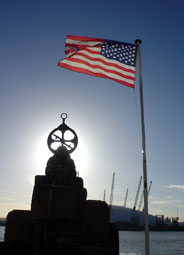
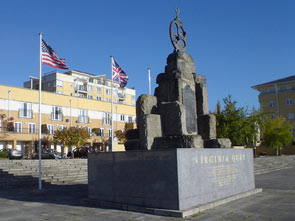
The departure point of that initial 1606 voyage is marked today by a monument beside the Thames. The best way to find it is to take the DLR to East India, then head down towards the river past the brand new Budgens. This used to be dockland, but a vast Barratt's housing estate now covers the site. Walk along the Greenwich meridian and turn left at the water's edge, and there facing the Dome is the First Settlers Monument[photo]. The memorial was once topped off by a stone mermaid, but she got stolen overnight once and has since been replaced by a metal astrolabe [photo]. In fact the whole monument was given a much-needed restoration by Barratt's when they moved on site (I know, who'd have thought) and now stands proud and double-flagged beside the river. [map]
Not that anyone ever comes to visit, as far as I can tell. Mews residents in Jamestown Way may step out of their front doors and stare past the monument towards the Dome, and the odd waterside jogger may occasionally puff by, but this most historic site remains well off the usual American tourist trail. Although today, I think, will be an exception. There are a scattering of quatercentenary events planned, both at here at Blackwall and at the Museum in Docklands, to help commemorate the place where the American dream began.
From near this spot 19 December 1606 sailed with 105 adventurers the 'Susan Constant', Capt Christopher Newport in supreme command. Landed at Cape Henry, Virginia, April 26 1607. Arrived at Jamestown, Virginia, May 13 1607 where the adventurers founded the first permanent English colony in America under the leadership of the intrepid Capt John Smith. (Erected by the Association for the Preservation of Virginia Antiquities)
Before I go any further, I should make the following clear: I have a very big soft spot for the Millennium Dome It'll be great to have it open and accessible again, even as a massive bland "entertainment hub" I still think that The O2 is a bloody stupid name for a building
OK, now let's all giggle at the The O2 website. [Or The O2 as they call it, because the site can't cope with subscripts] Don't giggle at the virtual tour, because that's rather good. Ignore all the stuff about booking tickets too. Let's concentrate instead on the text on the information pages. The following are genuine quotes. Honest. Straight up.
In fact, can I just criticise this map for a minute? How utterly useless and misleading is this map? The main road shown (the A13) doesn't appear to link to North Greenwich because someone has forgotten to draw in the Blackwall Tunnel. The same symbol is used for 'Bus', 'River' and 'TFL' (whatever a 'TFL' is - I think they mean 'tube station'). Some of the DLR is shown, but not all. "East India Docks" (sic) may be the closest DLR station to the Dome, but you'd have to swim across the Thames to reach it. London City Airport has been unceremoniously dumped on top of Bow Creek, with just a small arrow hinting that it's really rather further away. And where do the buses actually stop? There's no clue either on the map or underneath in the text. This is a nigh perfect example of how not to draw a useful map. </rant>
Silver discs(December 1981) A monthly look back at the top singles of 25 years ago
The three best records from the Top 10 (15th December 1981) Human League - Don't You Want Me: Let's define the 1980s in one song. Here it is. Even America succumbed. You nearly didn't hear it, because Phil Oakey wasn't keen. Don't You Want Me was only slipped in as a filler at the end of the League's recently released album Dare, from which three other singles had already been taken. The band only agreed to release it as a single so long as purchasing fans were rewarded with a free poster. As things turned out, the song sold itself. The pounding synth melody. Him singing down to her and her singing back up to him. A tale of Svengali-like fame and ambition. And the catchiest chorus you ever did hear (wooooooah-oh-oh-oh). This song broke all the rules for a Christmas number 1. It hit the top of the charts well before Christmas, it lodged there for a full five weeks, and it kept 'proper' sentimental mush by Cliff Richard off the festive summit. Plus, let's be honest, you love it. That much is true. [video] [TotP] "You were working as a waitress in a cocktail bar when I met you. I picked you out, I shook you up and turned you around, turned you into someone new." Soft Cell - Bedsitter: Following up their storming cover of Tainted Love, now a sudden retreat into the seedy world of backstreet anonymity. The song sounded upbeat enough, but the lyrics and video told a very different story. A lonely life lived out in one room, going through the motions, bereft of hope. No internet in those days, nothing to do, just tuck yourself beneath a grubby eiderdown and wait for Friday. The pointlessness of living for the weekend, earning just enough to blow in one hedonistic 48 hour splurge. The words meant little to me at the time, safely tucked up in my teenage suburban bedroom, but how they would resonate later. A song to cherish and adore, especially for all those of us who've since left that world behind. [video] [TotP] "Clothes and records on the floor, the memories of the night before out in club land having fun. And now I'm hiding from the sun, waiting for a visitor though no-one knows I'm here for sure" Abba - One of Us: For six years the Swedish foursome had dominated the charts. Every song a monster hook and every release a monster hit. This inoffensive ballad to love lost was no exception. But it was to be the very last of their blockbuster smashes. After 18 consecutive top ten hits, the next dribble of new Abba singles would struggle even to reach the top 30. Not that we realised at the time. It was Christmas, and Abba were up there where they belonged. It was the end of an era. [video] "One of us is lonely, one of us is only waiting for a call. Sorry for herself, feeling stupid feeling small, wishing she had never left at all"
The best Christmas record in the world ever Waitresses - Christmas Wrapping: In 1981 the Ze record label in New York put together a Christmascompilation album featuring one track from each of their artists. Cristina contributed, as did Was (Not Was), but it was the shining musical bauble by the Waitresses which really glittered. "Last year, ski shop encounter, most interesting. Had his number but never the time. Most of '81 passed along those lines." Ohio-born singer Patty Donohue half-chanted half-spoke the lyrics - the fairytale story of a single woman on Christmas Eve reflecting on missed opportunities. (W)rap music was still in its infancy, so the band got away with the punny title. "Flashback to springtime, saw him again, would've been good to go for lunch. Couldn't agree when we were both free, we tried, we said we'd keep in touch." In the wrong hands this cheesy backstory would be mushy mawkishness, but instead the tune chugs along with infectious optimism and cheery indifference. Indeed every time I hear this song I never fail to join in, jigging along in time to the sleighbells and reflecting on the joys of year-long singledom. "Last fall I had a night to myself, same guy called, Hallowe'en party. Waited all night for him to show, this time his car wouldn't go." But a happy ending is in store. The all-night grocery store, no less, to which both parties trudge through the snow to buy coincidental cranberries. You never can predict where the bloke of your dreams will appear. "So on with the boots, back out in the snow to the only all-night grocery. When what to my wondering eyes should appear, in the line is that guy I've been chasing all year!" Christmas Wrapping wasn't released as a single until the following year, and sadly never quite crept inside the Top 40 even then. At least the Spice Girls managed to take the song to number 1, as an Anglicised cover version B-side to their last Xmas chart-topper Goodbye. "Then suddenly we laughed and laughed, caught on to what was happening. That Christmas magic's brought this tale to a very happy ending!" But the 'proper' Waitresses version is the festive non-hit single that's refused to die, and is still rightly featured every year on Xmas compilations and radio playlists. May it be part of your Christmas, and mine, forever. "Merry Christmas! Merry Christmas! Couldn't miss this one this year!" those upbeat lyrics(on Chris the composer's blog) listen on YouTube (but don't watch the 'video') full Waitresses band info
20 other Christmas hits from 25 years ago: Begin The Beguine (Julio Iglesias), Daddy's Home (Cliff Richard), It Must Be Love (Madness), Why Do Fools Fall In Love (Diana Ross), I Go To Sleep (Pretenders), Ay Ay Ay Ay Moosey (Modern Romance), Good Morning Universe (Toyah), Cambodia (Kim Wilde), Flashback (Imagination), Rock'n'Roll (Status Quo), Wedding Bells (Godley and Creme), Turn Your Love Around (George Benson), Ant Rap (Adam and the Ants), Spirits In The Material World (Police), Young Turks (Rod Stewart), Stars Over 45 (Chas and Dave), Hokey Cokey (The Snowmen), Footsteps (Showaddywaddy), Yes Tonight Josephine (Jets), Wild Is The Wind (David Bowie) ...which hit's your favourite? ...which one would you pick?
Back in the old days of television, you may remember, men with unfeasibly large sideburns and corduroy jackets would appear on our screens lecturing about sculpture, anthropomorphisms and partial differential equations. They weren't really lecturing us, of course, they were passing on information to eager Open University students scattered all across the country. The "University of the Air" started broadcasting in 1971 with programmes filmed in the historic studios at AlexandraPalace (from which the world's first television broadcast had been made 35 years earlier). There weren't so many hours of 'proper' programmes back then, so the rest of us ended up watching much of the OU's academic output by default. Sunday mornings on BBC2, for example, were always full of bearded discourse and earnest documentaries. These had to be repeated during the week, because video recorders weren't yet commonplace, and so ended up slotted around the schedules (between the test card) at what now seem like unlikely times. Weekday mornings over breakfast, early evening after getting home from school... it's no wonder we remember these programmes so well.
Here, for example, are all the programmes on daytime BBC television on a typical Friday in 1981. Doesn't this take you back?
BBC1 Friday 11 September 1981
6.40 - 7.55amOpen University 6.40 Partial Differential Equations. 7.05 Rhondda 3: A Question of Identity 7.30 North Sea Oil: Taxation 7.55 Closedown
12.30pm News After Noon (& regional news) 1.00 Closedown
1.45 Chigley 2.00 Closedown
3.45 Ymryson Cwm Defaid (sheepdog trials) 4.20 Play School (with Chloe Ashcroft) 4.45 The Space Sentinels 5.05 Rentaghost 5.35 Roobarb 5.40 Evening News (with Richard Baker) 6.00 Nationwide
BBC2 Friday 11 September 1981
6.40 - 7.55amOpen University 6.40 The Curious History of Norethindrone 7.05 Maths: Homeomorphisms 7.30 Maths Across the Curriculum 7.55 Closedown
11.00 Play School 11.25 Trades Union Congress 1981 12.30 Closedown
1.45 Racing From Goodwood 3.45 Closedown
4.50 - 6.55pmOpen University 4.50 A Many-Splendoured Thing? 5.15 Making Light Work Out of It 5.40 The Other Tradition 6.05 Living with Death 6.30 Tunnels and Tunneling
25 years later the OU's students now receive all their video coursework materials either on DVD or online. The computer has become the new medium of communication and learning, so the old TV broadcasts are no longer required. I guess that's only fair, but I'm sorry to see these academic nuggets disappear. In my youth I learnt a lot from OU programmes I wasn't really supposed to be watching. And today's bored teenagers will never get the chance to accidentally discover group theory or Wittgenstein over their cornflakes, as explained by a style-free professor in a wide-lapelled shirt and kipper tie. Their loss.
The Piccadilly line is 100 years old today. Not that it was called the Piccadilly line to start with. The line originally went by the less catchy name of The Great Northern, Piccadilly and Brompton Railway, because it had been created from plans for two completely separate tunnelling projects. One of these went east-ish from Hammersmith to Piccadilly Circus, the other south-ish from Finsbury Park to Aldwych, with an extra tunnel built inbetween to link the two together. The financial mastermind behind the line was American tube entrepreneur C.T. Yerkes, who was also responsible for construction of the Bakerloo and Northern at around the same time. David Lloyd George, then President of the Board of Trade, opened the brand new railway on Saturday December 15th 1906. The new trains were painted crimson red, with tropical yellow upholstery, and shuttled 9 miles from suburb to suburb. The quintessential London tube line was open for business.
The Piccadilly line is 100 years old today. Not that TfL have put on a big show. They've baked a cake. They've produced quite a nice leaflet, which you might maybe be able to find at certain Piccadilly line stations. They've placed commemorative posters in certain trains. They've rustled up a wholly unimpressive webpage with links to some nice arty bits. And there's an exhibition of Piccadilly line photography opening at the Riverside Studios in Hammersmith on Monday, and moving to City Hall in January. It's not much, but it'll have to do. Take your pick.
Brompton Road station Station opened: Saturday 15th December 1906 Where on the tube map? Between South Kensington and Knightsbridge (station 7 here) Distance from South Kensington station: 500m northeast Distance from Knightsbridge station: 700m southwest Location: on Cottage Place near its junction with Brompton Road [map] Alight here for: the Brompton Oratory, the large domed Catholic basilica which stands opposite the station entrance. It's well worth a look inside just to gawp at the glorious ostentation of the interior. Marvel at the intricate decoration, the elaborate side-chapels, the tall marble columns, the vaulted roof, the whole overbearing experience. Forgive me, I may possibly be underselling the magnificence of the building. And, for someone like me unused to Catholic spaces, it's strange to be surrounded by so much pious public activity. There are candles to be lit, and stone bowls like birdbaths for dipping hands in, and hassocks to kneel on, and altars for genuflecting in front of, and a series of wardrobe-sized wooden cabinets each labelled with the name of a father confessor. I felt appropriately awed, and duly welcome, but not quite as if I belonged. Also alight here for: the Victoria and Albert Museum, just down the road. Rather quicker than walking through the long subway from South Kensington, anyway. Station building designed by: Leslie W Green, as were so many of the other 1906 Piccadilly line stations A bit of history: The station was never busy, being a bit too close to its neighbouring stations to be worthwhile. Even as early as 1909 not all Piccadilly line trains bothered to stop here, and "Passing Brompton Road" became a bit of a joke, even immortalised in West End lights. A new southern exit from Knightsbridge station, close to Harrods, provided the last nail in the station's coffin. Station closed: Monday 30th July 1934 What happened next? The station, along with liftshafts and various underground passageways, was used during World War Two as the capital's Royal Artillery's Anti-Aircraft Operations Room. This use was discontinued in the 1950s. The surface building is still owned by the military and is currently used as the London HQ of the University of London Air Squadron. What's the station like now? It's quite innocuous, really [photo]. You'd probably never notice the station frontage up a sidestreet if you were walking up the Brompton Road because this was only ever a tiled facade, never a separate building in its own right. It remains as elegant as before, but now surrounded by more ordinary modern buildings and with an extra nondescript storey layered on top. The station door is firmly locked, with a pushbutton answerphone to one side for air force admittance. Press 3 for ATC Wing HQ, 8 for ULAS Sqn Adjt and 5 for a Mess. What's outside? Sandwiched between the station and the Oratory is a cut-through alley with three parallel grey pathways. The well-heeled of Kensington walk up and down, shuttling between posh shops and their even posher villas beyond. Ladies are usually impossibly well coutured, and botoxed within an inch of their lives. But they're not too proud to allow their exercising hounds to defecate on the weedy strip of grass in front of the old station, and then scoop up the offending excrement in a plastic bag. Delightful. What can you still see from a passing train? Not much, because the platforms have been bricked off. All you'll see as your train passes through the disused station is the tunnel wall changing from black to brick and back to black again. What does the station look like inside? There's a very informative page with photographs here. Will the station ever be reopened? Not a chance.
The Piccadilly line is 100 years old tomorrow (or at least the central section is). The following Piccadilly line stations are therefore 99 years, 11 months and 29 days old today. Maybe you'll be making a centenary visit to at least one of them tomorrow. I know I will.
Hammersmith, Barons Court, Earl's Court, Gloucester Road, Knightsbridge, Hyde Park Corner, Dover Street (now Green Park), Piccadilly Circus, Leicester Square, Holborn, Russell Square, King's Cross, Caledonian Road, Holloway Road, Gillespie Road (now Arsenal), Finsbury Park.
Two other Piccadilly stations opened on that same day in December 1906, but closed long before their 100th birthday. Just for a change we're not talking DownStreet (opened March 1907) and we're not talking Aldwych (opened November 1907). We're talking two other forgotten stations, through which modern trains regularly rumble, but neither of which have seen a passenger in more than 70 years. Here's one of them, and I'll visit the other tomorrow...
York Road station Station opened: Saturday 15th December 1906 Where on the tube map? Between King's Cross and Caledonian Road (station 5 here) Distance from Kings Cross station: 650m north Distance from Caledonian Road station: 1.3km south Location: on the corner of York Way and Bingfield Street [map] Named after: York Way, which used to be called York Road Lying almost on top of: the main railway lines north from Kings Cross station, just as they emerge from the first tunnel Station building designed by: Leslie W Green - with one of his iconic crimson-glazed arched frontages A bit of history: York Road station was never busy, being a bit too close to Kings Cross to be really worthwhile. Even as early as 1909 many Piccadilly line trains no longer bothered to stop here. Sunday services were withdrawn in 1918. Station closed: Monday 19th September 1932 What's it like now? The station building still stands, severed from its neighbours, aloof and alone like an old mausoleum [photo]. The facade's still in pretty good shape, the tiles remain a satisfyingly deep ruby red, and the words "YORK ROAD STATION", "ENTRANCE" and "EXIT" are still clearly visible across the front [photo]. There's now a big metal fence around the building, and a high padlocked gate to the left which may one day need to be used as an emergency exit from the station below. A lonely bus stop lurks on the pavement outside, from which there are surprisingly good views across the bleak openness of the Kings Cross Railway Lands. It's still easy to see why the local passenger trade never took off. York Road is rather more astonishing than any abandoned tube station deserves to be, to be honest, just by still being here. What can you see from a passing train? Keep an eye out of the right-hand window and you may spot a platform-sized cavity, but with the platform itself removed. As an added treat for southbound travellers, a small patch of wall is visible revealing the station's original maroon and cream tile design. What does the station look like inside today? There's a highly informative page with photographs here. Will the station ever be reopened? Maybe. Local councillors certainly hope so. There is an awfully long gap on the Piccadilly line between Kings Cross and Caledonian Road, and nowhere to get off. The best chance for a reopened station comes through redevelopment brought about by the controversialKings Cross Central project just across the road, sometime in the distant near-future. But probably not. New residents and office workers will have to get the bus like the rest of us.
Double Time: It's a bit of a diamond geezer special in the latest edition of Time Out (available from all good newsagents in the London area) (not necessarily available from all good newsagents in the rest of the world). First of all there's the latest of my "London journeys" in which I take a premature ramble along the last mile of the 2012 Olympic marathon (you've got just seven months left to follow in my footsteps). And then there's a whole page of my favourite tube lists (most of which you'vealreadyreadhere) as part of the magazine's "London lists" cover feature. It's all a bit much, really.
So that my online audience doesn't feel left out, and to provide added value for readers of the magazine who may have clicked along, here's some extra background stuff for both articles:
The route of the London 2012 marathon Start: Tower Bridge Then three laps of the following circuit: past the Tower of London, along Lower and Upper Thames Street, down Queen Victoria Street and along the Victoria Embankment, opposite the Eye, beneath Big Ben, round Parliament Square, up Birdcage Walk, past Buckingham Palace and back up The Mall, through Trafalgar Square, along the Strand, down Fleet Street, up Ludgate Hill past St Paul's, round to the Bank of England, up Cornhill, along Leadenhall Street past the Lloyd's building and the Gherkin, down Minories Then a straight run up the A11: round Aldgate, along Whitechapel Road, along the Mile End Road, beneath the Green Bridge, along Bow Road, past my front door, over the Bow flyover And finally the last mile of the marathon: Along Stratford High Street (new property hotspot), turn left onto the Greenway (jogging atop a sewer), cross the Waterworks River (through security turnstiles), over the London to Norwich railway line (via an as-yet unbuilt footbridge), through the remains of Thornton Fields railway sidings (major Olympic Park thoroughfare), cross the City Mill River (across yet another new bridge) Finish:theOlympicStadium (on the site of Marshgate Lane Industrial Estate).
1) Tube station apostrophes with: Earl's Court, King's Cross St Pancras, Queen's Park, Regent's Park, St James's Park, St John's Wood, St Paul's, Shepherd's Bush without: Barons Court, Canons Park, Gants Hill, Golders Green, Knightsbridge, Parsons Green, Rayners Lane
2) How many carriages in each train? four: East London, Waterloo & City six: Circle, District, Hammersmith & City, Piccadilly, Northern seven: Bakerloo, Jubilee eight: Central, Metropolitan, Victoria
3) Deep level stations with exit by lift or stairs only: Belsize Park, Borough, Caledonian Road, Chalk Farm, Covent Garden, Edgware Road (Bakerloo), Elephant & Castle, Gloucester Road (Piccadilly), Goodge Street, Hampstead, Holland Park, Holloway Road, Kennington, Lambeth North, Lancaster Gate, Mornington Crescent, Queensway, Regent's Park, Russell Square, Shadwell, Tufnell Park, Wapping
4) Stations where Metronet have just this week started ripping off all the tiles in preparation for an 18 month refurbishment programme: Mile End (god help us)
5) 100-year-old tube stations (first opened in mid-December 1906): Arsenal (as Gillespie Road), Caledonian Road, Finsbury Park, Green Park (as Dover Street), Holborn, Holloway Road, Hyde Park Corner, Knightsbridge, Leicester Square, Russell Square [which may give you a clue to what I'm writing about tomorrow...]
Predicting the present: 12 years ago, in an end-of-year mailout for friends, I put together a month-by-month diary of the future. I started by predicting daily events in January 1995, then jumped ahead to February 1996, then March 1997, and so on. And the final month in my prophetic diary was December 2006. It seemed impossibly far away at the time, but now this future has finally arrived. So I thought I'd take a look back to see how good my predictions were. Twelve years ago, what was I expecting to happen this month? Here's my Christmas 1994 view of what Christmas 2006 might bring...
December 2006 Fri 1: World AIDS Day - still no cure, now three world leaders dead Sat 2: World Computer Virus Day - most hardware now infected Sun 3: All this year's National Comedy Awards won by politicians Mon 4: Chunnel rail link opens (but no trains run in the UK any more) Tue 5: This year's Drink-Drive campaign targets 14 year olds Wed 6: Weather forecasting is now 99% accurate 20 months ahead Thu 7: Next year's diaries now include sunshine and rainfall forecasts Fri 8: Wimbledon next year shifted to late August when it's dry Sat 9: Ashes tour moved to early July so it'll be sure to be rained off Sun 10: Sonic the Hedgehog wins Sports Personality of the year Mon 11: Blue Peter lights 1st fibre optic cable on Advent coathanger Tue 12: Only 13 QVC shopping days to Christmas Wed 13: Britain, alas, is no longer at the centre of world affairs Thu 14: World War 3 breaks out over Pacific oil drilling rights Fri 15: Japan, China, Australia & California wiped out in 8 hrs flat Sat 16: Nobody in Britain minds being insignificant any more Sun 17: Sudden shortage of cheap plastic toys this Christmas Mon 18: UK passport replaced by microchip brain implant Tue 19: Bernard Matthew Nut Roasts are top seller this Christmas Wed 20: All Christmas cards must now carry a Govt Health Warning Thu 21: The Stone Roses finally release their third album Fri 22: It's a traditional commercialised overpriced tacky Christmas Sat 23: Cliff Richard has this year's number 1 Xmas CD-ROM Sun 24: Last e-mail posting date for Christmas cards Mon 25: Nuclear fallout leads to first White Christmas since 1970 Tue 26: Channel 98 wins Xmas TV ratings war with 37000 viewers Wed 27: Chitty Chitty Bang Bang repeated on satellite TV all day Thu 28: 3 turtle doves, 2 French hens & partridge shot on royal hunt Fri 29: Vivienne Westwood launches new Man Utd strip, £89 Sat 30: Medical advances mean death is now only 95% fatal Sun 31: Archbishop of Canterbury gives her New Year message
1) I'm an affluent white male and I never use the post office, so neither will you. 2) If your village post office closes down there's sure to be another within a ten mile drive. It's no real hardship to hop in your car! 3) Small post offices aren't financially viable. And they only exist to make a profit, so we have to shut them down. 4) You can always buy your stamps in advance. They sell books of stamps at the till in Waitrose, you know. 5) Get someone to buy you a stamp machine for Christmas. You know it makes franking sense. 6) The new size and weight related postal charges are extremely simple to understand, so there's no way you'll ever need to go along to a post office in person to check you've paid the correct postage. 7) Why not catch a bus to your nearest post office? All buses were privatised several years ago too, so market forces mean there's bound to be a frequent service going in the right direction, leaving soon. 8) Gathering together in village post offices doesn't breed a sense of community, it breeds germs. Go home and don't breathe over me. 9) Instead of wasting the earth's resources on paper, send the other person an email instead. It's so easy even my grandmother could do it, if she had a computer. 10) Walk to the main post office in your nearest market town, why don't you? It can't be far down that pavement-less country lane, even with a zimmer frame. 11) Look, they've stopped post offices from issuing TV licences, and you can now apply for passports online, and they're withdrawing the Post Office Card Account, so why the hell would you want to go to a post office anyway? 12) We all need to take more exercise. A vigorous ten mile round trip to your new local post office will help to cut heart disease. 13) Why don't we shift all these endangered post office counters into one of the other shops in each village? There's a lovely antiques shop in my village which I'm sure would be glad of the custom. 14) Doesn't everybody do their banking on the internet these days? I know I do. 15) What our smaller post offices need to do is diversify. Sell newspapers, brew coffee, run an internet cafe, install a cashpoint machine, that sort of thing. 16) All those redundant postmasters and postmistresses will easily be able to find new jobs in the thriving rural economy. If all else fails there's always eBay (except they may find it difficult to post their parcels...) 17) Stop moaning. At least we're not shutting down your local organic farmers' market. Now that would be ghastly. 18) We could cut down the number of post offices to just one per county. OK, so the queues might be a lot longer, but we're British, we'll cope. 19) Stop getting all emotional about a service you never use any more. When was the last time you actually stepped inside a post office, eh? 20) Come to think of it, why don't we scrap daily postal deliveries too? The postal service would be much much cheaper if everyone had to go to their nearest sorting office to collect their mail. I mean, most of it's junk anyway. And you can always send the au pair on your behalf, can't you?
I can't decide whether it's... a) pointlessly addictive b) the welcome return of simple one-thought blogging c) a means of seeing whoselifeismoreinteresting than your own d) an online surveillance tool for stalkers e) all of the above
Yesterday's closure of part of the North London line isn't such grim news for East End travellers as you may have thought. Local residents will still be able to get around, almost as easily, using alternative rail transport[map]. The Jubilee line already duplicates the NLL between Stratford and Canning Town, and the DLR does the same between Canning Town and Custom House. There's no direct service replacement at either Silvertown or North Woolwich stations, but both are sited very near to the new DLR City Airport extension that opened twelve months ago [photo gallery]. Oh yes, this has all been carefully planned, this has. And the newly-disused NLL tracks won't be wasted either, oh no, because there are plans to run new services along those at some time in the near future. As follows:
Closed section 1: North Woolwich → Canning Town Should reopen as part of: Crossrail One day, maybe, the Government will decide to give the go-ahead to the Crossrail project. Not just a general statement of support with due funding to be provided when the time is prudent, but a big green light with all the money up front. If that day ever comes, then the far end of the North London Line may live again. One of Crossrails's two eastern branches (the one through Canary Wharf) is due to pass this way, and reusing a stretch of old track will be much cheaper than digging new tunnels. Big chunky Crossrail trains will emerge through a new portal just to the west of Custom House station, where a stonking big island platform will be built on the site of the current NNL platforms. The Crossrail route will then follow the just-closed NLL line through the Connaught Tunnel to Silvertown, where the old station and footbridge will be quietly demolished. Finally, a few hundred yards before North Woolwich station, another new tunnel opening will be dug so that Crossrail can head beneath the Thames to (maybe) Woolwich and (definitely) Abbey Wood. So (probably maybe) this end of the North London line will live again, in shiny 21st century form, but with none of its existing stations intact. latest Crossrail news simple Crossrail map complicated official Crossrail mapsand planning documents
Closed section 2: Canning Town → Stratford Will reopen as part of: Docklands Light Railway The DLR continues to extend its twintrack tentacles across East London. Its next target is the new Eurostar international station at Stratford, which will be linked by rail to the existing Stratford station in 2010. New DLR trains will arrive at the low level platforms, currently occupied by the North London Line, before continuing south along the old NLL tracks to Canning Town. Three new intermediate stations will be constructed along the way, including one at "Abbey Road" (which should confuse Beatles-seeking tourists). From Canning Town services will continue on to either Beckton or Woolwich Arsenal (via City Airport), which means that through services to the Silvertown area will once again be restored. Trains will stop more frequently and take a little longer to arrive, but they'll also run more often and be a great deal more pleasant to travel in. official DLR extension information (with maps) latest DLR extension news NLL transfers to DLR(today's press release)
How to travel from Woolwich to Hackney Wick Yesterday: Take the ferry or foot tunnel across the Thames. Walk a few hundred yards to North Woolwich station. Wait up to 30 minutes for the next train. Ride all the way to Hackney Wick. Today: Take the ferry or foot tunnel across the Thames. Walk 356 extra metres to the DLR station at King George V. Wait up to 10 minutes for the next train. Ride to Canning Town. Descend to lower platform. Wait a few minutes for a Jubilee line train. Ride to Stratford. Exit through ticket barriers. Walk to platform 1 (or cross to platform 2 via escalator, bridge and stairs). Wait up to 15 minutes for the next NLL train. Ride to Hackney Wick. In 5 years time: Enter Woolwich Arsenal station. Wait up to 12 minutes for a DLR train to Stratford International. Ride to Stratford. Alight at low level platform. Cross to new NLL platforms on northern side of station via long subway. Wait up to 8 minutes for an "Overground" train. Ride to Hackney Wick.
Tonight, just after eleven o'clock, a purple and yellow train will set off from Stratford on the last ever return journey to North Woolwich station. No doubt it'll be packed full of gentleman who like riding on 'last ever' trains, adjusting their after-dark camera settings to grab a final historic photograph. For once in its life, during the minutes leading up to its demise, this runty end of the North London Line will actually be busy. But to experience the true nature of this forgotten railway you really had to be here before today, back when this line was nothing special going nowhere much. On with the journey...
the Connaught Tunnel: A short narrow canal is all that links the Royal Victoria Dock to the Royal Albert Dock, so it's here between the two that the North London line dips underground to cross beneath the water. From here down to North Woolwich this becomes a single track railway, with the old second line through the tunnel now overgrown and impassable. The train passes beneath a series of low stone arches before plunging into damp brick blackness for just over a minute, emerging eventually into a different world. Welcome to...
Silvertown: The name suggests some shiny futuristic utopia, but that's a long way from the truth. The deserted station is a dead giveaway [photos]. A single platformed halt beside a barely-open ticket hall, built optimistically in 1963 for a workforce who've long since faded away. One industrial behemoth remains by the riverside - the giant Tate and Lyle refinery [photo]. Once the largest cane sugar refinery in the world, now the home of (and I quote) "a world leader in renewable ingredients". The company remains at the heart of the local community, although there's not much local community left. A few short leftover terraces stack up side by side across the footbridge on the opposite side of the railway. You might (or more probably might not) want to pop into Cundy's Tavern for an ale, or nip into Terry's Cafe (still adorned with 071 telephone number) for a cuppa. Or just stay on the train. Nearly there now. Silvertown station - a history with photos Silvertown life - some great old postwar photos, plus Stan's 69 page autobiography Silvertown - site of London's biggest ever explosion
The last mile down to North Woolwich makes for a strange finale. The railway line runs sandwiched between two parallel roads, neither connected to the other, just a thin strip of green dividing industrial estate from housing estate [photo]. Several new businesses have moved in beside the river, from the Loon Fung wholesale warehouse (complete with ornate Oriental gateway) to a concrete field of big white satellite dishes. A single frail footbridge connects river-side to dock-side (expect it to be chock-a-block with zoom-lensed photographers today). Inland are highly typical East End houses, some modern and council-built, some high-rise and low rent, others handed down from dock worker to unemployed son. England flags flutter from these windows even when no World Cup is on the horizon. But the streets have almost no depth, stretching back only a few hundred yards before the Royal Albert Dock cuts them short. The area is both remote and isolated, and this old railway was once its lifeline. [photos]
North Woolwich: And finally, the single track curves slightly towards the Thames to end at buffers beside a lamplit platform [photo]. Expect a handful of hardy souls to exit the train [photo] and wander dolefully towards the ticket hall [photo]. This is rarely open, so everyone passes instead through an undignified side gate out into the street. To the left is the original terminus building opened in the 1840s, now home to the North Woolwich Old Station Museum [photo]. Admission to this compact collection of railway memorabilia is free, but time your visit carefully because the museum's rarely open either. Most passengers exiting the station aren't locals. They're walking the short distance to the Woolwich ferry, or perhaps the Foot Tunnel, for onward connections to southeast London [photos]. Even the questionable delights of Woolwich are more attractive than the mean streets of North Woolwich, so it seems. There's not much more to investigate on this side of the river than a parade of shops and a waterside park, and a few leftover dock buildings, and (if the tide's right) some steps down onto the 'beach'. It's probably a good idea to head straight back to the deserted station before the train driver swaps ends and pulls off back towards Stratford [photo]. Atmospheric though the platform may be, you don't want to have to wait half an hour for the next service. Or maybe forever. North Woolwich station - a history with photos Rail shots fromNorth Woolwich and Silvertown Last train to North Woolwich - flickr group
The North London Line is a railway curiosity. It's the only National Rail line to be given prominence on the tube map. It winds around the less fashionable parts of the capital's northern suburbs, taking the most indirect route possible from west to east [map]. The trains are overcrowded, underfunded and infrequent, which means nobody travels this way unless they have to. And tomorrow, exactly one year to the day after the demise of the Routemaster, the North Woolwich end of the North London Line closes down forever. From Sunday NLL trains will run only from Richmond to Stratford, and the remainder of the track will be mothballed. It's au revoir to West Ham, adieu to Canning Town, cheerio to Custom House, goodbye to Silvertown and farewell to North Woolwich. Here's part one of a two-day tribute.
Last train(9th December 2006)
North Woolwich
23:37
Silvertown
23:39
Custom House
23:43
Canning Town
23:46
West Ham
23:48
Stratford
23:53
(where this line terminates)
The past 1846: The Eastern Counties and Thames Junction Railway opens between Stratford and Canning Town, for the transport of coal to Bow Creek. 1847: The line is extended from Canning Town to North Woolwich, alongside the river. 1855: This new stretch of line is diverted inland via Custom House to avoid having to pass over a swingbridge across the new Royal Victoria Dock. The original stretch of line is retained as the "Silvertown Tramway". 1880: Another Thamesside dock opens - the Royal Albert - so the line between Custom House and Silvertown has to be diverted into a new tunnel beneath the basin. the rest: It's really very complicated. More here.
The present Stratford (Low Level): The North London line cuts through shiny Stratford station like an open wound. If only the tracks weren't there, you could nip straight across from the Jubilee line to the exit without needing to negotiate the current escalator assault course. But no, platforms 3 and 4 are still in the way [photo]. The southbound platform, for all stations to North Woolwich, is usually much quieter than its Hackney-bound counterpart opposite. A ragbag handful of passengers wait patiently for one of two trains an hour to curve into view and glide beneath the bridge [photo]. On arrival each purple train disgorges a never-ending stream of passengers, all keen to escape into the welcoming arms of Stratford station. Anything but continue down the line to somewhere insignificant and underdeveloped. Climb on board, against the flow, and you'll easily find a seat amongst the discarded newspapers and general detritus of the departing hordes [photo]. The edge of civilisation is less than a quarter of an hour away.
West Ham: From Stratford south the North London line follows the route of the Jubilee extension. Or rather it's the other way round, because the the NLL was here 150 years earlier than the upstart Jubilee. In a pattern which will be repeated right along the line, there are rows of very ordinary houses to your left balanced by a much more industrialised landscape to your right. At West Ham a long narrow platform juts out from a brick-supported glass girder. It's not as luxurious as the Jubilee platform opposite, more an exposed forgotten backwater with distinctly uncomfortable sloping wooden benches. [photo]
Canning Town: Down the line at Canning Town the North London platform is slightly less intimidating, but just as isolated [photo]. All the action is on the unique double decker platform opposite, with the DLR whirring by on top and the Jubilee line below [photo]. NLL passengers could sit and wait for up to half an hour for a North Woolwich train, while across the tracks there's action a-plenty every couple of minutes [photo]. This unique vantage point will be lost after tomorrow, although you'll still be able to get a not quite as good view from the modern bus station next door. Anybody still on the train travelling eastwards? Not many.
Custom House: Now the NLL follows the Beckton branch of the DLR, east into the heart of "The Royals". Once desolate marshland, the docks here thrived during the late 19th century but couldn't survive the 20th. The most obvious sign of the recent regeneration of the area is the hu-uge ExCel exhibition centre, opened in November 2000, and accessible from the station via a series of concrete walkways. These cavernous exhibition spaces specialise in trade shows and major 'events', only a couple of which I've ever thought interesting enough to visit. And almost all of the visitors arrive either by car or on the DLR, not via the poor old North London Line. This stutters on apologetically eastwards, before veering south round Prince Regent station and into the arched gloom of the Connaught Tunnel. <journey continues tomorrow>
Remember this photo of Stratford's mis-timed Olympic countdown clock? Alerted by my post, tonight's Evening Standard and London Lite have taken the story one step further. Read the full article here. One of their reporters has contacted Newham Council, who have now apologised...
"It's very disappointing for this to go wrong when we are trying to get it right. It is something we are aware of. This is something people rely on and the countdown message is important for Newham residents. It's a symbol that needs to be got right. It's very frustrating. We wanted to do something that was simple but it has turned out to be tricky. It's a bit like the Games itself."
...and blamed the software company who installed the countdown timer two years ago...
"A spokesman for the council said the mix-up occurred after officials wanted to update the written message thanking the people of east and southeast London for their backing of the successful bid. They discovered the company had gone out of business and so engineers were brought in to try to change the message but succeeded only in altering the time."
So, there you have it. The whole thing's been a semi-amateur well-meaning typically-British balls-up. I wonder how long it will take the council to fix it, now that they know we know it's wrong. That's the power of blogging.
"The Circle, District, Hammersmith & City and Metropolitan lines will get new air-conditioned trains from late 2009."[pressrelease] good: And about time too. There's nothing tube travellers complain about more in the summer than sweaty overheated tube carriages. And now it'll be lovely and cool, like a New York apartment. bad: But for the other 10 months of the year, air conditioning really isn't very important at all, and tube passengers have completely different grumbles. bad: But air conditioning is only being introduced on four of London's twelve tube lines - the ones in the shallowest tunnels - and not the deep level lines where all the sweatiest sweat is. bad: But aircon won't be arriving until late 2009, so that's another three record-breakingly sweltering summers to survive unaided. bad: But it's only the Metropolitan line which gets new air-conditioned carriages in 2009. The rest of this rolling stock upgrade doesn't start until 2012. bad: But the full fleet of 190 ice-cool trains won't be in place on these four lines until 2015, by which time we may all have died from overheating.
"Trains on the Circle and Hammersmith & City lines will increase in size from six to seven carriages, an overall capacity increase of 17 per cent." good: And about time too. Current 6-carriage trains always stop short of the end of the platform, leaving hordes of passengers rushing forward to cram into the last doors of the rear carriage. There'll be less pushing and shoving in future. bad: But 16 of the platforms on the Circle and Hammersmith and City lines are going to be too short for these new longer trains. Either somebody's got to find the money to extend them (and we've got to put up with long-term engineering works) or some of the doors on the new trains will have to stay shut when they pull into the shorter stations. bad: But the new 7-carriage trains won't fit into some of the existing railway sidings. The sidings at Farringdon, for example, only just fit 6-carriage trains, and will be useless come 2015.
"Train interiors will be larger thanks to a new seating layout and door design. This will help ease congestion."[pictureshere] good: And about time too. The new carriages will be able to carry 9% more passengers, which means fewer people left standing on the platform. bad: But if there's more space, then something's got to be removed to make room for it. And what's being removed are several of the seats. "More capacity" really means fewer people sitting and more people standing. bad: But at the moment every train on the Metropolitan line has a nominal 448 seats. The new trains will have only 307 individual seat places. If you're commuting for over an hour all the way from Amersham into town, that lack of seats is really going to hurt. Perhaps not surprisingly, Metropolitan commuters are seething. bad: But the new seats will be hard plastic things with thin cushions, and not the comfy upholstered seats passengers are currently used to. bad: But there are overhead luggage racks and coat hooks in today's Metropolitan carriages, and none of these will be replaced. Where is Chorleywood Man supposed to store his briefcase and brolly now? bad: But the needs of the long distance Metropolitan commuter are completely different to the needs of the one-stop Circle line user. Why should all these new trains have to use the same carriage layout?
"Trains will have wide aisles and an end-to-end walk-through design" good: And about time too. There'll be space for wheelchairs and luggage and pushchairs, which can only be a good thing. And better security too, because you'll be able to see all the way from one end of the train to the other and need never feel isolated. bad: But that'll just make it easier for rag week students, buskers with accordions and gangs of muggers to work their way down the entire train seeking money and valuables. bad: But you know what the articulated interior design of these new trains really reminds me of? Bendy buses. Cavernous seat-lite bendy buses. Giant walk-through people carriers for the mass movement of human cattle. A lowest common denominator travelling experience, coming soon to a railway line near you.
"Better signalling means the upgrade will deliver 21% more trains per hour on the busiest sections of the upgraded lines." good: And about time too. More frequent trains can only be a good thing. There'll be 5 extra trains an hour to Uxbridge, for example, and as many as 34 trains per hour on the south side of the Circle/District line. Hurrah!
"The work will be undertaken by Metronet." bad: It'll be a bloody disaster, then.
Why do people insist on buying things twice? Maybe not quite in the same format every time, but the same thing nonetheless. You've probably even done it yourself...
"Look, I've upgraded my entire vinyl collection to cassette. Hear how much better it sounds." "Look, I've upgraded my entire cassette collection to CD. Hear how much better it sounds." "Look, I've bought all of my favourite band's singles again, on this compilation album." "Look, I've bought exactly the same compilation album again because it has a different cover and two bonus tracks." "Look, my favourite band has remastered all my favourite albums - I must buy them all again." "Look, I've downloaded all my favourite songs from my teenage years off iTunes." "Damn, my hard drive failed, I'll have to download all my favourite teenage songs off iTunes again."
More recently we've started doing it all again, but with sound and vision. We'll pay to see a good film at the cinema and then pay for it again on DVD so we can watch it in our own homes. It may be a different experience, with added bonus extras, but underneath it's exactly the same story for twice the price. And then there are TV series. We pay our licence fee to watch them "for free" but, because we're a bit useless at setting the video recorder, we often end up buying an entire series on DVD so that we can watch it at our own convenience (or, more likely, leave it on the shelf for a rainy Sunday afternoon and then never quite get round to it). It all adds up.
And now the entertainment industry wants us to buy our TV programmes yet again, but via different media. Television replay services are destined to be big, so the major players hope, be it by satellite, by broadband or by mobile phone. They'll record all your television for you, to save you the effort, and you can pay them extra to watch just the bits you want to see. Like the newly-announced service from BT Vision, for example. An engineer will come round and install a broadband box, at a price, which will let you enjoy all the Freeview channels you can already watch. If there are no cute animal documentaries playing live then you can watch streamed meerkats for just £1.99. If the videos playing on the existing music channels are boring, buy a PIN code to unlock the video of your choice for 29p. Did you miss last night's Ramsey's Kitchen Nightmares on Channel 4? Don't worry, BT recorded it and you'll only be charged 99p for the privilege of viewing it. And just how many times can you watch Pulp Fiction in 24 hours? It's only £2.99 to find out.
"Did you see that great TV programmeaboutbloggers on BBC1 last night?" "No, I'm watching it on my computer next Tuesday."
It might all come to nothing. I mean, nobody yet whips out their mobile to watch the X-Factor on the bus down to the pub on a Saturday night, do they? And people won't really fork out £5 to watch an hour of the latest music videos, will they? As we become spoilt for choice, we're in danger of swapping quality for convenience. Paying for video content doesn't necessarily make it better than the stuff we can already watch for free. But we'll probably all fall for it, and the entertainment industry will rub their hands together at screwing us over once again. Pay twice, watch once - that's the future if we're not careful.
My top 10 favourite places I've been to the top of (in no particular order)
1)Helvellyn (Lake District): Much easier to reach from the roadside than land-locked Scafell Pike, and the views are better too. From the top of England's third highest mountain there's an especially fine panorama out across Ullswater, Thirlmere and the green peaks of Lakeland. I particularly enjoyed the exhilarating ascent via the razor-sharp ridge of Striding Edge, with a sheer scree drop to either side. But tread carefully. [Visited: 1982] [map][photos] 2)Gherkin (London): The rarity of this "Open House" ascent made the 3½ hour queue worthwhile, and the view across London from the pointy-topped 40th floor was quite spectacular. Apart, that is, from the reflection in the west windows of the white tablecloths in the restaurant on the floor below - serious design error, folks. [Visited: 2004] [report][my top floor photos] 3)Corona Heights (San Francisco): It's not the most well-known seismic upthrust in the Bay area, but this rocky outcrop affords a splendid close-up overview across downtown. Just behind you, the sanatorium featured in Hitchcock's Vertigo. And do try to ignore the dogs relieving themselves on the scrappy patch of grass below. [Visited: 2002] [map][photo][view] 4)CN Tower (Toronto): The world's tallest freestanding structure was only a month old when my family took the lift to the summit, 1815 feet above Lake Ontario. I wish I'd had the guts to stand on the thickened glass in the floor of the observation deck, but I was much littler and scaredier then. [Visited: 1976] [map][photos] 5)St Paul's Cathedral (London): What, you mean there's another staircase above the Whispering Gallery? And then another less solid-looking set of steps inside the Dome right up to the very top beneath the golden ball? I never realised. All hail Sir Christopher! [Visited: 2003] [visit][view] 6)Eiffel Tower (Paris): The more you pay, the higher you get. I paid my francs and then monté dans l'ascenseur au troisième étage. But I really wasn't expecting to have to change lifts on a tiny platform halfway up the long thin neck of the tower, which made for an interesting mid-air experience. I've improved my French since. [Visited: 1980] [website][webcams][photos] 7)Glyder Fach (Snowdonia): Forget Snowdon (I climbed that in thick fog, so I'm biased). The view you really want is from the top of the Devil's Kitchen, above Llyn Idwal, at the dogleg bend in the deep glacier-cut valley of Nant Ffrancon, in broad backlit sunshine, looking out towards Anglesey. Mere words can't do it justice. [Visited: 1985] [map][views] 8)Beckton Alp (East London): The Thames Estuary is almost uniformly flat, so this old slagheap beside the A13 provided the only decent opportunity to survey East London from above. The artificial ski-slope here closed down several years ago, but they didn't quite fence off the summit properly and so I managed to scramble to the top one overcast afternoon. Ah, to stand all alone amongst the twisted metal remains of a downhill slalom, King of all I surveyed. Unexpectedly life-affirming. [Visited: 2004] [map][history][report][photos] 9)Empire State Building (New York): Manhattan's most glamorous observation deck, thrusting proudly above an astonishing forest of steel and glass. I just wish I'd visited a year earlier when the view downtown was still complete. [Visited: 2002] [website][old photos][new photos] 10)My last workplace (London): Somehow going to the office every day was less of a hardship when my top floor view crossed the treetops of Green Park. When I wasn't staring at my computer screen I could stare instead at Big Ben, Westminster Abbey, the Eye, Battersea Power Station, passing helicopters and even Crystal Palace transmitter in the distance atop the rolling southern foothills. Since relocation, alas, my view is of a brown brick wall.
In the latest January edition of DG magazine... The New Year Detox Diet Resolve yourself fitter! Faces to watch in '07 Available now in your local newsagent
What is it about monthly magazines? Why do so many of them insist on running a month ahead of reality? Do they really think we're so stupid that we won't buy a magazine dated 'December' in December in case we think it's an old copy? Alas, yes.
Pop down to your local newsagent and you'll find the January editions of several of Britain's favourite magazines on sale already. The January 2007 edition of Q magazine was published last Friday, the January copy of Empire has a cover article previewing "2007's darkest sequel" and January's FHM boasts "20 new sex tips for 2007". Even Practical Caravan, Cross Stitch Crazy and Classic Tractor have their January editions on sale already. Why? It's not January for four weeks yet. We don't want to read about 2007, we want to read about 2006.
In the ludicrous time-shifted world of the monthly magazine editor, New Year comes early. Magazine editors spend their November putting together articles on slimming and gym-going, and trying desperately to predict the trends of the upcoming year. Even worse, they'll have spent October assembling their special Christmas issues. This means sending out the junior researcher to find artificial snow and fake holly to decorate photographs of festive place settings. And it means trying to cobble together "Review of the year" articles and "Best of 2006" lists when there's still ten weeks of the year remaining, rendering the subjects meaningless. All this so that we, the readers, get our Christmas and nostalgia fix delivered in the first week of November, only to deem these magazines wholly irrelevant and chuck them away unread. And when we do finally want those gift-buying hints and Nigella's turkey-basting tips, at the start of December, it's too late because we're already being forcefed articles on New Year Resolutions instead. Pah!
Not that every magazine is quite as bad. Marie Claire is waiting until this Thursday before going all 2007, British Plastics & Rubber won't be pretending it's January for another fortnight, and most of the BBC magazines hold off until much nearer the end of the month before releasing themselves. Would it really be so awful for circulation if all magazines were more patient and published at the correct time, so that both the date on the front and the content inside were appropriate? It might mean publishing another January 2007 magazine at the end of this month, just to kick things back into proper synchronisation. Or just holding back every remaining 2007 issue by an extra couple of days each month so that the publishing date eventually aligns with reality by the end of the year. We, the British public, are quite intelligent enough to work out that the magazine in the shop must be the latest edition, no matter what month it says on the front cover. Alas, I fear this may never happen. In which case a very Happy New Year to all my readers (and I'd better start planning what I'm going to write for Valentine's Day).
Look, there are only 2012 days remaining until the 2012 Olympics. Or so it says here, in this (blurry) photo I took this morning outside Stratford station. This is the countdown timer looming high over Meridian Square, just a hop, skip and a jump from the site of the new Olympic Stadium. Back in the summer of 2005, when London's Olympic bid had yet to be won, a giant fibreglass statue of a strangely indiscernible athlete stood here beneath this high metal bar [photo]. The timer was then counting down to the 2012 decision (and the ripping of a golden envelope) at lunchtime on 6th July. And then, after London won the Olympics, the model athlete was removed and the timer restarted. It's now counting down to the Games themselves, displaying the remaining days, hours, minutes and seconds to any Stratfordian who cares to look upwards.
Except it isn't correct. This timer isn't counting down to the opening ceremony on 27th July 2012 at all, because that's still 2063 days away. Instead it appears to be counting down to mid-morning on 7th June 2012, some 50 days earlier. I'm not quite sure how this miscalculation could have happened (and neither is the last Olympic official I spoke to), but it is a trifle embarrassing. Seb Coe and friends are going to find it hard enough to build all their stadia in time for the real July 2012 deadline, without setting themselves this even tougher imaginary target. I wonder how long it will take whoever owns this giant mis-timer, be it the London Olympic team or Newham Council, to get their act together and shift the time seven weeks into the future. The clock is ticking...
volume: A forest of flashing speakers has been erected this week in the John Madejski Garden at the Victoria and Albert Museum. This usually serene courtyard is now home to an impressive piece of interactive audio-visual sculpture, entitled volume. Each thin black post, of which there are many, is covered by rows of tiny lights and topped off with a loudspeaker. As visitors wander around amongst the installation, motion detectors control an ever-changing sound-and-light show. Groups of lights glow, and ripple, and change colour, while a random electronic symphony echoes against the surrounding walls. The musical brains behind the volume project are Robert del Naja and Neil Davidge of Massive Attack, and the end result of their efforts sounds both soothing and upbeat (like one of those New Age trippy CDs, but one you might actually buy). The composition evolves, pulsates and modulates, but only until the last visitor retreats from the platform. In the absence of any human stimulation the colours fade away and the electric forest falls silent, pulsing occasionally with white light to beckon back any distant spectators. Go on, step back in, and pump up the volume.
Very Important Pedestrians: Oxford Street and Regent Street have been closed to traffic today in attempt to attract crowds of shoppers to the capital's two main shopping streets. It's not like the pavements are usually quiet, you understand, but today it's possible to step off into the road without being mown down by a passing double decker. Crowds of shoppers have duly turned up, and are swarming around the big (and little) stores snapping up Christmas goodies like there's no tomorrow. The roads aren't completely clear, though. At the intersection of the two streets a group of mysterious white inflatable globes is causing almost as much congestion as the usual traffic lights. Mobile musical entertainment is being provided by bagpipers and a couple of Sally Army brass bands, as well as the odd steel band and ethnic drumming ensemble. Elsewhere there's free mulled wine (if you know where to look), plus the usual balloon-sculpting elves and stilt-walking angels who gravitate towards events such as this. Beside Tottenham Court Road station people are queueing to enter Banksy's annual "Santa's Ghetto" exhibition (photos here). And outside John Lewis I stumbled upon a photocall by Ken Livingstone flanked by a row of grinning Santas (alas, they all buggered off into the nearest department store before I could grab a photo myself). Today's event seems to have been a great success (so long as you weren't trying to ride a bus anywhere nearby), and can only hasten the day when Oxford Street is pedestrianised for good. As for the Christmas shopping, though, it struck me that more pedestrians just means busier shops and longer queues, so I resisted. Maybe I'll return when the cars do - it should be quieter then.
In the dg postbag (because, even in this online age, some mail still arrives via my letterbox)
The tube network was particularly unreliable last week, with severe delays and track suspensions occurring almost hourly. On Monday my journey into work ended up taking more than 15 minutes longer than normal, so I decided to apply for a ticket refund under TfL's Customer Charter. It's very easy to do online if you have an Oyster card. Hey presto, my refund arrived by post yesterday. And now, hurrah, I have a £3 voucher (the cost of a single journey) which I can exchange for a train ticket at any time during the next 13 months. Which sounds very equitable. Except, erm, why would I want this? All of my daily journeys are already paid for on my Oyster season ticket. Even if I choose to journey outside my allocated zones, the maximum extension fare is only £1.50. What good is £3 towards a paper ticket I shall never use? Why haven't I been given £3 of pre-pay instead which I could actually use? Maybe I'll go out later and donate my free ticket to a passing bag-lady.
My local council have sent me a leaflet about recycling. They didn't just send somebody round to stick it through my letterbox, oh no, they stuck it in an envelope and posted it to me. The leaflet is to tell me that my new recycling collection day is Tuesday, which is news to me because my address has no recycling arrangements whatsoever. Tower Hamlets council have one of the worst records in the country for recycling, which probably explains why I don't have either a green recycling box or one of their pink recycling bags. All I now have is a leaflet and an envelope, both of which need recycling, and nowhere to put them.
After I complained about my endowment mortgage last month, I've since complained again about the financial settlement I was offered in redress. Not content with screwing me over once with an incorrectly-sold life assurance policy, the devious corporate leeches then subtracted future life assurance payments when calculating my compensation. They've now apologised for this 'oversight' and upped their original offer. It's only an increase of £42, which is insignificant compared to the size of my mortgage, but I guess every little counts.
Back in September, when I first gave my blog a festive revamp, you all thought I was being wildly premature. Gearing up for Christmas in late summer was consumer madness, surely? But, ten weeks later, who's laughing now? You're not ready for Christmas at all, are you? You've squandered the last couple of months on mindless trivialities when there were gifts to buy, parties to plan, food to prepare and sparkly decorations to purchase.
And now it's December, and Christmas is coming. It's already time to start gobbling down the first chocolate in your Advent calendar. You'll be having your work's drunken 'do' soon, if you haven't already. The last posting date for your Christmas cards is approaching fast, and I bet you haven't even bought them yet. And there are only a handful of weekends left to decide what special present to buy Auntie Jean. Hurry now, before it's too late. Baby Jesus is on his way, and he waits for no man. Fa la la la la la la la la.
I love Christmas. But there's one part of the annual festivities that I hate, and that's buying Christmas presents. It's not that I resent buying gifts for others, you understand, it's just that I find it bloody difficult. And this is because, every year, I make two fundamental mistakes: i) I never ask other people what they want. I know I should, but I don't. And so I traipse round the shops looking at this and that, over and over again, day after day, wondering which of this year's must-have gifts the important people in my life might just possibly like. But I never quite know, and I never stoop to actually asking them, so I always end up buying something they probably don't want instead. Even if everyone's always too polite to say so when they finally unwrap it. ii) I never buy the first thing I see. Why oh why don't I buy the first thing I see? It would save me hours and hours of time. Instead I waste vast portions of my December in overcrowded retail hell. All this time I'm trying desperately to buy something appropriate, something that will make the recipient think "ooh, that's clever, he's so perfectly summed me up in this single gift". But it never works. I usually end up buying something which says more about me than it does about them. I might as well have bought the first thing I saw because they'd have appreciated it just as much. Or just as little.
But I needn't inflict on others the horror of Christmas shopping on my behalf. So here's a special message to members of my family... Can we please have the same arrangement as last year? I'll buy you presents as normal, but you don't have to buy me anything. Honest, there's still nothing I want. No newly published books, no repackaged compilation albums, no overpriced gadgets, no amusingly ethnic novelty items, not even an Ethiopian goat. Really, I won't mind sitting there on Christmas morning not opening anything, just like I didn't mind last year. You deserve to spend less time in the shops this Christmas. And if you have any idea what you might want, maybe I'll save a bit of time too.