Why is there a cluster of tall buildings in the City of London?
It's partly because the City of London isn't averse to highrise development, but mainly because tall buildings are allowed to be built in some locations and not others.
For a full explanation you should read the 32 page planning document Tall Buildings in the City of London published in March 2019. I have, and I shall now oversimplify its contents for those of you with limited time. In short it's all about St Paul's Cathedral, but also to a lesser extent the Monument and the Tower of London.
For centuries the only tall buildings in the City were churches. In the 1930s the construction of a (gasp) 11 storeybuilding caused consternation when it blocked views of St Paul's Cathedral from the Thames riverside. In response the City Corporation introduced a local view protection policy called the St Paul's Heights. This successfully kept highrise development at bay until the 1960s.
The St Paul's Heights plan was intended to protect local views of the cathedral from the South Bank, the Thames bridges (including Waterloo Bridge and London Bridge) and along certain key streets (such as Fleet Street). My map shows the affected area in orange. Views from the South Bank and bridges explain most of the large chunk nearest to the river, while three streets in Islington (Farringdon Road, Amwell Street and St John Street) account for the sector to the north. Maximum heights were calculated for individual grid squares across the entire zone (for example in the Smithfield area no building can exceed 52m). The St Paul's Heights plan remains in force.
In 1991 the government defined eight Strategic Views to protect sight of the dome of St Paul's Cathedral from more distant viewpoints. The eight chosen locations were:
» Greenwich Park and Blackheath Point in southeast London
» Primrose Hill, Parliament Hill, Kenwood and Alexandra Palace to the north
» Richmond Park and Westminster Pier to the southwest
The reason you can only see five sectors on the map, not eight, is that some of the corridors have merged before they reach the boundaries of the City.
Strategic Views were later devolved to the Mayor of London. In 2007 Ken Livingstone narrowed their width and renamed them Protected Vistas. In 2010 Boris Johnson widened them again as a compromise between the two previous widths. The London View Management Framework remains in force.
The Monument Views Policy Area protects and enhances views of and from the Monument. It includes the four street blocks surrounding the Monument, plus five protected views from the viewing gallery itself (towards the Tower, the Thames, London Bridge, Waterloo Bridge and St Paul's). It's shown above in green.
Meanwhile in yellow is an area to protect the silhouette of the Tower of London, specifically the White Tower, as seen from the opposite side of the Thames. World Heritage Site skylines must be preserved.
Lines of sight prohibit the construction of tall buildings in all of these areas - orange, red, green and yellow. But there's one more factor to take into account...
This is a map of the City's 27 Conservation Areas. The first was designated in 1971 and the most recent (the Golden Lane Estate and Barbican Estate) in 2018. Official policy is that the development of a tall building in a Conservation Area would be inappropriate, so no new ones are permitted. Light-coloured areas on the map show that the City isn't as chock-full with historic buildings as some might think - a lot is covered by generic demolishable office blocks.
As you can see, most of the Square Mile has been blotted out leaving only a few areas suitable for highrise development. One is west of St Paul's around Fetter Lane. A larger patch spreads from London Wall down to Cheapside. A significant chunk is up north around Liverpool Street station. But the largest area of land available for tall buildings is to the east of Bishopsgate around Fenchurch Street and Leadenhall. This is where most of the whoppers have ended up, forming the so-called Eastern Cluster.
This final map shows the actual location of City buildings over 75m in height.
Light blue buildings precede 1970 - they're mostly churches. Red and yellow cover the rest of the 20th century, including the Barbican and Nat West Tower. Green brings us into the 2000s, including the Gherkin and the Broadgate Tower. Dark blue covers the last decade, confirming that construction has been speeding up recently. Empty circles show tall buildings under construction or not yet begun.
At present more than 60 City buildings exceed 75m in height and nine exceed 150m. Several more are on the drawing board. Most of the new batch are located inside an approximate triangle bounded by Liverpool Street station, Fenchurch Street station and Leadenhall Market. None are targeted for the western half of the City, nor anywhere near the river.
I've skated over all this, so if you're really interested you should read the full report. You may not like how high the City of London is climbing, nor how fast, but you can at least take comfort that tall buildings can't be built just anywhere... and we have St Paul's Cathedral to thank for that.
My third random ward is adjacent to the second, one gate clockwise around the former London Wall. Aldgate, which probably means 'Old Gate', gives its name to an irregularly-shaped area best known for a vegetable-shaped skyscraper. More somewhere to pass through than a busy destination, there is nonetheless plenty to track down. [pdf map]
Aldgate has one of the strangest City ward boundaries, incorporating a thin tongue of land which follows the street of the same name without including any of the buildings to either side. Aldgate tube station perversely lies outside Aldgate ward, newly pedestrianised Aldgate Square has a broad stripe of not-Aldgate across its centre, and all so that the site of the original Aldgate can be technically attached to the ward. The twin-arched gateway was rebuilt several times during the medieval period, then entirely reconstructed in 1609, then removed in 1761 after becoming a serious hindrance to traffic. The approximate location is marked by the pedestrian crossing on the stopped-up gyratory just outside Boots.
Close by, at the fork in the road between Leadenhall Street and Fenchurch Street, is the ill-famed AldgatePump. Originally a medieval well fed by spring water it was capped by a Portland stone obelisk in the 18th century, then shifted slightly to be on the pavement rather than in the middle of the road. Its waters were praised for being "bright, sparkling and cool, and of an agreeable taste", until it became clear that the mineral tang came from the leaching of calcium from the bones of the buried dead. The New River Company promptly changed the supply to mains water. Last year the Heritage of London Trust restored the pump, scrubbed the wolf's head spout and replaced the lantern on the top so it's all looking particularly splendid, but if you fancy a drink the Co-Op alongside is a much safer bet.
Three things to spot near Aldgate Pump
• Hartshorn Alley: A perplexingly modern alleyway burrowed behind the Co-Op to give access to several fire exits and a bookmakers, and just wiggly enough to be highly disconcerting.
• London Metal Exchange: The LME moved somewhere cheaper in 2016 so their former trading floor has been appropriated for the War of the Worlds Immersive Experience. The owners hope you'll top-up their £72.50 ticket price with a halfway cocktail and a meal in a steampunk restaurant, but the protracted alien assault has recently been immobilised by a tiny virus (which is wonderfully appropriate).
• Mitre Square: The site of Jack the Ripper's only City murder, and recently remodelled to remove all trace of the last authentic cobbles.
The ward's most famous building is the Gherkin, or 30 St Mary Axe to use its proper name. Completed in 2003, its dildoesquesilhouette is both instantly recognisable and much loved, although an increasing cluster of surrounding towers makes it a lot harder to spot these days. Its tenants are mostly insurance companies, although there is currently space to rent on the 32nd and half the 27th floors if you're interested. The spell breaks slightly if you stand underneath, the rising latticed skeleton somewhat overwhelmed by a drab piazza watched over by swivelling cameras.
Five things to spot around the Gherkin
• The Baltic Exchange: The original building at 24-28 St Mary Axe, home to a membership of 650 shipping companies worldwide, was mostly destroyed by an IRA blast in 1992. The Gherkin now occupies the site, and the Baltic Exchange has moved nextdoor to a less-wow building at number 38.
• Grave of a Roman girl: While excavating the Gherkin site contractors uncovered the skeleton of a girl, later determined to be about 15 years of age, buried circa 400 AD. She was reinterred at the same spot in 2007. The site is now marked with a laurel wreath and a Latin inscription.
• Holland House: Facing the Gherkin on Bury Street is the striking facade of an elegant office block built in 1916 for a Dutch shipping company. The southeast corner is marked by a splendid granite sculpture of the prow of a ship.
• Site of the Fall – study of the renaissance garden: Action 180: At 9:15 am Sunday 28 May 1967: That's a very long title for one of this year's exhibits from Sculpture In The City, a striking marble figure of a victim of the Vietnam War with a bag over his head.
• The Same for Everyone: More art from the same collection, this time an illuminated phrase appropriated by Nathan Coley and dropped into Cunard Place.
One thing not to spot around the Gherkin
• The Tulip: 20 Bury Street is an insignificant six-storey office block in one corner of the Gherkin's piazza, and the proposed site of Foster & Partners' latest assault on the City's skyline. They want to build a 305m-high visitor attraction resembling an erect sperm, constrained only by a minimal footprint at ground level. Supporters claim it'll bring cultural and economic benefits including viewing galleries, restaurants and (eek!) a loop of glass gondola pods circling the exterior of the building. Lest that sound too frivolous the plans also include a 'classroom in the sky', but the real aim is to outShard the Shard as a must-visit global experience. The Mayor said no, it'd be appallingly intrusive, but a higher level planning appeal is underway this week and who knows, aerialdesecration may be back on.
Aldgate ward lies at a sweet spot within the City for highrise development, a convenience numerous developers have duly taken advantage of. As well as the Gherkin we now have the Scalpel, a 38-storey angular tower with a slanting triangular face on top (but only visible from South London). Alongside is the 26-storey triple-stepped Willis Building, which architects thought tall in 2008, while over on Houndsditch is the impressively smooth Canof Ham. Demolition work is almost complete at 40 Leadenhall Street where a dense glass monster awaits erection. To walk around Aldgate is to peer into vast ground floor atriums where reception staff sit alone across unnecessarily wide foyers and lines of security gates lead to banks of escalators ascending to where the real work gets done.
Three places of worship to spot around Aldgate
• Bevis Marks Synagogue: Britain's oldestsynagogue in continuous use dates back to 1701 when most of the City's Jewish population lived in and around Aldgate. Set in a secluded courtyard off Bevis Marks, and still a safe refuge, visitors are normally welcomed for a fiver (National Trust members half price). It's quite the experience.
• St Andrew Undershaft: Rare survivor of both the Great Fire and the Blitz, soon approaching its quincentenary, better known as "that old church you can get a photo of with the Gherkin rising behind".
• St Katharine Cree: London's only Jacobean church, more impressive within than without. Being a City church it closes over the Christmas period, which is ecumenically perverse.
Aldgate ward used to extend well south of Fenchurch Street, but millennial restructuring lopped off all but a stubby tongue either side of Lloyd's Avenue. Here we find Lloyd's Register (not Lloyd's of London, but from the same coffeehouse roots), founded in 1760 to serve the needs of merchant shipping. Their Renaissance-style HQ was used by Monty Python in swashbuckling skit The Crimson Permanent Assurance, and augmented a century later by a towering Richard Rogers steel and glass extension bolted onto the side. As ever Open House is your key to getting inside, but for now treading the surrounding streets will have to do.
The best recent science fiction, fantasy, crime and horror – book review roundup
Sarah Baker's debut novel, Red Wall (Penguin, £12.99), presents a plausible post-pandemic society following the enforced division of England by a ten metre electric fence. Chris lives north of the wall in the ruins of X-Manchester, hollowed out by poverty and disease, but seeks reconciliation with childhood sweetheart Beth from virus-free Cambridg£. One of them must find a way across the barrier which divides them, deftly dodging the Border Force robots who shoot presumed migrants on sight, without triggering the microchipped BloodKlot implant which keeps wayward youth in check. Baker movingly charts Beth's coming of age story as her world and Chris's collide.
When a defeated President refuses to leave the White House quietly, a dangerous stand-off ensues. Robert Drakeman's latest thriller, Bunker Down (Faber, £14.99), imagines an entirely hypothetical situation in which a trigger-happy narcissist refuses to attend his successor's inauguration and takes refuge on a golf course with the nuclear codes. As FBI agents surround the clubhouse, social media bosses must decide whether or not to delete the President's account before Air Force One drops its deadly payload. Although Drakeman ramps up the tension from the tee-off, the denouement is sadly below par.
In Rollback (Titan, £8.99), Kendra McKay presents a frighteningly real near-future in which global health systems have been overwhelmed by a super-infectious virus. A team of scientists builds a time machine to send a vaccine taskforce back to 2018 in an attempt to warn society and prevent the outbreak from occurring. But in a very obvious twist which even a schoolchild could have seen coming, they unintentionally take the virus back with them and set off the whole crisis off several months early, so that when they return to the future they discover things are ten times worse. A subplot involving a cat giving birth to itself fails to lighten the mood.
Billed as a political pseudo-thriller, Party Games (Gollancz, £18.99) is the latest novella by Orion-winner Bernard Castle. After the Queen abruptly dies from Covid-19, her infection is traced back to a superspreader party celebrating Wilfred Johnson's 1st birthday at 10 Downing Street. As the country enters an unprecedented period of riotous mourning, DC Lena Nblisi must tackle an official veil of silence to uncover the wilful incompetence at the heart of power. An incisive tale of subverted justice, party favours, post-truth and plausible deniability.
A high-concept saga as much as a dystopian page-turner, Seb Danzig's Tuktuk (HarperCollins, £16.99) is the tale of Amir Kumar, a downtrodden Peckham resident eking out a hard life as a scooter-based delivery driver. With the English economy having flatlined, the Bankrupt are forced to carry out menial tasks for the Loaded to make ends meet, and a missed coffee-drop can be the difference between a bed for the night and going hungry. But when a redundant librarian offers to pay off Amir's health insurance debts in return for a delivering a mystery package, liberty and creative endeavour are cruelly compromised by political and socioeconomic reality.
Micaiah Holman's entertaining second novel, Nemesis (Hodder & Stoughton, £14.99), opens with an announcement by the WHO that a successful coronavirus vaccine has been discovered. But even as the world celebrates, an unprecedented iceberg calving event causes the Gulf Stream to accelerate sparking methane plumes across the Arctic and setting in train an irreversible surge in global sea level, plunging the population back into unmitigated despair as they realise things are never going to get any better and 2019 was as good as it ever gets. Without offering too many spoilers, Ms Holman will not be writing a follow-up novel.
Family troubles drive the plot of author Kit Percher's latest release, Stay Indoors (Vertigo, £9.99). Set in an unnamed suburb where a global pandemic has confined citizens to their homes, Jean and Ken spend their days watching TV, surreptitiously tending to their garden and waiting for the weekly grocery drone-drop. But when the internet fails and Radio 2 goes silent, the couple are forced to talk to each other over what's left of the coffee, opening up long-buried wounds. As the power cuts become more persistent and the sudokus run out, the race is on to settle old scores before hypothermia sets in.
In Last Christmas (Random House, £11.99), an exciting collaboration between Elizabeth Kay and Caitlin Lam, the nation's festivities are disrupted by a cavalcade of calamities. On the first day red tape at the Channel ports prevent delivery of Yuletide essentials, on the second day a global stock market crash wipes out the banking system and on the third day an additional coronavirus is discovered and runs rampant across the Home Counties. By the time the aliens land on day six the tension has been ratcheted up to unbearable levels, and in the end humanity's fate is a toss up between a solar flare and an unexpected meteor strike. The ideal uplifting 2020 stocking filler.
anagram 11) crater 12) ran age 13) airhorns 14) domains 15) more on 16) dice logo 17) my nickel 18) to resolve 19) brave nun 20) we heroines
cryptic 21) cram extra 22) wait (noun) 23) sounds misty 24) 9 in negative 25) spirit in brown 26) heavy laundry 27) endless dance 28) thanks newspaper 29) back in ham about 30) Lovelace manuscript
All now guessed, thanks. Answers in the comments box.
• Test and Trace app set threshold too high
• England lockdown 'may last more than 4 weeks'
• Prince William contracted virus in April
• increased help for the self-employed
• lockdown a 'medical and moral' responsibility (PM)
• everyone in Liverpool to be tested
• UK death rate 10% higher than usual
• shops extend hours/pubs offload beer
• US election - outcome unclear
• M&S suffers first annual loss
• 38 MPs vote against lockdown 2
• Lockdown for four weeks across England
• furlough scheme extended until March
• new rapid test misses half of cases
• Danish mink hosted virus mutation
• Denmark/Sweden/Germany → quarantine list
• infection rate may be stabilising
• UK bans visitors from Denmark
• St Paul's Cathedral gets £2m culture grant
• Joe Biden announced as US president
Worldwide deaths: 1,180,000 → 1,250,000 Worldwide cases: 45,800,000 → 49,600,000 UK deaths: 46,555 → 48,888 UK cases: 1,011,660 → 1,171,441 FTSE: up 6% (5577 → 5910)
For the first time, TfL's latest splurge ofpassenger data also includes official entry and exit data for stations on the Docklands Light Railway, London Overground and TfL Rail. Figures are for total entries and exits during the calendar year 2019.
The DLR's ten busiest stations(2019)(with changes since 2018) 1) Bank (30m) 2) Canary Wharf (18m) 3) Woolwich Arsenal (15m) 4) Canning Town (14m) 5) ↑1 Stratford (10.5m) 6) ↑1 Limehouse (9.8m) 7) ↓2 Lewisham (9.7m) 8) Shadwell (8.9m) 9) Heron Quays (8.2m) 10) Cutty Sark (7.1m)
Bank is the most used DLR station, which is good going for two cramped platforms shoehorned under the City of London. Tower Gateway is 14th, for comparison. In second place is Canary Wharf, the line's other financial nexus. Woolwich Arsenal takes third place, confirming the wisdom of driving a DLR extension under the river. Canning Town's total includes all those interchanging to/from the Jubilee line. Stratford's DLR passenger numbers continue to edge up while Lewisham's are falling back. Cutty Sark is the highest ranked DLR station not to interchange with any other railway line.
The DLR's ten least busy stations(2019) 1) Beckton Park (509000) 2) Pudding Mill Lane (856000) 3) Stratford High Street (1.18m) 4) Abbey Road (1.22m) 5) West India Quay (1.31m) 6) Gallions Reach (1.42m) 7) Star Lane (1.50m) 8) Elverson Road (1.70m) 9) ↑1 Royal Albert (1.82m) 10) ↓1 King George V (1.86m)
Beckton Park, three stops before Beckton, remains the least used DLR station. Pudding Mill Lane is the other DLR station with fewer than a million passengers annually (despite having been rebuilt as the largest station on the network). Stratford High Street, Abbey Road and Star Lane are all on the Stratford International branch, bypassed by the Jubilee line, and not especially busy. Most of the least used stations are on the fringes of Newham, with Elverson Road the only straggler south of the river. Pontoon Dock was in this Bottom 10 two years ago but is no longer in the Bottom 20 thanks to the development of dense new housing alongside.
The Overground's ten busiest stations(2019)(with changes since 2018) 1) ↑1 Highbury & Islington (23.6m) 2) ↓1 Canada Water (23.4m) 3) Stratford (16.0m) 4) Clapham Junction (14.8m) 5) Whitechapel (14.0m) 6) Liverpool Street (13.4m) 7) Willesden Junction (10.6m) 8) ↑1 Shoreditch High Street (9.5m) 9) ↓1 Seven Sisters (9.4m) 10) Shepherd's Bush (8.3m)
Highbury & Islington creeps into first position ahead of previous champion Canada Water, but only just. Both stations benefit from interchanges with busy tube lines. At Stratford more people catch the Overground than catch the DLR. Clapham Junction's 15m is perhaps half of all those who enter and exit the station annually. Shoreditch High Street is the only station in the Top 10 to be Overground only.
The Overground's ten least busy stations(2019) 1) Battersea Park (12200) 2) Emerson Park (323000) 3) Cheshunt (459000) 4) ↑3 North Wembley (550000) 5) ↑1 South Kenton (561000) 6) ↓2 South Hampstead (577000) 7) ↓2 Upminster (596000) 8) Romford (638000) 9) Headstone Lane (653000) 10) Bushey (699000)
The Overground's least used station is the one hardly any trains stop at. Battersea Park sees only two Overground departures and one Overground arrival a day, so attracts barely 40 passengers a day. Far more worthy of the title is Emerson Park, the least-used regularly-served station, which averages more like 1000. Cheshunt appears because it has much faster non-orange trains to central London, ditto Bushey. Figures suggest that quarter of North Wembley and South Kenton's passengers take the Overground while the rest take the Bakerloo. Upminster and Romford are very busy stations where the Overground is an insignificant part of overall traffic.
TfL Rail's ten busiest stations(2019)(with changes since 2018) 1) Stratford (27m) 2) Liverpool Street (19m) 3) ↑1 Romford (8.9m) 4) ↓1 Ilford (8.3m) 5) Paddington (4.7m) 6) Chadwell Heath (4.4m) 7) Goodmayes (4.0m) 8) Forest Gate (3.9m) 9) Seven Kings (3.5m) 10) ↑1 Harold Wood (3.1m)
One day this will be a Crossrail list, but for now it's mainly a measure of the popularity of suburban stations between Liverpool Street and Shenfield. Stratford and Liverpool Street dominate, both far in advance of Romford and Ilford, which themselves easily outrank everywhere else. Paddington is the only western station to feature. Stations from West Drayton to Reading are not included because they only joined TfL Rail in December 2019.
TfL Rail's ten least busy stations(2019) 1) Acton Main Line (381000) 2) Hanwell (676000) 3) ↑2 Heathrow T4 (1.43m) 4) West Ealing (1.49m) 5) ↓2 Maryland (1.56m) 6) Heathrow T2&3 (1.66m) 7) Shenfield (1.86m) 8) ↑6 Brentwood (2.43m) 9) ↑1 Hayes & Harlington (2.55m) 10) ↓2 Southall (2.56m)
Most of these lesser used stations are to the west of London, headed by currently insignificant halts at Acton and Hanwell. Heathrow is not (yet) a significant driver of TfL Rail services. Maryland is the only underperforming station to the east of the capital, along with Shenfield and Brentwood just outside. Anorak Corner 2023 is likely to bring lowly Twyford, Taplow and Iver to this list, but for now just revel in the sheer unnecessariness of it all.
Finally, because TfL are now producing data for tube, DLR, Overground and TfL stations on an equal footing, I can bring you this definitive ranking...
TfL's ten least busy stations(2019) 1) Emerson Park (323000) [Overground] 2) Acton Main Line (381000) [TfL Rail] 3) Roding Valley (450000) [Tube] 4) Beckton Park (509000) [DLR] 5) Chigwell (525000) [Tube] 6) South Hampstead (577000) [Overground] 7) Grange Hill (652000) [Tube] 8) Headstone Lane (653000) [Overground] 9) Hanwell (676000) [TfL Rail] 10) Hatch End (726000) [Overground]
I've excluded stations served by more than one mode, because their combined passenger totals are too large, so these genuinely are TfL's least used stations. I like how each of the four modes appears in the list, indeed numbers 1-4 include one of each! Emerson Park takes the tumbleweed award, and rightly so, followed by empty Acton Main Line and lowly Roding Valley. If London's National Rail stations were allowed to compete they'd take all ten places... and the next ten after that. And if only TfL had thrown in totals for tram stops then I could have brought you the Tube Map's Least Used Top 10, but hey, maybe next year.
Hurrah, it's that time of year again when TfL silently updates its spreadsheet of total annual passenger numbers at every tube station.
London's ten busiest tube stations (2019)(with changes since 2018) 1) King's Cross St Pancras (88.3m) 2) Victoria (85.5m) 3) Waterloo (82.9m) 4) Oxford Circus (78.1m) 5) London Bridge (74.3m) 6) Liverpool Street (67.2m) 7) Stratford (64.9m) 8) Bank/Monument (61.8m) 9) ↑1 Paddington (48.6m) 10) ↓1 Canary Wharf (47.7m)
King's Cross St Pancras retains its crown as London's busiest tube station, a title it's held since 2017, by attracting 88 million passengers last year. Previous champions Victoria and Waterloo are close behind. Central London rail termini take most of the top positions, with Oxford Circus a rare West End outlier. Out east it's Stratford which dominates, boasting more than twice as many passengers as it had ten years ago. The only stations to have changed places since last year are Paddington and Canary Wharf, indeed Canary Wharf is the only station in the Top 10 to have lost passengers. 2020's data will no doubt show something entirely different, so 2019's ranking is a last hurrah for what normality used to look like.
London's ten busiest tube stations that aren't also National Rail stations (2019) 1) Oxford Circus (78.1m) 2) Bank/Monument (61.8m) 3) Canary Wharf (47.7m) 4) Tottenham Court Road (42.0m) 5) Green Park (39.1m) 6) ↑1 Piccadilly Circus (38.4m) 7) ↓1 Bond Street (37.5m) 8) Leicester Square (34.6m) 9) South Kensington (33.1m) 10) ↑1 Brixton (32.0m)
The top five tube-only stations have remained static over the last twelve months, below which Piccadilly Circus successfully leapfrogs Bond Street. The majority of these ten non-rail stations are at the heart of the West End, delivering millions of Londoners to the shops and to work. Canary Wharf is the busiest station on just one line, keeping the whole of Docklands ticking over, while South Kensington confirms the pulling power of the museums. Meanwhile Brixton has added an extra two million passengers to return to the Top 10, nudging out longstanding Holborn.
London's ten busiest tube stations outside Zone 2 (2019) 1) ↑2 Walthamstow Central (18.9m) 2) Barking (18.1m) 3) ↓2 Seven Sisters (17.0m) 4) Ealing Broadway (16.1m) 5) ↑1 Tooting Broadway (15.43m) 6) ↓1 Wembley Park (15.42m) 7) ↑1 Tottenham Hale (14.0m) 8) ↑1 Balham (13.1m) 9) ↓2 East Ham (13.0m) 10) Wimbledon (12.5m)
It's all change beyond zone 2 as Walthamstow Central snatches pole position. Its passenger numbers are up 10% since 2018, one of the largest increases of any tube station, while further down the Victoria line Seven Sisters has dropped back. East Ham's fall is another consequence of a drop in passengers, whereas the swap between 5th and 6th is a statistical technicality. A number of these non-central hotspots are at interchanges with other railway lines, with Tooting Broadway the highest-placed tube-only station. If the list were to continue then Harrow-on-the-Hill (11m) would be the highest performing station in Zone 5 and Uxbridge (8m) the busiest in Zone 6.
And now for my favourite list of the year...
London's 10 least busy tube stations (2019) 1) Kensington (Olympia) (109000) 2) Roding Valley (450000) 3) Chigwell (525000) 4) Grange Hill (652000) 5) North Ealing (880000) 6) Theydon Bois (896000) 7) Moor Park (933000) 8) Ruislip Gardens (1107000) 9) ↑3 Upminster Bridge (1108000) 10) ↑1 Ickenham (1119000)
The least used station on the Underground remains poor old Kensington (Olympia), because that's what weekend-only trains (and a tiny handful of weekday-ers) does for you. It has a pitiful total... less than a quarter of the passengers at the second least used station, which continues to be Roding Valley. Indeed the Essex end of the Central line has a strong showing here, including all three stops on the Hainault shuttle. Two years ago four Metropolitan line stations outside London would have made an appearance, but Moor Park is now the only one left. Meanwhile North Ealing (zone 3), Ruislip Gardens (zone 5) and Upminster Bridge (zone 6) all lose out by having more popular stations close by.
The next ten least busy stations: Croxley, Chesham, Fairlop, West Harrow, Mill Hill East, South Kenton, Chorleywood, West Ruislip, North Wembley, Barkingside
Full datasets
» Tube passenger data can be found here (total annual entry and exit frequencies)
» For the annual rail passenger data update, see January's post
(and if you're thinking hang on, I thought Roding Valley was the least used tube station, I need to apologise...)
Anorak Corner(an apology)
Anorak Corner has been a regular annual feature on this blog since 2007. But if you've been paying attention you may have noticed I haven't published a tube update for well over two years, in fact not since June 2018.
TfL normally slip out an updated spreadsheet in the spring, but in spring 2019 absolutely nothing happened. I've been keeping an eye on the relevant page on the TfL website ever since, which is the best part of eighteen months, but the data's never changed. Then last week, to my surprise, the spreadsheet disappeared. The webpage is now solely a repository of dull monthly metrics and the annual station usage statistics have been withdrawn.
This seemed odd because TfL had promised earlier in the year that the station usage data would be published. An FoI request in March received the response that "2018 and 2019 data will be available at the end of March 2020", but then lockdown happened and it wasn't. Anorak Corner was on hold.
Thankfully another set of data appears to have slipped out in its place. TfL have a website called crowding.data.tfl.gov.uk where they publish detailed open data sets for the benefit of app developers and other statistical folk. A folder called Annual Station Counts was added in June, followed in September by spreadsheets AnnualisedEntryExit_2017.xlsx, AnnualisedEntryExit_2018.xlsx and AnnualisedEntryExit_2019.xlsx. These look very much like the old data but in technicolour, so hurrah, Anorak Corner is back on.
But the numbers don't quite match up. The new 2017 spreadsheet has different totals to the original 2017 spreadsheet, in every case about 5% lower, suggesting there's been a change in how the results are calculated. The difference is roughly equivalent to losing two weeks' worth of passengers. This means New Anorak Corner won't quite align with Old Anorak Corner, although the rankings generally haven't changed.
The 2018 spreadsheet then introduced another change. Almost all the entry and exit numbers are calculated from gateline data, but at three stations they're now based on boarding/alighting surveys instead. This hasn't made much of a difference at Richmond and Wimbledon but it's had a dramatic effect at Kensington (Olympia). The station's 2017 total had been 1,856,000 but its 2018 total was only 111,000 - a staggering decrease of 94%. Stripping out Overground users means a much better match to actual passenger numbers, but also suggests several previous years of data were very wrong.
I've based this year's Anorak Corner on the 2019 spreadsheet. This follows the updated method of measuring passenger numbers so is the new definitive standard. But it appears I've been telling you a lie for years regarding the tube's least used station. It's not Roding Valley, it's Kensington (Olympia), as should have been self-evident from the pitiful number of trains it gets. Please take all the other figures in this year's Anorak Corner with a suitable margin of scepticism. New Methodology, New Anorak Corner.
Lockdown 2 is not the same as Lockdown 1. Schools are open, the weather's worse and the rules on travel are subtly different.
But do you know what the rules on travel actually are? I ask because they keep changing, indeed they've been updated twice since the weekend.
Here's what the travel guidance said on Saturday after the Prime Minister's announcement.
The key message was to avoid "non-essential travel", which is much the same message as in the spring. The definition of essential travel was then spelled out for those whose common sense failed to match expectations.
But only non-essential travel by private and public transport was specifically restricted. Essential shopping wasn't defined. Exercise wasn't mentioned. And although we were being asked to avoid all non-essential travel, the list of reasons provided was preceded by "includes, but is not limited to". On the surface it seemed over-restrictive, but in reality it was anything but.
There was also a request to "reduce the number of journeys you make", without making it clear precisely what a journey was or over what period the reduction should be made. Did they mean journeys by private and public transport only, and making fewer than before, or did they mean leaving the house less often by whatever means?
Anyway forget that because they changed it. Here's what the travel guidance said on Sunday after a significant tweak.
The word 'essential' had entirely vanished. The concept of a local area had appeared. Travel to any open venue was now permitted. And exercise was now fine so long as you only needed a short journey to get there. But by rewording the text to clarify certain aspects of the guidance, further ambiguities had been introduced.
For a start, what precisely was a 'local area'? Was it administratively-based, for example a county or a borough, because that can be really problematic for anyone living on the border. Was it perhaps distance-related, as when Wales introduced a requirement earlier this year to stay within five miles of home. Or was this a good old woolly compromise, hinting that long jaunts across country weren't acceptable whereas a brief drive across town was fine. In a country as geographically varied as England something vague was probably the way to go.
Distance reared its awkward head again in relation to exercise, where this was now only OK if it required a 'short journey'. Was this about keeping cycle jaunts and walking trips down to a reasonable length rather than spending several hours outdoors? Or was it recognition that you might have to use transport to reach a park or recreational space and so to go to a local one rather than driving miles across country?
Anyway forget that because they changed it again. Here's what the travel guidance said yesterday after a significant tweak.
'Local areas' and 'short journeys' have now vanished, removing any ambiguity over what those phrases actually meant. But the opening line is now much more hard-hitting, suggesting "you cannot travel within the UK"! It's OK, an extended list of sensible exceptions follows, but the overarching tone seems a lot more restrictive than before.
Travel for work is fine if you absolutely have to. Travel for education, health or care is fine, as is jetting off to see the rest of your bubble. Travel for buying any goods or services is now explicitly OK, just so long as the premises are open...
...and travel for exercise has been significantly altered. Exercise now should take place 'locally wherever possible', which revisits the thorny definition of localness and also opens up the possibility of exercising elsewhere. But does 'wherever possible' mean you shouldn't go to your second nearest park, only the closest to home, or is it more about stopping people driving to distant woodland or the seaside for no good reason?
It's worth pointing out that the underlying legislation, published on Tuesday, hasn't changed. It's especially worth pointing out that this legislation doesn't list any travel restrictions whatsoever - everything is framed according to whether or not you have an acceptable reason to leave your home. All these supposed travel restrictions are in fact nothing more than guidance. The police should only be interested in where you're going and why, not how far you've come.
This lockdown travel guidance is somewhat vague, I bet, because we're all of us in very different circumstances. A family in the Lake District needs to read it and find relevance to their own situation, as does a student in Nottingham or a pensioner in Wembley. We all have to be persuaded to do the right thing, even when that right thing isn't tightly defined in law.
Anyway don't get too hung up on the fine detail because you can bet only a tiny proportion of the population have read it. More importantly the rules will probably have changed again by next week, as yet another attempt to make things clearer only serves to muddy the waters. Best stay at home.
Friday update: It's changed again. "If you live in England, you must stay at home and avoid travel in the UK or overseas, unless..."
I ask because I checked and I was very surprised, and then I checked my second nearest and I was amazed.
A lot of this comes down to definitions. Footpaths are everywhere - between buildings, through woods, across fields - but only some are officially classified as Public Rights of Way. These are paths on which the public have a legally protected right to pass, and have to be designated as such by local councils through inclusion on a definitive map. Some unrecorded routes may also be public paths through common usage, but for today's post I can only consider those appearing on council maps. Let's start closest to home...
Tower Hamlets
There are no public rights of way in Tower Hamlets. The National Parks and Access to the Countryside Act 1949 exempted London on the basis that it was overwhelmingly built-up land, an exemption which still applies to the 12 Inner London boroughs. If you check an Ordnance Survey you'll see it's true, there are no red dashed lines anywhere from Camden to Greenwich or Woolwich to Hackney. A campaign was started in 2010 to get the Inner London boroughs to produce their own Definitive Rights of Way Map but none have yet done so. This doesn't stop anyone walking up an alleyway or crossing a recreation ground, of course, but to track down an official public right of way I need to go to Outer London...
Newham
Newham has a Definitive Rights of Way Map, and better still has an interactive map on its website to show them all. This confirms that a lot of the paths I thought might be public rights of way actually aren't. The River Lea towpath is a permissive path. The Greenway is a permissive path. We walk along them thanks to the goodwill of the owner, which in the Greenway's case is Thames Water, who technically could withdraw access rights at any time. But I did spot a genuine public right of way less than half a mile from my home and it's here...
This is Three Mills, the tidal mill on the Lea, and a splendid place for a walk. But the public right of way isn't a riverside stroll, it's just this short run of cobbles which took me precisely one minute to complete. The public footpath starts halfway across the footbridge, because the other side is in Tower Hamlets where public rights of way don't exist. It continues above the millrace between the House Mill and the Clock Mill, then stops suddenly outside the entrance to Three Mills Studios. Here it meets the permissive path round the outside of the studio complex... which has been stopped up since March 2007, which just goes to show how easy it is to lose access to an unprotected path.
This 100 metre tiddler is my nearest public footpath. Ridiculous. But when I scoured Newham's map further I really struggled to find red dotted public rights of way, only green Permissive Paths and purple Other Routes (publicly maintained). Nothing in Stratford, nothing in the Olympic Park, nothing in Forest Gate, Plaistow or Canning Town. Eventually I spotted another one over by City Airport, and had to double check the map to confirm I wasn't seeing things. My second closest public right of way is here...
This is Connaught Bridge, a crossing point between the Royal Victoria and Royal Albert Dock. Pedestrians aren't welcome on the overpass so an alternative route exists at dockside level. The public footpath starts beside the end of the runway, close to a Caution Jet Blast sign, then ducks under the concrete roadway and crosses a cantilever footbridge. Fabulous view of Docklands at the far end of the water! But the public footpath then meanders along a hatched service road outside the DoubleTree Hotel, miserably overseen by Private No Parking signs, before passing the Premier Inn and stopping dead outside the Fox@Connaught. It took me barely four minutes to walk it end to end. It could hardly feel less like a public footpath if it tried.
Checking the map, it appears that Newham has only four other public rights of way.
• One's along the Thames foreshore facing Gallions Reach, a formerly desolate outpost now being overshadowed by flats. If you've ever walked the last section of the Capital Ring you'll have walked this way.
• A second runs alongside Langdon Academy playing fields and ends up beside a grim embankment on the North Circular. I've only walked it once, and let's just say I quickened my pace.
• A third cuts between the sheds on Beckton Triangle Retail Park, first alongside Harveys then across the car park to PC World. Fifty years ago this was Gooseley Lane, but there's no modern excuse.
• Finally a much longer public footpath exists around three sides of the City of London Cemetery in Aldersbrook. One side is part of the Roding Valley Way. I have never built up the confidence to walk down it.
Newham's six public footpaths, to be frank, are monumentally underwhelming. But they're still better than...
Waltham Forest
Although councils were supposed to have a Definitive Rights of Way Map in 2008, Waltham Forest missed the target. They managed a Rights of Way Improvement Plan, but this mostly recognised a series of action points without an actual outcome. One issue is that the three boroughs which merged to form Waltham Forest had very different footpath legacies. Walthamstow recorded 111, Chingford two and Leyton none at all ("There are no routes recorded for this area as it was considered to be so fully developed as to make a survey inexpedient"). It reads as if Waltham Forest put their predecessor's plans in a drawer and forgot about them.
Waltham Forest's RoWIP mentions that the borough now has 15 PRoWs, but doesn't mention where they are. No official map has ever been published. In 2017 a resident tried to extract the list in a Freedom of Information request, but all the Information Officer could say was "Public Rights of Way data referred to is recorded and retained in paper and PDF (extracts) format only at time of writing. Such data can be made available - by prior request - at any of the borough's libraries of offices." For all I know my second nearest public footpath is in Waltham Forest, but I have no easy way to tell.
And all this matter because a race is on. The Countryside and Rights of Way Act 2000 decreed that any pre-1949 footpaths not recorded on official maps on 1st January 2026 would cease to carry public rights and could be stopped up. The Ramblers Association has been running a lengthy campaign to hunt down England's missing footpaths, with lockdown giving local research a bit of a boost, but several thousand miles remain at risk. Some of those might well be in Waltham Forest, but who's to know?
Redbridge
Redbridge has an exemplary public footpath record. It has a plan, a Definitive Map and an interactive map on its website with all 160 public rights of way shown and summarised. I even used it once to write a particularly niche blogpost about five Ilford footpaths, it's that comprehensive. If I lived in Redbridge I'd know precisely where to walk.
But within three miles of my home, to my knowledge, there are only two public rights of way and they're both highly disappointing. I hope your nearest footpath, wherever it is, inspires you more.
Eight alternative futures. But which one will we be in come January? Let me ask again...
1
2
3
4
5
6
7
8
LOCKDOWN
NEW NORMAL
HARD BREXIT
DEAL
HARD BREXIT
DEAL
TRUMP
NOT
TRUMP
TRUMP
NOT
TRUMP
TRUMP
NOT
TRUMP
TRUMP
NOT
TRUMP
Pick a number, and leave your prediction here. predictions
To be clear this isn't the future you want, it's the future you expect.
• We defined LOCKDOWN as being like the Spring (e.g. pubs and restaurants closed) and NEW NORMAL as being like the Summer (e.g. pubs and restaurants open).
• We defined HARD BREXIT as not agreeing a deal with the EU (even though DEAL is a fairly hard Brexit, relatively speaking).
• And TRUMP/NOT TRUMP should become clear tomorrow, fingers crossed, which is why I'm asking you today.
Last time about half of you picked 5 or 6, with 3, 4 and 7 the least popular.
Predictions above, please, and any general comments in the normal comments box below.
And then in January we can look back and see whether we saw it coming.
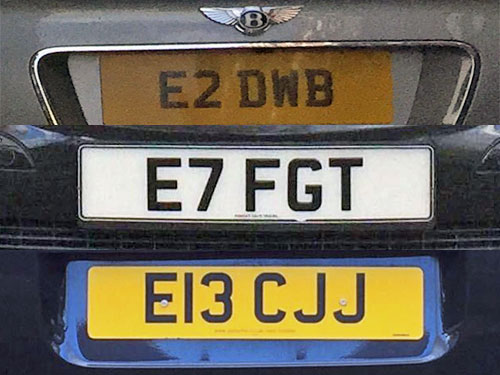
I've been playing numberplate spotting games again, looking for registration letters in sequence.
Registration letters first appeared at the start of numberplates in 1983. The letter 'A' was used for the twelve months starting 1st August 1983, then B from 1st August 1984 and so on. The process sped up in 1999 with two letter changes per year, one in March and one in September, until on 1st September 2001 the current two-digit code kicked in. The letters I, O, Q, U and Z were not used as registration letters, which means the sequence to hunt for is...
A B C D E F G H J K L M N P R S T V W X Y
This game takes a long time to play. It helps that registration letters appear on personalised numberplates as well as on old vehicles, but to work my way through the entire sequence of 21 letters still took me eight days. The DVLA reckons that only 7% of vehicles have a personalised numberplate, which helps to explain the scarcity.
I noticed while I was playing that some letters seemed to appear more often than others. J, M and S were popular, I thought, whereas waiting for an F took an age. So I decided to do a survey to check on letter popularity. I tallied all the registration letters I saw while walking the streets, and I did this for four days to get the sample size up to 450.
Here are my results.
Y came top, closely followed by R, S and T. The start of the alphabet proved a lot less common than the middle and the end. The lowest totals were for C, F and H, while even P looked oddly low compared to its neighbours. Vehicle registration letters are by no means evenly distributed.
Y R S T M W K N V L X J E P A B D G C H F
In fact what we have here are two overlapping graphs, one for 'old vehicles' and one for 'personalised plates'. Age of vehicle helps to explain why the gradient slopes upwards from left to right, roughly speaking, there being a lot more 19 year-old cars on the road than thirty-somethings. Most of the Ys I saw were old. But the varying popularity of letters on personalised plates has to be superimposed on top, and this is the more significant factor. Almost all the Ms and Rs I saw were personalised. Not many people want an F.
And this got me wondering about the most common first letters in people's names. Are there really that many first names starting with R, S and T, and so few starting with F, G and H? To try to find out I researched the Top 100 first names for boys and girls registered in 1944, 1954, 1964, 1974, 1984, 1994 and 2004, then totted up how many of these started with each letter of the alphabet. To add a touch of sexist realism I halved the totals for girls names before I added them to the boys.
J is the big winner here, particularly for younger males (Jacob/Joshua/Jack) and older females (Jean/Janet/Julie). A is second, fairly consistently through time, then S (with a peak around the 70s and 80s). Meanwhile F is far less frequent, and the end of the alphabet hardly gets a look in.
J A S M C D R G L K T H B P E N F W V Y X
But this doesn't quite follow-through to the results I saw on numberplates. M and S are popular in both, and F and P noticeably subdued. Egotistical Matthews buy a lot more personalised plates than elderly Freds. But if first names really were the key driver I'd have expected to see a lot more As than Ns, for example, and in fact I saw the reverse.
One reason for the discrepancy is that drivers choose registration letters for reasons other than their name, for example because they spell words or because 'X looks cool'. Another reason is that many personalised plates appear on company vehicles so reflect the name of the business. But possibly most important is that I carried out my survey in East London where many local residents don't have Christian names but Asian ones, so K, M, R and S are common first letters and C very much isn't.
Another intriguing skew is that most of the E registrations I saw appeared to be postcode-related, and you probably wouldn't get an E hump where you live. Essentially my analysis is too rough and ready to have proven anything. But maybe don't start playing Alphabetical by Registration Letter unless you have a lot of time to spare.
Thu 1: Spotted Michaela Coel again, this time in the vicinity of Victoria Park and much better disguised in baseball cap, designer dark glasses and a white scarf across her chin. Didn't fool me though - once spotted never forgotten. Fri 2: Those BBC4 pop documentaries they schedule just before screening another year of Top Of The Pops reruns are excellent, and 1990 was no exception. Sat 3: After two inches of rain fell yesterday, the northern Olympic Park was fulfilling its role as a flood bowl to ease water levels downstream. A heron lurked on the riverside footpath in several inches of water, right where I was standing yesterday, while gulls paddled around the nearby benches.
Sun 4: My favourite trainers have developed peeling soles, probably because I've walked hundreds of extra miles this spring and summer. Originally they were "special occasions only", then "definitely avoiding anywhere muddy", then "everyday choice" and before long they'll be "holes, dammit, farewell". Mon 5: Seasonal style tip - the men's headgear of choice this autumn is the mustard-coloured beanie. Other less hip shades are available. But any fool wearing one today is dressing by the calendar, not the weather forecast. Tue 6: My annual house insurance bill has somehow increased by over 150%. Not 50%, but 150%. Rang the brokers who apologised, found something cheaper and halved the annual fee they've suddenly started charging, but the bill is still up 30% and I fear for next year. Wed 7:Filming in the Olympic Park 1: A film crew village has appeared on an empty site beside Pudding Mill Lane station. It has six caravans for actors to hide inside between shoots, and two marquees, and a refreshment truck, and minibuses, but no actual filming. Whatever they're shooting nearby must be major because the caravans are still here three weeks later. Thu 8: The 3-year-old battery in my 5-year-old iPhone is now starting to show its age and will suddenly drop 30% for no readily apparent reason. Fri 9: Tesco say they've reduced the amount of plastic packing on their own brand cheese by 41%. That's good. They've also reduced the pack size from 460g to 400g. That's less good. The price per 100g has stayed exactly the same. That's good. The new pack is no longer self-seal. That's less good. Sat 10: A sign outside the Premier Inn/Brewers Fayre in Beckton says Book Now for Christmas, and I wish them good luck with that.
Sun 11: I can't believe it's not butter. Mon 12: Last November I had to have a new boiler installed in a different part of the flat. Today the builder finally came back to beautify the resulting mess. He started in a different room to the room I was expecting, which required some annoying last minute shifting of stuff. He's not especially good at social distancing. Tue 13: The builder again started in a different room to the room I was expecting, which required some annoying last minute shifting of stuff. By the end of the day some ugly pipes had disappeared behind new skirting and several tiles had been replaced. He's quite profligate with toilet roll. Wed 14: The builder arrived earlier than I was expecting, which required some annoying last minute shifting of stuff. By the end of the day I had a new cupboard where the boiler used to be. Alas he can't finish the job because its doors haven't arrived yet, and this means the new skirting's not going to get its final coat of paint until he returns in, sigh, maybe three weeks. Thu 15: Spotted 12 magpies on a grassy bank in the Olympic Park, and I have no idea what that signifies. Fri 16: Went round to BestMate's for dinner, rare chat and to finally watch S3E10 of The Crown. Stayed late, but was careful to leave shortly before midnight when Tier 2 restrictions kicked in. Sat 17: Had a mammoth number of visitors to the blog today, but it was mostly you lot refreshing the page endlessly to try to get past the High Alert screen (or to test out the random number generator). All the comments on the Sutton bus route word search were therefore fake, sorry.
Sun 18: I like listening to Ramblings on Radio 4, but this week's Walthamstow/Hackney Marshes episode is the first time I've listened to Clare Balding chatting to her guest in the same place I was walking. Mon 19: My landline doesn't normally ring on a Monday. Today it rang with the news that my mum's sister has died - not from that - following a few weeks of inexorable medical decline. She was always one to slip a letter into a birthday or Christmas card, even when there was nothing much to say. I shall miss them. Tue 20: Went to the non-essential clock shop in the Stratford Centre for a replacement watch battery - a rare purchase - thankful that it decided to fail during the gap between lockdowns. My 30 year-old Casio is so iconic you can still buy one (£29.99 in the front window) but I'm chuffed mine's an original. Wed 21: Rang BT because my broadband contract is coming to an end, and they somehow managed to find me a cheaper (identical) deal but with a Fibre upgrade thrown in. So that's good. Thu 22: Hurrah, the Roku player stuck into my smart TV now has a BBC Sounds app, so I can listen back to radio programmes over decent speakers. Fri 23:Filming in the Olympic Park 2: The western end of Northwall Road was busy with trucks, crew, refreshment tables and several stewards to keep members of the public at bay... and all to film a commercial, so they said. Sat 24: I slipped while clambering round Mudchute Park and grazed my hand on a gravel slope. End result: minor cuts across my palm and a tiny thorn to pick out. But I happened to have some hand sanitiser in my pocket, and that's the first time I've been thankful it's 2020. Sun 25: I haven't adjusted the clock on the microwave because I'll only have to change it again when the builder comes back.
Mon 26:Filming in the Olympic Park 3: Today's film crew on Northwall Road are from Warner Brothers, who appear to be organising a major vehicle incident underneath the bridge by the Velodrome. If you're watching a movie next year and spot a silver Subaru (RK52ZXF) upside down on the bonnet of a white car, that's where they filmed it. Tue 27: At Hackney Bridge the door to the perfumery reads GALLIVANT - Fragrance For Urban Explorers, and I have never wanted a start-up to fail more. Wed 28: As a follow-up to the major leak which disrupted much of East London's water supply three weeks ago, Thames Water have laid a temporary road across Hackney Marshes and are excavating two large holes beside the football pitches. Thu 29: A letter arrived from BT with details of my new broadband/landline contract, confirming that the terms have actually changed and kicked in yesterday so I'll get no more free weekend calls. A phone call to customer services confirmed they don't have a free weekend calls option any more and I should have been told this, sorry, and they can't undo it because it changed yesterday, sorry, and I should have received an email but they failed to update my address, sorry. The financial recompense they offered should pay for several weekend calls. Fri 30: Even though I've spent most of the last seven months walking around my local area, there always seems to be a fresh new street to explore. I may not be saying this by March. Sat 31: It's been London's wettestOctober on record, topping six inches of precipitation. It's also been the dullestOctober since 1894 with just fifty-or-so hours of sunshine. You weren't imagining it.
Nothing is more important to the English people than Christmas. The giving of gifts, high streets lit up with fairy lights, children's twinkly faces and twenty people sitting round a table feasting on a huge turkey with all the trimmings. We must protect Christmas at all costs, no matter what the naysayers say.
That's why I'm announcing not a lockdown but a strengthening of national measures, definitely not a lockdown. We must all spend November indoors so that Christmas can take place as normally as possible - carol singers on the doorstep, tinsel on the tree and maybe ten people sitting round a table guzzling a large turkey with trimmings.
I'm under no illusion about how difficult these next four weeks will be, but it is my sincere belief that if we shutdown over Divali we can surely rescue Christmas. Last minute shopping, Santa bringing presents and a maximum of six people sitting round a table eating a medium-sized turkey with some of the trimmings.
I am truly sorry for having to close everything again, but I firmly believe the country can only be persuaded to stay indoors if I pretend to promise a perfectly normal Christmas at the end of it. A bag of Aunt Bessie's from the freezer, a small tin of Quality Street and a single household gathered in the kitchen defrosting a turkey joint.
No freedom-loving Prime Minister wants to be seen imposing such harsh restrictions, but we will get through this if we act now and follow the rules I have so clearly stated. Stay at home and I can guarantee you the most memorable Christmas of your life, sat on an empty sofa with a box of After Eights and nobody to pull your cracker with.
• Spain introduces night-time curfew
• Wales anticipates another firebreak in January
• row about free school meal vouchers, again
• Nottinghamshire → tier 3
• Tory MPs call for roadmap out of lockdown
• study says antibodies decline rapidly
• sharp rise in deaths across Europe
• Staffordshire → tier 2
• 'too early to say what Christmas rules will be'
• Heathrow no longer Europe's busiest airport
• 2/3 of businesses at risk of insolvency
• second national lockdown in France
• 100,000 catching virus every day
• E Yorks → tier 2, W Yorks → tier 3
• Melbourne emerges from four month lockdown
• ½ million in England had virus last week
• Govt trying to avoid blanket measures
• cases now well above worst-case scenario
• 4 week lockdown across England from next week
• furlough scheme extended by a month
Worldwide deaths: 1,150,000 → 1,190,000 Worldwide cases: 42,400,000 → 45,800,000 UK deaths: 44,745 → 46,555 UK cases: 854,010 → 1,011,660 FTSE: down 5% (5860 → 5577)

Embargo until