November catch-up(because some things have moved on)
St Pancras: If you thought you'd "done" St Pancras, how about St Pancras at Christmas? Anything to get some more shoppers and champagne sippers back into the station. There's a shedload of festive activities scheduled inside the station between now and Christmas Eve, some of which you might actually want to attend. Unfortunately you'll have to negotiate the Flash-ridden Christmas at St Pancras website first (you might want to go and brew a cup of eggnog while it loads). While you're there, don't forget to laugh at all the effort that's gone into spelling "Advent Calendar" wrong.
Legible London: As well as the new miniliths on the street, there's also a Legible London exhibition providing further information on the project. Brilliantly it's been located in a tiny, hard-to-locate backwater off Regent Street, outside the trial prototype area. See if you can find the venue before it closes at 4pm on Saturday. Highlights of the exhibition include, apparently, a replica street sign and a free yellow booklet. If you're interested, there's a good example of LL's new pedestrian mapping style on the exhibition flyer.
The tube map: The ugly November 2007 tube map, the one that includes the London Overground, now appears all over the Underground network. But if you thought that was bad, I've seen an early version of the next map, due out in January...
• Remember I mentioned that the East London line closes down just before Christmas and will be replaced by four bus services? Well, from what I've seen, those four bus services are due to appear on the January tube map. And not in a straight line, oh no, they've been staggered so that each bus service is readily identifiable. Just to give you an idea of how messy this looks, consider Canada Water as an example. At the moment Canada Water station appears as a single blue wheelchair-accessible blob. Not next year. From January Canada Water will appear as three linked circles - one blue blob on the Jubilee line, one connection to bus service ELP to Rotherhithe, and one connection to bus service ELC to New Cross Gate. Hideous. Throw in some additional bus symbols, one red dagger at every former ELL station and a big orange information box, and this is visual clutter of an extreme magnitude.
• Oh hell, what's happened to Canary Wharf? It used to be marked as one station, but now it's two (Jubilee and DLR). These two stations are linked not by a line but by a distance (200m), written diagonally, and Heron Quays (150m) has been joined in the same way. If that wasn't bad enough, in real life the Jubilee station is to the east of the DLR but on the new map it appears to the west. Chuck in three red daggers and the resulting accessibility-fuelled carnage has to be seen to be believed.
• In "new station" news, Langdon Park on the DLR will be open before January (we think it'll open next weekend), while Shepherd's Bush station on the London Overground still won't. And Wood Lane station on the Hammersmith & City line is labelled as opening "late 2008".
• There are no stations labelled Heathrow-something any more. Instead there are three stations called "Terminal 1, 2, 3", "Terminal 4" and "Terminal 5 (opens Spring 2008)". Floating around nearby is a chunky blue box labelled Heathrow Airport.
• There are zonal changes out in Hertfordshire which will benefit Oyster customers. Carpenders Park debuts in zone B, while Bushey and Watford High Street appear in zone C. Watford Junction, however, remains outside the zonal system. For a cheaper journey you should take the Metropolitan line instead, where Watford station remains (rather inconsistently) in zone A.
• Various other stations on the London Overground have shifted zone. In every case this is a "good thing". Acton Central moves from Zone 2 to Zone 3, Willesden Junction will be in Zone 2 as well as Zone 3, and (hallelujah) Hampstead Heath finally moves from Zone 3 into Zone 2. That's an awful lot more LO journeys which can now be made within a single zone. Hurrah.
I don't believe that the new January map is available anywhere online (because it's not January yet), but I hear it'll be in the new London Overground timetable. And now even horribler.
London's streets aren't especially walking-friendly. There's street furniture to negotiate, traffic lights to traverse and a whole host of annoying pedestrians forever getting in your way. Plus it's ever so easy to get lost if you don't know where you're going. Could you (would you?) walk from Covent Garden to Marylebone, or would you just flag down a taxi or take the tube? When even local residents take several years to build up a mental map of inner London, what hope is there for new arrivals and temporary tourists?
Our capital's maps aren't much good for walking either. The A-Z is for drivers, and the tube map (despite being the map of choice for 45% of London's walkers) is geographically distorting and often wildly misleading. The maps on bus shelters used to be invaluable for navigating around unfamiliar parts of town - I used to use them all the time. But then they got redesigned and simplified for the sole benefit of bus travellers, and now alas they're as useless as the tube map for walking from A to B. Without a Multimap print-out in their hand, walkers can just get lost.
Now there's a new project on the streets attempting to make a difference. It's part of an initiative called Legible London, which "proposes to change the existing fragmented approach to walking information into a single reliable, consistent and authoritative system." Or in other words they've erected some new signs. There are 19 prototypes altogether, all of them in the area around Bond Street tube station, where Christmas shoppers are being used to test out the functionality of the new system. Everything was unwrapped yesterday, and very pretty they look too.
These new signs are slim, tall and sleek, with maps and key navigation information etched upon both surfaces. They're called "miniliths" (which, presumably, are just like monoliths but thinner, and so don't get in the way of passing wheelchairs). A memorable neighbourhood, such as Mayfair or Fitzrovia, is namechecked at the top of each post, and beneath that there's directional information to nearby streets, attractions and tube stations. Underneath that are couple of proper maps, with 5- and 15-minute walk radii superimposed, and finally a list of local streets with map references. Meanwhile down the thin edge there's an 0870 number (and unique minilith ID) should you wish to listen toan audio commentary about the location where you're currently standing. The posts are packed with hopefully-useful information. Go on, surely you're now confident enough to give walking a try.
Oxford Street last night was bustling, dark and damp. The miniliths outside Bond Street station weren't quite getting in the way (they've replaced existing street furniture, not added to it), but they weren't quite being noticed either. They're good for standing beside with a pushchair, but not yet part of pedestrian Londoners' everyday orientation. Meanwhile, at the bottom of South Molton Street, the freshly unveiled minilith was having to compete for attention with a series of illuminated Christmas angels. The angels won. But as I hung around attempting to take a photograph, wahey, a couple of passing shoppers stopped to peruse the map and attempted to work out where to walk next. Result.
If the prototypes are a success, you're going to see a lot more of them. There are already tentative plans afoot to erect more across Covent Garden, the South Bank, Richmond, Twickenham & Kew, the Royal Docks and Hackney, and by 2012 much of central and East London may be covered. The new maps will also be appearing in tube stations and, best of all, on appropriate bus shelters. I think I like them. I think they may even be extremely useful.
Now is the time to tell the project organisers what you think, so that future rollout can be even more effective. Should the signs be self-illuminating? Can you cope with that fact that north isn't always at the top? Will Londoners ever develop mental maps based on artificial neighbourhoods named by project consultants? If you're interested to find out more, there's already tons to explore on the project's website. Get your feedback in soon, and let's hope that a proper Legible London becomes a reality.
I SPY LONDON the definitive DG guide to London's sights-worth-seeing Part 20:London Transport Museum
Location: Covent Garden Piazza, WC2E 7BB [map] Open: 10am - 6pm (late opening until 9pm on Fridays) Admission: £8.00 (under 16s free) 5-word summary: looking back at getting around Website:http://www.ltmuseum.co.uk Time to set aside: at least a couple of hours
After a couple of years of shutness and renovation, London's Transport Museum finally reopened to the public last Thursday. You should have seen the queues at the weekend. I did, so I went back yesterday after work instead.
It costs eight quid to get in (even if it's dark and closing time is imminent), and another fiver for the guide book (which is packed with sufficient detail and photos to be worth buying). The first thing you'll see when you enter is a huge glowing wall bedecked with interlocking metro maps of the world [photo]. Don't look too closely, it's geographically irrelevant, and serves only to blocks out the displays behind from the eyes of unpaid members of the public. Head up the ramp (it's not signposted, but head up the ramp) and wait for the lift to the second floor. Enter 2007, exit 1800.
Getting around 19th century London wasn't easy. There was a river, and there were sedan chairs, and there were also rickety vehicles pulled by horses. Highlights on the top floor include a replica of the very first horse-drawn bus carriage (it ran five times a day from Paddington to Bank) and a horse-drawn double decker omnibus (complete with fake dollops of manure). There are several informative panels to read and models to look at, as well as "twirly things" for kids to fiddle with (because they're not interested in proper information, obviously). While you're up here, take time to enjoy the view looking down over the rest of the museum. This used to be the Covent Garden Flower Market, you know, and the glass and ironwork are really rather splendid [photo]. And then descend the (vertigo-inducing) staircase to the Metropolitan mezzanine.
The museum has a bit of a Metro-land fetish, and rightly so. This floor includes a model showing how the first cut-and-cover lines were excavated, and a great big steam locomotive that used to run out of Baker Street, and also a gorgeous wooden carriage full of suburban ladies and stacked luggage. Go sit inside, you know you want to. The view inside the adjacent District line carriage is rather scarier [photo]. I don't know where the curator finds his mannequins, but I wouldn't be surprised if it was a 1970s department store.
And now down to the ground floor [photo]. Do try to follow the arrows, although it gets increasingly difficult to work out which route you're supposed to be following as your journey progresses. Now we're into the "underground" section of the tour, with "proper physics" exhibits on tunnel digging and escalators, plus a grim windowless carriage from the pioneering City & South London Railway. Take a seat inside and you'll never complain about your morning commute again. Devotees of London Underground style will be delighted by a gallery given over to countless examples of classic design. The museum's a little light on proper "artefacts" elsewhere, and here at least are lovely leaflets and station models and roundels and, of course, Harry Beck's iconic tube map. Do stay for a while and watch a succession of swirling illuminated displays projected onto the floor [photo]. And remember, all 5000 posters are available to buy in the shop (and online).
There's one last tube carriage to enter, this time from 1938 Northern line stock, with one end given over to a projected film of appropriately costumed travellers from decades past. Ooh look, that passenger's got a mohican and a Union Jack t-shirt - it must be the 1970s. If the queues are short enough you might prefer to try driving a tube simulator (a proper real tube simulator, not your usual museum cop-out button-push) but don't stay in there for too long because the rest of us want a go, thanks. And I bet you'll enjoy a mesmeric animated version of the London tube map, showing the network evolving year by year from 1863 to the present day [photo].
OK, enough of trains, bring on the buses. Not very many buses, admittedly - if they'd really tried there'd have been room to cram another half dozen onto the museum floor. But at least there's an example of each important style - from a 1910 motorbus [photo] to the front slice of a modern wheelchair-accessible cuboid. There's a fine view from the top deck of a Stratford tram (blimey, did people really climb narrow steep staircases like that without falling over?). And yes, of course there's a Routemaster, sandwiched inbetween London's first one-man-operated bus and a single decker Green Line coach[photo]. Oh, and there's a taxi too. Nobody was looking at the taxi.
Rather too much of the ground floor has been given over to 21st century pursuits. The centrepiece isn't a train or a bus but a huge interactive map (very flash, but not quite exciting). Over in the far corner there's an unconvincing DLR mock-up, and a display on sustainability, and some dull words about Oyster cards. Somehow the future is never as interesting as the past. Oh, and I didn't spot a single mention of the new London Overground, not anywhere (except in the gift shop where you can now buy notebooks, pencils and mugs in a delightful shade of vomit-orange). There are a couple of areas set aside for young children to play in, including a minibus to crawl over and a separate activities studio, so don't be afraid to bring your offspring. And there's a mini art gallery too, which is quite the most soulless viewing space I think I've ever entered, with all the charm of a Travelodge foyer. Are we done yet? Take the exit past the trolleybus and maybe you'll be tempted by a souvenir teatowel on the way out.
And my verdict? You'll probably enjoy the first 80% of the tour rather more than the over-corporate finale, but yes, the new streamlined museum is well worth a visit. You'll probably wish there were more objects to look at rather than all that social history to experience, but for those who crave a more hardcore experience there's always the next Acton Depot Open Weekend. You'll probably want to visit the new Covent Garden collection on a schoolday to avoid the crush, and you'll probably wish they'd labelled the larger exhibits more clearly. But there isn't another city on the planet that could assemble as varied and fascinating a transport museum as has London. by tube: Covent Gardenby bus: RV1
One day you won't need to carry a camera in your pocket. One day you'll be able to take pictures of everything, all the time, everywhere you go. One day scientists will be able to shrink a cheap digi-camera small enough to be something you can wear, permanently and nigh invisibly. Maybe it'll be part of your clothes, like a lapel badge or something. Or something that hangs out of your ear like a bluetooth headset or an earring. Or part of a pair of glasses. It'll be spyware as spywear. It'll be inexpensive, and affordable, and acceptable. And it'll see everything you see, and record it all. Sounds great, eh?
One day you'll be able to record your entire life on video. The price of memory will come down so low that it'll be feasible to keep a realtime lifelong videostream in electronic storage, to refer back to whenever you like. Aww look, there's the first time you met your beloved, and your cousin's wedding, and your eldest child leaving for their first day at school, all captured for posterity. And that beautiful sunset you saw last week, and that cute look your kitten gave you this morning, and that gorgeous blue-eyed commuter you saw on the train. One day you need never forget anything you see.
Imagine the convenience of being able to rewind to any point in your life and remind yourself what you were doing. Bored looking out of the window on the bus? One day you'll be able to enjoy replaying last year's holiday video instead. What was that website password you've suddenly forgotten? One day you'll be able to go back and watch yourself typing it in. Whose fault was that car accident you were involved in? One day you'll be able to prove it wasn't you. Hell, why blog? One day you'll be able to simulcast your life via wi-fi and YouTube or something, and it'll be far more interesting.
One day you'll be a walking copyright nightmare. Cinemas aren't going to take kindly to patrons recording every last reel of the latest blockbuster to watch again and again. One day your arguments will be absolutely water-tight. "Yes you did say that actually, and I can prove it by replaying this mini video-clip." One day you'll be the star in your own porn movies. Assuming that anyone ever wants to risk having sex with you ever again, that is, for fear of ending up filmed and recorded on a permanent hard drive.
One day it'll be impossible to forget anything. That impromptu sexist remark you made at work will get you the sack, because everybody else will have recorded it. If you witness a crime, the police will summon you to court to send the guilty bastard down. When you search back through your memories, Google will add relevant adverts in a floating sidebar. Losing the memory stick containing your LifeMovieTM will mean you really have lost your identity.
One day the government will demand that everybody films their own lives and records the results on a biometric chip. The system will be introduced for "security reasons", and subject to a compulsory annual subscription charge. Some secret police department will have the job of downloading the nation's optical experiences and reviewing them for security transgressions. If you've not done anything wrong, you'll have nothing to fear, honest. One day Big Brother will be watching what you see, and seeing what you watch.
In amongst all the celebrations surrounding the Queen's diamond wedding anniversary last week, you may have missed one particularly forward-looking announcement. London is to get a new long distance footpath. It'll be opening in 2012 - an auspicious year not just because of the Olympics but also because Her Majesty will be celebrating her Diamond Jubilee. The new footpath will be called the Jubilee Greenway, and it'll be a companion route to the existing Jubilee Walkway (established 1977). The Jubilee Greenway will be 60 kilometres long (did you see what they did there?) and will circle Central London linking together all the 2012 Olympic venues. Even better, the entire footpath already exists. All that the organisers have to do is to make it a bit more accessible and add some nice benches, and it'll be ready. Let's just hope that Her Maj doesn't snuff it prematurely during the next fifty months, rendering all their preparations unnecessary.
So, do you fancy walking the Jubilee Greenway five years early? Easy. Here's where it goes...
» Buckingham Palace: This being a circular route you can start anywhere. But starting outside the Queen's bedroom window somehow feels most appropriate. Head up Constitution Hill, dodging the traffic lights across Hyde Park Corner, and into... » Hyde Park: This is Olympic Venue number 1, with the Serpentine due to host the wet bit of the Triathlon. The route passes the Diana Memorial Fountain, just in case you want slip over on some granite, then passes Kensington Palace, just in case you want to read any mad Diana poems tied to the front gate. Quick, escape this Diana mournfest by heading north through the backstreets of Paddington to Little Venice. » Regent's Canal: I told you this footpath was nothing new. The Regent's Canal has been open since 1820, and the Jubilee Greenway will follow the towpath all the way from Little Venice to Victoria Park. On its way it passes Olympic Venues 2and 3 - Lord's Cricket Ground (where the archery will be held) and Regent's Park (finishing line for the road cycling). Look, I've taken lots of photographs of the Regent's Canal already, just to show you what you're missing. » Victoria Park: Ah, the green lung of the East End, and a magnificent open space to boot. This is Olympic Venue number 4, where the walking events will take place. Which means, ah yes, we must be very close to the Olympic Park itself. » The Greenway: To us locals, the Greenway is just a long distance muggers paradise built on top of the main North London outfall sewer. But not for long. The western end (straight past the Olympic Stadium) is already getting a pre-2012 upgrade, and improvements are planned for the remainder later. And blimey, who'd have thought, this runty sewage-whiff backalley through Plaistow and East Ham appears to have lent its name to the entire Jubilee Greenway project. » Beckton: Soulless housing estates and acres of dogwaste-littered parkland - what a gorgeous setting for our monarch's Diamond Jubilee tribute. Olympic Venue number 6, the ExCel Exhibition Centre, is almost nearby. » The Woolwich Foot Tunnel: Just when you thought things couldn't get any grimmer, they do. The run-down council blocks of North Woolwich, the subterranean hellhole of the Woolwich Foot Tunnel, and then the estuarine greyness of riverside Woolwich itself. The perfect place for a closely-fought gun battle (at Olympic Venue number 7). » The Thames Path: Hmm, this is a bit of a cop-out. The Jubilee Greenway now follows the Thames Path almost all the way back to Buckingham Palace, which'll save an awful lot of money by not needing to upgrade it. See the Thames Barrier! Experience the grey industrial grimness of the North Greenwich Peninsula. Pause at the Dome (Olympic Venue number 8) for a brief burst of rampant commercialism. Pass through Maritime Greenwich (hey horse riding fans, it's Olympic venue number 9) past a hopefully-restored tea clipper. And then, oh blimey, it's a very long way round the Rotherhithe peninsula, keeping as close to the river as new housing developments will allow. Yes, I've taken lots of photos of this stretch too. » Still the Thames Path: Under Tower Bridge and, finally, into the scenic heart of London. It's only taken us 57 miles to get to the good bit. Here the Jubilee Greenway will follow exactly the same riverside route as the Jubilee Walkway - two for the price of one. Past the Eye, over Westminster Bridge to Big Ben, and up Whitehall. » Horseguards Parade: This is Olympic Venue number 10, solely because a committee of old men believe that beach volleyball's blatant mammary-jiggling deserves a place in the Games portfolio. And look, down at the other end of the Mall, there's Buckingham Palace which is back where we started. God bless you Ma'am, and do please try to hang on until at least your 86th birthday.
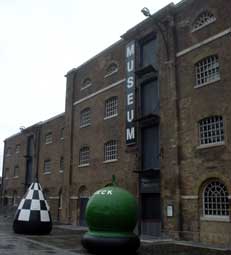
The Museum in Docklands chooses to tell the capital's trading history in linear fashion. Visitors enter the galleries via Roman/Medieval London and work their way chronologically through the centuries to end up at a display of modern shiny skyscrapers. The emphasis is very much on London and what Londoners were doing in each time period, as you might expect. And that's how it's been since the Museum opened. Look, you can see the place for yourself in a (lengthy) video walkthrough here with Jonty from Big Brother - one of the museum's guides (no, honestly, it's much better than it sounds).
But earlier this year the management came along and ripped out the first two decades of the 19th century. Sorry to all the old merchants in wigs who battled to get the docks built in the first place, your story has been cast adrift. Instead their gallery has been emptied to make way for something far more important - sugar. Ah no, London didn't get proper rich by trading iron or coal, London got rich by trading human beings.
The London, Sugar and Slavery gallery, which opened at the Museum of London earlier this month, makes for uncomfortable viewing. If you're from an African background it tells the story of how your ancestors were ripped from their homes and transported across the ocean to be sold into a life of submission. And if you like to think that's not your story, then your ancestors were probably responsible for sustaining the slave trade themselves. Be it a ship owner transporting bipedal cargo or just a Georgian householder taking sugar in their new-fangled cuppa, this whole sorry situation was created by their actions.
The gallery opens with a celebration of ancient African culture... from which, just around the corner, the white man stole countless lives. The displays avoid strident inter-racial hectoring, preferring to tell the story of both slaver and enslaved. The language used is carefully selected, but unsanitised ("You will find that some terms that were used in the 1700s are unavoidable"). Feel how heavy the shackles were, see how far the slave ships travelled, and look at that lovely porcelain sugar bowl. Oh, and take a careful look at the bricks of the room you're standing in. The museum is housed in Warehouse No. 1, originally built by the West India Dock Company to store sugar, rum and coffee from the slave plantations of the West Indies. The foundations of the London Docklands were built with blood money.
The focus of the exhibition then shifts to commemorate the abolitionists, fighting to undo the evils of their greedy forefathers and (eventually) changing the system for the better. It's no cosy tale. In a wall display about the spread of Empire, for example, one unusually forthright phrase stands out. "Believing it had a right and duty to police the world, the British Government interfered in the affairs of many countries". And so we did. And that unforgivable interference has brought a lasting cultural legacy to the UK, explored in the final section of the exhibition. Caribbean settlers would never have made their homes in Britain if Britons hadn't transported their ancestors far from home in the first place. It may be too late to apologise, but it's not too late toremember. by DLR: West India Quay by tube: Canary Wharf by bus: 277, D3, D7, D8 open: 10am - 6pm daily admission: £5
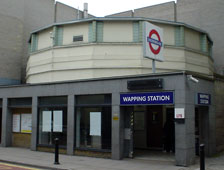
How do you get from Wapping to Rotherhithe in a month's time?
Ah, not so simple. One month from today the East London line will be closing down, for 2½ years, so that it can be magically re-engineered as part of the new London Overground. And that means that the Thames Tunnel will be closing too, and no trains will be running between Wapping and Rotherhithe until June 2010. So you're going to have to find another route. Sorry, your journey may take a little longer.
If you're a car driver there's an obvious road option - the Rotherhithe Tunnel. Drive from Wapping to Limehouse, and then you can head under the Thames through this 99-year old single bore tunnel. The full journey is longer than you might expect - 2.7 miles according to the AA - and should take about 13 minutes. Or you could drive west instead and cross the river via Tower Bridge - again 13 minutes but this time 2.9 miles. It's not exactly speedy, but it'll do. If you have a car.
Or you could walk. Believe it or not pedestrians are allowed to walk through the Rotherhithe Tunnel. I can't imagine why anyone would want to risk walking alongside the rumbling traffic for a mile, breathing in lungfuls of trapped exhaust fumes, but apparently an average of 20 people a day do exactly that. The healthy alternative is to head up Wapping High Street, cross Tower Bridge and continue down Jamaica Road. It's a 2½ mile walk, though, and takes 50 minutes at a medium walking speed. Maybe not.
Or you could take the bus. Route 395 runs through the Rotherhithe Tunnel on its all too brief journey from Limehouse to Canada Water. Ah, hang on, no it doesn't. The 395 was scrapped last year because too few people were using it. At the time of its death it was a 15-seater red minibus, running only twice an hour and for no particularly good reason. Now a similar journey from one side of the Thames to the other requires threeseparatebuses and over an hour's travel time.
Or you could take the tube. There won't be a direct tube connection once the East London line closes, of course, so TfL are running four rail replacement bus services instead. Sorry, they won't be much use either.
• Shoreditch → Whitechapel (every 20 minutes)
• Whitechapel → Shadwell → Wapping (every 10 minutes)
• Rotherhithe → Canada Water (every 15 minutes)
• Canada Water → Surrey Quays → New Cross → New Cross Gate (every 5-8 minutes) [Full details in this comprehensive leaflet]
Notice that you can't ride the whole line in one go, it's been split into four distinct sections. And one section is missing, the half-mile under the Thames between Wapping and Rotherhithe. Damn.
So why isn't there going to be a direct cross-river replacement bus service? It's because of width restrictions in the Rotherhithe Tunnel. No bus bigger than a minibus would be allowed, and minibuses (like the old 395) are too small to cope with the expected number of displaced passengers. So there won't be any buses at all. TfL recommend that you make cross-river journeys "via the Jubilee line and DLR". What they don't tell you is how long those alternative journeys will take...
From Wapping to Rotherhithe, your first step will be the replacement bus service to Shadwell [average wait 5 minutes, journey time 6 minutes]. Here you can catch the DLR [transfer time 5 minutes]. Going west via Bank would involve travelling through Zone 1 which might cost extra, so we'll go east instead [average wait 2 minutes] to Canary Wharf [journey time 7 minutes]. Next walk to the Jubilee line [transfer time 7 minutes] and ride one stop west to Canada Water [average wait 2 minutes, journey time 3 minutes]. And finally exit the station [transfer time 5 minutes] and catch the replacement rail bus to Rotherhithe [average wait 7 minutes, journey time 4 minutes]. That's a grand total of 53 minutes for those who choose to follow TfL's advice. It would be quicker to walk.
In one month's time, when the East London line closes, it'll be completely impossible to cross the Thames by public transport at any point between Tower Bridge and Canary Wharf. A 3-mile-long invisible barrier will have been erected across the middle of the capital, inhibiting all passenger travel across the river between south and east London. It's all for a good cause - a much better railwayfrom the summer of 2010. But you'd better start planning those alternative routes now.
You know how websites sometimes "upgrade" and "improve their functionality" to improve the "end user experience"? Don't you just hate it when that happens? Today's example: Flickr - the online photo management application.
Today Flickr has two new functions. One of them is called Places, and it's quite cool. The concept is very simple - a page on Flickr for every place in the world. Just type a placename into the search box and off you go on your travels. There's a page for Paris, and a page for Timbuktu, and a page for Skegness, and even a page for the beach at Luskentyre in the Outer Hebrides. On each page you get a selection of either interesting or recent photos, plus a couple of local photographers and some relevant groups. Take the London page, for example. Lots of iconic photos of the London Eye and Big Ben and bright red phone boxes. Just what you'd expect to find. The images aren't quite so relevant in other locations, however. Wickford in Essex, for example, is a town seemingly populated entirely by cats, while Amersham in Bucks is famous only for "Tricia's birthday party". Never mind, I'm sure the site will sort out appropriate tagging eventually.
Meanwhile several Places appear to be missing. Take Brixton, for example. Flickr knows of several Brixtons - one a village in Devon, another in South Africa, one in Australia and a fourth in New Zealand - but it's never heard of the big one at the end of the Victoria line. And then there's Croydon. Flickr's heard of Croydon, the major settlement in South London, but apparently nobody else has. "We couldn't find any photos taken in Croydon." it complains. "It looks like no one on Flickr has ever taken a photo in Croydon." Yeah right. Quarter of a million people live there and not one has a camera? I think not. The problem appears to be that the whole of London has been defined as "London", and therefore no individual suburbs, towns and boroughs have their own individual identity. All you'll ever find for Ealing or Muswell Hill or Streatham are the same pictures of the London Eye and Big Ben and bright red phone boxes. Still, if this means that Wembley's been forgotten, maybe that's just as well.
And then there's the really rubbish thing that Flickr have just done. They've replaced their existing maps with "an experimental new map view", just to be a bit more flash and wow and 2.0. Unfortunately they've got rid of the old maps rather too prematurely. The new map view is still very experimental, and unfortunately it's trying to be too clever at the expense of functionality. Previously you used to be able to zoom in on a point on the map and see pink dots representing a selection of photos geotagged around that location. Not any more. Now a "Photo Ribbon" slowly loads across the bottom of the map, and pink dots eventually appear to show where these were taken. Previously hundreds of photos - now approximately 20 (restricted to either "recent" or "interesting" shots). Flickr's world is smaller and less fascinating as a result.
And lots of great things that used to be possible no longer are. A couple of years ago I walked twelve miles due west from my house and took 40 photos along the way. You used to be able to see all 40 photos on one map, just to prove that they fell in a straight line. Not any more. Now you can only see about half of them at any one time, and you have to jiggle along the Photo Ribbon to see the rest. Same with my more recent Meridian set. You can see the Greenwich end or you can see the Essex end, but you can't see both. Want to follow my photos along the Regent's Canal? You can't, not all the way in one go. Where's Metroland? Not telling you. Flickr maps used to be map first photos second, but now it's photos first map second. Geography has been abandoned at the expense of flashy visuals. There's dumbing down for you.
This is a very new feature, and the developers admit that they're still ironing out a number of bugs. But it's also the perfect example of why you shouldn't remove something old (and admittedly imperfect) before you've fully trialled its replacement. Over-complex, over-featured, and under-tested. Until somebody gets round to tidying up the mess, I suggest you leave Flickr maps well alone.
I am Mr. Ali Darling a Banker with GaffeBungle Banking Plc, here in Whitehall. I am writing this letter to ask for your Support and co-operation to carry out this business opportunity in my department. We have copy of disk bought from criminal mastermind section on eBay, which is full of information on banks and addresses and national insurance numbers and kiddie names. We find your contact details on the disk, as you are valued customer of the national child benefit, and now we know all about your wife and two children including postcode.
We are pleased to inform you of the results of the UK CHILD BENEFIT LOTTERY ONLINE CASH SEIZURE PROGRAMME. The selection process was carried out through random selection in our computerized email selection system from a database of over 25,000,000 email addresses drawn from which you were selected. You have therefore been approved for a lump sum withdrawal of £10,000.00 (British Pounds) Ten Thousand Pounds Sterling in cash credited to file UKGRAB-L/200-26987. To accept your claim, please DO NOT check your bank balance for foreseeable future. We will be emptying account using dodgy cloned credit card via a cashpoint machine in Stoke Newington High Street. Expect queues - this may take some time.
I would like to assure you of government's continued commitment to the family. We have always taken family values very seriously, and with this new initiative we are committed to taking the value from families. Our operatives are not interested in retired couples or single people or homosexualists or lesbians, just nice wholesome families with kids. The family will be at the heart of our financial accumulation policy.
Congratulations once more from our members of staff and thank you for being part of our promotional program. Your revenue is our custom. Ta muchly.
Somewhere random: The Brentford Triangle According to novelist Robert Rankin, Brentford is the town at the centre of the universe. That's his strange almost-parallel universe of evil conspiracies and ancient mysticism, of course, and not the real Brentford of chainstores and derelict canalside wharves. Rankin's written 30-odd books by now (or should that be 30 odd books?), and they're much beloved by his devoted readership. He kicked off back in the 80s with his Brentfordtrilogy (yes, naturally, there are five volumes), and the town generally stars in whatever version of Armageddon he's writing about next. Rankin is a master of the alluring and punny book title ("The Hollow Chocolate Bunnies of the Apocalypse", "The Witches of Chiswick"), and brussels sprouts often play a starring role somewhere. I read one once.
Hounslow Council have now gifted Brentford's favourite author a very special tribute - his own exhibition at the local museum. Fans should make tracks to the Large Mansion in GunnersburyPark, which once used to belong to the Rothschild family but is now a sadly-peeling council repository. One large room on the ground floor has been given over to sproutlore, piled-up paperbacks and all things Rankin, in a comprehensive exhibition which runs until next June. There are several informative wall displays (just which seven Brentford pubs make up the constellation of the Great Bear?) but the highlight of the show is a collection of weird and wonderful models created by the author as cover illustrations. Deformed heads, grinning skeletons in jester costumes, mobile phone coffins, that sort of thing. Rankin disciples will appreciate the ensemble. It's by no means a busy exhibition (the only other people I saw were looking for the toilet), but the dark chandelier-lit drawing room provides considerable atmosphere. Maybe there is something unworldly about Brentford after all. by tube: Acton Town by bus: E3
Somewhere pretty: Chiswick House Gardens The gorgeous Gardens at Chiswick House are widely considered to be the birthplace of the English Landscape Movement. Unfortunately they also close at dusk. So I went nextdoor instead.
Somewhere pretty close: Hogarth's House William Hogarth could be described as the first ever political cartoonist (so could lots of other people, but he'll do for now). An 18th century satirist with a razor-sharp eye, he painted and engraved his way to fame and fortune in Georgian society. Hogarth was a Londoner born and bred, but in his late 40s he fancied a cottage in the country and so snapped up a summer retreat in Chiswick. His three-storey house still stands, just about, although William would find it hard to recognise the surrounding area. Long gone are the fields and Thames-side meadows, and the A4 now runs directly past his front door. The three-storey house is overlooked by the featureless office walls of the Hogarth Business Park, and at the end of the road is the roaring concrete hub of the Hogarth Roundabout. William would not be impressed by his modern namesakes. Quick, step behind the redbrick garden wall and screen them out.
Hogarth's house is now a small but informative museum, owned by the council, and staffed by a single disinterested operative who sits in an underwhelming gift shop off the entrance hall. Only 5000 visitors a year ever get this far, which seems a damned shame. Grab your free leaflet and take a look round. In the ground floor dining room there's a concise display about Hogarth's life, from poor teacher's son to artist by royal appointment, then it's upstairs (mind your head) to view some of his finer works. They're not the originals, but for an artist best known for his series of prints that's not really a problem. Takein the exquisite detail of The Harlot's Progress and A Rake's Progress, both pictorial fables of moral decline in six/eight all-too-easy stages. Reflect on the alcohol-fuelled despair of Gin Lane, alongside its less well known counterpart Beer Street (moral: gin bad, beer good). Smile at Hogarth's pointed political cartoons, and his treatise on the Line of Beauty, and a considerable breadth of other work. Clever bloke. And if you peer down out of the oriel window towards the 300-year-old mulberry tree in the garden (and blot out the buzz of the dual carriageway), you can almost imagine he's still here. by tube: Turnham Green by bus: 190
Somewhere historic: Syon Park Hounslow has more than its fair share of elegantstatelyhomes. Alas none of them are open in November. So I went to the biggest, just west of Brentford, and took a brief wander around the lush autumn parkland on the estate.
Syon House is the London home of the Duke of Northumberland. Ah yes, I was up at his northern residence - AlnwickCastle - earlier in the year. But that had some real history, whereas Syon House merits little more than a minor footnote in our nation's story. There used to be a medieval abbey on the site, but that's now just something for "Time Team" to dig up and Lord Percy's home has risen in its place. The house is currently covered in scaffolding, part of a winter makeover, so visitors are having to make do with a motley collection of assorted alternative attractions. Greatest of these are the gardens, landscaped by Capability Brown, and yours to visit for a mere four quid. Splendid they may be but I couldn't even find a sign pointing the way in, let alone spare the time for a look round.
Never mind, because Syon Park boasts a host of commercial hangers on. At the bottom of the car park, directly underneath the booming Heathrow flightpath, a mosaic lepidoptera flaps its wings above the entrance to the London Butterfly House. Alas this attraction closed for good last month, not that there's any sign to this effect posted outside. Nextdoor is The Tropical Forest (formerly The Aquatic Experience), a hands-on conservation experience especially aimed at children. The organisers seem particularly reluctant to divulge their admission charges, both outside their main entrance and on their website, nor even to outline precisely what you'll find inside. Redevelopment plans at Syon Park (the Duke fancies a new hotel) will soon doom their exhibit to the same fate as those endangered butterflies. Far more popular on Saturday afternoon were the adult retail outlets brought in to diversify the Percy's economic throughflow. Plants were being trolleyed out of the Wyevale Garden Centre like it was a spring bank holiday, and the Edinburgh Woollen Mill was proving essential to many a local lady's wardrobe. History pays, so it seems, even in November. by train: Syon Lane by bus: 235, 237, 267
Somewhere sporty: Griffin Park Alternate Saturday afternoons, in the backstreets ofBrentford, a red and white army is on the move. They sport a protective armour of scarves and official club fleeces, wrapped up warmly against the autumnal chill. All generations of footsoldier are represented, from the youngest apprentice to the most elderly general. They slip silently from their homes, making their way to the terraced arena before battle commences at the 3pm whistle. On every corner the sheriff's men keep watch in their fluorescent jackets and pointy helmets, their eyes peeled for any premature disturbance. Crowds gather at a multiplicity of muster points, each labelled by a coat of arms, for fortifying ale and hearty sustenance. A serving wench at the Princess Royal ladles steaming barbeque meat onto the plates of hungry troops, while others make do with a saveloy or hot dog from the serfs in the scullery.
The enemy have been sighted! Their official coach is laid up on the bridge alongside the queen's highway, arrived here this morning after a forced routemarch from Darlington. But the opposition have already slipped away to make last minute preparations, and now only a lone watchman stands guard outside. Still a merry band of local men streams in, their number now just over two thousand, each busily discussing tactics for the afternoon ahead. They stream over the tarmac drawbridge and through the security portcullis, pausing only to cast a few gold coins at the programme seller beside the gate. The dulcet tones of the minstrel Seal flow down over the grey battlements, as the assembled crowds within prepare themselves for the off. An epic second division tournament is anticipated. Let the Battle of Brentford commence!
(Damn, two-nil home defeat. Bees whacked) by train: Brentford by bus: 65
Go West. Hounslow is a ridiculously long borough, ten miles from tip to tip, almost perfectly aligned with the Heathrow flightpath. I said ALMOST PERFECTLY ALIGNED WITH THE HEATHROW FLIGHTPATH. It's not an especially coherent borough, with only the A4 and M4 to link its disjoint suburbs. But look carefully, especially in the Thames-side slice to the east, and there are some absolute gems hidden away. I'm almost tempted to drop "Hounslow" back into my random jamjar - there's easily enough here to merit a return visit. But preferably next time on a warm sunny summer's day...
Somewhere famous: Kempton Great Engines For a certain breed of gentleman, nothing beats a steamy day out. It might be a ride on a locomotive, it might be a chug on a traction engine, but sheer heaven only comes when they're tweaking a bloody enormous steam engine. And steam engines don't come much bigger than the Triple Engines at Kempton Park Waterworks. These monsters reside inside a huge Portland stone Engine House, erected by the Metropolitan Water Board in 1928, adjacent to two thin brick chimneys which are visible for miles across the floodplain. There are reservoirs aplenty along this stretch of the Thames, and these engines were needed to pump water up from the river and across town to the North London suburbs (via Cricklewood). And that's a very long way, which is why this is such an enormous engineering marvel. The steam engines went out of service in 1980 (blame that new-fangled electricity), but were restored a few years ago by that certain breed of gentleman. We thank them.
Seven weekends a year the Kempton Engines are steamed up in for the delight of their adoring public. This weekend was one of the seven (including today, if you're interested), so I kicked off my journey by heading down to the most inaccessible corner of Hounslow for a look. Blimey, if I'd known how far I'd have to walk from the nearest outpost of civilisation I might not have bothered. Along a back lane, through a Thames Water security gate and down a long curving access road with bramble-covered pavement. I think the journey works better if you drive. Outside the front entrance were a group of spluttering pipes and spinning wheels, lovingly tended by the Sussex and Kent Weald Stationary Engine Group. Beautifully preserved, guys, but there was some considerably more impressive vintage machinery inside.
Blimey. They. Are. Huge. I'd entered an enormous tiled cavern, the size of a squished cathedral, surrounded by a perimeter walkway looking down over a subterranean turbine floor. But the most impressive sight was off to the left and to the right - a pair of green triple-decker steam engines[photo][photo]. And not just three storeys high but also three cylinders wide, like a towering wall of pre-electric power. Men in white boiler suits were scuttling around on all levels, tending to the valves and dials and gauges, like something out of a 1920s James Bond movie. I arrived as they were firing up the engines - tweaking two smaller rear wheels to make the starter motor run - and then the room was full of swirling churning steaminess. Giant flywheels turned. Grown men beamed. Over in the corner their wives were busy selling filled rolls, jam sponge and steaming tea, and they beamed too. Every so often small groups of lucky punters got the opportunity to take an hour-long tour of the second engine ("The Lady Bessie Prescott"). Up the metal staircases they went, to view the entire spectacle from one, two, three levels up. Alas I couldn't afford the time to do the same, although the bloke on the front desk was extremely anxious that I was leaving too soon and begged me to come back next year. Maybe I will.
Oh, and I forgot to explain why this Hounslow powerhouse is famous, and why you've probably seen it before. It's because triple-expansion steam engines such as these used to be used aboard the largest ocean-going steamships. Remember that engine room scene in Titanic? That was filmed here (according to the council's website). And, at 62 feet tall, Kempton's still the biggest operational triple engine in existence. It's the king of the world. by train: Kempton Park by bus: 290, H25
Somewhere retail: Hounslow Road Parade, Hanworth I was planning to write about the shopping nirvana that is Hounslow Broadway, but I didn't have time to get off the bus and explore. I could have written about the bijou boutiques of Turnham Green Terrace, but it was cold and drizzly and I didn't feel like hanging around. So instead, here's an in-depth look at the retail location where I spent longest yesterday afternoon. On the A316, near lots of houses, by a bus stop. Forgive me if the following is of no interest whatsoever.
• MH Recruitment: They find labour for airline catering and cleaning. But not at weekends - shutters down. • Domestic Appliances: Local purveyors of quality white goods. On Saturday the owners were busy unloading several gleaming washing machines from the back of a lorry - none of them fell off, honest. • Elizabeth Fashions: One of those delightful old-fashioned "clothes and wool" shops you only find in suburban parades. Still displays an 081 phone number above its red and white striped awning. Balls of wool are down from £1.25 to 99p in the latest sale, a pair of blue nylon shorts is £1.99 and a pair of padded slippers bearing a football motif will set you back only £5.99. • Beijing Chef: Hanworth's favourite Chinese takeaway (serves "Traditional Fish & Chips"). • APW Property Services: The lady who lives above this shop gave me the strangest looks as I took a few photographs of the parade. She probably thought I was a criminal, or a spy come to gather intelligence for some evil parade-bombing terrorist empire. • Londis: They've got one of those Link cashpoint machines that charges the financially inept a small fortune for withdrawals (and they sell Haribo). • The Hotspot: "A famous name in Indian Quality Catering" - unlikely for a Zone 6 takeaway, I suspect. • Bunters Cafe: From what I saw, a feeding station for stocky blokes in trackies (they do pie and mash and eels on Fridays). • Q Barbers: There wasn't. by bus: 111, H25
[part 2 tomorrow - in the meantime here's a pretty photo of autumn leaves in Gunnersbury Park]
Random borough (15): Time yet again for me to take another random trip to one of London's 33boroughs. As I write I have no idea which one of the 19 remaining borough names will be revealed when I unfold the slip of paper I'm about to pick from my "special jamjar". I could pick any of London's other boroughs - inner or outer, urban or suburban, small or large, fascinating or dull. I just know it won't be Merton, Islington, Enfield, Sutton, Lewisham, Southwark, Kensington & Chelsea, Hackney, Hillingdon, the City, Bromley, Lambeth, Tower Hamlets or Haringey because they're the fourteen (dark grey) boroughs I've picked out already. So far my random jamjar has concentrated on a strip down the centre of London from Enfield in the north to Bromley in the south, leaving two gaping voids to either side. Will today's selection head east, or go west? Or will Croydon emerge victorious to complete the run down the middle?
Once I've researched my randomly-chosen borough online then I'll head off and visit some of its most interesting places (assuming it has any). As usual I hope to visit somewhere famous, somewhere historic, somewhere pretty, somewhere retail, somewhere sporty and somewhere random. I might even takelotsofphotographs while I'm at it, if the borough's photogenic enough. Then after I've made my grand tour I'll come back tomorrow and tell you all about it. Let's see where I'm going this time...
fivelinks - geography • One of the more popular Flickr groups is Guess Where London, full of as yet unidentified photos of the capital. Too easy? You need the pictorial challenge that is Guess Where Isle of Wight. [yeah, obviously, it's a heating pipe at Newport hospital] • How quickly can you pinpoint a variety of cities and countries on a global map? How well do you know your world?. (I can't get further than Level 10, I just don't know my Pacific Islands well enough) [via stroppycow] • To visit London without leaving your armchair, take a look at The London Map - an interactive virtual tour of the capital linked to over 100 panoramic 360° panoramas [see also Oxford, Cambridge, the Scottish Highlands, Paris, etc] • The 20th Century Society is trying to safeguard the few remaining K8 telephone kiosks for posterity. Only 12 working examples of these 1965 stalwarts remain, apparently. But where are they, and do you know of any more? [or maybe you'd prefer a commemorative teatowel][via i like] • Hey, car drivers, want to know the latest traffic conditions, emergency incidents and roadworks? Traffic Radio broadcasts continuous live traffic updates 24 hours a day online and on DAB Digital Radio, right across the UK. [It's like local radio travel news, but without the crass music and annoying DJs]
Another day, another grand reopening. The ancient boy king Tutankhamun is back in town for the first time since 1972, and his worldly goods are now on show inside the Millennium Dome. Well, some of them anyway. The Egyptian authorities haven't allowed all of Tut's treasures out of the country, although at least 50 are on show (alongside 80 further artefacts from his extended family). And there's one particular iconic treasure that you may be surprised to hear isn't present - Tutankhamun's funeral mask. You know the one, that stripy gold head-dress interspersed with strips of lapis lazuli, the one that's come to symbolise the opulence of the Pharoahs. Well sorry, it's not coming to North Greenwich. It's too weak and fragile to be transported, apparently, so you won't see it again unless you go to Cairo.
So what's that gleaming artefact pictured in the Tutankhamun advert on the front of yesterday's London evening freesheets? It looks exactly like the legendary King Tut face mask, and you might well be fooled as you head to the website to book your exhibition tickets. But check the blurry smallprint underneath. This is actually the "Canopic Coffinette of Tutankhamun". You what? It sounds like a motor-caravan perhaps, or maybe a blended cappucino. But no. The smallprint continues... "This gold and precious stone inlaid canopic coffinette contained Tutankhamun's mummified organs." Yes, this is a mini-coffin, just 15 inches high, created to hold the boy king's pickled liver. It's ornate, and intricate, and magnificent, but it's not the mask you're expecting. "Not the funerary mask." In the advertising business they call that a disclaimer.
And what of the exhibition itself? Well I can't tell you that yet because I haven't been. The first few days are only open to O2 phone customers, and as a second-class customer of a lesser network I am not worthy to attend. Plus it's quite expensive. The 1972 exhibition cost 50p to get in, whereas the O2 extravaganza costs £15 on weekdays and £20 at weekends. Plus, well, I've read somereallyveryvariablereviews of what's on show inside. Some visitors liked the atmospheric mood muzak pumped round the galleries and the concise accessible text used to label each exhibit. They enjoyed the fake pillars, the swirly drapes and the video presentations narrated by Omar Sharif. They relished the intimate opportunity to get nearly up close to history, and the exotic relics so beautifully reproduced in the souvenir shop. Others, however, found the whole experience tacky, vulgar, overhyped and underwhelming. "Swindle" was, I believe, a word used by one blogger who saw the exhibition last year in Chicago. It would be wrong to jump to conclusions without visiting myself.
So, when to go? Don't start looking via the O2's website, it's distinctly under-informative. Instead you'll be wanting the official website over at Visit London <...pause while page loads...> where they offer two different purchasing opportunities. Alas neither Ticketmaster nor SeeTickets make it at all easy to pick out the dates and times that aren't already sold out. One month's time at 3pm? Click click wait sold out. Two months time at 3pm? Click click wait sold out. Three months time at 3pm? Tickets available! If you can wait that long. You might instead prefer to use the touring exhibition's official website which provides a much better idea of hourly availability between now and next August, even if many of the times they claim are available actually aren't. And if you don't mind going on a weekday evening you could be Tut-tutting very soon. I may not bother.
Top Tut tip 1: Of course, there's another Egyptian exhibition in town. Head over to the British Museum, up at the back on the first floor, and there's a bloody marvellous collection of statuary, artefacts and proper big mummies. And all for free. Top Tut tip 2: Not in London? Don't worry because you can now enter into the Egyptian spirit every morning over breakfast. King Tutankhamun was particularly fond of his morning bowl of Coco Pops, and that's why Kellogg's are the "Official Cereal Partner" of the O2 exhibition. Well, either that or the world's gone mad. You decide.
St Pancras is reopened. A train to Paris and a train to Brussels departed just after eleven o'clock yesterday morning, and the first arrival (from Brussels) drew in a few minutes later. Nothing ran late, which was just as well given the quantity of the world's media scrutinising proceedings. By evening there were passengers milling around the ticket barriers and fumbling for passports as if the station had always been open. Normality beds down fast.
St Pancras is packed. Maybe it's just first day curiosity, but thousands of Londoners have headed up to the Euston Road to see what all the fuss is about. They stream in from the street and up the steps from the tube station, past the handful of boutiques that have opened so far. Nobody can buy a diamond encrusted chronograph or an M&S Simply Food sandwich yet, not until the ribbonned wrappers are peeled off the remainder of the shop windows in the undercroft. But there are angora berets up for grabs in Accessorize and there's Pomegranate Shower Gel in the Body Shop if anyone's interested. Most aren't. There's so much more to see up the escalators instead.
St Pancras is gorgeous. Some of it is almost lickable, if you're of an architectural bent. The arched roof shines down with dazzling brilliance, day and night. Every brick gleams and every handrail shines. Arrow-straight tracks support impossibly-long trains in perfect parallel lines. Signage around the first floor of the station is kept to an unobtrusive minimum. There are no huge billboards advertising chocolate or underwear, just Victorian surfaces as they were meant to be seen. Structural integrity has been maintained.
St Pancras is photogenic. Be it the grand vista of the station roof or the tiniest detail of Gothic brickwork, someone will have their mobile phone or camera lens pointing straight at it. Everybody wants to get their picture taken with Sir John Betjeman, or to peer up the skirt of the giantbronze woman at the end of platform six. They press "video record" as yet another yellow nosecone glides slowly up to the buffers. Police don't stop to give these amateur snappers a second look, they just walk on by and guide their sniffer dogs towards an alternative location.
St Pancras is sparkling. A crowd of willing wallet-emptiers has gathered at the trackside to raise a bubbling glass to its future success. The world's longest champagne bar turns out to be a very tiny square hut, with two long narrow seating areas stretching out for 40 metres in either direction. There's just enough room to sit in a booth or squat on a stool and gulp down a £7.50 flute of house champagne, or blow one quid less on a cheese and chutney sandwich. These drinkers are the people that the station's new shareholders want to attract back again and again, those who aspire to the international jetset lifestyle but prefer a low carbon alternative.
St Pancras is segregated. A long glass screen divides the public into the have-tickets and the stay-puts. Shopping and promenading around the perimeter are free of charge, but admittance to the departure zone costs. International travellers are confined behind a bombproof transparent screen where they parade around like zoo animals, dragging their suitcases behind them for the amusement of the watching spectators. Train passengers unlucky enough to be sitting in the window seats on platform 5 are stared at, right up close, by champagne sippers just a few feet away. They're watching you, do behave.
St Pancras is Betjeman's. His statue stands in pride of place above the undercroft, a few steps away from the old booking office. A pointy bronze overcoat flaps behind him in the non-existent breeze, as he tips his head back to stare in awe and wonder at the magnificent ceiling. A swirl of poetry spins around his feet, with additional lines and verses etched into the paving slabs nearby. He looks both delighted and startled to be here, as do we who follow in his footsteps. We wouldn't be standing here today without him. There'd probably be a ghastly identikit office block on site by now had he not stepped in during the 1960s and raised his voice for posterity. Thank you Sir! 21st century London will be forever in your debt.

Now there's a new project on the streets attempting to make a difference. It's part of an initiative called Legible London, which "proposes to change the existing fragmented approach to walking information into a single reliable, consistent and authoritative system." Or in other words they've erected some new signs. There are 19 prototypes altogether, all of them in the area around Bond Street tube station, where Christmas shoppers are being used to test out the functionality of the new system. Everything was unwrapped yesterday, and very pretty they look too.
Oxford Street last night was bustling, dark and damp. The miniliths outside Bond Street station weren't quite getting in the way (they've replaced existing street furniture, not added to it), but they weren't quite being noticed either. They're good for standing beside with a pushchair, but not yet part of pedestrian Londoners' everyday orientation. Meanwhile, at the bottom of South Molton Street, the freshly unveiled minilith was having to compete for attention with a series of illuminated Christmas angels. The angels won. But as I hung around attempting to take a photograph, wahey, a couple of passing shoppers stopped to peruse the map and attempted to work out where to walk next. Result.
I SPY LONDON
After a couple of years of shutness and renovation, London's Transport Museum finally reopened to the public last Thursday. You should have seen the queues at the weekend. I did, so I went back yesterday after work instead.
And now down to the ground floor [photo]. Do try to follow the arrows, although it gets increasingly difficult to work out which route you're supposed to be following as your journey progresses. Now we're into the "underground" section of the tour, with "proper physics" exhibits on tunnel digging and escalators, plus a grim windowless carriage from the pioneering City & South London Railway. Take a seat inside and you'll never complain about your morning commute again. Devotees of London Underground style will be delighted by a gallery given over to countless examples of classic design. The museum's a little light on proper "artefacts" elsewhere, and here at least are lovely leaflets and station models and roundels and, of course, Harry Beck's iconic tube map. Do stay for a while and watch a succession of swirling illuminated displays projected onto the floor [photo]. And remember, all 5000 posters are available to buy in the shop (and online).
OK, enough of trains, bring on the buses. Not very many buses, admittedly - if they'd really tried there'd have been room to cram another half dozen onto the museum floor. But at least there's an example of each important style - from a 1910 motorbus [photo] to the front slice of a modern wheelchair-accessible cuboid. There's a fine view from the top deck of a Stratford tram (blimey, did people really climb narrow steep staircases like that without falling over?). And yes, of course there's a Routemaster, sandwiched inbetween London's first one-man-operated bus and a single decker Green Line coach [photo]. Oh, and there's a taxi too. Nobody was looking at the taxi.
WALK LONDON
In amongst all the celebrations surrounding the Queen's diamond wedding anniversary last week, you may have missed one particularly forward-looking announcement. London is to get a new long distance footpath. It'll be opening in 2012 - an auspicious year not just because of the Olympics but also because Her Majesty will be celebrating her Diamond Jubilee. The new footpath will be called the Jubilee Greenway, and it'll be a companion route to the existing Jubilee Walkway (established 1977). The Jubilee Greenway will be 60 kilometres long (did you see what they did there?) and will circle Central London linking together all the 2012 Olympic venues. Even better, the entire footpath already exists. All that the organisers have to do is to make it a bit more accessible and add some nice benches, and it'll be ready. Let's just hope that Her Maj doesn't snuff it prematurely during the next fifty months, rendering all their preparations unnecessary.
The Museum in Docklands chooses to tell the capital's trading history in linear fashion. Visitors enter the galleries via Roman/Medieval London and work their way chronologically through the centuries to end up at a display of modern shiny skyscrapers. The emphasis is very much on London and what Londoners were doing in each time period, as you might expect. And that's how it's been since the Museum opened. Look, you can see the place for yourself in a (lengthy) video walkthrough here with Jonty from Big Brother - one of the museum's guides (no, honestly, it's much better than it sounds).
How do you get from Wapping to Rotherhithe?
Ah, not so simple. One month from today the East London line will be closing down, for 2½ years, so that it can be magically re-engineered as part of the new London Overground. And that means that the Thames Tunnel will be closing too, and no trains will be running between Wapping and Rotherhithe until June 2010. So you're going to have to find another route. Sorry, your journey may take a little longer.
From Wapping to Rotherhithe, your first step will be the replacement bus service to Shadwell [average wait 5 minutes, journey time 6 minutes]. Here you can catch the DLR [transfer time 5 minutes]. Going west via Bank would involve travelling through Zone 1 which might cost extra, so we'll go east instead [average wait 2 minutes] to Canary Wharf [journey time 7 minutes]. Next walk to the Jubilee line [transfer time 7 minutes] and ride one stop west to Canada Water [average wait 2 minutes, journey time 3 minutes]. And finally exit the station [transfer time 5 minutes] and catch the replacement rail bus to Rotherhithe [average wait 7 minutes, journey time 4 minutes]. That's a grand total of 53 minutes for those who choose to follow TfL's advice. It would be quicker to walk.
Hounslow Council have now gifted Brentford's favourite author a very special tribute - his own exhibition at the local museum. Fans should make tracks to the Large Mansion in Gunnersbury Park, which once used to belong to the Rothschild family but is now a sadly-peeling council repository. One large room on the ground floor has been given over to sproutlore, piled-up paperbacks and all things Rankin, in a comprehensive exhibition which runs until next June. There are several informative wall displays (just which seven Brentford pubs make up the constellation of the Great Bear?) but the highlight of the show is a collection of weird and wonderful models created by the author as cover illustrations. Deformed heads, grinning skeletons in jester costumes, mobile phone coffins, that sort of thing. Rankin disciples will appreciate the ensemble. It's by no means a busy exhibition (the only other people I saw were looking for the toilet), but the dark chandelier-lit drawing room provides considerable atmosphere. Maybe there is something unworldly about Brentford after all.
William Hogarth could be described as the first ever political cartoonist (so could lots of other people, but he'll do for now). An 18th century satirist with a razor-sharp eye, he painted and engraved his way to fame and fortune in Georgian society. Hogarth was a Londoner born and bred, but in his late 40s he fancied a cottage in the country and so snapped up a summer retreat in Chiswick. His three-storey house still stands, just about, although William would find it hard to recognise the surrounding area. Long gone are the fields and Thames-side meadows, and the A4 now runs directly past his front door. The three-storey house is overlooked by the featureless office walls of the Hogarth Business Park, and at the end of the road is the roaring concrete hub of the Hogarth Roundabout. William would not be impressed by his modern namesakes. Quick, step behind the redbrick garden wall and screen them out.
Syon House is the London home of the Duke of Northumberland. Ah yes, I was up at his northern residence - Alnwick Castle - earlier in the year. But that had some real history, whereas Syon House merits little more than a minor footnote in our nation's story. There used to be a medieval abbey on the site, but that's now just something for "Time Team" to dig up and Lord Percy's home has risen in its place. The house is currently covered in scaffolding, part of a winter makeover, so visitors are having to make do with a motley collection of assorted alternative attractions. Greatest of these are the gardens, landscaped by Capability Brown, and yours to visit for a mere four quid. Splendid they may be but I couldn't even find a sign pointing the way in, let alone spare the time for a look round.
Alternate Saturday afternoons, in the backstreets of Brentford, a red and white army is on the move. They sport a protective armour of scarves and official club fleeces, wrapped up warmly against the autumnal chill. All generations of footsoldier are represented, from the youngest apprentice to the most elderly general. They slip silently from their homes, making their way to the terraced arena before battle commences at the 3pm whistle. On every corner the sheriff's men keep watch in their fluorescent jackets and pointy helmets, their eyes peeled for any premature disturbance. Crowds gather at a multiplicity of muster points, each labelled by a coat of arms, for fortifying ale and hearty sustenance. A serving wench at the Princess Royal ladles steaming barbeque meat onto the plates of hungry troops, while others make do with a saveloy or hot dog from the serfs in the scullery.
Go West. Hounslow is a ridiculously long borough, ten miles from tip to tip, almost perfectly aligned with the Heathrow flightpath. I said ALMOST PERFECTLY ALIGNED WITH THE HEATHROW FLIGHTPATH. It's not an especially coherent borough, with only the A4 and M4 to link its disjoint suburbs. But look carefully, especially in the Thames-side slice to the east, and there are some absolute gems hidden away. I'm almost tempted to drop "Hounslow" back into my random jamjar - there's easily enough here to merit a return visit. But preferably next time on a warm sunny summer's day...
For a certain breed of gentleman, nothing beats a steamy day out. It might be a ride on a locomotive, it might be a chug on a traction engine, but sheer heaven only comes when they're tweaking a bloody enormous steam engine. And steam engines don't come much bigger than the Triple Engines at Kempton Park Waterworks. These monsters reside inside a huge Portland stone Engine House, erected by the Metropolitan Water Board in 1928, adjacent to two thin brick chimneys which are visible for miles across the floodplain. There are reservoirs aplenty along this stretch of the Thames, and these engines were needed to pump water up from the river and across town to the North London suburbs (via Cricklewood). And that's a very long way, which is why this is such an enormous engineering marvel. The steam engines went out of service in 1980 (blame that new-fangled electricity), but were restored a few years ago by that certain breed of gentleman. We thank them.
Blimey. They. Are. Huge. I'd entered an enormous tiled cavern, the size of a squished cathedral, surrounded by a perimeter walkway looking down over a subterranean turbine floor. But the most impressive sight was off to the left and to the right - a pair of green triple-decker steam engines [photo] [photo]. And not just three storeys high but also three cylinders wide, like a towering wall of pre-electric power. Men in white boiler suits were scuttling around on all levels, tending to the valves and dials and gauges, like something out of a 1920s James Bond movie. I arrived as they were firing up the engines - tweaking two smaller rear wheels to make the starter motor run - and then the room was full of swirling churning steaminess. Giant flywheels turned. Grown men beamed. Over in the corner their wives were busy selling filled rolls, jam sponge and steaming tea, and they beamed too. Every so often small groups of lucky punters got the opportunity to take an hour-long tour of the second engine ("The Lady Bessie Prescott"). Up the metal staircases they went, to view the entire spectacle from one, two, three levels up. Alas I couldn't afford the time to do the same, although the bloke on the front desk was extremely anxious that I was leaving too soon and begged me to come back next year. Maybe I will.
• MH Recruitment: They find labour for airline catering and cleaning. But not at weekends - shutters down.
Random borough (15): Time yet again for me to take another random trip to one of London's 33 boroughs. As I write I have no idea which one of the 19 remaining borough names will be revealed when I unfold the slip of paper I'm about to pick from my "special jamjar". I could pick any of London's other boroughs - inner or outer, urban or suburban, small or large, fascinating or dull. I just know it won't be Merton, Islington, Enfield, Sutton, Lewisham, Southwark, Kensington & Chelsea, Hackney, Hillingdon, the City, Bromley, Lambeth, Tower Hamlets or Haringey because they're the fourteen (dark grey) boroughs I've picked out already. So far my random jamjar has concentrated on a strip down the centre of London from Enfield in the north to Bromley in the south, leaving two gaping voids to either side. Will today's selection head east, or go west? Or will Croydon emerge victorious to complete the run down the middle?
St Pancras is reopened. A train to Paris and a train to Brussels departed just after eleven o'clock yesterday morning, and the first arrival (from Brussels) drew in a few minutes later. Nothing ran late, which was just as well given the quantity of the world's media scrutinising proceedings. By evening there were passengers milling around the ticket barriers and fumbling for passports as if the station had always been open. Normality beds down fast.
St Pancras is photogenic. Be it the grand vista of the station roof or the tiniest detail of Gothic brickwork, someone will have their mobile phone or camera lens pointing straight at it. Everybody wants to get their picture taken with Sir John Betjeman, or to peer up the skirt of the giant bronze woman at the end of platform six. They press "video record" as yet another yellow nosecone glides slowly up to the buffers. Police don't stop to give these amateur snappers a second look, they just walk on by and guide their sniffer dogs towards an alternative location.

 I SPY LONDON
 The
The