diamond geezer

 Thursday, July 31, 2008

202 current* blogs with diamond geezer on their blogroll**
*(at least one post since July 1st)   **(blogroll must appear on blog's main page)

affable-lurking, AngloAddict, An American In London, anglosaxy, Aprosexic, Arseblog, Autolycus, Baroque in Hackney, Bella's Web, Ben Bowen's blog, Betty's Blog, Big Britain, Big n juicy, bitful, Blazing Saddle, Blogging Up The Works, Blog KX, Blue Witch, bob's yer uncle, breakfast at britannia, Brian Micklethwait, Bridget's Blog, Brockley Central, Brought to Book, Cabin Essence, Clandestine Critic, Clapham Omnibus, Confederacy Of A Dunce, Cool Blue Shed, Corblue's Closet, Counting Sheep, crinklybee, Dan Wilson, DaveMoran.co.uk, Days on the Claise, The Deptford Dame, Depthmarker, Did's Life, D-Notice, Dogwood Tales, The Doorman's blog, Down on the Allotment, The Drugs Don't Work, dsng.net, D4D, enduring ramblings, English Buildings, evilmoose, Fallen Angel, Famous for 15 megapixels, The Fatalist, Fed by Birds, Firmly Wedged, A Fistful of Euros, The Flashing 12, FunJunkie!, ganching, Gareth Wyn, Geofftech - iBlog, Germany Doesn't Suck, Gertsamtkunstwerk, Giles' Blog, girl with a one-track mind, Gonzogeography, The Good Things In Life, Greavsie, Green Ideas, The Greenwich Gazette, Groc's various musings, Henri's World, hurry on home, I am Livid, IanVisits, i love the smoke, Imagined Community, I'm A Seoul Man, informationally overloaded, Instant Dreams, In the Aquarium, IsarSteve, I shook the royal throne, Itinerant Londoner, ITV Local London Blog, Jakartass, john davies, jon bounds/ramblings, John Flood's Random Academic Thoughts, John Nez Illustration, Klong Walking, The Knit-Nurse Chronicles, the last bus home, Lauren in London, A Life in Writing, Life On A Roll Of Film, LinkMachineGo, Little Man, What Now?, Little Miss Rachel, Living in Bury St Edmunds, London Daily Nature Photo, London Daily Photo, The Londoneer, Londonist, London: Mayor & More, The London Review of Breakfasts, London Sightseeing With A Homegrown Tourist... Ding Dong!, London Underground Life, The Loopzilla, Mad Dogs and Englishmen, Mad Teacher, Make Lard History, The Man from Catford, Many Miles..., the maturest student in the world, Mayfair Blog, McFilter, Mick Hartley, miketoons, Momentary lapses of insanity, Moon In The Gutter, moosifer jones' grouch, Mother of the Bride, murphyzVille, My Blog Has A British Accent, My Boyfriend Is A Twat, My Thoughts Exactly, Nik Rawlinson, No geek is an island, Notes from a Defeatist, Notes from a small field, nothing much to report, Now What Happens?, onionbagblog, O, Poor Robinson Crusoe!, Order of the Bath, Ornamental Passions, Osbornia octodonta, Our Little Corner of Paradise, pandemian, Pauly's 'Stoney Soapbox, Philobiblon, Pigeon blog, poons, Put 'em all on an island, Qype*Vibes, The Rabblers, Rachel from North London, Random Acts of Reality, Random Burblings, Random Reflections, Ranger 8, rARsh!, rashbre central, theRatandMouse, Res Publica, Ritual Landscape, Rosamundi's ramblings, Route 79, St Crispin's Day, St Margaret's at Cliffe Photo Diary, Samizdata.net, Scaryduck, screaming yellow fizz bang, Secret Songs of Silence, Short and sweet & sour, Shorty PJs, Silent Words Speak Loudest, Silversprite, Sim's Blog, smeg's window, Sputnik Sweetheart, A Student's Life, Studio Living, [T3G: 2], things magazine, This is Stoke Newington, Three Legged Cat, The 3Rs - Reading, Ranting & Recipes, To be a Pilgrim, Tom Steel, Toppsy Turvy, Tory Troll, Town Mouse, Travels around London, troubled diva, Twenty Major, Unnatural Vision, A View from England, Volume 22, Wanderlust, wee birdy, What was the score?, Wheeliebinland, Who Knows Where Thoughts Come From?, Wibbo's Words, The Willesden Herald, wine woman & song, World of Chig, The Worship St Irregulars, A Yankee in London, Yurt16, zerochampion

Cor, that's a lot! I'm duly honoured by each and every one of these blogroll links, so many thanks to you all.

Why not click on some of these 202 links to see what you're missing. Not all of them, obviously (unless you're especially bored), but maybe 10 or so. Pick them at random, or pick the ten with the most interesting names, or start somewhere in the middle and work your way backwards. I can't guarantee that every single blog listed here is a literary masterpiece, but most are dead interesting. I know - I've had to read them all over the last couple of days, just to check that they're still being updated.

I compile this list every year, so I started by checking all 200+ blogs on last year's list to see how many of them still linked here. About one in three have fallen by the wayside and don't appear this year. Some have just vanished - disappeared, deleted - which is a pity. Some are now on hiatus - either deliberately, or through month-long neglect - which is a shame. And a few are still going strong but have removed me from their blogroll - zapped, extinguished - which I guess is the way it goes. Still, at least several new blogs have come along and added me instead, so I'm not losing out completely. Which is nice.

I've always tried to keep my blogroll manageable - 20 sites max - although I'm aware that this means I don't link to as many other blogs as I could/should. So today's post is a small way of making up for that omission. I hope it's a fairly complete list, courtesy of Technorati and various other useful web services, but I bet it isn't. Let me know if I've missed you/anyone off the list.

 Wednesday, July 30, 2008

I fear Britain's national meal is changing.

Not so long ago, Britain's national meal was probably roast dinner. Roast beef, most likely, sliced thinly and served up with plump roast potatoes and various spoonfuls of veg, all covered in thick brown gravy with a dollop of horseradish on the side. The perfect roast beef dinner would be served up by Lynda Bellingham, or an OXO-crumbling Mum very much like her, and ladled out every Sunday to a smiling family sat round a bountiful dining table. Not so long ago.
Apologies to my vegetarian readers, because sliced cow has never been your meal of choice, but this is Britain we're talking about, and our carnivorous nation isn't averse to flesh-eating.

Or maybe Britain's national meal was fish and chips. Plump white cod fried to within an inch of its life in thick crispy batter, packed together with a mountain of greasy thick chips, unwrapped from a semi-transparent fat-stained sheet of newspaper. The perfect fish and chip supper would be served up on a Friday night fresh from the chippie, saving Dad the washing up, and sprinkled liberally with brown malty vingar and a splodge of artificially red ketchup.
Apologies to my vegan readers, because murdered fish has never been your meal of choice, but this is Britain we're talking about, and island nations don't mind a few bones between their teeth.

More recently, I suspect Britain's national meal evolved into Chicken tikka masala. A meal so convincingly Indian that legend tells it was probably invented in Glasgow. De-feathered meat from battery farm hell, already pre-chunked to save effort should you choose to hurl it all up later. The perfect Chicken tikka masala would arrive in a thick liquid gloop that'd stain your carpet orange should you spill a drop, and stain your intestine orange if you didn't. With added rice and naan for good measure, this modern multicultural classic used to be very popular indeed.
Apologies to my non-spicy readers, because I can't see what the attraction is either, but this is Britain we're talking about, and there's no accounting for national taste.

Chicken-in-a-BoxBut now there's a new favourite meal out there. It's taking hold first in the younger generation - generally those with only a few quid in their pocket, an empty life and plenty of independence. It's quick to cook, easy to get hold of, and extremely portable. It slips off the fingers with ease, and it slips down the throat in seconds. You can see the evidence on the streets - generally littered all across them. It's Chicken-In-A-Box. And it's everywhere.
Apologies to my under-25 readers, because some of you would rather stick pins in your eyes than eat this stuff, but this is Britain we're talking about, and lowest common denominator food rules.

As cheap and nasty fast food goes, there's little to compete with Chicken-In-A-Box. Take the very dodgiest scrapings of scrawny poultry, recombine the bits in over-salted water, squash everything together in a greasy overcoat of soggy batter, and heat the lot in a reservoir of cardiovascular poison. Serve with a liberal portion of thinly chopped potato sticks, similarly fat-soaked, and dump into a cardboard box topped off with artificial squirtings of slimy red sauce. Throw in a can of sugared fizzy water for good measure and there you have the lunchtime option of choice for many a school dinner refusenik. No wonder the nation is in the grip of an obesity crisis.
Apologies to my larger-framed readers, because your bulky belly is obviously hereditary and not in any way a reaction to excess diet, but this is Britain we're talking about, and our national waistline is rapidly heading States-size.

Britain's national meal has never been healthy. Roast dinners are oversized platefuls of lardy stodge (though usually accompanied by dollops of tasty veg). Fish and chip suppers are two healthy ingredients irrevocably tarnished (though sometimes with added Omega 3). Chicken tikka masala is little more than arterial glue (though probably with real tomatoes, if you're lucky). But, unlike previous comfort food classics, Chicken-In-A-Box has no redeeming features whatsoever. It's a cheap and nasty gut-filler for the can't cook won't cook generation. It's a cop-out meal, served up by grease-vendors, to palates that know no better. And it's being eaten daily to excess in a High Street near you. Beware the ubiquitous orange box, and be finger-licking afraid.
Apologies to all my readers, because some of you probably have a really nice healthy lunch planned, but this is Britain we're talking about, and the future is reconstituted meat and heart disease.

 Tuesday, July 29, 2008

What happens when Dragon's Den features a company with a very similar name to your blog?

11:24am First indications of unusualness arrive via an email from the owners of the Diamond Geezer diamond trading website. It's a very pleasant email, alerting me to the fact that they're on Dragon's Den this evening and I might like to watch, and not in any way promotional.
8:36pm Reply to email, wishing them luck. It's strange finally communicating with the 'other' Diamond Geezer website, the one that's higher up Google that I've managed to clamber.

9:18pm Ho hum. Dragon's Den is quite interesting, as ever, but no sign of any besuited diamond merchants. Aha, here's Clive... [blog visitors: normal]
9:19pm Clive scatters a few chunks of finely-cut ice onto a cushion and announces that Diamond Geezer is one of the UK's leading online jewellers. Ping. The first visitors start to arrive at my blog. [blog visitors = normal+a few]
[note to readers: I've got this stats package called Reinvigorate. It's got this clever USP whereby it pings every time your website receives a visitor. One vistor, one ping. I don't have it on all the time, honest, because that would be sad and self-obsessed, but I thought I'd go for the sound option tonight, just to see what happened...]
9:20pm Ping! Ping! Ping! Ping! Ping! Ping! Ping! Ping! My stats package is pinging like it's never pinged before. Blimey. [blog visitors = normal+100]
9:21pm Evan Davies does one of his pointless recaps, summarising what any viewer with even half a brain couldn't possibly have forgotten since one minute ago. The pings increase. [blog visitors = normal+250]
9:22pm Duncan Bannatyne switches Den conversation to the internet and the diamondgeezer.com web address. The pings increase to stormtrooper-army-level. [blog visitors = normal+500]
9:24pm My (ping) blog (ping) is (ping) currently (ping) averaging (ping) about (ping) five (ping) visitors (ping) a (ping) second (ping) [blog visitors = normal+1000]
9:27pm The conversation switches to diamondgeezer.com's Google ranking. Quite high. No mention is made of diamondgeezer.blogspot.com, obviously, but viewers heading to Google appear to be clicking on me by mistake. Can they not spell? [blog visitors = normal+1600]
9:29pm If I were a shallow money-grabbing blogger with a website smothered in adverts, I'd be rubbing my hands with glee. [blog visitors = normal+2000]
9:31pm Clive turns down the biggest deal ever offered in the Den. Good for him, the leeching dragons. What's wrong with only making a £3000 annual profit anyway? [blog visitors = normal+2200]
[You can watch Clive's performance on the BBC iPlayer, here. Share his pain.]
9:33pm Clive's genuine Diamond Geezer website has collapsed under the weight of his direct traffic. Bad luck Clive. Blogger, of course, is holding up brilliantly. [blog visitors = normal+2400]
9:35pm The programme's moved on, but misdirected visitors are still piling in. [blog visitors = normal+2600]
9:40pm OK, calming down now. [blog visitors = normal+2700]
10:00pm Another mention for Diamond Geezer over the closing credits, and my blog gets a final spike of incoming gemseekers. [blog visitors = normal+3000]

10:30pm Clive's website is struggling back, in low-graphics mode. [blog visitors = normal+3400]
10:50pm After all that internet attention, I've received only one comment from a newly-arrived visitor. And it turns out that they weren't Googling for "diamond geezer", they were Googling for "Neasden Nature Trail". Ahh, target audience. [blog visitors = normal+3500]
11:10pm Clive appears on Five Live to discuss his Dragon's Den appearance. Few listeners, if any, appear to be clicking through. [blog visitors = normal+3600]
11:20pm Clive rounds off his interview by saying that he too was watching his website stats during the BBC2 programme, and that his "visitor record shot through the ceiling". He fails to mention that his website couldn't cope with the attention. [blog visitors = normal+3650]
midnight Peace returns, and my pings again resemble sparse background radiation. But, blimey, that's more visitors than I've ever had in such a short time. [blog visitors = normal+3750] (And the moral of the story? If you want to make a profit out of blogging, why not change your name now to a product that Dragon's Den is featuring next week...)

Update: "diamond geezer" was the second fastest-moving search term in the UK for the week ending August 3rd (more details, and graph, here)

 Monday, July 28, 2008

No, dragon-hunters, you've got completely the wrong Diamond Geezer website. Try this one instead...

10 things I wish I'd gone back in time and told myself before I went to watch The Dark Knight (12A) at the cinema:
1) It may be a Batman film, but nobody goes ZAP! KAPOW! or ZONK! Sorry, I know you enjoyed the 1960s TV series with Adam West as the Caped Crusader, but it's not camp and fantastical like that at all. This Batman is dark, serious and intense. There's not even a Robin for heaven's sake. Holy Absentee!
2) You might want to consider taking emergency rations. It's a very long film, just over two and a half hours, and most people ran out of giant popcorn well before the middle.
3) Move along one from the seat you think you want to sit in. That'll leave a gap of only one, not two, which'll stop the pair of fat latecomers from squeezing past and wrecking your legroom.
4) Suspend disbelief. Lots of utterly ridiculous things will happen (like falling off skyscrapers and an unfeasibly long car chase) and will be taken very seriously. Yes, I know that's how action comics work, but it pays to be prepared.
5) The distributors haven't made a big fuss of this being a sequel, but it is. You might want to watch Batman Begins before you go, because then a few unspoken hints in the utterly convoluted plot might make sense.
6) Bang! Dead. Bang! Dead. Bang! Dead. Be warned that there are a heck of a lot of senseless deaths throughout. London's suburbs aren't yet anywhere near this bad, whatever the press and media might suggest.
7) Heath Ledger's going to get nominated for an Oscar for his role as the unhinged Joker. You might not agree with that, but watch out for the bit where he walks away from an exploding hospital because I bet they show that at the ceremony.
8) You might want to warn the snogging couple three rows in front of you not to sit there. Two of the cinema patrons to their left have very weak bladders and will interrupt all the good bits by walking past, twice, each.
9) It's not a very Batman-centred film. Many of the supporting roles have a lot more plot time and screen presence. Christian Bale's a bit dull really.
10) You could walk out fifteen minutes before the end. You won't, obviously, but trust me, it's the weakest bit of the film and you could.

fivelinks
solution to 'London Underground' crossword (Stanmore station)• Art on the Underground's latest project is a booklet of crosswords called The Answer Lies At The End of The Line. In this case the line is the Jubilee and the end is Stanmore, and that's where you'll find all the solutions painted onto the ceiling, as well as some cruciverbalist artwork. [I've been, and it's sort of nicely done, but it's probably not worth making a special effort to go] [just download the crosswords and fill them in when you get bored]
• I don't ride a bike, but if I did I'd want to buy 50 Quirky Bike Rides, which is a collection of unique and bizarre cycle routes from across the UK. [check out the book's contents list, complete with maps and photos] [podcast here]
London Open House isn't until mid-September, but it's never too early to reserve yourself an Annual Event Guide so that you can book a place on the rare must-see tours. [guide due to be published in mid-August]
• Chart anoraks will enjoy James Masterton's Chart Watch - a weekly dissection of the Top 40 singles, now with added ability-to-comment. [yes, some people do still care]
• Keep an eye on the latest UK newspaper headlines with Chipwrapper - what's each paper's leading story right now? [includes combined RSS feed]

 Sunday, July 27, 2008

London 2012  Olympic update
  Team Stadium


Olympic Stadium (four years to go)Four years from today, less than a mile from where I'm sitting, the opening ceremony of the 30th Summer Olympic Games will take place. Four years might sound like a long time, but it's not. There's no stadium as yet, which is perhaps not surprising given that this time last year the site housed several warehouses and the odd factory. But come 2012 there's got to be a huge circular grandstand erected around a mighty arena, otherwise there'll be nowhere to let off the balloons and fireworks. And somebody's got to build it.

Every month since the Olympic Park was sealed off, I've been up onto the Greenway bridge to take a same-angled photo. This month an extra crane has gone up, and all the surrounding land has been flattened and compacted to make terraces suitable for building. Marshgate Lane has been diverted, obliterated even, to be replaced by a new orbital distributor road for construction traffic. But the most striking change I saw wasn't on the Olympic stadium site at all, it was up on the Greenway, and it was walking home.

The Greenway's always been a fairly quiet footpath, bar the odd boy racer on a stolen moped, but no longer. Come half past five in the evening it's suddenly become a hive of commuter activity. No really. I stood to one side as a steady drip of men in suits, women in heels and workmen in boots wandered by, fresh from clocking off. The construction phase has begun, and now there's work to be done. Two great big temporary office blocks have been erected on the edge of the Olympic site, and their pedestrian access is via a long walkway to the Greenway. It's suddenly clear why the ODA have been so keen to keep this sewer-top footpath open during the construction period - it's the main route between the site office and the nearest DLR station at Pudding Mill Lane. And I suspect this also explains the expense spent on installing shiny new streetlights (but only along this northernmost stretch of the Greenway and not along any of the rest yet).

Marshgate Lane (with pelican crossing in the shadows beneath the railway arch)Another unexpected feature was a new pedestrian crossing at the bottom of the ramp beneath the railway arches. It's unlike any I've ever used before. It has lights and push buttons and green men and everything, but this area is so health and safety conscious that the whole length of the roadway is securely fenced off, even the crossing. Wait patiently and the two waiting wardens will press the button for you, stop the traffic and open their gate to let you across. Sigh, I remember when this particular stretch of Marshgate Lane was just a threateningly-quiet dingy tyre-strewn dead end, wholly suitable for fearless independent travellers. Now it's the main through route for Olympic lorries, dumper trucks and construction vehicles, unnavigable without assistance, and requiring a permanent staff of two lollipop men to keep the commuter stream moving. Who says the Games haven't created worthwhile jobs for local people?

Not everybody takes the DLR home, some take the bus. Road traffic on the Olympic Park has recently been boosted by a host of shuttling minibuses, each labelled "Team Stadium" to ensure that employees end up in the correct location. This is a vast construction site, so a complicated transport network has had to be established to move the workforce around and to keep them away from the underside of passing steamrollers. The ODA are even using bendy buses, painted white, to ensure sufficient passenger capacity. I noticed that one such articulated monster still has the number 453 on the back, so maybe this is where Boris is hiding all his bendies until he gets his new pseudo-Routemaster sorted out.

So what can we expect to see in the Olympic Park over the next year as "The Big Build" commences? The ODA are committing themselves to ten new milestones, including the pledge that "the foundations of the Olympic Stadium will be complete" and "work on the upper seating structure and roof will be underway." I'm cheered to see that "the overhead pylons will have been removed", but considerably less thrilled by the promise that "the erection of the new perimeter security fence will be underway". I expect to see something even less inviting than the blue wooden wall that currently encircles the site, incorporating razorwire, sheer concrete barriers and CCTV cameras. But all essential, alas, if the Queen is ever to stand on this building site and announce to a worldwide audience of two billion that London is where it's at. Four years and counting.

Monthly view from Greenway bridge - slideshow
Iain Sinclair muses on the Olympic Park - audio slideshow

 Saturday, July 26, 2008

It was the jaffa cake on the escalator that first alerted me. Escalators should always be cake-free, and indeed object-free, given their repeated circuitous motion. This, then, was a freshly-dropped jaffa cake, sitting chocolate side up on the metal slats. I wondered briefly, as I stepped carefully past, whether it might survive to the bottom intact or whether some other passing footstep would squelch the orange-y bit completely flat. More importantly, however, I wondered how the jaffa cake might have appeared here in the first place.

And then I hit the milk. One moment I was striding confidently down the escalator, holding onto the rubber rail in line with current safety guidelines, and the next my left hand was covered with white sticky white dampness. Yeee-ugh. The slimy trail continued for a few more unpleasant centimetres, and then I pulled my fingers away to walk on unsupported.

That looked like the spillage culprit a few steps below. A man with lank mousey hair and a thick blue jacket, clutching something edible tightly in front of him and lumbering unsteadily downwards. Not the best place for a fast food meal, I thought. He reached the foot of the escalator before me, wobbling unsteadily, and headed off towards his train. I spotted the telltale upturned blue lid of a milk carton on the lowest step as I alighted behind.

Oh great, I was walking behind a ravenous passenger intent on scattering his remnant leftovers anywhere and everywhere. I sped up, attempting to overtake him along the passageway to the platform. As I passed I noticed the unmistakable whiff of ingrained filth erupting from his unwashed torso. This was the kind of man who'd reek even in the middle of winter, but on the hottest day of the summer his fetid aura was all-pervasive. All this plus a little extra dab of milk. I walked a little faster to reach the uncontaminated air ahead.

I made sure I stopped just far enough up the platform to be safe, and looked back to watch my pasteurised nemesis shuffle to a halt. He made for the one remaining seat on a bench of four and settled back to finish off his meal. Alcohol might now be banned on the tube, but there are no such regulations against cow juice and cake. I noted the man's thin feral face, revealing rather too much cheekbone, as he stuffed down yet another jaffa from his plastic stack.

Two smart young ladies, who'd previously been enjoying their chat unmolested, looked briefly at one another and rose silently to evacuate their endangered resting place. Ignorant of being shunned so politely, the stooped diner munched on. With the next train now rumbling in the distance, an elderly couple then took the opportunity to rest awhile on the newly vacated seats. They didn't last long, but still probably several distasteful seconds longer than they'd have liked.

As the doors opened, the source of all our discomfort remained resolutely still, fiddling in his bag and gulping down a few more milky mouthfuls. I thought travellers to Hainault (via Newbury Park) might be safe from the inescapable discomfort of radiating body stench in a confined space, but no. At the last second the hungry hunchback arose, spilling more white liquid, and lumbered purposefully into the train.

By now I was, thankfully, safely tucked away in the carriage nextdoor. But my thoughts were with the nasally-assaulted passengers through the connecting door, doomed to travel in stinking jaffa cake hell. Commuting can be so wonderfully random sometimes, but random is not always wonderful.

 Friday, July 25, 2008

Olympic Marathon 1908 (the pictorial aftermath)

www.flickr.com: my 1908 Olympic marathon route photos
(30 new photos, mixed with 5 old ones)

Yesterday you got the words, today you get the pictures. You could just head over to Flickr and view them all there in sequence, but experience suggests you probably won't. So I'm going to give each of the 30 photos a little plug here, and then maybe you might click through and view the ones that sound interesting (or I might trick you with weasel words into viewing something mighty tedious - your risk).

Windsor: The castle before the tourists arrive; The castle after the tourists arrive; The Union Jack flying (so Her Maj was out); View from the bridge over the Thames (with wheel).
1908 Marathon plaque, EtonEton: Filming in the High Street (proper camera crew and all); Barnespool Bridge (pretty in pink); A "25 miles to go" plaque commemorating the 1908 marathon on a wall at Barnespool Bridge (wow, who'd have thought 100 years later?); Eton College's 'School Hall' and 'School Library'; Eton College Chapel (from a distance); The Playing Fields of Eton (with cricket pitch flattener).
Slough: Shoppers and birdy sculpture in the High Street; Wernham Hoggs (don't get your hopes up, Office fans); Hilariously incorrect road markings (well, OK, quite amusing).
Uxbridge: The boutiques of Windsor Street; The tube station entrance; Pretty pink flowerbeds at the Civic Centre (well, I liked them).
Ruislip: Some old buildings in the High Street; The even older Manor House.
Eastcote: A shop that hires hats (run by a lady called Felicity).
Pinner: A dull photo of the not terribly interesting River Pinn.
Harrow: Hang on, I appear not to have taken any photos in Harrow (but then the marathon missed all the good bits).
Wembley: The closest the 1908 runners got to the new stadium.
Harlesden: Caribbean fish shop (serving mysterious Caribbean fish); The Jubilee Clock (plus 999 personnel); The Willesden Junction Hotel (nice lettering).
Old Oak Common: A fairly spartan cafe (with washing line); Sidings full of old decaying railway carriages; Site of 1966 triple murder (in front of burnt-out council house) (story); Wormwood Scrubs prison.
White City: Monolithic newish BBC building; The BBC Media Village (not the interesting end, sorry, because photography's banned).

I may go back later and delete the photos you thought were the boringest, so click carefully.

 Thursday, July 24, 2008

OLYMPIC CENTENARY: Today I've been following the route of the 1908 London Marathon, blogging live via my mobile

WHITE CITY (26.2 miles): I've arrived at the 1908 Olympic marathon finishing line (or thereabouts, because there's no plaque marking the royal box. It's hometime at BBC White City, and streams of trendy meeja workers and smiley secretaries are pouring out of the Broadcast Centre and either heading home or hanging around for a pint. The Olympic rings (1908) are commemorated on the outside wall of the One Show studio, while in the window above is a large cardboard cutout of The Stig. And below in the courtyard are volunteers at a trestle table welcoming stragglers in a special centenary marathon, some jogging in with arms aloft for a celebratory Coke, others biking to a halt with a broad grin. Seems I've not been the only one out on the old course today. I desperately want to take some photos but I can't, because signs tell me I need the prior permission of the BBC (paying the licence fee not good enough, eh?). It's strange sitting in the middle of a busy place of work, once an Olympic stadium, especially when back home in Stratford it's going to be the other way round. My feet are aching now - I reckon I walked half of the 26 miles and bussed the rest. Major respect for all those who ran the distance both today and 100 years ago. Think I'd better limp out of shot before Adrian Chiles shines his big red spotlights on me.

WEMBLEY (21 miles): Ah, that famous sporting arena, forever associated with the 1948 London Olympics. But forty years earlier there was no stadium, no athletic epicentre, just a fledgling suburb on the edge of a growing city. The 1908 marathon runners would have run within 400m of the future stadium site, but never noticed. As a multiethnic crowd arrived from all corners of the globe, they'd feel very much at home in Wembley High Street today. Here there's an unmistakable Asian feel, with mothers in saris manoeuvring pushchairs while off-school babes flounce from clothes shop to nailbar. Further down the road in Harlesden the vibe switches to mostly Afro-Caribbean. Supplies of jerk chicken are plentiful, pumped reggae fills the streets and salons dispensing specialist haircare and beauty products are everywhere. Some of the buildings may be the same, but a century of change has altered this corner of London forever. OK, enough buses, time to walk down to Wormwood Scrubs and the finishing line at BBC White City.

PINNER (15 miles): I've been travelling through the affluent suburban fringes of northwest London, along green avenues lined by bright brick villas and mock Tudor domestic castles. Very few of these would have existed 100 years ago, just the odd village and farmstead along the way. But the Metropolitan Railway had just penetrated peaceful Ruislip and sleepy Eastcote, and the residential explosion was about to begin. Now the hedges along the marathon route are well-trimmed privet, not brambly bushes, and the grass is millimetre-perfect lawn, not bovine meadow. Residential nirvana, for those lucky enough to be at home today, is sitting on the back garden patio under a fringed parasol, sipping iced Pimms or an Earl Grey. Well-behaved sons cycle down to the park with fluorescent cricket stumps packed in their rucksacks, while dainty daughters in flowery dresses ask Mummy politely for an ice cream. As an Eastender used to bustle and densely-packed grime, I find the affluent atmosphere alien and alluring. Pinner is as far north as the marathon route extended. I fear it may be downhill from here on.

UXBRIDGE (8 miles): From Slough it's a long pedestrian-unfriendly slog up the A412 dual carriageway. 1908's marathon runners would have found the going rather easier - a pleasant rural jog through fields and pinewoods - but I've had to yomp along narrow roadside verges and even down the central reservation. In the commuter village of Iver Heath, after six miles on foot, a rare bus was passing so I decided to cadge a lift to Uxbridge. My extortionally-priced ticket took me over the twin streams of the M25 and the Colne, one considerably prettier than the other. In the main town it's now lunchtime. Office workers with dangling laminated security passes pause to queue for a Meal Deal with Diet Coke, while sweaty shoppers exert minimal effort to walk between one shopping mall and the next. Windsor Street's boutiques sell flowers, handbags and lingerie to the more discerning. Quickly my route passes back out of town, alongside the common, heading north towards Ickenham. Time to put my Oyster card to good use, I think.

SLOUGH (3 miles): After the historic calm of Eton, this much maligned modern town comes as a big contrast. The marathon route passes shiny glass service industries on the outskirts, then threads through the bustling High Street. Workmen are busy digging up the pavements and piazzas while a multicultural band of shoppers stuff themselves with muffins and pastries. There's nothing like t-shirt weather to bring out the full scale of Britain's obesity problem. One cafe-bar has dubbed itself Wernham Hogg in honour of Slough's most famous fictional paper company. Patrons are already drinking cooling pints and milkshakes at its shaded aluminium tables. Great for shopping, but Slough's other delights lie well hidden. 100 years ago the Olympic runners ran through here very fast indeed. I think Sir John Betjeman would have approved.

WINDSOR CASTLE: The 1908 Olympic marathon started from the East Terrace, but it's clear I'm not going to be able to get there without forking out some exorbitant admission charge. The entire south, north and east flanks of the castle are sealed off from the public (courtesy of Section 128 of the Serious Organised Crime Act 2005) so I'm stuck on the western side with the tourist swarms. Several foreign parties have already passed by, following grinning guides holding raised umbrellas, and snapping away with their cameras at every stretch of crennellated rampart. There's a considerable but discreet police presence around Castle Hill - I wonder if Her Maj is in residence. As the low flying jumbos scream overhead, and this sun-drenched tourist town prepares to welcome thousands more t-shirted guests, I'm starting my commemorative marathon journey outside the main castle entrance. Only 26 miles, near enough, to go.

Today I'm marking the centenary of London's 1908 Olympic marathon by following the original route, all 26 miles and 385 yards of it. I'll be setting out from Windsor Castle later this morning (give me a chance to get there first), then making my way to the site of the White City Stadium in Shepherd's Bush. I'm not running, not in this heat, but I expect to walk the first few miles of the route through Eton, Slough and Uxbridge. After that I'll probably do much of the rest by bus, with various stops along the way to see what these Olympic suburbs look like 100 years on. If you want to see where I'm going you can follow the original marathon route on this useful map, or check out the pre-sat-nav directions here. I'll be live-blogging from my mobile at various points, via email, and also sending updates via Twitter if you're watching on there. Yes, it's a ludicrous thing to do but hey, the weather's lovely and it beats going to work today. And if you're inspired to try something similar, why not sign up for a West London Marathon challenge? OK, I'd better get my trainers on, then head out to the starting line. Time to follow in the footsteps of Olympic history...

 Wednesday, July 23, 2008

The London Olympic marathon: 1908

1908 Olympic commemoration at the BBC Media Village (built on the site of the old White City Stadium)On Friday July 24th 1908, London hosted the second most important marathon race of all time. It wasn't as important as Pheidippides' Ancient Greek original, obviously, but the London competition set the standard for all modern marathons. Previous marathons had been run over 25 miles, near enough, according to location. But the distance run in London - 26 miles and 385 yards precisely - has since been adopted as the official distance worldwide. And it's all thanks to our Royal Family being a teensy bit selfish.

The 1908 Olympic Stadium was built just north of Shepherd's Bush Green at White City (then home to the Franco-British Exhibition, now the site of the BBC Media Village). Marathon organisers needed an appropriate starting position 25 miles away, and settled eventually on Eton College way out to the west. The fifty-or-so runners would gather on Barnespool Bridge and then run their way through the Middlesex countryside to the London suburbs. But King Edward VII was keen that the race set off from nearby Windsor, so the race was extended backwards across the Thames to start outside the famous castle. And not the front of the castle either, but the East Terrace round the back, starting just beneath the window of the royal nursery. How lovely, thought the Princess of of Wales, if my children could see this marvellous race begin. So the marathon became 26 miles long, not 25, for the benefit of a five princes and a little princess.

BBC Media Village (with 1908 Olympic athletics finishing line)Meanwhile, at White City, further royal moves were afoot. The marathon was due to end inside the stadium at the same finishing line as for the other athletics races. You can still see that finishing line today, etched out in a BBC courtyard (assuming you work for the BBC, that is, or can walk past their security guards unchallenged). But Queen Alexandra wasn't happy with the status quo. She wanted a proper view of the finish, except that her Royal Box was positioned a short distance away (in the wrong direction). Two choices - either shift the Royal Box or shift the end of the race. You can guess who won. In the words of the official Olympic report at the time, "385 yards were run on the cinder track to the finish, below the Royal Box." Total marathon length - 26 miles and 385 yards. And that distance stuck.

The 1908 Olympic marathon was memorable for another reason - its extraordinarily controversial finish. As the runners entered the stadium, the Italian Dorando Pietri was in the lead. But he was extremely tired, staggering erratically towards the tape, and many onlookers feared he'd not reach the end without collapsing. A few well-meaning officials nudged and supported him towards the finishing line, to rapturous applause. But this thoughtless assistance got Dorando disqualified, and his gold medal was given instead to American athlete Johnny Hayes. Public outcry ensured that the Italian was not forgotten, and Princess Alexandra presented him with a commemorative gold cup shortly afterwards. But I bet she kept very quiet about the fact the the race would have been a mile and 385 yards shorter had her relations not interfered, and Dorando would have won outright with ease.

That's how the start and the end of the 1908 marathon panned out, but the route inbetween may also surprise you. The selected course didn't spiral round the sights of central London like the modern television-friendly event, but instead traversed the capital's rural fringe. First stop Slough (mmmm), then Uxbridge (oooh), and then a mostly Arcadian jog through quiet villages like Pinner and Eastcote. I bet it's not such a peaceful route 100 years later! So tomorrow, on the anniversary of the great race, I thought I'd find out. I'm going to attempt to travel all 26 miles and 385 yards, for real, with the aid of a decent pair of walking shoes and an Oyster card. I'll see you in Windsor in the morning, and let's hope I'm not stumbling with exhaustion by the time I reach White City.

1908 marathon route: Windsor, Eton, Slough, Iver Heath, Uxbridge, Ickenham, Ruislip, Eastcote, Pinner, Harrow, Sudbury, Wembley, Harlesden, East Acton, Wormwood Scrubs, White City [map] [join in]
1948 marathon route: Wembley, Kingsbury, Queensbury, Stanmore, Edgware, Mill Hill, Borehamwood, Radlett, Watling Street, Elstree, Stanmore, Queensbury, Kingsbury, Wembley [details]
2012 marathon route: Tower Bridge, [Tower, Monument, Cannon Street, Embankment, Westminster, Buckingham Palace, Trafalgar Square, Strand, Fleet Street, St Paul's, Bank, Aldgate]×3 Whitechapel, Stepney, Mile End, Bow, my house, Stratford [map]

 Tuesday, July 22, 2008

  I SPY LONDON
  the definitive DG guide to London's sights-worth-seeing
  Part 24: HMS Belfast

Location: Morgan's Lane, Tooley Street SE1 2JH [map]
Open: 10am - 6pm (10-5 in winter)
Admission: £10.30 (under 16s free)
5-word summary: explore a preserved battle cruiser
Website: hmsbelfast.iwm.org.uk
Time to set aside: half a day

HMS BelfastI must have passed HMS Belfast scores of times, thinking it couldn't possibly be particularly worth a visit. I mean, it's just an old warship dumped in the Thames, and since when was a mothballed naval vessel interesting? But I was persuaded by visiting family members to give it a try, not least because two of them were still young enough to visit absolutely free of charge. And what do you know, it's fascinating. The whole multi-deck experience was like a cross between a museum and an assault course - perfect for keeping a couple of boys engaged and active. And all this plus a great view of Thames-side London too. Come on, down the gangplank.

It soon became obvious that mid 20th century warships didn't really do stairs. Steep ladder-type ascents yes, but gently-rising staircases no. You won't get up to the first gun turret in heels, that's for sure, but we were a testosterone-only party so we scrambled up with ease. Then through a doorway into the massive ship, along the main deck past a huge torpedo and some fairly unconvincing mannequins. We listened to our audio wand commentary relating not-quite thrilling stories of the laundry, the chapel and the mail room, and we hoped that the historical thrills picked up soon. They did.

HMS Belfast (Engine Room)No young children under four foot beyond this point. Youngest nephew was delighted to discover he was a few inches over, and we headed off down two steep ladders into the bowels of the ship. Voila, the boiler room - capable of being sealed off from the rest of the ship in case the steam ever erupted into an uncontrollable explosion. It's proper pipe-y down here, with valves and wheels and dials (and an informative video recording explaining how the stokers did their job). And just when we thought the designated route might be ascending back to the main deck, no, it was right back down again into the claustrophobic engine room nextdoor. It's not every day you get to clamber around a series of metal chambers in the middle of London below the level of the Thames, and we relished the opportunity.

Upstairs was still full of dodgy plastic soldiers, cooking plastic vegetables in the galley or hanging from ropey hammocks on the messdeck. There were also a couple of small museums, not quite interactive enough to entertain the youngest but still a necessary part of the experience. HMS Belfast, we learned, was a town-class cruiser commissioned four weeks before WW2 erupted, and survived only a few months into the war before being crippled by a single magnetic mine. It took three years to make her seaworthy again, just in time to protect our Arctic convoys and take the lead in the D-Day landings. She then saw post-war service in the Far East, before finally being saved from scrap and relocated in the Pool of London as a museum ship in 1978. Yes, it's OK kids, we can leave the museum now and go for a couple more scrambles down to the steering chamber and the magazine.

HMS Belfast (from the fo'c'sle)Eventually we climbed back out into the fresh air on the boat deck. It was impressive to stand at the front of the ship, beside chunky snaking anchor chains, and to look back towards the main gun battery. Photo opportunity now, boys. And one last ascent, this time right to the top of the ship via the bridge and wireless office. An opportunity to see the slightly more luxurious officers' quarters and lots more guns, plus an excellent view of the Tower and Tower Bridge from the highest platform. We were, by now, experts at scurrying up and down near vertical steps, which was just as well because there were several more sets here.

We gave the cafe a miss, sorry, because we had Borough Market in mind as a more discriminating lunchtime experience. So once the final audio history snippet had played out, we handed in our guides to the smiling officers on the quarterdeck and trooped back up the pier to the gift shop. Such restraint, not even a novelty captain's hat or a souvenir pencil sharpener. And we were pleasantly surprised to discover that, without trying, we'd spent nearly two and a half hours touring around London's finest maritime time capsule. How many times have you been past without exploring inside?
by train/tube: London Bridge  by bus: 47, 343, 381, RV1

 Monday, July 21, 2008

NORFOLK VILLAGE LIFE:
EXPOSED
I eat chicken in a garage.
Posted by DiamondG under private secret diary

The combined masses of the Women's Institute eye me quizzically.

"We've heard so much about you," they say. I wonder if they have ever seen a male under the age of 50 at one of their events before. "Would you like a stuffed olive?"

I have accidentally arrived in the village on the weekend of the annual WI Safari Supper. Four courses from starter to dessert, in four different locations, sequenced according to which committee member has the biggest conservatory. Only ten pounds a ticket, and husbands and hangers on are welcome. How better to spend a Saturday evening?

I find myself standing in a thatched cottage surrounded by women in flowery blouses. I stick close to my Mum, because in this environment she's the only coherent identity I possess. As each new couple enters through the low-beamed dining room they look at me with temporary bemusement, then turn to talk to the regulars. I sip my sherry a little faster.

A dear lady, who I later discover is 90, beams at me from the wicker chair in the corner. I am briefly introduced to the elegantly coiffured chairwoman as she and her husband glide past, effortlessly meeting and greeting. Maybe wearing Reeboks wasn't a good idea.

I attempt to make endearing smalltalk with our hostess. "Lovely garden you've got here." I think I'm winning.

The safari progresses. Prawn cocktail is served in the big house up the lane, in a room packed with ornamental owls. I find it nigh impossible to scoop up the saucy lettuce with only a small teaspoon. Thankfully everybody else is having similar difficulties. I can only smile and nod as the assembled company discuss ten bob notes and Marion's operation.

A yomp across the village green builds up my appetite for the main course. "Are you the last?" asks a man in the driveway. He's wearing an algae-green suit and clutching a choice of wines. I am ushered into the garage to sit at a cloth-covered picnic table. All the lawnmowers, hacksaws and jamjars full of nails are carefully hidden behind a makeshift screen of clothes-pegged blankets. I await my chicken.

"I've booked the peacock man as one of our speakers next year." This is not going to be an easy conversation to take part in.

Eventually the headmistressy lady to my right attempts to engage me in dialogue. "You're from London, then?" I hope she hasn't deduced this because I'm holding a knife in my hand, even if it is only lightly serrated. We discuss the treasures of the British Museum until our plates of gravy-soaked poultry arrive.

One last stop, for dessert. The spread of creamy pavlova, creamy gateau, creamy trifle and creamy profiteroles (all with optional additional cream) explains why so many husbands have agreed to attend tonight. We sit in the conservatory and go back for thirds. It is going to be a long night.

 Sunday, July 20, 2008

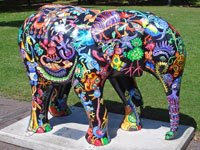
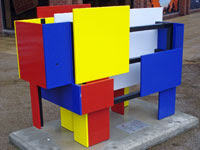
Back in 2002, central London was filled with fibreglass cows. More than 100 bovine sculptures were scattered around the capital, each decorated with a different (often humorous) colourful design. Well now it's elephants.

Hefty-LumpLight Construction
The AngelParallelephant

There are more than 50 be-trunked creatures dotted around the city, in streets and parks and shopping malls. One's on a theatre balcony, one's in the corner of a restaurant and one's in a department store doubling up as a very-pink nailbar. The designs are as weird and wacky as ever, including a brick-painted Camouflagephant hiding up an alleyway, a Go-Green Elephant with three bottlebank holes for recycling, and a Buzzophalant which looks distinctly like a bee. Or you might prefer the double decker bus, the one in football kit or the one with a Tardis on its back.

I spent much of yesterday afternoon, inbetween the showers, tracking down the elephants with the aid of a downloaded map. Some were hard to find, others rather easier, often because they were surrounded by grinning children. It was clear I wasn't alone - a number of families and tourists were out following the trail too, leaflet in hand. The most popular elephant was probably the mirrored specimen in the Royal Arcade (bottom left), which was forever being stroked and photographed. I rather liked the bright yellow elephant in St Giles (top right), and also the more abstract 'Parallelephant' in Theatreland (bottom right), the latter recently restored after vandals made off with its plastic ears.

If you're interested in seeing the menagerie for yourself, you'll find all the details on the Go Elephants! website. Quick, before they sell them all off for charity at the end of August. Or you could investigate pictures of the entire herd here, most of the herd here, or quite a lot of the herd here. Oh, and one other thing. The city in question isn't London, it's Norwich. Because not everything that's great and arty happens in the capital (but I bet some of you wish it did).

 Saturday, July 19, 2008

I travelled up to Norfolk by train yesterday. Seven stations in ninety minutes, all pretty much on time and without incident. But one thing about the journey repeatedly niggled. A few minutes before each and every station stop, the chief steward delivered the following announcement over the tannoy. And I wish she hadn't.
Ladies and gentlemen we will shortly be arriving at <insert name of station>.
Change here for services to <somewhere> and <somewhere else>.
If leaving the train at the next station please make sure that you have all your possessions with you.
Please use all available carriage exits, making sure that you close doors and windows behind you, and ensure that you take your ticket with you when you leave.
Actually I can't guarantee that's the precise wording she used, but I heard her spiel often enough to know I've got the gist right. It was obvious she was reading every time from a pre-determined script, or at least had delivered this speech so frequently that she knew every word by heart. More to the point, I'm sure the speech didn't used to be this long. The operating company have been adding in extra instructions, and even more extra instructions, presumably because they think we're so stupid that we need to hear them. Where will it all end?
Ladies and gentlemen we will shortly be arriving at <insert name of station>.
OK, I don't mind that bit. It's not always obvious what the next station will be (are we stopping at Stowmarket or not?) and platform signs aren't always legible enough to be read from inside a carriage.
Change here for services to <somewhere> and <somewhere else>.
And that's OK too, especially for infrequent travellers. Because, you know, somebody might actually be going to Lowestoft or Harwich or Bury St Edmunds for the very first time.
If leaving the train at the next station please make sure that you have all your possessions with you.
I never leave a train carriage without thinking "do I have all my possessions with me?" I'm able to do this because I'm a responsible citizen, and I don't need repeatedly reminding like I'm an blundering amnesiac. In particular I don't need prompting at every single station, on every single train, every time I travel. I know it's important that unattended hand luggage is avoided at all costs, because any ensuing police operation can cost huge amounts of unnecessary time and money. But surely we've all now heard this message so often, so frequently, that it goes straight over our heads, with zero impact, its meaning totally unnoticed, and ... oh damn, I think I just left my laptop on the train.
Please use all available carriage exits...
You what? This Inter City carriage has two exits, one of them closer to my seat than the other. What are the chances that I'll accidentally head towards the wrong exit, the slow exit, and won't notice? Really, surely, this part of the message is completely unnecessary?
...making sure that you close doors and windows behind you...
OK, I know that closing the doors saves a lot of time. If I don't slam the door shut then the poor guard may have to walk miles up the platform to close it before the train can depart, slowing the service and creating unnecessary delays. But closing the window too? Erm, why? Opening the window is part of the inefficient door unlocking mechanism, so why force us to close it again afterwards? Are they worried that the rain might get in or the central heating might get out? Really, aren't there better things to nag us about?
...and ensure that you take your ticket with you when you leave.
Oh come on, now you're just taking the mickey. Do people really leave their tickets on the train, thinking "oh, I bet I won't need that"? Or do naughty people try sneaking through the ticket barrier by saying "oh sorry, I had my ticket checked on the train so I thought I'd leave it there"? I think not. Honestly, whatever insane extra request will they decide to add next?
Customers and stakeholders, we will shortly be arriving at <insert name of transport node>.
Change here for other services with equally annoying on-board announcements.
If leaving the train at the next station please make sure that you take any unexploded baggage with you.
Please exit via a door, not a window, and slam it behind you taking special care not to smash your fingers.
Please do not vomit on the floor on your way out, or carve your initials in the back of the headrest, or spit on your fellow passengers, or run amok in the carriage with a large machete.
Please continue to breathe at all times, and thank you for travelling with National Express.
I live in fear that, even by the time I travel home, something similarly ridiculous may have come to pass.

 Friday, July 18, 2008

The Stratford Hoard

a few of 1000 sugar sachetsI don't normally travel home via Stratford station, but I did yesterday (hi Mum, I've pre-bought my train ticket, I'll see you later). The Central line platforms were the usual mass of scurrying humanity, the subway was a typically frenetic scrum, and the queues at the ticket barriers were as nightmarish as ever. Up on the DLR/Jubilee overbridge, however, I managed to time my arrival for one of the quieter interludes between outpouring trains. And I was pleasantly surprised to discover that the station's upper concourse has been transformed, for a few months only, into a very local museum.

The Stratford Hoard is a series of collections of ordinary objects, such as picture postcards or milk bottles, each contributed by somebody who works at the station or lives nearby. The objects are presented with due reverence in museum-quality cases, elevating what could be a mundane assortment of items to a position of perceived importance. Imagine if you will the highlights of Elizabeth Parker's collection of sugar sachets, pinned out across four separate display cases like an array of mounted butterflies. Or Kacey Young's collection of souvenir teaspoons, comprising ornate silvery-plated treasures from various locations around the world. Or the scarily-oversaturated world of Martin Kingdom's picture postcard graphic wall, reliving the long-gone era when holiday messages took even longer to travel home that you did.

Manorware teapots and painted milk bottlesOr teapots. Susan Langford collects tiny red-spouted Manorware teapots inscribed with the names of British tourist towns. They're usually kept at home and brushed occasionally with a duster, but for the next few weeks they're in pride of place in a glass cabinet beside the entrance to the DLR platforms, just behind a row of late 20th century printed milk bottles. It's a great idea, this exhibition, celebrating the way that ordinary people celebrate the ordinary by collecting it.

I'm almost sorry not to have contacted the curator myself and offered him the loan of my collection of early-1980s chocolate biscuit wrappers. I'm sure the good people of Stratford would have enjoyed remembering what a shiny-coated blue Penguin looked like, and ogling a pristine Trio, and gawping at a pair of long-gone Uniteds (original and orange). Ah yes, sssh, there's a collector in many of us.

As part of the project's official launch yesterday, an additional freesheet newspaper was being handed out to passing commuters. This was Issue 1 of The Stratford Grapevine, an arts-sponsored community newspaper 'by and about the people of Stratford'. Yes, I know, it sounds awfully worthy and dull, but the reality is far better than that. Pride of place is given to a series of articles about the Newham Striders, a well-established healthy walking group, who recommend a few non-standard strolls around the local area. There are reports about the West Ham Allotment Society (Nina recommends them too), the imminent retirement of Stratford's favourite independent tailor and the disappearance of Robert the steam engine. Throw in a Forest Gate Punjabi radio station, a Gerard Manley Hopkins plaque (in a supermarket car park) and a competition to try to find the perfect match for Olympic Fence Blue, and you have a surprisingly interesting package. Issue 2 is due out in September, and Issue 3 in November.

As another DLR train arrived and disgorged its Docklands cargo, I stood back to let the Essex hordes storm through. It was reassuring to see many of them accepting a Grapevine in preference to a London Lite (I know which I'd pick, given the choice), and then sitting reading about E15 rather than W1 on the train journey home. The 20-page tabloid can still be picked up from Stratford station for the next few weeks, or else you can download the pdf and read it at home. But for the sugar sachets and teaspoons you'll have to turn up in person.

 Thursday, July 17, 2008

How online communication used to be

IRC Log started for '#ParkCollege' channel: 19:06:57, 21/09/1997...
            BB_TROTER has joined from trotter@client87a9.globalnet.co.uk.
            BK has joined from ~BK@nordlys.demon.co.uk.
<Alex_King> cool
 <Han-Solo> its just a channel to chat :)
            Char^Brit has joined from Charlene@p50.ascend3.is2.bb.u-net.net.
 <Han-Solo> a friendly channel at that :)
            powerpup has left this channel.
 <Han-Solo> hey char^brit
            BB_TROTER has left this channel.
<Char^Brit> hello
    <Juha^> thanks, han
<Char^Brit> hiya han-solo
<Alex_King> so what type of channel is this???
    <Juha^> :)
            will has joined from will@p27-courser-gui.tch.virgin.net.
 <Han-Solo> alex a friendly one :)
 <Han-Solo> where you from char
<Alex_King> cool
            isw has joined from stairs@machine.multi.fi.
    <Juha^> hmm..
<Char^Brit> london, UK
    <Juha^> any new users???
            susi has left IRC: Ping timeout
<Alex_King> me
    <Juha^> hi..
    <Juha^> =)
 <Han-Solo> char cool, i`m in eastbourne
            Mongoman has joined from steven.mur@dialup-68.publab.ed.ac.uk.
    <Juha^> hmm..
 <Mongoman> hello
 <Han-Solo> hey mongo
<Alex_King> i am in camberwell
 <Mongoman> whats going on here then?
            Jim_27_N1 has joined from Jim@th-eng10-061.pool.dircon.co.uk.
            keyser has joined from na@DynIP-Line29.Tre.sgic.fi.
   <AcCuRa> cool, what are we, all south englanders
            Char^Brit has left this channel.
 <Mongoman> no im from scotland
   <lumley> hi keyser
 <Han-Solo> welcome one and all
<Alex_King> who is in camberwell
      <Unc> Here : Shropshire
            Topic changed to 'Cheer up...have fun :)' by Han-Solo.
<Alex_King> austraila
 <Mongoman> ok
 <Mongoman> cyaz
            Mongoman has left this channel.
            Tj has left IRC: Ping timeout
            will has left IRC: Leaving
            Han-Solo has made Juha^ channel operator
    <Juha^> tnx..
<Alex_King> warez are cool
 <Han-Solo> brb
            lumley has left this channel.
    <Juha^> *grrrr.*
 <Han-Solo> >×=- -=°LuV`97°=- Backdoor HaCk Detected From: Juha^
 <Han-Solo> >×=- -=°LuV`97°=- /kick #parkcol Juha^
      <Unc> Who or what is Park College?
      <Unc> Or where even :-)
 <Han-Solo> park college is the college i go to :) in eastbourne
      <Unc> Ah right thanx
            Han-Solo has enabled Alex_King to speak when moderated
            Alex_King has left IRC: Leaving
            Han-Solo has changed nick to han-_away.

 Wednesday, July 16, 2008

I had cause to visit one of the other flats in my block last night. I've been living here for years and in all that time I don't think I've ever had cause to step inside a single other neighbouring apartment. I smile occasionally at the woman from the flat nextdoor, I think I once saw someone from the flat opposite disappearing through their doorway, and I know the elephants in the flat above me by the sound of their thunderous footsteps. So much for East End community spirit. But on this occasion, thanks to circumstance, contact with a neighbour was unavoidable.

I stood outside their front door for a few awkward seconds, not quite believing that I was to be permitted across the threshold. "No really," they said, "come in come in." So I stepped across the welcome mat, muttering tangential smalltalk, and looked around me.

Ooh what a nice flat. Comfy sofas with luxurious scatter cushions. Bookshelves and CD racks in an elegant Heals or Habitat style. That posh laminate flooring stuff that doesn't look like somebody's slapped sticky-back plastic on the floor. Smart painted walls in what were probably up-to-the minute colours (not that I'd know, but they definitely weren't magnolia). An open plan kitchen with shiny metal appliances, bedecked with ironware utensils and a sprinkling of spice racks. Glass tables, arty objets and hand-woven rugs. Uplighters! In short, it was everything my flat isn't.

I smiled politely, trying not to let on that I was impressed. Here was somebody living in a similar sized space to me but who'd made very different use of the opportunity. They'd thrown thousands of pounds at making their place look nice, with a seemingly effortless understanding of style and design and fashion. And I was still living pretty much in an as-built shell with stuff in it. My flat's plain and functional, not chic and dapper. I could make more of an effort and tart mine up a bit - throw in a vase or a mirror or something, or paint the walls, or hang some arty photographs - but I choose not to. Because my flat's a place for me, not a canvas for creative expression and sociable entertaining. And DIY is such a tedious way to spend a weekend, don't you think? So why bother?

As my short visit drew to a close, my temporary host suddenly revealed an unexpected inadequacy. "You haven't got any sellotape, have you?" All this beautiful furniture and fabric on show, but it seemed there were no practical accessories behind the scenes. "No problem," I said. "I'll go and get some." In my flat I have sellotape on display in the same way that most people have ornaments, so I was able to lay my hands on a roll with ease.

I'm promised I'll get the sellotape back later, eventually, sometime. But I'll be holding my potential visitor at the front door, however inquisitive they might be, with no more than a tantalising glimpse down the hallway. My flat might be ready for unexpected discriminating guests one day, but not yet.

 Tuesday, July 15, 2008

Random borough (18): Ealing (part 3)

www.flickr.com: my Ealing gallery
(36 photos altogether)

Somewhere pretty: Hoover Building
Hoover Building, PerivalePeople don't usually get excited by vacuum cleaner factories. But this is no ordinary industrial warehouse, this is the legendary Art Deco Hoover Building, and it's gorgeous. It's 75 years old this year, constructed in response to a 1930s boom in labour-saving appliances. It was designed by Wallis, Gilbert and Partners, and built as the manufacturing hub of Hoover UK's suction empire. Hitler somehow managed to miss its gleaming white stonework, and travellers along the A40 Western Avenue are still wowed by its monumental pillared frontage.

I arrived just as the sun was about to disappear behind a giant grey showercloud, and had to run along the pavement in front of the building to make the most of the light. Quickly I snapped my distance shot, then strode through the angular ornamental gates for a close-up of the fan-windowed entrance. I was impressed by easy it was to gain access to the lawn at the front of the building - this is no locked-away mothballed treasure. Hoover Building, PerivaleSlowly the shadows cast by the bold serif lettering faded away and the bright facade faded to a less vibrant grey. Damn. A few stray streaks illuminated the canteen block to the west and the office pile to the east, but that was my lot. My attempts at intimate arty-angled abstracts were, alas, dulled by approaching cumulonimbus. So I went shopping instead.

From the front it's not immediately obvious, despite some ugly signage, that the bulk of the building is now a cavernous Tesco supermarket. But a slow stroll round to the rear revealed a trolley-ful car park, some fake Art Deco walls and the extraordinary entrance to a very ordinary shopping experience. Where once stood a factory floor, now the people of Perivale purchase ready meals and earn Clubcard points. I don't think the store sells Hoover bags, but I did succumb to some Earl Grey teabags and a bottle of wine. Meanwhile if you're the boss of a medium sized company seeking to relocate, you might like to know that 31000 square feet of office space in the main Hoover Building is currently up for grabs. Imagine the smile on the face of your employees if they ended up working here.
by tube: Perivale  by bus: E5, 95, 297

Somewhere sporty: London Motorcycle Museum
London Motorcycle MuseumThe National Motorcycle Museum is in Solihull, home to an extensive collection of classic bikes, a self-service restaurant and award-winning conference facilities. Forget that. You want the London Motorcycle Museum - a converted farm building up a sideroad in Greenford, packed with a few hundred two-wheelers, assorted memorabilia and a drinks machine. No contest. And just three quid gets you inside.

Once you've paid your money, you'll be amazed just how many bikes can be crammed into this long but reasonably narrow shed. Motorcycles are squeezed in everywhere, side-on or up on a ledge, tentatively arranged in themed areas. Many of the bikes are Triumphs - the owner has a bit of a thing about Triumphs - but you'll also spot Royal Enfields, Rudges and Velocettes. Laminated information sheets dangle from the central rail, enabling less-knowledgeable visitors to distinguish a Bonneville from a Flying Squirrel. Don't expect to see much modern stuff, but the displays stretch right back to the first engine-assisted boneshakers. Dotted inbetween are various bike-related items such as police helmets and bottles of Castrol GTX, along with various barely-related items such as teddy bears wearing goggles and portraits of the Queen. The whole place smells of garage, and petrolheads will feel immediately at home.

London Motorcycle MuseumFurther up the ramp there's a collection of army bikes, and some racing memorabilia, and several other vehicles that aficionados will no doubt distinguish better than I managed. And finally the "library", which more closely resembles a cheap cafe littered with bike books and brochures. Expect to be offered a free cup of steaming liquid from the vending machine (free of charge, but donations to Cancer Research welcomed). Maybe you'd like to watch an old VHS whilst flicking through some bike mags or checking the date of the museum's next special event. You might even be really lucky and get the special invite I received... "Do you fancy a look at our other machines in the barn?" An offer not to be refused.

An enthusiastic young man led me out through a rear door and unlocked the door to the second oldest building in Greenford. The museum has big expansion plans, starting with this restored barn which should be ready for permanent opening within a year. The plan is to devote the main shed to Triumphs, spaced out a bit better, and then to stack the remainder of the collection in here. There'll be plenty to see. I was impressed by the varied collection of sidecars, one of which was recently used to transport a nervous bride from her wedding to the reception. I even got to see the BSA and sidecar once used by Dad's Army's ARP Warden and verger, and which appeared at the Imperial War Museum only last week for a photo opportunity with the surviving cast.

It's not the most well-ordered museum you'll ever visit, but the ephemeral collection is all the better as a result. The staff are knowledgeable without being imposing, and managed to enthrall both a non-expert like me and a proper biker who was visiting at the same time. And I'm sure they'd appreciate you dropping by, be it on foot or swerving to a two-wheeled halt in the car park.
by train/tube: Greenford  by bus: E10

 Monday, July 14, 2008

Random borough (18): Ealing (part 2)

Somewhere retail: Southall
Somewhere retail? I must admit I was tempted to visit the shop on Acton Hill that was the site of the first Waitrose (but alas it's now a garish pizza takeaway marked only by a gum-splattered plaque set into the pavement). And there was a pet shop in Greenford with a dodgy sign that I quite liked. But no, the only obvious destination was a shopping strip in the west of the borough that's slowly evolved to become part of the subcontinent.

Southall Broadway

Southall used to be a fairly ordinary suburb, grown up beside the canal and railway, with a High Street full of all the usual grocers, butchers and bakers. The first South Asians arrived in the 1950s, attracted by employment opportunities at Heathrow and nearby, and now more than half of the local population is Indian or Pakistani. Over the years Southall Broadway has changed to match. Very few national chain stores bother to have an outpost here. There's a Woolworths and an Abbey, but no Starbucks or WH Smiths. Instead the street bustles with hundreds of independent shops, catering to the more important needs of local clientele - food, clothing, jewellery and music.

SouthallFruit and vegetables are sold from shops that resemble labour-intensive market stalls. Mangoes are everywhere (a bit like weed on the streets of Brixton but rather more legitimate). Brightly coloured fabrics and saris spill out onto the pavement, picked over by elegantly dressed mothers and daughters. Racks of shiny sandals are a big draw for some, while younger women seem more interested in window displays dripping with gold bangles and chains - why settle for sparkle when you can gleam? And the music pumping from passing cars was no doubt purchased in one of the many specialist stores along the Broadway (your one-stop shop for everything bhangra and Bollywood).

It's a harmonious high street, with hundreds of people busily buying and browsing, but I've rarely felt quite so out of place in London as I did here. On one occasion I walked through busy crowds for two whole minutes without seeing a single other white face (and when I did, she was an old lady collecting for the St John's Ambulance). No complaints - indeed many Southall residents must feel the same when they travel to other more monocultural parts of the UK - but I'm afraid I resisted the urge to dip my wallet into Punjabi culture. I didn't stop to watch a Bollywood classic at the astonishing Himalaya Palace Theatre, nor treat myself to a bulging bag of Royal Sweets, nor even grab a mango. In fact I'd better not tell you where I finally stopped off for lunch, you'd be terribly disappointed.
by train: Southall  by bus: 95, 120, 195, 207, 427, 607

  WALK EALING
  Somewhere random: Capital Ring (section 8)

  Osterley Lock to Greenford (5 miles)


This section of the Capital Ring crosses the centre of the borough of Ealing, so it seemed the perfect walk to take to get to know the place better. I hoped the rain would hold off, and it just about did,so maybe that was why I shared most of my walk with wildlife and not passing humans. The main part of the route follows the river Brent (apologies, inhabitants of Brent, but your namesake waterway is far prettier as it threads through the borough nextdoor). But first I travelled to Boston Manor, one of those annoyingly frequent stations on the tube to Heathrow, to kick off with a canalside stroll.
by train/tube: Boston Manor  by bus: E8  [full walk details]

Grand Union Canal: Only a few miles from the end of the canal (at Brentford), there's an unexpectedly rural feel to the waterway around Osterley Lock. Do try to ignore the M4 carving its brutal way across the valley. A good distraction is the unusual "labyrinth weir", stretching out like a water-gloved hand to maximise river flow in a confined space.
Hanwell LocksHanwell Locks: A rare flight of six locks which raises the level of the canal over 50 feet. The old Middlesex County Asylum rises beside the middle locks, where colourful information boards reveal the history of this historic staircase. Cross the lockgates and there are sideponds to explore. I was lucky, I got to watch a narrowboat making its way up, and got close to a heron by one of the lockkeepers' cottages.
River Brent: Thankyou Mr Fitzherbert for campaigning to open up the riverbank to public access, it's delightful. But the tunnelled footpath beneath Hanwell Bridge was flooded (very flooded) so I had to cross over the Uxbridge Road instead.
Ealing Hospital: Is this the ugliest hospital in London ? It looks like somebody plonked a giant Communist concrete apartment block down in the middle of nowhere, shielded by nothing. Recently rated by patients as the worst hospital in the country, and I can't say my spirits would be raised if I ever had to venture inside.
Wharncliffe Viaduct: Isambard Kingdom Brunel's first major structural project was this eight-arch brick viaduct which carries the Great Western Railway over the Brent valley. It's a striking sight from Brent Meadow, even if I've never noticed it from the train.
Wharncliffe Viaduct
Brent Lodge Park: Also known as 'Bunny Park', because of the small zoo here. Plenty of families with small children were out enjoying the animals, the cafe and the playground, plus a rather splendid Millennium Maze with yew hedges (and parent-friendly viewing platform). Even better, this was where the sun finally came out
River Brent (again): The Brent meanders through meadowland in the shadow of St Mary's Church, past golf courses and cricket pitches, and beside a vast wildflower heathland reclaimed from landfill. The butterflies and I had the whole stretch to ourselves.
Perivale Park: I'm sure it's delightful, but I abandoned the walk two miles early at the Ruislip Road because I had an appointment in Greenford (more of which tomorrow).

 Sunday, July 13, 2008

Random borough (18): Ealing (part 1)

Ah, Ealing, Queen of the Suburbs. This broad swathe of pleasant commuterland lies at the very heart of West London. It's the third most populous borough in the capital (I have yet to visit the top two). It's home to a broad mix of nationalities and cultures. It's strung out along the A40 Western Avenue and the Uxbridge Road. And it's not somewhere I'd previously spent a lot of time. I may have been missing out. Let's start today in Ealing itself, formely fields, now a major metropolitan centre.

Somewhere historic: Pitzhanger Manor-House
Pitzhanger Manor-HouseSir John Soane left his architectural mark on London. He designed the Bank of England (since redeveloped), the House of Lords (since burnt down), various churches and the Dulwich Picture Gallery, amongst others. He's best remembered, perhaps, for the house in Lincolns Inn Fields that now houses an eclectic museum in his name. But there's a less well known outpost of his Neo-Classical empire, out in Ealing, just south of the Broadway. It's easily overlooked. Shoppers pass by through Walpole Park, straight past the front door, without a second look. Staff inside the villa have a series of blue boards labelled "Open today, Free entry" with which they attempt to lure the public within. I'm not sure it works as frequently as they'd hope. But blimey, what a great little manor this is. Because nobody shows off quite so much as an architect designing their own home.

Soane snapped up Pitzhanger in 1800, aiming to transform it into a country retreat where he could impress clients. He succeeded. The facade is bold and striking, with four classical columns topped off by appropriately goddesslike statues. The entrance hall is narrow but unexpectedly tall, with decorative marble and plasterwork above. And... ah, hello, no I've never been here before, and yes I would like an audio wand tour, is it only a pound, that's a bargain, thankyou. The breakfast room is amazing, just a small wood-panelled chamber but with the most fantastically over-the-top ceiling . Clouds swirl around within a central elliptical disc, surrounded by snaking geometric lines and the occasional cherub. The room nextdoor has a ceiling depicting leafy trelliswork, positioned above a compass-style rug and sandwiched between an infinite panorama of twin reflecting mirrors. Very playful, very ornate, very Soane.

the Eating RoomDownstairs, in the oldest wing of the house, is a rather larger pair of rooms linked by three tall archways. The walls of the Eating Room are duckegg blue, there's very little furniture bar a mahogany table and some statues, and again the ceiling tugs at your eyes screaming "admire me". 100 years ago this became the reading room of Ealing Library, and it's now available for hire for weddings, civil partnerships and other ostentatious events. There are further rooms to explore, both up and down the central marble staircase, each with their own lengthy audio wand description. Really, you get your money's worth from this one. By the time you leave the house you'll know all there is to know about Soane, and particularly his troubled relationship with his two sons. John hoped Pitzhanger would inspire them both to become architects, but he was sorely and heartbreakingly disappointed. However, it might just inspire you.

See also: the arty PM Gallery nextdoor, free and with a modern nod to the community.
See also: the walled rose garden, once Sir John's vegetable patch.
Don't see also: the house's collection of Martinware (it's a special type of pottery), part of which was nicked by thieves earlier in the year, so the remainder is now off-limits.
by train/tube: Ealing Broadway  by bus: 207, 65, 83

Somewhere famous: Ealing Studios
Ealing StudiosThe Ealing name is synonymous with comedy. Not your modern sitcom or your Shakespearean knockabout, but a series of British film classics knocked out in the 1940s and 1950s which may well have had you/your parents/your grandparents rolling in the aisles. I can't say they've ever had that effect on me. Passport to Pimlico, Kind Hearts and Coronets, Whisky Galore (and that was just 1949), they're an acquired taste these days. But they were all produced in a back lot off Ealing Green, courtesy of film producer Michael Balcon. He tapped into a postwar feelgood vibe, brightening up the austerity years with such classics as The Lavender Hill Mob and The Ladykillers. The BBC took over the studios in 1955, producing dramas (such as Colditz) rather than comedies. And more recently Ealing's been bought up by a consortium intent on restoring the town's good name in the film business. The latest St Trinian's movie came from here, as well as bits of Notting Hill and Shaun of the Dead. But also Ant'n'Dec's Alien Autopsy, so Ealing's reputation still has a long way to go.

The original White House office building looks its age these days, and gives no hint (bar a blue plaque) that 4 acres of cinematic powerhouse lies behind. But take a short walk up the street and there, beside some rather dull modern offices, is the hotchpotch of buildings and workshops that make up the current studios. You get a semi-decent view through the railings - a chimney, a bland 50s block, a car park, and the door leading to miniature wizards The Model Unit. Somewhere in the near distance is the big stepped hangar where most of the filming happens. But you won't get far because security already have their beady eye on you, so there'll be no gatecrashing the soundstage thankyou very much. Just believe that somewhere in there is an understated plaque, pinned up by Michael Balcon just before he left, which commemorates the site's quintessential Ealing-ness: "Here during a quarter of a century many films were made projecting Britain and the British character."
by train/tube: Ealing Broadway  by bus: 65

 Saturday, July 12, 2008

Random borough (18): Time yet again for me to take another random trip to one of London's 33 boroughs. As I write I have no idea which one of the 16 remaining borough names will be revealed when I unfold the slip of paper I'm about to pick from my legendary (and as-yet unseen) "special jamjar". I could pick any of London's other boroughs - inner or outer, urban or suburban, small or large, Boris or Ken, fascinating or dull. I just know it won't be Merton, Islington, Enfield, Sutton, Lewisham, Southwark, Kensington & Chelsea, Hackney, Hillingdon, the City, Bromley, Lambeth, Tower Hamlets, Haringey, Hounslow, Brent or Redbridge because they're the seventeen (dark grey) boroughs I've picked out already.

I'm now embarking upon the second half of my haphazard capital odyssey. There's a fair chunk of East London still to visit, and a few stragglers in southwest London, and a ring of untouched boroughs surrounding Brent, but that's all. Which of these leftovers will be my destination for the day? Will I be treated to the cultural highlights of somewhere central and important, like Westminster or Camden? Or will I be dispatched somewhere rather more peripheral and off-radar, like Harrow or Havering? And will I need to make use of my TfL tube closures leaflet? Watch this space.

Once I've researched my randomly-chosen borough online then I'll head off and visit some of its most interesting places (assuming it has any). As usual I hope to visit somewhere famous, somewhere historic, somewhere pretty, somewhere retail, somewhere sporty and somewhere random. I might even take lots of photographs while I'm at it, if the borough's photogenic enough. Then after I've made my grand tour I'll come back tomorrow and tell you all about it. Let's see where I'm going this time...

diet update: I thought you might be interested to hear how my low-cholesterol-ness is getting on. It's now four months since my doctor told me I really ought to de-clog my arteries. Back in the middle of March I embarked upon a puritanical low-fat diet, cutting out excess stodge and living off only permitted foodstuffs. No crisps, no pie, no pizza, but plenty of oily fish and un-sauced chicken. I had two months to try to reduce my cholesterol levels before a follow-up blood test, and the Creme Eggs stayed in the cupboard all that time. It was grim, but look, it worked.

mid-March      X stone 7
mid-April      X stone
mid-May(X-1) stone 7
By mid-May I'd lost a whole stone (note to American readers, that's fourteen pounds) (note to continental readers, that's six and a half kilograms) (note to innumerate readers, that's about the same as chopping off my arm). Not only that but my cholesterol was down by a third, my doctor was happy and he felt no need to prescribe me anything. Result. I'd also dropped an entire waist size, which meant I was able to slip into pairs of jeans I'd not worn since 2004. And some of these were still almost in fashion.

mid-May(X-1) stone 7
mid-June(X-1) stone 5
mid-July(X-1) stone 4
But today I'm far more impressed by my minor weight loss over the last two months. Because a crash diet is easy, but a change of lifestyle is much harder. I'm still behaving myself by heating up porridge for breakfast and dining on salmon twice a week, but now I sometimes have a pizza inbetween. I've gone back to eating chocolate, in moderation, and ice cream, occasionally, and roast dinners, sometimes. I'm no longer the boring sod in restaurants who stops eating after the starter, or who turns down a biscuit with a cuppa, or who lives in a state of complete cheeselessness. I'm living again, but that stone I lost has stayed off, and my weight appears to have stabilised well beneath what it used to be. It's not a bad life really. Now, if I'm staying down here, I wonder if it's time for some new trousers?

 Friday, July 11, 2008

 Keep back from
the platform edge

Stand behind yellow line

London Blackfriars
[this platform closes next year]

Smoke #12The latest edition of Smoke magazine is now available for purchase. Hurrah! The irregular London fanzine has now reached issue 12, and the latest glossy offering features the usual mix of "words and images inspired by the city". All hail editor-in-chief Matt and his eclectic selection of contributors. Look, the cover even manages to make Peckham appear glamorous. Ah yes, there's still something reassuringly Zone 2+ about Smoke.

Most of the articles have an articulate literary bent, more descriptive than factual, and there's usually an arty angle to the images and illustrations. In this issue you can read about the Bethnal Green ski slope, see more of London's campest statues, explore the backstreets of Mornington Crescent and ride the Bus Of The Month along the Embankment. There seem to be more articles than usual about relationships, be it flirting on the tube to Edgware, going out with a road campaigning squatter from Leyton, or (in a quite delightful piece) nestling on the shoulder of a regular commuter on the 0725 to Waterloo. Perhaps these snippets here will give you a better idea. And then you can fork out £2.90 (stockists here, mail order here) for your own copy, because you're not borrowing mine.

And if you're the sort of person who prefers some decent reading material to a disposable freesheet, you might also be interested in this weekend's London Magtastic. This is a mini-festival devoted to the distribution of cheap/free independent publications, and you'll find it at Hays Galleria on Saturday. Participating periodicals include penny dreadful One-Eye Grey, the fictional Litro, Northern line inspired The Other Side, and various other capitalcentric fanzines. And Smoke, of course. And very definitely not the London Lite.

 Thursday, July 10, 2008

The Otford Solar System

The Otford Solar System (Earth in the foreground, the Sun and Mercury further behind)There are some things you don't expect to find on a village recreation ground. Like the planet Jupiter, for example. But head down to Otford in the Kent Commuter belt, just north of Sevenoaks, and there it is, red spot and all. And Venus. And Neptune. And all the other planets in the solar system, scattered around the village as part of an enormous scale model. Only in Britain, eh?

BestMate and I were wandering through Otford last week, like you do, admiring its quaint backwateriness. We strolled round the duckpond that doubles up as a rather frenetic roundabout. We looked behind the very old church and failed to find an unsignposted Bishop's Palace. We observed an unusually high concentration of small boutiques which sold hats, blouses and accessories to genteel Kentish women. We walked past the millennium mosaic, and the Heritage Centre (which was closed) and various other cultural extras that elevate this village well above the rural norm. And then I led him into the playing field and showed him the delights of the universe. He was almost impressed.

Otford JupiterFirst stop Jupiter, which was located not just beyond the asteroid belt but just in front of a tall hedge. Our solar system's largest planet was represented by a squat white pillar, topped by a metal disc on which was etched a two dimensional representation of the gas giant. Otford's Jupiter wasn't big, just 3cm across, but this is a scale model and there's a lot to cram in. We then walked another 100 metres or so past a football pitch to reach the pillar representing the Earth - a journey more like half a million kilometres in real life. On this disc was a tiny pinprick representing the Moon, less than a millimetre in diameter and orbiting at a distance of 9 centimetres. Don't worry, I looked all this information up on the website afterwards, I didn't take a ruler with me.

I apologised to BestMate for dragging him across a playing field so that I could view the Inner Planets. "Honest," I said, "I just want to take a few photographs and then we can leave." He shrugged with well-practised resignation. But there was an unexpected setback to my plans. The Otford solar system had two other visitors that day, one teenage male and one teenage female, and they had no intention of clearing out of orbit. Indeed, after a few cometary flypasts they came to a sudden halt near Mercury, settled down on the grass and started snogging. No chance of a decent photo while these two heavenly bodies were eclipsing the view.

space debris close to the Otford Sun"Sorry," I said to BestMate, "but I really am going to walk over there to look at the Sun, no matter how socially gauche it is." We strode purposefully towards the shiny football-sized dome representing our nearest star, attempting to ignore all the groping and cavorting taking place in the heliosphere. *cough* Suitably embarrassed we continued on our grand tour, first to Mercury ("don't look, they're still at it") and then to Venus ("it's shameless, like they haven't noticed us at all"). Typical, I'll probably only ever explore this solar system once, but my single opportunity for photographical evidence was being ruined by an unscripted alien invasion.

We paused to read the information board at the far end of the rec. We learnt that the model had been constructed to a scale of 1:five billion. We learnt that the positions of the planets around the village matched their astral alignment at midnight on 1st January 2000. We laughed at the suggestion that "dabbing a pillar top with a soft tissue is said to bring good luck". We checked that Venus and Mars were still cuddling (and they were). And we could have read lots of statistics about the planets, but nearby amorous activity was becoming rather cringeworthy at this point so we headed off into the relative privacy of deep space. If only space travel were this easy.

We didn't have a map with us, so we never found Uranus up the road or Neptune at the far end of the village or Pluto out in the middle of a distant field. I doubt that many visitors ever reach the outer reaches of the Otford solar system. But there is one further part of the model that's seen by far more people, far far away. It's a bronze globe about three centimetres across, resting on a platform in the Griffith Observatory in Los Angeles, representing Proxima Centauri. This red dwarf is the closest star to the Sun, but even at this scale they've still had to position it as many as 5400 miles from Otford's solar centre. Because space is big - really big. And, thanks to the good people of Otford, it's possible to believe how vastly, hugely mind-bogglingly big it is.

The Otford Solar System (map) (photos)
The Somerset Space Walk (leaflet) (photos)
Cycle the Solar System (York)
Spaced Out UK

 Wednesday, July 09, 2008

Heritage at risk

English Heritage have just released an updated list of the country's most important endangered architectural assets. They reckon that the best way to protect these neglected special buildings and structures is first to identify them, and then hopefully preservation and conservation will follow. Sounds like a good idea to me. And there are thousands and thousands of at-risk sites on their list. Watermills, tower blocks, drinking fountains, lychgates, town halls, bandstands, brick walls, viaducts, battlefields... everything's on here. There are several impressively detailed regional pdfs, each downloadable from the Heritage at Risk website, on which you can discover whether there are any threatened gems near you. Go on, you might be surprised.

I was surprised, because apparently there are six threatened heritage sites within a five minute walk of my front door. I live, apparently, at the heart of an at-risk cluster. So last night I grabbed my camera and went out for a (short) walk to investigate. Here's what I found. You can click on the thumbnails if you fancy seeing a full-sized photo (although why you'd want to I don't know, I mean, one of them is a bollard for heaven's sake, a bollard!). I bet that the place where you live isn't this endangered...

163 Bow Road
163 Bow RoadEarly 18th century property. Stock brick with red brick dressings. Modern shop on forecourt. Interior includes panelled rooms and good staircase. Inappropriate window frames added to facade. Paint applied to brick facade.
And I'd always thought this building was just a narrow stumpy 1930s block of flats behind a kebab shop. Just goes to show that appearances can be deceptive. This Georgian residence stands a long way back from the road, accessible only via an alleyway along the side of a launderette, which can't add much to the value of its housing stock. The roof terrace looks a nice place to be in a heatwave, if you don't mind breathing in exhaust fumes and the smell of halal chicken wafting up from below. But I can't say I'd be longing to live here.

199 Bow Road
199 Bow RoadLate 17th century stock brick with red brick dressings. Neo-Georgian shopfront. Unauthorised works to shopfront and alterations including changes to dormer windows.
This unassuming building, dwarfed between a residential block and a police garage, turns out to be more than 300 years old! I'd never have guessed. The ground floor frontage is an unplanned mess, semi-boarded to prevent vandalism and with wholly inappropriate plastic doors and windows. The first floor flats look less than pristine, and the top floor's a delapidated shell with a wooden attic roof open to the sky. This is the perfect example of a building that's somehow survived against all the odds, but may not survive unscarred much longer.

Two bollards, Bow Road
Bollard, Bow Road E3Two 19th century bollards which formed a group along with St Mary's Church, its gates and railings and the statue of WE Gladstone. One of the bollards has been removed.
Honestly? This black featureless bollard that I walk past every day is a Grade II listed building? I'm amazed. I've barely given it a second look before, and even now that I have I can't quite see what makes it special. The metal post is covered in what looks like thick black paint, so there are no obvious inscriptions or emblems anywhere on its surface. And yet, look, there's the circular scar in the pavement opposite where its twin bollard used to stand. Presumably this was ripped out when a pelican crossing was installed immediately beside it, because pushchair access is more important than heritage. Blimey, the things English Heritage keep their eyes on! Load of bollards.

8-12 Stroudley Walk (including Rose and Crown public house)
Rose and Crown Public HouseLate 18th, early 19th century, three storeys, stock brick with shop on ground floor.
Late 18th, early 19th century inn, of three storeys with parapet and stucco band. The roof is not visible. Forms an important local focal point. Now vacant and boarded up.

Not so long ago the Rose and Crown was a rather shabby pub packed with E3's less salubrious drinkers. And now it's a boarded-up shell, somehow retaining an unshattered 'Taylor Walker' glass lantern above the front door. Local alcoholics have been forced to move on, and have since taken up camp outside the betting shop beneath the post-war arched colonnade, where they slouch their lives away while their devil dogs roam the bleak concrete piazza. It's lovely round where I live. Two sozzled characters were particularly intrigued as to why I might be taking photographs of their erstwhile boozer and insisted on staring at me as they necked cheap lager hidden within a rolled-up newspaper. Thankfully they walked out of shot without confronting me and nicking my camera. The 200-year-old shop nextdoor is faring slightly better than the pub, now home to a subcontinental emporium selling vegetables, phonecards and assorted plastic essentials. But it'll take more than an architectural makeover to breathe new life back into this impoverished retail backwater.

How Memorial Gateway, Bromley High Street
How Memorial GatewayCirca 1893. Gabled stone gothic arch with double buttresses at each side. Formerly an entrance to St Mary's Churchyard. Suffering from stonework decay.
There used to be a Saxon church beyond this elegant gateway, one so famous that even Chaucer wrote about it, but no more. A German bomb scored a direct hit during the war, and what ruins remained were demolished in the 1960s to make way for the Blackwall Tunnel Approach Road. Now all that remains is an overgrown corner of the churchyard - perfect for glue-sniffing, arson and depositing canine excrement. Somehow this arched memorial to a much-loved Victorian vicar has survived the architectural carnage, but only just. It's now a depressingly downbeat gateway that nobody wants to use - overlooked, ignored and most definitely out of time. Here's hoping that an appearance on the Heritage At Risk register will safeguard it, and thousands of sites like it, for future generations.

 Tuesday, July 08, 2008

25 years ago today...

 Friday, July 08, 1983


6.45 Bedside radio switches on.
7.00 It's Mike Read with the Radio 1 breakfast show.
7.10 Crawl out of bed and stumble into the bathroom.
7.30 Breakfast in the kitchen. Mmm, Crunchy Nut Cornflakes.
8.05 Hop in car and Mum gives me a lift to school.
8.20 Arrive at school, just like normal. But not normal. It's the last day of term. It's the day after A Level study leave. It's the last day of the very last term. Last day at school.

8.25 Hello classmates. Hello class victim. We all insult the class victim. Sometimes I feel ashamed that we all insulted the class victim. I mean, this was the sixth form for heavens sake, and you'd think we'd have matured past that. Other times I'm mighty glad that somebody else was there to be class victim instead of me.

8.35 Enter form teacher. Form teacher outlines today's non-bog-standard timetable.
8.50 Go visit teacher of A-level-subject-one and drop off a pile of textbooks. I considered taking this subject at uni, but no, this was where I handed the entire subject in.
9.00 Cross school to visit teacher of A-level-subject-two and drop off another pile of textbooks. Another subject hits the buffers.
9.10 Return to form room, home of A-level-subject-three, which is suddenly my unique specialism.

9.20 It being the last day of term, somebody has of course brought in a board game. [Note to younger readers: board games were made of cardboard, didn't plug in, didn't flash, didn't move, didn't keep score for you, and didn't cost £49.99. You'd have enjoyed them] Our favourite board game at the time was called Cosmic Encounter. It was a bit strategy, a bit sci-fi, a bit geeky. But hell, we were geeky sixth formers so we never noticed that we should have been talking about football and breasts instead. [Note to younger readers: you can play Cosmic Encounter online today without the embarrassment of handling cardboard.]

9.50 The headmaster pops into the classroom to say goodbye. He shakes everyone's hand. I don't think he's ever done that before, but suddenly we're all men.
9.55 We get back to our board game. All that knowledge still to be had, all that free education waiting to be digested, and we spent our last morning shuffling bits of cardboard and pretending to be aliens. Still, I won the game, so it wasn't all wasted.

11.25 Our second game is rudely interrupted by the end of term. That's the last thing my classmates and I will ever do together. Unfinished.
11.30 All the Upper Sixth leavers head down to the garden for a bit of a 'do', and a drink. Some of us aren't even 18 yet, it's all very exciting. I bet schools don't hand out alcoholic drinks to their pupils today, even half an hour before they kick them out.
11.31 I sit down on the grass next to the young man who'd been my best friend at school for the first few years, back when we were still uniformed. We haven't chatted much in the Sixth Form, he went arts and I went sciences. We chat a bit now. We'll only ever chat three more times. Life moves on.

11.35 Time for farewells and prizegiving. Two boys I've been at school with since the age of 5 win the science prize. Two boys who were my second and third best friends win music and languages. One boy who was born in the same maternity ward as me wins the 'creep' prize for service to the school. The only boy who still sends me a Christmas card wins the history prize. None of my friends wins a sports prize. And I still have the Dr Who hardback that my ten pound book token paid for. The headmaster would have been so disappointed.
12.00 School's out, forever.
12.01 Walk home, swinging a nigh-empty bag, in the blazing July sunshine. This must be what freedom feels like.

12.30 Mum is holding a big fat envelope from my university-to-be. Life's rollercoaster continues. But weren't the last 29 minutes great?

 Monday, July 07, 2008

And then there are the days when you have far too many ideas for blogposts, but none of them seem interesting enough for a wider audience, so you stop writing after 100 words and move on to the next...

• I went to see more of the London Festival of Architecture at the weekend. You're not surprised, are you? Events were centred round the back of the British Museum in Montague Place, where a black raised walkway had been installed along the street. And what could visitors see from up there? A slightly elevated view of a backstreet containing a stage, a bar, and a bit of grass on the road. I endeavoured to be impressed, but I failed. The wooden Swoosh Pavilion in Bedford Square was more interesting, but there was nothing here to hold my attention for long...

• There may not be homeboys partying down Campbell Road, but Bow is celebrating its first number one hit single. The very local Dylan Mills (aka Dizzee Rascal) has topped the charts with his patently misspelt "Dance Wiv Me", on downloads only. Catchy little number, innit? The underlying beats come not from an 80s sample, as is so often the case these days, but from Scottish tunesmith Calvin Harris (so that's a first number one hit single for Dumfries too). Don't be put off by the tacky video packed with bling-bedecked babes, just enjoy the pulsing synth and DR's verbal dexterity...

• I wish I hadn't tidied up my flat over the weekend. I shuffled various piles of paper out of the way before my family came to visit, and now I can't quite remember which documents were the important ones. I'm sure I had a standing order somewhere, and an RSVP invitation, and a useful brochure, and a scribbled down web address, and a utility bill, and probably more. They used to be lying around on the top of various separate piles and now, in my hurry, they've all been shuffled into a single heap of mixed importance. Must untidy soon...

• I know you don't really care, but yes I now have two new bus routes passing my door – the 425 and 488. Both services are presently being shunned by the majority of the travelling public. Maybe these non-passengers are creatures of habit, maybe they can’t read the information posters at bus stops, or maybe the new buses just don’t go where they want to go. I suspect the latter. I've already seen elderly shoppers sitting patiently in the bus shelter outside Bromley-by-Bow Tesco waiting for an old S2 that'll never come. I do hope they got their shopping home eventually...

• Yesterday afternoon I was lured along to the re:fresh Festival taking place along the Regent's Canal in Islington. Very few, it seems, were tempted alongside me. The towpath was mostly empty, bar the usual joggers, dog walkers and drunkards. Stewards guided nobody at all towards overlooked attractions. Policemen watched out for non-existent crowd disturbance. The London Sinfonietta performed to an audience of barely anyone. A handful of hardy souls sheltered from blustery downpours inside a not-quite-interesting watertower. Organisers might blame the rain, but I blame the peripheral location. Have local developers Argent over-estimated the potential of their planned regeneration hub?

• I've broken the plastic door handle on my fridge. I tried supergluing it back together and leaving it to set, but no luck. The door seal is extremely strong, which would normally be a good thing, but one tug and it's snapped again. The freezer bit is fine, but the fridge door is buggered. So now I'm stuck having to open the edge of the fridge with my fingertips every time I want a cup of tea. Maybe I need to hint to my landlord to go and get me a new fridge. Or maybe I just need stronger glue...

 Sunday, July 06, 2008

Yesterday I had visitors. My brother and two nephews came down from Norfolk, by coach, to spend the day in London. Fortunately the weather forecast was mostly wrong and, after an initial drizzling, we were barely dampened all day. First stop was a Thames-side attraction I'd never visited before - most enjoyable, and which I'll tell you about another day. Second stop the Imperial War Museum, with lots of murderous weaponry to explore and plenty of interest to see. And third stop the Dome.

Well, that was the plan anyway. But London had other ideas. Because attempting to get around the capital by public transport at weekends can be a nightmare. From Lambeth to North Greenwich is less than five miles as the crow flies - should be easy enough, you'd think. Indeed five miles in Norfolk is a doddle of a journey, by car obviously, and would probably take no more than ten minutes. But SE1 to SE10, armed only with a travelcard, is quite another matter. We failed, utterly, lengthily, miserably.

So there we were outside the Imperial War Museum on Lambeth Road, attempting to work out an appropriate route to the Dome. Jubilee line, obviously, from nearby Waterloo or Southwark all the way to our destination. Except there was planned engineering work on the line and services were suspended between Green Park and North Greenwich, so that was out. Replacement bus services were operating... but only to Canada Water, and not from nearby, so no use there either. FAIL

Alternative tube route, then. Lambeth North to Embankment, then a slow chug east to West Ham, then Jubilee to North Greenwich. Except that this meandering journey heads in the wrong direction at least twice and looked like it would take forever. And anyway, my 9-year-old nephew had had enough of walking the streets by this time and wasn't keen on even a mild trudge back to the nearest station. FAIL

Bus, then. Only two routes run immediately past the museum, neither of which appeared to go anywhere useful. A careful look at the spider map at the bus stop revealed further routes, but again no obvious North Greenwich connection. I've since discovered there was a bus to the Dome running a few streets away, at Elephant and Castle, but at the time the Lambeth North spider map revealed nothing of the 188 so we completely overlooked it. If only TfL still produced proper street maps at bus stops, but no, we get the condensed summary for thick people. FAIL

River, then. A ride along the Thames to the Dome ticks lots of tourist boxes, and was a definite favourite with my vistors. So we took the bus to Bankside and walked down the pier to await the next eastbound service. Waiting passengers clustered around the boarding ramp, making no attempt at a queue (neither were there any railings to encourage us to line up, nor any employees on the pier to keep order). When the packed Thames Clipper finally arrived it was ten passengers off and ten passengers on, so only the most forceful managed to get on board. We didn't. The next boat would be just as full, we thought, and there were no clues how long we'd have to wait because the pier's electronic indicator was reporting fictional arrivals. At the weekend these catamaran services are an unpredictable unreliable raffle. FAIL

St Paul's, from Bankside PierSo, despite protestations, we decided to walk to the nearest tube station. Across the Millennium Bridge to St Paul's, a bit of a trek but a mighty scenic route all the same. But when we finally arrived we discovered the gates to the station firmly locked. Bugger. I'd checked the weekend engineering update on the TfL website before setting out but I'd missed the small print that St Paul's station was closed due to refurbishment works. We should have gone to Mansion House in the first place but, of course, on the tube map that's not geographically obvious. FAIL

At this point we completely changed our plans and headed instead into the West End for food. By bus from St Paul's to the Strand, what could possibly go wrong? But one stop from success our 23 suddenly veered right to avoid a closed street and eventually dumped us more than half a mile from where we wanted to be. No advance warning to disgruntled passengers, just an automated "This bus is on diversion" after it was too late. FAIL

We'd spent two hours traipsing around London getting absolutely nowhere, beset by engineering disaster, inadequate information and organisational mismanagement. Because sometimes, especially at weekends, London's transport is unutterably incompetent. And when you're only in town for a weekend, it's a shame to have it unnecessarily wasted.

 Saturday, July 05, 2008

Did you ever wonder how and why some of London's buses are numbered with letters? On the day that the S2 disappears, here's an answer. Three months ago David Brake forwarded me an email from Peter Osborn, who runs Red-RF.com, giving detailed information about the genesis of lettered bus routes. I reproduce this below, with thanks (and it now appears on Red-RF.com in the London Transport route numbering section).

S2, deceasedThe infamous Bus Reshaping Plan of 1968 made major upheavals to long-standing patterns of service and introduced areas of 'flat-fare' operation (now that all London bus journeys cost the same, it is easy to forget that crews used to have to cope with complex fare charts for each route). These were numbered with a letter prefix based on the area, thus starting with the W series and moving on to include Peckham, Ealing and so on.

The idea behind Reshaping was to replace parts of the bus network with a 'hub & spoke' arrangement, shortening trunk routes and providing high-capacity local links. At the same time, many suburban routes were converted to one-man operated buses. The high-capacity routes were 'flat-fare' - i.e. the same price for any distance, and used automatic fare machines on buses designed to carry large numbers of standing passengers. The Plan was a response to increasing staff problems and financial constraints at London Transport.

Implementation started in September 1968 in the Wood Green area (W routes W1 to W6 initially) and at Walthamstow (linked with the opening of the Victoria Line), where only one new service was flat-fare, the W21. The Wood Green area stretched from Crouch End to Edmonton, and encompasses today's routes W1 to W10. The Walthamstow area covers today's W11 to W19.

Reshaping, as first tried, was a disaster. Too much changed too quickly, the buses were too long for some of the roads and were unreliable, as was the fare equipment. And passengers didn't like standing. But the staffing and cost reasons behind all this were irrefutable, and then Ken Livingstone came along with Fare's Fair, so over time the old variable fares died out, first by fixed-fare zones then London-wide. One-man (later one-person) operation became inevitable, although some would argue the jury is still out on the efficiency of OPO on high-frequency trunk routes.

So the area schemes continued to be rolled out. Ealing (E routes), Peckham (P routes, even though P1, P2 and later P4 didn't go to Peckham), Morden (M routes) and Harrow (H routes) appeared by 1969. But the rot had set in - the Harrow scheme was a shadow of the original proposal and Woolwich and Romford schemes never got off the ground. A limited Croydon scheme (C routes, later abandoned) went ahead in 1970 and some Stratford (S) routes in 1971. Later schemes were the Bexley area (B routes), Docklands (D routes), Hounslow (H20 upwards), Kingston (K routes) Orpington (R routes for 'Roundabout', the group name) and Uxbridge (U routes).

Later examples of prefix route numbers tended to be local, rather tortuous routes, introduced to get buses into streets not previously served. This trend started with the minibus services in 1973 - see this link for more detail (it explains the C11) - and continued with the likes of Sutton services (S routes, including S3 which was previous used at Stratford) and Richmond routes (R68 etc). There are still oddities, like G1, presumably named after St Georges Hospital for which it's a local service, and the PR and RV routes which I mention at the end of the article on my site.

Thanks Peter. He recommends LOTS as the source of real information on the subject. I've now had a go at summarising London's current lettered buses in the table below.

 A (Airport) A10PR(Park Royal) PR2
B (Bexley) B11 B12 B13 B14 B15 B16 R (Orpington) R1 R2 R3 R4 R5 R6 R7 R8 R9 R11
(Richmond) R68 R70
C (Central) C1 C10 (Camden) C2
(Chelsea) C3 (Cricklewood) C11
RV(River) RV1
D (Docklands) D3 D6 D7 D8 S (Stratford) S2
(Sutton) S1 S3 S4
E (Ealing) E1 E2 E3 E5 E6 E7 E8 E9 E10 E11 T (Tramlink) T31 T32 T33
G (St George's Hospital) G1 U (Uxbridge) U1 U2 U3 U4 U5 U7 U9 U10
H (Hampstead) H2 H3
(Harrow) H9 H10 H11 H12 H13 H14 H17 H18 H19
(Hounslow) H20 H22 H25 H26 H28 H32 H37 H91 H98
 W (Wood Green) W3 W4 W5 W6 W7 W8 W9 W10
(Walthamstow) W11 W12 W13 W14 W15 W16 W19
K (Kingston) K1 K2 K3 K4 K5 X (Express) X26 X68
P (Peckham) P4 P5 P12 P13  

Do tell me if I've got anything in the table wrong (I bet I have).

 Friday, July 04, 2008

Fairlop Fair
Come, come, my boys, with a hearty glee,
To Fairlop fair, bear chorus with me;
At Hainault forest is known very well,
This famous oak has long bore the bell.

Let music sound as the boat goes round,
If we tumble on the ground, we'll be merry, I'll be bound;
We will booze it away, dull care we will defy,
And be happy on the first Friday in July.
New Fairlop Oak, Fulwell CrossBack in the mid 18th century, every first Friday in July, much of east London decamped to the Essex countryside for a drunken knees-up. They headed to Fairlop, near Hainault, to feast and be merry under a great tree - the Fairlop Oak. Its branches were said to cast a midday shadow 300 feet in circumference, covering roughly an acre of land, and a seething mass of booths and stalls were laid out beneath its mighty span. This was Fairlop Fair, and over the decades it grew from a simple annual picnic into a tumultuous alcoholic riot. I'm not going to tell you the fair's full fascinating story, because you can read about that elsewhere. But it all began with a man buying bacon and beans for his friends.
      Mr. Day, a shipbuilder, wishing to have a day's outing in the forest with his friends and employees, fitted up a vessel on wheels, fully rigged, in which he conveyed his picnic party to Hainault Forest, on the outskirts of which, some distance from Ilford, stood the famous Fairlop Oak. The holiday became an annual custom, and gradually changed its character from the simple gathering of a master and his men into regular saturnalia; during which, each year, from the first Friday in July, over the ensuing Saturday and Sunday, riot and debauchery reigned supreme in the glades of the forest and the eastern districts of London.

      The example begat by Mr. Day was followed by other ship, boat, and barge builders, but of late years, more particularly by the mast and block makers, riggers, shipwrights, and shipyard labourers; and more recently still by the licensed victuallers. These ship and boat cars attract immense multitudes along the Mile End, Bow, and Whitechapel Roads, down as far as Aldgate; the crowd assemble in the morning to see the holiday people start on their expedition. The most remarkable sight, however, is at night, when the "boats" return lighted with coloured lanterns, red and green fires, &c.
The Fairlop Oak no longer stands. It was an extremely old tree even in the 1700s, and gradual decay set in as further years passed by. Huge branches broke free, the hollow trunk was burnt out by irresponsible picknickers, and gales in 1820 brought the remaining wood toppling to the ground. The fair continued nearby but it was never quite the same, and events dribbled to a close at the turn of the 20th century.

Fairlop WatersVisit the site of Fairlop Fair today, just off Forest Road in the borough of Redbridge, and you'll find a very different place of entertainment. A flooded landfill site has become a centre for watersports, on which brave boarders sail and in which silent anglers dangle. The water's edge is surrounded by a very suburban golf course, and the Fairlop Waters bar and restaurant serves up beer and spicy food to keen clubbers. Peer through the large glass windows and you can see the golf widows beached on the bright red sofas, waiting patiently for their beloveds to return from a lengthy 18-hole round. And not just on the first Friday in July, but every day of the week. Alas the tin hut hosting Al's Adventure House has closed down due to lack of investment, and visiting children no longer run beneath the waving alligator to enjoy two hours of playtime fun. No longer is this a debauched hotbed of annual East End revelry, more a conservative sport and steakhouse hideaway.

new Fairlop OakBut the past hasn't been completely forgotten. Walk west instead of east from Fairlop station and you'll reach the roundabout at Fulwell Cross. The most impressive sight here is the copper blancmange library, but look instead to the grass circle at the heart of the fiveways junction. Here, in 1951, a replacement Fairlop Oak was planted to commemmorate the festival of Britain. A plaque on the wall of the local oak-themed Wetherspoons remembers the old tree as well as the new. This replacement Quercus robur has grown quite a bit in the last 50 years, and now stands proud and tall amidst the traffic at the top of Barkingside High Road. I doubt very much that any East End revellers will journey to Fairlop today and cross to the central reservation to merrymake beneath its branches. But do raise a First Friday glass tonight for London's drunken heritage, for the right to party, and for Fairlop Fair.
So we'll dance round the tree, and merry we will be,
Every year we'll agree the fair for to see;
And we'll booze it away, dull care we'll defy,
And be happy on the first Friday in July.
(hic)

 Thursday, July 03, 2008

Bus S2: Clapton - Stratford
Location: London east
Length of journey: 6 miles, 40 minutes


It's not the loveliest bus journey in the world. Clapton's Murder Mile, Hackney Wick and the Blackwall Tunnel Approach Road. You won't find London's rich and well-to-do riding this overcrowded backstreet route. But it has its moments. A Tudor National Trust townhouse, the birthplace of plastic, and a sulphurous trade union crucible - this bus passes them all. It's the S2, and it dies tomorrow.

endangered S2 in Hackney WickFor me, the S2 has three particularly interesting features. Firstly it's one of London's lettered bus services, the sole remaining outpost of Stratford's dwindled 'S' empire. More of that shortly, if you're patient. Secondly it's one of those buses that goes on a big loopy detour to eventually get back to somewhere it's already been. In this case that's a diversion to Bromley-by-Bow station and the nearby Tesco, much to the annoyance of any through travellers who get to spend seven unnecessary minutes of their life on an arterial road (or considerably longer if the traffic's bad). And thirdly the S2 is one of my local buses, a unique link to the heart of Hackney, in which I therefore have a personal interest. Especially now its days are numbered. Two.

From Saturday, TfL are instigating a major reorganisation of buses in the Bow area. They describe their new plans as "improved bus services", although I'm not wholly convinced. They even describe their changes as "enhancements". Yes, that's not a good sign, is it? Here are the plans.

bus changes in Bow

route 425Of all the buses I might have hoped they'd switch, alas, the bendy buses on route 25 aren't included and will continue to blunder along Bow Road unaltered. But they'll now have competition from a brand new route, the 425, giving a more pleasant alternative to articulated transportation. Although only from Stratford as far as Mile End station. Then the 425 turns right and follows route 277 north through Victoria Park and on to Clapton. The full journey from Stratford to Clapton is less than three miles as the crow flies, but the 425 travels twice as far. And TfL are scheduling this mysterious dog-leg route, which goes nowhere new, with a full double decker allocation. Only time will tell if passenger numbers justify their optimism.

route 276And then there's the 276. This Newham to Stoke Newington service used to run through what is now the Olympic Park construction site. Obviously that journey would now be an unacceptable security risk, so for the last year the bus has been diverted up the A12 via Fish Island. But not for much longer. From Saturday it'll be re-diverted, even further from its original route, following the current S2 through Bow. This may not be good news for long distance travellers, but it gives me yet another way to get to southeast Hackney. I used to have only one direct route to Homerton Hospital, and imminently I'll have three. I just can't imagine needing the choice.

route 488And finally, what of the demise of the S2? Overnight tomorrow it'll lose its letter and be reborn in decapitated form under a new route number, 488. That's almost as high as regular London bus numbers go, signifying an unimportant afterthought of a service. This instant irrelevance is what happens when you cut off the last mile and a half of the bus route, the bit that went to Stratford, the bit that made the journey useful. Southbound buses will now terminate in Bromley-by-Bow, a place that few Hackney residents feel a burning desire to visit. The 488 will be a runty little bus, running less frequently than the S2, carrying fewer people, to nowhere special. And it's got the elderly shoppers of E3 up in arms.

Roman Road's only decent supermarket closed down a couple of years ago, and nearby residents were forced to seek their weekly groceries elsewhere. Never mind, said local councillors, because there's a bus to the Tesco superstore in Bromley-by-Bow and you can go there instead. The S2 is therefore a lifeline to older shoppers, shuffling onto the bus with their single carrier bag and alighting immediately outside the supermarket's front door. Even better, returning S2s leave from exactly the same bus stop beside the trolley park. That loop round Bromley-by-Bow which so annoys Stratford-bound travellers is actually a godsend for shoppers who can't walk far. And the truncated 488 throws that benefit away. It'll terminate one stop past Tesco, then return afresh in the opposite direction on the other side of the A12 dual carriageway. Departing shoppers will have to cross a slip road, negotiate a series of shallow steps (or take a lengthy detour), walk down a forbidding underpass, ascend the ramp on the other side and then... damn, the nearest stop's still a considerable walk away up a completely different street. I can do Tesco to bus stop in four minutes, without bags, but I doubt I'll be quite so capable in 40 years time.

endangered S2 in Hackney WickWhich, if you're still reading, brings me to my main point. Back in November, TfL's Stakeholder Engagement department launched a major consultation to see what local residents thought of their proposed bus changes in the E3 area. You probably saw the consultation document on the TfL website, on the heavily-frequented "Bus route consultations" webpage. Oh you didn't? I doubt that many local residents noticed it either. There were no posters at bus stops, and nothing dropped through the letterbox of residents living along the route. Library users might have spotted a leaflet, and apparently there were some in hospitals too, but it was all terribly hit and miss. For non-inquisitive non-internet-enabled stakeholders, bugger all. No surprise, then, that elderly Tesco shoppers noticed nothing amiss until seven months later by which time the changes were imminent. Too late. And this is especially ironic given the content of the original consultation document...
Why make these changes?
The average age of the population is increasing, and more people are finding it difficult to walk some distance to get a bus. Even for younger people a long walk can be difficult with children or heavy shopping.
updated bus stop at Bow Church Oops. Meanwhile the Bus Stop Route Number Updater has already been out removing all trace of the S2 from the East End's bus stops. Alien numbers have appeared for buses that don't yet quite exist, because this is a change that cannot be reversed. And the results of the consultation have also been just been released, less than a week before the new services begin, with TfL finally admitting that their proposals aren't perfect...
"During the consultation period a number of people noted that route 488 would not provide a suitable replacement to route S2 going to Bromley-By-Bow Tesco. Route 488 will still serve Bromley-By-Bow Tesco's. Passengers will now need to use the underpass in order to access the northbound service. We are continuing to investigate how Bromley-By-Bow Tesco and surrounding areas could be better served in future."
In fact, TfL's proposals haven't changed a bit since the consultation was launched. All the changes they proposed in November are going ahead - same buses, same routes, same roads. Even though they've uncovered problems, even though they're creating difficulties that weren't there before, they're still pressing forward. Nobody's pausing to reflect, or amend, or come up with something better. The entire consultation exercise appears to have been a box-ticking sham to confirm what TfL were already planning to do anyway. Pity. So from Saturday, if you see any struggling stakeholders trying to lug their shopping underneath the A12, please give them a hand. And do say sorry.

 Wednesday, July 02, 2008

Monthly openings in (and around) London

 WeekdaySaturdaySunday
First» Sir John Soane's Museum: Candlelit evening opening (first Tuesday) (WC2)
» First Thursdays: After hours opening at East London's galleries and museums (E1-ish)
» Lates: Central London culture, every first Friday evening. (WC1-ish)
» Geffrye Museum Almshouses: Restored humble dwellings (E2)
» London Sewing Machine Museum: Honest, there really is (SW17)
» House Mill: Leaside tidal mill (E3)
» Ragged School Museum: Victorian education experience (E3)
» Wandle Industrial Museum: How Merton grew up (CR4)
» Island History Trust: Docklands photos on show (E14)
» Kirkaldy Testing Museum: Victorian metal testing (SE1)
» Croydon Airport Visitor Centre: London's first terminal (CR0)
» Shirley Windmill: Croydon post mill (CR0)
» Brentwood Museum: Ephemera-ful cottage (CM15)
Second  » Dorking Caves: Tunnels under Surrey (RH5)
» Markfield Beam Engine: Leaside steam pump (N15)
Third  » Datchworth Museum: Tiny Herts blacksmith (SG3)
» Mountnessing Windmill: Essex spinner (CM15)
Fourth   
Last» Postal Museum Archive: Filed-away philately (last Thursday) (WC1) » Coalhouse Fort: Tilbury's Victorian coastal defence (RM18)
» Red Cross Garden: Octavia Hill's hideaway (SE1)

There are many museums and attractions in and around London. Too many, in fact, for them all to receive a decent number of visitors every day. So some are only open occasionally. I'm trying to knock together a calendar of attractions that only open once a month. Can you help?

You're spoilt for choice this weekend. The majority of these monthly museums open on the first Saturday or first Sunday of the month. The second ****day of the month is less popular, and beyond that one-off openings are almost non-existent. Nobody thinks about "third Saturdays" or "fourth Sundays", so attractions tend not to open on these highly forgettable dates.

But I reckon I've missed quite a few once-a-months off my list. Please, if you know any more, let me know. [permalink]

Please note:
» Museums and attractions only, not events. So, for example, I can't accept the Critical Mass bike ride (last Friday of the month), and I can't accept monthly club nights, or monthly meetings, or monthly walks, etc.
» Regular events only. So I can't accept City Hall being open on the first weekend of the month, because it isn't always (but it is this month).
» I am willing to accept places that occasionally open on other days, so long as there's a definite main once-a-month opening.
» And I'll accept attractions just outside London, sort of inner Home Counties, but no further. No Brighton, no Birmingham, no Belfast.
» There must be a few weekday once-offs, surely? Any Second Tuesdays or Fourth Fridays?
» You might find some ideas here. I bet these search engines won't be much help. Or you might just know of somewhere anyway.
» Be patient and I'll start adding your suggestions this evening. Come on, because if we miss that one-off opening, it's a long wait until the next.

 Tuesday, July 01, 2008

Moving ads on tube platforms! Oh hurrah! Or maybe not.
"A new cross-track projection (XTP) system, which allows high-quality digital images the size of a 14 foot TV screen to be projected on to the walls at 23 sites opposite platforms, has been installed by advertising company CBS Outdoor for London Underground. Following the successful trial at Euston Tube station; Piccadilly Circus, Euston, Bank, Liverpool Street and Bond Street have now been kitted out with High Definition projectors and giant soundless screens."
XTP at Liverpool StreetLast night, on my way home from work, I alighted prematurely from my Central Line train to take a look at the Liverpool Street screens. Perfect, I'd stepped off immediately underneath one of the two huge clunky overhead projectors, currently switched off while the train was in the platform. But as the last carriage sped out of the station, the lens whirred into action and an instant advert appeared on the opposite side of the track. A giant-sized grinning moron stared out from the curved wall, and moved. He juggled berries, he pointed to bottles of fruit smoothie and he attempted to appeal to all the lowest common denominator passengers on the platform. There was nothing else to watch (all the other posters had been removed) so we watched him.

Next up an advert for Sky Plus. Thankfully we didn't get Ross Kemp extolling the system's simplicity in his posh voice - these adverts are silent. What we got instead was a floating set-top box accompanied by a semi-audible announcement about severe delays. Next up a plug for a popular West End Show - very careful targeting of passing tourists, this. And then the smoothie idiot again. Same product, different 20 seconds of gurning. And then Sky again (same advert) and then another West End Show. You'd not notice the repetition if you were only waiting for a minute or two, but I'd hit a five minute gap between trains. Everything twice, at least. OK, bored now.

XTP at Liverpool StreetAs the platform slowly filled with would-be travellers, I watched to see what their reaction would be. It was striking. The moving images on the opposite wall drew people's attention inexorably, completely, utterly. No human eye could resist the flickering hard sell, not when the alternative was staring at the platform. But there was one way to escape. Everybody holding a newspaper appeared to be immune. As each mini marketing masterpiece played out before them, they ignored it and continued to read their freesheet. It's official, Amy Winehouse gossip is more interesting than an animated Avenue Q advert. But hey, be it movie or newsprint, the advertisers had us either way.

At last, as the next train rumbled into the platform, the adverts switched off and previous reality was restored. Newly arriving passengers exiting from their carriages knew nothing of the drama that had been playing out on the wall behind them, they just rushed towards the escalators and home. I stayed to watch the next episode, even though I'd seen it all before. This time there was only the opportunity for a single plug for Spamalot before the following train intervened. These days, it seems, no moment of dwell time is too short to be exploited.

This, apparently, is the future. "The launch of XTP is about entertaining the three and half million passengers using the Tube each day," said Tim Bleakley, Managing Director Sales & Marketing, CBS Outdoor. I can't say I was entertained by what I saw. "We believe that this technology will enhance passengers' journeys," said Richard Parry, Strategy and Service Director for London Underground. I can't say I felt particularly enhanced either. My journeys home are usually frenetic enough with being optically assaulted as well. Waiting on a platform can be a great chance to switch off, but the only thing that switches off these adverts is an oncoming train. "These hi-tech screens are a perfect complement to the major upgrade work carried out by London Underground." Like hell they are. Like hell.

Two stations further down the line I had to wait in a crowd for a further five minutes on a bog-standard unmodernised platform. No dynamic commercials here, just people to watch and the occasional mouse scuttling around on the tracks. We coped with the ad-free nothingness, with ease. Sometimes it's good to be alone with your thoughts, and not burdened with someone else's. One day, I fear, all deep level tube stations may become sponsored cinemas. I just pray they find something more interesting to show us.

Powered by Blogger Weblog Commenting by HaloScan.com eXTReMe Tracker
jack of diamonds
Life viewed from London E3
days to the 2012 Olympics

email      twitter

my flickr photostream

What's on this weekend?
Lord Mayor's Show
Saturday 14th November
Starts with RAF flypast at 11.
Ends with free fireworks at 5.

twenty blogs
853
d4d
I like
arseblog
ian visits
geofftech
londonist
scaryduck
blue witch
route1to499
london 2012
thecustard.tv
onionbagblog
the big smoke
linkmachinego
in the aquarium
london daily photo
charity shop tourism
london reconnections
random acts of reality

2000+ blogs
updated uk blogs
london bloggers tube map

read the archive
Nov09  Oct09  Sep09
Aug09  Jul09  Jun09  May09
Apr09  Mar09  Feb09  Jan09
Dec08  Nov08  Oct08  Sep08
Aug08  Jul08  Jun08  May08
Apr08  Mar08  Feb08  Jan08
Dec07  Nov07  Oct07  Sep07
Aug07  Jul07  Jun07  May07
Apr07  Mar07  Feb07  Jan07
Dec06  Nov06  Oct06  Sep06
Aug06  Jul06  Jun06  May06
Apr06  Mar06  Feb06  Jan06
Dec05  Nov05  Oct05  Sep05
Aug05  Jul05  Jun05  May05
Apr05  Mar05  Feb05  Jan05
Dec04  Nov04  Oct04  Sep04
Aug04  Jul04  Jun04  May04
Apr04  Mar04  Feb04  Jan04
Dec03  Nov03  Oct03  Sep03
Aug03  Jul03  Jun03  May03
Apr03  Mar03  Feb03  Jan03
Dec02  Nov02  Oct02  Sep02
back to main page

diamond geezer 2008 index
diamond geezer 2007 index
diamond geezer 2006 index
diamond geezer 2005 index
diamond geezer 2004 index
diamond geezer 2003 index
diamond geezer 2002 index

my special London features
E3 - local history month
greenwich meridian (N)
greenwich meridian (S)
the real eastenders
olympic park 2007
great british roads
oranges & lemons
bow road station
high street 2012
trafalgar square
capital numbers
east london line
lea valley walk
olympics 2012
regent's canal
square routes
silver jubilee
cube routes
metro-land
river fleet
piccadilly
bakerloo

ten of my favourite posts
the seven ages of blog
my new Z470xi mobile
five equations of blog
the dome of doom
chemical attraction
quality & risk
london 2102
single life
boredom
april fool

ten sets of lovely photos
my "most interesting" photos
london 2012 olympic zone
harris and the hebrides
betjeman's metro-land
marking the meridian
tracing the river fleet
inside the gherkin
northumberland
regent's canal
dungeness

just surfed in?
here's where to find...
diamond geezers
flash mob #1  #2  #3  #4
ben schott's miscellany
london underground
watch with mother
cigarette warnings
digital time delay
wheelie suitcases
war of the worlds
transit of venus
top of the pops
old buckenham
ladybird books
acorn antiques
digital watches
outer hebrides
olympics 2012
school dinners
pet shop boys
west wycombe
bletchley park
george orwell
big breakfast
clapton pond
san francisco
thunderbirds
routemaster
children's tv
east enders
trunk roads
amsterdam
little britain
credit cards
jury service
big brother
jubilee line
number 1s
titan arum
typewriters
doctor who
coronation
comments
blue peter
matchgirls
hurricanes
buzzwords
brookside
monopoly
peter pan
starbucks
feng shui
leap year
manbags
penelope
bbc three
vision on
piccadilly
meridian
concorde
wembley
islington
ID cards
bedtime
freeview
beckton
blogads
eclipses
letraset
arsenal
sitcoms
gherkin
calories
everest
muffins
sudoku
camilla
london
ceefax
robbie
becks
dome
BBC2
paris
lotto
118
itv

search diamond geezer here