For my next alphabetical visit to unsung suburbs we're off to Grove Park, not the well-known one in Lewisham but the less well-known one in Chiswick. Indeed if you head to Chiswick station, that's precisely where Grove Park is.
Modern Chiswick covers the inside of a double bend in the Thames between Brentford and Hammersmith. It once comprised a scattering of villages and a lot of fields and orchards, nobody being particularly keen to live on land that regularly flooded. But a couple of large houses broke the mould, most notably Palladian wonder Chiswick House but also Grove House, a Georgian mansion further to the southwest. It had extensive river-facing gardens once described as some of the finest in England, and its owners included Earl of Grantham and the Duke of Devonshire. Then came the railways, specifically the Hounslow loop which cut across the Thames from Barnes in 1849, adding a very lonely-looking station initially called Chiswick and Grove Park. This triggered the building of a hotel and some well-to-do housing, but not too much, thus most of the land to the south remains as playing fields of one kind or another. And it's still a really nice place to live.
It's hard to define Grove Park's boundaries so let's start at the station and wander around a bit. The southern side boasts an elegant shopping parade, brief enough to be imposing, and whose parking spaces were recently half-filled to create a nicer place to sit. Perhaps grab a frothy coffee from Café Grove, or else some paracetamol from Busby's, a pharmacy which flags its independence with a stripy awning. Across the road is the Old Station House, Grove Park's original hotel, whose upstairs rooms have just been transformed into luxury apartments and whose downstairs mayor may not reopen as a pub. If your cat's sick or you want the Co-op, try the even shorter parade opposite the London-bound platform.
The first housebuilders had little imagination when it came to street names, hence we have Grove Park Gardens, Grove Park Road and Grove Park Terrace. Other streets got named after the Duke of Devonshire, his wife, his son's title and a Yorkshire abbey they collectively owned. Grove Park Road still boasts several chunky Victorian villas, gracefully spaced, but its most characterful house is probably the vicarage at number 64. This is where the poet Dylan Thomas lived from 1938 to 1941, roughly coincident with the publication of his Portrait of the Artist as a Young Dog, at least according to those who compiled the ChiswickWriters Trail. John Thaw and Sheila Hancock used to live at number 70 before they skedaddled to Wiltshire.
St Paul's Church was built from Kentish ragstone, has a pleasing symmetry and is topped by a teensy steeple and a fake belfry. The Duke funded it so that his new estate could become a parish in its own right, with other benefactors including Baroness Rothschild and the future Edward VII. I'm not sure if it's usually unlocked or whether I squeaked in while the weekly Coffee Club was clearing up, but I can confirm they have a wide range of jigsaws for sale by the rear pew at £5 a time. As for the super-streamlined Art Deco block opposite that's Hartington Court and it replaced the only other mansion to precede the railway. The even older Grove House was dismantled in 1928, some say to be shipped to America, and in its place are the dazzling white semis on Kinnaird Avenue.
It's quite hard to see the Thames in Grove Park because the waterfront was subject to a landgrab by the first wealthy homeowners. Walk far enough north and you reach the enchanting tidal riverside at Strand-on-the-Green, but that's one of Chiswick's original component villages so out of scope for a Grove Park post. I did however discover a permissive path alongside Redcliffe Gardens, a former missionary training college, which residents permit the public to walk down between 7am and dusk. At the far end eight steps lead down to a rock-strewn tidal strand, pleasingly exposed on my visit, but alas further access was along an absolute mudbath of a footpath so I decided to back off. That's private footpaths for you.
Grove Park Terrace is split by a rarity in residential London, a full-on level crossing. It's a fairly essential traffic connection hereabouts so uncloseable, and with Victorian houses on all sides entirely unbypassable too. But there is just room for a footbridge, which is just as well because Network Rail lower the barriers long before any train appears, indeed I watched three cyclists get so bored waiting that they headed off elsewhere. Closer to the station enough space was found for a proper viaduct, again funded by the benevolent Duke of Devonshire, which is just as well because without Grove Park Bridge TfL would never be able to send a bus here.
These days the Grove Park name also spreads north of the railway, and this is where the suburb's swishest row of shops can be found. Nominal proof comes courtesy of the Grove Park Deli, purveyors of Norbiton Fine Cheese, picnic quiches and balsamic olives. I can imagine Time Out running a gushing feature back in the day, also focusing on Nuka's Thai, Halo salon and the snug ambience of The Copper Cow. Checking the newspaper rack outside Budgens, they've reassuringly placed broadsheets on the top row, tabloids on the second and the Times Literary Supplement at the bottom. But this is probably as far as Grove Park goes because the church a tad closer to the A4 is St Michael Sutton Court, Little Sutton being another of the constituent villages from which Chiswick coalesced.
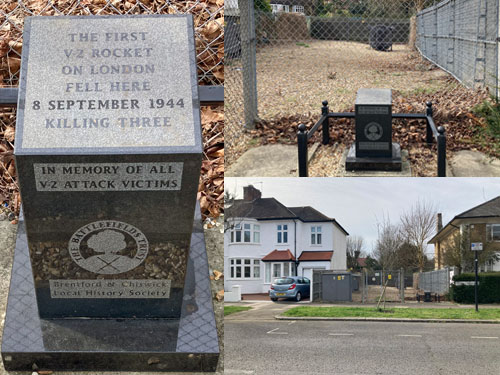
For leisure purposes, residents of Grove Park are fortunate to have the grounds of Chiswick House on their doorstep, with the Western Wilderness accessed up an alleyway from Staveley Road. But this street also has its place in history as the site of the first V2 bomb to land in London. The supersonic missile debuted without warning on the evening of Friday 8th September 1944, destroying eleven houses and leaving a crater 30 feet wide and 8 feet deep. Three people died; a toddler asleep in a cot in her front bedroom, her 68 year-old neighbour who ran three local sweet shops and an army engineer walking to the station to see his girlfriend. 60 years later a granite memorial was placed at the site, or rather squeezed into a gap beside an electricity sub-station because the actual landing spot was in the middle of the road, but it's none the less respectful for that.
Heading south Grove Park ends abruptly on the edge of Quintin Hogg Memorial Sports Ground, originally the playing fields for the Central London Polytechnic. Full marks to them for never replacing the original sign. Closer to the river Grove House's former ornamental lake has been repurposed as Chiswick Quay Marina, the nucleus of an exclusive nautical enclave. And if you continue to the far end of Hartington Road be sure to look out for the green gates by the traffic lights on the approach to Chiswick Bridge. The metal panels feature a hugely distracting plug for Dukes Meadows (Pay & Play - Golf, Tennis & Ski) and also a much smaller sign saying 'Ibis Cottage', this being the name of the incredibly famous property concealed down the drive. For this is the location of the Taskmaster House, Alex Horne's comedian-testing hideaway, which you have far more chance of seeing on Channel 4 than through the gates in real life.
I did however find a gap marginally wide enough to peek through and was thrilled to see that something challenging was underway. Two balloons were resting on pedestals in the driveway, one blue and one yellow, but the slit was really narrow so heaven knows what they were for. I did spot a couple of people wandering about, by the looks of them technicians rather than comedians, so most likely setting something up rather than filming. But look out for these coloured balloons when series 22 screens in the autumn, whatever task they were mastering, because the tip of Grove Park is much better known than you thought.
The UK has a serious housing deficit estimated to be in the region of 5 million unbuilt homes. That'll be why the government's recently advanced its new town strategy with plans including 15,000 new homes at Thamesmead Waterfront and 21,000 more at Crews Hill and Chase Park. But we also have a problem with tens of thousands of homes planned but never completed, especially near me where the Lower Lea Valley is awash with construction sites cleared but insufficiently built upon. To try to determine the extent of the problem locally I've been for a walk from West Ham to Pudding Mill Lane, increasingly perturbed by the extent of the unbuiltness.
Here's a very rough map with all the major planned redevelopment parcels coloured in.
Green for 'construction underway or complete' and yellow for 'nothing yet'.
In what follows I'm going to assume flats are a good thing, not sterile highrise neighbourhoods, because the more housing we build round here the less chance your local Green Belt has to be sacrificed.
1) Twelvetrees Park(aka West Ham Village) 3800 new homes planned, 750 built (26 acres, 85% of site empty)
This one sits immediately alongside West Ham station in an absolutely prime location, but also on the site of a former gasworks so hard land to remediate. Last year they finished the first wedge of flats overlooking the station, creating the illusion it's a lot more complete than it is, and also opened up two footbridges so the first residents can escape. A new station entrance is planned but thus far barely started because the contractor went bust, so even that's way behind schedule. If you cross for a peek you enter a brief canyon of public realm before descending alongside a tumbling water feature to a set of fountains that residents are advised not to play in. A small Sainsbury's has opened to cater for the captive audience but the staff looked seriously bored yesterday. Eventually there'll be an extensive linear park but so far they've only completed a a small scrappy triangle, beyond which is an expanse of delineated brownfield that'll be covered at a snail's pace. Proportionally speaking we're still at Twotrees, nowhere near Twelve. approved 2018, began 2021, first homes 2025, estimated completion 2040s
2) Bromley-by-Bow Gasworks 2150 new homes planned, none started (23 acres)
This is about as challenging as housebuilding gets, melding 2000 flats into the largest group of Victorian gasholders in Britain. The cluster of seven is readily seen from the train between West Ham and Bromley-by-Bow stations, and it's this excellent connectivity which has persuaded developers St William it's worth the expense of construction. They plan to build seven circular blocks of flats inside the existing ironwork, a bit like at Kings Cross, then add six more circular blocks to help get their moneysworth. One bombed gasholder becomes a central water feature while another will have its unique radial truss lifted to crown a 'innovative open air space'. Affordable housing barely gets a look in. Also it's all smoke and mirrors because each gasholder's cross-bracing has to be removed and then "re-erected with required alterations" so the flats can be built inside. It's an astonishing place, as I discovered when I was lucky enough to get a tour of the toxic brownfield in 2022. But it'll look incredibly different once the transformation's complete, which is absolutely no time soon, and thus far all that's appeared are a few diggers and some scaffolding. decommissioned 2010, plans approved 2024, construction begins 2027
In 20 years time you'll be able to walk from the back of Twelvetrees Park to the back of Bromley-by-Bow Gasworks, opening up a much-needed local connection. I had to walk the long way through the industrial estate instead, a diversion which enabled me to confirm that Poplar Riverside (2800 homes) remains 75% empty, Rivermark (530 homes) is mostly underway and Calico Wharf (800 homes) is a desolate void after its Chinese owners pulled out two years ago.
3) Bromley-by-Bow North 1200 new homes built, 50% of site untouched (20 acres)
This is a stripe of land tucked between the A12 and the River Lea, just south of the Bow Roundabout. It's been in developers' line of sight for ages, and I attended a consultation on future plans way back in 2009. However only one central chunk got the go-ahead, becoming a fortress of 219 flats in 2016. The triangular neck closest to the flyover was supposed to follow as the footprint to a residential skyscraper but that's never happened. In 2019 the railway's edge began its transformation into a 965-flat site called Leaside Lock, and this is finally nearing completion seven years later. But the land around Tesco has never even reached the planning permission stage, perhaps held back due to complex land ownership, and I for one am delighted about that. The intention was to build a lot of flats and a tiny replacement supermarket, disadvantaging thousands of existing residents, and I continue to pray that this gets left alone while developers focus on hundreds of nearby acres they've demolished already.
4) Sugar House Island 1200 new homes planned, 33% occupied (26 acres)
IKEA bought this site in 2012, a tongue of land between two of the Bow Back Rivers. They handed it on to another developer sharpish, the intention being to mix commercial space with semi-dense housing. Buildings along Stratford High Street were prioritised so they were mostly done by 2019, then the focus shifted to a residential stripe behind. Wander round and the neighbourhood feels quite substantial, so only if you exit the site and look across the river do you see quite how much remains unbuilt. By my calculations two-thirds of the site remains unconstructed and at this rate it'll end up being well over 20 years between initiation and completion. Nobody in the world of residential development, it seems, is capable of hurrying up a bit. approved 2012, began 2017, first homes 2020, estimated completion 2030s
5) East Quay 750 new homes planned, none started (3 acres)
This Leaside site, just north of the Bow Roundabout, could be the poster child for slow development. Half the site was razed by Crossrail. I attended the initial consultation event in 2018. The remaining oil silos were flattened in 2021 after developers London Square bought the land. Their plans included a 33-storey tower but this fell foul of post-Grenfell rules on double staircasing so had to be redesigned, at which point the project stalled and nothing whatsoever has happened since. The hoardings still say 'East Quay Coming Soon' but it totally isn't, red tape and finance have killed it, and if you visit the URL underneath you just get 'Error 404'. If anyone's living here before 2033 I'll be amazed.
And so we come to three post-Olympic developments where... not a sausage.
6) Pudding Mill 950 new homes planned, none started (13 acres)
Since being handed back after the Olympics not a single foundation has yet been built in Pudding Mill, only a handful of meanwhile uses. Chief amongst these is the Abba Arena, a world class attraction that squats on what will one day be Pudding Mill's highrise centre, but which currently has permission to remain until March 2031. The Snoozebox Hotel opposite is protected until 2028 so the only patch currently up for grabs is the expanse of empty hardstanding on Marshgate Lane which has been empty for years. The latestplanning documents suggest works might begin here in the autumn for completion in 2030, but that's already a 2-year slippage and will likely slip further. It's shocking that a key Olympic neighbourhood won't see a single resident until almost two decades after the closing ceremony. named 2011, plans approved 2023, first homes 2030?, estimated completion 2034
7) Bridgewater Triangle 575 new homes planned, none started (6 acres)
This is essentially Pudding Mill East, over on the other side of the Greenway. It's the development whose towers are due to overshadow the Manor Farm allotments, you may remember, so a bit further ahead in the planning schedule. I thought they'd started given the riverside footpath's been closed for a year but no, they're just doing embankment works to create a nicer walkway and the first ground-breaking's not due until June next year. So so slow. construction begins 2027, estimated completion 2031
8) Rick Roberts Way 750 new homes planned, none started (5 acres)
And finally, a tongue of land beside the Greenway which was used as a coach park in 2012. It's subsequently been used to sell used cars and currently supports a large Padel club, having always been at the end of the redevelopment queue. One end is due to become a secondary school and the other end housing, but unbelievably no progress has been made due to "the development agreement not being finalised with the preferred bidder in 2025". While the LLDC reviews "alternative delivery strategies" this site continues to be wasted, and for goodness sake how hard can it be to build some houses?
I know it's been a self-selected sample but even in this small patch of the Lower Lea Valley that's 12,000 homes which have been pencilled in but not yet built. Is it a planning system logjam, is it a lack of available construction companies, is it the financial squeeze, is it an excess of red tape, is it commercial reticence to flood the market, is it because private developers can only invest money from sales made, or is it just that building new homes is always a painfully slow process? Whatever, there are huge swathes of East London where everyone would like to build homes but nobody is, seemingly because it's too difficult. Perhaps we should stop bickering over which bits of countryside to plough up and focus instead on turbocharging construction on brownfield sites already agreed.
This is the timetable for the Silvertown Tunnel Cycle Shuttle bus, or SCS for short.
It runs every 12 minutes throughout the day, every day of the week. The first journey is at 0634 and the last at 2134. That's five buses an hour for 15 hours, or 76 journeys in total. And given the buses run in both directions, that's 152 crossings per day. I wonder how many bikes are using it.
We can see some data in a presentation given to the Silvertown Tunnel Implementation Group last month. They provided a graph showing daily shuttle usage across certain weeks last year. And as you can see, the number of bikes never once reached 152.
(It did exceed 152 in the first week the bus operated, with a maximum of 299 passengers on day 1, but in normal operation never that high again)
I therefore declare that the bus runs more often than the number of bikes who want to use it, which is insane. Put another way, the bus drivers are crossing the river more often than the cyclists.
It's very much the Mayor's prerogative to run a green-friendly bus to encourage cycling take-up, and still hugely cheaper than adding a cycle lane to the tunnel would have been. But the Silvertown Tunnel Cycle Shuttle Bus is an ABSOLUTE WASTE OF MONEY, regularly running empty for the benefit of a tiny number of Londoners, and there must be a better use for the £1,967,010 being squandered on it.
Friday's TfL press release, which limped very much below the media radar, was about improvements to the Mildmay line timetable.
It's unusual for an exhibition centre to fund extra train services, but that's because they're reopening fully after a lengthy transformation and want the publicity. Add more trains and people are more likely to come is the philosophy, which is especially true when you're opening 25 new bars and restaurants and want to be taken seriously as a prestige hospitality destination.
But it's not many trains, just three services in the morning peak and five in the evening peak. And they're only going five stops, not even as far as Willesden Junction.
Here's part of the new timetable, just published, jiggered about so you can hopefully see what's going on. (click to embiggen)
The extra shuttles have the green outline and start in May. All the other trains are in the existing timetable. The trains labelled 'SN' are hourly Southern trains running between East Croydon and Watford Junction.
The evening peak's current status quo is five Mildmay trains an hour plus one Southern train. The new shuttles will boost this by adding two trains an hour, cutting the gap between some trains from about 12 minutes to about six. That's very welcome extra capacity if you're used to cramming into a rush hour train. It does however come with a significant downside at Clapham Junction, which is that the extra trains run from a completely different platform.
Mildmay trains normally run from platform 1. But the extra trains are running from platform 17, which if you know Clapham Junction is way over on the other side of the station. Indeed platforms 1 and 17 are as far apart as you can get, accessed along a long squeezy subway or via a much longer footbridge. The smallprint in the press release thus reminds passengers "to allow up to 10 minutes to walk between platforms 1 and 17 at Clapham Junction", which pretty much wipes out all the benefits of running the extra trains.
Imagine turning up on platform 1, as normal, only to discover that the next train goes in six minutes from the other side of the station. You might reach platform 17 just in time for the doors to close, then have to trek back to platform 1 only for the doors to close there too. The switch doesn't really take 10 minutes but at rush hour you'd be hard pushed to do it quickly, so best not risk it, plus your average passenger won't even notice that the extra trains exist and will stay put anyway.
The extra trains are being funded by the consortium who acquired the Olympia complex in 2017 and will run for the next five years. But the three morning peak extras seem wasted because nobody wants to visit a luxury restaurant nexus at 8am, and the evening ones are a drop in the ocean running from an inconvenient platform. If they'd really wanted publicity then running a decent service on the District line to Kensington (Olympia) would have made a bigger splash, but operational difficulties alas make that a non-starter. It's clearly a lot better than nothing, but don't expect it'll genuinely help you reach 'London's newest entertainment destination'.
I was outside Alperton station in the week hoping to catch a bus to Wembley Central. How long will that take, I thought. So I checked.
According to the timetable the 297 gets there in 4 minutes, the 83 gets there in 6 minutes and the 483 gets there in 10 minutes. But all three buses follow exactly the same route stopping in exactly the same places, so the disparity is ridiculous.
I know these times are best guesses, and were originally described alongside as "off peak journey time in minutes". I know that different routes may have different loadings so it's possible there might be some variety here. But it is utterly ridiculous to suggest that one route should take more than twice as long as another, in this case a 6 minute difference, all on timetables freshly posted in the last six months.
And this is no unique occurrence, I've seen this kind of discrepancy across London. It seems there's no consistency in the production of these timestrips, no underlying model, just a bunch of backroom gibbons churning out numbers that sort-of look right. Obviously travel times will vary according to traffic conditions, but there's no excuse for giving three wildly different estimates for an identical journey.
(it took 6 minutes, by the way, in fairly decent conditions, so '4 minutes' looks ridiculously optimistic unless it's late at night and '10 minutes' is proper pessimistic assuming jammy cloggage)
In December 2024 the government announced that it intended to replace all England's two-tier systems with unitary authorities. There'd no longer be local councils AND county councils, just the one authority locally, mainly to save money. It was also suggested that the new authorities should have a population of at least half a million.
All affected councils were encouraged to come together to discuss what should replace them, then suggest proposals to the Secretary of State who would make the final decision. So let's see how that's going.
One council was way ahead of the game and that was SURREY. They submitted final plans in May last year, five months ahead of anyone else. The county council suggested a 2-authority split, supported by two of the existing boroughs. The other nine boroughs supported a 3-way split. The government responded in October by officially selecting the 2-authority option. That decision was made law three weeks ago through the Surrey (Structural Changes) Order 2026. And this means Surrey's existing district and county councils will be abolished on 1 April 2027 to be replaced by two new councils, West Surrey Council and East Surrey Council.
West Surrey: Guildford + Runnymede + Spelthorne + Surrey Heath + Waverley + Woking (population 685,000)
East Surrey: Elmbridge + Epsom and Ewell + Mole Valley + Reigate and Banstead + Tandridge (population 565,000)
Elections to the two new councils are taking place in May. Each will 'shadow' the existing authorities before taking over in 2027. No decision has yet been made on the seat of government for each new council. There has been a request from throwback obsessives to name the western authority "West Surrey and South Middlesex", this on the basis that Spelthorne was dragged screaming into Surrey in 1965. The Secretary of State has agreed to discuss the proposal, but will hopefully reject this ridiculously long name given 95% of the new authority was never in Middlesex.
Four further counties had their futures confirmed this week.
ESSEX will be moving to a five authority model in 2028. There had also been proposals for three authorities and for four, but these had less support. Thurrock and Rochford were the sole supporters of a 4-authority version, in both cases keen not to be lumped in with Basildon and Southend.
West Essex: Uttlesford + Harlow + Epping Forest (population 330,000)
North East Essex: Braintree + Colchester + Tendring (population 520,000)
Mid Essex: Brentwood + Chelmsford + Maldon (population 340,000)
South West Essex: Thurrock + Basildon (population 370,000)
South East Essex: Castle Point + Southend + Rochford (population 370,000)
The five councils are based around the key local centres of Harlow, Colchester, Chelmsford, Basildon and Southend. Each will have a population of around 350,000 apart from NE Essex which'll exceed half a million. Thurrock and Southend are already unitary authorities and will be absorbed into larger ones. Two of the new authorities are estuarine, three are coastal and three are London-adjacent. Havering remains firmly in the capital. All council names are indicative and subject to change.
SUFFOLK is going three-way. This one's messier.
Western Suffolk: West Suffolk + parts of Babergh + parts of Mid Suffolk
Central and Eastern Suffolk: East Suffolk + parts of Mid Suffolk
Ipswich and South Suffolk: Ipswich + parts of Babergh + parts of East Suffolk
The intention is to coalesce around Bury St Edmunds, Ipswich and Lowestoft although detailed boundaries are still to be finalised. It's thus not possible to give precise populations but each will have approximately 250,000 residents (rather fewer than Essex or Surrey). The 3-way split was the preferred option for all six existing borough councils, but not the county council which wanted one county-wide unitary instead. Well of course they did.
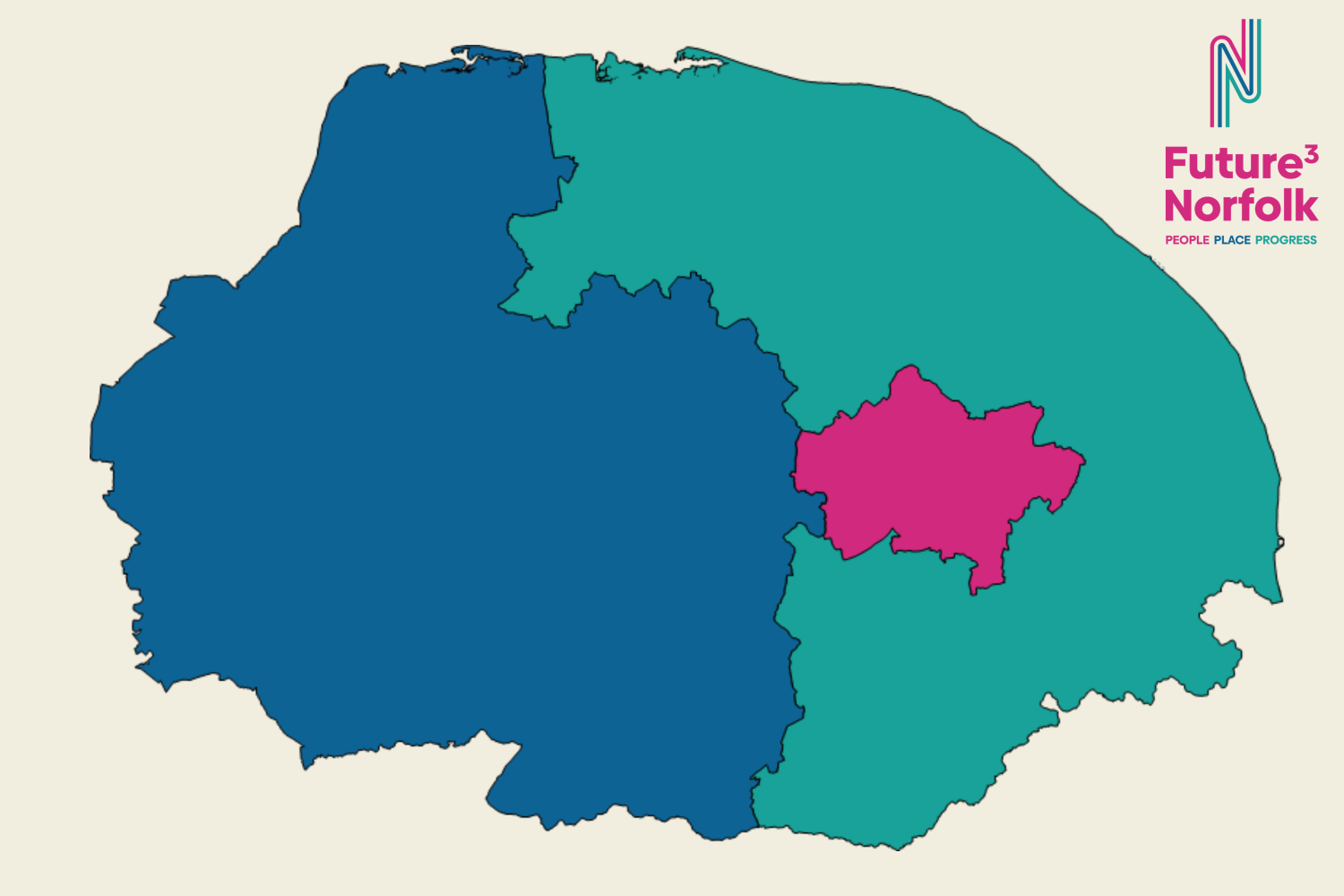
West Norfolk: Breckland + King’s Lynn + West Norfolk + a bit of South Norfolk (population 300,000)
Greater Norwich: Norwich + parts of Broadland + parts of South Norfolk (population 280,000)
East Norfolk: Great Yarmouth + North Norfolk + parts of Broadland + parts of South Norfolk (population 330,000)
Norwich's boundaries will expand to take in surrounding suburbs and towns, a move that's long overdue. The rest of the county will be split west/east, probably administered from King's Lynn and Great Yarmouth. East Norfolk is a strategically unhelpful shape and feels very much like the leftovers. All three authorities have a similar population, well below the half million minimum the government originally proposed. This is apparently deliberate, creating similar structures across Norfolk and Suffolk to fit the devolution footprint of their future strategic authority.
As for HAMPSHIRE, this complex coastal county will shift from 14 authorities to just five.
North Hampshire: Basingstoke + Hart + Rushmoor (population 410,000)
Mid Hampshire: New Forest + Test Valley + Winchester + East Hampshire (population 480,000)
South West Hampshire: Southampton + Eastleigh (population 510,000)
South East Hampshire: Portsmouth + Havant + Gosport + Fareham (population 580,000)
Isle of Wight (population 150,000)
This reorganisation will also include boundary changes designed to strip Mid Hampshire of several city suburbs. SW Hampshire thus gains seven parishes around Southampton Water and SE Hampshire gains four parishes north of Havant. Again expect name changes before the new authorities go live, given SW Hampshire is essentially Southampton and SE Hampshire is essentially Portsmouth. Also North Hampshire contracts to North Hants which is very nearly the name of a completely different county, so I bet that gets changed. The Isle of Wight gets the rare luxury of being left unaltered.
Fifteen counties haven't yet had their administrative futures confirmed. Chief amongst these is SUSSEX where the Secretary of State announcedthis week he wasn't quite convinced by any of the proposed options. Instead he'll be starting a further technical consultation wherein Brighton & Hove expands from its current footprint and Chichester switches sides. If this goes through there'd then be four authorities: an enlarged Brighton & Hove, a coastal strip from Littlehampton to Shoreham, the rest of West Sussex and the rest of East Sussex.
David Hockney:A Year in Normandie and Some Other Thoughts about Painting At: Serpentine North Gallery Location: West Carriage Drive, Kensington Gardens, W2 2AR [map] Open: 10am-6pm (Monday from noon, weekends until 7pm) From: 12 March to 23 August Admission: free Exhibition guide:guides.bloombergconnects.org Four word summary: seasonal iPaddery and tablecloths Time to allow: 30 mins
A David Hockney exhibition is usually quite an event; a big venue, fully ticketed, long lines. This is a medium event in a small venue, partially ticketed and I walked straight in.
It's at Serpentine North, a former gunpowder magazine in the heart of Hyde Park. This is the 2013 adjunct to the original gallery on the south bank of the Serpentine, just across the bridge, and if you've never been your cultural credentials are lacking. Picture a squat square building with hanging space around all four outer walls and two central rectangular galleries. For the Hockney show the perimeter has the trees and the thin centre has the tablecloths.
I wasn't going to go because the website said 'sold out'. Unsurprisingly when you offer free Hockney tickets to the masses they leap in and grab the lot, whether they genuinely want to turn up on a Thursday morning or not. But the smallprint said 'sold out' merely meant all the pre-booked tickets had gone, and that "Walk-ups are welcome but you may need to queue". It also said "The average queue time is currently 10 minutes", which didn't sound too terrible a price to pay. So I gave it a try and found no queue whatsoever, just a smiling member of staff gesturing me into the darkish interior. Tickets for June–August are being released at a later date if you prefer certainty of access.
A Year in Normandie is Hockney's response to moving into rural studios near Caen in 2019. When the pandemic struck he headed outside and painted the landscape around him, or at least dabbed creatively on his iPad, then shared these works with an appreciative global audience. As the title suggests he kept up his visual documentation for a year, right round to Spring again, and ended up with a portfolio of over 100 seasonal works. Around half have been selected to create an extended mural encircling the gallery, here on its first visit to the capital, as a panoply of French trees burst out into leafy splendour and then let it all drop again.
We start in foggy grey, branches bare, and as time passes the sky clears and the first green shoots appear. Hockney does a lot with blobs and splotches, for example a splatter of white and pink as spring blossom or a burst of yellow circles representing meadow flowers. Blossom season seems to go on for longer than you'd expect, proportionally speaking, but it is the most evocative of times so no complaints. Eventually all the trees are plain green confirming summer's here, this before rolls of golden hay appear and the descent into autumn begins. The first brown leaves appear on the bend into the final wall, and within a few frames they're tumbling and gone as a carpet of snow descends instead.
Superficially it has the flavour of a child's picture book on the seasons but is plainly more intricate than that. Skies change, motifs reappear, and could that possibly be the same tree as before but in different leafy guise? A rippling river flows through just one short subset of the autumnscape, a long grey cloud dominates a snatch of summer and one particular meadow appears as the backdrop for an entire month in spring. It all confirms an underlying structure deeper than simply a conveyor belt of trees, and you certainly get a good sense of David's rural environs in Beuvron-en-Auge.
David says one of his inspirations was the Bayeux Tapestry, another Normandy construct telling a lengthy tale in panoramic panels. He was more directly influenced by Chinese scroll paintings, 14th century landscapes illustrated on a continuous roll of paper or silk. These never ever depicted shadows, focusing instead on the permanent and physical, and this artistic foible allows Hockney to keep his grassy surfaces simple.
I confess to being less taken by the ten still lifes in the central galleries, these much more recently completed, and each for some conceptual reason featuring a gingham tablecloth. The perspective of each table is also 'wrong', all forward slanting and unnatural, but that's an accomplished artist doing what he likes and playing with the viewer. I was soon back walking the perimeter again, trying to mentally assign a month to each short strip of paintings (that's April cherry, that's a June storm, that's August hay and that must be November leaffall). In the end I found it so evocative I walked round three times, then exited through the obligatory giftshop and suspected they're going to do a roaring trade on books, cushions, coasters, postcards, trays and teatowels.
One of Hockney's Normandy paintings has been blown up to excessive proportions and is exhibited as a mural round the back of the restaurant across a flowerbed. I admired it more after a member of kitchen staff had finished his cigarette and moved out of the way. But the finest work out back was a nearby fruit tree bursting with frothy white blossom, bumblebee included, also a horse chestnut whose branches were tipped with sappy balls of green which within a fortnight will be a proper blanket of leaves. Beautiful stuff, and no tickets or walk-up queues required. Appreciate the seasons indoors sure, but don't forget to appreciate the real thing outside too at this pivotal time of greatest change.
I've decided to finish one of yesterday's posts. (sorry, probably not the one you wanted)
Last night the sun set on the District line at 6.20pm in Upminster, at 6.21pm from Hornchurch to Bow Road, at 6.22pm from Mile End to Kew Gardens and at 6.23pm in Richmond. This is because the District line runs from east to west and because the Earth is not as big as you think it is.
These are sunset times along the District line yesterday. The sun set first in Upminster because this is on the eastern side of London. The time was 6.20pm, or more accurately 6.20 and 53 seconds because you can be really accurate about celestial geography. By Upminster Bridge it was 6.20 and 57 seconds, and at Hornchurch it was 6.21 and 1 second. We've only gone 1½ miles west but that's already an 8 second difference. That's how susceptible sunset times are across relatively short distances. (I used the excellent Suncalc website to calculate the times precisely, this simply by clicking on a map)
Heading into my neck of the woods, Bow Road had a sunset at 6.21 and 58 seconds while Mile End's sunset was 6.22 precisely. The switch to 6.23 took place almost at the western end of the line, with Kew Gardens 1 second before and Richmond 3 seconds after. I've focused solely on the Richmond branch here to keep things simple, but on a train heading to Ealing Broadway the divide would come between Acton Town and Ealing Common.
These stripes may look to be of different widths but that's because tube maps aren't geographically accurate. They are in fact each approximately about 11 miles wide, i.e. for every 11 miles you go west, the sun sets a minute later. And there's a jolly good reason for that.
It's all to do with the length of a line of latitude through London. Imagine drawing a line west from the Houses of Parliament all the way round the world until it returned to Westminster. That line would precisely follow 51½°N and would be 15,501 miles long.
Here's how you work that out.
The formula for the length of a line of latitude is q×cos(L°)
where q is the length of the equator and L is the angle of latitude
The length of the equator is 24901 miles.
In London's case L = 51½° and the cosine of 51½° is 0.662.
So our line of latitude is 24901 × 0.622 = 15501 miles long.
There are 1440 minutes in a day and the Earth rotates an equal amount in each of them.
The key calculation is thus 15,501 ÷ 1440 = 10.8
i.e. in London the Earth rotates 10.8 miles every minute.
And that's why sunset in Richmond is a minute after sunset in Bow which is a minute after sunset in Upminster.
And this is always true, it doesn't depend on the season.
Here's how it looks on the Elizabeth line, another east/west railway but considerably longer.
These are sunset times tonight.
Again each of these stripes is 11 miles wide.
But this time there's a five minute difference from one end of the line to the other.
The sun sets five minutes later in Reading than in Shenfield.
And considering just the London bit, three minutes later in West Drayton than in Harold Wood.
This is why "The first 6pm sunset since October will be taking place in London tonight" is a potentially misleading headline. The clickbaiteers published it on 13th March, and it was indeed true for anywhere east of Whitechapel. Crucially it was correct for the Greenwich meridian. But anywhere west of Whitechapel saw its first 6pm sunset on 12th March, and Heathrow Terminal 5 scraped a 6pm sunset on 11th March, so for the majority of Londoners it wasn't actually true.
It's also why the Great Western Railway adopted 'railway time' in 1840, local time in Bristol being 10 minutes later than local time at Paddington. This was the first instance of a standard time replacing local mean time, and would ultimately lead to the official adoption of Greenwich Mean Time in 1884.
Be aware that sunset times also change going north/south, but at this time of year not very much.
Sunset barely changes along the Northern line tonight, being 6.24pm in both High Barnet and Morden.
The big changes are east/west because that's the way the world spins.
Also be aware that the 11 mile thing is only true for those living on a similar latitude to London.
If you live north of London your line of latitude is shorter so your sunset stripes are narrower.
For example Edinburgh is at 56°N and 24901×cos(56°)÷ 1440 = 9.7
So in central Scotland the sun sets a minute later for every 10 miles you go west.
If you live south of London your line of latitude is longer so your sunset stripes are wider.
For example Rome is at 42°N and 24901×cos(42°)÷ 1440 = 12.8
So in the Mediterranean the sun sets a minute later for every 13 miles you go west.
If you need a conclusion after all that, it's that London doesn't have just one sunset time it has several, generally a three minute spread. So try not to be too precise about sunsets if you don't know precisely where you're talking about.
(sorry, you probably wish I'd finished one of the other 39 unfinished posts)
» The book I finished yesterday was The Long Shoe by Bob Mortimer.
» London's most average bus number is the 219.
» The first chocolate biscuit in alphabetical order is probably a Bahlsen.
» The 1-word London place name with the highest Scrabble score is perhaps Bexleyheath (29).
» West Harrow is east of North Harrow.
» Clue 14: What a very tall one-legged clown has
My favourite fountain pen was a brushed silver Parker 25, always with a black cartridge never blue, which I used all the time at secondary school. But sadly...
It's amazing that the most watched programme on UK television can't attract even 10% of the population these days. Time was when a soap opera...
25 years ago today I came up to London to buy some cool clothes (they're still stashed in a bottom drawer), but I had to walk to the station because I'd crashed the car. Also...
"Are you enjoying that book?" asked the lady on the train, entirely out of the blue, "because I'm reading it next." I was only 60 pages in and told her so. But I could already tell it was up to the author's usual quirky standards...
Every time I buy a bunch of daffodils it comes with a small green rubber band, and now I have a lot of small green rubber bands and no good use to put them to. Maybe...
Let's ride London's most average bus! I calculated the mean of every current TfL bus route number and obviously it came out in the low 200s, and that's why today we're off to Wimbledon...
Gadabout: ABERYSTWYTH
Have you noticed how bikes are getting faster? I dare say with all these 20mph signs everywhere a lot of the zippier e-bikes are actually breaking the speed limit on a regular basis...
40 years ago today my optician asked if I'd got a job yet, then checked my eyes and told me they were much the same prescription as before. They're still much the same now thankfully, apart from...
What would happen if you listed all the chocolate biscuit varieties in alphabetical order? Abbey Crunch would obviously be first if they were chocolatey but no, so it has to be...
The coffee shop at Shortlands station is called Shotlands and I thought that was quite clever, almost as clever as...
Litter bins vary considerably across different London boroughs. In today's post I'm going to analyse that variety objectively and then confirm which borough officially has the best...
Tonight the sun sets on the District line at 6.20pm in Upminster, at 6.21pm from Hornchurch to Bow Road, at 6.22pm from Mile End to Kew Gardens and at 6.23pm in Richmond. This is because...
The upcoming local elections in the borough of Newham are a battle between Areeq, Clive, Forhad, Laura, Mehmood and Terri. Forhad ought to have the Mayoralty on a plate but...
I've often wondered, if you have a box of matches in your house and there's a fire, do they all blaze up and make the fire a lot worse? Or at least burn faster? Perhaps we shouldn't...
When is the right time to take your birthday cards down? Mine have now been up for a fortnight and arguably that's beyond the limit but I'm also tempted to leave them until...
Only one country has exactly 10 neighbouring countries, that's Brazil, although technically Belgium has 39 distinct land borders if you count all the twiddles because...
30 years ago today I realised I'd uploaded a computer virus from a floppy disc at work. Things were obviously safer in those days because none of the machines were connected, but imagine...
If you arrange all the London neighbourhoods in order of their Scrabble score then the smallest total is clearly Lee (3 points) whereas the maximum score is more debatable and is possibly...
But why are the warning stripes on escalators yellow? Wouldn't orange...?
The Bourneview public footpath level crossing in Kenley is still closed, until August apparently, while they explore and carry out additional safety measures. I was thus forced...
The thing about West Finchley station is it's actually east of Finchley Central! And it's not the only geographical inaccuracy on the tube network...
A Nice Walk: Hampton Wick High Street (½ mile)
When you say "Exciting changes to our website and app are on the way" what you really mean is all my data is about to be lost and you need me to jump through hoops because you can't transfer things properly. So it's fortunate that...
It worries me that a lot of the green energy revolution only applies to people in houses, not flats. They have roofs for solar panels, space for heat pumps and parking spaces for charging. All we have is...
I've always hated objectives. I could never take it seriously at work when we had to write some as part of the annual appraisal charade, 'smart' objectives no less, and quite frankly...
The tallest building in Wandsworth is One Nine Elms City Tower, but can you see the tallest building in Ealing (One West Point) from the top floor? Unexpectedly...
Scrolling along the FM band, national station-wise, it goes Radio 2 (88.1-90.1), Radio 3 (90.3-92.3), Radio 4 (94.6-96.1), Radio 1 (97.7-99.7), Classic FM (99.9-101.9). And in those gaps...
Which London station has three bears? It's Elmstead Woods and their names are Billy, Monty and Emma. Let me show you where they are and also the secret garden...
I understand that not everyone still has a CD rack but mine starts with ABC, no hang on Abba, and ends up with Yazoo. I never did get into ZZ Top otherwise...
The flowerbeds outside the shops in Elm Park commemorate 80 years of the garden suburb, that anniversary being in 2015, although they look a bit weedy at present...
20 years ago today I took a set of photos that are still my least-viewed Flickr photos of all time. I guess that's not surprising given...
There are many sights in Neasden but if we're ranking them the top 3 are undoubtedly the temple, the IKEA and...
The Great Tea Experiment
Milk first or hot water first? I decided to test this once and for all by making one of each and blind-tasting the resulting brew, and I did this with both teabags and loose tea. The results are incontrovertible...
Cotes, dill and laid are one-word examples, but Sir Morons and irate sow take two, and arguably Mrs Nerd Pancakes can't be done with fewer than three...
It's exactly 10 years ago today that track renewal work in Croydon town centre affected London Trams services and Line 4 did not run. You may remember...
Which Ordnance Survey maps have you lived on and how much do they add up to? If we're talking Landrangers then my total is 107+144+153+155+164+166+167+169+175+176+177+178 = 1931, although obviously there's a lot of overlap there...
28 records in this week's singles chart have been in the Top 100 for over a year, topped off by Mr Brightside at 497 weeks! It just goes to show how slowly music evolves these days. Even the current number 1 is on 40 weeks, and as for Everybody Wants To Rule The World...
Here are cryptic clues to the names of 30 cheeses. How many can you identify?
Cutty Sark station reopenedyesterday after a 10-month closure to replace all its escalators.
(that's all you need to know) (read on for background detail, jazz and cupcakes)
Cutty Sark station opened on 3rd September 1999 as part of the DLR's Lewisham extension. It had been dropped from the original plans for being too expensive, but Greenwich council insisted and the money was found. It's on a tightly confined town centre site, three storeys deep, hence the need for two sets of escalators to connect the platforms to street level. And those escalators weren't especially well maintained by a private contractor, thus were increasingly frequently out of order. Alternative access via stairwells and a tiny lift proved unpleasant and ultimately inadequate, especially for a busy station in a key tourist area. When TfL took responsibility in 2021 they spent £695,000 on repairs, which repeatedly failed, so eventually decided the only solution was to shut the station and replace all four escalators. The £4m renovation project that kicked off in May 2025 is now complete.
Cutty Facts
• The stairwell at Cutty Sark has 121 steps.
• Cutty Sark is (usually) the 5th busiest DLR station.
• Cutty Sark has (by far) the shortest platforms on the DLR, at 59½m.
• Cutty Sark is the 2nd-deepest DLR station (20m down, whereas Bank is 40m).
• 'Cutty Sark (for Maritime Greenwich)' is the longest name of any DLR station.
Yes they are very nice escalators, better than the creaky shonky things that were here before. These are the main pair from the platforms up to the mid-level concourse, then another set takes you to the street. Look, if you visit on the day the station reopens it's possible to get a photograph with nobody standing on them. I believe they're a tad narrower than your average escalator but that's cut-price millennial engineering for you. They're now that clever modern standard that doesn't run at full speed when empty so should last longer as well as being more efficient. They were manufactured in Slovenia by vertical transportation company Schindler, in case that should ever come up in a pub quiz.
While the station was closed they also took the opportunity to improve other aspects:
» A new lift (still small but quicker and more reliable)
» LED lighting throughout (yes, definitely brighter and more pleasant)
» White wall coverings throughout (when in doubt, slap a cover on)
» A new fire detection system (hopefully never required)
» Raised ceiling above the two upper escalators (can't say I noticed)
» New local artwork celebrating the local area (about that...)
They say artwork but it's more advert. Two large floor-to-ceiling panels are emblazoned with photos of local tourist attractions like the park, the Royal Observatory, the Painted Hall and the marathon. To be fair it is very attractive and there is a world-class embarrassment of riches hereabouts, hence why Visit Greenwich were involved in its installation. But when TfL say 'art' they normally mean high-level concept-driven creative excellence, and this is more a promotional photographic showcase. Fair enough.
The LED lights are doing a great job compared to the relative gloom experienced previously. Also the platform areas are brighter, what with white panels covering every surface. But what's less bright, indeed seemingly untouched, are the outer walls on the far side of the tracks. These weren't touched during the upgrade because trains continued to pass through the station at speed, so still look distinctly grubby in comparison. Another eerie touch is that none of the adverts have been changed since the station closed, indeed for a lot longer that that. One of the largest ads is for Eurostar and promotes swift travel to the 2024 Olympic Games ("Proudly taking Team GB and ParalympicGB to Paris"). On the opposite platform is an ad for the "sparkling rom-com" Fly Me To The Moon featuring Scarlett Johansson, and when it says "in cinemas everywhere July 11" that again means 2024, so it's all disturbingly throwback.
The weird thing about Cutty Sark is that you tap your card halfway up, or halfway down depending. The ticket machine's on the street but you won't see a validator until you've gone down the first flight and entered a large elliptical concourse. It is thus easy to miss, especially if you've taken the stairwell, and I bet many passengers exiting the station also fail to touch out. I bet they're not expecting cupcakes either.
The cupcake window was extremely brief and part of a special reopening ceremony yesterday morning. Two ladies in identical belted jackets stood beside a small table over which was draped a DLR-blue tablecloth, presiding over the distribution of celebratory sweet treats. Several trays of chunky cream-topped freebies awaited anyone wandering by, which proved very welcome, any dietary concerns addressed in asterisked smallprint displayed alongside. Each cupcake had a DLR logo on top neatly printed on rice paper. I note they were baked by an outfit in Manchester called Candy's Cupcakes, not locally sourced, which may be useful information if you ever need an inexpensive gimmick for your own sponsored PR shindig.
And that wasn't all. The concourse was full of people, most of whom had either been involved in the project or were employed by the company that runs the DLR. They're called Keolis Amey and they do all the operational stuff, generally behind the scenes but on this occasion had come out to applaud themselves. One of the main project managers was rightly pleased they'd managed to reopen the station earlier than expected and gave a bit of a speech thanking everyone involved. The big KA boss also gave a speech and although he wasn't quite as loud he too praised the construction team, the project team and everyone in the wider community. Several members of the wider community weaved through the event to reach their train or reach the surface, some clearly peeved by the unexpected blockage, others easily assuaged by a cupcake.
And then there was the jazz. A group of purple-shirted students from Trinity Laban had been invited to perform at the event and they were fantastic. They did two numbers, easing into a percussive beat and then swaying to a loud brassy rhythm, their music reverberating around the concourse. I'm not sure they had any direct link to the project other than ticking the 'community' box, but thanks to them it did feel like a celebration rather than a backslapping exercise. Maybe more impromptu musical performances should be hosted here, the acoustics are great, also if you're ever thinking of taking up an instrument then brass looks a lot more exciting than strings or wind.
Not only is Cutty Sark station now open again but it's also reappeared on the tube map, online version at least. I can confirm that using the station is now a more pleasant experience and hopefully a more reliable one. Just don't come expecting jazz or cupcakes because they were a one-off. And don't come this weekend because the entire Lewisham branch is closed, which I'm afraid is the downside of reopening a station earlier than expected.
It's six years ago tonight since Boris Johnson addressed the nation and placed it in lockdown. It's so long ago that 23rd March has rolled round to a Monday again.
It's easily the most consequential crisis of the 21st century, not just here but around the world, significantly affecting behaviours and killing millions.
But it does feel like we've been having more crises than usual of late, so I wondered if that was quantifiable. I've had a go.
I attempted to list the biggest crises since 2001 and that got somewhat unmanageable. What's catastrophic for some isn't existential for others, so for example the appalling situation in Sudan generally passes us by, as did the Arab Spring and Ebola. So I decided to take a UK-centric point of view. Yes it's parochial, but also hopefully realistic for those of us who live here.
My definition of crisis is 'that bad thing that's always at the top of the news for months'. Some things blow over quickly and some things never quite take hold, but a proper crisis is always hitting the headlines and high in the national consciousness. A crisis tends to repeatedly shunt ordinary news to the end of a news broadcast, so for example atrocious unemployment figures would get a cursory mention rather than being the subject of lengthy analysis. There's a lot of shunting in the news at present because you can pretty much guarantee what the first topic will be.
I considered the period 2001-2026 and managed to trim my list down to just eight overarching crises. They're so overarching that President Trump only gets one category, even though he's triggered all kinds of instabilities.
• War on Terror
• Financial Crisis
• Brexit
• Covid pandemic
• Ukraine conflict
• Gaza conflict
• Trump
• Climate change
(you might not agree, but I really have gone high level here)
I drew up a grid with crises down the side and years across the top, then coloured some of the cells in.
I used red if a crisis was particularly overwhelming in a particular year.
I used orange if it was still a crisis but less dominant in the news cycle.
I used yellow if it was still rumbling away in the background.
And I decided Covid was so extreme it needed its own colour, so that's purple.
I then deleted all the yellow because it was horribly subjective and just getting in the way.
And here's my grid. (you might not agree precisely with my colours, but hopefully the gist is right)
• The top row is the so-called War on Terror, with red for 9/11 and the Gulf War, and orange continuing up to 7/7.
• The Financial Crisis hit hardest in 2007/08, then rumbled away in the background choking growth and inspiring austerity.
• Brexit divided the country in 2016 and the ensuing arguments then dominated UK politics until Boris won his election.
• Covid was two years of utterly atypical restrictions, a national health emergency unsurpassed since 1919.
• Russia's invasion of Ukraine shocked Europe, far more than annexing Crimea had, triggering a prolonged cost of living crisis.
• Hamas's brutal incursion provoked Israel's inexorable demolition of the Gaza Strip, and they're not finished yet.
• Trump's 1st term was disruptive but his 2nd has been endlessly destabilising, peaking (so far) with an ill-thought through attack on Iran.
• And climate change continues to tick away, thus far all 'yellow' so I've uncoloured it, but rest assured its time will come.
These are the themes that have dominated our news over the last quarter of a century. What's disconcerting is that there are long periods when none appear and others where they all seem to pile on top of each other.
The 2000s had two big crises, one in the first half and one in the second. One started with planes hitting a building and the other with a banking collapse, then repercussions snowballed and the world reaped the consequences. The 2010s were much quieter, at least in my categorisation, the sole 'red' being the own goal of Brexit and our collective inability to make good of it. But since then it's been crisis after crisis with only the tiniest gaps, and more recently no gaps at all.
The gap between Brexit and Covid lasted just seven weeks, from 23:00 on 31st January 2020 to 19:30 on 23rd March. But the gap between Covid and Ukraine was gobsmackingly short, with all domestic restrictions lifted at midnight on 24th February and Vladimir Putin announcing his 'special military operation' at 02:30, just 150 minutes later. You likely slept through the last period of crisislessness.
Since then we've only added crises, the Gaza conflict on 7th October 2023 and the re-inauguration of President Trump on 20th January 2025. He's since demonstrated an unerring ability to dominate global headlines by saying outrageous things and occasionally backing them with unpredictably consequential action. What hope does domestic policy have of breaking through when so many egregious conflicts are occurring simultaneously?
There's every chance that the 'Trump 2026' cell will eventually turn purple because who knows how badly the current Iran war might turn out, indeed in a worst case scenario I might be introducing a new colour - black. But it pays not to catastrophise about the future because we have no idea how this will turn out, all we genuinely know is how previous crises turned out and that ongoing crises continue.
If you accept my very-rough UK-centric classification then the news cycle in the last few years has been the most tumultuous of all, with impacts from action abroad forever hitting home. Meanwhile the years 2009-2016 were relatively crisis-free, indeed almost a golden age by current standards. Who wouldn't swap 'ongoing austerity' for 'three simultaneous international conflicts, a cost of living crisis and zero prospect of growth?' It seems we're now a long way from living in a crisis-free year, if indeed my grid ever sees an uncoloured column again.
Equally it pays to remember that things can always turn around for the better. Six years ago the stock market had collapsed, a mutated virus was killing thousands and a libertarian PM was forced to confine people to their homes. It all looked dire, indeed many paid the ultimate price, and we spent almost two years living under previously unimaginable restrictions. But we stuck together, adapted to new conditions and ultimately found a scientific solution that returned us to near normality. Six years ago even the timeline we're in now might have looked unduly optimistic.
Crises are by their nature unpredictable and don't always impact all of us equally, thus are essentially unclassifiable. But yes things aren't great at present, yes they have been better and no, we don't yet know what's coming next.