20 things we learnt from TfL FoI requests in January 2026
1) Not all insulated pots are made of porcelain, some are Glass Reinforced Plastic. 2) When a "stand on both sides of the escalator" trial was attempted at Holborn station in 2016, the flow of customers increased by up to 30%. However when staff resources were withdrawn from the foot of the escalators, "customers reverted to the behavioural norm and queued to stand on the right with a minority walking on the left". 3) There are currently no plans to charge for the use of the Woolwich Ferry. 4) In the last financial year, the total revenue received for gambling advertising on bus shelters was £1,010,718 (up from £587,290 the previous year). 5) Twenty Bakerloo line trains per hour can be safely reversed at Queen’s Park. At peak times nine trains per hour continue northbound. 6) There is a business case for decreasing the frequency of route 310 to 1 bus per hour and a business case to withdraw the service. However these options are not being progressed at this stage due to expected stakeholder opposition. (multiple recent bus route analyses here) 7) The most used tram stops outside central Croydon are Wimbledon, Mitcham, Therapia Lane, Ampere Way and Beckenham Junction. The least used, by some distance, are Avenue Road and Coombe Lane. 8) If the Overground were to take over Great Northern suburban rail routes out of Moorgate, the existing rolling stock would be retained and yes, the lines would be added to the tube map. 9) Last year TfL received 18,363 applications for their graduate programme. Approximately 650 applicants were shortlisted and 172 job offers were made. 10) The LGBTQ+ pedestrian crossing lights at Trafalgar Square have been removed as part of the LED retrofit programme. LEDs are around five times more energy-efficient than standard lamps and have a significantly longer lifespan, helping to improve reliability and reduce maintenance. Unfortunately, as the LGBTQ+ signals were a bespoke design when originally installed, there is currently no equivalent LED version available that can be used as a direct replacement. (hey journalists, look, here's an actual news story for you)
11) A passenger on the Metropolitan line contacted TfL to complain about a Poem on the Underground called Goldfinch because it contained the lines ‘THIS WINTER’S DAY PRICKS LIKE CHAFF’ and ‘I’LL COCK MY HEAD’. They would have changed the offending words to something more family-friendly. 12) Superloop route SL4 (through the Silvertown Tunnel) is used by an average of 5300 passengers on Saturdays and 4500 on Sundays. 13) South Kenton station has been unstaffed since 9 January due to safety issues. A persistent ceiling leak has caused visible weakening of the structure. With continued rain the risk of the ceiling falling has increased. This has meant that it is unsafe for staff to be in the office. 14) The Elizabeth line entrance gate at Bond Street station facing Hanover Square had been closed as the mechanism for opening and closing the gates was faulty. Works to put the gates back into service were completed in the week ending 13 December and passengers no longer have to use the side gates. 15) There are no plans to run a Superloop service to Bluewater. 16) There are approximately 14,000 cameras in London Underground stations and 7,500 cameras onboard the trains. CCTV footage is stored for at least 14 days, with a number of stations holding recordings for at least 31 days. 17) The most popular stops on Bakerloop servce BL1 are Lewisham Clock Tower westbound and Waterloo Road eastbound. Overall, passenger totals are 7% higher eastbound than westbound. 18) A z1-9 annual Travelcard costs 38% more than it did ten years ago and 63% more than 15 years ago. 19) TfL lose no revenue due to the Freedom Pass because the settlement with London Councils comprises the costs of providing the scheme and the revenue forgone. The revenue forgone for 2024/25 was £260m. 20) The eleven tube stations with cross-platform interchanges between different lines are Acton Town, Baker Street, Barons Court, Euston, Finchley Road, Finsbury Park, Hammersmith, Mile End, Oxford Circus, Stockwell and Wembley Park.
Have you ever wondered how many pocket-size paper tube maps are printed? Well, it's currently 8 million a year although 10 years ago it was 30 million! Here's a graph.
TfL currently print an initial allocation of 4 million maps per year, printing more later if a top-up is required. The total cost of manufacturing 4 million copies is around £80,000. Updating the artwork generally only costs around £1000. Maps are packed in boxes of 3000. When a print run takes place two boxes are sent to all zone 1 stations and one box to all zone 2-9 stations. The initial shipment to stations totals 1,110,000 copies with the remainder held at the warehouse.
Also don't read too much into that very high bar at the start of the graph. 2016 was an unusual year with three separate tube map editions (January 2016, June 2016, December 2016). Also June 2016 was the time they mucked up the tram fare zone at Morden and had to do a complete reprint, binning the entire first run.
Someone asked "I would like to request the ridership figures for each TfL bus route in the 2024-2025 financial year, broken down by Oyster, Contactless, different Zip Card age groups, Orange Freedom Pass, Blue Freedom Pass, other ENCTS, etc.". A spreadsheet has been provided.
I can thus tell you that these are the most used bus routes by payment type.
18: most used by Oyster PAYG, 60+ Oyster and Bus Passes (and overall)
149: most used by contactless payment cards
158: most used by holders of Travelcards
5: most used by holders of 16+ Zip cards
279: most used by holders of child Zip cards
207: most used by holders of an elderly Freedom Pass
29: most used by holders of a disabled Freedom Pass
51% of bus passengers pay full fare (38% contactless, 13% Oyster).
12% of passengers use Freedom Passes (9% elderly, 3% disabled) and another 4½% use 60+ Oyster cards.
9% of passengers swipe a Bus Pass, 9% use a Zip card and 6% still use a Travelcard.
77% of passengers on school buses pay with a Zip card and 10% with a contactless card.
45% of passengers on nightbuses pay with a contactless card and only 1½% with a Zip card.
There's also a column in the spreadsheet headed 'Button Push', which I believe refers to passengers with non-electronic passes or boarding without paying. There were 129.5 million button pushes in this particular year, i.e. 7% of all passengers, although I believe this is a blanket estimate so don't read too much into how much lost revenue it represents.
To celebrate 200 years since the opening of number 5, here are cryptic clues to 20 famous bridges.
How many can you identify?
UK 1) alternatively healthy 2) below bronze 3) Bernie 4) breakdown truck 5) ChapsGPT 6) city news centre 7) cut north 8) Fe 9) hospital brown 10) Reznor
rest of world 11) 2 Iranian coins 12) echo Vic shifted 13) estranged from Posh 14) grinder gold 15) Ø sunder asunder 16) Poitier Port 17) precious portal 18) quatre plus cinq 19) rubs hoops about 20) sound dimension
Earlier this week TfL launched its latest Business Plan setting out what it hopes to achieve over the next four years. The last time they published a four-year Business Plan was nine years ago, the hiatus because intermediate governments weren't willing to agree a long-term funding deal. Now we can finally look forward to the near future with a reasonable degree of certainty, at least for now.
According to the Mayor, these are the TfL highlights for 2026-2030.
• New affordable housing and jobs with the DLR extension to Beckton Riverside and Thamesmead
• Modernising the Tube
• Cutting congestion
• Improving safety and accessibility
• High-quality walking and cycling infrastructure
• Eliminating road death and serious injury
The first of those won't be done by 2030, sorry. A lot of these are just "we're going to make things safer", which I'd hope is always the case. A lot of what's in the plan is 'things intended to happen in early 2026' because predicting the immediate future is easier than long-term. Also almost all of it is 'things already announced' so don't expect fresh wows. What we're really getting here is intent and aspiration, not certainty and assurance, so a lot of "we will move towards" and "work progressing" which could ultimately mean nothing.
I've been through the 69 page document to see what Londoners can look forward to. In the summary that follows I've missed out anything due to complete in 2026, also anything I consider a bit dull.
Milestones
» 20,000 homes "in the pipeline"
» 6000 zero-emission buses
» 3500 traffic signals with bus priority
» 100% of electricity from renewable sources
» 95km of additional cycle routes
» 265 new pedestrian crossings
By 2030
» 40% of Londoners to live within 400m of the strategic cycle network (currently 29%)
» Fare evasion at 1.5% or less (currently 3.5%)
» Contribution of fares to TfL's income expected to rise from 51% to 59%.
Bus
» Introduce Superloop services SL13, SL14 and SL15 in 2027
» Introduce bus priority corridor between Woolwich and Abbey Wood (via Thamesmead) by 2029
» Progress a new publicly owned bus company for London
» Expand outer London bus services while reducing some central and inner London services ("to align with changing demand")
Fares
» "Explore how fares innovation could provide even greater value for customers with loyalty and reward schemes"
Stations
» Start work on DLR extension to Thamesmead in 2027 (but won't open before the early 2030s)
» Complete new entrance at Elephant & Castle by 2028
» Add six new escalators at Pontoon Dock by 2028
» Step-free access at Leyton in spring 2027 (no further stations confirmed after this)
» "Progress work" at Surrey Canal (i.e. the usual bugger all)
Woolly train stuff
» "Make the case for" the West London Orbital project, the Bakerloo line extension and Crossrail 2
» Aspire to absorb Great Northern suburban rail route into the Overground (Moorgate → Welwyn Garden City and Stevenage via Hertford North)
Rolling stock
» New train fleet introduced on the Piccadilly line (the first train "within the next 12 months")
» New train fleet introduced on the DLR (first three trains already withdrawn from service awaiting supply chain solution)
» Introduce fleet of 24 new trams (with the potential to replace all 36)
» Introduce 10 new Elizabeth line trains to increase frequency in central and west London
» Complete overhaul of entire Central line fleet by 2029 (only four so far)
» Complete signalling upgrades on Metropolitan and District line (project began 2016)
Oh god no
» "Introduce next-generation corridor wraps on the Elizabeth line and a dramatic revamp of Waterloo station’s travelator to deliver high-impact, contextually relevant creatives that immerse and inspire Londoners as they move through the city"
My main takeaway from scouring the document is that the next four years are going to be a bit dull. We get new fleets of trains on the Piccadilly line and DLR, but all later than originally anticipated. We get nice improvements here and there but no new completed infrastructure, only an underwhelming DLR extension not yet in operation by 2030. What's more in 2029 Britain is likely to elect a London-hating government that seeks to yank all TfL's aspirations into reverse, so make the most of this lacklustre set of priorities because it's as good as we're going to get.
» There are houses because humans need shelter.
» There are roads so traffic can drive around.
» There are pavements so pedestrians can avoid traffic.
» It's not a jungle because we're not in the tropics.
But that's all a bit generic.
Why specifically does it look like this?
» There's a huge city here rather than agricultural land because London became the capital of Britain many centuries ago due to its strategic location on the Thames estuary facing mainland Europe.
» There's suitable building land here because the underlying geology is river deposits atop a layer of solid clay.
» There are houses here because they were built in 1925 prior to the introduction of the Green Belt.
» There are no fields here because they were built over to create the Becontreeestate.
» Becontree became housing thanks to section 41 of the Housing, Town Planning, &c. Act 1919 which stated that "where the London County Council are satisfied that there is situate within the area of a metropolitan borough land suitable for development for housing, the county council may submit a scheme for the approval of the Local Government Board for the development of such land to meet the needs of districts situate outside the area of such borough".
» The Housing, Town Planning, &c. Act 1919 came into being because Christopher Addision was elected MP for Shoreditch in 1918, became Minister for Housing and pushed for much improved social housing because "you cannot expect to get an A1 population out of C3 homes".
» The estate got the go-ahead on 18 June 1919 because the London County Council's Standing Committee on the Housing of the Working Classes resolved to build 29,000 dwellings within 5 years, of which 24,000 were to be at Becontree which at the time was a vast undeveloped site with good rail connections.
Fair enough, but why specifically does it look like this?
Why is Hedgemans Road long and straight and precisely here?
» Hedgemans Road is one of the key spine roads added to the Becontree estate in the mid 1920s to support the growth of an emerging estate.
» At its eastern end Hedgemans Road followed an old footpath across the fields from Gale Street to a pub on Church Elm Lane, on a direct line to Dagenham village.
» It's a straight road because it runs close and parallel to a railway, which is straight.
» The railway is straight because in the 1880s the London, Tilbury & Southend Railway built a direct line east via Upminster as a shortcut to skip the previous estuarine route via Tilbury.
If the railway had been built on a different alignment, or Dagenham's 13th century church had been located somewhere slightly different, Hedgemans Road wouldn't quite go this way.
And why do the houses look like they do?
» The houses look like this because they were part of 'Dagenham section 6', the sixth neighbourhood to be developed on the Becontree Estate.
» Plans for 3- and 4-bed cottages in Section 6 were designed by the London County Council Architects department at County Hall and signed off by G. Topham Forrest, Chief Architect, on 11th February 1925.
» If I'd taken my photograph quarter of a mile further down the road the houses would have been in section 6a instead, approved on 10th November 1925, thus slightly younger and slightly different.
I know all that because I found a webpage showing the estate's original hand-drawn plans because the internet is brilliant.
» The original houses are still here because all Hitler's bombs landed elsewhere.
» There are a variety of porches because Margaret Thatcher introduced Right to Buy for council houses in 1980.
» There's a park here, slotted into a 60m gap in the long row of houses, because the Gores Brook passes under the road and even in the 1920s they knew not to build on a flood plain.
» There's a traffic island here because there's a park here because there's a river here.
» There are cars parked on the pavement because car parking wasn't a priority in the 1920s so the council have subsequently tarmacked over the original grass verges.
» There's a bus shelter because route 145 has been coming this way since 17th February 1937.
» There's a sign on the lamppost saying "Warning to buses - Low Trees" because a double decker got its roof sliced off half a mile up the road in 2024.
» There are lampposts because a previous local authority believed it was important for residents to be safe after dark.
» There are street signs high on the lampposts because that's a very 'Borough of Barking & Dagenham' thing.
Fundamentally...
» Hedgemans Road is habitable because the climate is maritime temperate.
» It's habitable because it lies above the current sea level (nine metres above, for now...)
» It's habitable because it's not covered with ice because the last Ice Age ended 11,000 years ago.
» It's habitable because world superpowers have never exploded a significant number of nuclear weapons in anger.
» It's habitable because our planet has a breathable atmosphere.
» It's habitable because life evolved 3¾ billion years ago.
» It's habitable because rocks coalesced around a metal core orbiting the Sun 4½ billion years ago.
And yes that's a bit specious, if entirely true.
But mainly Hedgemans Road is here because former fields beside a convenient railway line proved the ideal solution to rehousing London's poorest after WW1.
Have you ever stopped and wondered why somewhere looks like it does?
Crystal Palace has an amazing subway. Wow, just look at those pillars! All this lies just beneath the main road where you can't see it. Actually you can see it at monthly open days and there was one yesterday. A lot of people walked round and took lots of photos and went wow. The results of Stage 1 of the restoration project are certainly impressive.
The news for retired people
Doing much on Tuesdays? Thought not. Well now you can fill your gaping weekday void with a trip to the amazing Crystal Palace Subway. You'll need to book a free ticket online before you go so hopefully your inkjet printer still works. It's in Crystal Palace very close to the bus station. The opening hours are 11am-1pm so don't worry, you can use your freebie travelcard to get here. Sorry no lifts, but the two long staircases do have handrails. The Crystal Palace Park Trust are painfully aware that the site isn't step-free and are trying to do something about it, but squeezing lifts into a heritage Victorian structure is both expensive and administratively difficult. Also no refreshments, but given there are no toilets that's probably just as well.
Crystal Palace (Low Level) station was opened by the WEL&CPR on 10th June 1854 to cater for traffic to the newly relocated Crystal Palace. Services were operated by the LBSCR. Pax faced a steep climb to reach the summit of Sydenham Hill so the LCDR promoted the CPSLJR to construct a branch from Peckham Rye via Nunhead to a new terminal station above the park. Crystal Palace (High Level) station opened on 1st August 1865 with four platforms optimised for mass arrivals, linked via subway to the main attraction. The station was renamed Crystal Palace High Level and Upper Norwood on 1st November 1898. In 1925 the branch was electrified as part of an SR scheme with trains operating every 20 minutes to Holborn Viaduct. Traffic dropped considerably after the palace was destroyed by fire 1936 and the spur line closed permanently on 20th September 1954, since when nothing of any interest has happened.
The news for photographers
The subway is patently photogenic. You really can't go wrong with a symmetrical Byzantine-style fan-vaulted ceiling with tiled brick pillars. It's really all a case of where to stand to frame the perfect shot. Arguably you want orthogonal for the perfect horizontal composition but arguably an oblique shot across multiple pillars works best. Almost certainly you want the better-lit eastern flank unless you prefer the more atmospheric gloom of the west side. Landscape rather than portrait, obviously. But oh my word trying to get the money shot is frustrating! In an appalling lapse of protocol other people are allowed to walk around the subway willy-nilly and they're forever getting in the way. You line up an appealing angle and then some imbecile lumbers into shot and lingers, ruining everything. Your viewfinder may look clear but there's always some berk ready to stick an arm in or, worse still, the appearance of a group of dodderers with no realisation that you'd really like them to move on. Why do tourist attractions insist on allowing commoners with smartphones into photogenic spaces without impressing on them the importance of holding back for the professionals?
The news for clickbait
Secrets don't come much bigger than a creepy crypt in Crystal Palace that literally nobody has heard of. What on earth am I going on about, right? Well, folks – grab yourselves a cuppa, make yourselves comfy, and allow me to explain. The Crystal Palace Subway is an actual subway that connects a station that isn't there any more to a glass palace that isn't there any more, how bonkers is that! Whiskery Londoners would once take day trips here, rather than heading to The Picturesque Market Town Near London That Has Just Been Named The Most Desirable Place To Live In Britain. And to cross the main road they used a subway that looks like a caliphate's brothel from Mission Impossible 5, exiting via secret tunnels that amazingly are still there! Who knew?
The news for event organisers
Got a wedding coming up, or a drinks reception in need of a unique setting? Then why not consider the Crystal Palace Subway, the newly-renovated heritage space not just on the edge of zone 3 but technically under it too. This unique event platform was formerly a fleeting underpass for Victorian daytrippers but because it's got an amazing roof it accidentally creates the perfect all-weather venue for your next bespoke gathering. Admittedly the impressive end is quite dark and leaks a bit, but it's OK because big money has been spent on a new roof over the outside bit so you could comfortably host a concert or a cocktail party here now. Book today!
The news for would-be volunteers
Open days at the Crystal Palace Subway rely on the goodwill of members of the Friends of Crystal Palace Subway and the Crystal Palace Park Trust. Join them and you too could attend in a coloured tabard, guiding visitors towards points of interest and explaining the sites history over and over again. You could also get involved in the ongoing renovation project, perhaps raising funds or maybe trying to work out where the water ingress is coming from (as was pretty obvious during yesterday's downpours). It's generous amazing people like this who improve the cultural fabric of our capital and give the rest of us somewhere pretty to photograph for fifteen minutes. Next opportunity 17th February... which is another Tuesday sorry.
Sometimes you just want to go for a nice walk, nothing too taxing, well-connected, municipal-focused, mixed heritage, excellent retail opportunities, refreshment-adjacent, no hilly bits, a bit of a stroll, won't take long. So here's a recently-curated heritage walk down Watford High Street, nowhere near enough to make a day of it but a nice walk all the same.
Either download the leaflet before you go or check the excellent information boards by the Pond and St Mary's Church.
At least one of the 17 stops made me go "hang on, what?!", and I used to live here.
Watford's Heritage Trail
1) Watford Town Hall
A fine Art Deco town hall built for the new municipal borough in the late 1930s. The architect was Charles Cowles-Vosey (who also designed the very similar Friern Barnet Town Hall). The long brick façade includes a concave curve that faced the town's focal roundabout, then rather smaller, and on top is a lantern clock tower. The building is still closed for lengthy upgrade works which plan to open up surplus office space to community use. One day the Museum of Watford will reopen inside, and on it drags.
EastEnders used to use the Town Hall to double up as courtrooms and as a register office.
2) The Colosseum
Originally the Assembly Rooms, this has long been Watford's premier music venue. Recently reopened after a lengthy refit and is looking rather splendid. Coming soon, Jason Donovan, Suzi Quatro and Justin from The Darkness. Its acoustics are nationally renowned, hence it was used to record the soundtracks to the Sound of Music, Star Wars and Lord of the Rings.
Of all the performances I've seen here, Captain Pugwash probably beats The Spinners.
3) Watford Central Library
Of 1928 vintage and feels it inside, although there's now a cafe in a side room which has yanked it into the 21st century a bit. Street art combo MurWalls have painted a whopping head and shoulders of Sir Elton John on the side.
They don't have Watford's Heritage Trail leaflets, alas, but they do have activity sheets for children to follow along.
4) The Peace Memorial
Comprises three copper statues - 'To The Fallen', 'Victory' and 'To The Wounded'. The plinthed trio is splendidly evocative despite being designed by a sculptor from Oxhey, this because Mary Bromet had been a student of Auguste Rodin. They used to stand outside the Peace Memorial Hospital but were shifted round the back of the town hall after road widening in 1971.
The Peace Memorial Hospital oversaw the town's health from 1925 to 1985 and whipped off my toenail in 1973. It's now the Peace Hospice.
5) The Pond
The one feature generations of Watfordians would recognise. Once a natural pond at the top of the High Street where horses and market animals would drink. More recently a stepped ornamentalpool shallow enough to revel in should Watford FC ever win anything. Very much a pigeon magnet.
Behind is the vacated Pryzm nightclub, formerly Top Rank, Bailey's, Paradise Lost, Kudos, Destiny and Oceana.
6) Monmouth Place
This fine multi-chimneyed building was built in 1928 and these days houses restaurants and bars. It's obviously Mock Tudor, but what's not obvious is that the herringbone brickwork is Genuine Tudor, the materials having been rescued from Cassiobury House (built 1546, demolished 1927).
The grounds of Cassiobury House, once the seat of the Earl of Essex, now form glorious Cassiobury Park.
7) Monmouth House
I'd always thought this was just another Tudorbethan row of shops but no, it's a 400 year-old Grade II listed building! It was commissioned in the 1620s by Sir Robert Carey, Earl of Monmouth, while he was living nearby at Moor Park. Carey was a courtier when Elizabeth I was on her deathbed and it was he who rode to Scotland to tell James VI he was also now James I. His widow moved here in 1639, and her downstairs rooms now host an Italian restaurant, slime parties and stainless steel cookware demonstrations.
Look out for the fire insurance mark above Fratelli's awning.
There's then a quarter-mile jump from the Pond cluster to the St Mary's cluster. Personally I would have included the late medieval timber-framed shop that houses Jackson's jewellers, also the late Georgian bank that's now Five Guys restaurant, also Gibson Butchers (home of the famous Gibsons sausages as seen on Celebrity Ready Steady Cook), but for some reason the trail skips all those.
8) Anthony Joshua Gold Letter Box
After the 2012 Olympics sixty postboxes were painted gold to commemorate the achievements of local champions. Anthony grew up on the Meriden Estate in Garston, was educated in Nigeria and Kings Langley Secondary School, and triumphed over other Olympians in the super heavyweight class./
This is one of three postboxes commemorating gold medals in boxing, the others being in Hull and Leeds.
12) St Mary's Parish Church
This flint and stone church is Watford's oldest surviving building, being substantially 15th century. It has a Hertfordshire-type tower with a turret and lead spirelet, also bells that bong every quarter hour. Visitors are welcome to potter inside, with the main interest being two substantial 17th century tombs in the Essex Chapel, all ruffs, marble drapery and pointy beards.
The churchyard is Watford's largest central open space, and the next five are all found there.
15) St Mary’s Square Millennium Feature
A new town centre square opened here on a raised platform in December 1999. At each corner is a pillar topped by two sculpted faces. According to a plaque these represent 'different aspects of Watford and five twin towns and their Festivals', which must have made sense at the time but the intended meaning has swiftly dissipated.
Watford's twin towns are Mainz, Pesaro, Nanterre, Novgorod and Wilmington. I went on German exchange to the first of these.
10) Fig Tree Tomb
St Mary's churchyard has several stonking old tombs, this one the focus of a legend that drew many Victorian sightseers to Watford. It's said an atheist buried here had claimed that if God existed a tree would germinate inside their tomb. A fig tree duly grew up from the tomb dislodging the lid, attracting the aforementioned pilgrims, until the cold winter of 1963 finally killed it off.
The tomb was restored in 2013 so you'd never guess any of this.
11) Gravestone of George Doney George was captured in Gambia in the 1760s, sold into slavery and brought to Cassiobury House where he spent 44 years as a servant. He's believed to have been well thought-of and well treated, but lived only two years as a free man after slavery was abolished in 1807.
It's believed George is the black servant pictured in the unfinished painting Harvest Home by JMW Turner.
13) Elizabeth Fuller's Free School
Opened in 1704 as a charitable enterprise, Elizabeth's school was “For the teaching of 40 poor boys & 14 poor girls of Watford in good literature & manners”. The school continued after her death thanks to carefully planned endowments and broadened its education, eventually leading to the creation of Watford Grammar School for Girls in 1907 and Watford Grammar School for Boys in 1912. I only went to one of these, so thanks Liz!
The old school building is currently occupied by Office On The Hill who specialise in leasing out deskspace in listed buildings.
14) Bedford Almshouses
Yet more ridiculously old buildings in a town many people believe to be a modern creation. This row of timber and plaster almshouses was built in 1590 for “8 poor women to be chosen from Watford, and from Langley & Chenies in Buckinghamshire”. Following centuries of continuous occupation they were nearly demolished in 1928, but saved when townspeople collected sufficient funds for repairs.
It took until the 1960s for the sculleries to be made into kitchenettes, and until the 21st century before residents got showers and baths.
16) Hornet Sculpture
The trail doesn't go to Vicarage Road but it does include this giant wasp added at the foot of Queens Road in 2001. Watford FC gained the nickname The Hornets after they switched to a yellow and black strip in 1959.
Had the sculpture been added earlier I suspect it would have scared the willies out of me when I went into what was then Woolworths, now McDonalds, for coloured pens and pick'n' mix.
17) Atria Centre
Watford's huge town centre mall opened in 1990 as the Harlequin Centre, a double decker monster than now stretches round to what used to be Charter Place. M&S are still here but John Lewis have long since scarpered, their once prestigious space now occupied by Dunelm, Poundland, Peacocks and B&M. New owners renamed the mall intu Watford in 2013, which everyone hated but thankfully they went bust and it was renamed atria Watford, and people also hated that so last year the council saw sense and renamed it the Harlequin again.
The trail finishes here, and I certainly had my eyes opened in a couple of places. Thanks Watford, thanks for everything.
Television is 100 years old today.
And it was born here, above an Italian cafe in Soho.
The man who first demonstrated television was John Logie Baird, a former engineering apprentice from Helensburgh. And although there are other places that can plausibly claim to be TV's birthplace, including a terraced street in Hastings, a hill in north London and Selfridges, most people agree that the decisive moment was a demonstration given to journalists in Frith Street on 26th January 1926.
Baird might never have made it to London had he not been a sickly boy. When WW1 broke out he wanted to enlist but was refused due to ill health, so took a job with the Clyde Valley Electrical Power Company helping to make munitions instead. In 1923 he moved to the south coast for the good of his health because it had a warmer climate, renting rooms at 21 Linton Crescent in Hastings. Here the first television signal transmitting equipment was constructed, with component parts including a hatbox, tea chest, darning needles and bicycle light lenses. The first image to be transmitted was the shadow of a St Johns Ambulance medal with a distinctive spiky outline, an item still on display at Hastings Museum. But his tinkering proved dangerous, and although a 1000-volt electric shock thankfully resulted in nothing worse than a burnt hand, his landlord duly asked him to vacate the premises.
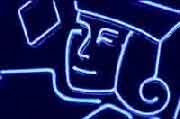
Baird moved to London in November 1924 in the hope of showing off his burgeoning invention, setting up a workshop in the attic at 22 Frith Street. Amongst those who dropped by was Gordon Selfridge who invited Baird to give demonstrations of his device in the Palm Court during his store's upcoming Birthday Week celebrations. He gave three shows a day to long queues of spectators, each invited to peer down a funnel at outlines of shapes transmitted from a separate device a few yards away, including a paper mask which Baird would make 'wink' by covering the eyehole. At this stage Baird's 'Televisor' was still electro-mechanical, the images formed by spinning discs with doubled-up lenses and perforated rectangular holes. But spectators were impressed, and Baird earned a much-needed £60 to plough back into his enterprise.
By October 1925 Baird had honed his processes sufficiently to be able to transmit an image with gradations of light and shade. Initially he used a ventriloquist's dummy called Stooky Bill, this because it had greater contrast than a human face and also because it wouldn't be harmed by intense heat or possible exploding glass. Later, somewhat over-excitedly, he invited a 20 year-old office worker called William Taynton to come upstairs and become TV's first human subject. William wasn't keen but an appearance fee of half a crown persuaded him to pick through a jungle of wires, sit in front of blazing hot lamps and stick his tongue out, for just long enough that Baird exclaimed "I've seen you, William, I've seen you. I've got television at last!" When the time came for a blue plaque to be unveiled outside 22 Frith Street in 1951, it was William they invited back to do the honours.
Then on 26th January 1926 came the first official demonstration to members of the press. Journalists and guests from the Royal Institution were invited into Baird's workshop in small groups and first shown the dummy on screen, then each other's faces transmitted from a separate room. Only one visitor got too close to the discs and ended up with a sliced beard. Most of those present weren't especially impressed and failed to realise the significance of what they'd just seen, but The Times followed up with a short article two days later.
Members of the Royal Institution and other visitors to a laboratory in an upper room in Frith-Street, Soho, on Tuesday saw a demonstration of apparatus invented by Mr. J.L. Baird, who claims to have solved the problem of television. They were shown a transmitting machine, consisting of a large wooden revolving disc containing lenses, behind which was a revolving shutter and a light sensitive cell. It was explained that by means of the shutter and lens disc an image of articles or persons standing in front of the machine could be made to pass over the light sensitive cell at high speed. The current in the cell varies in proportion to the light falling on it, and this varying current is transmitted to a receiver where it controls a light behind an optical arrangement similar to that at the sending end. By this means a point of light is caused to traverse a ground glass screen. The light is dim at the shadows and bright at the high lights, and crosses the screen so rapidly that the whole image appears simultaneously to the eye. (The Times, 28th January 1926)
These days 22 Frith Street is home to retro cafe Bar Italia. It's been owned and run by the Polledri family since 1949, a coffee-squirting dynasty who also run the Little Italy restaurant nextdoor. The stone floor was laid by their uncle Torino, a terrazzo mosaic specialist, and the counter was one of the first in London to be graced by an original Gaggia machine. Once a magnet for mods on scooters Bar Italia has attracted many famous names over the years, notably Rocky Marciano whose huge poster has pride of place behind the counter. You could thus celebrate today's centenary with an espresso and a slice of pizza in the photo-bedecked interior, or risk sitting outside below the neon sign with a froth and cheesecake combo.
Number 22 also displays a Milestone plaque erected by The Institution of Electrical Engineers citing "the world's first public demonstration of live television". Below is a much newer plaque citing this as an accredited World Origin Site. I first saw one of these inside the Alexander Fleming Laboratory Museum earlier in the month, earned for the discovery of penicillin, but whereas that was designated WOS 0001 the invention of television only ranks 0037. I believe they're unveiling it officially at 2pm this afternoon, even though it was perfectly visible over the weekend.
Baird was a highly driven inventor and entrepreneur and went on to develop prototypes for all sorts of forward-looking formats. In 1927 he came up with ‘Phonovision’ (image recordings onto 78 rpm gramophone records) and ‘Noctovision’ (infra-red TV). In 1928, amazingly, he demonstrated both colour television and stereoscopic (3D) television. His ultimate aim was television broadcasting via the BBC, beginning experimental transmissions of 30-line television in 1930 and delivering the first outside broadcast (from the Derby) in 1931, not that anyone was yet watching.
But in 1932 EMI started to provide serious competition, developing their own pioneering electronic television camera called the Emitron. The government's Television Advisory Committee ultimately recommended that both Baird's 240-line mechanical system and Marconi-EMI's 405-line electronic system be developed as alternatives for the proposed new London television station. And so it was that when broadcast TV first launched at Alexandra Palace on 2nd November 1936 the two systems alternated one week each... Baird second.
It rapidly became clear that the Marconi system was far superior and Baird's was dropped after just three months. Baird also suffered when his studios were burned in the fire that destroyed the Crystal Palace, and his company went into receivership when all TV broadcasting was suspended at the start of WW2. He carried on inventing at home in Sydenham, vastly improving his system for colour television, until his laboratory was made unusable by bomb damage. Alas ill health caught up with him and he died after a stroke at the age of 57, just one week after the BBC restarted television broadcasts in 1946. You can't see his final home in Bexhill because it was replaced by a block of flats in 2005, but Baird does have an impressive number of plaques across central London and SE26.
It's not always easy being first, and after early televisual success John Logie Baird saw his star wane and fade. But it's still him we remember for making possible one of the key transformative inventions of the 20th century, even though barely anyone watched his first efforts. It took ten years to get from Stooky Bill to BBC TV's opening night, then another two decades before the widespread adoption of TV sets in British households and two more until colour television took hold. But 100 years on almost all of us have a TV set at home and effectively another in our pocket, and all because a Scotsman came to London and cleverly spun some discs.
It's been another super Superloop Saturday and the channel's been out on the decks! Woop to the SL11, the big red express rocking the hood from North Greenwich to Abbey Wood.
Head to TikTok for all the reels of buses driving past and the full-length route videos, also more shots of buses driving past and route videos in the opposite direction. We got you covered!
Bit sad the Mayor didn't rock up but seems he only does weekdays. Not even Bus Aunty made an appearance. But BusTokker09 was there, also Jings, Markie, Rizzo, Dr Kilt, Denzel, the Carshalton Crew, Axeman Joe and some excitable 8 year-olds with their dads. Check out all their channels too, goes without saying.
I can't lie, the worst thing was they didn't even send the right vehicles.
What we expect on Day One is a pristine fleet in red and white, fully branded. What we got was old red Wrightbus Eclipse Geminis drafted in to cover for the lack of NB4Ls. These vehicles had plates like BG59FXD and BV10WVG which makes them 2010 vintage, so hardly the gleaming start Sadiq promised. Like Rizzo said, "Man these vehicles are older than I am!" Our first bus was so ancient that the driver had to hop out of his cab to try and nudge the front door open.
Thing is, the SL11 is due to run with electric double decks. But they're not arriving until later in the contract so the plan was to stopgap with New Routemasters instead, recently turfed off the SL3. But even they're not ready so instead we got doddery diesels making up at least 80% of the fleet. I don't think I saw more than three Boris Buses in SL11 livery all day. "Who even was Boris?" asked Rizzo, "the Mayor has only ever been Khan in my day."
Obvs we waited long enough to catch a proper SL11 with the white top and red bottom. When it came it had the proper blobby diagram on the side, also maps inside for the SL11 and N472 which is the nightbus version. But we were only on board for two minutes going nowhere before the driver chucked everyone off. I didn't hear why because like everyone I had my chunky headphones on. So we all piled off and had to get a scuzzy old bus instead, and someone from a rival crew got the front seat and that was my westbound reel wrecked.
Best thing about the SL11 is how often it is. The old 472 was only every ten minutes but this is every six, and ten an hour is massive! It means you're never far away from catching one, unless you're at a stop where it doesn't stop in which case you could be proper far away. It also meant there was none of the usual Day One riots as all us hormonal spotters piled onto the same top deck, because there was so many top decks to go round. Great vibes!
Bus statz by Jings
The SL11 is the most frequent Superloop route! every 6 minutes: SL11 every 8 minutes: SL4 every 10 minutes: SL8 every 12 minutes: SL1, SL2, SL3, SL5, SL9, SL10 every 15 minutes: SL6, SL7
The SL11 is the most 5th most frequent TfL bus route! every 5 minutes: 18, 38, W7 every 5-6 minutes: EL1 every 6 minutes: 29, 41, 86, 158, 207, SL11, W3 every 6-7 minutes: 5, 73, 137, 141, 279
I can't lie, a lot of the SL11s were mostly empty. Every six minutes does seem well generous, even for shoppers piling from Thamesmead to Woolwich. But it was proper great to sail past all the stops in Thamesmead North where the 472 used to stop and the SL11 doesn't. Ha we watched them put their arms out, and ha we whizzed straight past. It's their own fault for living near a bus stop they should have realised might be skipped one day.
Also the roadworks between Charlton and Woolwich are pretty rad. There's like a mile and a half of orange barriers and narrow carriageways, also lorries and diggers, also long wide trenches where unhelpful street furniture used to be. It's all so cyclists can have a safer ride, also Markie on his e-scooter. But it means 18 months of nasty disruption, no cap, and that totally slowed the bus down.
But it was still pretty fast. Jings says the 472 used to take an hour off-peak and the SL11 is now timetabled for more like three-quarters. We actually did North Greenwich to Abbey Wood in 37 minutes flat, although that's before everyone in southeast London climbed in their cars and drove to the shops so we imagine it was slower later.
Disappointingly no freebies. In the old days the jobbers in pink tabards appeared on day 1 and handed out maps and advice, even pin badges. Rizzo has all the pin badges on his rucksack. This time nothing, not even a smiling nod towards the bus because I guess TfL is skint now.
Anyway you don't want words you want vids, better still vidsto anurbanbeatwithoccasionalwordssuperimposedon top. All our favourite streams are on our ownchannels, including the full ride and the one Tokker sped-up after filming buses turning into the stand. Sorry for the five minutes of glare when LTZ1851 was driving into the sun, but we had to include it for completeness. If you're proper old, like over 30, you might also want to look at the photos the greyhairs with big lenses spent all day taking.
We don't yet know when the gang will next be together IRL, no firm info for the SL12's yet been spilled. But see you probably over Easter for a ride to the godforsaken estuary edge in Rainham, all faithfully recorded in portrait mode and watched by almost ten of you. Bring on the Havering Loop!
Reform's newest MP, Andrew Rosindell, will be on the BBC's Politics London programme tomorrow morning. And according to a preview clip the MP for Romford will say this...
One of the things I'm passionate about is Havering, which is my borough, not being tied to the Mayor of London, and I would like Havering to be more of an independent borough, and Nigel has said to me that Havering would have that choice, so we could actually be independent from Sadiq Khan, the Mayor of London and the City Hall bureaucracy, so I'm really keen on that.
Well of course he'd say that.
Andrew has always been an Essex boy at heart, despite being born a year after his beloved borough of Romford was absorbed into Greater London. Hence he's been fighting a one-man battle to get Havering absorbed back into Essex ever since becoming an MP in 2001, pleading with all the governments of the day to let them back in. His latest wheeze was an adjournment debate last May entitled Havering Borough and Essex Devolution, a valiant attempt to take advantage of upcoming administrative reorganisation and whisk Romford out of London's orbit altogether.
Now is the time to consider Havering’s future. With devolution for what is termed Greater Essex now being implemented, this must surely be the right moment to examine a change that would give the people of Romford, Hornchurch, Upminster and Rainham hope that we could be part of something that better suits our local needs and goes with the grain of our historical identity.
Evidence he presented to Parliament included:
» My house has a Romford, Essex RM1 postcode.
» My home telephone number has a Romford, Essex 01708 dialling code.
» The church where I was christened and confirmed falls within the diocese of Chelmsford, Essex.
» Essex county cricket club is our local cricket team, and we support it strongly.
» Romford football club are part of the Essex senior football league.
» Romford golf club is part of the Essex Golf Union.
» Our local bowling clubs for Romford, Gidea Park and Hornchurch all fall under the Essex County Bowling Association.
» The Bedfords Park visitor centre in the historic Essex village of Havering-atte-Bower is managed by Essex Wildlife Trust.
» Our water supply comes from Essex and Suffolk Water.
QED.
The Minister for Local Government and English Devolution threw polite cold water on the proposals, pointing out that plans for reorganisation are restricted to the shire counties and Romford isn't in one.
It is currently not envisaged that the boundaries of Greater London will be changed, or that the proposed Greater Essex mayoral combined county authority will be expanded, although the latter would be possible at a later date should it be locally desired and should statutory tests be met. (Jim McMahon)
But imagine a future in which a Reform government takes power and a Reform government is keen to please a Reform MP with his greatest desire. What might be the consequences if Romford, Rainham and Upminster were no longer in London?
London would look different.
A huge lump would be chopped off London's eastern edge, reducing the area of the capital by 7%. The easternmost point in London would become the Dartford Creek flood barrier rather than a muddy field far beyond the M25. London would be five miles narrower than before. One-sixth of London's Green Belt would vanish overnight.
London would lose 260,000 residents, reducing its population by just 3%. It'd become a younger city, a more left wing city and a less white city. A greater proportion of its residents would rent. It might also become a happier city because the moaners had left.
Havering becoming an independent borough would remove a large hospital from London, also a windmill, 18 secondary schools, seven miles of motorway and three Parkruns.
Havering would no longer have to follow what Andrew calls the Mayor's woke agenda. It'd remove the borough from ULEZ which would please its drivers no end. Residents would also no longer have to pay the Mayor of London's precept, currently £490 for a Band D property, but might end up paying more to a devolved authority once the rest of London's support was removed.
And what would TfL do? They'd still carry on running trains here, just as they operate trains in Herts, Bucks and Essex. But it'd look odd if they carried on supporting the Liberty line, given that the runt of the Overground would be entirely outside London. Also there'd be thirteen bus routes expelled entirely into Essex (165, 193, 248, 252, 256, 294, 346, 365, 370, 372, 375, 496, 498), none of which TfL would be obligated to operate and which a new Essex authority might not feel able to support. Havering's bus network could significantly deteriorate.
The London Loop would need redrawing, condensing the last four sections into a shortcut down the Rom valley.
The Freedom Pass (and 60+ Oyster) would no longer apply to Havering. That'll be why Andrew pre-emptively introduced the Transport for London (Extension of Concessions) Bill in Parliament last year. This would "Require Transport for London to enable any local authority in England which is served by a Transport for London route, or by a route to which a TfL concessionary scheme applies, to opt into concessionary fare schemes, including the Freedom Pass." Obviously it stands no chance, but a later Reform government could definitely push it through just to piss London off, so watch this space.
Finally, people who go on and on and on about Romford being in Essex would finally shut up because it would be.
Of course we're unlikely to get a new national government before 2029, so Andrew potentially getting his own way is a long way off. Also local government reorganisation in Essex should have been completed by then and nobody's going to want to do it again. Also the next City Hall election will have taken place a year earlier and the new Mayor might no longer be a Labour bogeyman.
It's never going to happen, Andrew's administrative wet dream will not manifest in real life. But imagine if it did. Residents of Havering might find out they lose more than they gain, and Londoners might be delighted to see the back of them.
Tower Hamlets is well connected with its tube, bus and train links across the borough to the City and the West End.
But then...
It is also served by the Docklands Light Railway (DLR) – the only fully accessible railway in the UK - and is home to City Airport.
City Airport is in Newham, not Tower Hamlets. Nobody's checked this for a while.
Check before you travel made easier by TfL
Jubilee line passengers can now receive the latest travel news direct to their computers and mobiles by signing up for travel alerts and weekend-closure-emails from the Transport of London website.
Nobody says "computers and mobiles" any more, this is quite old.
The site also gives details of longer term line and station closures, as well as tools to help passengers ‘grab’ live content for their personalised iGoogle homepage, Facebook or MySpace profile, blog or website.
Nobody mentions iGoogle or MySpace profiles any more either. iGoogle was a thing between May 2005 and November 2013. MySpace is still a thing but slumped in general public perception in 2009, having launched in 2003. As for TfL providing widgets to personalise blogs and websites, that stopped years ago too.
The drive comes as work to improve the Jubilee line is set to continue over the Christmas holiday period.
And that should properly help date this page. The Jubilee line had multiple closures in December 2005 to aid the introduction of seven carriage trains, also a full line closure for three days after Christmas in 2009.
Checking the Tower Hamlets website via the WaybackMachine, it seems Christmas 2009 is when the guff about iGoogle and MySpace was added.
I therefore assert that the text on this page of the Tower Hamlets website hasn't been updated for over 16 years.
I wonder if anyone can find anything older (and similarly out-of-date) on this or any other local government website.
LONDON A-Z For my second alphabetical visit to unsung suburbs we're off to Bexley, appropriately enough, where three Bs are strung out along two miles of road beyond Eltham. Blackfen, Blendon and Bridgen were still hamlets 100 years ago, then the building of Rochester Way and railway electrification triggered substantial residential growth. The A2 now hugs all three close, hence a local reliance on car culture, but I buzzed from one B to the next on foot instead.
B is for Blackfen
Blackfen is the largest of the three, inasmuch as its possible to divide up the amorphous suburban sprawl hereabouts. The name means ‘dark-coloured marshy district’, which is hardly a ringing endorsement but originally all this was woodland and farmland rather than real estate to flog. A few cottages existed near what's now the main crossroads and also a pub, The Woodman, which opened to serve rural drinkers in 1845. It'd be plausible to believe the current building was the original were it not for the date on the front, 1931 being the year development ignited locally. So keen were the owners to maintain trade that they built the new pub behind the old one before demolishing it, which has proved fortuitous because there's now room for an enormous beer terrace out front plus a row of timber sheds sponsored by Beavertown. The pub's owners have renamed it George Staples Sidcup, this because George Staples was the original publican in 1845 and because nobody's heard of Blackfen.
Blackfen has a lengthy run of shops, one end a proper redbrick parade circa 1938 and the other a more motley assortment of independent businesses. The motor trade features heavily should you need a used white van or alloy wheels, also haircare and schoolwear should your littl'un need togging out. The busiest cafe appears to be inside the Community Library, which is as it should be. Shops which provide an insight into the local population include a pie and mash shop, two funeral directors and Tonics!, a self-professed retro menswear shop for former mods, scooterists, skins, casuals or rudeboys. My favourite throwback is 1950s bakery J Ayre, not just because they display an 01 telephone number on the exterior but because they still bake gypsy tarts, and if BestMate ever needs a lift I drop in and buy him some from his childhood local. He also remembers when the Co-op was a Safeway, indeed Bexley's first large superstore, but not when it was the Odeon cinema before that. So quickly was Wellington Parade erected that they didn't wait to demolish all of Mr Gwillim's cottage, which is why you can still see its roof perched atop Bulldog Windows and Oscar's chippy.
If it still feels relatively quiet round here that's because urban planners chose not to add a junction to the A2 when the dual carriageway was upgraded in 1969. This calms the local streets somewhat, of which Days Lane is a repurposed country lane and Wellington Avenue one of the first new roads. It's a very Bexley thing that most houses have a garage round the back accessed via a lowly communal drive, the lack of garages up front allowing the developers to fit more houses in. At the heart of all this is The Oval, an eye-shaped green faced on one side by a lengthy Mock Tudor shopping parade. It's one of my favourite outer suburban foci, a genuinely attractive retail curve providing a desirable focus for the surrounding neighbourhood. It's also great for local branding, hence includes the Oval Cafe, Oval Brasserie, Oval Fish Bar, Oval Pet Centre and Oval Village convenience store. A road behind The Oval is called The Triangle, should I ever be looking for a series of geometric streets to review.
Blackfen's such a 1930s construct that it contains only four locally-listed buildings, and just one of these is over 100 years old. My favourite is the small concrete block behind the bus stop at the foot of Wellington Avenue which has a periscope-like metal vent protruding from its roof. It's actually an air raid shelter, and I'd hope there's a much larger space beneath the verge because you'd barely get two bunkbeds inside what's visible. Note the brief brick wall erected just in front of the entrance, a simple insurance policy that would have helped shield those inside from direct blast damage. Also locally-listed is the rare Edward VIII pillar box at the eastern end of Tyrell Avenue, accessed via a thin concrete footbridge across the tarmac chasm of East Rochester Way. The folk whose semis face the A2 direct have deliberately chosen Blackfen's shortest straw. If you're local (or just interested), Blackfen Past and Present is an excellent online resource that puts most London suburbs to shame.
B is for Blendon
Heading east Blackfen blends invisibly into Blendon, Bexley not being a borough that erects neighbourhood signs. The name originally means “the farm of the people who live by the dark water”, again suggesting there's something a bit gloomy about the groundwater round here. Blendon does have a junction onto the A2 so is inherently more car-focused, including two roundabouts, a Shell garage and a large Audi showroom. Most conspicuous is what looks like an abandoned chapel but is actually a small cottage with a spire on top, a folly first plonked here in the 1760s on the edge of Danson Park. It was designed by Capability Brown to cap the view across the lake from the big house, but that line of sight's now blocked off by three rows of houses and a dual carriageway leaving Chapel House looking somewhat forlorn. The dry cleaner at number 266 retired last year and her son is reopening the premises as a micropub called The Dog House in the spring.
The other out-of-place building by the roundabout is a turrety cottage, recently sold. This used to be the West Lodge for a large crenelated villa, Blendon Hall, built in 1763 as a country retreat set in extensive landscaped grounds. In 1929 the estate was inevitably sold off for housing, and because nobody wanted to buy the mansion in the middle it was demolished four years later. Walking the 88 acres today you'd never guess these upmarket avenues were once a rich man's parkland, although the twin lines of linden trees at the foot of The Avenue are actually a leftover from a path linking the Boat House to the Bath House. As for the lakes, formed by damming a local stream, they've since been filled in and replaced by two dippy cul-de-sacs called Beechway and The Sanctuary. Whilst virtually all of the houses here are big semis the estate also includes a few art moderne anomalies, one pair curved and the other not, and why on earth did they not build more than four of these architectural beauties? In 2007 a small hole opened up in a garden on Beechway, and when an archaeological team went down they found a narrow waterproof chamber that once ran the full length of the Hall.
B is for Bridgen
The last of the trio, and least well-known, is Bridgen. Like Blackfen and Blendon it was originally a smallhamlet, and it must still exist because TfL once produced a bus spider map for it. In its day it would have been a brief run of cottages where the road climbs a sudden rise, and still forms a noticeable break in the continuum of 1930s semis. One building looks like it was formerly a shop, one cottage displays a plaque dated 1827 and the flinty hall at the top of the hill is Bridgen's old infant school. Again there used to be a Georgian mansion here (a "handsome and spacious" pile called Bridgen Place) and again no trace remains because the estate's been turned over to housing. As for the pub on the corner, this started out in the 17th century as the Anchor and Cable, became the Blue Anchor in the 18th and is now just The Anchor. Alas in 1928 it was completely rebuilt because the Dartford Brewery realised a yokel-hole was totally inappropriate for hundreds of suburban incomers, so these days they serve smothered steak and spirits rather than a slice of Stuart history. One particular inn sign once led locals to nickname the pub The Snake and Pickaxe.
There is a bridge in Bridgen where the road to Bexley Village crosses the River Shuttle, a brief span originally called Gad Bridge. You can still slip off the road here and follow the river into what's left of Bexley Park Woods, passing what I consider to be southeast London's finest earthy meanders. Amid the trees on the north bank, best approached in sensible footwear, is a slab-topped concrete culvert out of which flows the half-mile Bridgen Stream. That's the buried river which once fed the lakes back at Blendon Hall, and here's where it joins the Shuttle which earlier drained the lower slopes of Blackfen. These three Bs really are connected and not just by road, by water too. The 132 bus also passes through Blackfen, Blendon and Bridgen, should you want to experience all of this in seven minutes flat.