Pershore is a small market town in Worcestershire and one of several fictional candidates for Borchester in The Archers. It's not quite in the Cotswolds, more the Vale of Evesham, a floodably fertile plain much favoured by market gardeners (as we saw yesterday). The river hereabouts is the Avon, as in Stratford-upon-, which was very much overspilling earlier in the week and thus limiting exploration potential somewhat. But I still got around to see many of the town's finest features, most of which you could list under the headings 'abbey', 'river' and 'Georgian'. [VisitPershore][town map][18 photos]
abbey
Pershore's Saxon monastery got the full Abbey upgrade in the 12th century when the Normans piled in. Alas the building suffered several subsequent catastrophes including two fires, the collapse of the north transept and Henry VIII, so what's left is a stunted building that ought to be larger. The tower was saved by local townspeople after the Dissolution, also the quire where the monks sang which was reformulated into a nave, also the south transept. But the surviving chunk is still impressive enough and also free to wander round, that is once you've stopped admiring it from outside.
The nave has intricate ploughshare vaulting, also carved stone roof bosses which would look even more splendid had the Victorians not decided to 'clean' them by washing off the brightly coloured paint. The transept has effigy-topped tombs of abbots and crusaders nobody's quite sure of the name of. The bookstall has a particularly wide collection of cards for 80th, 90th and 100th birthdays, though not 20ths and 30ths hinting at the age of the congregation. The truly unique feature interior is the bell-ringing platform which is a cube-shaped chamber suspended 30m off the ground inside the tower, propped up only by four horizontal supports. It was added by George Gilbert Scott and can only be accessedvia two spiral staircases, a walkway through the roof, a squeeze through a narrow passage and a see-through iron staircase down into the cage. Safer to just look up.
The abbey is surrounded by Pershore's only proper park and watched over by an iron horse. The Warhorse Memorial Sculpture was created by a local blacksmith, is made from recycled horseshoes is meant as a tribute to all the fallen animals across two worldwide conflicts. It was unveiled in 2019 (in pouring rain) and since then Armistice ceremonies have also been attended by a lot of poppy-clad folk on horseback. A few other sculptures are scattered around the wider site, my favourite being Peter Inchbald's two-sided Moon Goddess in St Andrew's Gardens (even if I'm not sure how the lunar disc can have a crescent hole).
river
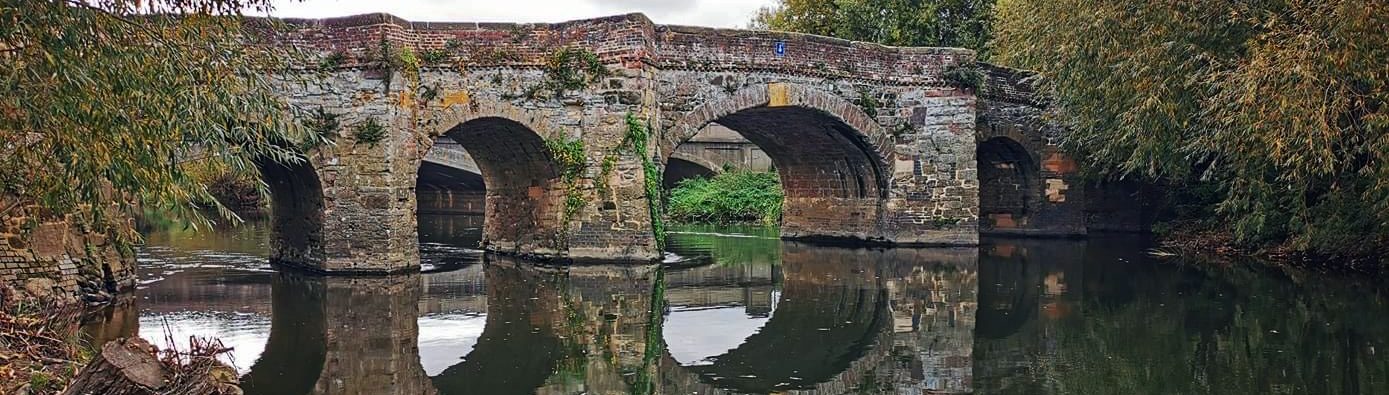
The Avon rules life in Pershore which is why you can't see it from the town centre. Locals worked out centuries ago it was safest to live on the slightly higher land alongside and let their long gardens stretch down to the river because it didn't matter if they flooded. Pershore is also the sole bridging point for miles, the earliest wooden crossing finally replaced in stone in the 15th century after the Abbot got washed away and drowned. The five-arched sandstone bridge is a rare medieval survivor, although the central span had to be rebuilt after Royalist troops ineptly destroyed it while fleeing from Parliamentarians during the Civil War. The narrow span proved increasingly impractical for road traffic so a proper concrete span was built alongside in 1926, but you can still walk across the jaggedy original as a short deviation from the main road. Even during flooding, blimey.
I once passed under thisbridge on a canal boat but you couldn't possibly do that at the moment because river levels are too high. Instead I watched an inexorable flow of brown water rushing through the central arch with maybe a metre's headroom, and understood why additional 'flood arches' had been built to either side to help ease peak flow. Normally this is a peaceful picnic spot with a footpath leading out across the meadows, and whilst the tables remained safely dry the path was a washout with substantial bankside undergrowth submerged beneath the water. It got worse than this in 2024 and far worse in 2007, the Avon occasionally capable of regional paralysis. But even at current levels the adjacent bridges at Eckington and Fladbury become impassable, and the Environment Agency employ flap-down yellow signs in the town centre to point to the diversions.
It could be worse were it not for the Avon Meadows Community Wetland a mile upriver. After the floods in 2007 additional water storage was carved out of the grass and several large reed beds dug as part of one of the UK's first urban sustainable drainage schemes. Not only does it do its job but it looks good too, doubles as a nature reserve and is intriguing to explore. I reached the boardwalk without too much trouble, stepping out through head-high reeds past a pair of inquisitive swans and a dipping pool. But the ground beyond was sodden, then decidedly underwater, so best come any time other than a wet winter if you want to see the river's edge where it should be, at its best.
Georgian
Pershore brands itself as a Georgian town and retains a very impressive run of period houses down the main street. They kick off abruptly by the Toll House on Bridge Street, where carts and coaches were once charged sixpence to cross the Avon if they were drawn by three horses, and which is currently on the market for £¼m. Further up the road The Star is a former coaching inn, The Angel contains salty Tudor boating timbers and The Brandy Cask used to be a wool warehouse. One of the most unusual buildings used to be The Three Tuns Hotel, hence the twiddly Regency ironwork, and has a plaque saying the future Queen Victoria stayed here overnight in 1830. It's now the town's most metropolitan pub and has been renamed after Claude Choules, the oldest combat veteran of the First World War, who was born in Bridge Street in 1901 and died in Australia at the record-breaking age of 110.
Some of the finer buildings don't have quite the pedigree you'd expect. The local arts centre (called Number 8) was created inside the innards of the former Co-op and now has raked seating. The Town Hall doesn't dazzle because it was originally commissioned as a post office, which to be fair is a decent size when you're only administering to a population of of 8500. Upstairs is where you'll find the town's museum, the Pershore Heritage Centre, although it only opens between Easter and October so I never got to see the Diamond Jubilee spade, the model train cabinet or the Titanic survivor's hat. But possibly the greatest surprise is that the large Georgian townhouse at the very start of Bridge Street is the home of former punkstress Toyah Willcox.
The Birmingham-born singer first grew to love the area when her parents bought a boat at nearby Wyre Marina, spending most of their weekends afloat. She moved here properly in 2002 along with husband Robert Fripp, King Crimson's offbeat guitarist, and has been known to kayak round her back garden if the river's high enough. You can catch a glimpse inside their quirky home by watching some of the couple's effusive Sunday lunch videos, seemingly recorded in the kitchen. Nobody can say It's A Mystery why she bought this pivotal property, it's because she loves living bang opposite the heart of a genuine market town. Alas these days Broad Street only looks like a marketplace once a month when stalls replace the usual stripe of car park so I didn't see it at its best, also the temporary traffic lights outside Tesco led to far too many queueing vehicles in many of my photographs.
Wychavon
Pershore is the administrative centre of Wychavon, largest and most southeasterly of the six Worcestershire districts. Though the town's much smaller than Droitwich and Evesham it's also more central, hence the council decided to build their Civic Centre here in 1991. With local government reorganisation imminent Wychavon's days are numbered, and I wonder how long it'll take this quirky name to disappear off signs, buildings and bins.
plums
Dip into the basket of market garden produce and you'll find Pershore is best known for its plums. Legend says a publican called George Crook discovered the famous Yellow Egg plum while walking through Tiddesley Woods in 1827 and within a few years it was being farmed widely in the area. Then in 1877 a Diamond/Prolific cross created the Pershore Purple, and these days a multitude of varieties are grown locally. Several plum-themed pubs and tearooms can be found in the town, but to get truly stoned best visit on August Bank Holiday weekend to experience the annual Plum Festival at which the mascots Prunella (purple) and Eggbert (yellow) invariably make an appearance.
station
Pershore station is a big disappointment, a single track halt served by hourly trains whose buildings were all demolished in the 1960s before the line was ultimately reprieved. It's also a mile and a half from the town centre with barely any bus connections, indeed officially in the neighbouring village of Pinvin, and surrounded not by houses but a large industrial estate. On the bright side it has a nice heritage sign in bold block capitals and Sir John Betjeman once wrote a poem about it, but otherwise substandard in every way.