I was in Bromley town centre yesterday and thought I'd pop into the library to see the museum.
It wasn't there.
I found the display cases where the museum used to be but they were all empty, that is apart from one where a mannequin's torso stood alone, its former clothing whisked off into storage.
And I thought, there go two more public facilities downsizing into something smaller.
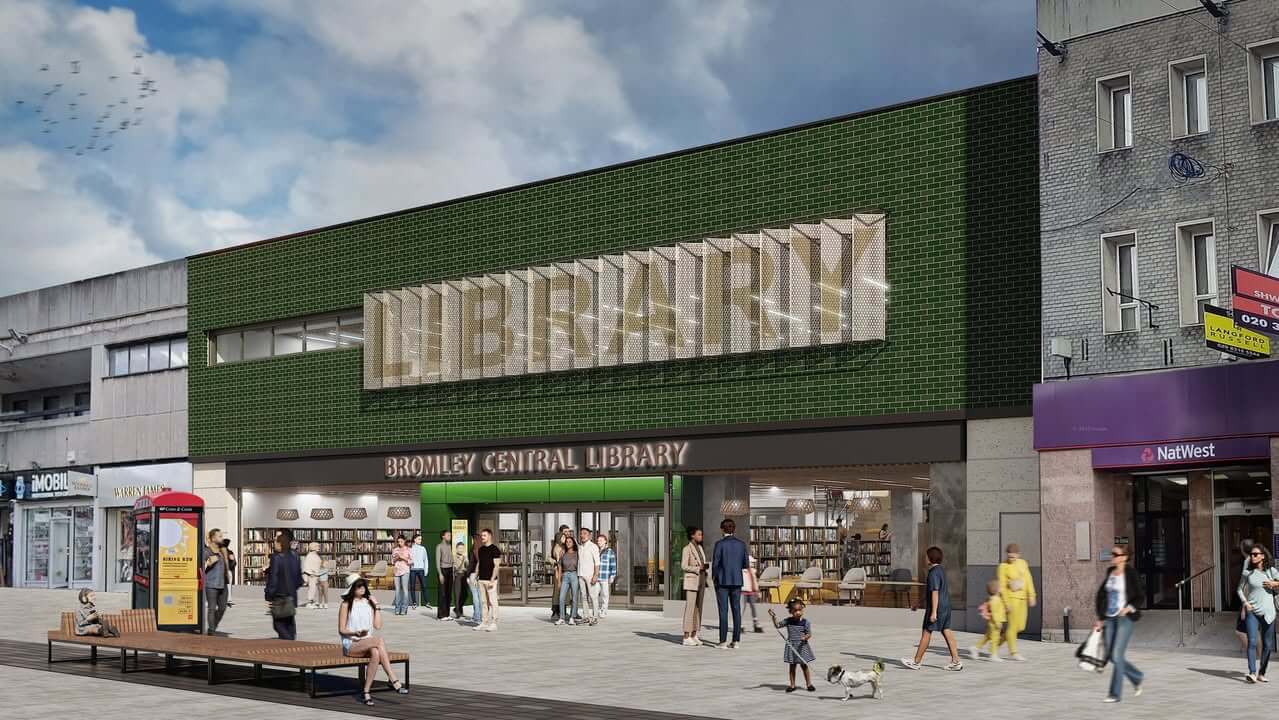
The issue for Bromley is that the concrete 1970s building where the library and museum are housed is approaching end of life so they're moving out. The adjacent Churchill Theatre has been sold (intact) to a consortium including Galliard Homes, so expect a final outcome involving continued dramatics and a fair few flats. Meanwhile the UK's 7th busiest library will be closing for four months later this year, the shutdown recently postponed from March to 'just after the summer exams', before moving to a new spot on the High Street. Unexpectedly it'll now be inside a former Top Shop, which isn't normally where you'd find a lot of books.
Bromley's Top Shop has been empty since 2020 so sticking a library in there makes good sense, but it'll be smaller with 28% less space for adult fiction/non-fiction and 7% fewer books. The children's library will be larger so that's a plus, but the rest of downstairs will be mostly seating, a few bestsellers and a couple of meeting rooms insufficient to cope with current use. Upstairs (where TopMan, Miss Selfridge and Dorothy Perkins used to be) will be better crammed with bookshelves, study space and a rejigged Local History Centre. But when it comes to anything museumy all that's being provided is "a vitrine wall which displays artefacts from the borough archives", which if I read the plans right will comprise only three slimline cases.
The hoardings outside 145 High Street tell the history of the site: i) originally The White Hart Hotel, ii) rebuilt as a Littlewoods department store in the 1960s, iii) subsequently occupied by Marks & Spencer, Primark and Top Shop. More tellingly they also tell the history of Bromley's central library, which seems very much a rise and fall. A membership-based Literary Institute opened in 1845, as used by local schoolboy HG Wells, this enlarged in 1864 within new premises at the Town Hall. The first public library opened in 1894 and was upgraded to a proper Carnegie Library on the High Street in 1903, until this too was deemed insufficient and the current concrete hulk opened in 1977. 2026's shift is thus the first backwards move, but I guess in an age of digitalisation we should be glad it's not even smaller.
What's not displayed is a history of Bromley Museum because that would be too depressing. It opened in 1965, the same year the borough was created, within the former medieval priory at Orpington. All sorts of local treasures (Sir John Lubbock's archive, HG Wells's tooth, David Bowie’s corduroy jacket) were displayed in increasingly underfunded surroundings, until 2015 when the council closed it and made all the staff redundant. Instead they opened Bromley Historic Collections, a few thematic cases in Bromley Library which I described in 2017 as "a taster for a museum that no longer exists". Now even that's gone and all that'll remain in the new set-up is a scant wall of artefacts, which is gobsmackingly little for a borough of 330,000 people.
Other boroughs to have squandered their museums include Wandsworth (closed to save money 2007), Barnet (sold 2011), Greenwich (closed 2018), Southwark (squished into Walworth Library in 2021) and Enfield (decimated in the corner of a cafe in 2022). It's not all grim - in 2023 I awarded top marks to Barking and Dagenham, Ealing, Hounslow, Harrow and Sutton for their municipal offerings. But when the choice is paying for adult social care or running a nice museum a lot of boroughs have thrown in the towel, egged on by austerity, with cultural services often the easiest to cut.
Dozens of London's libraries have have been downsized in recent years, not just Bromley Central, or simply shut for good. Take Wood Street in Waltham Forest for example, a fine Fifties edifice demolished to make way for a nine-storey block of flats, its replacement a scant slice of books beneath another residential development. See also Sidcup, Uxbridge, Canning Town and any number of other libraries that are now fewer shelves in a smaller but more modern space. See also the inexorable rise of the self-service library, e.g. Cheam and Burnt Oak, these now cut-price study spaces without a librarian. See also offboarding libraries to community operation, e.g. Ponders End and Bexley Village, these still loved by residents if not by councillors. And see also libraries that open just three days a week, for example the three nearest libraries to Bromley Central (which isn't going to help when that closes for four months).
Then there's Post Offices, like this one I saw at the weekend in Uxbridge. Thousands have been downsized to save money, often shifting into counters at the back of other retail premises. Here in Uxbridge services moved to the back of WH Smith when the Crown Post Office closed, but WH Smith is now TG Jones and they're closing this branch next month and suddenly the Post Office is toast. Everyone from the local MP downwards is up in arms but nothing can be done until alternative arrangements can be made, so from 5pm on 30th May it's a bus ride to Hillingdon or Cowley every time you need counter service.
And there's banks too. We've had years of closures and general thinning out, obviously due to the uptake of online banking but with the consequent creation of financial deserts. Islington's Halifax is doomed, Woking's Santander closed yesterday and the Nat Wests in Barnet, Eastcote, Hornchurch and Orpington all shut next month. Here in Bow our last Barclays and Nationwide fled in 2021 but we do at least have Stratford nearby, whereas a lot of provincial towns are being stripped away to nothing and might get a paltry banking hub stopgap if they're lucky.
There are many reasons for all this public downsizing, most notably funding cuts, digitalisation and the need to scrimp more savings. But we're also losing a lot of public buildings, the foundations of a public service presence and places you can actually visit to do things. If we're not careful the next generation will have nowhere to go that isn't commercially focused, not that some downsizing isn't necessary but in the face of economic rationalisation let's try not to extinguish all the good stuff.