Londoners of note
£20: William Shakespeare(1564-1616) Like many an ambitious twenty-something, William Shakespeare was strangely drawn from the shire counties to the bright lights of London. Nobody's quite certain when he arrived, but by 1592 he had a career of sorts as an actor and emerging playwright. Will joined up with a company of players called The Lord Chamberlain's Men and helped establish a theatre (called, originally enough, The Theatre) just outside the City boundaries in Shoreditch. Tax records catalogue a succession of London lodgings beginning in nearby Bishopsgate, later crossing the river to Bankside and then back again closer to St Paul's. In 1599 the increasingly successful Mr Shakespeare became a one-eighth shareholder in the Globe Theatre. Such classic plays as Julius Caesar, Macbeth and Hamlet were first performed here (to packed crowds of appreciative Londoners and not to bored field-trip GCSE students). A second winter-only theatre opened rather later at Blackfriars, where William bought up the old monastery gatehouse as his final London residence. The Blackfriars Theatre lingers on only as a streetname (Playhouse Yard), but the reconstructed Globe lives again as a thatched tourist magnet very close to its original site. Those who flock to Shakespeare's birthplace in Stratford are somehow missing the point.
Londoners of note
£20: Michael Faraday(1791-1867) At long last in this series of banknote characters, a Londoner born and bred. MichaelFaraday grew up in Newington Butts (better known today as "just south of Elephant and Castle"). At the age of 14 he was apprenticed to a bookseller and bookbinder in Blandford Street, just off Baker Street, and started to take an interest in matters scientific. A customer's chance gift of four Royal Institution lecture tickets drew young Michael to the attention of Sir Humphrey Davy, who promptly took him on as his laboratory assistant. Faraday rose through the ranks at the RI to become a Professor of Chemistry, discovering electrolysis and inventing the Bunsen burner along the way. But it's for his pioneering work on electricity that he's best remembered. Ooh look, moving this wire through that magnetic field creates an electric current, as does moving the magnet instead of the wire. Hey presto - the electric motor, the dynamo and the entire modern science of electromagnetism. The fulllist of Faraday's accomplishments is astonishing, and all this from a very humble, religious man.
Unfortunately the Royal Institution in Albermarle Street is closed for major refurbishment at the moment, so the Faraday Museum inside is closed too. But Michael spent his entire life based in London, so there's a lot more elsewhere still to track down. Southwark council have erected a blue plaque on a library in Walworth Road close to the site of his birth (although Southwark council are renowned for slapping a blue plaque on anything for almost anyone). More impressive, though less well-known, is this striking steel-box sculpture in the middle of the Elephant & Castle roundabout. Most passers-by probably think it's an electricity substation (which, in fact, it is, for the Northern line below), but it's also the official MichaelFaradayMemorial. It beats the usual bog-standard statue, although there are a couple of those around the town as well. The bookshop in Marylebone where Michael served his apprenticeship is marked by a brown 'blue plaque', and the building is currently occupied by an estate agents named Faradays. Over in the East End, beside the mouth to Bow Creek, is TrinityBuoyWharf lighthouse where Faraday experimented at great length to improve offshore illumination. At Hampton Court is the grace and favour house where he lived out the last two decades of his life. And to see his grave you'll have to travel to the evocative Highgate Cemetery. Faraday's current legacy is everywhere.
Londoners of note
£20: Edward Elgar(1857-1934) Elgar was born, and lived out most of his life, in the idyllic surroundings of rural Worcestershire. He was a man who found even the hustle and bustle of a market town like Malvern too distracting and preferred to compose his work in rented country cottages. So it's perhaps surprising to discover that, of the 25-or-so different residences in which he lived during his life, four were in London. Elgar's need to move to the capital was forced after works such as the Enigma Variations and the Pomp and Circumstance marches caused his fame to grow. In 1912 he moved into an expensive Queen Anne mansion in Netherhall Gardens, Hampstead, and named it Severn House. But a stream of visitors, and the onset of the First World War, led to a marked decline in his creative output and eventually a return to the Worcestershire countryside beckoned. Elgar's Hampstead home has long since been demolished, and only one of his London residences remains standing. It's this five storey townhouse in Avonmore Road, close to the Olympia exhibition centre, and now converted into flats. Edward lived here for just one year during an early abortive attempt to establish himself in the capital. But I bet he wouldn't have left overflowing binbags, a roll of manky carpet and an old TV set out on the steps in front of his house. A blue plaque is no longer a guarantee of class.
Londoners of note
£20: Adam Smith(1723-1790) Next year's new addition to the banknote hall of fame may be a Scot, but even DrAdamSmith spent a couple of years of his life in London hobnobbing with the literary hoi polloi. Today his political and economic outlook lives on in the capital in the form of the Adam Smith Institute, currently housed in temporary accommodation round the back of Westminster Abbey above an obscure timbered shop selling ecclesiastical vestments. As Adam's not yet officially noteworthy, I shan't say any more... but his libertarian disciples blog regularly on his behalf, if you're interested to dig deeper.
Londoners of note
£10: Florence Nightingale(1820-1910) You probably know Florence Nightingale as "the Lady with the lamp", or "that brave nurse from the Crimea". You might even associate her with the famous anagram "Flit on, cheering angel". But there's a lot more to Florence than her talent with bandages, and all is explained in one of London's least known museums hidden away beside the Thames in Lambeth.
The Florence Nightingale Museum is tucked beneath St Thomas's Hospital at the eastern end of Westminster Bridge [map]. No tourist is ever going to stumble upon it by mistake, so I was pleasantly surprised not to be the only visitor wandering around inside last weekend. It costs about half a tenner to get in, and for that you get a fairly traditional "cases and displays" walkround which leads you through the 90 years of Ms Nightingale's life. Florence was born in a certain north Italian city (you can guess which) while her well-travelled parents were on extended honeymoon. She had a privileged academic upbringing in Hampshire, but secretly hankered after an unfashionable career in nursing. The museum showcases many of her early belongings, as well as her pet owl Athena (now stuffed) who died of neglect when Flo rushed abroad to assist in the Crimean War. She wasn't so much a nurse as an administrator, and her in-depth background knowledge and logistical skills were precisely what was required to improve the horrific conditions for thousands of battleworn British soldiers. On her return to England Florence was rightly hailed as a national hero, but she shunned all such adulation in favour of continuing her reforming crusade. Her story is well told in the museum, and in the obligatory 20 minute audio-visual presentation, although (from what I saw) adults may want to linger inside rather longer than any accompanying children.
For the last half of her life Florence resided at 10 South Street, just off Park Lane, and spent her days meeting with the great, the good and the medically important. I attempted to track down her terraced townhouse by hunting for a blue plaque somewhere along the street. A tall Georgian cornerhouse looked a likely candidate, but the plaque beside the front door revealed that the famous occupant here was only "Skittles, the last Victorian Courtesan". Florence's plaque was on the opposite side of the street, high on a very ordinary concrete wall beside a suspiciously modern office entrance. The original house was long gone - her drawing room, her parlour, and the bedroom in which the frail, blind and bedridden Ms Nightingale spent her final decade. But the modern nursing profession still stands in testament to her achievements to this day.
Londoners of note
£10: Charles Dickens(1812-1870) £10: Charles Darwin(1809-1882) And then there are the two Charlies. One an acclaimed novelist, the other a renowned naturalist. One turned his spotlight on the human character, the other on the nature of man himself. And what do you know, I visited both of their London houses lastmonth, so there's no need for me to go into detail here again. Hurrah! Charles Dickens in particular spent so much time living in and writing about the capital that I could easily write a full week of posts about his literary London. Maybe I will one day. In the meantime you can investigate Dickens' London on this interactive map, or pay a virtual visit to Darwin's study.
Londoners of note
£5: Duke of Wellington(1769-1852) Poor old Arthur Wellesley didn't even get his name on the back of the old blue fiver, just his title. Arthur earned his fame stomping round Spain and Portugal during the Peninsular War, first becoming Viscount Wellington (because the name sounded a bit like Wellesley) and later the Duke. Only then did he cap a successful military career by defeating Napoleon at the battle of Waterloo, with the resultant adulation eventually propelling him to the giddy heights of Prime Minister. And in 1817 he moved into a grand town house on the edge of Hyde Park, where his successor lives to this day in private apartments on the third floor.
You've probably seen Apsley House, at least in passing, because it looks out over the six-lane gyratory system at Hyde Park Corner. But you may never have taken the time to go inside, which would be a pity because this is a top class stately home slap bang in the centre of London. I ventured inside "No. 1 London" for the first time last weekend, and was impressed to discover a bubble of grandeur and opulence in the traffic-choked heart of the West End. There's drawing room after drawing room after drawing room, as well as a huge dining room and the lavish Waterloo Gallery. Here the Duke held famed candlelit soirées, and here still hangs his impressive collection of European art. One room on the ground floor is given over to gifts of plate and china given by the crowned heads of Europe - far more impressive than any modern collection of Oscars or Nobel Prizes. But the most unexpected original feature of the house, and the most striking, is the 11 foot tall nude statue of Napoleon which stands at the foot of the main stairwell. Wellington had a grudging respect for his greatest adversary, and was pleased to accept the statue following the Battle of Waterloo when the French decided they no longer wanted it. But it's still a very odd experience to discover the mighty emperor, his dignity covered only by a figleaf, scaring old lady tourists at the foot of the main staircase.
Across the (very busy) road stands the WellingtonArch, upon which once stood a vastly oversized statue of the Duke. Now there's a magnificent winged statue of "The Angel of Peace Descending on the Chariot of War" on top instead, to which you can get right up close by paying a bit more money and taking the lift to the third floor [photo]. The suite of rooms inside the arch once housed London's second smallest police station with a staff of 10 constables, two sergeants and a cat. Now there's just a bit of an exhibition to see, but the visit's really only worthwhile for the view. You can stare across into Hyde Park, you can look down at the traffic circling Hyde Park Corner, and best of all you can peer high over the walls into the back garden of Buckingham Palace. Just the bottom of the garden, mind, but I can exclusively reveal that the Queen wasn't out at the weekend playing tennis or doing the gardening in her wellingtons.
Londoners of note
£5: George Stephenson(1781-1848) Here's the one banknote bloke who never lived in London. The father of railways was born in Northumberland and spent his working life linking the northern industrial heartlands. He never lived anywhere further south than Chesterfield, but today his greatest invention resides in the capital. In 1825 George engineered the world's first steam passenger railway between Stockton and Darlington, but fame came only with his next commission building the Liverpool and Manchester Railway. A competition was held to design the line's new locomotives, and Stephenson entered a revolutionary engine named Rocket. It had a top speed of 30mph, but easily beat the other entries when they all failed to work. At the opening of the railway in 1830, Rocket had the dubious honour of knocking down and killing the local MP who thereby became the world's first railway casualty. It's a lot safer to stand in front of Rocket today, down at the Science Museum in South Kensington, although you still have to watch out for rampaging crowds of schoolchildren running amok with clipboards. The shape is instantly recognisable, with a long thin chimney perched high above a stocky iron boiler. At the rear is a narrow footplate below a hinged door concealing the coal-fired furnace, and above one of the wooden-spoked wheels is affixed an understated brass nameplate. The modern train which brought you to the museum may look nothing like it, but your journey owes everything to Stephenson's Rocket.
Londoners of note
£5: Elizabeth Fry(1780-1845) Elizabeth would no doubt have been mortified to imagine that her portrait would one day appear on several million English banknotes. She was a modest Quaker who grew up in a religious community in Norwich, but her life changed in 1799 when she met wealthy East End merchant Joseph Fry. On marriage she moved to the Fry family home in Plashet (now East Ham) where she eventually decided that there was more to life than giving birth eleven times over. She started to visit the women inmates in Newgate Prison, bringing warm clothing for them and their babies, and eventually persuaded the governors to let her start up a prison school. Her influence grew and spread to other penal institutions across the country, with her undaunting emphasis always on respect and reform for female prisoners. After a pious and illustrious life she was buried in the Quaker cemetery in Barking, although no gravestone now marks the spot. And Newgate Prison, which she fought so long to reform, has also long gone - replaced by the Central Criminal Court of the Old Bailey(pictured). Justice at last.
Since 1970, a total of twelve famous people have graced the back of the banknotes issued by the Bank of England. It's a very exclusive list. And, with one exception, each of these people lived in London for at least some of their life. So I've been out to track down these noteworthy celebrities, to see where they lived, worked and/or died. Join me this week on the trail of twelve Londoners of note.
You have to be a bit special to be celebrated on an Englishbanknote. It's not everybody whose portrait is deemed worthy of being stuffed into millions of wallets, purses and piggy banks. You have to be British, you have to be dead, you have to be fairly non-controversial, and apparently it helps if you have a beard because that makes your portrait harder to counterfeit. Several potential candidates are considered, but it's down to the Bank of England's Governor to make the final decisions. Here are the twelve who've made the grade so far, distributed across three separate series of banknotes.
Series D £1 Isaac Newton (1978-1988) £5 Duke of Wellington (1971-1991) £10 Florence Nightingale (1975-1994) £20 William Shakespeare (1970-1993) £50 Christopher Wren (1981-1996)
Series E £5 George Stephenson (1990-2003) £10 Charles Dickens (1992-2003) £20 Michael Faraday (1991-2001) £50 John Houblon (1994-)
Series E(revised) £5 Elizabeth Fry (2002-) £10 Charles Darwin (2000-) £20 Edward Elgar (1999-)
So far that's ten men and only two women. So far that's four from the arts (two writers, a composer and an architect) and four from the sciences (three scientists and an engineer). So far that's ten properly famous and two just 'worthy'. And so far everyone has been English (although the surprise choice of Scottish economist Adam Smith for the £20 note from next spring breaks the pattern). With 'Series F' now on its way, I wonder who'll be next. Apparently the Bank already have a female shortlist including novelist Jane Austen, poet Elizabeth Barrett Browning and Octavia Hill, founder of the National Trust. I reckon Isambard Kingdom Brunel must be a prime candidate, and perhaps William Wilberforce. But who would you choose?
Londoners of note
£1: Isaac Newton(1643-1727) Let's start with possibly the greatest genius England ever produced. The discoverer of gravity, the inventor of calculus, the father of optics and the founder of mechanics. Any one of these achievements would be sufficient for IsaacNewton's scientific immortality, let alone the complete set. But they all happened either at home in Lincolnshire or at university in Cambridge, and not in London, so I'm going to ignore them. But in 1696 Newton finally moved from Cambridge to the capital to take up a job with the Royal Mint. Newton took his role as Master of the Mint very seriously, and it was for his financial achievements rather than as a scientist that he later received his knighthood. He became president of the Royal Society in 1703, and ruled this scientific organisation through a mixture of fear and intimidation until his death in 1727. And between 1696 and 1709 Newton lived here at 87 Jermyn Street, just south of Piccadilly.
Jermyn Street today is a backwater of timewarp tailoring, with fusty shops selling outfits and accessories to moneyed gentlemen from the shire counties. Here they can still buy a decent pair of brogues, or be fitted for a pinstripe blazer, or get their balding locks tended by a traditional wet-shave barber. The street is especially famous for shirts - distinctive shirts which scream class, breeding and colour-blindness. So perhaps it's not surprising that there's a tailor's, of sorts, on the site of Newton's old house. Disappointingly it's only a Hackett, catering for the upwardly mobile who can't quite afford a polo pony but can stretch to an overpriced jersey. An ornate plaque on the wall outside appears to be the best tribute to Sir Isaac's scientific genius that London can muster.
Remember Remember - a guide to Bonfire Night for young people
Hey youth! Did you know there used to be a British autumn tradition even bigger than Hallowe'en. Yes really. Back when your parents were kids nobody went trick or treating, nobody at all. Nobody carved out pumpkins, nobody dressed up as a skeleton and nobody went round throwing eggs at neighbour's windows. It's true. Instead we had our own festival of darkness and we called it BonfireNight. It was plain simple fun, and we didn't have to spend all our pocket money down at Woolworths if we wanted to join in. Ah, those were the days. So this November 5th why don't you ask a responsible adult to recreate all the excitement of a traditional Bonfire Night? See what you've been missing out on. Who knows, you might even enjoy it.
Step 1: Make yourself a guy Before the big day it's important to be able to extort money from the local population. For this purpose you'll need to create a big rag doll which looks like a bearded religious terrorist. But don't just copy the bloke on the front cover of The Sun, think 17th century Catholic instead. Because this festival is all about shameless religious persecution. Nothing changes.
Step 2: Take your guy out in public Find an old soapbox and attach some wheels to it (or, failing that, go out onto your estate and borrow a pushchair from one of the teenage mums). Then wheel your bundle of rags down to the local shops and hang around outside the library haranguing passers-by. The official cry used to be "Penny for the Guy", but you might want to update that to "A quid or we'll kick your head in".
Step 3: Buy a selection of fireworks Believe it or not, in the old days it was the children who bought the fireworks, not the adults. Shopkeepers thought nothing of selling bangers and jumping jacks to schoolkids with an evil glint in their eye, without a thought for whose eye they might end up in later. Try buying underage explosives today and you'll probably land yourself an instant Asbo and the phrase "irresponsible pyromaniac" on your criminal record. For the authentic retro experience you'll have to send Dad down to the shops instead of you. Not that he'll be able to buy much for ten shillings these days.
Step 4: Build yourself a bonfire In the less enlightened days before global warming, it was every good citizen's duty to tear down a few trees and send dark clouds of carbon emissions wafting high into the sky each Bonfire Night. All this so that Britons could risk setting their gardens alight and then end up smelling of smoke and roast hedgehog for the rest of the week.
Step 5: Pick the right evening There's only one correct date to let off fireworks, and that's November 5th. Just as nobody would ever go trick or treating a day early, so fireworks used to be restricted to one night only. Even if Bonfire Night fell on a wet Tuesday, bad luck, a wet Tuesday it was. This may have been a bit strict, but at least it confined all those dog-scaring bangs to a single six hour period.
Step 6: Stand in your garden Do not, repeat do not, go down to the council organised display in the park. Bonfire Night was never about joining in with your local community, it was about showing off in front of your neighbours in glorious isolation. Your amateur Dad would never merit a pyrotechnics safety certificate, but he was once fully entitled to detonate dangerous rockets in the dark from the middle of your back lawn. Blinding.
Step 7: Wait patiently while nothing happens Back garden firework displays are always a disappointment. One Dad can't set off ten rockets simultaneously, not like the professionals down at the park. He can stick one rocket in a milk bottle, but that'll probably fall over and fire horizontally towards nextdoor's cat. He can nail a Catherine Wheel into the shed, but a couple of revolutions later it'll probably fall onto the lawn with a muted splutter. And he can light the blue touchpaper on a Roman Candle, but it may be impossible to tell whether the ensuing two second fizzing is the intended special effect or a product malfunction.
Step 8: Get interactive Never mind, there's always the sparklers to look forward to. Just the one sparkler each, mind, because these used to be an expensive treat. Plus you were always a bit scared they might burn you because that nice presenter on Blue Peter had drummed the fear of God into you earlier in the evening. Look, I can spell my name in letters of fire... oh damn, it's gone out.
Step 9: Make your own entertainment Look, Mum's filled a bucket with water so everyone can try their hand at apple bobbing. Look, she's burnt some sausages under the grill in the kitchen and slipped them into a cheap white roll with some Heinz ketchup. Look, the whole family's standing out in the back garden, wrapped up warm in the dark, watching everybody else's fireworks exploding all around and having a whale of a time. That's how Bonfire Night used to be. Magic.
Step 10: Never waste your time and money doing Hallowe'en again
The great switch-off: A trip to see the London Christmas lights used to be a winter highlight for many a child. In December. But Christmas creeps earlier every year, and in 2006 the lights in Oxford Street and Regent Street will be switched on next week (sigh). They're up and strung across the road already, so I've been to take a look. And here's why you shouldn't bother making a special effort to come and see them yourself.
Regent Street lights Switch on: Tuesday 7th November I think these could be the most inappropriate Christmas lights anywhere, ever. Not the big snowflakey shapes, because they look like they could be quite impressive. No, I refer instead to the large cutout of a slug, labelled 'Slug', which you can see here displayed high above Regent Street. Further down there's a cartoon mouse called 'Roddy', as well as a giant rat and the odd toad, and various other characters never seen in the official nativity story. Because, yet again, Regent Street has succumbed to the allure of commercial sponsorship and has splashed wholly inappropriate illuminated cartoon characters along its length. Think Christmas, think 'animated family movie'. In this case it's the latest from Aardman Animations about a mouse flushed down into the sewers, which is about as unfestive as you can get. If you want to see 'toad' Sir Ian McKellen and 'rat' Shane Richie switch on the lights, get down here on Tuesday. If you have taste, stay at home.
• Selected Regent Street switcher-onners: 2003 Daniel Bedingfield; 2000 Billie Piper; 1996 John Major; 1995 Rolf Harris and Lionel Blair; 1993 Sylvester Stallone; 1989 Kylie Minogue; 1985 Joan Collins; 1981 HRH Princess Diana; 1980 David Essex
• Lots of photos of past Regent Street switch-ons
Oxford Street lights Switch on: Thursday 9th November Mmm, big shimmery silver candelabras dripping with gold bling baubles. There's tasteful for you. Are we in Liberace's ballroom, or have we perhaps stepped into Disney's Beauty and the Beast? It's not perhaps the Christmassiest of themes, but I suppose it'll look sparkly enough above the heads of late night shoppers over the next seven weeks. But hang on, aren't these exactly the same lights as last year, so you've probably seen them already! The date of the 2006 grand switch-on is a whole week earlier than in 2005, which I find particularly disturbing. And the ceremony sounds like it'll be the usual wholly forgettable exercise in middle-of-the-road promotional mediocrity. Heading the celebrity C-list are pop group All Saints (new album released this month), duetting couple Peter Andre and Jordan (new album released this month) and X Factor losers G4 (new album released this month). All this and Jamie Theakston too. I risked the Oxford Street switch-on two years ago (the Christmas with the swooshing laser beams) and was wholly underwhelmed [report]. Keep away and buy everything on Amazon instead.
• Selected Oxford Street switcher-onners: 2005 Westlife; 2001 S Club 7; 1998 Zoe Ball; 1996 Spice Girls; 1993 Richard Branson; 1990 Cliff Richard; 1987 Derek Jameson; 1986 Den and Angie Watts; 1984 Esther Rantzen
• Lots of photos of past Oxford Street switch-ons
Also to avoid this week
• Spirit of Christmas Fair(Olympia, until Sunday): "A stylish and inspirational shopping event bringing together the most desirable and original gifts, decorations, gourmet food and wine". Or, from what I saw outside earlier in the week, a lot of well-scrubbed Kensington women spending their husband's property income on hampers, baubles and pashminas. Avoid at all costs.
• Christmas Parade(Harrods, 8:30am today): Father Christmas arrives prematurely at the world's most ostentatious department store, then sets up home in his 4th floor grotto and asks little rich kids what share options they want for Christmas.
If it's quarter past seven on the morning of the third of November then I've been single for exactly seven years. (Yes, I know I post this particular post at the sametimeeveryyear, but I have updated it a bit, and I intend to keep posting it every year on this date until my situation changes. Not that I care if it doesn't, you understand.) And there are a lot of us single people about. Some might say that we're missing out on the joys of coupledom, and maybe we are, but I'm convinced that there are equally many positive points to being single:
Single: You get the whole duvet to yourself. Coupled: You don't need a hot water bottle.
Single: There's half as much ironing to do. Coupled: There's twice as much ironing to do but somebody else might do it.
Single: You can hoover the carpet when you think it needs doing. Coupled: Somebody else hoovers the carpet before you think it needs doing.
Single: Nobody ever tells you that the kitchen must be repainted and the bathroom must be retiled. Coupled: Two people can repaint the kitchen or retile the bathroom far more quickly than one.
Single: You can watch whatever TV channel you like, without arguments. Coupled: There's somebody to talk to about the programme you're watching.
Single: Nobody complains when you burp, belch or fart. Coupled: Somebody points out when you have ketchup on your chin.
Single: You never come home to a blazing row. Coupled: You sometimes come home to a cooked meal.
Single: You get to eat the whole ready meal for two yourself. Coupled: It takes just as long to cook for two as it does for one.
Single: You can always go on holiday somewhere you find interesting. Coupled: Hotel rooms cost less per person, and there's somebody to talk to at breakfast.
Single: You can spend all your money on yourself. Coupled: There are two salaries coming in and only one set of bills.
Single: You can walk away from a flatshare, any time. Coupled: You can afford a mortgage, together.
Single: There are no important birthdays or anniversaries to accidentally forget. Coupled: Somebody actually remembers your birthday.
Single: You never have to buy useless presents for your partner, just for the sake of it. Coupled: Somebody buys you presents occasionally, and it's the thought that counts.
Single: You're allowed to flirt with people in the street. Coupled: You don't need to flirt with people in the street.
Single: You like the idea of being coupled. Coupled: You like the idea of being single.
Single: You can still have a riotous social life in your 30s. Coupled: You can still have a riotous social life in your 60s.
Single: You can always get a double seat to yourself on public transport. Coupled: You can never find a double seat because they're all being hogged by single people.
Single: You have no friends to go out with because they've all partnered off and are staying in. Coupled: You don't have to go out with those annoying friends you had while you were single.
Single: You already know which set of parents you'll be spending Christmas with this year. Coupled: The family sometimes chooses to spend Christmas at your house.
Single: You don't catch every sniffle, cold and flu bug off your partner. Coupled: When you suffer a major cardiac arrest, somebody actually notices and dials 999.
Single: You never get left alone and desolate because your life partner's just passed away. Coupled: When you get old and infirm, you don't end up in a care home because there's nobody to look after you.
Single: Being coupled is restrictive, stifling and a sign of personal weakness. Coupled: Being single is unnatural, lonely and a sign of personal failure.
Single: The bathroom is always free. Coupled: The bedroom is always full.
Single: You can lie in bed in the morning for as long as you like. Coupled: There's a very good reason for lying in bed in the morning.
Single: Nobody sees what you look like first thing in the morning. Coupled: Somebody loves you despite what they see first thing in the morning.
Single: You never pack your bags and walk out on a relationship only for your partner to move a carefully-planned replacement bloke into the house six hours later. Not that I'm in any way bitter, you understand...
Of course you're not. You might be a little bit overweight, or slightly plump, or maybe even stocky, but you're definitely not fat are you? Nobody likes to think that they are anyway, although the truth is often a little harder to swallow. Latest figures suggest that a quarter of UK men are obese and nearly half are overweight. For women, it's one in five obese and one in three overweight. We're an overfednation, and we're getting larger.
The government definition of obesity is based on the Body Mass Index, or BMI. And the government definition matters, because if they think you're fat then you may face increased insurance premiums or restricted access to certain services. The BMI is an unforgiving measure which takes no account whatsoever of other factors such as muscle weight or waist size, but it's still the official statistic.
You can calculate your BMI by dividing your weight (in kilograms) by the square of your height (in metres). If you prefer pounds and inches, that's BMI=703×weight÷height². And here's what the outcome of that formula means:
BMI less than 18½: underweight BMI between 18½ and 25: 'normal' BMI between 25 and 30: overweight BMI over 30: obese
There are onlinecalculators for working all this out with minimum fuss, but these merely tell you what your BMI is. And what you really want to know is "How much would I have to slim down before I'm normal?" and "How heavy do I have to get before I'm obese?" So that's what today's table tells you, with absolutely no mathematics required whatsoever.
For example, if you're six foot one tall and weigh less than 10 stone, then you're officially underweight. If you're five foot six tall, then you need to slim down to 11 stone before you're considered officially normal. And if you're five foot nine and weigh 14½ stone or more, then you're officially obese.
I'm concerned, because it turns out that I'm only a couple of packets of crisps away from official chubbiness. But I'm sure you're not worried. Because there's no way you'd ever be obese, is there?
• The minimum cost of making a phone call from a BT telephone box rises this month to 40p. It used to be 30p in 2004, 20p in 2000, 10p in 1984, sixpence in 1966, threepence in 1959 and tuppence in 1925. • In 2001 there were 150000 BT callboxes. Now there are just 63500. BT are keen to point out that only 23000 of these make money, just so that you feel sorry for them for having to maintain a public service. • "Eee, when I were a child we never had these mobile phone things what kiddies have today. I always walked to school with a tuppenny coin for the payphone in my pocket, just in case I ever had to make a phone call home. We all did in them days. But I didn't usually need to use it. There was always a couple of seconds of free talktime before the pips butted in, and that was long enough to signal to my parents that I was ready to be picked up. None of this modern £1-a-minute ringtone rubbish."
• The first UK payphones had a Button A (to deposit the coins and make the connection) and a Button B (to return coins if the operator couldn't connect you). These started to be replaced in 1959 by new 'pay-on-answer' callboxes. • Ever wondered how an old 1960s payphone works? ("When the called subscriber answers, the line polarity reverses...")
• This photograph shows a K2 kiosk(right, introduced 1927) next to the slightly smaller but more common K6 kiosk(left, introduced 1935). • Kiosk K2 was designed by Sir Giles Gilbert Scott, who was also the architect behind Battersea Power Station. He based the kiosk's distinctive dome on the roof of the John Soane Mausoleum in St Pancras cemetery. • When phone boxes were first introduced, many people felt that red was rather too obtrusive. Other colours considered, but rejected, include Deep Brunswick Green, Black, Light Battleship Grey and Dark Battleship Grey. • "The standard colour for the Kiosk No. 6 is Post Office Red. The approximate quantities of paint which will be required for one kiosk are:- Paint, Kiosk Primer 1½pints; Paint, P.O. Red 3½pints; Varnish, Weatherproof 2½pints". • Other kiosks in the 'K' series included the spike-topped K1(1921), the white concrete K3(1929), the 'Vermillion Giant' K4(1930) and the glass-doored K8(1968).
GREEN means GO.
You may go ahead if the way is clear. You may go ahead even if the way is not clear. Quick, before that lorry runs you over.
AMBER means KEEP GOING.
No need to stop. Hurry up and you'll get through before the lights change. Just keep your head down and charge on through. Wheeee!
RED means CARRY ON.
The red signal isn't for you, it's for car drivers. They have to stop at the stop line, but you're on a bike so you can carry on. You're only small and you're highly manoeuvrable, so carry on pedalling. What harm could it possibly do? And you don't want to lose any of that hard earned momentum you've built up, do you? I mean, why should pedestrians suddenly have the right of way. If you swerve carefully you'll probably miss them all anyway. Remember that as a cyclist you're completely above the law, no matter what swear words passers-by might hurl at you. Do whatever the hell you like, why don't you?
RED 10 seconds later means PUSH TO THE FRONT.
There may still be pedestrians crossing the road in front of you, but if you nip between them you can be poised ready at the front of the queue when the passing traffic clears. Come on, every second counts!
RED 20 seconds later means HEAD OFF EARLY.
There's nothing coming, is there, so why wait? What harm would it do to scoot off across the road junction right now? OK, so it's technically illegal, but since when has that ever stopped you? Go on, get a head start on everyone revving up behind you.
RED AND AMBER means YOU'RE A BIT LATE, ALL THE OTHER CYCLISTS SET OFF SEVERAL SECONDS AGO.
Hurry and you might just catch up with them.
A GREEN ARROW means TURN RIGHT, OR GO STRAIGHT ON, WHATEVER.
There's a bit of green up there. Even if it's not the direction you want to go, just go.
A RED FILTER means SNEAK RIGHT.
There must be a gap in the oncoming traffic soon. Maybe immediately after this next car in the couple of seconds before that bus arrives. Or just go anyway, because all those other vehicles have brakes and they know how to use them.
NO LIGHTS AT ALL means POWER CUT.
Never mind. It's not like you'd be paying a blind bit of attention to the lights even if they were working. Carry on regardless, just like normal, you thoughtless selfish roadhog.
There are loads of places to dine out in Greenwich. There's the noodle bar in the high street, and that big pub on the riverfront, and even the sausage van up on the hill beside the observatory. But forget those - the best restaurant in town is most definitely the pie and mash shop a few doors up from the Cutty Sark. Goddard's has been serving up top quality pie since 1890, and is still run by the great grandchildren of the first owner. It's a proper traditional pie shop, with gnarled glass windows, old marble tables and wooden pews for seating. If you've ever been, you'll know just how good it is. And you'll be as gutted as I was to discover (from a small handwritten notice in the window) that Goddard's is closing down in a fortnight's time "due to family circumstances". No more pie, no more mash, it's the end of an era. But time enough for one last slap up meal.
The trick to getting served at Goddard's at the weekend is to arrive just before noon. Arrive a minute later and there'll be a queue stretching back to the door, probably including a pushchair or two, and you'll be waiting rather longer. At least that'll give you time to decide what to have. A traditional plate of beef pie and mash will set you back just £2.20, or maybe take the vegetarian cheese and onion option instead. Your meal is served up by a bevy of ladle-wielding handmaidens hemmed in behind a high green-tiled counter. Each plate comes with two scoops of finest mashed potato, liberally doused either in dark brown gravy or the more traditional 'liquor'. This green gloop may look a bit strange, but it's really only parsley gravy made from butter and flour. And yes, Goddard's serve jellied eels too. The eels are cooked fresh from the Thames estuary (which is how they came to become a local East End delicacy) and the jelly is formed as the stewing juices cool. Maybe it's not surprising that most of Goddard's modern diners wimp out and plump for a pie instead.
Here's what I had yesterday. This is no ordinary 'takeaway' pie, it's the 'Special' Steak 'N' Kidney Pie for a premium £3. Break your way through the enveloping piecrust and there's an ocean of prime beef inside. No wasted space, no gristle, just chunks of top-quality meat piled high in a moist gravy. There's even more gravy over the two mounds of mashed potato, although thankfully on this occasion I managed not to drip any down the front of my jumper. I should have asked for a side order of mushy peas, just to make this a slightly more healthy meal, but I sort-of made up for this omission with my fruit-based dessert. That's an apple crumble there on the right, concealed beneath a deep layer of non-instant custard, and quite delicious it was too (if perhaps a little heavy on the stomach after all that earlier stodge). And finally a mug of steaming tea to wash the whole meal down - there's none of this namby-pamby frothy coffee at Goddard's. Dining out in Greenwich will be far less enjoyable after they've gone.
For a short few weeks this autumn there's been a unique opportunity to take a look inside one of London's most iconic buildings. Battersea Power Station has been opened up as a temporary art gallery, hosting a range of modern work from China, and it's attracting large crowds. But the real magnet is the building itself, its quartet of ivory chimneys rising into the sky like beacons from a bygone age. I've been, she's been, he's been, and you've got one more week to go yourself. Before the new owners transform it into something more 'contemporary'. Hurry now while history lasts.
The past:Battersea Power Station was built by a private consortium in the 1930s in an attempt to stave off creeping nationalisation. They commissioned Sir Giles Gilbert Scott to build a giant generating station by the Thames, far larger than any previously built in the capital [photo]. He began with a huge steel girder box, then clad it in brick and placed an Art Deco turbine hall in the interior [photo]. The futuristic control room had a marble floor and could only be used by operatives wearing felt-soled shoes. The new generating station saw Londoners safely through World War Two, somehow avoiding major bomb damage. The original building was extended by the addition of a second turbine hall in the 1950s [photo], increasing the number of chimneys from two to the now-familiar four. Battersea belched away for a couple of decades more until increasing inefficiency led to the closure of first one turbine hall and then the other. The site went dark on 31st October 1983, and the building has been decaying slowly ever since. Various plans for restoration have been put forward, but the planned theme park never materialised and the Tate Modern ended up inside Bankside instead. The two turbine halls were gutted anyway, just in case.
The present: What a great idea to host an exhibition of Chinese art inside Battersea Power station. Quite frankly any excuse would have done, just to get the doors open again and allow London inside. It was an opportunity I couldn't to miss. You get a decent view of the power station from across the river in Pimlico or from any passing train, but the view stood right up close is so much better [photo]. The chimneys tower above you, the brick walls rise up like sheer cliffs and the broken windows echo with windswept loneliness. Inside it's much the same [photo]. For the exhibition they've erected scaffolding to allow you to walk out into one end of the boiler house, now roofless and open to the sky [photo]. It's a bit like standing inside a ruined cathedral, except that the nave is much longer, the towers are much taller and the glass is stained only by pollution. To each side are the two turbine halls, the first more photogenic than the second. Public access has been restricted to just one end, and you have to try hard to imagine each vast chamber filled with turbines, electrical switchgear and bustling workmen.
A narrow utility staircase leads you up from Turbine Hall B, past various frowning security guards, to three storeys of dark concrete workspaces. For the purposes of the exhibition these have been filled with Chinese art, mostly video-based. Even though you've really come to view the building instead, your attention suddenly switches to these animated windows on an emerging modern culture based 5000 miles away. It's a bonus, to be honest, that the art is a worthwhile sideshow to the surrounding architecture. One memorable installation is a wall-length wire cage filled with slowly-rotting apples, which no doubt by next weekend will smell even more like a tramp's Diamond White breath. Back outside the building the Chinese theme continues, with free bicycles provided for visitors to get around the site [photo]. It's not so vast that bikes are actually needed, but it's a nice touch and it keeps the kids occupied. And everywhere, both inside and out, a crowd of Londoners are snapping away trying to capture the perfect evocative photograph. Just my luck to visit on a wholly grey and overcast day, so my photographs lack the perfect blue backdrop that othersmanaged on earlier visits. • Tickets must be pre-booked. Book online for next Thursday→Sunday here. • Arrive early, preferably before 12:30, because the weekend queues get very long very quickly.
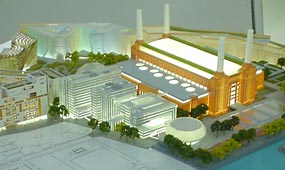
The future? What next for Battersea Power Station? That question was answered, sadly, by a promotional video screened in a narrow chamber on the ground floor. Here the site's current owners, Parkview International, showcased their long-delayed plans. You can guess, can't you? The central building will become (buckets at the ready) "an epic space that can variously function as a market place, a concert venue, a product exhibition platform or a fashion and brand showcase." Essentially that's an umpteen-storey shopping mall. Outside, so the on-screen architect enthused, they're deliberately building modern "signature buildings" to provide a "yin-yang contrast" to the old power station [photo]. To the west a long thin "benchmark" hotel will block current views from Clapham and the railway viaduct, and to the east will arise a similarly obstructive "modular" conference centre. Parkview are also squeezing in some "weave-like" office blocks, a "flexible" 2000-seat auditorium and an "advanced concept" residential building, assuming Wandsworth Council let them get away with it. Oh, and they want to knock down the chimneys first, because they're unsafe. But they'll rebuild them, honest, and then stick a single restaurant table at the very top of one. Work may, possibly, begin next summer. Few watching the showreel seemed impressed by the promotional bravado.
The "Power Station" website is full of some of the most vacuous bluster I've ever read, and I truly hope that not all of this redevelopment comes to pass. I know it would be criminal to leave Battersea Power Station to waste away and crumble unseen, but does London really need yet another "destination venue" and "commercial focus"? Some of us think not. There were hundreds of culturally-aware Londoners swarming around the building yesterday, taking one last opportunity to enjoy its unique character and history. But I doubt that any of them will want to come back for a cappucino and some shoe shops.
"It's getting dark earlier isn't it?" "And it'll be even darker tomorrow when the clocks go back." "Still, at least it'll be a bit lighter in the mornings."
Here's a scarily-detailed response to the above conversation...
A brief classification of darkness* • Sunset: the time at which the centre of the sun slips beneath the horizon. • Civil twilight: the period during which the centre of the Sun is less than 6 degrees below the horizon. Outdoor objects can still be clearly distinguished, the horizon is clearly defined and the brightest stars are visible. It's not completely dark. • Nautical twilight: the period during which the centre of the sun is between 6 and 12 degrees below the horizon. Outlines of outdoor objects may be distinguishable, but detailed outdoor operations are not possible and the horizon is indistinct. It's nearly completely dark. • Astronomical twilight: the period during which the centre of the Sun is between 12 and 18 degrees below the horizon. Illumination of the sky is practically imperceptible. It's completely dark, unless you're an astronomer. • Darkness: the period during which the centre of the Sun is more than 18 degrees below the horizon. It's pitch black. (* under good atmospheric conditions in the absence of moonlight or other illumination)
How dark is it at 6pm? • Daylight: 17 March → 18 October • Sunset: 19 October (ie last week) • Civil twilight: 20 October → 28 October (would have been longer, but the clocks go back tomorrow) • Nautical twilight:(skipped when the clocks go back) • Astronomical twilight: 29 October → 24 November (suddenly very dark) • Pitch black: 25 November → 24 December • Astronomical twilight: 25 December → 28 January • Nautical twilight: 29 January → 20 February • Civil twilight: 21 February → 15 March • Sunset: 16 March (before the clocks go forward)
How dark is it at 5pm? • Daylight: 8 February → 28 October (and then the clocks go back) • Civil twilight: 29 October → 6 November • Nautical twilight: 7 November → 15 January (it never gets completely dark) • Civil twilight: 16 January → 6 February • Sunset: 7 February
How dark is it at 7am? • Daylight: 24 February → 20 October • Sunrise: 21 October (ie last week) • Civil twilight: 22 October → 28 October (and then the clocks go back) • Daylight: 29 October → 4 November (yes, it really is daylight again) • Sunrise: 5 November (but not for long) • Civil twilight: 6 November → 28 November • Nautical twilight: 29 November → 3 February (it never gets completely dark) • Civil twilight: 4 February → 22 February • Sunrise: 23 February
>> All figures are for London - even though it's never dark in sodium-glow London >> Further in-depth information about twilight can be found here, here, here and here >> You can find day-by-day twilight details for London here, and other world locations here
And so ends diamond geezer's fourth annual tube week. I continue to be amazed by how much interactive interest the London Underground inspires, even amongst people who rarely or never use it. And I'm also surprised, every year, that I don't run out of new tube-related stuff to write about. I mean, four years on and I still haven't written a tube week post about disusedstations. Maybe next year...
Tubewatch (20)tube fiction
• 253(Geoff Ryman): 252 passengers on board an about-to-crash Bakerloo line train each get one page to tell their life story. And the driver makes 253. [got it, it's good]
• Neverwhere(Neil Gaiman): An underworld fantasy about "London Below", which looks suspiciously like the Underground but populated by the weird, the fantastic and the macabre. [got it, it's great]
• The Adventure of the Bruce-Partington Plans(Arthur Conan Doyle): Sherlock Holmes tracks the mysterious murder of a government clerk whose body is found on the rails near Aldgate station. [read it, it's OK]
• King Solomon's Carpet(Barbara Vine): A bunch of London misfits, linked in various ways by the tube, are drawn to an old schoolhouse overlooking West Hampstead station. [got it, it's Rendell-icious]
• Tunnel Vision(Keith Lowe): A geeky groom spends the day before his wedding attempting to visit every station on the tube network. [got it, it's good]
• Underground(Tobias Hill): Someone's pushing women in front of tube trains, so a lonesome tube worker ventures down old tunnels to try to solve the mystery. [never read it]
• Metroland(Julian Barnes): A suburban 60s coming-of-age story, rather more about sex and idealism than anything Betjeman might have written. [never read it]
• The Rats(James Herbert): Gory 70s horror with mutant rats rising up out of the sewers and Underground to feast on unsuspecting Londoners. [read it, it's predictable]
• A Metropolitan Murder(Lee Jackson): "The last train of the night pulls into the gas-lit platform of Baker Street underground station. A young woman is found strangled, her body abandoned in a second-class carriage." [never read it]
• Geoffrey the Tube Train and the Fat Comedian(Alexei Sayle): I suspect the title tells you all you need to know [flicked through it, never bought it]
• Underground Ernie Annual 2007(Joella Productions): The exciting adventures of every pre-schooler's favourite cheery tube worker and some talking trains. [I'll give it a miss, thanks]
• any more suggestions?
Tube quiz (20)Name that anagrammed station
Back in February the talk of the web was a map of the London Underground with every station name replaced by an anagram. It was so good that Transport for London's lawyers insisted it be removedfor infringement of copyright. Tourists might have mistaken it for the real thing, they argued, thereby diminishing TfL's brand image (or some such rubbish). The dabstars! But if you can't see the map any more, then I can base a quiz on it. Below are anagrams of the names of 30 different tube stations, as lifted from the anagram tube map. How many of the original names can you identify?
1) Pelmet 2) Pig Pen 3) Ink Blur 4) Sap Lust 5) Big Durex 6) Wet Mash 7) No Screws 8) Candle Oil 9) Emu Sprint 10) Otter Bends
Tube geek (20)Busiest lines
According to the latest TfL statistics, London's busiest tube line is the Northern line with just over 200 million passenger journeys each year. And the least busy? That's the Waterloo & City line with just under 10 million passenger journeys each year. Or so the headline figures say. I'd like to disagree. Share out each line's passengers equally, station by station, and the tiny Waterloo & City line (with just 2 stations) works out much busier than the Northern (with 50). OK, this may be a fairly meaningless statistic, but it does at least seem to give a fairly sensible rank ordering of busy-ness...
Annual journeys (millions)
Number of
stations
Passengers
per station
Victoria
161
16
10.1 million
W & City
10
2
4.8 million
Jubilee
128
27
4.7 million
Northern
207
50
4.1 million
Bakerloo
96
25
3.8 million
Central
184
49
3.7 million
Piccadilly
176
52
3.4 million
District
173
60
2.9 million
Circle
68
27
2.5 million
H & City
46
28
1.6 million
Metropolitan
54
34
1.6 million
East London
10
8
1.3 million
The Victoria line rightly comes out as the busiest, with barely a backwater station anywhere along its length, while the "you can always get a seat" East London ends up the quietest. And look, the list splits surprisingly neatly in two, with the deep-level tubes at the top and the cut-and-cover lines at the bottom. Which means that the busiest lines have the narrowest tunnels and the squashedest passengers, while the quietest lines have the broadest tunnels and the most spacious carriages. Typical, eh?
Tube geek (19)Single track tube lines
• District: Kensington (Olympia) southwards (600m) - the tip of the branch line from Earl's Court
• East London: South of 'Canal Junction' to either New Cross (600m) or New Cross Gate (300m) - where the foot of the East London line splits in two
• Metropolitan: Chalfont & Latimer to Chesham (6.3km) - the longest tube journey between two neighbouring stations [details]
• Northern: Finchley Central to Mill Hill East (1.1km) - over the Dollis Brook viaduct [photos]
• Northern: Kennington Loop (700m) - enables terminating southbound Charing Cross branch trains to loop round and enter the northbound Charing Cross branch platform
•• Northern <--> Piccadilly: King's Cross Loop and Euston Loop (1.1km) - the former is a connecting tunnel allowing a train in the northbound Piccadilly Line platform at King's Cross St. Pancras to enter the northbound City branch platform at Euston; the latter is a connecting tunnel at Euston between the old section of the northbound City branch and the southbound City branch [details][details]
• Piccadilly: Hatton Cross to Heathrow Terminals 1,2,3 via the Heathrow loop (5.5km) - the one-way airport run
• Piccadilly: Aldwych to Holborn (800m) - this shuttling branch line closed in 1994 [details]
Tubegeek quiz (19)Just one change
There's only one station on the underground network from which it's possible to reach every other station with no more than one change of trains. Name that station. (and, if you can, try to convince the rest of us why)
n.b. For example, it's not Covent Garden, because you can't get from there to Wapping without changing twice.
n.b. Assume it's the middle of the day, sort of noon-ish. Update: It appears that TfL introduced a Mill Hill shuttle service last week, so now there are no solutions to this problem. But we've had a lot of fun/frustration in the comments box coming up with almost-solutions.
Tubewatch (19)Move down along the platform
The average tube platform is more than 100 metres long. More than long enough for people to spread out along when waiting for the next train. But do people spread out when they reach a tube platform? Do they hell. Most of them enter the platform and then stop, because they can't be bothered to walk any further. There's all that space, but most people don't use it. Here's a diagram to show you what I mean. The long white rectangle represents the platform, and each red dot shows the stopping place of a typical passenger.
I've based my diagram on the eastbound Central line platform at Holborn, but it could be any station anywhere. Passengers enter down the stairwell and walk onto the platform, where the great majority come to a halt bunched up within a few metres of the entrance. Some move a little further along, but far fewer head down towards the sparsely-populated ends of the platform. And a significantly greater number of people head left rather than head right. They've been lulled into a subconscious trance by their journey down the stairwell, and so continue on in the same direction rather than doubling back. Most tube passengers act like sheep, huddling together in predictable patterns rather than thinking for themselves.
Families, tourists and those carrying heavy luggage are always the most likely to stop dead in front of the entrance. Reaching the platform has been a big enough adventure for them already, so why walk any further? But platform lethargy can strike anyone at any time, even hardened commuters. It takes positive action to walk further along the platform, especially right down to the end where you might be able to board the next train more easily. It baffles me why more people don't make more of an effort. I always walk along the platform myself, always, because I like a bit of space to myself. And if the rest of you want to stay huddled around the entrance then that's fine by me, because when the train arrives it means I'm more likely to get a seat. And you may not get on at all.

Londoners of note
Like many an ambitious twenty-something, William Shakespeare was strangely drawn from the shire counties to the bright lights of London. Nobody's quite certain when he arrived, but by 1592 he had a career of sorts as an actor and emerging playwright. Will joined up with a company of players called The Lord Chamberlain's Men and helped establish a theatre (called, originally enough, The Theatre) just outside the City boundaries in Shoreditch. Tax records catalogue a succession of London lodgings beginning in nearby Bishopsgate, later crossing the river to Bankside and then back again closer to St Paul's. In 1599 the increasingly successful Mr Shakespeare became a one-eighth shareholder in the Globe Theatre. Such classic plays as Julius Caesar, Macbeth and Hamlet were first performed here (to packed crowds of appreciative Londoners and not to bored field-trip GCSE students). A second winter-only theatre opened rather later at Blackfriars, where William bought up the old monastery gatehouse as his final London residence. The Blackfriars Theatre lingers on only as a streetname (Playhouse Yard), but the reconstructed Globe lives again as a thatched tourist magnet very close to its original site. Those who flock to Shakespeare's birthplace in Stratford are somehow missing the point.
At long last in this series of banknote characters, a Londoner born and bred. Michael Faraday grew up in Newington Butts (better known today as "just south of Elephant and Castle"). At the age of 14 he was apprenticed to a bookseller and bookbinder in Blandford Street, just off Baker Street, and started to take an interest in matters scientific. A customer's chance gift of four Royal Institution lecture tickets drew young Michael to the attention of Sir Humphrey Davy, who promptly took him on as his laboratory assistant. Faraday rose through the ranks at the RI to become a Professor of Chemistry, discovering electrolysis and inventing the Bunsen burner along the way. But it's for his pioneering work on electricity that he's best remembered. Ooh look, moving this wire through that magnetic field creates an electric current, as does moving the magnet instead of the wire. Hey presto - the electric motor, the dynamo and the entire modern science of electromagnetism. The full list of Faraday's accomplishments is astonishing, and all this from a very humble, religious man.
Unfortunately the Royal Institution in Albermarle Street is closed for major refurbishment at the moment, so the Faraday Museum inside is closed too. But Michael spent his entire life based in London, so there's a lot more elsewhere still to track down. Southwark council have erected a blue plaque on a library in Walworth Road close to the site of his birth (although Southwark council are renowned for slapping a blue plaque on anything for almost anyone). More impressive, though less well-known, is this striking steel-box sculpture in the middle of the Elephant & Castle roundabout. Most passers-by probably think it's an electricity substation (which, in fact, it is, for the Northern line below), but it's also the official Michael Faraday Memorial. It beats the usual bog-standard statue, although there are a couple of those around the town as well. The bookshop in Marylebone where Michael served his apprenticeship is marked by a brown 'blue plaque', and the building is currently occupied by an estate agents named Faradays. Over in the East End, beside the mouth to Bow Creek, is Trinity Buoy Wharf lighthouse where Faraday experimented at great length to improve offshore illumination. At Hampton Court is the grace and favour house where he lived out the last two decades of his life. And to see his grave you'll have to travel to the evocative Highgate Cemetery. Faraday's current legacy is everywhere.
Elgar was born, and lived out most of his life, in the idyllic surroundings of rural Worcestershire. He was a man who found even the hustle and bustle of a market town like Malvern too distracting and preferred to compose his work in rented country cottages. So it's perhaps surprising to discover that, of the 25-or-so different residences in which he lived during his life, four were in London. Elgar's need to move to the capital was forced after works such as the Enigma Variations and the Pomp and Circumstance marches caused his fame to grow. In 1912 he moved into an expensive Queen Anne mansion in Netherhall Gardens, Hampstead, and named it Severn House. But a stream of visitors, and the onset of the First World War, led to a marked decline in his creative output and eventually a return to the Worcestershire countryside beckoned. Elgar's Hampstead home has long since been demolished, and only one of his London residences remains standing. It's this five storey townhouse in Avonmore Road, close to the Olympia exhibition centre, and now converted into flats. Edward lived here for just one year during an early abortive attempt to establish himself in the capital. But I bet he wouldn't have left overflowing binbags, a roll of manky carpet and an old TV set out on the steps in front of his house. A blue plaque is no longer a guarantee of class.
The Florence Nightingale Museum is tucked beneath St Thomas's Hospital at the eastern end of Westminster Bridge [map]. No tourist is ever going to stumble upon it by mistake, so I was pleasantly surprised not to be the only visitor wandering around inside last weekend. It costs about half a tenner to get in, and for that you get a fairly traditional "cases and displays" walkround which leads you through the 90 years of Ms Nightingale's life. Florence was born in a certain north Italian city (you can guess which) while her well-travelled parents were on extended honeymoon. She had a privileged academic upbringing in Hampshire, but secretly hankered after an unfashionable career in nursing. The museum showcases many of her early belongings, as well as her pet owl Athena (now stuffed) who died of neglect when Flo rushed abroad to assist in the Crimean War. She wasn't so much a nurse as an administrator, and her in-depth background knowledge and logistical skills were precisely what was required to improve the horrific conditions for thousands of battleworn British soldiers. On her return to England Florence was rightly hailed as a national hero, but she shunned all such adulation in favour of continuing her reforming crusade. Her story is well told in the museum, and in the obligatory 20 minute audio-visual presentation, although (from what I saw) adults may want to linger inside rather longer than any accompanying children.
For the last half of her life Florence resided at 10 South Street, just off Park Lane, and spent her days meeting with the great, the good and the medically important. I attempted to track down her terraced townhouse by hunting for a blue plaque somewhere along the street. A tall Georgian cornerhouse looked a likely candidate, but the plaque beside the front door revealed that the famous occupant here was only "Skittles, the last Victorian Courtesan". Florence's plaque was on the opposite side of the street, high on a very ordinary concrete wall beside a suspiciously modern office entrance. The original house was long gone - her drawing room, her parlour, and the bedroom in which the frail, blind and bedridden Ms Nightingale spent her final decade. But the modern nursing profession still stands in testament to her achievements to this day.
You've probably seen Apsley House, at least in passing, because it looks out over the six-lane gyratory system at Hyde Park Corner. But you may never have taken the time to go inside, which would be a pity because this is a top class stately home slap bang in the centre of London. I ventured inside "No. 1 London" for the first time last weekend, and was impressed to discover a bubble of grandeur and opulence in the traffic-choked heart of the West End. There's drawing room after drawing room after drawing room, as well as a huge dining room and the lavish Waterloo Gallery. Here the Duke held famed candlelit soirées, and here still hangs his impressive collection of European art. One room on the ground floor is given over to gifts of plate and china given by the crowned heads of Europe - far more impressive than any modern collection of Oscars or Nobel Prizes. But the most unexpected original feature of the house, and the most striking, is the 11 foot tall nude statue of Napoleon which stands at the foot of the main stairwell. Wellington had a grudging respect for his greatest adversary, and was pleased to accept the statue following the Battle of Waterloo when the French decided they no longer wanted it. But it's still a very odd experience to discover the mighty emperor, his dignity covered only by a figleaf, scaring old lady tourists at the foot of the main staircase.
Across the (very busy) road stands the Wellington Arch, upon which once stood a vastly oversized statue of the Duke. Now there's a magnificent winged statue of "The Angel of Peace Descending on the Chariot of War" on top instead, to which you can get right up close by paying a bit more money and taking the lift to the third floor [photo]. The suite of rooms inside the arch once housed London's second smallest police station with a staff of 10 constables, two sergeants and a cat. Now there's just a bit of an exhibition to see, but the visit's really only worthwhile for the view. You can stare across into Hyde Park, you can look down at the traffic circling Hyde Park Corner, and best of all you can peer high over the walls into the back garden of Buckingham Palace. Just the bottom of the garden, mind, but I can exclusively reveal that the Queen wasn't out at the weekend playing tennis or doing the gardening in her wellingtons.
The father of railways was born in Northumberland and spent his working life linking the northern industrial heartlands. He never lived anywhere further south than Chesterfield, but today his greatest invention resides in the capital. In 1825 George engineered the world's first steam passenger railway between Stockton and Darlington, but fame came only with his next commission building the Liverpool and Manchester Railway. A competition was held to design the line's new locomotives, and Stephenson entered a revolutionary engine named Rocket. It had a top speed of 30mph, but easily beat the other entries when they all failed to work. At the opening of the railway in 1830, Rocket had the dubious honour of knocking down and killing the local MP who thereby became the world's first railway casualty. It's a lot safer to stand in front of Rocket today, down at the Science Museum in South Kensington, although you still have to watch out for rampaging crowds of schoolchildren running amok with clipboards. The shape is instantly recognisable, with a long thin chimney perched high above a stocky iron boiler. At the rear is a narrow footplate below a hinged door concealing the coal-fired furnace, and above one of the wooden-spoked wheels is affixed an understated brass nameplate. The modern train which brought you to the museum may look nothing like it, but your journey owes everything to Stephenson's Rocket.
Elizabeth would no doubt have been mortified to imagine that her portrait would one day appear on several million English banknotes. She was a modest Quaker who grew up in a religious community in Norwich, but her life changed in 1799 when she met wealthy East End merchant Joseph Fry. On marriage she moved to the Fry family home in Plashet (now East Ham) where she eventually decided that there was more to life than giving birth eleven times over. She started to visit the women inmates in Newgate Prison, bringing warm clothing for them and their babies, and eventually persuaded the governors to let her start up a prison school. Her influence grew and spread to other penal institutions across the country, with her undaunting emphasis always on respect and reform for female prisoners. After a pious and illustrious life she was buried in the Quaker cemetery in Barking, although no gravestone now marks the spot. And Newgate Prison, which she fought so long to reform, has also long gone - replaced by the Central Criminal Court of the Old Bailey (pictured). Justice at last.
Londoners of note
Let's start with possibly the greatest genius England ever produced. The discoverer of gravity, the inventor of calculus, the father of optics and the founder of mechanics. Any one of these achievements would be sufficient for Isaac Newton's scientific immortality, let alone the complete set. But they all happened either at home in Lincolnshire or at university in Cambridge, and not in London, so I'm going to ignore them. But in 1696 Newton finally moved from Cambridge to the capital to take up a job with the Royal Mint. Newton took his role as Master of the Mint very seriously, and it was for his financial achievements rather than as a scientist that he later received his knighthood. He became president of the Royal Society in 1703, and ruled this scientific organisation through a mixture of fear and intimidation until his death in 1727. And between 1696 and 1709 Newton lived here at 87 Jermyn Street, just south of Piccadilly.
Step 1: Make yourself a guy
The great switch-off: A trip to see the London Christmas lights used to be a winter highlight for many a child. In December. But Christmas creeps earlier every year, and in 2006 the lights in Oxford Street and Regent Street will be switched on next week (sigh). They're up and strung across the road already, so I've been to take a look. And here's why you shouldn't bother making a special effort to come and see them yourself.
I think these could be the most inappropriate Christmas lights anywhere, ever. Not the big snowflakey shapes, because they look like they could be quite impressive. No, I refer instead to the large cutout of a slug, labelled 'Slug', which you can see here displayed high above Regent Street. Further down there's a cartoon mouse called 'Roddy', as well as a giant rat and the odd toad, and various other characters never seen in the official nativity story. Because, yet again, Regent Street has succumbed to the allure of commercial sponsorship and has splashed wholly inappropriate illuminated cartoon characters along its length. Think Christmas, think 'animated family movie'. In this case it's the latest from Aardman Animations about a mouse flushed down into the sewers, which is about as unfestive as you can get. If you want to see 'toad' Sir Ian McKellen and 'rat' Shane Richie switch on the lights, get down here on Tuesday. If you have taste, stay at home.
Mmm, big shimmery silver candelabras dripping with gold bling baubles. There's tasteful for you. Are we in Liberace's ballroom, or have we perhaps stepped into Disney's Beauty and the Beast? It's not perhaps the Christmassiest of themes, but I suppose it'll look sparkly enough above the heads of late night shoppers over the next seven weeks. But hang on, aren't these exactly the same lights as last year, so you've probably seen them already! The date of the 2006 grand switch-on is a whole week earlier than in 2005, which I find particularly disturbing. And the ceremony sounds like it'll be the usual wholly forgettable exercise in middle-of-the-road promotional mediocrity. Heading the celebrity C-list are pop group All Saints (new album released this month), duetting couple Peter Andre and Jordan (new album released this month) and X Factor losers G4 (new album released this month). All this and Jamie Theakston too. I risked the Oxford Street switch-on two years ago (the Christmas with the swooshing laser beams) and was wholly underwhelmed [report]. Keep away and buy everything on Amazon instead.
• This photograph shows a K2 kiosk (right, introduced 1927) next to the slightly smaller but more common K6 kiosk (left, introduced 1935).
GREEN means GO.
AMBER means KEEP GOING.
RED means CARRY ON.
RED AND AMBER means YOU'RE A BIT LATE, ALL THE OTHER CYCLISTS SET OFF SEVERAL SECONDS AGO.
A GREEN ARROW means TURN RIGHT, OR GO STRAIGHT ON, WHATEVER.
A RED FILTER means SNEAK RIGHT.
NO LIGHTS AT ALL means POWER CUT.
There are loads of places to dine out in Greenwich. There's the noodle bar in the high street, and that big pub on the riverfront, and even the sausage van up on the hill beside the observatory. But forget those - the best restaurant in town is most definitely the pie and mash shop a few doors up from the Cutty Sark. Goddard's has been serving up top quality pie since 1890, and is still run by the great grandchildren of the first owner. It's a proper traditional pie shop, with gnarled glass windows, old marble tables and wooden pews for seating. If you've ever been, you'll know just how good it is. And you'll be as gutted as I was to discover (from a small handwritten notice in the window) that Goddard's is closing down in a fortnight's time "due to family circumstances". No more pie, no more mash, it's the end of an era. But time enough for one last slap up meal.
Here's what I had yesterday. This is no ordinary 'takeaway' pie, it's the 'Special' Steak 'N' Kidney Pie for a premium £3. Break your way through the enveloping piecrust and there's an ocean of prime beef inside. No wasted space, no gristle, just chunks of top-quality meat piled high in a moist gravy. There's even more gravy over the two mounds of mashed potato, although thankfully on this occasion I managed not to drip any down the front of my jumper. I should have asked for a side order of mushy peas, just to make this a slightly more healthy meal, but I sort-of made up for this omission with my fruit-based dessert. That's an apple crumble there on the right, concealed beneath a deep layer of non-instant custard, and quite delicious it was too (if perhaps a little heavy on the stomach after all that earlier stodge). And finally a mug of steaming tea to wash the whole meal down - there's none of this namby-pamby frothy coffee at Goddard's. Dining out in Greenwich will be far less enjoyable after they've gone.
The past: Battersea Power Station was built by a private consortium in the 1930s in an attempt to stave off creeping nationalisation. They commissioned Sir Giles Gilbert Scott to build a giant generating station by the Thames, far larger than any previously built in the capital [photo]. He began with a huge steel girder box, then clad it in brick and placed an Art Deco turbine hall in the interior [photo]. The futuristic control room had a marble floor and could only be used by operatives wearing felt-soled shoes. The new generating station saw Londoners safely through World War Two, somehow avoiding major bomb damage. The original building was extended by the addition of a second turbine hall in the 1950s [photo], increasing the number of chimneys from two to the now-familiar four. Battersea belched away for a couple of decades more until increasing inefficiency led to the closure of first one turbine hall and then the other. The site went dark on 31st October 1983, and the building has been decaying slowly ever since. Various plans for restoration have been put forward, but the planned theme park never materialised and the Tate Modern ended up inside Bankside instead. The two turbine halls were gutted anyway, just in case.
The present: What a great idea to host an exhibition of Chinese art inside Battersea Power station. Quite frankly any excuse would have done, just to get the doors open again and allow London inside. It was an opportunity I couldn't to miss. You get a decent view of the power station from across the river in Pimlico or from any passing train, but the view stood right up close is so much better [photo]. The chimneys tower above you, the brick walls rise up like sheer cliffs and the broken windows echo with windswept loneliness. Inside it's much the same [photo]. For the exhibition they've erected scaffolding to allow you to walk out into one end of the boiler house, now roofless and open to the sky [photo]. It's a bit like standing inside a ruined cathedral, except that the nave is much longer, the towers are much taller and the glass is stained only by pollution. To each side are the two turbine halls, the first more photogenic than the second. Public access has been restricted to just one end, and you have to try hard to imagine each vast chamber filled with turbines, electrical switchgear and bustling workmen.
The future? What next for Battersea Power Station? That question was answered, sadly, by a promotional video screened in a narrow chamber on the ground floor. Here the site's current owners, Parkview International, showcased their long-delayed plans. You can guess, can't you? The central building will become (buckets at the ready) "an epic space that can variously function as a market place, a concert venue, a product exhibition platform or a fashion and brand showcase." Essentially that's an umpteen-storey shopping mall. Outside, so the on-screen architect enthused, they're deliberately building modern "signature buildings" to provide a "yin-yang contrast" to the old power station [photo]. To the west a long thin "benchmark" hotel will block current views from Clapham and the railway viaduct, and to the east will arise a similarly obstructive "modular" conference centre. Parkview are also squeezing in some "weave-like" office blocks, a "flexible" 2000-seat auditorium and an "advanced concept" residential building, assuming Wandsworth Council let them get away with it. Oh, and they want to knock down the chimneys first, because they're unsafe. But they'll rebuild them, honest, and then stick a single restaurant table at the very top of one. Work may, possibly, begin next summer. Few watching the showreel seemed impressed by the promotional bravado.
And so ends diamond geezer's fourth annual tube week. I continue to be amazed by how much interactive interest the London Underground inspires, even amongst people who rarely or never use it. And I'm also surprised, every year, that I don't run out of new tube-related stuff to write about. I mean, four years on and I still haven't written a tube week post about disused stations. Maybe next year...
Tubewatch (20) tube fiction
Tube quiz (20) Name that anagrammed station
Tube geek (20) Busiest lines

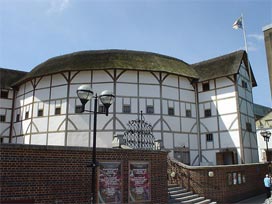
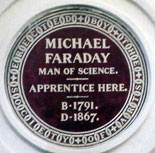 At long last in this series of banknote characters, a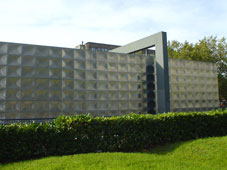
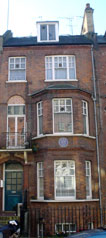
 The
The  For the last half of her life Florence resided at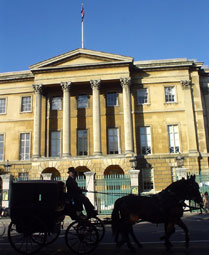
 The father of railways was born in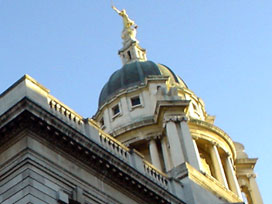
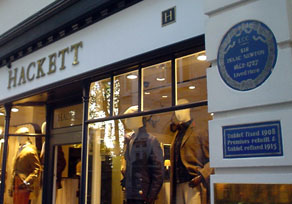 Let's start with possibly the greatest genius England ever produced. The discoverer of gravity, the inventor of calculus, the father of optics and the founder of mechanics. Any one of these achievements would be sufficient for
  Step 1: Make yourself a guy
 I think these could be the most inappropriate Christmas lights anywhere, ever. Not the big snowflakey shapes, because they look like they could be quite impressive. No, I refer instead to the large cutout of a slug, labelled 'Slug', which you can see here displayed high above Regent Street. Further down there's a cartoon mouse called 'Roddy', as well as a giant rat and the odd toad, and various other characters never seen in the official nativity story. Because, yet again, Regent Street has succumbed to the allure of commercial sponsorship and has splashed wholly inappropriate illuminated cartoon characters along its length. Think Christmas, think 'animated family movie'. In this case it's
 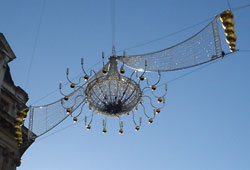 Mmm, big shimmery silver candelabras dripping with gold bling baubles. There's tasteful for you. Are we in Liberace's ballroom, or have we perhaps stepped into Disney's Beauty and the Beast? It's not perhaps the Christmassiest of themes, but I suppose it'll look sparkly enough above the heads of late night shoppers over the next seven weeks. But hang on, aren't these
 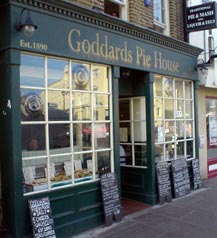 There are loads of places to dine out in
  Here's what I had yesterday. This is no ordinary 'takeaway' pie, it's the 'Special' Steak 'N' Kidney Pie for a premium £3. Break your way through the enveloping piecrust and there's an ocean of prime beef inside. No wasted space, no gristle, just chunks of top-quality meat piled high in a moist gravy. There's even more gravy over the two mounds of mashed potato, although thankfully on this occasion I managed not to drip any down the front of my jumper. I should have asked for a side order of mushy peas, just to make this a slightly more healthy meal, but I sort-of made up for this omission with my fruit-based dessert. That's an apple crumble there on the right, concealed beneath a deep layer of non-instant custard, and quite delicious it was too (if perhaps a little heavy on the stomach after all that earlier stodge). And finally a mug of steaming tea to wash the whole meal down - there's none of this namby-pamby frothy coffee at Goddard's. Dining out in Greenwich will be far less enjoyable after they've gone.