Tubewatch (40)OSI Ten years ago the Oyster system was but a flash in a developer's eye, and today we almost all use it. Touch, swipe, wave... and you're through. It helps us get home faster, it saves us from carrying small change, and it helps TfL to employ fewer staff. London's rail network is mighty complicated, and sometimes the combination of gates, interchanges and human error ends up with us unintentionally paying extra. But at other times the software is set to be kind, to allow us to do something slightly out of the ordinary, to twist the rules. And so it is with the OSI - the Out of Station Interchange.
Say you want to change lines, maybe even change mode of transport, but the system forces you to touch out and then touch in again. Won't you be charged twice, for two journeys? Not if it's an OSI. At designated OSIs the system allows you through, so long as you transfer in a set amount of time, and only charges you once. For example at Hammersmith. If you arrive on the Hammersmith & City but want to cross to the District, that's fine. The OSI permits you 20 minutes to cross the main road, maybe buy a coffee, even nip off to the toilet, then continue your journey. Pay as you go, but no need to pay extra.
Here's a list of all the acceptable Underground to Underground OSIs (if it's on this list, then exiting and re-entering is free) (if it's not on this list, then exiting and re-entering costs extra) 15 minutes allowed: Bank, Bank - Monument, Kenton - Northwick Park, King's Cross St Pancras, Waterloo 20 minutes allowed: Elephant & Castle, Euston - Euston Square, Hammersmith, Wood Lane - White City, Paddington 25 minutes allowed: Hanger Lane - Park Royal 30 minutes allowed: Goodge Street - Tottenham Court Road, Leicester Square - Tottenham Court Road (temporary, during platform closure)
Here's a list of OSIs between the tube and other modes of travel (which might be more useful) Underground to DLR: Bow Road - Bow Church, Canary Wharf, Canary Wharf - Heron Quays, Tower Hill - Tower Gateway Underground to Overground: Shepherds Bush, Kenton - Northwick Park, Kilburn - Brondesbury, Finchley Road - Finchley Road & Frognal, West Hampstead - West Hampstead, Kentish Town - Kentish Town West, Camden Town - Camden Road, Archway - Upper Holloway, Seven Sisters - South Tottenham, Walthamstow Central - Walthamstow Queens Road, Leytonstone - Leytonstone High Road Underground to National Rail: Bounds Green - Bowes Park, Clapham North - Clapham High Street, Sudbury Hill -Sudbury Hill Harrow (plus interchange at lots of central London termini, eg Cannon Street) (plus at lots of same named stations, eg Balham)
For a full list of Oyster-friendly Out of Station Interchanges, look here. TfL don't broadcast this list willingly, indeed it normally takes a Freedom of Information request to prise it out of them. I've sourced many of this year's Tube Week lists from other people's TfL FOI requests, as catalogued here. Please, whatever you do, don't start firing off petty trivial FOI requests at TfL. It only annoys them and wastes their time, and the information you'll get back is never very... (oooh, blimey, who knew?)
For lots of useful background information on Oyster, I can heartily recommend this site - an independent guide to using the little blue swipecard. What's a Continuation Exit? How do you mix Travelcards with Pay As You Go? How long is a Maximum Travel Time? All covered. The Oyster system may work smoothly most of the time, but when it gets complicated or cocks up, there's no need to pay more than you should.
(n.b. today's tube quiz will be along later this morning, at the obvious time)
Tube geek (39)Circle It's not just London has a Circle line. Here are some other world cities with circle lines (and the number of stations on the loop). Isolated circles: Tokyo 29, Madrid 28, Delhi 21, Beijing 18, Glasgow 15, Singapore 15, Detroit 13, Moscow 12, Sydney 7 Shared circles: Seoul 43, Nagoya 28, Berlin 27, London 27, Shanghai 26, Osaka 19, Oslo 13, Miami 8 Round and back loops: Brussels, Bucharest, Chicago, Hamburg, Incheon, Liverpool, London, Madrid, Melbourne, Newcastle, Paris, Singapore, Sydney, Tokyo, Vancouver.
Tube quiz (39)Tube fiction This erroneous line diagram graced the westbound platforms at Mile End for years, until modernisation swept along and replaced it. Can you spot the fictional District line station? And then can you spot the fictional station in each list below? 1) see photo 2) Wood Green, Wood Lane, Wood Road 3) Aldgate, Highgate, Moorgate, Newgate, Southgate 4) Heathrow Terminal 3, Heathrow Terminal 4, Heathrow Terminal 5 5) Clapham Common, Clapham Town, Clapham North, Clapham South 6) Ruislip Gardens, Ruislip Central, Ruislip Manor, South Ruislip, West Ruislip 7) West Ealing, West Ham, West Hampstead, West Harrow, West Kensington 8) East Finchley, North Finchley, West Finchley, Finchley Central, Finchley Road 9) Elm Park, Hyde Park, Kilburn Park, Newbury Park, Queen's Park, St James's Park, Woodside Park 10) East Acton, North Acton, South Acton, West Acton, Acton Broadway, Acton Central, Acton Town Answers are in the comments box, so don't peek until you've had a go at guessing them all.
Tubewatch (39)Mile End (sigh) As we've established on many a previous occasion, TfL employ a special team of cretins to install their next train indicators. Is there an ideal place on a ceiling to install one? Great, let's fix it somewhere else. Is there a clear line of sight all the way down the platform? Right, let's block the view. Can you read the text clearly? Tell you what, let's stick a security camera and a "Way Out" sign directly in front. I am convinced that there must be two groups of contractors working at underground stations - those who install next train indicators and those who install everything else. There seems to be no coherent planning whatsoever between the two, and one somehow always gets intheway of the other.
For example I have, several times, moaned about the next train indicators at Mile End station. Here we are at one of East London's busiest interchanges, where stepping between the District and Central lines should be easy as can be. But if you want to know when the next train's due and where it's going, bad luck, because from much of the platform the information's entirely illegible.
Mile End station got upgraded a couple of years ago, after a lengthy hiatus where it looked like the decorators had gone home mid-job. As part of that upgrade the roof was lowered, concealing the station's lofty arches beneath an artificial white ceiling. Problems with water ingress were to blame, with the new shielding needed to conceal drip trays which prevent customers getting occasionally damp. Trouble is, they're really rather low ceilings, low enough that tall people can easily reach up and touch them. And this created a problem. Hang a normal-sized next train indicator from the new rather-low ceiling and very tall people might easily hit their head. Health and safety decreed that this would never do, so the overhead obstruction had to move.
So contractors removed all the next train indicators from the middle of every platform at Mile End, and relocated them instead at the far western end. You can't bump your head on a metal sign if it's at the end of the platform, that was their rationale. Trouble is, you can't see it easily either, especially not from 130 metres away at the far eastern end of the station. And then the planners made things worse by installing four new platform signs, at the bottom of the stairs, one a few yards in front of every NTI. Even fortunate souls with keen eyesight didn't have a hope of reading where the next Central line train was going, because a sign telling them this was "Central line westbound platform 1" now blocked the view. Important real time information hidden by simple static information, that was the problem. Installed by cretins. Westbound platform 1: next train indicator at far end of platform, blocked by platform sign Westbound platform 2: next train indicator at far end of platform, then shunted in from edge of platform so it's unreadable from anywhere other than the foot of the stairs, then blocked by platform sign Eastbound platform 3: next train indicator at far end of platform, blocked by platform sign Eastbound platform 4: next train indicator at far end of platform, blocked by platform sign
TfL thought they had a partial solution, however - a second size of Next Train Indicator, You've seen them - smallish, squarish, several lines of electronic display. So they added a few of these to the central pillars in roughly the middle of the platform. Great if you're the member of staff hanging around waving your plastic bat despatching trains, but tough to read from much further away because they're concealed by the next pillar along. Plus almost all of the boards point away from the far eastern end of the platform, so they're also impossible to see. From a significant proportion of Mile End's platforms, alas, next train information cannot be seen. Is there a train coming? Dunno. How many minutes away is it? Not a clue. Shall I just stand here and hope for the best? Fingers crossed.
With Mile End being an interchange, and hundreds of rush hour commuters crossing along the full length of the platform, lack of visibility proved a problem. Passengers were leaning out over the edge of the platforms to try to peer round the edge of the annoying intermediate sign, in the vain hope of maybe seeing what was coming next. They all knew that standing in front of the yellow line was dangerous, but they stood in front of the yellow line all the same in a quest to uncover unseen information. And did TfL care? Nope, they just left all the signage where it was, because that was where rules and regulations deemed it had to be. And so things would have stayed, had not health and safety intervened.
Enter HM Inspector of Railways, who turned up at Mile End earlier this year to carry out a risk assessment of his own. He was particularly interested in the information displays mounted on the west end walls and concluded that the display on the westbound Central Line platform effectively invited passengers "to put themselves in a position of danger". While they were trying to stare long distance down the platform, a train could whoosh up from behind unseen and knock them down. That was his expert opinion, so station staff were forced to take urgent immediate action... removing the blocking sign on platform 1! I rarely cheer for health and safety, but it's only thanks to the inspector's visit that the next train indicator is visible again. Admittedly you still need the eyes of a hawk to read it, but that's better than the continuing obstruction on platforms 2, 3 and 4 where no similar decapitation risk was perceived.
Two underlying problems came to light in the inspector's report. Firstly, the lack of coherent risk assessment procedures when installing passenger displays. Nobody had thought "might it be a bit dangerous to position all the next train indicators at one end of the platform at the foot of a busy staircase?" - they'd only thought "nobody'll bump their head down there, so that'll do". And secondly, the limited technology available to the project team involved in the station upgrade. TfL only had two types of next train indicator - the long thin one and the small square one - and neither of these were appropriate at Mile End. But TfL are now looking at procuring different-sized next train indicators for use across the network, including a less deep information display which can be mounted on low ceilings without causing a further hazard. Well, that's what they told the inspector anyway.
Will Mile End really get its own bespoke next train indicators? Only time will tell. But it would be nice to think that information displays on all four platforms might one day be fit for purpose, thanks to a nice man with a clipboard, rather than some inadequate off-the-shelf solution installed by cretins.
Meanwhile, how one station's name on the map haschanged... 1998-1999: North Greenwich 2000: North Greenwich for the Dome 2001 - June 2007: North Greenwich Jul 2007 - Aug 2009: North Greenwich for the O2 Sep 2009 - Sep 2010: North Greenwich Oct 2010 - present: North Greenwich for the O2
Tube quiz (38)Baker-loo Within months of opening, back in 1906, the Baker Street and Waterloo Railway had been renamed the Bakerloo. The diary column in London's Evening News first suggested the name - a contraction of two stations near opposite ends - and it stuck. But could other tube lines be rebranded today with similar portmanteau names? The Jubilee could become the Stratmore line, for example, while the Hammersmith & City might be better as either Hammerking or Barksmith. The District line has so many ends to choose from, but maybe Upbledon, or Richminster? In fact, aren't the trains that ply between Wimbledon and Edgware Road already frequently referred to as Wimbleware services? I'm sure you can do better... Do try to make your names catchy, or a bit clever, or both (Heathcock is good, Terminalfosters is bad). The Northern, Metropolitan and Central lines have lots of arms and loops to describe. The Mill Hill East and Olympia shuttles could do with names (while the latter survives). And I know I don't normally include the DLR and the Overground in tube week, because they're not tube lines, but they have so many different routes that giving each a separate name might be a damned good idea.
Tubewatch (38)Pot pourri • The Bank/Monument complex (see Tube week 5) is one of the busiest interchanges on the Underground network. If you were building it from scratch (and there weren't bank vaults in the way) you wouldn't have built this nightmarish clogged-up warren of passageways, stairs and escalators. So majorplans are afoot to remodel the Northern line platforms, and also to create another station entrance in King William Street with step-free access. The biggest change will be the digging of a brand new southbound Northern line tunnel, and the re-use of the old one as a circulation space for passengers. A bit like there now is at Angel, which used to be narrow and congested and no longer is. The official consultation process is now underway, with plans online here and a special exhibition at 10 King William Street from 8am to 6pm until Friday 11 November [Ian'sbeen]. Don't all rush, because the consultation runs until 31st December next year. Construction isn't then due to begin before 2015, with completion scheduled for (blimey) 2021. Expect congestion for some years yet.
• And, while we're talking new projects, the Croxley Rail Link continues to edge forwards towards possible realisation. Several weeks of widespread public consultation were undertaken back in the spring, revealing detailed plans for diverting the Watford spur of the Metropolitan line to Watford Junction. Next Monday the outcomes of that consultation are being released, via "six new fact sheets", followed by drop-in sessions throughout the rest of the month. That's 16th November in Fuller Way, Croxley, then the 17th at Watford Museum, then two local schools (Laurence Haines on the 22nd and Watford Boys on the 24th). A possible completion date is 2015, but everything depends on a DfT funding decision next month. Fingers crossed?
• I was travelling home on the Metropolitan line last night, on one of the new S Stock trains, when my train stopped at King's Cross St Pancras. What a lovely step-free gap between train and platform, I thought, unlike the big drop down from the old A Stock trains. I was sitting opposite the wheelchair space, which made me recognise how impressively accessible these new trains are. But then I looked up at the Metropolitan line diagram above the carriage windows - the purple line with coloured circles to show all the step-free stations. Eight white circles (for step-free access from street to platform) and no blue circles (for step-free access from street to train). Hang on, I thought. There's step-free access from street to platform, and these new trains have step-free access from platform to train, so surely there must be step-free access from street to train. So why does King's Cross have a white circle on the S Stock line diagram when surely it should have a blue circle? Any wheelchair user on board the train might look at the wrongly-coloured map and assume it was impossible to get off, which it clearly isn't. Why, I mused, have TfL gone to all the expense of fitting updated line diagrams in these new accessible trains, only for them to include blatantly incorrect information. And then I remembered that the rollout of wheelchair accessibility symbols on tube maps is already a wholly illogicalinconsistent shambles, so this stupidity was nothing unexpected, and went back to reading my newspaper.
Tube quiz (37)All change, all change There's no interchange, anywhere, between the District line and the Metropolitan line. So travelling from any station that's only on the District line to any station that's only on the Metropolitan line requires changing trains at least twice. Are there any other tube journeys which need a minimum of three trains? Any that need four?
Tubewatch (37)Brockley Hill You'd know where Brockley Hill was if it had its own tube station. On the northern edge of town, where the A41 marks the boundary between Harrow and Barnet, that's where. And Brockley Hill should have had its own tube station, nearly did have its own tube station, still has remnants of its own tube station. Except it never did get its own tube station, after all kinds of reality unexpectedly kicked in, which is why it remains an obscure London backwater. And rightly so.
There were plans in the mid-1930s, big plans, to extend the Northern line beyond the suburbs. The railway had already been responsible for the urbanisation of large areas of Middlesex beyond Golders Green, and now the plan was to repeat this beyond Edgware. Three more stations, one at Brockley Hill, one at Elstree South and one at Bushey Heath, each with vast tracts of undeveloped countryside alongside ready to be covered with housing stock. A few preparatory works were completed, but then World War Two started and all efforts transferred to finishing the High Barnet branch instead. After 1945 London's priorities were different, and legislation to enforce an encircling Green Belt stopped work in its tracks. It was pointless to build a new railway if there were no houses to serve and no passengers to carry, so the extension was cancelled and the line still halts at Edgware.
Head into the 1920s housing estate north of Edgware station today and there are a few clues to what didn't quite happen. Most of the houses are typical Betjemanesque Tudorbethan semis, or similar, but a thin line of more modern housing stock has infilled along the line of the railway-to-be. Campbell Croft is thin and a bit exclusive, while Shelley Close is more mainstream with room for bungalows on one side of the road only. Stirling Avenue is fairly normal, as cul-de-sacs go, if rather more contoured than I'd expect a potential railway track to be. And then the invisible line hits the Edgware Way dual carriageway - which, if you look carefully, has a layby by a lone brick wall which was due to support the Northern line [photo]. But it never arrived. The Green Belt starts precisely here.
Beyond the A41, so long as you cross carefully, it's all fields. Damp autumnal grassland, uncultivated and meadowed, where thin fingers of the Edgwarebury Brook drain down. One small corner beyond the river has become Edgwarebury Park, while the remainder (as far as the M25, on a distant ridge) is an extensive nature reserve specked with scabious and sedge. Car boot sales are held here on Sundays, big ones, although the season's over now and the tyre tracks are gone. And amidst the grassland, between the hatchback sales pitches, there's an intermittent line of dilapidated brickwork. Welcome to Brockley Hill station.
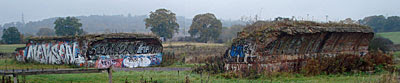
Five brick piers are all that's left of the low viaduct which should have carried Northern line trains north to Bushey. Of these only one still has sufficient curvature to confirm that these were once arches - the rest have long since crumbled away [photo]. Each stumpy pillar is about ten foot off the ground, I'd guess, each colonised by vegatation, each standing alone in a very deliberate line. One's a flattened U-shape, so it's possible to can scramble up the pile of earth on the inside, then clamber up onto the top of the stonework for an aligned view. And they've all been graffitied, because Barnet's artists love an unsecured canvas, bringing a splash of colour to these islands of brown in a sea of green. [photo]
Check on an Ordnance Survey map to see a faint cutting running north alongside the dual carriageway, heading for Elstree South where there isn't a station either. Next up was London Transport's Aldenham works, which used to repair buses but is now a large industrial park, and finally Bushey Heath which is merely a roundabout. It would all have looked so very different, almost wall-to-wall urban sprawl, had the Northern line reached out this far. But instead Elstree still feels like a village, and the Edgwarebury Brook still runs through open fields, and residents in the new Barratt housing by the Brockley Hill roundabout have to walk ten minutes up the hill to Stanmore station instead. The tentacles of the London Underground, they only stretch so far, and some corners of London are best left well alone. (If you haven't already seen it, Jay Foreman's video about the Northern Heights extension is detailed and ace)
Tube geek (36)Depth and height How deep, or how high, does the Underground network go? London's surprisingly hilly, but only in places, so some of the answers may surprise you...
Stations closest to sea level: West Ham (1m above); Bermondsey, Canning Town, North Greenwich (2m above); Canary Wharf, Elephant & Castle, Kennington, Lambeth North, Parsons Green (3m above) Stations highest above sea level: Amersham (145m above); Chalfont & Latimer (122m above); High Barnet (111m above); Chesham (110m above); Hampstead (108m above); Highgate (100m above) (all based on typical ground level outside station)
Tubewatch (36)Travel tools It's not too many years ago that, if you wanted to catch the tube, you had to turn up at your local station and hope. And now there's no need to say "Oh it's not running, damn!" so long as you've checked the internet or your smartphone first. But I do wonder if you've noticed all the available travel tools at your disposal to keep an eye on how the trains are running. Here's my tube week compilation.
Live travel news All the latest news is on the map on the TfL website, the one with the coloured delays and suspensions, and you already know about that. Then there are the rainbow boards at stations (which you can widgetise and add to a webpage of your own design, if you so choose). Me, I really like the live travel alert service, which sends me a text message every morning if there's disruption on my commute into work, and another on the way home, ditto. You can pick any route of your choice, and any time for the text messages to be sent, or maybe get the info by email instead. Dead clever. Also dead clever are the live departure boards which show the next trains due at almost any station on the network, even if you're sitting at home or in the office. Sometimes they're much better than the information you'd get from the next train indicator board if you were standing at the station.
Engineering work Every weekend we expect engineering hell (unless it's December, that is, when you'll be glad to hear TfL have cleared the decks almost completely to enhance pre-Christmas shopping trips). Next weekend's engineering works are always visible diagrammatically here, or else you can sign up here to get the same information emailed to you weekly. Click the "future dates" option above the map to see disruption on any of the next 28 days - here's Saturday 3rd December, for example - almost clear! If you really need to know up to three months into the future, there's the planned works calendar - recently revamped into a tabular format which does seem strangely familiar. Or for six months advance warning, this regularly-updated pdf has everything you need.
Normal service Being a "turn up and go" railway, the tube doesn't really do timetables. Except there are timetables, obviously, they're just not terribly widely circulated. Download the timetable for any tube line or any tube station from here (or from the interactive map here). Often they're a bit vague, but sometimes they're unexpectedly specific. You might even spot something perversely unusual, like the fact that Bow Road has two Circle(!) line trains each morning at 0524 and 0543. Who knew?
Tube quiz (36)Intermediate stations How well do you know the tube network? Below are ten pairs of stations, each from a different line. All you have to do is pick the correct station inbetween. Easy? Pick from the dropdown list each time. 1) Wembley Central → → Harlesden 2) Grange Hill → → Fairlop 3) Mansion House → → Monument 4) Upney → → Dagenham Heathway 5) Westbourne Park → → Latimer Road 6) Wembley Park → → Dollis Hill 7) Ruislip Manor → → Rayners Lane 8) Tooting Broadway → → South Wimbledon 9) Boston Manor → → Hounslow East 10) Finsbury Park → → Tottenham Hale Answers are in the comments box, so don't peek until you've had a go at guessing them all.
Time once again for diamond geezer to go totally tubular with another week devoted to the London Underground. Prepare for five days of quizzes, quirks, commentary and obscure statistics. Eight years ago I looked at the busiest stations and journeys where it was quicker to walk. Seven years ago I investigated tube line colours and the easiest interchanges. Six years ago I discussed overcrowding and precisely where the underground is underground. Five years ago I wrote about accessibility and why people never move down the platform. Four years ago I examined the agonies of Bank/Monument and taking your bike on the tube. Three years ago I spent the entire week wondering why 'next train' indicators are installed by cretins. Two years ago I visited the tube's least used station and wondered where all the litter bins went. And last year I took the Chesham shuttle and bemoaned the evils of the new King's Cross passageways. I hope there's still something left to write about this year. Mind the doors.
It's taken me a while to visit London's newest street. So long in fact that it probably isn't London's newest street any more. King's Boulevard, in the freshly-minted postcode of N1C, was quietly unveiled back in September. It's currently a road with one main purpose - to help students get to college - but soon to be rather more important than that. It's also the first road across the former railway lands north of King's Cross, or at least the first since they demolished all that was here before and started again. What used to be here included Battle Bridge Road, a terrace of tall Victorian brick buildings (and the setting for 1955 film The Ladykillers). All gone, flattened, erased... and now King's Boulevard curves through instead.
The street starts by the German Gymnasium, at the nexus where the re-aligned King's Cross will face the revamped St Pancras. The GG was London's first purpose-built gymnasium, now nearly a century and a half old, and will be the only building on King's Boulevard dating from pre-2012. For now the road has a pair of pavements squeezed between low hoardings, behind which construction work of an urgent nature is proceeding. At least one of the buildings beyond is scheduled for next Spring, although you wouldn't guess while all the digging remains at foundation level. A series of oversize postcards depict what Two, Four and Six Pancras Square will look like, and quite frankly it's nothing to get excited about. Make the most of the uphill stroll now, with distant glimpses of architectural character, because eventually this'll be a deep glass canyon of bog-standard offices and mixed use units.
A vast regeneration project is afoot, courtesy of developers Argent. It's taken years to get this far, and only a smidgeon of the eventual 67 acres is yet opened up. Someone in the project team has brightened up the hoardings on the eastern pavement with a series of stories, detailing the area's history and its future potential. Some of these are deeply interesting, some geographically misplaced, and some guilty of appalling hyperbole. If you're the copywriter who wrote the drivel about KX shopping ("Look in vain for Man at C&A; as fresh and locally sourced as the food is the fashion") I'd give up the day job now before you inflict cerebral injury on anyone else.
Partway up King's Boulevard is a giant Underground roundel, marking the spot where yet another entrance to King's Cross St Pancras tube station will one day open. Presumably this is so that offices built hereabouts can charge higher rents because they have convenient adjacent access to a key transport portal. In reality, however, this entrance will be at least two subterranean minutes from the new Northern Ticket Hall, which itself is at least three subterranean minutes from any train, probably more. It beggars belief how far tube travellers are asked to walk at KXStP, and the new Pancras Square entrance will make things even more cruelly worse.
More tempting, from Wednesdays to Fridays only, a new-wave street food zone pops up in front of the mural by the traffic lights. If you're not familiar with such kerbside-stall delicacies, we're talking stuff like burritos, noodles and pulled pork - nothing mundane and British. Friday's line-up included Big Apple Hot Dogs (who come from Old Street, but pretend not to) and Hardcore Prawn (who deal in Asian fusion, obviously). I imagine the lunchtime crowds are mostly arts students and Guardian journalists, both of whom are based nearby, although there's nowhere especially tasteful to sit and eat your purchase, yet, in this windswept building site.
Next up, beyond Goods Way, is a new bridge across the Regent's Canal. This is sorely needed because one of the old warehouses on the opposite bank has opened up as Central St Martin's University of the Arts, and the students and staff need a way in and out. The relocated university is now based in the Granary building, one of several listed buildings on the northern half of the site to survive Argent's blitzkrieg renewal. It looks impressively Victorian on the outside and (once through the entrance lobby, reception and visitor centre) impressively modern on the inside. The architects have tacked the shiny glass onto the old brickwork with panache, in a lofty four-level space of workshops, studios and lecture theatres. Lucky students, so long as they don't mind being surrounded by fenced-off construction for their first year.
Give it time and further historic structures will be opened up - the Coal Drops, the Goods Shed, the Fish and Coal Office - plus a large public space leading down to the canalside. Oh yes, King's Boulevard is only the start, there's an entire new London neighbourhood waiting to spring into life here. Still hard to imagine, while there's only one college and one road, but undoubtedly unstoppable.
For the twelfth year running, a world-renowned artist has been invited to fill the Tate Modern's enormous Turbine Hall. Some years it's great (ooh, orange sun) (ooh, spiral slides), other times it's a bit of a duffer (ah, bunkbeds), (oh, please do not step on the sunflower seeds). And this year? Nearer great than duff, for sure, as visual artist Tacita Dean presents "Film".
Half the Turbine Hall is blacked out, as a tall thin screen stretches from floor to almost roof. The official paperwork describes it as a "monolith", and the orientation as widescreen rotated through 90° (from landscape to portrait). Nah, it's just a big film, and all the better for it. Up each side are the perforations writ large, as a reminder that this is proper grainy film and not newfangled digital. Tacita is a fervent supporter of old school 35mm, and wants to remind us all what we'll lose when progress consigns this long-standing display format to obsolescence. Her film certainly trembles and quivers as if the screen were made up of a billion tiny insects - or maybe that was just me staring at the image too hard. But what you're meant to watch is the vertical canvas, as it flips from objects to abstract to natural and back again. Eleven minutes all told, which seemed the right length to enjoy without ever getting stale. Sometimes all you see is a film representation of the Turbine Hall window shielded behind, perhaps with coloured circles or triangles obscuring part of the image. Other times there are clouds and forests and escalators, and the occasional mountain, and hang on were those tomatoes? It's a bit random, often surreal, but that needn't matter because the message is the medium itself.
Once you've been standing in the dark for a while, it's interesting to watch others entering the space to see how they react. Some stay only briefly, some settle down on the seats for the full loop, others walk up the edge of the Hall for a closer look. But it's children, very young children in particular, who appear most transfixed by Tacita's projection. They pause and gawp, then smile, then toddle gaily forward towards the giant source of illumination. Several pairs of middle class parents turned up while I was there, attempting to open their infant's eyes to art via this wonderfully accessible visual piece. Look at that Jack, no come back here Jack, stand there while Daddy takes your photo in front of the waterfall Jack.
The Tate's giant pop-up continues to screen daily until 11th March. You could watch the whole video virtually on YouTube, should you be unable to visit the South Bank before then. But remember, as the in-auditorium advert has it, that film always looks better properly projected at the cinema.
Half a mile upstream from the Tate, in the bowels of Somerset House, is an exhibition you'd probably enjoy. It's called ForgottenSpaces, and it celebrates those unsung patches of land around town that could be put to better communal use. The architects' organisation RIBA invited interested parties to nominate an undeveloped site and how they might develop it, and more than a hundred possible scenarios were submitted. Walk in off the Embankment, head through the dark door straight ahead, and you can enjoy the shortlist of 28. Better still, they're displayed in the tunnels and lightwells beneath the central courtyard, which is a fascinating forgotten space in itself. Each proposed project is given a full before-and-after write-up - what's there now (in detail, with maps and diagrams) and what could be there instead (ditto). A café on the pontoon of Hungerford Bridge, a bee-friendly urban park through Neasden, the pedestrian reclamation of the Chiswick Flyover, that sort of thing. Some of the ideas are dull (please, don't turn the Twelvetrees gas cylinders into a "memory bank"), some are misjudged (the abandoned platforms at Highgate to become a concrete installation, no thanks). But others are inspirational (a climbing tunnel accessed via Clapham Common station's wartime shelter? Bring it on). I spent much longer down here than I expected, soaking in the fantasy, and the fantastic detail of what might one day happen but probably won't. So remember, should you come skating at Somerset House this winter, that there might be something else worth seeing in the vaults beneath your blades. (until 29 January)
Walk London CAPITAL RING[section 13] Stoke Newington to Hackney Wick (3½ miles)
The start of Capital Ring Section 13 is marked by the legendary ISIHAC pianist Colin Sell. He won't be the marker if you walk this way, but he was for me. I'd seen Colin less than 48 hours earlier on stage in Norwich, and now here he was again, definitely him, chatting happily on a traffic island opposite the entrance to Abney Park Cemetery. He was standing alongside a woman I assumed was his wife, but could easily have been his broadcasting partner Samantha. Sharp-eyed Radio 4 listeners might be able to confirm her lovely features from my long-lens photo.
Every so often, where green spaces grow thin, the Capital Ring is forced to follow roads. So it is at the start of section 13, which heads up from the foot of Stamford Hill via a fair chunk of street. The Ring's official blurb describes this as "tracing Stoke Newington's expansion over the last 150 years", which in reality means fifteen minutes of front doors and front gardens. Still most interesting, though, when a few minutes up Cazenove Road I realised I was the only bare-headed male on the street. Thousands of Hasidic Jews live in this corner of Hackney, have done for years, recognisable by their sidelocks and wide-brimmed black hats. Elsewhere their characteristic black dress might earn curious glances, whereas here - as children lean from windows and mums empty their cars of shopping - it's just a normal part of communal family life.
Springfield Park is a treat. There's a sparkycafe in the White Lodge Mansion, overflowing outdoors during my sun-blessed visit, but likely to be more inward-looking this forthcoming autumnal weekend. Close by is a shady pond, plus fowl and fountains, in contrast to the more extensive cut grass elsewhere. But the treat is beyond the clipped intermittent hedge, where the land suddenly drops away to reveal aview across the Lea towards Waltham Forest [photo]. The site's geologically rich, with a gravel terrace at the top of the hill nearest the mansion, leading down to impermeable London Clay, then sedimentary "brickearth" and a layer of alluvium. The descent's steep enough that wheelchair users on the ring are diverted via an alternative route "without steps", so be sure to enjoy the autumnal panorama before lowering yourself to river level.
Cross the footbridge to see Springfield Marina - a densely-packed boat store filling a cut-off meander of the former Lea. And then the broad open space of Walthamstow Marshes, always a joy, stretched out across umpteen acres of verdant floodplain [photo]. The Ring sticks close to the waterside, tempting though it might be to head off instead through the bullrushes across the summer pasture. One tranche for cattle, another for kite skating, and mind the pylons inbetween. The fourth railway arch in from the river was once the makeshift hangar for Britain's very first aircraft [photo]. Aviation pioneer A.V. Roe flew his "Yellow Terror", the Arvo 1, across the marsh and into the sky for an inaugural thirty metre leap. For the centenary in 2009 a commemorative blue plaque was unveiled, but it's probably a finer tribute that the Stansted Express rumbles over the top every fifteen minutes.
Near the Lea Bridge Road, where a footbridge leads walkers back onto the Hackney bank, a new housing development encroaches. It's not beautiful, even with a metal tree plonked out on the front lawn, although the view from the fifth floor balconies must be lovely. Take the towpath beneath the road, past the Princessof Wales pub (which underwent a gender swap in 1997) then cross back to the eastern bank [photo]. On the left are the Middlesex Filter Beds, always worth a diversion, where reeds and rushes fill several drained pools once used to purify drinking water. On quiet days this nature reserve might afford views of sparrowhawks or newts, whereas I saw only humans (playing guitars, hiding in the reeds or checking the football results). I was also accosted by a lovely lady with a clipboard who asked if I wouldn't mind taking part in her survey. EIGHTEEN pages later I'd offered her my full thoughts on TfL's "Olympic Walking and Cycling Route Enhancement programme", although the tickboxes and maps unadventurously assumed that nobody would be walking as far as my 3½ mile trek.
Ever further down the Lea, there's a temporary diversion at Cow Bridge while a footbridge is upgraded across the river. This is probably a good thing, because the detour affords a proper glimpse of the Hackney Marshes (and its record-breaking expanse of paired goalposts), which otherwise the Capital Ring would ignore. Partway along, where Lesney's Matchbox factory used to stand, now a sprawling mixed-use development has arisen [photo]. It's clad in contrasting coloured rectangles, which architects of the future will one day use to date early 21st century design heritage, assuming anything from this bereft style survives early demolition. Mind the cyclists, mind the duck-feeders, mind the joggers - all of whom make this part of the Lea Valley Walk their own. The Olympic Stadium suddenly appears, far downstream, as a web of white drinking straws part-hidden behind a bend or two. It's preceded by a less landmark building - the pig-ugly 2012 International Broadcast Centre - whose insipid features blight the once green view from Leabank Square[photo]. The towpath continues into the heart of the Olympic Park, securely isolated behind razorwire and electrified fencing. But after the Handball Arena, by the orange post at White Post Lane, that's your lot for now [photo]. End of section 13 - cyclists please dismount.
If you'd been watching television in its first weeks, 75 years ago in November 1936, what might you have seen?
BBC television Wed 18 Nov 1936
3.0 Programme Summary 3.5Modern Galleries Potteries and Sculpture (with commentary by John Piper) 3.20 Film 3.30 Interval (Time, Weather) 3.35London Characters Gypsy Petulengro and W.J. Smith The Whistling Guard (interviewed by Leslie Baily) 3.50Movietone Magic Carpets Land of the Nile 4.0 Close
9.0 Mostly a repeat of all the same stuff (but with Rosina Dixon - the Singing Cook - and Jack O'Brien - a Ganger) 10.0 Close
BBC television Thu 19 Nov 1936
3.0 Programme Summary 3.5The Mask Theatre Masks by Elise Passavant (with the BBC Television Orchestra) 3.20 Film 3.30Wireless Transmitter Valves The various stages in the construction of Radio Transmitter Valves (described by Leslie Mitchell) 3.45 Interval (Time, Weather) 3.50Nina Devitt (Cabaret Artist) 4.0 Close
9.0 Mostly a repeat of all the same stuff (but with Suzanne McClay - Cabaret Artist) 10.0 Close
BBC television Fri 20 Nov 1936
3.0 Programme Summary 3.5Women's Interests A Laundry Demonstration - Mrs Daisy Pain will give some tips about ironing (This is a practical demonstration by a practical woman, and an experienced laundress) 3.20 Film 3.30Vivienne Brooks (with the BBC Concert Orchestra) 3.50Movietone Magic Carpets Fisherman's Fortune 4.0 Close
9.0 Mostly a repeat of all the same stuff (but with Impressions of Film Stars by Bubbles Stewart) 10.0 Close
BBC television Sat 21 Nov 1936
3.0 Programme Summary 3.5Gardening Demonstration Autumn Pruning (with C.H. Middleton, the well known broadcaster, in his first Television appearance) 3.20 Film 3.30 Interval (Time, Weather) 3.35Starlight Claude Dampier (The Professional Idiot) 3.50Movietone Magic Carpets Fisherman's Fortune 4.0 Close
9.0 Mostly a repeat of all the same stuff (but with cabaret from Edward Cooper at the piano) 10.0 Close
Not forgetting such classics as... Mon 17 Nov: Inn Signs Through The Ages Some examples of inn signs from the exhibition now being held at the Building Centre (described by Fred Taylor R.I.) Tue 8 Dec: A Demonstration by The Women's League of Health and Beauty(led by Prunella Bagot Stack) Sat 2 Jan: Winter Sports Commander Jack Shirley will give hints to beginners in ski-ing (Mannequin display arranged by H.E. Plaister) Thu 14 Jan: Home Affairs A discussion between the Rt. Hon. Herbert Morrison M.P., and John Hilton on London's Green Belt (with maps and diagrams) Sat 23 Jan: The White Coons Concert Party(arranged by Harry S. Pepper and Doris Arnold)
6.0Ceefax AM 6.50Breakfast Time (with Sally Magnusson and Guy Michelmore) 9.5Animal Crackers (with Lucinda Lambton) 9.45One in Four Disabled magazine 10.0Neighbours Jim explains to Scott how serious things are 10.30Play School (with Carol Chell and Floella Benjamin) 10.55Five to Eleven (with Joanna Lumley) 11.0Gardeners' World (with Percy Thrower and Geoff Hamilton) 11.30Open Air (with Bob Wellings, Pattie Coldwell and Eamonn Holmes) 12.25Star Memories Nick Ross talks to Penelope Keith 1.0One O'Clock News (with Martyn Lewis) 1.25Neighbours Kim takes drastic action 1.50Bric-a-Brac (with Brian Cant) 2.0The Clothes Show (with Selina Scott) 2.30The Onedin Line The crew is struck down with ship's fever 3.20Valerie David needs a job
3.50-5.35Children's BBC (with Phillip Schofield) 3.55Pie In The Sky 4.10Wizbit 4.20The Mysterious Cities of Gold 4.45Beat The Teacher 5.0John Craven's Newsround 5.5Blue Peter (with Janet Ellis, Peter Duncan and Mark Curry) 5.35Masterteam (with Angela Rippon) 6.0Six O'Clock News (with Sue Lawley and Nicholas Witchell) 6.35Look North (with Harry Gration) 7.0Wogan 7.35Life on Earth part 10, Themes and Variations (with David Attenborough) 8.30Brush Strokes Jacko develops his outside interests 9.0Nine O'Clock News (with John Humphrys) 9.30Panorama Cervical Cancer 10.10The Monday Film The Money Movers 11.40Championship Bowling from the Guild Hall, Preston 12.10Weather and Closedown
BBCtv today celebrates 50 years of television
9.0 Pages from Ceefax 9.38-2.35Daytime on Two Programmes for schools and colleges 2.35Sign Extra Discovering Birds (with Tony Soper) 3.0Championship Bowling from the Guild Hall, Preston 6.0The Rag Trade (TV50 repeat, from 1962) 6.30Dr Finlay's Casebook (TV50 repeat, from 1964) 7.20The Mike Yarwood Christmas Show 1978 (TV50 repeat, from 1978) 8.5Horizon The Crab Nebula (TV50 repeat, from 1971) 9.0Fawlty Towers Basil the Rat (TV50 repeat, from 1979) 9.35Edna the Inebriate Woman (TV50 repeat, from 1977) 11.0Newsnight 11.45Late Night Line Up (with Joan Bakewell) 12.20Weatherview and Closedown
(Come on, surely everybody keeps old copies of the Radio Times from 1986? Just me then?)
OPENING OF THE TELEVISION SERVICE 3.00p.m. - 4.30p.m. MONDAY 2nd NOVEMBER, 1936
3:00 Opening Announcement - Leslie Mitchell (reserve Announcer, Miss Bligh) - announcement as undernoted:-
"This is the B.B.C. Television Station at Alexandra Palace.
To-day the Television Service is to be opened by the Right Hon. G.C. Tryon M.P., His Majesty's Postmaster-General. Major Tryon will be introduced by Mr. R.C. Norman, Chairman of the B.B.C., and will be followed by the Right Hon. Lord Selsdon, K.B.E., Chairman of the original Television Committee. On the platform with these speakers are the Right Hon. Lord Inverforth, Chairman of the Marconi-E.M.I. Television Company and Sir Harry Greer, D.L., M.P., Chairman of the Baird Television Company.
We have had to make a change in the programme as published in the "Radio Times". The opening programme is to be televised twice; firstly by the Baird system; then, after an interval of thirty minutes, by the Marconi-E.M-I. system.
After the speeches, the latest edition of the British Movietone News will be shown; then Adele Dixon, and after her Buck and Bubbles; both these performances will be accompanied by The Television Orchestra, conducted by Hyam Greenbaum. After this there will be an orchestral interlude in sound only..."
As the plaque at Alexandra Palace says, the world's first regular high definition television service was inaugurated precisely 75 years ago today. It was anything but high definition by current standards - a flickering black and white display, broadcasting to a handful of appropriately-equipped homes in North London. There were two competing systems, Baird and EMI Marconi, battling for future dominance in an epic VHS/Betamax-type tussle. It was already obvious that Marconi's 405-line system was superior to Baird's 240, but broadcasting kicked off on an equitable basis all the same. The toss of a coin decided that Baird would be used to make the first historic transmission from Studio B - details of which appear in the transcribed script above. And then all the performers trooped nextdoor into Studio A to perform the whole thing again, live via the alternative camera set-up. An hour in, and already BBC Television's first repeat.
Alexandra Palace wasn't the BBC's first choice of location. They'd have preferred Crystal Palace to the south, but that would have meant building from scratch and they didn't have either the time or the money. Ally Pally was higher above sea level and (crucially) available for rent, so they whacked up a transmitter tower on the roof and it was all systems go. Good decision, as it turned out, because at the end of November 1936 the old Crystal Palace burnt to the ground. Initially programmes were broadcast for only a couple of hours a day, less on Sundays, all with a prim, proper, stilted, very middle class vibe. Not surprising, given that a television set then cost the equivalent of what a car does now, so nobody on the council estates of Tottenham was watching.
Viewing figures were boosted by the Coronation of George VI the following spring (an estimated 50000 people watched that), though still low enough that the entire service could shut down for three weeks mid-1937 to allow staff to take their summer holidays. World War Two brought an enforced closedown, during which time Alexandra Palace's mast was used to confuse incoming German bombers by jamming radio frequencies. Ally Pally remained the BBC's main TV transmitting centre for London until 1956, then became an important centre for news, and finally the outpost where professors in Arran sweaters made informative broadcasts for the Open University. But since 1981 the old studios have been locked away, slowly decaying, opened only infrequently, at constant risk of redevelopment or worse. Fancy a look inside?
On Saturday 5 and Sunday 6 November 2011 a series of free activities for the public will be staged at ‘Ally Pally’ to encourage the public to explore the past and discover the future of television. Highlights include: - » tours of the famous BBC Studios where history was made on 2 November 1936 » interactive and immersive audio visual displays featuring rarely-seen BBC footage » taking centre stage and preparing to go ‘on air’, made up in authentic 1930s TV style (with blue lips and eyes and white pancake facepaint) » sharing your BBC and ‘Ally Pally’ memories with roving reporters » 1930s inspired food from the ‘BBC canteen’ » demonstrations of the latest innovations in 3D TV » become a BBC newsreader! Record a snippet of the news and take the recording home with you as a unique souvenir. Entry is free, but anyone wishing to take a tour of the BBC studios needs to call 0208 365 4321 to secure a timed ticket.
I've been inside the old BBCstudios as part of Open House, and it was fascinating to walk up the narrow staircase into the very place where TV broadcasting began. Every Japanese gameshow, every Brazilian soap opera, every iPlayer catch-up download, has its roots here in a high, dingy room in Haringey. Best visit this weekend while you can, while Alexandra Palace's inner sanctum survives. And I wonder which is more likely to reach its centenary - television itself, or the place of its birth.
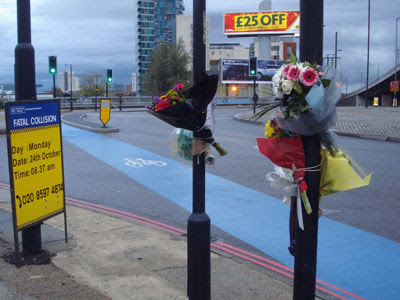
Three on the traffic lights, two on the no entry sign. To a friend, to a workmate, to a much loved Dad.
A life untimely ended, at the end of Cycle Superhighway 2. An Olympic worker, on his way to the office, never arrived.
One week on from the unfortunate accident, a reconstruction was held. At the height of Monday's rush hour, did you see anything, were you there?
Family and friends come together to remember, to bear witness, to pray it never happens again. The widow's pleas make page 27 of the Evening Standard, and barely a mention in other mainstream media.
After work I go down to the Flyover to see the fresh flowers. I walk beside the Cycle Superhighway. Thereisnothingsuperaboutit.
Now you see it, now you don't. Now it passes through a parked car. Now it disappears into a bus stop. Now it swings out into open traffic. Now it narrows down to half a lane. Now it's blocked by queueing vehicles. Now it broadens out to an advanced stop line. Now it continues invitingly across the roundabout. Now they see you, now they don't.
Brian's funeral takes place in Twickenham on Friday. The blue stripe remains.

Tubewatch (40) OSI
Tube geek (39) Circle
Tube quiz (39) Tube fiction
So contractors removed all the next train indicators from the middle of every platform at Mile End, and relocated them instead at the far western end. You can't bump your head on a metal sign if it's at the end of the platform, that was their rationale. Trouble is, you can't see it easily either, especially not from 130 metres away at the far eastern end of the station. And then the planners made things worse by installing four new platform signs, at the bottom of the stairs, one a few yards in front of every NTI. Even fortunate souls with keen eyesight didn't have a hope of reading where the next Central line train was going, because a sign telling them this was "Central line westbound platform 1" now blocked the view. Important real time information hidden by simple static information, that was the problem. Installed by cretins.
Enter HM Inspector of Railways, who turned up at Mile End earlier this year to carry out a risk assessment of his own. He was particularly interested in the information displays mounted on the west end walls and concluded that the display on the westbound Central Line platform effectively invited passengers "to put themselves in a position of danger". While they were trying to stare long distance down the platform, a train could whoosh up from behind unseen and knock them down. That was his expert opinion, so station staff were forced to take urgent immediate action... removing the blocking sign on platform 1! I rarely cheer for health and safety, but it's only thanks to the inspector's visit that the next train indicator is visible again. Admittedly you still need the eyes of a hawk to read it, but that's better than the continuing obstruction on platforms 2, 3 and 4 where no similar decapitation risk was perceived.
Tube quiz (38) Baker-loo
• I was travelling home on the Metropolitan line last night, on one of the new S Stock trains, when my train stopped at King's Cross St Pancras. What a lovely step-free gap between train and platform, I thought, unlike the big drop down from the old A Stock trains. I was sitting opposite the wheelchair space, which made me recognise how impressively accessible these new trains are. But then I looked up at the Metropolitan line diagram above the carriage windows - the purple line with coloured circles to show all the step-free stations. Eight white circles (for step-free access from street to platform) and no blue circles (for step-free access from street to train). Hang on, I thought. There's step-free access from street to platform, and these new trains have step-free access from platform to train, so surely there must be step-free access from street to train. So why does King's Cross have a white circle on the S Stock line diagram when surely it should have a blue circle? Any wheelchair user on board the train might look at the wrongly-coloured map and assume it was impossible to get off, which it clearly isn't. Why, I mused, have TfL gone to all the expense of fitting updated line diagrams in these new accessible trains, only for them to include blatantly incorrect information. And then I remembered that the rollout of wheelchair accessibility symbols on tube maps is already a wholly illogical inconsistent shambles, so this stupidity was nothing unexpected, and went back to reading my newspaper.
There were plans in the mid-1930s, big plans, to extend the Northern line beyond the suburbs. The railway had already been responsible for the urbanisation of large areas of Middlesex beyond Golders Green, and now the plan was to repeat this beyond Edgware. Three more stations, one at Brockley Hill, one at Elstree South and one at Bushey Heath, each with vast tracts of undeveloped countryside alongside ready to be covered with housing stock. A few preparatory works were completed, but then World War Two started and all efforts transferred to finishing the High Barnet branch instead. After 1945 London's priorities were different, and legislation to enforce an encircling Green Belt stopped work in its tracks. It was pointless to build a new railway if there were no houses to serve and no passengers to carry, so the extension was cancelled and the line still halts at Edgware.
Five brick piers are all that's left of the low viaduct which should have carried Northern line trains north to Bushey. Of these only one still has sufficient curvature to confirm that these were once arches - the rest have long since crumbled away [photo]. Each stumpy pillar is about ten foot off the ground, I'd guess, each colonised by vegatation, each standing alone in a very deliberate line. One's a flattened U-shape, so it's possible to can scramble up the pile of earth on the inside, then clamber up onto the top of the stonework for an aligned view. And they've all been graffitied, because Barnet's artists love an unsecured canvas, bringing a splash of colour to these islands of brown in a sea of green. [photo]
Time once again for diamond geezer to go totally tubular with another week devoted to the London Underground. Prepare for five days of quizzes, quirks, commentary and obscure statistics. Eight years ago I looked at the busiest stations and journeys where it was quicker to walk. Seven years ago I investigated tube line colours and the easiest interchanges. Six years ago I discussed overcrowding and precisely where the underground is underground. Five years ago I wrote about accessibility and why people never move down the platform. Four years ago I examined the agonies of Bank/Monument and taking your bike on the tube. Three years ago I spent the entire week wondering why 'next train' indicators are installed by cretins. Two years ago I visited the tube's least used station and wondered where all the litter bins went. And last year I took the Chesham shuttle and bemoaned the evils of the new King's Cross passageways. I hope there's still something left to write about this year. Mind the doors.
It's taken me a while to visit London's newest street. So long in fact that it probably isn't London's newest street any more. King's Boulevard, in the freshly-minted postcode of N1C, was quietly unveiled back in September. It's currently a road with one main purpose - to help students get to college - but soon to be rather more important than that. It's also the first road across the former railway lands north of King's Cross, or at least the first since they demolished all that was here before and started again. What used to be here included Battle Bridge Road, a terrace of tall Victorian brick buildings (and the setting for 1955 film The Ladykillers). All gone, flattened, erased... and now King's Boulevard curves through instead.
The street starts by the German Gymnasium, at the nexus where the re-aligned King's Cross will face the revamped St Pancras. The GG was London's first purpose-built gymnasium, now nearly a century and a half old, and will be the only building on King's Boulevard dating from pre-2012. For now the road has a pair of pavements squeezed between low hoardings, behind which construction work of an urgent nature is proceeding. At least one of the buildings beyond is scheduled for next Spring, although you wouldn't guess while all the digging remains at foundation level. A series of oversize postcards depict what Two, Four and Six Pancras Square will look like, and quite frankly it's nothing to get excited about. Make the most of the uphill stroll now, with distant glimpses of architectural character, because eventually this'll be a deep glass canyon of bog-standard offices and mixed use units.
Partway up King's Boulevard is a giant Underground roundel, marking the spot where yet another entrance to King's Cross St Pancras tube station will one day open. Presumably this is so that offices built hereabouts can charge higher rents because they have convenient adjacent access to a key transport portal. In reality, however, this entrance will be at least two subterranean minutes from the new Northern Ticket Hall, which itself is at least three subterranean minutes from any train, probably more. It beggars belief how far tube travellers are asked to walk at KXStP, and the new Pancras Square entrance will make things even more cruelly worse.
Next up, beyond Goods Way, is a new bridge across the Regent's Canal. This is sorely needed because one of the old warehouses on the opposite bank has opened up as Central St Martin's University of the Arts, and the students and staff need a way in and out. The relocated university is now based in the Granary building, one of several listed buildings on the northern half of the site to survive Argent's blitzkrieg renewal. It looks impressively Victorian on the outside and (once through the entrance lobby, reception and visitor centre) impressively modern on the inside. The architects have tacked the shiny glass onto the old brickwork with panache, in a lofty four-level space of workshops, studios and lecture theatres. Lucky students, so long as they don't mind being surrounded by fenced-off construction for their first year.
For the twelfth year running, a world-renowned artist has been invited to fill the Tate Modern's enormous Turbine Hall. Some years it's great (ooh, orange sun) (ooh, spiral slides), other times it's a bit of a duffer (ah, bunkbeds), (oh, please do not step on the sunflower seeds). And this year? Nearer great than duff, for sure, as visual artist Tacita Dean presents "Film".
Half a mile upstream from the Tate, in the bowels of Somerset House, is an exhibition you'd probably enjoy. It's called Forgotten Spaces, and it celebrates those unsung patches of land around town that could be put to better communal use. The architects' organisation RIBA invited interested parties to nominate an undeveloped site and how they might develop it, and more than a hundred possible scenarios were submitted. Walk in off the Embankment, head through the dark door straight ahead, and you can enjoy the shortlist of 28. Better still, they're displayed in the tunnels and lightwells beneath the central courtyard, which is a fascinating forgotten space in itself. Each proposed project is given a full before-and-after write-up - what's there now (in detail, with maps and diagrams) and what could be there instead (ditto). A café on the pontoon of Hungerford Bridge, a bee-friendly urban park through Neasden, the pedestrian reclamation of the Chiswick Flyover, that sort of thing. Some of the ideas are dull (please, don't turn the Twelvetrees gas cylinders into a "memory bank"), some are misjudged (the abandoned platforms at Highgate to become a concrete installation, no thanks). But others are inspirational (a climbing tunnel accessed via Clapham Common station's wartime shelter? Bring it on). I spent much longer down here than I expected, soaking in the fantasy, and the fantastic detail of what might one day happen but probably won't. So remember, should you come skating at Somerset House this winter, that there might be something else worth seeing in the vaults beneath your blades. (until 29 January)
Walk London
Springfield Park is a treat. There's a sparky cafe in the White Lodge Mansion, overflowing outdoors during my sun-blessed visit, but likely to be more inward-looking this forthcoming autumnal weekend. Close by is a shady pond, plus fowl and fountains, in contrast to the more extensive cut grass elsewhere. But the treat is beyond the clipped intermittent hedge, where the land suddenly drops away to reveal a view across the Lea towards Waltham Forest [photo]. The site's geologically rich, with a gravel terrace at the top of the hill nearest the mansion, leading down to impermeable London Clay, then sedimentary "brickearth" and a layer of alluvium. The descent's steep enough that wheelchair users on the ring are diverted via an alternative route "without steps", so be sure to enjoy the autumnal panorama before lowering yourself to river level.
Ever further down the Lea, there's a temporary diversion at Cow Bridge while a footbridge is upgraded across the river. This is probably a good thing, because the detour affords a proper glimpse of the Hackney Marshes (and its record-breaking expanse of paired goalposts), which otherwise the Capital Ring would ignore. Partway along, where Lesney's Matchbox factory used to stand, now a sprawling mixed-use development has arisen [photo]. It's clad in contrasting coloured rectangles, which architects of the future will one day use to date early 21st century design heritage, assuming anything from this bereft style survives early demolition. Mind the cyclists, mind the duck-feeders, mind the joggers - all of whom make this part of the Lea Valley Walk their own. The Olympic Stadium suddenly appears, far downstream, as a web of white drinking straws part-hidden behind a bend or two. It's preceded by a less landmark building - the pig-ugly 2012 International Broadcast Centre - whose insipid features blight the once green view from Leabank Square [photo]. The towpath continues into the heart of the Olympic Park, securely isolated behind razorwire and electrified fencing. But after the Handball Arena, by the orange post at White Post Lane, that's your lot for now [photo]. End of section 13 - cyclists please dismount.
As the plaque at Alexandra Palace says, the world's first regular high definition television service was inaugurated precisely 75 years ago today. It was anything but high definition by current standards - a flickering black and white display, broadcasting to a handful of appropriately-equipped homes in North London. There were two competing systems, Baird and EMI Marconi, battling for future dominance in an epic VHS/Betamax-type tussle. It was already obvious that Marconi's 405-line system was superior to Baird's 240, but broadcasting kicked off on an equitable basis all the same. The toss of a coin decided that Baird would be used to make the first historic transmission from Studio B - details of which appear in the transcribed script above. And then all the performers trooped nextdoor into Studio A to perform the whole thing again, live via the alternative camera set-up. An hour in, and already BBC Television's first repeat.
Viewing figures were boosted by the Coronation of George VI the following spring (an estimated 50000 people watched that), though still low enough that the entire service could shut down for three weeks mid-1937 to allow staff to take their summer holidays. World War Two brought an enforced closedown, during which time Alexandra Palace's mast was used to confuse incoming German bombers by jamming radio frequencies. Ally Pally remained the BBC's main TV transmitting centre for London until 1956, then became an important centre for news, and finally the outpost where professors in Arran sweaters made informative broadcasts for the Open University. But since 1981 the old studios have been locked away, slowly decaying, opened only infrequently, at constant risk of redevelopment or worse. Fancy a look inside?
On Saturday 5 and Sunday 6 November 2011 a series of free activities for the public will be staged at ‘Ally Pally’ to encourage the public to explore the past and discover the future of television. Highlights include: -I've been inside the old BBC studios as part of Open House, and it was fascinating to walk up the narrow staircase into the very place where TV broadcasting began. Every Japanese gameshow, every Brazilian soap opera, every iPlayer catch-up download, has its roots here in a high, dingy room in Haringey. Best visit this weekend while you can, while Alexandra Palace's inner sanctum survives. And I wonder which is more likely to reach its centenary - television itself, or the place of its birth.