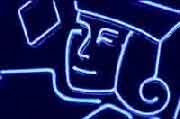
The June 2012 version is now available, be that online or at stations, although not every station has paper copies yet. This is the map with the Tracey Emin cover, featuring a bird perched on the branches of the Northern line, and a highly stylised Central line wiggling across the centre. Admire it for its art, if you like, but whatever you do don't use Tracey's squiggle for serious route planning.
There are two reasons you might expect a new tube map right now - one is the Olympics, and the other is a cablecar. Surprise surprise, the true reason's almost none of the former and much more of the latter.
Here's the Arabfly Dangleway in full effect on London's tube map for the first time. Previously it was "under construction" and now here it is in full corporate red. Perversely the symbol for the Dangleway is three lines, when in reality the cablecar travels along two, and it's shown here going round two bends, when of course in reality there aren't any. That's topological maps for you. The name of the sponsoring airline prefixes both of the station names because they paid £36m for the privilege, and if you'd paid more your name could have been here instead. On the paper map their name appears eight times in total, including twice in the key, which the marketing department must be absobloodylutely chuffed about. The rest of us, I think less so.
One casualty of the new sponsor's appearance is mobile company O2, whose naming rights at North Greenwich have been summarily erased from the tube map. It's been an on-off relationship over the years (2007-09 on, 2009-10 off, 2010-12 on, 2012- off), but the tide's turned firmly against again. I had wondered whether this deletion was Olympic related, given that The O2 has to remain brand-free for non-sponsors during the Games. But the Dangleway's sponsors aren't the official airline of the Games either, so I assume someone's decided commercial entities now only appear on the tube map if they've paid.
Elsewhere on the map, not so many changes. Up at the far end of the Metropolitan line, four stations that used to have white blobs (step-free access from street to platform) now have blue (step-free access from street to train). Nothing's changed at stations such as Pinner and Chorleywood, what's different is that almost all of the trains on the Metropolitan line are now the new S Stock. This has lower carriages than the old A Stock, so passengers in wheelchairs can spin in and out at roughly platform height, which is excellent. There's no such blue circle at Chesham, because the curved platform creates a gap that wheelchairs will never safely cross. And there are no such blue circles yet at Uxbridge or King's Cross St Pancras, because trains with different height carriages stop at these platforms, and TfL haven't yet got round to introducing a special-coloured wheelchair blob for "step-free access from street to train on certain lines only".
And where's the Olympics? Well, amazingly, it's barely mentioned. There's no special symbol at Stratford, nothing at West Ham, nothing at Canning Town, nothing at all. That's a surprise, given that line maps on Jubilee line trains now have bright magenta panels indicating all the Games Venues along the line. But not on the tube map. Instead five stations have daggers, with a reference in the key to Olympic changes afoot. † Bank and Waterloo: the Waterloo & City line will run later during the Games, and at weekends. † Cannon Street: will have "normal" opening times during the Games, including opening on Sundays. † Cutty Sark: will sometimes be closed during the Games. † West India Quay: trains from Bank won't stop here during the Games. † Pudding Mill Lane: completely closed from 14 July to 12 September.
And that's it. There's no mention of scary queues, there's no mention of potential delays, and there's no mention of other stations where access will be curtailed. Pontoon Dock and Prince Regent will be entrance only during the Games, while Custom House will be exit only. Nothing. Marble Arch and Hyde Park Corner will be exit only for twelve hours a day during the Games, and that doesn't get a mention either. Someone somewhere has made a very deliberate decision to keep the Olympics off this tube map, and to leave spectators to make their way around using other information, or instinct. To use the Spectator Journey Planner, perhaps, or getaheadofthegames.com, although that seems riskily optimistic. Or maybe an Olympic tube map is planned, and this isn't it.
Back to the Dangleway. Does the map provides any clues about when it might open and how it might operate? Checking the daggers in the key, it'll open "in summer 2012" and "special fares apply". Not much help. But there are alternative versions of the tube map on the TfL website, with more to offer. According to the Rail and Tube map, the cablecar will be in a special "Arabfly Dangleway fare zone", so expect to pay extra on top of your Travelcard, at whatever rates are finally announced. The Step-free Tube Guide reveals that there'll be a 50mm step and 75mm gap to board your gondola, which is step-free enough. And the Bicycle tube map says "Bicycles may be carried at any time", which is great, but also that "operational hours are different to those of the Underground." More tourist attraction than commuter essential, then, as expected.
But most telling of all is the timing of the new map. Four of the 17 daggers on the map relate to stations on the Overground that aren't step-free now but will be next month. If publication had been delayed until July, those daggers wouldn't have been needed. Ditto the special Olympic instructions - useful in July, pointless in June. There is only one genuinely new thing on this tube map which could possibly require a June 2012 publication date, and that's the cablecar. TfL must be confident it'll be opening this month, sometime in the next 20 days, otherwise they'd have held this tube map back until July. So prepare to ride the Dangleway, possibly imminently, as weeks of testing morph swiftly into passenger service. It's on the map, so active service can't be too far away.
There's been another tweak at the Bow Roundabout. Another change in addition to the segregated cycle lane and early-start cycle lights unveiled last week. There was a problem, you may remember, in that cyclists approaching the advanced stop-line were misinterpreting what the newly-installed forest of lights actually meant.
• Some ignored the red light in the cycle lane, because the lights alongside for traffic were at green. • Some jumped the red light in the cycle lane, because the lights ahead onto the roundabout were at green. • Some ignored the red light at the roundabout, because they'd just seen a green light in the cycle lane. • Some jumped the red light at the roundabout, because they thought it looked safe to do so.
They like yellow signs in the Bow Roundabout Upgrade Department. Previously, when the roundabout proved to be a deathtrap, they whacked up big yellow signs saying DRIVERS LOOK OUT FOR CYCLISTS AHEAD and CYCLISTS BEWARE DRIVERS TURNING LEFT. They've removed the latter while putting in the new segregated cycle lane. But now we have three new yellow signs that say CYCLISTS STOP ON RED. Because they don't.
The first yellow sign has been affixed to the traffic light in the cycle lane, as a reminder to cyclists that this light does indeed apply to them. Not realising this is a very easy mistake to make. The amber and green lights have bike symbols, so it's very obvious that amber and green apply to bikes. But the red light is just an ordinary red circle, so there's no indication it applies to the cycle lane at all. Cyclists are missing its importance, spotting green elsewhere, and whizzing through. The yellow sign aims to cure that.
In particular, the red light in the cycle lane is lit only when the main traffic lights alongside are at green. Cyclists arriving during this phase see cars, buses and lorries streaming off onto the roundabout and expect to join them. They're not supposed to, else the advance cycle light system doesn't work, but it is incredibly tempting. The segregated cycle lane stretches ahead, with an unobstructed path to the roundabout, and beyond. Why not jump the lights and skip ahead to there? The yellow sign aims to stop that.
It would make sense to replace the red disc in the cycle light with a red bike symbol, to match the existing bike symbol for amber and green. Cyclists should then realise that this red light is for them, without the need for a special yellow sign underneath. But it's not easy to replace the symbol in a traffic light, not overnight, whereas evidence suggests a new yellow sign can be knocked up really quickly. CYCLISTS STOP ON RED. Yes, it sounds really very condescending indeed. But the set up here is so complicated that cyclists appear to need a blatant reminder of the not-bleeding obvious.
Moving ahead to the roundabout, there are two yellow signs - one on a traffic light and one on a lamppost facing the traffic. These are here for a very serious reason, to stop cyclists who've misread the junction from entering the roundabout at danger. Many who've just passed a green cycle light in the cycle lane appear to think this gives them carte blanche to continue ahead. Not so. The front lights at the roundabout are also supposed to apply to bikes, but many (many) cyclists using the junction fail to realise this. The yellow sign aims to change that.
But will they understand what's meant? All the yellow signs say the same thing. CYCLISTS STOP ON RED. Cyclists reaching the roundabout have already passed one of these, now here's another, so is it obvious enough that this is a subtly different message. The junction has eight traffic lights altogether, five of which are applicable to cyclists, and now a couple of these have signs attached. I reckon this is still vague enough to be potentially very confusing. Indeed, all that TfL appear to have done is to take a clearly sub-optimal solution to cycling safety at the Bow Roundabout and added some sticking plasters. The yellow signs don't make anything safer, they're merely an attempt to clarify the mixed messages brought about by the muddle of lines, lanes and signs that engineers recently installed.
I've been out watching to see what cyclists do now that the yellow signs are in place. There aren't quite so many cyclists about, this being the weekend, but I spotted five. Only one stopped at a red light, as requested. Two sailed through the first green light, then the following red light, then straight round the roundabout, completely ignoring the new messages. One ignored the junction and diverted over the flyover instead. And one missed the segregated cycle lane completely, tried edging down the left-hand lane of traffic, clipped a driver's wing mirror, apologised, stopped at the red light while the cycle light alongside was on green, then proceeded onto the roundabout along with the rest of the traffic and narrowly avoided being turned-left onto. I think it's true to say the yellow signs aren't yet working.
The police came to stand beside the new Bow Roundabout lights yesterday afternoon. They might have been observing, but more likely they were there as a much more effective way of saying CYCLISTS STOP ON RED. Because, sorry, a few yellow signs just aren't going to cut it. The upgrade of this junction is an over-complex and confused mess, and no amount of cheap tinkering will change that. If anything the junction is now more dangerous than it was a month ago, with additional hazards brought about by an inadequately thought-through upgrade. What's required is a more expensive redesign of the entire junction, which isn't likely in this climate, or something that impedes vehicular flow, ditto. But now that TfL have gone for the advance cycle-light solution, they're obviously going to stick with it, hence the three yellow signs. CYCLISTS STOP ON RED. Patronising, ineffective and inadequate.
She Lay Down Deep Beneath The Sea - Tracey Emin Turner Contemporary, Margate
(26 May - 23 September 2012)
It's taken a year, but Margate's new art gallery has finally paid tribute to the town's second-favourite artist. JMW Turner's still number 1, but he's had his major moment in the limelight, and now it's Tracey's turn. She's produced a suite of newly-produced work, and it fills four of the galleries at this fledgling coastal attraction. A fluorescent nude greets you at the top of the stairs - you'd expect nothing less - reclining and pert in a few simple linked curves. She's hot on simple, is Ms Emin, as the repetitive displays in the next gallery reveal. An abundance of female genitalia is on view, all in much the same shade of royal blue, all of it representative of the artist herself. It's hard not to stare, to be honest, particularly at the central casually suggestive squiggle. There's plenty of text-based art too, also blue, in briefly ambiguous emotional scrawl. It's clever how the phrases evoke meaning in so little, but not clever enough to make you want to buy the t-shirt in the shop downstairs. Nextdoor, more of the same, plus an empty steel bath and some beautifully intricate labial tapestry. The exhibition's not all by Tracey, you may be pleased to hear - a few of Turner's lesser known female nudes have also been wheeled out. Ditto Rodin on the adjacent wall, while his famous statue The Kiss takes pride of place in the main lobby overlooking the sea [odd photo]. Further Emins round things off, with erotic lines made arty through embroidery, and a mucky Heals mattress which at first appears to be white with brown stains but on closer inspection reveals itself as brown with white. She's created more imaginative work, and flown with more diversionary ideas, but the overall effect remains as self-revelatory as you'd expect. You might get more out of the exhibition if you hire Tracey's words and thoughts on audio, but don't be surprised if it's all a bit much, and simultaneously not enough. [watch some]
Horizon - John Smith Turner Contemporary, Margate
(1 - 17 June 2012)
On a completely different tack, crammed into a makeshift mini-theatre downstairs, is this ever-so-simple film of the sea. East London professor John Smith pointed a camera out of the Turner Contemporary's window over the course of three months, then stitched together the results into a rhythmic 18 minute loop. The top half of the screen's always sky, the lower half always sea, with the horizon the only unchanging feature across the centre. The scene switches in the time it takes a wave to beat once, perhaps stormily beneath leaden grey clouds, then to rippling blue calm, then to another random day's Margate panorama. Most of the time nothing happens, but occasionally a gull flies through, or a boat sails past, to create a fictional sense of interest. Only once does low tide intrude, and only once does the sun set, otherwise it's choppy bleakness pretty much all the way. It's terribly repetitive, yet strangely alluring, and I reckon it's a good test of artistic appreciation if you can bear to sit through the whole thing. Most couldn't. I could. And, sorry Tracey, I preferred this. [watch some]
What the hell are "other payment solutions"? If you run out of cash at the Games, are Visa going to sign you up to some instant credit thing? Or do they have a hotline to your bank details and a card-printing machine? Something here strikes me as exploiting a captive audience.
The message is clear. If you're attending a London 2012 event and don't have a Visa card, make sure you're stuffed with cash before you arrive. Or just bring a packed lunch and empty water bottle, and avoid the urge to buy a souvenir bug-eyed mascot, and you should be able to enjoy the Games without prostituting your finances.
Finally, almost a year since it first opened, TfL have rejigged the far end of Cycle Superhighway 2 at the Bow Roundabout. It took two dead cyclists to spur them into action, before they eventually came up with a scheme to introduce "cycle early-start facilities." Allow cyclists onto the roundabout just ahead of the traffic behind, they thought, and then those cyclists won't be accidentally squashed by left-turning vehicles. TfL have now carved a new segregated cycle lane out of the pavement, and shifted waiting traffic back to give cyclists a clearer run at the roundabout. The new layout opened last Friday, then promptly shut again, with contractors toiling over the bank holiday weekend to iron out some problems. They scraped new blue chippings off the road, and they shortened the end of the cycle lane barrier so that vehicles didn't keep running over it. And finally on Wednesday the new traffic lights were uncovered and the adjusted layout was properly launched. And are there still problems? Oh yes. Because the new cycle-friendly "improvements" at the Bow Roundabout aren't as good as TfL are about to tell you they are.
10 reasons why the new cycle-friendly "improvements" at the Bow Roundabout aren't as good as TfL are about to tell you they are
1) It's all incredibly over-complicated Where there used to be three traffic lights, now there are eight. Two guard the exit from the new cycle lane, where cyclists are supposed to wait if the main traffic is on green. Ahead are three more lights, these designed for vehicles only, which are generally at red only if the cycle lights are on green and vice versa. And then there are three traffic lights at the entrance to the roundabout - these were here before - and they're not quite in sync with any of the traffic lights behind. Eight lights in total, which could get very confusing, so TfL have shielded several lights from view depending on where you are. Some have shutters over amber and green, so they're visible only to traffic curving from the right. Another has lengthy curved shielding masking visibility from the cycle lane, so that only vehicles at the front of the traffic queue can see it. To add to the confusion, three of the traffic lights don't display a green circle, they display a green forward arrow. This suggests that you can only drive straight ahead, which completely isn't the case, so the presence of these arrows is baffling. Stumble upon this forest of lights for the first time and you'll quite likely be disoriented, wondering which of the various asynchronous lights are meant for you. Welcome to the new improved Bow Roundabout early-start facilities.
2) Cyclists aren't quite sure what to do There isn't another junction like this in London. It's new, and different, and original. This means that cyclists arriving at the lights have to work out what to do from the visual cues all around them. They're supposed to stop if their cycle lane light is red, even though the the other six traffic lights are green. They're supposed to carry on if their special cycle lane light is green, even though the other six traffic lights are red. It's not surprising they often do the wrong thing. Some cyclists hover in the cycle lane when it's at green, hesitant to continue. Some cyclists head forward a bit but not far enough, leaving themselves only fractionally ahead of the other traffic when the lights change. Some skip the cycle lane altogether and negotiate their way through the main body of traffic. And others get it right, waiting up at the front of the tiny strip of blue paint, ready for a quick getaway. I'm amazed how many completely different things I've seen cyclists do here, how many different ways there are to wrongly interpret this new junction layout. Everyone'll get better at it, more familiar, once they've ridden through a few times. But on your first approach, this genuinely isn't straight-forward at all.
3) Cyclists are misunderstanding what the lights mean and putting themselves in danger If you see a green bike symbol on a traffic light in a segregated cycle lane, obviously you cycle past it. And why wouldn't you keep going, because you've had the green light... straight ahead and onto the roundabout? The blue stripe in front of you does lead off most invitingly as the Cycle Superhighway continues. But then, oops, you're on the roundabout at the wrong time, potentially colliding with traffic swinging round to exit via the A12. I've seen several cyclists whizzing through the initial green light clearly unaware that the final set of red lights does actually apply to them. These final lights are ordinary traffic lights, no red bike symbol here, nothing specifically warning cyclists to stop. It's not TfL's intention that this new set-up is dangerous, but for those who misunderstand the mixed messages of the signals, it clearly is.
4a) Cyclists are jumping the first light It's naughty, jumping red lights, we know. But the lights in the cycle lane are only red while the lights for the main traffic are on green, and that's really annoying. Why should you wait everyone else sails through onto the roundabout? Why shouldn't you jump your red light and join them? 'Good' cyclists are supposed to hold back, then filter ahead and wait patiently for a minute while the whole cycle goes round again. It's no surprise to see several cyclists being 'bad' instead, jumping their red to hit everyone else's green, in order to get round the junction quicker. But then, hey presto, they're in precisely the position of danger that used to exist here before, as traffic turning left potentially cuts them up. 4b) Cyclists are jumping the second light It's naughty, jumping red lights, we know. But when you're lined up beside the roundabout, with all the other vehicles a few seconds behind you, why wouldn't you sneak onto the roundabout if the coast is clear? There's another segregated cycle lane round the edge of the roundabout a few metres ahead, so if you can reach that you'll be safe as houses. I've seen several cyclists take the opportunity to skip the red light at the roundabout when a gap in circulating traffic allows, most especially when absolutely nothing is coming. Time it right, however illegal the move, and jumping red is safer than waiting for green.
5) The gap between lights changing is rather short You might expect there'd be several seconds delay between cyclists getting the green light to venture onto the roundabout and the traffic behind getting the same. Not so. The lights behind change very swiftly, overlapping with the change in front. The thing that protects the cyclists isn't time, it's distance, with cars and lorries having to make up ten metres or so from a standing start to catch up. That's fine if cyclists have ridden right to the front of their advance stop box, but not if they've hung back. I've seen both hesitant and queueing cyclists caught up by the traffic behind, which has promptly attempted to turn left across their path. Obviously TfL don't want to hold up the traffic at the Bow Roundabout any more than they absolutely have to. But the two streams aren't as segregated, in time, as much as you might like to think.
6) The segregated cycle lane starts immediately after a bus stop This still amazes me. The new segregated cycle lane starts less than ten metres after a bus stop. If there's no bus, fine, you sail straight through. But if there is a bus, then you have to swing out to cycle round it, then swing back in afterwards (very quickly) to join the narrow lane. Meanwhile the bus that's been in the stop might well be signalling to pull out, across your path, leading to a very dangerous conflict. Thirty buses an hour pass this way, so the likelihood of a big red mobile obstruction is fairly high. At the moment this problem doesn't apply, because the bus stop's closed due to all the recent roadworks. Once it's reopened, I do genuinely worry how dangerous this switchback might be. But TfL appear to be doing all their initial safety monitoring before this potential hazard is back in place.
7) A large number of cyclists are still using the flyover instead There are two ways to cycle east past the Bow Roundabout. You can stay at ground level and negotiate the roundabout itself, with all the attendant dangers that still brings. Or you can risk cycling across two lanes of traffic to reach the central flyover, and whizz over that, which I'd say is still the chosen option for about half of the cyclists riding this way. There are no traffic lights up there, no left turning tipper trucks, and it's quicker, so it's the favoured option for many. Getting off the flyover at the far end isn't easy - there are serious risks here as well as on the approach. But it's interesting to observe how many cyclists are completely shunning TfL's expensive junction refit because they think there's a better (maybe safer) route over the top.
8) It should have been designed properly the first time There's going to be lots of positive spin in the media regarding this junction refurbishment. The first advance cycle lights in Britain, investing in safety, creating a better transport environment, pioneering technology, whatever. But the truth is, the original solution which opened here last summer (pictured) was woefully inadequate. Where now there's a segregated cycle lane, some cheapskate previously thought it fit to paint half a lane of normal traffic blue. Where now there are advance stop lights, cyclists were previously left vulnerable to left-turning lorries. The previous solution was pathetic, especially the clogged-up approach road, unworthy of the title "Cycle Superhighway". What we have today is being praised as good mainly because what it replaced was so poor.
9) There were two deaths here, but only one of the approach roads has been fixed. The latest roadworks only help to improve the eastbound slip road where Brian Dorling died. The westbound slip road where Svitlana Tereschenko died remains untweaked, apart from a few patronising yellow signs warning drivers to look out for cyclists. Apparently the westbound slip road will be modified, but not until after the Games are over. Stratford High Street is a crucial part of the main Olympic Road Network, which Bow Road isn't, so there'll be no physical tweaks slowing down the traffic until all the Olympic sponsors have gone home. Yes, there are yet more roadworks to come... it's not finished yet.
10) There's still absolutely no provision for pedestrians And after all this, Bow Roundabout remains just as dangerous for pedestrians to cross as it was before. If anything it's more dangerous, because the mass of new semi-obscured traffic lights on the eastbound slip road makes it even harder to judge when it might be safest to cross. But it seems there'll be no signalised crossings on any of the eight slip roads, because apparently "introducing a green-man phase for pedestrians on each branch of the Bow Roundabout was shown to create mile-long tailbacks reaching back westwards towards Mile End." I reckon it would be simplicity itself to introduce a green man phase on four of the eight slip roads, those feeding onto the roundabout, but it is alas true that crossings on the four exit roads would sometimes create major tailbacks. A lot of money has been spent at the Bow Roundabout attempting to improve safety for cyclists, now for a second time, and still not entirely successfully. But pedestrians must continue to risk their lives and take their chances, to cross a junction that remains nowhere near as safe as TfL are about to tell you it is.
I recently declared Sutton the most boring borough in London, based on having visited every London borough in search of interesting things to visit. So with news that Sutton has just opened a new museum, I thought I'd best pay an inquistive visit. What could it possibly contain, and would it be worth the trip? And I'm still not changing my mind about Sutton's overall interestingness. But I can reassure you that Honeywood Museum is lovely.
You'll find Honeywood beside CarshaltonPonds, which are a splendid water feature near the source of the Wandle. One of the springs rises behind the house and flows underneath into Upper Pond - an ornamental feature that's thought to have been created for a local Jacobean nobleman. Honeywood itself is an architectural hotchpotch, mostly well-to-do Victorian weatherboard, but with a flint and chalk chequer wall embedded in the interior that's definitely 17th century. A variety of owners have passed through, from a slave trader to a photographic rep, until eventually it fell into the hands of the council. They made it a Heritage Centre, fairly low-key, but a recent Lottery grant enabled an upgrade verging on full transformation. Look for the ducks at the water's edge, and you'll not go far wrong.
"You looking for the toilet?" asked the nice lady at reception. She was pleased to discover I was a genuine visitor - I think me being under 60 threw her - apparently they get a lot of throughflow from the new Honeywood cafe nextdoor. She recommended I start in the Carshalton Village room, where I learnt a lot about Carshalton Village, whilst standing uncomfortably close to the next cafe patron availing themselves of the adjacent facilities. The billiard room has been sympathetically restored, with bright green baize and balls surrounded by brown leather sofas. Opposite in the drawing room I learnt about Suttonites at play, including the nugget that sausage'n'icecream magnate Thomas Wall lived locally and donated the football ground that's now home to Sutton United. One cabinet contained an endearing copy of Sky-Lark magazine, an Edwardian family production complete with handwritten articles and stuck-in photos. Only one copy was ever made, in a feint-lined book, then handed around from house to house for everyone to read.
Upstairs, up twisty carpeted suburban treads, further display spaces tucked away in the many bedrooms. The RiverWandle provides the greatest amount of local history, beautifully depicted on two interactive maps, and plenty of detail of old mills and industry and the like. There aren't many actual exhibits - Honeywood's displays are mostly text-based - although there is a trout, and a chunk of William Morris printing block. I liked the Childhood Room, as did a three year old girl visiting with her dad, but for different reasons. She liked playing with all the newer stuff on the floor, whereas I liked the collection of vintage games in the display cases. Victorian children playing the board game Fairyland - Through The Enchanted Forest faced hazards such as "Savage Two-headed Cat" and "Ask me for a cabbage". As for "Flying Caps", where hand-shaped flippers fired paper dunce's caps towards a grid of holes, I'd be amazed if anybody ever managed to score any points.
The largest room, looking out over the pond, contains a striking cartographical record of the growth of Sutton. The borough was once a string of minor villages surrounded by fields, until the railways came, and all those fields were gradually, inexorably, completely covered by houses. That'll explain why there's not much actual long-term history in the borough, which is why they're making the most of Honeywood. Its displays will mean most to folk who live nearby, but that's not to say more distant lovers of heritage won't enjoy the place too. As Ian wrote on the board on the landing... "Best coffee and panini I've had in ages. Great refurb! Well done".
Also in the immediate area...
Knitted ducks: They may not be here for long, but yarnbombers tied two long lines of red white and blue waterfowl to the railings on the bridge across the Carshalton Ponds especially for the Diamond Jubilee. Simple, but hugely effective. [photo][photo]
Sutton Ecology Centre: Just across from Honeywood, in the grounds of The Lodge, this tightly-packed acre contains woodland, a pond, walled garden, composting area and other ecologically sound features. Grab a map leaflet on the way in to explore fully. It's all very nicely done, not too scrubbed up, and was being much enjoyed by several families on my visit.
Carshalton Water Tower: Grade II listed pumping station for the gardens of Carshalton House. It's not often open, now being part of a school, but you can visit on summer Sunday afternoons, and this weekend for Open Garden Squares.
The Grove Park: The upper Wandle flows through, via an ornamental cascade, past a restored water mill.
Olympic lockdown continues. It's a slow but inexorable process, and this bus route is the latest casualty. Yesterday the D8 terminated at Stratford City, at the nine-month-old bus station outside Westfield. And today it doesn't, because it's not allowed, because the bus station is closed. The same goes for the other three buses that used to drop folk off outside the shopping centre, the 97, 241 and 339 - they've all been diverted to terminate at the bus station outside Stratford station instead. The largest urban shopping centre in Europe just got harder to get to, and it's going to get worse.
Riding the D8 to Westfield has been a slightly surreal experience, and all because the last half mile runs along the edge of the Olympic Park. It's a fairly normal bus journey until the penultimate stop at Warton Road, shortly after which the driver has to stop again. The bus pulls off into a lay-by, not so that anyone can alight, but so that a security guard can climb aboard. They start at the front and work their way back, giving all the passengers and especially their baggage the once over. No matter whether the bus is packed or empty they always check right up to the back seat, just in case someone's left a suspicious package in the far corner. As a passenger you can't fail to feel just a little uncomfortable, as if the powers that be don't trust you to ride this bus without bringing naughty luggage. When I travelled earlier this week the guard was a spotty youth in a ridiculous woollen hat, softly swaggering to and fro with a subdued sense of self-importance. He'll be out of a job this morning, or else switched to some different section of the security perimeter still in need of scrutiny. My apologies if you are an international terrorist in search of a cunning means of destroying the Games, because the "hiding explosives in a carrier bag at the back of a bus" option just expired.
Car drivers don't escape either. A little further up Warton Road is a security marquee with spaces for four vehicles, which you have to drive into if the guard on sentinel duty waves his baton. Then it's a full "can we look in your boot please?" search, and you're not allowed to proceed further until they have. Westfield must have hated these pre-Olympic security measures, because goodness knows how many drivers have been put off visiting since last September. Good news - the vehicle friskdown won't be in operation after the Games. But bad news - all the car parks at Westfield are shutting down in a couple of weeks... for the rest of the summer.
For the D8 the problem lies behind the railway, beyond the currently-pointless roundabout. Montfitchet Road rises along a gentle curving viaduct, one side of which looks out over the Aquatic Centre. Any bus or car exploding here could cause major damage to backstage Olympic infrastructure, which would never do. A whole series of bollards and rising ramps is in place, to stop even the most determined joyrider or evildoer from gaining access. There are even additional holes where presumably even more bollards will be added, so risk-averse are 2012 security planners, because the Olympics simply cannot fail.
For the time being however there's still a Westfield-bound pavement, fully accessible to pedestrians heading to or from the shops. You can wander along the edge and look down over the Aquatic Centre and all the portakabins round the back, as well as stare across to the Orbit and the Stadium, fairly close-up. With the Greenway closed off it's probably the best spot to overlook the Olympic Park, as I hope this photo indicates. Just don't think of wandering off. Some of the view remains entirely unobstructed, but much is now obscured by thick wire fencing, especially all the way down Westfield's western perimeter.
A slightly disturbing sign has appeared in several locations along that fence, mostly adjacent to what will eventually be spectator entrances. Its message is clear. Entry to this Venue constitutes acceptance of the "Venue Regulations" as published at www.london2012.com. If you have tickets here this summer you'll be walking past this sign and giving tacit acceptance to whatever the terms and conditions are - not that you'll know what they are, or have any easy means of finding out. Worryingly, if you search for "Venue Regulations" on the London 2012 website, absolutely nothing appears. Which is useless. But (thanks Joachim) the Venue Regulations can be located via Google, and here they are. For your advance scrutiny, listed below is a selection of the rules that Olympic Park visitors will be unknowingly signing up to. LOCOG haven't got a hope in hell of enforcing number 6, have they?
So, to summarise. With 51 days to go before the Games, all of Westfield's buses are being diverted elsewhere. And with 39 days to go before the Games, all public vehicles will be banned. No cars, already no buses, and no more taxis either. Your only escape south from Westfield, for three entire months, is via the station. Either over the footbridge across the platforms, or through the ticket barriers and onto a train, that's your lot. There are plenty of buses and taxis in Meridian Square Stratford, but will lazy Westfield shoppers be willing to lug their purchases that far? More importantly, with no car parks on site and few nearby, will East London and Essex regulars bother to come shopping at all?
During the Games, it's expected that more than half of spectators to the Olympic Park will enter and exit via Westfield. A large tarmacked area is already set aside for snake-like queueing, safely out of the way of all the shops. But again, to get here you're either going to have to arrive by train or venture across that single footbridge - the barrier of the railway precludes any other way. Westfield may be The Official Shopping Centre of London 2012, but it'll be a hellish place to shop this August. The split-level entrance by the station is badly designed enough at the best of times, so expect the footbridge to Stratford (leading to tottering steps and a single escalator) to be a really unpleasant potential bottleneck. Inside, the narrow decks in the mall get overcrowded too easily as it is, and that's without hundreds of thousands of spectators exiting the Park via an enforced retail-friendly route-march. London 2012's best hope is that most of Westfield's normal shoppers stay away... an operation which begins today, and steps up in a fortnight.
Bus 60: Streatham - Old Coulsdon Location: London south, outer Length of journey: 12 miles, 75 minutes
For the Diamond Jubilee, I thought I'd go out and ride London's number 60 bus route. A long drive, straight down the middle of south London, from the foot of Lambeth almost to the very edge of Surrey. An opportunity to see how outer suburbia has been celebrating the Jubilee, if it's been bothering at all. Do join me on the top deck.
Last time I was in Streatham there was a bus station. Now there's only an extensive gap where that and the ice rink used to stand, awaiting transformation into the long-awaited Streatham Hub. There'll be a new ice rink, a sports centre, some flats and a giant Tesco, and you can already guess how architecturally unadventurous it'll look. Plus there'll be a new Bus Interchange, from which the number 60 will head off, rather than starting opposite the (thankfully still standing) United Reformed Church. I think I'm in line to climb on board the bus first, but an obese young woman clutching a bulging pastry blunders past me. I would have complained, but queueing is so passé these days, plus her Oyster flashes up to show it's a Freedom Pass so there's probably good reason.
The first evidence of street parties comes swiftly, before we queue to turn right off the High Road. A banner strung across Barrow Road announces a two-day BBQ shindig for the Jubilee, apparently a "Resident's Celebration", which sadly suggests only one person will be turning up. The bus heads off into residential Streatham Vale and stops outside a "Village Card, Gift & Balloon Shop" - which sounds nothing like the kind of business that would survive in any true village. A young woman in summer dress and flipflops runs flailing towards the bus. The driver waits - he's kind like that - and she skips aboard with a cheery "thanks", then slumps panting on the top deck. The Jehovah's Witnesses are out in Pollards Hill where the bus gets busier, possibly with people trying to escape. The library and Harris Academy look rather modern, the vanilla-block housing estates and cemetery rather less so. Only a single pair of flags stuck to the roof of a Volvo Estate hint that a Jubilee might be imminent - other than this, Merton really isn't trying.
Having bypassed Norbury, we're back onto London Road through Thornton Heath. An Asian woman whose house number is in the 990s is busy sweeping her front garden unnecessarily clean with a long brush, putting her less immaculate neighbours to shame. There are no celebrations at Jubilee Court, a bricky block of Thirties flats, whose windows are shuttered and residents rehoused, probably as the aftermath to an arson attack last year. Just past the pond, Broughton Road is temporarily closed for a Jubilee street party. Nobody's turned up yet, but there is a bouncy castle inflating in the street and a mini-marquee erected in someone's front garden.
Croydon creeps up on us, past the sort of shops you only find half a mile from where the proper shops are. Grand Parade now boasts little more than a dry cleaners and an afro-salon, while the Half Moon pub is nothing but an eclipsed shell. The most sincere Jubilee wishes are offered by the Croydon Tamil Business Forum, in a celebratory message to Her Majesty pinned up in the front window of a riot-restored business. Elsewhere the town's piecemeal regeneration continues, with over-modern developments going up alongside Victorian terraces and gaping wasteland. Finally at West Croydon station the passengers pour off, impatient to hit some proper retail, before we queue for trams and zip round the Whitgift.
The second half of the journey is a different world, escaping from Croydon's high-rise nucleus in a break for the countryside. Banners on South Croydon High Street announce this as the Restaurant Quarter, a claim which is not immediately obvious but soon proves true. A young girl in pink plastic sunglasses and dreadlocks plonks herself down on the seat beside me and proceeds to sing something sweet but entirely undistinguishable for the next five minutes. Her mother sits patiently behind, secretly wishing I wasn't there so her other daughter could sit up front too. We pass a school cricket match at the proper Whitgift, but only one cluster of fluttery bunting (which turns out to be outside a party goods shop).
At the bus depot we pull over for a change of driver, allowing a prolonged stare into the recesses of this gloomy garage. And then we're off through Purley Oaks, past just one concrete aberration at Canberra Court, and a lot more roadside greenery. The shops in Purley town centre are the most patriotic so far, with more than half decorated in red, white and blue, and one carpet shop with a cardboard cut-out of Her Majesty in its window. The bus slowly empties as the houses become more detached, more half-timbered, more stockbroker belt. Out here they're not ashamed to hang flags from the fourth bedroom window, or to slap Union Jack wing mirrors on the spare hatchback. One last push.
Coulsdon's not in Surrey, but nearly is, and wishes it was. There are still a few passengers queuing to climb aboard, most clutching bags of groceries from Waitrose in the High Street. We nip beneath the bypass (ugly, but necessary) and start our final ascent - a lengthy climb between white detached houses to the top of New Hill. And finally we pull in besidetheTudor Rose pub (offering Ju-Bellini cocktails this weekend) in the heart of Old Coulsdon. It's a charming spot, set around medieval St John's church - the sort of place where you suspect there's always a Union Jack flying from the flagpole outside the estate agents. Even the funeral directors has some jolly balloons and assorted royal memorabilia in the window. If you're in the area today they're holding a Giant Picnic in Grange Park from noon (but bring your own food, and probably best a raincoat). They're celebrating 60 glorious years all along route 60, but most especially here in Old Coulsdon.
A thousand boats sailing in a grand flotilla down the Thames, headed by Her Diamond Majesty, watched by a jubilant crowd. It must have seemed like a good idea at the time. The seven miles from Battersea to the City would allow hundreds of thousands to line the banks and watch the Thames Diamond Jubilee Pageant go by. Alas, for anyone arriving less than a few hours early, those banks weren't long enough...
London Bridge (1pm): "Would you like a flag?" asks the grinning girl lurking in the entrance to the ticket hall. I decline. "Are you sure?" she adds, as if I were somehow mad not to want to wave an advert for a well-known weekly gossip magazine for the rest of the afternoon. Outside on King William Street, a man with a pushchair has six of these flags in his hand, and another two sticking out of the back of his rucksack. The hawker attempting to flog "proper" Union Jacks for money loses. The grinning girl wins. I'm hoping to cross London Bridge to the South Bank, but I'm not a car so I don't rate my chances. Half the pavement has been fenced off to facilitate later viewing, and the remaining strip is home to a slowly-trudging snake of humanity going nowhere fast. Sight of the Thames: nil. I move on.
Blackfriars (1.15pm): The bridge is closed, for the benefit of fortunate souls with pre-accredited tickets. The rest of us have to make do with the Victoria Embankment, which ought to be great, but is already nearly full. The road is full as far as the eye can see, even the stretch behind HMS Wellington where there's no view of the river at all. Any chance of getting anywhere near the water's edge is clearly entirely hopeless. A sliver of river is visible from the ramp down from Blackfriars Bridge, but the only sight there'll be of the Queen is the giant "77 Jubilee balcony shot" poster draped across Sea Containers House opposite. Thankfully a big viewing screen has been set up so that nobody misses out entirely, but this means thousands of Britons have travelled miles from their own TV merely to watch the Pageant on another. Prospects of a memorable day out: nil. I move on.
Grosvenor Road (2pm): Pimlico station isn't usually this busy. But then it's not every day that the Queen floats by, and the neighbouring roads aren't normally sealed off. A crowd of well-wishers line up to file through security, merely a cursory bag check, then wander along the street in search of a view. It soon becomes clear that all the best views were bought up by property developers many years ago, as the river lies concealed behind a façade of apartments. Through archways we can see residents sat out on their own private walkway, shielded from the weather, alcohol in hand. Pimlico Gardens are open, a rare public space, but with crowds already several deep there's nothing to see here. It's a very simple problem. The Thames is always lower than the surrounding riverbank, obviously, so unless you're standing in the front few rows on that riverbank you'll see nothing. Even when the apartments and businesses along Grosvenor Road finally make way for Thames-side, you'd need to be stood up on the pavement to have a chance of seeing anything. Those who got here very early are in place. Those who brought mini-stepladders are looking smug. The rest of us stroll blindly behind (or climb up on top of the nearest bus shelter, that seems to work). Huge numbers of would-be onlookers are still turning up with flags and brollies, both here and elsewhere along the river, but there is zero opportunity to onlook anything. On nearby Cadogan Pier the Queen and Prince Philip are finally walking down the gangway to board the royal launch. We know this only thanks to a big TV screen placed across the Embankment, in front of which the crowd is so large it's very hard to pass. An old couple sat on a bench despair at the endless stream of people brushing past them, their picnic uneaten alongside. Anaemic chips are selling well, the official Jubilee Pageant programme less so. I move on.
Chelsea Bridge (2.30pm): Only a very select group of spectators have been allowed onto the bridge, pitifully few, guarded by police and security in a line across to the portaloos. The whole of the Chelsea Embankment looks full, which is perhaps not surprising given it's building-free and bang opposite the ticketed festival in Battersea Park. I stand at the top of the slope and look down at the sea of heads, cagoules and flags. There is no point in walking any further. But there is a small window in the trees ahead through which a fraction of the Thames can be glimpsed. We stand and wait - the Sloanes, the families, the Chelsea Pensioner - until the flagship Gloriana rows into view. It's tiny, and indistinct, and (after all this time) unutterably underwhelming. There may be an hour and a half of pageant yet to pass by, but a fair number of the crowd start to retreat, perhaps to the pub, perhaps back home, now it's been proven that standing here is completely pointless. I move on.
Wapping (4pm): Seven miles downstream, the railings are empty. It's started raining, which may explain it, but we're also past the flotilla's dispersal point and the Queen's not coming this far. One family has stuck it out, bravely sipping champagne beneath an umbrella. Several drinkers are settled on the pebble beach below The Prospect of Whitby, and dozens more on the far bank outside a pub in Rotherhithe. For hundreds of souls still gazing from their Thames-side balconies, it feels like their patience may never be rewarded. Eventually a distant boat emerges round the corner from the Pool of London, low and black, followed by something gold. The first barge is The Royal Jubilee Bells, pealing out for considerably fewer souls than heard it in town, and the second is the flagship Gloriana. It's a shame that they're passing much closer to Rotherhithe than to Wapping, but I'll know better where to stand if ever there's a Platinum Jubilee. Suddenly the Thames is full with craft, which in these wider stretches is quite a difficult state to achieve. There are canoes and kayaks and dragon boats and gondolas, most with flags a-fluttering, and cheery oarsmen waving from the water. It's a very Canaletto moment, except that Canaletto had much better weather, and fewer kayaks. Late arrivals on the Thames Path stop and stare, filling up the spaces along the railings now there's something to see. The weather takes this opportunity to worsen considerably, the breeze whipping up and the rain coming down much heavier. The towers of Canary Wharf start to disappear in the swirling murk as dozens of Commonwealth boats pass by, in what would be a blaze of colour but is actually a muted grey. All further boats come in smaller convoys, with greater gaps, be they warships, steamships, Viking longships or whatever. I hold my own at the water's edge for an hour, even as most others slip away, increasingly sodden and shivering in the relentless downpour. And eventually I surprise myself and leave early, because conditions really are that bad, and because once you've seen five hundred distant boats you've seen them all. Drying out at home in front of the telly, I hear the BBC presenters saying what a wonderful pageant it's been and how the weather didn't dampen the crowd's spirits. It wasn't like that on the ground, either in terms of visibility or spectator cheeriness. But a marvellous once in a lifetime sight all the same, for those of us who were fortunate enough to eventually find front row seats. [photos]
London's newest strategic walk is the Jubilee Greenway, created specially to celebrate the Diamond Jubilee. I say new, it was actually announced five years ago, but it wasn't until February this year that Her Maj laid the final special route-marker flagstone. The Jubilee Greenway is (deliberately) 60km long and links most of London's 2012 Olympic venues from Lord's in the west to Woolwich in the east. A lot of it follows pre-existing walks, like the Capital Ring and Thames Path, which saved a considerable chunk of cash when putting it together. There are more thrilling walks round London, to be honest, but fans of waterside walking will find much to enjoy. Here's a quick summary...
1) Buckingham Palace → Little Venice (via Hyde Park) [walked it] 2) 3) 10) The Regent's Canal (the entire length) [walked it] 4) 5) Victoria Park → N Woolwich (via the Greenway) (shadowing the Capital Ring) [walkedit] 6) 7) 8) Woolwich → Westminster Bridge (shadowing the Thames Path) [walked it][walked it] 9) Westminster Bridge → Buckingham Palace (see below)
» If you'd been on section 7 yesterday, just before Tower Bridge, you'd have been able to watch preparations for today's Thames Diamond Jubilee Pageant. Many of the high masted boats are mooring up here because they can't get under London Bridge, so forming an "Avenue of Sail". It was a marvellously unusual sight, even in overcast gloom, with a motley collection of barges, galleons and warships clustered along both banks [photo][photo][photo]. Even better, the occasional flotilla of smaller boats chugged past on the rising tide, getting themselves in place for the start of the main event. Bodes well, although prime viewing spaces on the riverfront won't be quite so easy to grab today. [photo]
» Meanwhile, on the South Bank near the end of section 8, Jubilee Gardens have now reopened. Originally created for the Silver Jubilee in 1977, this grassy rectangle had grown threadbare and distinctly tatty, so the Diamond revamp is long overdue [photo]. As well as relaid turf and swirly flowerbeds, a series of stone paths wind across the park. Some paths' edges double as seating, in places, and were being well used yesterday by families, Shoreditch couples and an entire troop of Guides. Picknickers with weak bladders, be warned, it costs 50p to spend a penny in the state-of-the-art conveniences alongside.
WALK LONDON Jubilee Greenway[section 9] Westminster Bridge to Buckingham Palace (2 miles)
In two miles flat, this final section of the Jubilee Greenway passes some of the most famous sites in London. Even on a good day it's a busy, but this weekend it's sheer madness (and today, sorry, probably entirely impossible). The walk starts on the eastern side of Westminster Bridge, the crowded stretch where only tourists go, where they can nosh McDonalds and play arcade games and queue for sharks. Most weren't heading through the subway yesterday, or at least no further than a photo opportunity (with flags) across to the Palace of Westminster [photo]. The Albert Embankment was rather quieter, looked over by a couple of medical staff from St Thomas's Hospital on a fag break. A few older visitors sat on the raised benches reading their commemorative Daily Mail, their view of the Mother of Parliaments part-blocked by a couple of manky barges.
Down to Lambeth Bridge and back, that's the Greenway's last Thames hurrah. The bridge currently has flags and metal barriers along its length, one for maritime decoration, the other for today's crowd control. There'll be viewing screens here, with bag searches and standing room rationed, although it's hard to imagine this being the ideal Pageant experience. Victoria Tower Gardens will be a more favoured viewing site, if you can see over the river wall, which is where those on the disabled viewing platform will have a head start. Here you'll find the ultimate royal pop-up, a Diamond Jubilee Shop, which is essentially a red trailer stocked with slightly dubious souvenirs [photo]. There's the official programme, and mugs, and teatowels, even a commemorative teaspoon should the fancy strike. But does anybody truly need an inflatable flag, or a tin of Jubilee teabags, or a Prince Philip mask, or an embroidered crown?... anybody except the Royal Parks' accountants, that is? Judging by the crowds jostling at the counter, sadly yes.
The path heads beneath the Victoria Tower and on towards the Elizabeth Tower, which is what the Clock Tower supporting Big Ben might be renamed if forelock-tugging MPs get their way. Watch out for the Golden Jubilee sundial near the Jewel Tower, and the Silver Jubilee Walkway explanatory panel near St Margaret's Church. It's Tourist Central round here, and the narrow pavement leading up towards Westminster Abbey barely copes. But rejoice, because someone's finally installed a pedestrian crossing to the centre of Parliament Square so you can cross to see Nelson Mandela without risking life and limb nipping through the traffic. The authorities have also removed all but one of the protesters who used to face the Palace, but Brian Haw's peace shack survives, now eleven years a thorn in the conscience of a nation. They'd rather you stared instead at the ring of giant Commonwealth flags flapping all around, which most visitors happily do.
The eastern edge of St James's Park is already sealed off, not especially securely, but with policemen patrolling the verge alongside Horseguards Parade. If you've chosen to walk the Greenway to see London 2012's Beach Volleyball venue, you're out of luck. On the bright side, The Mall is currently open to pedestrians only, so you can stride straight down the street (minding the manure) rather than having to walk along the pavement alongside. Huge Union Jacks hang at regular intervals, dressed with thick yellow tassels, in readiness for the Queen's carriage procession to ride this way on Tuesday [photo]. But it's Monday's concert that's having the greatest impact, taking place as it does on a special stage surrounding the Victoria Memorial [photo]. The entire front of Buckingham Palace has been sealed off while preparations continue, with security guards keeping non-ticketholders at a considerable distance [photo]. You can detour into the park to see the Diamond Jubilee Floral Crown, if 4m-high flower arrangements are your thing [photo]. But your chances of reaching the final Greenway stone outside the Queen's front gate? Sorry, the end of the route's uncompletable until the Diamond Jubilee's over.
You'll find this decorated carriage on the Jubilee line. Two special commemorative trains have been running up and down for a few weeks (or occasionally breaking down in an embarrassingly prolonged way). It's still a bit of a surprise to stumble upon one, either rattling into a station, or sat out in the open air at a terminus. But on the Jubilee line, this Diamond Jubilee, what else would you expect?
Meanwhile, inside certain other trains on the Jubilee line, this has happened...
It's a new Olympic line map, part of a rollout to guide visitors to the Games this summer. Venue names have appeared above the relevant stations, in a bright Olympic magenta (conveniently not the same colour as any tube line). Thanks for this Darren!
» Stratford for the Olympic Park: End of the line, and a walk through the subway to Westfield will get you to the Park entrance sharpish. » West Ham not for the Olympic Park: There is a special walkway from West Ham to the Park, but it goes from the District line platform, so Jubilee line passengers are being encouraged to go all the way to Stratford instead. » Canning Town for ExCel: That's for ExCel If you don't mind a long walk, or (more likely) a change to the DLR. » North Greenwich for North Greenwich Arena: I love this. The map used to say "North Greenwich for the O2", but O2 aren't the official Mobile Network Provider of the Games so their brand name has to be completely wiped. For three glorious months. I bet they're livid.
But not all naming rights have been quashed. Look, there's the ArabFly Dangleway appearing on an actual map in its actual colours for the actual first time. Officially the Dangleway has no confirmed opening date, but the map here says "opening summer 2012" (the smart money's on sometime this month). It's interesting that the Dangleway's not being promoted here as the quickest way to ExCel, instead best to stay on the train and change at Canning Town. And, sigh, as the mobile phone company disappears from the map, so an airline most people can't afford lands instead. After the Games, expect North Greenwich to be the tube map's first double-branded station.
Further along the line, courtesy of Darren's hastily snappedphotos, are the following... » Westminster for Horseguards Parade: for the Beach Volleyball (I hope the weather isn't like this) » Green Park for Horseguards Parade and Hyde Park: for two venues? It's going to be busy here. » Bond Street for Hyde Park: for interchange with the Central line, the other mega-busy Olympic service, so this'll be worth avoiding. » St John's Wood for Lord's: for archery... it's not cricket. » Wembley Park for Wembley: for both Stadium and Arena.
There really are a heck of a lot of Olympic stations on the Jubilee line. This is purely by coincidence, you understand, but makes this the best connected Underground line by far, venue-wise. That's one of the reasons why the Jubilee line is likely to be stuffed during the Games, and why you should avoid it this summer if you can. If Britain were a republic, TfL might well have felt the urge to permanently rename this the Olympic line. But instead, be it Silver, Golden or Diamond, the Jubilee line it will remain.
The Diamond Jubilee » Derby Day (Sat 2): It's not in London, and you're not going. Let's move on. » The Big Jubilee Lunch 2012 (Sun 3): Celebrate plucky British spirit by sitting at a trestle table in the middle of your local street in miserable temperatures and driving rain. » Thames Diamond Jubilee Pageant (Sun 3): Stand somewhere on the banks of the Thames between Battersea and Tower Bridge to watch hundreds of carefully choreographed historic boats sailing by. The miserable temperatures and driving rain should make it easier to find a decent viewing space, but harder to enjoy any decent viewing. » The Diamond Jubilee Concert (Mon 4): Unless you've got a ticket, you'll have to watch Gary Barlow from your sofa. » Diamond Jubilee Beacons (Mon 4, 10-10:30pm): More than 4000 beacons will be lit, all across the country. This time there's no attempt at geographical line of sight correctness, just a series of lighting times organised by theme. Interactive map here. » The Commemorative Bit (Tue 5, 10:30am-3:30pm): A service at St Paul's in the morning (by royal car), lunch at the Palace of Westminster (by royal car), and then an all-too-brief procession down the Mall to Buckingham Palace (by rocky gold carriage). And then the weather improves.
» Transit of Venus (Wed 6): If you're up early, and if it's not cloudy, and if you can see the eastern horizon, and if you've got protective eyewear, then you can enjoy one of the rarest spectacles in the sky. Unfortunately that's a lot of ifs. The Planet Venus will cross the disc of the Sun, between sunrise and 5:50am, and then won't do that again for over 100 years. It was a marvellous experience viewed from London back in 2004, so this early morning showing is likely to be an anti-climax. This website shows you what you're likely to see, and when, from anywhere on Earth. Seriously, after this, never again in your lifetime, not until 2117. » Open Garden Squares Weekend (Sat 9 and Sun 10): 208 gardens, many not usually open, are open. Your £9 ticket gets you into them all. Maybe this is the year I finally go. » London Green Fair (Sat 9 and Sun 10): Eco-friendly stuff on the Camden side of Regent's Park. It's been going 20 years, but has got rather bigger of late. I've been. » Something somewhere (Sat 16 and Sun 17): Come on, there must be something good on in London this weekend. » London 2012 Festival (Thu 21 Jun - 9 Sept): A once-in-a-Gamestime celebration of the arts, more Radio 3 than Radio 2, more Radio 4 than Radio 1, with events across the country. I'll let you know as soon as I find a one-off event that looks interesting. » The Greenwich and Docklands International Festival (Thu 21 - Sun 30): This rocks. Every year this outdoor multi-evening extravaganza brings dynamic performance art to the East End masses, both north and south of the river. In previous years I've seen giant giraffes and swirly firewheels, and this year they've promised even bigger. Expect giant insects along Roman Road in Bow, dancing in Docklands, a foamy ship of dreams in Woolwich, and really rather a lot of stuff in Greenwich. Here's the brochure. Something for everyone. » London Festival of Architecture (Sat 23 June - Sun 8 July): This also rocks. A huge number of building-based events, many of them free, spaced out across select London hubs over three weekends. Only happens every two years, and it's always a bit special. This year's theme is "The Playful City", whatever that means. Alas, as usual, the list of events on the website is woefully hard to scan for highlights, ensuring that many of the really interesting things are likely to go overlooked. Highlight of the opening weekend looks to be the London Pleasure Gardens by Millennium Mills in the Royal Docks. There's quite a lot of stuff around King's Cross later on, as far as I can tell. Worth digging into. » West End Live (Sat 23 & Sun 24): See free performances from the casts of London's world-famous musicals at this festival in Trafalgar Square. Your mother-in-law would love it. » Exhibition Road Music Day (Sat 23): Music with a cultural tinge, headlined by a French chanteuse, along the pedestrianised street in South Kensington's Exhibition-land. » City of London Festival (24 June - 27 July): The City's annual artsfest includes the Bank of England Open Door event on Sat 23rd and Sat 30th June, where you can get a free half hour tour round the innards of the Old Lady. Expect shorter queues that for Open House in September. Highly recommended. » Reopening of Forty Hall (Sat 30): After several months closed for renovations, Enfield's finest historic house reopens to the public, with free tours (book in advance) and a hog roast.

Here's the Arabfly Dangleway in full effect on London's tube map for the first time. Previously it was "under construction" and now here it is in full corporate red. Perversely the symbol for the Dangleway is three lines, when in reality the cablecar travels along two, and it's shown here going round two bends, when of course in reality there aren't any. That's topological maps for you. The name of the sponsoring airline prefixes both of the station names because they paid £36m for the privilege, and if you'd paid more your name could have been here instead. On the paper map their name appears eight times in total, including twice in the key, which the marketing department must be absobloodylutely chuffed about. The rest of us, I think less so.
Elsewhere on the map, not so many changes. Up at the far end of the Metropolitan line, four stations that used to have white blobs (step-free access from street to platform) now have blue (step-free access from street to train). Nothing's changed at stations such as Pinner and Chorleywood, what's different is that almost all of the trains on the Metropolitan line are now the new S Stock. This has lower carriages than the old A Stock, so passengers in wheelchairs can spin in and out at roughly platform height, which is excellent. There's no such blue circle at Chesham, because the curved platform creates a gap that wheelchairs will never safely cross. And there are no such blue circles yet at Uxbridge or King's Cross St Pancras, because trains with different height carriages stop at these platforms, and TfL haven't yet got round to introducing a special-coloured wheelchair blob for "step-free access from street to train on certain lines only".
It would make sense to replace the red disc in the cycle light with a red bike symbol, to match the existing bike symbol for amber and green. Cyclists should then realise that this red light is for them, without the need for a special yellow sign underneath. But it's not easy to replace the symbol in a traffic light, not overnight, whereas evidence suggests a new yellow sign can be knocked up really quickly. CYCLISTS STOP ON RED. Yes, it sounds really very condescending indeed. But the set up here is so complicated that cyclists appear to need a blatant reminder of the not-bleeding obvious.
3) Cyclists are misunderstanding what the lights mean and putting themselves in danger
5) The gap between lights changing is rather short
8) It should have been designed properly the first time
I recently declared Sutton the most boring borough in London, based on having visited every London borough in search of interesting things to visit. So with news that Sutton has just opened a new museum, I thought I'd best pay an inquistive visit. What could it possibly contain, and would it be worth the trip? And I'm still not changing my mind about Sutton's overall interestingness. But I can reassure you that Honeywood Museum is lovely.
"You looking for the toilet?" asked the nice lady at reception. She was pleased to discover I was a genuine visitor - I think me being under 60 threw her - apparently they get a lot of throughflow from the new Honeywood cafe nextdoor. She recommended I start in the Carshalton Village room, where I learnt a lot about Carshalton Village, whilst standing uncomfortably close to the next cafe patron availing themselves of the adjacent facilities. The billiard room has been sympathetically restored, with bright green baize and balls surrounded by brown leather sofas. Opposite in the drawing room I learnt about Suttonites at play, including the nugget that sausage'n'icecream magnate Thomas Wall lived locally and donated the football ground that's now home to Sutton United. One cabinet contained an endearing copy of Sky-Lark magazine, an Edwardian family production complete with handwritten articles and stuck-in photos. Only one copy was ever made, in a feint-lined book, then handed around from house to house for everyone to read.
Olympic lockdown continues. It's a slow but inexorable process, and this bus route is the latest casualty. Yesterday the D8 terminated at Stratford City, at the nine-month-old bus station outside Westfield. And today it doesn't, because it's not allowed, because the bus station is closed. The same goes for the other three buses that used to drop folk off outside the shopping centre, the 97, 241 and 339 - they've all been diverted to terminate at the bus station outside Stratford station instead. The largest urban shopping centre in Europe just got harder to get to, and it's going to get worse.
For the D8 the problem lies behind the railway, beyond the currently-pointless roundabout. Montfitchet Road rises along a gentle curving viaduct, one side of which looks out over the Aquatic Centre. Any bus or car exploding here could cause major damage to backstage Olympic infrastructure, which would never do. A whole series of bollards and rising ramps is in place, to stop even the most determined joyrider or evildoer from gaining access. There are even additional holes where presumably even more bollards will be added, so risk-averse are 2012 security planners, because the Olympics simply cannot fail.
A slightly disturbing sign has appeared in several locations along that fence, mostly adjacent to what will eventually be spectator entrances. Its message is clear. Entry to this Venue constitutes acceptance of the "Venue Regulations" as published at www.london2012.com. If you have tickets here this summer you'll be walking past this sign and giving tacit acceptance to whatever the terms and conditions are - not that you'll know what they are, or have any easy means of finding out. Worryingly, if you search for "Venue Regulations" on the London 2012 website, absolutely nothing appears. Which is useless. But (thanks Joachim) the Venue Regulations can be located via Google, and here they are. For your advance scrutiny, listed below is a selection of the rules that Olympic Park visitors will be unknowingly signing up to. LOCOG haven't got a hope in hell of enforcing number 6, have they?
2. Any Person who rejects a security search or refuses to comply with rules and security notices published by LOCOG from time to time will be refused entry to or ejected from the Venue.So, to summarise. With 51 days to go before the Games, all of Westfield's buses are being diverted elsewhere. And with 39 days to go before the Games, all public vehicles will be banned. No cars, already no buses, and no more taxis either. Your only escape south from Westfield, for three entire months, is via the station. Either over the footbridge across the platforms, or through the ticket barriers and onto a train, that's your lot. There are plenty of buses and taxis in Meridian Square Stratford, but will lazy Westfield shoppers be willing to lug their purchases that far? More importantly, with no car parks on site and few nearby, will East London and Essex regulars bother to come shopping at all?Bus 60: Streatham - Old Coulsdon
The first evidence of street parties comes swiftly, before we queue to turn right off the High Road. A banner strung across Barrow Road announces a two-day BBQ shindig for the Jubilee, apparently a "Resident's Celebration", which sadly suggests only one person will be turning up. The bus heads off into residential Streatham Vale and stops outside a "Village Card, Gift & Balloon Shop" - which sounds nothing like the kind of business that would survive in any true village. A young woman in summer dress and flipflops runs flailing towards the bus. The driver waits - he's kind like that - and she skips aboard with a cheery "thanks", then slumps panting on the top deck. The Jehovah's Witnesses are out in Pollards Hill where the bus gets busier, possibly with people trying to escape. The library and Harris Academy look rather modern, the vanilla-block housing estates and cemetery rather less so. Only a single pair of flags stuck to the roof of a Volvo Estate hint that a Jubilee might be imminent - other than this, Merton really isn't trying.
The second half of the journey is a different world, escaping from Croydon's high-rise nucleus in a break for the countryside. Banners on South Croydon High Street announce this as the Restaurant Quarter, a claim which is not immediately obvious but soon proves true. A young girl in pink plastic sunglasses and dreadlocks plonks herself down on the seat beside me and proceeds to sing something sweet but entirely undistinguishable for the next five minutes. Her mother sits patiently behind, secretly wishing I wasn't there so her other daughter could sit up front too. We pass a school cricket match at the proper Whitgift, but only one cluster of fluttery bunting (which turns out to be outside a party goods shop).
A thousand boats sailing in a grand flotilla down the Thames, headed by Her Diamond Majesty, watched by a jubilant crowd. It must have seemed like a good idea at the time. The seven miles from Battersea to the City would allow hundreds of thousands to line the banks and watch the Thames Diamond Jubilee Pageant go by. Alas, for anyone arriving less than a few hours early, those banks weren't long enough...
Blackfriars (1.15pm): The bridge is closed, for the benefit of fortunate souls with pre-accredited tickets. The rest of us have to make do with the Victoria Embankment, which ought to be great, but is already nearly full. The road is full as far as the eye can see, even the stretch behind HMS Wellington where there's no view of the river at all. Any chance of getting anywhere near the water's edge is clearly entirely hopeless. A sliver of river is visible from the ramp down from Blackfriars Bridge, but the only sight there'll be of the Queen is the giant "77 Jubilee balcony shot" poster draped across Sea Containers House opposite. Thankfully a big viewing screen has been set up so that nobody misses out entirely, but this means thousands of Britons have travelled miles from their own TV merely to watch the Pageant on another. Prospects of a memorable day out: nil. I move on.
Wapping (4pm): Seven miles downstream, the railings are empty. It's started raining, which may explain it, but we're also past the flotilla's dispersal point and the Queen's not coming this far. One family has stuck it out, bravely sipping champagne beneath an umbrella. Several drinkers are settled on the pebble beach below The Prospect of Whitby, and dozens more on the far bank outside a pub in Rotherhithe. For hundreds of souls still gazing from their Thames-side balconies, it feels like their patience may never be rewarded. Eventually a distant boat emerges round the corner from the Pool of London, low and black, followed by something gold. The first barge is The Royal Jubilee Bells, pealing out for considerably fewer souls than heard it in town, and the second is the flagship Gloriana. It's a shame that they're passing much closer to Rotherhithe than to Wapping, but I'll know better where to stand if ever there's a Platinum Jubilee. Suddenly the Thames is full with craft, which in these wider stretches is quite a difficult state to achieve. There are canoes and kayaks and dragon boats and gondolas, most with flags a-fluttering, and cheery oarsmen waving from the water. It's a very Canaletto moment, except that Canaletto had much better weather, and fewer kayaks. Late arrivals on the Thames Path stop and stare, filling up the spaces along the railings now there's something to see. The weather takes this opportunity to worsen considerably, the breeze whipping up and the rain coming down much heavier. The towers of Canary Wharf start to disappear in the swirling murk as dozens of Commonwealth boats pass by, in what would be a blaze of colour but is actually a muted grey. All further boats come in smaller convoys, with greater gaps, be they warships, steamships, Viking longships or whatever. I hold my own at the water's edge for an hour, even as most others slip away, increasingly sodden and shivering in the relentless downpour. And eventually I surprise myself and leave early, because conditions really are that bad, and because once you've seen five hundred distant boats you've seen them all. Drying out at home in front of the telly, I hear the BBC presenters saying what a wonderful pageant it's been and how the weather didn't dampen the crowd's spirits. It wasn't like that on the ground, either in terms of visibility or spectator cheeriness. But a marvellous once in a lifetime sight all the same, for those of us who were fortunate enough to eventually find front row seats. [photos]
London's newest strategic walk is the Jubilee Greenway, created specially to celebrate the Diamond Jubilee. I say new, it was actually announced five years ago, but it wasn't until February this year that Her Maj laid the final special route-marker flagstone. The Jubilee Greenway is (deliberately) 60km long and links most of London's 2012 Olympic venues from Lord's in the west to Woolwich in the east. A lot of it follows pre-existing walks, like the Capital Ring and Thames Path, which saved a considerable chunk of cash when putting it together. There are more thrilling walks round London, to be honest, but fans of waterside walking will find much to enjoy. Here's a quick summary...
Down to Lambeth Bridge and back, that's the Greenway's last Thames hurrah. The bridge currently has flags and metal barriers along its length, one for maritime decoration, the other for today's crowd control. There'll be viewing screens here, with bag searches and standing room rationed, although it's hard to imagine this being the ideal Pageant experience. Victoria Tower Gardens will be a more favoured viewing site, if you can see over the river wall, which is where those on the disabled viewing platform will have a head start. Here you'll find the ultimate royal pop-up, a Diamond Jubilee Shop, which is essentially a red trailer stocked with slightly dubious souvenirs [photo]. There's the official programme, and mugs, and teatowels, even a commemorative teaspoon should the fancy strike. But does anybody truly need an inflatable flag, or a tin of Jubilee teabags, or a Prince Philip mask, or an embroidered crown?... anybody except the Royal Parks' accountants, that is? Judging by the crowds jostling at the counter, sadly yes.
The eastern edge of St James's Park is already sealed off, not especially securely, but with policemen patrolling the verge alongside Horseguards Parade. If you've chosen to walk the Greenway to see London 2012's Beach Volleyball venue, you're out of luck. On the bright side, The Mall is currently open to pedestrians only, so you can stride straight down the street (minding the manure) rather than having to walk along the pavement alongside. Huge Union Jacks hang at regular intervals, dressed with thick yellow tassels, in readiness for the Queen's carriage procession to ride this way on Tuesday [photo]. But it's Monday's concert that's having the greatest impact, taking place as it does on a special stage surrounding the Victoria Memorial [photo]. The entire front of Buckingham Palace has been sealed off while preparations continue, with security guards keeping non-ticketholders at a considerable distance [photo]. You can detour into the park to see the Diamond Jubilee Floral Crown, if 4m-high flower arrangements are your thing [photo]. But your chances of reaching the final Greenway stone outside the Queen's front gate? Sorry, the end of the route's uncompletable until the Diamond Jubilee's over.
» Derby Day (Sat 2): It's not in London, and you're not going. Let's move on.