Thursday, July 12, 2018
À PARIS: Maison La Roche
Le Corbusier, the 20th century's most influential architect, was born Charles-Édouard Jeanneret and was actually Swiss. But he moved to Paris permanently at the age of 30, founding his first practice, and the city contains many examples of his finest work. One of these is Maison La Roche, an early commission for a Swiss banker and art collector, shoehorned into an awkward cul-de-sac site surrounded by older residential buildings. It's now a UNESCO World Heritage Site, half private museum and half public showhome, should you fancy looking around.
[Entrance €8; closed Sundays; nearest station Jasmin, line 9] [website]
Maison La Roche exemplifies le Corbusier's Five Points of Architecture, his guiding principles for modern housing design. The first of these is that the core of the building rests on free-standing columns, raising it from the ground, here allowing for a small featureless garden beneath the main gallery. Here you may find a crowd of young foreign tourists, hyped up for a group visit, ideally on their way out so they don't spill into every photograph you later take. The front door is kept shut, and you have to ring the bell so that the solo member of staff inside can let you in.
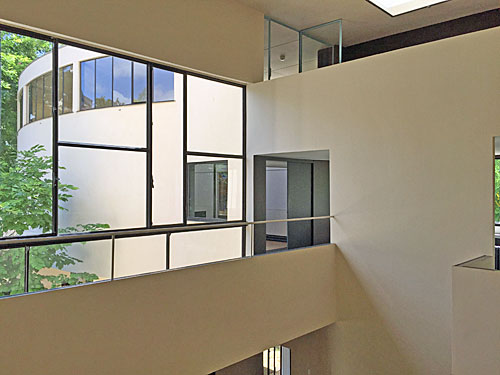
After engaging in conversation about tickets and rucksacks and blue plastic protective slippers, I was particularly chuffed to be given a copy of the house guide in French, which I then had to swap for English so I had a hope of reading it. Be warned that Le Corbusier didn't provide much space for luggage, and what little there is isn't especially secure. But the entrance hall does exemplify another of his Five Points, an open floor plan premised on a skeletal internal structure. This space rises three storeys, with irregular landings and balconies skirting its rim, all linked by narrow stairs. They've had to install netting across the top landing, I suspect to prevent visitors from accidentally tumbling over.
The most impressive space is the Gallery, a long room supported on those stilts we saw earlier. It bulges outwards, the dominant feature being a ramp which links the main room to a galleried library, and which can be a bit slippery to negotiate when you have blue plastic bags on your feet. The high horizontal windows running the whole length of the façade are another of the architect's Five Points, made easy to include when the external walls aren't loadbearing. Some sparse and quirky furniture only adds to the ambience. The far corner seems to be the optimal place for a photo, although it can be hard to stand there because it's often occupied by optimal photographers.
Several more normal rooms can be found stacked on the other side of the hallway, for dining, sleeping and abluting, because Maison La Roche had to be practical too. But climb to the very top and there's another treat, and another Point - a roof terrace "to form the transition between inside and outside". This one's long and segmented, with sheltered bits and curved bits and plenty of room for sunbathing, not to mention opportunities for chatting with the neighbours on their subtly different terrace nextdoor. This kind of design no doubt works best in countries with a warm climate, but what a wonderful use of limited space.
The last of le Corbusier's Five Points he called "la façade libre", specifically that if exterior walls aren't load-bearing they can be made to act as a curtain concealing the interior. That's certainly true here, as standing outside you have no idea quite what wonders are going on within. As I left, a fresh party of Japanese teenagers were streaming in and bootee-ing up, ready to discover this for themselves. Or more likely they were about to take some cracking Instagram shots, because if there's one thing le Corbusier understood a century ago, it's that great visuals never go out of fashion. [10 photos]
posted 07:00 :
Wednesday, July 11, 2018
(I think it's time for the football post)
I went walking in the Chess Valley at the weekend, enjoying some glorious views on a 10 mile hike from Chorleywood to Chesham. I particularly liked this view on the slopes above Latimer.
A few steps further on along the footpath, sheltering from the sun beneath a canopy of trees, I stumbled upon a large group of youths. They might have wandered in from the adjacent country house hotel, but they had a snappy staffie with them so it was more likely they were from the local village. There were enough of them to form a football team. A few were wearing a soccer jersey. I wondered how they'd react as I walked by.
The closest lad stopped chatting as I approached, turned to face me, and said "It's coming home!"
He actually means that, I thought. He genuinely thinks it is.
The tone of his voice was confident and smiley. He'd clearly been discussing the football with his mates before I arrived. He also felt certain enough in his beliefs that he could turn to a complete stranger walking by, make explicit his view of the future and expect them to agree too. I gave a brief response which must have sounded like I agreed, because I got a matey laugh in reply, but was in fact carefully judged to be utterly neutral. And I thought to myself, wow, what must it be like to have that level of belief in a process entirely beyond one's control.
I don't do belief. I've had every chance over the years, but I cannot place blind faith in something which might turn out to be entirely incorrect.
I could have believed in God. I got taken to church every week as a child, and got to experience all kinds of worship as a member of the choir. There was enough religion at school too, it being the default part of every assembly and the focus of a regular lesson every week. But I don't ever remember being convinced that the big invisible deity in the sky ever existed. My parents were good at leaving me to make up my own mind, and my own mind said don't believe, because I don't do belief.
I could have believed in politics. A lot of people get swept up, to left or right, and believe there's only one true way of doing things. They know their position, they know how they want their country to be, and they have unshakeable faith in how best to get there. I should make clear that most supporters of political parties are pragmatists, as are most politicians, willing to give or take according to debate. But fervent supporters plough their furrow no matter what the facts, and cannot be turned, and that's not me, because I don't do belief.
I could have believed in football. I latched onto a team aged six, and sort of followed them, but never took it as seriously as I could. I liked it if they won, but I didn't punch the sky if they won big, and I didn't feel despair if they lost. I worked out at an early age that my support wasn't going to make a blind bit of difference to whether my team won or not, that shouting at the TV was pointless, and that my life didn't end if results went the wrong way. I had every opportunity, but I never made football my credo, because I don't do belief.
In particular, I have never believed in my national team. I smile if they win, but I never expect them to be successful just because of who they are. I cannot tie my state of happiness to the one-off performance of a bunch of men solely because they happen to represent the country I live in. I am never 100% certain of the result before kick-off. I do not wake up on match days thinking "we are going to absolutely smash them". Football may be coming home, but I don't believe in my heart that it must.
To be clear, I'm not entirely indifferent about all of these things. To be even clearer, I'm not saying I don't do hope. I hope that all sorts of things will happen, and I suspect you do too. I hope that certain teams will win, that certain political ideas will be successful, that the future will be a better place, even that the weather will be nice. But I can never bring myself to move up the scale into the box marked blind faith, because I don't do belief.
INDIFFERENCE HOPE BELIEF
I like evidence. I can be swayed by an argument. I understand cause and effect. I know things aren't necessarily going to go the way I prefer just because I want them to. I'd say it stands to reason, but those who believe don't need a reason, they just believe.
I also have a grasp of probability, so I know there's a decent chance any football match could swing either way. It's fantastic that we've reached the semi finals of the World Cup, but to win the trophy we still have to win two more matches, and that's no dead cert. It's a bit like having to flip a coin twice and getting heads both times, which is a long way from impossible, but still less likely to happen than not. And yet some people reckon England's coin is heavily biased and should always come up heads, and they're the ones who believe.
I sometimes wonder if my life would be easier if I believed. A God who loves me for who I am. Brexit delivered no matter what the consequences. A devotion to anything Jeremy Corbyn suggests. Certainty that anyone who isn't white and British is a lesser being. And a national football team I could blindly follow to the ends of the earth, the right to victory guaranteed.
I have a theory that society is shaped, and democracies swung, by people who believe. But I'm more than happy not to be one of them.
posted 07:00 :
Tuesday, July 10, 2018
07:00 I am on a day trip.
07:01 I am on a train.
09:00 I am an hour ahead.
10.00 I am zipping alongside l'autoroute.
11.00 I am being serenaded by an accordion on the Metro.
12.00 I am on an architect's roof wearing blue plastic slippers.
13.00 I am walking the disused railway.
14.00 I am at The Thinker's feet, missing the flypast.
15.00 I am mortified, having just got the pictograms for male and female toilets the wrong way round.
16.00 I am back on the Metro, in search of a fizzy water fountain.
17.00 I am walking the other disused railway.
18.00 I am musing on the fact that I've only seen one tattooed Parisian since I arrived.
19.00 I am swept up in the rush to watch the World Cup at home, in a bar, or on the big screen outside the Town Hall.
20.00 I am far from the semifinals, eyeing up a silver orb on a concrete podium.
21.00 I am in the departure lounge, after 14 miles of walking (and 14 Metro trains).
22.00 I am very grateful to the EU for free data roaming (even if it is only for a year).
22.00 I am an hour back again.
23.00 I am really looking forward to a cup of tea.
posted 07:00 :
Monday, July 09, 2018
When does Crossrail open?
I ask, because TfL are very keen not to tell us yet.
Obviously it's December 2018. Everyone's happy to admit that much, from TfL on their website to the company delivering Crossrail itself.
But the precise start date is officially unknown, despite there being a target date everyone behind the scenes is working to, and it being an open secret what that date is.
There are several reasons for this secrecy. Firstly, the TFL Press Office has an announcement schedule pencilled in, and we haven't yet reached the day of the announcement. Secondly it's still perfectly possible that the launch of Crossrail will be delayed, say if the stations aren't ready, or the trains aren't fully tested. But most importantly we haven't yet been given an official launch date because THE OFFICIAL LAUNCH DATE MUST NOT BE INCORRECT. It would be mortifying for Crossrail to be seen to fail, even by a day, hence no official launch date will be given until everyone's sure it can be achieved.
The open secret launch date is Sunday 9th December 2018.
Evidence 1: 9th December 2018 is Timetable Changeover Day
Rail timetables across Europe change on two specific dates - the third Sunday in May and the second Sunday in December. Crossrail is a rail line, rather than a tube line, so it stands to reason its new timetable will kick off on Sunday 9th December. No other date was seriously in the running.
BUT when it opens in December, Crossrail will be in three distinct parts. Two of these mesh closely with existing rail services, i.e. Paddington to Heathrow and Liverpool Street to Shenfield. But all the new stations and new infrastructure will be on the line from Paddington to Abbey Wood, and that's entirely separate from every other National Rail line, which means TfL can run it or not run it however they damn like. Basically, if they don't start on 9th December, no other existing services will be affected.
Evidence 2: In September 2016 a Crossrail manager said it would be 9th December 2018
During Open House in 2016, certain Crossrail stations were opened up to a handful of the public to look inside. I went to Tottenham Court Road but Ian Visits went to Bond Street, where a loose-tongued Crossrail manager confirmed the official opening date as Sunday 9th December 2018.
BUT it could have changed since then, obviously. Although this shows just how long ago the target date was set.
Evidence 3: In October 2016 a consultation report said it would be 9th December 2018
It's fair to say few mortals got excited by 2016's "Crossrail Central Operating Section (CCOS) Proposed Network Statement" consultation, let alone took time out to read the accompanying documentation. But if they had, they'd have seen repeated clear indications of the start date: "We are seeking your views on our Network Statement for the Crossrail Central Operating Section valid in relation to the 2019 timetable (which commences on 9 December 2018)." Rock solid proof?
BUT the day a timetable begins isn't necessarily the same day a service begins, so perhaps we can only count Sunday 9th December as the earliest possible date.
Evidence 4: A recent board paper for a TfL committee says it will be 9th December 2018
TfL's Finance committee met last week and, as usual, its minutes and board papers were uploaded to the TfL website. Bosses sometimes hold back certain papers because they contain sensitive information. But Item 10 - Crossrail Central Operating Section - contained a specific indication that the operator MTR Corporation (Crossrail) Limited had been granted a concession "to run passenger services on the CCOS from 9 December 2018." That's another pretty definitive statement.
Evidence 5: Westminster council say it will be 9th December 2018
This is another spot by Ian Visits, and another bullseye. Westminster council's cabinet are meeting today to discuss the transformation of Oxford Street, pushing ahead with plans which don't involve pedestrianisation. Within the accompanying statement, published online, they refer to safety measures which "may be required in advance of the opening of the Crossrail stations at Tottenham Court Road and Bond Street, currently scheduled for 9 December 2018." That's a very definitive statement, and all the more convincing because TfL's Press Office haven't had their censoring fingers anywhere near it.
Evidence 6: Changes to bus services serving Custom House station are scheduled for 8th December 2018
Yes, I know that's Saturday 8th rather than Sunday 9th, but changes to bus routes are always rolled out on Saturdays, so this is as close as you can get. According to the website londonbusroutes.net, half a dozen changes are confirmed for 8th December, including the splitting of the 104 (into a 104 and a 304) and the rerouting of the 241, 300, 330 and 474. All of these changes were proposed last July as part of a Crossrail-related consultation. And if they're happening that weekend, then in these cash-strapped times this must be the weekend Crossrail begins.
But then there's the evidence for the prosecution.
Counter-evidence 1: TfL's "One year to go" press release appeared on 19th December 2017
You may remember this press release, it included a tube map with an extra purple line on it (and TfL's Press Office knows everyone goes nuts about a tube map). Nowhere in the press release was a specific date given, only "December 2018", but the headline was clear enough, beginning "One year to go". A lot of the media assumed this meant Crossrail would begin on 19th December 2018, which was precisely one year ahead, but it'd be astonishingly unusual for a new high profile railway line to be launching on a Wednesday.
Counter evidence 2: TfL's "11 months to go" press release appeared on 22nd January 2018
We've stuck up our first purple roundels, they said, along with a strapline saying "with 11 months to go until the opening of the new railway". If taken seriously, this would suggest three days before Christmas. Surely not?
Counter evidence 3: TfL's "10 months to go" press release appeared on 21st February 2018
We want six exclusive brand partners, they said, along with a strapline saying "to align with the historic launch in 10 months' time". Considering the dates of these last three pieces of evidence suggests that TfL's Press Office has been waiting until roughly the 20th of the month before daring to announce that Crossrail will be open in x months time. This might hint at a slightly later opening date in December, nearer the 20th than the 9th, allowing some wriggle room if things were marginally delayed. But then in April they did this...
Counter evidence 4: TfL's "8 months to go" tweet appeared on 13th April 2018
A tweet about test trains running under Victoria Dock merited an #8monthstogo hashtag, and this was published as early as the 13th of the month. Perhaps an earlier start for Crossrail was now planned. There again, I note TfL didn't risk a #7monthstogo or #6monthstogo tweet, or press release, so perhaps they're becoming a lot more cautious as the great day approaches.
Hearsay 1: Crossrail's running behind schedule.
An electricity substation exploded last year when they switched it on, putting the testing of trains months behind schedule. A software problem means the new Crossrail rolling stock still hasn't made it to Heathrow. Board papers referring to Crossrail milestones are routinely excluded from the TfL website. The construction of Bond Street, Paddington, Liverpool Street and Woolwich stations is running worryingly late, so much so that planned public Open Days have been cancelled. You won't find the TfL Press Office confirming any of these rumours, indeed some may be pure speculation rather than hard facts. But enough whispering is going on to suggest that all is not 100% well behind the scenes.
It is perfectly possible, even likely, that when Crossrail launches in December not everything will be ready. At best, some of the interior station decor may not be complete. Perhaps not every lift or escalator will be operational on Day One, or some of the cladding will be missing. More seriously, certain stations could launch with only one of their two exits open, because one out of two is initially good enough. In a worst case scenario, Crossrail could begin with one or two stations closed, and trains passing straight through while construction work completes.
In conclusion, an increasingly silent uncertainty is the main reason why TfL won't yet commit to announcing a launch date for Crossrail. But if it isn't Sunday 9th December 2018, FIVE MONTHS FROM TODAY, something will have gone disastrously embarrassingly wrong.
posted 07:00 :
Sunday, July 08, 2018
Local News: Burst water main causes flooding chaos in Bow
Around nine thirty on Friday evening, a pipe under Fairfield Road cracked. It took a bollard with it. Water gushed everywhere.
Stay away from Bow East London as the road has literally cracked open flooding the whole area in the last 20 mins #london #tfl #flooding pic.twitter.com/TUr7jcrlAh
— Honest Emily (@_honestemily) July 6, 2018
A lake erupted along Bow Road. Traffic suddenly found itself in deep water, up to half a metre deep in places.
Burst pipe in Bow causing flooding. Chaos. #flood #bow pic.twitter.com/y5wMrF3ENR
— Rory Campbell (@rufeus) July 6, 2018
Ten fire engines turned up, along with 72 firefighters and some private vans which said 'Floodcall' on the side.
And I would have been entirely oblivious to this, sat indoors just down the road, had Twitter not sprung into action.
[Fire Brigade tweet] [Met Police tweet] [1 minute video] [37 second video] [27 second video]
So I went out to have a look, taking care to fill my kettle first in case my water supply was about to conk out.
It's not every day you find several fire engines parked outside your house, the crew stood around while a thick tube descends into a neighbour's basement to pump them dry. Bow Road was very much sealed off to traffic. I got my trainers wet attempting to cross to the other side. A group of young people sat on the steps in front of the Roman Catholic church, beyond the police tape, watching proceedings.
Whilst the situation now appeared to be under control, and the lake had shrunk considerably, a flow of water was still making its way round the corner, past the supermarket and down either side of Bow Church. The drains in the blue gutters caught most of it, but some trickled onwards using the banks of the Cycle Superhighway as an artificial channel. One stream pooled above the ramped access to a bus stop bypass, then spilled over the top creating a particularly attractive water feature (unless you were a cyclist, but now was not the time).
The fire brigade hung around until dawn, and then Thames Water made a start on repairing the cracked roadway. In daylight the mess was obvious, with cracks and excavated rubble everywhere, and men in hi-vis with diggers doing their best. My taps were still running fine, but less fortunate properties were now reliant on an inadequate supply of free bottled water.
The bottom of Fairfield Road remained fenced off, denying passage to anything that wasn't on foot or two wheels, which was causing big problems on the buses. A blockage here meant no double deckers could get in or out of Bow Garage, so only buses which were out of the depot were still in play, and routes 8 and 205 were being forced to operate a 50% service.
At breakfast time Bow Road was also still closed to traffic, with a fine residue of light brown mud in places where the temporary river had been. A few puddles remained. At bus stop M, the Countdown display merrily announced the arrival of buses which weren't coming, indeed couldn't possibly have arrived. Cyclists and pedestrians enjoyed the opportunity to wander wherever the hell they liked, from the flyover all the way up to Campbell Road. Car drivers, forced to divert down inadequate sidestreets, were less chuffed.
By lunchtime the traffic on Bow Road was flowing again. By late afternoon the offending cracked pipe had been removed from underneath Fairfield Road and dumped on the roadway. Fresh blue plastic pipes were lined up close by ready to become a replacement connection. By dusk the water supply for numerous properties still hadn't been switched back on, which in this heat must've been no fun. The Bow Bells pub remained closed all day, due to a flooded cellar. And as for the hole, with underground spaghetti now visible threaded above an irregular void, it doesn't look like anything'll be driving over it any time soon.
Can you spot the old pipe that did all the damage? Hahah #bow #london #flooding pic.twitter.com/8b1VUlHRxn
— Honest Emily (@_honestemily) July 7, 2018
A couple of years ago this same corner of Bow Road and Fairfield Road caused considerable problems for contractors working on the upgrade of Cycle Superhighway 2, thanks to some awkwardness underground, and they had to keep coming back to do lengthy extra repairs. I also note that this latest cracked pipe has occurred at the precise point where Crossrail's northbound tunnel passes under Fairfield Road, which may of course be a complete coincidence. But best keep an eye.
posted 07:00 :
Saturday, July 07, 2018
Copper coins are hard to spend, but they add up. For years I've been storing my excess in a jar, or more specifically a giant plastic Coke bottle with a slot in the cap, accumulating quite a stash. I've always meant to do something with it, speculating I might have a windfall on my hands, and yesterday was the day I finally sprung into action. Would all the effort be worth my while?
There are several options for converting a haul of coppers.
1) Spend them
Copper coins are only legal tender up to 20p, so disposing of them this way involves buying a lot of stuff. If you spread these purchases out across an entire decade it becomes a lot more manageable, but scrabbling around with lots of small change never goes down well in shops. So we invariably get given more coppers than we spend, which is why they stack up.
2) Feed a machine
My local supermarket has a Coinstar machine which swallows coins and returns a voucher in return. But it also swipes 9.9% commission at the same time, so no way was I going to take my coppers there. I understand that all Metro Banks have a Magic Money Machine that's free to use, but my nearest is three miles away.
3) Bag them up and take them to a bank
For this you need some special plastic bags, and a bank. Copper coins should be bagged up £1 at a time. 2ps and 1ps should never be mixed. Be aware that a bank or building society will generally only take bagloads of coins off your hands if you have an account with them.
I went with option three.
3a) Get some bags
Only one bank survives on Bow Road these days, and it's not mine, so I headed into Stratford instead. I had to queue at the main counter, which took a while, because several people in front of me were trying to undertake lengthy complex transactions. Meanwhile several people behind me were getting angry, and making exasperated remarks, even tutting. I started to worry that when I came back with a barrowful of coppers, the queue's ire would be targeted on me. But eventually I got my bags - a few more than I thought I'd need - and confirmed that the bank had no upper limit on how many I could bring back.
3b) Unleash your coins
Pouring all my coins out of my giant plastic bottle proved harder than I expected, and required a heck of a lot of shaking to force everything through the neck. Suddenly I had a huge pile of mixed coinage in front of me, surely numbering into the thousands. They had that dirty accumulated coin smell when handled. I decided to start by picking out as many 2ps as I could, counting as I went, rather than separating everything in advance.
3c) Count your coins
Counting is important, because each bag has to contain exactly 100 1p coins or exactly 50 2p coins. It pays to be correct because a cashier will be checking later, and you'll start looking annoyingly incompetent if proven innumerate. I double counted, because I was mortified of being shown up in public. First I separated out what I hoped were piles of £1, 2p coins first, then 1ps. This took the best part of an hour. Then (to be extra careful) I counted those piles into bags, 10 coins at a time, counting again if the numbers didn't tally. This took the best part of another hour.
3d) Bag your coins
I felt a slight sense of smugness at this point, as I saw the unruly portion of my life savings laid out under firm control. But it doesn't pay to get ahead of yourself. A very important thing to do at this stage is to make sure every bag is sealed properly, to prevent loose coins escaping later in the process, which as I later discovered is a bit embarrassing.
3e) Count your piles
I found I had thirteen piles of 2p bags, and 14 piles of 1p bags. That's twenty-seven bags altogether, making a total haul of £27. That's not to be sniffed at, although it's not as amazing as I might have expected after almost two decades of collecting. I thought it was probably no coincidence I had roughly twice as many 1ps as 2ps.
3f) Take your bags to the bank
I had thought I might be able to carry my £27 in an ordinary carrier bag, but when I lifted it up I realised I'd need to switch to a rucksack. Here's a fact about copper coins - a 1p coin weighs 3.56g and a 2p weighs 7.12g, deliberately twice as much. This means every £1 bag weighs in at 356g, and 27 bags is knocking on ten kilograms. The richer you're about to become, the heavier your burden.
3g) Queue in anticipation
This time it's serious. This time you are going to induce consternation in those behind you when they spot you unloading bags of small change onto the counter. Hold your nerve, because for all you know some of them are planning transactions that'll take even longer. I compounded the problem by turning up just before closing time on a Friday (but this actually worked out well because by the time I reached the counter they'd closed the queue to fresh joiners).
3h) Hand over your bags
To her credit, the cashier didn't sigh, at least outwardly. Instead she reached for her little balance and tested each of my bags one at a time to ensure it really did weigh 356g. Dammit, Bag One was 1p short, so I already looked a pillock... but thankfully I'd had the sense to bring a few spare coppers with me (top tip!), and handed one over, and we were back on track. Altogether I handed over three extra coppers to make up for my miscalculations, but thankfully I seemed to get the other 24 bags right, so earned my brownie points back.
3i) Take your money
I wasn't given cash in return, I had to stick my card in the terminal and the money went straight into my account. Hey presto, that pile of coins that'd been clogging up my house for years was suddenly something more useful, and could actually be spent. I now had £27 to spend on a train ticket to the coast, or a night down the pub, or a heck of a lot of penny chews, depending. I'm just trying not to think about how inflation means I'd have been better off spending my coppers at the time, rather than waiting until 2018 to cash them in.
3j) Return to your life
Impressively, my time at the counter only totalled six minutes. The woman beside me was still in the throes of a much longer transaction, trying to pay her mother's care home bill, and I felt almost virtuous for not tying up the cashiers for longer. I walked out with a receipt and an empty rucksack, and basically something for nothing. Sometimes a little bit of effort pays off, but I must try not to do it too often.
posted 07:00 :
Friday, July 06, 2018
In recent years, TfL have made sterling efforts to encourage visitors to London onto the tube, the river, hire bikes and (especially) the cablecar. But only rarely have they gone out of their way to suggest that tourists take the bus, leaving the market clear for the high-priced open top sightseeing brigade. So you may be interested to hear of a new initiative on the TfL website, under the Experience London umbrella, introducing a series of 'bus leisure routes' for tourists.
These aren't special extra buses, there'd be no money for that. Instead these are five existing routes, rebranded 'bus leisure routes', each backed up by a downloadable pdf telling tourists how to ride. Take your pick.
Bus leisure route 9: London's Museums and PalacesBus leisure route 9, for example, starts at Somerset House and heads to Holland Park, ticking off three palaces and six museums along the way. Bus leisure route 17 whisks you from King's Cross to London Bridge via four historic hostelries. Bus leisure route 22 covers Fulham Palace to Piccadilly, featuring the King's Road and Royal Academy. Bus leisure route 139 skips from Waterloo to Abbey Road via Hamleys, Selfridges and Lord's Cricket Ground. But I picked at random, which is why I'm now going to tell you of my experiences on bus leisure route 35, from Brixton Market to Columbia Road.
Bus leisure route 17: Heritage and Pubs
Bus leisure route 22: Antiques and Curios
Bus leisure route 35: London's Markets
Bus leisure route 139: Classic London
Bus leisure route 35: London's Markets
Brixton Market
Bus stop T: Brixton Station
We're off to a cracking start. Brixton Market is just the kind of non-central gem a visitor to London could easily miss. The online blurb confirms that the local speciality is African and Caribbean produce, and contains a hint that change is afoot, noting that Granville Arcade has recently rebranded as ‘Brixton Village’. Faultless so far.
Borough Market
Bus stop G: Union Street
Bus stop M: London Bridge
Next stop Borough Market. But what the linear map completely fails to mention is quite how far this is from Brixton on a number 35 bus. The 133 does the journey more directly, and gets there faster. Most Londoners would surely take the tube instead. But this is bus leisure route 35, so we're taking the 35, even if that means crawling via Camberwell for 40 minutes. If you're a temporary visitor to London, I'm unconvinced that sitting pointlessly on a busy double decker is the optimal use of your time. I can't say I enjoyed the experience. Bus leisure route 35 does pass two well known markets along the way, namely East Street Market in Walworth (birthplace of Charlie Chaplin) and the Elephant & Castle shopping centre (while stocks last), but I guess they're not sufficiently iconic to get a mention. And even when you do finally reach Borough Market, it turns out that one of the suggested bus stops (Union Street) is a bit of a hike, whereas the other (London Bridge) is almost outside. After an unproductive four mile journey, thank goodness the food offering is tip top.
Leadenhall Market
Bus stop M: Fenchurch Street
Bus Stops L/N: Threadneedle Street
Here's a very different kind of market, more a collection of upmarket shops, but under a fabulously decorated roof, and of course it's been in Harry Potter. Leadenhall Market is easily reached by bus leisure route 35, three stops across the Thames, and the onboard display even announces the correct stop as 'Fenchurch Street for Leadenhall Market'. There's just one catch at present, which is that long-term roadworks are forcing a diversion via Bank so the 35 no longer stops outside. Will Old Broad Street do? It's not clear, but expect a walk.
Lloyd's of London
Bus stop M: Fenchurch Street
Bus Stops L/N: Threadneedle Street
After a four mile hiatus earlier in the route, markets three and four turn out to be in the same place. The trail map's good, because it suggests you should walk from one to the other rather than take the bus, estimated walking time 2 minutes. But the linear map's misleading, because it shows the two attractions at different stops, rather than the same one. Also, see how creatively our trail curators are interpreting 'market' here, Lloyd's being a building with a distinctly financial flavour. It is an amazing architectural confection, but there's not really very much to do here apart from briefly look at it.
Spitalfields Market
Bus Stop L: Liverpool Street Station
Bus stop H Primrose Street
Again the map offers two bus stops to get off at, but the second one is closer. The first stop is actually announced as 'Liverpool Street Station for Petticoat Lane Market', but alas Petticoat Lane's Sunday revels haven't been deemed worthy of inclusion. Thankfully Spitalfields is another excellent London market, or at least one an international visitor would consider as such, with its focus on designer goods rather than cheap kitchen scourers. Bus leisure route 35 has again hit the spot.
Brick Lane
Bus stop H: Primrose Street
But here the trail loses it somewhat. Brick Lane is only five minutes walk from the far side of Spitalfields Market, as the text on the map carefully points out. But bus leisure route 35 goes nowhere near Brick Lane - the 67 and 205 go closer, and the 8 would be a better bet. This is the point on the trail where wishful thinking disconnects with reality, because bus routes don't magically link specific categories of tourist attraction. It's all got a bit contrived... and then it gets contriveder.
Columbia Road Flower Market
Bus Stop X: Shoreditch Town Hall
Shoreditch Town Hall is the stop where the bus terminates, so you have to alight here and walk for 10 minutes to reach Columbia Road. The alternative is to carry on walking from Brick Lane, which is 15 minutes, depending on which end of Brick Lane you start. Visitors would have been better off catching the 26 or 48 from Liverpool Street, but the map isn't allowed to tell you that because it has to maintain the bus leisure route 35 mystique. What the text does correctly warn is that Columbia Road Flower Market only operates on Sundays, as does Brick Lane Market... except Sunday's the only day Borough Market isn't open, so it turns out there isn't a day of the week you can tick off the whole list in one go.
I did not enjoy my journey on bus leisure route 35. One outlier in Brixton and everything else on the eastern border of the City does not make for a happy ride. If I'd taken you on bus leisure route 22 instead, I'd have been moaning about how the last seven places all occur after the point marked "Get off the bus here and walk to the remaining locations". If I'd taken you on bus leisure route 9, I'd have been more positive, but less happy that the bus stopped at the wrong end of Exhibition Road for all the museums. If I'd taken you on bus leisure route 17, I'd have been raving about the pubs, but pointing out that the listed "Heritage" felt a bit random. And if I'd taken you on bus leisure route 139, I'd have groaned at how lowest common denominator touristy it all was, but actually I suspect that means it's the most successful of the lot.
It's great to see buses getting a bit of promotional love from TfL for a change. But the contrived nature of these bus leisure route journeys leads me to suspect that they could end up wasting tourists' time as much as opening their eyes to some proper treats. I'm also disappointed that the quintet doesn't include TfL's most obvious slamdunk tourist bus, the heritage Routemaster service which shuttles between Trafalgar Square and Tower Hill, passing St Paul's Cathedral along the way. Bus leisure route 15 should be getting far more attention from TfL than it currently affords, and I eagerly await its appearance in this peculiar portfolio.
posted 07:00 :
Thursday, July 05, 2018
Hastings has no ordinary pier.
1872: Pier opens
1999: Pier goes into administration
2001: Pier reopens under new management
2006: Pier found to be unsafe, and closes
2007: Pier partly reopens
2008: Pier found to be unsafe, and closes
2009: Pier "one storm away from collapse"
2010: Pier mostly destroyed by arson
2011: Pier wins Lottery grant
2016: Pier reopens under community ownership
2017: Pier wins Stirling Prize
2017: Pier wins "Pier of the year 2017"
2017: Pier goes into administration
2018: Pier bought by private businessman
25 June 2018: Pier reopens
Hastings Pier once looked quite ordinary, as piers go. A pavilion down the end, with refreshment, amusements and entertainment on the way. But for the 21st century it's been reimagined as a free space, rather than a collection of buildings, and resembles a long wooden tongue stretching out into the English Channel. [website] [webcam] [history]
What immediately strikes you is how empty it is. This is deliberate. An enormous public platform over the sea has huge potential, "inspiring temporary installations and events across a variety of scales". The freedom to roam above the waves and gaze back towards the resort is exhilarating. But generating sufficient reason to visit has proved problematic, and the absence of income proved the downfall of the previous community-led administration.
Only one building has survived arson, storm damage, and reconstruction, and that's the restaurant. A gently-curving glass-fronted building, it's long and thin with a rack of seating outside for nice weather. It was well-frequented in the blaze of yesterday afternoon. But its signage is underwhelming, its closed doors aren't quite welcoming, and its menu is poised one rung above the chippie takeaways in the heart of the town.
The one new permanent structure is a wooden pavilion in the centre of the pier, made from timber rescued after the 2010 blaze. It's a highly attractive multi-purpose space, with steps on one flank where a entire group of French schoolkids might sit, leading to a cafe on the upper deck. This sells beer and snacks, which can be enjoyed sitting atop the pier and gawping seaward, which I can certainly recommend. But the draught beer was off, the serving girl didn't know where the bottle opener was or how to make a coffee, and the function room on the ground floor was wasted dead space because there wasn't an event on.
To either side of the pier are some large beach huts, painted in an optimal spectrum of seaside colours. There are five huts on one side and seven on the other. A couple sell drinks and ice cream, one sells tasteful crafty goods, one is a photo booth and one contains gender neutral toilets. The best hut contains the 21 saucy McGill seaside postcards which were deemed too obscene to sell, including one about a pickled gherkin, one about a bathtime whistle and a frankly astonishing design in which a giant stick of rock emerges from a man's groin. But the other huts were closed, nobody was around to whip up interest, and a commercial buzz was missing.
Walk all the way down to the end of the pier, across empty timbers, to find a few benches and a telescope. Display boards tell you what to look out for (mostly boats and birds), how long the pier is (277m) and what percentage of trusses had to be repaired as part of the restoration (70%). But there isn't much to see other than sea, and there are very few benches, indeed there aren't many benches across the entire pier, either to maximise the space available for temporary events or to funnel those who want to sit down into a refreshment setting. I would have liked a better reason to linger at the end of the pier, or indeed to linger anywhere.
It'd be dangerous to jump to conclusions about the state of a pier less than a week after it's reopened under new management. Most of what's present will have been there before he bought it, and some may not have survived the transition. But the local community are certainly angry about the buyout, given that they'd raised almost half a million pounds to keep the pier as a public asset, only for the administrators to sell it to a businessman for fifty thousand instead. He sounds a bit of a 'character' too, having recently painted his other pier in Eastbourne gold (without planning permission) and ever ready with an excitable quote (telling the community to thank him and stop moaning). This could all end very badly, or he might be the commercial shot in the arm the pier's long-term finances desperately need.
A big retro drum and bass festival is taking place on the pier this Saturday, if you fancy bouncing around to Evil B and Skepsis, plus DJ Hazard on the decks. Next month's long-planned Gilbert and Sullivan double bill has however been unceremoniously kicked out somewhere else, as a result of the administrative changeover, so all is not well on the events front.
Hastings Pier is a glorious space to perambulate, an open canvas for opportunity, and a refreshingly different take on seaside recreation. But the absence of physical stuff could easily result in an absence of purpose, and there is a risk its turbulent history might succumb to yet another magnificent failure.
posted 07:00 :
Wednesday, July 04, 2018
The new American Embassy in Nine Elms opened six months back, if a fortified cube on an island within a moat can ever be described as 'open'. It's even less open than usual today, it being Independence Day when all the visa-stampers get the day off. But the sharpshooters will still be in place, and the security cameras will still be whirring, indeed if I've not been automatically added to some security database after walking round the perimeter taking dozens of photos I'd be very much surprised.
Kieran Timberlake's space-age cube is a genuinely striking building, not least because three of the four sides have been covered in strings of silver sails to keep the sun out. These also help to keep whatever's going on inside a bit more secret, as well as looking mighty fine in full-on solar glare. Meanwhile the north face is allowed to be plain glass without wrecking the building's top-class environmental credentials, which must be nice for those working inside, because the River Thames provides the only view that isn't highrise flats.
Somewhat unexpectedly, for a secure citadel, the flank facing Nine Elms Lane is open and welcoming. A footpath leads down through well-tended beds planted with colourful Stateside blooms, watched over by what looks like a full-time gardener keeping everything watered and spruce. Official visitors and office staff continue to the East Pavilion, the main entrance for pass-waving and checking in, past a man in black with a big handy gun. But fear not, any casual passer-by can instead dogleg back along the lakeside, take a seat, and maybe watch the ducks.
I was surprised by the ducks. I was also surprised by the length of the bench, which curves round for a good fifteen yards, allowing plenty of space to settle. The poolside planting looks positively sylvan, and the waterfall churning over both sides of the island adds to the ambience, but in truth this is all part of the passive security screen which keeps terrorists at bay. No explosives-packed truck is going to ever make it across this lake, but then it wouldn't have made it past the pavement either, because the embassy's perimeter hedge conceals a dense ring of chunky black bollards.
Would-be American citizens, and lesser consular visitors, are asked to enter the complex round the back. It's a bit of a hike at present, while the adjacent plots remain development sites, and passes the back of the first set of flats to be built hereabouts. Thankfully someone had the sense to get the local Waitrose up and running long before the embassy dropped in. Mind any reversing lorries as you approach, try not to antagonise yet more cops with guns, and manoeuvre past several more police cars than would be deemed necessary anywhere else.
Only drop in at the West Pavilion if you've a delivery to make. Visa-seekers need to head to the South Pavilion, a long curved cabin with full-on airport-style security, which grants the favoured entry to the inner sanctum. BestMate tells me a sweeping outdoor pathway leads up to a proper entrance in the southwest corner of the cube, which is also what the map engraved by the poolside shows, so it's hardly a secret. Give it a few years and I'm sure it'll look properly imposing but, as I mentioned earlier, a building site vibe remains unavoidable today.
Some of those trekking past may be local residents. Already open, squeezed between the embassy and the railway viaduct, is a Bellway development called The Residence. Because it's a late 2010s project you already know exactly what it looks like, the only distinguishing features being higher than usual ceilings, and an orangey palette to accent the brickwork round some of the windows. I wouldn't call any of the four core residential buildings a "striking edifice", but the marketing did, and they sold, so all's well.
But the chief development here is called Embassy Gardens, a disjoint three-phase "diplomatic precinct" which will eventually deliver 2000 homes. Phase 1 is up and running and has that Waitrose. Phase 2 is nearing completion, and is the site of the notorious Sky Pool which will allow rich swimmers to doggy paddle between two rooftops 35m above the ground in a transparent trench. The guard rail's already up, but anyone planning to ogle the privileged from ground level will have to wait until the scaffolding comes down. And Phase 3 remains at a skeletal stage, should you fancy popping into the sales pavilion and spluttering the word 'affordable' to see what the reaction is.
Meanwhile, back in Mayfair, the American flag no longer flies over Grosvenor Square. That gilded bald eagle is still looking down from the roof, but the grim little check-in capsules out front are now empty, other than a token gun-free security presence, and the statues of Roosevelt and Reagan outside look somewhat lost. Obviously the building's destiny is to become a luxury hotel, obviously Qatari-owned, because who wouldn't want to stay in a defensive administrative bastion? A two-week programme of cultural events is underway in the square outside, culminating in the inaugural Mayfair Sports Day on Friday 13th, but don't expect President Trump to drop by. The US embassy has moved on, and seemingly taken the special relationship with it.
posted 07:00 :
Tuesday, July 03, 2018
One way of showcasing your country to the world is to open a cultural hub. A place to nurture a deeper understanding and appreciation of your nation in the international community, a focus of enrichment to communicate your countless charms to the rest of the world. That's what Japan have done with a trio of hubs across three continents, one in Los Angeles, one in Sao Paulo and one on Kensington High Street. Turn right out of the tube station... M&S, H&M, Japan House.
Each hub features an exhibition space, a multi-purpose space with theater facilities, a retail space, food and drink, books, online connectivity, and a cafe space. The project merges together these functions, and the activities they enable, to introduce a variety of themes, in detail and with substance: the future of tradition, the passion of popular culture, the power of advanced technology, and the diverse appeal of Japanese food. Activities are designed to appeal to as wide an audience as possible, including those with no previous interest in Japan.Japan House isn't a new building, rather a beautifully-converted shop. Until recently it was a Gap, and if you go way back, the corner of Derry & Toms. What it reminded me of was a small Apple store - open plan, tables of product, white and black decor, and a sleek spiral staircase corkscrewing down the centre. It's free to enter. The doorman is unfailingly polite. The counter immediately inside the entrance sells matcha tea. You'd expect nothing less.
Beyond the caff (and the comfy chairs), the rear half of the ground floor forms the shop. It's stocked not with Hello Kitty t-shirts but a curated collection of design-led manufactured goods (or as the Japanese call it, monozukuri). Everything oozes practicality and style. Goodies include bronze sake bowls, jointed wooden hangers, plaited bamboo boxes, kitchen graters and rainbow crayons. One manufacturer has brought over a complete set of accessories made from brown paper, including shoes, purses and handbags. If money is tighter, target the tenugui - a set of colourful multipurpose cloths.
Another focus is art, the inaugural exhibitor being architect Sou Fujimoto. Upstairs, as a kind of window display, he's stuck various household objects on plinths and called it 'Architecture is Everywhere'. A handful of Pringles ("layering hills is architecture"). A skew pile of matchboxes ("separating and connecting"). An upside-down glass ashtray ("a cave turned into architecture"). An upturned kitchen scourer ("people live in nooks and crannies"). It's all appallingly pretentious and yet somehow, as serendipitous inspiration goes, rather great.
A lot more of Sou's models are in the proper gallery downstairs. Some are just sugar lumps with leaves on, or slanting multi-coloured glass bricks, or interwoven paper strips, and hardly practical. But other ideas have been worked up into potential buildings, like a spiral library or a web of rising staircases, and his tower of petal-like apartments destined for Montpelier looks amazing. Light and delicate, and uncommonly creative, you have until 5th August to peruse the assembled mini-structures.
Also downstairs is a small library where you can read up on cherry blossom, cities and historic art. On the top floor is a proper sit-down restaurant, named after its chef Shimuzu Akira. And at the back of the ground floor is a very small travel centre, with free transport maps and travel brochures, assuming your visit to Japan House has inspired you to visit the real thing. It certainly won't have put you off.
posted 07:00 :
There are more 53 year-olds in the UK than any other age group.
According to the latest figures, the population of the UK hit 66 million in the middle of last year.
At the time, there were 940,080 52 year-olds, comfortably ahead of those aged 50, 53 and 51.
Hence a year later, assuming we haven't all died or migrated, 53 must be the most common age group.
I never realised quite how commonplace I am.
Using the ONS's wonderfully detailed spreadsheet, and applying similar reasoning, here are the most common age groups in various parts of the country...
2: Barking & Dagenham
6: Blackburn, Bradford, Bolton
20: Oxford, Cambridge, Canterbury, Cardiff, Leeds, Portsmouth, Sheffield, Swansea, Belfast
22: Tyne & Wear
26: Glasgow
27: Edinburgh, Merseyside, Greater Manchester, West Midlands, Bristol, Hull, Islington
29: Bexley, Havering, Southwark
30: Newham, Tower Hamlets
31: Hackney, Lambeth
32: London, Brent, Ealing, Wandsworth, Westminster
35: Lewisham, Waltham Forest, Watford
36: Croydon, Enfield, Harrow, Sutton
37: Bromley, Hounslow, Kensington & Chelsea, Milton Keynes, Redbridge, Slough
38: Greenwich
50: City of London
51: Essex, Surrey, Worcestershire
52: West Midlands, Cambridgeshire, Hertfordshire, Kent
53: UK, England, Scotland, Northern Ireland, Leicestershire, West Sussex
54: Wales, County Durham, Cumbria
71: Cornwall, Devon, Dorset, East Sussex, Lincolnshire, Norfolk, Northumberland, Somerset, Suffolk
posted 00:53 :
Monday, July 02, 2018
Every Londoner loves an Aperol Spritz, but free travel is even better.
So we were proper gobsmacked when we discovered the tube has a Hidden Secret Fare Zone, and you could be paying a lot less for your journey than you think!
The magic happens across the Zone One/Two boundary, in what we've creatively decided to call Zone One And A Half. And it only happens at peak times because, well, here comes the full rundown.
Every tube journey within Zone 1 costs £2.40, tops. Every journey between Zone 1 and Zone 2 also costs £2.40 during the off peak. But at peak times that Zone 1→2 journey shoots up to £2.90, a massive 20% extra... UNLESS your journey is in the hidden secret zone.
Imagine, for example, you're at Euston in the rush hour and you want to go to Mornington Crescent. The negronis at La Patagonia are enough reason for anyone, huh? Euston's in Zone 1 and Mornington Crescent's in Zone 2, so you'd expect the trip to cost £2.90. But TfL are kind because they know it's only one stop, so here's the rub, THEY ONLY CHARGE YOU £2.40.
They call these cheaper trips Short Distance Cross Boundary Journeys. Brief hops of a station or two, from one side of the dividing line to the other, which secretly cost you less. And £2.40 rather than £2.90's not to be sniffed at. That's a potential saving of £1 a day, or £20 a month, which is easily enough to pay for your next Contactless Cheese Festival, or whatever.
Here's a map of the Secret Hidden Journeys you can make from Lambeth North.
Kennington in peak hours, £2.40. Oval in peak hours, £2.40. Not £2.90. And nobody tells you that.
Sometimes it's even better than that. Here's a map of the Secret Hidden Journeys you can make from Paddington. Wow.
You can go all the way down the Hammersmith & City line to Wood Lane for £2.40, for a proper full-on splashout at Westfield. You can go all the way up the Bakerloo line to Kilburn Park for £2.40, not that we can imagine why anyone would. And oddly you can zigzag down to Holland Park for £2.40, for a selfie in the Kyoto Garden, because sometimes changing line is OK too. TfL's amazing pricing computer just knocks off the discount automatically, without you even noticing.
And it works the other way round too, from Zone 2 into Zone 1. Here's a map of the Secret Hidden Journeys you can make from Camden Town.
Blimey, who'd have thought? Camden Town to King's Cross and the Eustons you might have expected. But Camden Town to Oxford Circus is miles, and that's only £2.40 in the rush hour, ditto Tottenham Court Road. But not Holborn, because that would be pushing it, nor Angel, which still costs £2.90 even though it's only three stops away. That flash-grilled avocado taco at Wahaca will have to wait!
Finally here's a map of the Secret Hidden Journeys you can make from Whitechapel.
This is amazing. There are SIXTEEN Zone 1 stations you can travel to more cheaply from Whitechapel than TfL admit. All the way down the District line to Mansion House or up the Hammersmith & City to Farringdon. As far as St Paul's or Old Street or London Bridge via a change of train. The Overground and DLR get in on the act too, as cheaper fares to Shoreditch High Street and Tower Gateway confirm. Even a couple of short Crossrail journeys will be cheaper at the end of the year when the purple line kicks in. It's a Hidden Secret Bonanza!
Start one stop further out at Stepney Green and only five of these destinations get the cheaper treatment. Start at Mile End and there's only one, namely Aldgate East, and everywhere else in Zone 1 costs the full £2.90. But hey, that's still a lot better than nothing, and everyone loves something for nothing, QED.
Yes, we know, it's all very complicated. That's because there are 170 Secret Hidden Journeys altogether, so we can't even draw you a simple map. We could link to TfL's database of Short Distance Cross Boundary Journeys, obtained via a Freedom of Information request, but patronisingly we doubt you'll be able to understand it. Instead just look at our pretty pictures, and be wowed, and retweet this Utterly Amazeballs News wildly on social media.
TfL could be charging you 50p less for your tube journey this morning than you think. And if that isn't a good excuse for an extra strawberry in your Pimms, you're playing London wrong, right?
n.b. Short Distance Cross Boundary Journeys genuinely exist, honest, but are hidden and secret.
n.b. Short Distance Cross Boundary Journeys do not apply to stations on the boundary of Zones 1 and 2.
n.b. Short Distance Cross Boundary Journeys only exist between Zones 1 and 2, there are none further out.
n.b. Short Distance Cross Boundary Journeys can also be identified via the Single Fare Finder, but only if you think to look.
posted 07:00 :
Sunday, July 01, 2018
THE UNLOST RIVERS OF LONDON
The Ravensbourne
Gidea Park → Hornchurch → Elm Park (3½ miles)
[Ravensbourne → Beam → Thames]
Don't get your hopes up. This is the Ravensbourne in Havering, not the long and important river of the same name in southeast London. It flows south between Romford and Hornchurch, missing both. It goes pretty much nowhere the average Londoner has heard of, too far east to be on the capital's radar. Unless you've lived or worked locally, my description of its route will bear absolutely no relevance to your life. But if you're still with me, let's go. [Google map] [1921 OS map] [1975 map]
The Ravensbourne used to rise at Gallows Corner, once a place of gibbetry, now a five-arm roundabout with flyover and KFC drive-thru. Don't go looking for the source here, it's long vanished beneath the tarmac. But what's great about this particular river is that downstream very little has been buried, so it only takes two streets for the fledgling brook to appear. It pops up on Ferguson Avenue, south side only, emerging from a culvert into a deep concrete ravine between two houses.
Initially there's only a shallow trickle, barely enough to cover the bed, but what do you expect after a month with virtually no rainfall? This upper section of the Ravensbourne once formed the boundary between the Municipal Borough of Romford and Hornchurch Urban District, so the bungalows on the west bank are older than the semis on the east. A tiny footbridge links the two parallel avenues a little further down, and then the river hits a railway cutting and has to duck deep underneath.
The obstruction is the Great Eastern mainline, otherwise known as the line out of Liverpool Street, and soon to be cast in purple. A locked gate leads down to the Gidea Park Traincrew Depot, a substantial set of sidings where several Crossrail trains will be stashed, though full of less sparkly stock at present. On the other side of the tracks are the remains of the Romford Factory, one of the very first locomotive works, which thrived briefly in the 1840s and was then turned over to making tarpaulins to cover goods trucks instead. Some of Havering's few tower blocks now cover part of the site, while the South Range, Sheet Drying Shed and Grease Factory and Sponge Cloth Laundry have been incorporated into a much more modern development. [pdf history]
The river flows on into Haynes Park, the largest greenspace in Squirrel's Heath, preserved for recreational purposes in 1937. The Ravensbourne forms part of the conservation area down the western side, edging a delightful meadow, if bleached-yellow and tinder-dry at present. I was amazed to have the entire northern half of the park to myself, a good eight acres, despite it being mid-afternoon on a glorious summer's day. Maybe nobody plays football on World Cup days, or maybe the lack of an entrance at the northern end of the park discourages visitors, but with this level of indifference on display I fear it may be only a couple of decades before suburbia's unloved parks get churned up for housing.
Northumberland Avenue has some lovely detached homes, the best on the walk, indeed the entire area's much more pleasant than you'll think it is if you've never been. Gidea Park might well be my top tip for Crossrail living, with more suburban bang for your zone 6 buck. The bus shelters in Slewins Lane currently feature a poster for a missing cat wearing a studded diamante collar. Brooklands Gardens boasts spacious semis with topiary orbs hanging out front. Only one St George's flag in Lewis Road has 'the Sun' printed in the corner. The dip of the Ravensbourne is plainly evident in Hillview Avenue, even if the tiny balustrade above the culvert is hard to spot. Somewhere behind the bungalows' back gardens, the Ravensbourne's first tributary feeds in.
Our next railway obstruction is the runtiest stretch of the Overground - the line between Romford and Upminster. To cross it requires a serious detour to find the alleyway round the back of the garages, then retracing to the rear of Courage Close. Here we find one of London's handful of pedestrian level crossings, a brief trot across a gated single track, with Emerson Park station just visible in the distance. This is why you've never been. It takes a few more minutes to hike back to the line of the river, here concealed behind the line of Lyndhurst Drive. This is quintessential 1940s Havering, and boasts more than its fair share of black cabs, plus some allotments and a salon called Hairport. The houses in this particular street, I can confirm, currently have a 5% take-up rate of flapping England flags.
Next we reach Ravens Bridge, a once-rural crossing point on the road from Romford to Hornchurch, and only a short walk from the latter. It's possible to walk alongside the river for the majority of its final mile, because this is where we enter Harrow Lodge Park, slipping down a shady path alongside the cricket ground. The stream still barely fills its broad channel, until it joins with a brief piped-in tributary and flows down a weir into something deeper that a fish could conceivably live in. The occasional discarded trolley and broken paving slab intrude, but the mown riverside path is a particular pleasure after all that pavement-bashing.
Hornchurch Sports Centre is the dominant feature at the top end of the park, then a trio of blocks of flats, and then the enormous artificial lake. The Ravensbourne was dammed in the mid-50s, and creates an impressive centrepiece, with one half for boating and the other for pedalo-free waterfowl. The Lakeview Palace cafe is a big draw, where former EastEnders can sit out front with a proper cooked breakfast and check the racing in folded tabloids, while tattooed parents take their angels out in swan-shaped paddle boats. Beyond the dividing footbridge a windpump keeps the real swans' lair properly aerated. The grass alongside is covered with downy feathers, and more unspeakable deposits, hence the wise picknicker sprawls further upslope.
And that's it for surface water, because beyond the dam the Ravensbourne returns to pipes beneath the park for its last few hundred yards. But you can still tell where it used to go, through an undulating patch of oak woodland with dips and climbs, and hidden paths few visitors follow (because the playground to the south is a much bigger draw). The river only pops up again unseen round the back of the Maylands Health Centre and Parkview Dental Practice, crossing overgrown scrubland to join the River Rom, which from this point on is known as the Beam River. And even though that's worth a walk, I've blogged it already, so just the Ravensbourne will do.
» London's Unlost Rivers
...or read more in my monthly archives
Jan26 Feb26 Mar26 Apr26 May26 Jun26 Jul26 Aug26 Sep26 Oct26
Jan25 Feb25 Mar25 Apr25 May25 Jun25 Jul25 Aug25 Sep25 Oct25 Nov25 Dec25
Jan24 Feb24 Mar24 Apr24 May24 Jun24 Jul24 Aug24 Sep24 Oct24 Nov24 Dec24
Jan23 Feb23 Mar23 Apr23 May23 Jun23 Jul23 Aug23 Sep23 Oct23 Nov23 Dec23
Jan22 Feb22 Mar22 Apr22 May22 Jun22 Jul22 Aug22 Sep22 Oct22 Nov22 Dec22
Jan21 Feb21 Mar21 Apr21 May21 Jun21 Jul21 Aug21 Sep21 Oct21 Nov21 Dec21
Jan20 Feb20 Mar20 Apr20 May20 Jun20 Jul20 Aug20 Sep20 Oct20 Nov20 Dec20
Jan19 Feb19 Mar19 Apr19 May19 Jun19 Jul19 Aug19 Sep19 Oct19 Nov19 Dec19
Jan18 Feb18 Mar18 Apr18 May18 Jun18 Jul18 Aug18 Sep18 Oct18 Nov18 Dec18
Jan17 Feb17 Mar17 Apr17 May17 Jun17 Jul17 Aug17 Sep17 Oct17 Nov17 Dec17
Jan16 Feb16 Mar16 Apr16 May16 Jun16 Jul16 Aug16 Sep16 Oct16 Nov16 Dec16
Jan15 Feb15 Mar15 Apr15 May15 Jun15 Jul15 Aug15 Sep15 Oct15 Nov15 Dec15
Jan14 Feb14 Mar14 Apr14 May14 Jun14 Jul14 Aug14 Sep14 Oct14 Nov14 Dec14
Jan13 Feb13 Mar13 Apr13 May13 Jun13 Jul13 Aug13 Sep13 Oct13 Nov13 Dec13
Jan12 Feb12 Mar12 Apr12 May12 Jun12 Jul12 Aug12 Sep12 Oct12 Nov12 Dec12
Jan11 Feb11 Mar11 Apr11 May11 Jun11 Jul11 Aug11 Sep11 Oct11 Nov11 Dec11
Jan10 Feb10 Mar10 Apr10 May10 Jun10 Jul10 Aug10 Sep10 Oct10 Nov10 Dec10
Jan09 Feb09 Mar09 Apr09 May09 Jun09 Jul09 Aug09 Sep09 Oct09 Nov09 Dec09
Jan08 Feb08 Mar08 Apr08 May08 Jun08 Jul08 Aug08 Sep08 Oct08 Nov08 Dec08
Jan07 Feb07 Mar07 Apr07 May07 Jun07 Jul07 Aug07 Sep07 Oct07 Nov07 Dec07
Jan06 Feb06 Mar06 Apr06 May06 Jun06 Jul06 Aug06 Sep06 Oct06 Nov06 Dec06
Jan05 Feb05 Mar05 Apr05 May05 Jun05 Jul05 Aug05 Sep05 Oct05 Nov05 Dec05
Jan04 Feb04 Mar04 Apr04 May04 Jun04 Jul04 Aug04 Sep04 Oct04 Nov04 Dec04
Jan03 Feb03 Mar03 Apr03 May03 Jun03 Jul03 Aug03 Sep03 Oct03 Nov03 Dec03
Jan02 Feb02 Mar02 Apr02 May02 Jun02 Jul02 Aug02 Sep02 Oct02 Nov02 Dec02