Distressingly this is our fourth bank holiday under lockdown. Typically it's another warm sunny day which in normal times would've seen many of us flocking cross-country to make the most of it. Annoyingly these perfect conditions will all be wasted, again, except by those with cars and no sense of communal responsibility.
Under normal circumstances I would definitely have travelled somewhere by train today, not least because it's a rare weekday with off-peak fares, but instead I find myself pottering around ultra-locally. So for blogging purposes I've been imagining where I could potentially have gone, at sequential intervals of 10 miles from home.
10 miles from home: Epping Forest
A walk along socially-distanced footpaths sounds ideal, and the tea hut at High Beach is the requisite distance from home. But my normal means of getting there involves the Central line which remains off limits, and to walk it would be a 20 mile round trip and that's entirely impractical too. If even the first location on this list is out of bounds, all hope of near-future travel is screwed. also 10 miles from home: Putney, Neasden, Gidea Park, Ruxley
20 miles from home: Sevenoaks
A trip to inner Kent should be cheap and easy, plus I fancy a walk across the Deer Park to Knole because I've not been getting much value from my National Trust membership this year. But even though bank holiday trains to Sevenoaks ought to be quiet, the tubes before that alas won't be. also 20 miles from home: Uxbridge, Croxley Green, Billericay, Chartwell
30 miles from home: Southend
A dash to the seaside makes for a perfect bank holiday treat, and the seaside doesn't get any closer to me than this. Unfortunately I suspect thousands will have had the same idea, so the pier'll be packed, the prom'll be seething and the queue for a Rossi's lemon ice will be plain dangerous. also 30 miles from home: Maidenhead, Luton, Maidstone, Gatwick
40 miles from home: Biggleswade
I'm always happy to visit a minor provincial town in search of points of interest, because they always have several. I could even try looking up where Harper Twelvetrees was born. But today is not the day for putting my health on the line for a minor provincial town. also 40 miles from home: Aylesbury, Isle of Sheppey, Farnham, Reading
50 miles from home: Goring
The Thames Valley is gorgeous at this time of year, and Goring's ideal because I can pair a waterside stroll with a hike up onto the Downs. I've missed both of these lately. I'm less convinced that reaching Paddington will be as enjoyable. also 50 miles from home: St Neots, Lavenham, Canterbury, Brighton
60 miles from home: Dungeness
This is another personal favourite, first the adventure of riding the Romney, Hythe and Dymchurch Railway to get there, then the magnificent desolation of the pebbly waste Derek Jarman called home. But those RHDR trains are really tiny, so couldn't be worse for social distancing, so not today. also 60 miles from home: Blenheim, Wellingborough, Walton-on-the-Naze, Bognor Regis
70 miles from home: Banbury
It's not the most exciting of destinations but I've never been, except straight through on a narrowboat, and it'd be nice to see the legendary market cross first hand. That said I see the Lego exhibition in the town's museum has been delayed, so maybe I'd be better off waiting. also 70 miles from home: Thetford, Sutton Hoo, Gosport, Andover
80 miles from home: Shanklin
I love the Isle of Wight, and last time I was in this coastal resort I had to miss out on riding the cliff lift because I had a tube train to catch. I just worry about the additional complications of reaching the island by ferry, catamaran, hovercraft or whatever, and then doing it all again on the way back. also 80 miles from home: Stow-on-the Wold, Rugby, Stamford, Aldeburgh
90 miles from home: Calais
I had genuinely been considering a day trip to Calais this year, taking advantage of the special Southeastern Day Tripper ticket before the UK's Brexit transition period ends. But a ferry crossing's just too much faff at present, and within weeks the need to quarantine on both sides of the Channel will have killed this day trip off. also 90 miles from home: The Needles, Evesham, Leicester, Southwold
100 miles from home: Bournemouth
Bournemouth's possibly the perfect target on a sunny spring bank holiday, with miles of sand, two piers, leafy chines and a dash of refined heritage to boot. However I hear the narrow paths zigzagging from clifftop to beach are proving a social distancing nightmare, so where'd be the fun in that? also 100 miles from home:Bath, Loughborough, Boston. Hunstanton
110 miles from home: Bristol
Or how about Bristol? This waterside city is a cultural hub it's hard to tire of, plus it's easy to use Temple Meads as the jumping-off point to somewhere interesting nearby. I fear the waterfront might be quite busy though, the Clifton Suspension Bridge considerably more so, so no. also 110 miles from home: Lichfield, Nottingham, Cromer, Dunkirk
120 miles from home: Lincoln
I am persistently cross with myself that I've not been back here this century, at least before sunset. Lincolnshire remains one of my least-blogged counties, and the cathedral on a hill would be an ideal reintroduction. I worry that not much would be open this particular bank holiday, though. also 120 miles from home: Yeovil, Glastonbury, Hereford, Dieppe
130 miles from home: Ludlow
Here's part of the country I know very little about - borderline Shropshire - but the town has a castle and a museum and a river plus some rollicking scenery. However I note it's a three-and-a-bit hour journey from London, each way, which can't possibly be the safest use of my time. also 130 miles from home: Bridport, Ironbridge, Market Rasen, Ostend
140 miles from home: Eyam
Nowhere has more historical resonance at present than the plague village of Eyam, whose residents took a hit in 1665 for the greater good. For that very reason I suspect the current inhabitants may not be best pleased with Londoners barging in and poking around, so best give the place a miss. also 140 miles from home: Barry, Shrewsbury, Cleethorpes, Bruges
150 miles from home: Crewe
It's not the most glamorous of towns, more a jumped-up railway junction, but it has a Heritage Centre full of trains which'd be eminently bloggable. However I'm not convinced walking the streets for the rest of the day would be any more fun than walking the same old streets back home. also 150 miles from home: Sidmouth, Minehead, Llandridnod Wells, Rouen
160 miles from home: Alderney
I'd love to go back to the Channel Islands, especially this tiny one which I last visited in the spring half term 45 years ago. But I well remember how small the plane was, and we had to catch another plane before we caught that one, so aviation issues mean I can cross this off the list for some considerable time. also 160 miles from home: Exmouth, Oswestry, Stockport, Pontefract
170 miles from home: Swansea
I've already had to cancel a trip to Wales as part of post-lockdown travel restrictions, so it'd be brilliant to go back properly and explore more of the rocky coast around the Mumbles. However nothing's really changed since the end of March, GWR-wise, so Wales is not going to be happening any time soon. also 170 miles from home: Torquay, Runcorn, Rochdale, Leeds
180 miles from home: Liverpool
I have never been bored on a trip to Merseyside, there being so much to see and so many things to do, even people to meet. Unfortunately I see there are rail replacement buses in operation this bank holiday weekend, and the idea of piling aboard a crowded coach at Crewe quashes all my desires to go back at present. also 180 miles from home: Ilfracombe, Machynlleth, Burnley, Harrogate
190 miles from home: Scarborough
How have I never ever been to Scarborough, despite living not so very far away for a year? I've been meaning to go for ages, to finally experience the architecture, the chips and the sweep of the bay. But I haven't pre-booked my LNER ticket, as is now mandatory, so I won't be going today. also 190 miles from home: Clovelly, Rhyl, Preston, Antwerp
200 miles from home: Plymouth
This actually is the last place I visited outside London, so OK, I really don't need to go again. Indeed it looks like standing on the hillside at Mount Edgcumbe, marginally into Cornwall, is going to be the furthest I get from London for some considerable time. also 200 miles from home: Porthmadog, Snowdon, Blackpool, Brussels
210 miles from home: Paris
Eurostar makes a trip to the French capital so straight-forward, which is why I've availed myself of several journeys over the past few years. Alas, not only is Brexit cutting us off from the continent but coronavirus is too, so I'm glad I got over there while I easily could. also 210 miles from home: Tintagel, Pembroke, Bangor, Lancaster
220 miles from home: Barrow-in-Furness
I'm now reaching the boundaries of a viable day trip, indeed this is normally a four hour journey and the only way to get there before noon is to leave Euston at half past five. Today however a railway replacement bus is involved and you can't get to Barrow before quarter to three in the afternoon, so no thanks. also 220 miles from home: Padstow, Barnard Castle, Middlesbrough, Amsterdam
230 miles from home: Durham
But this sounds like a perfectly reasonable place to visit. I could maybe drive up from London, acting responsibly and with integrity, as I'm sure this would be perfectly legal. In fact I have no alternative but to go, as every adult in the country would doubtless agree, and not even the Prime Minister can stop me. also 230 miles from home: Newquay, St David's, Holyhead, Lake Windermere
This is my local Tesco supermarket, a large drab box beside the A12 in Bromley-by-Bow.
I've shopped here many hundreds of times, but only now thought to dig into the site's history, which is how I came to discover the amazing exploits of Victorian philanthropist Harper Twelvetrees.
Harper was born in Biggleswade in 1823, moving to London in 1848 with the express intention of manufacturing a cheap range of laundry products. Only when the government scrapped duty on soap in 1853 did this become financially viable, and shortly afterwards he set up a small factory on Goswell Road in Islington. Initial success required him to expand, and in 1858 he moved production to a larger site off Three Mill Lane in Bromley-by-Bow adjacent to the River Lea. A century and a half later it's where I buy my milk and frozen peas.
At the centre of the site was a timber-framedhouse of Tudor origin, much upgraded by its previous owners the Lefevre family (who were responsible for setting up the distillery at Three Mills across the river). One of their number, Charles Shaw-Lefevre, had recently ended a lengthy term as Speaker of the House of Commons and been elevated to the Lords as the 1st Viscount Eversley. Harper Twelvetrees renamed his new property Eversley House, moved his family in and built his new factory around it.
The Imperial Chemical Works was a great success. It manufactured a vast range of products targeted at ordinary working people, with Harper's aim to "encourage cleanliness among the poor by selling them a packet of soap powder for a penny". One of his biggest brands was Saponine, a detergent which "lathers abundantly in hot or cold water" and "washes expeditiously with or without soap". If you were lucky enough to get to the Bodleian Library's The Art of Advertising exhibition at the start of March you could have enjoyed this glorious full colour Saponine ad from Harper Twelvetrees' Soapery, Bromley-by-Bow. In its day, the company's advertising was considered brash, even vulgar.
Also manufactured here were Satin Enamel Starch, Harness Polishing Liquid, Soluble Powder Blue, Perfumed Toilet Soap, Saltpetre, Epsom Salts, Metallic Writing Inks, Powder Lead, Yeastrine, Baking Powders, Mice Killer and Bug Destroyer. In one corner of the site was a small factory equipped with lathes and circular saws for the production of washing machinery. Mrs Beeton praised Twelvetrees' Villa Washing and Wringing Machine in her Book of Household Management... "excellent for family use...very easy to work without being cumbersome... strong and very durable", and all yours for 55 shillings.
At its peak the Imperial Chemical Works employed over 400 people. Harper was keen to look after his employees' welfare, building rows of cottages nearby to provide accommodation and setting up a lecture hall on site in a former workshop. Lord Shaftesbury and John Stuart Mill are amongst those believed to have stood at the lectern. A library was set up in one corner, and the hall also hosted evening classes, sewing circles and non-denominational services. Meanwhile sick employees were covered by a benevolent fund subsidised by one hour's pay a week, while thrift was encouraged via a penny savings bank.
As the Stratford Times reported in 1861, Harper Twelvetrees was changing Bromley-by-Bow for the better.
But it didn't last. In 1865 Twelvetrees sold his chemical works through a third party to the General Trading Company for £53852-8s-5d, but they then went into liquidation and he only recouped £791. Declared bankrupt through no fault of his own, Harper did what any self-respecting Victorian philanthropist would do and started again, this time on the other side of Bow at the Cordova Works in Grove Road. His reputation was strong enough that the business took off by selling a similar range of products to before, and his patented soap powder was even exported overseas. Harper Twelvetrees died in Upper Clapton in 1881 at the age of 58, leaving behind five children called William, Walter, Florence, Edwin and Herbert.
The original Three Mills site was bought up in 1871 and transformed into the Crown Chemical Works. For almost a century this was home to Kemball, Bishop and Company Limited, manufacturers of citric acid, a full history of which can be downloaded here (courtesy of the Greater London Industrial Archaeology Society). KB's chief claim to fame, I was thrilled to read, is that its tanks were secretly used by the government during WW2 to scale up the country's production of penicillin. Around the same time the company also teamed up with American pharmaceutical company Pfizer, which worked out well until 1971 when production was outsourced to Ireland and the Bromley works closed down. [1897 map][1949 map]
The site was levelled and lay derelict until 1983 when Tesco came along and opened their superstore. The building's footprint is on the skew so doesn't precisely match the chemical works, but essentially the homewares and drinks aisles are outside the boundary while most of the food section and the self service tills lie firmly within. Harper Twelvetrees' house would have been in the main car park, just opposite the disabled ramp leading up to the rear entrance, should you ever wish to pay tribute to the great man. It's a shame that the pharmacy counter isn't on the site of the penicillin tanks, and that the washing powder shelves are at the wrong end of the store, but you can't have everything.
If your local supermarket has a more interesting backstory, I'll be surprised.
• reopening schools in doubt over safety concerns
• most of Europe past virus peak
• hospitals in São Paulo overwhelmed
• loss of taste/smell added to UK symptoms list
• food industry seeks 'pickers who are stickers'
• tests now available to anyone with symptoms
• death toll in Brazil overtakes UK
• Trump is taking hydroxychloroquine
• inflation tumbled to 0.8% in April
• contact tracing to begin in June
• track and trace app delayed until June
• 17% of Londoners may have had virus
• Scotland to start easing lockdown next week
• UK buys 10m antibody tests
• global death toll accelerating
• 14 day quarantine for those entering the UK
• UK borrowing at record high
• Dominic Cummings broke quarantine while infected
• ...this was abhorrent behaviour/perfectly OK
• (and may also have driven to Barnard Castle)
Worldwide deaths: 310,000 → 340,000 Worldwide cases: 4,600,000 → 5,300,000 UK deaths: 34,466 → 36,675 UK cases: 240,161 → 257,154 FTSE: up 3% (5799 → 5993)
Today marks two months since the imposition of lockdown, during which time we've all been living under a series of ill-defined rules. So I made some rules of my own.
Go out...
✔ no more than once a day
✔ no more than 5 days a week
✔ for less than 2 hours
✔ no more than 2 miles from home
✔ within a 1×2½ mile box
✔ keeping as far from others as possible
✔ without meeting friends or family
✔ without stopping to sit down
✔ avoiding all transport
✔ and be home by noon
Some of these were the law, some were what I felt comfortable with and others I fell into as a matter of routine. At no point in the first eight weeks did I break any of them.
Then as lockdown supposedly eased, I realised I needn't/shouldn't/couldn't carry on. Some of these rules were no longer necessary, while others risked tying me into a set of limiting behaviours for no particularly good reason. So I started breaking them.
Here's where I stand today, with a red cross if I've finally broken that rule.
In brackets is the number of consecutive days I've kept it up.
✘ no more than once a day (63 days)
✘ no more than 5 days a week (56 days)
✘ for less than 2 hours (59 days)
✔ no more than 2 miles from home (68 days)
✘ within a 1×2½ mile box (60 days)
✔ keeping as far from others as possible (61 days)
✔ without meeting friends or family (73 days)
✔ without stopping to sit down (60 days)
✔ avoiding all transport (68 days)
✔ and be home by noon (60 days)
no more than once a day: This'll be the law requiring 'daily exercise'. I finally broke this rule yesterday when I went to Tesco to do 'essential shopping' and then went out for a walk. no more than 5 days a week: This is me ignoring my right to daily exercise in favour of staying in a couple of days a week because it felt safer. I got a lot of spring cleaning done. But last week I upped 5 to 6, and this week I've been out the full 7. for less than 2 hours: Two hours felt about right to start with, then became a self-imposed limit. I finally broke through the 2 hour barrier last week, delayed by writing copious notes, and haven't been timing myself since. no more than 2 miles from home: I still haven't walked more than 2 miles from home since all this started. I've still managed loads of five mile walks though. within a 1×2½ mile box: I stayed within my quarantine box for 60 days, then consciously snapped out of it by doing a full circuit of Victoria Park. My new 'box' is now 2 miles wide, but still 2½ miles deep. keeping as far from others as possible: It's impossible to social distance perfectly, but every step of every walk since March has been made with human avoidance in mind. without meeting friends or family: My last social meets with friends (73 days) or family (75 days) were both for birthday meals in early March. I have no idea how extroverts are coping with this. without stopping to sit down: Pausing during daily exercise was specifically outlawed, you may remember, and I still haven't slumped on a lawn or a bench since lockdown started. avoiding all transport: It's now 70 days since I was last on a bus, and almost as long since I was on a train. In the absence of a bike, my horizons are significantly diminished. and be home by noon: Entirely my choice this one, but being out first thing in the morning has felt safer than being out in the busier afternoon. I haven't been out in the evening for 79 days, so have been missing a heck of a lot of sunsets.
I intend to break at least three more of these rules today, and then hopefully I won't feel trapped by not doing things any more. But don't expect to see me on board public transport any time soon.
For the last three weeks, in lieu of fresh material, Radio 4's The Archers has been rebroadcasting a number ofclassicepisodes lifted from the last two decades. I have of course continued to count the number of episodes in which each character appears, despite this now being based on editorial selection and hence intrinsically meaningless.
Eddie and Jennifer have been the most-heard characters, at six episodes apiece, with their spouses Clarrie and Brian as runners-up. Brookfield power couple David and Ruth made four appearances each, along with matriarch Jill and the inimitable Lynda.
3: Tony, Pat, Tom, Adam, Ian, Kenton, Shula, Ed, Emma, Joe 2:Jack, Peggy, Helen, Rob, Henry, Lillian, Siobhan, Debbie, Alice, Neil, Will, Kirsty, Alan
Bridge Farm doesn't register until the rundown reaches three. Here too we find the first of the no-longer-present characters (whose departure I've signalled by underlining), in this case Joe Grundy. Peggy's long-dead husband Jack appeared in two of the selected episodes, as did serial baddies Rob and Siobhan.
I've split the single appearance category into two lists, one for current characters and one for those no longer heard. Hearing Phil and Nigel again will have been evocative for many listeners, not to mention former Bull stalwarts Sid and Kathy. Given that no episodes from 2003-2005 or 2011-2013 were included in the selection, many other one-offs will have missed out.
Several of these classic episodes contained a much larger cast of characters than would usually be included today, in one case as many as fifteen. However when present-day Ambridge returns this Monday a new monologue-heavy format means that the entire week's episodes will feature only four characters, thereby distorting these statistics even further. I'll keep you updated.
This road sign on Wick Lane has been puzzling me lately, because the metric measurements are ridiculously precise.
12 foot 9 inches is fine, but 3.890m is given to the nearest thousandth of a metre, i.e. to the nearest millimetre, and that's not the way low bridge signs normally work.
I could have done some proper research, but instead I speculated wildly like a man in a comments box. Surely this was incorrect? Aren't all low bridge signs supposed to be to one decimal place, or maybe two? I think I saw a sign like this somewhere else once? Maybe it's an old sign? What if all low bridge signs are actually supposed to be like this? Perhaps the EU are to blame? Isn't this typical of local councils nowadays? Who employs idiots like these? Obviously this can't be right?
And then I got tired of speculating without any evidence and did some proper research by tracking down the Department for Transport's Traffic Signs Manual. All the answers I needed were in Chapter 4, a meaty tome, twelve of whose 109 pages are given over to signs for bridges. Here we go...
The standard minimum clearance over every part of the carriageway of a public road is 16’‑6” (5.03 m). Where the clearance over any part is less than this, signs should be provided.
This is why you've never seen a low bridge sign saying 17 foot something or 6 metres something. In fact you won't have seen a sign saying 5 metres something either, but we'll get to that.
The Regulations require heights on new signs to be shown in both imperial and metric units.
This dual marking is because bridge strikes are a very serious hazard, and the government doesn't want anyone versed in only one of the measurement systems to misjudge.
Imperial and metric heights should be calculated separately.
It may not surprise you that there are very specific rules for this. Let's start with the rules for imperial.
The imperial figure shown on signs to indicate the available headroom should be at least 3 inches less than the measured height to allow a safety margin. If the resulting figure is not a multiple of 3 inches, it should be rounded down to the nearest lower multiple of 3 inches.
The DfT provide two examples to help you get your head round this.
Example 1: measured height 15’‑2”
• subtract 3” to create a safety margin: 14’‑11”
• round down to nearest multiple of 3”
• sign as 14’‑9”
Example 2: measured height 14’‑6”
• subtract 3” to create a safety margin: 14’‑3”
• sign as 14’‑3” (rounding down not required as already a multiple of 3”)
This means if you see an imperial height on a low bridge, the real clearance is three, four or five inches higher than that. For example the road sign in this photo shows 10’‑3”, so the real clearance could be 10’‑6”, 10’‑7” or 10’‑8”.
The highest a low bridge can be, you may remember, is 16’‑5”.
Thus, the maximum headroom that will normally appear on a sign is 16’‑0”.
This is the kind of top fact I like to unearth during research.
Next, the rules for metric measures.
To obtain the metric figure shown on signs, the bridge height should be measured to two decimal places, rounding down to the nearest 0.01 m. The following method is then used to calculate the appropriate signed height:
a) if the second decimal digit is 8 or 9, delete it and sign the bridge with the remaining whole number and the first decimal digit;
b) if the second decimal digit is 7 or less, delete it and reduce the first decimal digit by 1. Sign the bridge with the remaining whole number and first decimal digit, as reduced.
Examples are again provided (and arguably even more necessary).
Example 1: measured height 4.19m
• remove the final 9 (subtract 0.09m)
• sign as 4.1 m
Example 2: measured height 4.17m
• remove the final 7 (subtract 0.07m)
• reduce first decimal digit by 1 (subtract 0.1m)
• sign as 4.0 m
Essentially measurements ending in 8, 9 or 0 round down once, and measurements ending 1, 2, 3, 4, 5, 6 or 7 round down twice.
This means if you see a metric height on a low bridge, the real clearance is at least eight centimetres higher than that, and maybe as much as seventeen.
The maximum headroom that will normally appear on a sign is 4.9 m.
This is why you never see a low bridge sign saying 5 metres something. Even though 5.02m officially counts as a low bridge, it'll always be signed 4.9m instead.
And finally, importantly, this.
The height shown on the sign must be to only one decimal place.
Here we have official confirmation that the sign I saw on Wick Lane was incorrect. It shouldn't say 3.890m, it shouldn't even say 3.89m, it should be rounded down to 3.8m. Whoever made the sign broke the rules, because the rules say three decimal places is not allowed.
With my initial query solved, I was now intrigued by the fact that imperial and metric heights are rounded differently. One might be rounded down a lot and the other a little, depending on what its final digit was, and the two heights displayed on the bridge might no longer be equivalent.
A quick bash with a spreadsheet confirmed that the difference between imperial and metric measures is normally small. Three quarters of the time they're no more than two inches apart, but the difference can occasionally be as much as four.
The greatest difference occurs when a bridge has a clearance of 3.57m (11’‑9”), in which case 3.4m is four inches less than 11’‑6”. The maximum difference in the opposite direction occurs when a bridge has a clearance of 2.88m (9’‑2”), in which case 8’‑9” is just over two inches less than 2.8m. But this is all by the by.
I'll end by analysing this classic low bridge on Coppermill Lane on Walthamstow Marshes.
It says 1.5m, which means the actual metric clearance must be somewhere between 1.58m and 1.67m. But 1.58m is 5’‑2”, which rounds down to 4’‑9” and the sign alongside doesn't say that. Similarly 1.67m is 5’‑6”, which rounds down to 5’‑3” and the sign alongside doesn't say that either. This means the actual clearance must be somewhere between 1.59m and 1.66m, which may be some consolation if you rick your back while cycling underneath it.
And this is why I like doing proper research.
If you have nothing better to do, 1700 pages of traffic sign manuals might keep you occupied too.
Today I'm completing my walk tracing the disused railway between Bow and Victoria Park (1850-1944). If yesterday was mostly flats, today is mostly dual carriageway.
Just to the north of Old Ford station, somewhat unexpectedly, the trackbed of the disused North London Railway can still be seen. Step out onto the footbridge at the end of Old Ford Road and there it is, an overgrown strip of green running immediately alongside the A12, plain as day.
A quick bit of local infrastructure history. The A12 is part of the East Cross Route, one of the few sections of the GLC's proposed London Motorway Box to be bulldozed through to completion. It was planned in the 1960s, by which time the North London Railway was only being used for freight, so it made sense to build the new road alongside an existing breach in the townscape. Between 1973 and 1984 an ever-decreasing number of trains ran alongside what was then an urban motorway, the A102(M), before the tracks were finally lifted leaving a thin strip of land unsuitable for development. If only the railway had closed before the road opened a much more efficient use of land could have been achieved, but chronology dictated otherwise. [1893 map][1949 map]
The flats alongside the line are part of the Locton Estate, another Tower Hamlets neighbourhood laid out before the railway closed, otherwise they could have fitted in a couple of extra blocks. The flats on Candy Street are additionally constrained to the north due to the intervention of Joseph Bazalgette's Northern Outfall Sewer. By coincidence this is also the point where his High Level and Middle Level Sewers converge, rising to the surface beyond Victoria Park to continue their journey to Abbey Mills above ground. Thames Water still maintain a depot here to keep an eye.
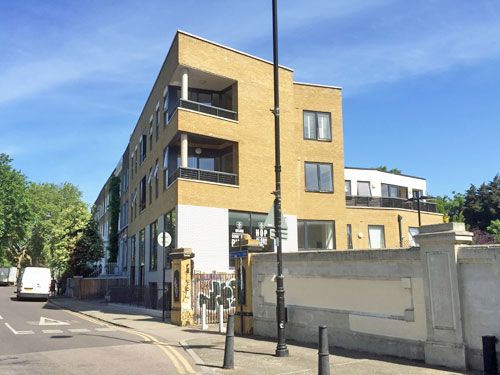
The former railway has become a stripe of woodland by the time it reaches Wick Lane. Here the abutment of the original bridge lingers on as a graffitied brick wall, easily spotted alongside the letterbox tunnel beneath the A12. Ducketts Apartments across the street are the only housing to have been built on the railway alignment north of Old Ford. Another brick abutment marks the point where trains once crossed the Hertford Canal, not many feet above the towpath, and has again proved irresistible to purveyors of aerosol art.
This brings us to the unlikely tale of Britain's first railway murder, which occurred on this very line in July 1864. City banker Thomas Briggs was heading home on a late train from Fenchurch Street to Hackney Wick when he was robbed and beaten for his gold watch, then thrown from the compartment. His body was spotted on the tracks by the driver of the next southbound train and taken to the nearby Mitford Castle pub where he died from his wounds. A German tailor called Franz Müller was accused of the crime after selling the watch chain to a jeweller, subsequently arrested in New York and sentenced to death by hanging. The incident captivated the nation and led to the introduction of communication cords in all train carriages. In 2011 Kate Colquhoun wrote a finebook about the case called Mr Briggs' Hat, which I have attempted not to over-spoiler.
A few years ago you could have popped into the Mitford Castle for a pint, although by this time it had lost its upper storeys and been renamed the Top O' The Morning. Alas the pub closed in 2013, and in 2015 was demolished to make for way a jarring stack of luxury apartments and a new pub called The Italian Job. This being borderline Hackney the new place majors in craft beer and 'insane sourdough pizza', while the noticeboard outside informs us that lockdown tragically aborted a Mothers Day cupcake-baking class. At least they've reaffixed the heritage plaque outside, but its murderous legend doesn't fit the incorrigible hipster vibe.
Cadogan Terrace, you may remember, is inner London's only single track road with passing places. Its Georgian terraces face Victoria Park and no longer have a railway chugging along the rear, so residents must be doubly pleased. The run of houses broke only for Wallis Road, here reduced to a stubby cul-de-sac after the A12 barged brutally through. At its lowest point a thickly wooded embankment is the sole clue that trains were once carried overhead. For pedestrians or those on two wheels a dramatic footbridge extends further across six lanes of traffic as the East Cross Route splits to meet the Hackney Wick interchange.
The junction's complex because it was supposed to link to the North Cross Route but that was never built, for which residents of Camden, Highbury and Dalston remain eternally grateful. It was also complicated by the presence of the North London Railway, which swept across the left-hand carriageways at what used to be ground level via a brand new concrete viaduct. This touched down on the wooded embankment you can see in the middle of the photo, which was also the site of Victoria Park station, by this time defunct. The viaduct was finally removed in the late 1990s, having carried no passengers and very little freight.
The entrance to Victoria Park station was on the bend in Cadogan Terrace opposite what used to be the park's Station Gate. Today it's a car parking space, immediately behind which the A12 carves by in cutting, summarily demolishing all trace of the main building and two platforms. The brick footings of a former signal box survive on the far side of the chasm above the Hackney on-ramp. A third platform existed to the rear, this time on the Stratford line, because we have finally reached what used to be the junction with what's now the Overground. Don't bother looking out of the window on your next journey between Homerton and Hackney Wick because you won't see it because it isn't there. A12 one, North London Railway nil.
Today (and tomorrow) I intend to follow the route of the nearest disused railway to my home, which I have somehow never got round to blogging before.
The line in question was opened by the East & West India Docks & Birmingham Junction Railway in 1850, and was once important, but declining patronage and bomb damage saw it close to passengers in 1944 and to freight in 1984. The trackbed to the south of Bow was reused as part of the DLR in 1987, but the northern tracks were subsequently lifted and have mostly been covered by housing. It's that defunct northern section I'm attempting to trace, aided by the fortunate coincidence that the entire mile falls within my quarantine box.
The North London Line didn't originally go to Stratford but to Poplar, because that's where the docks were. The first westbound trains headed for Islington and Camden, but in 1865 a viaduct was opened connecting Dalston to a new terminus at Broad Street and services were diverted there instead. From Poplar to the City typically took three quarters of an hour, thanks to the inefficiently roundabout route, with trains running every 15 minutes at peak times. You can read a (very) full history of the line on the excellent Disused Stations website, or perhaps join the North London Railway Historical Society to get your four-monthly newsletter fix.
I'm going to start my journey at Bow station, or as it's now known Bow Church. The original station building was on the northern side of Bow Road, with a lofty chapel-like roof and ten arched windows along its frontage, whereas the DLR station was added on a fresh site to the south. Down below were four platforms, the extra two feeding spurs long since built over which allowed southbound trains to head towards Fenchurch Street or Plaistow [1897 map][1955 map]. The bomb-damaged building was retained as a parcel depot after closure but removed entirely when the DLR was built, and today a lowly car hire lot covers the spot. Bow station should not be confused with Bow Road, the disused Great Eastern Railway station 100 yards down the road (1876-1949), nor Bow Road, the later Underground station (still operational).
Just beyond the former platforms the two remaining tracks now narrow to one so that DLR services can rise steeply to curve round towards Stratford. But originally the line ran straight ahead with no connection to the Great Eastern Mainline, amid a veritable granny knot of railways dividing up the heart of Bow. I'd like to show you the modern view from the front of the DLR but that would involve non-essential travel, so here's someone else's front-seat video instead.
To see where the line went next requires a five minute walk down to the police station then back up into the Malmesbury Estate. Trains ran along the back of Caxton Grove, whose terraces have long since been replaced by flats or, on the railway side, a scrap of recreation ground. This is the Four Seasons Green Play Area, a breakout space for local families, thus alas locked at present to avoid unnecessary congregation. In normal times I would have entered the 'Dog Agility Area' at the rear and looked over the fence towards the site of an old signal box, but this too is currently an illegitimate option.
Continuing north immediately requires crossing another railway, this time the mainline into Liverpool Street. The chunk of Bow beyond has been comprehensively redeveloped since the war, one of the most recent additions being a slanting brick block on the former railway alignment in Morville Road. Those giant bluebells are part of an oversized community art project round here - we'll be passing two huge anemones and a massive daisy later. Earlier cul-de-sacs covering the ex-railway have Thatcher Era stamped all over them, with a parking space for all. Having walked up Primrose Close and back for no readily apparent reason, I can confirm that the disapproving Neighbourhood Watch vibes are strong.
At Tredegar Road comes one of the few obvious relics of the old railway, a humped bridge. Cars and buses still slow to rumble over it, despite the fact no train's been underneath since 1984 and housing either side ensures none ever will again. Both Victorian parapets survive, in grubby brick, one now with a communal bin store stashed behind.
The next wall of flats is a 21st century bastion, marketed as The Heart of Bow, and then we hit the Lefevre estate, formerly Lefevre Road, Lefevre Grove and Lefevre Terrace. Its blocks are each named after a Roman god or goddess, individually illustrated in cartoon form above the main door, which must have seemed like a good idea at the time. The estate's centrepiece is a linear park brightened by those hugeanemones I mentioned earlier, whereas railway-hunters need to slip down one of the forbidding cul-de-sacs to discover the former alignment. Chariot Close, between Juno House and Saturn House, is a direct hit on the up platform of our next station.
This is the same estate viewed from the A12, shielded by a barrier block with fearsomely small windows to muffle the roar of the former motorway. The down platform was at its northern tip. Here we find Old Ford station, an 1867 addition to the line which unsurprisingly faced Old Ford Road. This ridiculously long street once ran from York Hall in Bethnal Green to the McDonald's drive-through at the Bow Roundabout, but construction of the A12 severed it in the low 600s, precisely here.
Old Ford station's L-shaped building had a central arched doorway between three pairs of matching windows, and the words North London Railway written in cement across the facade. Also closed in 1944 the building lingered on until 1967 before being demolished, although the RailwayTavern across the road survives intact. Looking at the mundane flats covering the station entrance today, it's hard to imagine earlier residents stopping to buy a newspaper from the W.H.Smith bookstall in the ticket hall before starting their commute into the City.
It's been a tough eight weeks, especially for those who rely on London's premier cablecar for their cross-river travel.
So it's fantastic news that services on the Dangleway restarted at 7am yesterday morning, once again providing regular travellers with the ideal isolation experience. Now any Londoner can make their daily travel just that little bit safer, so long as they live nearby and need to make an essential journey to somewhere just across the water.
The Dangleway's sponsored aerial pods are the perfect environment for risk-free travel. Step inside, let the doors close behind you and leave your health concerns behind as you swoop above the Thames in your own private cocoon. Important: Do not touch any of the surfaces as previous occupants may have been unclean.
To make use of the restored Dangleway service, simply make your way to North Greenwich or that dead bit of waterfront beside the Royal Victoria Dock. Please do not queue for a ticket, because that would mean giving our furloughed staff something to do. Instead walk up to the barrier, wave your contactless card and prepare for lift off.
If crowds are heavy expect to have to queue while maintaining a 2 metre distance from other passengers at all times. However experience suggests overcrowding is not normally an issue, especially now that families from the Home Counties are unable to make a special visit, so expect to reach the departure zone in seconds flat.
Given the national requirement to maintain social distancing, the capacity of the wider transport network is hugely constrained. However, unlike the tube where only 15 per cent of normal passenger numbers can be carried, we are 100% confident that even reduced Dangleway capacity will be more than enough to meet demand.
In excellent news, all solo passengers and household groups are to be given their own private cabin for the duration of their flight. Previously the Private Cabin Experience was only guaranteed on payment of a £60 fee, but coronavirus allows us to offer this unique privilege to all.
The Dangleway remains the ideal vantage point from which to view the building sites of North Greenwich, the towers of Woolwich and the scrapyards of Silvertown. Given that you're unlikely to be getting on a plane any time soon, this glorious panorama may be the only aerial view you'll be seeing for quite some time.
A Dangleway journey remains the best way to visit various South London attractions including the Emirates Aviation Experience, which is closed, the O2, which is closed, and the Cutty Sark, which is closed. The Thames Barrier remains open.
Across London's transport network, only TfL Rail and the Dangleway are now running at 100% of normal service. Given that nobody wants to go to Heathrow any more, or ever wanted to go to Romford, the Dangleway is the sole mode of travel offering a full and essential service.
Hand sanitiser dispensers have been installed at Dangleway Terminal North and Dangleway Terminal South, just as they have at tube stations and tram stops across the capital. Please squirt yourself before and after your ride in the sky, as part of the 'new normal' of public transport etiquette going forward. Masks are neither useful nor technically necessary, but we urge you to wear one anyway.
Please come back and ride the Dangleway very soon. Annual passenger numbers have been in decline since 2012, and were on course for another record low in 2020 even before lockdown intervened. We need you and, rather than cramming aboard a horribly unhygienic train, we're thrilled to say you now need us.
Previously a white elephant carrying mostly nobody.
Now, unexpectedly, the only safe way to travel.
As a child I had a number of I-SPY books, including the classics At the Seaside, The Sky and British Coins. Even though I didn't live in London at the time I also had this one, ideal for the infrequent times we hopped on the tube and came up to town.
The book lists 70 sights to look out for, a question to answer when you get there and a points value for each answer. I can tell I only took my I-SPY book up to London once because I've only written in three answers and scored a measly 60 points, whereas 1250 points were required for the Order of Merit LONDONER - Second Class.
I've tried to determine precisely how old my copy of the book is, and failed. The cover says it cost sixpence, which dates it to February 1971 or earlier, but also says it was published by the News Chronicle, a liberal-leaning broadsheet which ceased publication in October 1960. This edition can't be from any later in the 1960s otherwise it'd mention the Daily Mail instead, so my family's best guess is that it's a hand-me-down from my Dad and he bought it in the mid-1950s.
I-SPY The Sights of London is unusual in that you're not left to your own devices to track down each point-scoring item... a map has been provided. This takes up the entire centre spread and stretches from the Serpentine in the west to Tower Bridge in the east. All the sights are labelled and listed, and a set route weaves around central London from Nelson's Column (1) to Charing Cross (70). Not only does this make it easier for the average Redskin to follow, it also meant Big Chief I-SPY only had to walk round once to gather all his content.
Actually it's not a terribly efficient route. Trafalgar Square is visited three times, 18 (Eros) and 19 (Porter's Rest) would be better ticked off the other way round and a ridiculous hyperleap has been inserted between 60 (Tower Bridge) and 61 (Broadcasting House). I also note that all 70 of the chosen sights are north of the Thames with not a single example south of the river, so I can only assume Big Chief I-SPY wasn't overly impressed by the newly-built Royal Festival Hall.
Here's a typical double page spread from early in the book around Trafalgar Square. Number 3 asks you to find George IV's statue and, for 25 points, write down what's missing. Number 4 is St Martin-in-the-Fields, including the salacious fact that the crypt contains a whipping post, but the question's about the date in Roman numerals on the portico instead. Number 5 concerns the "One-man" Police Station facing the Strand, which back then was still being used as a lookout, and number 6 relates to the Standard Measures of Length embedded in the back wall. There are some proper psychogeographic titbits here.
I thought it would be interesting to scan through the book and see which of the 70 locations have disappeared since it was published in the 1950s. Let's see...
(17) Roosevelt Memorial: This hasn't moved, but the US Embassy has shifted so you'll no longer "see plenty of American cars". (23) Statue of Charles I: This is still in Trafalgar Square, but good luck trying to answer the question "Which part of the statue was replaced a few years ago?" (24) Bust of Charles I: The book claims this can be found "over the entrance to the United Services Museum", but we now know this as the Banqueting House. (26) No 10 Downing Street: It's no longer possible to score 20 points by identifying the "useful article standing each side of the front door". Ah for the innocent days when the general public could mill around outside. (31) Big Ben: The book correctly notes that this is the bell, not the tower, but scaffolding currently prevents us from identifying "something unusual about the face of Big Ben which is not usual on clocks". (39) The Discovery: This is the first proper disappearance. Captain Scott's Discovery was an Embankment-side tourist attraction until 1979, and can now be visited in Dundee. (43) No 17 Fleet Street: It is no longer possible to gain "free admission to a panelled room known as Prince Henry's Room" (but the question is still answerable). (45) The News Chronicle Time Band: As previously mentioned, this newspaper closed 60 years ago. The idea that anyone can wander in off the street to stare at a clock in an entrance lobby died rather more recently. (56) London Stone: At time of publication this Roman relic was "set in the wall of a church", but that was bombed in the war and demolished in 1962 so you can no longer score 20 points for naming the church. (58) London Bridge: The sentence "The present bridge was opened in 1831" was only true until 1973, so counting the arches no longer gives the intended answer. (60) Tower Bridge: For some mysterious reason the question is about the Royal Mint, not the bridge, and that moved to Wales in 1967. (66) Covent Garden: Described here as "a great bustle of vegetables, flowers, fruit, and people", the famous market moved to Nine Elms in 1974 so is no longer on route.
I can't get to central London right now to test out the remainder of the book, and probably neither can you, but the advance of the internet means many of the I-SPY book's questions are now answerable without stepping out of your front door. To test out that theory, see if you can discover the answers to these 20-pointers using digital photos and/or a bit of research. comments
(9) St James's Park: At the Birdcage Walk entrance is a statue on a drinking fountain. What is there on the right hand side of the figure? (10) Buckingham Palace: One of the large figures on the Victoria Memorial is a workman wearing a leather apron. What tool is in his belt? (13) Albert Hall: What letter is to be seen above each of the lower windows? (15) The Serpentine: How many arches in the Serpentine Bridge? (19) Porter's Rest (Piccadilly): Which English town is mentioned on the Rest? (28) Statue of Lincoln (Parliament Square): How many buttons can you see on his cuff? (37) Cleopatra's Needle: What insect is shown on the base of the statue just above the inscription? (42) The Law Courts: What is shown in the lower right-hand of the face of the clock? (55) Mansion House: What weapon is shown in the lamp-post shields? (59) Tower of London: What is on top of the four weather vanes? (62) British Museum: What colour are the "Spearheads" in the great gates? (67) Opera House: What two-wheeled vehicle is shown over the entrance?
(no more than one I-SPY answer each, thanks... in the special comments box above)
My local garden centre is still closed, which is a shame because the reopening of garden centres is one of the cornerstones of the leisure-driven economic revival the government announced last week.
I guess there's always tennis, but the courts in Victoria Park are fully booked.
Which means I'm going to have to take up golf.
There are over 100 golf courses in London, covering approximately 3% of the capital by area. The only problem is that there isn't one anywhere near me, and if you live in inner London there probably isn't one anyone near you either.
This isn't a great map, sorry. I've cobbled it together from a geographically accurate map CityMetric published last year, but I refuse to steal theirs so you're lumbered with my somewhat approximate version instead.
Eleven boroughs have no golf courses, including all the inner London boroughs north of the Thames, plus Lambeth and Lewisham to the south. The boroughs of Brent, Waltham Forest and Barking & Dagenham only have one course each. That's quite some golf desert.
Unsurprisingly it's the ring of outer boroughs that has all the golf courses, and if you were to nudge over the border into the Home Counties you'd find dozens more, Land is cheaper out here, or it was when the golf clubs nipped in and bought up large tracts that can't now be used for housing.
The closest golf course to central London is Hampstead Golf Club, whose clubhouse is five miles from Charing Cross. It's set across classic landscaped parkland and was founded in 1893. However it only has nine holes, so if you want the closest proper 18-holer that's Highgate, which is almost nextdoor. Both courses reopened last week, but alas only to members and their guests so I'm not going to get a game at either.
The next-closest, at five and a quarter miles, is the Aquarius Golf Club atop the Beechcroft Reservoir in Honor Oak (but that's 9 holes and currently members only). The 18-hole Dulwich & Sydenham Hill Golf Club is five and half miles distant, and allows visitors to play on weekdays, so if you're in the West End they're probably your best option. Fifth place goes to Wimbledon Park at six miles, but they're only allowing members to play during the current crisis (and recently sold up to the tennis club across the road so may not be around much longer).
I've done some mapwork to try to find the place in London furthest from a golf course and I reckon it's Columbia Road in Bethnal Green, where the Sunday flower market is held. This spot is 5½ miles from Hampstead, 5½ miles from Honor Oak and 5½ miles from Wanstead Golf Club in Redbridge. I hope there aren't too many keen golfers in the nearby tower blocks because they couldn't have any further to go.
My closest golf course is the one at Wanstead, which is marginally closer than neighbouring Ilford. But it'd still be a four mile walk, which isn't entirely practical, and also the next available timeslot is at six minutes before sunset on Wednesday which I don't think would be good value for £20. The clincher came when I read the Dress Code...
...and suddenly I don't feel quite so bad there isn't a golf course anywhere near me. Hopefully the government will unlock something less upwardly-mobile soon.
• Stay Alert - Control The Virus - Save Lives
• PM announces conditional plan to ease lockdown
• nation tries to unravel what little has changed
• PM tries to clarify what he said yesterday
• rules now different in England to Wales/Scotland
• furlough scheme to continue for four more months
• death rate in care homes now falling
• after seven weeks, lockdown eases marginally
• England nudged back to work/golf courses reopen
• public urged to avoid public transport
• New Zealand back to (new) normal
• every country in Africa now affected
• UK economy shrank 2% in first quarter
• Govt approves Roche antibody test
• 0.27% of the population currently infected (ONS)
• coronavirus may never go away (UN)
• unions say June too early to be reopening schools
• plan to test all care home staff and residents
• anti-lockdown protesters gather in Hyde Park
• football restarts in the German Bundesliga
Worldwide deaths: 280,000 → 310,000 Worldwide cases: 4,000,000 → 4,600,000 UK deaths: 31,587 → 34,466 UK cases: 215,260 → 240,161 FTSE: down 2% (5935 → 5799)
150 things I saw on a walk up the Olympic Park and back
Empty bottle of Dragon Stout, bus stop identification number 348, graffiti by Eiros on a listed building, passive aggressive note slipped under the windscreen of a badly-parked car with a noisy alarm, private ambulance, a slew of white vans, man sporting lockdown mohican, black rubber glove standing erect on top of an orange plastic cone, two fully-decorated Christmas trees in storage, Chris and Loanne's Farmdrop delivery boxes.10
Weary jogger, former station sign from Pudding Mill Lane DLR, line of key worker caravans, three IJWS waste tankers queueing to enter waste disposal site, stack of unread Metro newspapers, discarded juice cartons left behind after impromptu skateboard gathering, innumerable pigeons, electric Jump bike abandoned outside permissible zone, tweet from Sir Peter Hendy, yellow JCB scooping aggregates from the lofty mound beneath it.20
Freshly-trodden socially-distant footpath, hedgerow with dog roses, History Tree, John Deere utility vehicle towing water bowser, treetops alive with birdsong, gardener from Willerby Landscapes hoeing the approach to footbridge H16, three yellow irises (two of which have opened since Monday), alliums, jogger stopping to photograph Rachel and Hannah's bench, banks of colourful poppies.30
Olympic ode commissioned by the current Prime Minister, two ducks-a-leaping, the last of the hawthorn blossom, a pair of flirty goldfinches, giant-size crayon mooring posts, desire line path dodging between poppies and oxeye daisies, YTIЯUƆƎƧ, Muster Point 4, heavy-breathing jogger, set of permanently temporary traffic lights.40
Approximately 100 superfluous crowd control barriers, moped rider choosing not to stop at a zebra crossing, the ongoing construction of balconies, jogger sporting closely-cropped pink hair, man doing sit-ups on a sloping lawn, a cheeky cigarette, father using picnic table bench to do step-ups while carrying a small child to provide additional weight, shaggy spaniel lolloping behind a cyclist, nodding rushes, horse manure (not fresh).50
Child alighting from a Segway to point at some wild flowers, max headroom 10' 3", waterside buttercups, sunburnt QEOP litter-picker, concrete pillar sprayed with the graffiti I Am Ill With Hope, double decker bus with one passenger, main road that's not normally this easy to cross, man skipping with fluorescent rope, shadow-boxer, woman on football pitch doing stretching exercises while her dog circles.60
Bright orange footbridge, Tesco bag for life abandoned on bench, History Tree, woman brazenly picking flowers from beside the path, flapping banner advertising this afternoon's hockey internationals between England and Argentina (long since cancelled), Supply Pillar FP2, dual carriageway as busy as it often is, jogger doing a clockwise loop of the Velodrome, damselfly, meadow scattered with thistles and daisies.70
Magpie pecking at locked gate, discarded Santander Cycle Hire receipt, inspection hatch shielding supply of non-potable water, the City of London, interlocking shadows of the five Olympic rings, champagne cork and two bottletops, kickboxing practice, small white butterflies, thickly-wildflowered slope, a dozen sparrows hunting for food on a recently-watered lawn.80
Perfectly-aligned handrail shadows, horticultural contractor's truck proceeding slowly with lights flashing, abandoned tennis ball, circle of white paint sprayed onto grass around trip hazard, Canary Wharf, mum and toddler playing on picnic blanket, irrigation rainbows, History Tree, avenue of acers, overweight couple only one of whom has chosen to wear a face covering.90
Goose staring defiantly into midriver to protect nesting site, cyclist deftly taking a selfie while crossing bridge, pristine dandelion clock, path that didn't used to pass through a low hanging branch, Shred-It van, cloud of tiny flies, brightly-coloured lycra one-piece, roadbuilders sitting down behind trolley for a fag break, the aftermath of wet resin, two bored traffic marshals.100
Apple orchard, beheaded silver birch, half-covered 20mph speed limit signs, photographer setting up her tripod to capture a bank of dazzling flowers, rising radial lock, pair of red Beats headphones leaking loud dance music, bearded dad actively encouraging son Toby to cycle down a set of canalside steps, floppy poppy, dinging cyclist approaching from behind, unhired swan pedalos.110
Personal trainer working with client hanging from coned-off exercise equipment, History Tree, small child on the back of a bike pointing up at two cranes and shouting "wow! wow!", The Honest Sausage, boy running onto the lawn beneath the Orbit for some much-needed football practice, cashpoint, mothballed cafe, cycle hire station with only two gaps, shrivelled daffodil stalks, the beginnings of a new university campus's second floor.120
Gabion as vehicular obstacle, LTN1/55, handrail recently scrubbed clean of pigeon droppings, class 315 train not yet retired from TfL Rail, locked allotments, motley collection of sheds, a dozen empty soft drink bottles cut in half to provide frost protection, several blocks of flats awaiting recladding, sixty Jubilee Greenway plaques, incorrigibly inquisitive labrador.130
Four blue plastic gloves disposed on top of an empty pack of Heineken, rusting iron barge, leaking drainage outfall, pre-Olympic footpath infrastructure, resident setting off to do essential shopping, lockkeeper's cottage, angler with a big net and an actual can of worms, socially-distanced angler puffing on a reefer, flat-builders pumping sealant into a 3rd floor balcony, flat-builders nailing down a 7th floor ceiling.140
Telecoms engineer sat on a reel of cable checking his phone, empty Capri-Sun pouch, DHL delivery pulling up onto the pavement, concierge popping outside and leaving reception unguarded, elderly cyclist returning home with this week's Bangla Post, four coot chicks, woman wielding a bunch of tulips, Thames Water van checking McDonalds car park terms and conditions, 277 relief bus, empty bottle of Dragon Stout.150
Terms and conditions for TfL's £1.6bn bailout package
» service levels increased "as soon as possible"
» reintroduction of fares on buses
» reinstatement of the congestion charge (now including weekends, and extended to 10pm)
» congestion charge to increase from £11.50 to £15 from 22nd June
» temporary suspension of Freedom Pass/60+ card concessions during morning peak
» temporary suspension of free travel for under 18s
» fare increase next year on all modes by RPI plus 1%
» promotion of active travel and traffic management
» review of TfL's future financial position and structure
» 2 government representatives to join TfL board, finance committee and programmes & investment committee
I worry that my TV remote is about to break. It's been dodgy for a while, sometimes working when I press a button and sometimes not. It's not the batteries because I've changed those, and it's not the sensor because my sightline's clear, it's definitely the remote. Something inside rattles when I shake it, but I try not to shake it too much in case that dislodges something important and breaks a crucial connection. I worry because my TV doesn't have an on switch, let alone any exterior button which allows me to change the channel, because the 21st century can be so impractical sometimes. Should my remote fail then my TV will be essentially bricked, and I can't nip down to Currys and buy a replacement because Currys is closed.
Obviously I could order a new TV to be delivered, but that'd be a ridiculously expensive over-reaction. I could simply order a new remote, because Amazon has those for £30, or there are questionable generic copies for under a tenner. But I'd still be without a TV while the package arrived, and being without a TV isn't a good thing at the moment. Actually, I see Sony do a 'remote' app for my smartphone, so if I downloaded that I could still use my TV uninterrupted in case of gizmo malfunction. But none of that will stop me from worrying that my TV remote is going to break, because I genuinely don't need the hassle.
I worry that my phone is going to die. The battery's been a bit temperamental for a few months because it's pushing three years old, indeed I've been doing damned well to string it out this far. Sometimes the percentage plummets unexpectedly, and if it plummets to zero that's not good news. But in the week that lockdown started it plummeted to zero and then wouldn't turn back on no matter how many cables I plugged in or buttons I pressed. I spent five agonising hours convinced my phone was never going to revive, furious that battery failure had happened at precisely the wrong moment, until ohthankgod it somehow magically woke up again.
Obviously I could buy a new phone, but that's ridiculously expensive compared to simply replacing the battery, which I can't get done at the moment because all the shops that replace batteries are closed. In the meantime I'm trying to ignore the 'battery service' indicator that's been triggered and trying to make sure the battery never quite gets down to 0% again, just in case. I see Apple have very recently brought out a new model which they describe as a 'budget' phone, so maybe after five years it's finally time to upgrade. But I'd rather not upgrade, because oh the palaver, and my technological inertia always wins out.
I worry that my laptop is going to expire. It's even older than my phone, and the other week the dreaded blue screen of death suddenly appeared at the same time as a loud electronic screeching noise and I thought dammit, there it goes. Thankfully the machine rebooted straight away as if nothing awful had ever happened, but I worry that now it's done it once it could do it again. I worry particularly because buying a new laptop online is bloody difficult if your laptop is broken, and I think I mentioned that all the shops are shut. You should perhaps worry more because if my laptop dies you'll have nothing new to read for weeks, so consider this a tentative advance warning.
I worry that my microwave is on the verge of breaking. The start button's suddenly not as springy as it was and has started clicking when I press it, which isn't how it's supposed to function. This stickiness only started a few weeks ago, then briefly went away but is now definitely back. None of the other buttons and dials on the front of my microwave can be made to turn the thing on, so if my start button breaks my oven will be kaputt. Again the online purchase of a microwave is a possibility, but in the past I've dashed to Argos and had a replacement in place in under an hour, and hanging out for a protracted courier delivery simply cannot compete.
I worry that the fluorescent tube in my kitchen is going to blow. It usually fails every couple of years or so and the current tube is dangerously close to the limits of normal service. One day soon I expect to flick the switch and hear the tube splutter and fail, plunging the room into darkness, which would be bloody awkward because my kitchen has absolutely no natural light whatsoever. Flimsy glass tubes aren't exactly delivery-friendly, and again my go-to shop in Stratford is closed so I worry this would inhibit my ability to prepare food for a considerable period.
I don't worry that my kettle is going to break, because my kettle did break three weeks before lockdown and I jumped on a bus and bought a replacement. Instead I give thanks that it broke at the end of February and didn't decide to linger on until the end of March, because that would have totally scuppered my ability to brew vital lockdown refreshment. Likewise I'm ecstatic that my gas supply was turned off last September while builders tried to work out how to fit a new boiler, because if that two month energy hiatus had happened now I would have been screaming in abject misery.
I'm increasingly concerned that one of my teeth might break, even though one never has, because getting that sorted under current conditions would be an absolute nightmare. I've started being extra careful walking up and down stairs because now is not the time to end up in A&E with a broken limb, even though I've never done that either. I'm also giving knives and scissors a little extra respect, being extra wary of bumping my head on cupboard doors and trying harder than usual to avoid straining my back while doing housework. On top of all this I've yet to succumb to appendicitis, so hope very much that 2020 isn't the year.
I should perhaps be more worried about catching coronavirus, but it's good to have other lesser things that haven't happened yet to preoccupy me instead.
Today we're going to learn the correct names for the different parts of a London bus stop.
Basics first.
The upright is a post, not a pole.
The bit that sticks out is the flag.
The letter in a red circle at the top is the point letter.
Timetables are enclosed in a Timetable Frame (TTF).
Frames are available in single, double or triple sizes.
More than one frame makes a Timetable Cluster.
The post is made from lightweight aluminium.
The aggregate base is slanted to provide a tactile indicator for the partially sighted and to deflect pushchairs.
The bus stop flag is made up of several constituent parts.
The roundel has a red Bus Stop stripe underneath.
Below that (on a sticker) is the location name.
Below that is the towards information.
Below that are tiles showing individual bus routes.
Officially, only the top part is the flag.
The flag comprises the roundel and location name only.
The boat is separate, and attaches to the bottom of the flag.
The boat combines the towards information, route numbers and sometimes a red tile with additional information.
The Aquatics Centre boat is two rows deep.
The Waterloo Bridge boat is six rows deep.
The Hounslow High Street boat is five rows deep.
Boats are made up of Q-tiles and e-tiles.
e-tiles cover a single tile space. Q-tiles cover three tile spaces.
Q-tiles spread across the entire boat.
The Bow Church boat has only one Q-tile.
The Hounslow High Street boat has two Q-tiles.
Boats are assembled from three sizes of component: 3s, 6s and 9s.
A 3 has one row, and fits 3 e-tiles.
A 6 has two rows, and fits 6 e-tiles.
A 9 has three rows, and fits 9 e-tiles.
There isn't a 12, so the Bow Church boat is a 6 with another 6 underneath.
The Aquatics Centre boat is a 6.
The Waterloo Bridge boat is a 9 with another 9 underneath.
The Hounslow High Street boat is a 6 with a 9 underneath.
The bus stop identification number is hidden on the underside of the boat.
At Wandle Road, the bus stop identification number is 17569.
An SMS plate is attached to the post below the boat and above the TTF.
Simple.
So long as I've interpreted the FoI request properly.

Terms and conditions for TfL's £1.6bn bailout package