When the tide's right a considerable difference in water levels can be seen at Bow Locks. On the left is the Lea Navigation, essentially a canal where the water tends to remain at the same height. On the right is Bow Creek, a tidal waterway with a considerable vertical range. This creek empties out twice a day, as we saw in my photos earlier this week, then at high tide rises much closer to the rim of the channel. At the highest spring tides (as blogged here) the water in the creek rises to 4.8m above sea level and can briefly overtop the path. But because tides are predictable the riverbank has been engineered to cope with these occasional maxima, and only when heavy rain and wind conspire is wider flooding a serious risk.
It's much the same on the Thames in central London. Water levels vary from "barely enough water for a pleasureboat" to "ominously lapping the top of the wall", with a potential 7.8m range inbetween. These regular tidal cycles are totally familiar and already built-in, so the worst that normally happens is the slight overtopping of the Custom House walkway downstream of London Bridge. It takes a rush of floodwater coming down the river or a tidal surge coming up to disturb the equilibrium, and only very rarely do bad weather and spring tides coincide to devastating effect. The last fatal inundation in central London was in January 1928, caused when snow melt, heavy rainfall and a storm surge coincided with a spring tide, with February 1953's infamous surge narrowly failing to overtop the river wall.
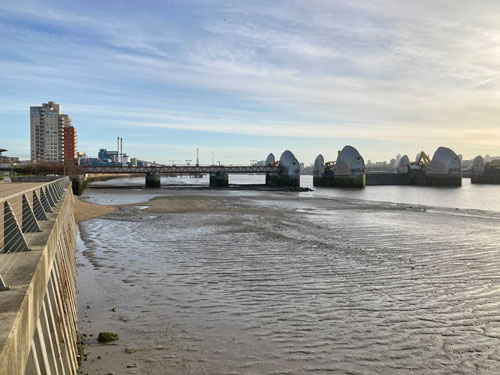
Central London is now protected by the Thames Barrier and has been since the 1980s. Its gates have been closed for flood defence more than 200 times, most recently on 7th November, as well as countless times as a rehearsal. This ever-ready sentinel provides reassurance for those of us living upstream and should prevent long-term catastrophic damage to basements, tunnels and services that weren't even present in 1928. But global warming will eventually make the barrier less reliably effective, and by 2070 maybe even obsolete. Even a small rise in sea level is expected to cause an increase in closures that'd make the Thames navigationally unreliable, and we can't keep it closed forever.
It's instructive to see what the City of London is doing in response. Earlier this year they published a Riverside Strategy with an eye to the year 2100, having recognised that some of the most valuable infrastructure on the planet needs to be better protected. The plan is to shore up their river defences to withstand the worst the 21st century might deliver by raising walls by up to one metre while still retaining an "outstanding riverside environment". The City has almost bottomless pockets when it comes to flood risk, as they recently proved by restructuring Hampstead Heath's ponds in case of highly unlikely catastrophic dam failure.
At present the Environment Agency requires that riverside flood defences are at least 5.28m above sea level downstream of London Bridge and 5.41m upstream. The City of London's mile of waterfront currently meets these requirements, helping to keep even the highest tide at bay, but they recognise this won't always be the case. Their plan is to raise flood defences to 5.85m by 2065 and to 6.35m by 2100, which is quite a hike. Only two brief stretches currently meet the 2100 target, one at Billingsgate and the other under Southwark Bridge, and the remainder needs remediation before the end of the century, either in two phases or all in one go.
For example the section of river wall between Blackfriars and the Millennium Bridge requires an uplift of 15cm by 2065 and maybe 65cm by 2100. An even greater intervention is required on the Victoria Embankment west of Blackfriars Bridge, potentially an extra metre by the end of the century. An appropriate response could be as simple as raising the top of the wall but the City also wants views of the river to be retained so it might also require raising the pavement. They intend to act in "a pragmatic and timely way", hence the need to start planning early so that any future building works along the riverside bear long term targets in mind. The project's summary webpage has artists' impressions and slidy maps and is well worth a read.
It's not clear what happens halfway along the Embankment where the City merges into Westminster, only that other boroughs will have to act eventually or face increasing risk of inundation. It's one thing hoping a once in a lifetime flood won't come upriver, but quite another to cope with inexorably higher tides twice a day. Scientists estimate that sea level could rise anywhere between 30cm and 100cm by the end of the century, maybe even more, and best not imagine the mess that would make of central London without additional protection. One melted ice sheet (or other tipping point calamity) and the Underground could become the Underwater.
Humanity's been fortunate to evolve through a period of long term sea levelstability. Shorelines have been pretty much consistent over the last 6000 years, a rise only starting to accelerate with the dawn of the Industrial Revolution. But a considerable amount of land's been lost to the sea before, for example when the land bridge between Britain and continental Europe was submerged about 10000 years ago, and a lot more will be lost in the future as temperatures rise. One day, long after we're all dead, the inexorable advance of the waves will smother countless coastal settlements and relegate central London to the sea bed. Until then it's all about how good your defences are, as the City well knows, so best start planning now.
If it's 9th December then it's time for myannualreminder that Crossrail is late.
It had been due to open on 9th December 2018.
This means Crossrail is now THREE YEARS LATE.
Crossrail's opening date was initially a moveable feast but in July 2014 management fixed on December 2018 for the opening of the first section between Paddington and Abbey Wood. For the next four years that deadline held, at least in public, until with 100 days to go TfL suddenly owned up and admitted the line wasn't ready. They weren't joking, given three years later it still isn't ready.
Initially the delay was only a year but there have been six further delays since, the most recent in summer 2020. It's all still very much up in the air because it relies on a software update that hasn't yet been implemented and which could still completely scupper things. But the "first half of 2022" window is very wide so should still encompass best- and worst-case scenarios, with the best-case scenario being just 13 weeks away.
Here's a date for your diary.
Sunday 6th March 2022
I've been told this opening date by... i) a friend who 'knows' people ii) an anonymous commenter on this blog iii) a Crossrail train driver
The train driver is probably the most significant. You can't just magically open a railway on a particular date, you need staff in place and that means shift patterns have to be planned well in advance. Drivers were told the potential opening date on Saturday 20th November, fifteen weeks beforehand, so if everything does go ahead there will at least be someone to operate the trains.
At this stage 6th March remains an aspiration rather than a shoo-in, which is why TfL won't be announcing the date to the public any time soon. They did the same with 9th December 2018, keeping the precise date under wraps despite it being an open secret within the organisation. They know never to announce an opening date they might not meet, which last time they didn't, for fear of making scathing headlines worse.
It may not happen. One bodged software update and everything'll be careering into the summer, if we're lucky, and even then Bond Street station still might not be ready for passengers. But bear Sunday 6th March 2022 in mind over the next three months because it is the opening date everyone's (currently) working to.
87 days and counting... which, excitingly, is the closest it's ever been.
While we're doing Crossrail, let's have a word about Crossrail's Next Train Indicators.
Stations aren't yet open but trains are running and some of the Next Train Indicators are both operational and visible. This set is above the gateline at Custom House (and has been visible for over a year).
One day, in one direction only, that's going to be important. Spotting the next westbound train to Reading in amongst a slew of Paddingtons, Heathrows and Maidenheads may be necessary for some travellers. But here at Custom House every single eastbound train will only be going two stops to Abbey Wood, and always will be, so a list of ten Abbey Woods is very much overkill. Nobody'll be catching the tenth one, nor the fifth, indeed only a slowcoach will be interested in the second.
And for the first few months all westbound trains will be going to the same destination, namely Paddington, so the majority of what's on display will be noise. The only key piece of information everyone'll need is the number of minutes until the next train and that's a single digit occupying a surprisingly tiny proportion of the overall screen. From a distance this squinty presentation isn't ideal.
Also, because I've stood and watched, that digit is going to disappear before the train arrives. TfL are doing what they've done at numerous existing stations and are removing the next train from the list as soon as they don't think you've got time to get it. Here at Custom House the time ticks down to 2 minutes and then the next train magically vanishes, even if you've still got 90 seconds to catch it, because they don't want you to dash down the stairs and slip. It's a psychological thing. Passengers who see "1 min" tend to hurry even if they don't need to, and TfL would far rather you missed a train than had an accident.
We have yet to see how many minutes early TfL will remove the next train from indicators at stations with deeper Crossrail platforms. But all the evidence from the rest of the network is that they're really risk averse (for example five minute drop-offs when interchanging at Bank, eight minutes on the Overground in Hackney and a blanket 2 minutes across the DLR) so prepare to be annoyed/delayed on Crossrail too.
Also note how the Eastbound indicator is titled "towards Abbey Wood", which is fine, but the Westbound indicator says "towards Heathrow or Reading". In the opening stages no trains are going to Heathrow or Reading, only to Paddington, and onward travel will require a split-level change onto a differently branded service.
It's different again at Farringdon, where the Next Train Indicators are again visible from the street. Forgive my blurry photos through the glass.
This time the Eastbound heading is "towards Shenfield or Abbey Wood", despite there being no direct trains to Shenfield because that's the final state of operations. Admittedly there's no reason why the boards should be titled the same on opening day as they are now under Trial Operations, but I bet they will be.
Finally note that every eastbound platform is a Platform A and every westbound platform is a Platform B. This has been known for at least three years, ever since Open Days were held at part-completed stations, but it doesn't hurt to remind you again now. All Abbey Wood trains will run from Platform A, if that alliterative coincidence helps you to remember.
The original B109 ran through the heart of Hackney and would have been a blessedly short walk between Hackney Downs and Hackney Central stations. But once Mare Street closed to through traffic the A107 was diverted round the houses instead, simultaneously wiping out the B109 (Amhurst Road) and the B110 (Dalston Lane), so that's two B Roads I don't have to tread.
The replacement B109 is in Newham and is one of the main north/south roads connecting Barking Road to Romford Road. It's not one of the busy shopping arteries, more a second fiddle intermediary, and fairly representative of the Victorian heart of the borough. It's also quite dull, I have to admit, but I can promise a serious confectionery icon (and an unexpected sighting of the Stig) which I hope will keep you reading.
I'm starting at the southern end of Katherine Road so I can follow the houses in street number order. Vera Lynn's childhood home is up a street on the other side of Barking Road so alas I can't tell you about that. Instead I'm ducking between Brit Local (your local branded shop) and Eazy Homes (landlords wanted) to enter East Ham's terraced grid. The houses have very small front gardens, just large enough for bins and maybe pot plants, bikes, leftover paint or discarded clotheshorses. You can also get your car exhaust fixed or your shock absorbers tweaked here, indeed backstreet Newham offers many such opportunities. I wonder if you can guess what the famous confectionery company will be.
The Earl of Wakefield served pints from 1895 to 2013, particularly to West Ham fans, but the pub is now a church where you can meet Pastor Claude on Sunday afternoons. This first parade of shops has just one national chain, namely Ladbrokes, because they know where their clientele hangs out. Builders merchants are unusually commonplace, including one whose awning reveals it used to be an Afghan Halal Oriental Cuisine Restaurant. Occasionally the pavement narrows to make way for plastic buckets, brooms and shovels. Newham council put up "Sam Say's 20 Is Plenty" signs at the end of umpteen sidestreets ten years ago and still haven't got round to removing all the aberrant apostrophes. The confectionery story is well worth waiting for, honest.
A man stopped me beside a display of Dulux Weathershield and asked "You're not looking for the metal shop are you?" I was not, and a few minutes later when I spotted the aforementioned establishment I wondered if the man had wanted to know where it was himself but phrased his question really badly. In these troubled times it's hard to know whether the catering equipment & carpets shop is permanently shuttered or just doesn't bother opening in the morning. Some local residents have meter cupboards that don't close. Front gardens still aren't quite large enough to park a moped. The confectionery giant is now only couple of paragraphs away so hang in there.
This wouldn't be Newham if there weren't eventually some flats, some three-storey and some seven-. These appear just before the road rises to cross the District line, about halfway between Upton Park and East Ham stations, at bridge number D155. High walls ensure no trains are visible. Azeem Enterprises have been manufacturing threads, zips and elastics on Katherine Road since 1972, and their workshop still has the words Trimming Merchants stuck above the window in wonky red letters. Ahead we cross the B165, better known as Plashet Grove, which is the chief east/west road in these parts. The local butchers have branded this Halal Meat Corner, and if the lights take a long time to change you can stop and watch them carving poultry and lamb through the giant windows. The sweets are close now.
In the early 19th century the cottages here formed the hamlet of Plashet. One was owned by a historian called Katherine, who ultimately gave her name to the road, and whose mother was the famous prison reformer Elizabeth Fry. She lived round here for a while too. Today the area looks anything but rural with dense terraces, skips on the pavement and a surfeit of white vans loading white goods outside a bathroom showroom. For those who like to know which bus route we're following, it's now the 325. St Stephen's garage no longer sells Flare petrol but does do MOTs. Grangewood School is the only (ISA accredited) independent school in Newham, because Newham is not Richmond, and is housed in the former Plashet Park United Reformed Church Hall. Look, here it is!
Wow, this is not what you expect to find down an obscure B Road off the Newham beaten track. It's where esteemed purveyors of boiled sweets Trebor started trading in 1907, launching what would eventually become a global sugar-based empire. The name Trebor is famously 'Robert' spelled backwards, a fact which won't have escaped the attention of co-founder Robert Robertson. The current building is a 1935 Art Deco upgrade. a move which allowed the company to diversify into compressed powder confectionery like Refreshers and Parma Violets, and also saw the birth of Extra Strong Mints. Further Trebor factories followed in Chesterfield, Woodford and Colchester, and this outdated Forest Gate outpost eventually closed in 1983 to be converted into loft apartments. For a full-on minty-fresh Trebor history, head here.
Opposite the former sweet factory is a Tesco Express (established 2011) in which mints remain available. Less mainstream items can be purchased from the Himalaya Food Store nextdoor. That seriously ornate-looking pub is The Duke of Fife, or was, because since 2012 it's been filled by a Paddy Power bookmakers and an African restaurant. If I might just list shop names to pad out this paragraph, the next stretch includes Diamond Carpets, The Trimming Shop, Empress Property Management, Jamil's Barber Shop, Vape, Dhajia's, Wok & Pie, Panda's Kitchen and Five Star Trimming. I will not mention Anne's Patisserie because a) it's entirely atypical b) it's closed. I will mention Forest Gate Homeopathic Services because a) it's quite retro b) it's entirely unnecessary. And here's the Stig.
He may not be the real Stig, given he stands permanently on the pavement outside Quality Car Paints Limited, but he does do a very successful job of luring passing pedestrians to look at the wide range of aerosols within. We're almost at the end of the road after a walk that's been so long the house numbers are now in the high 500s. The flats on the corner of Romford Road occupy the site of Plashet Hall, locally known as Potato Hall, whose rooftop lantern once commanded views of ships on the Thames. The flats are considerably less interesting. But at least the sweet factory was good.
The government's levelling-up agenda isn't normally associated with London, but five boroughs have managed to wheedle £65m from the firstround of funding. Newham put in two bids and won by far the largest share of London's cash, which is nice, especially when one of the issues they're trying to solve is the lack of bridges across the River Lea.
"The Lower Lea is a highly severed place. The river is a political boundary, between the London boroughs of Tower Hamlets and Newham, and a physical boundary, creating significant severance between neighbouring communities. There is currently no ability to cross the river between the A13 at Canning Town and Twelvetrees at Bromley-by-Bow, a distance of over a mile."
Lack of bridges doesn't normally earn you money, but in this case there's an economic imperative which is jobs and houses.
"The area is poised for significant growth of over 40,000 homes and 280,000m² of commercial space over the next 20 years."
The plan is for a new footbridge at Lochnagar Street, roughly halfway along the crossing-free stretch of the river. This will help to connect a heck of a lot of homes in Tower Hamlets to several business parks on the Newham side, and also enable an active transport corridor between Langdon Park and Star Lane DLR stations. It's the red bridge on this map.
Ignore the unbuilt bridges with yellow letters, they're not part of the delivery.
Lochnagar Street is a stumpy turning off the A12 dual carriageway, barely 30m in length, used by drivers for U-turns and to access the Aberfeldy estate. It used to be longer and almost reach Bow Creek, back when all this was wharves and terraced streets, but has subsequently declined into a grim landscape of rundown warehouses, refuse services and vehicle repair. A lot of this has recently been cleared in readiness to become a significant residential waterside neighbourhood, so on the left will be Calico Wharf (785 flats, 16 storeys), ahead will be Islay Wharf (133 flats, 22 storeys) and to the right will be East Riverside (547 flats, 20 storeys). This future vision is almost unimaginable at present, as are "countless opportunities for picturesque strolls along meandering riverside walkways", but a new footbridge connection can only help.
Current riverside reality is a deep creek intermittently crossed by power cables, whose water drains away to muddy shallows twice a day. What's planned here is a perforatedconcrete span 55m in length and resembling an elongated Pringle attacked by a hole punch, paid for by levelling-up. It'll land immediately alongside a massive Sainsbury's distribution centre (opened 2016, closed 2021) which creates an immediate obstacle to onward progress. Thankfully a footpath already exists on this side of the river, namely the Leaway, which I have blogged about onnumerousrepeatedoccasions. This path connects directly to the adjacent business park and also downriver through Cody Dock, though not necessarily conveniently, so some of the funding will be spent on making this backwater creekside a tad more appealing.
"To ensure safe and accessible access to the new bridge, a programme of investment along the walkway leading to the bridge will bring activation and safety to encourage its regular use."
If all goes to plan Lochnagar Bridge will be completed by March 2024, indeed this expectation is a condition of funding, which'd be impressively fast given how many times a bridge hereabouts has been promised but not delivered. I greatly look forward to crossing it.
Meanwhile five other bridges between here and the Thames are under joint consideration by the boroughs of Newham and Tower Hamlets - target date 2031 - but will only progress if developers come on board. They're the lettered crossings on my earlier map, starting with one that's had planning permission since 2010.
A) Poplar Reach Bridge(Leven Road Gasworks to Cody Dock)
The Leaway stops dead at Cody Dock because the riverbank ahead is occupied by an obstinately immovable scrapyard. One solution has always been to build a bridge and continue the path on the opposite bank, but this relied on the remediation of a former gasworks and only now are the first flats arising on Poplar Riverside (2800 homes, 14 storeys). Alas the developers have only been asked to leave space for a footbridge rather than funding one themselves, leaving future residents potentially rather cut off.
B) Mayer Parry Bridge(Leven Road Gasworks to Electra Business Park)
This potential bridge launches from a different corner of Poplar Riverside and would land amid the unfinished Leaway section on the Newham side. It's yet not certain which half of Bidder Street it'd connect to, nor how, which doesn't inspire confidence. Like the previous bridge it's protected but unfunded, and would probably be built second so is even less likely to appear.
C) A13 Connector Bridge(Blackwall Trading Estate to Leamouth Depot)
This would be a solely Tower Hamlets bridge, connecting underneath the A13 to complete a Leaside path along the west bank. Essentially it'd be a riverside subway, but having been down to the unwelcoming spot I can't work out how it'd thread through the Victorian ironwork at high tide. It also won't be built until the Blackwall Trading Estate becomes 336 flats, which may be a decade away.
D) Leamouth Crossing(Orchard Place to the Limmo Peninsula)
This is much nearer the end of the Lea, just downstream of the Lower Lea Crossing. One side is the Limmo Peninsula, a former Crossrail building site currently at the "emerging masterplan" stage which could eventually contain 1500 homes. The other side is the tongue of land leading to Trinity Buoy Wharf, rebranded by developers as Goodluck Hope (804 homes, 32 storeys) and nearing completion. A creekside path has finally opened here, I was excited to discover yesterday, although it's anodyne as anything.
E) Trinity Buoy Wharf to Thames Wharf Bridge
One day there should be a new DLR station south of Canning Town at Thames Wharf, the wrong side of the Silvertown Tunnel, which'll unlock 5000 new homes on a site called Thameside West. If this happens they might also build a footbridge across the mouth of Bow Creek landing by the diner at Trinity Buoy Wharf, but there are so many ifs and maybes I wouldn't count on this ever happening. A lot of "nice to have"s are going to be sacrificed over the coming decade as London levels down.
Happy Christmas, said BestMate, I've got us tickets to the Crystal Maze.
The Crystal Maze Live Experience is an immersive attraction based on, but not directly connected to, the iconic Channel 4 programme. It's not cheap, with tickets starting at £55 per person, but various London-based websites who received free tickets have described it as "worth every penny".
Alas this was my Christmas gift in 2019 and alas the tickets were booked for 21st March 2020 and alas this proved to be the very weekend the whole of UK hospitality locked down. Never mind, they said, we'd be more than happy to keep your money and let you rebook later, assuming we ever reopen. We decided to skip 2020 and most of 2021 and eventually plumped for a date at the start of December, keeping our fingers crossed that social restrictions wouldn't be reimposed by then. And somehow they haven't been so we finally got to attend this weekend, only ninety weeks late.
The Crystal Maze Live Experience opened in Islington in 2016, but following unprecedented demand moved to new premises in the heart of the West End in 2018.
Eight of us attended because you go round the maze in groups of eight, and if you come with less they threaten to make up the difference with assorted strangers. The majority of our group was made up of BestMate'sBrother'sFamily, which meant three teenagers as well as an assortment of adults - a combination which served us well.
The new premises are a former casino on Shaftesbury Avenue, the Golden Nugget, its upper floors remodelled into four thematic zones. That's Medieval, Future, Industrial and Aztec zones, in that order, starting at the top of the building and working your way down.
They told us to come "at least 30 minutes prior to your ticket time" so we arrived with 40 minutes to spare but apparently that was too early so we had to wait in reception. This cramped area doubles up as a souvenir shop and also as somewhere to flog you photos afterwards because you're not allowed to take any yourself. Phones, coats and jewellery go in lockers upstairs, your first challenge being to try to memorise the number you've stashed yours in.
Teams normally get to wear coloured satin jackets to add to the nostalgic vibe (except during times of pandemic when shared clothing is risky so you go round as is).
Ah I see how this works, I thought, as we were asked to wait for 20 minutes in a bar on the first floor. But my moneygrabbing assumptions proved incorrect when we were told not to order anything stronger than tapwater because nobody's supposed to enter the maze under the influence of alcohol. Instead we sat in one corner like lemons and wondered how long we still had to wait because all our timepieces were in the lockers. Try not to need the toilets.
Figaro's Bar opened a fortnight ago, is open to the wider public and is supposed to "have the feel of a clifftop looking out onto the Mediterranean Sea". I can confirm that this is total bolx.
At the allotted time you're sent up several more flights of stairs to be admitted to the maze. We were sent up too early and nearly gatecrashed the previous group, which is the kind of rookie error you'd have thought they'd have ironed out by now. The first room is somewhere to have a group photo taken and to sign an electronic waiver, which I totally bodged but they let me in anyway. A second (smaller) room then whisks you back to the 1990s with clips from the original TV programme, edited to make it looks like Richard O'Brien approves, and then your Maze Master nips out.
Channel 4 screened the Crystal Maze between 1990 and 1995, then again between 2017 and 2020. It was never filmed here.
The maze has several hosts, each leading a separate party through the maelstrom. These characters make or break your experience, but ours was absolutely excellent as befits (I suspect) a drama-trained resting actor. A mix of humour, brio and encouragement goes a very long way, which in this case is through four zones and down three floors. It's all been a bit underimpressive up to this point, but then you head through into Medieval and suddenly it's like stepping into the TV show.
The individual games may be physical, mental, skill or mystery. Your team leader gets to decide who plays each one.
Four different rooms lead off the cobbles, each with a door that'll slam shut if you linger inside too long. The two or three minutes allowed for completion are timed by the Maze Master on a cheap plastic timer rather than displayed anywhere you can see it. I suspect this allows for a little leeway, on the generous side, if that'll increase the drama of the situation. Every room also has a couple of windows so that remaining members of the team can look in and help, or maybe hinder, with whatever weird thing the player's been asked to do. Apparently teams don't normally win both of their first two games, or maybe we were only told that to make us more excited.
Each zone is cunningly split in two, allowing one group to be in the first half and another in the second, which optimises collective flow through the maze.
Before the end of the Medieval zone one of us had shot, one had rung, one had climbed and one had shuffled. Picking the right person for the right challenge turned out to be important, and having teenagers in the group made some of the physical challenges a breeze. But there's still an element of total luck involved, in that what's behind the door might be something you're good at, might be something you can conquer or might be a blown chance before you've even started. Try to ignore the black t-shirted game operatives involved in menial behind-the-scenes tasks occasionally walking through. Somewhere in the background a separate clock is ticking, counting down the allocated time before every group in the maze has to move on to the next segment.
Transferring between zones, or half-zones, usually involves a spell of physical activity ranging from very mild to properly active. Some crawling is involved.
The games are genuinely well constructed, both in material terms and with regard to how challenging they are to solve. Lights flash, pulleys turn, guns fire, cables connect and crystals magically roll down chutes if you're successful. Ideally bells don't ring if you want to avoid an automatic lock-in. Thematic dressing is successfully applied throughout, including video screens in the Future zone and an entirely sandy floor in Aztec. The time element is also carefully thought-through, in that you're genuinely up against it, although there were a couple of occasions when we smashed it and the Maze Master had to plug the surplus minutes with banter, which is where being a professional actor comes in.
Four games in each zone means a maximum of 16 crystals by the end, and also that everyone should play two games on the way through. The maze actually contains 32 games so each team only plays half of them.
I got two games to play, both of them mental, and failed on both. One I knew exactly how to solve but then added an extra rule which made it nigh impossible, having made the mistake of taking on board an extra piece of advice that'd been shouted through the window. The other game was based on subjective knowledge rather than deductive skill and therefore all too easy to bodge, which I did, so only escaped the room by taking on board an extra piece of advice that'd been shouted through the window. Somehow every member of BestMate'sFamily won two crystals from their two games, which was fabulous from a team point of view but only increased my sense of personal disaster.
After just over an hour you reach the Crystal Dome, a geodesic structure with fans beneath the floor, within which you have five seconds per crystal to grab (and post) as many gold tokens as you can.
We had 11 crystals by the end, causing our Maze Master to exclaim "double figures!" as if this were a rarity. That meant 55 seconds inside the dome, which again felt absolutely like the telly (except they'd removed all the silver tokens as a Christmas treat). The rest of my teammates reached and leapt and tried to grab the whirling tokens, whereas I'd spotted there were hugely more on the floor so scooped those into the slot instead. We did well, I think scoring 200-and-something, but the need to weigh the boxful at the end means I'm still not entirely sure how many we collected. Indeed our Maze Master's final words were almost drowned out by a minion hoovering all the tokens back beneath the floor of the dome, just before we were cast out and found ourselves back on the landing by the lockers.
A screen by the exit displays the All Time Highest Scores, revealing that 20 teams (including the Queen Bees and the Tena Ladies) have scored more than 850 and five have somehow broken 1000.
I became enormously suspicious of the high score table when it said that one group had scored 18946, significantly more than the number of tokens in the Dome and well over ten times higher than the second placed team. The very end of the experience almost blew the magic, but thankfully the buzz from the previous 70 minutes was still strong. We sat down in the bar and engaged in a lengthy post-mortem, having ordered a much cheaper round than they'd have liked, and generally agreed it had been a mighty successful afternoon. BestMate'sBrother'sFamily are very much escape room aficionados, so the fact they'd been hugely impressed spoke volumes.
The Crystal Maze Live Experience lives off its TripAdvisor score which is currently a maximum 5. It is most suitable for lively groups with cash to splash. It appears to be currently unbookable, either because it's sold out or because the website's rubbish.
On the way out we looked at the photos they'd taken and decided very much against buying any, in part because face coverings don't make for a joyful photograph but mostly because one of us had been wearing green and so had disappeared. I left the building collectively chuffed and personally disappointed. Not only had I blown both chances to win a crystal but I'd also flunked one of the transitions between zones and had to go round the back way, which somehow left me feeling old as well as incompetent. There's nothing quite like being confirmed as a failure in a game you've absolutely adored across three decades. Start the fans please.
The main fares revision which would normally be scheduled to take place on Sunday 2nd January is very likely to be delayed because the DfT has not yet clarified...
i) the extent of fare rises allowed on National Rail services
ii) the outcomes of discussions regarding future funding of TfL
...and it takes time to implement these changes and update relevant software. 2021's fare rise was delayed until March, and this may happen again in 2022.
On S Stock trains, three tourist announcements are made at all times...
South Kensington: "for the Museums and Royal Albert Hall" Wood Lane: "for Westfield London" Wembley Park: "for Wembley Stadium and Wembley Arena"
...and some are only made between 10am and 4pm...
Aldgate East: "for the Whitechapel Gallery" Barbican: "for the Museum of London" Blackfriars: "for Riverboat services from Blackfriars Pier" Baker Street: "for Madame Tussaud’s" Embankment: "for Riverboat services from Embankment Pier" Hammersmith/High Street Kensington: "for bus services to Olympia London" King's Cross St. Pancras: "for the Royal National Institute of Blind People and the British Library" Olympia: "for Olympia London" Temple: "for Somerset House" Tower Hill: "for the Tower of London, Tower Bridge and Riverboat services from Tower Pier" Westminster: "for Westminster Abbey, the Houses of Parliament and Riverboat services from Westminster Pier"
Lines are electrified with a four-rail Direct Current (DC) system. The configuration and potential of the conductor rails varies across the network. As of 2020, there are three different conductor rail configurations:
a) The original configuration is nominally 630V (voltage), with a −210V centre conductor rail and a +420V outside conductor rail. This is the default configuration wherever deep-level tube trains operate.
b) Beginning in 2016, sections of the sub-surface network were reconfigured to a 750V configuration (−250V and +500V rails). As of 2019, the entire sub-surface network uses this configuration except for Uxbridge to Finchley Road (via Harrow) as 1973 Stock and 1996 Stock (of the Piccadilly and Jubilee lines respectively), share the railway.
c) In areas where London Underground and third rail rolling stock share tracks, the centre conductor rail is electrically connected to the running rails. This still results in a 750V voltage but in a 0V/+750V configuration. Lines configured in this manner include: i) between Gunnersbury and Richmond on the District line ii) between East Putney and Wimbledon on the District line iii) between Queen's Park and Harrow & Wealdstone on the Bakerloo line
Short platforms on the Northern line Front doorway: Charing Cross NB, Moorgate SB Rear doorway: Camden Town (High Barnet branch NB), Charing Cross SB, Clapham Common SB, Euston (Bank branch) SB, Hampstead NB
Short platforms on sub-surface lines (S8 stock) 1 rear door cut-out: Eastcote WB, Great Portland Street, Harrow-on-the-Hill (platform 4), Rayners Lane EB 2 rear doors cut-out: Barbican EB, West Kensington EB 1 front & 1 rear door cut-out: Barbican WB
Short platforms on sub-surface lines (S7 stock) 1 front door cut-out: Ealing Common WB, Goldhawk Road EB, Monument EB, Temple WB 1 rear door cut-out: Acton Town EB, Ealing Broadway (platform 7), Hammersmith (H&C platform 3), Monument WB, Parsons Green SB, Temple EB 2 rear doors cut-out: Ealing Common EB 1 front & 1 rear door cut-out: Gloucester Road 1 front & 2 rear doors cut-out: Notting Hill Gate NB, Paddington (Circle & District) 2 front & 1 rear doors cut-out: Baker Street (platform 6) 1 front & 3 rear doors cut-out: Baker Street (platform 5) 2 front & 2 rear doors cut-out: Bayswater, Notting Hill Gate SB
Short platforms on the DLR: Cutty Sark, Elverson Road, Royal Albert, Gallions Reach Short platforms on the Overground: Canada Water (one set of doors locked), Rotherhithe (two sets of doors locked), Wapping (one set locked on platform 1 and two sets on platform 2)
Short platforms on Crossrail (9 car trains) rear set of doors locked out: Hayes & Harlington (platform 5) rear 3 sets of doors locked out: Burnham, Taplow rear 4 sets of doors locked out: Iver, Maidenhead (platform 1), Twyford (platform 4) rear 5 sets of doors locked out: Forest Gate, Langley, Seven Kings rear 6 sets of doors locked out: Maryland rear 8 sets of doors locked out: Hanwell
Visitors to Open Days 2018: 12,418 2019: 17,339 2020: 7,270 2021: 13,135
...and for the umpteen people who keep emailing TfL wanting to know which postcodes are inside the expanded ULEZ and where the cameras are, the 78511 postcodes are listed here but they won't tell you the camera locations.
• masks mandatory in shops/on public transport
• all adults to be offered booster by end of January
• no need to cancel your Xmas plans (PM)
• PM does not deny hosting Xmas party last year
• Heathrow T4 reopens for red list arrivals
• time to consider compulsory vaccination (EU)
• UK buys 114m doses for the next 2 years
• omicron may increase chance of reinfection
• Ireland reintroduces social restrictions
• travellers to UK must test before departure
Worldwide deaths: 5,190,000 → 5,250,000 Worldwide cases: 261,000,000 → 265,000,000 UK deaths: 144,724 → 145,551 UK cases: 10,110,408 → 10,421,104 1st/2nd/3rd vaccinations: 51.1m/46.5m/19.8m FTSE: up 1% (7044 → 7122)
truly unique - technically everywhere is unique in some respect
modern - of course it is, you're still building it
waterfront neighbourhood - yes, but most of the flats have no river view
prime position - hardly, this is the arse end of Newham near a sewage works
exciting new architecture - nah, it's all the usual stacky brick vernacular
historic setting - it used to be warehouses and a coal wharf
vibrant - there may be a Co-Op but the coffee shop has folded
destination - nobody's coming here specially, trust me
tree-lined squares - a patch of grass with the odd sapling
intimate green spaces - by which of course they mean 'small'
play areas - a few logs, boulders and ropes
waterside views - mmm, West Thamesmead, if you're lucky
on the edge of the centre of London - it's 9 miles from Charing Cross, ffs
exciting new neighbourhood - a fish and chip van visits on Saturdays
brand new community - ...apart from the flats that opened alongside in 2007
setting the scene for a way of life - every housing development ever
Here's the reality.
Much the usual 2020s-style estate, relatively densely packed, with snippets of green.
Play areas prioritising safe and cheap over recreational amenity.
Only a few blocks face the Thames, looking out across the grey estuary towards Woolwich and Thamesmead.
The 2010s section facing the dock basin has a bit more character, as well as 40 artists' studios, but that phase sold out a while back.
You could be anywhere, except you're not, you're in the remotest corner of Newham. But this hasn't stopped the marketing team from further brand massaging, locationwise.
At Royal Albert Wharf, everything you need is close by
Canary Wharf and Westfield Stratford City are just 20 and 23 minutes away respectively by DLR from Gallions Reach, so you’ve got shopping, leisure and business covered when you live at Royal Albert Wharf. It’s a good feeling having everything so close.
Translated into miles, Canary Wharf and Westfield Stratford City are four miles away. This is not close. A resident of the Barbican lives closer to Canary Wharf and Westfield Stratford City than the far flung residents of Royal Albert Wharf. If you want to live close to things you do not live here.
Then there's this.
Open air living
Royal Albert Wharf’s docklands location, away from the congested noisy city, gives you open skies, cool air, a sense of peace and freedom. Stroll the waterside walkway or reconnect with nature in local green spaces. This location is relaxed, uninterrupted, tranquil and vibrant all at the same time.
What nobody's mentioned is the close proximity of London City Airport, nor that the development lies only 100m from the flight path. With the end of the runway less than half a mile away this means planes approaching from the east screech past the development at minimal elevation. I wasn't quite standing in the right place to get the money shot, but even I was startled by how near the plane got. No other residential site is closer to the City Airport flight path than Royal Albert Wharf.
It's not all negative. The artists' studios round the central basin add character, the Capital Ring path passes through and any waterfront setting can be attractive. Then there's the the GallionsHotel - a genuine Victorian hostelry - plus a DLR station within five minutes' walk. What's more if you have a car you'd be living in that rare slice of Newham just beyond the North Circular where the ULEZ does not apply, which could save you a fortune.
But there are better-connected, less generic and much quieter places to live, especially if you're planning on spending half a million on a two-bedroomed hutch.
The louder the marketing shouts "unique vibrant destination", the more likely they're not telling you everything you need to know.
After a dalliance with Haringey we're back in the East End, tracking a northerly cross section across Tower Hamlets and Hackney. The B108 starts in Shadwell, ends in Dalston and is almost straight apart from a slight stagger along the borough boundary.
At 2.7 miles it's also my longest B Road yet (and longer than the next 20 B Roads to come), which means you're about to get a whistlestop description rather than an in-depth travelogue. I can also promise you encounters with three other B Roads and no fewer than seven A roads.
We start on the A1203, better known as The Highway, close to the Old Rose pub and the BP garage. That's a busy link road whereas the B108 is a fairly narrow fairly minor connection with a weight limit to deter big lorries. The local landmark with the white towers is St George-in-the-East, one of Hawksmoor's six London churches and thereby almost 300 years old. Much of the east side of Cannon Street Road is equally Georgian whereas the wall of flats opposite is resolutely postwar, and this contrast will re-emerge repeatedly as we head north.
We cross the B126, better known as Cable Street, dodging the bikes and ducking under the DLR. Its first arch houses a dark kitchen for people who like their fish and chips to cost £13 and arrive by bike. The road gets a lot flattier after that, in a drably monolithic way, and then very generic backstreet E1 retail. That means small independent shops very much targeting the local Asian community, including halal takeaways, grocery nooks and travel agents that'll speed you to Mecca. For those who like to know which bus route we're following, it's very much the D3 for the next few paragraphs.
We cross the A13, better known as Commercial Road, in the gap between a tattooist and a free school. Ahead is New Road, which looks anything but, and includes a few Georgian terraces that'd be utterly desirable were they anywhere else but here. One of the modern buildings on the right is Flu Camp, part of the Queen Mary Innovation Centre, where volunteers get paid to be infected and lie around in bed for a fortnight. The boarded-up hospital buildings beyond are due to be reborn not as flats, shock horror, but as life science laboratory space. The former Royal London Outpatients annexe will not be missed.
We cross the A11, better known as Whitechapel Road, which is the second major trunk road in quick succession. By following Vallance Road we skip the market and dive back into a world of minor mini-markets, one of which the owner has had the nerve to call Low Cost Shop. Before long there isn't a pre-war building in sight... other than the former Earl Grey pub whose blue plaque tells us that Mary Hughes Friend Of All In Need once lived here. In 1926 she turned the building into a homeless refuge and renamed it the Dewdrop Inn, living here in voluntary poverty until she was knocked over by a tram, and hers is quite the biography.
We cross the B135, better known as Dunbridge Street, just beyond the mainline railway bridge. Its arches have long been home to car repair shops and taxi tweakers, and have more recently been joined by a series of dark stores for instant grocery services. The redbrick terrace on the corner may look innocuous but has been built on the site of the Kray Brothers' family home. It even has a plaque outside, depicting a well known figure in cartoon form, but that's for the entirely coincidental reason that Prince Charles turned up to inaugurate the replacement building in 1988. Most of the streets beyond were demolished to create Weavers Fields in the 1960s.
We cross the A1209, better known as Bethnal Green Road, at the Marquis of Cornwallis (which used to be one of the Krays' locals). It all gets very postwar up ahead, including a grassy square where two slum streets have been replaced by trees and an outdoor gym. For those who like to know which bus route we're following, for the next few paragraphs there isn't one.
We cross the B118, better known as Gosset Street, via a recently-traffic-calmed wiggle. All the lovely old terraces around Columbia Road lurk just off to the left, whereas the B108 sticks to flats and more flats the other side of Warner Green. The only old building is St Peter's Mission Hall which the local parish church hires out for £100 an hour, and blimey the classified roads come thick and fast round here...
We reach the A1208, better known as Hackney Road, and just for a change we follow it for 200 metres before heading back north. It's quite a contrast, not least the sudden appearance of artisan pastries, vinyl records and whittled spoons. It's also the boundary between Tower Hamlets and Hackney. Best we hurry on into the latter.
The last mile of the B108 is better known as Queensbridge Road and starts beneath a massive plane tree. The road ahead is almost perfectly straight and a lot wider than all that's gone before, indeed a very broad B Road. Fine three-storey terraces soon make way for yet more substantial flats and a school broadcasting its Ofsted report along its frontage ("Low level disruption is rare"). The large open space shielded behind a brick wall is Haggerston Park, which is an excellent example of just how attractive a former gas works can be.
We cross the Regent's Canal, which explains the hump, and enter Haggerston proper. It takes a while but eventually the streets to either side get really desirable - a state which only intermittently applies to Queensbridge Road. Amongst its other delights are a man cleaning all the cycle hire stands, a shop selling highly optimistic bags of charcoal and a pub that specialises in Sunday roasts and chip butties. Some flats look like they should be at the seaside, others like a defensive barrier. For those of you who like to know which bus route we're following, it's very much the 236 throughout.
We reach the A104, better known as Dalston Lane, and also the A1207, better known as Graham Road, and stop. That's been Shadwell to Dalston in one hour flat. I hope you've enjoyed the sneak peaks at B Roads yet to come.
At the end of next week TfL runs out of money. That's unless the government stumps up extra funding, which it will, but probably not as much money as TfL would like and invariably with extra strings attached and only at the last minute.
As part of the initial war of words the Mayor has claimed that "this could mean more than 100 bus routes being withdrawn and less frequent tube timetables on a number of lines and branches", even "potentially closing a whole Tube line." In return the government has accused the Mayor of "empty threats of managed decline" and "needless sabre-rattling" because they know it won't be that bad, although it still won't be good.
Closing an entire tube line wouldn't be too terrible if that line were the Waterloo & City line, given it was recently closed for 15 months and the rest of the network coped. But this does suggest that large parts of the TfL network are technically superfluous and Londoners would cope if they were suspended, which wouldn't be ideal but could save a heck of a lot of money.
If governmental billions really aren't forthcoming, the only option might be a slimmed down but functional network with all key connections retained. So I've had a go at helping TfL's most pessimistic accountants by attempting to suggest how services could be safely stripped down. It almost looks like the normal tube map, so hopefully the wider public wouldn't be too upset. I hope you'll be impressed by quite how much dead wood I've managed to wipe away.
The map gets bigger if you click on it, but not hugely bigger because some of my deletions are really messy.
First I've fully withdrawn not one but three tube lines. Well done me.
• The Waterloo & City line has gone, obviously, because it's strictly unnecessary.
• I've also got rid of the Circle line because it shadows the Hammersmith & City and District lines all the way round. There are a couple of corners that only the Circle line links, but a slightly longer journey via Earl's Court or Aldgate East solves that. We're not trying to make travelling easier here, just not impossible.
• My third casualty is the Bakerloo line, not least because everything north of Queen's Park is doubled with the Overground and there's no need for both. Also between Paddington and Elephant & Castle other lines always run very close, indeed pretty much in parallel with easy connections at Baker Street and Waterloo. It'd mean shutting a few stations, but there are two Edgware Roads so nobody'll miss one, Marylebone's within easy walking distance of Baker Street and Regent's Park is ridiculously close to Great Portland Street. The only messy gap is around Maida Vale but a replacement bus service between Queen's Park and Paddington would solve that and be hugely cheaper. Best of all, given Bakerloo trains are nearing obsolescence, mothballing the entire line for a couple of years would extend the life of any future service.
Two other lines become significant casualties of my streamlined regime.
• The Metropolitan line is cut back to start at Wembley Park rather than connecting wastefully to the West End and the City. Wembley Park is easily reachable on the Jubilee line, even if that's a bit slower, or commuters could simply catch a Chiltern service from Marylebone instead. The availability of Chiltern services is also why I've cut the line between Moor Park and Amersham, retaining only a separate shuttle from Chesham, because let's not waste TfL's money when National Rail can take the strain. Wembley Park → Uxbridge/Watford
• The Hammersmith & City line is significantly shortened and no longer shadows the District line to Barking. Instead it takes advantage of the Metropolitan line's withdrawal from Aldgate and terminates there instead, with onward passengers invited to make a simple pavement level connection to Aldgate East. Best of all train journeys should be a lot quicker because my changes have removed all the annoying junctions where signalling issues used to slow the service. Hammersmith → Aldgate
Four lines get milder amputations.
• The Piccadilly line loses its Heathrow Terminal 4 loop and also terminates at Rayners Lane rather than Uxbridge (because the Metropolitan covers that). These cuts shouldn't be a problem because they're exactly the changes TfL introduced when the pandemic kicked off. Cockfosters → Heathrow T5/Rayners Lane
• The District Line loses its Olympia spur, obviously, but also the Ealing Broadway branch (enabled by making sure the Piccadilly always stops at Turnham Green). Richmond → Upminster/Edgware Road → Wimbledon
• The Central line loses the Woodford-Hainault shuttle because it serves three really lightly-used stations (and they're not in London anyway). West Ruislip → Epping/Ealing Broadway → Hainault
• The Northern line loses its two unnecessary appendages, namely the Mill Hill East branch and the Battersea extension (because if people coped without it three months ago they'll cope again). Edgware/High Barnet → Morden
I'm leaving the Jubilee and Victoria lines alone because I am not unreasonable.
Elsewhere...
• The Overground loses a) Emerson Park b) New Cross c) Crystal Palace d) the Richmond branch e) the Goblin. Rationale: a) Nobody'll miss it. b)c) National Rail serve these. d) The District line goes there (and Acton has far too many stations as it is). e) It was closed for so many years its users already know how to cope without it.
• The DLR doesn't need Stratford International because Stratford's only a shopping mall away, nor the line down to Canning Town because the Jubilee line shadows it. Also, let's lose Tower Gateway.
• The Trams can lose Elmers End, if only so that they can be seen to contribute something to the overall cuts.
• TfL Rail should start at Ealing Broadway rather than Paddington and at Stratford rather than Liverpool Street. Anyone who needs to travel inbetween can use the Central line or National Rail.
• The Dangleway is cancelled. This will not surprise you.
Finally, and most importantly, Crossrail must never open because this will save shedloads of money. Nobody needs it because it's never been there for them to need, so it'd be best if we stopped all enabling works immediately. It'd mean the last 12 years have been a complete waste of engineering effort, but cancellation is the only option now that cost-cutting is the top priority.
I'm sure you'll agree that the remaining services on my depleted tube map would be perfectly sufficient for everyday use, especially now that passenger numbers are 40% down on normal pre-pandemic usage. It might mean slightly longer journeys for a few unfortunate travellers, but it's better than "managed decline" or shutting down the network altogether.
These cuts would reduce TfL's outlay by millions of pounds, completely solving their budget issue overnight... apart from one teensy underlying problem which is people. You can't shut lines without making hundreds of drivers and other staff redundant, and that'd be hugely awkward not to mention hugely expensive, if indeed it's legally possible.
Perhaps it's best I don't give TfL ideas, or indeed the government, before they screw the capital on the basis that London no longer needs a “London-style” transport service.
30 unblogged things I did in November
(includes half a dozen additional clickable photos)
Mon 1: The japonica on my balcony is in full flower. I thought it was unusual there were bees on it, even though it's mild for November, but it turned out they were wasps. Tue 2: The riverside path beside the Tower of London has finally reopened. I walked through at 10am just as the Beefeaters marched up to the front gate to let the day's visitors in, and the queue must already have been 100 strong because it seems the tourists are back.
Wed 3: In Stepney I spotted a Lost Budgie notice sellotaped securely to a lamppost (Please Help Find Bluebell ... She is a budgie with a blue belly and underside... she gets scared easily... she responds to "Hi, come here Bluebell" ...we miss her so much) but given she flew out of the window in June I fear we have to assume the worst. Thu 4: For my Programmes I enjoyed on BBC Sounds slot this month I offer you What's Funny About, in which two BBC comedy producers discuss the histories of 12 utterly iconic sitcoms (e,g. Blackadder, W1A and The Office). Hurrah for in-depth intelligent radio. Fri 5: I walked over to BestMate's at 7pm, and seriously East London, I was expecting a better firework display than that. Even the youths in the local park setting off illicit bangers couldn't stretch beyond a minute. Sat 6: Aagh, my phone failed to recharge overnight so it was only on 1% when I woke up... and that delayed me long enough to miss discovering the dead body by Bow Locks. Sun 7: Today I walked the B300 through Southwark, which I was excited to see had a B300 sign embedded in the wall of a chapel, although at current rate of blogging it'll be 2023 before I get to tell you about it. Mon 8: The subway under the station at Hackney Wick has just opened, 3½ years after the station itself, which'll save a few locals a few minutes (and looks quite pretty from the right angle).
Tue 9: I accidentally left the building at the same time as my most annoying neighbour, and she asked if the noise I could hear in my flat was quieter now, and I said "yes thanks, apart from..." and it was all very civil, and I was quite pleased I'd managed to deliver a coherent rational response I'd been entirely unprepared for, and it has actually been quieter since. Wed 10: This week's unexpected out-of-stock item at Tesco - toothbrushes (there are normally four shelfsworth). Thu 11: Today's extra Two Minute Silence, the one some people prefer to the actual Two Minute Silence because it takes place on a working day and forces everyone to stop and remember, was being summarily ignored by everyone in Stoke Newington High Street this morning. Fri 12: We're into that pretty fortnight when leaves look amazing but haven't fallen off yet. Hope you made the most of it. Sat 13: Dammit I appear to have a cold. It's been a while. I can't work out if I caught it off the friend with a cold I met yesterday, or the short train journey I took the day before, or the long train journey I took the day before that. Sun 14: A Benjys has opened on Cornhill in the City. It's seemingly linked to the fabled low-cost sandwich chain that went bust in 2007 because the sign out front says "The Original Benjys Company", although the breakfast special is now a wrap because takeaway snacks have shifted since, although it is an egg, bacon, Cumberland sausage and cheese wrap and it does also say Builders Welcome in the window and toast is on the menu for £1.25 so it could genuinely be the real thing. Mon 15: The footbridge across the Lea between Here East and Gainsborough Primary has opened to the public. I'm sure it was previously only for schoolkids. It's not especially useful, or direct, but every connection helps.
Tue 16: OK that cold didn't last long, indeed it was barely a sniffle. Wed 17: I got a message from a friend saying "Is that how you spell disect?", so I responded by taking a photo out of the train window and adding "...ect" on the end. Thu 18: I like how I can extend the loan on my library books simply by pressing a button in an app, even though I suspect I have no intention of reading them during the next three weeks, after which I might do the same thing again. Fri 19: I've only seen a kingfisher twice in the last six months, neither time inside the Olympic Park. Today's flew out of a tree just to the north, on a quiet Leaside footpath, flashing its blue undercarriage at close quarters as it sped off upriver. [map of sightings] Sat 20: On my walk round the Isle of Dogs I was overtaken by a golden retriever being taken for a ride by its owner on the front of a cargo bike. You'd have gone aaah. 15 minutes later I overtook them because cargo bikes are too wide to get through a bikes-only gate, and 15 minutes later I caught up with the owner bagging the dog's poo. All thoughts of 'aaah' dissipated at that point. Sun 21: The Elephant & Castle shopping centre has now completely disappeared, which is sad, and the elephant relocated to the top of a temporary stack of shops with minimal footfall within an adjacent mega-development, which looks sadder.
Mon 22: Only in Canning Town would you find a notice stuck to a lamppost saying "Lost a bag with girls pajamas and cloths inside. If found, please call <number> and leave a massage. Thank you" Tue 23: This week I've been trying to track down a 2022 diary, but the Ryman in Canary Wharf didn't have the right size and the Ryman at London Bridge didn't have the right colour so hurrah for the Ryman in Muswell Hill. Wed 24: If you know where to look, the very first daffodils are already poking above the ground in the Olympic Park. Thu 25: I have never had to change the batteries in a thermostat before. Fri 26: Thanks for all your lovely reminiscences about special places you only got to visit because of someone you knew or who you worked for. Some of us have been damned fortunate. But when I published today's post at 7am I wasn't expecting to be able to add an extra experience to my list before the end of the day. Sat 27: The Landscape Photographer of the Year exhibition is back at London Bridge station (formerly at Waterloo, formerly at the National Theatre). The winning shots are as jawdroppingly spectacular as ever and make me feel ever so undertalented. Nobody else was looking at the boards, however, just rushing through or shielding inside to make phone calls. Sun 28: One of my neighbours has left a trail of pine needles all the way up the communal stairs from the front door, and I know technically it's Advent Sunday but I don't rate that tree's chances of surviving until the middle of December, let along Christmas Day. Mon 29: Today's Tesco price shock - a ½kg bag of own-brand pasta which used to be 55p a couple of months ago is now 70p, and that's a 27% price hike (which admittedly is better than the 50% they were predicting).
Tue 30: The service road leading to the relocated City Hall in the Royal Docks has been now been renamed Kamal Chunchie Way. For reasons previously discussed it's an excellent choice, although I can't help thinking of a chocolate bar every time I see it. Sadiq & Co are due to arrive in January.