Earlier this week, during that rare sunny slot, I went for a walk round the outside of the big loopy Thames meander from Rotherhithe to North Greenwich and took some photos along the way. And I wondered what would happen if I restricted myself to two hours to write the whole lot up, would there be any noticeable difference in quality, appreciation and engagement? That's five minutes down already, let's see how this goes.
This is Greenland Dock in Rotherhithe, the largest dock south of the river. I took this pretty photo while standing outside the Moby Dick pub, which is appropriately named because this is where London's whaling fleet used to process their prey. Here are three sentences randomly selected from the Wikipedia article about Greenland Dock. From the 1720s, Greenland whalers also used the dock and substantial blubber boiling houses were built to produce oil on the south side. Between 1895 and 1904 Greenland Dock was greatly expanded by being extended at a cost of £940,000 to the west in a project carried out under Sir John Wolfe-Barry, the engineer who built Tower Bridge. A masterplan was produced that advocated evicting the remaining industrial occupiers of the quaysides and transforming the dock into a residential area. I particularly like the seagulls sitting on their buoys.
This is the exit from South Dock, which unsurprisingly is just to the south of Greenland Dock. You can still walk over the lock gates but you might have to wait for a bike coming the other way first. That's Greenland Pier sloping down into the Thames which gets a Thames Clipper service every half hour or so. If London had a magic money tree, or properly funded transport provision, you could nip over to Canary Wharf in four minutes for free whereas it currently costs £3.80 and it's only that 'cheap' because they introduced a cut-price Cross River fare earlier this year. Greenland Pier was built on the site of Dog and Duck Stairs, and the leafy promenade where I'm standing was called South Dock Pierhead, and that metal lump behind the railings is an original capstan, and I'm just reading all this off an old Ordnance Survey map, I'm not super-knowledgeable.
This isn't just any old boundary stone, this is the dividing line between St Paul's parish Deptford and St Mary's parish Rotherhithe and it's been standing beside the Thames for over 200 years. More importantly until 1889 it was the actual dividing line between Kent and Surrey, after which both sides both became proper London, but it always seems amazing that the counties of Kent and Surrey came this close into the heart of what we now know as the capital. Unfortunately this isn't the precise location where the boundary used to be because they moved the stone in 1988 when all the surrounding housing was being built, it used to be on a nearby bridge over the Earl's Sluice which is one of London's lost rivers. I've not done any specialist research here, I'm just reading the information off that plaque you can see on the wall but can't read because I've shrunk the photo down far enough to make me appear well-informed.
This is the slipway of the former Greenwich Steam Ferry and can be seen at this level of clarity if you're fortunate enough to turn up bang on low tide. The steam ferry opened in 1888 with a highly innovative design whereby passengers and vehicles were transported down the foreshore on moveable platforms to the waiting ferry. The platforms were pulled up and down on cables operated by engines in the cellar of the ferry terminal building. Greenwich Steam Ferry only ran for a few years before commercial and operational difficulties led to its suspension in the early 1890s and closure in 1899. Again I haven't looked any of this up, I copied the last three sentences verbatim off an information board installed by the Environment Agency earlier this year because copying is easy.
This is a sign I saw on the railings at Crowleys Wharf, which is where the Greenwich Meridian crosses the Thames Path but that's not relevant here. It says: Text 999 "Register" to text police in emergency. I wondered what the hell that was about and when I got home I Googled and ended up on one of those clickbait pages local newspaper websites write these days and that explained everything. Apparently it's a scheme for the deaf and hard of hearing to contact the emergency services without having to talk, you just send a text message to 999 instead. Anyone can do this but it only works if you register first by texting the word "Register", so best to do that now before you find yourself hiding from a burglar and unable to make a noise without being caught. And I never knew that before.
This is Enderby Wharf, a recent housing development on the banks of the Thames in Greenwich. I think it's about five years old, also it's where the cruise liner terminal was going to be but now isn't, sorry I don't have time to check. There's now a new gastropub on the site in what I think was an old office building for a company that I think used to make submarine cables, which is cables that go underwater not cables for submarines because that would be silly. All I really want to say is my God aren't those flats ugly, the colours are garish like you might find in a limited edition of TicTacs, quite horrible. I'd never have agreed to that combination, you have to pity the folk who live in those shoeboxes because their view is all blue and orange, typical bloody Barrett homes, horrible stuff, and it turns out emotional invective is so much faster to write than facts.
This is the Thames Path at Morden Wharf, the narrow bit with the lovely weeping willow trees. But they're doomed because I saw a planning notice pinned up beside the path dated 4th November and it was titled "Essential Revetment Repair Works consisting of the full refurbishment and replacement of the existing revetment and associated raising and widening of the Thames Path and River Wall with associated works and alterations". You can't fully replace a revetment without killing off the trees embedded in it, plus I know they're for the chop because I read about it on the 853 website a couple of weeks ago. Darryl's got the full story and all the appropriate links to planning documents plus the revelation that all the trees were expected to be dead within 10 years anyway, and thank goodness for sites that still do local news properly, not least because it saves me doing it.
This is the view across the Thames from North Greenwich near the end of Drawdock Road. It's amazing how this view has changed, even quite recently, from a few Docklands towers to a forest of steel and glass with some extraordinary shapes, but that's Wood Wharf for you. I've got a photo from 2010 somewhere but I don't have time to delve into what these new towers are because I've run out of time, my two hours are up. Look at that, I've managed to write over 1200 words in the time it normally takes me to write much less and all because I've plagiarised and waffled rather than wasting time on proper background research. That's brilliant, I now have the rest of the afternoon free and can also go out this evening, because if you take a few nice photos it seems you can get away with any old rubbish underneath.
When the Silvertown Tunnel opens in 2025 it'll provide a fresh opportunity to connect the two sides of the Thames by bus. Only one bus route crosses the river downstream of Tower Bridge, the 108, so the plan is to boost the network by creating more, aided by the new tunnel being double-decker-friendly. A consultation launched yesterday.
If you just want to know what these new bus routes are, click here and you'll jump 600 words further down today's post. If you want to know how the proposed routes originated, keep reading. If you have a crayon, put it down and maybe learn something.
When planning conditions for the Silvertown tunnel were agreed they included a requirement for minimum levels of cross-river bus services. The expectation was that no fewer than 20 buses an hour would pass through the Silvertown and Blackwall tunnels during peak periods. This being a time of financial hardship, that's been translated into "exactly 20" buses an hour. And because the 108 already provides five of those 20, the big decision is how to deliver the other 15.
One of the first things TfL's planning team did was to draw up a map showing all the places you can already reach by public transport from the two sides of the tunnel. They noted there wasn't much use in sending a new bus route up the Lower Lea Valley because the DLR and 108 already go that way. They also ruled out Woolwich because the DLR and Crossrail are much more attractive ways to cross the river. But a 'Bus Opportunity Zone' presented itself across the eastern side of Newham and in a stripe south towards Blackheath and Kidbrooke.
Rather than guessing this was correct they also punched numbers into TfL's planning model (which is called MoTiON - Model of Travel in London). They identified various possible bus corridors, then generated forecasts for passenger demand and some came out better than others. North of the river they focused on i) Canary Wharf ii) Barking Road iii) the Royal Docks, and south of the river they chose i) Greenwich/Lewisham ii) Blackheath/Grove Park iii) Kidbrooke/Charlton. And then they tried linking them together in different ways - options A, B and C.
At this point they were mostly playing with short, existing bus routes which might be extended across the Thames.
129: Lewisham → North Greenwich (recently extended) 330: Wanstead Park → Pontoon Dock (recently extended) 335: Kidbrooke → North Greenwich (recently introduced)
All three options came up with similar passenger numbers and time savings, with A marginally ahead of B and C. But the planners also came up with another option, B1, in which the blue route ran fast from the Angerstein Roundabout to the Silvertown Tunnel without stopping at North Greenwich station. Londoners want more express services, they reasoned, plus there are already plenty of other bus routes linking to the tube. And option B1 gave better results than the other three so they decided to run with that.
108: Lewisham - Stratford (unchanged) 129: Lewisham → Wanstead Park (replacing the 330) 335: Kidbrooke → Beckton New Route: Grove Park → Canary Wharf
5 buses an hour on each route... target hit.
But the increase in passenger demand wasn't as high as it might have been. What if they ran two of the buses more frequently, because shorter waiting times boost demand, and never extended the third? So they came up with two more options - B2 (without extending the 129) and B3 (without extending the 335). And then, because it pays to be thorough, they added option B4 in which both the 129 and 335 crossed the Royal Docks at existing frequencies. One of these is what we're getting.
Option B2 was the most expensive because it used the most vehicles overall, and option B1 the cheapest. But when it came to estimated passenger benefits option B3 was just ahead of B2, with B1 trailing far behind. Option B3 led the pack because it had the best benefit to net cost ratio and generated the most passenger benefit. It also "provided only additionality", i.e. it left the existing 330 and 335 alone so no passenger could complain their journeys were being wrecked. And option B3 is what's been put forward in the consultation.
The proposal is...
Blackwall Tunnel 108: Lewisham - Stratford (unchanged) [5 buses an hour] Silvertown Tunnel 129: Lewisham → Gallions Wharf (Great Eastern Quay) [7½ buses an hour] X239: Grove Park → Canary Wharf (Westferry Circus) [7½ buses an hour]
The 108 carries on using the Blackwall Tunnel as it does now. The 129 is extended through the Silvertown Tunnel to Great Eastern Quay, the easternmost housing estate in Newham. And the X239 is a brand new route from Grove Park to Canary Wharf which runs without stopping for three miles(!) in the middle of the route.
The 108 is only in the consultation because its route is getting more efficient. A new road junction in North Greenwich will shorten the twiddle the southbound 108 has to make on the approach to the bus station. One existing bus stop closes but nobody'll care. Forget about the 108.
The 129 will be the workhorse through the tunnel with eight trips an hour. It'll provide a quick and easy way to get from North Greenwich to the Royal Docks, which is currently the sole premise of the cablecar. With a bus stop outside City Hall the 129 is essentially the Dangleway Replacement Bus, indeed it basically makes the cablecar redundant. The 129 then meanders around Beckton and the Royal Docks (so it's not going to be fast) and entirely misses Canning Town and Custom House stations. It also reinstates connections removed earlier this year when Crossrail opened, most notably the 101, 300 and 474, almost as if TfL knew the 129 was coming when they buggered about with the local network.
The X239 is brand new and unlike any other bus route. It starts by linking Grove Park to Blackheath, a journey which can't currently be done by train or on a single bus. It then heads to the Sun-in-the-Sands roundabout, joins the A102 dual carriageway and skips every bus stop on the peninsula. It doesn't even stop at the tube station, the idea being to speed up the journey as much as possible, before ducking under the river through the Silvertown Tunnel. It doesn't stop on the far side in Newham either, it speeds over the Lower Lea Crossing and the first stop is in Tower Hamlets near East India station. That is a very lengthy (and peculiar) gap. For the approach to Canary Wharf the route diverts through Wood Wharf, the emerging neighbourhood, as TfL deign to give future residents a bus service. It's hard to see who route X239 is really for, but TfL's model suggests passengers exist so hopefully they do.
n.b. there is no route 239, there hasn't been since 2008.
The consultation also asks about minor twiddles in Silvertown, Leamouth and Blackwall. Here are three road junctions where vehicles can't currently turn in the necessary direction so buses might have to go a less efficient way. For the 129 that's down one of Newham's most miserable backroads beside the Silvertown Viaduct, and for the X239 that's back under the Lower Lea Crossing and/or past the Tower Hamlets council tip. With money for roadworks hard to find, the duff route is very likely to win out.
And that's it, just two new bus routes are planned to run through the Silvertown tunnel, at least to begin with. What's more only one is going to be useful for local journeys and one's only going to be useful if you want to go from Docklands to the Lewisham/Greenwich border. It may feel a bit underwhelming but at least they're the best routes for the available money, so the model says, so let's hope the model's right. And it's still a lot better than drawing lines on a map in crayon without any evidence to back you up.
We could guess, or we could interrogate the actual data that's been provided in a Freedom of Interest request. It's amazing what questions TfL will answer these days.
Hey presto, a spreadsheet with 65536 lines of data duly ranked by number of passengers.
To be clear this is a) journeys in the calendar year 2021 b) from one tube station to another c) made using Oyster or contactless
And the 20 most popular tube journeys are...
Most popular of all, by some distance, is Brixton to Oxford Circus. The journey people most want to make is from the end of the Victoria line to the heart of the West End. 594486 passengers annually equates to about 1600 passengers a day.
In second place is the same journey in the opposite direction. Intriguingly 78,000 fewer passengers travelled from Oxford Circus to Brixton than from Brixton to Oxford Circus, a 13% difference. That doesn't mean they didn't travel back to south London, just that they probably went via a different route.
Next up is Victoria to Oxford Circus, a shorter version of the top journey. Oxford Circus appears as the entrance or exit station for half the journeys in the top 10.
Then it's North Greenwich to Canary Wharf and back again. It's only a one stop journey but it helps a lot of south London residents get to work in Docklands. For comparison, that's about two thirds of the number of people who cross the Thames by cablecar.
Half of the top 10 journeys are either to or from a National Rail terminus, confirming the importance of the tube for feeding people into the centre of town. Rail routes from south London predominate because there's less tube down there.
The top 10 journeys are all on either the Victoria line or the Jubilee line. It's probably not a coincidence that these are the two most recent tube lines, deliberately planned for optimal connections.
It takes until 13th place until a journey on another line appears, that's Liverpool Street to Oxford Circus on the Central line. The Piccadilly line squeaks into 17th place with Leicester Square to King's Cross.
It shouldn't be a surprise that all of the top 20 journeys are on a single line. Although many journeys tend to require an interchange somewhere, the journeys with the most passengers are going to be those that are the simplest to make.
Indeed all of the top 99 journeys are on a single line, with the Jubilee line by far the most popular.
• Jubilee line 37
• Victoria line 26
• Central Line 17
• Northern line 7
• Piccadilly line 5
• Circle line 4
• Bakerloo line 3
The Circle line's top journey is Liverpool Street to King's Cross (in 30th place) and the Bakerloo line's top journey is Waterloo to Oxford Circus (in 86th place). It takes until 108th place for the Waterloo and City line to appear, although it should be noted that the line was closed for half of 2021 and had restricted opening hours for the remainder. The District line doesn't register in the list until 161st place, which is Embankment to Tower Hill.
The 100th most popular journey is the first to require a change of trains. It's Barking to Stratford (which is also the first appearance of zone 4 on the list). However this journey can also be made by direct c2c trains at weekends so maybe that's a significant part of what's being counted.
The first genuine journey to require a change of trains is King's Cross to Waterloo in 133rd place. It sounds like the sort of journey you ought to be able to make on one train, but you can't. That's probably why TfL used it for their 2019 case study into passenger routing using depersonalised wi-fi data (in which they discovered that 32% of passengers change at Oxford Circus, 27% at Green Park and at least 15 other routes are used).
The second genuine journey to require a change of trains is Whitechapel to Stratford, way way down in 231st place. When the data was collected this required a change at Mile End but today it can be made in one stop via Crossrail. It'd be interesting to know how this'll affect future statistics.
What you may be thinking at this point is "OK, but what are the least popular journeys?" Unfortunately the data doesn't go down that far, it cuts out at journeys made by just 31 passengers over the course of a year. These include unlikely trips such as Northwood to Mill Hill East, Caledonian Road to Roding Valley, Ickenham to Chalk Farm, Wanstead to Eastcote and Hendon Central to Upminster Bridge.
So this is not the "amount of people that done every possible route in the tube". If you know your maths you'll have been suspicious from the start. The total number of possible journeys between 272 stations is 73712 but the FoI spreadsheet only has 65536 rows. This means 8000 journeys don't appear, and we may never know which of these had the fewest number of passengers or even none at all.
But if you know your spreadsheets you'll have been thinking something else, which is "ah yes, Excel 2010 spreadsheets have a maximum of 65536 rows." It sounds like whoever compiled the data for the FoI request, or whoever readied it for public consumption, was using a spreadsheet program that's at least 12 years old. TfL aren't wasting your fare money on up-to-date software, which you may or may not find reassuring.
It's important to remember that 2021 wasn't a typical year, it was still very much affected by lockdown restrictions and advice not to travel. We know from other data that this had the effect of reducing travel in zone 1 and boosting it elsewhere, which makes it all the more impressive that the top journey was to Oxford Circus. So take all this pandemic-related passenger data with a pinch of salt... but I bet the underlying trends hold up.
Thursday update: The FoI response has been deleted and then replaced with a new spreadsheet containing all combinations down to the 288 journeys made by only one passenger. These include North Harrow to West Ruislip, Colliers Wood to Wimbledon Park and Chesham to Debden. The new database has 70224 lines of data. Combinations with zero annual journeys are not listed - these include Croxley to Ruislip Gardens and Theydon Bois to Ickenham (in both directions).
100 years ago today the Liberal Party flipped into irrelevance. A General Election was held on 15th November 1922 to decide who would follow PM David Lloyd George into Number 10, and as it turned out there'd never be a Liberal Prime Minister again.
Lloyd George had been leader of a Liberal/Conservative coalition since 1916, but in October 1922 this finally fell apart and in the subsequent election his party were routed. It didn't help that the party had split into Liberals and National Liberals, and it definitely didn't help that the Labour Party were becoming an electoral force. So when the results came in the Conservatives (led by Bonar Law) had a clear majority of seats and the Liberals have been out of Downing Street ever since.
For the previous century power had flipped between Whigs and Tories, then between Liberals and Conservatives which was practically the same thing. The Whigs evolved into the Liberals during the 1850s.
100 years of Prime Ministers (1822-1922)
1822
1835
1846
1852
1859
1868
1874
1886
1895
1905
But the last time Britain elected a majority Liberal government was in 1906, after which they only had the numbers to rule in coalition and after 1922 not even that. Sure they earned significance during the Lib Lab pact in the 1970s and yes, five years of coalition power in the early 2010s. But the politician in the hot seat has only ever been blue or red, mostly blue, over the last 100 years.
100 years of Prime Ministers (1922-2022)
1929
1935
1945
1951
1964
1979
1997
2010
In British politics the third party rarely does well, and what happened a century ago is that Labour leapfrogged the Liberals into second place. It didn't look fatal at the time but it's proved that way since and shows no sign of recovery. Changes to the political battlefield can be glacial but with hindsight there's often a hinge, and for Liberallessness that was 100 years ago today.
BBC Radio was 100 years old yesterday, and celebrated with special programmes, podcasts, reconstructions, playlists, news reports, tweets, documentaries and all sorts of things that aren't recognisably wireless.
Day 1 on 14th November 1922 featured two news broadcasts, one at 6pm and one at 9pm, read first at normal speed and then at half speed to see which the audience preferred. The first bulletin on 2LO included reports on the opening of the Old Bailey sessions, a speech by Conservative leader Bonar Law, the aftermath of a "rowdy meeting" with Winston Churchill, a train robbery, the sale of a Shakespearean first folio, London's foggy weather and the latest billiards scores. The newsreader was Arthur Burrows, director of programmes. And it was broadcast from Marconi House on the Strand, pictured below, from a room on the seventh floor.
On Day 2, i.e. 100 years ago today, the two news broadcasts were followed at 9.15pm by a results programme for the General Election which had been held that day. This was also the day that broadcasts began in Birmingham (5IT) and Manchester (2ZY) under separate editorial control. The first ever children's programme was broadcast at 7pm on 2ZY and featured a selection of gramophone records plus the story of The Happy Prince read by Miss A Bennie, The Lady of the Magic Carpet. These were simpler times.
Jump ahead half a century and I wondered what was on the radio at 6pm on 14th November 1972.
Radio 1: Radio 1 Club with Noel Edmonds from the YWCA, Edinburgh Radio 2: Teddy Johnson (including at 6.15 Dick Barton - Special Agent) Radio 3: Stock Market Report Radio 4: News (followed by The Ken Dodd Show)
(plus 20 local radio stations)
As for 14th November 2022, the BBC now has 5 national stations, 4 digital stations, 3 streamed stations, 8 services for the home nations, the World Service and 41 local radio stations. At 6pm Radio 4 celebrated with a special 2LO-led news broadcast in which the BBC itself was the focus of several stories. I like that the first non-news programme of the BBC's second century was I'm Sorry I Haven't A Clue (first broadcast 1972) followed by The Archers (first broadcast 1951). Other properly old programmes still broadcasting on the 100th anniversary included the Shipping Forecast (1924), Woman's Hour (1946), Today in Parliament (1947), Book at Bedtime (1949), Brain of Britain (1953), Today (1957), Farming Today (1960), The World at One (1965), Start The Week (1970), PM (1970), You and Yours (1970) and The Food Programme (1979).
I spent 10 hours yesterday watching or listening to BBC content, which is fairly standard, including four different radio stations and two different TV channels. Hurrah for entertaining radio, for engrossing television, for intelligent producers, for talented production, for news that attempts to be balanced and for all this without repeated breaks for commercials. My life would be significantly diminished without the BBC, an organisation which unexpectedly sprang from a consortium of wireless manufacturers a century ago. Long may it inform, educate and entertain.
In 1946 the small Hertfordshire town of Stevenage was designated Britain's first New Town and tasked with absorbing London overspill. Existing residents protested when minister Lewis Silkin turned up to explain the plans, but living on the Great North Road beside the East Coast Mainline meant they were always going to be top of the government's regeneration list. Today Stevenage is home to 90000 people and a lot of distinctive architecture, so is a fascinating draw for any fan of postwar urban town planning.
To celebrate the town's 75th anniversary Stevenage Museum has just released a Town Centre Walking Guide, which is 52 pages of heritage excellence and allows anyone to explore the history of 32 buildings, streets and sculptures. I went and walked it for real, and a lot further beyond the town centre to boot, on a proper gadabout. [VisitStevenage][map][24 photos]
The best place to start is the Town Square, a focal piazza that's the embodiment of everything Stevenage stood for. At the centre is the iconic clocktower, an open box on stilts which still chimes the hour if you're fortunate enough to be nearby. At the bottom is the chiselled plaque the Queen unveiled in 1959, a town map comprised of graphic squares and a relief of Lewis Silkin who's no longer the local bogeyman. It rises from a fountained pool whose coloured tiles were inspired by a inter-war Dutch arts movement, and around the edge is bench seating designed to bring the town together. The architects of Town Square didn't believe in curves, only straight lines.
One peculiarity is a central raised platform which provides no useful function other than as somewhere to look down on the surroundings (and to snog your teenage partner in relative peace, from what I saw). Up here is the town's first public sculpture - Joy Ride by Franta Belsky - which depicts a mother carrying a child on her back. And from here you can also see a large tiled mural, a celebration of working together, on the front of what used to be the Co-Op but is now Primark. This mix of art and architecture will be familiar to anyone who's been to Harlow, another early new town, and proved photogenic enough that I circled back to the Town Square to take photos on four separate occasions.
Stevenage also boasts the UK's first pedestrianised shopping precinct, a radical idea for the 1950s though it looks somewhat shabbier today. The chief axis is Queensway, its name another gift bestowed upon the Queen when she was kind enough to turn up, and runs quarter of a mile from the post office down to the library. In its day its shops would have sufficed but a number of additional developments have been bolted on since including an indoor shopping mall, several warehouse-y units and a full-on retail park. I was expecting a better selection to be honest - central Stevenage has no anchor department store nor anything highbrow, not since Waitrose scarpered in 2019.
There are of course plans to redevelop most of the town centre, apart from the listed bits, under a project subtitled stEVENage BETTER. This'll particularly transform the area between the town square and the station, although a number of peripheral projects are already complete and introducing a jarring modern aesthetic. The bus station has already shifted - it jumped in June to make way for what'll be a residential development, council hub and garden square. I'm glad I got to see the town before most of the damage was done.
My favourite building turned out to be the parish church, a late '50s triumph by Seely & Paget which resembles an engine shed with copper roof, flint walls and concrete buttresses. The doors were locked but I could still appreciate the autumn sunlight flooding into ribs of the nave. Most alluring of all was the belltower, a slender skeletal pillar with a concrete staircase spiralling up the centre to an open platform beneath a piercing spire. To be the bellringer here must be either exhilarating or terrifying, depending on vertigo and the weather. The building's overall impact has been dampened somewhat by the construction of a Holiday Inn nextdoor, but from the right angle in the right light it's stunning.
In a peculiar move Stevenage Museum is located in the crypt, so has all the ambience of a warren leading to a boiler room. It includes a lecture room, a small art gallery and the main event which is a sequence of galleries explaining history of the town. Bafflingly this starts midway through the timeline, as if the entrance was once at the back, and the cases are quite small and the displays don't look like they've been updated since the 1990s. But it's a great story, centuries long rather than decades, and enlivened by a number of evocative dimly-lit artefacts. Come between Wednesday and Saturday if you want to explore, and yay it's free.
Behind the church are the unexcitingly named Town Centre Gardens, built on the cheap by the town's Landscape Architect by incorporating existing lanes and hedgerows into the design. At its heart is a lake fed by a spring, amid which is yet another piece of uplifting optimistic sculpture, and the overall effect works really well. The town's main park is another watery transformation, this time the mile-long valley of the Stevenage Brook which has been dammed to create lakes for wildfowl and watersports. This is a new town with plenty of sprawl and space.
Several residential neighbourhoods merge into one another beyond the central zone, most named after the farm or hamlet they swallowed whole. The closest is Bedwell with its avenues, looping crescents and varied Fifties housing. If you want your own little private castle with a garden to tend to and parking out back, move to Stevenage. Most of the other neighbourhoods are culdesackier, with road numbering that must confuse many a delivery driver and a cobweb of meandering pathways that link the whole lot together.
The town planners tried to segregate pedestrians from drivers wherever possible (so walking or cycling around Stevenage often involves using a lot of subways), and also chose to build roundabouts instead of traffic lights to help keep the main feeder roads moving. The employment zone is further segregated by having been built on the other side of the railway in a long strip where Kodak, the Platignum Pen Company, Hawker Siddeley Dynamics and English Electric Aviation once held sway. The aviation industry has always been important in Stevenage, and Airbus opened a significant Space and Defence HQ on Gunnels Wood Road only last year.
Each neighbourhood has its own shopping centre, although these vary somewhat in size. St Nicholas has little more than a frankly disappointing Morrisons and an atmosphereless pub, Bedwell stretches to a betting shop plus takeaways and Chells manages a Tesco Express and a sculpted polar bear. But I was unprepared for the downbeat state of the shadowy dogleg parade in Pin Green with its throwback launderette, hardware store, chippie and family butchers. It was clearly the future once, but is now reflective of a neighbourhood in urgent need of levelling up.
So where were Stevenage's better off residents? In the Old Town, that's where, along the Great North Road with its former coaching inns and occasional half-timbered houses. Here were meze grills, beauty salons and a vinyl record shop, plus a stall stacked with shortcrust pies and another where Callum from the Bald Viking Beard Company was hoping to sell Heavy Butters and Mighty Balms. Behind the main road I was staggered to discover a preserved crooked street dating back centuries, namely Middle Row, destroying forever any idea that Stevenage was a modern invention.
At the north end of the Old Town a very long chestnut avenue leads uphill towards St Nicholas's church, by far the oldest building in Stevenage. It has a peculiar spire that dwarfs the tower it sits upon, and is the building in the photo I showed you at the end of yesterday's post. The country lane that passes by leads further uphill to Rooks Nest Farm and Rooks Nest House, the childhood home of the author EM Forster. He based his most famous novel Howards End on this rural backwater, and its epigraph 'Only Connect' is commemorated in a beautiful memorial on the far side of the churchyard, which I never saw.
Forster was one of those who fought against the development of Stevenage as a new town, and when you look out across the rolling fields behind Rooks Nest you can see why. And whilst that patch of 'Forster Country' was indeed preserved, Silkin's new houses spread right up to the edge of this outlying lane, and it only takes a minute to step through into a full-on landscape of detached cul-de-sacs, terraced flats and regular buses into town. What a place of contrasts Stevenage is, and has become, and is still becoming.
1) I got Wordle right in three. Nobody cares that I got Wordle right in three, nobody cares if anyone gets Wordle right in three, it's just nice to tell people sometimes. I've got Wordle right in three 102 times. More to the point I've got Wordle right in two 16 times, which is 5% of all my attempts, and Wordle right in 1 once. That'll never happen again.
2) I bought a rail ticket to a station outside London and then I had to collect it from a machine. I presume you know you don't have to use the plastic card you bought it with, any credit/debit card will do, and that you don't have to collect it from the station you said you were going to collect it from, any station with a National Rail ticket machine will do. But what you may not have realised is that the eight-character collection codes only use half the letters of the alphabet.
Letters that get used: BCFGHJKLNRTWX Letters that don't: ADEIMOPQSUVYZ
The unused letters include those that might resemble numbers like IOQSZ, and letters easily confused with other letters if you scribble them down badly like DEMUV. It's clever because you don't want to turn up to retrieve expensive tickets and be thwarted by your own sloppy handwriting. Also the digits 0 and 1 don't get used, but you probably expected that.
3) I threw some Mini Cheddars, a spy novel, a pencil, a refillable bottle, two Twix fingers and a newspaper into a rucksack.
4) I was delayed by a pheasant. The train was making good time but suddenly started braking more than usual and came to a halt on a viaduct. Passengers looked at each other. Eventually the driver made an announcement saying a pheasant had hit the train hard enough to jolt the evacuation door on the front which had tripped a failsafe and now the train wouldn't move. Passengers sighed. Eventually the driver said some engineers were on their way to reset it but they'd probably be about an hour because you can't just drive to the middle of a field. Passengers tutted. The lady opposite rang up her friend and cancelled their day out. Eventually the driver learned how to reset the system himself and we crawled into the next station where we all got turfed off to wait for the next non-cancelled train behind us. Passengers grumbled, but they'd got off more lightly than the pheasant.
5) On the platform I observed human nature under mild pressure and wasn't impressed. One passenger asked the driver how there could be a train behind us when the internet said it was cancelled. Another passenger asked the engineer why they couldn't build trains to withstand bird strikes. Another passenger asked them both where the pheasant was because they couldn't see any blood. It's a very British thing to complain by asking a question through a fixed grin under the false assumption that you know more than the expert you're talking to. Don't be a smug ignorant questioner.
6) I explored a town I think I've only been to twice. It needed blogging. I walked 10 miles.
7) I received a message from a friend saying "Hey, when Twitter dies how are we still going to keep in touch?" or words to that effect. They sent it via Twitter because that's the only way we have to talk. Over the years I've built up quite a network of friends/acquaintances/contacts on Twitter, many of whom I have no means of contacting any other way. I hope Twitter doesn't implode else I'm going to lose touch with a lot of people I assumed I was connected to for the long term. See also all the people I used to chat to on ICQ, MSN and numerous other online chat services that suddenly expired and now I have absolutely no idea what they're up to, nor any way to ask. Online relationships are fragile and oh so easily extinguished.
8) I walked out of town to the old church. I hoped it would be unlocked. It wasn't. Never mind, I thought, I'm not missing anything unique or awesome. I'd done my research before I left home by downloading a lengthy guide from the church's website and reading it and nothing properly stood out. It read more like "yes, there are stairs in the Bible too" and "effigies just remind us there is life after death" and it was all a bit preachy. So I was really peeved when I got home to discover I'd missed something unique and awesome in the corner of the churchyard which the guide had completely ignored, other than a small thumbnail beside some text about God's glorious creation. I'd walked really close to this properly geeky thing which would have been a highlight of my trip but I totally missed it, for God's sake.
9) I was amazed how mild it was. It's just ridiculously mild at the moment, not by summer standards but mild for mid-November. Last night was really mild too, indeed there've been records broken not just in the UK but across Europe. We keep breaking "warmest" records not "coldest" records, and every month so far this year has been warmer than average, and this is so going to get worse, slowly, inexorably, like boiling a frog.
The last three times the UK broke a monthly warmest temperature record: July 2022, December 2019, February 2019 The last three times the UK broke a monthly coldest temperature record: December 1985, January 1982, July 1977
10) I submitted my Delay Repay claim when I got home, and that'll have paid for my newspaper.
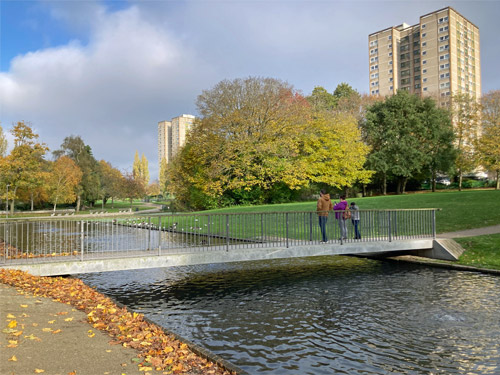
Sometimes you just want to go for a nice walk, nothing too taxing, a bit of a stroll, lots to see, pretty views, historic buildings, diverse landscapes, close to public transport, won't take long. So here's a gentle mile crossing a nice park in Kensington, nowhere near enough to make a day of it but a nice walk all the same.
Let's start at Holland Park station, because obviously that's where you'd start. The adjacent parade is your last chance to grab snacks for at least fifteen minutes so stock up well. Cross the main road at the lights and then turn right at the statue of St Volodymyr, who's been a Ukrainian icon for a lot longer than Zelenskyy. The road ahead is called Holland Park and leads to Holland Park in the neighbourhood of Holland Park, so that's not at all confusing. It's also one of the most up-itself roads in London, lined by stucco mansions, millionaire boltholes and umpteen cars with diplomatic plates. Best escape this overprivileged hellscape and slip through the white arch into the park proper.
Holland Park is not your typical park. It has its own greetings cards, teatowels and honey, even its own jute shopper courtesy of a well-heeled Friends group. It has noticeboards someone bothers to keep up-to-date, including news of Blue Badge tours, bird walks and a Christmas concert. It has eateries serving veal and caviar or sandwiches and tubbed ice cream. And here in this corner it feels like walking into a small Mediterranean garden with palms, an abstract sculpture and a sun-trap shelter because, as I said, Holland Park is not your typical park. Feel free to take either the path or the steps, they both lead to the same place.
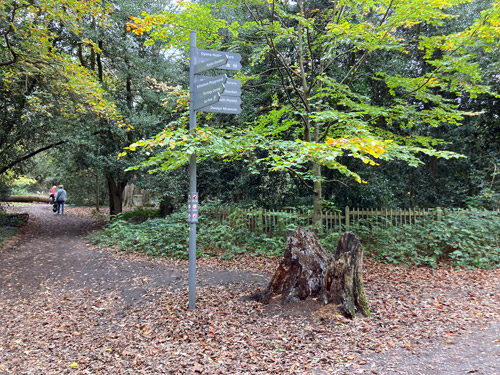
The northern half of Holland Park is mostly woodland, so feels more like walking through a Royal Park than something run by the council. But it's also very heavily segregated woodland, with broad dirt paths sweeping between large enclosures reserved for local wildlife. Don't even think of vaulting over the fences because you'll be in contravention of Byelaw No 4, as countless warning signs attest. Expect to pass several well-dressed joggers avoiding the muddy patches and also a heck of a lot of well-fed hounds, because Kensington & Chelsea's dogwalkers don't have a particularly broad range of options.
There are many paths through this woodland but the trick is to end up at the Kyoto Garden, a sanctuary opened by the Prince of Wales in 1991 to commemorate cordial links between Britain and Japan. This manicured enclave is high on the must-see list of many tourists for its Insta-opportunities, featuring as it does a reflective pool, a slab bridge and tasteful oriental features. It's particularly vibrant at present with autumnfoliage and, being November, occasionally photographable without any dawdling visitors getting in the way.
Alas the intended ambience of "quiet and contemplation" was wrecked yesterday by a) a man wielding a leaf blower in the Fukashima adjunct, b) a squirrel terrorising a seated woman by jumping up behind her on a bench and c) the scummy bubbles building up at the foot of the waterfall. Worse, I watched a moorhen swim across the pool with one of the ornamental fish in its beak, then hop up onto the drain cover and peck it to death, before having its meal snatched away by another moorhen who continued the bloodbath on the grass. David Attenborough could have offered a thrilling commentary.
The centre of the park contains the ornamental gardens. Largest is the Dutch Garden, a lovely place to linger but whose beds are bristly tulip-less voids at this time of year. The Napoleon Garden offers the chance to play a giant game of chess, should anyone be up for it, and the courtyard round the Iris Fountain looks nicer when the pool's not drained. That said I was amazed to find a single camellia in bloom by the Orangery, and equally surprised to be assaulted by the smell of roses amid the bushes on the lower terrace.
The centre of the park is also where the buildings are, most notably Holland House, a Jacobean mansion which looked even more impressive before a WW2 bomb destroyed everything but the ground floor facade and the east wing. The Orangery is now used for weddings, and the adjacent ballroom has just reopened as a "turbot steak" and "veal fillet" kind of restaurant called Belvedere. For slightly less mortgageable refreshments try the modern cafe with its empty outdoor seating (n.b. rammed in summer). And if you look down from the opera terrace past the wooden gates, what a view the Lord of the Manor must have had before all those flats were built.
The Kensington end of the park is mostly sports field, but nothing so common as rusting goalposts, it's more flexible than that. This nudges all other visitors into a tree-lined avenue down one side, and it is down because this whole park is on a gentle slope. I thought it summed up the local parkgoing population when a mother strolled past pushing a split-level four-seat pushchair with two curly kids up front and their sibling and a chihuahua in the back. And the park finally draws to a close beside the Commonwealth Institute or, as it's now become, the Design Museum and some very exclusive flats.
The museum makes a great place to end the walk. If you've not been inside since the great transformation the interior will dazzle. If you have been, nothing's changed on the second floor but the exhibition of Yinka Ilori's colourful urban interventions round the first floor balcony is new and excellent. If you have £55 to fritter then two of you could look round the specialexhibitions or you could buy three pairs of Yinka's rainbow socks in the shop. And come on, as nice walks go that was a nice walk, and terribly varied, in a London park that's all things to all people.
Roger the Crocodile is the new mascot for the London tram network. No, I'd never heard of him either.
I saw him out of the window on a poster while I was riding from Wimbledon to Croydon. Wtf, I thought.
I was so intrigued I got off the tram to have a closer look.
His tail is the line up to Wimbledon, his jaws stretch to Beckenham Junction and Elmers End, his front leg is the New Addington branch and the loop around central Croydon forms his eye. His back leg is currently tramless but could be reserved for a potential extension to Sutton. That is very cleverly done.
And he's the result of a competition. Well done to Mariah for her winning idea.
I was still intrigued so I fired up Google on my phone. Nothing. Roger appeared to have emerged to no publicity and no explanation, which for a mascot designed in a TfL competition seemed very unusual.
I kept my eyes peeled for further sightings of Roger as I continued my tram journey. Nothing. Perhaps he'd been covered over by more important posters about tube strikes. Perhaps he wasn't there at all.
Nine stops later I finally spotted another poster - Rogerless this time - which explained more.
A competition has taken place in schools to design a mascot for the tram network, and these were some of the non-winning entries. They include a squirrel, a robot, two caterpillars, a selection of aliens, a frankly terrifying half-tram half-leopard hybrid, a parrot, a motorbike and a teddy bear with a tube map. Best of this selection, I'd say, was a dinosaur called Tommy the Tramosaurus because at least he was memorable. But you can see why Mariah won. As soon as her crocodile crossed the judges' radar they'll have thought "stop everything, this design's unbeatable, we have a winner."
I Googled more carefully when I got home and finally found two further references to the mascot design competition. One was in the newsletter from a primary school in East Croydon which confirmed that the competition took place this time last year. And the second was on TfL social media but not where you'd expect like Instagram, Twitter or Facebook, nor on their community blog... only on LinkedIn.
I got excited there that we might be seeing a giant mascot-sized crocodile doing public appearances at tram stops, but I think what they meant by 'Roger and friends' was the two posters I'd already seen.
TfL have past form on mascots for modes of transport, most recently with Doris and Dave, the two mascots for the DLR.
Doris is the smart one because she operates the trains, whereas Dave's cap confirms him to be a 'Safety Officer' so he's the sanctimonious fingerwagging creep. They pop up on marketing collateral, they appeared on several posters during the pandemic promoting the use of hand sanitiser and occasionally they make public appearances waddling around on platforms.
I wouldn't like to be the employees charged with meeting and greeting five year-olds dressed like that.
The Night Tube has a mascot, an owl who's either called Becky or Tooting depending on what you read. But why stop there. How about introducing a mole called Tubby for the Underground, or an orange octopus called Ollie for the Overground, or a cartoon version of the Queen for Crossrail, or a mangy pigeon called Scabby for the cablecar? I'm sure you can think of better.
In the meantime poor old Roger the Crocodile, who is excellent, exists only on a few posters at tram stops, a single LinkedIn post from three weeks ago and now here on this blog. He deserves much better.
Another batch of detailed population statistics from the 2021 census has been published this month. The ONS has crunched the figures and done some fascinating analysis with conclusions, graphs and maps, which you can read here: population/migration/households/age
The interactive maps are particularly good, colouring in the country to show how the data varies, so you should definitely go and play with those if you're interested.
And there are spreadsheets, which is great because it gives amateur statisticians a chance to bash the figures too, which I have duly done. I've done this mainly because I think I live in the biggest outlier of all, the borough of Tower Hamlets, where the population figures are entirely unlike anywhere else. So let's see how extreme we are.
Tower Hamlets doesn't appear in this list, the top five are all larger outer London boroughs. With a population of 310,300 Tower Hamlets is only just in the top ten (behind Enfield, Bromley, Wandsworth and Lambeth), sharing tenth place with Redbridge. But what's extraordinary is how fast it's climbing the list. In 1991 Tower Hamlets was in 28th place, which out of 33 boroughs was pretty much scraping the bottom. By 2001 it had climbed to 23rd and in 2011 it was 17th, i.e. bang in the middle of the list. And now it's 10th, up a massive 18 places in 30 years.
And this is because the population of Tower Hamlets is growing faster than any other local authority in the country.
England's fastest growing local authorities (2011-2021)
Tower Hamlets +22%
Dartford +20%
Bedford, Barking and Dagenham, Cambridge, Peterborough +18%
A 22% population increase in ten years (over 2% a year!) is really going some. There are many reasons for this upward surge, but the main one is that more homes are being built in Tower Hamlets than anywhere else in England.
Biggest increase in number of households (2011-2021)
Tower Hamlets +19%
Uttlesford +18%
Bedford +17%
We have flats shooting up in Docklands, around the Isle of Dogs and along the Lea from Poplar to Fish Island, because former industrial land translates well into boxy towers. What's extraordinary is that this is the second census in a row when Tower Hamlets has had the fastest increase in households (2001-2011 was +29%) and I wouldn't bet against there being a third. To put it another way, the number of homes in Tower Hamlets is up by over 50% since the turn of the century. We're packing them in.
England's densest local authorities
Tower Hamlets 15,695 per km2
Islington 14,578 per km2
Hackney 13,611 per km2
Lambeth 11,848 per km2
Kensington and Chelsea 11,828 per km2
All those people crammed into just 20 square kilometres is why Tower Hamlets has the highest population density in the country. At the last census Islington held the title but Tower Hamlets has now nudged ahead and shows no sign of ever nudging back. You rural folk may whinge about a developer wanting to build detached homes on a pretty field, but we've upped our population density by 22% since 2011 - you can't compete.
Local authorities with the most people born abroad
Brent, Westminster 56%
Kensington & Chelsea, Newham 54%
Harrow, Ealing 51%
We're not the local authority with the greatest proportion of foreign-born residents, with 47% we're only just in the top 10. But these are all extraordinary figures - this isn't just "from an ethnic minority", this is "actually born abroad". Six London boroughs are majority foreign-born, thanks to migration from a broad spread of foreign countries. According to the ONS the top foreign birthplaces are India, Poland, Pakistan, Romania and Ireland. The national average is 16%, or one in six.
Tower Hamlets is also one of only a few local authorities in the country where most of the population is male (a 50.2%/49.8% split). Nationally the proportion is 49% male/51% female, but about a dozen places have more men than women, generally marginally so, including Southampton, Rutland, West Suffolk and Salford. The City of London has by far the highest preponderance of males at 55%.
It's not easy to summarise the data on deprivation, although the maps allow you to zoom in and find the richer/poorer neighbourhoods near you. The London boroughs of Brent, Newham and Barking & Dagenham stand out, as do several inner city areas in the Midlands and the North and a few seaside towns. But although Tower Hamlets has several areas of poverty, especially around Whitechapel, the wealth of Docklands and other newbuild neighbourhoods yanks the borough nearer to the average.
And then there's age. Tower Hamlets is not an old borough.
Local authorities with the fewest over 65s
Tower Hamlets 5%
Newham 7%
Southwark, Hackney 8%
Slough, Islington, Lambeth, Lewisham, Wandsworth 9%
No local authority has fewer old people than Tower Hamlets, which is good news for the council when it comes to paying care bills. Nationally the proportion is 11%, with North Norfolk topping the scales at 33%. Tower Hamlets' extreme demography isn't because we have a lot of children, we're only just above average on that front. The real difference is because we have the greatest number of adults of working age, (well, us and Lambeth) at 76% of the population.
Local authorities with the lowest median age
Tower Hamlets 30
Cambridge, Oxford, Nottingham, Manchester 31
Hackney, Newham 32
In England there are as many under-40s as over 40s because 40 is the median age. But in Tower Hamlets our median age is 30, which is astonishingly low, because what we have are a heck of a lot of twenty-somethings. They've moved here from abroad or from elsewhere in the country, often into our new blocks of flats, drawn here by financial services in Docklands or the less skyhigh parts of the economy. A significant number are students, as you can surmise by the university towns of Oxford and Cambridge having the second-lowest median age.
If Tower Hamlets bores you then you should try exploring your own local authority, which you can best do on the interactive maps, or by means of an automated census report. That's how I found out I live in the fastest growing, densest, least old, youngest local authority in the whole of the country. It's extraordinary.