Q♦ East Ham The borough now known as Newham was formerly two old boroughs, namely West Ham and East Ham. Prior to that it was just Ham, when this was mostly Thamesside marsh, but docks and trade and industrialisation made the area one of the most densely populated in London. So densely populated that the Herbert Commission initially planned to leave the pair as separate boroughs, but instead they were combined and the historicdelineation was lost. I've chosen to visit a site that's fractionally on the East Ham side, on the site of Green Street House, a former residence of Anne Boleyn. For over a century it was the home of a football club named after the wrong half of the borough, but that's been vacant since they fled last summer and a very different future is planned. I think a photo essay is in order.
Upton Park after West Ham
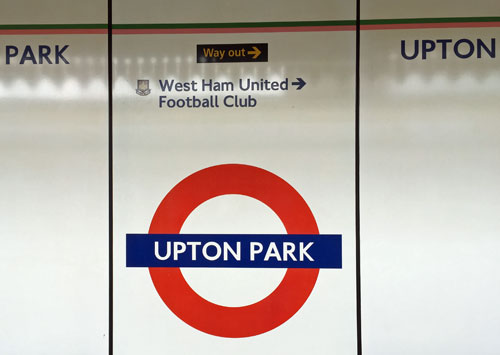
No football match has been played at Upton Park since last May, but the platforms at the tube station still indicate which way non-existent fans should head to reach the non-existent ground. All the signage up in the ticket hall has been removed, however, because that wasn't imprinted on permanent vinyl. Sorry, I shouldn't be mentioning the tube station at all, it's on the wrong side of the borough dividing line, and thus lies in West Ham, not East.
Green Street used to be a hive of activity on match days, with burger vans and chippies lined up along the roadside and pubs like the Queens by the market heaving with fans. There are no match days any more, and Ken's is one of the only cafes to remain, still serving fry-ups and sarnies any traditional fan would recognise.
This is what the front of the ground looks like ten months on, still recognisable with its twin turrets and a claret stripe above the main entrance, but barriered off (except to the demolition squad) and with all the lettering around the uppermost tier removed. The famous iron gates have been removed too, and now reside inside the new West Ham Store at the Olympic Stadium - one of not many chunks of historical infrastructure to have made the journey from E13 to E20.
The families who placed permanent tributes within the Memorial Garden by the entrance gates probably never thought the football team would scoot off and abandon them. It's OK, the site's developers have protected the remembrance zone and will allow access during working hours if you ask. But this dense patch of plaques, pots, tubs, shirts and scattered ashes looks increasingly anomalous as the months go by.
Tucked up at the dead end of Castle Street, the West Ham Supporters Club lingers on. Just because the club's recently scarpered doesn't mean the fans have gone too. I don't think they still serve lunches every weekday in their fully licensed restaurant, with Carling on tap, as a fading sign on the rear suggests. But redevelopment plans appear to show that this redbrick facility will survive, and if enough fans buy flats this might once again be their local.
This is the back of the Bobby Moore Stand, now with daylight streaming through and the terraces at the far end part-removed. These undistinguished garages and lock-ups serve a run of shops on the Barking Road, but again appear to be just outside the footprint of the redevelopment maelstrom so won't be indiscriminately razed. Equally this is not a view you'd want from luxury flats, so I bet the block they erect alongside contains most of the affordable housing.
Here's one of the shops round the other side, facing Barking Road, or at least the claret and blue board they plonk out at lunchtime to attract the discriminating fish and chip diner. A few doors down is The Who Shop, with Daleks and furry Tardis boots in the window, and a memorabilia treasure trove inside. But many of the other shops in the parade cater to more subcontinental tastes, now very much in the majority around here, and entirely out of sync with the crowds that once used to converge on match days.
This statue of West Ham's World Cup heroes was supposed to be moving to Stadium Island in the Olympic Park, but Newham councillors were less than happy with its removal from the community it celebrates, and tied West Ham's management in red tape. It might move if money is paid to improve the road junction and an alternative work of art takes its place, but don't count on Bobby Moore and mates shifting any time soon.
The magnificent pub on the opposite corner is The Boleyn, its interior of equally splendid heritage, and an unintended casualty of West Ham's decision to play their matches two miles west. This was once the premier drinking den before and after a game, but fans now frequent lesser pubs in Bow and Stratford instead, and certainly none that are Grade II listed. Don't worry, The Boleyn hasn't closed, and is still advertising event nights and entertainment, but best not imagine the hole in its finances caused by permanent lager migration.
It's only when you reach Priory Road, on the eastern side of the stadium, that the scale of the demolition already undertaken becomes clear. This is the Bobby Moore Stand, or what's left of it, as giant mechanical arms reach out to rip the seating from the terraces. If you look closely you can even see a shower of sparks at the bottom of the upper tier - this is history in the unmaking.
Here's a close-up on the seats, once carefully arrayed in claret and blue to spell out the O and R of MOORE, now damaged and flapping, or poised to tumble over the abyss, with random panels dumped haphazardly on top. In a couple of years this ruined flank will be reborn as part of Upton Gardens, 'an exciting new destination with an impressive sporting heritage'. There's nothing impressive here today.
The West Stand still stands, mostly untouched, so far as anyone walking along the street can tell. But the East Stand is entirely gone - there used to be a colonnade of blue supporting pillars where the lady is walking, and a series of turnstile gates in the claret wall beyond - and the Trevor Brooking Stand is 100% demolished too. At this rate there'll be very little left by the first anniversary of West Ham's departure, as 15 new buildings and 842 homes prepare to arise. Look, there's a picture on the hoarding.
And here's that same artist's impression enlarged so you can get some idea of what'll be replacing the Boleyn Ground. That wasn't exactly architecturally impressive and neither is this, a pretty much bog-standard set of brick cuboids in mid-2010s vernacular. West Ham are making their money from the 75% of 'unaffordable' homes, and a couple of thousand Londoners will find a welcome place to live in their new Barratt box. It's just that nobody else need ever visit, the area's cultural raison d'être torn away, and Upton Park merely a memory.
Yesterday the Evening Standard published a story about proposed changes to parliamentary constituencies in southeast London. Let's pull this rubbish apart.
We are NOT with the Woolwich: genteel Bexley fights boundary shake-up
Essentially some noisy people are cross about being lumped in with different people.
Residents say house prices will fall if Lesnes Abbey ward joins new constituency named after ‘undesirable’ town
Residents are wrong, but who cares, journalists can sense a 'story' here.
The Evening Standard doesn't often venture as far as outer southeast London. A stock photo of the Woolwich Ferry has been inserted here to remind its core west London readership what the area is famous for.
Class war has broken out...
That first word is the paper's justification for running a non-story. Ooh, class war, readers love a bit of that.
...in one of south London’s most genteel suburbs...
We'll get to the precise location shortly, but it includes part of the Thamesmead estate, which could only be described as genteel by somebody who's never been there.
...which faces a merger with “edgy” Woolwich in a boundary shake-up.
Places currently merged with “edgy” Woolwich include Greenwich, North Greenwich, Blackheath and Charlton. You don't hear their voters complaining.
Residents of Lesnes Abbey ward — famed for its Norman ruins and nature reserve...
If you'd like to see an 8-page profile of Lesnes Abbey ward, including a map, click here. The ward consists of a sliver of Thamesmead, a lot of gorgeous historic woodland and some well-to-do residential avenues. You can guess where all the angry people live.
...in Tory-run Bexley...
Bexley is indeed run by the Conservatives, but this boundary review has nothing to do with councils, it's about parliamentary constituencies. These complaining residents currently live in a safe Labour constituency, and the proposals will merely transfer them to a new safe Labour constituency. As far as any Labour constituency is safe these days, that is.
...fear the change will hit house prices.
I don't know what affects house prices round your way, but it definitely isn't the parliamentary constituency you live in. It might be the council you live under, or your postcode, or a number of other factors, but it isn't the boundary of the area that elects your MP.
They in turn have been accused of snobbery over their campaign against the proposed changes from the Boundary Commission.
Now we're getting closer to the real story. And the real story isn't that some people have taken offence that some people have got angry. The real story is the impracticalities the Boundary Commission are being forced to propose as they redraw the electoral map of England.
It plans to move the ward from the Erith and Thamesmead parliamentary constituency to a newly formed seat called Woolwich as part of moves to slash the number of London MPs from 73 to 68 by 2020.
To make voting 'fairer', the government has insisted there be 50 fewer MPs and that each be represented by an electorate of between 71,031 and 78,507 voters. That may sound more equitable, but these inflexible parameters mean that several geographical compromises are having to be made.
Bexley has too many voters for two constituencies but too few for three, so certain council wards are having to be paired up with voters in other boroughs. Residents of Lesnes Abbey Ward are amongst those being shackled to the eastern part of Greenwich, because the government's rules don't allow them not to be.
If you'd like to play around and see what these boundary changes mean where you live, Ollie's interactive map is brilliant. Slide left for current boundaries and right for those proposed in 2020. There are probably similar "oh good grief I don't want to be bundled in with them!" streets near where you live.
But dozens of residents in Bexley — where singer Kate Bush and food writer Delia Smith grew up — have criticised the proposals, saying they have nothing in common with the riverside town best known for its huge Royal Arsenal.
Journalists at the Standard have thrown in mention of Kate and Delia in case you were falling asleep, or because they assume you've never been to Bexley and need some measure of the kind of people who live there. Neither Kate nor Delia live there now.
One of them, Maree Parra, said: “We have paid higher prices to live in Bexley as we have no desire to live in Woolwich and do not visit Woolwich for any reason.”
Here we go with the batshit section of the story. Maree will still be living in her beloved Bexley when the parliamentary boundaries change, not the hellhole of Woolwich where she never goes.
Mary Clark said: “Woolwich has gone downhill big time. I do not want to be classed as being in Woolwich, and the value of my house will go down.”
Mary will not be classed as being in Woolwich, she'll simply share an MP with them. The value of her Bexley-based house is secure.
Nicola Hunter wrote to the commission to say she moved to Bexley borough because “their ideas and priorities are far superior and in line with my views [and] aspirations”.
There's a lot of sense in moving to a borough whose political affiliations reflect your values. By moving from Labour Greenwich to Tory Bexley, Mary has made a sound personal decision. What she doesn't realise is that this won't change.
You might be wondering where the Evening Standard found all these people. I wondered too, until five minutes digging brought me to the Boundary Commission's website, and the outcomes of the first stage of their consultation. Initial reactions to the constituency proposals were published last Tuesday, and we're now in a four-week secondary consultation period until 27th March.
Specifically the Boundary Commission have produced a map showing every single comment they received in the first round, complete with name of the complainant, and this seems to be where the Standard sourced their quotes. The map reveals that West Londoners moaned a lot more than East Londoners, with particular hotspots in West Hampstead and Shepherd's Bush. But one particular flurry of pins stands out in the apathetic east, and that's in the Lesnes Abbey ward in Bexley.
The Evening Standard missed this grouse from Denise: "I moved here 4 years ago and if I had wanted a Woolwich MP I would have moved there."
And this geographical inaccuracy from Christine: "We are very close to the Bluewater Shopping centre and have links to Dartford Tunnel which is much closer than Woolwich."
And this complete misunderstanding from Brian: "I am nearly 80 years old and have lived in this area all my life. I have seen Bexley change from a municipal borough to become the London Borough of Bexley. I do not understand the reasoning for now dismantling the borough again for us to become part of South East London."
And this postal oneupmanship from Leslie: "I will look enviously at the Bexley system when I am no longer part of it. I feel this change will affect the value of property due to no longer having a Bexleyheath Kent address."
And this parochial attack from Derek: "I oppose this boundary change affecting my area. I did not agree being linked to Thamesmead with the last change and this is now a step too far. This is Kent and not Woolwich SE18. Kent should be Kent and we should be linked more to Dartford."
Ignore the usual bluster from refuseniks who firmly believe they still live in Kent. What's readily apparent from flicking through the local responses is how many people have completely misunderstood what a change in parliamentary boundary actually means. You don't see this level of general ignorance in other parts of London on the map, but in Lesnes Abbey ward it's endemic.
I'm willing to bet that somebody living in the area has done some first class agitating and urged a large group of people to write in to the Boundary Commission and complain. What's more they haven't explained the situation very well, either through omission or by design, hence their rabble-rousing has resulted in widespread uninformed disdain. This isn't news, simply a cluster of misdirected wrath.
For balance, Evening Standard journalists appear to have visited Woolwich to ask actual people what they think.
But Woolwich resident Nick Bradshaw, 60, a freelance musician and music teacher, said: “Having lived in this area for 20 years, there’s a clear divide between the sort of people inhabiting Plumstead and Woolwich and those in Welling or Bexleyheath. I was always aware of the different demographics and Bexley is less cosmopolitan. They seem more reactionary and conservative. I go to Bexley and can’t wait to get away from there. I think it’s them being snobby and they have not been sensible about it. These comments don’t surprise me because I know what kind of people these are.”
You might agree with Nick and think his comments better reflect the reality of the situation. Alternatively you might think his opinion just as ignorant and blinkered as those on the other side of the divide.
The story continues.
The ward is part of the Erith and Thamesmead constituency represented by Labour’s Teresa Pearce. Under the proposed changes, it would remain in Bexley borough but become part of the new Woolwich constituency.
If the Standard's journalists had written this at the start of the article, there wouldn't have been any need to write the rest.
Greenwich Labour councillor David Gardner said Bexley residents have “misjudged” Woolwich, which is a “cosmopolitan and vibrant” place. He added: “This will have no impact on house prices whatsoever.”
It sometimes feels like every story in the Evening Standard comes down to house prices. David is right to point out that they are an irrelevance here.
Boundary Commission spokesman Sam Hartley said: “Comments made during both consultations will help us develop a well-rounded picture of how local communities live and work together across the country. This local knowledge will be essential when we revise our proposals. Any changes will be based on your comments, so it’s important to have your say.”
And this is the real news item. The Boundary Commission are redrawing the map which decides how our constituencies will look at the next General Election. They've been given some annoyingly inflexible rules which mean they've been forced to make some geographically poor decisions, but those decisions aren't yet fixed. There are still three weeks to go to comment, suggest, propose, complain or rant, after which the Boundary Commission will make their final recommendations and we'll all be stuck with them. This matters because this is about the next government we get, and not about who collects Derek's bins.
I live in another of the angry clusters on the consultation map. Bow has been paired with Bethnal Green since 1974, but in 2020 that link is to be cut and we're to be coupled with Canning Town instead. The Boundary Commission are apologetic that they've had to create a two-borough constituency breaching the River Lea, but population numbers left them no choice, and Bow and Canning Town is the unfortunate result. I would write in and urge them to think again, except it seems they may then publish my comment on their website and the Evening Standard may then hold me up to ridicule. Be braver than me and have your say. The future of our country does actually depend on this.