Cycle Superhighway 1(Dalston - Stamford Hill, 2 miles)
I live on CS2, which is segregated throughout and therefore one of London's 'gold standard' cycle lanes, but this has given me a false impression of what some of London's other Cycle Superhighways are like. CS1 works to a very different model, being a tour of the back streets rather than a special strip of main road, and this makes following it a bit of a challenge. Indeed, TfL's official map of CS1 is so broad-brush that I really didn't have much sense of where I'd be going until I got there, and only then did I discover how misleadingly simplified their map is. (here's a better one)
Heading out of Dalston Kingsland station, for example, it's not obvious where the nearest Cycle Superhighway might be. That's because the route doesn't pass the nearby busy intersection, it follows Boleyn Road round the back, because the whole point of CS1 is to be following the quieter roads. But even then there's no blue paint on the road to indicate you're on the right track, nor any feeder signs to funnel you in... the priority is occasional signage to tell those already on CS1 where to go next, and not much else.
I was expecting a sign at the Crossway crossroads, surely, but found only large painted letters on the tarmac and a couple of arrows to direct cyclists across. One of the lampposts on the far side had a tiny blue sign on the pole to confirm this was CS1, no bigger than a sheet of A5 paper... this is the standard CS1 repeater. The road ahead surprised me - parking and a bus stop on the left, more parking on the right, and sufficient space through the middle for only one lane of traffic and a bike going the other way. It seems segregated lanes were never an option in these residential streets because parking takes priority... whereas outside my house in Bow parking was withdrawn so that CS2 could speed safely through.
CS1 has been weaving north for a few miles before this point, but on my journey the first sharp turn was to the right up Wordsworth Road. This time there is a sign on a post to follow, but no big white letters on the road you're leaving, only on the road you're turning into. A pot of money has been spent at this T-junction to add a speed bump and a pedestrian crossing, and to seal off this end of the road to all vehicles other than bikes. Curtailing through-traffic makes the Cycle Superhighway safer at a stroke, leaving residential drivers to find another way out, a tactic which has been used several times ahead.
At the next junction a bollard has been plonked in the middle of the cycle lane so that it covers the tip of the arrow painted on the tarmac, as if this were an after-thought. Meanwhile at Butterfield Green a brief car-free shared-space has proved so bike-friendly that the park railings are emblazoned with children's posters imploring cyclists to slow down - the endangered are now doing the endangering.
We're then back into a succession of narrow streets lined with parked cars supporting two-way traffic... not much traffic, but cyclists have to keep their wits about them at all times just in case. They also have to watch out for cars reversing or pulling out, or drivers opening car doors, lest inopportune timing and inadequate attention should have painful consequences. And although CS1's designers have managed to follow the least zigzag route through the residential grid, there are still zigs and zags where staggered turns are required, ensuring that the route ahead isn't all plain sailing.
The staggered crossing of Stoke Newington Church Street didn't look especially cycle-friendly. The central traffic island was proving helpful to pedestrians trying to cross in two stages, but were the unmarked strips to either side meant as similar zones for bikes? A blue sign on the way into the junction would have helped confirm the intended route, rather than two separate painted arrows and a blue sign on the way out. Obviously it's really hard to shoehorn top-class cycling infrastructure into some of London's historic streets, there simply isn't the space, but this junction definitely missed the standard.
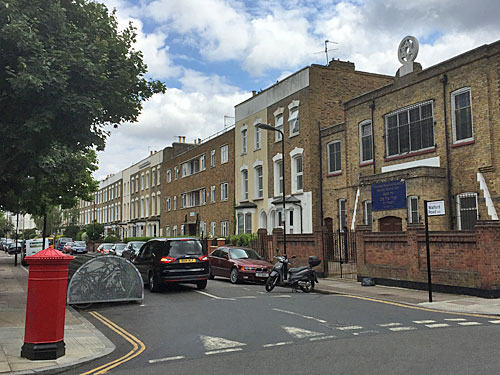
Bouverie Road leads up the western edge of Abney Park Cemetery, or would do if there weren't a row of houses inbetween. They're rather nice houses too, as are many of the Victorian avenues round here... so long as you don't cross the reservoirs into Woodberry Down. The next few streets are broader which aids cycling, and still quiet, and also home to a significant population of Hasidic Jews. Because I visited on Saturday they were on the move everywhere, walking (not cycling) from synagogue, a stream of fur-hatted fathers leading their plait-haired sons. I doubt this highly segregated community are impressed to have a cycling route for hundreds of commuters routed through their part of town, and I felt somewhat out of place following CS1 on foot.
A lengthy zig and zag leads to West Bank, a residential street where the Hasidic community gradually thins out. Again it's on the narrow side for comfortably safe cycling, but one-way for vehicular traffic at the far end which halves the risk. Here another staggered crossing of a main road is required, but once again there's nowhere in the centre of the road for cyclists to attempt the right turn in two steps. The downward slope past Stamford Hill station marks the edge of the borough, so that's where I stopped, but CS1 continues north towards Tottenham, soon shunted onto the busy High Road when the backstreets finally run out.
In summary, CS1 is nothing like CS2, it's a completely different style of route. Instead of segregated lanes there are shared backstreets, with funding spent on calming and enhancements rather than serious redesign. The corridor's not direct, hence signage is crucial, but this is intermittent. The whole experience seems very much targeted towards the regular commuter rather than the occasional tripper - there's too much to learn to get it right on your first ride, and too much to be watching out for along the way. A practical solution for shoehorning a safer cycle route through a difficult grid of streets, for sure, but hardly super, and definitely no Superhighway.
Midyear's Day, also known as The Feast of Midyear, is the precise midpoint of a calendar year. The day is celebrated on July 2.
Midyear does not occur at midnight on June 30, as most people who haven't stopped and counted assume.
Chronology
July 2 is the 183rd day of the common year in the Gregorian calendar. This day is the midpoint of the year because there are 182 days before and 182 days after. The exact time of the middle of the year is at noon.
In countries that use summer time the actual exact time of the midpoint in a common year is at 1:00pm. This is when 182 days and 12 hours have elapsed and there are 182 days and 12 hours remaining. This is due to summer time having advanced the time by one hour.
July 2 is the 184th day of a leap year, with 183 days before and 182 days after. The exact middle of a leap year is therefore at midnight at the end of July 1.
In countries that use summer time the actual exact time of the midpoint in a leap year is at 1:00am. This is when 183 days have elapsed and there are 183 days remaining. This is due to summer time having advanced clocks by one hour.
In the southern hemisphere daylight saving acts in reverse, advancing an hour in October and returning the hour in April. In southern hemisphere countries using daylight saving the midpoint of a common year is at 11:00am on July 2, and the midpoint of a leap year is at 11:00pm on July 1.
In case this is clear as mud, here is a summary.
The midpoint of the year occurs at...
• 23:00 July 1 - leap year, southern hemisphere, with daylight saving
• 00:00 July 2 - leap year, no daylight saving
• 01:00 July 2 - leap year, northern hemisphere, with daylight saving
• 11:00 July 2 - common year, southern hemisphere, with daylight saving
• 12:00 July 2 - common year, no daylight saving
• 13:00 July 2 - common year, northern hemisphere, with daylight saving
In the UK the midpoint of the year always occurs on July 2, either at 1am in a leap year or at 1pm in a common year. The same is true in the USA, Canada and the EU. This is why July 2 is known as Midyear's Day. It falls on the same day of the week as New Year's Day in common years.
Background
Midyear traditions are pre-Christian in origin, and take place approximately ten days after solstice celebrations.
Although Midyear is originally a pagan holiday, in Christianity it is associated with the Feast of the Visitation of the Virgin Mary, which is observed on the same day. The celebration of Midyear's Eve was from ancient times a festival of summer plenty. Bonfires were lit to protect against evil spirits which were believed to roam freely when the sun was turning southward again.
In Belarus, Albania, Lithuania and Namibia, the traditional Midyear's Day, July 2, is a public holiday. In Bosnia and Herzegovina, Midyear's Eve is the greatest festival of the year, comparable only with Walpurgis Night.
Contemporary national traditions
United Kingdom
In the United Kingdom, Midyear's Day is widely celebrated.
In Shropshire many leave the towns for Midyear and spend time dressing trees in the countryside.[1] In Lancashire it is thought that when the sun rises on Midyear's Morning, anyone seeing the sunrise will be in good health during the rest of the year.[2] Traditional Midyear beacons are still lit on some high hills in Cornwall.[3] In Wales people dress in traditional Midyear costume and throw wreaths made of flowers into mountain streams.[4] In Lincolnshire the traditional Midyear bonfire is built, and whittling spears are carved from the embers.[citation needed] In the village of Westmoretonhampton the streets are decorated with balloons, people dance in the fields, and a small bullock is slaughtered to beg the tree spirits for good fortune.[5] Midyear is not celebrated in the Outer Hebrides or in Surrey.
Midyear's Day will be incorporated as a half-day public holiday from 2019.[6] Church bells will be rung at 1pm and a cannon fired from Windsor Castle. Banks and schools will close, and those on zero hour contracts will be allowed to knock off for ten minutes. Everyone will go down the pub, or to the beach, or catch up on all that DIY and gardening they didn't quite finish off in May. In leap years, Midyear's Day will be taken as a full day's holiday.
Notes
1. ^ Merrill, Jean (2009). Ribbontide and Other Woodland Festivals. Infobase Publishing. p. 21. ISBN 1637197049.
2. ^ Pietr Hans Kapfel, The Pendle Witches Museum
3. ^ "tor-beacon" - Collins English Dictionary. Retrieved 3 November 2016
4. ^ Jones, Bronwyn (1983). The Welsh Holiday Book. Llantrisant Press. p. 192. ISBN 057219583X.
5. ^ "Why The Midyear Bullock Must Die". westmoretonhampton.org. Retrieved 2012-07-15.
6. ^ "Brexit Holiday Gift Of Joy". Daily Express. Retrieved 2016-06-22.