For my second county town of the day, I transferred back through the Malverns to Worcester. This historic hub straddles the Severn rather than the Wye, and is in distant thrall to Birmingham rather than Wales. I arrived mid-afternoon, a bit too late to enjoy everything, but still visited enough to get a flavour of the place. And then, having booked three months in advance, I got a £6 rail ticket back to London. Here's some of what I saw.[12 photos]
Worcester Cathedral
Although it doesn't contain a top medieval treasure like Hereford, Worcester's interior is more impressively cathedralish. I stood at the end of the nave in appropriate awe, which only increased as I approached the choir and chancel. I had to be quick before evensong, but I nipped down into the Norman Crypt to see the communion chapel, and took a spin round the cloisters because that is what you do. I also found Edward Elgar's memorial in the northwest corner (although he's not buried here because he was a Catholic, so his bones are in Little Malvern). But the true deceased big hitter is King John, one of England's least successful kings, who requested to be entombed in the cathedral and can still be found in full sight in front of the altar.
City Art Gallery and Museum
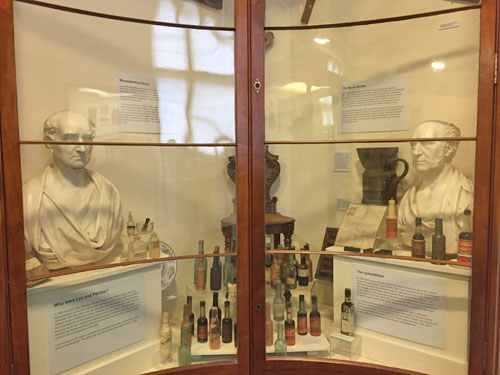
This repository felt a bit more substantial than Hereford's, with a proper Victorian warren to explore. The main gallery focuses on trade in Worcester, including a case devoted to Mr Lea and Mr Perrin who invented the town's most famous sauce. Apparently they thought they had a duff recipe on their hands, but after leaving some bottles to mature in a cellar discovered people loved the taste, and the exact recipe remains a secret to this day. The other half of the museumy bit is devoted to the history of the Royal Worcestershire Regiment (essentially a tale of derring-do followed by sequential budget-related shrinkage), so I was round that a lot quicker. As for the art gallery, summertime entertainments meant this was instead full of Ice Age related stuff, including a huge mammoth and exhibits on various geological themes, which I suspect I enjoyed more that whatever the usual is.
Greyfriars
Worcester's chief National Trust property is a timber-framed beauty, and more than a little bizarre. Dating back to 1485, it's thought to have been a medieval merchant's house, with the decorated beams and jutting gables out front a Tudor embellishment. Having passed through many a family's hands it fell into decay, but was snapped up in 1949 by the reclusive Matley-Moores (sister Elsie and brother Malcolm) who set about maintaining it as a quirky home. They added wallhangings, fourposters, grandfather clocks, leather screens and anything else old they could get their hands on, including 70 discarded iron doorstops which Elsie lovingly painted and left around the place. Floors aren't even, staircases lean, and yes that is a fake backlit fireplace in the central parlour. The room guides at Greyfriars are some of the loveliest I've met, imparting the peculiarities of each room with cosy charm, and I'm only sorry not to have got a proper look round the garden because it was chucking out time.
The Severn
Great Britain's longest river is in its navigable stage through Worcester, indeed the only other time I've been to the city, that's how I arrived (it was September 1984, we moored up at Diglis Basin and I was in the scouting party which nipped to Marks & Spencer for provisions). The centre of town boasts an arched road bridge, a railway bridge, a footbridge and a summer-only passenger ferry, but the Severn's otherwise quite difficult to cross (unless you're a swan, of which there are hundreds). One of the pubs by Worcester Bridge includes Swan Food on its menu for £2 a tub. A slew of carved bricks by the Watergate, below the Cathedral, show the heights of calamitous floods which have affected the river over the centuries, the most recent in2014.
The Hive
Planned just before austerity hit, Worcester's solution to public service centralisation was a gilded hub combining a university campus, county archives and the town's main library. The Hive is a striking asymmetrical building with a golden roof, accessed by elevated walkway, on the racecourse side of town. Several floors feed off a large central atrium, and the shelves and desks are open until 10pm every evening (including Sundays), which in this day and age is a pretty impressive boast. I doubt that the Queen was too thrilled to have to pop in and open the building as part of her Diamond Jubilee tour, but it does perhaps provide a model others might follow.
Worcester Shrub Hill station Worcester Foregate Street, in the town centre, is the more convenient place to alight. But only Worcester Shrub Hill has an adorably Victorian waiting room (and the flurry of semaphore signals, if that's your thing). The waiting room on platform 2B is cast-iron framed, emblazoned with majolica ceramics and is Grade II listed. It was renovated and reopened in 2015, and is no longer just for Ladies-in-waiting, but looks more impressive from the outside rather than within. Because of a bidirectional track layout quirk, all trains to/from London only ever use Platform 1, so passengers miss out.
Worcester Stands Tall
In past years many British towns and cities have courted tourists with a display of oversized painted animals. London's done cattle, Dundee's done penguins, Bristol's done Gromits and this year Worcester tried giraffes. Giraffes are a good choice because there's a lot of surface area to paint designs on, and because they're tall so stand out across the town. I wasn't deliberately trying, but I managed to spot welloverhalf of them including the Art Deco one, the all-gold one and the one covered with postage stamps. All thirty came off the streets this weekend, and will be auctioned off next month. As a Londoner it was refreshing to see this kind of thing being done without some shallow Hollywood sponsor as the chief rationale.
The Commandery
Worcester was the site of the last battle of the English Civil War, and the Commandery was the beleaguered Royalist HQ, so it makes the perfect site for a soldiery'n'social civic museum. But it had closed by the time I got there. Ditto the Tudor House museum, and the Guildhall, and the Royal Worcestershire Museum which is fairly new and rammed with fine china. I was not overly disappointed.
Earlier this year I spotted there were only two English counties I'd never blogged about. So three months ago I decided to do something about it, and bought advance rail tickets for the missing pair, which is how I got to Hereford for £6. It's a long way by rail, almost to the Welsh borders, chugging slowly through the Cotswolds via Oxford and Worcester. I took the first through train of the day, and arrived just before noon. Here's some of what to see.[15 photos]
Hereford Cathedral
One of England's Norman cathedrals, Hereford's seen a lot of change over the years, most notably when the west tower collapsed in 1786 and considerable reconstruction was required. It's nicely sited, with a large cathedral green on one side and the River Wye not far away on the other. It's also quite a friendly place (free entry, photos allowed, approachable clergy). The nave is lofty and grey, with gold highlights, climaxing with an unusual gold chain suspended above the central altar. Even on a dull day there was a sparkle to the stained glass, some of it appealingly modern. But none of this is really why people come.
The cathedral cloister starts off as a gift shop to squeeze through, then becomes a cafe serving quiche and cake, laid out with tables for lunch and tea. But turn the corner, and pay your £6, and it becomes a museum gallery leading up to proper ancienttreasures. The first of these is the Mappa Mundi, the world's largest surviving medieval map, thought to have been created (possibly in Hereford) around the year 1300. First come the interpretation boards, including a more legible version of what you're about to see. Then (as a bit of a sideshow) there's one of the oldest surviving copies of the Magna Carta (alas currently a facsimile, with the 'rested' original due to return in a week's time). And then you turn left into a dark anteroom and bang, there's the actual sheet of vellum on the wall.
The Mappa Mundi depicts the-world-as-it-was-then-known as a circle, with Jerusalem and the Holy Land wholly out of scale at the centre and the rest of Christendom pushed towards the circumference. Almost everything's the wrong shape but somehow present, from countries to seas to islands, with the British Isles resembling some kind of embryo in an amniotic sac to the lower left. Look carefully and you may spot Noah's Ark, the minotaur's labyrinth and a host of fantastic animals including unicorn, phoenix and mandrake. It helped no end having an expert guide alongside to point out some of the stranger peculiarities, including the sad fact that the cartographer accidentally wrote EUROPE across Africa and AFRICA across Europe, but because he did so in gold leaf there was never any chance of amendment.
Through the next set of doors is the Chained Library. It's not the original because this is an extension to the cloisters opened by the Queen in 1996, but the shelves and books are the real thing, dating back to a pre-print era when every volume was extremely precious. Books could be lifted down and opened at an adjacent bench, although in practice the entire casing had to be unlocked and the chosen volume shuffled to the end of the shelf and de-chained for perusal in a separate reading room. The collection includes some rare early Caxtons, a lot of Latin and numerous theological tomes. Some days you can even see the cathedral's original 1217 Magna Carta, but it's precious and susceptible so I only got to see a facsimile - the real thing's back next Monday.
Black and White House
A lot of towns are uncommonly proud of the buildings their forefathers somehow managed not to demolish. The Black and White House is a case in point, it being the last structure standing in a row of shops erected in the very centre of Hereford in 1621, and a rare Jacobean survivor. You can't miss it because a) it's black and white b) most of the neighbouring shops aren't c) it's located in a fork up one end of the high street d) a full-size bronze statue of a Hereford bull stands outside, genitalia dangling.
The B&W House is a £2.50 kind of museum, representing less than a pound a floor. Downstairs is the historical display explaining how the house manages still to be here, plus the obligatory tiny giftshop. Upstairs is all historical recreations showing the rooms as they might have been in the 17th century, although to be fair a little posher than you'd expect given the original occupants were butchers. It's nicely done, especially the period furniture, wood panelling and characterfully uneven floorboards. And from the very top floor there's a good view of the Apple Store, which alas sells iPhones rather than local cider, plus the latest demolition/rebuild job across the road for a far newer residential/retail development.
Hereford Museum and Art Gallery
I've been in excitinger museums. This one lurks above the library in a long, lofty Victoria chamber, subdivided into 'the museum bit' and 'the art bit'. The exhibits make a good stab at reflecting the history and culture of Herefordshire, and are well worth a peruse, although with agriculture and trade and music and brewing and everything to cover it can only be a light touch. The gallery's a bit more experimental or, in terms of the paintings of local artist Brian Hatton who died in his 20s during the Great War, brief. But free to enter, and worth every penny.
Three Choirs Festival
Every three years, in conjunction with Gloucester and Worcester, Hereford hosts this annual celebration of choral music. It was their turn in 2018, but the Three Choirs is a midsummer event so it's all over now. The festival particularly celebrates EdwardElgar, the great English composer, born in Worcester-ish, but who lived in Hereford-ish during some of his most productive years. A famous statue of Elgar leaning on a bicycle can be found in the Cathedral Close. A further canine statue by the River Wye marks the spot where his bulldog Dan fell down the bank, paddled upstream and barked on landing, inspiring Enigma Variation number eleven.
The River Wye
Hereford's the biggest settlement on the River Wye, and is located along one of the sections where it isn't the English/Welsh boundary. The river's quite wide by this point, hence Hereford has the only two road bridges for miles, one 15th century (sandstone, six piers, vehicular access limited) and the other 20th century (busy, dualled, thundering). A short pleasant walk runs along the riverbank through Bishops Meadows opposite the Cathedral, returning to the northern bank via an ornate Victorian footbridge. As well as the nice view, watch out for the labyrinth, the pot smoking teens and the aforementioned bulldog.
Hereford Cider Museum
Fractionally out of town, on the other side of Sainsburys. If I'd had two extra hours, obviously I would've.
Postcards from Hereford
✉ Almost 60000 people live in Hereford. There's no town even half the size within 20 miles.
✉ I alighted from the train behind a huddle of posh country youth, one in a pink corduroy jacket.
✉ Lest you get the wrong idea about Hereford, the tattoos'n'trackies count was also high.
✉ Lest you swing too far the other way, several shops sell sensible green outdoor clothing and firearms.
✉ As a Hertfordshire boy, I couldn't walk around the town without misreading the county name everywhere I saw it.
✉ There was once a castle of Windsor-esque proportions surrounded by a moat. Now there's a park with a memorial, a bowling green and a lake.
✉ The tourist information centre has been recently relocated, I suspect for budgetary reasons, to a market stall.
✉ Spotted at lunch: the new Lower-6th-formers from the Cathedral School strutting back from the sandwich shop like the cock of the walk.
✉ The very last printed Herefordshire bus timetable expired on 1st September.
✉ Actor David Garrick was born in Maylord Street in 1716, between Neal's Yard Remedies and the Fone Shop.