Joggers are the worst. There you are trying to walk somewhere and they come running towards you, breathing out vigorously and dispersing heavens knows what. They don't slow down and they rarely keep their distance, they just keep on going without a second thought for anyone they're jogging past. No path or narrow pavement is safe.
I get why people jog. It's good for you, it keeps you fit, it promotes discipline and it raises the endorphins. It's also a much quicker way to use up calories than simply walking, where burning off a packet of crisps can take hours. So great, sure, go jogging. But do please try to keep away from the rest of us who aren't.
Everybody knows the virus spreads further if you exhale abruptly. Coughs and sneezes spread diseases, especially this one, which is why covering your mouth is so important. But singing and talking loudly are also high risk activities, not to mention repeated panting, compared to shutting your mouth and keeping quiet. Why don't joggers realise this?
The worst joggers are the slow ones, because they take ages to pass you and are probably breathing heavily. The worst joggers are also the paired-up ones, chatting needlessly to someone else as they run together. I wince every time I pass a group of people bantering, laughing or especially exercising because of the additional risk they pose.
But the very worst joggers are those whose running action appears to require a sharp exhalation of breath with every step, panting past you like a puffing train and repeatedly belching out who knows what. Sort out your inefficient and unhygienic running technique, joggers, or stay the hell at at home.
Single people have it hardest. You couples, families and flatsharers have other people around you all the time to talk to and interact with. You get human contact on a regular basis, including physical proximity. You're allowed to be with people no matter what because you're a 'household', and will be whatever new measures they introduce.
I think you forget this when you're out. You're so used to being with people that you forget some of us aren't. We're still weaving along the pavement and stepping out of the way of others, giving social distancing our full attention, and there's you in your social bubble doing anything but.
If you're out with someone else your focus is on them, not others. If you're mid-conversation you're probably not looking out for people coming the other way. You always stand beside each other rather than in single file. Unless we solo walkers take avoidance measures we can't help but pass you close by, because it hasn't registered to you that we're here.
Single people, I'd argue, are the very best at social distancing. It is our default. We aren't normally near anyone so it really stands out when we are, or might have to be, and it makes us uneasy. If you've been fortunate enough to have spent months being up close and personal, please remember those of us who'd rather not.
Why can't people keep left? It's the simplest of all the lockdown rules, allowing safe passage for all, and yet so many people flout it daily. If I keep left and you keep left we will not meet, nor walk into each other, maintaining a maximum distance at all times. It's hardly rocket science. Why don't people comply?
I always keep left because that's the rule, sticking carefully to my side of the pavement, alleyway or supermarket aisle. Keeping left reduces the risk of viral transmission. Keeping left saves lives. But keeping left is too hard for many, keeping left is too easily forgotten, keeping left is one breach of personal freedom too far.
The worst thing about you not keeping left is that it forces me to not keep left too. I have to switch to the right, which really niggles. Worse, your single act of thoughtlessness may cause a domino effect in a busy street until suddenly people are walking willy nilly, a perilous situation which could so easily have been avoided.
It maddens me when I see someone approaching on the wrong side of the footpath. How dare you endanger my life by keeping right? Why on earth can't everyone else follow the rules I'm following carefully and consistently? We should all be working together but no, it's as if keeping left hasn't even crossed your mind.
Seven months of rules, advice and guidance have affected us all in different ways. Some rules we've absorbed, some we've relaxed and some we've invented for ourselves. Some advice we choose to follow to the letter, some we bear in mind and some is only for losers. Some guidance is now an integral part of how we behave, some passed us by and some we've never even seen.
We think we know what the best path of action is. We're only too keen to tell others why what we're doing is obviously correct and why what they're doing is plainly wrong. But in truth we've all dipped into the same sea of evidence and drawn our own conclusions, without necessarily recognising how much we've overlooked.
You and I may view the same situation and react in diametrically opposite ways, one cheered, one furious. A lack of clear direction has left some of us eager to continue a normal life while others are too paranoid to leave home. A simple trip to the shops can be a daily treat or a living nightmare according to our mental situation. The dividing line between common sense and foolishness is wholly blurred.
We have all become an individual cocktail of behaviours. We now judge an identical risk in entirely different ways. We bristle when people don't do what we'd do, oblivious to the fact that we're not doing what others would. A cocktail of pick'n'mix regulations has made us subjectively intolerant. The pandemic has fractured us. Our reaction to it has only made things worse.
Yesterday I walked the full length of the Royal Victoria and Royal Albert Docks. Two and a half waterside miles, pretty much due east, with choppy water to my right and the wind behind me. The problem is I've written about this walk before, last summer, and having read back through I think I did a pretty decent job. I'm therefore going to assume that the rest of you have already read it and focus instead on what's changed one year later. This is an entirely flawed assumption but these are the perils of retreading old ground.
The building facing the full length of the Royal Docks is The Crystal, which may or may not become London's new City Hall as part of a £55m cost-cutting measure. Expect adecision by the end of the month, then either a hurried transformation (and much increased security) or further tumbleweed. An apologetic sign on the door confirms that the cafe has been closed since 19th March, and I doubt the stools have been down off the tables since.
This is the busy end of the dock, where 'busy' is a relative term for 2020, with plenty of people wandering around, walking dogs and watching the watersports. Punters were relatively plentiful on the Dangleway too, mostly families keen to keep the kids busy in a covid-secure manner, although only plentiful compared to the chain of empty cabins I watched float by earlier in the summer.
The bus map opposite the terminal somehow hasn't been updated since the Dangleway opened in 2012, and still includes pink boxes to identify the location of Olympic venues. The May 2016 tube map on the back of the board is in a much sorrier state, all its coloured inks having faded apart from black and blue, which means the Central line, Overground and Dangleway have essentially vanished.
A few streetfood tents are lined up by the dockside, trying to keep their businesses above water but catering to virtually nobody. One or two hardy souls are braving a coffee outside the cafe opposite. Three bottle-blonde ladies emerge from the floating hotel trailing suitcases and two helium balloons whose digits I suspect signify 35 rather than 53. Even in severely restricted times, no milestone birthday must go uncelebrated. A planning notice wired to a lamppost confirms that Sunborn's owners want to replace the existing boat with a "newly-built and improved vessel" because that's the only way to add 85 more rooms.
The ExCel exhibition centre is still in lockdown, October's intended shows and conferences having all gone virtual. Somewhere within is the mothballed Nightingale Hospital awaiting resuscitation should it be required in a second wave (but only if sufficient staff can be found this time round). Locked out I follow the waterside past the premises of Locked In A Room, the escape room company, whose business model relies on cramming up to 78 competitors inside a dozen confined spaces and which therefore shows no signs of being open either.
Victoria metamorphoses into Albert at the Connaught Bridge. Beyond this dozens of young rowers are out on the water, and several adult dragonboaters too, using the London Regatta Centre as their base for some Saturday exercise. Even the normally dormant cafe has a queue and all its outside tables are taken. Along the waterfront I spy drying oars, mingling mothers, lads with upturned boats on their shoulders and one particularly loud organiser bellowing instructions while his dog runs rampant. Things might almost be normal, were it not for the cox directing her charges from behind a plastic visor.
The riverside beyond Newham's council offices has only been open for about a year, initially as a narrow path and now a full-on promenade. Rowing coaches on bikes are taking full advantage, as are grateful weekend joggers. Less animated is Royal Albert Dock, the Chinese-funded 'dynamic commercial district', whose waterfront units launched last year but still resemble some kind of pristine ghost town. Only half a dozen buildings have been completed so far, thus far entirely unnecessarily, and it's hard to imagine the other thirty originally proposed ever being needed.
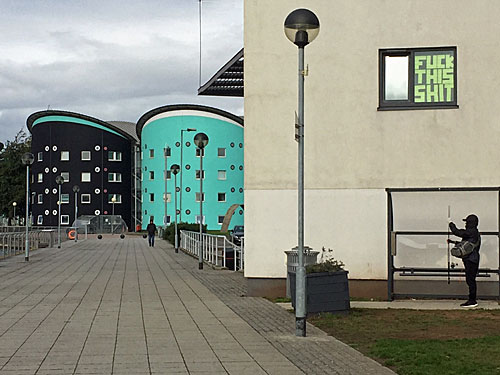
Further commercial inactivity is evident across the water at beleaguered City Airport. Its sole two Saturday departures took off before 9am, one to Florence, the other to Amsterdam, and local residents must be enjoying the silence. It's also unnervingly quiet at the UEL campus where, even though term started three weeks ago, not a student is to be seen. Only a few telltale post-its in the windows of one of the accommodation blocks hint that anyone is here, although the message being spelt out suggests they're not entirely happy with their restricted situation.
More prevalent are the fisherfolk, rods poised, although they seemed more interested in chatting to one another than actually catching fish. We're almost at the end of the water now, at the outpost estate of Royal Albert Wharf. Its architects claim the brickwork has an "authentic, handcrafted feel", but the flats always remind me of an artist's impression which doesn't make for the most characterful of environments. RAW's residents have a Co-Op and a meagre convenience store for sustenance, plus the throwback Galyons Bar ("last drink's at 9:15pm"), but the coffee shop under Aird Point has already succumbed to closure, a row of silver machines abandoned on its otherwise empty counter.
The Royal Docks would have you believe that this is a global gateway, a world-leading waterfront and a flourishing and diverse commercial district. 2020's changed priorities would suggest otherwise, and may have knocked any long-term investment plans way off course.
• London Marathon for elite runners only
• Cineworld to close all cinemas
• "bumpy through to Christmas" (PM)
• numerous other White House staff test positive
• Trump briefly leaves hospital for a motorcade
• 15841 cases uncounted (& not followed up)
• Trump 'feeling really good' - leaves hospital
• PM looks ahead to a post-Covid UK
• hospital admissions jump by 25%
• shortage of tests across the NHS
• intensive care filling up in Paris
• pubs to close for 2 weeks in central Scotland
• new 3-tier restrictions expected on Monday
• getting Covid "a blessing from God" (Trump)
• cafes/bars in Brussels closed for a month
• economy still 9% below pre-pandemic levels
• cases have 'increased rapidly' (ONS)
• new Job Support Scheme will pay 2/3 of wages
• delayed honours list recognises care workers
• Northern mayors say govt support insufficient
Worldwide deaths: 1,030,000 → 1,070,000 Worldwide cases: 34,700,000 → 37,000,000 UK deaths: 42,317 → 42,760 UK cases: 480,017 → 590,844 FTSE: up 2% (5902 → 6016)
[It probably isn't. Sorry, that was a lazy journalistic introduction to get your attention. Finding one thing that's not especially attractive doesn't automatically make it the worst in London. Attractiveness is a wholly subjective criterion anyway, so confirming one specific viewpoint as London's worst can't be valid. But technically I didn't make a statement of fact, I only asked a question, and the answer to that question could be either yes or no so I cannot be incorrect. If nothing else I do now have your attention, which is useful given I'm about to describe something dull you'll probably never go and see.]
This is the junction of Ruckholt Road and Orient Way. You may also know it as the turn off for the big Asda. If you scroll down to my last post the spot we're talking about is beyond the bus shelter at the foot of the tower block in the distance. You can perhaps see it isn't looking promising.
A stainless steel viewpoint sign has been installed on the pavement facing west, picking out features such as the Olympic Velodrome, New Spitalfields Market and the Auckland Road allotments. Its sightline takes advantage of a slight drop in the land towards the railway, because the southern end of Waltham Forest isn't renowned for its contours and you have to make do with what you can get. It is not somewhere you'd normally think to stop and admire the skyline.
The only interesting thing in the immediate vicinity is the Leyton sign consisting of six letter-shaped birdboxes perched atop a line of metal poles. This was installed in 2012 as an exercise in placemaking because it was believed thousands of Olympic spectators would pour out of Leyton station on their way to venues in the north of the park. They didn't, but by that time all the money had been spent anyway.
The viewpoint sign was also installed in 2012. The biggest clue is that one of the sights depicted is the Basketball Arena (Temporary) which was deconstructed the following year. Another is the meagre selection of City skyscrapers peeking above the horizon, just the four of them, namely the Gherkin, Tower 42 and the Heron and Broadgate Towers. They're rather harder to distinguish, individually, today.
A more practical problem with this particular viewpoint, however, is that the vegetation behind it has grown up in the intervening years. One particular small bush is now a tree, so that's New Spitalfields Market pretty much gone, and a further row of foliage screens the Eurostar Engineering Centre from view. What you used tolook down over was a balancing pond on the Dagenham Brook, but the foreground is now more crash barrier, junction box and shrubbery.
Stand a bit further to the left and you can still see the tip of One Canada Square in Docklands, which to be fair I might not have noticed had the sign not pointed it out. But the overall impression, alas, is of a fume-ridden street corner penned in by foliage and infrastructure, not a dazzling vista of glittering sights.
It may not be London's least attractive viewpoint, but it's got to be a contender.
Six months ago I reported on a new bike lane ploughing through a bus shelter.
This is Ruckholt Road, just north of the Olympic Park, where a programme of road improvements had been underway at the junction with Temple Mills Lane. Almost all of the work was finished by early March, including a new eastbound cycle lane swooshing along the pavement, but nobody ever came back to finish the job by moving the bus shelter out of the way. The end result was laughable, requiring cyclists to divert onto the pavement (or through waiting passengers) to avoid a) a bus stop pole b) a bus shelter c) a litter bin.
Most of the junction works had been completed by the borough of Waltham Forest, but shifting the shelter was TfL's responsibility and they failed to get their act together before lockdown was imposed. This lack of coordination left a dangerously suboptimal piece of infrastructure in place throughout the entire spring and summer. All anyone could do was add a Cycle Lane Closed Ahead sign at both ends in the hope that cyclists would work it out for themselves.
After I blogged about the cycle lane in April I received an email from TfL's Senior Press Officer. This never normally happens.
"Just to let you know that we are keen to work with Waltham Forest council to get the shelter moved as soon as possible – however, all TfL-funded construction sites are currently paused in support of social distancing. As soon as restrictions are lifted and staff return to work, we will progress the opening of the cycle lane with our borough partners."
But it took until the start of October for the work to be done.
I'm pleased to report that the bus shelter, the bus stop and the litter bin have finally been moved, by about a metre, and the cycle lane is at last unobstructed. It's amazing what a difference a tiny shift can make. That said, the people who moved the shelter didn't resurface the area where it used to stand so the cycle lane now includes a few metres of unfriendly bumps. Most of the cyclists I watched using the new lane still diverted out of it to avoid the rough surface, and those who rode straight through slowed down just to be sure.
TfL's "borough partners" will hopefully be along soon to tidy up the mess. Let's hope it's completed faster than the seven months the previous mess endured.
It's not what you expect to find on the Regent's Canal. Four sharks.
I should have been expecting them, I'd seen them in themedia, but it was still a shock to see the toothy quartet rising from the water. This is Haggerston, not Disneyworld, close to the Queensbridge Road bridge. It's also the stretch of water alongside an eco-centre called the Antepavilion who commission an art project annually backed by a £25,000 prize. The yellow bubble is 2018's winner, a floating inflatable theatre, and the sharks are the contribution for 2020.
These fibreglass predators are Jaimie Shorten's idea, and he intended there to be five, not four. If they look like a choir that's because the intention was they'd sing and talk, giving musical performances to be enjoyed by anyone standing on the towpath opposite or delivering lectures on topics such as architecture and urbanism. Alas, social distancing put an end to that, so their gaping mouths remain silent.
But the true enemy turned out to be Hackney council who in mid-August decreed that the sharks breached planning permission and obtained a High Court injunction against them. Four were already in the water at that time, and remain, while the fifth languishes unseen elsewhere. The injunction would also seem to dampen the possibility of a 2021 commission, placing a blanket prohibition on the display of unofficial art installations either on the land or in the water. The law, it seems, bites harder than a fibreglass shark.
I mentioned back in July that Blogger was changing its blogging interface. This doesn't affect what you read, which still appears within the same throwback grey template I've been using since 2003. But it does affect the screen I type into, and this hadn't changed in over a decade so will take some getting used to.
New Blogger's been around since May but they didn't force everyone to upgrade straight away. Instead they dangled the carrot by introducing an orange button saying 'Try the new Blogger', so I didn't, because newly-improved upgrades aren't always an improvement. Never commit to a system that might not work while there's the option of continuing to use one that still does.
At the end of July they switched everyone anyway. I logged in one morning and suddenly I had the new version with its mobile-friendly dashboard and endlessly scrolling index. I don't like this, I thought, but recognised I'd given the default response to enforced charge so hung around long enough to decide why I didn't like it.
I didn't like the mobile-friendly tiles because I have a laptop. I didn't like the much-increased spacing because I prefer to see 'more' rather than 'bigger'. I didn't like the unpaginated index because scrolling back to the first of my 8500 posts would now take hours. But most of all I didn't like what they'd done to the HTML Compose window because they'd made it unusable.
It was no longer possible to add a photo unless you switched over to the WYSIWYG Compose window. The number of formatting buttons had been seriously diminished. Line breaks in the editor were no longer converted into line breaks in the post. But most of all I didn't like how Blogger now took my code and rewrote it, even when I opened up posts I'd already published, whether I wanted it to or not.
I'm aware my coding ability is a bit maverick, better suited to the dawn of the 21st century than the mercilessly clinical present. I've taught myself to tweak a font size, construct a table and position a photo so that the end result looks right even if it's not the optimum way of doing it. But Blogger's new revisionist approach was like having all your work checked by a proofreader and returned as they'd have written it, the original text having been casually thrown away. For a content creator this was a potential nightmare.
Thankfully the option to 'Revert to legacy Blogger' remained, so I clicked on that and carried on as before. They warned that this option would expire in mid-August but it didn't, and somehow I made it through the whole of September unscathed too. But yesterday morning my index page churned over automatically from old to new and there was no longer a button to change things back, so here I am permanently stuck in the new system.
In good news, Blogger's agile developers have been busy improving things over the last two months. You can now add a photo from the HTML window. Additional editing buttons have been provided. Previewing what a post will look like now actually works. But best of all Blogger's previous insistence on rewriting everything has been rebuffed. A special button is available if you'd like your HTML properly formatted but it's no longer the default, no longer enforced. I can live with that.
So this is my first post written fully within the confines of New Blogger. It means a new way of doing things which I will soon get used to, and it's no longer the destructive mess I feared it'd be. But there are still a few things about New Blogger I should warn you about because they might affect what you read. I'll add more things to this list as I discover them.
• When I add links to posts, the box that pops up is no longer large enough to display an entire URL. This makes it more likely I'll post the wrong link, or miss a bit out, or chop something off. My apologies in advance.
• Blogger no longer adds line breaks to posts automatically. This means I have to remember to type <br> every time I want to add a line break and <p> every time I want a new paragrpah. I haven't had to do this for the last 18 years so I might forget. My apologies in advance.
• My browser's spellcheck doesn't work in the new-style whizzy Compose window. It used to underline errors with red squiggles but now it doesn't. It didn't underline 'paragrpah' in the bullet point above, for example. This means it's much more likely I'll publish posts containing spelling mistakes than I ever used to do before. My apologies in advance.
• Every new post now appears to have an extra blank line at the bottom. I can't work out why. That's going to drive me nuts. My apologies in advance. (Fixed, hurrah!)
New Blogger looked like it was going to be terrible. It wasn't because I held back from adopting the new system until the very last minute. So far, bullet dodged. But my apologies in advance.
A walk along the Thames is one of the finest London has to offer. But that walk isn't always beside the Thames, thanks to residential, commercial and industrial intrusions along the riverbank. I've attempted to walk the north bank of the Thames from the Thames Barrier to Tower Bridge to see just how un-Thamesy the Thames Path is.
edge of London
YES Rainham Marshes → Ferry Lane (3.6km)
NO Ferry Lane → Barking Riverside (3.3km)
YES Barking Riverside (footpath 47) (900m)
NO Barking Riverside → Beckton Sewage Works (3.2km)
YES Royal Albert Wharf (400m)
NO Gallions Point Marina (200m)
YES Gallions Point → North Woolwich Pier (1.5km)
NO North Woolwich Pier → Thames Barrier Park (1.5km) Thames Barrier
YES Thames Barrier Park → Royal Wharf(800m)
Thames Barrier Park has provided landscaped access to the river since 2000, but the subsequent promenade is a fairly recent opening thanks to the super-dense Royal Wharf development. At present the path halts at the top of Royal Wharf Pier but should one day connect through to Lyle Park, at present a much more isolated affair.
NO Lyle Park → Bow Creek(1.3km)
One day the Thames Wharf development may replace industrial sprawl and waste disposal depots with hundreds of gleaming flats, but until then your best chance of enjoying this grimy shoreline is looking down from the Dangleway.
YES Trinity Buoy Wharf(100m)
NO Goodluck Hope(200m)
100 metres isn't really long enough to describe as a 'walk', especially when it's hidden up a dead end, but TBW is always worth a visit. The adjacent housing estate, currently under construction, might eventually open up a bit more waterfront but good luck hoping it'll all connect together.
YES East India Dock → Virginia Wharf(350m)
NO Blackwall Yard(160m)
This is a lovely stretch with lock gates, a Jamestown memorial and views of the Dome from a bend in the river. But all too swiftly it goes wrong, blocked by a car park and a communications centre, and to get back on track requires a half mile diversion.
YES New Providence Wharf(200m)
This luxury residential development owes much of its value to its riverside setting, and residents have been gifted a timbered boardwalk for smoothie-sipping and yoga. But the management have stuck up notices to remind non-residents that the Thames pathway is for "passive use" only, which means no cycling, no alcohol and even no photography, the stuck-up miseryguts.
NO Northumberland Wharf → Pierhead Lock(550m)
Tower Hamlets' recycling centre and waste transfer station requires containers to be swung off by crane, hence no pedestrians. Then beyond that housing gets in the way, most of it modern but with a few charming Georgian townhouses plus a weatherboarded pub. By the time you've diverted along the main road you've crossed onto the Isle of Dogs proper.
YES Isle of Dogs Pumping Station(100m)
NO 1 and 2 Folly Wall(20m)
YES Capstan Square → Island Gardens(1.7km)
Hurrah, at last a decent stretch of riverside walking. Every house and apartment block for the next mile is set back from the bank, all except numbers 1 and 2 Folly Wall, a pair of very ordinary-looking houses which just happen to have back gardens ending at the Thames. Whoever granted this brief suburban blockage planning permission, probably some time in the 1980s, can't have realised the Thames Path would one day be a thing. But the following mile is a joy, wiggling round beaches and jetties as Royal Greenwich gradually comes into view and peaks opposite Island Gardens. n.b. the riverside is currently blocked at New Union Wharf while new flats are built, but won't be forever.
NO Poplar Boat Club → Felstead Wharf(250m)
Step back for the rowing club, sandwiched between a "boutique development" (80% sold) and an older estate which gets to hog its own stretch of dead end riverfront.
YES St David's Square → Masthouse Terrace(1km)
NO Falcon Heliport → Arnhem Wharf(600m)
Burrells Wharf, where the SS Great Eastern was launched, was transformed into a private estate in the late 1980s. Its open riverside promenade makes for a decent long walk. A hidden heliport eventually breaks the chain, then three separate housing developments conspire to keep their Thamesside to themselves. Ten minutes spent bashing Westferry Road instead is no treat.
YES Arnhem Wharf → Narrow Street(1.6km)
This is a fine stroll up the western side of the Isle of Dogs, skirting Canary Wharf behind a skyscraper nobody yet has the money to build, then curving round into Limehouse. It feels like much more than a mile. If you haven't been keeping count, the good news is that 80% of the perimeter of the Isle of Dogs benefits from public access.
NO/YES/NO Narrow Street(300m/200m/200m)
Narrow Street's been here for ages, so the riverside was always for living on and trading from rather than a nice walk. Occasionally a public walkway has been gifted, either side of the exit from Limehouse Basin, but mainly we're doing street walking now.
YES Phoenix Wharf → King Edward Memorial Park(500m)
At last a breakout along a broad promenade past Atlantic Wharf and the brick ziggurat of Free Trade Wharf. Normally King Edward Memorial Park enjoys recreational waterfront, but that's been temporarily swallowed up by Thames Tideway Tunnel works. It'll look better later.
NO Shadwell Basin → Arnhem Wharf(50m)
YES Trafalgar Court(100m)
NO Prospect of Whitby → Wapping Pier Head(1km)
It gets bitty here, tediously, first an alleyway to skirt the exit from Shadwell Basin and then an unnecessary boardwalk behind Trafalgar Court. But that's still better, riverwise, than a long trek along the cobbles of Wapping Wall and Wapping High Street. Occasional stairs lead down to the water, but the lack of general access is a consequence of a neighbourhood whose origins go back centuries rather than decades.
YES Capital Wharf → St Katharine's Way(500m)
NO HMS President → St Katharine Docks(600m)
Here's a splash of luxury living as we approach the City, first a pristine promenade, then Hermitage Riverside Memorial Garden, then an easily missed boardwalk round the back of Tower Bridge Wharf. Again it doesn't last, the Thames Path having lost its identity somewhat since we left the Isle of Dogs.
YES St Katharine Docks → Tower Bridge(150m)
I'll stop here, as we finally reach London's lowest bridging point. Since leaving the Isle of Dogs only 40% of the Thames Path has been beside the Thames, which isn't great. But along the entire eight miles since the Thames Barrier it's the other way round, with 60% of the riverside accessible. That's good, but maybe not as good as you'd have hoped the Thames Path would be. Should you continue it gets much better, though, with a full 4km of Thames embankment to enjoy between the Tower of London and the Houses of Parliament. Pick your section carefully if you want to enjoy the best Thames Path experience.
This is the pedestrian crossing in the centre of the Olympic Park.
It connects the southern half to the northern half.
It's an example of a straight-across single stage crossing.
To get your bearings this is Waterden Road, the busiest road in the Olympic Park connecting Westfield to the A12. A separate minor road joins at a T-junction just to the left. This was once the most pedestrian-friendly crossing in East London, likewise the most vehicle-hating, thanks to a green man phase lasting far longer than was generally ever necessary. The T-junction is now being drastically remodelled which means temporary lights have been installed for well over a year, and their changing cycle is much less generous.
The precise location of this junction isn't important, I'm just using it as an example of a crossing that makes you wait on the pavement much longer than is technically necessary.
If you turn up here as a pedestrian 🚶 you are very unlikely to find the green man green. The green man phase lasts for just six seconds, whereas red lasts more like a minute.
0
6
15
80
🚶
That's six seconds of green, meaning cross, followed by nine seconds of no illuminated man at all, followed by a minute of red. In reality most people who arrive during the 'dark' phase are going to start crossing anyway, perhaps at hastened pace, interpreting the lack of man as "hurry up". So far, so normal.
Here's what the traffic 🚗 closest to you sees.
0
6
15
20
50
80
🚶
🚗
A red traffic light shows initially while pedestrians are crossing. Then the lights turn green and vehicles on the main road get about half a minute of flow. The lights then change back to red while traffic exiting the side road gets priority, after which the cycle repeats.
During the final half minute the traffic in front of you is going nowhere so you could cross to the central refuge in perfect safety. But annoyingly the signal stays red because this is a straight-across single stage crossing. Loitering in the centre is not approved. Nothing by halves. All or nothing.
Here's what's happening with traffic 🚓 on the other side of the road.
0
6
15
20
50
80
🚶
🚗
🚓
This time there are two flows, first from the main road and then from the sideroad, totalling almost a full minute. That's why the straight-across single stage crossing keeps you on the pavement. But there's always a gap in the middle of that minute because traffic takes a few seconds to emerge from the sideroad. If you were standing on the central refuge you could easily nip across and complete your crossing. Nipping across, however, is never taken into account when phasing lights.
TfL have to assume that pedestrians are slow and saintly, for example in a wheelchair, using a walking stick or pushing a child. But you're probably not, indeed recent research shows that 80% of Londoners cross within 30 seconds of arriving at a pedestrian crossing irrespective of whether or not a green man is shown, and more than 50% cross within five seconds of arriving no matter what. In real life sinners outnumber saints by a considerable margin.
This particular crossing has a red man phase lasting over a minute, much longer than 30 seconds, suggesting that most people turning up on red will cross anyway. I usually do. Observation confirms that I am not alone. The big danger, however, comes just before the traffic lights turn green. As a pedestrian it's not possible to tell that the lights are about to change colour because every traffic light is screened from your view, making it all too easy to step out at precisely the wrong moment.
More helpful would be a straight-across two stage crossing, because each side of the road could be signalled differently. Pedestrians would be invited to cross safely to the central refuge during a period of almost half a minute, not just six seconds. There'd still be a wait on the other side, but the risk-taker would have a much better chance of being able to nip through a gap in the traffic... which in this case is actually scheduled.
Alas TfL don't believe in straight-across two stage crossings. They worry, perhaps rightly, that pedestrians will choose to see the green man on the far side rather than the red man halting immediate passage. Sometimes TfL install those horrible louvre strips to try to ensure that this green man is only visible when you're halfway across, but all this tends to do is make the green man annoyingly hard to see. In some circumstances staggered crossings are installed instead, but these have a nasty habit of slowing pedestrians down by adding a faff of a walk in the middle.
Paris trusts its citizens to use straight-across two stage crossings, erecting signs saying 'Traversez en 2 temps' where this is the case. It's not rocket science to learn to look at one signal for half the road and another signal for the other half.
But in London straight-across single stage crossings are the default, even on the widest roads, often without a central refuge to aid a jaywalker's passage. These are all well and good for the slow and saintly but, for the 80% of us who are going to lose patience and try to cross anyway, a straight-across two stage crossing might actually be a lot safer.
Three inches of rain in three days has defeated me. I went out for a walk on Friday (and got wet), and I went out for a walk on Saturday (and got wet), but on Sunday I stayed indoors all day for the first time since mid-May. So, in the absence of anything new to tell you, I thought I'd trawl back to 5th October in years past and see if there was anything I didn't tell you about at the time.
Saturday 5th October 2019:Luton
I was actually going to Dunstable (sigh, I miss mundane provincial exploration) and up onto the Downs (sigh, I miss proper hills with proper views), and I blogged aboutboth of those. But to get there I went via Luton, a town I used to know well, and took a brief look around. The bus station's had a considerable spruce up since the 1990s, its bleak expanse of tarmac having been gifted a teardrop-shaped drop-in in one corner. Officially this is the Arriva Luton Travel Centre, but mostly it's a Starbucks with an information desk in one corner, and proved unexpectedly difficult to extract a timetable from. The cut-through to the shopping centre is less grim than it once was, overlooked by a mural stating If You Can Dream It You Must Do It which I consider to be very poor municipal advice. The Mall was busy but less big-branded than when it was an Arndale, with the market still the place where people with even less cash hang out. I walked a brisk loop round George Street and concluded that Luton had changed even more than I had.
Friday 5th October 2018:Audley End/Saffron Walden
We went to Audley End, but I blogged about that at the time, and then we ticked off everything Saffron Walden has to offer, but I blogged about that too. Pretty much all I didn't blog about were the textiles exhibition, the tortoise-carving and the fish fingers & chippy spuds dinner. I have nothing more to give.
Thursday 5th October 2017:180 The Strand
This Brutalist office block is being rebuilt so in 2016 opened itself up as an occasional space for the presentation of modern art. I've blogged about various exhibitions but not this one, which opened today, whose highlight was Ryoji Ikeda's Insta-friendly oscillating digital floor (shoes off please). I also enjoyed the digital waterfall and Arthur Jafa's 'Love is the Message, the Message is Death', but the best bit as always was walking round a gutted building and its grubby backstairwells. Sadly every consecutive exhibition has toured smaller and smaller portions of the interior, and reopening as a creative hub doesn't look like such a great idea now.
Sunday 5th October 2014:Severndroog Castle
Yesterday (that's 2020 yesterday) was the day of the annual Thames Barrier full testclosure. I didn't go because it was raining, but mostly because when I went in 2014 the weather was pitch perfect blue-sky-tastic and I doubt that's beatable. Blogged that, obviously, as well as a trip up to the top of Severndroog Castle afterwards. But what I never got round to mentioning was the walk from the foot of the tower to the cafe in Oxleas Wood. BestMate's Other Half insisted they knew which way to go, based on what their smartphone told them, and started to head off in the general direction of Shooters Hill. I insisted we could be there in half the time if we took the direct route through Jack Wood along something called a 'footpath', which Google Maps didn't recognise because it had assumed we were in a car. Google's skewed view of the world, favouring vehicles and marketable businesses, should never be your travel default.
Saturday 5th October 2013:Northern line south
One thing I've discovered looking back at 5th Octobers past is how often I got two blogposts out of a single day trip. On this occasion I went to admire the architecture of stations on the Northern line (post one) and visited Colliers Wood's ridiculous Bridge To Nowhere (post two). That bridge does now go somewhere, I'm pleased to say, but I've blogged that too so am increasingly unconvinced that this nostalgic trawling of days past is working.
Sunday 5th October 2008:Battersea Park
This was the day the revamped Shepherds Bush station opened, in preparation for Westfield, so I went along early and blogged that. Then I went to Battersea Park to watch a boy I was at school with, now thirty years older, fire fifty coloured flares across the grass and call it art. It made for another blogpost, now replete with dead links, but I've never blogged my extraordinary photo of a billowing greyhound before so here it is a dozen years later.
Friday 5th October 2007:Westminster
This was quite a day at work. When I got the job our team had a contract by default, which was nice, but later it was spun out to competitive tender and we had to fight other companies to retain it. This involved writing a massive document promising the world and, on this particular morning, giving a 40 minute presentation to people we'd previously worked alongside. I got to do six of those minutes, thankfully competently, and adroitly skated over a sourcing issue during the Q&A. Then in the afternoon we threw a leaving party for my Project Support Officer who was off to a more reliable job in Stevenage. I bought her a John Lewis voucher, but was later taken to one side by a female colleague and told it would have been better if I'd picked somewhere that sold shoes instead.
Saturday 5th October 2002:Camden
I hadn't yet been blogging a month, but still managed to recount my shoe shop purchasing exploits and my ghastly hiccuping nightbus ride home from a night's drinking in the West End. Things not mentioned: attending a gig at the Camden Barfly, complimenting the lead singer in the urinals, meeting a Radio 3 producer under the stairs and the inordinate length of time uploading a new album to your portable mp3 player used to take.
Friday 5th October 2001:Guernsey
My parents were just about to celebrate their Ruby Wedding so the whole family flew over to Guernsey to spend a long weekend celebrating there. Alas, even for October, the weather was poor. Later in the weekend we'd revisit the German Underground Hospital, watch the grandchildren trampolining, stand on a causeway in gale force winds, poke limpets and endure the anniversary meal from hell in the hotel conservatory ("sorry the tables are too small and we forgot your drinks and the steak is wrong, now would you mind hurrying up because the Saga party are due in for a quiz at half past eight"). But on the Friday night, after a late flight, there was only time for half a lager in the bar before going to bed.
The only other 5th October I've ever blogged about is the day I started university, a date that's somehow now 37 years in the past. Here's hoping the weather clears up this week and I can get out and tell you something new.
On Friday lunchtime the Mayor of Tower Hamlets tweeted this.
Apparently Tower Hamlets now has one of the highest levels of Covid-19 in London.
So, in addition to current national measures, residents are being asked to avoid visiting other households unless absolutely necessary.
At present this is advice, not an instruction or a legal obligation. It's also unexpected, and unusual.
Every UK local authority with official restrictions on socialising [map] lies north of a line drawn between Bristol and The Wash, every single one. The closest place to the capital with restrictions is Leicester, some 100 miles distant. Even Luton, which was one of the first places to be labelled an area of concern, is still only advising residents to "limit social interactions with other households." Suddenly Tower Hamlets has become (unless you know different) the odd one out in southern England.
It's debatable whether Tower Hamlets has one of the highest levels of Covid-19 in London. In the latest figures, released on Friday, Tower Hamlets had 131 new cases, a rate of 40.3 cases per 100,000 population. Eight other London boroughs had a higher rate, namely Redbridge, Newham, Hounslow, Havering, Barking & Dagenham, Ealing, Hackney and Hillingdon. Redbridge's rate was 62, which is the 64th highest rate in England. Tower Hamlets' 40.3 wouldn't even make England's top 100.
I've also seen 'latest figures' suggesting that Tower Hamlets has the fifth lowest rate in London, and elsewhere figures suggesting it has the fifth highest. Far too many differentways ofmeasuring infection are available. I am perfectly willing to believe that the Mayor knows better than me which numbers to take note of and when to get concerned. But there are no rankings in which Tower Hamlets is so near the top of the list that it should be the sole borough in London to be offering additional advice on social distancing.
Whatever, the advice has been given and we are being asked "to avoid visiting other households unless absolutely necessary". I don't have any other friends in Tower Hamlets to go and visit, so that's easy enough. But the wording of the advice also suggests I shouldn't go round to visit BestMate who lives in Newham, but he can still come round and visit me. Ditto the Mayor's advice seems to suggest I should no longer consider heading up to Norfolk to see my family, but their councils have no qualms about them travelling in the opposite direction.
Also it's not clear what "unless absolutely necessary means". BestMate has my spare front door key, so I'm sure I could go round if I accidentally locked myself out. But for the wider community is babysitting your grandchildren OK, or helping to paint the spare room, or offering to do some gardening? Guidance is all very well, but when its edges are as woolly as this it's all too easy to conclude it doesn't apply to you.
Perhaps more importantly I wonder how many of Tower Hamlets' residents have even noticed. An announcement on Twitter and Facebook couldn't even reach 10% of the borough's population, judging by the number of followers, and if a mass email did go out I never received it. The council's Instagram feed remains silent on the matter. Most hopelessly, if you visit the Tower Hamlets website the Mayor's advice isn't there.
The website's homepage includes all the usual links to council services and a scrolling carousel of featured highlights, but not the Mayor's message. Even if you click through to the dedicated coronavirus information page the most recent update is dated 23rd September. Meanwhile the most recent newsstory, from Friday, is merely about new play equipment in local parks.
The story has been covered by the BBC, the Evening Standard and several nationalnewspapers, because being the first London borough to suggest restrictions brings you to prominence. But that's not going to have made an enormous dent in the local consciousness, especially in such an ethnically diverse borough with a particularly youthful demographic. It is exceptionally difficult for a council to get its message out these days, especially when it's only advice and not advice anybody wants to hear.
I will not be popping round to see you any time soon, probably, sorry. And if this is a foretaste of what's to come eventually across a wider range of London boroughs, perhaps even a legal restriction, best get your social mixing in soon.
• three more Welsh counties face lockdown
• cases at 40 UK universities
• ban on socialising in pubs in the NE
• WHO develops quick low-cost test
• calls to end 10pm pub curfew
• global deaths pass 1 million
• PM misquotes new NE restrictions
• four more Welsh counties face lockdown
• students won't face Christmas quarantine
• Speaker demands greater Parliamentary say
• PM calls for "collective forbearance"
• growth in cases could be slowing
• new restrictions in Merseyside
• Poland and Turkey added to quarantine list
• SNP MP broke self-isolation rules
• President Trump tests positive
• "everyone got a bit, kind of complacent" (PM)
• President Trump taken to hospital
• latest Bond film postponed again, to April
• conflicting reports on Trump's health
Worldwide deaths: 990,000 → 1,030,000 Worldwide cases: 32,700,000 → 34,700,000 UK deaths: 41,971 → 42,317 UK cases: 429,277 → 480,017 FTSE: up 1% (5842 → 5902)
There have been mutterings of late about adding Thameslink to the tube map. A London Assembly member asked the Mayor if he was planning on producing a co-ordinated map and he replied...
Thameslink's been on the tube map before. It was present during most of the 1990s, initially in orange and later in white. Here it is in 1997.
Only the central section from Kentish Town to London Bridge and Elephant & Castle was shown. Also present at the time were the Northern City line out of Moorgate and the North London line from Richmond to North Woolwich. Thameslink vanished from the map in 2000, the year TfL was formed, with the North London line the sole surviving non-TfL service.
There are sound reasons for putting Thameslink back. It's the only non-tube line to cross central London, it operates a very frequent service, its fares are identical to those charged by TfL and a lot of people don't realise it exists. It might not even be too intrusive.
n.b. This is not an official map, this is me playing around by drawing lines. I'm using lime green solely because it stands out.
Thameslink now has two northern branches, one through Kentish Town and one through Finsbury Park both of which ought to appear. Fortunately most of the central section either shadows existing lines or doesn't really get in the way. The only additional station is at City Thameslink, which'd fit nicely into available white space.
But the tube map didn't have accessibility blobs in the 1990s and these could make interchanges very messy. King's Cross St Pancras is already served by six lines so might struggle with a seventh. Meanwhile Farringdon is due to get much more complex when Crossrail opens and Thameslink would only make that worse. Are we making the tube map more useful or just making it harder to follow?
And where do you stop?
Beyond Kentish Town the next station is West Hampstead, which on the map is way over to the left hence horribly impractical. Thameslink doesn't interchange with TfL services anywhere else in north London so it'd only get in the way. But it's south London which would see the greatest potential tangle, with at least four branches linking up to existing stations at Greenwich, Woolwich, Abbey Wood, Denmark Hill, Peckham Rye, Norwood Junction, East Croydon, Mitcham Junction and Wimbledon. Best not go there, I suspect.
You can see why TfL is "looking into" how Thameslink could be included on the tube map rather than committing one way or the other. Whatever they eventually decide, someone isn't going to like it.
As for whether or not the tube map is fit for purpose, here's a comments box for that: comments
The peculiar thing about Wilson Street in the City of London is that it carries on. It carries on and becomes Paul Street and carries on and becomes Pitfield Street and carries on and becomes Whitmore Road and carries on and becomes De Beauvoir Road and then it stops. Main roads and suburban roads sometimes do this, but it's unusual for a chain of central London backstreets to carry on for two miles. It makes for an easily navigable walk too... you simply carry on.
Wilson Street starts near Finsbury Circus, midway between Moorgate and Liverpool Street stations. You might never give it a second look. It's also slap bang on the edge of the City - the Red Lion on the right is in the Square Mile but the hotel on the left is in Islington. Behind the pub is the Broadgate development, but only the backside of the monolithic extension, not the alfresco-friendly Finsbury Avenue piazza. The first road junction is with Sun Street, a crossroads I blogged about in detail last year as the point where Islington, Hackney and the City meet. It's all mostly Hackney from here on, though. Prepare for many contrasts.
Paul Street is dominated by relatively recent office blocks benefiting from a near-City location without the corresponding rent, interspersed by a handful of Victorian leftovers. One's a pub (already pleading with passers-by to book their Christmas parties), another's a coffee roastery (whose obligatory humorous chalkboard would be funnier if only someone could spell 'forcast'). A couple of proper throwback cafes survive, one incorrigibly Italian, the other wafting the whiff of bacon out onto the pavement. A heavily-bearded cargo bike rider rocks by, confirming we're on the Shoreditch fringe.
The northernmost stretch of Paul Street is one of Hackney's first ultra low emissions streets, enforceable weekday peak hours only, so pick your vehicle carefully. Meanwhile the whole of Paul Street is part of Cycle Superhighway 1, or whatever it's been branded this year. Whoever mapped out CS1 clearly recognised the benefits of a quiet backstreet that carries on and on and on - this cycleway will be with us almost to the finish. The two-wheeled influence is most visible straight ahead at the extra-broad push-button crossing of Great Eastern Street and Old Street, by far the busiest spot on the entire route.
Pitfield Street will take us into Hoxton, but not the smart bit. Instead expect an increasing preponderance of council estates the further north we head. Inside the first kebab shop a moustachioed caricature is sharpening his two biggest knives. Two white-haired ladies are watching the washing machines inside the community launderette (open three days a week only). The George & Vulture takes the prize for the oddest-named pub. Muzzy's Cafe is where the hoodies hang out. Green Planet Organic sells Juices, Fruits and Veggies. It hasn't taken long for this central London street to reach somewhere to live rather than somewhere to work.
Our surroundings are now resolutely postwar, bar one classical Georgian parish church. This has a bike repair shed out back, which won't be the only cycle-related business to have taken root beside the superhighway. Eventually the flats break for green space. "We love Shoreditch Park" says the council banner slung across the railings, indeed they love it somuch they're building hundreds of flats, a new secondary school and a leisure centre in one corner. The leisure centre is to replace an existing one, and is almost complete on the site of the old tennis courts. The rest is all cranes and building site, narrowing Pitfield Street so it can currently only be used by bikes and pedestrians. Let's keep going.
Whitmore Road is relatively brief, sandwiched between the Colville and New Era Estates. A minor shopping parade exists for the alteration of clothes, the cutting of hair and (once again) the mending of bikes, but the main retail hub hereabouts is Hoxton Market. A quirky sculpture of a mother in a purple 'I ♥ Hoxton' blouse and her two children points the way. Whitmore Road's final flourish is to cross the Regent's Canal, just above The Barge House restaurant and alongside the potentially hilarious 'Canal Walk' streetsign (if the C's been painted over again, which currently it has).
De Beauvoir Road starts somewhat down at heel. A cluster of twenty storey blocks of flats overlooks a grid of lower-rise housing, this the De Beauvoir Estate thrown up in the 1960s just before the rest of the neighbourhood became a conservation area. Hackney council already have their eye on knocking down the area around the community centre to fit in several more flats. The change in circumstance as you cross Downham Road is dramatic. Here are the original "homes for the upper classes" laid out around De Beauvoir Square and first occupied in the 1840s. They're splendid, especially if you're on estate agent's commission, many with pillared porches and most with steps up to the front door and steps down to a basement. But in terms of density De Beauvoir Town's more Harrow than Hackney, and not quite what a 21st century inner city needs.
It's a very quiet road now, with through traffic diminished by the judicious sealing off of sidestreets. St Peter's church revels in the silence. The biking contingent finally leave us at Englefield Road, just past the authentic Indian restaurant and just before the horse trough lovingly filled with bedding plants. The home stretch is a broad avenue with speed humps, and retains one of Hackney's classic old N postcode streetsigns. What finally brings the two miles of linked roads to a halt is a primary school, a proper Victorian brick multi-storey, which blocks passage through to the Balls Pond Road. What I like is that anyone else who started walking up Wilson Street would have ended up precisely here, even without directions or a map, just so long as they'd carried on.
Tue 1: Walked to Upton Park to see what West Ham's old ground had turned into. A lot of flats, of course, but only half as many flats so far as there will ultimately be. Most of the blocks are named after former players, including Alan Sealey, Noel Cantwell and Wally St Pier. Any ex-footballing vibe was otherwise entirely absent.
Wed 2: It seems a lot busier on the roads this morning. Maybe people really are 'going back' to the office and to school... and judiciously avoiding public transport. Thu 3: Went to the dry cleaners to collect my winter jacket because it pays to be ready. Then I hid it away because obviously it's not necessary yet. Fri 4: The leaves on the trees by the lake in Victoria Park look they might be on the turn already, but I suspect that's an illusion. Sat 5: My neighbours, in an upstairs direction, have decided to throw a party. They do not normally do this. Their party is loud, goes on late and involves a possibly-not-illegal number of revellers. When they turn up the volume on Teardrops by Womack and Womack I do actually shout a swear word in their general direction, but I doubt they hear. I survive the evening by watching three hours of Battlestar Galactica until I'm tired enough that I fall asleep anyway. Sun 6: The problem with walking around the Isle of Dogs at the weekend is the number of joggers out puffing and panting, especially through the narrow bits. Island Gardens is the furthest south I've been since March. It was nice to wave at Greenwich again. Mon 7: Boarded a train to go to Southend, which was nice and empty because it was 10am, but made the mistake of getting the train back at 4pm which meant the carriages were full of schoolkids (who it turns out travel a lot further west than anticipated). Tue 8: This is the first time I have ever seen Carpenters Lock, in the centre of the Olympic Park, open... although only for cleaning gunk out of the mechanism, not to let an actual boat through.
Wed 9: Radio 4Extra is repeating Hordes of the Things, a four-part epic fantasy Tolkien spoof. When it was first broadcast in 1980 I recorded it on a C120 cassette and played it over and over, which meant I was able to mouth along to the latest broadcast almost word for word. HotT was written by Andrew Marshall and John Lloyd, starred Paul Eddington and Frank Middlemass, and was I suspect a formative influence on my sense of humour. Thu 10: The squirrel who frequents my balcony is more interested in acorns than conkers. Fri 11: Mince pies are back, and 2020 deserves treats so I bought a box. That said, I haven't finished off my Creme Eggs yet. Sat 12:Londonist continues to publish very little, as opposed to the usual fifty posts a week pre-lockdown. This week they've only published eleven, five of which have been sponsored posts extolling the likes of Chinatown, mealkits and a shop that sells mattresses ("If you think mattress shopping means making a long trip out to a retail estate on the outskirts of town, think again"). When your business model is predicated on people going out and doing stuff, and they no longer do, it's damned hard to make a living. Sun 13: TfL have deleted the @elizabethline Twitter account, just four years after prizing it off an American businesswoman. They've also killed off @circleline, all the other tube lines, @LondonDLR, @TfLTravelAlerts, @TfLBusAlerts, even the official Dangleway account, in an attempt to focus customer response on the increasingly bland @TfL account. Hundreds of thousands of old tweets have been extinguished overnight, erasing all sorts of embarrassing optimism. Mon 14: The first visitor to my flat in six months arrived to fix my cooker. It's not good that an eleven-month-old cooker should need urgent repair, but guaranteewise much better than failing at thirteen months. Tue 15: Let's go to Wanstead Flats, said Best Mate, so we did. I also showed him the delights of the vast City of London Cemetery, but we had to keep dodging funerals because bright red t-shirts don't look especially respectful.
Wed 16: Walking beside the river in the Olympic Park, three irrigation sprinklers popped up and started spraying in a slow rotating pattern... and suddenly I was starring in my own sci-fi movie trying to dodge deadly killer lasers in a futuristic corridor. I escaped with slight leg wounds. Thu 17: Hurrah, it's launch day for the new Ben Aaronvitch Rivers of London paperback, False Value. Bought the only copy in Stratford and was 80 pages in by the time I reached Ramsgate. I'm never disappointed. Fri 18: Went round to BestMate's for dinner, which we used to do weekly but haven't risked since March. Managed to work out which Netflix episode we'd got up to, and we're optimistic we might be able to finish the series before London locks down again. Sat 19:My Open House tally for the day: 2. Walked 13 miles to visit them and got a nasty blister for my troubles. Sun 20:My Open House tally for the day: 2. Walked less than a mile to visit them. I'd like to apologise to the pastor for pointing out that the church's Easter Garden was still on display. Mon 21: Now that a new bridge has been swung into place over the Lea, two fresh roads have opened in the Olympic Park - Bassett Lane and Sweetwater Place. At present all they do is force drivers to drive a fraction further than before, but by the end of the year Marshgate Lane should be complete all the way through to Waterden Road.
Tue 22: Returned to the library for the first time since March. Booked an appointment before turning up. This turned out not to be necessary. The long queue at the door was for people demanding recycling bags. Sanitiser and Test'n'Trace were required on entry. Only a tiny corner of the library was actually open. Looked at a few shelves without touching the books. Ended up walking away with a sealed bag of six staff-chosen picks. Good choices, thanks. Wed 23: Went to Ryman and bought myself a 2021 diary, just in case non-essential shops become no-go zones later in the year and I end up with nowhere to write down my daily thoughts regarding the ongoing apocalypse. Thu 24: Walked up the narrow staircase from Shad Thames to the southern deck of Tower Bridge and, for the first time in my life, there was nobody else on it. Tourism in central London really is screwed. Fri 25: I'd love to go back to FarthingDowns and Happy Valley down Croydon way, but the next best thing is to listen to the audio trail the Friends have just launched including narration by Martin Jarvis, Joanna Lumley, Benjamin Zephaniah, Miriam Margolyes and Noddy Holder. Sat 26: Hell yes, I just got the balance between gravy granules and boiling water spot on. Sun 27: The Sunday street market in Chatsworth Road is up and running again, with stallholders attempting to flog artisan bread, bijou soap and ethnic concoctions to not enough people. Mon 28: Especially for the four of you who chipped in to tell us that T registrations were used in Scotland in 2007 when TN07 was used in place of SN07 "because nobody wants a numberplate that reads SNOT", I'm delighted to bring you this photo of an authentic TN07 numberplate I spotted today in a Stratford backstreet.
Tue 29: Walking in Victoria Park I had a choice of walking on the left- or right-hand side of a tree-lined avenue. I picked left. Shortly afterwards a large branch fell to the ground on the right, precisely where I'd have been walking. It wouldn't have made a full-on Casualty episode, but it was no twig either. Wed 30: The Google StreetView car drove past me this morning, not so far from home. I look forward to trying to spot myself in a few months time... although I wish I'd worn a nicer shirt.