1 thing that happened to me 50 years ago this week
• On Saturday it was the FA Cup Final, and I picked Arsenal to support and my brother chose Liverpool. My new team won the Double (for the first time) and my brother cried (but he's won more European trophies since). This means I have now been an Arsenal supporter for fifty years and two days.
10 things that happened to me 40 years ago this week
• I bought the new Adam & The Ants single Stand and Deliver for 99p from WH Smith (which I shared with my brother because we were friends again by now).
• I also bought a Rubik's Cube for £3.99 and a Magic Octagon for £2.99 (which was basically a Rubik's cube with four of the corners sliced off). Both were soon irreversibly muddled.
• I did my O Level revision religiously every evening on topics including equations of motion, Macbeth, shipbuilding, German prepositions, atmospheric pressure, Latin poems and excretion.
• My chocolate biscuit wrapper collection reached 1961 specimens (mostly repeats).
• The words on Jigsaw this week were wizard and vanish.
• My form group at school was about to be broken up after five years of uneasy camaraderie. This was probably just as well as we'd reached the rumbustious stage of being banned from the form room at lunchtimes as punishment for forming a human pyramid in the library.
• Most mornings this week one unfortunate member of the form was bound hand and foot with springy cycle straps and leather belts, then pushed out into the corridor and with a cry of 'Bondage!' to be mocked by passers-by. I can confirm this was neither clever nor enjoyable.
• Later in the week the mob progressed to using Martin's cigarette lighter to burn corners of holdalls and the ends of people's shoelaces.
• I was so excited when our new ZX-81 computer finally arrived direct from Sinclair HQ in a polystyrene box wrapped in brown paper. My excitement was tempered slightly when most of the programs I tried entering proved too large for its 1K memory. My frog-jumping game didn't fit even once I'd taken all the frills out. Started saving up for a 16K extension.
• Also the Pope was shot, François Mitterand was elected French President and Blue Peter launched a competition to design a plate for the upcoming Royal Wedding.
10 things that happened to me 30 years ago this week
• Found my lost umbrella in the office where I must have left it last Wednesday.
• Not only was the family home up for sale, there it was in the Watford Observer with a six figure price tag.
• I needed four first class stamps to send off for a job application in Bedford and a job application in Northampton. Both entirely unnecessarily, as it turned out.
• The landlord of the B&B I was lodging in knocked on my door, ostensibly for a chat but really because he wanted to steal one of my bedside drawers. I refused so he went nextdoor and stole one of Joe's instead.
• Had my first ever bottle of Irn-Bru (and decided I preferred Tizer).
• Watched Doogie Howser MD, Brookside, The Chart Show, the Comic Strip, Twin Peaks and The Darling Buds of May (but annoyingly missed Cluedo).
• Sat down with the man in charge of printing the Daily Mail for an in-depth chat (not about newspapers).
• Lost my fountain pen. I think I must have just put it down somewhere. I was utterly bereft without my Parker 25. Bought a new one on Saturday.
• Left the house at 6.30 to catch three trains to a job interview in a town I'd never been to before. The last time I had a job interview I was the only candidate, so there being four was a bit of a jolt. Survived the informal chat, the tour of the building and being taken for lunch (something with mince followed by an eclair). I was interviewed first and managed to bat back the volley of probing questions, I think capably, then had to wait around for the others to be similarly grilled. The cleaners were ready to lock up by the time the result came - hurrah, the job was mine! My new boss offered all sorts of helpful information and drove me back to the station, where I tried to find a cardphone so I could relay the good news to my parents. I was allowed to see the interview notes just before I left the job seven years later, and apparently I came over really well but they didn't like the way I looked. Never read your interview notes.
• Had to tell my boss at Job 1 that I had Job 2, and he smiled at the time but I don't think he took it well.
10 things that happened to me 20 years ago this week
• Drove into town for a haircut, two CDs, a copy of Q magazine and some M&S food, only to find I'd lost my ticket for the multi-storey and had to pay a £9 penalty.
• Came up to London for a day trip, including a DLR trip to Greenwich, a photo astride the meridian, a look at the new London Authority 'bubble' being built on the South Bank and several beers. Also spotted Mo Mowlem being driven into Westminster. I've had more successful dates.
• My landlord informed me that the entire building needed to be emptied for repairs to the flat roof so I'd need to find somewhere else to live before the autumn.
• Drove to Cambridge and got stuck in an enormous queue on the A14 on the way home, and I don't miss that.
• Did that thing where you wait for everyone to leave the office, then use the photocopier to print things you shouldn't really be copying at work.
• Tony Blair announced a General Election for July, and what a different era that now feels.
• Two months after managing to smash my fingernail in a car door, its replacement was finally at trimmable length.
• My nice boss had retired recently and I was swiftly working out that his replacement was a slimy delegator, all bonhomie but as little action as possible, an upward climber everyone liked the first time they met him, a creator of fuss, a skin-of-the-pants chancer... and maybe I didn't want to be here any more.
• Because I wasn't enjoying Job 3 I rang up what would be Job 4 to request an application form. It eventually arrived days late, very close to the final deadline, because someone had written Ipswitch, Southwark as part of the address and the Royal Mail had got confused.
• I rushed the application form, filling it in while watching the Cup Final and Eurovision, thinking that would do. It very much didn't - I wasn't even shortlisted for interview. But everything turned out OK because a few weeks later a more senior role came up and I applied for that, much more carefully, and got it... and that's how I ended up in London. I often thank the unseen minion who misaddressed that envelope.
3 things that happened to me 10 years ago this week
• I encountered Angela Lansbury near Bus Stop M, accompanied a workmate to A&E and climbed aboard the prototype New Bus For London... but I blogged about all this at the time so needn't go into detail again.
Lost their £10,000 deposit: 17 of the 20 candidates
Electorate = 6.1 million Voted for Sadiq = 20% of the electorate Voted for Shaun = 16% of the electorate Didn't vote for Sadiq = 80% of the electorate Couldn't be arsed to vote at all = 58% of the electorate
Gave 1st preference vote to someone other than Sadiq or Shaun: 624,585 voters (25%)
Got the most 2nd preference votes: Sian Berry (Green) 486,798 votes (22%)
Gave 2nd preference vote to someone other than Sadiq or Shaun: 1,539,087 voters (56%) Gave 2nd preference vote to same candidate as 1st: 265,343 voters (10%) Did not give a 2nd preference vote: 327,980 voters (13%)
Voted for too many candidates (disqualified): 87,214 voters (3½%) Didn't fully understand how the Supplementary Voting system works: a lot of people
Most Laboury constituency: North East (Islington, Hackney & Waltham Forest) Most Conservativey constituency: Bexley & Bromley Most Greeny constituency: Lambeth & Southwark Most Libdemmy constituency: South West (Hounslow, Kingston & Richmond) Most Binfacey constituency: Greenwich & Lewisham Most Cockwombly constituency: Bexley & Bromley Tightest Sadiq/Shaun contest: Barnet & Camden
London AssemblyMembership: Lab 11, Con 9, Green 3, LD 2 Gaining one seat: Conservative, Green, Liberal Democrat Losing one seat: Labour Losing both seats: UKIP Number of votes required to block the Mayor's Budget: 17
Next Mayoral election: Thursday 2nd May 2024 (not 1st May 2025, it's only three years) Next Mayoral election: First past the post, alas(so a lot duller than this)
• some safeguards still required after June
• EU plans to allow vaccinated tourists
• care home residents can go out & not self-isolate
• PM says roadmap still on track
• virus continues to surge across India
• UK likely on 'steady course out of pandemic'
• Indian delegates at G7 talks self-isolate
• US supports waiver on vaccine patents
• finally... the elections delayed from last year
• Bank of England predicts V-shaped recovery
• under-40s to be offered alternative to Oxford jab
• only 12 countries on UK travel green list
Worldwide deaths: 3,180,000 → 3,270,000 Worldwide cases: 152,000,000 → 157,000,000 UK deaths: 127,524 → 127,603 UK cases: 4,403,170 → 4,433,090 Vaccinations: 34,346,273 → 35,188,981 FTSE: up 2% (6969 → 7129)
Canary Wharf has a brand new district called WoodWharf. As if the place isn't rich enough already, the money-grabbing bastards have only gone and struck out east by building a dense new neighbourhood on a former industrial estate. It's been a long time coming and is barely half finished so far, but will grow into a place designed to collaborate, to innovate and to embrace the future. Tower Hamlets is one of the poorest boroughs in the country and yet we're still building luxury baubles to pander to the privileged few.
This residential-led, mixed-use, waterside community includes several apartment towers, a dockside park and a significant amount of office space. When you think of all the socially-responsible alternatives these 23 acres of brownfield site could have been used for it's a criminal waste. Imagine living a stone's throw from the office in a fully furnished apartment with world-class dining options on your doorstep. It's sickening to see this prime location on the Poplar borders transformed into yet another playground for the rich.
To find Wood Wharf, head out of the small entrance at the opposite-to-normal end of Canary Wharf station and keep going. Dodge the windswept outdoor tables for boozed-up bankers, continue past the security barrier and try to avoid the guard's steely gaze. This sloping causeway is Water Street, its dockside recently activated by the arrival of two floating multi-storey pavilions. One will be filled by The LondonProject, a Dubai-based hospitality extravagance, so expect their "conceptual bar, restaurant and lifestyle venue" to be full of the most detestable people imaginable.
8 Water Street (with its special emphasis on pet-friendly apartments) welcomed its first residents last year, while 10 George Street's marketing centre is now open for walk-in viewings. These flats aren't cheap, as you can tell from the snazzy threads worn by the loaded tossers swishing in and out. As yet Herzog & de Meuron's 58-storey signature cylindrical tower at One Park Drive, with its dazzling white exterior divided into three irregular typologies, is not yet occupied. Prices here start at £840,000, ffs, for which any banker with common sense could buy a much larger property in the Shires with an actual garden.
Food marketplace Mercato Metropolitano (Mayfair/Elephant & Castle) and urban eatery Pedler (Peckham) are already committed to bringing their artisanal wares to the neighbourhood, which is currently food-free. Overpriced croissantmongers Gail's Bakery were also primed to move in but footfall is currently peanuts and their jaunty hoardings have thankfully been taken down. When the development is complete a central retail district based around a cluster of narrow lanes will provide Wood Wharf's retail heart. Don't expect anything useful, just rapacious businesses hoping to topslice the excess wealth of residents and visitors alike.
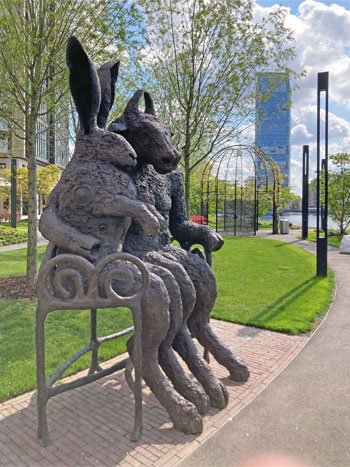
Street art is an important part of life at Wood Wharf, including two startlingly life-sized fibreglass figures facing off on the pavement in Park Drive. Until recently you could have found a mirrored steel turd in Water Street, ideal for reflective Insta selfies, but don't rush because that's already been whipped away. The most recent arrival is Minotaur and Hare on Bench by Sophie Ryder, recently implanted as an adjunct to the new children's playground. So long as nobody brings more than three children at the same time, the playground should perform its function admirably.
The best part of Wood Wharf right now is Harbour Quay Gardens, a vibrant greenspace expanding inexorably alongside the South Dock. To be fair it is quite nice, as you'd expect from a corporate development that can afford to greenwash its surroundings to lure in as many potential purchasers as possible. A long sinuous wiggle of benches faces south and is already well-frequented by the workforce on adjacent building sites. But someone needs to have a word with the morons who installed an additional row of benches 50cm from the water's edge, so close that nobody can safely step round to sit in the middle and anything you drop risks getting very wet.
Wood Wharf continues to flourish and grow, with most of the commercial and residential district beyond Charter Street still a busy construction site. New blocks of flats are clearly visible from the cut-through footpath, including one so stereotypically drab it can only be destined for affordable lowlife. In a couple of years' time expect Wood Wharf to be a thriving destination for lunchtime grazing, weekend browsing and high-rise living. But it's pretty much dead at present, so keep this bombastic pustule on your radar and don't waste your time coming down just yet.
Hurrah, it's that time of year again when TfL silently updates its spreadsheet of annual passenger entry/exit totals at every tube station.
However, and it is a very big however, 2020's figures are perverse. The figures are calculated for a typical week in autumn then multiplied up to a full year, as usual, but for 2020 this means "the sample window is the period of the UK Government's second national lockdown". Overall ridership is therefore down to 35% of what it was in 2019, so absolutely none of what follows is either normal or consequential.
London's ten busiest tube stations (2020)(with changes since 2019) 1) ↑6 Stratford (25.1m) 2) ↑3 London Bridge (24.7m) 3) ↓1 Victoria (23.0m) 4) ↓3 King's Cross St Pancras (18.8m) 5) ↓2 Waterloo (16.6m) 6) -- Liverpool Street (16.3m) 7) ↑10 Finsbury Park (15.8m) 8) ↑11 Vauxhall (15.5m) 9) ↓5 Oxford Circus (14.6m) 10) ↑29 Barking (14.3m)
This is eye-popping stuff. London's busiest tube station is officially Stratford, not one of the normal big-hitters in central London. During lockdown a lot of people were still using Stratford station to get around, especially those with essential non-office-based jobs. Stratford's total is only 40% of what it normally is, but Waterloo and Oxford Circus only managed 20% allowing East London to leapfrog past. Other non-central railheads performed strongly, for example Finsbury Park and Vauxhall. I confess I never ever expected to see Barking in the top 10 busiest tube stations. London Bridge is the top-performing rail terminus (it's more normally third). The biggest tumble out of the top 10 belongs to Bank/Monument which plummeted from 8th place to 47th.
The next 10: Canary Wharf, Brixton, Paddington, Canning Town, Walthamstow Central, Seven Sisters, Hammersmith (District), South Kensington, Bond Street, North Greenwich
These are mostly stations in zones 2 and 3, whereas normally they'd be stations in zone 1.
London's ten busiest tube stations outside Zone 2 (2020) 1) ↑1 Barking (14.3m) 2) ↓1 Walthamstow Central (10.4m) 3) -- Seven Sisters (10.0m) 4) ↑5 East Ham (8.5m) 5) ↑1 Wembley Park (8.3m) 6) ↑1 Tooting Broadway (8.1m) 7) ↓3 Ealing Broadway (7.7m) 8) ↑4 Leyton (7.3m) 9) ↓2 Tottenham Hale (7.2m) 10) -- Wimbledon (7.0m)
It's also all change beyond zone 2, but the reshuffle isn't quite as extreme as in the centre of town. Again it's tube stations with rail connections that do particularly well, with East Ham, Wembley Park, Tooting Broadway and Leyton the exceptions. Northeast London has a particularly strong showing, which correlates well with TfL's warnings about busy stations during the pandemic. If the list were to continue then Harrow-on-the-Hill (6m) would be the highest performing station in Zone 5 and Uxbridge (4m) the busiest in Zone 6.
The smallest decreases in passenger numbers compared to last year 1) Dagenham East ↓16% 2) Kenton ↓17% 3) Stonebridge Park ↓18% 4) Harlesden ↓19% 5) Becontree ↓20% 6) Barking ↓21% 7) North Wembley ↓22% 8) Willesden Junction ↓22% 9) Dagenham Heathway ↓22% 10) Sudbury Hill ↓24%
You'd expect passenger numbers to have decreased significantly during lockdown but two stretches of two lines have bucked the trend. One's the eastern end of the District line (i.e. Barking & Dagenham) and the other's the northern end of the Bakerloo line (i.e. Brent) where passengers just kept on travelling. Not so many home workers out here, I suspect, and rather more with jobs they needed to travel to.
The largest decreases in passenger numbers compared to last year 1) Heathrow Terminal 4 ↓100% 2) Covent Garden ↓90% 3) Piccadilly Circus ↓89% 4) Bank/Monument ↓89% 5) Leicester Square ↓89% 6) Tottenham Court Road ↓86% 7) Temple ↓85% 8) Mansion House ↓84% 9) Charing Cross ↓83% 10) Blackfriars ↓81%
Blimey, this is savage. Heathrow Terminal 4's big fat zero is because it's been closed to passengers since last May (and the data is based on autumn travel). All the rest of the top 10 decreases are in zone 1, with passenger numbers in the West End utterly diminished compared to normal. Lack of tourists and lack of shoppers have contributed to killing off traffic, not just people staying away from the office. Astonishingly zone 1 and Heathrow account for the entire Top 50 biggest decreases, a sequence eventually broken by Richmond (↓73%) in 52nd place.
Let's see what all this has done to my favourite list of the year...
London's 10 least busy tube stations (2020) 1) Kensington (Olympia) (35000) 2) Roding Valley (190000) 3) Chigwell (247000) 4) Grange Hill (297000) 5) ↑1 Theydon Bois (493000) 6) ↓1 North Ealing (507000) 7) ↑4 Croxley (515000) 8) Ruislip Gardens (549000) 9) ↑1 Ickenham (555000) 10) ↓3 Moor Park (593000)
Discounting Heathrow T4, the least used station on the Underground remains poor old Kensington (Olympia), because that's what weekend-only trains (and a tiny handful of weekday-ers) does for you. It has a pitiful total... less than a fifth of the passengers at the second least used station, which continues to be Roding Valley. The Essex end of the Central line has a very strong showing including all three stops on the Hainault shuttle, as per usual. Passenger numbers may have tumbled here, as everywhere else, but a lesser used station will always be a lesser used station.
The next ten least busy stations: Chesham, West Finchley, Fairlop, West Harrow, West Ruislip, Chorleywood, Upminster Bridge, Mill Hill East, Chalfont & Latimer, West Acton
And while we're here...
DLR Top 5: Canning Town (11m), Stratford, Bank, Woolwich Arsenal, Lewisham DLR Bottom 5: Beckton Park (166000), West India Quay, Pudding Mill Lane, Royal Albert, Custom House
Overground Top 5: Stratford (11m), Clapham Junction, Canada Water, Highbury & Islington, Willesden Junction Overground Bottom 5: Emerson Park (120000), Cheshunt, Upminster, Bushey, South Kenton
TfL Rail Top 5: Liverpool Street (9m), Stratford, Paddington, Romford, Ilford TfL Rail Bottom 5: Heathrow Terminal 4 (0), Twyford (13000), Taplow, Iver, Langley
As well as voting for London's next Mayor and members of the Greater London Authority today, we here in Tower Hamlets are also voting in a referendum on how the council is run. I doubt that many residents have noticed, let alone taken all the issues on board, so will likely be surprised later today when faced by a voting slip with a question they've not previously considered.
It's not a catchy question because the wording is fixed by legislation and can't be tweaked. But essentially it's do you want a Mayor or do you want a leader? Quick, make your mind up based on zero background knowledge and put a cross in a box.
The vast majority of local councils are run by a leader elected by the other elected councillors. The role of Mayor exists but is mostly ceremonial, often taken in turns according to party and longevity. Day-to-day control rests with a single person voted for by councillors and not directly by the public.
This was how things used to be in Tower Hamlets until 2010 when a campaign to switch from leader to Mayor was unexpectedly successful. It was driven by former council leader Lutfur Rahman, now disgraced, who managed to cobble together enough signatures to trigger a previous referendum and then persuade enough of the electorate they wanted a Mayoral system. The subsequent election saw Rahman elevated to the Mayoralty as an independent, bypassing Labour's 63% share of councillors, and he then proceeded to bleed our coffers dry. 2021 is the first legal opportunity to switch the system back.
What's concerning is the almost complete lack of referendum debate and discussion that's permeated through to the wider community. I've had nothing through my door presenting arguments one way or the other, nor seen any posters in windows... whereas in neighbouring Newham who are having a similar debate I've seen loads.
It's only while researching this post that I've discovered the current Mayor, John Biggs, is keen to abandon the Mayoral system and so remove his direct route to power. I've also spotted that Lutfur Rahman really wants to keep it, and both of these seem excellent reasons to put a cross in the second box. I suspect this makes me better informed than 90% of Tower Hamlets residents who are essentially going to pick an outcome at random (or pick Mayor - no change - because it sounds more familiar than the alternative).
It's also why I think referendums on anything other than major national issues are dangerous. An ill-informed public selecting options on a whim - essentially a coin toss - risks accidentally introducing appalling policies which then affect thousands. It also encourages those who can spend the most money on promotion ("Vote Yes on Proposition 46!") to get their opinions rubberstamped in law, and that rarely ends well.
If today's referendum confirms a switch then next year's Tower Hamlets council elections will be run on the old model and we won't be asked to vote for a Mayor again. It makes a lot of sense, but I fear not enough Tower Hamlets residents understand what's at stake and will sleepwalk into retaining the status quo.
When in Elephant & Castle you should obviously go and look at the famous shopping centre, which is alas now the famous ex-shopping centre. It closedin September after 55 years, to the dismay of those who frequented its eclectic and cosmopolitan collection of shops across three austere levels. Vacated and fenced off, the building's days are very much numbered. I only took this photo on Sunday and by Tuesday a giant excavator had smashed the blue wall into rubble.
Walking around the perimeter, where the subways used to be and the roundabout no longer is, the stacked boxes all look somewhat forlorn. I particularly missed the elephant-with-a-castle-on-its-back statue, removed from its podium in January. Apparently it's off being 'pampered' and is due to reappear in Castle Square later in the year, in an attempt to placemake the pop-up units at Elephant Park (as mentioned yesterday). This is also where many of the traders evicted from the shopping centre have ended up, although only a minority and with much lower footfall and basically good luck to them.
What's coming when it's gone is towers and 461 flats, a quarter for social rent. What's coming when it's gone is smarter shops, restaurants and leisure facilities. What's coming when it's gone is a fresh hub for the London College of Communications. What's coming when it's gone is a new station entrance with step-free access to the Underground and Thameslink. What's not coming back is a diverse inexpensive shopping centre housed in a 60s wormhole, because you don't gentrify a neighbourhood by catering to those who already live here.
Alas it's not a safari park, it's a new enormous housing estate at Elephant & Castle. And yes, it looks exactly how you'd expect a new enormous housing estate to look.
It's big, around 25 acres in size, and will have around 3000 homes when it's complete, which it isn't yet. Several apartment blocks are finished and occupied, a few plots are still building sites and many areas remain empty. But ten years ago it used to look like this.
This was the Heygate Estate, one of Southwark's largest, built in Brutalist style in the early 1970s. Long slab blocks faced off towards Walworth Road and New Kent Road with a scattering of smaller flats inbetween, all linked by raised concrete walkways. Fifty years ago it was desirable and visionary, but before long bleak and uninviting, and eventually shady and shunned. It was an evocativeplaceto walkthrough but perhaps not to live.
The council plumped for regeneration in conjunction with a major developer and agreed a financially disadvantageous deal, spending more on planning and demolition than the paltry £50m they received. Tenants were decanted before alternative accommodation was available, with no intention of them ever coming back, although a few held on amid boarded-up desolation. And then in 2013 the site was sealed off, a few mature trees preserved in the centre and all the rest sequentially knocked down. Cue Elephant Park.
The flats look very different now, less monolithic and with stairwells instead of communal balconies. Whereas ground level was previously given over to endless rows of garages they now host commercial units, or will do if they ever rent them all out, and the obligatory car parking is concealed underneath. Previous residents got a concrete community centre and a rundown parade of essential shops and services. The new lot get a cinema room, gym, co-working space and roof terrace, because the new lot very much aren't council tenants.
The developers have made a big thing of the site's central park, even conscripting it into the site's new name. It takes advantage of a few retained mature trees but is otherwise is mostly lawn (sorry, "newly laid biodiverse grass") and roped-off playground. The park's smaller than it was due to be in the initial plans and isn't yet fully shadowed by residential towers. Marketing collateral makes a big thing of the fact it'll have a nature trail, which is about as cheap as environmental greenwash gets. Most of the flats in Park Central West and Park Central East either aren't adjacent to the park or look the wrong way.
One thing that's already up and running is Elephant Park's foodie destination, which is Sayer Street. One side is all cafes and restaurants, sequentially 'small plates & grill', Italian, Japanese, Ecuador/Spanish, Lebanese, Caribbean, Taiwanese and 'vacant'. A fried breakfast at the first of these will set you back £11 because this is no longer an impoverished estate, more somewhere to graze and brunch. On the opposite side of the street are three Insta-friendly sheds, or rather 'maker spaces', to temporarily boost the cultural credentials of the site. A garden centre, an art exchange and a podcast studio are the current lucky incumbents.
The marketing team at Elephant Park have gone big on elephants, assembling a cluster of glittery silver and gold-trunked sculptures in the piazza to the west of the park. I wasn't sure if the private security guard standing nearby was watching them or watching the rest of us - I suspect the latter. The marketing team also love their ampersands, dotting around various slogans like 'Live & Breathe', 'Green & Active' and 'Flavour & Energy'. They've not gone quite so overboard on Castles but there is a Castle Square, which thus far resembles a Boxpark but in ribbed timber.
Its two storeys are given over to micro retail units housing such delights as beauty salons, sweet shops and mobile phone emporia. One nice touch is the view over the park from the upper deck, although you have to be careful not to block the entrance to the lift in the process. Another nice touch is the provision of free public toilets, because these days developers have the wherewithal and the money in a way that councils have long since abandoned. And as a bonus the whole structure looks to be just temporary enough that it could be removed at a later date to provide a proper gateway to the estate from Elephant & Castle station.
It is essentially all change, but then it's all change all around Elephant & Castle at the moment. Some might call it much-needed redevelopment, others characterless gentrification, but the end result continues to be wholesale displacement. Elephant Park is certainly an attractive hotspot for incomers seeking convenience and lifestyle but the people I saw living in the Heygate a decade ago are long gone, maybe even to somewhere with a chippie.
It being a bank holiday yesterday I fancied a bit of bluebelling. I've seen a fair few this year beside roads, in the odd corner of the Olympic Park and scattered across Tower Hamlets Cemetery Park. But what I'd thus far missed was a proper carpet of blue, the kind of thing I'd normally head to the North Downs or the Chilterns for, or perhaps make do with Highgate or Bexley. So I walked to Wanstead and that did me just fine.
Wanstead Park is always a delight, blessed with a leftover landscape from a Georgian mansion and carefully tended by the City of London. But it's particularly delightful at this time of year so long as you leave the lakeside, step off the grass and walk into the woodland.
The place to be is Chalet Wood, a leafy triangle to the north of The Temple. You could easily miss it if you didn't know it contained a springtime treasure, but the steady flow of people ought to be a hint that something special lies within. I made sure I got there early before the throng of bank holiday bluebellers descended.
The clearing was larger than I was expecting although still with very tightly defined horizons. A five-minutes-to-walk-around floral showpiece, although with dawdling to admire the spectacle expect to take rather longer. And with a proper shimmer of blue from proper bluebells, that's Hyacinthoides non-scripta, it delivers the full-on carpet experience.
Originally it was good enough to look at them, or maybe point your lens across the clearing for a dazzling shot. Now the key thing is to take a selfie with the bluebells in the background or plonk your family in front and upload the best image. Prepare to wait your turn.
The springtime onslaught used to result in thoughtless trampling, so for protection's sake the park wardens have laid down logs to define the edges of paths. Nothing's really stopping anyone stepping over, but they seem to do the trick. So too do signs pinned up advising folk not to walk on the bluebells, and allegedly the one-way arrows help too.
I found myself in the middle of the wood before I found my first arrow, having walked what turned out to be the wrong way down a narrow path. A nearby mother promptly turned to her two toddlers and read out the notice ("Please follow the one way arrows so that everyone can enjoy the bluebells safely"). Initially I thought she was educating them, but I swiftly deduced she was passive-aggressively lambasting me.
It was lovely to be amidst the spectacle, indeed I was chuffed just to be walking through woodland again because there's precious little of that near me. And then I headed off north towards Warren Road past an increasing stream of people walking the other way. They clutched children and cups, they chatted to friends and partners, and they converged inexorably on the springtime delights in the shadowy clearing. If you can't get your bluebell fix in the countryside this year, there's always Chalet Wood.
There's a new long distance walking network in town... and in the city and in villages and snaking across the countryside. Wherever you are in Britain it ought to be somewhere near you.
It's called Slow Ways - an initiative to connect the nation via a web of interconnected walking routes. It was originally proposed by Daniel Raven-Ellison, perhaps better known as the man who dreamt up the dubious concept of National Park Cities (and, more impressively, convinced Sadiq Khan that London was one).
For the Slow Ways project hundreds of nodes were selected marking centres of population, usually at accessible locations like railway or bus stations. These were then connected by straight lines to create a lattice of routes across the country - approximately 7500 connections altogether. The idea was to find a decent walking route for each of these connections, not necessarily direct but pleasant and broadly accessible, via a major crowdsourcing challenge.
Over the last year thousands of people have explored their localities to suggest possible routes and these are now available on the Slow Ways website (free of charge, no logging in required). The next stage of the project is to review each route and provide some background information to provide confidence that the routes selected are appropriate. What's the geography like, are the paths of a reasonable quality, is there a better way to go, that kind of thing.
Each Slow Ways node has about half a dozen connections depending on local topography. Here's the node for Rochdale which links to seven towns and villages up to six miles distant. Longer walks can be created by chaining together individual routes, so for example Manchester is two links away (via Middleton). To review each section and confirm it's better than potential alternatives will require a lot of additional input, but it only requires a few Rochdale residents to take an interest and hey presto, a verified interconnected pedestrian highway.
Some Slow Ways cross fields, others traverse hills, some follow the coast and a lot wend through suburbs. But I don't have that luxury of landscape here in East London, so for my trial run I've chosen to follow a Slow Way that's rather more mundane.
This is Dalbet, so called because it runs between Dalston and Bethnal Green. It's just two miles long, very much at the short end of the Slow Ways oeuvre, and involves only 12 metres of ascent so is hardly tiring. But it's still a good choice for me to investigate because there isn't an obvious direct route, indeed I bet most Londoners would plump for private or public transport every time rather than try to negotiate the intermediate area on foot.
I started at Bethnal Green tube station and headed north. I immediately wanted to take a shortcut through Museum Gardens, which was considerably more verdant and blossomtastic than the 'official' route up busy Cambridge Heath Road and would also have cut the corner off. I suspect this is the kind of feedback the Slow Ways team wants to hear because at present Dalbet is simply one person's submission with no reviews as yet.
I had a lot more trouble when it came to taking the turning off Old Ford Road, because there wasn't one. The line drawn alluringly on the map instead passed through some railings leaving me to take a diversion round the foot of a tower block. I suspect this is the kind of feedback the Slow Ways team not only wants but needs. Things got better after that, following quiet backstreets and with a zebra crossing in just the right place to traverse one burst of traffic. It wasn't especially picturesque, nudging into a light industrial zone past taxi repair yards, but I wasn't complaining.
Next a problem of scale. It wasn't clear from the line on the map whether I was supposed to follow the Regent's Canal towpath or the parallel (quiet) street. This was partly because I couldn't zoom in close enough to distinguish between the two but mainly because someone had drawn the line much too approximately. This shouldn't be a big problem in urban Bethnal Green but a badly-drawn line could leave you badly adrift in a Bedfordshire field or the Brecon Beacons. The canal was lovely whicheverway.
The next section involved walking the full length of Broadway Market with its artisan cafes and bijou shops - precisely the kind of jewel you might have missed if you'd chosen the route yourself. Then came the full length of London Fields, zigzagging across the grass in a Way that was definitely Slow, and all the more pleasant for it. I was impressed that this Slow Way had now managed to be off-road for nigh on one mile (canal/pedestrianised street/park) which is quite an achievement for inner London.
Finally it was time to head west along Forest Road, a long residential backstreet which was appropriately quiet and required no additional navigation for the next ten minutes. I only had to remember to turn right just before the end into a long pedestrianised piazza and I'd reached my destination at Dalston Junction station. It felt like forty-five minutes that someone had thoughtfully curated rather than simply thrown together, so I'd chalk that up as a Slow Ways win.
I don't really need a Slow Ways network to find my way around East London but I imagine it could be very useful elsewhere in the country where I'm less familiar with the landscape. It could also encourage me, or you, to take an interesting route from A to B rather than hopping onto some less sustainable form of transport. But it all relies on input and accuracy, so there's a lot of work to be done before I could be sure that a Slow Way wouldn't leave me adrift and unable to continue.
Imagine if this really took off and a detailed network of Slow Ways crisscrossed the entire country. In the meantime the beta website is well worth an explore, and if you dipped in and offered some feedback it might be even better.
A lot more people are out and about now that non-essential shops and outdoor hospitality are open. Roads are busier, public transport fuller and pavements generally bustlier. But do you know what the government's official travel guidance says? It still says this.
This guidance is unchanged since the Stay At Home order was withdrawn at the end of March. We are still advised to minimise travel and avoid making unnecesary trips. And yet simultaneously pub terraces are open, dining in the street is legal and shopping for any old tat is fine, despite not being in any way essential. If you only pop down to your local high street fine, no conflict. But what about travelling several miles for a beer with friends, shopping in a neighbouring county, going for a long walk in the countryside or taking a daytrip to the seaside?
It makes sense that travel within the UK is opening up again now that cases are so low. It makes sense that the government would prefer us to go out and boost the economy rather than confine us to our locality. But it hasn't put this into words by updating its travel guidance and is instead relying on us to follow unspoken rules, as has been the case throughout most of the pandemic. It seems our boundaries are now defined by what's open, not how far away it is and how we get there, despite official advice to the contrary.
The May bank holiday weekend is usually an excellent time to go travelling, say to the seaside. It's not such a good time to go to the seaside this year because there's a pandemic and also the weather forecast is poor. But I wondered anyway how much a trip to the seaside costs, mainly for future reference, and in case it's useful for anyone else.
I've assumed...
a) a return
b) day trip
c) from London
d) by train
e) travelling on Bank Holiday Monday, i.e. off peak
f) without a railcard
I've picked twelve coastal resorts and rounded fares to the nearest £.
Off-peak
Cheaper tweak
Gt Yarmouth
2¾h
£61
£40 (split at Colchester)
Clacton
1½h
£36
£30 (advance ticket)
Southend
1h
£15
-
Whitstable
1¼h
£26
-
Margate
1½h
£27
-
Folkestone
1h
£29
-
Hastings
1½h
£32
-
Eastbourne
1½h
£36
-
Brighton
1h
£13
-
Bognor Regis
1¾h
£33
-
Southsea
2h
£33
£20 (advance ticket)
Bournemouth
2h
£53
£46 (advance ticket)
Forget Great Yarmouth, both for reasons of time and cost. Bournemouth's also a long and expensive journey so probably not there either. A return ticket to most of the resorts inbetween costs about £30 (and would be more like £20 if you had a railcard). Portsmouth & Southsea's surprisingly good value so long as you take the right train. But there are two much cheaper ways to get to the seaside and they are Southend (£15) and Brighton (£13). Southend's cheap because c2c fares have always been excellent value, and Brighton's astonishingly cheap so long as you travel by Thameslink at the weekend (or on a bank holiday). The catch with both is a lack of sand, but the beach isn't always the main reason people go to the seaside.
The May bank holiday weekend is also an excellent time to go bluebelling.
Here are four places you might go for a splash of blue.
Off-peak
Tring
35m
£21
Wendover
50m
£14
Box Hill
45m
£10
Sevenoaks
40m
£14
It's cheaper to get to the hills around London than to get to the seaside. A tenner (or just over) should cover it. Box Hill's cheaper than Sevenoaks despite being the same distance from central London. The outlier is Tring, which is barely four miles from Wendover but costs a lot more to get to because it's on a completely different line. Pick your bluebelling target carefully.
And now, because this is my blog, this is how much it would cost me to go to these four places.
before
now
Tring
£14
£26
Wendover
£9
£19
Box Hill
£7
£15
Sevenoaks
£6
£12
The first column is how much I would have paid when I had an annual Z1-3 Travelcard with a Gold Card offering 1/3 discount on rail fares. The second column is how much I'd have to pay now that I don't have one. Journeys are from Bow rather than from central London.
The price is now much higher because I no longer have my 1/3 discount and I'd have to pay for the tube journey to and from the railway terminus. Overall it's about twice as much as the previous fare, which is an interesting financial deterrent compared to what I'm used to. Obviously my annual Travelcard was a substantial investment up front so these figures aren't entirely comparable, but it's going to take me some time to get used to how expensive fares really are.
This May bank holiday I intend to go see some bluebells on foot instead, hopefully dodging any heavy showers. The seaside will have to wait.
• oxygen amongst aid sent to India
• shops and pubs finally reopen in Scotland
• PM preferred "bodies piled high" to 3rd lockdown
• US will export 60m unused Oxford doses
• 1st jab halves transmission of virus
• 60m Pfizer jabs ordered for winter booster
• Turkey goes into first lockdown
• vaccine age limit lowered to 40
• Brazil passes 400,000 deaths
• UK infections 20 times lower than January
• 1 in 7 high street shops empty
• 3000 clubbers attend test event in Liverpool
Worldwide deaths: 3,090,000 → 3,180,000 Worldwide cases: 146,000,000 → 152,000,000 UK deaths: 127,417 → 127,524 UK cases: 4,403,170 → 4,418,530 Vaccinations: 33,508,590 → 34,346,273 FTSE: up ½% (6938 → 6969)
Thu 1: Walked past the fenced-off area on Wanstead Flats and listened to the skylarks singing, confirming that the fenced-off area works. Fri 2: The sick-looking history tree in Temple Mills Lane has been cut down and replaced by a new mature specimen (which as yet doesn't have a large steel ring attached).
Sat 3: I hoped the special prize cryptic crossword would keep me occupied for a substantial portion of the weekend but instead I had it polished off by 6pm, an hour earlier than last Easter. This never normally happens. Sun 4: The Gentle Author has written a history of St Mary's Church in Bow (and the surrounding locality) that's so good, and so detailed, that nobody else need ever bother. Mon 5: Today's highlight was crossing Walthamstow Marshes in the snow, which was highly unusual for Easter Monday (not the weather, which happens more often than you'd think, but the fact I hadn't gone on a big long trip somewhere outside London). Tue 6: Used my last three recycling bags to dispose of monthsworth of boxes, bottles and paper (and am now waiting for libraries to reopen so I can collect more bags, because Tower Hamlets council don't like to make recycling easy). Wed 7: Celebrated 20 years of knowing BestMate by doing the same walk we first made in April 2001, spotting herons and opening two bags of Mini Cheddars.
Thu 8: Things you find up a random street in Canonbury - a brick substation for the former Islington Electricity Department. Fri 9: I would tell you about the unexpected but uplifting out-of-comfort-zone morning I had, but Prince Philip's death was announced a few minutes afterwards so all normal exposition is on pause as a mark of respect. Sat 10: There's been a lotoffuss about the history wall fronting the Crossrail tracks in North Woolwich, which has led to the panel casually referencing local murders to be removed, so it's reassuring to see the panels about diphtheria, mugging and bodies being flung out of tower blocks after gas explosions are still in situ.
Sun 11: Randomly bumped into a former date (and their subsequent partner) outside Borough Market and stopped for a nice catch-up chat. Discovered they'd lost their job and are no longer local, so unless something equally random happens in the future I doubt I'll ever see them again. Mon 12: Impressed by the number of people sat at small tables outside Westfield in temperatures below ten degrees grimly sipping an alcoholic drink, purely because they now can. Tue 13: Work is finally underway to turn The Crystal into London's new City Hall, which thus far seems to stretch to removing the Royal Docks exhibition, obscuring the windows with sheeting and setting up a works compound outside. Wed 14:busatlas.uk is a wonderful attempt at mapping the UK's principal inter-urban and rural bus services, such as they still are. Thus far the project has ticked off most of the counties along the south and east coast of England plus some of the Midlands. Here are Sussex and Suffolk, for example.
Thu 15: Bethnal Green's independent natural history gift and concept lifestyle store has reopened, or at least its door is open should anyone consider walking inside, and if that isn't a sign of creeping gentrification I don't know what is. Fri 16: Shot five seconds of a top-performing YouTubevideo. Sat 17: The years showcased on Pick of the Pops have been nudging later recently and are now generally from the range 1976-1996. Years before 1976 have only featured twice in the last six months, whereas the 21st century has popped up five times (usually with a fairly lacklustre musical selection). Sun 18: Other things I saw in Bermondsey - a blue plaque on a closed pub because Paul McCartney once filmed a video inside, a bronze cat on a river wall and six pigtails for £9.
Mon 19: Birdwatching update: I spotted the allegedly elusive kingfisher skimming low over the Lea at the end of Channelsea Creek, which does seem to be a hotspot. And then two hours later I spotted another, or possibly the same bird, beyond the Park limits in the much quieter waters just upstream of Eastway and the A12. Twice in one day is ridiculously brilliant. [map of sightings] Tue 20: A few weeks late, but they've finally refilled the Hertford Union Canal. Dozens of narrowboats have already dashed back to grab a coveted mooring space. Wed 21: It's a shame Count Binface didn't use his page in the London Mayoral booklet to promote his manifesto because some of his policies are rather good (No shop to be allowed to sell a croissant for more than £1) (The hand dryer in the gents toilet at the Crown & Treaty, Uxbridge, to be moved to a more sensible position) (Ceefax to be brought back for all households within the M25) Thu 22: I'm using lockdown to catch up on classic films I really should have watched before. Today Evil Under The Sun, yesterday Death On The Nile and the day before Westworld. Fri 23: Radio 1 has launched another streaming-only Sounds-exclusive variant called Radio 1 relax, which is refreshingly pop-free and quite good as background music so long as you avoid the wellness hours.
Sat 24: A swish new poster has gone up at Dangleway North promoting the Private Cabin Experience, cost £90, despite the fact that every group of travellers gets its own cabin at the moment for social distancing reasons. Sun 25: Londonist continues to have a very muted pandemic. Over the last week it's only published five posts, one of which was 'The Best of Londonist' (which simply listed the other four). Meanwhile Time Out managed 13, mostly promoting venues coming out of lockdown, and marketing cannon Secret London spaffed 30. Mon 26: The new series of Just A Minute featured ten different chairs, presumably as an audition for taking over Nicholas Parsons' role permanently. Of the final four Jo Brand wasn't strict enough, Julian Clary's natural waspishness was wasted, Tom Allen felt unfamiliarly modern and Stephen Fry was effortlessly excellent (but I suspect wouldn't always be available as a regular host). Tue 27: Found a plaque in Central Park, East Ham, commemorating the miniature railway that operated here for "3 glorious years". A 1940s Pathé newsreel answered all my questions.
Wed 28: The Blossom Garden in the Olympic Park is nearly complete, now with a proper walkway, tidied lawn and several benches. Many of the 33 trees are in full fruity blossom at the moment, but I fear the garden can't be officially opened until after the Mayoral election and all the white and pink will have dropped by then. Thu 29: For those of you wanting an update on my numberplate-spotting, in the last fortnight my second attempt at Full Reverse Chronological has sped through 21 to 51, then prefix Y to prefix A, then suffix Y to suffix S, so only 15 more to go. Meanwhile my attempt to spot all 420 personalised registrations from A1 to Y20 is going really well and after two months I only have seventeen more to tick off. The sole missing single-digit pair is P3. The only other absence below the teens is L10. Y is proving the most elusive letter (I still need Y13, Y14, Y16 and Y17). Fri 30: For those of you not wanting an update on my numberplate-spotting, I can instead offer you five items from today's Tesco receipt: gammon joint, whole cucumber, raspberry cheesecake, low quality scones, reduced-salt ketchup.
One thing about getting older is that your body works less well. Little things, mostly, that mount up over time to maybe something significant. Bits of you stop functioning properly or get damaged or break, and other bits work less well than they used to, and some things might be wrong but you can't easily tell, and before you know where you are your conversation is peppered with endless references to aches and pains.
I'm fine, thanks for asking, but still afflicted by bodily degradation, everyday niggles and potential poorliness.
So I thought I'd make a list of the most obvious ways my body's going wrong, or might be going wrong, in the hope it'll be cathartic rather than hypochondriac.
» I intend to be quite vague in what follows.
» For reasons of privacy I'm not telling you precisely what the various niggles are so have numbered them.
» The list is in a random order rather than juggled by potential seriousness.
» Some of the afflictions occur more than once but I've numbered them separately every time, just to throw you off the scent.
» I'm fine, thanks.
Don't waste your time trying to guess what the niggles are as I won't be confirming anything. And please don't offer advice based on your assumptions because I'll just roll my eyes at how completely wrong you are.
• For several years I've been a bit concerned about [Niggle 1]. It used to ache on and off, often for months, but then it would suddenly stop aching and be perfectly OK for ages. Thankfully it's been perfectly OK for at least a year so I've stopped being concerned about it... but I did once show it to a doctor and he said it's probably a sign of eventual [Affliction 1] and that wouldn't be great.
• I know it happens to everyone eventually, and it was due to happen to me earlier than most, but it's still unnerving to see [Niggle 2] because the change is only ever one-way.
• [Niggle 3] is mildly noticeable and started in March. It might be linked to [Niggle 4] but as yet I haven't distinguished any obvious deeper issues.
• [Niggle 5] has been there for absolutely ages, long enough for me no longer to be concerned about what it might be a signal of, because it clearly isn't.
• I've often thought [Niggle 6] would turn out to be an issue, especially the longer time's gone on, and I'm more convinced right now than I've ever been, but in a smaller way than I'd been expecting.
• Associated with [Niggle 7], a nearby part of the body also used to ache in a minor but prolonged way, and it was never really annoying but I'm pleased it doesn't do it any more (and hasn't for ages) because it could be a symptom of [Affliction 2].
• I've only recently spotted [Niggle 8] and it's totally minor but also definitely shouldn't be there.
• I'm forever waiting to get symptoms of [Affliction 3] or the related [Affliction 4] because it runs in the family, but thankfully there's nothing yet and may never be, but then my Dad would have said that at my age.
• I came to terms with having [Niggle 9] quite early in life, which is just as well because otherwise I might have lost all confidence in social situations. But it does also mean I have to be a little bit wary, especially in conjunction with [Niggle 10], just in case.
• Previously they'd been perfect but then [Niggle 11] came along, very much accelerated by lockdown. Thankfully I've rolled back the worst of it through careful choice of clothing.
• I'm not as concerned about [Affliction 5] as a doctor suggested I ought to be, and I have definitely let things slip during lockdown because I've had different priorities, but I suspect I could probably pull things back if necessary.
• It's about time I got [Niggle 12] sorted because I really should have done by now, in fact I was convinced it was going to be sorted last time. But I'm getting by OK and I have a cheap workaround for when it gets really awkward, which thankfully isn't very often, especially in summer.
• [Niggle 13] is mildly noticeable and started in February. It might be linked to [Niggle 14] but as yet I haven't distinguished any obvious deeper issues.
• [Niggle 15] is something I might once have laughed at in older people and here it is happening to me, but thus far in a wholly manageable and not too wildly awkward way.
• My [Niggle 16] definitely shouldn't be that colour. There was a point where I thought it might be something serious but I think it's probably a one-off and it seems to be growing out.
• I had a real shock earlier this month when [Niggle 17] suddenly appeared. It was actually enough to make me go and get it checked out by a professional, but apparently it's not a problem and I can continue with my life unchecked so that's brilliant.
• I already have a fairly good idea of the most likely thing that'll kill me, and just very occasionally [Niggle 18] happens and I wonder... but so far I've wondered unnecessarily.
• I never understood [Niggle 19] until it happened to me a couple of years ago, and now it's a fairly permanent daily fixture. It became much easier to deal with once I relocated it.
• I remember my grandmother suffered from [Niggle 20], not that suffer is quite the right word, but it is unnerving to see it inexorably emerging.
Three of these niggles are niggling me more at present than the others. [Niggle A] and [Niggle B] occasionally raise their heads and remind me they're there, independently, which I'd rather they didn't. Both are probably just inconveniences but there is an outside chance they're not, indeed they might potentially be connected, although I know that's just my brain running ahead of my common sense. [Niggle C] only emerged last week, annoyingly, and has proven capable of disturbing my sleep even though I'd rather not be thinking about it. Logically it cannot possibly be anything bad, but I suspect it is and am struggling with the disconnect between these contradictory positions.
You know how it is with niggles, they often come and go. A few years ago I was most concerned about [Niggle D] which I had bad feelings about, but then it totally went away. [Niggle E] looked chronic for a while but then disappeared of its own accord for reasons I have never understood, but could just as easily come back. [Niggle F] suddenly limited my existence over the winter and I thought it was going to be permanent but then just as suddenly went back to normal. I spent a few years peeved by [Niggle G] until I went along to the doctors' and they totally sorted it, removing it from my list.
It's so hard to be certain which current niggle is going to hang around for the rest of your life and which is merely a temporary annoyance. I'm hoping for the latter.