Six photos from yesterday's walk, none of which were interesting enough for a full post of their own.
This shop used to be the PercyInglebakery at the eastern end of Roman Road, which closed permanently last July along with all their other stores. Last autumn I watched workmen unceremoniously removing the fixtures and fittings and since then it's been empty. But thanks to a banner hanging above the shutters we now know that the new tenants will be Sweet Talkers Dessert, an independent eatery selling pink ice cream, pink cupcakes and rich pink gateaux with an extra dollop of cream on top. As yet their website has no content and their Instagram has no posts (interestingly they plumped for sweettalkerdesserts rather than the technically correct sweettalkersdessert), but apparently they are Opening Soon. From a carb palace to a sugar temple, that's how it goes. I sighed.
I sighed because I'm more likely to buy a pastry than a sundae... and then I stopped and reminded myself this isn't all about me. I sighed because Roman Road's riddled with dessert parlours so doesn't need more... and then I checked my assumption by walking the length of the road and didn't see another. I sighed because sugar is so much worse for you than stodge... and then I remembered it's your diet that matters, not a single meal. So I suspect the real reason I sighed is because Roman Road is evolving and moving away from what I'm used to, a bit like when my local Post Office closed and was replaced by two halal grocery shops. But what I really need to remember is that I never went into Percy Ingle anyway so its replacement is irrelevant, I'm just inventing notional disappointment... and anyway there's still a Greggs beside the chippie directly across the street.
This was the scene on London Fields yesterday morning as a pop-up tent promoting Low Traffic Neighbourhoods drew in the crowds. It was organised by Hackney Living Streets and the Hackney Cycling Campaign, and their cunning ploy was to offer a free breakfast of croissants, fruit, coffee and/or orange juice to everyone stopping by. Kickstart a conversation, hand out some postcards and hope everyone goes home and adds their support on the London Fields LTN consultation webpage. The advantage of a gazebo in a park, obviously, is that pedestrians and cyclists are going to notice whereas drivers and cabbies are most likely stuck in traffic elsewhere.
I don't know why the London Fields LTN is quite so contentious but it currently has 4820 comments submitted on the council website which is double the total of any other Hackney LTN. Maybe it's because the measures were introduced in September last year so pedestrians and cyclists already know how much they like them and drivers have had eight unhappy months of having to go round the long way. There is a tendency to see LTNs as a moral crusade, either wholly good or wholly bad, whereas the important thing is which of the individual interventions work and which go that one step too far. Engaging sensibly with a consultation, prompted by a free croissant, has got to be better than blinkered fury.
This is April Street in Shacklewell, a gorgeous 1880s terrace with one of those old NE postcode streetsigns everyone loves. I smiled on finding it, but felt like I'd stumbled on it one month late because a post about April Street would no longer have timely relevance. But it did get me wondering which month of the year has the most London streets named after it and which months have none at all. Here are the results of my research (and Spring wins hands down).
I spotted this pair at the top end of Hackney Downs, pulling a little cart packed with water bottles and feeding a tree. Newly planted trees tend to need a lot of aftercare because they have unnaturally small root systems, having been grown in nurseries with an economic interest in packing saplings close together. Heavy watering helps young trees establish a connection to the soil, even in a showery month like this, as these two volunteers plainly know. I love their trolley, I love their dedication and I love that their group is called the Tree Musketeers.
The group's based at a long-established Tree Nursery at the southern end of Hackney Marshes. There's lots to be done there, if that's your thing, but they also plant trees elsewhere, care for community orchards and manage forest trees in Wick Woodland. I'm sure they'd welcome more volunteers seeking to help the environment and the planet, as might similar initiatives nearer where you live, although I'd be surprised if any other branches have such a cool name.
This impressive legalese is pinned up on a bridge leading onto Hackney Marshes and at several other entrances to the site. An injunction imposed 11 months ago has been discharged, and the peculiar thing is the way the notice refuses to admit precisely what it is that's no longer banned.
It's lots of things actually, starting last summer when 'persons unknown' flooded onto Hackney Marshes and abused the space. Unlicensed musical events, damage to trees and plants, the possession of nitrous oxide, the playing of loud amplified music, the lighting of fires and the dropping of litter have all been subject to arrest since June last year. That's pretty damned draconian which is why the injunction was always going to be time limited. But I can see why Hackney council might be unwilling to list and laminate the things you're no longer not allowed to do.
It's Newham Heritage Month again, the second annual celebration of the people who made the borough, this year with a theme of Shops, Docks and Factories. A programme of live participatory events and online activities is available, backed up by a permanent website that's culturally rich and ethnically diverse. Expect embroidery workshops, heritage barge days, twilight theatre, virtual guided tours and films about curry houses, not to mention all the events during the first half of May you've already missed.
I decided to plump for the self-guided Wonderful Women of Newham History trail, Silvertown edition, launched last weekend and produced in conjunction with the East London Women's Museum. Downloading a map and directions allows you to walk from Canning Town to North Woolwich ticking off ten spots where inspirational women made their mark, estimated duration an hour and half. The materials are beautifully produced and well worth a read but the walking instructions, alas, are some of the worst I've ever tried to follow. So here comes a post in which I praise the idea and rip apart the delivery...
Wonderful Women of Newham History trail(Silvertown edition)
If arriving by transport, get off at Canning Town station and turn right on Caxton Street North.
Caxton Street North isn't outside the station, it's a five minute walk away. Even the introductory instruction blows it.
1) 25 Huntingdon Street - Martha Little
I'd never been to Huntingdon Street before and for good reason, there's nothing here bar industrial units, a row of lockup garages and the backs of gardens. The road's also been entirely realigned since Victorian times so there isn't a number 25 and this isn't the spot where Martha would have run her business as a Sawdust and Firewood Merchant. Not a great start.
2) 56 Victoria Dock Road - Mary Lloyd and Martha Wooding
Likewise there isn't a number 56 any more, nor indeed any of the original Victorian buildings, so the high-end drapers where Mary and Martha were partners is long gone. Instead we've been lured to a grubby spot beneath the Silvertown Viaduct on the pretence that two women lived here together for 23 years so might have been romantically involved, even though there's zero documentary evidence that they were.
Continue down Victoria Dock Road and then use the pedestrian step crossing to get to the roundabout.
It took me a long time to work out that by 'pedestrian step crossing' they meant footbridge.
Take the third exit onto Dock Road.
The third exit turns out to be the fourth road.
For wheelchair users take the 474 bus from Charrington Steps (Stop S) and get off at West Silvertown Station and go direct to Silvertown Memorial.
Hell no. Wheelchair users can't access the bus stop because it's on the viaduct up a flight of steps (there's a clue in the name Charrington Steps). Indeed wheelchair users really shouldn't be attempting this trail because they're also going to be royally stuffed between stops 6, 7 and 8.
3) 81 Dock Road - Sarah Ann Cundy
Sarah had the inner strength to run a dockside pub with her daughter, but not this one which she ran with her husband instead. It was called The Bell And Anchor, but like everything hereabouts it was demolished decades ago. Indeed Dock Road is a horribly bleak spot with a vacated cement works on one side and a Silvertown Tunnel worksite on the other, and coming here is inherently pointless.
Continue down for around 15 minutes and then turn right on John Harrison Street.
No, it's called John Harrison Square. The name doesn't appear on any street signs (nor on maps of the Royal Wharf development) so you would never know this was the right place to turn off.
Bear right onto Royal Crescent Avenue.
No, it's called Royal Crest Avenue. Again there are no street signs in any useful locations.
4) Silvertown Memorial - Norah Griffiths
Hurrah, proper history, the site of London's largest ever explosion. But the trail spends so long explaining the blast that Norah's heroic act holding up a roof gets short shrift, and it was only when I did some research later that I discovered she saved a number of young children from a crushing death.
Go back up Royal Crescent Avenue but bear right.
Still should be Crest, not Crescent.
Turn left onto Admiralty Avenue.
No, Admiralty Avenue is on the right.
This turns into Starboard Way.
Only if you've gone the wrong way.
Turn left onto North Woolwich Road.
No, turn right. This is the first utterly disastrous direction.
5) Charles Street - Ethel Colquhoun
Ethel's one of the real-life characters in the book The Sugar Girls, whose career trajectory at Tate & Lyle took her from shop floor to management. But her birthplace was destroyed in the Blitz, and Charles Street is now a grim semi-industrial cul-de-sac leading to scrappy builders yards. The sign at the end of the road confirming that Newham acquired the land for regeneration has an 0181 phone number, which just goes to show how long this place has been a desolate nowhere. This is the fourth time this trail has taken us somewhere miserable with nothing to see.
6) Brick Lane Music Hall - Janet Keiller
The music hall in an old church is gorgeous but ignore that. Instead the trail directs to some anonymous gates on the other side of the road. This used to be the entrance to Tay Wharf where the famous Keiller & Sons marmalade factory was located, but founder Janet had been dead 75 years by then and she lived miles away in Dundee so it's entirely tenuous to claim her as a wonderful woman of Newham.
Continue down and then take the left hand 'restricted usage' road onto Connaught Road.
I still have no idea what this means. No road leads to Connaught Road, restricted or otherwise, because a railway line blocks the way. There is a recently-reopened footbridge, which is the only possible connection, but whoever wrote these directions seems to have an aversion to writing the word 'footbridge'.
7) 2 Connaught Road - Eleanor Marx
Eleanor was an active member of the Silvertown Women's Branch of the Gasworkers Union, who held meetings here in 1889 when this was the Railway Tavern. But it's not the Railway Tavern any more, that was demolished ten years ago and replaced by a particularly ugly silver block of flats which quite frankly you have no need to troop this far to see.
Return back the way you came, continuing left on Factory Road.
That'd mean crossing back (unnecessarily) over the footbridge. Factory Road is a claustrophobic lorry-riddled half mile skirting the high walls of the Tate & Lyle factory and not somewhere I'd ever direct a walking trail. You'd have got a much better view from Connaught Road anyway.
8) Tate & Lyle Factory - Edna Henry
Edna's another of the Sugar Girls, one of the first black women to work at the factory and a union shop steward. Initially overlooked for promotion she later turned promotion down because it would prevent her from representing her girls.
Continue down Factory Road and turn left onto Fenhill Street.
It's actually Fernhill Street, and technically it doesn't connect with Factory Road (unless you haven't been to the area and don't realise Crossrail runs inbetween, in which case you might well assume it did).
9) Henley Arms
This was a popular pub with Tate & Lyle workers, apparently, but that's the best female connection this trail can muster. It was good to see the pub open again after lockdown because I had been convinced it'd permanently closed.
Carry on down Albert Road and turn left on Pier Road.
This one's correct. Credit where credit's due.
10) 6 Pier Road - Connie Hunt
Connie was a key campaigner in the fight against City Airport in the 1980s and helped draw up a People’s Plan which showed how the land could be put to much better effect for the benefit of the local community. This early eco-protest earned a public enquiry, but the government obviously ignored that and built the airport anyway. It's an empowering story but I'm not sure it was worth the trek to North Woolwich see the former campaign office in what's now a laundrette.
To summarise, the Wonderful Women of Newham History trail features several inspirational women, some tangential filler, a chain of locations it's not really worth visiting and some appallingly-written directions that should ensure you get lost. You'd be much better off doing some research into these characters at home, or maybe signing up for that embroidery workshop instead.
It's now 29 months since Crossrail was due to open but didn't.
Let's see how the three stations in the West End are progressing.
PADDINGTON
It's nine years since the taxi rank was removed from Eastbourne Terrace and work began on creating a new western entrance to Paddington station. It's nearly ready and you can sort of walk around it, but the Crossrail portal is still barriered off because there are no trains to catch.
An enormous black canopy has appeared, running most of the length of the street, designed to cover the bank of escalators leading down to the Crossrail ticket hall. The skeleton was there last time I looked so what's new is the glass that forms the roof and also the view down into the escalator chasm. The barriers at pavement level had recently been shifted far enough back to allow me to walk underneath the edge of the glass canopy and look up, and also to peer through the mesh and look down. It was odd seeing open air escalators descending into the depths, and odd seeing a giant rod spanning the gap to keep the two sides stable, and odd being able to see a bit of platform 1 on the far side. Passengers can already enter the mainline station this way, i.e. round the back of the escalators past a bank of departure boards (Hayes & Harlington... Penzance... Heathrow Term 5).
I was unexpectedly disappointed by the work of art on the glass canopy. It's called A Cloud Index and consists of a detailed cloudscape the length of a football pitch printed in white ceramic onto the glass. The artist Spencer Finch arranged 60 pastel drawings from cirrus at one end to altostratus at the other with the aim of giving passengers ascending the escalators something ethereal to look up at. Alas closer up the clouds look too much like drawings and not convincingly natural, indeed more like something a large flock of pigeons might have deposited on the glass. This interpretation was strengthened during my visit by the sight of a squad of workmen in orange hi-vis standing on the roof and jetwashing it, which I guess is a regular necessity to get rid of any genuine guano. I reserve the right to change my mind once I've seen the full panorama from the foot of the escalators, however, whenever that may be.
BOND STREET
Bond Street has always been the fly in the Crossrail ointment, way behind schedule due to prolonged contractual problems. So it was surprising and yet not at all surprising when I took a look at the western entrance and it still absolutely wasn't ready.
All the other central London Crossrail stations have their walls intact but not Bond Street which from this angle continues to resemble a concrete slab supported by windswept pillars. Nothing says "what the hell were they thinking when they said Crossrail would open in 2018?" better than this 2021 snapshot. Bond Street is actually one of two stations not yet to have reached Staged Completion 3 (SC3) status, the other surprisingly being Canary Wharf which had always looked like it was furthest ahead of the rest.
Things didn't look much better over on Gilbert Street where the same unclad concrete lump I saw last time continues to despoil the backroads of Mayfair. Admittedly I didn't venture across to the station's new eastern entrance on Hanover Square to see how that was getting on, and that might be tip-top complete by now, but somehow I doubt it.
TOTTENHAM COURT ROAD
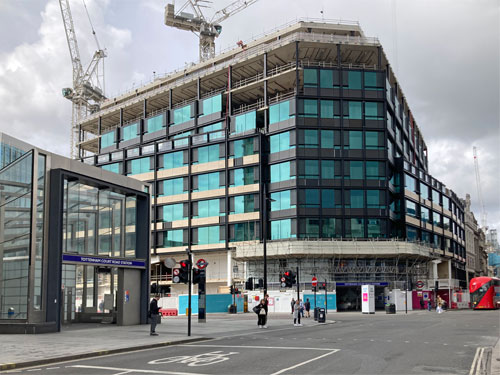
TCR's doing a lot better, indeed it recently became the third central station (after Custom House and Farringdon) to be handed over to TfL. The escalators leading down from the remodelled tube station have been waiting behind hoardings for some time, and the platforms were deemed substantial enough three years ago to allow visitors down for an Open Day. So what really struck me on my latest visit was outside, specifically how much of the new building above the ticket hall is now complete. It's going to be called Soho Place, a so-called "destination to work, shop and play", and I was surprised how architecturally uninteresting it was. Its drab facade is a jagged edifice of mostly windows, as yet neither finished nor clad, but I've seen the artist's impression of the finished building and it doesn't get any more characterful.
Meanwhile the Dean Street entrance has been ready for three years, pretty much, even if it originally resembled a bland black box from the outside. Again the big change here is the building on top, now several storeys high, because it was always in the playbook to monetise the space above the station entrance. What's unusual is that it's going to be flats rather than offices, and luxury flats at that (which admittedly is less of a shock). The development's called TCRW SOHO and offers investors hotel-style living overlooking Oxford Street in a building covered with dark reconstituted stone and gold decorative panelling.
It'll look gaudy and vile, but only 92 people have to think it attractive and that's £140m sorted.
But for £2.40 you'll be able to walk in underneath, eventually, and experience the dazzling ticket hall that leads down to a world of purple possibility. Sometime in the first half of 2022, they say, and who knows this time they may finally be right.
It's an exciting day today as we're finally allowedto do all sorts of things we haven't been able to do for ages. Travel is go, pubs and restaurants are go, theatres and museums are go, even picking up five strangers for casual sex is back on the agenda again. So hurrah for step 3, the next stage in the government's cautious but irreversible roadmap, which will bring joy to everyone who's got wet outside a cafe recently.
So it's the perfect time to take advantage of the Mayor's new Let’s Do London campaign, created in partnership with the city's hospitality, culture and retail industries, which aims to encourage Londoners and visitors back into central London as soon as possible. The heart of town has been pretty much dead for months as Londoners stayed in their own neighbourhoods and international tourists were kept at bay. Now the need is for as many people as possible to abandon the suburbs and return to the West End, and for god's sake spend some money while they're here.
It turns out arranging lots of chairs outdoors didn't really cut it, except in that first giddy week when people were so desperate for social contact they'd meet anywhere. A record-breakingly cool April followed by an unseasonably damp May swiftly put paid to al fresco nirvana, because nothing dampens outdoor sales like chilly wind and heavy showers. So it's excellent news that the West End's surplus of hospitality venues is now available to soak up the punters who've just discovered their local restaurants are fully booked for weeks.
Those who've tired of watching boxsets twice will find solace in a smattering of actual films in actual cinemas, of which the West End has dozens. Live theatre can also be guaranteed to deliver an emotional punch that months of lockdown lacked, and all at eyewatering prices which'll feel reassuringly familiar. And let's not forget London's empty museums, whose curators have had nothing to do since Christmas except tweak their displays to perfection, so you should pre-book now before furlough ends and market forces close them down.
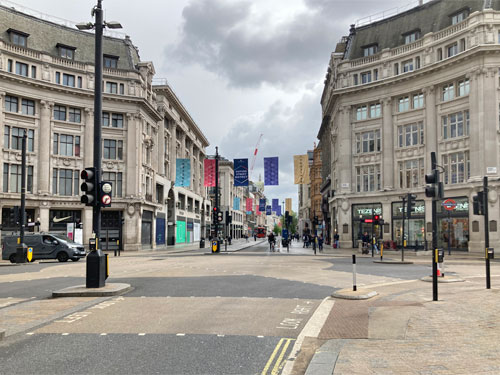
Perhaps most importantly, Oxford Street is desperate to see you again. Britain's premier shopping experience has been echoingly empty of late and very much needs footfall, punters and genuine customers. Please try to wean yourself off online shopping and return to a street where all your favourite goods are freely available at higher prices. Not only are there fewer buses on the road but also substantially fewer pedestrians on the pavements, so your visit may be unlike anything you've ever experienced before.
Most will want to flock to the big department stores, if only for the unfamiliar thrill of riding on an escalator again. But don't overlook the big brand flagships, the fashion outlets and the souvenir merchants flogging fridge magnets that look like phone boxes. Better still, while you've been away at least a dozen units have transformed into American Candy stores selling Cheetos, Gatorade and Hershey bars from unpriced shelves. Nothing quite says Oxford Street like swiping your contactless card and discovering you've just paid £10 for a small packet of sour cherry jellybeans.
It's already too late for Arthur Beale, London's oldest yacht chandler, whose shop on Shaftesbury Avenue has been supplying sailors, adventurers and explorers for nearly 500 years. A lack of customers during lockdown has finally forced them to close their physical store and a clearance sale is now underway. Arctic socks, splicing kits, knot-tying handbooks and headtorches are now available at a very respectable 20% off, but please be aware that 'ropes are not included' in the special offer.
Once you've done your shopping why not take a break in one of the Royal Parks? These look much like the parks in your part of town except more royal, but most importantly they have paths you haven't jogged round umpteen times during lockdown so have untapped novelty value. Hyde Park for example has more than enough space to accommodate the entire population of Hillingdon, should they all turn up, plus a load of kiosks who urgently need you to buy a coffee, a pastry and/or an ice cream.
Whenever you're ready to return to central London, the tube is ready to whisk you safely into town. Scientists have categorically proven that every surface is virus-free, and hand sanitiser is available everywhere just in case they're not. The only potentially dangerous thing would be other travellers in close proximity, but there are hardly any of those at present so it's entirely safe for everyone to surge back into trains and stations. You may not have missed travelling on the tube but our accountants have been screaming at you to come back for several months, so please do.
As lockdown eases today remember how important it is to refresh and reignite our city by spending money in the middle of town, not closer to home. Until millions of international tourists can be persuaded to return, or are legally allowed to, kickstarting the capital's economy is basically down to you. Come see a show, eat a meal, tour a museum or browse a store and Let's Do London, preferably repeatedly.
Five years ago I blogged a map of London's department stores.
On the day after Debenhams closed its doors for good, I thought it was time for an update.
Pink boxes denote areas where department stores have closed since 2016.
Most of the department stores that have disappeared since 2016 are Debenhams, once a mainstay of our town centres but now vanished in a puff of economic smoke. The capital's 15 former Debenhams were in Harrow, Uxbridge, Romford, Westfield, Oxford Street, Ilford, Hounslow, Wandsworth, Battersea, Wimbledon, Eltham, Sutton, Croydon, Bromley and Orpington. Of these areas only Hounslow and Battersea are now departmentstore-less, without even a Marks & Spencer to their name. Only the Debenhams in Hounslow, Ilford, Sutton, Uxbridge, Harrow, Bromley and Romford continued to trade until May 2021.
Turning to the other national chains, House of Fraser's London total has dropped to four since 2016 with the closure of stores in Richmond and the City. We also already know that their Victoria branch (formerly Army & Navy) will be closing next summer as part of an office redevelopment, which'll leave Oxford Street, Westfield and Croydon as the sole HoF outposts. Fenwick's three stores remain open, including one operating as Bentalls in Kingston. John Lewis still has seven stores (including Peter Jones in Chelsea), having opened in Westfield White City in 2018 but closed its Purley Way outlet last summer. As for Marks & Spencer they've only shuttered their stores on Holloway Road and in Covent Garden, but a number of smaller stores have lost their clothing sections and been repurposed for food sales only.
Many of the department stores in the centre of town are world famous, notably Harrods in Knightsbridge and Selfridges' flagship store on Oxford Street. Liberty in Soho is another iconic one-off, while Harvey Nicks and Fortnum & Mason lean more towards the rich and foreign tourists. It'd be seismic if any of these chose to close their doors.
Meanwhile out in the suburbs several smaller department stores somehow survive. Many of these owe their existence to Morleys of Brixton who first branched out in Tooting and then bought up several other suburban stores. These include Elys on nearby Wimbledon High Street, Pearsons of Enfield, Selby's on the Holloway Road and Roomes in Upminster. The only surviving independent on my map is John Sanders on Ruislip High Street, following the sad demise of Blands in Wembley (2017), the delightfully named Bodgers of Ilford (2018) and Tudor Williams in New Malden (2019).
Outside central London the only places to retain three department stores are Brent Cross, White City and Kingston, and the only places to retain two are Enfield, Stratford, Brixton, Croydon and Bexleyheath. Bexleyheath is a proper success story because it's gained a department store since 2016, courtesy of a branch of Morleys opening in the former BHS, so hurrah for that. Meanwhile Ilford, Battersea and Croydon have each lost two department stores since 2016.
Of the 82 department stores on my map five years ago 30% have disappeared, which is fairly depressing. But if you discount M&S and only look at 'proper' department stores the fall is 45%, which looks considerably worse. It's mostly Debenhams' fault, the rest have held up fairly well, but the map could well be a lot emptier by 2026. The pull of wandering round a one-stop shop for drapery, fashion and electrical goods is waning thanks to online shopping and the pandemic, but there is still a joy in buying something special and taking it home to use straight away. Use 'em or lose 'em.
n.b. a 2016 post listing London's closed department stores is here.
• "keep your hugs brief"
• UK alert level lowered from 4 to 3
• PM confirms major unlocking next Monday
• NHS app to become vaccine passport
• Queen's Speech focuses on pandemic recovery
• Indian mutation a "variant of global concern"
• Brit Awards held with in-person audience
• Test & Trace app reduced UK cases by 1-2%
• cases surging in Bolton
• vaccinated Americans need no longer wear masks
• Indian variant may threaten roadmap
• 2nd jabs accelerated to beat Indian variant
It was a great day for the hospitality industry when the Whitechapel Bell Foundry closed its doors. Nobody needs bells any more but what they do need is a bell-themed boutique hotel at the heart of historic East London, plus a nice little artisanal cafe on the side.
So it's our pleasure to welcome you to England's newest heritage destination, The Bell End, just as soon as we've knocked down all the bits of the original building we don't want.
The Whitechapel Bell Foundry was founded in 1570 and was once listed by the Guinness Book of Records as Britain's oldest manufacturing company. No other factory from the reign of Good Queen Bess is still going strong, or at least was going strong until it became financially unviable and sold out to a holding company. Thankfully this 450 year-old business is to be reborn as a mixed use development with 103 beds, artists' workshops and a super little gift shop courtesy of a kindly bunch of venture capitalists.
It's all because nobody needs bells these days, not proper full-sized ones. The Foundry sadly failed to understand the first rule of global economics, which is built-in obsolescence, so their products have endured for centuries without the need for replacement. Not since the mass destruction afforded by the Blitz has the foundry had a full order book, so it was always inevitable that the business would fold and a bespoke hotel concept take its place.
You can't miss the building because its wonky Georgian brickwork despoils a corner plot opposite HSBC and Superdrug. We plan to activate the shuttered frontage by replacing the downstairs workspace with a cafe, thereby neutralising pesky industrial health and safety protocols. The history of the formerbusiness will be told via display spaces featuring leftover tools and implements, because that's cheaper and more efficient than retaining the extinct traditions themselves. Expect the pit where the largest bells were cast to be securely covered, brightly lit and never again used for its original purpose.
We're absolutely beside ourselves with excitement at the thought of monetising the space where Big Ben and the actual Liberty Bell were struck. Our accountants are similarly thrilled at the thought of all the Americans who'll want to pay a pilgrimage to the Whitechapel Road and fork out for a light lunch and hopefully an overnight stay. All it took was the brave choice to repurpose the front of the building and rebuild the rear, rather than wasting public money trying to rescue the original business model. Market forces confirm that London has too many bell foundries and not enough boutique hotels, so it makes perfect economic sense to replace the last of one with the umpteenth of the other.
Rest assured that the long tradition of bell manufacture will continue on site. A small downstairs area will be partitioned off as a pseudo-foundry where cafe patrons will be permitted to observe operations through protective glass. Only handbells will be manufactured, not the tower bells for which the site is world famous, but excitingly these will be for sale in the building's gift shop. Not only did this tick all the right boxes in the planning application but we expect our visitors to be exactly the kind of people who buy shiny trinkets as souvenirs, thereby helping to make The Bell End financially self-sustaining.
The previous business selfishly only employed 24 staff, many of them merely professional craftspeople rather than proper serving staff or chambermaids. The new development will generate over 180 jobs, many of them low paid and none of which will require expensive long-term apprenticeships. The Bell End will also accommodate creative workspaces at subsidised rents for the benefit of local makers and creatives, but only because the building's listed and we had to do something with the upstairs rooms.
Just look at how attractive the new hotel will be. This is no boxy annexe, this is a distinguished design solution with all the pizazz of a modern block of flats, which will undoubtedly contribute positively to the overall ambience of the Whitechapel High Street Conservation Area. We're particularly proud of the full-sized bell dangling from a gantry on the rooftop which our architects confirm adds to the historical authenticity of the overall aesthetic, because nothing says The Bell End like a rampant protuberance.
We're enormously grateful to Robert Jenrick, the construction industry's favourite housing minister, for rubberstamping the conversion of the foundry into a luxury boutique hotel. He understands that you can't simply retain world-class heritage these days, everything has to be financially self-supporting, otherwise the public would be expected to subsidise the preservation of irreplaceable facilities out of taxpayers' pockets. How much better to open a cafe, flog handbells and lay a miniature chocolate on guests' pillows than to preserve an anachronistic anomaly from the first Elizabethan Age. The Bell End stands firm and proud, and hopes very much to welcome you soon.
In excitingnews for residents of Kennington, its tube station is about to be nudged from zone 2 to the boundary of zones 1 & 2. The change will have absolutely no effect on fares to/from any other stations, not yet. But expect it to bring broader passenger benefits in four months' time.
What's happening in September is the opening of the Northern line extension, a shiny transport bauble courtesy of developers redefining riverside Wandsworth. Trains that would normally have turned back at Kennington will instead continue to new stations at Nine Elms (for Sainsbury's and gaudy towers) and Battersea Power Station (for reimagined heritage and gaudy towers). Both these stations need to be in Zone 1 for prestige reasons, so intermediate Kennington needs to be nudged into zone 1 too. And because the only fares software update before September is this weekend, Kennington needs to be nudged into zone 1 now.
Short term it means very little. Fares on the Northern line south of Kennington won't change because Kennington remains in zone 2. But journeys from Kennington to zone 1 (or from zone 1 to Kennington) will be cheaper because the entire journey will now be in one zone. Off peak the fare drops from £2.50 to £2.40, so peanuts, whereas at peak times it falls from £3 to £2.40. A Kennington-Moorgate commuter might save £300 a year as a result, so that's nice.
Technically it's a little more complicated than that. TfL operate a secret special offer called Short Distance Cross Boundary Journeys whereby peak journeys that creep across the Z1/2 boundary only pay the Z1 fare. For Kennington this means that rush hour journeys to Bank, Borough, Charing Cross, Embankment, Lambeth North, London Bridge, Monument and Waterloo already only cost £2.40. Nothing changes if you're only going a few stops. But anyone travelling deeper into zone 1 (or travelling off peak) will start saving money from Sunday, hurrah.
Stations don't normally switch zones because many people would end up paying more. But shifting a station onto a zone boundary is fine because no passenger loses out, only TfL who end up collecting less in fares. Don't worry, Kennington's shift was agreed last summer by TfL's new overlords at the Department for Transport so the loss in income has been rubberstamped from on high.
Also it's not normally the done thing for two consecutive stations to be on a zone boundary. Vauxhall and Kennington are distinct because they're on different lines, but Kennington and Elephant & Castle are adjacent Northern line stations and that's unusual. But there is precedent here, notably the creation of a blurry Z2/3 boundary around Stratford in 2016, so practicality does sometimes outweigh network purity.
Kennington's shift to the Z1/2 boundary might look OK on the tube map (whenever that's updated, everything in today's post is an unofficial mock-up) but it looks odder in real life. Here's a map showing zone 1 stations in yellow, zone 2 stations in red and stations on the Z1/2 boundary in orange. The three stations on the Northern line extension (Battersea Power Station, Nine Elms and Kennington) have a black ring around them.
Kennington turning from red to orange extends the edge of zone 1 much further into South London than TfL have ever admitted before. Meanwhile that odd-looking yellow bulge is the result of extending zone 1 to include Battersea and Nine Elms. This is an attempt to placemake a new neighbourhood south of the Thames in an area that's always been relatively inaccessible from central London - a situation the Northern Line Extension is intended to change. The most jarring outcome is the proximity of Battersea Power Station station (zone 1, yellow) to Battersea Park station (zone 2, red), highlighting that the incomer has been granted numerical prominence entirely subjectively.
The awkwardness of adding these two new Z1 stations is revealed if you attempt to draw an imaginary zone 1 boundary across the map.
Before the arrival of the Northern Line Extension you could have drawn a smooth line sweeping north of Kennington and stuck closer to the river. But the introduction of a third Z1/2 station forces the line to wiggle irregularly, compelling any Z1 boundary to bend inwards. The discrepancy arises because Nine Elms has been granted full-on Z1 status but Vauxhall, closer in, remains boundary 1/2. It'd make total geographic sense to redefine Vauxhall as Z1 only, but that'll never happen because it'd penalise Victoria line passengers.
It's interesting to look back at the Planning Inspectorate's 2014 report and the representations businesspeople made to ensure that the two new stations ended up in zone 1. The Director of the St James Group building consortium said Z1 would be a great benefit and allow good integration with the remainder of Central London. The Chief Executive of the Vauxhall One BID didn't want new residents paying a £300 annual penalty for living in zone 2. That Chief Executive became a founding member of Leave EU two years later, then progressed to chairman of the Brexit Party, was elected to the European Parliament in 2019 and last week failed to gain a seat on the London Assembly.
In four months' time, according to the very latest committee minutes, two brand new stations will appear on the tube map. Squeezing them in is going to be made much more difficult by the need to show the Z1/2 boundary in the correct place, with the location of Vauxhall likely to be the design's sticking point. This is my attempt in which I've been forced to drag Vauxhall away from the river, geographically unhappily, in order to confirm that a Northern line journey from central London to Battersea Power Station is all within zone 1.
And it's the need to encourage through-journeys which explains why Kennington gets to be in Zone 1 from Sunday. Nobody wants residents of the Vauxhall, Nine Elms, Battersea Opportunity Area to have to pay extra to travel into central London, and nobody wants people in central London to have to pay extra to go shopping at the power station. It's all about lubricating the wheels of capitalism, because that's the only reason tube lines get extended these days.
But this new zoning won't be quite such good news for residents of South London heading up the Northern line and changing to the new extension. Kennington may be in zones 1 and 2 but Battersea Power Station and Nine Elms are only going to be in zone 1 so visitors from the south will be expected to pay a premium to travel there. It'll be cheaper to get out at Vauxhall and walk.
A special thing happened yesterday morning. The temperature in my living room returned to the same value it was at the start of November. It's been a long winter.
The indoor temperature on 2nd November 2020 was 18°C. The indoor temperature finally got back to 18°C on 12th May 2020. That's a gap of 191 days (or, to put it another way, six months and one week).
To clarify a few things...
» This is the temperature in my living room first thing in the morning.
» First thing in the morning is the coldest time of day in my house.
» First thing in the morning is not affected by any central heating I may have had on.
» I'm not one of those people who leaves the central heating on overnight.
» I don't believe in heating the house while I'm unconscious under a duvet.
To clarify a few more things...
» My thermometer is close to an outside wall quite near a window.
» Yes, obviously I've been keeping a daily record in a spreadsheet.
» Don't say you're surprised.
The indoor temperature started its wintry descent when we had a coldish snap at the start of November. It soon recovered but then began a steady decline to a minimum of 12°C on 7th December. It managed to get back up to 16°C just before Christmas, then slumped into the New Year and spent a full fortnight below 12°C. An erratic recovery kicked in, but a really cold spell in the middle of February dragged morning temperatures down to a wintry low of 10°C. Within a fortnight it was back at 16°C, but only briefly, and there were two more lowpoints at the start of March and April. More recently there's been a long spell hovering around 15°C, until finally this week the temperature shot up and returned to 18°C.
My average first-thing-in-the-morning temperature over the last six months was 14°C. The temperature was below 15°C two-thirds of the time, below 13°C for six weeks and below 12°C for three weeks. Hurrah for central heating and its ability to make the rest of the day less chilly. Hurrah also for living alone, which means I have full control of the radiators.
I'm perfectly comfortable in indoor temperatures of 18°C, I'm not one of those people who needs the thermostat stuck in the twenties. I'm actually OK at 15°C most of the time, which may be a bit more resilient than some of you. I'm not comfortable at 12°C, which is double-jumper weather, and that week of 10°C first thing in the morning wasn't pleasant.
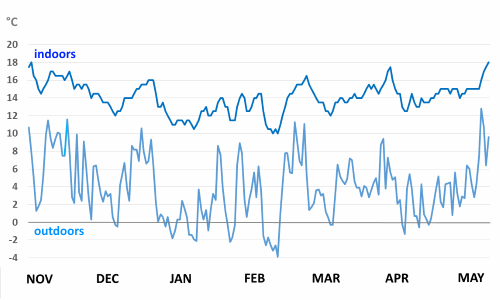
To make any sense of all this, the graph obviously needs a second line.
To clarify a few things...
» The top line is the temperature indoors.
» The bottom line is the temperature outdoors.
To clarify a few more things...
» This is the overnight minimum temperature outdoors.
» I do have an outdoor thermometer so I really should have taken data from that.
» Instead the graph shows the overnight minimum in Hampstead, a few miles away.
As you can see the temperature indoors closely correlates with the temperature outdoors. After a cold night the temperature in my living room is cooler, whereas if it's a mild night the temperature indoors holds up better. A prolonged cold snap drags the temperature down further for longer. There's rarely a lag, it's pretty much immediate.
But the two lines never cross, or even meet, because the brick walls of my flat are good at insulating. In fact the two lines are generally about 10°C apart because that's how good my walls are. The maximum difference was 14°C at the start of November when the walls still held a bit of leftover summer heat. The minimum difference was 4°C earlier this week because it's spring and the building I live in is still warming up.
The first time the outside temperature dipped to freezing overnight (in December) was the first time my inside temperature dropped to 12°C. The freezing fortnight at the start of January was the first time my early morning indoor temperature dipped below 12°C. But it took until the Arctic burst in February for the indoor temperature to reach 10°C thanks to outdoor temperatures below -2°C. At the coldest times the difference between inside and outside is generally twelve degrees.
Now that my central heating has been resolutely switched off for some time, an interesting observation is how stable the daytime temperature in my flat is. For example it was 18°C first thing yesterday morning and then hovered around 18-19°C all day even though the temperature range outdoors was rather wider. The baseline temperature inside a flat or house depends a lot more on the temperature of the building than the temperature of the air outside. A building is slow to warm up in the spring and slow to cool down in the autumn, like the sea, which helps explain why it's taken until May for my indoor temperature to finally match November.
Anyway, it's nice to be back in the half of the year when the temperature indoors is high enough first thing in the morning to be entirely ignorable. But I intend to carry on recording it, if nothing else to observe the effect of outdoors on indoors during the hottest sweatiest bit of the summer. Assuming we get a hot sweaty bit, that is. We've been a long time waiting.
Over the last year certain key freedoms have been deemed so important that they've been opened up faster than they might otherwise have been. What can this tell us about what it means to be a typical Brit?
The right to go to the pub
In March last year the Prime Minister left it until the very last minute to close down pubs. Epidemiologically this was stupid and dangerous and undoubtedly led to numerous additional deaths. But Boris knows his electorate and understood their inalienable right to go to the pub, so discounted closure until the evidence was overwhelming... and even then allowed publicans the rest of the evening to wind things down. Reopening has similarly been pub-fixated - can we go? must we sit outside? when can we drink indoors? - as if this is one of the things Britons most obsess about. Perhaps it is.
The right to meet up at Christmas
Throughout the autumn there was a growing obsession with whether or not we'd be able to meet up with family at Christmas. It looked possible at one point, then less likely, then the intended duration shrank from hopefully five days to sorry only one day (and in certain parts of the country no days at all). Scientifically speaking this was a ridiculous relaxation that would undoubtedly kill people, and probably kickstarted our second spike, but the political need to permit family festivities overruled medical common sense. Other religious festivals weren't so lucky, nor other indoor gatherings of any kind, but the divine right to Christmas was somehow deemed essential.
The right to a foreign holiday
This one's always been bubbling under the surface, like a glimmer of hope at the end of a very long tunnel. Apparently what the average Briton needs to validate their existence is the right to travel abroad for a summer break, and anywhere that doesn't guarantee sun and heat somehow won't do. A holiday in Blighty just doesn't cut it, as evidenced by the inexorable reappropriation of the word "staycation" to mean a somehow-substandard not-foreign holiday. Nobody genuinely needs to hop on a plane for solely leisure-based reasons this summer, risking bringing back who knows what from abroad, but for some reason the approved next step after 'stay at home' and 'stay local' is 'a fortnight in the Algarve'.
The right to hug others
This one's crept to the surface recently, the need for extreme physical contact rather than just human proximity. This week we're not allowed in other people's homes but next week not only can we go indoors we can additionally hurl ourselves at our loved ones with respiratory abandon. Admittedly subsidiary guidance advises us to hug responsibly, avoid going in face to face and keep it brief, but that's not the overall message which is "hug everyone again because they deserve it". An emotional response is being allowed to dominate the science, and all because it's supposedly a human right rather than right in itself.
I don't feel bereft or personally blighted if I'm not allowed inside a pub at the weekend. I coped with not seeing the rest of the family at Christmas because it was no harder than not seeing them on any other day. I'm capable of not going abroad this year if it helps to keep my fellow citizens safer. And I don't come from a family of huggers so I look on the rest of you with a degree of emotional incredulity. I consider this entirely rational behaviour. I suspect it also makes me culturally abnormal.
None of this is about whether easing lockdown is right or wrong, but instead the fact that certain key activities have been allowed to deviate from the norm, accelerated ahead of others because they're deemed more important to our national psyche. Our populist government knows what the wider population wants, which is beer and Christmas and foreign sun and hugs, and maybe this is indeed what it means to be British.
The Queen's speech yesterday included the intention to introduce an obligation to show photo ID before voting. As oppressive unnecessary gerrymandering goes, this is brazen.
The UK does not have a significant problem with electoral fraud. It sounds plausible that it might have, but all the evidence confirms the opposite. In 2019, of 595 alleged cases investigated by the police, only four led to a conviction. The smallest majority in the General Election that year was 57.
The government's line is that "showing identification to vote is a reasonable approach to combat the inexcusable potential for voter fraud", but potential is not the same as reality and this move would simply disenfranchise a significant number of voters.
A pilot scheme of voter ID checks was held in 10 local authority areas in 2019 which resulted in 2000 people being turned away, 750 of whom failed to return. Three different models were trialled, one of which merely allowed voters to turn up with their poll card, so it's significant that the government has chosen to adopt the more draconian reqiurement for full-on photo ID.
It won't just be driving licences and passports that are valid, the government has signalled that certain other photo-based ID documents will be acceptable. There's also a suggestion that local councils will provide photo ID free of charge where necessary, as they currently do in Northern Ireland. But this remains an additional unnecessary imposition for no obvious reason other than to deter certain unwanted voters.
It's no use sounding surprised about this. It was clearly signalled in the Conservative manifesto eighteen months ago, so if you voted Tory you've essentially already agreed.
I've been reassured by the general outburst of outrage these proposals have elicited, and similarly appalled by the mendacious smirk on the face of a government intent on biasing the electoral system in its favour. Assuming their huge parliamentary majority ensures this moral travesty goes through, imagine how much worse a fifth term could be.
My 16th random ward is an odd'un, being long and thin and mostly unnoteworthy. Langbourn fits into a narrow slot between Bank and Aldgate, somewhat irregularly, and touches more City wards than any other - eight in total. Other than containing half of Leadenhall Market it's not especially blessed with points of interest, but it does have more than its fair share of back alleys to explore. [pdf map][10 photos]
Historically Langbourn followed both sides of Lombard Street and Fenchurch Street, but after several administrative rejigs now only the northern flank remains. The sole southern exception is St MaryWoolnoth which was deemed to have historic connections and so remains inside a tiny arrowhead protruding at the ward's west end. It's the City's sole example of a Hawksmoor church, reimagined 300 years ago because Wren's repairs to the medieval church proved inadequate. Look out for its Baroque tower topped by two turrets facing the Bank road junction, but set back a bit. St Mary's was nearly demolished in 1897 to make way for the City and South London Railway but engineers were persuaded to build their entrance in the crypt instead (which now houses a bank of lifts down to the Northern line platforms).
The ward's only other surviving church is St Edmunds on Lombard Street, with its poky-out clock, although it's now used as the London Centre for Spiritual Direction rather than as a place of worship. It's also where the Bishop of Islington is based should you ever need to see him. Lombard Street was once known for its many hanging pictorial signs, introduced identify businesses before addresses were numbered. The most striking of the four that remain is the golden grasshopper signifying the home of Tudor financier Sir Thomas Gresham, although the current danglers are merely Edwardian replicas.
St Gilbert Fenchurch was never rebuilt after the Great Fire but its churchyard lives on as a small garden off Fen Court. Its benches are a little glum, but tucked behind one tomb is a decent-sized stone labyrinth based on a design found on St Agnes in the Isles of Scilly. More striking is a sculpture called the Gilt of Cain, installed in 2008 to commemorate the preaching of anti-slavery sermons nearby. This consists of a granite podium facing a cluster of sugar-cane-like pillars, each engraved with a bit of poem, and I recommend climbing up to the 'lectern' for a different perspective.
Alongside is One Fen Court, Langbourn's only recent tall building. The City's largest public roof garden perches above its 15th floor, in normal times freely accessible by lift and an unexpectedly nice recreational hideaway. I had to make do with accessing the public realm underneath the building, a black-walled cavern that's usually brightened by dynamic art on the ceiling, but when that's switched off it becomes an oppressive inactive void that undoubtedly sounded nicer in the planning application. An abomination twice the height is due to replace Marks & Spencer on Gracechurch Street, its trio of linked towers rising unapologetically above the site of the old Roman Forum.
Leadenhall Market dominates the centre of the ward. Half of it's officially in Lime Street, but everything south of the central arcade lies in Langbourn instead including several smaller offshoot passageways. All the shopfronts are brightly and uniformly painted, concealing whether it's a sandwich shop, a boutique or a Pizza Express until you look closer. Shoppers should be aware that very few businesses have reawoken as yet, but this is excellent news for photographers because it's still uncannilyeasy to get absolutely nobody in shot.
In Bull's Head Passage I found a holy icon of Harry Potter pilgrimage, the entrance to the Leaky Cauldron, as used in the first movie before expensive backlot sets became available. Hagrid leads Harry through the market to a curved doorway whose blank sign magically reveals the name of the pub before they step inside. In reality this is the rear entrance to the Glass House opticians and the sign outside says London Migraine Clinic, which must be a bit of a letdown when the guided tours deposit their Potterphiles outside.
South of Leadenhall the web of streets becomes more mundane, a mix of mostly gents outfitters and unfancy eateries. On Lime Street you can window shop for brogues and dress shirts and ogle cricket memorabilia. In Cullum Street Temple Food offers exceptionally traditional sandwiches and cooked breakfasts immediately opposite the oatmilk macchiatos of the Curators Coffeestudio. Giorgio Italian Menswear closed for refurbishment in the summer of 2018, supposedly for three weeks, but never reopened. Bolton's restaurant has a box of reassuringly retro paper menus outside in the hope that patrons will convert their normal calamari fritti and tiramisu into a boxed takeaway.
Explore the alleyways further and there are proper pubs, the kind tourists never find but are instead frequented by office workers without expense accounts. The entire menu at the Bunch of Grapes consists of rolls, pies and chips, £4.50 max. The Swan Tavern lurks up its own Passage and boasts Edwardian marble bars. Charles Dickens drank regularly in the George & Vulture in Castle Court and mentions it numerous times in Pickwick Papers. It's less a pub and more a restaurant these days. but with a traditional cuisine that peaks at roast beef and breaded veal. Alas I can't yet mention the Jamaica Wine House across the alleyway because local boundaries are seriously counter-intuitive and that's in Cornhill ward.
Langbourn's back alleys are fascinating to explore if less historic than you'd hope. I tried to walk them all, including the wood-panelled squeeze through Bengal Court round the back of the G&V. But I was thwarted by a film crew who'd spotted the benefits of an atmospheric secluded backdrop and had turned up with a fleet of vans, bright lights and security. At every potential entrance off Cornhill and Lombard Street they told me I couldn't pass, until eventually I stumbled upon one unguarded portal. Here a runner asked me ever so politely to wait while a smart-suited youth strode purposefully out of Change Alley... and cut!... and I shall be watching out for that scene in every upcoming drama series for the next eighteen months.