Today is my 57th birthday, so you can probably guess what I'm having for dinner.
Beans on toast, of course, and soup.
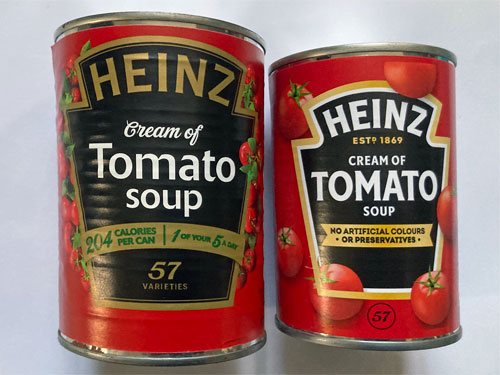
I've had these tins of Heinz Cream of Tomato Soup for quite some time, especially the can on the left. It has a best before date of March 2018, when I was merely 53, and is notably bigger than the best before May 2023 version. Back then Heinz gave you 400g of soup for your money and now it's only 300g, and I doubt the price has fallen in response. The recipe however remains exactly the same - salt and sugars and all.
Another change is the 57 trademark, now a black number in a circle whereas previously it was the full 57 Varieties in gold. American pickle baron Henry J. Heinz came up with the famous slogan in 1896, supposedly inspired by a New York shoe shop which promised shoppers "21 styles". He wasn't trying to be accurate - Heinz sold at least 60 different products by then - and the 57 is said to be a juxtaposition of his and his wife's lucky numbers. Nevertheless the number 57 soon became synonymous with his fast-growing company, and is so engrained in global consciousness that I've long considered today to be my Heinz birthday.
Which made me wonder where Heinz's UK operation was based and whether perhaps it was in London... and a little research soon threw up three locations for a birthday visit.
The Heinz Factory, Harlesden(1925-2000)
Heinz soup was initially a luxury import, available in the UK only at Fortnum & Mason and Harrods. But in the 1920s the company invested in a large British factory to bring their products to the masses and chose a site in Harlesden between the railway and the canal. If you know the McVities factory on Waxlow Road, the Heinz site was at the far end of the street in a longer building with 'Heinz' written on the brickwork and a giant '57' balanced on the roof.
At first it was merely a bottling plant churning out a range of pickles and sauces, including salad cream and calves feet jelly, with canned goods like baked beans and soup following in 1928 and 1930 respectively. To enjoy a scratchy old newsreel following the production of those baked beans through the factory, click here.
Soon no cafe table was complete without a bottle of Heinz ketchup and no larder stocked without a can of Heinz soup, which triggered the need to purchase 31 adjacent acres. Output peaked at one million cans of beans a day in the 1960s, with Heinz the major local employer, but by now a larger modern factory in Wigan was ready to take production away. In the last years at Harlesden only the manufacture of tomato ketchup was left behind, and the workforce slumped to a mere 450 until in 2000 the factory closed for good. This being a valuable site they knocked the whole lot down and replaced it with a business park set out with large multi-purpose warehouses... from 57 varieties to 29 sheds.
Today the site has a single entrance on the Park Royal estate watched over by a security checkpoint at the gate. A stream of employees flows both ways, perhaps starting a shift in pharmaceutical processing, perhaps heading home after a day in specialist logistics. It's very bland back there, up several dead ends with copious space for parking. I preferred the option of a walk along the Grand Union towpath where the factory once showed its backside to the canal. It's now all millennial units, with the occasional tiny gap where employees are permitted a couple of benches facing the water. I did at least get to enjoy the sudden arrival of a heron and the sweet smell of wafted digestives, but it's no longer true that Harlesden Meanz Heinz.
Heinz HQ, Hayes(1965-2017)
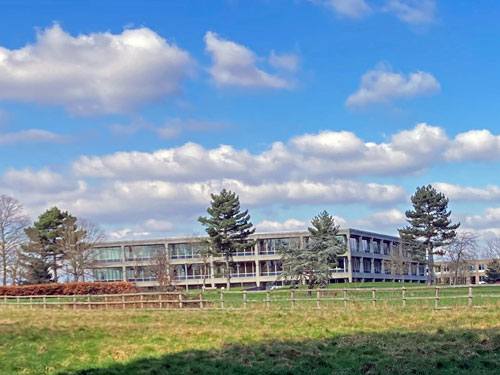
Heinz management chose not to hang around in Harlesden and sought a greenfield site with additional space for laboratories and research. They invited American architect Gordon Bunshaft to design a campus on the site of a run-down Victorian house in Hayes, working under the restriction that only a small part of the grounds could be redeveloped. He designed two squat rectangular buildings using reinforced concrete, part sunk into the ground to make them less intrusive on the landscape. The main HQ had a central courtyard with a shallow reflecting pool, while bosses were gifted offices facing out towards open parkland. It was all considered pioneering when it opened in 1965, which coincidentally means it's celebrating its 57th birthday this year.
Unfortunately all the buildings are now empty, bar a security team watching over the site, with management having been turfed out in 2017 after Kraft swallowed Heinz. The drive that wends up from Mead House Lane has been obstructed by concrete blocks and the main entrance off Park Lane firmly locked while alternative tenants are sought. Indeed the entire perimeter of the site is so impressively screened by trees that when I checked on Google Streetview I wasn't convinced I'd be able to see anything. But I still went, which is how I found myself wolfing down the last bites of a hot cross bun from Kingshill Bakery as I stepped up to the gate. I could see the South Building at the end of the drive but very low down, as its creator intended, and also the roaming dogs that one of the warning signs was keen to promise.
My saviour was a public footpath connecting two separate housing estates, which meandered along the edge of the site around the site of a drained ornamental lake. If I lined up the metal fence carefully with the row of conifers behind it was still possible to find gaps offering a half-decent view of Heinz HQ, its concrete shining in the spring sunshine, adrift in fields resembling open countryside. Hayes Park must have provided a gorgeous backdrop for the executives charged with flogging spaghetti hoops or coming up with a new flavour of cheesy toast toppers, back when working amid natural surroundings was very much not the norm.
That said, the view from the new administrative offices is even more impressive...
Kraft Heinz HQ, London SE1(2017-)
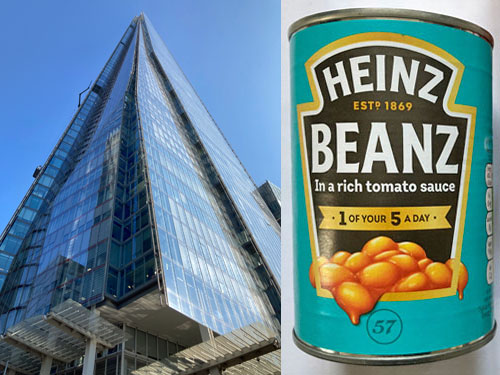
Today what's left of Heinz's UK empire trades from the 20th and 21st floors of the Shard. It means soup and beans sharing desk space with Lea & Perrins, Maxwell House and those thin slices of processed cheese, but that's massive global food and beverage conglomerates for you. I must say I'd never twigged before that the Shard was the location of the SE1 9SG address on the back of every can. But I'm pleased to say that the Cream of Tomato I'm having for dinner tonight displays Hayes, Middx, UB4 4AL on its label instead, because a 57th birthday really ought to be celebrated by one of 57 Varieties from a 57 year-old listed building.
Have Travelcard will travel. I haven't had one for nigh two years so it's been good to get back out exploring again.
In particular there are several London boroughs I hadn't been to for absolutely ages so I've made the effort to drop in again, sometimes deliberately, sometimes on the way to somewhere else. Here are photos from six of those boroughs, not necessarily because they're blogworthy but mainly as a signal that I've been.
Ealing: unvisited for 149 days
PETERS HAIRDRESSER S is a full-on apostrophe nightmare at a backstreet salon behind West Ealing Broadway. The gap between HAIRDRESSER and S strongly suggests that the sign was originally written with a superfluous apostrophe... and if you look closely you can see it originally was, and has been painted over. Meanwhile PETERS should have an apostrophe between the PETER and the S but doesn't. You might think it possible that the salon could belong to someone whose surname is Peters, so this is technically correct... but no, because Streetview retains evidence of an earlier sign for PETER'S BARBER SHOP. The whole mess is then compounded by having been written in Comic Sans and stuck on using slightly-peeling plastic letters. You'd hope a business established in 1966 would know it's name, but its clear they dont.
Havering: unvisited for 272 days
This is the emerging housing estate at Beam Park, or at least a small completed part of it. It's based on some of the old Ford Dagenham site where 2900 homes are due to be built, and would have been built faster had transport links been better. Trains from Southend pass immediately alongside the development but there's never been a station here, only a pesky two mile gap. The first flats were built in 2019 on the basis that a station would definitely be added, but lastyear the government suddenly said they'd never promised anything and didn't believe it would be viable, leaving new owners and potential purchasers in the lurch. Yesterday the DfT 'clarified' the situation, saying the station "needs to show that it can generate revenue over a continuous 3-year period" and that the Greater London Authority must agree to fund "any associated operating losses". Such is the Power Of The Shapps. When you think of all the suburban stations that'd never get built today if you applied the same logic, the economic argument is absurd. I caught the bus back. It took ages.
Richmond: unvisited for 731 days (i.e. two years and one day)
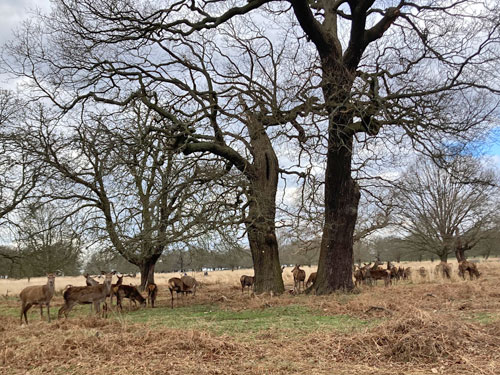
I love a hike across Richmond Park, not least because there's always another path to follow, another corner to explore and another expanse to get lost in. This time I walked from the Queen's Gate to the Bog Gate, making sure to divert via the Isabella Plantation where the rhododendrons are already starting to bloom and the heathers are sparkling. It both cheered me up and made me sad I'd missed two previous springs. Later when crossing the boggy expanse near White Ash Lodge I was so preoccupied while edging round the muddy bits that I completely missed a herd of grazing deer until I was almost upon them. Two dozen heads looked up... and one of those heads had antlers and seemed to be looking more sternly than the rest. I kept moving and hastened towards the next quagmire, reflecting that I'd be fine because it's not rutting season and I didn't have a dog. I've missed these walks.
Kingston: unvisited for 731 days
The Coronation Stone outside Kingston Guildhall commemorates the unlikely fact that seven Kings of England were crowned in the town, not precisely here but in a chapel round the back of Pret A Manger. We're talking 10th century, so that'd be Edward the Elder, Athelstan, Edmund I, Eadred, Eadwig, Edward the Martyr and Ethelred the Unready. This greywether sandstone lump has been moved several times since the chapel collapsed, first (1730) beside the parish church, then (1825) beside the Elizabethan Guildhall, then (1840) to the Yard of the Courts, then (1850) beside the road outside Clattern House, then (1935) to the Garden of Rest in Church Street and finally (1936) to its current position outside the Guildhall. According to a planning notice tied to the railings it's due to be repaired and cleaned soon, and to have a brand new interpretation board installed. I hope the new board is as informative as the current engraving, which looks to have been there since the 1980s and resembles a typed sheet of paper.
Hillingdon: unvisited for 744 days (i.e. two years and two weeks)
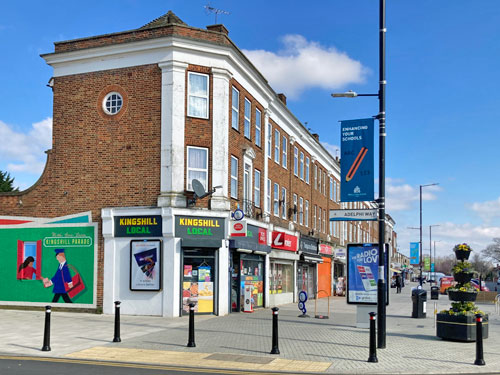
This is Kingshill Parade in Hayes (or rather Hayes End, or perhaps North Hayes, depending on how you choose to subdivide this sprawling suburb), a tad to the north of the Uxbridge Road. It's the chief shopping centre for a large postwar estate you have no need of ever visiting, nor even passing through, hence I never previously had. Here you can source helium balloons, pick'n'mix and private tutors along with other household staples, and admire a municipal stack of floral baskets. You can also get your ear pierced at Jeff's Gents Hairdressers, wash your smalls at Brookfords Launderette and pick between Costcutter and the Co-Op for your milk. But what gladdened my heart was the sight of Kingshill Bakery, independent purveyors of freshly baked bread & cakes, filled rolls & sandwiches. I grew up with a bakery like this at the top of my road, its window brimming with loaves, cream cakes and sticky buns (although back then they wouldn't have given their iced doughnuts such prominence).
The lunchtime rush was underway, which in this part of the world means two local tradesmen popping in for a buttered baguette, so I had to wait almost thirty seconds before being served. My eye was caught by the ovens out back, confirming fresher bakes than anything Pret'll serve you, and also by the prices on the whiteboard, confirming cheaper bakes than everything Benugo does. I plumped for a cheese and bacon slice but the headscarfed server frowned and told me they didn't have any, so I switched my selection to one of the hot cross buns in the window instead. She slipped it into a white paper bag and spun it round, then charged me a ridiculously low 45p for my plump juicy treat. It was delicious, and all the better because it was unintentionally topped off with a smear of cherry from a previously adjacent danish. What fools we are to live in inner London when the proper haute cuisine is on the outskirts.
Harrow: unvisited for 744 days
I was changing buses in Northolt yesterday (as part of my research for tomorrow's post) when I realised I was only one minute's walk from the Ealing/Harrow boundary. Obviously I nipped down to the railway bridge and back again so I could say I'd been, because that's how I roll, and I also took a single photo in case it proved useful as visual evidence. This is that photo. Don't worry Harrow, I'll be back to see you properly soon. And I still need to drop by four other boroughs I haven't been to for over two years, but maybe I can make a post out of those later.
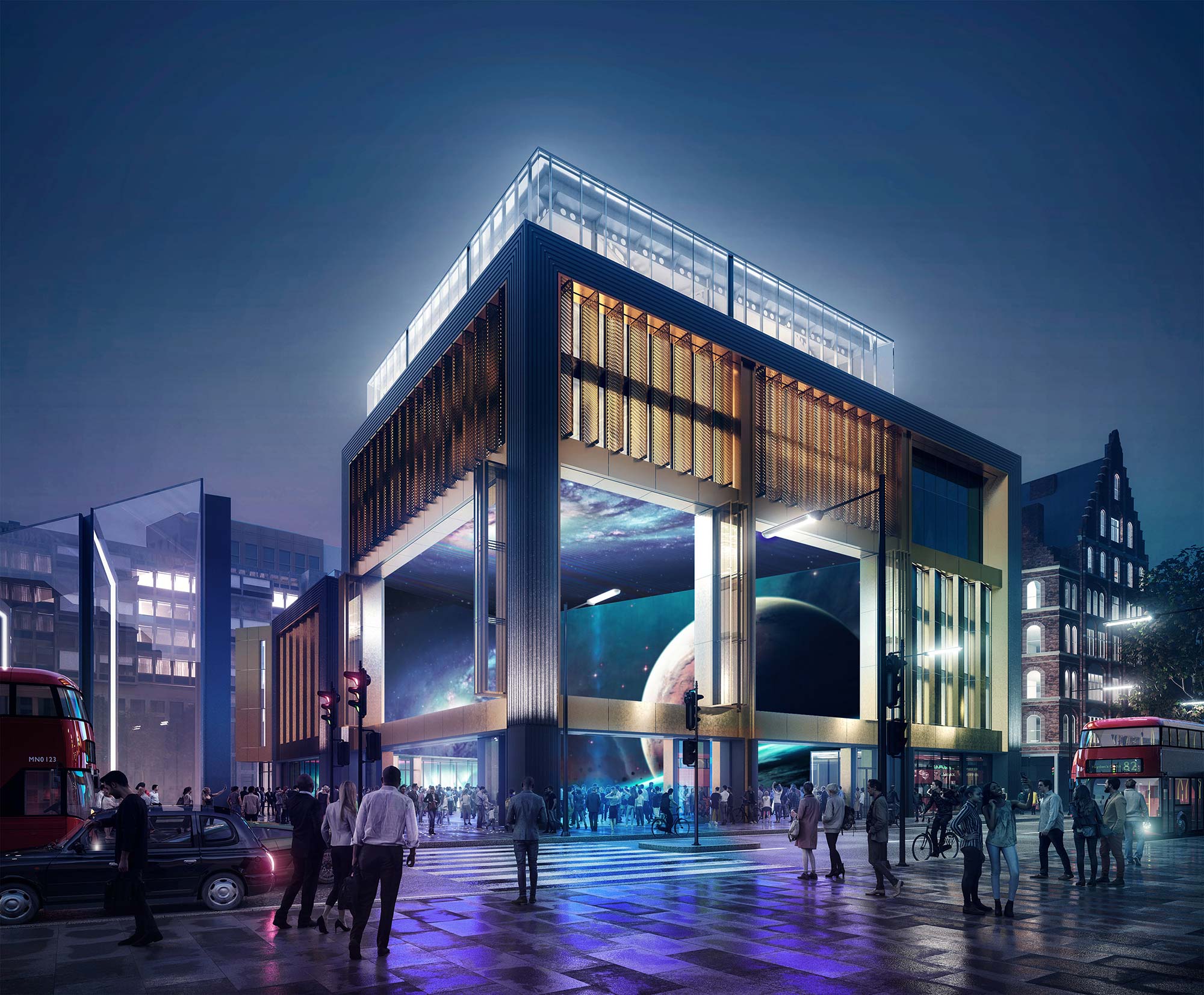
Crossrail isn't only transforming transport, it's also changing the landscape around its stations. Take Tottenham Court Road, for example, where all the buildings between the Astoria and Centre Point were knocked down to facilitate a worksite and have since been rebuilt in modern form. The Dionysuschippie is now a bustling station entrance, the old fountains have been pierced by a prismof glass and to the rear of Denmark Street is the most abhorrent blot of all. It's called Outernet London, it's sheathed in garish gold and it's destined to become something you never realised the capital needed... an "immersive public environment".
Imagine a largeauditorium you walk into off the street. It has four-storey wraparound screens, plus another covering the ceiling, so that audacious visual effects can play out all around you. Altogether it has 2000 square metres of LEDs at supposedly record-breaking pixel density, the idea being to act as a 360 degree cinema that'll hold your attention, wow and amaze. No tickets are required and no queueing is anticipated because the owners really want you to come inside. They've even aligned one of the entrances with the escalators coming up from Tottenham Court Road station's ticket hall in the hope you'll funnel straight in.
And don't think you'll escape if you're just passing by on Charing Cross Road. Two of the golden walls hide outward-facing screens and are also retractable, opening up the interior so you can see the animation from the pavement or the top of a passing bus. They hope passers-by will think "ooh that's interesting, I need a closer look" and duck inside to watch the dancing pixels. Their expectation is that 100 million people will visit annually, maybe only for a few minutes each but that's sufficient, job done.
If you've not worked out what this is yet, it's a cinema for brands.
Once within these four digital walls you'll be served up a diet of marketing dazzle and sponsored content. You might be amazed by a giant shark, a living rainbow or a glowing starscape, maybe even some genuine art, but they'll only be there at the behest of a corporation whose slogan or logo will be flashing past you later. It'll be like Piccadilly Circus on steroids.
And you know what happens when people are faced by a monumental visual experience... they whip out their phones and press record, then upload their amazing video in the expectation of gaining likes. Kerching, objective achieved.
You may not be mug enough to spread the word but sufficient millions will, slipping the ongoing brand narrative into the timelines of their followers and without expecting to be paid a penny. It's an almost faultless plan, alas, in much the same way that a crocodile is a perfect predator. You might not like what it does but you have to appreciate the way it does it.
A couple of adjacent spaces can be hired by whoever wants to pay, within which you might discover Samsung's latest range of phones, engage with Dua Lipa's next music release or witness the dawn of a new perfume. It was once said that the future of the High Street is as somewhere you go to engage with a brand you'll buy later, and this is very much the apotheosis of that trend.
An entire city block has been erased to make way for this complex, bar the facades on two sides which have been retained to provide a heritage veneer. One of these sides is the legendary music nexus of DenmarkStreet, once known as Tin Pan Alley, where numerous rock legends played, jammed and recorded. It's still possible to buy a top class guitar in some of the original shops but others are now empty husks with reconstructed 21st century interiors. Look carefully and one unit has been knocked through to create the entrance to an arcade that'll connect through to the rest of the complex, and is again lined by enormous LED screens.
Even though it's currently blocked off, this 21 metre-long arcade is already playing video content. From outside you can see a sliver of pink sky above some kind of tropical environment, where every sixty seconds a bunch of digital balloons floats up and explodes in a burst of glittery fireworks. It's conceived as a brand tunnel and you can already imagine how visitors will stop, wave a camera-enabled device and wait for the best bit. They call this the Now Arcade, the separate spaces Now Trending and the big corner auditorium The Now Building.
Yes there'll be food here too, with the Chinese restaurant on the top floor due to open for a soft launch at the end of the month. A fair chunk of the upper storeys has been given over to luxury apartments and "session rooms", where the moneyed can enjoy a short or long stay in breathtakingly garish surroundings. The blurb makes much of the site's musical connections, suggesting you can sleep where the Rolling Stones recorded their debut album or in the mews house where the Sex Pistols once lived, but one look at the associatedimagery confirms that all aspects of raunch and anarchy have been wiped clean away.
The least cynical part of Outernet London is probably the music venue in the basement. It's called the 12 Bar Club and is named after a small Denmark Street club where Keane, Adele and the Libertines played before they were famous, but which was forced to close in 2015 so that this monstrosity could be built. Don't expect the former management to be involved or happy, they went bust a year after relocating to Islington. Do expect to read a lot more about gigs down below and product launches upstairs and everything Outernet-related in numerous Time Out column inches going forward.
What simultaneously amazes and depresses me about this new development is that someone did the sums and worked out that a temple to advertising could turn a profit. This is a central London hotspot where you'd expect rents to peak, and yet a building that's essentially a big digital screen expects to rake in enough from brands to make it financially sustainable. Prepare to peer in and be appalled, and simultaneously to watch digital natives embrace the concept and share share share.
• U-turn on compulsory jabs for NHS staff
• New Zealand reopens international borders
• Queen returns to light engagements
• cases soar in Hong Kong's 'fifth wave'
• Western Australia reopens its borders
• anti-inflammatory can help to treat virus
• Wales to end restrictions at end of month
• cases rising sharply in Scotland
• Ireland removes all travel restrictions
Worldwide deaths: 5,940,000 → 6,000,000 Worldwide cases: 434,000,000 → 445,000,000 UK deaths: 161,224 → 162,008 UK cases: 18,804,765 → 19,119,181 1st/2nd/3rd vaccinations: 52.7m/49.1m/38.3m FTSE: down 7% (7489 → 6987)
• ...and that's where I'll leave it
I started these weekly summaries in the week beginning 8th March 2020,
so ending them in the week ending 6th March 2022 feels appropriate.
It's been a very long two years.
It feels like a natural place to break. All restrictions have recently been ended, at least here in England, and a fresh nightmare is dominating the news cycle.
The pandemic's not really over. I know of at least two friends currently laid low with the virus, and the wider repercussions of lockdown and other restrictions will be with us for many years. But it is now possible to approach everyday life with a reasonable amount of normality - health conditions depending - and to make future plans again with some degree of confidence.
This time two years ago we were just about to tip over into an unknown world.
Here's how that first summary looked in the second week of March 2020.
20 things that happened this week #coronavirus
• "highly likely" virus will spread in a “significant way”
• worldwide recession anticipated
• country-wide quarantine in Italy
• new cases start to decline in China
• WHO says COVID-19 outbreak now a pandemic
• UK Health Minister diagnosed with virus
• Budget: £12bn stimulus in response to virus
• interest rates cut from 0.75% to 0.25%
• Trump suspends Europe → USA travel for 30 days
• UK strategy moves from 'containment' to 'delay'
• "Many more families are going to lose loved ones" (PM)
• schools/universities closed in many countries (not UK)
• panic buying of toilet roll/pasta/tinned food/etc
• continuous cough + fever = self-isolate for 7 days
• UK strategy is to "build up herd immunity"
• local elections postponed for 1 year
• professional football suspended until April 3
• London Marathon postponed until October
• several European countries close borders to visitors
• Spain and US declare state of emergency
Worldwide deaths: 3500 → 5500 Worldwide cases: 103,000 → 150,000 UK deaths: 2 → 21 UK cases: 206 → 1140 FTSE: down 17% (6463 → 5366)
That first bullet point proved to be a massive understatement.
The following week came the PM's request to end "non-essential travel", the next week legal restrictions and an enforced lockdown. The pandemic rollercoaster was well underway, although nobody knew how steep the drop would be nor how long we'd be on the ride. Two years, as it turned out, and perhaps it was best for morale that all they told us at the beginning was "at least three weeks".
I've recorded just over 100 weeks of #coronavirus summaries, which is well over 1000 bullet points, in an attempt to keep a record for posterity. Look, there's "herd immunity" getting a mention in my first dispatch, just to confirm that someone important really did say it. I've transcribed all of 2020's summaries onto a single page for historians here, and might one day get round to doing the same for 2021 and even 2022.
It's also morbidly fascinating to see the statistics tick up.
Here are the figures for 8th March 2020, 7th March 2021 and 6th March 2022.
Worldwide deaths: 3500 → 2,580,000 → 6,000,000
I've been using the dashboard at John Hopkins University to keep track of the 'official' death toll, which was relatively tiny back then and is massive right now. It's also undoubtedly an underestimate... but still below the number of fatalities caused by the Black Death, Spanish Flu and the HIV pandemic. The figures suggest more people have died in the last twelve months than in the first twelve months (but more likely we weren't recording deaths very accurately to start with).
Worldwide cases: 103,000 → 116,000,000 → 445,000,000
Cases have increased even faster than deaths, and to a much higher total. 445 million cases is greater than the entire population of the USA, so a phenomenal number of people, but again a massive underestimate because millions will have had the virus without being tested. It can't be the case that as little as 6% of the world's population have had the virus, which just shows the danger of taking statistics at face value. It's also worth saying that this total is currently rising by 11 million cases a week, so globally the pandemic is very much not over.
UK deaths: 2 → 124,419 → 162,008
Two years ago we'd only had two deaths and had no idea what we were in for. The first year saw 124,000 more, and reassuringly the last year has only seen a quarter of that number. It's still an appalling total, approximately equivalent to the UK's annual number of deaths from cancer or from heart disease, and a massive number of lives cut unexpectedly short. You could argue that 162,008 deaths is less than 0.25% of the UK's population so what's the problem, but only if you were a coldhearted selfish bastard so best not.
UK cases: 206 → 4,213,343 → 19,119,181
By contrast the number of cases in the second year has been significantly more than in the first. This reflects improvements in the testing system whereby initially hardly anyone could access one and now anyone can, as well as the rollout of vaccines meaning illness is now usually less severe. The data suggests that one-third of the UK's population has tested positive at least once, which again must be an underestimate but we may never know for sure.
UK 1st vaccinations: 0 → 21.8m → 52.7m
Back when all this started a successful vaccine was thought to be at least 18 months away (if it was even possible). Today 92% of all those aged 12 and over have had at least one dose, which is a spectacular public health success (and puts paid to the whining lie that "there isn't enough data"). But for second doses the tally is only 85% and for the booster jab just 67%, so the vaccine rollout has definitely faltered, and most recently slowed to a minimal crawl.
FTSE: 6463 → 6630 → 6987
I started tracking share prices in that first week because the FTSE had just suffered its largest weekly fall since 2008. The index bottomed out at 4993 on the day of lockdown, which was 25% down since the start of March, but steadily recovered afterwards and peaked at 7661 as recently as last month. The crisis in Ukraine has dragged it down again and will likely drag it lower, indeed we may well be into another tumultuous economic cycle. Pray we're still in the 6000s this time next year.
The world's in a bad place again, so it might be tempting to start up another weekly feature called 20 things that happened this week and focus on aggressive warfare, humanitarian disaster, rising energy prices, the cost of living crisis and climate change, but best not. After two years let's pretend it's still possible to go back to normal.
This is the longest B Road I've walked since the B108 and almost hits two miles. It's also the furthest from home so far, snaking up the Lea Valley within the London borough of Enfield. It used to start on Tottenham High Road and sweep round towards the North Circular, then got extended north to Ponders End, but today only the extension is still classified. It's very suburban. It has its moments.
The B137 starts within earshot of the North Circular at its first junction west of the River Lea. If you ever made a dubious trek to Angel Road station, that's pretty much where it is. Montagu Road bears off the tarmac maelstrom at the foot of a tower block beside a busy Turkish corner shop called Oz Tonbul Supermarket. The handful of parking spaces outside are a favourite rendezvous point for commercial drivers taking a break from the A406, maybe clustered in conversation, maybe surreptitiously swapping goods or maybe popping into Mums Cafe for a fry-up. I gave the dozen huddled men a wide berth and set out on the latest leg of my quest.
At this end of Montagu Road the terraces are compact and the front gardens just about big enough for your bins. One resident considers it classy to balance two stone dogs on their wall, both of whom are eyeing up a similarly petrified rabbit. Slicing across here is a disused railway that until 1964 connected the two Lea Valley Lines, and which has recently been snazzed up and reopened as a footpath to deliver Edmontoners to Meridian Water. The next brief shopping parade is bookended by Montague Supermarket (with its superfluous 'e') and Hammond Cafe (which is still using Internet as a customer lure). Should you ever wish to celebrate your nuptials in a vast warehouse on an industrial estate, be sure to book your reception at Prince & Princess Wedding Hall.
And now for a tale of three cemeteries. The earliest two are Victorian, opened to serve the overflowing needs of inner city synagogues rather than any local population. Together they constitute the largest surviving (and most densely-packed) Jewish burial ground in the UK, which somehow stretches back as far as what's now Edmonton Green shopping centre. I had hoped for a look deep inside Edmonton Federation Cemetery but it was Saturday and the gates were firmly locked. Montagu Road fact: This end of the B137 was originally Jeremy's Green Lane, but was renamed after Samuel Montagu, the benefactor of the larger Jewish cemetery.
Instead I had to make do with the smaller, younger, Tottenham Park Cemetery which was originally Christian and now caters mainly for Muslim burials. Its headstones commemorate mostly Mustafas and Mehmets, occasionally Fatimas, and appeared to be squeezed into every available space. The gravedigger, who was hanging around in his van waiting for an interment, told me they have room for another 350 burials because a lot of people who bought plots have never used them, and after that they'll be filling 400 acres over at Sewardstone. The chapel at the heart of the site is no longer used, indeed is now derelict, pigeon-infested and used for storing wheelbarrows.
This is also where the Salmons Brook crosses the road, as an attractively fishy gate confirms. It then flows across a recreation ground as a minor landscaping feature before escaping under the railway and merging with Pymme's Brook. I'd know this if I'd ever walked its full length but that's eight miles of unlost river for another day.
The area ahead was once known as Marsh Side and was home to a few cottages and a moated farm, then a sewage works because the centuries come at you fast. Further evolution has brought a modern housing estate in place of filter beds and allotments, whose finest feature is a horse called Monty constructed from recycled metal. He was sculpted by Iain Nutting and is protected by what must be Enfield's least visible Please Do Not Climb notice, dropped flat into the grass. The food store across the road really needs to take down the two glittery reindeer above its front entrance. For those who like to know which bus route we're following it's been the 192 up to this point and will be the 191 from the next paragraph onwards.
There's been a pub at the top of Picketts Lock Lane since at least Tudor times. The twin-chimneyed building you can see today is a 1930s rebuild and retained the hostelry's splendidly evocative name - The Cart Overthrown. Alas it closed in 2017 and the interior is currently occupied by a Turkish charity bazaar, while Freddy's Hand Car Wash squirts out a living in the corner of the car park. In further evidence of unstoppable progress the Claverings business park is named after the medieval farmstead it squats across, and that is one mighty tower block erupting at the end of Bounces Lane. I thought Walbrook House resembled a 22-storey prison, but it turns out the bars covering the exterior are temporarily exposed while cladding panels are replaced.
It's here that Montagu Road becomes Nightingale Road, which is named after another swallowed farm, and the quality of suburbia climbs by a notch. The road is lined by 1930s homes with prominent gables and front gardens large enough to park in, and served by a quintessentially copper-roofed shopping parade. The Turkish barbers and the Spar off licence seem to be thriving but, as business decisions go, calling your taxi company Airports Only Limited looks to have proved financially disastrous.
A broad and intermittently busy road stretches ahead. Its main secondary school has been shielded behind a screen of semis so doesn't dominate, whereas the massive campus of primaries was postwar infill and is merely fenced. If I tell you that one of these schools is called Cuckoo Hall Academy you'll no doubt be able to deduce the name of yet another farm that once existed here. On the final bend some of the houses have additional geometric designs across their frontage, be that interlocking hoops, bold diagonals or a retro flash, which is a nice Betjeman-friendly touch.
The B137 draws to a close between a Bulgarian bakery and a house clearance hub at traffic lights on the Hertford Road. This is the A1010 and was formerly the A10 back when road numbers made some geographical sense. Next stop Harringay.
Enfield quiz
Here are clues to the names of 20 places in the London borough of Enfield.
How many can you name?
1) ice 2) XL Wrekin 3) acorn forest 4) archery field 5) rooster lager 6) a dowdy hole? 7) run after team 8) fedora lowered 9) angry Taureans 10) crankier summit
11) Ramsay Mountain 12) shipmates mound 13) emerald handprint 14) muddled as governor 15) Great Cambridge Road 16) union protest on canal 17) opposite the north barrier 18) journalist weekday weight 19) think about firing off an email 20) where Cockney chickens are kept
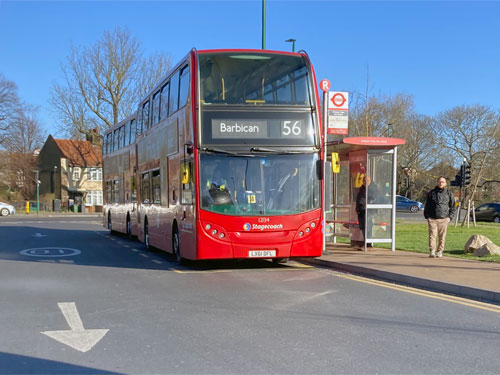
Route 56: Whipps Cross to Barbican Location: London northeast, inner Length of bus journey: 8 miles, 50 minutes
Last year I didn't ride my birthday bus route, I only walked it.
I have now ridden it end to end, because I thought I ought to before I'm 57.
It was much as I described before, but a lot faster.
You didn't miss much...
• I managed to get a top front seat (because the heavily-tattooed bloke who looked like he might take it decided to sit at the back)
• A small dog boarded near Bakers Arms (but with its owner, so nothing anecdoteworthy)
• On Lea Bridge Road the man in the other front seat spotted his friend on the pavement and they waved and ran over to board the bus, and my neighbour kept craning round to see if they were coming up the stairs but in fact they'd decided not to get on, and I knew this because I was sitting on the left-hand side but they couldn't see anything and only understood when their friend rang up and explained (and that's my best story from the trip and narrativewise it's really dull, sorry)
• The iBus display wasn't working (so you couldn't see what the next stop was, only hear it)
• The Lea Valley Ice Centre is currently a freshly-rebuilt shell open to the elements (this time last year it hadn't been demolished)
• The cycle-lane-less stretch of Lea Bridge Road (which I moaned about in my 48 and 55 write-ups) is finally getting a bypass (currently half-tarmacked, half not) through the adjacent park
• At Clapton Pond a man smelling of mothballs sat behind me (and stayed on until the end)
• The exclusive bit of road served only by route 56 took just 3 minutes to traverse (but did gain us 3 passengers)
• Beyond Dalston Junction interest in catching the bus dwindled somewhat (because a number 30 was hoovering up the passengers)
• On Essex Road I spotted a man in a supermarket casually dropping 3 lemons into his bag (on reflection I decided this was a supermarket that offered its customers shopping bags rather than shopping baskets, thereby negating any interest in the anecdote)
• Traffic was quite light (we sailed round the Angel gyratory into the duller backstreets of Islington)
• Frustratingly the bus terminated before its usual destination at St Barts Hospital, dumping us three stops short with my narrative incomplete ("From 12:00 Monday 28 February to 23:59 Sunday 13 March, route 56 is starting and terminating at Barbican, Museum of London due to electrical works")
• By rights I should have walked the last bit (but I did that last March so I decided not to do it again)
Hopefully next week's trip to Kingston will prove at least marginally more incident-packed.
It's come to my attention that when my Lizzie project finally opens, some of the rest of the network will need its signage updating. See to it, would you?
All the line diagrams in all the tube carriages are going to need refreshing with little rectangular stickers showing interchanges with our newest line. I fear there are an awful lot of them. It's such a pain.
The Bakerloo line only interchanges at Paddington but we're still going to have to update every diagram. Previously we've done this with tacky little stickers but maybe this time we need to go the whole hog and print brand new strips for every carriage.
The Northern line's easy, it only interchanges at Tottenham Court Road and Moorgate, and you've got to update all the diagrams anyway when the Bank branch reopens.
The Hammersmith & City/Circle diagrams are more of a pain because there are six (SIX!) stations to amend. Maybe we should leave off Barbican and Moorgate because we don't want to encourage people to change trains there? I'm sure you're onto this but I just wanted to be sure.
Let's leave the Piccadilly line until later. It only interchanges at Heathrow and that's still going to be branded TfL Rail for several months (plus we're probably going to have to add a 'Special fares apply' label before the year's out).
The Jubilee line's a pain because Bond Street isn't going to open at the same time as Canary Wharf. Could you do your usual trick with a special sticker which you peel off later? Also has anyone measured how many metres it is from the existing Canary Wharf station to the new one?
I don't even want to think about how many times the Central line is going to need purple extras. I think a completely new line diagram is the only option here.
Actually I see we've been quite cunning in that the Victoria and Waterloo & City lines don't overlap with Crossrail at all. Originally I saw this as a strategic error but now I see it as impressive economic foresight which should save us several thousands in signage outlay.
Then there's the potentially really expensive change which is to update the enamel signs on station platforms. Hundreds of these are going to become incorrect overnight and quite frankly it gives me the financial willies. Again we could just use stickers like we did with TfL Rail, but the Elizabeth line is a premium brand and we don't want something a child could scratch off with their fingernails.
I'm not sure how much advance notice our usual company needs to produce new panels, but that's only going to be an issue if Crossrail somehow opens this month and what are the chances of that?
Actually I wonder if you're already on top of this? I was out on the DLR at Island Gardens and I see you've already installed a new enamel panel there even though the new line isn't open yet!?!
Also we need to have words about what you've written. As our Design Idiom suggests, the brand is "Elizabeth line", never just "Elizabeth" by itself, but look at what you've gone and done! I nearly had palpitations when I saw the single word "Elizabeth" beside Canary Wharf and not the full phrase.
I guess it's possible this abbreviation was decided at a meeting I wasn't invited to, and that the brand will always appear as "Elizabeth" on signage going forward. I simply want to express my discomfort at this pragmatic and sensible choice which is absolutely not what we agreed.
But have you jumped the gun by relabelling Stratford in purple too? I understood that during the initial phase Stratford will continue to be served only by TfL Rail services (which should still be blue) so there's going to be an awkward overlap when Canary Wharf is genuine Lizzie and Stratford isn't.
I'm also having nightmares about Paddington and Liverpool Street if for the first few months these stations are going to be served by both Elizabeth line AND TfL Rail services. What do we do, show both, or leap ahead to the end state and install a pristine new panel just the once?
My apologies, I really hadn't stopped to think how complicated, anomalous and expensive this might be. I'll leave the problem in your capable hands.
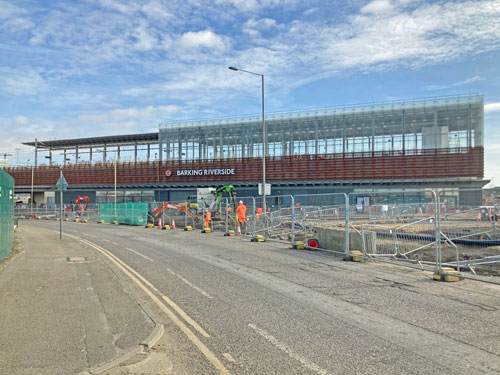
When freedom allows I like to go for a walk along my favourite footpath, Footpath 47. It's in Barking Riverside, a development area so badly named they've had to put up signs to tell residents where the Thames is, otherwise they'd never find it.
The footpath starts near a defunct power station behind a tranche of new homes. Outer London's most frequent bus service stops immediately alongside. As yet you can't get here by train although they're working on that and the Overground should arrive before the end of the year.
The viaduct's in place, its signalling is being tested and the station is fundamentally complete, having reached the "tweaking the electrics on the platforms" stage. Outside remains a bit of a warzone, however, and is not yet a bold civic focus offering freshly-brewed coffee.
Footpath 47 has led a charmed life, given it skirts an enormous building site and goes nowhere useful. The entrance tends to shift every time I visit depending on how works are proceeding, and is currently signposted off Fielders Crescent via a dirt track past a bemused security guard.
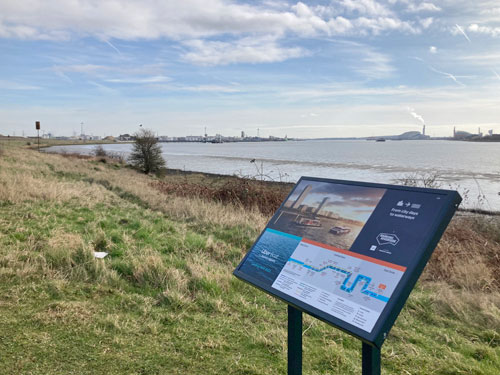
I love how abruptly the footpath hits the sweep of the Thames, offering fine views of industrial estuaryside and the Belvedere incinerator. Thames Clippers have erected a sign on the bank confirming they intend to serve this godforsaken spot by the end of the year, despite nobody yet living anywhere near.
Try not to look at the artist's impression of the pier which shows a wall of identikit residential blocks stretched along the riverfront, because nobody's started to build any of those yet. Instead focus on the real life tussocky strip between the tideline and the security fence which continues to support an abundance of wildlife.
What's special about this arc of riverfront is that it's entirely undefended - the grass slopes directly down to the water's edge. In reality this is brownfield abandoned after a power station was decommissioned, but I prefer to ignore that and pretend I'm walking along a remote bit of proper estuary.
You might see a boat go by or meet an ornithologist in the know, but most days expect to have this entire one mile strip to yourself. It's this certainty of solitude that draws me back to Footpath 47 and its unique open panorama, at least until Bellway transform it into a sanitised wetland strip with timber boardwalks and a 'coastal garden'.
The path is eventually forced to turn inland by a lagoon where the Gores Brook empties into the Thames. Take a last look downstream at the glories of Crossness, then follow the line of teasels as it hugs the security fence above the reeds. It's the only nature reserve I know where all the bushes sport scraps of flapping plastic.
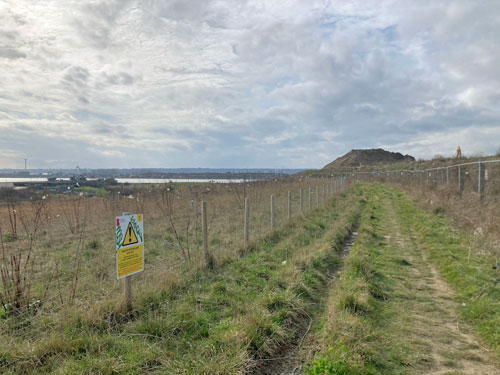
A brief climb passes the foot of a mound of rubble which even now a yellow digger is attempting to make habitable. Ten years ago you could have wandered off the track to hunt for butterflies, or ridden a noisy scrambler bike across the mounds, but health & safety now restricts access to a single track.
The path ends by squeezing through a narrow gap in a spike-topped fence and emerging onto Choats Road. A graffitied sign depicts some of the birds you might have seen and lists emergency procedures should anyone become trapped in mud. A trip to Footpath 47 is never without an element of mild peril.
Everytime I return to this unique mile I rejoice that it's still here and the wall of ten thousand new homes hasn't yet reached the water's edge. They remain reassuringly far off at present and the natural environment survives, but one day all this'll be gone. You have time to wait for the train, but I recommend a memorable safari by bus instead.
Tue 1: I tried watching BBC3's launch night, as I did 19 years ago, but this time I didn't make it past the first hour. Wed 2: They let me into Tate Modern without a timed ticket (because Wednesday mornings are quiet) but still insisted I picked one up from the information desk, despite the fact I'd already passed the only point at which tickets were checked. It was good to see some fresh art on the walls (and also much of the same old). Thu 3: I'm quite excited that interest rates have doubled because my additional savings income might almost be enough to pay for a day's heating. Fri 4: I always like to watch an Olympic opening ceremony for the sense of global togetherness, but I'm not convinced that one was worth hurrying home for. Sat 5: It's retirement day for one of my longstanding pairs of jeans which has passed from "slight hole" to "nobody'll spot that" to "I'd better never wear these outside the house again". Sun 6: I've lived for 81% of the Queen's reign, and she's ruled for 73% of her life. Mon 7: When you're walking through the Woolwich Foot Tunnel and nobody else is around, the last thing you want to see accelerating towards you is a moped. I suspect a restaurant needs to restrict its delivery zone to one side of the river.
Tue 8: After lightening the shade of the blog's template on Sunday, and nobody noticing, today I switched it back (for jarring legacy reasons) and again nobody said they noticed. Wed 9: I took three monthsworth of recycling out onto the pavement (in three bags). We Bow Road residents have to do this at very specific times, and I always worry the bags'll be ignored or thrown in with general rubbish and all my green efforts will have been wasted. Thankfully they were gone by the time I got back from the shops so my conscience rests easy. Thu 10: I thought I was expecting a visitor so I tidied up a bit and made sure I had the right biscuits this time. But they never came, indeed they were probably never intending to, which does at least mean I get to eat the entire pack. Fri 11: My phone rang and it was BestMate on Highway 101 in California wanting some up-to-date travel advice, so I checked my go-to sources and we came to the conclusion his satnav had an aversion to bridges. Sat 12: That doesn't happen very often any more. It made me feel ten years younger (and wish I was). Sun 13: I spotted some on-trend youth performing for a camera on a street corner in Fish Island, watched by a rapt and adoring posse, and were I more on-trend myself I might have some idea which channel the video'll appear on.
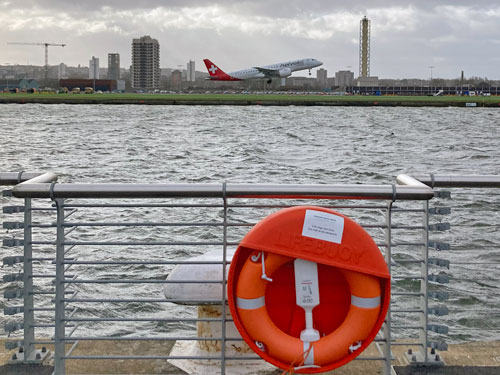
Mon 14: In sad news, Jess the missing black and white Albert Square cat won't be coming home. At least her microchip provided some closure. Tue 15: Exactly ten years ago I appealed for a proof reader to check what I'd written, first thing every morning, so I could update any glaring grammatical or spelling errors on the blog before breakfast. One of you kindly emailed in and, ten years later, is still performing this invaluable task on a daily basis. I sent copious anniversary thanks by email - the embarrassment you've saved me from! - and today want to reiterate those thanks in public. In a Schrodinger-style twist, I only discover what her cat's been doing on days when I make an error. Wed 16: I realised the library probably wouldn't allow me to renew Richard Osman's first whodunnit so I hurried up and finished it. It was more complex than I was expecting, and I think more satisfying, and nicely topped off with humorous observations. Thu 17: Ever since it was announced that face coverings would be mandatory I wondered how many days it would take for a public body to offer me a free one, and the answer was 583. My thanks to the Tower Hamlets team unloading stock on the street in Bethnal Green. Fri 18: Went out for a walk after Eunice had blown through and the debris was mostly broken branches (although later I'd discover half a dozen trees in Victoria Park weren't so fortunate, and many of the back fences in Beckton couldn't withstand the storm either). Sat 19: In my letterbox this morning is yet another plea from English Heritage hoping I'll renew the membership I took out for a single year in 2018, and now I worry how much of my annual subscription was blown on postage sending other people reminders. Sun 20: Thanks Dad! Mon 21: Watching a succession of planes taking off from City Airport's runway still gives me a thrill, partly from the sheer physical implausibility of massive objects leaving the ground, but mainly from knowing I don't live next to it.
Tue 22: While I was asleep BT switched off my landline and transferred me to Digital Voice. In the morning I unplugged my phone from the wall and into my Smart Hub, as directed, and hey presto my first digital phone caller rang in the evening. Unfortunately they rang at quarter past 10 and wanted to discuss deep philosophical matters so I totally missed celebrating 22.22 on 22.2.22, and that opportunity will never arise again. Wed 23: My new Santander debit card arrived in the post, and after always being Visa suddenly this year it's Mastercard with a completely different number and it just feels dirty. Thu 24: After two years of Covid restrictions it was great to get three hours of relative normality before Vladimir Putin kickstarted war in Europe. Fri 25: I've managed to extend my Wordle winning streak to 60. I'm also playing the 6-letter version, the 10-letter version, the ×2, ×4, ×8 and ×16 versions, the choral version, the arithmetical version, the world geography version and the local government authority version. Sat 26: I'd forgotten how muddy Epping Forest can be in the winter, even on its tamer fringes. I apologise for looking a bit splattered on the bus afterwards. Sun 27: The sad news has broken that TfL has failed to find a new sponsor for the Dangleway. Apparently absolutely nobody applied, perhaps put off by the £1m pricetag or perhaps because it's a white elephant project past its prime. Unless a potential suitor can be found, expect the Dangleway to be unbranded from the end of June. Mon 28: In numberplate-counting news, I once again tried spotting all the age identifiers in reverse order (from 2021 back to 1963). I started in October with '71', sped back to prefix 'A' (1983) within a fortnight, spent over a month stuck on suffix 'G' (1969) and finally finished yesterday with suffix 'A', one day before the new '22' plates would have invalidated my sequence.

Enfield quiz
All the prices a tube fare can be (with examples)