After a brief respite in outer London, my next B Road takes us straight back to Tower Hamlets. It links Stepney to the Bow Roundabout, which also makes it the closest any B Road has yet come to my house. That means this is really familiar territory, for me if not necessarily for you, so forgive me if I focus a bit more on some of the associated minutiae.
The B140 starts at a double mini-roundabout halfway down the B121 in the historic heart of Stepney, not that it looks at all ancient today. The youth centre on one side is barely ten years old whereas the green bulk of Stepney Green Mathematics and Computing College was squeezed out of the last dregs of New Labour's BSF budget, before which it had a vaguely normal name. I can't decide if the young adult I see exiting reception for a smoke is a member of staff or just a beardy sixth former. A few yards down is the first of ten zebra crossings on the B140, with the next three due long before we reach the canal.
We're following Ben Jonson Road, a street named after the playwright who wasn't quite Shakespeare, and here comes central Stepney's main parade of shops. One side looks very dated, inserted beneath postwar council flats, the other very much of this century behind a sheen of maroon brick. On the older side the window display at Veekay Images still invites you to bring in your home videos for transference to DVD, while the Around A Pound shop has just had a job lot of generic kitchen roll delivered which is blocking half the pavement. The new side has much more of a tax adviser/accountant/estate agent vibe, so much less shopping goes on over there.
Behind the bus stop a 200 year-old boundary stone has been given prominence, even though it's now in completely the wrong position, and some wildly optimistic benches have recently been added at an over-jaunty angle. The oldest shop here is probably Johnny Walls Bakery, a red-fronted throwback from an era when locals wanted "takeaway teas", pastries and sausage rolls. Today its front window display is all bread rolls and empty shelves, and the interior anything but enticing, but a dedicated clientele still appreciates its limited lunchtime options. For contrast I watch Lalbagh Halal Food Store getting its meat delivered, which involves three carcasses being piled into a shopping trolley and then pushed to the front door by holding onto a calf's legs rather than the handle.
The health centre on the corner of Harford Street was built on the site of Stepney Gasworks, as were several acres of flats behind. Some of the gasworks wall survives immediately before the canal, which'd be the Regents, which is where E1 becomes E3. Before we cross the waterway it's a good time to turn round and see the Gherkin lined up perfectly at the end of the road, its silhouette still perfectly visible from this angle (even if all the sky behind has been skyscrapered out). What you can't easily see is the Ragged SchoolMuseum looming over the towpath because it's sheathed under a serious amount of sheeting while the Lottery does it up.
The road now arcs through Mile End Park or, as it used to be known pre-extension, King George’s Field. The George in question was the Fifth, in whose honour many playing fields were opened nationwide, and it says a lot about the speed of the process that this one opened three monarchs later in 1952. For a sylvan moment we pass between football pitches and canalside greensward, then plunge under a railway viaduct where scrap metal, welding and rubber tyres break the spell somewhat. If I had a backyard selling BBQ chicken I probably wouldn't brand it Cabby's Jerk. The only takers at the Skate Park this morning look like they haven't been teenagers for years, but still launch off the top of the ramp with the aplomb of a beginner.
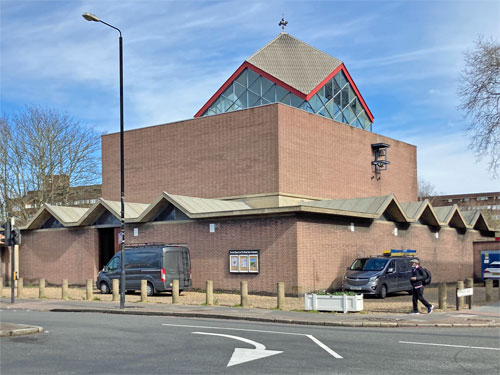
The bold New Brutalist building on the corner with Burdett Road is St Paul's, which some say is "the most significant parish church to be built in Britain in the latter half of the twentieth century". It's Grade II* listed, which isn't bad for a 1950s construction, and comprises two concentric brick boxes topped by an octagonal glass lantern, plus a rippled concrete porch. Normally it's an Open House treat but they've got the builders in at present so the main doors are wide open revealing a) the central altar b) scaffolding towers c) last week's hymn numbers. St Paul's Way is resolutely postwar all the way down, and mostly post-postwar, and even now unfinished. I see the coffee shop at the Community Centre has been refranchised yet again and goes by the name of Bow Brew, at least for now. If you're still counting, there've been four more zebra crossings.
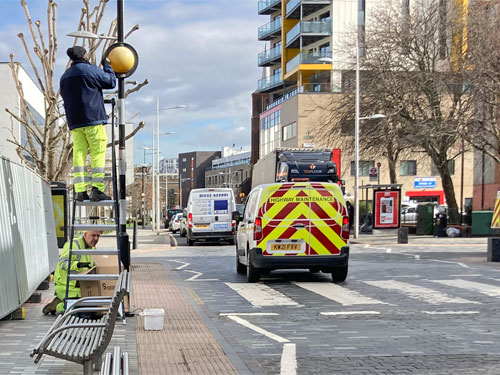
One of the belisha beacons is being tweaked by two workmen, one on his knees and the other up a stepladder with a screwdriver. I watch aghast as he unscrews half of the orange ball and drops it into a cardboard box, revealing that the globe is in fact two hemispheres bolted together... for this is how the LED version works. That's an illusion entirely shattered. I've not yet walked a mile but the chunky white building on the left is my second massive BSF school and the multi-coloured stack on the right my second mega-medical centre. The Church of the Holy Name and Our Lady of the Sacred Heart could probably do with a shorter name, and holds masses in Vietnamese on thứ hai, thứ ba and thứ bảy. For those who like to know which bus routes we're following it's been the 309 until now, was also the 339 for the first three paragraphs and will be the 323 for the next three.
Until the mid 1800s this whole area was Bow Common, a name which survived even after the whole lot was swallowed by housing, and the sweet rural track ahead was originally Bromley Lane. It's now Devons Road and almost entirely flats... and boasts one of the least enticing Nisa supermarkets you will never enter. Alcoholics should note that the Earl of Devon stopped serving pints in the 1980s, while The Angel of Bow dispenses craft beers, 'lovely food' and Maldon oysters so might be too up itself for E3. Much more target audience is fried food outlet The Munch Plug (seriously, what were they thinking?) with its menu of buffalo wings, naga doners and wagyu burgers.
It's taken nine paragraphs but we have finally reached the first house on the B140, assuming it counts because it's no longer All Hallows Rectory. These days the church engages with the community by means of its Ahaba cafe, where Drink of the Week is a Green Smoothie comprising avo, apple, broccoli and spinach. The interior of Davis For Tyres looks seriously flammable. The Fish Bar, which is sandwiched between two betting shops, has long since transitioned to kebabs. Tower Hamlets council really don't want any pesky pedestrians nipping across their double mini-roundabout so have surrounded it with sturdy metal barriers. And yes, that's the hot cross bunpub just over there...
The Widow's Son remembers a sailor in the Napoleonic Wars who told his mother he'd be home for Easter so she saved a hot cross bun for him but never he returned, and the pub on the site of her cottage has hung a bun above the bar every Good Friday since. Expect to hear that story in full across all local media in a fortnight's time. The old pub's recently been surrounded by a major housing development and has daytime competition from two unmemorable coffee shops. This is the point where Devons Road DLR station intrudes, outside which is that pelican crossing where TfL have been trialling pedestrian priority. After I blogged last month about how it wasn't working I received an anonymous comment from 'your friendly neighbourhood traffic engineer' saying "You may want to check these lights again and see if they're working correctly now", and indeed the whole beeping trial has been switched off.
The B140 now does something bloody stupid, it turns left. It ought to follow Devas Street straight ahead to a bespoke junction with the A12, like all the traffic does, but that link didn't exist at time of classification so the B Road remains on its original alignment (n.b. in fact it ran just to the left of Prospect Park along a road that's since been cul-de-sac-ed, and sorry I realise I'm speaking to a very local audience here). Devons Road drops noticeably to duck under the District line and then enters the world of Poplar HARCA, my local housing collective. It should then continue up Stroudley Walk to Bow Road, like it used to, but can't because that was pedestrianised many years ago and seriously, why don't B Road classifications ever get updated?
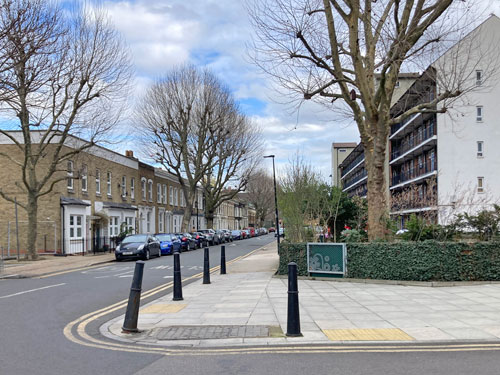
Instead the B140 turns right onto properly minor Bruce Road, there being no other way through, then left onto St Leonards Street. Along the way are today's first proper houses that aren't flats (Jessies Cottage is dated 1865, Isaiah Cottage 1866 and Priscilla Cottage 1867), a blue plaque to Mahatma Gandhi, a Health Centre opened by Cherie Booth, the site of a Jacobean royal hunting lodge, a demolished church's memorialgateway and all sorts of places I've blogged to death over the last 20 years because I live just around the corner. To add insult to injury the last ten metres of the B140 are one-way so you can only exit onto the A12, not enter from it, so all this going round the houses has been semi-pointless. I doubt that 'your friendly neighbourhood traffic engineer' can fix this but someone should, assuming B Roads are supposed to have any coherent function whatsoever.
Update: Maybe they have. The National Street Gazetteer shows Devas Street as a B Road, suggesting the final link now goes straight on, although the underlying Ordnance Survey map still shows the B140 wiggling through the backstreets of Bromley-by-Bow.
With my fresh Travelcard I have continued to visit London boroughs I haven't been to for ages, indeed in the last three weeks I've now visited all 33. Here are some more photos from the great unvisited.
Hounslow: unvisited for 160 days
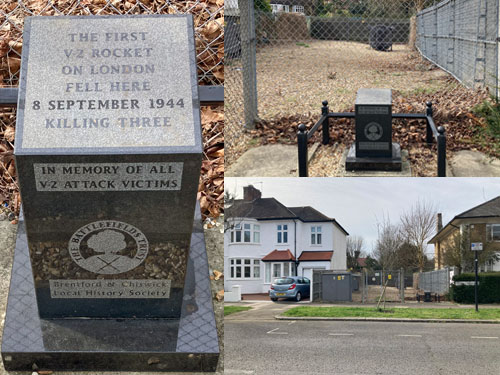
The first V1 bomb to hit London during WW2 randomly hit a railway bridge in Mile End, whereas the first V2 hit a street in Chiswick. The V2 was a fearsome weapon, the world's first long-range guided ballistic missile and the height of a four storey building. It was also supersonic so unlike the V1 made no warning noise before it landed, and the first to arrive would have been the most unexpected of all. This landed in Staveley Road on the Chiswick Park Estate, a quiet suburban avenue tucked between Chiswick station and Chiswick House, and left a crater 30 feet wide and 8 feet deep. Such was the force of the blast that eleven houses were destroyed and a dozen more seriously damaged, making it abundantly clear that something dangerously new had just arrived. It was twenty to seven on the evening of Friday 8th September 1944, and the rocket had been fired from the Dutch coast just five minutes earlier.
Three people died, including three-year-old Rosemary Clarke who was asleep in a cot in her front bedroom, and nextdoor 68-year-old Ada Harrison who ran three local sweet shops. The final fatality was army engineer Bernard Browning who was on leave at the time and walking to the station to see his girlfriend... wrong time, wrong place. It took 60 years for a memorial to be placed at the site, or rather squeezed into a gap beside an adjacent electricity sub-station because the actual landing spot was in the middle of the road. The site now also has an extremely detailed information board, from which it's possible to transcribe all sorts of useful details in lieu of independent research. All the houses were rebuilt and the road today is a quintessential middle class backwater lined with cherry trees, and my word the magnolia are resplendent, and only a block of granite reminds us that sometimes the horror of war lands in suburbia with no warning.
Hammersmith & Fulham: unvisited for 160 days All Saints Fulham is an ancient church beside the northern approach to Putney Bridge. You may know it as that church whose lightning conductor impaled that actor who played Doctor Who in that seminal horror film The Omen, but I know it best as the church where I was a page boy. It was a Saturday in 1968 and I'd been dressed up in what the happy couple thought was a smart red uniform, but I remember being less convinced. I got to process up the aisle with a bridesmaid I didn't know and then had to stand there throughout the ceremony, except nobody had told me how important it was to stay put. So when I decided I needed a wee so I merrily abandoned my post and trotted back to where my parents were sitting, and my Dad suddenly found himself lumbered with taking me outside. My black trousers hadn't been tailored for convenience so relief was by no means straight-forward, and then I trotted back in as if nothing untoward had happened. Never trust a three year-old to stand still.
This week I saw the church was open so went back inside and revisited the scene of my urinary disgrace. It's a very fine building, if a bit too Gothic to be the original, but quite the backdrop for a wedding all the same. It must also be very expensive to maintain because dozens of notices pleading for donations have been placed around the building, as well as terminals where you can tap a debit card to pay £2, £5 or £10. I walked up the aisle again and stood at the foot of the chancel steps where I once had before, if a lot lower down, then walked back out and tried to spot where I must have relieved myself. The yew avenue would have been a dead cert so long as the trees were as thick then as they are now, otherwise there was this one particular shady tomb, or else god forbid the side of the building. At least my bladder control is better now than it was then.
Barnet: unvisited for 730 days (i.e. exactly two years)
In a bonanza year for London station openings, Brent Cross West should be another. It'll be an intermediate Thameslink stop between Cricklewood and Hendon, and not so very far from the start of the M1 at Staples Corner. Previously there wasn't much call for a station here because the surrounding area was all industrial estate, but Barnet council spotted an opportunity and now everything to the east of the railway has been demolished to provide over 6000 homes. Last time I walked through it was all mothballed sheds, but today it's a massive expanse of earth ringed by yellow hoardings that's being moulded by a fleet of diggers, dumpers and cranes. What's coming are dense stacks of flats with all the charisma of Colindale, and what's open is a small visitor centre with a cafe for making expressions of interest.
The best view is currently from the unredeveloped side, concealed round the back of Decathlon in the horriblest bit of the Edgware Road. The station's still very much a skeleton, with an incomplete footbridge and as yet no way down let alone a welcoming piazza out front. It's nowhere you'd want to hang around, nor did it look like somewhere you could catch a train from in nine months' time, but let's wait and see. The station's much harder to see on the other side where a fenced-off footpath weaves through a building site into the face of full-on construction traffic, but all still at some considerable distance. I can see why they've located the sales office as far away from here as possible bookended by some 1930s semis. Latest drone view here.
Croydon: unvisited for 746 days (i.e. two years and two weeks)
Every time I go back to the Whitgift Centre some more shops have closed, and after a two year gap the difference is really noticeable. It's by no means dead and several big hitters remain, but elsewhere units are sheltering temporary art projects or more likely empty and footfall has definitely decreased. The future of the 60s mall has been in question ever since long-term potential partners Westfield pulled out, and given the council's financial tribulations I doubt anyone else'll be coming on board any time soon. Alas Waterstones didn't have the book I wanted.
Merton: unvisited for 746 days
It turns out you can walk from Mitcham to Mitcham Junction round the backs of gardens beside the tram tracks, pretty much, and I do not recommend it.
Sutton: unvisited for 746 days
I also went to Sutton but I forgot to take a photo. Still, that's the full set.
It's two years today since Britain started toppling into pandemic abnormality. When the day started things were still the strange side of normal, or the normal side of strange, but by the end of the day we'd all been advised to work from home and not go to restaurants and make only essential journeys, and the financial markets were tumbling and there was talk of those with underlying conditions isolating for 12 weeks and toilet roll was hard to come by, and I'm not saying society just tipped over in one day but in the morning I went to the library and took a train to Neasden and by the evening I knew I wouldn't be doing either for a while, and it wasn't proper lockdown yet because it was still legal to go to Cheltenham or sit in a pub, but this was where the unthinkable kicked in and I was having trouble sleeping and ffs where was all this heading?
We're well past that now, not the virus but the terrible bit, so by now we should be back into some kind of normality and I guess we are but it doesn't feel like it, society isn't back to where it was, a lot of things have shut and prices are shooting up at an alarming rate and there's always climate change and suddenly a big war's come out of leftfield and horrific things are happening and meanwhile a nasty virus that didn't previously exist is still waiting out there to take you down for a week, or worse, and none of it's good.
Inflation's not been this high since 1992 and that's a generation ago, expect it to eat away at your earnings and your savings and ultimately your lifestyle, and rising interest rates sometimes help balance things out but the interest rate on my bank account is still 0.01% and that's not even a Creme Egg a month, and we're all getting poorer and it can only get worse, the price of food and goods and services is climbing inexorably and especially petrol, blimey how much is a full tank now, and even if you don't have a car it's going to bite you when the increases are applied to transporting food and other goods, I can see the prices tick up every time I go to the supermarket, all the cheese went up last week and we still have to eat.
I got my letter from British Gas yesterday telling me how much my bill is going up and I knew it would be terrible but sheesh, the headline figure may say that the energy cap is increasing by 54% but my unit rate is going up from 4.4p per kWh to 7.9p per kWH and that's 80% and what the hell, and that's only for half a year the annual increase is going to be astronomical, and I see my standing charge is only going up by 4% and maybe that's how they balance things out to make 54% but my god, the very idea that turning the heating on is going to cost 80% more next month is the stuff of financial nightmares, so it's just as well it's April and I won't need to, but next winter... well, best stock up on jumpers.
We've just had well over a year when you knew what the top story on the news was going to be, it was going to be Covid, and everything else was crammed into a quick run-through at the end, indeed it was often like that previously with Brexit which was four years of tediously fractious bickering and no sooner had we got that out of the way than the virus came along and that dragged on for ages and when we did finally withdraw all legal restrictions there were only three hours (three hours!) before Putin invaded Ukraine and that's been dominant ever since, it's just all bad news all the way relentlessly like the world's in a downward spiral and where will it all end?
The war in Ukraine is monumentally depressing, a month ago it was just 'exercises' and "we're not invading honest" and then this jumped-up megalomaniac rolled his troops over the border and claimed he was doing the local population a favour as he started bombing them, and the dreams of a nation were put on hold as they ran for their lives or hid in cellars or knuckled down and fought back, and if they live in the wrong place their city can be seized and their power turned off or their home destroyed, and maybe Putin knows it's wrong but he also knows he can get away with it because the West won't dare stop him for fear of spreading the conflict to neighbouring countries or even wider, nobody knows what he might do, and it's been a long time since the world felt as dangerously volatile as this.
When I was in Croxley last week I found myself walking past a friend's house where in 1979 I remember being really frightened the world was going to end, we'd been invited round for drinks or dinner or something and it was all lovely and I remember we listened to Out Of The Blue by ELO all the way through, but all the time I was sitting on their sofa thinking "what if they drop the bomb right now?" and looking out of the window and listening out for telltale noises because I'd just got a book out of the school library about nuclear warfare so was suddenly petrified someone might push the button, and we lived within three miles of RAF Northwood so if it ever happened we were as good as dead, indeed I'd worked out I was basically human collateral, and it's OK this adolescent phase didn't last long and I soon came to terms with existential risk and eventually the Cold War thawed, but that spectre is somehow looming over us again and me being back where I'd had nuclear nightmares brought it all flooding back.
I'm not nervous right now because the threat of atomic weapons is just deluded bluster, indeed the war in Ukraine is most likely destined only to be intractably appalling, but one misconstrued tactical decision is all it'd take to nudge us towards unwise escalation or global conflict, even Armageddon, and it's not a likely outcome but the very fact the unthinkable is thinkable again is unnerving enough, not that I have any control over it, and once again I find myself living somewhere that'd be vaporised in the first few seconds, and obviously it won't happen but I know there's this slim alternative timeline where it might should the steamroller of events dictate.
Even the best-case scenario for the future looks bleak as prices soar and refugees flee and sea levels rise and governments continue to make self-serving decisions eroding our lives and the pandemic hasn't gone away either, and all we can do is battle on knowing it's not as bad as it could be and there's always joy in the everyday and we have to grasp the here and now and it might never happen, indeed I wish I could have told me back in 1979 not to worry because there is a future and it all gets better and the world has years of dazzling brilliance ahead of it, and that's also what me in 2022 needs to hear right now, best just knuckle down and trust we aren't suddenly toppling into calamitous abnormality again, or even forever.
With only sixty-odd days to go until Crossrail opens, we can but peer in and see what we're missing.
Liverpool Street
This is the entrance from Liverpool Street - not the station but the actual street. It's what you'll see if you wander over to the glass wedge that's been there for a while and was finally unboxed last year. Just beyond the grille is the first set of escalators whirring down into the depths, watched over by a City of London coat of arms and some words saying how pleased they were to part-fund the station. Occasionally a member of purple staff turns up because this is a jolly useful back entrance, and another member of purple staff tugs open the gate and in they go and the escalator briefly wakes from its low-energy setting. Crossrail's now so late that the office block alongside where they had their offices has been almost entirely dismantled (and will be reborn as fresh offices four storeys higher).
This is the entrance from within the existing Underground station. It bears off from the top of the Central line escalators through a line of solid metal doors with tiny windows that gives the whole thing the look of an airlock. The passageway beyond is white and featureless, because Crossrail's art project doesn't stretch this far, and very broad because it's going to see a lot of footfall. It also slopes down at a minimal gradient, but just enough for health and safety to have required superfluous handrails to be fitted to either side. The top of a key set of escalators is visible through another metal gate, because Crossrail is nothing if not topologically flexible, and off to the right is what looks like yet another passage. Londoners, we have so much to explore.
Farringdon
This is the entrance from the Thameslink side of the station. Arrive on the northbound platform and you can reach this point on the level, whereas if you come from the southbound or from the tube it's an up-and-over job before descending these escalators. They were set in motion some time back for the benefit of those aiming for Luton Airport or Stevenage, and feel vastly over-engineered for the trickle that's currently passing. It all looks damned impressive though. The roof funnels down with diagonal concrete ridges resembling the facets of a diamond, while the next set of escalators can be seen behind glass emblazoned with additional diamante artwork. Another metal gate blocks the way for now, but that hasn't stopped TfL's commercial arm from firing up the screen on the other side with a loop of adverts on which Ed Sheeran appears prominently. Don't let him scare you away.
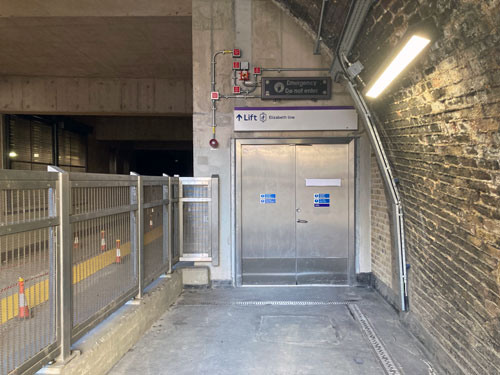
This is the entrance from Barbican tube station and it's a massive contrast. The only way in is from the far end of the westbound platform, part-hidden inside an arch where Thameslink trains once ran. The sign above the double doors just says 'Lift' because that's the sole connection, and even then only down to the purple concourse rather than up to the satellite ticket hall. It's a really half-hearted interchange, and if you ever make the mistake of getting off the back of an eastbound train will require a mega-detour down, over and all the way back. Should the tube map gain an interchange blob at Barbican once Crossrail opens, think twice before alighting here.
Tottenham Court Road
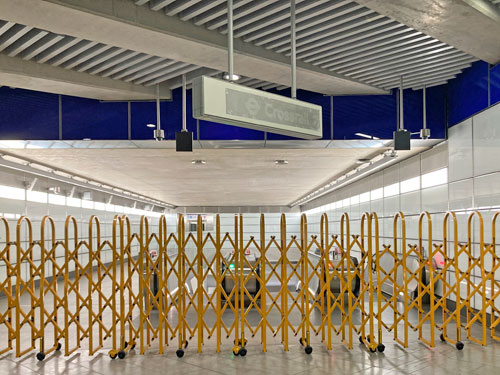
This is the entrance from the main ticket hall on the corner with Oxford Street. It's immediately adjacent to the escalators down to the Northern line and remains sealed off behind a slidy yellow barrier. The amazing thing about this entrance is that the sign pointing down still clearly says 'Crossrail' because it was installed before Boris Johnson named the line after the Queen in February 2016. It must therefore have been in situ for at least six years, way back when December 2018 was still the intended opening date, and so far we've been waiting an additional 170 weeks. I like to think TfL are trolling us with the unlit Crossrail signage and will magically replace it with something regal in nine weeks' time, but let's wait and see.
Bond Street
Haha haha ha haha ha ha ha haha ha haha haha haha ha haha ha ha haha ha haha ha haha ha haha ha ha ha haha ha haha haha haha ha haha ha ha haha ha haha haha ha haha ha ha ha haha ha haha haha haha ha haha ha ha haha ha haha haha ha haha ha ha ha haha ha haha haha haha ha haha ha ha haha ha haha haha ha haha ha ha ha haha ha haha haha haha ha haha ha ha haha ha haha haha ha haha ha ha ha haha ha haha haha haha ha haha ha ha haha ha haha haha ha haha ha ha ha haha ha haha haha haha ha haha ha ha haha ha haha haha ha haha ha ha ha haha ha haha haha haha ha haha ha ha haha ha haha ha ha ha ha no.
Paddington
This is the Eastbourne Terrace entrance alongside platform 1 (where the taxis used to wait). The mainline station's newest access point is already proving popular, not least with long distance travellers keen to pop out for a smoke. Currently you can only connect to the street because the two Crossrail portals are closed, but on Sunday they opened briefly for the last of the public Trial Operations safety exercises. Almost 2000 volunteers turned up, including some really excited eight year-olds, and got to test whether staff could cope with rush-hour level crowds on the platform. But nobody else is due to go down and ride the trains until the gates open properly in two months' time, while managers focus on assurance and software engineers make yet more critical final tweaks to signalling.
It's nine years ago today since Siemens won the contract to deliver Crossrail's communications and control systems, and mostly their fault that all we can do for now is peer in.
A couple of years ago I wrote a post asking Where are London's largest circles?
(The Inner Circle in Regent's Park, diameter 330 metres, we decided)
Today I'm trying something similar but one dimension less.
Where are London's longest straight lines?
Could be a road, could be a railway, could be a waterway, could be any surface feature that's perfectly straight. What are the longest lines you can see straight down without a minor bend or wiggle?
A little thought should suggest that London's longest straight lines are probably a) artificial b) quite flat c) quite old. A long time ago it was easy to draw a straight line across the landscape because there was nothing else there, but the amount of undeveloped space has shrunk with every passing decade making twists and curves more likely.
I got the idea for this post from the railway viaduct between London Bridge and Deptford. It's broad, straight and carves across Southwark for 3½ miles with a total disregard for what was there before. You can ride it on a train or follow the line of arches at ground level, because it's been there since 1836 and everything else has moulded around it. But if you drop a straight line onto Google Maps with one end at London Bridge and the other at Deptford it turns out the viaduct's very gently curved, or maybe three or four straight sections imperceptibly linked, so not geometrically perfect. You could allow it because it's really close, but I can only find a mile or two that definitely fits the bill.
So my apologies, this is all going to have to be annoyingly subjective.
Watling Street(Edgware Road) (the A5)10 miles
London's longest straight line was always going to be a Roman road. The Romans arrived 2000 years ago so got to build their famously straight roads wherever they liked, in this case on a beeline for St Albans. It is astonishing to think that their decision still shapes northwest London to this day. But alas Watling Street isn't quite as straight as you'd assume, only very nearly so. It contains a slight bend in Maida Vale (by the Regent's Canal), a more serious mild slalom through Kilburn (courtesy of the River Westbourne?) and a minor modern deviation at Staples Corner. The longest undeniably straight section is the 2½ miles from Kilburn High Road station to Cricklewood, which is still an impressive length... or you could take a less pedantic view and claim the full ten miles.
Watling Street(Shooters Hill Road etc) (the A207)6½ miles
London's second longest straight line is the same Roman road but on the other side of the capital. The road to Dover runs almost arrow straight from Blackheath Royal Standard to the foot of Shooters Hill, then up and over, passing through Welling and Bexley before a modern bend impinges in Crayford. Six and a half miles of straight line is an impressive length to leave across a landscape. Again there are minor issues, most notably a short curve near the Nags Head pub in Welling, but the Broadway Shopping Centre (and Bexley's pedestrianisation) has knocked it off line too, so a mathematician might only accept the 2½ miles from Woolwich Common to Welling.
Lea Valley Line(Tottenham Hale - Ponders End)4 miles
London's longest straight railway, and its longest undeniably straight line, runs up the Lea Valley to the west of the big reservoirs. In a flat valley the most efficient way to join two stations is usually a straight line, which is exactly what engineers created between Tottenham Hale and Ponders End. The straight section north of Brimsdown is much longer, but doesn't quite hit two miles before it crosses the border into Hertfordshire.
New North Main Line(Perivale - Northolt)3.6 miles
The New North Main Line runs from Old Oak Common to South Ruislip and since 1948 has been paralleled by the Central line's West Ruislip branch. It's almost straight all the way but in reality it's three straight lines, the first from North Acton to the River Brent and the third from the Yeading Brook to West Ruislip. All three sections are long but the longest is the middle one, which you'll have followed if you've ever ridden the Central line between Hanger Lane and South Ruislip. One day HS2 will follow this same alignment too (and has already severed the National Rail connection to the south).
North Kent Line(Woolwich Arsenal - Belvedere)3.5 miles
A lot of online measuring suggests to me that London's third longest straight railway line is the one that runs south of Thamesmead. Crossrail will be following half of it, but the whole thing's well over three miles.
District line(Bromley-by-Bow - East Ham)2.8 miles
I wasn't sure which straight bit of the eastern District line would be the longest but it turns out it's the Newham stretch (2.8 miles), which narrowly beats Upney to Dagenham Heathway (2.6 miles) and also Dagenham Heathway to Elm Park (2.1 miles).
The next three are also railways... South Western Main Line(Raynes Park - Berrylands)2.8 miles Great Eastern Main Line(Gidea Park - edge of London)2.5 miles Great Western Main Line(Hanwell - Southall)2.5 miles
Heathrow Runway 09L/27R 2.4 miles
Yes of course this is in the list, and it's a genuine straight line too. Heathrow's north runway stretches across an inordinate amount of former farmland and is marginally longer than its southern twin (2.3 miles). It also defines a flight path which, if I hadn't restricted myself to surface features, is arguably the longest straight line in the capital.
South Eastern Main Line(Chislehurst - Orpington)2.3 miles
Back to the railways. Although the full eight miles southeast of Hither Green looks pretty straight, only the section through Petts Wood genuinely is.
Meridian Way (A1055)2.2 miles
The first non-Roman road in the list is a 1980s link road in the Lea Valley, specifically the section between Meridian Water and Ponders End. It's no coincidence that it runs alongside the longest straight railway line in London.
Greenway (Plaistow - Beckton)2.1 miles
And yes, the Northern Outfall Sewer makes the cut. It has a few bends but the last stretch down to the sewage works in Beckton flows for just over two miles... assuming you can accept the A13 roundabout intruding midway. If not then its southern counterpart the Ridgeway manages exactly two miles... although again with the odd surface blip.
HS1/Tilbury Loop (Rainham - edge of London)2.1 miles
We've had HS2 so here's HS1, flying low across the Rainham Marshes beside the A13 viaduct. The road bends but the local and international railways are straight and just scrape over 2 miles before reaching the Greater London boundary.
If I'm being really pernickety the Lea Valley railway line wins.
If I'm being a bit more tolerant it's Watling Street instead.
My attempt at a map of the longest straight lines is here.
...at least until I'm told otherwise. If you do have any suggestions remember they have to be actually straight, not roughly straight, and also need to be at least two miles long.
My next B Road joins Finsbury Park to Wood Green and is sandwiched between the East Coast Mainline and Green Lanes. It also joins the B150 to the B151 so goodness knows why it's the B-One-Hundred-And-Thirty Something, but road classification was never an entirely rational activity. You may know it better as one leg of the Harringay Ladder, a multi-runged estate of desirable Victorian terraces, so expect this to be quite a pleasant walk.
The B138 starts beside the northern edge of Finsbury Park (the actual park, not the suburb). A couple of grand townhouses guard the entrance, a faded circle of paint acts as a mini-roundabout and the street name is written in raised rusted letters high up on the wall. The first 100 metres are Alroy Road - a different name to what follows because this strip alongside the railway was developed before everything further north. It's only long enough for a dozen houses, plus a former Hornsey council depot that now hosts MOTs and car repairs. The road then rises up alongside the East Coast Mainline and over the Goblin via a bridge officially numbered 2022, which is a splendid coincidence. From here on it's Wightman Road and this is the HarringayLadder, and trains will merely be a near neighbour.
The developers of the Harringay Park Estate prioritised housing over services, so this is one of only two shopping parades they included. A lot of units have subsequently been converted to residential, somewhat inelegantly, but you can still get a Thai takeaway, your tyres fixed or a cheap room for the night. The finest throwbacks are George's Tailors (he was plainly visible through the window hanging up shirts) and Sylvia's Hair Care (for what looked like an authentic 90s styling experience). Harringay railway station is accessed on one side via a fragile footbridge, and on the other the first rung of the Harringay Ladder runs down to Green Lanes (or rather runs up because the rungs are alternating one-way streets). It's called Umfreville Road, a name so unusual that many have assumed the streets of the ladder were named coherently, but apparently not.
I was quite taken aback by St Paul'schurch at the top of Cavendish Road. It looks like a child's building blocks, or maybe a Toblerone on a Viennetta, more precisely a grey equilateral prism balanced on a hefty brick cuboid. Until March 1984 this was a fairly standard Victorian church but then it burnt to the ground, on Ash Wednesday no less, and a decade later this bold postmodernconfection arose in its place. I couldn't take a look inside but online you can, and imagine worshipping in that.
Wightman Road was the first part of the Ladder to be built, which'd be late 1880s, and is relentlessly residential for the next three quarters of a mile. Its houses aren't quite identical but do share certain characteristics - terraced, fiddly plasterwork, a recessed porch and invariably bay-windowed. Their front gardens are just about large enough to contain a table tennis table, so long as you didn't need to walk around it, which means owning a vehicle is pretty much out of the question. And whereas some frontages are well-maintained with painted ironwork and stained glass others are tattier with overflowing bins and smashed-open meters, so gentrification hasn't fully overwhelmed the area yet.
Unlike the rest of the ladder Wightman Road's not straight, and also manages to gently rise and fall a couple of times. Partway down the last slope is the New River, here buried underground but if you follow the footpath beside number 201 it emerges soon after. The only non-house on this section is M&A Motors, another vintage garage where exhausts and paintwork are seen to, often in a shower of welded sparks. The small park between Falkland Road & Fairfax Road isn't original, it's the end result of a doodlebug strike in July 1944 (and was intermediately prefabs). It's officially dog-free and currently daff-free, and is overlooked by a bulbous blue sculpture atop a landscaped mound.
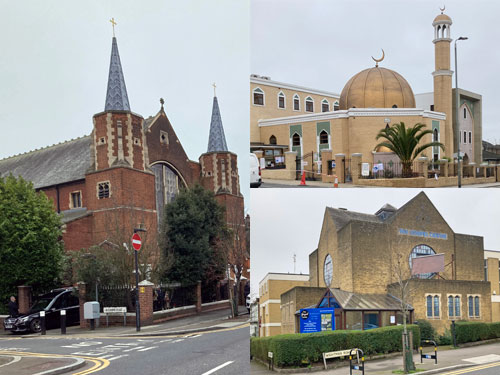
Here come the places of worship, all of which are evolutions of their original self. St John the Baptist was a derelict Anglican church when a Greek Orthodox congregation took over in the 1980s, and its interior iconography took 12 years to paint. The domed mosque is a 1990s project by the London Islamic Cultural Society and was built on the site of the Hornsey & Wood Green Synagogue. And the Gospel Centre started out as a non-denominational space but has since morphed from The Church of Christ to a Jesus-Centred Community. Only the Greek church was hosting a funeral the day I passed, the undertakers waiting patiently for the mourners to shuffle inside before the deceased could join them.
Here comes the next station up the line, which is Hornsey, and also the second of the shopping parades. It's much busier and blessed with several continental food options including a large but lowly Polish delicatessen and a small but intimate Greek bakery. You can of course also get your car fixed, because this seems to be a very B138 kind of thing, and buy all sorts of sparkly dangly things at Angelo's Lighting. His corner shop marks the point where the Harringay Park estate becomes the Hornsey Park estate and also the only place where there's a very busy road to cross, which'd be Turnpike Lane. For those who like to know which bus route we're following it's none at all, surprisingly.
From here on it's all Hornsey Park Road, a non-laddered entity. The houses here are of a similar age but less fancy, often three-storey and with no bay windows above ground level. More importantly some of the gardens are now just big enough to squeeze a hatchback into which you can bet adds a few thousand to the asking price. The inhabitant of number 36 has placed a stone wolf, a stone wizard and a stone Paddington Bear on their pebbledash, and I suspect that's taken a few thousand off instead.
These cranes are busy constructing a 12-acre "city village" called Clarendon, which sounds classy but is actually the name of the gasworks they demolished first. 1700 homes are on their way in stacked towers and are currently half-built, and I don't need to show you a photo because they look as predictable as you'd expect. The development has a smallpark with south-facing sun-loungers and heritage lampposts, and a publicity campaign focused on solvent incomers rather than local need. You don't have to go far to see what council housing used to look like because round the bend is Sky City, a large rooftop estate in angular brick perched on top of Wood Green's 1980sshoppingmall. It's quite the finale to the B138, a Victorian terrace with a looming backdrop of rotunda and pitched roofs.
Here we discover another example of how anachronistic the numbering of B Roads can be. Originally this was a T-junction where Hornsey Park Road met Mayes Road, so it made sense one was the B138 and the other the B151. But when Shopping City was built the direct link to the High Road was severed, somewhere around TK Maxx, and the T-junction became a simple right-angled bend. It means the two B Roads could both be given the same number because if you start driving down one you end up on the other, but it'll never happen because classification inertia rules. And Mayes Road is somehow of medieval origin, a country lane crossing a lost river, as you'll discover when I come back and walk the B151... assuming I ever get that far.
If niche bus content is your thing, you probably wouldn't expect online clickbait portal MyLondon to satisfy your needs. Their normal news diet tends to be victims of non-local crime, what someone said on ITV this morning and over-optimisticinterpretations of long range weather forecasts.
One day Callum will undoubtedly be promoted and MyLondon will have a vacancy for niche bus content, so I just wanted to flag my credentials in advance and prove that I can compose a clickbait headline any subeditor would be proud of.
The secret rare bus with London's highest number that serves an Essex commuter town even less often from today
It may be called Transport for London but TfL isn't ashamed to send buses into the Home Counties to serve passengers there. One such escapee is the 549, a peculiar route that runs very infrequently between London and Essex, and whose timetabled gaps have suddenly widened by 15% this morning. Admittedly it's not actually a secret bus, because that would be economically ludicrous, but the average Londoner lives nowhere near Woodford and most people in Redbridge drive anyway so will definitely never have heard of it.
The 549 became a TfL bus route in 2003 and shadows the Central Line between South Woodford and Loughton, except on Sundays. For some residents on Chigwell Road and Hillside Avenue it's the only bus, although north of Roding Valley station the sole beneficiaries are the population of Essex. Admittedly the 549 doesn't actually have the highest number of any London bus route because the 607 express to Uxbridge is bigger, as are all of the school buses, as is the 733 Northern line replacement, as is the 969 mobility bus in Richmond, but if you ignore all the special routes no bog-standard TfL service can beat the 549, so that'll do.
The northern terminus is at Loughton station near the big Sainsbury's, where anyone with any sense is going to nip on the Underground rather than wait up to an hour and a half for a bus. A not insignificant portion of the route runs through Epping Forest where passengers are highly unlikely to board, and there aren't exactly a lot of houses between the railway and the river Roding anyway. Admittedly TfL does try to serve all corners of the capital so it's only fair that those on the outer edge get a regular service, but what on earth is Buckhurst Hill in Essex doing with four London bus routes anyway?
It originally ran every 30 minutes, back when two vehicles operated the route, but in 2005 lost one of those and dropped to an hourly service. Heavy traffic made the route increasingly unreliable so since 2012 it's run every 70 minutes, i.e. at hard-to-remember times, but that hasn't quite solved the problem. So as of today the gap between buses is being increased to 90 minutes, which means longer rests for drivers and fewer journeys for passengers. Admittedly 'every 90 minutes' isn't rare by provincial standards, but only three TfL buses run less frequently so for London it's now very poor.
When the 549 started it was operated by Arriva, then later by Docklands Minibuses, then by Go-Ahead London and most recently by Stagecoach. But as of this morning it has a brand new operator, namely Sullivan Buses, which means passengers can expect to see a completely different diesel-powered vehicle pounding the streets. They've won the new contract with a timetable that winds down before 8pm each evening, whereas before it ran just after, which is yet another degradation of the service. Admittedly Sullivan are a lovely company run by caring souls, but one has to question why they're operating a bus route more than 15 miles from their depot in South Mimms.
I caught the bus and it was very much not full, indeed a minibus could have sufficed. Also one man got on expecting us to be the 167, because the 549's so infrequent he wasn't aware of it, so he asked to be let off at the very next stop. Not for nothing is the 549 one of London's ten least used bus routes. It also serves London's least used tube station and achieves an average speed of 14mph, which are precisely the kind of nerdstats a news article like this requires. Admittedly there was one elderly passenger who rode two stops on the London side of the border for whom the 549 is plainly a lifeline, but some would argue TfL shouldn't be spending our taxes on people like her.
A check of the new timetable confirms that only one journey is scheduled to take more than 30 minutes, which is the 0845 weekday departure from Loughton. Most journeys take 20-something minutes and the fastest just 18, but the new timetable is still allowing 45 minutes before drivers have to turn round and go back. This means there's now only room for nine journeys a day whereas yesterday there were twelve, and this is solely to even out the gaps in the service. Admittedly passengers tend to prefer a regular timetable to something that returns every hour and a bit, but it seems TfL are now prioritising a memorable service over one that makes best use of resources.
So that's the secret rare bus with London's highest number that serves an Essex commuter town even less often from today. You'll never use it but thank you for clicking, and do come back next time we make niche bus content sound interesting.
It's time to revisitadeadtransportlink and show you several shots I've shown you before but in a later stage of decay.
This is the bottom of Baldwins Lane in Croxley Green and that's the Metropolitan line passing overhead. Had plans for the Metropolitan line extension ever happened this would have been the place where trains veered off across a new viaduct on their way to Watford Junction. As you can see no such viaduct veers off because the project is very much dead. Local councillors like to pretend it isn't and dangle various non-tube alternatives, but none of the options add up and there's already a bus service not enough people use and there's no money and it's never going to happen. As a Croxley boy I take no joy from this, nor any pride in being the one who broke the news, but that's how it is.
This is the entrance to Croxley Green station, the pointless terminus of an anachronistic spur line. I say this as someone who grew up ten minutes walk away but we only ever took the bus. The last train ran in 1996 and since then the wooden platform's been removed, the signs taken down and the viaduct fenced off. From the roadside you can still clearly see the steps up from the Two Bridges roundabout, watched over by a peeling pair of red Network SouthEast lampposts. The fence is now a bit sturdier than it used to be so access is not an option, but if anyone was intent on trespass then Storm Eunice has brought down a tree on top of a Vauxhall Astra in the Sea Scouts' car park and gouged a convenient notch in the wire fencing behind.
This is the fabulous lattice girder bridge across the Grand Union Canal which once carried hardly any trains to Watford Junction. It survives because it was never part of the Metropolitan line extension blueprint and Herts County Council bought it instead. The big plan was to construct a 400m viaduct from the right-hand side of Photo One to the left-hand side of Photo Three, thereby linking the Underground to an arc of disused railway and correcting a 100 year-old disconnect. What shocked me on this visit was the enormous tower in the background, indeed it had been startlingly out-of-place since I spotted it on the horizon from the upper slopes of suburban Croxley. Southwest Hertfordshire just doesn't look like this... except seemingly it does now.
This is a closer view from Ascot Road, the dual carriageway access road which severed the original railway in 1996. The 24-storey monster is already the tallest building in the whole of Watford, indeed it's somehow seven floors taller than the previous incumbent, but has yet to welcome tenants. The tower block went out to consultation in the heady days of 2016 when the Metropolitan Line Extension was still a thing, and was granted planning permission in 2017 just before TfL officially cancelled everything. Cassiobridge station would have been located right here at the foot of the tower so its presence would have made some sort of sense as a gateway landmark for West Watford. Instead it'll now be packed with residents reliant on cars and looks horribly adrift, but such are the unintended casualties of cancelled transport projects.
This is what an unbuilt railway looks like. A thicket of undergrowth, cut back when extending the line was a viable prospect but since left to run wild. Last time I stood here (at the top of the ramp where Cassiobridge station ought to be) it was still easy to see through the fence and spot a cat sitting on the rails. Today those rails are almost completely obscured and will completely disappear once spring leaf growth begins. Everything now lies in the shadow of hundreds more flats, and hundreds more are appearing just up the line on the site of the former Watford Laundry. It wouldn't be difficult to start hacking back the branches again, should anyone ever work out why a dead end transport link needs to exist, but for now only local wildlife is seeing any benefit.
This is the view from Hagden Lane with the Laundry Works development in the near distance. The line of the railway remains very obvious, as if someone strimmed it last summer, but the embankments are already running rampant and the vegetation below the bridge is heading that way fast. When I peered over the wall in 2013, just before the extension got the green light, the trees on the line below were already wellabove head height. I fear we might be heading that way again.
This is the view from the other side of the same bridge, looking down at the ruins of Watford West station. It was never destined to be replaced under MLX proposals because these days new stations only ever benefit unbuilt houses, not existing residents. I was surprised to see that the security gate down to the platform was unlocked because it never had been before, and thus a little less surprised to see four teenagers hanging out and smoking something down on the tracks. They however were positively shocked that someone on the bridge was taking a photo and glared in my direction before one of them vaulted onto the platform and hotfooted it up the stairs. I was in full-on retreat by this point and managed to avoid an angry confrontation... but if you have ever wanted to access this urbex treasure, now might be a good time.
And this is the existing Watford station from which Metropolitan line trains still run to central London. It was due to be closed by now, even under the most pessimistic version of the timeline, with all services filtering via the extension instead. Instead those alternative tracks remain total tumbleweed and the 97 year-old Metroland terminus has won a permanent reprieve. Sometimes, alas, the sensible thing to do is throw all your dreams in the bin and leave everything alone.
Route 57: Clapham Park to Kingston Location: London southwest, outer Length of bus journey: 11 miles, 70 minutes
It's traditional around every birthday that I take a numerically significant bus journey. Fifteen years ago I took the 42 to Dulwich, then subsequently the 43 to Barnet, the 44 to Tooting, the 45 to Clapham, the 46 to Farringdon, the 47 to Bellingham, the 48 to Walthamstow, the 49 to Battersea, the 50 to Croydon, the 51 to Orpington, the 52 to Willesden, the 53 to Whitehall, the 54 to Elmers End, the 55 to Oxford Circus and most recently the 56 to Smithfield. This year it's a lengthy suburban safari, the 57 to Kingston.
My starting point is an elongated grassy roundabout on the South Circular in the backwoods between Clapham and Streatham. It's the same place where I ended my journey on the 45 so I've known this moment was coming since 2010. My double decker is older than that and has arrived fresh from the depot, early enough for the driver to pop out for a smoke. As the clock ticks down he stubs his butt, pats his phone away, climbs aboard and fires up the engine. Just me, then. I clamber up to the top front seat, because sitting any further back diminishes the narrative, and wonder whether this year's bus ride is going to be an eventful journey. Because of where I've sat, it absolutely is.
We're soon on the climb past the interwar council blocks of the Clapham Park estate, which is in completely the wrong direction based on our ultimate destination. Another passenger joins us at the next stop, plus a puffed-out mother our driver kindly waits for because TfL needs customers. At the big traffic lights we filter right onto Streatham Hill while a beggar briefly pauses from his cup-shaking shtick and walks back to the front of the queue. The main road south appears to be extraordinarily over-bused, which it turns out is because 11 different routes go this way, which may have something to do with Brixton Bus Garage being the next stop. One of these surplus routes is the 59 which means you can expect a ride to Streatham again in two years' time (and, sigh, again in three).
Streatham has one of the longest High Streets in the country but we're only going to follow half of it. Its multitude of outlets includes a Wimpy and a Greggs side by side, a beauty salon called Tracey Nails, a carpet shop that looks like it was once a cinema and an Odeon that somehow still is. Banners tied to lampposts urge residents to Shop Local and they easily could, although rarely at a big name store. We keep pulling in at bus stops where it turns out nobody wanted us, they were waiting for one of the multitude of other services. But at St Leonard's Church I spy four young girls in rainbow jackets bouncing up and down with glee on the pavement as the 57 approaches, their shrieks only growing louder as we pull in. "All aboard!" cries Mummy, "and up you go!". My narrative feature has arrived and will be with us for the next six paragraphs.
The girls bound up to the front seats which they anticipate are theirs, but are disappointed to see both are taken. The other occupant kindly stands and retreats to the rear, but I'm staying put because this is my birthday bus, plus I got here first. My comeuppance is swift as three of the girls pile into the vacated seat and Mummy tucks up beside me clutching the fourth... and then Mummy Two slots in behind. The cacophony is immediate. I Can See Everything! Down There Is My School! It's All Crazy!! The girls are particularly excited because we're heading downhill and approaching a bit of a hump across a railway line, which they treat as if it were part of a theme park ride. Amazing! Woo Hoo!! Again! Again! Again! Again! This is not how I'd envisaged my 57 ride would be.
Had I caught a different vehicle I'd be now recounting some of the delights of Mitcham Lane, like the cherry blossom, the Furzedown pub and the twin churches at the summit. Instead I'm listening to some very loud six year-olds with a need to state the obvious. Oh I See More Buses! Hello Driver! Wow I Can Even See Faraway Trees It's Amazing! Personally I would have focused on the faraway pylons, somewhere over Sutton way, but I doubt they know what one of those is yet. Just before the River Graveney we pause to turn right (cue more screeching) and set off along a backroad towards Tooting. This has been traffic calmed with pedestrian islands at regular intervals, so obviously the girls assume We're About To Crash!! and repeat this every time we squeeze through another gap. There are a lot of them.
We make it through to Amen Corner, which might have been well named if only the girls were getting off but they're not. I recognise Mitcham Road from my younger self's journey on the 44 (in good news this is the last of today's birthday repeats). The loudest girl has now discovered she can slide along the handrail as the bus negotiates a bend so Mummy tells her not to, and also to close her mouth because she's revealing her 'toothy gap'. This provokes giggles and also sets off the two parents on a lengthy chat about wobbly teeth, and I can't decide if my readers would rather be hearing about this or the Art Deco bingo club we've just passed. The girls meanwhile are judging other drivers... He's Going To Get a Fine! ...based on woefully inadequate understanding of the Highway Code.
My hopes of imminent salvation are raised at Tooting Broadway station when Mummy Two rises from her seat. Alas it's only because she's whipped out her smartphone and is asking everyone to turn round for a photo. The girls pause from screeching and tell her they don't say Cheese, they say Silly Sausages, and I suspect the subsequent image is out there on a Facebook feed somewhere. Ahead is yet another slight hill to get overexcited about, Wheeee!, but that's nothing compared to the fuss when Cuddly Monkey is pulled out of Mummy's bag. The girls all want to play with it but are firmly told to give it back to the child on Mummy's knee, who it turns out was a boy all along. In southwest London one should never assume that long flaxen hair is genderable.
Colliers Wood High Street has been given the cheap-but-effective cycle lane treatment, i.e. reflective posts at regular intervals sealing off the inside lanes. Listen I Can Count To Ten! I'm pleased to see the Charles Holden pub is still afloat, even if Graffiti Burger has gone under. Are We Taking Two Buses? Are We? The monolithic tower block by the station looks less dour now it's been reclad. Yes And Then Back Again! Thankfully we don't get to change drivers outside the bus garage, this being where the 57 stables overnight. I Know Two And Two Is Four! The Mummies have completely switched off from their offspring's conversation and are now discussing the holiday one's booked to Crete, how nice the pool sounds and which of the credit cards they've put it on.
I recognise Abbey Parade from my very first Random Borough trip, although a lot of the shops have since been converted to shabby residential. The girls remain crash-obsessed, though are somehow convinced they'll be safe from dying because they're upstairs. Another right turn swings us round towards Wimbledon Broadway past the Polka Theatre and then the YMCA. Mummy tries to get the oldest to say the name out loud ("Come on, it's like the song!) but because she's been taught phonics it comes out as Yuh Muh Sah Ah and so she's none the wiser. Then comes the moment I've been praying for as Cuddly Monkey is packed away and the girls brace to alight. "Down we go!" cries Mummy, and I listen as they scream off down the stairs and continue their hullabaloo on the pavement. Passengers on the 93 have no idea what they're in for.
It's time to negotiate the Wimbledon gyratory in relative peace. This includes a brief visit to the town's no-expense-spent bus station and a chance to enjoy the back of Morrisons. Outside Wimbledon station three boys fresh from a kickabout - let's call them Stussy, JD and Mitre - wander through the traffic and bash on the door, with no success. They decide to chance a mad dash to the next stop round the corner, and easily make it because we have three red lights to queue through. I'm nervous as they head upstairs, but relieved when they head straight for the back of the bus because they're twice as old as the previous lot. Their run now proves to have been even more unnecessary because the driver is waiting for a lady on crutches to clamber aboard. I hear swearing from the rear seat which I will not repeat, in capitals or otherwise.
Ahead is Worple Road where SW19 merges into SW20 and the council tax band nudges gently upwards. A man with a leather bag full of golf clubs boards a few stops down, as if to prove the point. Cherry blossom and tulip trees are out in full force, which isn't usually the case on my birthday bus ride. The three footballing lads bound off, but not before one of them has paused to yell "Thank you driver!", proving you should never prejudge your fellow passengers too early. A red face on a lamppost frowns at the car in front for doing 23, whereas our driver gets a smiling green face for doing 15. And hey presto here we are in Raynes Park, a definite notch above, where you can brunch at Babylon and where the former Barclays Bank is now the domain of New Life Aesthetics.
I'm making this journey on the day of the Wimbledon Half Marathon so a steady stream of athletes is jogging towards us, by the looks of them probably on their second lap. The course prefers pounding the streets to squelching across the Common, and the budget only stretches to handing out cups of water rather than bottles of energy drink, but the gritted smiles on the faces of the runners appear genuine. The 57 is the only bus to pass the end of Beverley Avenue, the actual fictional home of river goddess Beverley Brook in the Rivers of London books by Ben Aaronovitch. The stream of the same name passes her back garden, followed closely by the A3 dual carriageway... which we rise to cross and then glide back down (landing between Spar and Currie Motors).
Coombe Lane West is where the money is, an undulating road lined by large detached homes with hedge-screened gardens. Private roads lead off to either side, most of them multi-garaged, so there are no takers for our £1.65 bus ride. From behind comes half a conversation it's very hard to ignore, a phone call from a young woman wearing tight leathery leggings and what looks like yesterday's make-up. She's tells her friend "I actually got kidnapped", moans that "they're banned so why am I not banned" and has to break off because "Nicki's Whatsapping me". She must be all of 19, so when she launches a reminiscence from "back in the day when we was young" I suddenly feel very old. Three times as old, in fact, but let's not go there.
Only single deckers are allowed under the low bridge by Norbiton station so instead we turn right to serve the local hospital, which to be fair is what TfL services prefer to do anyway. It's a lot safer to approach the town centre via Kingston Hill, which is a steady descent past banks of flats new and not so new. I bet no pub earlier en route would have dared paint a Virginia Woolf quote across its front wall. The grounds of Tiffin School contain a 14th century freestanding chapel and, immediately alongside, a rotunda extension resembling a car showroom. Our final stop lies ahead at Fairfield bus station, the lesser of Kingston's two interchanges, where all remaining passengers pour out and flood off to the shops.
Across the road I spot a double decker on route 65 - a reminder that it's only eight years until I'll be back here again, maybe with a bus pass. There are many journeys to be taken between now and then, though hopefully none so loud.

Route 57: Clapham Park to Kingston