5/11: Plot Four hundred years ago today, had all gone to plan, Guy Fawkes planned to destroy the Houses of Parliament and most of the country's nobility in one single catastrophic act of high treason. Instead he found himself locked away inside the Tower of London, beaten but as yet unbowed, the tables turned. Fawkes was secured in an upper room inside the Lieutenant's Lodgings, still insisting to his captors that his name was 'John Johnson', honest guv. Then the following day, on the direct orders of the King, he was taken down to the dark basement of the White Tower to be tortured in the hope that this might finally loosen his tongue. By November 9th Guido had admitted all, the shaky signature on his confession hinting at the brutality of the abuse that he had experienced. Fawkes spent the last three months of his life locked inside the Tower, denied the freedom he had hoped to deny others, before finally being led away to trial and execution. End of.
You probably think of the Tower of London as a vastly overpriced tourist honeytrap, and you'd be right, but think of the place instead as central London's finest medieval castle and somehow the £14.50 entrance fee feels slightly more justified. The setting is nothing if not spectacular, tucked in beside the Thames alongside eponymous Tower Bridge. Here, ten centuries ago, William the Conqueror ordered the construction of a huge fortress to subdue the people of newly-invaded London. The sheer enormity of the White Tower was like nothing seen before in England, and the local population must have been duly cowed. Over the years the scale of the castle was enlarged, first with one high surrounding wall and then another, until eventually the structure contained a full 20 towers encircled by a deep protective moat. In medieval times the Tower doubled up as both military stronghold and royal residence, although its defences were never tested by any invasion and most kings and queens preferred to live elsewhere. From Tudor times the Tower became more of a prison and armoury, but within the walls were also to be found a mint, a royal zoo, a record office and a fiercely guarded treasure house. Few, if any, buildings anywhere in England are as diverse, or as historic.
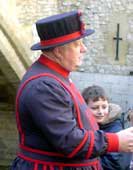
I entered the Tower via the modern paved piazza on the western side (and not by boat through Traitors'Gate). The queues were pretty long, even first thing on a Sunday morning, and I suspected that I was one of the few visitors attending from my home country. A free guided tour of the Tower runs half-hourly from the main gate - a mass of eager tourists flocking round a single cheery Yeoman Warder - but I walked past to gain entry to the main part of the castle site before the majority of the day's visitors arrived. The central courtyard was almost deserted, save for a couple of gossipping Beefeaters and a few flapping ravens, and the experience was rather magical.
The start of the day was definitely the best time to view the Crown Jewels in the Waterloo Block. I sailed through the slalom of antechambers, barriers and film presentations (during busier periods the experience must be a little like queuing for an upmarket Disney ride), eventually passing through a thick vault door to view the collection itself. A wide variety of royal regalia was on display, from official coronation robes to obscenely ostentatious gold banqueting plate, but the centrepiece was the priceless set of bejewelled crowns, orbs and sceptres. These are viewed by standing on the world's slowest travelator and being carried gently by. It being quiet, I went past three times, just because I could. Most impressive were the enormous sparkling gemstones, including the legendary Koh-i-Noor diamond and the world's largest cut diamonds, Cullinan I and Cullinan II. The British Royal Family may have custody of these unique jewels only because of outdated historical privilege, but this collection surely makes Her Majesty the UK's official diamond geezer. But it's been more than fifty years now since much of the coronation regalia was last used, and at this rate it may be a couple more decades before King Charles gets to wear any of it in public.
Next I nipped across the courtyard to the White Tower. There were four floors to explore, most featuring exhibitions of royal armour and shining weaponry. I was duly impressed by the size of King Henry VIII's codpiece (surely he should have been embarrassed walking around with that mighty protruberance sticking out in front of him?), and also by some of the intricate equestrian armour. A special audio-visual exhibition on the top floor presented the story of the Gunpowder Plot, just in case I hadn't seen it enough on my previous travels, while in the basement (somewhere) was the very room where Guy Fawkes was taken to be so brutally tortured. Best of all however was the chance to walk around inside an ancient Norman castle in the very centre of London. I'm a great lover of twisty-turny medieval stone staircases, and there were several of these on the way round. William the Conqueror may not have been bound by modern accessibility legislation, but I was secretly pleased that no modern committee had ordered the renovation of the historic upper floors to include ramps for pushchairs or lifts for wheelchairs. Sorry, but some buildings are best left well alone.
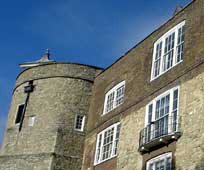
The courtyard was more crowded now. Tourists were busy filming the sentry outside the Jewel House, taking pictures of the ravens hopping about on the lawn and accosting Beefeaters to pose with them in a souvenir photo. Some were gathered around the scaffold on Tower Green where (only seven) prisoners were executed, while others enjoyed the dramatic presentations being staged to bring the Tower's history to life. Around every corner it seemed there was another doorway to explore. I squeezed into the Bloody Tower to see the room where two royal princes may once have been murdered, and braved another narrow staircase in the Beauchamp Tower to see graffiti scratched into the stone wall by desperate prisoners back in Tudor times. I explored Edward I's royal palace overlooking the river, now partially restored to resemble their original 13th century splendour. I found the well-concealed entrance to the eastern battlements, from which you can look down on the front doors, rooves (and washing lines) of the houses occupied by the Yeoman Warders and their families. And beneath the Bell Tower I captured this photograph of the very room in which Guy Fawkes was held during his time in the Tower (behind the upper right window). Here he'd have spent his last night on earth, praying to his Catholic God before being taken away to be hanged, disembowelled and chopped up into four meaty chunks. I counted myself rather more fortunate when, after thoroughly enjoying my time exploring the Tower of London, I was able to leave of my accord.
5/11: Treason The Gunpowder Plot was foiled not on the fifth of November but on the fourth, 400 years ago today. There were no black and yellow security barriers outside the Houses of Parliament in those days, no armed guards posted at every entrance and no compulsory bag searches before entry. All the conspirators had to do was to hire a cellar beneath the House of Lords, fill it with 1½ tons of gunpowder and wait. Unluckily (for them) the State Opening of Parliament was delayed by a month because of plague, during which time news of the 'secret' plot leaked out. Guy Fawkes and his barrels of explosive were therefore discovered just in time, significantly extending the life expectancy of Britain's ruling aristocracy in the process.
It's not widely known just how easy it is to gain entrance to the Palace of Westminster. You can write to your MP and ask to be taken round (although, given who my MP is, I think I'll wait a few years). You can queue up to see a debate in the Commons or the Lords (the latter has far shorter queues than the former). You can ask the fierce-looking policemen outside St Stephen's Entrance for permission to take a look round Westminster Hall (open daily at present for a Gunpowder 1605 exhibition). Or you can do what I did and take a tour of the main building during the summer recess (at only £7 per head, this must be one of London's best bargains). Admittedly the security checks are really quite strict (the stern lady in the black portakabin poked me with her electronic wand and gave me a very thorough patdown before issuing me with my official visitor's sticker). But once you're through, the chance to experience democracy first hand is really rather special.
The officialtour of the Houses of Parliament begins here in the Sovereign's Entrance, beneath the Victoria Tower. I was lucky and ended up in a tiny group of seven, just me and some backpacking tourists from Australia and Texas, showed round by Robina the Blue Badge Guide. She asked us to put away our cameras and then led us into the building, following the route the Queen takes when she comes to open Parliament. Even at nearly 80 Liz can still climb the initial grand staircase unaided, we were told, so there was no sign of a Stannah stairlift installed as yet. As we entered the Robing Room it was immediately obvious, if it hadn't been from outside, that this is not the original Palace of Westminster. A firein 1834 succeeded where Guy Fawkes had not, destroying the medieval building and forcing an almost complete rebuild. What we were seeing was the uber-Gothic interior of a Victorian architect's wet dream - all fancy ornate woodwork and excessive over-decoration. The gold leaf plastered around the room, and the Chair of State in particular, looked as if it might well have cost the entire 19th century GDP of an exploited Empire colony.
Next to the Royal Gallery, an extremely long, high room lined with portraits and grand paintings. The two most prominent of these are huge canvases depicting, in great detail, the defeat of the French at Trafalgar and Waterloo. Comfy chairs are scattered along the full length of the room, as befits the country's most exclusive gentleman's club. It's just a short procession from here through the Prince's Chamber ante-room to the (oh my God I'm actually standing in the)House of Lords. This historic chamber is a lot more compact in real life than it looks on the television but also a lot grander, so long as you look at the big gold throne and the panelled walls and not the squashed red leather benches or the obtrusive dangling microphones. We got to sit on the steps at the far end, while Robina pondered out loud the various possible futures of this increasingly less important second chamber.
Continuing eastward, the subtle colour change of furniture from red to green signalled our passage from the Lords to the Commons. We'd arrived in the Central Lobby, the buzzing hub of the Palace and the classical backdrop you usually see behind TV political correspondents. Except it was a Saturday morning so the place was almost silent, apart from a clerk at the main desk and some yellow-helmeted workmen wheeling long low trollies, frustratedly trying to find a step-free exit from the building. The Members' Lobby nextdoor housed bronze busts of 20th century Prime Ministers, including recently departed Heath and Callaghan. My local MP merited only an empty pigeonhole.
We ventured onward towards the Commons chamber itself, where Black Rod fears to tread. The surrounding 'Aye' and 'No' lobbies were rebuilt after World War 2 following major bomb damage and therefore look disappointingly ordinary, more like a town hall library than the national seat of power. Robina sat us down in the Noes for a quick historical update, then led us into the (oh my God I'm actually standing in the)House of Commons. Our group got to line up along the Government backbenches, more usually occupied by Tony's semi-loyal hecklers, while the tour ahead of us took the place of Her Majesty's Opposition. Here we stood as unelected members of the public, right at the very heart of British democracy, facing one another across the Despatch Boxes. Alas we were not permitted to act like real MPs and shout 'hear hear' or fall asleep on the green-backed leather benches. Major building work was underway, with a huge new security screen being erected to prevent any more angry fathers hurling condoms full of purple flour (or worse) at the PM, so unfortunately much of the chamber was boarded off. Still, I can at least say I saw half of the most important room in the country.
We retraced our steps and entered St Stephen's Chapel, site of the original (pre-fire) Parliament building. This is now used as the main entrance hall, a bit of a comedown from setting the nation's laws, but four brass studs still mark the corners of the spot where the Speaker's Chair once stood. And finally to the oldest part of the palace, Westminster Hall, where Robina took her leave. This is a mighty imposing structure. The walls are more than nine centuries old, the hammerbeam roof dates back to King Richard I, and the bland cafe alongside is so old that David Blunkett was Home Secretary at the time it was opened. The hall itself has seen great pomp and drama, including several coronation banquets, the trial of King Charles I and the Queen Mum's lying in state. And in January of 1606 the trial of Guy Fawkes was held here, back in the building he'd attempted, but failed, to destroy. Parliament exacted its retribution, and Fawkes was hung, drawn and quartered (along with three other conspirators) outside in Old Palace Yard. Death had come to Westminster, just not quite in the way the plotters had planned.
5/11: Gunpowder Just 36 barrels of gunpowder, cunningly concealed beneath the Houses of Parliament, could very easily have changed the course of history. Even half that amount would have been sufficient to destroy the buildings above and, at the same time, all of Britain's top royalty, nobility and church leaders. In the end, of course, Guy Fawkes was discovered before he could light the fuse, and there are some who reckon his gunpowder was so far past its use-by-date that it wouldn't have gone off anyway. But, how exactly do you make gunpowder? Earlier this year I took a trip to a secret establishment on the outskirts of north London where I met up with some shadowy men who explained everything. No doubt my report below contravenes new Government legislation on the incitement of terrorism but, given that you've already downloaded it, you might as well read on...
Britain's largest gunpowder factory is, or rather was, located in the upper Lea Valley (roughly where the Greenwich meridian crosses the M25). The factory started out peacefully as a few water mills run by monks from nearby Waltham Abbey, but was converted to gunpowder production in the late 17th century when we went to war with the Dutch. That's slightly too late to have provided the gunpowder used by Guy Fawkes, but the process would have been very similar. Three main ingredients were required - 75% saltpetre (known to chemistry teachers as potassium nitrate), 15% sulphur and 10% charcoal. Mix them properly, and extremely carefully, and you have a recipe for destruction. By 1735 these were 'the largest and compleatest works in Great Britain', and they were snapped up by the Crown a few decades later. Explosives from the Royal Gunpowder Mills were instrumental in fighting the Napoleonic Wars, the Crimean War and the Boer War, and the factory and its workforce expanded enormously. The Mills' heyday was the First World War, during which hundreds of tons of Cordite were produced every week for use in the trenches of northern Europe. And that's when my great grandfather James worked here, as a 'Danger House Man' (whatever that was), so I had an extra special interest in going along to take a look.
Today the Royal Gunpowder Mills are one of those wonderfully semi-amateur museums run by volunteers with a passion for restoring our industrial heritage. In this case I suspect the place has attracted men who like playing with guns and blowing things up, but in a nice way. They've certainly got a fantastic (and enormous) site to play with. There are acres of woodland, with decaying industrial relics scattered amongst the trees (and plenty of wildlife frolicking inbetween). There are several long buildings formerly used as explosives factories (with very thick end walls so that, if the gunpowder ever blew up, the buildings next door didn't take the full force). There's an intricate network of canals and rivers (and yes, there is a steam railway in there somewhere too, just because these places always have one). Where else could you see a 'nitroglycerine nitrating house', or a 'guncotton drying stove', or even a rare Victorian cast iron aqueduct? Only here, I suspect.
The ladies selling tickets at the entrance were very pleased to see me, maybe because they hadn't been over-stretched by visitors that morning. But there were enough of us to fill the land train, essentially a big trailer on the back of a tractor, which took us on a guided tour of the less accessible parts of the site. In one of the old buildings, until recently a government laboratory, a white-coated 'scientist' took pleasure in explaining to the occasional visitor how rockets work. In another small room the walls were lined with 200 historic guns and rifles, each lovingly polished, and if you asked the curator nicely he'd let you go outside and fire blanks. And down on the central green a distinguished old gentleman was trying hard to persuade a young boy that the site offered many exciting attractions for modern youth, but I suspect you had to be a certain sort of child to enjoy the experience.
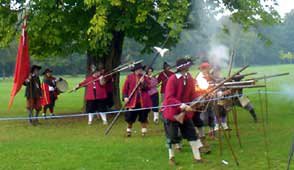
But I was really here at the Gunpowder Mills for their special Gunpowder Plot weekend (held, conveniently, back in September before the site closed down for the winter). The fine folk of Sir Marmaduke Rawdon'sRegiment of Foote (a division of the English Civil War Society) were present to re-enact "Catesby's Last Stand" - a dramatic recreation the final moments of the doomed plotters. In practice this meant a bunch of bank managers, civil servants and primary school teachers all dressed up in period Stuart costume, strutting up and down on the central lawn wielding period weaponry and exclaiming loudly in ye olde English. Some of the pikesmen (and women) got to march about a bit, but the people having the most fun were those allowed to run amok with finely choreographed musket fire.
Bit of history: Following the discovery of the Gunpowder Plot, Thomas Catesby and the remaining conspirators made their escape from London by riding northwestward towards the Welsh Marches (map). Tired, wet and bedraggled they arrived at Holbeach House in Staffordshire on the evening of 7th November 1605 where, rather stupidly, they left their sodden ammunition in front of a log fire to dry out. Oops. The resulting explosion injured several of the plotters, who were therefore not at their best the following morning when the local sheriff came by to round them up. One single government bullet killed both Catesby and Thomas Percy, which was a bit of luck, and the surviving conspirators were then easily captured and taken back to London to await trial and execution.
A bit of a sorry mess all round really, but a fantastic tale for re-enactment purposes. The battle action unfolded with all due spectacle. Everybody shouted where necessary and fell over as appropriate. The man at the back with the big red flag carried his big red flag impeccably. The special effects team relished their opportunity to waft smoke across the Essex countryside. The weekend wenches waved from the sidelines. The narrator tried his best to tell us what was going on (even though his microphone kept cutting out and he had to keep repeating everything... repeating everything). And the bloke playing Catesby hammed up his role magnificently, dying at the finale with a loud dramatic flourish. Plot defeated.
I wouldn't want to watch this sort of stuff every weekend (let alone take part), but the experience really did bring the past alive. I'm sure the other spectators would agree with me, even if we were heavily outnumbered by the actors and all their historic hangers on. It's a great shame that the event, and indeed the museum, weren't better attended, but then I guess most modern families would rather spend their weekends in the high street battlezone instead. They're missing out. And one day I really must thank my great-grandfather for inspiring me to pay a visit to his most fascinating workplace.

5/11: Plot
You probably think of the Tower of London as a vastly overpriced tourist honeytrap, and you'd be right, but think of the place instead as central London's finest medieval castle and somehow the £14.50 entrance fee feels slightly more justified. The setting is nothing if not spectacular, tucked in beside the Thames alongside eponymous Tower Bridge. Here, ten centuries ago, William the Conqueror ordered the construction of a huge fortress to subdue the people of newly-invaded London. The sheer enormity of the White Tower was like nothing seen before in England, and the local population must have been duly cowed. Over the years the scale of the castle was enlarged, first with one high surrounding wall and then another, until eventually the structure contained a full 20 towers encircled by a deep protective moat. In medieval times the Tower doubled up as both military stronghold and royal residence, although its defences were never tested by any invasion and most kings and queens preferred to live elsewhere. From Tudor times the Tower became more of a prison and armoury, but within the walls were also to be found a mint, a royal zoo, a record office and a fiercely guarded treasure house. Few, if any, buildings anywhere in England are as diverse, or as historic.
I entered the Tower via the modern paved piazza on the western side (and not by boat through Traitors' Gate). The queues were pretty long, even first thing on a Sunday morning, and I suspected that I was one of the few visitors attending from my home country. A free guided tour of the Tower runs half-hourly from the main gate - a mass of eager tourists flocking round a single cheery Yeoman Warder - but I walked past to gain entry to the main part of the castle site before the majority of the day's visitors arrived. The central courtyard was almost deserted, save for a couple of gossipping Beefeaters and a few flapping ravens, and the experience was rather magical.
The courtyard was more crowded now. Tourists were busy filming the sentry outside the Jewel House, taking pictures of the ravens hopping about on the lawn and accosting Beefeaters to pose with them in a souvenir photo. Some were gathered around the scaffold on Tower Green where (only seven) prisoners were executed, while others enjoyed the dramatic presentations being staged to bring the Tower's history to life. Around every corner it seemed there was another doorway to explore. I squeezed into the Bloody Tower to see the room where two royal princes may once have been murdered, and braved another narrow staircase in the Beauchamp Tower to see graffiti scratched into the stone wall by desperate prisoners back in Tudor times. I explored Edward I's royal palace overlooking the river, now partially restored to resemble their original 13th century splendour. I found the well-concealed entrance to the eastern battlements, from which you can look down on the front doors, rooves (and washing lines) of the houses occupied by the Yeoman Warders and their families. And beneath the Bell Tower I captured this photograph of the very room in which Guy Fawkes was held during his time in the Tower (behind the upper right window). Here he'd have spent his last night on earth, praying to his Catholic God before being taken away to be hanged, disembowelled and chopped up into four meaty chunks. I counted myself rather more fortunate when, after thoroughly enjoying my time exploring the Tower of London, I was able to leave of my accord.
The official tour of the Houses of Parliament begins here in the Sovereign's Entrance, beneath the Victoria Tower. I was lucky and ended up in a tiny group of seven, just me and some backpacking tourists from Australia and Texas, showed round by Robina the Blue Badge Guide. She asked us to put away our cameras and then led us into the building, following the route the Queen takes when she comes to open Parliament. Even at nearly 80 Liz can still climb the initial grand staircase unaided, we were told, so there was no sign of a Stannah stairlift installed as yet. As we entered the Robing Room it was immediately obvious, if it hadn't been from outside, that this is not the original Palace of Westminster. A fire in 1834 succeeded where Guy Fawkes had not, destroying the medieval building and forcing an almost complete rebuild. What we were seeing was the uber-Gothic interior of a Victorian architect's wet dream - all fancy ornate woodwork and excessive over-decoration. The gold leaf plastered around the room, and the Chair of State in particular, looked as if it might well have cost the entire 19th century GDP of an exploited Empire colony.
We retraced our steps and entered St Stephen's Chapel, site of the original (pre-fire) Parliament building. This is now used as the main entrance hall, a bit of a comedown from setting the nation's laws, but four brass studs still mark the corners of the spot where the Speaker's Chair once stood. And finally to the oldest part of the palace, Westminster Hall, where Robina took her leave. This is a mighty imposing structure. The walls are more than nine centuries old, the hammerbeam roof dates back to King Richard I, and the bland cafe alongside is so old that David Blunkett was Home Secretary at the time it was opened. The hall itself has seen great pomp and drama, including several coronation banquets, the trial of King Charles I and the Queen Mum's lying in state. And in January of 1606 the trial of Guy Fawkes was held here, back in the building he'd attempted, but failed, to destroy. Parliament exacted its retribution, and Fawkes was hung, drawn and quartered (along with three other conspirators) outside in Old Palace Yard. Death had come to Westminster, just not quite in the way the plotters had planned.
"Last of all came the great Devil of all, Guy Fawkes, who should have put fire to the powder. His body being weak with the torture and sickness he was scarce able to go up the ladder, yet, with much ado, by the help of the hangman, went high enough to break his neck by the fall. He made no speech, but with his crosses and idle ceremonies made his end upon the gallows and the block, to the great joy of all beholders that the land was ended of so wicked a villainy." (The Weekeley News, 31 January 1606)• The Houses of Parliament (how and when to visit)Britain's largest gunpowder factory is, or rather was, located in the upper Lea Valley (roughly where the Greenwich meridian crosses the M25). The factory started out peacefully as a few water mills run by monks from nearby Waltham Abbey, but was converted to gunpowder production in the late 17th century when we went to war with the Dutch. That's slightly too late to have provided the gunpowder used by Guy Fawkes, but the process would have been very similar. Three main ingredients were required - 75% saltpetre (known to chemistry teachers as potassium nitrate), 15% sulphur and 10% charcoal. Mix them properly, and extremely carefully, and you have a recipe for destruction. By 1735 these were 'the largest and compleatest works in Great Britain', and they were snapped up by the Crown a few decades later. Explosives from the Royal Gunpowder Mills were instrumental in fighting the Napoleonic Wars, the Crimean War and the Boer War, and the factory and its workforce expanded enormously. The Mills' heyday was the First World War, during which hundreds of tons of Cordite were produced every week for use in the trenches of northern Europe. And that's when my great grandfather James worked here, as a 'Danger House Man' (whatever that was), so I had an extra special interest in going along to take a look.
Today the Royal Gunpowder Mills are one of those wonderfully semi-amateur museums run by volunteers with a passion for restoring our industrial heritage. In this case I suspect the place has attracted men who like playing with guns and blowing things up, but in a nice way. They've certainly got a fantastic (and enormous) site to play with. There are acres of woodland, with decaying industrial relics scattered amongst the trees (and plenty of wildlife frolicking inbetween). There are several long buildings formerly used as explosives factories (with very thick end walls so that, if the gunpowder ever blew up, the buildings next door didn't take the full force). There's an intricate network of canals and rivers (and yes, there is a steam railway in there somewhere too, just because these places always have one). Where else could you see a 'nitroglycerine nitrating house', or a 'guncotton drying stove', or even a rare Victorian cast iron aqueduct? Only here, I suspect.
A bit of a sorry mess all round really, but a fantastic tale for re-enactment purposes. The battle action unfolded with all due spectacle. Everybody shouted where necessary and fell over as appropriate. The man at the back with the big red flag carried his big red flag impeccably. The special effects team relished their opportunity to waft smoke across the Essex countryside. The weekend wenches waved from the sidelines. The narrator tried his best to tell us what was going on (even though his microphone kept cutting out and he had to keep repeating everything... repeating everything). And the bloke playing Catesby hammed up his role magnificently, dying at the finale with a loud dramatic flourish. Plot defeated.

 5/11: Plot
 You probably think of the
  I entered the Tower via the modern paved piazza on the western side (and not by boat through
  The courtyard was more crowded now. Tourists were busy filming the sentry outside the Jewel House, taking pictures of the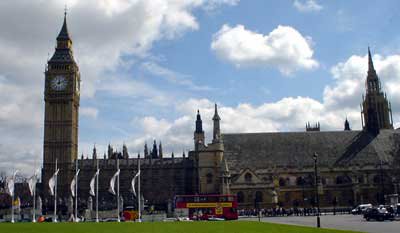
 The
The 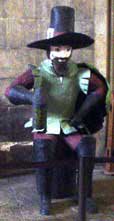 We retraced our steps and entered
  Britain's largest gunpowder factory is, or rather was, located in the upper Lea Valley (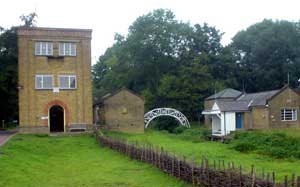

 A bit of a sorry mess all round really, but a fantastic tale for re-enactment purposes. The battle action unfolded with all due spectacle. Everybody shouted where necessary and fell over as appropriate. The man at the back with the big red flag carried his big red flag impeccably. The special effects team relished their opportunity to waft smoke across the Essex countryside. The weekend wenches waved from the sidelines. The narrator tried his best to tell us what was going on (even though his microphone kept cutting out and he had to keep repeating everything... repeating everything). And the bloke playing Catesby hammed up his role magnificently, dying at the finale with a loud dramatic flourish. Plot defeated.