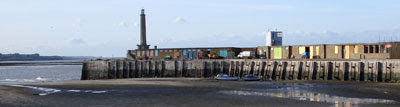
Seaside postcard: Margate → Broadstairs
Why take the bus or train from Margate to Broadstairs when you could walk? It's only five miles along the Thanet coast, perfect for a stroll on a sunny winter's afternoon. This is part of the longest stretch of coastal chalk in the country, and there's a choice of cliff-top or cliff-bottom for most of the way. I ventured this way on Saturday afternoon, trying to maintain a decent speed in my race against sunset. And there really was plenty of interest along the way, including several delightful beaches and one gobsmacking surprise.
» Margate Winter Gardens: You could easily miss the the entertainment hub that is Margate's Winter Gardens. It was built in an artificial seafront hollow, almost 100 years ago, with only a covered staircase to lead the way down to the main entrance from the road above. The three mayors of Margate, Broadstairs and Ramsgate each have their own reserved parking space on the beachfront, from which aspect the building's municipal design now looks somewhat salt-encrusted and weatherbeaten. But big name acts still occasionally pack in the crowds - this month, for example, Boy George and Dionne Warwick.
» Cliftonville: Margate spreads eastward for a couple of miles along the clifftop, past increasingly upmarket avenues of retired folk. Their faceless non-bungalows keep an almost-respectable distance from the sea, providing a grassy edge ideal for winter strolls and dogwalking. The beach may be a little concrete-y in places, but at low tide there's plenty of sand for a four-legged runaround. And is that, ooh yes, a chalk stack at the end of Percy Avenue[photo]. What retired geologist could ask for more?
» Kingsgate Bay: You want more? How about a chalk arch too? A proper hole in the cliff [photo] has been carved through White Ness, as seen in all the best geography textbooks. This bay is a proper exclusive residential location, as exemplified by the unexpected castle on the opposite clifftop [photo]. Kingsgate Castle dates back only 250 years, which explains the ostentatious brickiness of it, but has since been divided up into rather ordinary flats.
» North Foreland: If you want an under-visited sandy beach, head for the former smuggler's haunt of Joss Bay (toilets and ice creams summer only). Up the gently-sloping hill, between fields of winter cauliflowers, looms the tall white tower of the North Foreland lighthouse[photo]. A beacon was first lit here in 1499 to warn off ships entering the English Channel, and 500 years later this became the very last UK lighthouse to be fully automated.
» Cliff Promenade: On the 'private' North Foreland Estate, on a strip of grass hugging the cliff edge, I stumbled across an unlocked iron gateway half hidden amongst a clump of bushes [photo]. "THIS TUNNEL IS DANGEROUS" screamed a notice beside the entrance, along with some disclaimer about using it at your own risk. I was through the gate like a shot. In front of me stretched a long uneven staircase, cut deep into the rock, whose function wasn't immediately apparent. A few steps down a gaping rectangular chasm opened up to my left, with a grille at the bottom to stop supermarket trolleys and human bodies being hurled to their doom. On the far side a red metal door had been wrenched from its hinges, allowing unrestricted access down several more steps to an enclosed graffitied landing below [photo]. I half-expected to find local youths wielding blades or sniffing lighter fuel, but reassured myself that this was a respectable Neighbourhood Watch area and therefore such behaviour would be frowned upon. The next flight of stairs doubled back into darkness, at which point I decided that this was no place to stumble unaccompanied and returned regretfully to the surface. I got the sense that this was somewhere special, but it was only when I got home that Google provided the reason why...
Blimey, who'd have thought?! These were The Thirty-nine Steps, as described in the famous adventure novel by John Buchan. He'd been recuperating in a villa called St Cuby at the top of the cliff, immediately opposite this private staircase in the bushes, and decided to immortalise them in prose. Had I ventured three flights down to the bottom I'd have emerged onto the beach below (or been murdered by a passing German spy, one or the other). Oh, and I'd also have descended rather more than 39 steps. There were 78 in Buchan's time, which he conveniently halved to make a better title, but the old oak treads have long since been removed to make way for 108 concrete replacements. The 108 Steps - it's not quite so catchy is it? But, believe me, just as atmospheric.
» Broadstairs: And finally, just before sundown, to a seaside resort best lit at dawn. Not that the bride and groom posing for photos on the beach appeared to mind [photo]. The old town nestles above a chalk-edged bay, from the bandstand round to a castellated homestead now called "Bleak House" [photo]. It was here, in the study overlooking the sea, that Charles Dickens wrote the majority of David Copperfield. In lodgings elsewhere around the town he also penned chapters of the Old Curiosity Shop and Barnaby Rudge, so it's not surprising to find a special museum devoted to him on the seafront [photo]. Don't expect a lot for your £2.30, there's only one room of proper Dickens memorabilia and the remainder is local paraphernalia and contemporary Victoriana. From here for 20p you can pick up a Town Trail leaflet to help guide you round the other historic sites and buildings that this pretty town has to offer. But it's hard to sightsee in the dark, so I headed instead to the station (and my four hour journey home).
Seaside postcard: Shell Grotto, Margate The last thing you expect to find underneath the streets of Margate is a mysterious shell-decorated chamber of indeterminate origin. Indeed, back in 1835 this was the last thing that local man James Newlove expected to find beneath an unmarked field on the outskirts of town. So he bought up the field without telling anybody why, and within a couple of years members of Victorian society were paying good money to troop down into this newly discovered cavern to marvel at its unexplained wonder. Believe it or not, despite science and carbon dating and all sorts of modern stuff, even 160 years later nobody's quite sure when (or how) this underground anomaly got to be here.
Newlove's field has long been built over, so the Shell Grotto now resides between rows of Victorian terraces up an anonymous sidestreet. From the outside all you see is a bland concrete shopfront (is it a curry house? is it a hairdressers?). Ring to enter and family life inside will stop for long enough to let you in. Shell-covered gifts, new age goodies and the Eighth Wonder café await, but maybe on the way out, OK? Pay your £2.50 (everything in Thanet is so reasonably priced compared to London) and pass through into the ante-room named the Mystery Museum. The name is perhaps overhyping things - this is no more than a few cabinets of local paraphenalia plus a wall of laminated speculation regarding what you're about to see next. Down the steps. Mind your head.
The initial roughly-hewn passage is nothing special, but then come the shells. All four and a half million of them, crammed into a grotto less than 70 feet long. The first feature is a circular rotunda, whose inner and outer walls are completely covered with mystical patterns made from carefully-arranged nautilus, scallop and conch. There are rosettes and swirly curves and astrological symbols, and it doesn't take too much imagination to decide that some of them definitely represent *ahem* reproductiveorgans. Round the bend the walls rise up to a shell-rimmed dome through which a patch of daylight intrudes. Next there's a wiggly serpentine passage decorated with yet more mysterious symbols, both fertility and otherwise, leading downward to the final rectangular chamber. This looks like a place of worship, of sorts, with an arched recess on the far wall and a grid of designs constructed from yet still even more shells. Except on the far wall, that is, which was destroyed by bomb damage in WW2. No problem, the other surfaces are impressive enough.
I was fortunate, some would say, that my visit coincided with the presence of the grotto's greatest champion and expert - local historian Mick Twyman. He'd been doing some "measuring up" in the morning, hunting for angles and distances in the orientation of the patterns, but he couldn't resist giving an impromtu tour to the few of us present. Mick believes that the temple dates back more than 2000 years and is pagan in origin. Look at this, he repeatedly exclaimed, pointing out several 82° solstice angles and an imaginary line representing the 2012 Celestial Conjunction. My fellow visitors nodded in amazement as he pointed out one supposed astronomical coincidence after another. How many hours of daylight are there at the winter solstice? Yes, eight, and that's the same as the number of patterns in this subdivided square! What does this squiggly line look like? Yes, a jaguar, and that means that the builders must have visited South America where they worship jaguars! I was sorely tempted to chip in and express my naked cynicism at Mick's increasingly outlandish claims, but he was a master showman and my fellow visitors would have looked at me like I was an ignorant fool.
My money's on the shell-cave being an encrusted decorative folly, previously lost to recorded memory, and not an ancient celestial calculator imbued with cryptic mystic meaning. I mean, this is Margate we're talking about, for heaven's sake. But whatever the case, however wrong one of us is, this is still a fascinating subterranean attraction.
Seaside postcard: Margate Following in the steps of Cockney geezers Chas and Dave, I spent yesterday on a day trip down to Margate. Think Kent, think top right corner, think two hours from London via the fastest train. Margate boasts more then 200 years as a top seaside resort, and many's the family holiday that's been spent on the town's sandy beaches over the years. But far fewer now make the trek down for a full seven days of bucket and spade and winkles, and the town is having to reinvent itself to turn back decades of steady decline.
Step out of the station and you're almost on the beach already. How convenient is that? Margate's main beach is broad and yellow, and north-facing, and rarely completely empty even in February. Only some of the seafront amusement arcades are currently open, while the rest are boarded up awaiting a summer influx that may never come. The most famous of these is Dreamland[photo] - a vast funfair complex packed with swirly loopy rides and various sugary delights. Except that Dreamland didn't open last summer, nor is it anticipated to open again in its current form. A smaller park of 'heritage rides' has been proposed instead, featuring classic attractions rescued from across the UK. In the meantime the huge Big Wheel has been dismantled, the minor rides have been cleared away, and only the Grade II listed ScenicRailway remains. This wooden switchback is the UK's oldest surviving rollercoaster, erected in 1920, although in 2008 it looks a pretty forlorn sight when viewed from the roof of the car park nextdoor [photo]. Let's hope it survives to entrance future generations of thrill seekers.
The centre of Margate, in the winter months at least, feels very much like a seaside town whose time has been and gone. There used to be a Marks and Spencer on the high street, for example, and now there isn't. A once grand-looking pillared shop on the seafront is now a Primark. Stand still for a couple of minutes and you'll probably be passed by both a mobility scooter and a revving boy racer. But council planners are trying to make a difference here by transforming the old town into a CulturalQuarter. They hope to fill the twisty narrow backstreets with alluring cafes, exclusive galleries and tempting boutiques. I found the cafes alright, but also a shop that sold dentures, a long-gone launderette and a firmly-shut museum. This metamorphosis has a way to go yet.
But there is one major arts project which, although years behind schedule, hopes to transform the future of the town. Margate has big plans to capitalise on the fame of its one truly famous resident - the painter JMW Turner - to invigorate local residents and to bring the right sort of people flocking to the town. So what better than a major new art gallery, built to a truly modern design, plonked down on the foreshore close to where he used to live. The site's just a boatyard and carpark at the moment [photo], as it has been for the best part of a decade, but the design is at last finalised and all funding agreed so construction should start soon.
In the meantime the Turner Contemporary project maintains a physical presence inside the tiny Italianate harbourmaster's office close by. It's little more than a couple of well-lit rooms with a temporary gallery space tacked on at the back, but this is the heart of the campaign to get the town involved and inspired. Here I met the lady in charge of spreading the word within Margate and beyond, and she delighted in explaining her vision with evangelical zeal. For half an hour. A six-part gallery of interlocking blocks is planned, clad in opaque milky glass, reflective during the day and brightly illuminated at night. Various travelling exhibitions will make their home here (although, interestingly, Turner's presence seems restricted to name only). The educational outreach programme has already begun, and a series of innovativeartyevents is underway (to which I was cordially and repeatedly invited). There's a real creative drive here and, if anything offers the opportunity to revitalise Margate from within and without, this is it. Why not come back in 2010 to see how it's all worked out?

» Kingsgate Bay: You want more? How about a chalk arch too? A proper hole in the cliff [photo] has been carved through White Ness, as seen in all the best geography textbooks. This bay is a proper exclusive residential location, as exemplified by the unexpected castle on the opposite clifftop [photo]. Kingsgate Castle dates back only 250 years, which explains the ostentatious brickiness of it, but has since been divided up into rather ordinary flats.
» Cliff Promenade: On the 'private' North Foreland Estate, on a strip of grass hugging the cliff edge, I stumbled across an unlocked iron gateway half hidden amongst a clump of bushes [photo]. "THIS TUNNEL IS DANGEROUS" screamed a notice beside the entrance, along with some disclaimer about using it at your own risk. I was through the gate like a shot. In front of me stretched a long uneven staircase, cut deep into the rock, whose function wasn't immediately apparent. A few steps down a gaping rectangular chasm opened up to my left, with a grille at the bottom to stop supermarket trolleys and human bodies being hurled to their doom. On the far side a red metal door had been wrenched from its hinges, allowing unrestricted access down several more steps to an enclosed graffitied landing below [photo]. I half-expected to find local youths wielding blades or sniffing lighter fuel, but reassured myself that this was a respectable Neighbourhood Watch area and therefore such behaviour would be frowned upon. The next flight of stairs doubled back into darkness, at which point I decided that this was no place to stumble unaccompanied and returned regretfully to the surface. I got the sense that this was somewhere special, but it was only when I got home that Google provided the reason why...
» Broadstairs: And finally, just before sundown, to a seaside resort best lit at dawn. Not that the bride and groom posing for photos on the beach appeared to mind [photo]. The old town nestles above a chalk-edged bay, from the bandstand round to a castellated homestead now called "Bleak House" [photo]. It was here, in the study overlooking the sea, that Charles Dickens wrote the majority of David Copperfield. In lodgings elsewhere around the town he also penned chapters of the Old Curiosity Shop and Barnaby Rudge, so it's not surprising to find a special museum devoted to him on the seafront [photo]. Don't expect a lot for your £2.30, there's only one room of proper Dickens memorabilia and the remainder is local paraphernalia and contemporary Victoriana. From here for 20p you can pick up a Town Trail leaflet to help guide you round the other historic sites and buildings that this pretty town has to offer. But it's hard to sightsee in the dark, so I headed instead to the station (and my four hour journey home).
The last thing you expect to find underneath the streets of Margate is a mysterious shell-decorated chamber of indeterminate origin. Indeed, back in 1835 this was the last thing that local man James Newlove expected to find beneath an unmarked field on the outskirts of town. So he bought up the field without telling anybody why, and within a couple of years members of Victorian society were paying good money to troop down into this newly discovered cavern to marvel at its unexplained wonder. Believe it or not, despite science and carbon dating and all sorts of modern stuff, even 160 years later nobody's quite sure when (or how) this underground anomaly got to be here.
The initial roughly-hewn passage is nothing special, but then come the shells. All four and a half million of them, crammed into a grotto less than 70 feet long. The first feature is a circular rotunda, whose inner and outer walls are completely covered with mystical patterns made from carefully-arranged nautilus, scallop and conch. There are rosettes and swirly curves and astrological symbols, and it doesn't take too much imagination to decide that some of them definitely represent *ahem* reproductive organs. Round the bend the walls rise up to a shell-rimmed dome through which a patch of daylight intrudes. Next there's a wiggly serpentine passage decorated with yet more mysterious symbols, both fertility and otherwise, leading downward to the final rectangular chamber. This looks like a place of worship, of sorts, with an arched recess on the far wall and a grid of designs constructed from yet still even more shells. Except on the far wall, that is, which was destroyed by bomb damage in WW2. No problem, the other surfaces are impressive enough.
I was fortunate, some would say, that my visit coincided with the presence of the grotto's greatest champion and expert - local historian Mick Twyman. He'd been doing some "measuring up" in the morning, hunting for angles and distances in the orientation of the patterns, but he couldn't resist giving an impromtu tour to the few of us present. Mick believes that the temple dates back more than 2000 years and is pagan in origin. Look at this, he repeatedly exclaimed, pointing out several 82° solstice angles and an imaginary line representing the 2012 Celestial Conjunction. My fellow visitors nodded in amazement as he pointed out one supposed astronomical coincidence after another. How many hours of daylight are there at the winter solstice? Yes, eight, and that's the same as the number of patterns in this subdivided square! What does this squiggly line look like? Yes, a jaguar, and that means that the builders must have visited South America where they worship jaguars! I was sorely tempted to chip in and express my naked cynicism at Mick's increasingly outlandish claims, but he was a master showman and my fellow visitors would have looked at me like I was an ignorant fool.
Following in the steps of Cockney geezers Chas and Dave, I spent yesterday on a day trip down to Margate. Think Kent, think top right corner, think two hours from London via the fastest train. Margate boasts more then 200 years as a top seaside resort, and many's the family holiday that's been spent on the town's sandy beaches over the years. But far fewer now make the trek down for a full seven days of bucket and spade and winkles, and the town is having to reinvent itself to turn back decades of steady decline.
In the meantime the Turner Contemporary project maintains a physical presence inside the tiny Italianate harbourmaster's office close by. It's little more than a couple of well-lit rooms with a temporary gallery space tacked on at the back, but this is the heart of the campaign to get the town involved and inspired. Here I met the lady in charge of spreading the word within Margate and beyond, and she delighted in explaining her vision with evangelical zeal. For half an hour. A six-part gallery of interlocking blocks is planned, clad in opaque milky glass, reflective during the day and brightly illuminated at night. Various travelling exhibitions will make their home here (although, interestingly, Turner's presence seems restricted to name only). The educational outreach programme has already begun, and a series of innovative arty events is underway (to which I was cordially and repeatedly invited). There's a real creative drive here and, if anything offers the opportunity to revitalise Margate from within and without, this is it. Why not come back in 2010 to see how it's all worked out?