The tentacles of Hull, City of Culture, spread up to and beyond the city boundary.
Act V: Micropolis Springhead Pumping Station, until 5 Nov
One of the City of Culture's major communal strands has been the story of the Land of Green Ginger, a mysterious underground land populated by tiny people, or so the story goes. Ever since some magic crates were discovered back in April heralding a mass gathering in the local park, a series of Acts Of Wanton Wonder have taken place across the suburbs, drawing families into a complex fictional world. The latest chapter began when an unexpected light was seen on top of Springhead Pumping Station, an old Victorian building still used by Yorkshire Water. For two weeks everyone's invited up the lamplit path to investigate further, and marvel, and thousands have already been inside.
Mice, it seems, are key to what goes on at Micropolis, and not in a good way. In room 1 we see projected mice running furiously inside projected wheels. In room 2 we discover the projected mice are being fed into a projected mincer inside a model factory, while tiny projected people emerge with projected McDonalds french fries from a projected door in the wall. So what if it's a tiny bit gruesome, the creative team has had an enormous amount of fun putting this lot together. [BBC video]
In the main room a sprawling cityscape has been built out of what's probably cardboard, with a dozen tower blocks rising at the back, their windows individually illuminated. A man in his underpants is dangling from one, while other lower windows reveal gymming dancers, angry pensioners and butchers sharpening rather large knives. Surely nobody would buy a meaty meal from Fat Rat Burgers or Rolling Rat Kebab, and just what might be going on behind the cinema's closed doors? If this surreal mash-up of model village, murder and looping projected infill were on show in London you'd never have heard the end of it. Your loss is Hull's children's gain.
An Eyeful of Wry: Government Art Collection Brynmor Jones Library, University of Hull, until 26 Nov
The Brynmor Jones Library is best known for its former librarian, the poet Philip Larkin. I missed him by a year, and haven't been back since 1987 when I used to scan the shelves to aid some postgrad assignment. I almost remembered which way to go to find the place, not helped by the fact that the Art Deco styled block with its brutalist 1969 extension has been very recently re-extended with a new building out front. A banner above the doorway, aimed at next September's intake, urges them to 'Step into your bright future'. I stepped through into very much my distant past.
The library includes a new gallery to showcase the university's considerable art-hoard, which this month is hosting a selection of the more humorous items from the Government Art Collection. Some 18th century cartoons remind us that political satire is nothing new, but the majority of the display is considerably more modern; some Martin Creed neon, a Grayson Perry battlescape, bronze 'polystyrene' cups, even a large frame filled with a reproduction of the floral grille on a Safeway Alpine Garden Gel Air Freshener. I wish this kind of stuff had come visiting when I was studying here.
The best artefact was hidden up the back, a pianola with one-man-band-style instruments attached, conceived by artist Mel Brimfield. This springs into action for 4 minutes 33 seconds on the pressing of a big red button, launching a hyperactive score played too fast for human hands, with added bangs and crashes from behind. This madcap medley commemorates Roger Bannister's record-breaking run in the Helsinki Olympics, even though he only came fourth, and includes snippets of national anthems and even the theme from Ski Sunday. If you dare to click here for an unmuted video, you'll get some idea of my startled joy on pressing red. [quieter BBC video]
The Dyslexia Portrait Brynmor Jones Library, University of Hull, until 11 Nov
"And if you head across to the far wall beyond the reception desk," urged the volunteer, "there are some abstract photographs based on interviews with dyslexic people." Indeed there were, but I used the art simply as an excuse to cross the lobby past study desks, book drops and a bank of photocopiers, a pretence to mingle with a generation of students I was no longer part of. What I remembered as a temple to books was now a conduit for streamed information, suggesting either I passed through when study was really simple, or conversely when the skills needed to learn anything were conspicuously hard. I walked out of my alma mater feeling chastened and irrelevantly anachronistic.
There used to be astation on the Beverley Road called Stepney. It closed to passengers in 1964, although the track is now a cycleway and the former station building has been subdivided into flats. For Hull 2017 ten lifesize metal sculptures of potential staff and passengers have been embedded in the stumpy remains of what's left of the platform. The installation didn't detain me long, but I thought I'd best mention it because some readers get desolate if I keep blogging for days about things that aren't railways.
Gary Saunt Presents: A Cultural Heritage from Beverley to Hull Beverley Art Gallery, until 2 Dec
Eight miles north of Hull lies Beverley, a very different kettle of fish. Beverley is a proper Yorkshire jewel, the county town of the East Riding, and retains a twisty historic high street leading to a part-time market square. Its museum and art gallery have transferred to a building that's anything but quaint, the so-called Treasure House, a modern brick hub on a corner site with a cylindrical sightseeing tower. For the very latest City of Culture exhibit head through the upstairs gallery, past the world's largest cattle painting, to find an amazing digital mural.
The panels of this 'dreamscape' stretch for over 20 metres round the gallery walls, taking the viewer on a notional journey from Beverley at one end to Hull at the other. Everywhere inbetween appears to have been skipped over, however. In addition to well-known buildings from the two towns, over 200 people have been crammed in throughout, from actual local-born souls like Maureen Lipman (she's playing cards) to interlopers like Stephen Hawking (he's sat in a dodgem car) and Stephen Fry (he's on a throne with Sooty). It's surreal but brilliant, and merits careful scrutiny throughout as you try to deduce who's who, what's what, and where the artist's warped humour might have come from. Non-visitors can pore over several of the individual panels here.
I also found time to go into Beverley Minster, of course, with its lofty Perpendicular towers and splendid Early English nave. A treasure house of a very different kind, and a reminder that there's a great deal of culture to be enjoyed around here all the time, not just in 2017. [13 photos]
As a former resident of Hull, I had to go back in 2017 to experience its year in the spotlight as the UK's City of Culture. I'm pleased to report that Hull did not disappoint. Here are seven events from the arts programme on show right now.
The Train Track and the Basket – Claire Barber Hull Paragon Interchange, until 31 Dec
Passengers arriving at Hull's imposing terminus this year are greeted by flapping banners, jolly posters and a flock of colourful birds. The birds are part of an artwork remembering the station's role in six decades of 'transmigration', the flow of human traffic from mainland Europe to the New World. Millions of people arrived in Hull by boat, caught trains across to Liverpool or Southampton and then sailed on to a new life in America, until WW1 brought this human flow to an abrupt halt. Many of the migrants carried their belongings in woven baskets, hence that theme's splashed across the windows too.
This entrance space is also where to find the City of Culture pop-up booth, staffed throughout the day by advice-wielding volunteers. The most useful thing I was given was a sheet of A4 paper listing just the events taking place on the day of my visit, which helped enormously in unpacking the 72-page catalogue for what to see. Far too much to see in one day, obviously, but I gave it a damned good try.
The Tool Appreciation Society Hull Central Library, until 10 Feb 2018
The ToolAppreciationSociety sounded like a brilliant take on overlooked history, the contribution of skilled craftspeople to the making of society. Artist Linda Brothwell has been out meeting local veterans like Walter Oglesby and Eva Crackles, as well as assembling four collections of traditional tools to work on especially modern projects, such as the replacement of missing letters outside a Liverpool cinema.
I found the exhibition inside Hull Central Library beyond the staircase beyond the cafe. The most enthusiastic volunteer I've ever met greeted me and showed me all the stuff there was to see in his downstairs room, pointing out what was on the walls, explaining every stack of paper on the table, handing me a newsletter, offering me a sticker, inviting me to leave feedback, then finding more words on the wall he hadn't pointed out before. Upstairs in the Edwardian reading room, by contrast, the volunteer on duty merely clicked his clicker once to register my presence then totally ignored me while I spent not very long reviewing Linda's toolset and longer admiring bookcases and the wood-panelled walls.
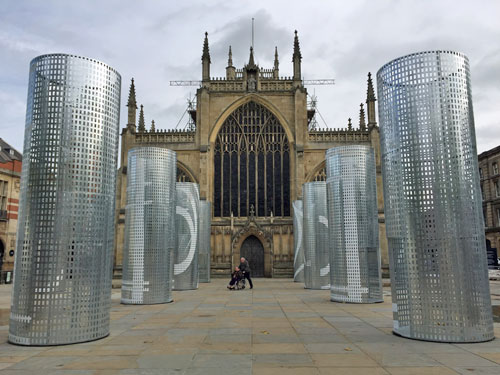
A Hall for Hull with Trois Points de Vue Trinity Square, until 12 Nov Hull Minster, England's largest parish church, has a slightly less large piazza out front, generally empty. We'll fill that, said Chile-based architects Pezo von Ellrichshausen and Swiss artist Felice Varini, who've arranged 16 large galvanized steel columns in a grid formation in front. Their stated aim was "to highlight the symmetry of the church's facade", although it's currently despoiled by scaffolding so that didn't quite work. Apparently "visitors to the installation will be able to inhabit each of the six-metre-high columns", or in other words step inside, "and experience varying light conditions created by perforations in the steel skin", this mainly because the weather changes. Previous sculptures in the Look Up series, such as the windfarm blade poised above City Square, have had rather more impact.
Turner & The Whale Hull Maritime Museum, until 7 Jan 2018
For those in search of 'proper' art, Hull's maritime museum has borrowed four canvases by the watercolour master JMW Turner. His whaling quartet was originally displayed at the Royal Academy and captures the offshore industry at its peak, with somewhat fuzzy ships and bloody blurs for carcasses. The people of Hull thank NPS Group for their sponsorship of this exhibition.
The last time I visited Hull the Fruit Market area was in transition, a dilapidated collection of warehouses close to the Humber's murky banks. Today it's a swanky street of bars, galleries and boutiques which wouldn't be out of place in Hackney, except that the far end hasn't quite risen yet, and the coffee is cheaper. As I followed a trio of blondes tottering down the cobbles past a chocolatier and micro-distillery, I wondered what on earth had happened to the city I once remembered.
At the heart of this new gentrified zone is the Humber Street Gallery, a four storey warehouse tastefully converted into exhibition floors with a cafe on the ground floor and a rooftop bar on top. It also put on the two art exhibitions this year which have most made me smile, so well done them.
Hull, Portrait of a City Humber Street Gallery, until 31 Dec
Photographic exhibitions can be dull, but not this pair, laid out inside the Humber Street Gallery on separate floors. Upstairs are Olivia Arthur's portraits of the youth of Hull, uncompromisingly snapped in black and white poses reflecting their hobbies and interests. Two footballing teens, a girl with a snake hanging from her neck, an Elvis impersonator, a suckling Mum, a space geek, a skateboarder, etc. etc. Blimey, I thought, closely inspecting one of the prints, that young lad really does have 'Destiney' tattooed on his neck.
Downstairs is Martin Parr's photojournalsitic paean to the eateries of Hull. Wall upon wall of chippies, married couples in aprons, cash and carries, formica tables, trays of lemon tarts, 'posh' eggs, Polish sausages and sea salt shortbread, the full diversity of Humberside cuisine as it is eaten. Here were dining out experiences I recognised, with a selection of the photos provided in a printed supplement to take away. The next time the Evening Standard serves up Cara Delevingne and the latest avocado pop-up, get real. [BBC video]
British Road Signs Humber Street Gallery, until 29 Oct
To celebrate the 50th anniversary of the Calvert and Kinneir road sign, leading artists and designers were invited to come up with a brand new circle, triangle or square. Sir Peter Blake came up with several. I loved the wit and verve of the 58 signs in the gallery, especially those with a simplistic thrust or a pertinent point to make. A warning sign based on an impossible triangle. A mini roundabout in three concentric circles. A Beatles sign with arrow pointing up paired with a Stones sign with arrow pointing down. Give Way to investment in health, education and renewables. Nazis prohibited. Love cycling. No shilly-shallying on the way.
Adding a red superhero cape to the motorcyclist 'leaping over' a vehicle isn't exactly original, but seeing all these signs properly manufactured and stuck on poles was a delight. Of course this year is actually the 52nd anniversary of the Calvert roadsign, and this collection first went on display at the Design Museum in 2015. But as they were commissioned and created by MADENORTH, all the better to see them for nothing in Hull on an up-and-coming street. Non-Hullensians can swipe-right through the British Road Signs Project road signs here. [BBC video]
The Sixteen Thousand BLOCK C, C4DI, until 5 Nov
As great ideas for public art go, try this. The City of Culture team approached every early years setting in the city, provided clay, and invited every child under five to decorate a brick. All these bricks were then fired, and positioned (upended) in a geometric pattern across the floor of a new business hub located by the mouth of the river Hull. This collective assembly represents the youngest members of Hull's population, and has given them an early taste of the potential of creativity. It looks great.
All's quiet now, but when the schools break up next week the volunteers expect a rush of families coming to see what their littluns have been doing. Then once half term's wrapped up every child has the right to take their own brick home... although they're not catalogued, nor in order, so I doubt that plan is in any way practical. A truly striking reminder, however, that Hull's next generation is very much on its way.
The Turner Prize is awarded annually to a practising British artist, and is worth £25000 to the winner. This year for the first time there's no upper age limit, and two over-50s are included on the shortlist of four. In alternate years the Turner Prize exhibition is held in a gallery outside London, and this year it's at the Ferens Art Gallery in Hull, the UK's City of Culture 2017. Entrance is free (which isn't generally the case when it's in London).
The Ferens Art Gallery was opened in 1927. It's named after (and was paid for) by Hull businessman Thomas Ferens, whose company Reckitt & Sons made its money manufacturing household products including Brasso, Windolene, Dettol and Reckitt's Blue. The building is a mostly one-storey affair, in classical style, and owns an acclaimed provincial art collection. The Ferens was recently closed for two years to enable a £5m makeover in readiness for its TurnerPrizepresentation. It's a cracking gallery.
Lubaina Himid
Lubaina is the oldest of this year's finalists, hence the centrepiece of her display was created back in the 1980s, an angry Hogarthian collection of lifesize cutouts depicting Thatcherite London. I much preferred her 100-piece Lancaster Dinner Service, a recontextualised crockery set overpainted with characters from the British slave trade, including obese red-coated gentleman on willow pattern and nobler black profiles on a tureen. This jolted my uneasy Empire sensibilities - her censored collage of Guardian news and sports pages somewhat less so.
The volunteers in attendance, in their blue City of Culture jackets, make a refreshing change to the unresponsive attendants usually found in galleries. These Hull citizens are keen to nip in and engage, to say hello or to ask a little more, with a smile and without being overly intrusive. It's almost like they can't believe a quartet of nationally-important works has ended up in their backyard, and their enthusiasm is infectious.
Hurvin Anderson
Hurvin paints, simply paints, which in the repertoire of the Turner Prize verges on an original choice of medium. His canvases are big and bright and frequently reflect his family's Caribbean background, as for example with a parrot outshining the canopy of a tropical tree. A recurring motif in his works is the barber's chair, often empty or with its inhabitant anonymously facing the other way.
The volunteer who strode up to me in this room had a fairly firm opinion that Hurvin should win the Turner. This is the one our visitors seem to like best, he said (those visitors on yesterday's evidence being mostly the retired of the East Riding and beyond). A lot of the other rooms contain more experimental stuff whereas this is proper painting - I'm paraphrasing what he said, but I suspect most of those he strides up to agree.
Andrea Büttner
German-born Andrea works in a variety of media, and her woodcuts are prominently positioned in this year's Turner display. A row of eight, in stark black and white, depict what look like hastily-drawn handbags with arms outstretched, but which take on a deeper meaning when the title of the work reveals them to be beggars. A separate scrapeboard-style work entitled Duck and Daisy (more duck than daisy) exhibits a somewhat cartoonish take. More involving are Andrea's photoboards illuminating the words of Simone Weil, a French philosopher whose descriptions of the rise of 30s fascism plainly resonate today.
I don't know if you've spotted it, said the lovely lady overseeing this room, but there's a spelling mistake over there. Her intervention inspired me to read every word on the Simone Weil boards, but I still missed the glaring error even though it was in a title. Did you see it, asked the attendant half an hour later, now patrolling in a different room - Uprootedness spelt with only one 'o'? Maybe this was art, but more likely transcriptional carelessness, and if Andrea wins the £25000 I may wince.
Rosalind Nashashibi
Last year's Turner winner was a filmmaker, and Rosalind is screening two. The first is Electrical Gaza, an eye-opening documentary showing daily life inside this hard-to-enter enclave. We see mostly men and boys, singing, selling fish, lounging in alleyways, washing horses in the sea or crowding at the border gate, the action occasionally slipping into animation. In Vivians Garden a mother and daughter in Guatemala do nothing much but chat, pick clothes and create their own art, in an unfamiliar but disjoint slice of life. Both films are illuminating, especially to an international audience, but perhaps too National Geographic to be worthy of a win.
A pair of grey-haired blue-jacketed ushers waited on duty outside each temporary screen. You know there are two cinemas, this one's 20 minutes and the other's 30, mind the curtains, there are seats on the left-hand side. Neither of the pairings knew whether they were the first to greet you or the second. You know there are two cinemas, this one's 30 minutes and the other's 20, mind the curtains, there are vacant seats up at the back. London's art crowd should to head to the provinces more often, it's a lot friendlier out here.
The winning artist will be announced on 5th December. It'll be Hurvin or Lubaina (unless it isn't).