In terms of postcodes they don't, because the 'N' postcodes and 'S' postcodes never touch.
But there are two spots where three postcode compass points meet, and they're the red dots on this map.
The point where South meets West meets East is in the middle of the River Thames. It's almost exactly the same spot where Westminster meets Lambeth meets the City, and is less than 100 metres from the centre of the Garden Bridge, should that ever be built.
But you can't actually visit South West East London unless you're in a boat, so I'm giving it a miss.
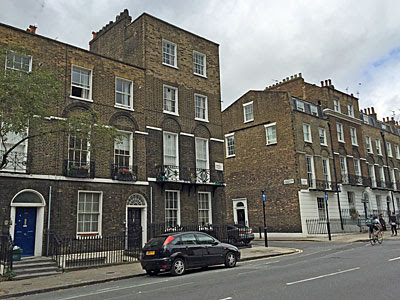
Instead I've been to the point where North, West and East London meet - that's the top red dot on the map. What's more it's nowhere important, it's an obscure road junction on a side street, about half a mile from the Royal Mail's largest London sorting office. And it looks like this.
This rather splendid row of Georgian townhouses is in Finsbury, near Angel, just off the Pentonville Road.
The houses on the left are in East London. This is Amwell Street EC1, named after one of the sources of the New River which ends at the bottom of the road. It's a broad and desirable thoroughfare with smart sash windows and basement flats, and small independent shops of the type that the Evening Standard likes to gurgle about. There used to be a Post Office a few doors down but that closed ten years ago.
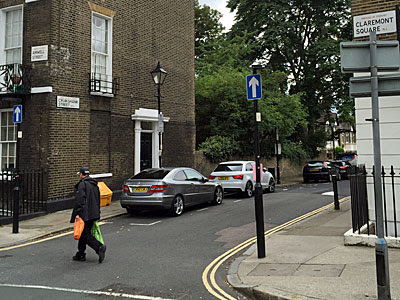
The houses on the right are in North London. This is Claremont Square N1, a fractionally more upmarket location with terraces of smart villas around three sides. In the centre is a covered reservoir, 55 metres square, built by the New River Company in 1855 to store and filter their water supply. Concealed beneath a raised mound of grass, the reservoir is reputedly made from four million bricks, and is still in use today.
The road leading off inbetween is in West London. This is Cruikshank Street WC1, a short one-way street of elegant 4-bedroom maisionettes with a classical touch. Originally called Bond Street, it was renamed in 1938 to honour 19th century caricaturist George Cruikshank who lived nearby. At the foot of the street is BevinCourt, a striking Y-shaped block of Modernist social housing designed by Berthold Lubetkin.
This quiet corner of Islington is the only place in London where the street signs have postcodes starting with N and W and E. It is the very kind of location that tends to make urban psychogeographers very excited.
I stood on the street corner for a few minutes attempting to channel the creative tension and cultural disconnect, but felt nothing, which isn't surprising because postcodes have no bearing on anything other than how residents' letters are sorted. But this is the precise point where North, West and East London meet. For what it's worth.
100 years ago today a bomb fell on the Black Swan pub in Bow Road, and five people were killed, including the publican's two daughters.
And this might be just another wartime tale, except that the flying machine causing the damage was a Zeppelin, the German crew were later captured by a village policeman, and the two daughters reputedly came back as ghosts.
This is the story of L33, one of four Super Zeppelins which targeted London and the South East on the evening of 23rd September 1916. At 200 metres long, these rigid airships were Germany's latest masterweapon and on their inaugural mission, and only one of the four would return safely to base.
Zeppelin L33 was captained by Alois Böcker and had a crew of twenty-one, plus a cargo of high explosive bombs and incendiaries stashed in a compartment in the centre of the keel. After crossing the Channel it passed over Foulness Island at 10.40pm, approaching the capital via Billericay (11.27pm) and Upminster (11.40pm). Here it dropped its first bombs on the common, causing no damage, before reaching Wanstead at a minute to midnight. A change of course took the Zeppelin down towards the Thames, passing between the anti-aircraft guns at Beckton and North Woolwich, then zigzagging back towards West Ham. It was a misty night, but East London was well served with searchlights and these picked out the aerial invader with ease, and a few minutes into Sunday 24th September one of the ground-based defences scored a direct hit.
With hydrogen now leaking from within, the German crew needed to lose weight fast, so an impromptu bombing raid began. The first cluster of high explosives landed off St Leonard's Street near to the junction with Empson Street (today just off the A12 opposite Bow School). Four terraced houses were wrecked, many nearby windows were shattered, and six people were killed. Some larger bombs were dropped on the North London Railway Carriage Depot, a maze of sidings and engine sheds beside what's now the DLR, north of the Limehouse Cut. Considerable damage was done to a boiler house, to rolling stock and to the tracks themselves. The next bomb damaged several houses and a Baptist Chapel on Botolph Road, a slum street long since vanished (behind the betting shop on Stroudley Walk). And then the Zeppelin reached Bow Road.
The Black Swan pub had stood on the corner of Bromley High Street for a hundred years, opposite St Mary's Church in the heart of the old village of Bow. The landlord in 1916 was Edwin John Reynolds, and he and his extended family lived in a suite of rooms above the bar. At precisely 12.12am a single 100kg bomb hit the pub dead centre, taking out all the floors down to the basement, and leaving a heavy pall of smoke in the air. The wife of the licensee was found in the cellar, and his two daughters Cissie and Sylvia were killed by the blast. His mother-in-law Mrs Potter also lost her life, and firemen found the dead body of Sylvia's one year-old daughter stuck in the rafters. Seven other local residents were injured when the neighbouring premises were destroyed, after what had been a wholly unexpected and tragic night.
The Zeppelin continued to the north, dropping another 100kg bomb at the eastern end of Wrexham Road (now the junction with the A12 dual carriageway). Three women were injured here, but little damage was done. Turning east towards Stratford the flight path now crossed what was then an industrial zone along the River Lea. A bomb fell on Cook's Soap Works (on Cooks Road) and failed to explode, while the British Petroleum works on Marshgate Lane were not so fortunate - several underground oil pipes were broken and a large water main damaged. Most of the airship's remaining bombs fell inconsequentially on Stratford Marsh (now the southern part of the Olympic Park), but one hit Judd's Match Factory, setting it on fire and destroying most of the stock.
Even with its ammunition dropped, L33 was still losing height and the captain made the decision to withdraw into Essex. The wounded Zeppelin headed off via Leytonstone, Woodford and Buckhurst Hill, taking another hit from ground defences at Kelvedon Hatch, eventually reaching the coast near West Mersea. Böcker's plan was to sink his airship in the North Sea to prevent the British from recovering its technology, but at 1.15am a gust of wind brought the craft down tail first in fields outside Little Wigborough. All of the crew survived the crash landing, and promptly set their craft alight in the hope that it would be destroyed. Then they marched off down the lane, where they promptly bumped into a Special Constable on a bike with a flashlight, attracted by the blaze. He was, understandably, suspicious.
"How many miles is it to Colchester?" asked Kapitänleutnant Böcker, in a not-quite-convincing English accent. Suspicions confirmed, the constable followed the Germans up the lane to Peldon, where they were delivered to the village constable who formally arrested them. Böcker and his crew became the only armed soldiers to be captured on English soil during the First World War, and were swiftly transferred to the military base on Mersea Island. Meanwhile the frame ofthe Zeppelin was still mostly intact, and attracted a quarter of a million sightseers and souvenir hunters over the subsequent weeks. The military were also delighted to have foreign technology to investigate, and incorporated aspects of the German design into later British airships.
The crash of the L33 is the most exciting thing ever to have happened in Little Wigborough, and is being celebrated this weekend with a centenary event called Zepfest. A £10 ticket will allow you to walk the crash site, hear talks from experts and see a selection of World War 1 vehicles, as well as experience a flypast (weather permitting). You should also be able to pop into St Nicholas church to see the memorial to Zeppelina Williams (1916-2004), a baby girl born in the neighbouring village on the day of the crash and whose name was suggested by the doctor who delivered her.
Back in Bow, the Black Swan pub was eventually rebuilt in 1920. All sorts of apocryphaltales exist of the ghosts of Cissie and Sylvia Reynolds appearing in the building, and of beer taps starting and shutting off by themselves. It's clearly tosh, especially any supposed sightings in the last 40 years because the pub was demolished in the early 1970s to make way for the widening of Bromley High Street. Head down today and you'll see Hardwicke House, a none-too exciting block of flats, and absolutely no pubs at all. So entirely has pre- and post-war redevelopment wiped away the Bromley side of Bow that few who live here now could even begin to picture the scene 100 years ago when fire rained down from a Zeppelin overnight. But what a story.
Should we build the Garden Bridge? I've been down to the intended site to decide for myself.
I started at the northern end of the proposed span, at Temple. Very few people were using the station, which is fortunate because it's going to have to be closed for six months when construction gets underway, and this means nobody will be inconvenienced. When the bridge finally opens the station will be immediately adjacent to a world-class tourist destination, thereby justifying its existence, and providing useful access to Somerset House and the Strand.
The area immediately around Temple station is an inaccessible backwater, adjacent only to the Thames Embankment, and would be greatly enhanced if tourists from the South Bank were able to reach it more easily. Also the East-West Cycle Superhighway passes this way, so cyclists won't need to go up to the new bridge to push their bikes across the river, and £30m of transport funding won't have been wasted.
At the moment the immediate locality can only support a small independent cafe, an Australian-themed bar and two stalls selling magazines and fruit. Although this makes it easy to buy a proper breakfast and a copy of Private Eye, modern visitors expect so much more, and the opportunity to introduce chain outlets selling mass-produced pastries should not be understated.
Alongside in Temple Place is a Grade II listed Cabmen's Shelter, a small green hut opened in 1880, providing rest and sustenance for the taxi trade. This will have to move when the road is pedestrianised, shifting parking spaces for the cab trade into neighbouring Surrey Street, and with the added benefit that passers-by will then no longer be distracted by the offer of a freshly-fried bacon butty or toasted ham sandwich from the hatch for £2.50.
Access to the Garden Bridge will be via lifts or stairs to an upper deck on top of Temple station. This upper deck already exists, and is a bland featureless expanse with only a table tennis table and more than thirty benches. Bad planning means that any view across the river is blocked by trees, so in summer there really is nothing to see, and heaven knows why quite so many people were up there.
The view from the centre of the river will obviously be much better, there being no annoyingly massive trees in the way, because the deck of the bridge can't support substantial roots. But the span will thrive with plantlife, which means nobody will miss the three plane trees on the Victoria Embankment which will have to be felled so that the Garden Bridge can carve through. From what I saw, the leaves are already turning yellow and starting to fall off, so the removal of these diseased trees can't come soon enough.
A big gap exists between Waterloo Bridge and Blackfriars Bridge, a ghastly planning oversight which makes crossing the river very difficult. To reach Waterloo Bridge from Temple I had to walk for three and a half minutes, which is clearly beyond the ability of most people. More to the point I passed only forty trees along the way, suggesting that the new Garden Bridge will really bring this barren stretch of the Thames to life.
The view from Waterloo Bridge is distinctly substandard, with some domed cathedral in the background, and a big watery space where the Garden Bridge ought to be. Also there's no vegetation on Waterloo Bridge, only an awful lot of traffic, and none of the deck is sponsored. Especially confusing are the rules which mean the bridge is permanently accessible to the public and not sealed off overnight, nor watched over by private security guards, nor closed twelve days a year for jollies.
The South Bank is of course ridiculously busy, and urgently needs an additional exit to ease the pressure. My trek back from Waterloo Bridge to the Garden Bridge's intended landing point took all of three minutes, so was a real slog, and involved walking past another forty trees. Again the riverside walkway isn't really suitable for cyclists, so preventing them from riding across a beautiful arboreal span will prove no hardship.
The Garden Bridge clearly has to touch down somewhere, and a patch of lawn in front of ITV's South Bank studios is more ideal than most. Hardly anybody uses it, so a concrete and steel platform will be more welcome than the risk of treading in something unpleasant. A number of occasional coffee vans already utilise the embankment close by, and IBM's office block isn't exactly scenic, so the arrival of a grey structure with retail outlets won't look entirely out of place.
Somewhat disappointingly a pressure group has attached signs to each of the three dozen trees on the South Bank they say will be cut down to make way from the bridge and its associated podium. But they may be lying, and these mature specimens may somehow be left standing around the footprint of the new building, so long as the row of shops and cafes doesn't stretch out too far. What's for certain is that this invasive propaganda has an impact on those walking by, and many strike up a conversation about the integrity of the Garden Bridge as they pass.
It's surprisingly hard to envisage the impact the Garden Bridge will have at its two endpoints, even given the vast amount of publicity this landmark project has had over the last few years. Only when the trucks arrive and the chainsaws start to whirr will the reality start to bite, and it'll then be a couple of years before the utopian crossing opens and the sponsors start to get their money's worth.
The Lumley-Heatherwick Bridge, as it will surely be known, is a bold architectural project unique in its ability to divide public opinion. How astonishing it might be to walk across the Thames between horticultural specimens from around the world, pausing to enjoy the vistas opened up mid-river and paying heed to all necessary bye-laws. Tourists will flock to London to see it, two vibrant cultural districts will be linked, and an ever-changing seasonal landscape will be unlocked each day at six.
But how can the project's questionable funding be justified, and should we be encouraging the privatisation of public space, and wouldn't any bridge be better located elsewhere? Let's hope this folly is never built.
300 things I love about London [because it's fifteen years today since I moved here]
Life, nightlife, the sense of history, the Underground, the Overground, canalside strolls, the view from Greenwich Park, the fact there's always somewhere new to discover, cutting-edge architecture, classical architecture, curvaceous Regent Street, the chimes of Big Ben, the 2012 Olympics, layers of history, nightbuses, investment, world cinema, world cuisine, the world in a city, a Muslim Mayor, London is Open, sunlight on the Thames, the museums in South Kensington, the museums that aren't in South Kensington, not needing a car, the wobbly Millennium Bridge, the City's dragons, a bus stop within 400m, it's quicker to walk, being able to choose from more than two local radio stations, suburbia, Trellick, Balfron, step-free travel, Tate Modern, mudlarking, Hampstead, the view from Hampstead Heath, diversity, acceptance, mind the gap, five of Arsenal's Premiership away matches being nearly at home, strolling along the South Bank, Waterloo sunset, the view from the top of anywhere tall, low tide, festivals, the Royal Festival Hall, pavement swagger, ghost signs, ghost stations, sitting in the Radio 4 audience, Trafalgar Square, knowing that I could walk home from Trafalgar Square if I really had to, art-filled piazzas, 100% style, tracing a line on a map, taking the tram, realising that the person drinking next to me in the pub is a celebrity, the Woolwich ferry, Hammerton's Ferry, the plurality of alternative routes, St Pancras station, cultural gravity, the highest pod on the London Eye, lost rivers, not-yet lost rivers, walking up the escalator, decent mobile phone reception, clapping the Marathon, density of infrastructure, free newspapers, the Night Tube, cab drivers, memories embedded in every streetscape, heritage Routemasters, the tiles along the Victoria line, blue plaques, global landmarks, having a local library, taking a shortcut down a back street I've never walked down before, realising that Dr Johnson was right, scouting the rural outskirts, Hawksmoor, Soane, Holden, watching the dawn over Tower Bridge, watching twin bascules rise, Blue Badge guides, the forgotten corner of a Victorian cemetery, the West End, the East End, the Congestion Charge, 24 hour bagel shops, 24 hour fridge-filling, culture on my doorstep, Banksy on the wall, the original of that famous work of art, an unexpected rainbow, deckchairs in Green Park, Roding Valley, Ruislip Lido, the Embankment illuminated, eyeballing a famous person in the street, recognising where a film was shot, Riddlesdown, revisiting Nairn's London, the DLR, sitting at the front on the DLR, meeting up with mates, Totters Lane, 0° longitude, standing in two hemispheres, the City, parklife, knowing when your bus is coming, Citymapper, the Ceremony of the Keys, being alone under the Thames in a foot tunnel, greasy fry-ups, fast trains to the coast, the view from Primrose Hill, far less fog than everyone imagines, snow on terraced rooftops, a good service is operating on all lines, Covent Garden, yes they deliver, creative possibilities, the view from the front seat on the top deck of a bus, alleys, tunnels, the middle of Richmond Park, free-roaming deer, D Stock, getting caught up in West Ham turfing out, street art, street food, Kenwood, being out at 4am, an unexpected smile in the rush hour, the Gherkin, critical mass, Soho, pie and mash, Longplayer, the opportunity to pop into Parliament, street markets, lidos, late-openings, rooftop terraces, gasholders against a bright blue sky, Open House, speeding down the river beneath world famous bridges, bleak estuary strolls, film premières, Farthing Downs, regular flypasts, garden squares, General Roy's cannons, not needing to drive home from the pub, pedestrian countdown lights, postcode identity, hyperlocality, Epping Forest, swiping my Oyster, pay-as-I-go, the smell of bacon from a Cabmen's shelter, undeveloped farmland, the Low Emission Zone, finding myself somewhere you've never been, Northala Fields, high streets that stay open after 5:30, art galleries that stay open after 6, still buzzing on a Sunday evening, always having something to do even when it's raining, Mornington Crescent, pocket parks, atypical roundels, characterful terraces, Denis Severs' House, urban wildlife, a night at the dog track, outstaring a fox, Foyles, youthfulness, a nearby launderette just in case, lights at night, pounding the Loop, free fireworks on Blackheath, the National, the Saatchi, the Serpentine, the Sales, garden squares, suburbs pretending to be villages, actual proper unswallowed Kentish villages, anything that Bazalgette built, one hundred different burgers, the heat island effect, Remain, the Hainault loop, crossing Oxford Circus diagonally, cycle superhighways, living in a medieval village, Sister Ray, walking faster than the traffic, overtaking a jogger, Kew Gardens, standing under the dome of St Paul's Cathedral, living in a city that tourists pay £100 a night to visit, not needing a hotel before catching the red-eye, Spitalfields, King's Cross, never needing to Uber, windmills, forest, hills, fields, Hilly Fields, Strawberry Hill House, the 4th plinth, Norway's gifted tree, the Geffrye at Christmas, the top floor at the V&A, the Sultan's Elephant, gelateria, lavender fields, Limehouse to Little Venice, this not being Ipswich, following in Roman footsteps, stepcounter heaven, plane trees, grime, world-class design, the Freedom Pass, heron-spotting, New Johnston font, so many cinemas, still so many bookshops, wi-fi, 1908, 1948, E20, EL2, RV1, 4G, Zone 6, crossing Westminster Bridge at night on the back of a bike, the skyline at dusk, Eel Pie Island, do not touch the walrus, do not feed the pelicans, Beckton Alp, the Hoover Building, a sewing machine museum, gridlessness, reaching the middle of Hampton Court Maze, long-term planning, wondering what the Turbine Hall will hold next, anything you need within half an hour, if the local branch doesn't stock it ten others might, floating towpaths, legacy, Little Waitrose, international churn, the sheer variety of Theatreland, the contrast between Erith and Twickenham, nipping down to national celebrations, it's only a short dash to the country, knowing the ambulance will get here in time, the British Museum, arthouse pop-ups, brutalist symmetry, some pubs still aren't flats, free stuff-to-do every weekend, whatever I want, anything I need, the anonymity of not knowing my neighbours, being one in nine million, collective consciousness, common ground, independence, invisibility, togetherness, cosmopolitan coexistence, centrality, accessibility, the proximity of possibility, social autonomy, human availability, the fact it's not as scary as out-of-towners think it is, Metro-land, moquette, deserted Thames-side beaches, a 600 square mile playground, the buzz, infinite choice, the city's constant resilience, feeling alive, simply living here.

300 things I love about London