All 22 stations on the Metropolitan Line from Amersham to Liverpool Street have a letter 'R' in their name.
If only Aldgate had an 'R' as well, that'd be the whole journey from one end of the line to the other, but alas not.
Meanwhile there are 18 consecutive stations with a 'T' on the Piccadilly line between Knightsbridge and Heathrow, and 15 consecutive stations with an 'A' on the Metropolitan line between Barbican and Ruislip Manor.
But what really caught my eye was what happens if changes of line are allowed - how many consecutive lettered stations are possible now? To clarify, it's tube stations only, and no station may be visited more than once in each chain.
According to the thread it's possible to travel through 20 successive stations containing the letter 'T', 24 stations with an 'E' and 28 stations with an 'A'. But the winner in this alphabetical challenge is 'R', a letter which they said could be found in the names of 36 successive tube stations from Amersham to North Greenwich. So I thought I'd give this record-breaking 'R' journey a try. And hurrah, I actually managed 38! Here's how.
AMERSHAM
This route begins almost as far out of London as you can get by tube. Only Chesham would be further, but Chesham doesn't have an 'R' in it, so Amersham it is.
→ CHALFONT & LATIMER → CHORLEYWOOD → RICKMANSWORTH
Technically I could divert via Croxley next, because there are a tiny number of journeys round the North Curve between Rickmansworth and Croxley either very early in the morning or very late at night. But connections would be awkward, and TfL don't bother putting this line on the tube map, so I'm going to ignore the possibility.
→ MOOR PARK
When the Metropolitan line extension is opened in 2020 (or whenever), there'll be a better way to start the 'R' challenge. All the stations from Watford Junction down to Croxley will have an 'R' in, and there'll be five of them, knocking the final total up to 39. In the meantime, however, Amersham is the better way to begin.
→ NORTHWOOD → NORTHWOOD HILLS → PINNER → NORTH HARROW → HARROW-ON-THE-HILL → NORTHWICK PARK → PRESTON ROAD → WEMBLEY PARK
Metropolitan line trains from Amersham used to run fast through a lot of this section, skipping stations to get passengers to central London faster. But these days only a few rush hour services run fast, which means residents of Pinner get more trains but residents of Amersham get slower trains (and stop at lots more stations with an 'R' in).
→ FINCHLEY ROAD
Could a diversion down the Jubilee line have added five more stations? Alas no, because Neasden, Dollis Hill and West Hampstead don't have an 'R' in them, so I had to stay on the Met and speed by.
→ BAKER STREET
Similarly I couldn't take the Jubilee line along this stretch because Swiss Cottage and St John's Wood aren't playing ball. Indeed it's a well known piece of tube trivia that St John's Wood is the only tube station to share no letters with the word 'mackerel', and that's got an 'R' in it.
→ GREAT PORTLAND STREET → EUSTON SQUARE → KING'S CROSS ST PANCRAS
The Metropolitan line continues to Liverpool Street via four more stations with an 'R' in them, but Liverpool Street is surrounded by stations that don't have an 'R' in them so is pretty much a dead end. Instead it's finally time to get off my first train and head for the stations inside the ring of the Circle line. One hour down, one hour to go.
→ RUSSELL SQUARE → HOLBORN → COVENT GARDEN → LEICESTER SQUARE
The Piccadilly line is the only way out from King's Cross St Pancras, because I can't travel via Euston, because it doesn't have an 'R' in it.
→ TOTTENHAM COURT ROAD → GOODGE STREET → WARREN STREET
And now the shenanigans begin. By some fantastic lexicographical quirk, every station inside the Circle line has an 'R' in it (excluding Queensway up one end, and Bank and St Paul's up the other). This reduces the challenge to 'trying to visit as many stations as possible without doing one twice', before exiting the central area at Victoria. Expect a lot of zigzagging.
→ OXFORD CIRCUS
After Oxford Circus and before Green Park, there's a choice of nipping to either Bond Street or Piccadilly Circus - it's not possible to collect both. I chose to take the Bakerloo line because the interchange at Oxford Circus is really easy.
→ PICCADILLY CIRCUS
It'd be nice to pick up Charing Cross by going one more stop down the Bakerloo and coming back up the Northern, but I've already been to Leicester Square, so Charing Cross has to go uncollected.
→ GREEN PARK
And it'd be nice to continue along the Piccadilly line to pick up Hyde Park Corner and Knightsbridge, but South Kensington has other ideas about that, by not having an 'R' in it.
→ VICTORIA
I've now reached the opposite side of the Circle line and grabbed ten stations inbetween, which I believe is the maximum possible, and the key to the challenge.
→ ST JAMES'S PARK → WESTMINSTER
If the first hour on the Metropolitan line was easy, the last 40 minutes spent interchanging around central London has been somewhat of an assault course, and is not for the faint-hearted.
→ WATERLOO → SOUTHWARK → LONDON BRIDGE → BERMONDSEY → CANADA WATER → CANARY WHARF → NORTH GREENWICH
Thankfully the end of the journey is easy, as the Jubilee line delivers seven consecutive stations to finish off the challenge. What is it about the letter 'R' which makes it appear so frequently in the names of tube stations? But it's not possible to continue past North Greenwich as the next stations are Canning Town and West Ham, and they're sadly R-less. Still, that's 38 stations in a row all with the letter 'R' in them, which is pretty damned impressive in itself.
P.S. Yes, I have genuinely travelled this route, and it took me 1 hour and 57 minutes.
P.P.S. If the cable car were part of the tube network, I could then have continued from Greenwich Peninsula to Royal Docks - it's not even necessary to include the name of the sponsor - making 40. And if the DLR were allowed too, I could then have extended my route from Royal Victoria all the way to Gallions Reach, making 47 in total. But that's not allowed, so 38 it is.
P.P.P.S. When Crossrail opens, I think we can get the 'R' total up from 38 to 40 by including a hyperleap between Tottenham Court Road and Bond Street. But in the meantime 38 is the maximum possible, and that's still amazing enough, I think you'll agree.
The Home Secretary has announced that the triggering of Article 50 next year will be marked by a public holiday.
Prime Minister Theresa May welcomed the announcement and said: "Pressing the button to exit the European Union will be a happy and momentous occasion for our country. We want to mark the day as one of national celebration. A public holiday will ensure the most people possible will have a chance to celebrate on the day."
A full programme of commemorative events will be held across the country, from Sunderland to Cornwall, and from Blackpool to Great Yarmouth. Celebrities including Noel Edmonds and Sir Ian Botham will lead rallies in key constituency hubs, and a range of British-made souvenir merchandise will be available for purchase.
Foreign Secretary Boris Johnson said: "The last few months have been a difficult time for Britain. A turbulent referendum campaign tore the country apart, pitting neighbour against neighbour and reason against hate. We now seek to drive forward the momentum of that collective decision, and to heal the wounds with a good old British knees-up."
All private sector workers will be given the day off, along with selected public sector workers including teachers in academies and outsourced colleagues on zero hours contracts.
David Davis, Minister for Exiting the European Union, said: "Only when Article 50 is triggered will the Brexit process become real and unstoppable. Whilst we are not yet ready to release all the details, we want the public to be as prepared as possible for this historic day, and to unite together towards a common aim."
The public holiday will apply only to businesses in England and Wales. The electorates of Northern Ireland and Scotland failed to vote Leave, so it would be unfair to give them the day off.
Small amounts of funding will be available for hosting street parties, village fetes and parades of armed forces veterans. A 'Fifties' theme has been confirmed, looking back towards a golden age of rosy austerity. All free-to-air TV channels other than BBC1 and ITV will close down for the day, and the Channel Tunnel will be temporarily sealed off. Meanwhile Mary Berry and Marks and Spencer will join forces to release a special selection of era-appropriate British treats including spam and blancmange washed down with a bottle of dandelion and burdock.
Citizens will be encouraged to send 'Happy Article 50' greetings cards and to drape their homes with red tape. Gary Barlow and Andrea Leadsom will headline a special concert on The Mall in conjunction with The Sun newspaper, with tickets awarded to a random selection of confirmed Leave voters. At dusk a chain of beacons will be lit starting from the White Cliffs of Dover, spreading a message of hope to all four corners of our country. Migrants may be invited to the festivities with community consent. The day will end with a series of bonfires beside rivers, because it would be especially symbolic to burn bridges as our exit from the EU is confirmed.
The name of the public holiday is as yet undecided. The Prime Minister suggested Article 50 Day, but focus groups suggested this was a bit dull. Liam Fox suggested Victory Over Europe Day, but this was thought too triumphalist. Boris Johnson suggested The Big Brexit Red Button Holiday, until it was pointed out that this is too long to fit in a Daily Express headline. Nigel rang in to suggest Independence Day, but this was considered a bit over-the-top, and the actual day of independence will be at least two years hence. The Home Office sub-committee in charge of things even considered asking an expert, then remembered that Britain's had enough of experts. Instead a shortlist of suggestions will be aired on The One Show in November and put to the public vote, and the most populist of these will be adopted. In the meantime the codename St Brexit's Day is being deployed, which seems to sum things up well enough.
As yet it is not possible to confirm the date of this additional bank holiday. We cannot pre-announce the precise moment that Article 50 will be triggered because this would place us at a disadvantage in future negotiations with the EU and our trading partners. Obviously June 23rd is high on the list, as this would be the first anniversary of Our Glorious Revolution, but that's probably too obvious. Several Cabinet members were quite keen on April 23rd, except that's a Sunday next year and so ineligible. Boris Johnson wanted May 30th to make a long weekend of the Spring break, but the Chancellor explained he probably can't target the date that precisely. Instead the public holiday will be scheduled whenever fits best with how things are going, all things considered, and will be delivered in the fullness of time when conditions are right.
Confirmation of the date of St Brexit's Day will be released via social media on the previous evening, shortly after financial markets cease trading, thereby increasing economic stability in turbulent times. This is an important part of the plan, almost as important as guaranteeing that the stock markets are closed on the day Article 50 is triggered. This isn't really a public holiday for the public, it's a bank holiday for the banks, ensuring that there can't be a run on the pound when Brexit becomes irreversible.
In the meantime rest assured that this current period of political stalemate will soon be over, because our plans are definitely coming together. We do very much know what we are doing, and we'll have those trade deals and that ban on immigration sorted before you know it. In the meantime we've cooked up this diversionary sideshow as a patriotic smokescreen, and to make it look like we're doing something.
Please make plans now to join us on St Brexit's Day, assuming it happens, and whenever it may be.
Yesterday I hastened down the Lea from Hoddesdon to Holdbrook. Today it's time to trek across Broxbourne from east to west. [11 photos]
Somewhere historic: Waltham Cross
Two Walthams coexist on either side of the River Lea - the more ancient Waltham Abbey on the Essex side, and the one we're interested in in Herts. Its name derives from the funeral procession of Queen Eleanor of Castile, beloved wife of King Edward I, who died in a village near Lincoln in November 1290. The queen's embalmed body was then transported to Westminster Abbey for burial, pausing overnight a dozen times, and the King later had memorial crosses built at each stop along the way. Waltham was the last stop before London, a diversion from Watling Street to Ermine Street so that Eleanor's procession would end with a ride through the City. Of the twelve Eleanor Crosses only three survive today - two in Northamptonshire and one here at Waltham, now Waltham Cross.
The monument has three hexagonal storeys, like an ecclesiastical wedding cake, topped off with a spire and cross. It almost didn't survive, having been ill-treated by villagers and clipped by several coaches over the years. In 1728 a certain Mrs Robinson "rebuilt part of her house and encroached upon the road and broke down a good deal of the cross to make way for her roof", and in 1796 "much of its beauty is concealed and many of its ornaments disfigured" thanks to extensions at the neighbouring tavern. The cross's exterior brims with 13th century symbolism, and features some especially fine carvings of the queen, but these are not the originals. When the cross was restored in 1950 the crumbling carvings were due to be binned, but Cheshunt's librarian far-sightedly rescued and rehoused them, and they're now in the care of the V&A.
Eleanor's cross now stands behind railings in the centre of a pedestrianised square and looks clean and cared-for, though surrounded by buildings that are anything but ancient. On Saturday the cross was being serenaded by two buskers, almost tunefully, while a man in a red trailer parked alongside attempted to flog me Virgin Broadband. The betting shop opposite is the site of the aforementioned tavern, Ye Old Four Swannes Inn, well known in these parts for the quartet of swans perched on a gantry across the High Street. Again these are replicas, the elm originals having been transferred to Lowewood Museum in 2007 (where I caught them earlier, and very splendid they are too). by train: Waltham Cross, by bus: 217, 279, 317, 327, 491
My next location is less than a mile distant, but excuse me while I make a pilgrimage to my grandparents' house along the way. I know this area well from visiting it a lot as a child, and my Mum knew it better because she grew up here. Their very ordinary semi still stands, though only just, being a hairsbreadth from the tarmac chasm bulldozed through Waltham Cross in the late 1970s to feed traffic onto the A10 bypass (whereas at least the M25 had the good manners to tunnel underneath). The diamond lights in my gran's front door might still be the same, but the solar panels on the roof are new, and the lawn in the front garden has been paved over so that two identical black Fords with matching personalised numberplates can be parked outside. On Saturday new neighbours were emptying their belongings from the back of a white van, while the oddball in the house at the top of the street had stuck a sign to their wall urging 'The Pigs' to STOP LEAVING RABISH NR MY DOOR OR TAKE IT TO YOUR MOTHER. Never go back.
Somewhere pretty: Cedars Park
Whereas Queen Eleanor only passed through Waltham Cross, King James I spent much of his time here. He took a particular shine to Theobalds Palace, and persuaded the Cecil family to swap it for Hatfield House, whereupon he had the place extended into a turrety mansion on the scale of Hampton Court. The estate was enormous, marked by a ten mile long wall around the perimeter, and swiftly became James's favourite place outside the capital. A menagerie of animals including five camels and an elephant was kept to entertain guests, along with grand gardens centred round a marble fountain with secret pipes to splash unwitting passers-by. Charles I spent much of his childhood at Theobalds, and the announcement of his accession to the throne was made at the gate after his father died here following a particularly nasty bout of dysentery. But Charles was also the palace's undoing, it being handed over to the Commonwealth after the Civil War who promptly demolished it.
A subsequent mansion called The Cedars is now a conference centre, privately owned, in whose grounds London's Temple Bar nearly crumbled away. But the spot where the palace once stood is now a 47 acre park, open to the commoners of Broxbourne, who flood in to enjoy a resource far better than your average recreation ground. One 17th century arched wall remains, which you can walk or ride or even skateboard through on your way to the rose garden. Down by the wildflower meadow is a spiral turf mound, or Venusberg, recently piled up to mimic a Jacobean viewing feature. The trees are particularly fine, as you tend to find on the estate of a former mansion, and a couple of older buildings contain a tearoom for the adults and a Pets Corner for the kids. The original Elizabethan palace had a hedge maze, and this has been recreated by volunteers from News International, whose monolithic 21st century printing works lurks less than half a mile away. And all across Cedars Park are impressively evocative plaques, really very well done, explaining what used to be here when this was Monarchy Central. by train: Theobalds Grove
Somewhere musically famous (1): 12 Hargreaves Close, Bury Green
Cliff Richard is from Broxbourne, although not originally, neither was that his real name. Harry Webb was born in India in 1940, his family emigrating to England after independence, downsizing several notches from Empire comfort to suburban house-sharing. In April 1951 the family were offered a three-bedroomed council house in Bury Green, an estate on the western side of Cheshunt, at 12 Hargreaves Close. Young Harry went to the same school as my Mum (though she'd have left by then), and performed his first concert at the youth club behind the church where my parents got married (though he'd have been far too famous by then to appear at the reception). Band rehearsals took place in the front room at number 12, where the skiffle sometimes got too loud for the neighbours at number 11 who once begged the council to stop "these long, noisy evenings." Harry gave them short shrift, and played on. [map]
Hargreaves Close is rather quieter today, or at least it is on a Saturday afternoon. Not a soul was out of doors, which is probably just as well when you're stalking a cul-de-sac with a camera. Each side of the close is a single terrace, made up from what look like semi-detached houses merged together, with a central space of lawn and hardstanding for parking all the cars everybody now owns. Number 12 is down the far end on the right, now with porch and uPVC windows, and a small shrub in a grey stone pot by the door. The owner's probably tired of fans dropping by for a gawp, although it can't be as bad as the time in 2009 when Cliff himself popped back for a visit and an interview with Piers Morgan. I liked the estate, it had a sense of space and greenery, and endearing street signs with each road's name hand-painted with letters of somewhat variable thickness. All this plus an adventure playground on the green in Tudor Avenue - as I say, deserted, but still a good place to bring up The Young Ones. by train: Theobalds Grove
I'd nearly been to Cliff's road several times, but not quite, because my grandparents are buried 100 metres away in Cheshunt Cemetery. I was never sure how they managed to get such a prime location near the chapel, and I still don't know which arm of the family comes down to keep the gravestone clean. I strode up the yew avenue and paused for a short while to say hello, like you do, then wandered up to the very far end where I failed to find my auntie. While walking back to the entrance I spotted a blue star-shaped helium balloon rising over my head into the sky, and looked across to see the small child who'd just released it. "Bye Dad!" he called, standing proudly with his brother, mum and nan as the balloon drifted higher and eventually out of sight. Always go back.
Somewhere musically famous (2): The Old School House, Goffs Oak
Victoria Adams is from Goffs Oak, the only significant village in the district of Broxbourne. She's better known as Victoria Beckham, perhaps better still as Posh Spice, one of the sparky girl group who owned the mid-Nineties. And having been to Goffs Oak I now see where the 'Posh' bit came from, indeed the adjective could hardly have been anything else. [map]
There are two bits to Goffs Oak, with the main village a commuter hub up a long hill from Cuffley. It's smart but not oppressively so - it has a laundrette and a Co-Op, so how could it be? By contrast the Adams family's bit of Goffs Oak is disjoint across the fields, a nucleus of homes unreachable by pavement, but then nobody around here doesn't drive. At its heart is a crossroads and a single pub, the Prince of Wales, off whose four arms curl a handful of more-than desirable cul-de-sacs. Not all the houses are gated, but the majority are, with spike-topped railings in black and gold, and intercoms to keep unwelcome visitors out. Personalised numberplates are the order of the day, so I wasn't surprised when three consecutive Range Rovers went by, nor when the only business on St James Road turned out to be a car wash.
Most of the houses are infill but Victoria lived in one of the originals, The Old School House, located halfway between the pub and the parish church. Two-storey and three-gabled, it's large without being massive, and nicely finished in cream and timber. Further back along the road is a double garage with a toy soldier on sentry duty outside, and space for a full dinner party to park alongside. Just a fraction of garden is visible from the road, complete with classical statue, and there's every hint that this would have been a delightful place to grow up. Indeed I understand Victoria's parents still live here, which says something when your daughter is a global brand who could fund a house anywhere. But who'd move when Goffs Oak appears to get posh right, still a compact community rather than a string of isolated fortresses, and quite some springboard for a girl with dreams of fame. by train: Cuffley
Broxbourne's the last of four Hertfordshire districts on my orbital tour of the capital, and one of the smaller boroughs surrounding London. Essentially it's a string of merged residential areas threaded down the A10 to the west of the River Lea, plus a bit of countryside tacked on for balance. Hoddesdon and Broxbourne are the towns at the top of the chain, and Cheshunt and and Waltham Cross at the bottom. Two of the most obvious places for sightseeing are the New River and River Lea itself, but I've walked both of those before so gave them a miss. And whilst Broxbourne's not otherwise an obvious destination for a day out, I hunted down a few hopefully interesting locations. [11 photos]
Broxbourne's museum is housed in a Georgian mansion at the quiet end of Hoddesdon's High Street. It's part of a municipal cluster which includes a police station and Broxbourne's civic hall, the latter recently rebranded 'Spotlight', and soon to welcome Julian Clary and a Little Mix tribute act (separately, you'll be relieved to hear). The museum has a couple of rooms downstairs and three up, plus a central hallway with a video camera which allows the unseen lady on the desk to say hello to you as you walk in. The borough has a fair bit of history from its location on the road north out of London, and as a favoured spot for royalty, which I'll come back to in due course. There's also a goodly collection of Victoriana from an era of long-gone shops, and souvenirs from when local towns were favoured weekend destinations for leisure-seeking Londoners.
Hoddesdon gets rather more of a look in than the rest of the district, perhaps not surprising when it's on the doorstep, but a bit of a disappointment if you're a visitor whose family grew up at the Cheshunt end. A rather broader approach was taken by the travelling exhibition in the main gallery which showcases musical talent from across the East of England, including the not-local Depeche Mode and the very local Cliff Richard. This exhibition closed yesterday, so I won't go on about it, but I did relish the opportunity to press a button and play my Mum's favourite song in her local museum, and the discordant clash this made with the wartime ditties playing outside. Meanwhile the gift shop so prominently advertised outside on the pavement probably won't solve your Christmas gift problems, sorry, unless you're a resident with an interest in local history, in which case there's every chance. by train: Broxbourne
I'm not sure how I've never been to Hoddesdon before, although this may have a lot to do with badly-spaced stations. The town's had a market since the 13th century and grew later as a coaching stop, being not quite halfway to Cambridge, before the railway whisked that trade away. A surprising number of old buildings remain - the downloadable Heritage Trail lists 52 separate locations - including a charming tavern from 1532 and an repurposed office block from 1622. The High Street in particular is bubbling over with character, much of it timber-framed, and remains a popular location for weekend shopping. The Victorian clocktower at the north end was built on the site of a medieval chapel, hence still belongs to the diocese of St Albans, and retains two of the original clock faces. Looming behind is an ill-advised block of flats above a Morrisons, plus a modern shopping mall that looks wholly out of place (and is mostly dead). So yes, a nice town to have on your doorstep, but not even the Heritage Trail could fire my enthusiasm for a longer stay. by train: Rye House
Somewhere retail: Tesco HQ
If you have a tin or packet from Tesco in your kitchen cupboard, and it's been there for a year or more, it probably says 'Produced for Tesco Stores Ltd, Cheshunt' on the back. Jack Cohen's company rolled into town in 1973, opening up New Tesco House on Delamare Road to act as its headquarters. At the time Tesco wasn't the retail behemoth we know today, just a high street stalwart diversifying into grocery, but the scale of its new office suggested high hopes for the future.
Delamare Road is one turn back from Cheshunt station, a one-street industrial estate running for quarter of a mile beside the railway. It's not the kind of place you'd expect to house such a major brand, indeed the immediate neighbours are a printing company and a Monster Gym. But there it is, a five-storey concrete bunker with several rows of identically indented windows, either magnificently brutalist or oppressively no-frills, depending on your perspective. Look closely at the white plastic fascia above the entrance and you can just make out the company logo, while underneath a security guard sits waiting for a workforce who will never return. For alas New Tesco House is a casualty of the company's recent accounting scandal, closed to save money with the loss of 2000 staff, and all business merged into existing premises on the dull side of Welwyn Garden City.
The electric car charging points installed out front now seem a complete waste of money, and the sign pointing round the back towards Deliveries is no longer true. Two further buildings across the road have been sealed off with low concrete blocks, sufficient to deter invasion by vehicle if nothing else, together with a forwarding address and map for anyone who turns up here by mistake. No lorries turn up any more, and judging by the scale of one rear depot there'd once have been dozens of them. Instead the site waits to discover its future, with housing the most likely ultimate fate. Thousands of new residents will be able to commute easily to jobs up in London, which'll be convenient, there being rather fewer opportunities on their doorstep. by train: Cheshunt
Somewhere sporting: Lee Valley White Water Centre
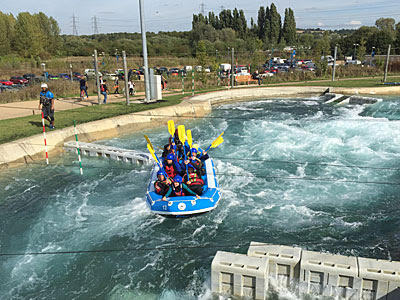
When London's 2012 sporting infrastructure was doled out, Hertfordshire got canoe slalom, the original intention being to build a circuit by the Lea near Broxbourne. But that site was too contaminated, so instead an overspill car park beside the county boundary with Essex was acquired, which is how several medals came to be handed out just off the main road between Waltham Cross and Waltham Abbey. And four years later the resulting infrastructure at the Lee Valley White Water Centre is still being well used, indeed at the weekend it was absolutely thriving.
There are two slalom circuits, one wild and Olympic standard, the other for more intermediate paddlers. You'd likely have more luck on the latter, the Legacy Loop, where children skim round in what look like tyres and middle-aged men in wetsuits haul themselves out of the water after an unfortunate kayak tumble. But all eyes are on the maincascade, a rough descent over artificial grade 4 rapids, where the white water of the centre's name is all too apparent. Canoeists use the weirs to practise turns and tumbles, but the main commercial event these days is rafting. Groups of nine tog up in protective layers and inch (or hurtle) round the course, watched over by a coach who encourages and cajoles, and a team of staff who watch from the sidelines ready to help anyone who flies loose. Several participants came unstuck while I was watching, one flopping out like a dead salmon as their raft descended into the foam, before hauling himself back on board further down the course.
It's not for me, I have enough trouble swimming, and I'd have been weeded out by the safety assessment in the lake at the beginning. But corporate clients lap up this stuff midweek, while stag and hen parties are amongst those taking advantage at the weekend. At £50 a seat it's not cheap, but it is a nice little earner for the site, and goes to pay for the hydraulics which keep the waterway churning over. The other thing management got right was the The Terrace, a cafe bar plus BBQ which overlooks the start of the descent. The first time I saw its exterior decking five years ago I thought it far too large, but this Saturday it was packed with friends and families and hangers on of those out on the water, plus those who'd already been round, totally ignoring the action while they tucked into coffee, prosecco, beers and meat. A rip-roaring post-Olympic success, I'd say, in a way the Velopark back in Stratford rarely seems to be. by train: Waltham Cross

Beyond London (14): Broxbourne (part 1)