There's been an enormous military presence in central London this week. Scores of army personnel have seen been rounding up civilians, searching their hand luggage and then corralling them behind makeshift barriers in the Royal Parks. Don't worry, it's all been in a good cause, and it's had absolutely nothing to do with 'the other' events of the week. A Living Museum opened in St James Park on Monday, organised by the Ministry of Defence as part of the 60th anniversary commemoration of the end of World War 2. It's a great idea - a series of 1940s exhibits with the focus on people, not on instruments of death - and a welcome opportunity for war veterans to remember and be remembered.
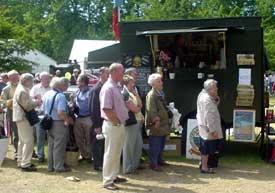
So, while the Queen was busy yesterday afternoon unveiling the new Women of World War II memorial in Whitehall, I went and queued up in the Mall for a trip back in time instead. I'll say one thing for the armed forces - they organise a damned efficient bag search. We then snaked into the main exhibition area through an unnecessary chicane of metal barriers - two easy minutes for me but walking hell for a few of the 80-year olds hobbling behind me. Never mind, there were ham and piccalilli sandwiches available in the veterans catering area at one end, although I hope they weren't original NAAFI rations.
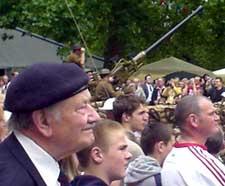
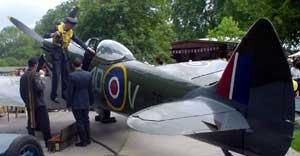
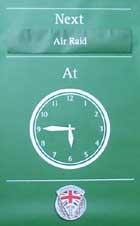
By the entrance I saw an old soldier in full regimental uniform and medals standing chatting to a young modern recruit with a celtic tattoo poking out beneath his khaki sleeves. A significant number of attendees looked like they'd seen active service fifty or sixty years ago, but they'd also brought along their grandchildren to pass on unforgettable wartime experiences to a new generation. Look kids, there's a German tank, and listen, that's the sound of the All Clear, and hey, let's give you a rifle and show you how to handle it. Several re-enactments brought the past nostalgically back to life. I cowered as ack ack guns and searchlights spun round to fight off an air raid, I watched uniformed pilots scramble into the cockpit of a Spitfire and I listened to the old music hall songs that kept the nation entertained back on the Home Front.
It was good to see several displays devoted to the often forgotten war in the Far East where so many soldiers fought and perished. And every level of wartime contribution was remembered, from the vegetable growers of the Land Army to the essential work of the Medical Corps, and from an evacuee support network to the codebreakers at Bletchley Park. Rather more up to date, I discovered GCHQ recruiting at the back of one tent, and the MoD were running a deviously interactive scratchcard competition in another (yay, I won a free wallet and an illuminated pen). So many people were smiling and enjoying the day, it's a pity that such an impressive participatory event will almost certainly never happen again.
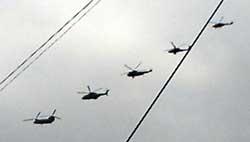
Today is National Commemoration Day, the culmination of this week's events. You can still get into the Living Museum until 1pm this afternoon (and if you can, do), and then there's a show on Horseguards and a parade and flypast on the Mall. The aircraft taking part in the flypast are due to gather over Victoria Park in East London later this afternoon, so I'll be down there to see the sky filled with airpower as it might have been back in the days of the Blitz that wreaked such terrible devastation on this part of the capital.
I must admit I'd originally been surprised and disappointed when I first heard that Britain's end-of-the-war commemoration would take place in early July - a meaningless date of no chronological significance halfway between VE Day and VJ Day. Alas the atrocities of recent days have given this week's celebrations an extra resonance. No matter what the generation, it appears that there are some people to whom you can never say thank you often enough.
After Thursday's golden dawn, Friday's grey skies echoed the previous day's bleaker sunset. As I headed down the Bow Road on my way to work it was clear that the streets were rather quieter than usual. Certainly far quieter than twelve hours previously when I'd been part of the steady trickle of displaced humanity walking in the opposite direction, making its weary exodus away from the paralysed capital. And unnervingly quieter than 24 hours earlier when a joyful London had still been basking in the heady afterglow of Olympic success.
The first bus to pass me yesterday morning was half empty. Normally there are passengers rammed into every doorway of every passing bendy bus, but suddenly taking a ride up west in a fragile metal box seemed far less alluring. Another East End bus was pictured, lost and empty, on the front of the newspaper I picked up outside the station. For the first time in four years the Muslim newsagent started up a lengthy conversation with me which stretched further than a cheery smile and a thankyou. He was concerned to hear how I'd managed to get home the previous evening and proceeded to relate how a member of his family had been unnervingly close to Aldgate when the first bomb exploded. Everyone, it seemed, had a story to tell.
Bow Road station was also much quieter than normal - no queues at the ticket office, no waiting at the barriers, no jostling down the stairs. Personally I was just glad that the station was still open, and still standing. A succession of regular recorded announcements advised us to keep hold of our luggage and to watch out for unattended packages - not that anybody really needed any prompting. While a handful of us waited, the tannoy recited a litany of suspended lines and closed stations. I think we were all impressed that the list wasn't longer. We stood around on the platform for five long minutes, after which gap the next train to arrive would normally be absolutely packed. But not on this particular morning. The doors opened and then, with an invisible one-fingered salute directed towards a gang of shadowy bloodied terrorists, we stepped on board and continued with our normal lives.
The Central line train I switched to at Mile End was even more unusual - there were several spare seats. Normally I get to stand squashed into my own tiny patch of space somewhere beside the far door, my newspaper clutched unopened beneath my arm, but yesterday for once I got the chance to sit down and open it. Reading about the tragic events across central London helped me to ignore the fact that I was doing precisely what so many of the slaughtered had been doing so innocently the day before. My fellow travellers (unusually for a Friday morning) were all wide awake and alert, surreptitiously scanning the floor of the half-empty carriage for suspect packages that obviously weren't there. There was absolutely no sign of alarm or panic, not even when we stopped briefly in a tunnel because of a security alert on the train behind us. Neither did we flinch at Liverpool Street where, 23 hours earlier, such tragic events had played out in the Circle line tunnel almost directly over our heads. Life continued.
I disembarked at a semi-deserted Holborn station. In the rush hour traffic above the surface central London appeared to be getting back to normal, but half a bus half a mile up the road told a different story. However bravely life goes on, however resilient the travelling public, a lot of patching up still has to happen before London feels wholly safe and safely whole. And there are some scars that will never heal.
It was hard to be certain but I sensed that people were looking a little uneasy on the Underground yesterday. Maybe that was just their regular Monday morning back-to-work look but more likely it was something else, a subconscious response to events last week 800 miles away in Madrid. Not that most people enjoy rush hour tube travel at the best of times, packed head-to-armpit in overcrowded carriages, but somehow those carriages didn't seem quite so overcrowded yesterday either. Those of us wielding newspapers flashed bleak headlines across the carriage, while travellers with bags clutched them a little closer. It's as if Londoners are silently praying not to be 'there' when 'it' happens, not that anyone quite knows where 'there' is, what 'it' might be, or when 'it' might happen. Me, I prefer to continue to wonder if, not when.
Last week's terrorist atrocity in Spain reminded us all how fragile freedom is, how much we take it for granted and how easy it is to lose it in a flash. Anyone can board a train in Europe, travelling anywhere, carrying anything. It's not like boarding a plane where we expect to queue for hours in advance and to have all our darkest recesses searched lest we have even a nail file stashed away somewhere. Trains and stations remain very public spaces, very accessible but also very exposed. And long may that remain so. Should we ever end up flashing an ID card to pre-book a ticket to travel three stops down the Victoria Line then the terrorists would undoubtedly have won. And there would still be plenty of other targets elsewhere for them to hit anyway.
London can't afford police patrols in every Underground carriage, which is just as well because there are hundreds of carriages, most of them quite full enough already. The police are introducing plain-clothes patrols, or at least they've told us they are (it is by definition hard to be sure). They've also promised to increase 'stop and search' checks by uniformed officers, although the chance of any of them uncovering 'it' 'there' if 'it' happens must be absolutely tiny. No, our best chance lies with the latest campaign to ask the travelling public for increased vigilance. Our eyes can be everywhere. And better to bring the entire network to a halt for every unattended carrier bag than to miss one anonymous rucksack opportunely abandoned underfoot in the peak hour rush.
London's been here many times before, of course, and London's by no means unique. The IRA's bloody mainland bombing campaign kept Londoners alert thirty, twenty, even as recently as ten years ago, and you still can't find a litter bin on the Underground as a result. And sixty years ago we endured the Blitz - night after night of terrible bombing, and night after night of terrible casualties. 17 died in a direct hit on Marble Arch tube station, 68 at Balham, 56 at Bank, 173 at BethnalGreen... and even that was but a tiny fraction of the overall death toll. A very heavy price was paid but London continued, and so it will again. Even if 'it' happens which, please God, 'it' never does.
Which, alas, 'it' just did. Please God 'it' never happens again.
After the day when London's dreams came true came the day the city had so long dreaded. Millions of commuters travelled to work by bus and train as normal, unwitting participants in a lottery of death. At the end of the day us lucky winners merely had to walk all the way home - the unlucky ones will never make it home again. But London won't be defeated by such evil and cowardly acts - it never has been and it never will be. See you all on the tube again tomorrow?
I must confess, I was expecting to be writing about Paris this morning. Hell, I even went to the effort of visiting the city three months ago to grab some tasty shots of the Stade de France. Seems I needn't have bothered. Fabulous, isn't it?
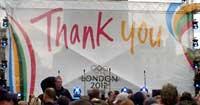
Olympic snapshots: Trafalgar Square I didn't think Trafalgar Square would be very full yesterday. I was wrong - it was rammed. Thankfully I'd arrived early and was able to weave my way down through the crowd into the central space, just a few rows back from the main stage. The world's media were already in place on the raised piazza in front of the National Gallery, their cameras pointed out over the seething throng below. Most people present were resigned to this being the London bid's last hurrah, a final 'Thank you' celebration for us getting this far through the shortlisting process. It had been a plucky attempt by the British underdog, although surely doomed to ultimate failure. But there was still a real air of tension in the square, especially when it was announced that the final battle was to be fought between Paris and London. And where better for a good old Anglo-French showdown than at the foot of Nelson's Column? A pointless mimed performance by popstar Rachel Stevens dampened the atmosphere somewhat, but a pair of chirpy presenters from Capital Radio rescued the situation by wheeling on a series of top class Olympic athletes. And then the big screens either side of the stage flashed over, live, to the announcement of the result in Singapore.
I have never seen anyone take so long to open an envelope. IOC president Jacques Rogge stood there building up his part for ten of the longest seconds anyone in the crowd will ever remember. 200 miles apart, two capital cities stood in expectant silence. And then, as the wholly unexpected word 'London' dripped from his lips, the crowd around me erupted in jubilant celebration. People gasped, and cheered, and leapt, and hugged, and waved flags in the air... and they carried on doing so for some considerable time. The line of Olympic greats took a second to react, but it was a joy to be close up to Kelly Holmes as she pulled another of her legendary jaw-dropping expressions. Her euphoria was infectious. After a few minutes Heather Small bounded on stage to perform 'Proud' to a delighted audience, and it all felt so right. "I step out of the ordinary, I can feel my soul ascending, I am on my way, Can't stop me now." Somehow, against all the odds, Seb Coe had pulled off one last gold medal-winning performance and the 2012 Olympics were coming here, to our city. Who'd have thought? Alas the next act lined up on stage was a jumped-up rap wannabe with a freshly-signed record contract complete with the dreaded words "and this is my new single". It was a depressing reminder of how easily big business takes priority over sporting achievement, something I suspect we'll see rather more of as 2012 approaches.
A red, white and blue flypast from the Red Arrows restored national pride somewhat, at which point (regrettably) I had to leave the square. I had to be back in the East End within the hour to rendezvous with my landlord for the first time in four years. I wondered whether he might want to evict me from my flat in favour of a foreign camera crew, or at the very least treble my rent now that I live amongst some of the most desirable real estate on the planet. But I needn't have worried. For a start, London's 'obsolete' transport system whisked me back to the Olympic Zone with plenty of time to spare. And my flat inspection went swimmingly, thank you very much (my surfaces have never been so gleaming), with eviction never even on the menu. It seems I'm safe and secure in my stadium-side home for several years to come, so I have every expectation of remaining an Olympic resident until the five-ring circus arrives here in 2012. Bringiton!

There's been an enormous military presence in central London this week. Scores of army personnel have seen been rounding up civilians, searching their hand luggage and then corralling them behind makeshift barriers in the Royal Parks. Don't worry, it's all been in a good cause, and it's had absolutely nothing to do with 'the other' events of the week. A Living Museum opened in St James Park on Monday, organised by the Ministry of Defence as part of the 60th anniversary commemoration of the end of World War 2. It's a great idea - a series of 1940s exhibits with the focus on people, not on instruments of death - and a welcome opportunity for war veterans to remember and be remembered.
So, while the Queen was busy yesterday afternoon unveiling the new Women of World War II memorial in Whitehall, I went and queued up in the Mall for a trip back in time instead. I'll say one thing for the armed forces - they organise a damned efficient bag search. We then snaked into the main exhibition area through an unnecessary chicane of metal barriers - two easy minutes for me but walking hell for a few of the 80-year olds hobbling behind me. Never mind, there were ham and piccalilli sandwiches available in the veterans catering area at one end, although I hope they weren't original NAAFI rations.
By the entrance I saw an old soldier in full regimental uniform and medals standing chatting to a young modern recruit with a celtic tattoo poking out beneath his khaki sleeves. A significant number of attendees looked like they'd seen active service fifty or sixty years ago, but they'd also brought along their grandchildren to pass on unforgettable wartime experiences to a new generation. Look kids, there's a German tank, and listen, that's the sound of the All Clear, and hey, let's give you a rifle and show you how to handle it. Several re-enactments brought the past nostalgically back to life. I cowered as ack ack guns and searchlights spun round to fight off an air raid, I watched uniformed pilots scramble into the cockpit of a Spitfire and I listened to the old music hall songs that kept the nation entertained back on the Home Front.
It was good to see several displays devoted to the often forgotten war in the Far East where so many soldiers fought and perished. And every level of wartime contribution was remembered, from the vegetable growers of the Land Army to the essential work of the Medical Corps, and from an evacuee support network to the codebreakers at Bletchley Park. Rather more up to date, I discovered GCHQ recruiting at the back of one tent, and the MoD were running a deviously interactive scratchcard competition in another (yay, I won a free wallet and an illuminated pen). So many people were smiling and enjoying the day, it's a pity that such an impressive participatory event will almost certainly never happen again.
Today is National Commemoration Day, the culmination of this week's events. You can still get into the Living Museum until 1pm this afternoon (and if you can, do), and then there's a show on Horseguards and a parade and flypast on the Mall. The aircraft taking part in the flypast are due to gather over Victoria Park in East London later this afternoon, so I'll be down there to see the sky filled with airpower as it might have been back in the days of the Blitz that wreaked such terrible devastation on this part of the capital.
Journey back to reality (ish)
The London Olympics: 2012
I didn't think Trafalgar Square would be very full yesterday. I was wrong - it was rammed. Thankfully I'd arrived early and was able to weave my way down through the crowd into the central space, just a few rows back from the main stage. The world's media were already in place on the raised piazza in front of the National Gallery, their cameras pointed out over the seething throng below. Most people present were resigned to this being the London bid's last hurrah, a final 'Thank you' celebration for us getting this far through the shortlisting process. It had been a plucky attempt by the British underdog, although surely doomed to ultimate failure. But there was still a real air of tension in the square, especially when it was announced that the final battle was to be fought between Paris and London. And where better for a good old Anglo-French showdown than at the foot of Nelson's Column? A pointless mimed performance by popstar Rachel Stevens dampened the atmosphere somewhat, but a pair of chirpy presenters from Capital Radio rescued the situation by wheeling on a series of top class Olympic athletes. And then the big screens either side of the stage flashed over, live, to the announcement of the result in Singapore.
I have never seen anyone take so long to open an envelope. IOC president Jacques Rogge stood there building up his part for ten of the longest seconds anyone in the crowd will ever remember. 200 miles apart, two capital cities stood in expectant silence. And then, as the wholly unexpected word 'London' dripped from his lips, the crowd around me erupted in jubilant celebration. People gasped, and cheered, and leapt, and hugged, and waved flags in the air... and they carried on doing so for some considerable time. The line of Olympic greats took a second to react, but it was a joy to be close up to Kelly Holmes as she pulled another of her legendary jaw-dropping expressions. Her euphoria was infectious. After a few minutes Heather Small bounded on stage to perform 'Proud' to a delighted audience, and it all felt so right. "I step out of the ordinary, I can feel my soul ascending, I am on my way, Can't stop me now." Somehow, against all the odds, Seb Coe had pulled off one last gold medal-winning performance and the 2012 Olympics were coming here, to our city. Who'd have thought? Alas the next act lined up on stage was a jumped-up rap wannabe with a freshly-signed record contract complete with the dreaded words "and this is my new single". It was a depressing reminder of how easily big business takes priority over sporting achievement, something I suspect we'll see rather more of as 2012 approaches.

 There's been an enormous military presence in central London this week. Scores of army personnel have seen been rounding up civilians, searching their hand luggage and then corralling them behind makeshift barriers in the Royal Parks. Don't worry, it's all been in a good cause, and it's had absolutely nothing to do with 'the other' events of the week. A
  So, while the Queen was busy yesterday afternoon
  By the entrance I saw an old soldier in full regimental uniform and medals standing chatting to a young modern recruit with a celtic tattoo poking out beneath his khaki sleeves. A significant number of attendees looked like they'd seen active service fifty or sixty years ago, but they'd also brought along their grandchildren to pass on unforgettable wartime experiences to a new generation. Look kids, there's a German tank, and listen, that's the sound of the All Clear, and hey, let's give you a rifle and show you how to handle it. Several re-enactments brought the past nostalgically back to life. I cowered as ack ack guns and searchlights spun round to fight off an air raid, I watched uniformed pilots scramble into the cockpit of a Spitfire and I listened to the old music hall songs that kept the nation entertained back on the
  It was good to see several displays devoted to the often forgotten war in the Far East where so many soldiers fought and perished. And every level of wartime contribution was remembered, from the vegetable growers of the Land Army to the essential work of the Medical Corps, and from an evacuee support network to the codebreakers at Bletchley Park. Rather more up to date, I discovered
  Today is
  I didn't think
  I have never seen anyone take so long to open an envelope. IOC president Jacques Rogge stood there building up his part for ten of the longest seconds anyone in the crowd will ever remember. 200 miles apart, two capital cities stood in expectant silence. And then, as the wholly unexpected word '