Olympic snapshots: Media Centre I am, very nearly, an Olympic resident. A marathon runner could jog from my front door to the edge of the Olympic Zone in one minute flat (and, if all goes to plan come 2012, they'll be doing precisely that). The prospect of wholesale urban regeneration on my doorstep is therefore a very desirable thing, and would be even more desirable if I owned my flat rather than renting it. My corner of the Olympic Zone, between the Bow flyover and Pudding Mill Lane DLR station, has been designated as the Media Village and International Broadcast Centre. This means that we'll be descended upon by the global equivalents of Gary Lineker and Sue Barker, their task to link together the latest reports from the taekwondo, the weightlifting and the synchronised swimming. I look forward to sharing a bag of chips with everyone outside Mam's Fish Bar. Construction of the Media Village requires that a whole swathe of heavy industrial units are cleared away from the site first, although most of these appear to specialise in waste disposal so maybe they can dismantle themselves. I'd like in advance to thank you, the British taxpayer, for funding a project that my local councils could never ever afford by themselves. True community gold really could be unearthed at the end of this Olympic Zone rainbow. But I wonder how easy it would be to live with the biggest building site in the country at the bottom of my road for seven long years before any of the rewards can be felt.
Olympic snapshots: Back the Bid Go back just a year and you'd have been hard-pushed to find many Londoners who supported the Olympic bid. It needed a massive (and carefully conceived) PR campaign to turn the population of this Candidate City in favour of the 2012 Olympics, and thankfully that's exactly what we've had. You can't fail to have noticed 'Back the Bid' flags hanging from London's lampposts, 'Back the Bid' banners draped across London's public buildings and 'Back the Bid' stickers plastered all over London's public transport. This photograph, taken at Bromley-by-Bow station, shows one of two tube trains that have been madeover in Olympic colours - even the seats have been covered by special yellow 'Back the Bid' upholstery. It's an awful lot of money to throw at a campaign for an event London probably won't win, and all this still only achieved a 68% satisfaction rate in the IOC's final survey of public opinion, but the expense might just be worth it when you consider the potential regenerative benefits to be had in London's poorest boroughs if the bid is successful. I just wonder how many months it will take to remove every last scrap of depressingly upbeat 2012 branding across the capital when Paris wins on Wednesday instead.
Olympic snapshots: 2012, no thanks As you can see, noteverybody wants the Olympics to come to London. You'd be hard pushed, for example, to persuade citizens of Shetland, Belfast and Birmingham that their hard-earned taxes should be spent laying asphalt and astroturf in my backyard. Many Londoners are equally strongly opposed to the huge debts they might end up paying off over the next seven years (and beyond). But the most vociferousprotests have come from those living and working on the Olympic site itself, so it came as no surprise to stumble upon this delightful piece of graffiti sprayed on the underside of a litter-strewn bridge down Marshgate Lane. 308 local businesses would be forced to relocate within two years of a successful Olympic bid, and they're understandably aggrieved. Compensation has only been pledged based on existing land values, a token gesture insufficient to cover the cost of reconstruction on more expensive land elsewhere. A major legal challenge is threatened if London wins tomorrow. Most of the thousands of jobs which would be lost are in unglamorous but essential service industries such as waste disposal, recycling, demolition (and, erm, luxurysalmon-smoking). Although several thousand new jobs would be created in construction, these wouldn't be especially appropriate jobs for ex fish filleters (neither would they continue beyond 2012 like the jobs to be found here today). At least a few local unskilled teenagers can look forward to employment selling programmes and flipping burgers for three weeks in the summer of 2012. Beyond the closing ceremony, however, who knows? Maybe some of the current skilled workforce would like to apply to become a parkkeeper or, rather more likely I fear, a security guard.
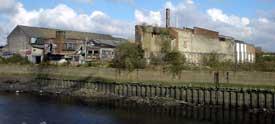
Olympic snapshots: Aquatics Centre These two ramshackle buildings are fairly typical of the industrial skeletons to be found scattered around London's Olympic development site. They were half derelict when I took this photograph 18 months ago, a crumbling example of what happens when an area is left quietly to fall apart, and have since been demolished. We're looking out across the Waterworks River on the eastern edge of the Olympic Zone, on the very spot where London's new Aquatics Centre is about to be constructed. The powers that be have promised to build two 50m swimming pools and a 25m diving pool here, whether we win the 2012 Games or not, which is the sort of government commitment this deprived area so desperately needs. The inhabitants of nearby Stratford wait expectantly to see whether this new water feature will be full of international champions breaking world records or just teenagers divebombing one another and urinating in the shallow end when they think nobody's looking.
Olympic snapshots: Olympic Park Heaven knows why the IOC originally complained that the Olympic Zone area was inaccessible and underconnected because you can't move around here for train tracks. Branch lines, mainlines, light rail lines, tube lines, they're all here already. And sidings - acres and acres and acres of railway sidings. Some are already in the process of being transformed into StratfordInternational station, immediately to the east of the proposed stadium, and ever so convenient for (ahem) all those eager Parisian visitors to the 2012 Games. However, as you'll see from this photo, Thornton Fields sidings have yet to be transformed. They run off the mainline from Liverpool Street to Norwich, sandwiched on a long island site between two of the Bow Back Rivers. During the week inter-city trains are stockpiled here during that daytime lull between the morning and evening rush hours. But visit at the weekend, as I did, and the sidings are completely deserted. I'd been out taking a stroll down the Waterworks River, not another living soul in sight, when I noticed an unlocked iron gate beckoning invitingly from the towpath. There was no warning sign telling me to keep out so I wandered through into the empty sidings and stood all alone beside the vacant tracks and gantries. It was an eerie experience, and I had a gut feeling that this was somewhere I wasn't supposed to be. Come 2012 and these sidings will be wiped from the map to be replaced by a wide paved pedestrian walkway linking together the major sporting facilities up and down the two-mile-long Olympic site. I look forward to standing here again, still not a train in sight, but surrounded by hundreds of thousands of bustling spectators.
Olympic snapshots: the Olympic Village A Velopark is planned for the very northern tip of the Olympic Park, tucked inbetween the A12 and New Spitalfields market. £22miliion will be spent constructing a velodrome and an outdoor BMX circuit where blokes in tight lycra can wear enjoy wearing streamlined pointy helmets in public. But there's already a major cycling facility just a few hundred yards to the south - the 53 acre Eastwaycyclecircuit. A mile-long tarmac track curves invitingly through hilly green heathland, with challenging off-road tracks scattered around inbetween. London cyclists love Eastway and, as a visiting pedestrian, I was quite taken by it too. Not that there was any evidence that this circuit is ever used by cyclists any more. The changing rooms were padlocked, the admission prices were years out of date and the only official presence as I wandered around the track was a security guard with a very large alsatian. If the IOC award the 2012 Games to London, the Eastway circuit will be eradicated so that the Olympic Village and other sporting facilities can be constructed on the site. The world's best athletes and Paralympians will live right here, for a fortnight each, on the very spot from which I took this photograph. The Olympic village will also consume some really (really) nasty student flats nextdoor at Clays Lane (yes, I know they all belong to a well-meaning co-operative, but you'd really only live here if you had no choice). Hopefully the social housing left behind by the Olympics will create a more worthwhile place for disadvantaged local Londoners to live.
Olympic snapshots: Hockey Stadium Wander through to the southern edge of the Eastway cycle circuit and there, hidden down a well-hidden footpath, you may stumble upon the delights of the Bully Point Nature Reserve. I was charmed to discover this verdant mini-valley hidden away between some allotments and a giant building site, extremely close to the tunnel mouth into which Eurostar trains will plunge on their seven minute journey to St Pancras. Here the tiny Channelsea River flows, here trees and bushes explode each summer in a riot of green, and here butterflies silently flit between the fragrant flowers on the riverbank. Even kingfishers are regularly seen, here, bang in the middle of a godforsaken East London wasteland. To be honest it's only the urban location that makes this lowly spot feel so special. But a successful London Olympic bid would erase this natural beauty spot forever. The Channelsea river would be diverted and the allotments concreted over, while Bully Point would disappear forever beneath the pitch of a new Hockey Stadium. In fact the entire Olympic development zone would have to be fenced off for several years leading up to 2012, its green corridors made wholly inaccessible to us local residents while all evidence of reality was obliterated. Sure the new Olympic park would have trees and flowers and rivers but they'd all be fresh, sanitised and artificial. And somehow, I suspect, rather disappointing. Standing here in peaceful silence amongst the leaves and buzzing insects, I hoped for the first time that London's Olympic bid might fail so that the wildlife residents of Bully Point could survive into a more permanent future.
The 2012 Olympics will probably be held in: Paris But: there's still a chance it might be London So: let me dream for the next 75 hours, won't you?
Olympic snapshots: the Olympic Zone Now: This is MarshgateLane, about half a mile west of Stratford and just up the road from my house. I guess a long time ago it was quiet a country lane snaking between the triple braids of the River Lea, surrounded by grass, farm animals and the odd passing bird. Not any more. Marshgate Lane now runs through some of the most dismal scenery East London has to offer. It's a drab polluted wasteland covered by warehouses, small factories and discarded junk. Pylons stalk the grey horizon. Lorries thunder down from the M11 delivering fats and waste cooking oil to tall belching incinerators. Workers in orange dungarees eat their sandwiches surrounded by a sea of litter. A long queue of rusting cars lie trashed along the roadside waiting their turn to be cannibalised for spare parts. And, just to give you a true sense of the place, I took this photograph while standing on top of a giant sewerpipe. Marshgate Lane is a place you'd hate to work, not a place you'd like to live, and it could be so so much better. 2012: If London is awarded the 2012 Olympics, this part of London will be transformed. And about time too. Look down from the sewer pipe in seven years time and you'll see a striking Olympic Stadium rising anew in the centre of the photograph. It takes quite a leap of imagination to picture anything quite so enormous and important here today, but maybe a leap of imagination is exactly what's required around here.
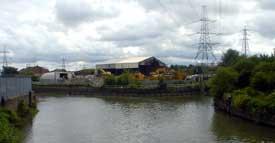
Olympic snapshots: the Olympic Stadium Here's a view from the opposite angle, looking south towards the intended site of London's 2012 Olympic stadium. As you can see there's a lot of water round here. The River Lea passes along the western perimeter of the site, and we're only a stone's throw from the lockkeeper'scottages from which the Big Breakfast used to be broadcast. But there are several other rivers threading through the site, all part of the Bow Back Rivers, each with their own wildlife and ecosystem. Here at Carpenter's Lock two of those braids join, leaving a scrap of land inbetween that's just big enough to hold an Olympic stadium. The water also provides a useful natural barrier that would act as a security cordon around the future arena, should it ever be built. Today you can still walk freely following a series of overgrown footpaths along the riverbanks, taking in the greenery, the desolation and the silence. Very few local people appear to bother to tread these paths, far from the madding crowds, but those of us who frequent the remoter stretches of the Bow Back Rivers prefer it that way.
Olympic snapshots: the Stadium (interior) If you try standing here in seven years time you'll probably be arrested, because this is the very centre of the proposed Olympic stadium. Stand on this spot on the evening of Friday 27th July 2012 and you'll be whisked away in a heaving sea of choreographed flag-waving schoolchildren, all taking part in the extravagant made-for-TV spectacle of the opening ceremony of the XXXth Olympiad. And over the following fortnight the world's best athletes (and the world's most convincing steroid-takers) will stand here on the winners rostrum to receive their Olympic medals. Hence I was very disturbed to discover that there are already three flags fluttering over this very spot, and that they're all German. That's because there's a Mercedes after-sales centre on the site today, the sort of grey shed you bring your car back to when it stops working - I guess it beats turning up early and staking your claim with a beach towel. But a single cross of St George still flutters proudly in the forecourt of Bywaters skip hire service nextdoor, so maybe there's still hope.
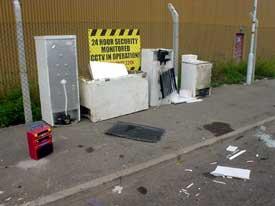
Olympic snapshots: the Stadium (interior) I guess few snapshots sum up the huge amount of redevelopment needing to be carried out if London wins the 2012 Olympics better than this picture. Across the road from the Mercedes garage, still well inside the 400m running track, I found a cheap karaoke machine and four smashed fridge-freezers, all lined up side by side on the pavement. They've got to go. In just seven years flat Marshgate Lane needs to be transformed from an industrial dumping ground littered by abandoned white goods into a state-of-the-art arena for world class sport. There are warehouses to dismantle, there are pylons to bring down, there are contours to level and there are polluted bushes to clear away. Admittedly many of the businesses that will be eradicated reallydon't want to go, but their removal will bring about the 'legacy' redevelopment that remains London's trump card over the Paris bid. Vote to bring the Olympics here and there'll be no more fridge freezers, no more karaoke machines and no more waste. Maybe, just maybe, this place has a bright future.
The 1944 Olympics should have been held in: London But: there was a big World War on at the time So: London was awarded the 1948 Games instead.
Olympic snapshots: Wembley Stadium Then: A lot of mopping up and rebuilding needed to be carried out after the Second World War. Nevertheless London willingly took on the responsibility of hosting the 1948 Olympics, the first to be held following a twelve year wartime hiatus, and they did so on a shoestring budget. The Games cost just £¾ million to stage, with existing facilities being used wherever possible and athletes housed not in some expensive new village but in schools, homes and even military barracks. And for its Olympic arena London turned to Wembley, the nationalstadium built two decades previously for the opening of the British Empire Exhibition in 1924. The Wembley Olympics ran successfully and smoothly, remembered best perhaps for a dashing Dutch housewife and not for Great Britain's lowly 12th place in the medal table. My history of Wembley Stadium is here, and there's more about events at the 1948 Olympics here. Now: After years of vacillation and political wrangling, the famous twintowers have fallen. In their place, ever so slowly and worryingly behind schedule, a new 21st century Wembley Stadium is rising into the Brent sky. You can see the white Wembley Arch [stats: weight 1750 tonnes, length 315m, height 133m] across half of London, but I chose to take a look from close up. This photo is taken from the perfect viewpoint of Sherrins Farm Open Space, a grassy kickabout zone hidden away on the opposite side of the Chiltern railway line. The changing facilities are non-existent, the pitch slopes downhill and any goalposts are almost certainly knitted, but it's currently the only place round here where budding Beckhams can still play ball.
Olympic snapshots: Olympic Way Then: Olympic Way, a long (and very wide) pedestrian thoroughfare, was built for the 1948 Games as a crowd control measure to link the stadium to the nearby tube station. This brutal minimalist walkway carved through what had once been gardens and across the site of an ornamental lake, more's the pity. But look behind the modern hotdog stall and you can still see the remains of one of the glories of the 1924 BritishEmpireExhibition - the Palace of Industry. In its heyday this vast 13 acre hall contained dazzling examples of British invention, including a coal mine and real pit ponies, and was constructed as one of a pair with the neighbouring Palace of Industry. Elsewhere on site were built opulent pavilions relative in size to the perceived importance of various Commonwealth countries, so Australia, Canada and India were afforded rather more space than Nigeria, Burmah and Ceylon. Now: With the exception of several thousand Indian families, the nations of the new Commonwealth have long abandoned Wembley. Only a very few buildings from the Empire Exhibition remain, and those that still stand have been subsumed into a rundown retail park of furniture shops and carpet warehouses. The Palace of Industry has become a shabby shadow of its former self with jaundiced paint peeling from the pioneering concrete walls. The interior of this former exhibition space has been brutally subdivided and now houses, amongst other light industrial delights, a fleet of White Arrow delivery vans. Meanwhile Currys and JD Sports nextdoor stockpile white goods and sweatshop trainers mass-produced in the rising economies of the Far East. The glory days of Empire lie unnoticed and forgotten.
Olympic snapshots: Live Aid Then: On Saturday 13th July 1985 the world returned to Wembley, either on foot or via satellite, for the Live Aid concert. I was a student at the time and three of my flatmates were lucky enough (and solvent enough) to get tickets. While they stood on the hallowed turf of Wembley Stadium in the presence of greatness (and Nik Kershaw), I sat at home watching the entire event on my portable black and white television. From Status Quo to Paul McCartney the top pop acts of the eighties (and a few dodgy hangers-on) kickstarted their failing careers with a few unforgettable performances. Those who'd never heard of U2 suddenly had, and those who'd heard of Duran Duran suddenly wished they hadn't. But, more importantly, the world's conscience was pricked as the plight of poverty-stricken Africans was given the prominence it so desperately deserved. Now: And so it is again today, with the Live 8 concert in Hyde Park. Say what you like about Bob Geldof (and the words 'gobby', 'opinionated' and 'stubborn' spring to mind) but his persistence has certainly helped to launch the issue of world poverty much higher up the global agenda. Hurrah. Only the silent cheers of 20 years ago will echo round Wembley Stadium today, but at least the original event is commemorated in this tiled mosaic on the approach to Wembley Park station. Look, it's that Dire Straits bloke with the annoying bandana, that Tina diva with the frizzy perm, showman Freddie in his finest hour, and some anonymous drummer who has too much hair to be Phil Collins. Today the torch finally passes to the new generation of (supposed) international musical megastars, but I bet nobody erects a mural in Hyde Park to commemorate the event.
The 1908 Olympics should have been held in: Rome But: Mount Vesuvius erupted in 1906, so the Italians didn't have enough cash to build a stadium and rebuild Naples So: the 1908 Games came to London instead.
Olympic snapshots: White City Stadium Then: When London got the call to host the 1908Olympics there was one big problem - there was nowhere to hold the Games. Thankfully the city was constructing a huge Franco-Britishexhibition in White City at the time, so they tacked on an Olympic-sized stadium in the northwest corner of the site and built it in ten months flat. The giant stadium held 93000 spectators and a running track one third of a mile long, and by April all was ready for the opening parade of the 22 participating nations. Now: You're right, that building in the photograph doesn't look much like an Olympic stadium. Some athletics may have continued at White City until 1970, but for most of the 20th century the former grand arena was nothing but a glorified greyhound track. The stadium was eventually demolished in 1985 and, with BBC Television Centre located just down the road along Wood Lane, a new BBC office block was built on the site. At least silver looks less showy than gold or bronze.
Olympic snapshots: The finishing line Then: See that line of white lettering across the front of this photograph? It reads "This is the site of the finishing line of White City Stadium which hosted the 1908 Olympics". And it was right here that one of the most famous marathon races in Olympic history was played out. The marathon had started back at Windsor Castle, with the race specially lengthened so that it could begin right in front of the royal box - a distance of 26 miles 385 yards that remains the marathon standard to this day. By the time the race reached the stadium Dorando Pietri of Italy was in the lead. Unfortunately he then collapsed with exhaustion, five times in total, only to be helped to his feet by some over-zealous British officials and carried over the finishing line. This enraged second-placed John Hayes of the United States, and an American protest (eventually) led to the Italian being stripped of his gold medal. As a result of this farce (and other dodgy decisions during the Games), all Olympic events since 1908 have been adjudicated by a pool of international judges and not a rabble of biased amateurs from the home country. Now: The finishing line now stands in the courtyard of the BBC's new Media Village, opened just last year beside the existing White City building. Off the left hand edge of the photo there's a row of the type of shops that modern planners think office workers want (great if you want a latté, a muffin or a panini). The whole area looked very dead when I visited on a rain-soaked Saturday morning, but I'm delighted that to see that this historic finishing line is still semi-accessible to the public.
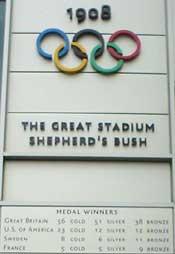
Olympic snapshots: The medal table Then: The British found one particularly cunning way to use their home advantage in the 1908 Olympics to good effect. The games opened on 27 April but, rather than the compact fortnight we know today, they continued for a full six months until 31 October. For local athletes this wasn't a problem but, in the days before commercial air travel, global competitors were at a distinct disadvantage. Of the 2000 competing athletes there were proportionally more UK competitors than perhaps there ought to have been, and look what happened as a result.
For the first (and only) time in the history of the Olympic Games, Great Britain topped the medal table. Look, we got a mammoth haul of gold medals, more than all the other nations of the world put together. I know that, once upon a time, this blessed country of ours used to be a great world power but surely this was one self-deluded step too far. Nevertheless the 1908 Games were still a considerable success, impeccably organised with Empire efficiency, and laid the foundations for the founding of the International Amateur Athletic Federation four years later. Now: On the wall of the Broadcast Centre in the BBC Media Village, just beyond the Olympic finishing line, stands a tall plaque commemorating the 1908 Games. Olympic chief Jacques Rogge unveiledit five weeks ago in the presence of Director General Mark Thompson, and a small crowd of BBC staff. Look, Martin was there and got photos. I'm sure there are some other bloggers working nearby who could tell us more.
Olympic snapshots: White City reborn Then: The original White City exhibition consisted of 20 huge palaces and 120 exhibition buildings spread across a sprawling 140-acre site. The exhibition showcased the industrial and cultural achievements of England and France (like that would ever happen today, eh?) and drew more than eight million visitors. Whitewash was used to cover the multiplicity of steel and concrete buildings on site - hence the name 'White City'. Wood Lane station (on the Central line) was built to serve the exhibition, and underground anoraks may be interested by the following websites which chronicle the unusualtracklayoutatthenow-demolishedstation. Now: Much of the White City area has recently been razed to the ground ready for major redevelopment. Tall cranes stand guard over an enormous building site north of Shepherd's Bush Green, complete with its own office for the signing on of casual labour. There'll be some affordable housing in one corner, of course, but most of the site is earmarked for the largest shopping centre in London. Great, just what we need. And it's all due to open in 2008, exactly a century after there really was something here worth celebrating.

The London Olympics? 2012
I am, very nearly, an Olympic resident. A marathon runner could jog from my front door to the edge of the Olympic Zone in one minute flat (and, if all goes to plan come 2012, they'll be doing precisely that). The prospect of wholesale urban regeneration on my doorstep is therefore a very desirable thing, and would be even more desirable if I owned my flat rather than renting it. My corner of the Olympic Zone, between the Bow flyover and Pudding Mill Lane DLR station, has been designated as the Media Village and International Broadcast Centre. This means that we'll be descended upon by the global equivalents of Gary Lineker and Sue Barker, their task to link together the latest reports from the taekwondo, the weightlifting and the synchronised swimming. I look forward to sharing a bag of chips with everyone outside Mam's Fish Bar. Construction of the Media Village requires that a whole swathe of heavy industrial units are cleared away from the site first, although most of these appear to specialise in waste disposal so maybe they can dismantle themselves. I'd like in advance to thank you, the British taxpayer, for funding a project that my local councils could never ever afford by themselves. True community gold really could be unearthed at the end of this Olympic Zone rainbow. But I wonder how easy it would be to live with the biggest building site in the country at the bottom of my road for seven long years before any of the rewards can be felt.
Go back just a year and you'd have been hard-pushed to find many Londoners who supported the Olympic bid. It needed a massive (and carefully conceived) PR campaign to turn the population of this Candidate City in favour of the 2012 Olympics, and thankfully that's exactly what we've had. You can't fail to have noticed 'Back the Bid' flags hanging from London's lampposts, 'Back the Bid' banners draped across London's public buildings and 'Back the Bid' stickers plastered all over London's public transport. This photograph, taken at Bromley-by-Bow station, shows one of two tube trains that have been madeover in Olympic colours - even the seats have been covered by special yellow 'Back the Bid' upholstery. It's an awful lot of money to throw at a campaign for an event London probably won't win, and all this still only achieved a 68% satisfaction rate in the IOC's final survey of public opinion, but the expense might just be worth it when you consider the potential regenerative benefits to be had in London's poorest boroughs if the bid is successful. I just wonder how many months it will take to remove every last scrap of depressingly upbeat 2012 branding across the capital when Paris wins on Wednesday instead.
As you can see, not everybody wants the Olympics to come to London. You'd be hard pushed, for example, to persuade citizens of Shetland, Belfast and Birmingham that their hard-earned taxes should be spent laying asphalt and astroturf in my backyard. Many Londoners are equally strongly opposed to the huge debts they might end up paying off over the next seven years (and beyond). But the most vociferous protests have come from those living and working on the Olympic site itself, so it came as no surprise to stumble upon this delightful piece of graffiti sprayed on the underside of a litter-strewn bridge down Marshgate Lane. 308 local businesses would be forced to relocate within two years of a successful Olympic bid, and they're understandably aggrieved. Compensation has only been pledged based on existing land values, a token gesture insufficient to cover the cost of reconstruction on more expensive land elsewhere. A major legal challenge is threatened if London wins tomorrow. Most of the thousands of jobs which would be lost are in unglamorous but essential service industries such as waste disposal, recycling, demolition (and, erm, luxury salmon-smoking). Although several thousand new jobs would be created in construction, these wouldn't be especially appropriate jobs for ex fish filleters (neither would they continue beyond 2012 like the jobs to be found here today). At least a few local unskilled teenagers can look forward to employment selling programmes and flipping burgers for three weeks in the summer of 2012. Beyond the closing ceremony, however, who knows? Maybe some of the current skilled workforce would like to apply to become a parkkeeper or, rather more likely I fear, a security guard.
These two ramshackle buildings are fairly typical of the industrial skeletons to be found scattered around London's Olympic development site. They were half derelict when I took this photograph 18 months ago, a crumbling example of what happens when an area is left quietly to fall apart, and have since been demolished. We're looking out across the Waterworks River on the eastern edge of the Olympic Zone, on the very spot where London's new Aquatics Centre is about to be constructed. The powers that be have promised to build two 50m swimming pools and a 25m diving pool here, whether we win the 2012 Games or not, which is the sort of government commitment this deprived area so desperately needs. The inhabitants of nearby Stratford wait expectantly to see whether this new water feature will be full of international champions breaking world records or just teenagers divebombing one another and urinating in the shallow end when they think nobody's looking.
Heaven knows why the IOC originally complained that the Olympic Zone area was inaccessible and underconnected because you can't move around here for train tracks. Branch lines, mainlines, light rail lines, tube lines, they're all here already. And sidings - acres and acres and acres of railway sidings. Some are already in the process of being transformed into Stratford International station, immediately to the east of the proposed stadium, and ever so convenient for (ahem) all those eager Parisian visitors to the 2012 Games. However, as you'll see from this photo, Thornton Fields sidings have yet to be transformed. They run off the mainline from Liverpool Street to Norwich, sandwiched on a long island site between two of the Bow Back Rivers. During the week inter-city trains are stockpiled here during that daytime lull between the morning and evening rush hours. But visit at the weekend, as I did, and the sidings are completely deserted. I'd been out taking a stroll down the Waterworks River, not another living soul in sight, when I noticed an unlocked iron gate beckoning invitingly from the towpath. There was no warning sign telling me to keep out so I wandered through into the empty sidings and stood all alone beside the vacant tracks and gantries. It was an eerie experience, and I had a gut feeling that this was somewhere I wasn't supposed to be. Come 2012 and these sidings will be wiped from the map to be replaced by a wide paved pedestrian walkway linking together the major sporting facilities up and down the two-mile-long Olympic site. I look forward to standing here again, still not a train in sight, but surrounded by hundreds of thousands of bustling spectators.
A Velopark is planned for the very northern tip of the Olympic Park, tucked inbetween the A12 and New Spitalfields market. £22miliion will be spent constructing a velodrome and an outdoor BMX circuit where blokes in tight lycra can wear enjoy wearing streamlined pointy helmets in public. But there's already a major cycling facility just a few hundred yards to the south - the 53 acre Eastway cycle circuit. A mile-long tarmac track curves invitingly through hilly green heathland, with challenging off-road tracks scattered around inbetween. London cyclists love Eastway and, as a visiting pedestrian, I was quite taken by it too. Not that there was any evidence that this circuit is ever used by cyclists any more. The changing rooms were padlocked, the admission prices were years out of date and the only official presence as I wandered around the track was a security guard with a very large alsatian. If the IOC award the 2012 Games to London, the Eastway circuit will be eradicated so that the Olympic Village and other sporting facilities can be constructed on the site. The world's best athletes and Paralympians will live right here, for a fortnight each, on the very spot from which I took this photograph. The Olympic village will also consume some really (really) nasty student flats nextdoor at Clays Lane (yes, I know they all belong to a well-meaning co-operative, but you'd really only live here if you had no choice). Hopefully the social housing left behind by the Olympics will create a more worthwhile place for disadvantaged local Londoners to live.
Wander through to the southern edge of the Eastway cycle circuit and there, hidden down a well-hidden footpath, you may stumble upon the delights of the Bully Point Nature Reserve. I was charmed to discover this verdant mini-valley hidden away between some allotments and a giant building site, extremely close to the tunnel mouth into which Eurostar trains will plunge on their seven minute journey to St Pancras. Here the tiny Channelsea River flows, here trees and bushes explode each summer in a riot of green, and here butterflies silently flit between the fragrant flowers on the riverbank. Even kingfishers are regularly seen, here, bang in the middle of a godforsaken East London wasteland. To be honest it's only the urban location that makes this lowly spot feel so special. But a successful London Olympic bid would erase this natural beauty spot forever. The Channelsea river would be diverted and the allotments concreted over, while Bully Point would disappear forever beneath the pitch of a new Hockey Stadium. In fact the entire Olympic development zone would have to be fenced off for several years leading up to 2012, its green corridors made wholly inaccessible to us local residents while all evidence of reality was obliterated. Sure the new Olympic park would have trees and flowers and rivers but they'd all be fresh, sanitised and artificial. And somehow, I suspect, rather disappointing. Standing here in peaceful silence amongst the leaves and buzzing insects, I hoped for the first time that London's Olympic bid might fail so that the wildlife residents of Bully Point could survive into a more permanent future.
Now: This is Marshgate Lane, about half a mile west of Stratford and just up the road from my house. I guess a long time ago it was quiet a country lane snaking between the triple braids of the River Lea, surrounded by grass, farm animals and the odd passing bird. Not any more. Marshgate Lane now runs through some of the most dismal scenery East London has to offer. It's a drab polluted wasteland covered by warehouses, small factories and discarded junk. Pylons stalk the grey horizon. Lorries thunder down from the M11 delivering fats and waste cooking oil to tall belching incinerators. Workers in orange dungarees eat their sandwiches surrounded by a sea of litter. A long queue of rusting cars lie trashed along the roadside waiting their turn to be cannibalised for spare parts. And, just to give you a true sense of the place, I took this photograph while standing on top of a giant sewerpipe. Marshgate Lane is a place you'd hate to work, not a place you'd like to live, and it could be so so much better.
Here's a view from the opposite angle, looking south towards the intended site of London's 2012 Olympic stadium. As you can see there's a lot of water round here. The River Lea passes along the western perimeter of the site, and we're only a stone's throw from the lockkeeper's cottages from which the Big Breakfast used to be broadcast. But there are several other rivers threading through the site, all part of the Bow Back Rivers, each with their own wildlife and ecosystem. Here at Carpenter's Lock two of those braids join, leaving a scrap of land inbetween that's just big enough to hold an Olympic stadium. The water also provides a useful natural barrier that would act as a security cordon around the future arena, should it ever be built. Today you can still walk freely following a series of overgrown footpaths along the riverbanks, taking in the greenery, the desolation and the silence. Very few local people appear to bother to tread these paths, far from the madding crowds, but those of us who frequent the remoter stretches of the Bow Back Rivers prefer it that way.
If you try standing here in seven years time you'll probably be arrested, because this is the very centre of the proposed Olympic stadium. Stand on this spot on the evening of Friday 27th July 2012 and you'll be whisked away in a heaving sea of choreographed flag-waving schoolchildren, all taking part in the extravagant made-for-TV spectacle of the opening ceremony of the XXXth Olympiad. And over the following fortnight the world's best athletes (and the world's most convincing steroid-takers) will stand here on the winners rostrum to receive their Olympic medals. Hence I was very disturbed to discover that there are already three flags fluttering over this very spot, and that they're all German. That's because there's a Mercedes after-sales centre on the site today, the sort of grey shed you bring your car back to when it stops working - I guess it beats turning up early and staking your claim with a beach towel. But a single cross of St George still flutters proudly in the forecourt of Bywaters skip hire service nextdoor, so maybe there's still hope.
I guess few snapshots sum up the huge amount of redevelopment needing to be carried out if London wins the 2012 Olympics better than this picture. Across the road from the Mercedes garage, still well inside the 400m running track, I found a cheap karaoke machine and four smashed fridge-freezers, all lined up side by side on the pavement. They've got to go. In just seven years flat Marshgate Lane needs to be transformed from an industrial dumping ground littered by abandoned white goods into a state-of-the-art arena for world class sport. There are warehouses to dismantle, there are pylons to bring down, there are contours to level and there are polluted bushes to clear away. Admittedly many of the businesses that will be eradicated really don't want to go, but their removal will bring about the 'legacy' redevelopment that remains London's trump card over the Paris bid. Vote to bring the Olympics here and there'll be no more fridge freezers, no more karaoke machines and no more waste. Maybe, just maybe, this place has a bright future.
Then: A lot of mopping up and rebuilding needed to be carried out after the Second World War. Nevertheless London willingly took on the responsibility of hosting the 1948 Olympics, the first to be held following a twelve year wartime hiatus, and they did so on a shoestring budget. The Games cost just £¾ million to stage, with existing facilities being used wherever possible and athletes housed not in some expensive new village but in schools, homes and even military barracks. And for its Olympic arena London turned to Wembley, the national stadium built two decades previously for the opening of the British Empire Exhibition in 1924. The Wembley Olympics ran successfully and smoothly, remembered best perhaps for a dashing Dutch housewife and not for Great Britain's lowly 12th place in the medal table. My history of Wembley Stadium is here, and there's more about events at the 1948 Olympics here.
Then: Olympic Way, a long (and very wide) pedestrian thoroughfare, was built for the 1948 Games as a crowd control measure to link the stadium to the nearby tube station. This brutal minimalist walkway carved through what had once been gardens and across the site of an ornamental lake, more's the pity. But look behind the modern hotdog stall and you can still see the remains of one of the glories of the 1924 British Empire Exhibition - the Palace of Industry. In its heyday this vast 13 acre hall contained dazzling examples of British invention, including a coal mine and real pit ponies, and was constructed as one of a pair with the neighbouring Palace of Industry. Elsewhere on site were built opulent pavilions relative in size to the perceived importance of various Commonwealth countries, so Australia, Canada and India were afforded rather more space than Nigeria, Burmah and Ceylon.
Then: On Saturday 13th July 1985 the world returned to Wembley, either on foot or via satellite, for the Live Aid concert. I was a student at the time and three of my flatmates were lucky enough (and solvent enough) to get tickets. While they stood on the hallowed turf of Wembley Stadium in the presence of greatness (and Nik Kershaw), I sat at home watching the entire event on my portable black and white television. From Status Quo to Paul McCartney the top pop acts of the eighties (and a few dodgy hangers-on) kickstarted their failing careers with a few unforgettable performances. Those who'd never heard of U2 suddenly had, and those who'd heard of Duran Duran suddenly wished they hadn't. But, more importantly, the world's conscience was pricked as the plight of poverty-stricken Africans was given the prominence it so desperately deserved.
Then: When London got the call to host the 1908 Olympics there was one big problem - there was nowhere to hold the Games. Thankfully the city was constructing a huge Franco-British exhibition in White City at the time, so they tacked on an Olympic-sized stadium in the northwest corner of the site and built it in ten months flat. The giant stadium held 93000 spectators and a running track one third of a mile long, and by April all was ready for the opening parade of the 22 participating nations.
Then: See that line of white lettering across the front of this photograph? It reads "This is the site of the finishing line of White City Stadium which hosted the 1908 Olympics". And it was right here that one of the most famous marathon races in Olympic history was played out. The marathon had started back at Windsor Castle, with the race specially lengthened so that it could begin right in front of the royal box - a distance of 26 miles 385 yards that remains the marathon standard to this day. By the time the race reached the stadium Dorando Pietri of Italy was in the lead. Unfortunately he then collapsed with exhaustion, five times in total, only to be helped to his feet by some over-zealous British officials and carried over the finishing line. This enraged second-placed John Hayes of the United States, and an American protest (eventually) led to the Italian being stripped of his gold medal. As a result of this farce (and other dodgy decisions during the Games), all Olympic events since 1908 have been adjudicated by a pool of international judges and not a rabble of biased amateurs from the home country.
Then: The British found one particularly cunning way to use their home advantage in the 1908 Olympics to good effect. The games opened on 27 April but, rather than the compact fortnight we know today, they continued for a full six months until 31 October. For local athletes this wasn't a problem but, in the days before commercial air travel, global competitors were at a distinct disadvantage. Of the 2000 competing athletes there were proportionally more UK competitors than perhaps there ought to have been, and look what happened as a result.
Then: The original White City exhibition consisted of 20 huge palaces and 120 exhibition buildings spread across a sprawling 140-acre site. The exhibition showcased the industrial and cultural achievements of England and France (like that would ever happen today, eh?) and drew more than eight million visitors. Whitewash was used to cover the multiplicity of steel and concrete buildings on site - hence the name 'White City'. Wood Lane station (on the Central line) was built to serve the exhibition, and underground anoraks may be interested by the following websites which chronicle the unusual track layout at the now-demolished station.

 I am,
I am,  Go back just a year and you'd have been hard-pushed to find many Londoners who supported the Olympic bid. It needed a massive (and carefully conceived)
  As you can see,
  These two
  Heaven knows why the IOC originally complained that the Olympic Zone area was inaccessible and underconnected because you can't move around here for train tracks. Branch lines, mainlines, light rail lines, tube lines, they're all here
  A
A  Wander through to the southern edge of the
  Now: This is
  Here's a
  If you try standing here in seven years time you'll probably be arrested, because this is
  I guess few snapshots sum up the huge amount of redevelopment needing to be carried out if London wins the 2012 Olympics better than
  Then: A lot of mopping up and rebuilding needed to be carried out after the Second World War. Nevertheless London willingly took on the responsibility of hosting the 1948 Olympics, the first to be held following a twelve year wartime hiatus, and they did so on a shoestring budget. The Games cost just £¾ million to stage, with existing facilities being used wherever possible and
  Then: Olympic Way, a long (and very wide) pedestrian thoroughfare, was built for the 1948 Games as a crowd control measure to link the stadium to the nearby tube station. This brutal minimalist walkway carved through what had once been gardens and across the site of an ornamental lake, more's the pity. But
  Then: On Saturday 13th July 1985 the world returned to Wembley, either on foot or via satellite, for the
  Then: When London got the call to host the
  Then: See that line of white lettering across the front of this
  Then: The British found one particularly cunning way to use their home advantage in the 1908 Olympics to good effect. The games opened on 27 April but, rather than the compact fortnight we know today, they continued for a full six months until 31 October. For local athletes this wasn't a problem but, in the days before commercial air travel, global competitors were at a distinct disadvantage. Of the 2000 competing athletes there were proportionally more UK competitors than perhaps there ought to have been, and look what happened as a result.
 Then: The original