Somewhere famous: The Crystal Palace In the beginning this was plain old Sydenham Hill, and nobody paid it much attention. And then in 1851 the Great Exhibition in Hyde Park opened, and closed, and there was a giant iron and glass building in need of a new home. The CrystalPalace was relocated here on the ridge, high above southeast London, and a new park of entertainment and enlightenment opened up in the surrounding fields. It was a great success, attracting huge crowds by road and rail, although a gradual decline set in after a few decades. In 1936 the palace burnt to the ground in an unexpected and spectacular fire. Head to the top of Sydenham Hill today and you'll find just the artificial terraces where the Italian Gardens once stood [photo], and a few headless statues [photo], and some stone sphinxes [photo]. Be thankful that Bromley Council didn't have their way a few years ago, else there'd now be a 20-screen multiplex cinema and leisure centre on top of the hill in a building resembling an airport terminal. The only thing Londoners can see atop Sydenham Hill today is a giant 200m television mast, built on the site of John Logie Baird's TV studios. Here's hoping nothing uglier is ever slapped down beside it.
Somewhere pre-historic: Crystal Palace Dinosaur park[photo] "Please Mummy, can we go and see the dinosaurs?" "Yes certainly. They're over here in the corner of the park, down by the lake." "But Mummy, that's not a dinosaur, that's a big fibreglass mammal hanging onto a tree." "It's a Megatherium, darling, a giant sloth. And there's a family of Anoplotherium under those trees." "But Mummy, they're not dinosaurs either. Take me over the bridge past that waterfall." "Look dear, there are some artificial rock strata in that artificial cliff-face." "I'm not interested in fake geology, Mummy. I want to see the dinosaurs that Benjamin Waterhouse Hawkins built." "Heretheyare! The Iguanodon is so big that Ben held a 20-strong dinner party inside it when the park opened." "That's just an old wives tale, Mummy. Why has it got a thumb sticking out of its head?" "It's not anatomically accurate, darling. These dinosaurs were designed 150 years ago before scientists knew any better." "And the Icthyosaur has seen better days, and that Megalosaurus has pigeons sitting all down its spine, and those Labyrinthodons are just plain dull." "OK son, I know it's not Jurassic Park, but at least it's free." "They're brilliant, Mummy! Can we come again next weekend?"
Somewhere sporty: Crystal Palace Athletics Stadium[photo] In the beginning there was just a park. But no park is complete without sport, and over the years this park has seen greater sport than most. • WG Grace used to wander over from his house on Crystal Palace Road to play cricket here. • A football ground was built in the park, and all 20 FA Cup Finals from 1895 to 1914 were played right here. More than 120000 spectators watched Aston Villa beat Sunderland in 1913. • The England rugby team's first match against the All Blacks was held at Crystal Palace in 1905. Not atypically, England lost fifteen nil. • Crystal Palace FC was formed here in 1905, and remained until 1914 when the army took over the park. • A race circuit for motorcycles opened around the park in 1927, and was also used for motor racing between 1953 and 1973. Parts of the circuit are still clearly visible today. • The Crystal Palace Athletics Stadium was opened in 1964. It's capable of hosting world class events, although it doesn't get to hold many these days. You can peer down at the tracks from the grassy bank to the south. The surrounding buildings include a 10 storey accommodation block, and are a bit ugly. The sports complex houses London's only 50m swimming pool, and the whole thing will soon be utterly superseded by the new Olympic Stadium in Stratford. by train: Crystal Palace (where else?)
I SPY LONDON(14) the definitive DG guide to London's sights-worth-seeing Somewhere historic: Down House Location: Luxted Road, Downe BR6 7JT [map] Open: 10am - 6pm (closed Mondays and Tuesdays and January) Admission: £6.90 5-word summary: where Charles Darwin created evolution Website:English Heritage Time to set aside: a couple of hours
One of the most important, or most dangerous, houses in the world is located in Downe - a small village on the southeast fringe of London. It was here, five years after his voyage round the world aboard the Beagle, that Charles Darwin set up home [photo]. And it was here that he stayed for 40 years until his death, carrying out experiments which would shape our future. I just wish he'd lived somewhere slightly more accessible.
Getting to Down House by car is easy - it's not far from Biggin Hill off the M25. Buses are rather more infrequent, however, and if you miss one then it's at least an hour until the next. Entrance to the house is via the car park, through the big front door into the hallway and then into the obligatory giftshop. I handed over a small rectangular portrait of Charles Darwin and received £3.10 in change, then entered the ground floor to see where the great man lived and worked. All the fixtures and fittings have been restored just as they would have looked in the late 19th century. An audio guide narrated by David Attenborough provides full background information, both of Darwin's scientific discoveries and of his everyday life here at Down House. You really get the atmosphere of a comfortable but happy Victorian family home in which something extraordinary was being thought through.
The highlight of the tour is the opportunity to stand inside Darwin's wallpapered study. Here he examined thousands of specimens he'd brought back from around the world, using that microscope on the table, and here he mulled over the importance of his many findings, sat in that chair beside the desk. There's the board on which he wrote up his notes, and that's the pen he used for answering his correspondence. Right here is where On The Origin of Species was written, the very spot where men suddenly turned into apes. In this very room evolution was intelligently designed. Even 150 years later Darwin's central argument, created here, still reverberates on.
Charles was a creature of habit and took a walk round his extensive grounds three times each day. He laid out a long tree-lined 'sandwalk' between two meadows to give himself time and space to think, surrounded by the nature he sought to understand. He used his garden as a laboratory, the perfect spot for cultivating earthworms or growing different strains of apple. In his wooden greenhouse he experimented with carnivorous plants and the cross pollination of orchids, experiments which have been recreated today. The grounds of Down House are still both immaculate and productive. I could have come home with a marrow fresh from the kitchen garden, but made do instead with a recently fallen sweet chestnut picked from the lawn. I think I'll plant it round the back of my flat... after all, given where it was born, it's surely fit enough to survive. by train (& bus): Bromley (then 146) or Orpington (then R8)
Somewhere random: Orpington I didn't mean to end up in Orpington, it's just that I missed one bus to Down House and it was a long wait for the next one. [And then when it arrived, blimey, it was just a tiny cross-country minibus]. Just in case you should ever find yourself stuck in this market town with time to kill, here are some random places you could visit. • Orpington used to be in Kent, and it still looks rather more Home Counties than metropolitan. So there are lots of quite ordinary shops. • Orpington Priory was founded in 1032. Many of the old buildings survive beside the library, and there are some nice gardens. • BromleyMuseum is situated in the old Priory. It's probably full of all sorts of thrilling local ephemera, but it has one of those big wooden doors which looks closed and uninviting even when the museum's open, so I gave it a miss. • There's a proper Roman villa next to the station, or at least the remains of one, except it's closed on Saturdays. • In Poverest Road there's an old Roman bathhouse dating back to AD270, but it's not open very often. • The War Memorial is one of the most prominent landmarks in the town, but it's in the middle of the main roundabout and quite dangerous to get to. • There are lots of 1850s coal posts in Orpington - you could go looking for them. • Oh please, hasn't that bus arrived yet? by train: Orpington by bus: anything starting with R
Yesterday I ended up in the south eastern corner of London in the randomly selected borough of Bromley. This is the big one. Bromley is the largest borough in the capital, greater in area than the eight smallest boroughs put together. A lot of it is green belt, and the southern fringe is unexpectedly rural and remote. The rest is classic suburbia, filled with two-car households, leafy avenues and the occasional commuter railway. It wasn't easy getting around, but I hope I managed to pick out several interesting parts of the borough all the same.
I SPY LONDON(13) the definitive DG guide to London's sights-worth-seeing Somewhere pretty: ChislehurstCaves Location: Old Hill, Chislehurst BR7 5NB [map] Open: 10am - 4pm (tours on the hour, closed Mondays and Tuesdays) Admission: £5 5-word summary: a lantern-lit underground mine tour Website:www.chislehurstcaves.co.uk Time to set aside: an hour
There may be no tube stations in the London borough of Bromley, but there is an underground. Twenty-two miles of underground tunnels, to be exact, carved into the chalk beneath Chislehurst Hill. Nobody's sure quite how long they've been there, but they're definitely not natural. Maybe the Druids built the tunnels as a temple, maybe the Saxons dug them to extract chalk and lime, or more likely post-medieval Britons came down here in search of flint for weapons. But the end result is a vast labyrinth of artificial catacombs - not so much caves as a network of interconnected mines. And, as you'll discover if you visit, thousands of wartime Britons had good reason to be thankful it was here.
Your underground tour begins beyond the cafe and gift shop (cheques made payable to Kent Mushrooms Ltd) at the entrance to three interlinked cave systems. Adults get a flickering oil-lit lantern to carry, which adds greatly to the whole experience. Not far along the tunnels there's a fully consecrated 'church' (number of baptisms: one) and also a low stone concert stage. A surprising number of famous names once played down here, including Lonnie Donegan, Jimi Hendrix, David Bowie, Pink Floyd and some local lads called (appropriately enough) the Rolling Stones. On, deeper into the chalk hillside, with a succession of shadowy passages leading off in all directions. The guide may know precisely where he's going, but before long you'd not have a hope of finding your way out without him.
At one of the deepest points, 30 metres beneath the local cricket pitch, there's a raised stone alcove which may (or may not) have been a Druidic sacrificial altar. In another cavern there's a pool of crystal clear water, dripped and filtered through the chalk above, which may (or may not) be haunted. And every now and then you pass a sign on a brick wall which reads "Ladies Toilets" or even "Citizens Advice Bureau", or something else equally incongruous. During the Second World War these caves were used as a vast underground shelter, and thousands paid a penny a night to sleep in bunk beds far from the bombs falling overhead. A subterranean settlement the size of a small town grew up, complete with its own canteen, barber shop and even hospital. It was stuffy and it was spooky, but at least it was safe.
I enjoyed my hour-long tour of the caves far more than I was expecting. Most of this was thanks to our tour guide, a young black-clad gentlemen who'd clearly spent far too much of his life in the dark and who kept us entertained with dry wit and drama. It was also a masterstroke to be on the same tour as a group of teenage boys celebrating one of their number's 13th birthday - the perfect age for mixing bravado, awe and downright terror. Judging by the way these lads attacked the gift shop afterwards, I wouldn't be at all surprised if a couple of them started turning goth within weeks, then came back to play real-life role playing games in the tunnels at weekends. If you own some wide-eyed adolescents who need to be kept occupied for an hour, or if you just fancy a bewitching Hallowe'en-tide day out, I'd heartily recommend a visit. by train: Chislehurst by bus: 162, 269
Somewhere retail: Bromley High Street Every time I make one of these 'random borough' visits, only one of the six locations I visit is ever full of people. And it's always the shops. Bromley High Street was no exception. You can tell shopping's important round here because they make a special announcement the second you get off the train - "This is Bromley South. Alight here for the Glades Shopping Centre". There must be little else of any importance in the town centre. The long High Street looks just like any other, although we're talking major chain stores rather than pound shops. Single-sex gangs of youths stalk the malls, the girls striding purposefully from fashion outlet to shoe shop, the boys out for a laugh beneath gelled haystack hair. Out in the street there's an upmarket market where pushchairs jostle with shopmobility buggies. It's not too late to buy a shrub for the garden, and it's not too early to buy a homemade teddy bear for Christmas. In Market Square the wall beside Argos has been painted with a giant green mural depicting Charles Darwin's 'tree of evolution' (more from him tomorrow). Until last year the mural featured the life and works of HG Wells instead, which is perhaps more appropriate given that he was born in Atlas House just across the High Street. His birthplace is now a department store, until recently an Alders but since metamorphosed into a featureless Primark. And HG's upstairs window, marked by a small blue plaque, now looks out over a kiddies' mini-fairground ride and a garish pink Ann Summers. No one would have believed it in the last years of the nineteenth century. by train: Bromley South, Bromley North
Random borough (11): It's time once again for me to take another random trip to one of London's 33 boroughs). Can you believe I'm still only a third of the way through the list? As I write I have no idea which one of the 23 remaining names will be revealed when I unfold the slip of paper I'm about to pick from my "special jamjar". I could pick any of London's other boroughs - inner or outer, urban or suburban, small or large, fascinating or dull. I just know it won't be Merton, Islington, Enfield, Sutton, Lewisham, Southwark, Kensington & Chelsea, Hackney, Hillingdon or the City because they're the ten (dark grey) boroughs I've picked out already. Five of the last six boroughs I've visited have been very central, rather small and thereby a bit on the easy side. Maybe today I'll end up somewhere further out, sprawlier and a bit more of a challenge. Or maybe not.
Once I've researched my randomly-chosen borough online then I'll head off and visit some of its most interesting places (assuming it has any). As usual I hope to visit somewhere famous, somewhere historic, somewhere pretty, somewhere retail, somewhere sporty and somewhere random. I might even takelotsofphotographs while I'm at it, if the borough's photogenic enough. Then after I've made my grand tour I'll come back tomorrow and tell you all about it. Let's see where I'm going this time...

In the beginning this was plain old Sydenham Hill, and nobody paid it much attention. And then in 1851 the Great Exhibition in Hyde Park opened, and closed, and there was a giant iron and glass building in need of a new home. The Crystal Palace was relocated here on the ridge, high above southeast London, and a new park of entertainment and enlightenment opened up in the surrounding fields. It was a great success, attracting huge crowds by road and rail, although a gradual decline set in after a few decades. In 1936 the palace burnt to the ground in an unexpected and spectacular fire. Head to the top of Sydenham Hill today and you'll find just the artificial terraces where the Italian Gardens once stood [photo], and a few headless statues [photo], and some stone sphinxes [photo]. Be thankful that Bromley Council didn't have their way a few years ago, else there'd now be a 20-screen multiplex cinema and leisure centre on top of the hill in a building resembling an airport terminal. The only thing Londoners can see atop Sydenham Hill today is a giant 200m television mast, built on the site of John Logie Baird's TV studios. Here's hoping nothing uglier is ever slapped down beside it.
"Please Mummy, can we go and see the dinosaurs?"
In the beginning there was just a park. But no park is complete without sport, and over the years this park has seen greater sport than most.
I SPY LONDON (14)
One of the most important, or most dangerous, houses in the world is located in Downe - a small village on the southeast fringe of London. It was here, five years after his voyage round the world aboard the Beagle, that Charles Darwin set up home [photo]. And it was here that he stayed for 40 years until his death, carrying out experiments which would shape our future. I just wish he'd lived somewhere slightly more accessible.
Charles was a creature of habit and took a walk round his extensive grounds three times each day. He laid out a long tree-lined 'sandwalk' between two meadows to give himself time and space to think, surrounded by the nature he sought to understand. He used his garden as a laboratory, the perfect spot for cultivating earthworms or growing different strains of apple. In his wooden greenhouse he experimented with carnivorous plants and the cross pollination of orchids, experiments which have been recreated today. The grounds of Down House are still both immaculate and productive. I could have come home with a marrow fresh from the kitchen garden, but made do instead with a recently fallen sweet chestnut picked from the lawn. I think I'll plant it round the back of my flat... after all, given where it was born, it's surely fit enough to survive.
I didn't mean to end up in Orpington, it's just that I missed one bus to Down House and it was a long wait for the next one. [And then when it arrived, blimey, it was just a tiny cross-country minibus]. Just in case you should ever find yourself stuck in this market town with time to kill, here are some random places you could visit.
There may be no tube stations in the London borough of Bromley, but there is an underground. Twenty-two miles of underground tunnels, to be exact, carved into the chalk beneath Chislehurst Hill. Nobody's sure quite how long they've been there, but they're definitely not natural. Maybe the Druids built the tunnels as a temple, maybe the Saxons dug them to extract chalk and lime, or more likely post-medieval Britons came down here in search of flint for weapons. But the end result is a vast labyrinth of artificial catacombs - not so much caves as a network of interconnected mines. And, as you'll discover if you visit, thousands of wartime Britons had good reason to be thankful it was here.
At one of the deepest points, 30 metres beneath the local cricket pitch, there's a raised stone alcove which may (or may not) have been a Druidic sacrificial altar. In another cavern there's a pool of crystal clear water, dripped and filtered through the chalk above, which may (or may not) be haunted. And every now and then you pass a sign on a brick wall which reads "Ladies Toilets" or even "Citizens Advice Bureau", or something else equally incongruous. During the Second World War these caves were used as a vast underground shelter, and thousands paid a penny a night to sleep in bunk beds far from the bombs falling overhead. A subterranean settlement the size of a small town grew up, complete with its own canteen, barber shop and even hospital. It was stuffy and it was spooky, but at least it was safe.
Every time I make one of these 'random borough' visits, only one of the six locations I visit is ever full of people. And it's always the shops. Bromley High Street was no exception. You can tell shopping's important round here because they make a special announcement the second you get off the train - "This is Bromley South. Alight here for the Glades Shopping Centre". There must be little else of any importance in the town centre. The long High Street looks just like any other, although we're talking major chain stores rather than pound shops. Single-sex gangs of youths stalk the malls, the girls striding purposefully from fashion outlet to shoe shop, the boys out for a laugh beneath gelled haystack hair. Out in the street there's an upmarket market where pushchairs jostle with shopmobility buggies. It's not too late to buy a shrub for the garden, and it's not too early to buy a homemade teddy bear for Christmas. In Market Square the wall beside Argos has been painted with a giant green mural depicting Charles Darwin's 'tree of evolution' (more from him tomorrow). Until last year the mural featured the life and works of HG Wells instead, which is perhaps more appropriate given that he was born in Atlas House just across the High Street. His birthplace is now a department store, until recently an Alders but since metamorphosed into a featureless Primark. And HG's upstairs window, marked by a small blue plaque, now looks out over a kiddies' mini-fairground ride and a garish pink Ann Summers. No one would have believed it in the last years of the nineteenth century.
Random borough (11): It's time once again for me to take another random trip to one of London's 33 boroughs). Can you believe I'm still only a third of the way through the list? As I write I have no idea which one of the 23 remaining names will be revealed when I unfold the slip of paper I'm about to pick from my "special jamjar". I could pick any of London's other boroughs - inner or outer, urban or suburban, small or large, fascinating or dull. I just know it won't be Merton, Islington, Enfield, Sutton, Lewisham, Southwark, Kensington & Chelsea, Hackney, Hillingdon or the City because they're the ten (dark grey) boroughs I've picked out already. Five of the last six boroughs I've visited have been very central, rather small and thereby a bit on the easy side. Maybe today I'll end up somewhere further out, sprawlier and a bit more of a challenge. Or maybe not.


 I SPY LONDON (14)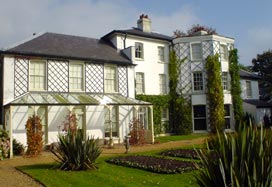
 Charles was a creature of habit and took a walk round his extensive grounds three times each day. He laid out a long tree-lined '
 I didn't mean to end up in Orpington, it's just that I missed one bus to Down House and it was a long wait for the next one. [And then when it arrived, blimey, it was just
  There may be no tube stations in the London borough of Bromley, but there is an underground. Twenty-two miles of underground tunnels, to be exact, carved into the chalk beneath Chislehurst Hill.
  At one of the deepest points, 30 metres beneath the local cricket pitch, there's a raised stone alcove which may (or may not) have been a Druidic sacrificial altar. In another cavern there's a pool of crystal clear water, dripped and filtered through the chalk above, which may (or may not) be haunted. And every now and then you pass a sign on a brick wall which reads "Ladies Toilets" or even "Citizens Advice Bureau", or something else equally incongruous. During the Second World War these caves were used as a vast underground shelter, and thousands paid a penny a night to sleep in bunk beds far from the bombs falling overhead. A subterranean settlement the size of a small town grew up, complete with its own canteen, barber shop and even hospital. It was stuffy and it was spooky, but at least it was safe.
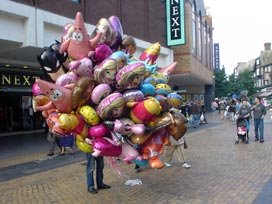 Every time I make one of these 'random borough' visits, only one of the six locations I visit is ever full of people. And it's always the shops. Bromley High Street was no exception. You can tell shopping's important round here because they make a special announcement the second you get off the train - "This is Bromley South. Alight here for the Glades Shopping Centre". There must be little else of any importance in the town centre. The long High Street looks just like any other, although we're talking major chain stores rather than pound shops. Single-sex gangs of youths stalk the malls, the girls striding purposefully from fashion outlet to shoe shop, the boys out for a laugh beneath gelled haystack hair. Out in the street there's an upmarket market where pushchairs jostle with shopmobility buggies. It's not too late to buy a shrub for the garden, and it's not too early to buy a homemade teddy bear for Christmas. In Market Square the wall beside Argos has been painted with a giant green mural depicting Charles Darwin's '