It's a cracking Easter weekend, weatherwise - very warm and sunny across the UK. But how unusual is that?
To help find out, here's a table summarising the weather over the last 50 Easter weekends.
The temperature shown is the highest temperature recorded anywhere in the UK across the four-day bank holiday weekend.
For example, in 1969 the highest temperature was 21°C at Gatwick Airport on Easter Monday. This temperature appears in the second column because Easter Day was Sunday 6th April.
Highest Easter weekend temperature
23-31 Mar
1-8 Apr
9-16 Apr
17-24 Apr
summary
1969
21°C
very sunny
1970
13°C
unsettled
1971
18°C
dry, fine
1972
19°C
mild, wet
1973
14°C
mixed, cool
1974
18°C
mostly fine
1975
10°C
cold, sunny
1976
21°C
mostly fine
1977
12°C
wintry, snow
1978
15°C
cold, windy
1979
23°C
warm, dry
1980
17°C
fair
1981
18°C
went downhill
1982
14°C
cold, bright
1983
11°C
wintry, snow
1984
26°C
very warm
1985
17°C
unsettled, dull
1986
13°C
showery, chilly
1987
24°C
went downhill
1988
17°C
indifferent
1989
19°C
improving
1990
13°C
unsettled
1991
18°C
went downhill
1992
20°C
warm, dry
1993
16°C
mixed
1994
13°C
wet, windy
1995
19°C
went downhill
1996
17°C
mixed
1997
18°C
improving
1998
12°C
wintry showers
1999
19°C
warm, dull
2000
18°C
wet
2001
15°C
cold wind
2002
18°C
went downhill
2003
25°C
went downhill
2004
18°C
average
2005
18°C
very dull
2006
17°C
mixed
2007
20°C
dry, sunny
2008
11°C
wintry
2009
20°C
mixed
2010
15°C
dull, cool
2011
28°C
very warm
2012
16°C
very dull
2013
9°C
very cold
2014
21°C
very sunny
2015
21°C
improving
2016
15°C
wet, windy
2017
15°C
mostly dry
2018
14°C
unsettled
2019
26°C
very warm
The data comes from a splendidly geeky webpage, now defunct, but captured forever within the Wayback Machine archive. It has full summaries of weather across the Easter weekend between 1959-1989 here, and 1990-2014 here, which you should read if you're after considerably more detail.
It's important to note that the weather often changes dramatically across the Easter weekend, so the highest temperature on one day may not reflect the temperature on the others. For example in 1970 the maximum temperature of 13°C occured on Easter Monday in Suffolk, whereas the highest temperature on the Saturday in London was only 6°C.
Also a high temperature in one part of the country doesn't necessarily mean it was similarly warm everywhere. For example in 1979 the maximum temperature of 23°C occurred on Easter Sunday in London, but Manchester only reached 13°C on the same day.
Also temperature doesn't tell the whole story, so it could have been a mild Easter but also miserably wet. For example Easter Monday in 1973 was plagued by thunderstorms and hail, and London saw over an inch of rain across the Sunday and Monday combined.
That said, the following obvious conclusions jump out...
» Easter tends to be coldest when it's in March
» Easter tends to be warmest when it's in the second half of April
» The two coldest Easters were both in March
» The five warmest Easters were all in the second half of April
But...
» An early Easter is not always cold
» A late Easter is not always warm
» An early Easter (26th March 1989) can be warmer than a late Easter (23rd April 2000)
Also, before anyone gets over-excited...
» A random snapshot of over-specific data proves nothing about global warming
» The Church isn't going to change the date of Easter just because Britons would like better weather
As an aside, I like how the table shows that Easter never appears in the same column two years running. That's because the gap between consecutive Easters can only be 50, 51, 54 or 55 weeks, never 52 or 53.
The worst Easter of the last 50 years is undoubtedly 2013, when a cold east wind pegged temperatures down to 4-6°C in many places and Braemar recorded a record-breaking low of -12½°C on Easter Sunday. Other notably poor Easters include 1994, 2008 and 2012, while more recently in 2016 Easter Monday was blighted by Storm Katie.
The best Easters were probably 1969 (dry, fine and very sunny, except on the east coast), 1984 (fine, warm and sunny), 2007 (dry, sunny and mostly warm), and especially 2011 (whose top temperature of 28°C was the warmest since 1949). We won't top that at Easter 2019, but four days of wall-to-wall sunshine and temperatures in the mid-twenties might just be as good as Easter ever gets.
This secret 'tube' map can bring ad-clicks to your media platform
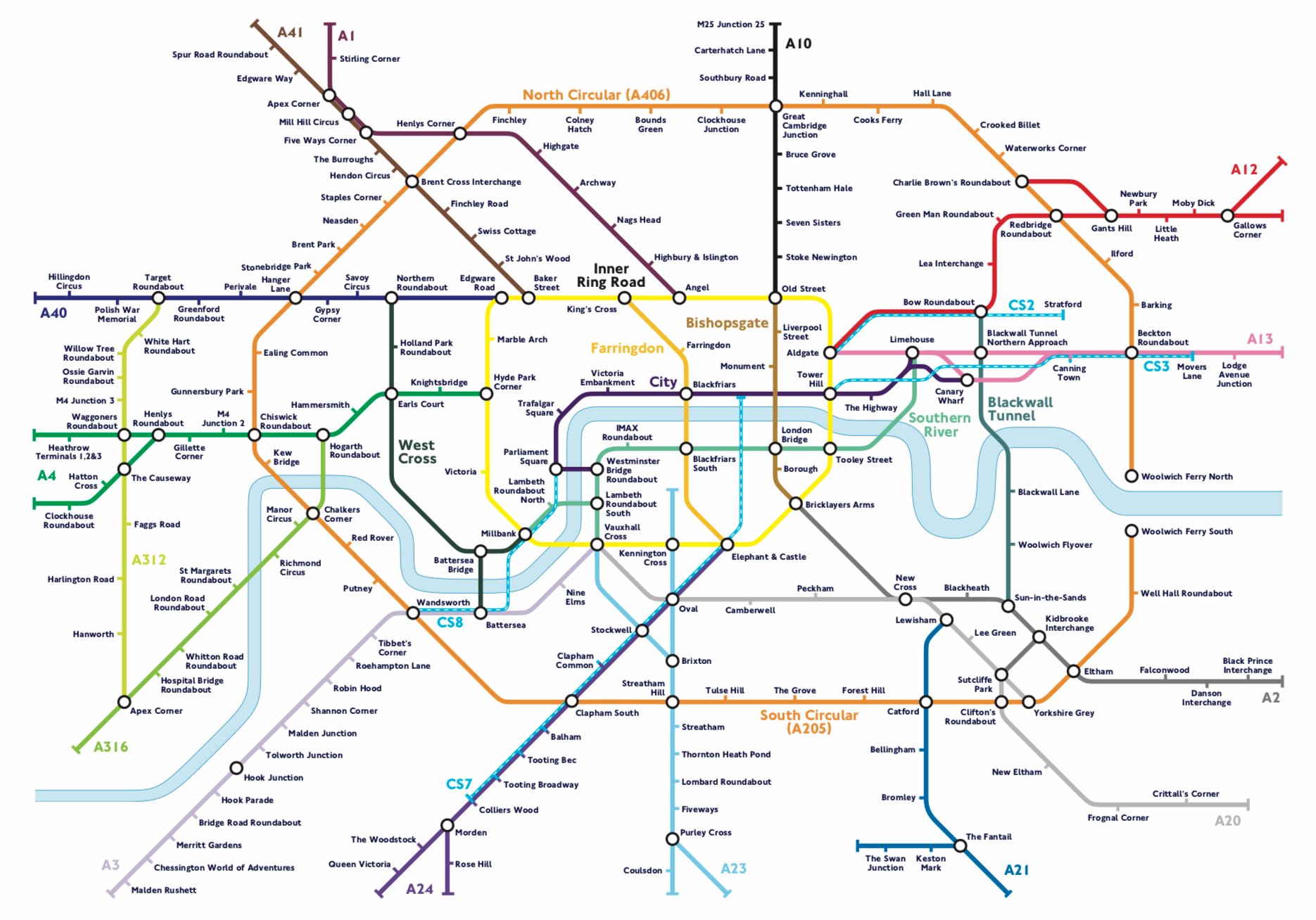
Does your website need more traffic? Have you run out of fresh and exciting tube map variants to embed and surround with adverts? Well, your prayers have been answered because wow, look at this one.
Looks like a proper tube map, right? Wrong, because this baby is nothing less than a map showing all of the capital's main arterial roads. Mind blown.
That yellow ring in the centre isn't the Circle line, it's the Inner Ring Road, and likewise the outer orange ring isn't the Overground, it's the North and South Circulars. TfL's Network Management team have truly excelled with this one.
We love how some of the other colours match up too, like the Bakerloo-brown of the A41 sticking out to the northwest, the District-green of the A4 heading to Chiswick and the Central-red of the A12 aiming for Gants Hill. Damned clever these map boffins, what?
How many times have you listened to the travel news and wondered where Henlys Corner or the Target Roundabout actually are? Wonder no more! Also, how long has the world waited to see Chessington World of Adventures on an actual tube map? Job done!
Look closer and you'll see the map also includes Cycle Superhighways! Interestingly it doesn't show the superhighway along the Embankment, which might mean this map's older than it looks, so best not mention that when you tweet excitedly about how brilliant the 'new' map is.
Copyright is not important. The Deputy Mayor for Transport Heidi Alexander tweeted the map last month which makes it 100% public domain, thus fair game to display on your website however and whenever you think fit. Cheers Heidi!
As a bonus, there's no need to waste time writing actual text to accompany the map. Lots of people responded to Heidi's original tweet so you can simply cut and paste their comments to provide editorial content.
But the most incredible thing is that London turns out to have two Apex Corners, one in Edgware and one in Hanworth. Who knew? There's also a Clockhouse Roundabout and a Clockhouse Junction, and somewhere in the suburbs to take the piss out of called Moby Dick, plus the inexplicable presence of Robin Hood, Charlie Brown and Queen Victoria. Your editor should be able to bash out an article really quickly.
Dash to it and grab the full size version of this amazing hidden secret map, and let's get clickbaiting.
Hampstead's high on the list of London's most enticing neighbourhoods, and is always good for a visit. The High Street has a bohemian vibe, the backstreets are gorgeous and the Heath is extensively explorable. But if your day out needs a little extra, Hampstead is also home to half a dozen historic houses... just don't try to do them all in one go.
A fine old house on the higher side of town, Fenton House is a treasure trove of ephemera amid a gorgeous garden. Its last owner, Lady Binning, loved to collect porcelain of dubious artistic value, and the National Trust have used this as an excuse to cram the house with more porcelain, period tapestries and keyboard instruments. "If you hurry upstairs," said the guide at the door, "the harpsichords are about to kick off." The garden is on the large side for Hampstead, and exquisite, with an upper terrace and a lower orchard/vegetable garden which don't initially appear to be connected. At present the house and garden are overrun with middle class off-school children, and this weekend sees the annual Egg Hunt Weekend so stay well away, but avoid the holidays and Fenton is a truly genteel treat.
At the heart of chalybeate Hampstead, Burgh House was rescued by local residents in the 1970s before it could be sold off as yet another private dwelling. They established a museum upstairs to tell Hampstead's story, filling two rooms, and later added an art gallery round the back. The main display doesn't change much, so they keep visitors coming back with additional exhibitions, which at present include a lovely paean to The Ponds on the Heath. Keeping the place ticking over is expensive, so the fact that weddings are booked every Saturday until next year really helps, plus what people really come for isn't the museum but the basement cafe. Its terrace teems with local life, politely poised over coffee and cake, but do step beyond to the enjoy the collection.
Keats House
Admission £7.50 (free to Art Pass holders, half price NT members, £2 Camden residents)
Opens at 11am (closed Mondays, Tuesdays) [website][blog report, 2011]
This is the poetic/dreamy one.
The creative high point of John Keats' tragically short life came during his brief stay in Hampstead, precisely 200 years ago. In 1818 he took lodgings with his publisher on the edge of the Heath, in April 1819 the love of his life moved in nextdoor, and in 1820 tuberculosis struck and off he sailed to Italy. The house is now Keats House in Keats Grove, adjacent to Keats Community Library, and is operated as a visitor attraction by the City of London. It's very well done, essentially in setting an atmosphere because not much survives of Keats time' here other than letters and of course those odes. Sit here, listen to this, read these, and stand in the actual rooms where he wrote and slept. With three storeys-worth to explore and several bicentenary events planned, now is a great time to visit (just not next week when the house is closed for maintenance).
2 Willow Road
Admission £8.00 (free to NT members, joint ticket with Fenton House, £14.50)
First tour at 11am, explore independently from 3pm (closed Mondays, Tuesdays) [website][full-on blog report, 2012]
This is the modernist/architectural one.
Hampstead's long had a creative left-leaning bent, so was the obvious place for Hungarian architect Ernö Goldfinger to build a house. Neighbours protested at his plan to replace a row of cottages with a box on concrete stilts, but today his home is thought worthy enough to be protected by the National Trust. Come early and you'll need to join a tour, kicking off with a seriously retro 1996 documentary in the garage, then following your guide up the spiral stairs into the house proper. The guide I got was excellent, buoyed by guests who asked pertinent questions, and gave us 15 minutes longer upstairs than we were due. Only the Goldfingers ever lived here so the place is a proper time capsule (Sony Trinitron in the lounge, tin of M&S ham in the kitchen, Rimmel eyeshadow in the bathroom), as well as being an pioneering exemplar of interior design. My third time round, but I still loved it.
Kenwood House perches at the top of the Heath, surrounded by trees, and is the most-visited of the six. It was gifted to the nation by the Guinness family and English Heritage now use it to display the finer points of their art collection. That means florid portraits, including Vermeers and Rembrandts, but with plenty of other historical infill, and the Library is symmetrically gorgeous. When I dropped by yesterday upstairs had been roped off, which limited the attraction somewhat, and the sentinel at the door was attempting to flog the guidebook with coldcaller-levels of focused devotion. For most the cafe is the focus rather than the house, but Searcys don't come cheap so feasting on the paintings might be the wiser option.
Freud Museum
Admission £9.00 (half price for NT members, Art Pass holders)
Opens at noon (closed Mondays, Tuesdays) [website][full-on blog report, 2009]
This is the thoughtful/psychological one.
It's also the only one I haven't been to this week, because you can't do them all in one go. But next time you go to Hampstead, pick one or more and make a great visit better.
If you've been through a tube ticket hall recently you may have seen, or picked up, TfL's new promotional leaflet.
TfL normally go to great lengths not to print anything, indeed over the last few years leaflet racks have become tumbleweed holders for tube maps, accessibility screeds and not much else. So someone must have thought it financially worthwhile to produce a 20 page full-colour leaflet banging the drum about transport improvements and distributing it widely across the network. That might be the Mayor, who gets to pen a cheery upbeat welcome on pages two and three. Or it might be some other executive who's worked out that people won't ever click on a webpage about TfL's improvement programme but might read about it if you print it out for them.
Rather than eulogising generally, the leaflet focuses on seven different changes, some underway, some complete. Each gets a double page spread with text and two photos, and each covers a different aspect of the capital's transport system. Let's take a look at the chosen seven.
Improvement 1
Easing congestion and improving accessibility at a transformed Victoria station
This is a strange place to start. TfL are rightly proud of the mammoth reconstruction project they've had underway at Victoria since 2011, and which they finally completed six months ago. A new entrance at Cardinal Place, extra interconnecting walkways and full step-free operation are certainly something to crow about. The transformation has also done much to ease congestion, mainly by deliberately directing passengers down extra passageways on tediously devious routes. Lengthy bastardtunnels were first put into operation at King's Cross St Pancras in 2009, and are much despised, and further bastardtunnels have since made an appearance at Tottenham Court Road (oh god, how much further does this corridor go?) and Bond Street (I have no idea where I am, but this cannot possibly be the quickest way to the trains). It's the opening of Victoria's bastardtunnels which has allowed the station to enter a lengthy period of escalator renewal, with a tedious one-way system around a miserable shuffling labyrinth in operation until July 2020. So when I currently think of Victoria the last thing I'm thinking is 'improvement', merely additional grind, and maybe it would have been wiser to keep quiet.
Improvement 2
Greener buses for a cleaner city
The Mayor's been banging the drum about air pollution ever since entering office, initially to emphasise that he inherited the problem rather than causing it, and more recently to be seen to be doing something about it. Fixing bus engines is one of the few things he can proactively do, hence now "all new buses are equipped with state-of-the-art technology". This doesn't mean zero emissions, indeed double deckers only have to be diesel-electric hybrids which "are estimated to reduce carbon dioxide by up to 30 per cent", a fairly meaningless phrase. Meanwhile all new single deckers will be zero emission but only from 2020, and that's only "at tailpipe", and as for the Mayor's long-promised 12 Low Emission Bus Zones, they won't all be in operation before the end of the year. Getting there, but nowhere near job done.
Improvement 3
A more frequent and spacious service on the tube
Here's one of TfL's more overused claims, indeed Ken Livingstone and Boris Johnson could rightly have used it, and whoever's Mayor in 2024 will probably be able to do the same. That's because increasing capacity is a mammoth project, involving both signalling and rolling stock, and because nobody's been able to complete the project as quickly as they'd have liked. The leaflet boasts specifically about "two more trains an hour during peak periods" on the Victoria line, and extended evening peak service on the Northern line "between 5pm to 7pm", and an "increased" number of trains on some of the Jubilee line during the "busiest periods in the morning and evening". That's great, but your journey probably hasn't just been mentioned. The leaflet also praises the 192-strong fleet of spacious S Stock trains on the Circle, District, Hammersmith & City and Metropolitan lines, which affects far more passengers, but this replacement programme started way back in 2010 and was completed in April 2017. Future stock renewals remain distant pipedreams, so don't merit a mention.
Improvement 4
Stay connected and updated as you travel
The fact that over 95% of Underground stations have wifi isn't new, indeed checking Facebook underground's been perfectly possible for more than six years. What is new is that you can now connect at Victoria Coach Station and (finally) at 79 London Overground stations. The leaflet went to print in February, so doesn't mention that the impressive fact that onboard wifi is now available on purple TfL Rail trains, nor that free wifi was switched on at North Greenwich bus station this week. What may excite you more is that 4G mobile coverage is coming to the tube "from 2020", unless you're the sort of curmudgeon who enjoys hearing fellow passengers' phone conversations collapse when they enter a tunnel, in which case you'll no doubt hate the idea.
Improvement 5
Connecting more of London with new Night Services on the Tube and Overground
The word 'new' is doing a lot of heavy lifting work here. The tube's had an overnight weekend service for almost three years, and even the most recent Overground addition was in February last year. It makes sense for the leaflet to praise the Night network, and to labour the obvious point that fares in the small hours of the morning are off-peak. But Improvement 5 is also entirely retrospective, with zero mention of any further Night Tube extensions to come, and very much old news.
Improvement 6
Updated Santander Cycles for improved safety and comfort
This is an intriguing headline claim, effectively confessing that the original bikes were unsafe and awkward to ride. Turn up at a cycle hire station today and you're likely to get one of those. The new less cumbersome bikes are being built in Stratford-upon-Avon, and "will offer riders improved handling, safety and comfort, with a new gel saddle, lower frame, tyres with puncture prevention and a new gear hub." The leaflet explains no more, and doesn't mention that they first entered service eighteen months ago, nor that they won't be replacing the original eleven thousand outright, merely adding to them.
Improvement 7
'Please Offer Me A Seat' badge scheme
Here's another welcome, but non-recent, introduction. The POMAS badge scheme was launched two years ago, in April 2017, providing visual notification that the wearer might need to sit down more than you do. The badge is by no means foolproof, as the more recent #LookUp campaign felt compelled to address, but this doesn't get a mention. Instead the double page spread is more a nudge that certain readers might find the badge useful, and the rest of us need to know what it means.
...and the elephant in the room? That's Crossrail, of course, which doesn't get a single mention in any form anywhere in the leaflet. We're now four months past the point where TfL should have been screaming the name Elizabeth in every press-release, poster and publication, but instead all mention remains resolutely off-limits and we don't even have official confirmation of how late it might launch. I choose to see this 20 page leaflet as a distraction, a handful of shiny things new and not so new, designed to help us look the other way.
Clapham Common South Side
WC Wine & Charcuterie.
Pigeon-splattered benches.
Cyclist resting on tree stump, phone-tapping.
Crow with opened ketchup sachet in its beak.
Planning notice 18/05422/RG3
Lime-green lime leaves, budding buds, swollen-trunked plane.
Royal Exchange 4½ miles, Whitehall 4 miles.
Bearded jogger in orange shorts.
Bottletop, Kinder Bueno, beauty treatment price list, KitKat Chunky.
BBQs or fires are not permitted.
A baby's bonnet with two pompoms, abandoned on a fencepost.
Five geese on the Long Pond.
Orange balloon tied to pushchair.
Playing an undefined racket sport whilst simultaneously walking the dog.
Bench, fag ends, supermarket receipt, black plastic fork.
Controlled zone (20) Mon-Fri 9am-6pm.
The Windmill, 42 boutique bedrooms. Sunday Roasts. Chef's Pick.
Headphones over a woolly hat.
Chunk of polystyrene pecked by blackbird.
Crosslegged man, hat off, picnic plucked from a Sainsbury's carrier bag.
Cycle path. Discarded bicycle frame.
Red ice cream van, queueless.
Eagle Pond, reeds, railings, heron.
Danger Thin Ice. Do Not Feed The Ducks.
Angler with Warburtons loaf and tray of maggots.
Pauline Smith's tree. Bouquets. Plastic butterfly.
Pigeons on the pitch in 3-5-42 formation.
Dustcart, cement mixer, Driver Under Instruction.
Deep Level Shelter, information board, air vent.
Sawn stumps and piled-up branches.
Superloo.
Nightingale Lane
CCTV.
Discarded scratchcard.
Freshly-mown grass scattered across recreational space.
Two sausage dogs, two owners, one blanket.
A personal trainer and his enslaved starjumper.
Tussock with daisies and dandelions.
Zebra crossing.
Clapham Common West Side
Pergola. Tulips, the last narcissi.
Easter Holiday tennis session with merry kids and scattered balls.
Lucio's First Class Catering at Bowling Green Cafe.
Classic Breakfast £6.10. Healthy Option £5.50.
Lambeth Social Services, having a chat.
Heading home with the au pair, demanding an ice cream.
London County Council boundary marker.
Group hug.
Snogging on a bench.
Funfair, flags and flashes, waltzer, wigwam, win a pink teddy.
Low Level Air Raid Shelters.
Pausing on a bench for a fag and a flask of tea.
Synchronised pull-ups, topless, on the Fitness Frames.
Frisky sniffing hounds.
Kickabout, jumpers for goalpost.
Front lawn, electronic gates, intercom. Centra Londo N Ultra Low Em Issionzone Oper Ates 24/7
Scooter adventures in Battersea Woods.
Dangerous structure, do not enter.
Plane tree avenue, stinkpipe, bluebells.
Children's playground, please shut the gate.
Three children riding aboard a twin buggy.
Impromptu cricket match using a tennis racket.
Bored girls climbing a streetlamp.
Clapham Common North Side
Headlong dash carrying a football and six orange cones.
Urinating poodle.
Long-tailed rainbow kite, aloft.
Kopparberg bottle, Maryland Cookies wrapper, Dr Pepper.
Old lady walking one dog and carrying the other.
Half-hearted jogger. Stoic jogger. Jogger wielding pushchair. A dozen other joggers.
Ponytailed woman doing enforced press-ups.
Tree number 157 (dead).
Inspection covers for MWB, GPO and BT.
Post inscribed Battersea 1874.
4-way Control Wait Here. Waiting cyclist with backseat toddler.
Illegible milestone.
Laminated poster detailing Mortlake Green Playground Implementation Proposals.
Defecating staffie.
Look Both Ways.
Brown paper bag, candystripe paper bag, plastic carton.
Horse chestnut candles.
Railway ticket sales voucher, price £24.60.
Holy Trinity Clapham. Planters, daffodils, cherry blossom.
The Pavement
Yesterday's Metro, open at page 5.
Cock Pond, drained, imperceptibly sloped, awaiting summer paddlers.
Penalty Charge Notice wrapper.
Green Flag.
Squatting greyhound.
Picture-perfect apple blossom.
Metropolitan Drinking Fountain and Cattle Trough Association trough.
Joe Public - pizza by the slice.
Homeless guy, Special Brew in hand, with black labrador.
Those nice folk at RATP, the Parisian equivalent of TfL, kindly publish an annual list of passenger numbers at every Métro station. It's part of a large online datafile which includes maps, pictograms, precise station locations, air quality figures and Pantone colours. The file in question is called Trafic annuel entrant par station du réseau ferré. Importantly the data is for entrances only, not exits nor interchanges. 2018's figures are due out in the next couple of weeks, so what follows are passenger numbers for 2017. RER stations are counted separately, so their passengers do not appear.
Paris's ten busiest Métro stations (2017) 1) Gare du Nord (51m) 2) Saint-Lazare (47m) 3) Gare de Lyon (37m) 4) Montparnasse-Bienvenue (29m) 5) Gare de l'Est (21m) 6) Republique (18.2m) 7) Bibliotheque (18.1m) 8) Les Halles (16m) 9) La Defense (15.3m) 10) ↑1 Bastille (15.2m)
The top 5 are all Métro stations attached to major rail termini. Gare du Nord, at the head of the list, is Europe's busiest railway station. Montparnasse is the busiest Métro station south of the river. Four of the top 10 are on line 4, and four are on line 5. Republique is a major hub served by five different lines. By contrast Bibliotheque, Les Halles and La Defense are served by only one Métro line. Châtelet was in the top 10 last year, but has been nudged out this year by Bastille. If passenger numbers for Châtelet and Les Halles were combined (they form a Bank-Monument-style duo), it'd be in fifth place.
To compare these figures with the London Underground, which counts entrances and exits, we'd have to double them. That'd make the combined Top 10 as follows...
» Gare du Nord, King's Cross St Pancras, Saint-Lazare, Waterloo, Oxford Circus, Victoria, Gare de Lyon, London Bridge, Liverpool Street, Stratford
I've already blogged about the top three stations in this list. Numbers 3-6 are all on line 7bis, the disconnected branch to the northeast of the city. Another two (2 and 9) are on the nearby, even shorter, line 3bis. Another three (1, 7 and 8) are on the buckled loop of line 10, previously discussed. The only other line which gets a look in is line 12, where Falguiere is very close to Montparnasse. Half of the top 10 are served by trains in one direction only.
To compare these figures with the London Underground, again doubling makes sense (although it's not entirely fair for one-way stations). Whatever, the combined Top 10 would be as follows...
» Église d'Auteuil, Roding Valley, Chigwell, Grange Hill, Pelleport, Pré St-Gervais, Chorleywood, North Ealing, Moor Park, Theydon Bois