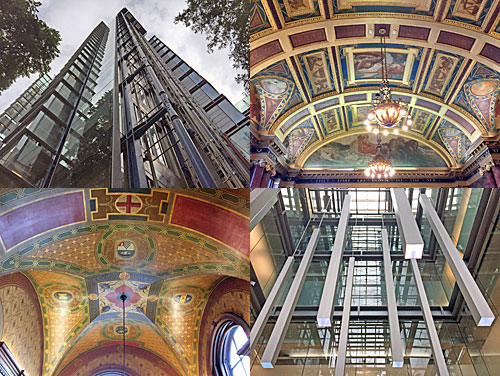
Building:Trinity House is the UK's General Lighthouse Authority, and has been based in a Georgian building overlooking Tower Hill since 1796. The interior was gutted by an incendiary bomb in 1940, then painstakingly recreated using photographs from a spread in Country Life. [take a tour] A look around: It all looks lovely today, with history reverberating from every surface, as befits an organisation with deep naval pockets. A huge collective portrait dominates the loftylobby at the top of the main stone stairs, beyond which are rooms with even more impressive painted ceilings and maritime memorabilia. The postwar extension is rather more functional, featuring stained glass removed from Mile End and windows commemorating royal patronage, plus plenty of space for hosting receptions or ceremonial. I'm guessing nowhere else in London boasts a huge silver lighthouse, on silver rocks, locked securely in a silverware case.
Building: Not to be confused with the Newham suburb, this lengthy building faces the Thames waterfront between London Bridge and the Tower, and is where ships' captains would have come to pay duties on their cargoes. The current building is about 200 years old, its warehouse interior mostly modified into austere government offices, but the Long Room where the counters for payment used to be survives intact. A look around: Custom House is still used by Her Majesty's Revenue and Customs, so when you visit for Open House what you're really coming to is an HMRC Roadshow. Chirpy geezers will explain how they spot cigarettes being smuggled through airports, how they crack down on under the counter laundering and how they fly abroad to nail tax-avoiding fraudsters. Trained dogs will practise suitcase sniffing in the courtyard. And when eventually you reach the Long Room prepare to doubletake when you see rows of drab government desks squished in beneath a historic ceiling. My thanks to the dozens of civil servants who turned out at the weekend to smile and nudge us round, in what to them is simply their daily place of work.
Building: Not Lloyd's of London, but from the same coffeehouse roots, Lloyd's Register was founded in 1760 to serve the needs of merchant shipping. Their Renaissance-style HQ in Fenchurch Street dates from the turn of the 20th century, and is the very building used by Monty Python in their swasbuckling skit The Crimson Permanent Assurance. A century later Richard Rogers added a twin-towered steel and glass extension, bolted onto the side behind a churchyard garden. A look around: They've got the Open House experience nailed here - first a chat from someone knowledgeable in the glazed atrium, then directed off round a self guided trail so the next batch queueing in the churchyard can troop in. Follow the arrows to meet an archive conservator and peruse a model oil rig, then move on into the serious palazzo with its OTT decoration. The Old Library boasts barrel-vaulting and bookcases with rosewood inlay, but the main event is the General Committee Room up the marble staircase. An Italianate saloon embellished with nautical symbolism, beneath a painted ceiling echoing the Sistine Chapel, this dizzying space is proof that trade pays.
Building: You've likely seen the building at the head of the approach to the Millennium Bridge, a plain glass box on the corner of Queen Victoria Street. The Sally Army's nerve centre is the result of downsizing in 2004, with the majority of the site rented out to a hotel to help pay for the missionary upgrade. The architects' brief was "Modern in design, frugal in operation and evangelical in purpose", hence the chief features are external and internal glazed walls stencilled with quotes from scripture. A look around: First expect a ten minute film, in part recalling how this site was firebombed out of existence in 1941, followed by a soft soap account of the organisation's good works around the world. Then expect a tour of the building, from the glass walled conference rotunda to the General's glass walled office where his desk can be seen by every passer by. The chapel space is beautifully simple, a small room leading down to louvred windows which reflect the sky and clouds rather than the uglier buildings opposite. Expect the tour to end in the cafe, of course, and there might even be a brass band to entertain outside.
Building: Escaping the City now, here's an unlikely survivor that probably merits an entire post of its own. Victorian passengers waiting for trains at Peckham Rye luxuriated in a huge room above the ticket hall, which eventually fell out of favour and became a billiard hall, which eventually fell out of favour and was closed. A few years ago the windows facing the platform were unbricked and a major restoration began, which still has some way to go - the floor is still imperfect in parts and the walls and roof very much looking their age. Most recently the main stairwell has been reconnected, topping old with new, and fresh access permits many possible future community uses. A look around: It wasn't just Open House luring visitors inside, the walls of the waiting room were also emblazoned with historic photos of Peckham Streets from the 1890s to the present day sourced from Southwark council's collection. These were wonderfully evocative, especially so if you actually live here, hence the room was packed out, not just with older history buffs but with trendy bearded youth. Many paused for some tea and cake and a sit down, which was apt, as this marvellous room briefly reverted to its original purpose.
Buildings: Beside the Regents Canal in Hackney, this unique rooftop project hosts a series of experimental architectural structures with a focus on innovation, sustainability and recycling. Four different eco-buildings perch atop Columbia and Brunswick Wharf, the kind of complex rooftop cityscape a rogue TV detective might normally chase a criminal across. This year's addition is a scaly silver framework resembling a ventilation duct, encased in stapled cardboard 'tiles', which conceals a tiny sheltered garden at its upper level. A look around: Poking around old warehouses is fun enough, but exploring roofspaces via diverse atypical stairs was quite an adventure. The only way to reach two of the houses was to descend a long external ladder from one roof to another, while temporary wooden stairs in a separate building eventually narrowed to a tiny vantage point within the aforementioned silver twirl. Yes, of course there are beehives up here. Yes, I bet the parties hip Hackneyians throw up on the roof are quite something.
Building: I'll finish off with one near my home, a former dog biscuit factory beside the Limehouse Cut converted into residential units long before this was cool. The conversion was done poorly, or so the latest owner of Unit 4 Block B believed, so he brought in architects to spruce up his cavernous warehouse-style space. They did a proper revamp using a lot of reclaimed materials, adding a master bedroom above the living space, which doubles up as the perfect shooting gallery when TV crews or Hollywood directors come to visit. A look around: It's surely obligatory to poke round someone's home on Open House weekend, if only to go "ooh, I like the way they've done that, I wonder whether it would work in my place?" or to erupt in a seething fit of jealousy. For the majority of the group I walked round with it was definitely the former, ogling the rough surfaces, eyeing up the bathroom sinks and coveting the Crittall windows. Divided up differently you could easily squeeze four pleb-sized flats into the same space, and the heating bill must be on the high side, but it's amazing how desirable a dog biscuit bakery can become.
It's always illuminating on Open House weekend to visit one of London's town halls. One year I deliberately visited six. These bastions of democracy regulate our local lives, but most of us would never dream of venturing inside, let alone scrutinising their role. Several were participating this year, but I only made it to Hackney Town Hall, picked pretty much at random because it was near somewhere else I wanted to go. And I hit the jackpot, not only because the interior's an Art Deco gem, but because a decade of major renovation has (just) finished and one of the architects was available to guide us round. [restoration pdf]
Hackney's first town hall is now a Coral betting shop on Mare Street, abandoned for a larger site in 1866, then rebuilt in 1934. It's this Neo-classical rebuild which still stands, facing the palm trees in the main square between the library and the Hackney Empire. The architects were Lanchester and Lodge, their brief to design something grand but cheap, hence a surfeit of plasterwork behind the Portland stone facade. Here's a photo of the frontage in which I have carefully cropped out the worldly goods of two homeless men arguing loudly about which of them detests the other more.
I wish I'd been inside previously to be able to compare the scruffy octogenarian look to this latest spruce up. The marble across the floor of the entrance passageway has been given a painstaking polish, and the space opened up by knocking through a couple of unnecessary walls. Chiselled letters on the lintel declare HACKNEY TOWN HALL with élan, and beyond is the REGISTRAR OF BIRTHS, MARRIAGES AND DEATHS, a function long since displaced to the glass warren across Reading Lane. I would have taken a photo of this handiwork to share, but a row of Hackney personnel were lined up underneath and that would have felt wrong, so I made do with grabbing a bit of elegant staircase as the tour began.
The main public spaces are a bit wow, thanks mainly to the light fittings. These are original - geometric confections of glass and shiny brass - perched atop finials, ribbed round pillars or glowing from the ceiling. The finest of all holds sway above the Council Chamber, an extruded octagon of superphallic dimensions illuminating proceedings. The wood panelling round the walls was in an appalling condition but has been French-polished back to life, while the restored bank of upholstered seating now conceals gubbins to allow council voting to progress electronically. As for the long narrow room hidden at the back under the public gallery, this would once have reeked of cigar smoke, but is now a lush snug where elected members can network and/or relax.
We got to poke inside the Mayor's office, and to see his personal collection of Hackney community paraphernalia stashed inside a cupboard rescued from the cellar. We got to walk the corridors and see the portraits of all Hackney's formerMayors, their dress and demeanour either evocatively or scarily out of date. We also got to go outdoors indoors by entering what used to be a central courtyard, now covered over for use as an accessible events and circulation space. If all the renovation work looked expensive we were reassured that it had greatly improved energy efficiency, and had allowed over 50% more council staff to work within the building, so had also brought economies to bear.
For larger events the Assembly Hall has one of the only remaining sprung dance floors in London, and large square lamps looming overhead. The Bridgetown Bar nextdoor is a more intimate darkwood space with illuminated marble bar, and old photos round the wall from the town hall's heyday. Two of the last rooms to be finished off are the marriage suites, shortly available for booking, one of which was so tastefully blue it made tour members coo with appreciation. I think the architect leading us round was suitably impressed by our reaction, as indeed had we been with her knowledgeable input to the tour. It was great to see a building so beautifully restored - Historic England are well chuffed - and revived to function at the very heart of its community. [7 photos]
This next building dates from the same year, 1935, and can be found half a mile up the road to Dalston overlooking Fassett Square. It was an extension to Hackney's German Hospital, that a redbrick cluster, this a five storey annexe with general medicine and maternity care in mind. Teutonic thinking led to a Modernist design, with a massive concrete canopy above the main entrance and practically elegant terrazzo stairwells. Patients would have appreciated the bright and airy interior, and the current residents do too, because of course the hospital was closed in 1987 and was swiftly turned into flats. However a surprisingly high proportion of the current residents are architects, which is always a good sign, and they turned out at the weekend to show us round.
There was no peering inside the accommodation, but we did see the lobby, and stand in the car park where the tennis courts used to be, and climb the (lovely) stairwell to the roof. The hospital's designers provided a roof garden for the benefit of convalescent patients, as well as a long balcony one floor lower down to push trolleys out onto. The roof garden is more an open space with planters than a verdant horticultural feast, and boasts a splendid swooshing shelter up one end which resembles an elongated mushroom. For those who like this kind of thing, this is the kind of thing they really like.
Particularly splendid are the views, there not being too many tower blocks in this part of Hackney to break sightlines. Immediately adjacent is the original hospital, again now residential, swiftly taken out of German hands at the outset of the Second World War. But I was more interested in the terraces on the other side, because Fassett Square E8 has nationwide fame as the set designers' inspiration for Albert Square E20. It was great to be able to look down on an oddly familiar style of housing, and its central garden square, and to learn that EastEnders still send a research team to Fassett Square every year to make notes on how real life fashions in fixtures and fittings have subtly changed. There may be no pub or shopping parade, nor cursing Cockneys casting aspersions in the street, but (Overground) trains do rumble past noisily up one end. The BBC originally considered filming all their exterior shots here, but the looming Modernism of the German Hospital would have made camera angles too difficult so they built a set in Elstree instead, and the rest is history. Residents of sleepy Fassett Square much prefer it that way. [8 photos]
As an intermission from Open House, let's try to answer the question...
What's the most this ride could cost?
The table below is for transport in London, and shows the maximum cost of a single journey for one adult.
It does not include...
...free journeys
...return journeys
...journeys starting or finishing outside London
...penalties, peculiarities, quirks or unusualnesses
mode
payment
time
cost
notes
bus
Oyster/contactless
anytime
£1.50
Includes one additional journey within one hour - the Hopper
tram
Oyster/contactless
anytime
£1.50
Includes one additional journey within one hour - the Hopper
tram
cash
anytime
£2.60
Ticket machines will be removed soon - consultation underway
DLR
Oyster/contactless
off-peak
£2.80
zones 1-4 (any journey not including Bank or Tower Gateway costs only £1.50)
tube
Oyster/contactless
off-peak
£3.10
zones 1-5 or 1-6
overground
Oyster/contactless
off-peak
£3.10
zones 1-5 or 1-6
TfL Rail
Oyster/contactless
off-peak
£3.10
zones 1-5 or 1-6
cablecar
Oyster/contactless
anytime
£3.50
50% off if you ride 5 times in a week and then ring 0343 222 1234
DLR
Oyster/contactless
peak
£3.90
zones 1-4 (i.e central London to Woolwich)
rail
Oyster/contactless
off-peak
£3.90
e.g. Crews Hill - Slade Green (zone 6 - zone 6)
cablecar
cash
anytime
£4.50
tube
Oyster/contactless
peak
£5.10
zones 1-6
overground
Oyster/contactless
peak
£5.10
zones 1-6
TfL Rail
Oyster/contactless
peak
£5.10
zones 1-6
tube+rail
Oyster/contactless
off-peak
£5.40
e.g. Uxbridge - Purley (zone 6 - zone 6)
tube
cash
anytime
£6.00
zones 1-6 (also applies to Overground and TfL Rail)
rail
Oyster/contactless
peak
£6.20
e.g. Crews Hill - Slade Green (zone 6 - zone 6)
rail
cash
anytime
£7.10
e.g. Surbiton - Orpington (zone 6 - zone 6)
river
Oyster/contactless
anytime
£7.20
Thames Clippers - all zones
tube+rail
Oyster/contactless
peak
£7.80
e.g. Uxbridge - Purley (zone 6 - zone 6)
river
cash
anytime
£9.00
Thames Clippers - all zones
tube+rail
cash
anytime
£9.80
e.g. Enfield Lock - Chessington South (zone 6 - zone 6)
connect
any
anytime
£10.30
Heathrow Connect to Paddington
rail
1st class
anytime
£10.60
e.g. Surbiton - Orpington (zone 6 - zone 6)
congestion
online
7am-6pm
£11.50
Or £14.00 if you pay the Congestion Charge the following day
river
online
weekends
£15.40
River Bus Express for The O2 - VIP Champagne Single
HEX
online
off-peak
£22.00
Heathrow Express (cheaper if bought at least 14 days in advance)
HEX
online
peak
£25.00
Heathrow Express (cheaper if bought at least 14 days in advance)
HEX
on board
anytime
£27.00
Heathrow Express (turn-up-and-go fare)
taxi
any
before 8pm
£31.00
Typical maximum fare for 6 miles
HEX
1st class
anytime
£32.00
Heathrow Express (journey time 15 minutes)
taxi
any
8pm-10pm
£33.00
Typical maximum fare for 6 miles
taxi
any
after 10pm
£34.00
Typical maximum fare for 6 miles
uber
app
non-surge
£37.00
Central London to Heathrow
cycle hire
any
all day
£50.00
Extra Ride Charge Limit (equivalent to 12½ hrs at £2 per 30 mins)
taxi
any
anytime
£90.00
Typical maximum fare for central London to Heathrow
If you'd like to clarify something in the table, or add something extra to the table, or if you think something in the table is incorrect, please use this special comments box. comments:
If you'd like to comment on the table, or comment about today's post in general, please use the normal comments box.
Kaymet are "a maker of trays and trolleys since 1947", whose south London factory flung wide its doors over the weekend for anyone to look around. That's the kind of Open House offer I find hard to resist, so I headed down the Old Kent Road to track the metalworkers down. Their factory's at the end of Ossory Road, a light industrial dead end (with evangelical infill) backing onto an Asda superstore. Turn left at the stonemasons, walk past the tiny hut doubling up as a showroom, and here is a small business doing what small businesses do best.
The building's the seventh Kaymet has inhabited over the years, and nothing special, merely a large functional shed seemingly haphazardly laid out. But the product which emerges at the end of the line is premium stuff, sold in Harrods and John Lewis, and fundamentally the same design which first emerged in 1947 and was exhibited at the Festival of Britain. The handles are attached more efficiently these days, and the range of colours is a more recent diversion, but the benchmark tray is still made by thwacking a sheet of aluminium in a big press, then hand-finishing the edges and anodising the result.
Kaymet started up under a German owner, surname changed for postwar anonymity, and his son still helps out with day to day operations. But the current owner of the business is an escapee from City Hall whose department disappeared under Boris, and who couldn't bear to see a long-standing local business slide into liquidation. He and his wife are now more deeply involved in day-to-day operations than they ever expected, and mesmerisingly enthusiastic too, which made the tour an especially engaging half hour. It was a privilege to wander amongst the workbenches, machinery and boxes of frames, and to learn the 'trade secret' of how they punch through the rubber squares that make the non-slip trays non-slip.
It's reassuring to know that some of London's manufacturing industry survives, indeed Kaymet have discovered that 'Made in London' still resonates with luxury foreign markets. What's less reassuring are the relentless economic pressures on land in inner London, which mean that small-time manufacturing has a tendency to metamorphose into flats. The Old Kent Road is under particular pressure on this front. Over 800 small businesses in the immediate area provide work for around 10000 people, but various Southwark Council redevelopment plans loom large on the gentrification drawing board. The Bakerloo line extension, if it ever happens, will plonk two new tube stations either side of Ossory Road, and tomorrow's Londoners want accommodation more than they want trays.
Had the owners thought to have Kaymet trays on sale at the end of the Open House tour they'd have sold several, instead making do with disposing of a few hastily-sourced seconds at less than market price. Even I was tempted, which is saying something. Instead it proved more tempting to sign the Vital OKR petition, supporting a pressure group speaking out for the economy of the Old Kent Road. They plan to fly maritime signalling flags down the street which read "We are not nothing", just as John Edgington's did in 1969 before their tent-making premises were brushed aside by the Bricklayers Arms flyover. We all need somewhere to live, but let's try not to destroy what makes London special in the process. [video]
Tucked away in an old printworks in a backstreet near West Norwood station is a unique collection of mechanical timepieces. Most horologists tend to collect wind-up antiques or intricate watches, but James Nye has a passion for the electro-mechanical, and had long been searching for somewhere to keep them. The ground floor of this post-industrial building proved ideal, and his clocks now have collective life rather than being stashed away where hardly anyone ever sees them.
Electro-magnetic clocks are pulse-driven, some with an internal oscillator and others a pendulum. They were often used in institutions where it was important to have a network of clocks all telling the same time, for example in an office, hospital or school. The master clock would be maintained at the correct time and a series of slave clocks would be connected by wires to run synchronously elsewhere. Most of James'sclocks are the masters, and have the look of a long-case timepiece about them, while other exhibits include regulators used for the very precise timing of astronomical observations.
The Clockworks exists not just as a museum but as a conservation workshop. A raised concrete platform at the rear of the floor proved ideal for the installation of tools and benches, and more importantly provides somewhere for horology graduates to continue to practice after completing their degree. Several apprentices (from West Dean and Birmingham) have worked here over the last five years, maintaining the collection two days a week and practising the art of conservation on the others. If you have any kind of vintage clock or watch which might need repairing or bringing back to life, hold this place in mind.
It's a lovely mixed-use space, with a small library up front and various historical oddities scattered elsewhere. Dr James is a twinkly and engaging curator, as befits the chairman of the Antiquarian Horological Society, while the apprentice I spoke to was equally cheerful, dedicated and keen. I suspect my lengthy Open House visit merely scratched the surface of all there is to know about the world of distributed timekeeping. Thankfully the collection's also open 'by appointment', particularly if you have a small group you'd like to bring round, should you too ever fancy a fascinating insight into what makes these things tick.
Many London skyscrapers have a dull name and a nickname. The Leadenhall Building is dull-ly titled because it's on Leadenhall Street, but is better known as the Cheesegrater because of its distinctive wedge-like shape. Here it is in Lego, in case you need reminding.
The Cheesegrater is the second tallest building in the City of London (or the tallest if you think the Heron Tower's 92ft mast is a cheat). It's the shape it is to protect views of St Paul's Cathedral from Fleet Street - the upper storeys taper back to keep out of the way of Wren's dome. Its planning application was approved in 2005, but construction was held back by the economic downturn and so final completion took place only two years ago. It's unusual in that the building's spine is at the rear, with a 'cassette' of liftshafts and utilities bolted onto the back, allowing the floors to cantilever forwards in open plan style for maximum office flexibility. 48 floors, 225 metres high, if you're counting.
The architects were Rogers Stirk Harbour + Partners, better known as "the agency Richard Rogers started", but since renamed to reflect new talent rising up through the ranks. Although it was never intended, the company needed new premises a couple of years ago and the 14th floor of the Leadenhall Building was available, so they now run their international practice from a building they designed. They were also the ones providing guides for the Open House tours, which meant visitors were particularly well informed.
The Cheesegrater squeezes a significant amount of public space into its small footprint because there's a gap where the ground and first floors ought to be. Bring your table tennis bat and you can even have a game of ping pong underneath the overhang in this outdoor atrium. Two sets of escalators swoop up through the void, on weekdays delivering a suited insurance salesforce to the main lobby on the second floor. Head through the security barriers and, surprise, you're already pretty much at the back of the building. Three sets of glass lifts shoot up from a lofty corridor fringed in geometric yellow, with (whoa!) an all round view if you stand at the rear.
What does a top-rank architectural practice have just inside its entrance? Security, obviously, and then a long rack of scale models of some of the more famous buildings they've designed. Lloyd's of London (1978-86) is there in wood at 1:500, while the Pompidou Centre (1971-77) is a colourful burst of perspex at 1:1000. Several far flung global landmarks are included - the practice has a particular penchant for airport terminals - but the Cheesegrater itself doesn't fit on the shelf and gets to stand elsewhere. Some modern clients now prefer to see a digital blueprint, but all the physical models are still cut, carved and stuck together in a glass-fronted workshop located in the room behind.
This being expensive real estate the RHSP workforce are tightly packed in, but there are also meeting spaces and a cafe area, plus breakout tables with a rather distracting view. The dome of St Paul's is clearly seen to the west, while other buildings the practice has designed are picked out by stickers on the glass. It doesn't take a sticker to identify the Lloyd's Building, whose metallic Grade I bulk rises immediately opposite, extruded service shafts and all. It must help for getting work done that this is only the 14th floor, not up in the forties, although the amount of floor space does get considerably narrower up there.
The guide for our group had worked on designing the unsexy part of the building - the basement - rather than the cheaper visible stuff in the sky. He therefore knew his stuff, in considerable depth, without cramming a few key facts the night before or having to read the salient points off a cribsheet. Maybe that's why he also ended up apologising for talking too much at each of the stopping-off points and making our tour much longer than everyone else's. When you're up a special skyscraper for a one-off visit, hell yes, these are the kind of guides you want. [7 photos]
Not every Open House building with a lofty view is a pre-book. Some are turn-up-and-walk-in, capacious enough to cope without a queue, and offering a perspective only employees normally see. This year Watermark House was one such venue, the employee base for a Japanese bank previously sited out in Docklands and now tucked in by the Thames adjacent to Cannon Street station. Their office block is built partly on the site of a Roman wharf and partly on the site of a key medieval trading post, which sounds dreadfully destructive except that several centuries of later development had already destroyed what was previously here, and all Nomura's tenancy replaced was a 1970s telephone exchange.
For Open House, all visitors got to see was the lobby and the 6th floor, but the 6th floor is home to the City of London's largest roof terrace, so that's all good. Open decking surrounds various bits of garden, some shrubby, some floral and one raised section used to grow vegetables. With a beehive or two, a row of deckchairs and a reflective pool, it all feels appropriately zen. The lack of pigeons is also a bonus, which is thanks to the two year-old Harris Hawk which handler Laura wields on site two days a week. Bumping into a falconry display in an elevated Japanese garden is one of the delights which helps keep Open House fresh.
I don't know how many of the employees bring their coffee or lunch out from the cafe inside, but what a great resource, and what splendid views. The twin brick towers of Cannon Street station dominate, but one's eye will more likely turn to the thread of the Thames. Immediately opposite lie Pickfords Wharf and the Golden Hind, while the Shard is unmissable further downstream, and then an unobstructed view of Tower Bridge. Pick your City employer carefully and every day can have a scenic interlude to balance out the hours of slog. [6 photos]
Only 64 weeks remain until London's grand new east-west rail artery opens. Only 8 weeks remain until trains start being tested along the completed track. And minus one days remain until Open House made available tours of Crossrail building sites deep underground. Three of the stations opened up to the public were Bond Street, Whitechapel and Farringdon, whose limited availability was very rapidly snapped up. Rather more tickets for Canary Wharf were available, because that's far enough advanced not to require a guided hard hat tour, indeed has been for some time. So I grabbed a slot down there, and got to see what you'll all be seeing next year, once it's all finally finished.
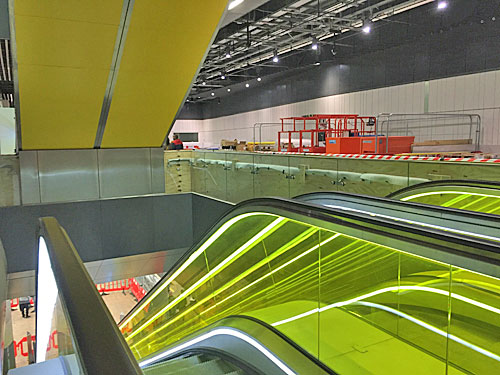
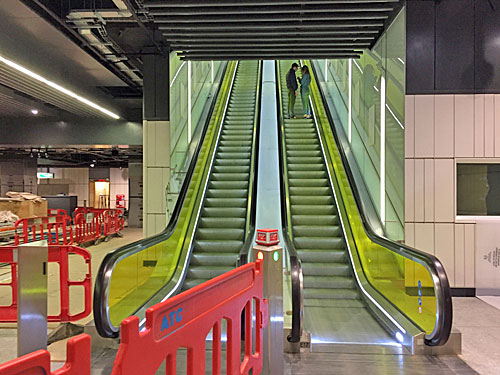
The first time I descended into Canary Wharf for Open House, five years ago, we spiralled down a rickety temporary staircase to a cavern with no platforms, tracks or tunnels. Today all these are in place, plus platform-edge walls, and most of the escalators now work. The escalators are veryyellow, almost unnervingly so, in what may or may not be a reference to the 'canary' part of the station's name. They are terribly photogenic.
Several banks of escalators are in place to speed you from platform level up to the ticket hall, and further banks then lead up to ground level. Some even have the Canary Wharf brand plastered across the glass up the side, perhaps as a subtle reminder that you're entering a private commercial estate and maybe you'd like to visit the shops and restaurants now you're here.
The layout's a bit like Canary Wharf on the Jubilee line, in that there's an intermediate level which runs the entire length of the station. It's nominally the ticket hall, but expect minimal ticket sales action to take place here, being more a vast circulation space between (as yet uninstalled) barriers. Various banks of electrical cupboards appear to run along some of the length, and not much else in the way of features, it's actually a bit drab... but after fifteen further months of fitting-out this could obviously change.
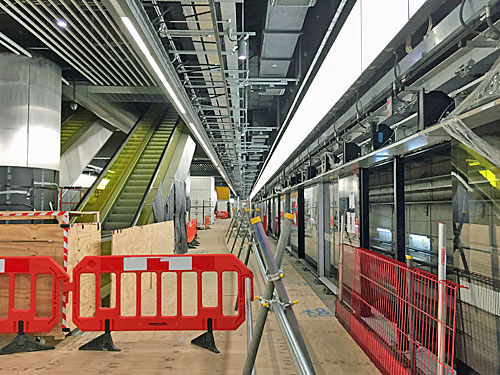
Platform level is where all the action is, or will be. Another broad concourse stretches 250 metres down the length of the station (board this end for Liverpool Street, and the other end for Moorgate). All that so far fills the central void are escalators and chunky liftshafts - any seating and roundels are yet to come. There isn't yet a proper floor to stand on either, we were walking around on timber planks, and the majority of the platform area remained out of bounds.
What's being installed at the moment are the platform doors. The entire length of the westbound appears to be complete, and covered up, but not yet the eastbound so we were able to have a good stare along that. Some of the mechanism above the doors was visible, and the screen itself didn't look quite as chunky as on the Jubilee line. In a few places the glass panels haven't yet been installed - perhaps this makes access to the track easier - and we were offered a clear-ish view down onto the rails you won't see.
Did I mention how yellow the escalators are?
It was great to be able to have a look round, and to meet with several of the workers and engineers who are helping to bring this project to its conclusion. Their enthusiasm and keenness shone through, and they probably can't wait to show off their handiwork to the rest of you. I've been particularly impressed across three separate visits to see this hole in the ground transform into proper infrastructure, so many thanks to Open House for the sequentialopportunity they've provided.
One day this construction phase will be but a memory, and these yellow escalators will be just another part of commuting in London. That day is 448 days away. Keep counting.