Église d'Auteuil ligne 10, XVIe arrondissement
Trafic annuel entrant par station: 177,017 The least used Métro station in Paris
The least used Métro station in Paris is down these steps.
We're in southwest Paris, north of the river, in the former village of Auteuil. This was swallowed up by the city in 1860, back when it most mostly home to nobility and vineyards, and has been a hangout for the nouveau riche ever since. It's pleasant without being overly snobby, and quiet without being dead. It's not the kind of place where you'd expect to find the least used Métro station. But there are reasons, and they're complicated.
We're near the tip of line 10, which was originally line 8 when it opened in 1913. The line ended in a loop, turning back at Porte d'Auteuil on the edge of the Bois de Boulogne. Line 10 took over in 1937, thanks to some tunnelling jiggerypokery elsewhere which need not detain us. In 1980 the line was extended westwards towards Boulogne so the loop was cut and instead became a kind of buckle. Trains head out of town through Église d'Auteuil, Michel-Ange Auteuil and Porte d'Auteuil, and back into town via Michel-Ange Molitor, Chardon-Lagache and Mirabeau. Here's a map, along with annual passenger numbers at each of the stations.
Line 9 cuts down the middle of the loop, with a remarkably equitable two and a bit million passengers at each station. None of the other stations on line 10's buckle come close, and all feature in the 20 Least Used Métro stations. But Église d'Auteuil's total of barely 180,000 is way off-kilter, despite being in the heart of a residential neighbourhood. And the chief reason for this is that RATP only count passengers entering the station. Passengers entering the station can only travel west, towards the banlieues, whereas they probably want to go east towards the city centre. What's more there are two eastbound stations within 250 metres - that's closer than Leicester Square is to Covent Garden - so they get the traffic instead. Lots of people get out at Église d'Auteuil, because it's the first station across the Seine, but they don't officially count.
If you do enter the station, descent is via a couple of flights of steps past all the usual maps and diagrams. At the foot of the stairs are two ticket machines, then a window behind which sits a member of staff without much public to administer to. Beyond the ticket gates is a single tiled platform, gently curved, with four orange plastic seats in the centre. And at the far end is a second exit, not available for entry, which reaches the surface partway down Rue Wilhelm. This station was in fact originally called Wilhelm, after the 19th century French musician, but during the First World War a local councillor became convinced it had been named after Kaiser Wilhelm instead, so he successfully campaigned for the name change. Fake news is nothing new.
Arriving at, rather than departing from, the station involves an intriguing train manoeuvre. The track rises steeply after passing under the Seine, so reaches Mirabeau station at an awkward angle and continues climbing towards Église d'Auteuil without stopping. Those waiting on the eastbound platform get to watch trains whooshing up an incline, and those aboard westbound get to look down on them as they pass. Here's a video which shows, repeatedly, how that looks.
Which brings us back to the square containing Église d'Auteuil itself. The eponymous church which watches over the station entrance has a high narrow dome, several modern extensions and a busy congregation. The obelisk in the heart of the square marks the location of the tomb of Henri-François d'Aguesseau, former Chancellor of France, left behind when the remainder of the cemetery was moved on. Molière once lived in a country house beyond the pedestrian crossing. The Bistro d'Auteuil on the cobbles serves biers, charcuterie and salades. Parisians really are much better at making their street corners somewhere you might want to hang out (and simultaneously much worse at having a decent-sized patch of grass close by).
Rue d'Auteuil wiggles off from here, the historic thoroughfare at the heart of the old village. It's lined with charming little shops selling meat and bread and dainty glazed pastries, and flowers and jewellery and leather goods, like a local high street flecked with upmarket infill. Some of the city's richest citizens live out here in gated enclaves, which is rare in Paris, but those who venture out onto the streets clutching baguettes and bouquets are more bourgeois than grandiose. Keep walking and within four minutes you've reached the main Place d'Auteuil, a charming triangular marketplace where the next westbound staircase descends. Passengers flock here, to the 61st least used Métro station, rather than back there to the least used of all.
Pelleport ligne 3bis, XXe arrondissement
Trafic annuel entrant par station: 361,581 The 2nd least used Métro station in Paris
Pelleport and Pré St-Gervais usually jockey for penultimate position in the Parisian Least Used stakes, and Pelleport currently holds the title by a margin of just 6000 passengers. Alighting from the train it looks normal enough, a very typical pair of facing platforms within an elliptical tiled tunnel. Above ground it looks normal enough too, a very typical Parisian road junction in the eastern suburbs. The reason for such low footfall is the railway itself, specifically line 3bis - the runtiest Métro line of them all. Originally it was a branch of line 3, but got disconnected in 1971 to streamline services on the busier arm to Gallieni. Line 3bis therefore serves just four stations, nowhere anybody who isn't local wants to go, and Pelleport is one of the two in the middle.
The platforms are generally deserted, as you can see, partly because of location but also because trains are unnecessarily frequent. Tiles are white. Seats are yellow. A gallery of oversized gilt-framed posters lines the walls. This is a deep level station, indeed 3bis is a deep level line, so Pelleport's lifts are very necessary. On this occasion I decided to ignore them and take the stairs, there being no sign at the bottom warning that this wasn't a good idea. It proved not to be a good idea, as the staircase turned and turned and turned until eventually I'd climbed 98 steps. Adverts on the walls suggest people must come this way, probably downwards at the height of the rush hour, but it was a relief to finally reach the surface.
Above ground Pelleport has a very dinky entrance, almost chalet-like in construction, designed by Charles Plumet using reinforced concrete and ciment de Grenoble. The lift doors open directly onto the pavement, with egress from the stairs on one side and a hideyhole for selling tickets on the other. A high roof is required to conceal the lift machinery, decorated with ornate ceramics plus the word Metropolitan in smart lettering across the middle. Peer closer and the words Rue Pelleport appear in mosaic on the edge of the overhang, which would have been what counted as a station nameplate in 1921. Below that on the main wall are three similarly original signs... ← Billets ←, Ascenseurs and Escalier ...for reasons previously explained.
The station entrance pokes up at the intersection of Avenue Gambetta and Rue Pelleport, less than a kilometre from the edge of the city, on the same block as an oversized hospital. Other corners are taken by the obligatory bistro, an awninged cafe, a run-of-the-mill pharmacy and a tempting boulanger/pattisier/traiteur. No tourist is going to stumble their way out here, ensuring these remain genuine outlets for the immediate populace, along with further independent retailers tucked away on bifurcating sidestreets. Seven-storey apartment blocks shield the spring sun. Coffee and pastries are taken at outside tables. Traffic slowly streams. And a better station on a better-connected line is only 300 metres down the street, so why start your journey here?
Pré St-Gervais ligne 7bis, XIXe arrondissement
Trafic annuel entrant par station: 367,131 The 3rd least used Métro station in Paris
When in Paris, why not visit its three least used Métro stations? Number three is on the northeastern outskirts of Paris, not so far from number two, almost on the edge of the city. To reach it you take line 7bis, which is a peculiarity in itself (as the name suggests). Originally this was a branch of line 7, but was chopped off in 1967 because it was significantly less busy, and trains now shuttle around a handful of stations. On the onboard diagram the line looks like a paddle, but in real life it better resembles a wriggling sperm, with four stations forming a one-way loop round the head and the other four forming a tail. Pré St-Gervais is the station at the nose end, indeed it's the timetabled eastbound destination (despite the fact that services arrive, carry on and head back).
Trains run into a single platform, commonplace in London but a rarity here, They don't hang around, so the handful of waiting passengers leap up off their blue plastic seats to head off towards Danube and Botzaris. There's no reason to linger. The only way out is up a flight of steps and along a bright tiled passageway, where you could then take further stairs but far better to take the lift. Going up. It's then a short walk past the ticket office and then a final flight to emerge in a quiet part of town beneath an old Métro sign. Most Parisian stations are far from step-free.
Five roads meet at the adjacent road junction, the local housing neither too old nor too new. A few old souls are hunched over on white plastic chairs outside the Bar Du Metro Brasserie. The temperature flashing up on the pharmacy's green cross is five degrees too optimistic. The greengrocer at the corner shop shuffles a few trays of wholly mundane fruit and veg. In the park on the hill a posse of four police officers on bikes stop to talk to some reclining teens, then pedal off. From the summit there's a fine view across the périphérique into the banlieues, densely packed to the horizon. A tram wiggles round what was once the city wall, heading somewhere more useful.
It's partly Pré St-Gervais' borderline location that keep its numbers down, and partly its train service being a one-way loop to nowhere much. But this was not always so. Between 1921 and 1939 an extra rail tunnel was opened between Pré St-Gervais and Porte de Lilas, allowing a more useful shuttle connection to link up with line 3. This operated again between 1952 and 1956, but Porte de Lilas now had a direct connection to the city centre via new line 11, so the underused link was permanently mothballed. But the tunnel's still there, and so is a totally unused tunnel connecting the other way, which is where one of Paris's most elusive ghost stations is to be found. [tunnel map]
Haxo is a brilliant name for a station, or would have been had it ever opened. It was planned as the eastbound twin to Pré St-Gervais, and is located (out of sight) just 100m down the road. But no connection to the surface was ever made, so no trace exists at ground level, only a scrappy raised terrace covered by evidence of exercised dogs and far too many pigeons. Neither is it visible from a passing train - all that can be seen is the entrance to the tunnel that eventually leads there. The only way to reach Haxo is via illegaladventuring, or as part of an occasional film crew in need of an authentic disconnected platform.
There are longstanding plans to reconnect line 7bis and line 3bis to create a brand new line, notionally numbered 19. This would create a more useful arc through the 19th and 20th arrondisements, linking Gambetta to (almost) Gare de l'Est. The two tunnels are disjoint, so the new line would pass through Pré St-Gervais in a westbound direction and Haxo heading east. Should this ever happen, the existing platform at Pré St-Gervais would be taken out of service and the parallel shuttle platform used instead. But newly-opened Haxo would instantly become one of the least used stations on the Paris Métro, because drawing an obvious line on a map isn't the same as running a profitable railway, so don't expect any expensive de-ghosting any time soon.
London's not big on long straight lines, other than a few Roman roads transformed into traffic jams. But Paris boasts a full six-miler - the axe historique - a true ceremonial alignment of arches, obelisks and major thoroughfares. This is what happens happens when you stick kings, emperors and presidents in charge of town planning.
It grew in stages. Originally it was merely the central axis of the garden in front of the royal palace, the Palais des Tuileries, because the French do like a bit of formal symmetry. In the 1660s it was extended to provide a charming vista along an elm avenue, later renamed the Champs Élysées. This reached Place d'Étoile in 1710, where a century later Napoleon ordered the Arc de Triomphe to be built, eventually completed in 1836. The line continues along increasingly arterial roads and crosses the Seine to reach La Défense, a postwar business district sufficiently distant for Parisians to tolerate high-rise building. At the very far end is La Grande Arche, a whopping office block courtesy of François Mitterrand, which completes the line of perspective... for now.
The Palais des Tuileries is no more, having been burned to the ground by a rampaging mob in 1871. This opened up one side of the ginormous quadrangle that forms the Louvre, so today the eastern end of the axe historique is marked by the most famous art gallery in the world. I had been considering going inside, because Thursday mornings are one of the best times to avoid the queues, but decided against because a) the weather was too good to be trapped inside, b) I'd seen the Mona Lisa 39 years ago, before the invention of the smartphone, c) one huge art gallery a day is quite enough. Instead I wandered around the outside of the glass pyramid a bit, which was looking a bit less splendid than usual because the surrounding water features had been drained revealing triangular concrete slabs. All the usual tourists sat around enjoying a rest, or stood around in large groups, the Louvre being one of the sights you have to tick off even if you're not planning to spend hours exploring inside. Maybe next time.
This is the smaller of the two arches Napoleon had built to celebrate a string of victories, but the only one of the two to be completed before his string of defeats. It lines up precisely with the axe historique, having doubled up as the entrance to the Palais des Tuileries before that was demolished. Intriguingly it doesn't line up properly with the Louvre, whose central axis is slightly out of sync due to the slight curvature of the River Seine. Instead the axe historique now terminates at the equestrian statue of King Louis XIV in the Louvre's courtyard, seemingly naggingly off-centre but in fact perfectly aligned.
The palace may have gone but its garden survives, remodelled as the ultimate in French formality. Pristine lawns and topiary clusters are carefully balanced to either side of a scrunchy central promenade, along with colourful flowerbeds and classical statuary. In spring admire the dazzling pinks of the cherry blossom. In high summer dive for the shade of the avenue of clipped trees. Two ornamental ponds complete the facilities, each medially aligned, one smaller and round, the other larger and octagonal. I could have grabbed a perimeter seat in one of the official green non-deckchairs, admired the fountain and watched the small boats, but I had an axis to follow.
Largest square in Paris, threaded through with streaming traffic, centred on a 75 foot obelisk from Luxor and the ideal place to guillotine deposed royalty.
No longer bucolic fields the Champs Élysées is Paris's chief thoroughfare, almost two kilometres in length, and is also used for military parades and concluding the Tour de France. One end's green and palatial, the other's mostly shops. I headed to the latter to see what all the fuss was about and discovered a succession of brand temples on either side of a teeming highway. The traffic's far far worse than Oxford Street, but this doesn't matter because the street and pavements are much wider so the cars can do their thing while you windowshop. There's even space to fit tented brasseries between the roadway and the shops, so spacious is the Elysian experience. I checked for riot damage following the recent gilet jaunes protests, and spotted only a handful of shops with telltale boarding (although I doubt Lacoste previously covered their windows with sparkling metal grilles).
Built long before the motor car, the intention was never to become a roundabout, but that's essentially what this victory arch has become. It sits at the heart of an astonishing twelve-armed road junction, an effect which can only be achieved at scale, which means attempting to walk round it takes absolutely bloody ages. Cars and buses and scooters swirl round, like a circular Hyde Park Corner, while tourists step up to the roadside for a triumphant selfie. The proper thing to do is pay 12€ for the privilege of climbing 284 steps to the roof terrace, via a small museum in the attic, and gawp across Paris in a dozen directions. Thursday would have been a cracking day for it too. But I burrowed down to the Metro station that's sort-of underneath instead, and followed the rest of the axe historique by rail.
This is the oldest, and the busiest, of the Métro lines under Paris, and follows the historic alignment from roughly Place de la Concorde to the Grand Arche. It's also fully automated, and has been since 2012, which means there's no driver to get in the way if you sit right at the front. From here you can see both tracks within a single squat tunnel, in this case almost perfectly straight, the most entrancing array of lights being those on the descent to Porte Maillot. For the 1992 extension to La Défense the tracks rise up to cross the Seine mid-dual carriageway, revealing a forest of skyscrapers ahead, before ducking back down into the gloom. It'd be even more fun than the DLR if only the seats faced forwards.
Wow. This hi-tech commercial district stretches for a full kilometre uphill, its broad centralstrip bounded by office towers from the deepest recesses of architectural imagination. Be they colourful, slanted or merely very tall cylinders, each seems fearful of not being noticed so makes an extra special quirky effort. The overall effect is closer to London Docklands than the City, but with a far greater feeling of space despite the commercial clustering. I arrived at lunchtime to find office workers pouring out to collect lunch from a handful of streetfood vans, or more likely from outlets elsewhere, before diving back inside their separate vertical domains. I negotiated a succession of steppedterraces on my ascent, the expansive medial strip concealing an arterial road underneath where no foundations can be placed. I nipped inside Les Quatre Temps, which in 1981 was Europe's largest shopping centre, where armed soldiers mingled cautiously on the escalators. And I made my way inexorably towards the monster building at the far western end.
Officially it's a hollowed-out cube, 110m in length/width/height, clad in marble, but everyone calls it an arch. It was opened in 1989 to mark the bicentennial of the French Revolution, and now houses a couple of thousand civil servants within its twin pillars. Intriguingly the arch is twisted six degrees off-centre, partly to echo the skewness of the Louvre at the other end of the alignment, but chiefly because the railway lines and motorway buried underneath didn't allow the foundations to go in straight. For 15€ it's possible to ride a scenic elevator through the central void to an upper observation deck, which I tried in 2005, got the willies and vowed never again. An "elevator incident" in 2010 did indeed close the attraction down for the next seven years, which I feel somewhat justifies my irrational fears. Instead I settled on the steps, whipped out a thermos of tea and spent several minutes staringback down the canyon of offices towards the Arc de Triomphe, an Egyptian needle and ultimately the Louvre. It's incredible that the central axis of a old royal garden has become all this.
Fifty years ago Paris lacked a permanent showcase for the contemporary arts, so President Georges Pompidou decided to build one. A major international competition was conducted, ultimately won by Richard Rogers and Renzo Piano with a groundbreaking 'inside-out' design. Centre Georges Pompidou opened in 1977, across seven functional floors, and was thoroughly refreshed for a grand reopening in 2000. Today it attracts over 3½ million paying visitors a year, which is more than any UK attraction manages, and there's nowhere else quite like it. It's also reallydifficult to photograph.
The large car-park-esque building is located a few blocks north of the river, alongside a rectangular open space whose footprint is approximately the same size. This is a good place to sit and stare up at the pipes, girders and struts on the exterior, plus the tubular escalator snaking up the side. I've got as far as outside the building before, but been thwarted by lack of time or the fact it's always closed on Tuesdays. On this visit I picked my day carefully and timed my visit to avoid the queues by turning up at 4pm. The Pompidou keeps all its exhibition galleries open until nine, so a late visit pays.
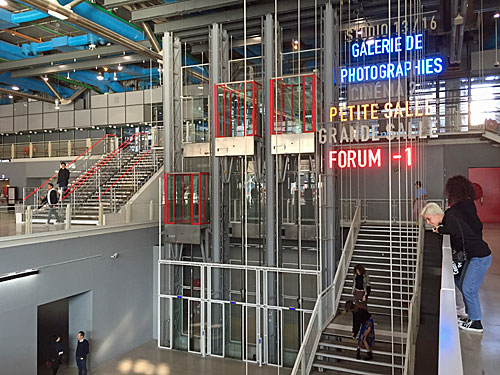
Anyone can get inside the main building for nothing, but you do need to make your way through security first. This grants access to a huge atrium, with all the exposed painted pipework and ducting you'd be expecting, plus an underutilised mezzanine level and a labyrinthine basement. If all you want is a wander and the Photography Gallery that's fine, but basically you're not getting anywhere decent without paying. Further wandering costs 5€, but what everybody goes for is the 14€ “Museum and exhibitions” ticket, otherwise all you're going for is a view. Sticking your rucksack in the cloakroom is obligatory, but now free.
As a first time user I confess to being impressively baffled as to where the art was and how to get there, but the gist is that it's "up the escalators". The short escalator I thought connected only to a cinema was the key, leading first to a ticket check and then to the external tubular experience. It's here you step into the escalatorzigzag up the side of the building, shielded inside a grimy perspex pipe which might once have felt hugely futuristic but now has shades of '80s shopping mall. It's further than you think. The first two floors contain a public library, accessed elsewhere, and the next floor is only for the exit from the main collection, so you need to climb one grinding flight higher.
Four paragraphs in, and at last here's the art. The Musée National d’Art Moderne showcases key works from 1905 to the present day, conveniently split by floor into 'before I was born' and 'after'. On the 5th floor that means Expressionism at one end and Pop Art at the other, arranged pretty much chronologically, which makes a pleasant contrast to the vagaries of Tate Modern's woolly thematic blur. Starting off down the first long compartmentalised gallery I was starting to worry that the two hours I'd allocated weren't going to be enough.
You don't get a lot of any particular artist, but you do get a lot of artists. And while French painters get more of a look-in than others, that's no bad thing. I loved the bright speckly Matisses, and the expressive Kandinskys, and made tracks to further investigate Quizet. It was inspiring to be surrounded by a select few googly-eyed Picassos, a couple of them pointedly blue. An added dimension was provided by objects rather than canvases, for example a selection of Bauhaus furniture, as well as some intriguing historical displays tucked up intermediate side-passages. All in all a big thumbs up to the fifth floor, and I wish I'd had the chance to walk a bit slower.
Downstairs comes the modern modern art, post 1965, arranged more conceptually. Here we find the plastic lumps, deconstructed metaphors and video installations, tons of them, filling a similar-sized space less densely. More a showcase than a permanent exhibition it's still an intriguing wander, even if nosing round certain corners can be a brief disappointment. A handful of artists get their own mini-exhibitions up one end, these currently including Stéphane Mandelbaum's cartoons, Isidore Isou's graphics and Ellsworth Kelly's windows. I'm not sure whether I enjoyed this floor more for its variety or its unfamiliarity.
Scattered across the building, on the top floor and the first, are four further galleries devoted to specific temporary exhibitions. In the main upper galleries that's currently a Victor Vasarely retrospective. I initially thought "who?", but grew to enjoy his dazzling optic art more and more with each twist and turn. He's on for three more weeks. Downstairs offered The Factory Of Life, a thought-provoking assemblage of bio-chemistry masquerading as art (and vice versa), plus a body of bold vegetal sculpturings from Brazil. Each of these galleries was noticeably busier than the main collection, presumably because all the local visitors have already seen that, possibly several times.
All in all, hugely worth the initial 14€.
Aside: In London the core art comes free, but you get stung for a lot extra to see small individual periodic exhibitions. In Paris entering the art gallery costs, but the small individual periodic exhibitions bear no additional cost. Both models have their positives, and I love that London offers so much for nothing, but the Parisian model is undoubtedly better value for money.
And when you're done with the art, there's the view. The sixth floor balcony extends the length of the building, and is higher than the entire neighbouring skyline so would have some amazing views if only it weren't inside a grime-encrusted plastic tube. The fifth floor balcony has almost as good an aspect and is entirely open, so that's the place to be (beating the fourth floor where the rooftops opposite start to block everything). A few steeples, obviously the Eiffel Tower, distant Montparnasse and a single compact skyscraper cluster in the distance. What wowed me most though was Sacre Coeur on its hilltop, a domed spectacle above lines of chimneypots, proving that architecture is also art. Formidable. [12 photos]
À PARIS:Five months ago Eurostar launched a special offer for cheap travel between January and March. With all those dates to choose from and Brexit looming, obviously the day I picked for a day trip to Paris was our last full day in the EU, March 28th. That'll be fitting, and fun, and potentially tumultuous, I thought.
But Eurostar texted the day beforehand and said sorry, French customs officers are on strike, please change your dates. With Brexit already postponed by a fortnight, obviously I delayed my trip by a fortnight, and then Brexit didn't happen again. Not a problem. I rebooked for yesterday, which turned out to be a glorious day in the French capital with not a cloud in the sky, and had a lovely day out. Here are a few observations for starters.
• I remain impressed that I can wake up at 5am, be whizzing underneath Stratford at 7am and stood outside Notre Dame listening to the clock strike eleven three hours later.
• The exchange rate is appalling these days, and euros are essentially pounds.
• I tracked down kilometrezero, the point from which all distances from Paris are measured. It's on the Île de la Cité in the middle of the Seine, which is exactly where a central point should be. Specifically it's marked by an unobtrusive octagonal brass plate within the cobbles in front of Notre Dame cathedral. The inscription says Point Zéro Des Routes De France but is now very worn. People don't generally give it a second look, unless their tour guide brings them over to make a fuss, but it felt like the kind of thing this blog really ought to mention and so I have.
• I ate a Cornish pasty on the Champs-Élysées, sorry.
• A Zone 1/2 Mobilis ticket (7.50€) costs roughly the same as London's Z1/2 daily cap (£7), but is hugely cheaper than our paper equivalent (£12.70).
• The biggest change in central Paris since my last visit is the spread of the e-scooter. They're everywhere, scattered across pavements and piazzas, abandoned where their last riders alighted. Several operators are in town, most especially Lime and Bird but also Dott, Uber and Voi. At €1 per hire plus €1.50 for ten minutes they're cheap for short journeys, and fun, and generally used in the road or along a cycle lane rather than careering across a pavement. Tourists also find them useful, and I spotted several couples and family combinations riding tandem to save cash. At rush hour the bicycle remains king, and the motor-scooter is still immensely popular, but commuting by e-scooter comes a definite third. With hire bikes also a prominent feature, in a similar variety of operators and colours, Paris has clearly taken soft mobility to its heart.
• Going through security at Gare du Nord is slower and more antiquated than going through security at St Pancras. Both are miserable experiences.
• The passenger lounge at Gare du Nord has nowhere near enough seats.
• Eurostar's wifi is very poor. I got better connectivity by turning it off.