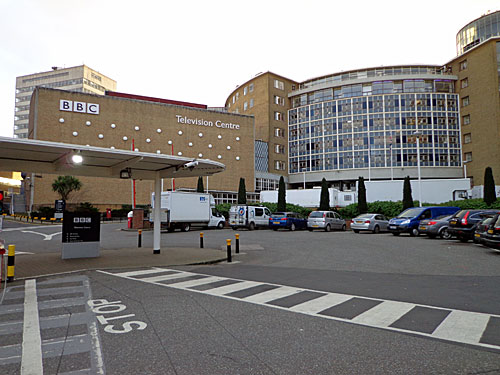
We all hate the BBC and its leftist propaganda, not to mention its lamentable programming output, all unjustly paid for via the Broadcasting Tax. So it was sweet justice when the government froze the licence fee and cut Auntie's finances down to size, forcing her to sell off Television Centre.
Hordes of vastly overpaid staff were kicked out to the frozen north five years ago, and the landmark building was handed over to developers to improve. What a marvellous decontamination job they've done!
Rather than penpushing bureaucrats and so-called acting talent, the former offices round the Helios courtyard now contain prestigious compact flats.
"The Courtyard Apartments are a collection of contemporary conversions with underfloor-heated polished screed, windows the full span of every apartment, and sections of ribbed ceiling."
Most of Television Centre's studios were demolished to create a crescent of designer apartments embracing the original core. It's clearly an improvement in every way.
"The Garden Apartments are designed to take full advantage of the landscaped private grounds, while a palette of pale oak flooring and biscuit-coloured terrazzo embodies the clean lines of Television Centre’s original design."
Where once the Blue Peter Garden doubled up as every viewer's shared backyard, now only genuine residents with bottomless pockets will have access to the space.
"Following the elegant curve between the Helios and the Crescent — a space wider than a London street — a private garden awaits for each resident to explore and enjoy. Imagine living in the middle of a city and waking up every morning to see a lush landscape outside your window."
Actual blue chip offices have been added, where entrepreneurs can earn proper money rather squandering our taxes on so-called entertainment.
"The office reception sits below the atrium at the centre of the internal street, with seating and breakout areas creating a buzzy and dynamic space with full Wi-Fi coverage and 24-hr concierge. The splayed geometry and staggered positioning of the bridge links make a bold, graphic statement across the atrium, and serves to connect people and activity across floors and between businesses."
Rest assured there are no namby-pampy socialist ideals here, only pure unapologetic privilege.
"The health club is a new concept called House Gym from Soho House with top range equipment, an 18.5m rooftop pool, steam room, sauna, fitness and yoga studios, and a spa offering residents and hotel guests a full range of beauty treatments."
In an act of genius, the private cinema will only show content the BBC either never made, or can't afford to broadcast any more.
"A residents’ screening room will show the latest films and sporting events, and will also be available to hire for private screenings."
But perhaps best of all, Television Centre's new owners have opened the gates to the public. Previously menacing BBC commissionaires kept taxpayers at bay, but now anyone can wander up the stepped recreational terrace and enter Auntie's secret sanctum. Imagine orbiting the central fountain to peruse a ring of retail units, each potentially offering juice infusions, light pasta dishes and unorthodox cocktail concepts. What today's audience really wants is a vibrant culinary destination, not some jumped-up tap-dancing space.
And yesterday this is what they got. The inaugural Television Centre Festival kicked off at 5pm, bringing foodie treats and a rotating program of DJs to this once-stuffy enclave. It's intended as a showcase for the top-class eateries moving onto the site, from street-sliced pizza to ultra-stacked burgers, not to mention a Conran restaurant and a mixology hub. Pick the right 'test card menu' and you could splash out an entire licence fee in one evening, rather than frittering it over an entire year.
The first night certainly drew the crowds, who queued patiently under the awning on the astroturf, and hovered round the meat vans clutching plastic goblets of prosecco. I was particularly thrilled to note that almost nobody was venturing further into the circular courtyard to inspect Television Centre's once-iconic architecture. Millennials are more than happy with alcohol and an experience, so should be the first generation not to fetishise the BBC, which should ensure the Corporation's ultimate downfall.
But something had to sour the evening. The BBC Concert Orchestra, an obscenely large body of unnecessary civil servants, put on a free performance in the atrium of the revamped office block. Unsurprisingly they kicked off four minutes late. These musical leeches then proceeded to murder a series of light entertainment theme tunes, from some ghastly Welsh version of Doctor Who to the overrated Strictly.
Office workers emerging after hours of unpaid overtime paused on the overhead walkways to listen in, then got bored and headed home. Some of the downstairs audience were plainly entranced, jiggling to Grandstand and mouthing all the words to Postman Pat, having been brainwashed by one of the BBC's most dangerous entry-level narcotics. But most members of the Netflix generation failed to recognise any of the older themes and talked all the way through the performance, just as if they were sat at home on their flatshare sofa, confirming that linear television is an irrelevance in modern society.
The orchestra won't be playing again and haemorrhaging more public money, thank God, but the festival continues until Saturday night. As well as food, Sarah Malcolm will be hosting a playful vinyasa flow class on mats around the Helios, providing an hour of soft yet fiery yoga practice with a focus on moving with breath and intention. Meanwhile a members' club for women will curate a live podcast, because streaming is the future, while DJ Leo Greenslade spins the decks. I'm sure you'll agree, this inspired line-up features more talent than The One Show has exhibited in a lifetime.
Yes, there are still three TV studios on site, where ITV and other commercial broadcasters will share what used to be an exclusively proletarian site. But consumers of Britain rejoice, for Television Centre is no longer a building but a brand, no more a cultural dictatorship but a lifestyle choice. At long last White City is well on its way to becoming a cluster of cool, and the Biased BBC has been well and truly cut down to size.
Yesterday I walked due south from where I live in Bow.
I walked for three hours - that's nine miles altogether.
Here's a snapshot of what I saw, taken every 10 minutes along the way.
(and here's a map, charting my progress in 10 minute leaps)
0h 0m - St Mary's church, Bow
Along the path through the churchyard, the new wooden planters are bobbing with daffodils. The tower is encased in scaffolding, lottery-funded, with a portaloo carefully positioned outside the main oak door. Dour-faced locals wait at one pedestrian crossing and then the next, carrying bulging bags for life. The 108 bus now departing will reach Lewisham an hour before I do.
0h 10m - Devons Road DLR station, Bromley-by-Bow
Every copy of City AM has been taken. The station's confectionery shack - Mo's Hut - is firmly shuttered. In the alley alongside The Widow's Son, as a nod to upscaled gentrification, an enterprising chap in a jaunty hat has set up a coffee stall. To attract attention his cart is parked on astroturf, his stash of napkins sits on a bird table, and two wooden deer nudge their antlers over the pavement. A cuppa costs a quid.
0h 20m - Hobday Street, Lansbury Estate
Built too late for the Festival of Britain, the flats on the northern side of the estate have won no awards. The Lansbury Mosque looks more like an ageing scout hut. Salisbury House rises 10 floors above a tree with a deflated helium balloon trapped in one of its branches. A well-wrapped toddler emerges through the security door followed by grandma, allocated childcare duty in the second week of the school holidays.
0h 30m - Poplar Recreation Ground
Near the empty playground, a ring of perfect white hyacinths surrounds a core of pink around a single palm. An elderly gentleman sits on the bench opposite, legs crossed, flat cap down, with a blue plastic bag at his side. The top of 1 Canada Square is intermittently visible through a blanket of low cloud. In Hale Street, outside the council depot, a mural to George Lansbury and the Poplar Rate Rebels has survived the last decade ungraffitied.
0h 40m - Upper Bank Street, Canary Wharf
Lunchtime has broken out amid the shiny towers, and the boulevards are thronged. Revolving doors spin to reveal officefolk on today's quest for nutritional novelty. Phones are whipped out for a burst of belated tapping. Cigarettes are lit. In the opposite direction, workplace lunchmates in smart suits and paunchy shirts return to their desks dangling meal deals and boxed pulses.
0h 50m - South Quay DLR station
Beneath the gloomy meandering viaduct numerous contractors vans are parked up, each ready to service the latest sky-high building project. Men in helmets and hi-vis await lorries to marshal. The shopping arcade supports a Subway and a Tesco, and no longer anything more. Signs direct curious flatbuyers along the dockside to a snazzy marketing cube on a floating pontoon.
1h 0m - Millwall Outer Dock
Here at the foot of the Millwall Dock it's somehow still the lowrise 1980s. At City Harbour a woman emerges to sit on her grey-facing balcony, wraps herself in a thick coat and lights up. An underfed alsatian, on walkabout with its anoraked owners, sniffs its way round every inch of the edge of the jetty. Every single one of the 50 private moorings reserved for residents of Clippers Quay is empty.
1h 10m - Westferry Road, Isle of Dogs
Chapel House Street is one of a handful of long-standing residential thoroughfares at the tip of the island, as can be evidenced by the Victorian pillar box opposite the Chinese takeaway. These days the street merges into newbuild flats and the Infinity Apartments. The estate agent on the corner eagerly awaits the completion of Island Point, an utterly bog-standard brick-box development which'll look exactly like you think it will.
1h 20m - Greenwich Foot Tunnel
I've finally had to deviate from my 'due south' track to hit this rare Thames crossing, but only by quarter of a mile, so fortuitously is my home located. Both lifts are working. A family wielding a pushchair pursue me into the central flat section. Each lamp is now individually numbered. A Chinese couple pause to take a grinning selfie in front of the tunnel's grimy tiles. No cyclists are present, no rules are broken.
1h 30m - Victoria Parade, New Capital Quay
Back on track at the mouth of Deptford Creek, a "most exclusive waterside village" has erupted along the biggest bend in the Thames. Concierges guard lift lobby entrances. Costa have moved in, plus a busy Waitrose, but the large ground level unit facing the Isle of Dogs remains For Sale/To Let. Once fully stocked with sandwiches, the fire engine departs. A pigeon walks the line of benches, awaiting discarded biscotti crumbs. No ounce of character survives.
1h 40m - Greenwich High Road, Greenwich
My latitude now matches the nearby Greenwich Observatory, but I'm following the meridian shifted 1 minute west, so I'm on the High Road instead. The North Pole isn't the pub it once was, offering a shisha lounge and an upstairs Piano Restaurant. Greenwich Sewage Pumping Station has been overtaken for the Tideway project. A girlfriend with a deathwish walks into the traffic obliviously Facetiming into her phone.
1h 50m - Elverson Road DLR station
Housing on the eastern flank of the station lacks the architectural gravitas of the west. Coldbath Street has flats where taxi drivers live. Bliss Crescent is inappropriately named. Workmen from Morrisons Utility Services are busy reworking some coned-off pavement with the last spoils of the financial year. Access to The Handy Shop, for those in need of cans or mobile top-up, is partially obstructed.
2h 0m - Asda, Lewisham Way
On this, the pretentiously modern side of Lewisham town centre, all the apartment blocks are called Something Cortes. One has childcare at its foot, another gaily-painted pipes. A row of artfully-positioned stones prevents traffic from mounting the kerb and crossing the piazza. Shoppers dodge manoeuvring buses to grab a week's worth from Asda. One short Victorian terrace lingers on, selling laminate flooring, BBQ ribs and hair extensions.
2h 10m - Marsala Road, Ladywell
This is one of several late 19th century residential street hereabouts, with front gardens too small for cars but large enough for three coloured bins. The owner of the Jaz'May ice cream van nips out of his front door, then drives off for a cornet session up Hilly Fields. The front of number 101 is plastered with 'No Junk Mail', 'No Cold Callers' and 'Please Leave And Do Not Return' stickers, plus a rather fetching basket of fuchsias.
2h 20m - University Hospital, Lewisham
What used to be Lewisham Public Library, opened in 1900, now fronts the borough's Registry Office (and Nationality Checking Service). This in turn fronts the University Hospital, a long splurge of less-heritagey buildings, emblazoned with Smoke Free stickers on every outward facing surface. This alas merely shifts the phalanx of puffers onto forecourts and pavements, forcing passers-by (i.e. me) to inhale lungfuls of nicotine as they walk past.
2h 30m - Rushey Green, Catford
My ten-minute snapshot occurs along the dullest part of the shopping parade, after the Sainsbury's ghost sign, but before the chain stores kick in and the giant cat stares down. The discount furniture showroom is empty (other than of furniture). Nando's is buzzing. The Eastern Queen is proud to be fully licensed. Splendid Barbers will do you for a fiver. Shopping baskets are tugged. Off-school children are cajoled.
2h 40m - Bromley Road, Catford
Thanks to geography, I find myself walking along the the A21 for half an hour. Beyond the gyratory it's twin carriageway residential, with speed cameras and doctor's-surgery-sized villas. A beardy ginger courier hops out of his van to deliver a package to the concrete church. A rainbow flag hangs above the side entrance to the Lewisham Unitarian Meeting House. The magnolia on the corner of Penerley Road is splendid, but taped off.
2h 50m - Catford Bus Garage, Bellingham
Red vehicles aplenty are parked up, and swing in, and turn out. Drivers mill around between shifts. Across the road the parade features exactly the same chain of BBQ rib vendor as I passed 50 minutes back. A dilapidated house with broken windows boasts a used car forecourt outside. The Hand Car Wash is a flurry of chamois. A gleaming vehicle pauses to let me pass, then accelerates out into the traffic with a roar before screeching to the lights.
3h 0m - Southend Lane, Southend
After precisely three hours, my walk south is at an end... on Southend Lane in the former village of Southend. Both pubs have become dubiously designed stacks of flats. Tudor-style semis face off against pebbledash. Two boys on bikes perform wheelies which elicit angry shouts from a passing car. A hearse with a personalised numberplate glides by. I have not fiddled the timing, nor the astonishingly apt location, of my ultimate destination.
What is London's longest alphabetical train journey?
(this, of course, depends on what you mean by 'alphabetical journey')
Stations beginning A, B, C, D etc
Only nine tube stations start with the letter A.
Only one of these (Arnos Grove) is adjacent to a tube station starting with the letter B (Bounds Green).
But the next station (Wood Green) starts with a W, not a C, so that's the end of the chain.
The longest alphabetical journey on the tube is therefore Arnos Grove → Bounds Green.
So that's a disappointing start.
If you extend the search to the entire tube map, four more stations start with A.
But none of these are next to a station starting with B.
Purely in terms of probability, that's not really a surprise.
If you're happy to accept tram stops, there are three more A→B journeys. Addiscombe → Blackhorse Lane, Avenue Road → Birkbeck, Avenue Road → Beckenham Road
But there are still no adjacent Cs.
If you extend the search to all of London railways, hurrah, there's one better success. Albany Park → Bexley → Crayford
And if you allow any stations within the Oyster zone, hurrah, that chain gets even better. Albany Park → Bexley → Crayford → Dartford
Across the whole of the rest of the UK rail network, only one other chain of stations matches that.
It's up in Scotland, on the line between Edinburgh and Glasgow. Armadale → Blackridge → Caldercruix → Drumgelloch
But A-D is the very best we can do.
Stations beginning with consecutive letters
What if the first station can start with any letter, not just A?
I can find only one chain of three consecutive alphabetical tube stations. Ravenscourt Park → Stamford Brook → Turnham Green
Even changing trains mid-journey doesn't add any more to the list.
The wider tube map, adding DLR, tram and Overground, offers nothing as good.
Throw in the whole of the London rail network and there are a couple more chains of three. Lee → Mottingham → New Eltham Richmond → St Margarets → Twickenham
But three stations is London's maximum, which is somewhat disappointing (unless you know better).
Outside London, here's a four in South Wales (but I can't find a five). Barry Docks → Cadoxton → Dinas Powis → Eastbrook
Stations containing consecutive letters
Can we find consecutive tube stations containing A, then B, then C, then D, etc?
Yes we can. Here are some chains of five.
Fulham Broadway → West Brompton → Earl's Court → Gloucester Road → South Kensington
Edgware → Burnt Oak → Colindale → Hendon Central → Brent Cross
Hampstead → Belsize Park → Chalk Farm → Camden Town → Mornington Crescent
Those are all without changing trains.
Allow changing trains, and it's possible to get to nine.
Chancery Lane → Holborn → Tottenham Court Road → Goodge Street → Warren Street → Oxford Circus → Green Park → Hyde Park Corner → Knightsbridge
Starting with K instead of A, here's a tube journey which hits the maximum of eleven.
Bank → Liverpool Street → Moorgate → Barbican → Farringdon → King's Cross St Pancras → Euston Square → Great Portland Street → Baker Street → Regent's Park → Oxford Circus
...and here's another.
Southwark → Waterloo → Westminster → Embankment → Charing Cross → Piccadilly Circus → Leicester Square → Tottenham Court Road → Goodge Street → Warren Street → Euston
Stations in alphabetical order
This should be easier.
In good news, two adjacent stations are always in alphabetical order, in one direction or the other.
In bad news, the next station only has a 50/50 chance of following on, and then again, and then again.
This is similar to flipping a coin until you get a different result, so a long chain isn't very likely.
Here are several examples of five consecutive tube stations in alphabetical order on the same line. Arsenal → Finsbury Park → Manor House → Turnpike Lane → Wood Green Baker Street → Edgware Road → Paddington→ Royal Oak → Westbourne Park Barons Court → Hammersmith → Ravenscourt Park → Stamford Brook → Turnham Green Bermondsey → London Bridge → Southwark → Waterloo → Westminster Borough → Elephant & Castle → Kennington → Oval → Stockwell Croxley → Moor Park → Northwood → Northwood Hills → Pinner Eastcote → Rayners Lane → South Harrow → Sudbury Hill → Sudbury Town Leyton → Leytonstone → Snaresbrook → South Woodford → Woodford
If TfL ever build the Metropolitan line extension there'll be a six.
Cassiobridge → Croxley → Moor Park → Northwood → Northwood Hills → Pinner
(but they won't, so there won't be)
If changing trains is allowed, I can get to six. Baker Street → Bond Street → Green Park → Hyde Park Corner → Knightsbridge → South Kensington
There is a genuine consecutive six on the Overground. Canonbury → Dalston Junction → Haggerston → Hoxton → Shoreditch High Street → Whitechapel
Here's a seven on the wider London rail map. Barnes → Mortlake → North Sheen → Richmond → St Margarets → Twickenham → Whitton
And if you allow changing trains, this is a ten. Beckenham Hill → Bellingham → Catford → Catford Bridge → Ladywell → Lewisham → Nunhead → Peckham Rye → Queens Road Peckham → Surrey Quays
(this assumes it's OK to use the interchange at Catford/Catford Bridge)
Across the whole country, using NationalRail, here are two sevens. Cardiff Central → Cardiff Queen Street → Cathays → Llandaf → Radyr → Taffs Well → Trefforest Estate Bidston → Birkenhead North → Birkenhead Park → Conway Park → Hamilton Square → James Street → Moorfields
Change at Moorfields and you can travel one more station to Sandhills, scoring eight.
And if you focus instead on stations stopped at during a single train journey, this is ten. Barry → Barry Docks → Cadoxton → Cardiff Central → Cardiff Queen Street → Cathays → Llandaf → Radyr → Taffs Well → Trefforest
That train journey is the 07:42 from Bridgend to Aberdare, and well done to Tom Forth for finding it.
He has a lot more of this kind of thing, computer-churned, over here.
(we'd best leave reverse alphabetical order for some other time)
NATIONAL WATERWAYS MUSEUM Location: Ellesmere Port, Cheshire, CH65 4FW [map] Open: daily 10am-5pm (closed Mondays) Admission: £9.75 (ticket acts as annual pass) Website:canalrivertrust.org.uk/places-to-visit/national-waterways-museum Five word summary: Canal boats great and small Time to allow: half a day
It's not where you'd expect a National Waterways Museum to be - beside a chemical works in Cheshire - but there is a good reason. I note there's also a National Waterways Museum in Gloucester, and a Canal Museum at Stoke Bruerne in Northamptonshire... which used to be known as the National Waterways Museum, to complicate matters. But of these three sites operated by the Canal & River Trust, the admission charge in Cheshire is the highest, so I guess it must be the flagship.
Ellesmere Port exists solely because a canal was planned between the Mersey and the Severn in the late 18th century. It was to be called the Ellesmere Canal, named after a small town in Shropshire passed on the way, hence the docks on the Cheshire marshes were named Ellesmere Port. The link was never completed, and the northern end metamorphosed into the Shropshire Union instead, but the name stuck and the docks grew to be bustlingly profitable. The Manchester Ship Canal cut through in 1894, severing the original connection to the Mersey, but bringing even greater trade. That's long gone, but Ellesmere Port's location at the junction of two very different kinds of waterway makes it ideal for a broad-ranging museum.
The NWM is based on a seven acre site sandwiched between the M53 and the Ship Canal, complete with two sets of locks and several large basins. Some of the surroundings have been gentrified Cheshire-style, with a Holiday Inn slapped on one of the quays and a private residential zone overlooking the lighthouse at the actual junction. It seems an odd place to want to live, overlooking flat estuarine nothingness, and with the chemical pipes of Stanlow Refinery flaring not far enough away. But the museum shields you from all that somewhat (so do remember to go and stare at the enormous Ship Canal properly before you leave).
In good news, there's more to look around than there initially appears. Initially you'll be nudged down towards the slipway, where boats were hauled up from the docks for maintenance, and get to meet various 'characters' who once worked here. What you're supposed to do is stand in the right place and use an augmented reality app on your phone to bring them to life, but life's too short, and I found that reading the script on a nearby laminated sheet wasted far less time. There's also the option of walking round with a free audio guide, which might have been excellent but I turned down because it would only have kept me out in the pouring rain for longer.
The main exhibit is inside three brick warehouses, today relabelled as the Exhibition Hall, with rather more tucked away upstairs than down. Here you'll find the full gamut of UK canalboating writ large, from reproduction boatyard toolsheds to painted narrowboats you can walk inside. It's often easy to forget that boating families were confined to a tiny cabin at the stern, with the majority of their internal space given over to precious cargo, rather than the luxurious full-length layout modern holidaymakers enjoy. Elsewhere all the canals' mechanisms and operational extras get a mention, for example painted jugs, mileposts and aqueducts, although if you really want to understand how locks work then best walk outside and inspect the real thing.
The displays are never overly parochial, so although NW England and Wales get a good look in, the rest of the country is covered as well. I smiled when I found a photo of Rickmansworth in a digital display, and grinned more broadly when I found specific reference to Common Moor Lock in a temporary exhibition. 'No Sign Of Canals On Mars' showcases the cruising logs of Eileen Burke, a boater on the Lea and Stort in the 1960s, in appealingly sellotaped scrapbooks interspersed with newspaper cuttings from the Space Race. It's gorgeous stuff (and also available in a limited edition boxed reproduction). Nextdoor I had a go at the icebreaker challenge, where you have to rock your body for 30 seconds to smash through a channel of virtual ice, but only because I knew absolutely nobody else was upstairs watching me.
It's not all about boats. The blacksmiths' forge which used to operate on site has been left as it was when the canal company moved out in the 1960s, and is still used to host day courses in smithing if that's your thing. Gentlemen who like greasy engines are well catered for in the former gasworks power hall, and also the enormous Pump Room, while others regularly get their hands dirty in the heritage boatyard. Another interesting diversion for visitors is the row of four dockers' cottages, each bedecked inside as it would have been in a different decade, from austere Victoriana to the almost comfortable 1950s.
But mainly it's about the boats. Several are moored up around the site, with the larger specimens in the lower basin, and often with the opportunity to clamber aboard unsupervised. Had I turned up the previous weekend there'd have been dozens more as part of the annual Easter Gathering, one of the seasonal cavalcades which keep places like this alive. In better weather the museum also runs a 30 minute barge trip, with commentary, up the Shropshire Union and back. The NWM's not where most locals go at the weekend - the massive shopping centre one junction down the M53 has far more allure. But if you're reading this you'd no doubt enjoy the old boats better.
Other things to do in Ellesmere Port (by reader Si)
1)Cheshire Oaks is not everyone's cup of tea. Nor is it in Chester - it's a few miles away on the outskirts of Ellesmere Port. However, Britain's largest Designer Outlet Mall is a popular destination for the city's tourists. Parking is free, though you can book and reserve a space for £5 as the owners understand the section of their clientele who'd see things like a designer shirt for £95 as a bargain too good to refuse. For those of us that aren't like that, while most of the shops will not be for us, there are some high street retailers offering some products for slightly less than they do on the high street. As such, clearly no visit to NW Cheshire is complete without walking the ¾ mile around this shrine to capitalism.
Tucked away in almost-Wales, Chester is a popular spot for international tourists 'doing' England. The city walls are the biggest draw, ostensibly Roman and remarkably complete, surrounding some unusually attractive shopping streets. With history and retail within easy walking distance, it's no wonder Chester reels them in. Here are ten things to see and do in the city (although I'm relying on you lot to supply 8, 9 and 10). [12 photos]
1) Walk the City Walls
These are extraordinary, forming a two mile circuit around the heart of the city, tracing out an approximately playing-card-shaped path. The Romans started them off as earthen banks, soon fronted with stone for greater defensive strength. City fathers later extended the ring to its current extent and topped it off with a capstone walkway. Large gateways allowed the populace in and out, and a variety of observation towers became embedded within. But whereas most English cities knocked most of theirs down, Chester retained its wall, and it's still possible to go for a complete circuit to this day.
Except it isn't quite. A 100m gap on the southern flank facing the River Dee takes you back to street level. Not all of the wall is original - some bits are Civil War restorations, others are Georgian infill, and the odd elevated section looks very much like late 20th century concrete. All the original 'gates' are long gone, replaced by wider vehicle-friendly gaps. One northern section has been fenced off for repairs for two years after the stairs were found to be highly unstable, and trains to Wales run straight through where the northwestern corner used to be. But the remainder's impressive enough, and that's most of it, rest assured.
2) Shop The Rows
Chester's central shopping district is lined by tall half-timbered buildings, very Elizabethan-looking (even if most are Victorian rebuilds), and collectively most striking. Some are boutiques, some are chains like W H Smiths, while others are nothing more than generic mobile phone repair shops in an impressive setting. Most notable are the Rows, a two storey configuration dating back to medieval times, where the upper floor is set back behind covered walkways and the ground floor nudged slightly underground. None of this looks especially disabled-friendly, and the upper terrace I walked along felt a bit untravelled, but my word it puts your local architecturally-bereft shopping centre to shame.
3) Snap the Eastgate Clock
It's said to be the second most photographed clock in England, after Big Ben (which I know is technically not a clock, before all the pedants write in). It's perched on what used to be the eastern gate into the city, replaced by a sandstone arch in the 18th century, and now located partway along the main shopping street. The four-faced clock, glinting gold beneath a copper cupola, was added for Queen Victoria's Diamond Jubilee, It looks good from below, but for a decent close-up is best approached along the city walls, and then you can wave backdown at all the shoppers snapping up.
4) Tour the Cathedral
The city boasts a middle-ranking cathedral, neither wildly alluring nor drably mundane, perhaps because it's built from local sandstone. Entrance is free, although you have to queue at a desk for a ticket on the way in, and when the till flashes up "Customer" it cheapens the experience somewhat. As well as a donation, what they're hoping is that you'll pay for an 'experience' up the tower, reached via various narrow elevated passageways, although I judged sodden spring days weren't the best time for a decent view. My favourite (downstairs) element was probably the cloisters, with second place to an under-construction 350000-brick model of the cathedral in Lego, currently risen to top-of-the-windows level.
5) Explore the Grosvenor Museum
Chester's museum straddles the needs of locals and tourists alike, hence feels a little underwhelming for a city of this historical calibre. The highlight is the gallery packed with Roman gravestones uncovered from the city walls during renovation, their inscriptions protected from the elements over the intervening centuries. The actual Roman gallery is perhaps a little dated, and the collection of fine silverware upstairs probably never gets busy. I liked the period rooms hidden behind the gift shop, and one of the contemporary art exhibitions, but gave the could've-been-anywhere natural history galleries a miss, sorry.
6) See the Amphitheatre
The city's finest Roman remains lie just outside the walls, specifically England's largest amphitheatre, or rather what's left of it. Once a deep, fully-seated bowl, now only the lower level remains, and two-thirds of the oval has never been excavated. On the undisturbed side lies Dee House, a Georgian townhouse listed in its own right, leaving the council in a dilemma as to which feature should be more worthy of preservation. While they agonise over making their minds up, and whether a boutique hotel would be the best outcome, bring a packed lunch and imagine gladiators battling to the death.
7) Watch the Racing
Chester has the UK's oldest racecourse in continuous use, and also one of the shortest at barely one mile in length. It's located on The Roodee, adjacent to the city walls, inside a meander on the Dee which used to be Roman harbour. Racing's infrequent, between May and September only, and gives members of Cheshire society somewhere to see and be seen. Even without going to the races I was struck by how well-groomed many of the locals were, bedecked in the best labels, shod in proper footwear and with barely a hair out of place (blondes being more frequent than genetics would suggest). Check the dress code before attending.
8) Go to the Zoo
Regularly voted best zoo in Britain, and always the country's most-visited wildlife attraction, Chester Zoo has grown from a private collection to a genuine family-friendly success. I am however unable to write a review because a) I didn't go, b) I have a conflict of interest relating to The North of England Zoological Society. This is your chance to add your comments, if any of you have been, which seems likely given it gets almost two million visitors a year. Update: Andrew says "The zoo is a good one, particularly if you have children in train. Elephants, rhinos, chimpanzees, orangutans, etc. Monorail and boat trip. Some bits were somewhat tired when I was there last but I understand the owners have been/are refreshing parts of it." Caz adds "The enclosures are spacious and the animals look contented. The new Islands area is very attractive with themed structures, sound effects and planting – and there’s a fun boat trip."
9) Follow the River
The Dee loops around Chester's southern rim, and is easily accessed. Two readers recommend a boat trip "from the Groves upriver as far as the iron bridge", and a third once tried hiring a rowing boat to oar it himself. Mike also suggests "a stroll in the Meadows on the other side of the river, where the countryside comes right into the city". If it's a sunny day, Wole rates "a stroll through Grosvenor Park" (which I see also boasts a miniature railway open at weekends from Easter). Amber has particular memories of the swans, "lots of them, flying or paddling downstream to 'work' in the city centre where they would be fed and photographed."
10) Something else This one's are over to you. I only spent three hours in Chester, and spent an hour of that checking out a peripheral football stadium, plus I remember scandalously little of my previous visit in 1980. If you don't come up with something I shall be forced to write about a walk along the canal and the underwhelming castle. You can do better.
The odd thing about Chester FC, an English club in football's fifth tier, is that they play in Wales.
Not all of Chester is in England. The Welsh border swings in round the Dee estuary, crossing the river a mile downstream from the city centre, then bending west again. For centuries the boundary passed through saltmarsh and farmland, well away from any commercial activity, but suburbanisation nudged the city outwards, beyond its famous walls. In particular a huge trading estate grew up to the west, a warren of car dealers and builder merchants, and nudged inexorably closer to the country nextdoor.
Chester City FC used to play at SealandRoad, an ageing stadium at the top of Bumpers Lane. But in 1990 new owners took over and announced plans to redevelop the site as a retail park, like they do, and fans were forced to groundshare with distant Macclesfield for two years until a replacement could be built. The chosen site was farmland halfway down Bumpers Lane, slap bang on the border between England and Wales, hence the team's unique geographical quirk. At the new Deva Stadium the entire pitch and all four stands are in Wales. But the admin block stuck to the front nudges out just far enough to reach England, hence the main entrance isn't in Wales, hence the stadium is officially English.
I quite liked the idea of walking from Chester to Wales, so set off on a short trek up the Sealand Road. The site of the former stadium is now a Poundland and TX Maxx and, for now at least, a Maplin. Bumpers Lane is unrecognisable as the dead end dirttrack to the Dee it once was, lined by innumerable low-res warehouses. All the family-friendly chains and big supermarkets are at the top end, then come the retail sheds where Dads like to spend their weekend afternoons, and finally the council tip. And all the time the floodlights at the very far end were growing closer... and hang on, why were they blazing?
Deva Stadium is normally a silent void surrounded by an empty car park - ideal conditions for a spot of psychogeographical flaneury. On this occasion, however, the car park was full, and excitable shouts from within confirmed that a match was in progress. What's more a considerable number of police were present, far more than I'd expect to find at a National League match, and I realised I'd now have to carry out my stadium reconnaissance under their full scrutiny. Worst of all they'd parked their dog vans at the very point where Bumpers Lane reverts to a farm track and heads into Wales, and I no longer fancied walking past the barking to explore. Dammit. Always do your research before you visit, especially if your plans include a football stadium on a Saturday afternoon.
I wandered through the potholed car park to the front of the offices, where a club minion was shifting traffic cones in readiness for the end of the match. He eyed me suspiciously as a I took a photo of the doors to the bar and shop, made brief conversational contact (in English, not Welsh), then wandered off to shift some more. I took the opportunity to step into Wales. The border slants across the car park, with the disabled spaces against the back of the main stand a few yards on the Welsh side. But there were absolutely no signs anywhere to give the game away, and unless I'd checked on a map beforehand I'd never have known.
A roar went up from inside as the match reached fever pitch. I guessed from the noise level that the home side must have done something impressive, but not quite as impressive as scoring a goal. The gate at the back of the stand flapped open and a spectator emerged, walked round the side of the stadium, knocked, and popped back in. I considered trying the same and becoming spectator number 3104, but thought better of it, and continued round into the Welsh arm of the car park. The outsides of prefab football stadia alas aren't the most exciting of places, in this case a whitewashed wall with four doors, intermittently broken by adverts for the village chemist who sponsored the family stand.
A much longer roar erupted from the far side, sustained for celebratory length, which I assumed must be bad news for the home team. Sure enough a trickle of supporters appeared at the gates, heading silently for their cars parked in the adjacent country. One was a dad leading his young daughter, one of whom sounded sorry not to be staying until the final whistle. I finally checked on my phone and discovered that yes, Tranmere Rovers had just scored a goal. They're from just up the Wirral, making this a local derby, which suddenly explained the presence of police in large numbers. What's more that goal they'd just scored had condemned Chester to relegation, and a purgatorial season in the National League North now awaits. What a time to have turned up.
It's particularly gutting for supporters, whose team has been climbing the non-league echelons since the owners went bust in 2010, and who'd finally got back to where they were when they were kicked out. For 2018/19 they'll be one rung down. The replacement club is known as Chester rather than Chester City, and now has no connection to the bankrupt consortium who flogged off the original ground.
Further perambulation proved impractical, under the gaze of dozens of police officers with nobody else to look at, plus there's not much to be gained from following an invisible line across a packed car park. My planned escape down Bumpers Lane was still obstructed by trained canines, but I reassured myself that the brief footpath I'd planned to follow down to the Dee was probably a quagmire and I'd had a lucky escape. My visit to the start of the Wales Coast Path will have to wait. In the meantime I'm pleased to have visited the English football stadium that's actually in Wales, just as Nuneaton Town, Darlington and Southport will be doing next season.
Yesterday the government introduced a 'sugar tax' on soft drinks, affecting any beverage containing more than 50 grams of sugar per litre. The tax is 18p per litre for any drink with 5-8g of sugar per 100ml, and 24p per litre for any drink with more than 8g of sugar per 100ml. That's a hefty mark-up.
The idea is to dissuade us from buying drinks that are bad for our health, but also to nudge manufacturers into selling drinks with less sugar in. Irn-Bru, Ribena and Lucozade have all reformulated their recipes to have less than the threshold, so they're not affected by the tax hike. But Coca-Cola and Pepsi market themselves very much on taste, so didn't dare tweak their 11g per 100ml, so they're being charged top whack.
But what does this mean in practice? To find out I checked the prices of several well-known fizzy drinks on Thursday, before the sugar tax was introduced, and then checked them again on Friday to see what the impact had been.
On Thursday my local Tesco was selling the following sizes of ordinary 'Classic' Coca Cola.
If you like Coke, the best value deal was the 1.5 litre bottle (87p per litre), and the worst value was the 6 cans (£1.53 per litre). It is astonishing how much extra people will pay for exactly the same liquid in different packaging.
And what happened on Friday? Let's start with the 1 litre bottle, because that's easiest. The sugar tax on Coca Cola is 24p a litre, so we need to add 24p to the price, so the new price is £1.25.
Similarly the 1.5 litre bottle merits a sugar tax of 36p, so the new price is £1.66. And the 6 cans between them contain 2 litres of Coke, so that's 48p added, making a nice round price of £3.50. Hey presto.
And these are indeed the new prices being charged, except for the pack of 18 cans which for some reason is on sale at £8.00 rather than the expected seven. Special offers, and unexpected mark-ups, do sometimes muddy the calculations somewhat.
Oddly when I visited Tesco online on Thursday, rather than my local store, they were already charging Friday's prices. This premature surcharge seemed somewhat unfair. Meanwhile Sainsbury's and Asda didn't increase prices on their website until today, one day late, which is good news if you went shopping yesterday.
So I'll now focus on Waitrose, who charged different prices online on Thursday and Friday, to illustrate the impact of the sugar tax. Here are the overnight price rises for various quantities of standard Coca Cola at Waitrose, compared to what the sugar tax suggests they ought to have been.
Unlike Tesco, Waitrose have passed onto the consumer all the extra VAT the sugar tax incurs. With VAT included, the top rate of increase is 29%, not 24%, making this an even tougher discentive than it initially appears.
Other, non-sugar-heavy drinks are of course available, and their prices haven't risen. For example a 1.75 litre bottle of Diet Coke still costs £1.69 at Waitrose, and 8 cans of Diet Coke still cost £3.59. If you're in a shop and want to see the implementation of the sugar tax writ large, compare the prices of the diet and non-diet versions of your favourite fizzy drink. Once you've seen that the difference is as much as 50p on a 2 litre bottle, you'd be a fool to buy the expensive sugary version.
Coca Cola pulled a particularly crafty trick in advance of Sugar Tax Day by changing the size of their flagship bottle. This used to contain 1¾ litres but has now shrunk to 1½, which helps to disguise the true magnitude of the sugar tax increase. Cut the volume by 14% at the same time as slapping on a 24% tax, and the hope is that consumers won't get so cross about a 20p hike which would otherwise have been 36p.
Customers should of course also be shopping around. The prices of fizzy drinks vary massively between supermarkets, and what you think of as normal in your local store may be extortionate compared to elsewhere. For example, here are the prices of six cans of Coke in five online supermarkets, after the sugar tax has been added.
That's a 10% variation between Sainsbury's and Asda in the price of this six-pack staple. And remember, each of these cans contains 7 teaspoons of sugar, or 35g, which is the reason the sugar tax is so long overdue. Indeed, between them the six cans contain 210g of sugar, which is about as much as you'd normally put in an entire Victoria sponge.
Meanwhile, here's what's just happened to a 2 litre bottle of unadulterated Pepsi. The sugar tax plus VAT should be 58p on a 2 litre bottle, but these are the actual price rises this week.
Red Bull is another sugar-heavy beverage where the top rate of tax applies. Waitrose increased the price of eight 250ml cans this week from £7.99 to £8.57, an increase of 58p (48p sugar tax plus 10p VAT). But the sugar-free version still costs £7.99, which is yet another reason never to buy the sweeter version. If you insist, then you really should be buying your Red Bull at Asda, because eight cans only cost £6.79 there.
And what of Lucozade? A 1 litre bottle of Lucozade Original currently costs £1.50 at Tesco, Sainsbury's and Waitrose, exactly the same as it did earlier in the week. It may be called 'Original' but the recipe is anything but, the sugar content having been cut by two-thirds last year to avoid the new tax. This particular reformulation hasn't been popular, with long-standing drinkers despising the taste, and diabetics angry the new formula can no longer halt a sugar dip. Assuming you still fancy a bottle you again want to be going to Asda, where the unoriginal Original only costs a quid.
In conclusion, the imposition of the sugar tax is a financial minefield, but with the underlying message that sugar-heavy drinks now cost considerably more. If you are so brand-obsessed that you can't deal with the artificial sweetener version, you deserve all the tax and cavities coming your way. Maybe you should switch to tap water, assuming you haven't already, and save pounds. Just give fruit juice a miss, because that's also ridiculously sugar heavy, but the government hasn't got round to taxing it yet.