Tubewatch (39)Mile End (sigh) As we've established on many a previous occasion, TfL employ a special team of cretins to install their next train indicators. Is there an ideal place on a ceiling to install one? Great, let's fix it somewhere else. Is there a clear line of sight all the way down the platform? Right, let's block the view. Can you read the text clearly? Tell you what, let's stick a security camera and a "Way Out" sign directly in front. I am convinced that there must be two groups of contractors working at underground stations - those who install next train indicators and those who install everything else. There seems to be no coherent planning whatsoever between the two, and one somehow always gets intheway of the other.
For example I have, several times, moaned about the next train indicators at Mile End station. Here we are at one of East London's busiest interchanges, where stepping between the District and Central lines should be easy as can be. But if you want to know when the next train's due and where it's going, bad luck, because from much of the platform the information's entirely illegible.
Mile End station got upgraded a couple of years ago, after a lengthy hiatus where it looked like the decorators had gone home mid-job. As part of that upgrade the roof was lowered, concealing the station's lofty arches beneath an artificial white ceiling. Problems with water ingress were to blame, with the new shielding needed to conceal drip trays which prevent customers getting occasionally damp. Trouble is, they're really rather low ceilings, low enough that tall people can easily reach up and touch them. And this created a problem. Hang a normal-sized next train indicator from the new rather-low ceiling and very tall people might easily hit their head. Health and safety decreed that this would never do, so the overhead obstruction had to move.
So contractors removed all the next train indicators from the middle of every platform at Mile End, and relocated them instead at the far western end. You can't bump your head on a metal sign if it's at the end of the platform, that was their rationale. Trouble is, you can't see it easily either, especially not from 130 metres away at the far eastern end of the station. And then the planners made things worse by installing four new platform signs, at the bottom of the stairs, one a few yards in front of every NTI. Even fortunate souls with keen eyesight didn't have a hope of reading where the next Central line train was going, because a sign telling them this was "Central line westbound platform 1" now blocked the view. Important real time information hidden by simple static information, that was the problem. Installed by cretins. Westbound platform 1: next train indicator at far end of platform, blocked by platform sign Westbound platform 2: next train indicator at far end of platform, then shunted in from edge of platform so it's unreadable from anywhere other than the foot of the stairs, then blocked by platform sign Eastbound platform 3: next train indicator at far end of platform, blocked by platform sign Eastbound platform 4: next train indicator at far end of platform, blocked by platform sign
TfL thought they had a partial solution, however - a second size of Next Train Indicator, You've seen them - smallish, squarish, several lines of electronic display. So they added a few of these to the central pillars in roughly the middle of the platform. Great if you're the member of staff hanging around waving your plastic bat despatching trains, but tough to read from much further away because they're concealed by the next pillar along. Plus almost all of the boards point away from the far eastern end of the platform, so they're also impossible to see. From a significant proportion of Mile End's platforms, alas, next train information cannot be seen. Is there a train coming? Dunno. How many minutes away is it? Not a clue. Shall I just stand here and hope for the best? Fingers crossed.
With Mile End being an interchange, and hundreds of rush hour commuters crossing along the full length of the platform, lack of visibility proved a problem. Passengers were leaning out over the edge of the platforms to try to peer round the edge of the annoying intermediate sign, in the vain hope of maybe seeing what was coming next. They all knew that standing in front of the yellow line was dangerous, but they stood in front of the yellow line all the same in a quest to uncover unseen information. And did TfL care? Nope, they just left all the signage where it was, because that was where rules and regulations deemed it had to be. And so things would have stayed, had not health and safety intervened.
Enter HM Inspector of Railways, who turned up at Mile End earlier this year to carry out a risk assessment of his own. He was particularly interested in the information displays mounted on the west end walls and concluded that the display on the westbound Central Line platform effectively invited passengers "to put themselves in a position of danger". While they were trying to stare long distance down the platform, a train could whoosh up from behind unseen and knock them down. That was his expert opinion, so station staff were forced to take urgent immediate action... removing the blocking sign on platform 1! I rarely cheer for health and safety, but it's only thanks to the inspector's visit that the next train indicator is visible again. Admittedly you still need the eyes of a hawk to read it, but that's better than the continuing obstruction on platforms 2, 3 and 4 where no similar decapitation risk was perceived.
Two underlying problems came to light in the inspector's report. Firstly, the lack of coherent risk assessment procedures when installing passenger displays. Nobody had thought "might it be a bit dangerous to position all the next train indicators at one end of the platform at the foot of a busy staircase?" - they'd only thought "nobody'll bump their head down there, so that'll do". And secondly, the limited technology available to the project team involved in the station upgrade. TfL only had two types of next train indicator - the long thin one and the small square one - and neither of these were appropriate at Mile End. But TfL are now looking at procuring different-sized next train indicators for use across the network, including a less deep information display which can be mounted on low ceilings without causing a further hazard. Well, that's what they told the inspector anyway.
Will Mile End really get its own bespoke next train indicators? Only time will tell. But it would be nice to think that information displays on all four platforms might one day be fit for purpose, thanks to a nice man with a clipboard, rather than some inadequate off-the-shelf solution installed by cretins.
Having started 'Next Train' Indicator Week at one end of my daily commute, I'm ending it at the other. I'm a bit surprised, because I didn't think Holborn's NTIs were anything special. But once reader Marc had pointed out the crude display on a separate platform, this station's signage shortcomings became all too apparent. Holborn's a perfect and up-to-date example of how uncoordinated the planning of these things still is. Installation by cretins continues.
Next train: Holborn
First to the eastbound Central line platform. It's where reader Rachel waits each morning, and where I stand each evening before I head home. Picture the scene - a straight tubular platform with a low subway bridge across the centre. Six months ago there were two 'next train' indicators, both of the long-standing green&orange type, one attached to each side of the overbridge. This meant that destination information was clearly visible from the majority of the platform, but alas not from a blind spot beneath the bridge. Pretty good, but not perfect. Holborn station is currently undergoing refurbishment, and new 'next train' indicators are part of the package. Perhaps sensibly, the new displays have been installed before the old ones have been removed. They hang a few feet further away from the central bridge, so there's no blind spot underneath any more. Unfortunately there's now a blind spot almost everywhere else. From further away the new signs completely block out sight of the old and, although they've been installed for months, the new signs are not yet functional. Installed by cretins.
So I stand each evening and stare at the new signs, wondering what it says on the old ones sandwiched behind. The new signs merely tell me I'm waiting for "Eastbound trains: Central line", which I know already, and they tell me what the time is in hours minutes and seconds, which I know already. The next train is for Idunno, and it's arriving Anywhen. Why oh why, if the new signs aren't yet plugged into the signalling system, did some cretin decide to install them several months early. I know I shouldn't be surprised, but I do despair.
So next to the northbound Piccadilly line platform. It's much the same story here - a new indicator installed before the old one has been removed. Thankfully this new NTI actually works, and it doesn't block the old one. Unfortunately it's been installed by cretins. The new 'next train' indicator has been attached to the ceiling immediately to the right of the platform entrance, which is (unsurprisingly) very close to a "Way Out" sign. This is especially bad news if you want to stand on the left half of the platform, ready to board at the rear of any arriving train. From here the "Way Out sign" obscures almost all of the dot matrix display, apart from the first four letters. If you're lucky, the first train will be heading to "Arno". If you're unlucky it'll be heading to "Cock".
Did the electrical contractors do this for a laugh? Or did nobody consider the unfortunate combination of truncated information and accidental filth? Surely TfL, if your trains go to Cockfosters, you should always think twice before you install anything. Evidently not. I'm still kicking myself for not waiting on the platform long enough. My photograph of this abysmal debacle only has one Cock in it, whereas if I'd hung around longer I could have hit the jackpot with two.
But this platform's not somewhere I wanted to wait for long. And that's because it's home to TfL's next generation of 'next train' indicators - NTIs that talk. If you can't see the the destination of the next train, either because some cretin has blocked it or because you're blind, then worry no more because it'll be announced out loud. Something like this...
"Piccadilly line. The next train to Cockfosters will arrive in 2 minutes. Next station Russell Square."
Surely this kind of announcement must be a good idea, making our stations aurally accessible to all? Well yes, except that the announcement doesn't stop there. About a minute later, as the next train is about to hurtle into the platform, TfL now insist on subjecting us to the following...
"Ladies and gentlemen, the next train will be a Piccadilly line service calling at all stations to Cockfosters. Ladies and gentlemen, please stand behind the yellow line as the train approaches. Use the full length of the platform and let customers off the train first."
Good grief, that's a bit excessive isn't it? As a regular commuter, all I want to know is where the next train is heading. Instead I'm subjected to 43 words of dressed-up waffle and patronising nannying. I know the next train will be a Piccadilly line service, because it's the only line to use this platform. I know the train will stop at all stations, because in this direction they all do. I don't need to hear "Ladies and Gentlemen" twice thank you, because I haven't switched gender inbetween. I know to stand behind the yellow line, even if the occasional exuberant passenger still forgets. I can't use the full length of the platform, because there's only of me and I'm not that wide. I don't need to use the full length of the platform because it's a Saturday afternoon and the station's not particularly busy. And I already know to let customers off the train first (although, OK, maybe TfL can't repeat this often enough because so many commuters appear to be inconsiderate self-obsessed me-first thrusters). But, before every single bloody train for the foreseeable future, is this really necessary? I don't want to listen to a perpetual sequence of on-message announcements, I just want to know where the next few trains are going and when they'll arrive. Otherwise, oh disembodied automated voice, please shut up.
I hope I haven't given the impression over the last week that all of London's 'next train' indicators are poor. Many are well designed, expertly positioned, unblocked by clutter and written in a font size large enough to read without squinting. The DLR ticks almost all boxes, for example. But there are still a lot of sub-standard, ill-thought-through, incompetent displays out there, providing an inadequate service for travellers and wasting public money. Installed by cretins. And each perfectly re-installable, should anybody at TfL actually care.
NTI scariness, category 7: Displays that talk • Tower Hill (District/Circle, eastbound): This one talks, but has an annoying habit of announcing a completely different destination to the one displayed on the board. As yet, bloody hopeless. • Euston (Northern): "The next train to Morden will arrive in two minutes. Next stop King's Cross St Pancras. Please stand back from the platform edge." • any more?
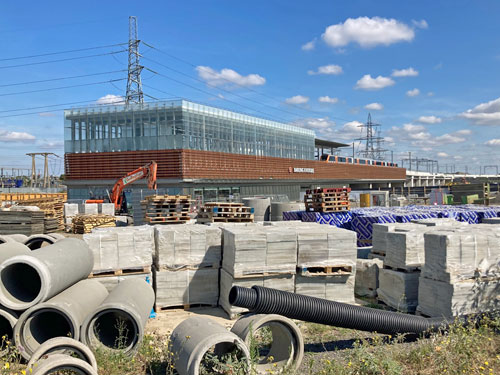
This week TfL have opened a new premier sightseeing attraction to rival the cablecar - the Barking Riverside Viewing Platform. [25 photos]
This amazing elevated viewpoint offers never-before-seen 360° views of East London and the Thames from almost 10 metres in the air. Previously tourists have only been able to glide across the wasteheaps of the Royal Docks in sponsored gondolas susceptible to heavy breezes, but now they can finally stand on a solid island platform and soak in the full glories of estuarine Barking and Dagenham. What's more it's fully weatherproof, cheaper to visit and much more easily reached from Gospel Oak, so what's not to love? Take to the sky and enjoy a truly unique experience.
The Barking Riverside Viewing Platform is a £327m project designed to create a raised structure in a remote area notoriously close to sea level. Previously there was nowhere to go if you wanted to overlook the former marshes downstream of Creekmouth, but this incredible infrastructure triumph provides a much-needed vantage point in the midst of a desolate post-industrial landscape. What's more it's not yet surrounded by any other buildings - flats, businesses or otherwise - so the line of sight to the horizon is often excellent.
The Barking Riverside Viewing Platform is situated in a transport desert to the south of the A13. Walking there is not advised and local parking is extremely limited, but a very frequent bus service runs 12 times an hour from Barking so getting there is really straight-forward. Just alight at either of the bus stops that aren't quite outside and aim for the giant slab of concrete and glass that cuts across the heart of Barking Riverside - you can't miss it. Then head for the austere notch carved through the foot of the viaduct and a group of smiling staff will ignore you unless you need a ticket, in which case you can buy one from the machines.
One day there may be shops here, even somewhere to buy a hot drink, but for now the Barking Riverside Viewing Platform is a refreshingly commercial-free attraction. Instead swipe through the barriers into the cavernous interior and prepare to make your ascent. A pair of lifts is available at the far end to whisk you directly up to viewing level, but far better to climb all 52 steps to help generate a better sense of self-achievement. Left stairs or right stairs it doesn't matter, the orange stairway to heaven works both ways.
The Barking Riverside Viewing Platform is now arrayed before you - a single paved expanse over 100 metres long and at least eight metres above ground level. What's more the architects have really planned ahead in preparation for all weather conditions, with one end shielded by a vast glass shell and the other end open to the elements. It's just like being at the top of the Shard but with less chance of vertigo and a much better view of the Bexley waste incinerator.
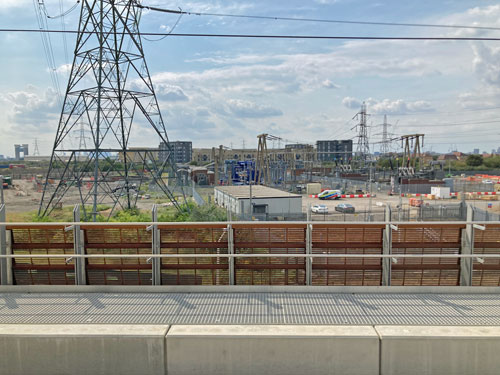
In a genius move the BRVP is subdivided into two separate vantage points labelled Platform 1 and Platform 2. First time visitors will naturally gravitate towards Platform 2 with its stunning view of a serpentine bend in the Thames. From the building site in the foreground to the landfill hills in the distance this is a panorama that truly delivers. Giant wind turbines whirl on both sides of the Thames, the liquid storage silos of Stolthaven Dagenham can be clearly seen and yes that really is the legendary shore of Thamesmead beyond a stripe of rippling grey. If you're particularly lucky a big ship might be passing by, otherwise you'll have to make to with an empty bus.
When you finally manage to tear your eyes away you'll discover that platform 1 offers an even more amazing panorama. The characterfully spiky structure directly in front of you is what remains of Barking Substation, once the powerhouse of East London and still a veritable cavalcade of transformers, cables and pylons. To the left you should catch Docklands, maybe even the Shard, and at the far end of River Road the actual Barking Flood Barrier. Shift further along the platform and off to the right are the distant towers of Ilford, even Stratford, but alas the City skyline remains hidden because someone thoughtlessly built an estate of flats in the way.
It would be too distracting to have both platforms clear at the same time, so TfL have cleverly arranged for four orange carriages to block off most of each view for 15 minutes at a time. They alternate, first occupying platform 1 and then platform 2, affording visitors sight of either central London or the downstream Thames but not both. A genuine sense of expectation builds up as each departure time approaches, after which those who choose to remain on the platform are suddenly rewarded with a fresh panorama. Be sure to prolong your visit beyond quarter of an hour otherwise you're only getting the half of it.
What's more these orange carriages double up as an additional sightseeing attraction, carrying passengers along a mile-long viaduct with exceptional viewing possibilities. Take a seat in the refreshing air-conditioned interior and you'll be whisked gently northwards along elevated tracks allowing you to look down on additional acres of post-industrial wonderland. Soak in the grey boxes of the outlying power station, a secondary school and its astroturf sports ground, various marshy soakaways and the future slums of a strikingly modern housing estate. Large carriage windows maximise viewing opportunities, although you may have to twist your neck because the seats sadly all face the wrong way.
The sightseeing train returns to ground level at Renwick Road and then continues all the way to Barking. Here you might choose to go home, but far better to take the next train back to the riverside and enjoy the full length of the viaduct for a second time. Perhaps you'll spot the playground you missed on the way out, or catch the cheeky silhouette of the Gherkin and Cheesegrater as they finally emerge from the shadows. And don't be in a hurry to descend back to ground level, make sure you've spotted every last visual treat the Barking Riverside Viewing Platform affords. I think I spotted 50 pylons in total from this unique vantage point - maybe you can do better.
The Barking Riverside Viewing Platform is open daily from 5.30am to midnight, and just imagine how amazing the sparkling lights on all the cranes will look after dark. But it's during the daytime that this multi-million pound structure offers the optimum conditions for a truly astonishing and entirely isolated day out. Come soon before they build thousands of flats right up close and wreck the entire point of visiting.
TfL have been playing with the Circle line over the weekend. They've been practising for December, when the orbital route is split apart and all the trains start/finish their journeys at Hammersmith instead. The Circle will be broken at Edgware Road which then becomes a key interchange hub. But can this ageing station cope? I'm not convinced.
Here's how the new split-Circle arrangements at Edgware Road should work:
Platform 1: All eastbound trains (from Hammersmith) [Circle][H&C] Platform 2: Start/end of the line for orbital Circle line trains [Circle]
Platform 3: District line trains to Wimbledon [District] Platform 4: Westbound trains to Hammersmith [Circle][H&C]
It ought to be simple. Each of Edgware Road's four platforms will have its own dedicated service, so all passengers need to do is go to the correct platform and wait. But over the weekend, without even any temporary signage in place, it didn't feel simple at all. Now wonder the member of TfL platform staff I spoke to described his weekend experience as a "nightmare".
Case study: arriving at Edgware Road platform 2 on a terminating Circle Line train "Last and final stop. This train terminates at Edgware Road. Please cross to platform 1 to complete your eastbound journey. All change please, all change." It's hard to see that the driver could have done more to inform passengers about what was going on. Even so, only 80% of the train's passengers disembarked. The rest sat where they were, either because they "knew" that Circle line trains didn't terminate here or because English wasn't their first language and nobody had warned them in advance that the Circle was no longer a Circle. Eventually most of the non-movers twigged, but some sat tight in blissful ignorance. Meanwhile the first westbound passengers clambered on board, ready for their Circle line journey to High Street Kensington and Victoria. An over-stretched member of TfL staff moved down the platform, knocking on each carriage in turn and yelling "All change, all change please!" Passengers duly disembarked, even those who'd just got on because they actually knew what they were doing. A fluster of animated conversation with the member of staff ensued, and the westbound passengers re-boarded the train they'd boarded correctly in the first place.
One particular Spanish couple stood baffled on platform 2, trying to work out what to do next. They had a pair of large suitcases in tow, no doubt fresh from the Heathrow Express at Paddington, and their command of English wasn't great. "Tower Hill?" they mumbled. TfL-Bloke directed them towards Platform 1 and told them to catch the next Circle line train. Absolutely right, mate. Alas the first train to arrive was an eastbound Hammersmith and City train, and the Spanish couple needed a lot of persuasion not to climb on board. Meanwhile the westbound Circle line train on platform 2 closed its doors and set off. It struck me that this train was actually going to Tower Hill, but the couple had been advised to get off it and wait for a train going round the other way. This should have been good advice because the clockwise journey's normally quicker, but not in this case. A lengthy wait ensued and no eastbound trains arrived at all. Circle line trains will run less frequently under this new revised timetable (six an hour, rather than seven an hour) so expect to wait up to 10 minutes in the future. The "next train" indicators provided no useful information. The system at Edgware Road is supremely useless - ancient boxes with weedy red text, and seemingly unable to announce any arrival until a minute before it happens. If they're not upgraded before December when Edgware Road becomes a key Circle line hub, I'd expect customer annoyance and dissatisfaction to be high.
Another Circle line service arrived on platform 2, and another few hundred people crossed to platform 1 to complete their eastbound journey. Meanwhile some of those already waiting on platform 1 crossed back to platform 2, thinking an eastbound Circle line train had finally arrived. Wrong, it terminated here, all change please. The new influx of passengers waited semi-patiently, adding an extra five minutes to all of their journeys, before the next eastbound train finally appeared. This was another Hammersmith and City line train, to Whitechapel, and it was already fairly full. Within seconds it was a lot fuller. The Spanish couple looked around for assistance, but within such a large crowd there was none. They tried checking their tube map, but it didn't actually show the weekend's temporary service and wasn't much help. Eventually, just before the doors closed, they clambered aboard and set off in cattle class conditions. I hope they changed trains before Aldgate East, because it's no fun lugging a pair of suitcases across from one platform to the other, and it's a mighty inefficient way to get to Tower Hill. They should have waited. One minute later a Circle line service finally arrived, going precisely where they wanted to go, and it was nigh empty. Ah, if only they'd picked a different weekend to travel, one when they'd not been forced to change trains at Edgware Road. Alas, come December, none of us will have that option.
Tomorrow I'll be making my daily morning journey from Bow Road station to Green Park station for the last time. Over the last three years I've learned everything there is worth knowing about this journey, including where to stand, where to sit and how to be first up the escalator at the other end. After tomorrow all of this hard-earned knowledge will be wasted because I have a new journey to study and conquer (of which more tomorrow). So today I thought I'd offload everything I've ever learnt about the old tube journey in case any other Bow-to-Piccadilly commuter should one day find it useful.
London Commuter Handbook: no 2904: Bow Road to Green Park
1) Enter Bow Road tube station. If you need to pick up a Metro then you'll find them hidden just behind the door on your right, but for a journey of this length it's probably better to bring a serious newspaper with you instead. If the middle ticket barrier is green, use it - this avoids pushing past the ticket queues blocking the path to the left hand barrier. Once past the sleeping ticket attendant, turn left on the bridge then keep right down the stairs (it's slightly quicker than keeping left).
2) Pass left along the platform. Glance at the 'next train' indicator as you pass, because the curvature of the platform means you won't be able to read it from the far end of the station. If the indicator says that a 'METROPOLITAN LINE' train is due, this in fact means that a Hammersmith & City line train is due. You can slow down because you don't want to catch this one. If the indicator says that a 'DISTRICT LINE' train is due then hurry along the platform because you do want this one and it'll be here in under a minute. Pass almost as far along the platform as you can, but stop halfway between the fourth and fifth pillar from the end. Stand next to the storage licence posted on the blue wall, right behind the words 'MIND THE GAP' written at the platform edge.
3) When the first District Line train arrives, walk forward and enter the rear door of the first carriage. Expect to have to stand because the train is usually pretty full by the time it reaches Bow Road, but you'll find conditions much emptier in the front carriage than they would be in the rear carriage. Cross the carriage and lean against one of the glass partitions on the opposite side, preferably the one on the right. Try to take exactly one minute to read the front cover of your newspaper.
4) When the train arrives at Mile End station, expect at least half of those on board to move towards the doors ready to cross to the Central line platform opposite. This is good news because they will vacate a number of the twenty seats on either side of where you are standing. Politely stake your claim to one of these seats and sit down quickly before the commuters crossing from the Central line platform try to board your District line train. Given the choice, try to sit in one of the eight 'end' seats because then only one person will be able to sit next to you. Best of all are the two seats at the very rear of the carriage because they have an extra ten centimetres of space adjoining.
5) If you're reading the Guardian, open it cautiously to an angle of no more than 45 degrees. Try to finish the broadsheet section of the paper by the time the train pulls into Tower Hill station, because at this point the carriage is likely to fill up considerably with c2c commuters arriving from Southend and Basildon. Continue to read the tabloid G2 section, including any supplements, aiming to have reached the TV review and Doonesbury cartoon by the time the train leaves Embankment.
6) As the train enters Westminster station fold up your paper, stand up and move towards the door on the left hand side of the train. Listen for the scramble behind you as all the commuters who've been standing since Tower Hill rush for your newly vacated seat. Exit the train and walk forward towards the staircase in the back wall of the platform labelled 'Stairs to Jubilee line'. Do not divert via the escalator. Walk/run down the staircase, which you'll probably have to yourself because nobody else seems to use it.
7) Cross the first concourse to the top of the furthest escalator. If a westbound District line train has recently disgorged from the platform above, try to enter the slipstream of commuters by moving across to the left-hand side of the queue for the escalator. Walk down the left hand side of the escalator, overtaking the few lost souls who insist on reading their Metro between trains. Cross the second concourse, keeping left round the corner past the lift just in case you accidentally walk into a stream of commuters coming the other way. Walk down the left-hand escalator on your right, and at the bottom take the first passageway to your left onto the platform.
8) When you reach the westbound Jubilee line platform, turn right. The track is sealed off from the platform by a wall in which are a series of numbered doors. Look for doors 8 and 9, then stop and rest your backside against the seatrest on the wall opposite. When the next train pulls into the station keep back - do not approach the doors. Wait for all the passengers to disembark - there should be more of these than there are passengers waiting to board. Wait for all the other passengers to board, then walk casually up behind them, look apologetically in their direction, wait for them to edge forward and try to squeeze into the last remaining space just inside the train doors. If this doesn't work, rush down to door 10 and squeeze in there instead.
9) This is the squashed section of the journey. Breathe in and try not to stare into the face of the fellow passenger whose briefcase is pressed hard against your nether regions. Stare out of the window - it'll all be over in two minutes and 30 seconds. Smile, because if you were the last person in at the last station then you'll be the first person out at the next station.
10) When the train stops at the next station, which is Green Park, shoot out of the door into the tunnel opposite, avoiding any commuters hurtling through in the opposite direction trying to catch the train from which you have just exited. There are two 'up' escalators, both to the right of the one 'down' escalator. It's usually quicker to take the emptier, righthand 'up' escalator, unless it's full of passengers just emerged from the opposite eastbound Jubilee platform. Walk straight up to the landing above, then veer right towards the final escalator, avoiding any passengers cutting across to the Victoria line tunnels to your left. Walk up the final escalator, turn left into the main ticket hall and head straight across to the ticket barrier immediately in front of you. If you've followed all the instructions properly, you should be the first person from your train to exit the station. Congratulations.
The return journey from Green Park to Bow Road is rather more straight-forward. Full details are available by email to anyone who can forward proof of home and work addresses in the E3 and W1 areas.
It's well known that TfL sometimes install signs which deliberately direct passengers the long way round. The labyrinthine tunnels of King's Cross St Pancras are particularly egregious in this respect. But what's not yet commonly known is the sheer meandering cruelty they've imposed at one of central London's new Crossrail stations. Allow me to shine a spotlight on...
The Evil Arrows of Tottenham Court Road
When stepping off a train at an unfamiliar station, one of the first things people do is look for an arrow pointing towards the way out. They trust, not unreasonably, that this arrow will be pointing in the correct direction. But at Tottenham Court Road several of the arrows on the wall are deliberately pointing in the wrong direction and send you off on a walk much longer than it needs to be. And this isn't just on one platform it's on both, as well as misleading passengers entering down the Dean Street escalators. The bastards.
» Arrive at the rear of a westbound train and a passageway off the platform opens up immediately in front of you. This dogleg is indeed the fastest way out, but only the Northern line is signposted this way. The Central line and the Tottenham Court Road exit are both arrowed off to the left, and if you believe this white lie then you're adding over a minute to your journey.
The evil arrows direct you along the platform towards another, wider, passageway but brazenly send you straight past that as well. If you squint down that passageway you'll see a Way Out sign on a more direct route, but if you only believe the arrows on the platform you'll be walking further.
Not until the third passageway do the evil arrows finally deign you direct you towards the central passageway. And then they direct you back past the end of passageway two and eventually to the end of passageway one at the foot of the main escalators. This roundabout hike takes well over two minutes, and that's without kids or luggage, whereas you could have reached those escalators in just one minute. The bastards.
Anyone alighting from the rear three carriages of the train is embroiled in this deception. And those who alight from the front two carriages are embroiled in another.
» If you step off the front of a westbound train what you should do is head for the passageway at the head of the platform. But it's not signed, other than for those wanting the lift, despite the fact it leads directly to the central passageway for easy exit.
Instead the evil arrows point back down the platform, in entirely the wrong direction, before eventually pointing inwards and admitting entry to the return route between the platforms. None of this dubious kerfuffle is actually necessary.
If you watch a freshly-arrived train disgorging passengers, a few who know what they're doing take the quick route, 20 seconds tops. The proportion is higher than it used to be in the first week because familiarity breeds contempt. But the majority of passengers meekly do what they're told, sweeping round an unnecessary loop and reaching the foot of the Dean Street escalators a full minute later than necessary. The bastards.
» Meanwhile on the eastbound platform, the evil arrows trick those in the front two carriages into leaving via a roundabout route. It's particularly evil for those alighting from the very front of the train who are directed straight past the first connecting passageway and sent instead down the second, a diversion that adds at least another minute.
Both side-passages are enormous so congestion isn't the issue, just a perceived need to manipulate passenger flow. Again if you look down these passageways you'll see Way Out signs at the end of them. But a dutiful tourist in London for the first time isn't going to risk that, they're relying on the platform-based arrows to help them thread through the labyrinth, except the arrows are lying. The bastards.
» At the rear of the eastbound platform the trickery isn't aimed at people leaving the platform, it's for those arriving from outside. When you reach the foot of the Dean Street escalators the closest entrance to the westbound platform is actually immediately behind you. But the signs don't point this out, instead they direct everyone straight ahead along the central passageway...
...and only there do the arrows split into westbound and eastbound versions. Had you been awake and looked backwards you could have slipped through to the back of the train in 30 seconds, but this deliberate subterfuge instead delivers you two carriages further up the train one minute later. The bastards.
So that's four sets of evil arrows altogether, one set at each end of each platform, like so...
In each case passengers are being directed past one connecting passageway so they can use another instead. In each case the unluckiest passengers are being sent at least a minute out of their way, and in the case of the rear of the westbound platform it's a minute and a half. I reckon that's at least an hour collectively wasted every time a busy train arrives at the station.
And there's more.
» The Northern line connection at Tottenham Court Road should be brilliantly quick because this is the only station in Central London where Crossrail and the tube lie really close. But if you emerge up the stairs fresh from the Northern line, no sign directs you straight ahead down the shortcut to the westbound platform.
Instead the only signs for the Elizabeth line point to the right towards the foot of the main escalator and then along the central passageway. And only then, after you've walked the traditional 'unnecessary minute', do the signs finally split into westbound and eastbound to direct you to the platforms. The bastards.
I think I've worked out what's going on with Tottenham Court Road's misleading signage, and it's that each of the nine passageways connecting to the platforms is notionally one way.
On the eastbound platform there are two designated ways in and two designated ways out, and on the westbound platform two ways in and three ways out. In real life you can walk any which way you like, but all the arrows on all the signs assume the connecting passageways are one way and direct you accordingly. That's why they'll often direct you straight past the quickest exit and, if you believe them, delay your progress.
It's hard to fool passengers arriving at the station because as soon as they see a passageway leading to a platform they make a beeline down it. It's much easier to fool passengers looking for a way out, which is why most of the one-way arrows prioritise arrivals over departures.
In a small congested station with narrow corridors a one-way system can make perfect sense. But Tottenham Court Road is a futureproofed station with massive passageways, so all this one-way thinking feels totally unnecessary. I could imagine these arrows being helpful if a busy train was emptying at the height of some future rush hour, when yes it might be a good idea to keep opposing flows apart. But right now, and for the vast majority of the time, the task they perform is overly-pessimistic misdirection.
Conclusion
The evil arrows exist to cope with worst-case passenger flow. At all other times, which is the vast majority of the time, they cruelly send unfamiliar passengers unnecessarily out of their way.
Summary
The Evil Arrows send the following journeys the wrong way...
• Westbound Crossrail → Way Out (TCR) [rear 3 carriages]
• Westbound Crossrail → Central line [rear 3 carriages]
• Westbound Crossrail → Way Out (Dean St) [front 2 carriages]
• Eastbound Crossrail → Way Out (TCR) [front 2 carriages]
• Eastbound Crossrail → Central line [front 2 carriages]
• Eastbound Crossrail → Northern line [front 2 carriages]
• Entrance (Dean St) → Eastbound Crossrail [everyone]
• Northern line → Westbound Crossrail [everyone]
Some tube stations are really complicated places to negotiate, not because there are several lines but because there are several possible destinations. These are multi-platform hubs, and it's essential to end up on the correct platform in order to board the correct train. Arriving passengers need clear signage which amalgamates all travel options, as for example provided by banks of purple-topped screens on the Metropolitan line at Baker Street. But other same-line interchanges can be a complete nightmare. And, by your common consent, the very worst of these is the District line's frenetic epicentre at Earl's Court.
There are only four District line platforms at Earl's Court, two (adjacent) westbound and two (adjacent) eastbound. You wouldn't think it would be difficult to stand on one island or the other and wait for the next train. But it is. And the problem is very simple. Each platform has its own 'next train' indicator which indicates the next train to arrive on that platform only. Whichever platform you choose to stand on, it's extremely hard to tell what's due to arrive next on the platform nextdoor. Wait, shuffle check, shuffle back check, wait some more, shuffle shuffle check, shuffle wait. It's a right pain, and during rush hours a sure-fire recipe for clogged congestion.
As on much of the rest of the District line, the signalling system at Earl's Court is archaic. No flash electronic 'next train' displays here, just a very old-school system involving illuminated arrows. But maybe not as old school as you remember. There used to be some genuine heritage lightboxes here - big compartmentalised displays with elegant white text on a bold blue background. Like this westbound, and like this eastbound. Proper museum fodder and very characterful, but not 100% useful. Alas at the end of last year they were replaced, and by something less gorgeous but equally dysfunctional. There are now lots of new signs spaced out along each platform, each with a nod at how things used to look, but each little more than a bland list in block capitals beside a box of cheap-looking arrows. Current signalling permits nothing more useful.
Eastbound, platforms 1 & 2: There are two distinct choices, although the destination board makes things look far more complicated. Do you want to head north via High Street Kensington or east via Victoria. Sorry, but your next train could be arriving on either platform. Shuffle, check, shuffle, check. A frequent bugbear occurs when both platforms are occupied by trains travelling in the same direction. What most passengers then need to know is not the final destination but which train will be leaving first. Because there's nothing worse that sitting expectantly in your carriage only to see the other train heading out of the station first. Not a clue. Oh hang on, maybe there is. One single illuminated sign hung high over the platform (above where the old indicators used to be), and most definitely not easily viewable from the full length of the station. Sheesh what a disjoint mess this station's signage is.
Westbound, platforms 3 & 4: There are four distinct choices, so which train's due next really matters. It's still not easy to tell from the indicators, though, as commenter slabman knows all too well... "Invisible from more than 2 metres away and placed at the head of the stairs from the Piccadilly, which opens into a bedsit sized space bounded by pillars and a lift. So, a crowd gathers there to watch the indicator and fight for position with the commuters coming up the stairs. Brilliant!" And commenter Steven adds... "On emerging from the Piccadilly Line and seeing a train about to leave, one has to fight through people to locate a board to identify which train it is." Even once you're on board, trains here can wait and wait and wait for no obvious reason. Changing trains at Earl's Court is no fun whatsoever.
But there is hope. At the moment the platforms at Earl's Court are covered with scaffolding, right down the middle of each - a series of blue portakabin-type hideaways propping up a forest of pipes and tall poles. It's as if the Ideal Construction Show has relocated from the nearby exhibition hall and set up shop in the heart of the station. And it's all this scaffolding which is blocking sight of one platform's signage from another. One day, maybe, if Metronet ever clear the whole lot away, viewing the whole picture might get a whole lot easier. But what's really needed here (and at similar stations on the network) is a single 'next train' indicator listing destination, time and platform for the next three-or-so arrivals. You know, like most National Rail stations have. In the meantime, if you want to know how many minutes away the next service to Olympia is and where it'll appear, don't hold your breath.
NTI uselessness, category 4: Displays giving passengers the runaround • Edgware Road (Circle/District/H&C): Personally, I despise Edgware Road even more than Earl's Court. It's a very similar set-up with two pairs of island platforms, but this time with the added complication of terminating trains. Westbound or eastbound? It's not always easy to tell. Trains pause here for long periods of time while waiting for a gap in the service, and again it's often nigh impossible to tell which is the next train out. One of the 'next train' indicators here glows blood red, not orange, which I always find very unnerving. And at the foot of the stairs, as commenter Ben points out, there's quite possibly the worst 'next train' solution anywhere on the network. The main dotmatrix display for all four platforms is upstairs on the concourse near the ticket hall (because eastbound trains can leave from any of three platforms). Downstairs, instead of having another repeater display on the platforms, they have... a CCTV screen fed from a camera pointing at the concourse display. The text is tiny and blurred, and often blocked by passengers walking in front or standing around with suitcases. It's cheap and it's nasty and it looks so desperately amateur. If Edgware Road ever becomes the lynchpin of a new non-circular Hammersmith and Circle line, I dread to think to imagine how appalling changing trains here might become. • Wembley Park: Your next southbound Metropolitan line train... is it platform 5 or (long scurry across bridge) platform 6? It's not always obvious. It may look like 5 (next train 1 min) but many's the time a slow train's sneaked ahead into 6, opened its doors to an empty platform, and pulled out before anyone could reach it. • Whitechapel: Your next westbound Hammersmith & City line train... is it a through service or is it departing from the 'eastbound' platform? There's a bridge and two flights of stairs between the two, and absolutely no clues for waiting passengers which it might be. • Plaistow: Your next westbound Hammersmith & City line train... is it a through service or is it departing from the bay platform? There's an incredibly long walk (up, over and along) between the two, and absolutely no clues for waiting passengers which it might be. • any more?
Opened: 24th October 2022 Status: The final Crossrail station Delay: Five months late Actual delay: Almost four years late
Brief summary: Bond Street is perhaps the purest Crossrail station of all. A pair of long straight platforms, several crosspassages with curvaceous walls, an exit at each end, escalators leading up and out.
Change here for: Central line, Jubilee line, Oxford Street West.
Main entrance: Davies Street (just behind the shopping centre containing the tube station entrance) Building on top of entrance: Architecturally undistinguished, not yet complete. Ticket hall: A long ribbed box to funnel passengers to the gateline at the far end, three ticket machines. Upper concourse: huge space (mostly empty), somewhere to double back to the top of the escalators, access to lift, temporary giant glowing purple roundel.
Artworks above escalators (by Darren Almond) Top of top escalator:'Horizon Line' - a large grid of fragmented numbers cast in aluminium made up of 144 individual hand-polished tiles. Artiest of the three. Bottom of top escalator:'Time Line' - four words on separate nameplates (FROM UNDER THE GLACIER) intended to remind us 'how our journey through this network of tunnels has literally cut through geological time itself'. Top of bottom escalator:'Shadow Line' - four words on one nameplate (REFLECT FROM YOUR SHADOW) intended to 'evoke a sense of departure and leaving something in your wake'. Bottom of bottom escalator:No. Darren only created three artworks.
Other entrance: Hanover Square (not as close to Oxford Circus as you'd like) Building on top of entrance: Architecturally undistinguished, complete. Ticket hall: A functional slot, three ticket machines, a shorter walk to the gateline. Leading directly to: The longest Crossrail escalators (60m long). Artwork? Hell no. Captive audience for well over a minute, so twin ribbons of digital adverts.
The platforms: Two. Parallel. Very long. How long? So long that the trains stop in the middle of the platform with a carriage-length gap at each end. Blimey that's long: Yup, 255m each. I counted 165 light panels along the length of the westbound platform.
Where are the platform exits? Yet again, front and back. For a fast exit you need to be either at the front of the train or the back of the train. Do the exit arrows lie? Only slightly. If you arrive in the front or back carriage, exit via the passageway closest to you. If you arrive in any other carriage, follow the arrows.
Davies Street
Hanover Square
Abbey Wood →
9
1
1
9
← Paddington
Platform level layout: Very symmetrical. Each platform has crosspassages adjacent to carriage 1, carriage 2, carriage 5, carriage 8 and carriage 9. The central passage links only to the other platform, while the others lead to a concourse at the foot of the escalators. Walk to the far end of each platform behind the escalators to find another passage with access to the lifts. Anything novel? Nah. If you've been to any other central London Crossrail station, you'll recognise how Bond Street looks. It looksgood though.
What about signage? On the eastbound platform the line diagrams show you may have to change at Liverpool Street. This is true for the next two weeks. But on the westbound platform the line diagrams show you don't have to change at Paddington. This is not yet the case. The line diagrams facing the lifts already show the final configuration. And the tube maps? Unique, I think. The tube map posters show the new station interchange at Bond Street but no connections yet at Paddington and Liverpool Street. They'll be out of date in a fortnight but they're correct right now. They also show the new name for the cable car (which is still red, not IFS purple).
Did you get your stopwatch out? Hell yes.
Platform to street level (Davies Street): 2½ mins Platform to street level (Hanover Square): 2 mins Full walk-through (Davies Street → Hanover Square): 6 mins
Oxford Circus crossroads to Hanover Square entrance: 3 mins Oxford Circus crossroads to Crossrail platform: 5 mins
How about changing to the Underground? Simple. But long. Explain: Whether you're changing to the Central line or Jubilee line, aim for the Davies Street exit. After the first escalator a passageway bears off the right. It's bright, bendy and goes on a bit. It took me almost two minutes. A bench has been provided halfway along in case you get tired. The passage leads to the original Bond Street tube station, landing on the concourse between the escalators. Follow the winding corridor to the Central line or head down the escalators for the extended hike to the Jubilee line.
Interchange times Crossrail → Central line: 3 minutes 15 seconds. Crossrail → Jubilee line: 3 minutes 45 seconds. The important thing to know: It's not a quick interchange. But it's quicker than changing at Tottenham Court Road.
And by lift? Step-free access to the Jubilee line takes two lifts. Step-free access to the Central line takes three lifts.
Finally: let's answer the big questions.
Liverpool Street to Bond Street (Central line): 11 mins Liverpool Street to Bond Street (Crossrail): 7 mins Canary Wharf to Bond Street (Jubilee line): 16 mins Canary Wharf to Bond Street (Crossrail): 14 mins
So: Crossrail is the quickest route to Bond Street But: Don't change specially, because changing takes longer than the time you'd save.
The Victoria line was built with interchange in mind. All but one of the 16 stations link to another line, or maybe several, making ease of transfer the priority. But just how long do those connections take? I've worked my way down the line with a stopwatch to find out.
n.b. I only walked these one way (walking the other way might be different). I walked from platform to platform (apart from at mainline termini). I timed from the moment I left one platform to the moment I arrived on the other. I walked to the nearest platform, which may not be the platform you need. I did this experiment off-peak. I always walked down escalators, but never up. I walk quite fast. I am not sad, honest.
Walthamstow Central (Greater Anglia → Victoria) [1m10s] The original route down to the Victoria line is direct from National Rail platform 2 (although now there's another entrance direct from the bus station). Head down the steps, through the ticket barriers and down the escalator. If arriving here by tube, it's quickest to sit at the front of the train.
Blackhorse Road (Overground → Victoria) [1m20s] Up to the cheap-looking footbridge, follow the passage into the ticket hall, then double back and head down the escalator.
Tottenham Hale (Greater Anglia → Victoria) [1m15s] It's dead easy to step up to the ticket hall from the northbound National Rail platform (but a rather longer up and over from the southbound). There's a nice row of plants above the escalators.
Seven Sisters (Victoria → Greater Anglia) [2m30s] To interchange here, best sit at the Brixton end of the train. Exit is via a twisting passage with two-way flow, full of awkward blind spots. Then double back in the ticket hall and follow a straight passage to the National Rail platforms. Think functional, not beautiful.
Finsbury Park (Victoria → Piccadilly) [5s] Fabulously swift passage to parallel platform. Thank you, Victoria line designers. Finsbury Park (Victoria → First Capital Connect) [1m10s] Woo, spiral staircase! 50-or-so steps lead up to a grim passage below the National Rail platforms.
Highbury & Islington (Victoria → Overground) [2m25s] A slower than usual yomp, because they're refurbishing an escalator at the moment, but it's never quick. A lot of up and down is involved. Highbury & Islington (Victoria → First Capital Connect) [5s] A simple short passage across to the gloomy Moorgate-bound platform.
King's Cross St Pancras Sorry, but this is indeed as complex as you're expecting... (Victoria → Piccadilly) [50s] Don't follow the signs! Take the sneaky staircase accessed from the 'Euston Road' end of the platform. (Victoria → Northern) [1m5s] Ditto. (Circle → Victoria) [1m50s] Not such a bad journey, via the original main escalator link. (Victoria → King's Cross mainline) [4m] That's four minutes if you follow the signs, and trek the evil long route via the new passages and the Northern ticket hall. Worst interchange on the entire list... (Victoria → St Pancras High Speed) [6m] ...apart from this, which is worse... (Victoria → Other St Pancras services) [8m] ...and this, which is godawful. This proves that either a) only mugs follow the official signs or b) St Pancras really is a very long way from the Victoria line.
Euston (Victoria → Northern) [15s] So long as you want the southbound via Bank, dead quick. Not so quick otherwise. Euston (Victoria → Mainline services) [3m] That's from the bowels of the station to the main concourse, probably battling behind lots of slow people with suitcases.
Warren Street (Northern → Victoria) [1m30s] This is the interchange that feels the most old-school, past some lovely cream and black tiles (and via two escalators).
Oxford Circus (Victoria → Bakerloo) [20s] Another splendidly quick parallel platform passage. They designed this line so well, those 1960s planners. Oxford Circus (Victoria → Central) [1m50s] A long trek down a long passage past a busker. Interestingly it's much quicker walking in the opposite direction, from Central to Victoria, which takes only half the time [55s]
Green Park (Victoria → Jubilee) [1m20s] This is the 'quick' interchange at Green Park, via steps and a single escalator. Green Park (Piccadilly → Victoria) [1m40s] This involves a long passage, but it's still a minute shorter than the really long interchange at Green Park, which is (Jubilee → Piccadilly) [2m40s]
Victoria (Victoria → National Rail) [2m] This requires ascent by escalator into a hellish ticket hall filled with milling tourists, then further steps up to reach the mainline concourse. Victoria (Circle → Victoria) [1m10s] A fairly quick descent, so long as you're at the right end of the platform.
Pimlico There is no interchange here.
Vauxhall (Victoria → South West Trains) [3m10s] A long escalator, a long passage, and then entry into the back of the station where there appears to be absolutely no guidance as to what mainline trains are leaving when from which platforms. A poor experience.
Stockwell (Victoria → Northern) [8s] That's the fifth brilliant connection to an adjacent platform. I say again, the Victoria line was designed with interchange in mind. Don't expect anything anywhere near as good from Crossrail.
Brixton (Victoria → Southeastern) [4m] Riding up the escalator, then walking up the steps into Brixton, takes 1m40s. There are then no signs pointing towards the National Rail station concealed round the corner, which is atrocious signage (unless I missed something) (I don't think I missed anything).
Have you visited TfL's online departure boards lately? A place on the web to discover where your local tube station's next train is heading. The next three trains, in fact, in both directions. Plus full details of whereabouts those trains are at the moment, be it in the platform or several stations back down the line. For some underground lines these details have been available for a couple of years. But now they're available for all eleven lines. How wonderful is that? (thanks Rob for letting me know)
Barbican stationplatform 2
Imagine the situation. You're four minutes from the station - maybe at home, maybe at the office, maybe checking the web on your mobile. You check the TfL departure board and discover that the next train to your chosen destination is five minutes away. So there's just time to rush down to the platform as the next train arrives, and no time wasted waiting around. We've had a similar system on the DLR for years, and it's saved me many a premature journey.
If you want to give it a try for yourself, the departure boards page is here. Pick a line, pick a station, track the trains. Or if you can't make your mind up, try the Circle line, or the Central line, or Camden Town, or Acton Town. Clever, isn't it?
In fact it's so clever that in many cases it's better than the information being provided at stations. Take Earl's Court, for example. The information provided online is far more comprehensive and useful than anything you could discover while standing baffled on the platform wondering how long you've got to wait to get anywhere. Or how about Bromley-by-Bow - one of my local stations whose next train indicators were recently upgraded. Online I can see the next three trains plus all relevant timings. Standing on the platform I can see only the destination of one next train, and with no clue as to when it will arrive. I hate that, and I shall hate it more knowing that I'd be better off viewing from home.
The online system may be comprehensive, but it's not yet perfect. I've been clicking around and noted a few issues here and there. Particularly here. • Bow Road: The one station I really care about, my local - no next train information whatsoever. Ditto Mile End (District line). But on either side, at Bromley-by-Bow and Whitechapel - full information? Why the black hole round where I live? Sigh. • Beyond Edgware Road on the Hammersmith and City line: another 'next train' black hole, both online and in real life. But check out the Hammersmith arrivals page and TfL clearly know where all their H&C trains are, they're just not telling you. • The Circle line: A lot of stations are listed as being on the Circle line even though they're not really. Ladbroke Grove and Hammersmith for starters (not until December). And Aldgate East and West Ham (never!). • Waterloo & City line: Abbreviated to the "Waterloo line". When it's working, the online system often lists far more arrivals than departures. • A number of stations have information for some platforms, but not others:Stepney Green, westbound only. White City, no terminating services. Grange Hill, clockwise only. • Last trains: Often gets these wrong, promising additional services even after the last train has passed by. • Blackfriars: No trains stopping until 2011, but full platform information available. • Some stations don't yet exist: Chesham. Wood Lane. Shepherd's Bush Market. The whole of the London Overground. • Any more?
But enough nit-picking. This is a clever system with considerable potential, and it'll no doubt all work one day. Now you can watch London's trains chug around, updated every minute, without even being there. And if only there was web access underground, it'd probably even be more useful than the existing (sometimes visible) next train indicators. It's a grand departure.
Going Overground - Riding the Goblin Barking → Gospel Oak
10:38 My District line train is pulling into Barking station, platform 2. As I watch from the window, a two-carriage purple runt of a train chugs out from platform 1 and disappears up a nearby branch line. Bugger, I've missed my Overground connection. It's going to be a 29½ minute wait. 10:39 Barking I am not alone. A dad and two kids cross the platform with me and slump dejectedly onto a bench. An elderly lady completes her slow walk down the stairs from the ticket hall and sits beside them. She's seen it all before. We hang around in the sunshine between the pink-painted pillars as a small crowd slowly gathers. And gathers. 10:58 The next train rattles up the single track and halts in front of the gloomy buffers beneath the station building. A horde of northeast Londoners ooze out of the jam-packed carriages, and we stand back as they outpour. With only two two-carriage trains an hour, even Saturday morning is rush hour. 10:59 I have a seat, squashed in between a motley assortment of old couples with shopping, oversized blokes in trackies and yawning migrants. I also appear to have picked the seat in front of the nutter. "Ya me so solid me can hear ya rok," he yells into his mobile phone. "Serious serious serious!" The wait isn't over yet. 11:08 A panting mother with a double buggy just manages to climb aboard the train before it departs. She beams with unspoken relief. The growling diesel paws its way out from the platform... over a wiggly river, under a roaring arterial road and off into the suburban wilderness. 11:11 Woodgrange Park When I moved to London I nearly bought a flat next to this unloved pair of bleak platforms. Lucky escape, I think. Two Oyster ticket readers stand shrouded beneath bright blue covers, waiting for the dawn of a new era. 11:14 Wanstead Park We're gliding on an elevated Victorian viaduct at chimney-pot level across a Mary Poppins skyscape. If only this were Putney, these rather pleasant residential terraces would sell for at least half a million. 11:17 Leytonstone High Road Two-thirds of this platform lies crumbling and abandoned beyond a cost-cutting barrier. The other third of the platform, decorated with plastic-flowered hanging baskets, is sufficiently long for our little train. 11:20 Leyton Midland Road The nutter is still in full flow... "well safe safe safe safe, yeah, ring me back ring me back." Shame, because otherwise this has been an unexpectedly scenic ride across the rooftops of Newham and Waltham Forest. 11:22 Walthamstow Queens Road Blimey, somebody's (very recently) built a gleaming new waiting room on the eastbound platform. It looks like a weatherproof glass portakbin and it has push-button sliding doors, one of which appears to have jammed open. Two glum local residents are waiting next to it. 11:25 Blackhorse Road This is the only other station on the line with a tube connection, so half the train escapes and switches to the Victoria line. Hurrah, the nutter gets off! Boo, a smelly woman sits behind me instead. 11:26 And now for a scenic interlude. The line slips between two raised reservoirs and over several braided streams as it crosses the Lea valley. Look, there's the Gherkin and Canary Wharf in the distance, seemingly light years away. A goods train rumbles slowly by on the opposite track. 11:29 South Tottenham The peace and quiet is shattered by two freshly-boarded toddlers who proceed to bounce and sing as we progress westwards. Haringey fades from view behind a leafy screen. 11:33 Harringay Green Lanes Only a stubby platform remains here, along with a forest of concrete pillars that once supported a structure suited to lengthier trains. And then, as the contours rise around us, we enter the first deep cutting of the entire journey. 11:35 Crouch Hill Blimey, aren't the passengers different all of a sudden? We've entered the muesli-eating organic/yoga zone, and the clientele heads distinctly upmarket. The latest toddler on board has a rather super pushchair and is called Oscar. He's wearing a brown corduroy coat and stripy woollen hat, and is clutching a teddy bear named Bear. Mum has a sharp black bob and a buttoned scarlet overcoat, and probably lives in one of those very smart terraces backing down to the railway. 11:38 Upper Holloway Even the council blocks look posher round here. The station sits at the bottom of a red-leaved autumnal bank beneath a tall church tower- we're a world away from the concrete and grime of distant Barking. 11:42 Gospel Oak And slowly, finally, the train veers round a curve at the foot of Hampstead Heath into platform 3 at Gospel Oak station. It's all change here if you fancy going further, but it's a damned long walk down the narrow stairs to street level and back up again on the other side of the tracks. There'll be a Richmond train along in ten minutes, if you can squeeze aboard, and then only another 12 stations to go. Say what you like about this new-fangled London Overground, it's still going to be a long time before you can get to nowhere fast.

Tubewatch (39) Mile End (sigh)
So contractors removed all the next train indicators from the middle of every platform at Mile End, and relocated them instead at the far western end. You can't bump your head on a metal sign if it's at the end of the platform, that was their rationale. Trouble is, you can't see it easily either, especially not from 130 metres away at the far eastern end of the station. And then the planners made things worse by installing four new platform signs, at the bottom of the stairs, one a few yards in front of every NTI. Even fortunate souls with keen eyesight didn't have a hope of reading where the next Central line train was going, because a sign telling them this was "Central line westbound platform 1" now blocked the view. Important real time information hidden by simple static information, that was the problem. Installed by cretins.
Enter HM Inspector of Railways, who turned up at Mile End earlier this year to carry out a risk assessment of his own. He was particularly interested in the information displays mounted on the west end walls and concluded that the display on the westbound Central Line platform effectively invited passengers "to put themselves in a position of danger". While they were trying to stare long distance down the platform, a train could whoosh up from behind unseen and knock them down. That was his expert opinion, so station staff were forced to take urgent immediate action... removing the blocking sign on platform 1! I rarely cheer for health and safety, but it's only thanks to the inspector's visit that the next train indicator is visible again. Admittedly you still need the eyes of a hawk to read it, but that's better than the continuing obstruction on platforms 2, 3 and 4 where no similar decapitation risk was perceived.
First to the eastbound Central line platform. It's where reader Rachel waits each morning, and where I stand each evening before I head home. Picture the scene - a straight tubular platform with a low subway bridge across the centre. Six months ago there were two 'next train' indicators, both of the long-standing green&orange type, one attached to each side of the overbridge. This meant that destination information was clearly visible from the majority of the platform, but alas not from a blind spot beneath the bridge. Pretty good, but not perfect. Holborn station is currently undergoing refurbishment, and new 'next train' indicators are part of the package. Perhaps sensibly, the new displays have been installed before the old ones have been removed. They hang a few feet further away from the central bridge, so there's no blind spot underneath any more. Unfortunately there's now a blind spot almost everywhere else. From further away the new signs completely block out sight of the old and, although they've been installed for months, the new signs are not yet functional. Installed by cretins.
So next to the northbound Piccadilly line platform. It's much the same story here - a new indicator installed before the old one has been removed. Thankfully this new NTI actually works, and it doesn't block the old one. Unfortunately it's been installed by cretins. The new 'next train' indicator has been attached to the ceiling immediately to the right of the platform entrance, which is (unsurprisingly) very close to a "Way Out" sign. This is especially bad news if you want to stand on the left half of the platform, ready to board at the rear of any arriving train. From here the "Way Out sign" obscures almost all of the dot matrix display, apart from the first four letters. If you're lucky, the first train will be heading to "Arno". If you're unlucky it'll be heading to "Cock".
TfL have been playing with the Circle line over the weekend. They've been practising for December, when the orbital route is split apart and all the trains start/finish their journeys at Hammersmith instead. The Circle will be broken at Edgware Road which then becomes a key interchange hub. But can this ageing station cope? I'm not convinced.
"Last and final stop. This train terminates at Edgware Road. Please cross to platform 1 to complete your eastbound journey. All change please, all change." It's hard to see that the driver could have done more to inform passengers about what was going on. Even so, only 80% of the train's passengers disembarked. The rest sat where they were, either because they "knew" that Circle line trains didn't terminate here or because English wasn't their first language and nobody had warned them in advance that the Circle was no longer a Circle. Eventually most of the non-movers twigged, but some sat tight in blissful ignorance. Meanwhile the first westbound passengers clambered on board, ready for their Circle line journey to High Street Kensington and Victoria. An over-stretched member of TfL staff moved down the platform, knocking on each carriage in turn and yelling "All change, all change please!" Passengers duly disembarked, even those who'd just got on because they actually knew what they were doing. A fluster of animated conversation with the member of staff ensued, and the westbound passengers re-boarded the train they'd boarded correctly in the first place.
1) Enter Bow Road tube station. If you need to pick up a Metro then you'll find them hidden just behind the door on your right, but for a journey of this length it's probably better to bring a serious newspaper with you instead. If the middle ticket barrier is green, use it - this avoids pushing past the ticket queues blocking the path to the left hand barrier. Once past the sleeping ticket attendant, turn left on the bridge then keep right down the stairs (it's slightly quicker than keeping left).
As on much of the rest of the District line, the signalling system at Earl's Court is archaic. No flash electronic 'next train' displays here, just a very old-school system involving illuminated arrows. But maybe not as old school as you remember. There used to be some genuine heritage lightboxes here - big compartmentalised displays with elegant white text on a bold blue background. Like this westbound, and like this eastbound. Proper museum fodder and very characterful, but not 100% useful. Alas at the end of last year they were replaced, and by something less gorgeous but equally dysfunctional. There are now lots of new signs spaced out along each platform, each with a nod at how things used to look, but each little more than a bland list in block capitals beside a box of cheap-looking arrows. Current signalling permits nothing more useful.
Westbound, platforms 3 & 4: There are four distinct choices, so which train's due next really matters. It's still not easy to tell from the indicators, though, as commenter slabman knows all too well... "Invisible from more than 2 metres away and placed at the head of the stairs from the Piccadilly, which opens into a bedsit sized space bounded by pillars and a lift. So, a crowd gathers there to watch the indicator and fight for position with the commuters coming up the stairs. Brilliant!" And commenter Steven adds... "On emerging from the Piccadilly Line and seeing a train about to leave, one has to fight through people to locate a board to identify which train it is." Even once you're on board, trains here can wait and wait and wait for no obvious reason. Changing trains at Earl's Court is no fun whatsoever.
• Edgware Road (Circle/District/H&C): Personally, I despise Edgware Road even more than Earl's Court. It's a very similar set-up with two pairs of island platforms, but this time with the added complication of terminating trains. Westbound or eastbound? It's not always easy to tell. Trains pause here for long periods of time while waiting for a gap in the service, and again it's often nigh impossible to tell which is the next train out. One of the 'next train' indicators here glows blood red, not orange, which I always find very unnerving. And at the foot of the stairs, as commenter Ben points out, there's quite possibly the worst 'next train' solution anywhere on the network. The main dotmatrix display for all four platforms is upstairs on the concourse near the ticket hall (because eastbound trains can leave from any of three platforms). Downstairs, instead of having another repeater display on the platforms, they have... a CCTV screen fed from a camera pointing at the concourse display. The text is tiny and blurred, and often blocked by passengers walking in front or standing around with suitcases. It's cheap and it's nasty and it looks so desperately amateur. If Edgware Road ever becomes the lynchpin of a new non-circular Hammersmith and Circle line, I dread to think to imagine how appalling changing trains here might become.
Going Overground - Riding the Goblin
11:08 A panting mother with a double buggy just manages to climb aboard the train before it departs. She beams with unspoken relief. The growling diesel paws its way out from the platform... over a wiggly river, under a roaring arterial road and off into the suburban wilderness.
11:35 Crouch Hill Blimey, aren't the passengers different all of a sudden? We've entered the muesli-eating organic/yoga zone, and the clientele heads distinctly upmarket. The latest toddler on board has a rather super pushchair and is called Oscar. He's wearing a brown corduroy coat and stripy woollen hat, and is clutching a teddy bear named Bear. Mum has a sharp black bob and a buttoned scarlet overcoat, and probably lives in one of those very smart terraces backing down to the railway.