There are several shopping malls in East London, but only one is targeted at shoppers with cash to splash. We're generally not that rich over here, at least in comparison to the other side of town. Even Westfield provides a toned down retail offering at Stratford City compared to Shepherds Bush, which has its own luxury enclave called The Village. Ilford would never support a premium handbag shop, while Hackney's designer offering is limited to outlet stores. But there is one anomalous outpost of wealth out east, the financial centre at Canary Wharf, so it's only right they have a shopping mall in which employees can spend their bonuses. It's called Jubilee Place, and it just got bigger.
Jubilee Place opened ten years ago, the second shopping mall at Canary Wharf. The first sits under the main tower, a lengthy subterranean arcade leading from Cabot Square down to Waitrose. It's got some upmarket shops, but also much more ordinary fare like JD Sports and a Carphone Warehouse. It's somewhere for financial service workers to shop at lunchtimes, and for more affluent locals to go at weekends. Jubilee Place runs parallel, on the opposite side of the Jubilee line station, beneath Jubilee Park. See what they did with the branding there?
Jubilee Place has a relatively exclusive feel. Nothing so over the top as might be found in Mayfair, this isn't the Bond Street of E14. But there are fragrance boutiques and ladieswear collections for browsing, plus several food outlets aimed more at sit-down dining than desktop takeaway. The supermarket is an M&S Simply Food, which is always a good way of spending extra on calories. Stores sell high-class cashmere for protection against the air-conditioned office, and tailoring for City gents who aren't based in the City. Only a branch of Boots lowers the tone slightly, but hey, what self-respecting futures analyst wouldn't need a chemist on their doorstep?
The new extension to Jubilee Place is on Level Minus Two. That's one floor below the main mall and two floors below the park, on the same level as the Underground station ticket hall. This used to be nowhere special. You walked in from the tube via two sets of heavy doors (still present) to face a small newsagents selling papers and sweets. A short escalator then led up to a mezzanine, and up again to the the glazed atrium at the heart of the main mall. That's now changed. The newsagent's long gone, his corner replaced by several artisan-style shops. And the direct escalator's no longer there either, forcing everyone to walk further past lots more shops before ascending. A marble mall has been created, with swish lighting, glazed shop frontages and bijou display cases containing goodies you might like to purchase. One mosaic on the floor commemorates London as "the world's only open market for tortoise shell", as if this were somehow a good thing. And all the time security guards watch, just in case something less than perfect might occur.
Jubilee Place's brand new shops increase the upmarket factor somewhat. Monica Vinader sells contemporary celebrity-endorsed jewellery. Orlebar Brown sells not swimming trunks but "resortwear". There's lingerie, fitness gear, exclusive homeware and posh tights. The only food option is Le Pain Quotidien, for when a sandwich won't do and you need "elegant boulangerie fare made with organic ingredients". The anchor tenant is Banana Republic, located at the end of the mall, making its first appearance east of the City. There's even a boutique selling ballet shoes, hardly an East End staple.
Now you might be thinking, excellent, that's just what I need. You might live or work in Docklands, and this might save you an annoying trip into town. Indeed I'm not going to moan or complain about this new development, merely shine a spotlight on its existence. But read on.
The estate's owners have long encouraged those with disposable income to shop here, making available various free publications in each mall. Us plebs pick up The Wharf newspaper to read about Tinchy Stryder's roots and Asda's new community space. Those with bonuses to spend pick up Canary Wharf magazine, a glossy full colour freebie which this month reaches its 100th edition. Think gold-embossed cover, think adverts for jewellery and motors, think fashion spreads for business travellers. Page 32 lists nine November basics for fashion conscious men, including a £300 pair of trousers, a £448 hoodie and a £595 jumper. The cheapest watch pictured on page 57 costs £1360. Page 107 showcases Harrods' Decadence Hamper, a Christmas steal for £20,000. Or maybe you'd like a three bedroom flat on the 41st floor across the docks, assuming you have £2¼ million to spare.
Tower Hamlets is one of the most divided boroughs in the country, with a vast gulf between those who live here and those who work here. Only 15% of jobs in the borough are taken by local residents, with the others filled by people commuting in. Those who work in Tower Hamlets have an average salary of £58,000, whereas the median household income for those who live here is only £29,550. Indeed nearly 20% of households live on less than £15,000 a year, while 49% of children in Tower Hamlets live in poverty – the highest rate in the UK. Here some of the most deprived wards in London nuzzle up against some of the richest, and not enough of Docklands' financial muscle trickles into the surrounding communities.
If you ever fancy a sharp contrast, start at Chrisp Street Market on Poplar's Lansbury Estate, and see what they have in the way of fashion, jewellery and fine dining. From here it's just three stops on the DLR, or five stops on the bus, to the underground shopping malls at Canary Wharf. There are no pawnbrokers here, no 99p stores, no fried chicken shops, and what's easily affordable in one place costs more than a month's income in the other. Twas ever thus, we've always been a divided society. But a visit to Jubilee Place might well remind you on which side of the divide you belong.
WALK LONDON The London Loop[section 14]
Moor Park to Hatch End (4 miles)
This is the shortest stretch of the London Loop, a mere four miles long. It's very woody, so ideal for an autumn stroll. It starts on the Metropolitan line and ends at the Overground. It's almost entirely in Hertfordshire. And I met almost nobody while I was walking it. That'll be Section 14, then. [map]
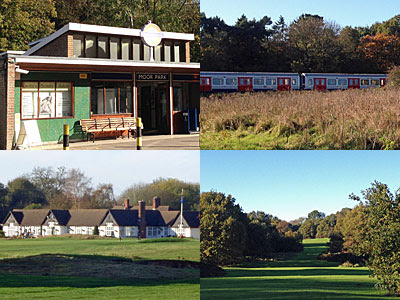
This walk kicks off at one of the least used stations on the Underground, which is Moor Park. A short parade rises up the street outside, where the moneyed folk of this exclusive estate do their shopping. But the link to the Loop's not going that way, it doubles back underneath the platforms to the "Sandy Lodge" exit. Despite growing up one station up the line I'd never used this exit before, nor even realised it existed. If you've brought your golf bag, it's this way out for the Club House. But ramblers should head right, along the footpath through the beech trees down the edge of the railway. I've never seen anyone walking this way before, not from a passing Metropolitan line carriage, but it's a pleasant stroll all the same. If brief.
Section 14 officially starts here, just before the edge of Northwood, and heads diagonally uphill. First it climbs beneath the pylons, up the scrappy heath the golf club didn't want. But then it crosses the golf course proper, starting by the 17th tee. The owners are very keen that you cross only via the proper path, marked intermittently by posts and signs and polite notices. Occasionally you get to cross the pristine fairway, so watch out for flying balls, but everyone seemed busy putting when I passed. Retired foursomes and business networkers, by the looks of it, because it costs a pretty penny to play here. The course is named Sandy Lodge because the gentleman who founded it wanted to create seaside-style links within reach of London, and found an ideal patch of sandy deposits on this Moor Park hillside. Sandy Lodge Halt opened on the railway line in 1910 to service the golfers' needs, and was later renamed.
Beyond the 5th tee is the walker's way out, then a short stretch of private road leads out of the Moor Park Estate. Things change fairly swiftly. Past the petrol station is the edge of South Oxhey, an overspill council estate of note, which choirmaster Gareth Malone got to sing. Fear not, we're entering via an extensive greenspace, a grassy common speckled by clumps of trees. Motor Cycles, Golf Practice, Horse Riding and Cars are not permitted here, according to a grubby sign erected by Three Rivers Council. I thought the streets ahead looked pleasant enough, until two teenagers in a red car sped by honking their horn, riding in a suspiciously joyful way. Don't worry, the road walk is only brief, disappearing up the end of a cul-de-sac into the woods.
These are OxheyWoods, 100 hectares of ancient woodland on the edge of London, thankfully never destroyed to make way for housing. It's a lovely spot. Twisty paths lead through the trees, at first mostly oaks with a splash of sweet chestnut. They're very muddy paths too, at this time of year, and I had to step carefully much of the way to avoid getting squelchy boots. Thankfully nobody saw me tiptoeing along the edge of the undergrowth, indeed I hadn't seen a single fellow walker on the first half of the route. If I heard a sound ahead of me it was invariably a squirrel, or possibly a distant car. A single crossing of Oxhey Drive intruded, recently blocked to prohibit those on horseback from passing through. And then more woodland, and more blessed leafy silence - does nobody go walking around London any more?
The rambling rush hour finally arrived, in the form of a shaven-headed Dad with his two sons, and three slowly ambling pensioners. But they were walking parallel paths, with the Loop veering (somewhat muddily) to the left. Before long I was very alone again, trudging carefully across the mulch into a beechy clearing. In the far distance I could hear increasingly desperate cries of "Ollie!", as if some dog or child had been mislaid in the woods. I deduced which it was when a hound came charging out from the neighbouring golf course and made directly for me. Encountering an unaccompanied out-of-control dog is pretty much top of my terror list when out walking, and here was my worst case scenario unfolding. Thankfully (and somewhat unexpectedly) "Ollie" suddenly halted, and lost interest, allowing me to pass swiftly (and somewhat sweatily) on.
After nearly two miles of woodland, the Loop finally emerges into open fields. This is the edge of Greater London, into which we now pass via the stud at Pinnerwood Farm. Even though we're miles out, various familiar central London landmarks are just about discernible on the horizon. Be prepared for a squelchy patch outside the main barn, then the path nips round the side of the Victorian farmhouse to avoid the horseboxes. A properly exclusive lane lies ahead, including 18th century Pinnerwood House which has its own stream flowing through the garden. Although most of the path is decently waymarked, at the next junction some idiot has planted a three-way sign showing the Loop in all directions - I had to check my map before turning left. Three final fields follow, the second home to a dozen grazing horses. And the last is rather boggy, especially in the farthest corner where Section 14 officially ends. Tread very carefully to re-enter suburbia via the aspirational avenues of Hatch End.
00.00 - Asleep 07.00 - Still asleep 08.45 - Awake after particularly long sleep 08.50 - Mug of tea, bowl of Shreddies 09.40 - Slouching in a nice hot bath 10.35 - On the bus 11.00 - At Roman Road Market. Apart from one artisan bakery stall, Mary Portas's street food legacy has ebbed away. But still ticking over. 11.30 - Sat on a bench in the Olympic Park. The eastern half is relatively busy with sightseers, playground users, cafe drinkers and gardeners. I think there's only me in the western half. 12.30 - At the supermarket, buying food for the weekend. Apart from the milk, everything in my basket has a reduced sticker on it. There is a chubby elf outside dispensing Santa hats. 12.40 - On the bus. Sky's turned grey from blue. 13.00 - Home. Mug of tea. Tuna sandwich. 13.25 - Bringing my (budding) Christmas cactus inside, off the balcony, before the frost gets it. 13.45 - On the tube. At Bow Road was nearly thwacked in the face by a cello being carried on a lady's back. 14.30 - At Camden Lock for the opportunity to go down into the drainedcanal for a look around. No such luck, all tours full. 14.45 - Escaping the tourists, noodles and head-down phone-starers by bus. 15.30 - Walking from one Jubilee line station to another, so you have something to read about next week. 16.30 - At the Canary Wharf Screen to watch some Art On The Underground. Except they've turned it off. 16.40 - On the DLR home. It has been a day out packed with special memories. 17.00 - Mug of tea, fruit shortcake biscuit 17.35 - Flicking through the 100+ photos I took while I was out. Almost all of those taken indoors or underground are rubbish. 18.05 - Oven on, washing machine on, Pick Of The Pops on. 18.10 - The fireworks for Westfield's Christmas Lights Switch-on are making a racket 18.50 - Cod fishcakes, jacket potato, mushrooms, brussels sprouts, peas 19.55 - Mug of tea, dark chocolate KitKat 20.00 - Three and half hours of Doctor Who, including at least three complete episodes, on BBC3 now, you say? Ace. 20.55 - Trying to decide if the autumn's yet cold enough to turn the heating on. As yet unconvinced. 21.45 - Writing about somewhere you'll never go, for the blog tomorrow. 23.00 - I reckon I've uttered ten words today: "thanks" to a lady on a bus, "thanks" to a man on a bus, "cheers" to my local newsagent, "no problem" to a lady with a cello, "sorry" to a lady on a train, and "that's not enough... thanks" to the supermarket cashier who shortchanged me at Waitrose. 23.15 - The brussels sprouts are becoming obvious 23.50 - Mug of drinking chocolate 23.55 - If I tweeted more often, I suspect it'd be like this. I'll spare you.
So, where's the oldest advert on the Underground? Not a preserved heritage poster somewhere. Not a ripped scrap of fading colour, half-forgotten on a wall. I mean the oldest advert in a proper frame in a proper station masquerading as a proper advert.
I think I may have found it.
It's at Canning Town station, on the Jubilee line. It's about halfway along the subway linking the ticket hall to the bus station. And it's this.
The advert is for one of a series of full colour leaflets that TfL brought out in conjunction with BBC Radio London. "Real Arts", it was called, "Your guide to viewing & doing the arts in London". A 36-pager, you could pick up a copy from leaflet racks like the one on the opposite wall. Forty diverse arts venues got the nod within, from across the capital, complete with what's on and transport access details. There were three special offers too, including a free poster giveaway from selected London theatres. And the smallprint on page 3 says "Offers valid only during October and November 2002, unless otherwise stated." Which, by my calculations, makes this poster advert at Canning Town 11 years out of date. And I think that's a record.
At first glance the advert looks perfectly current. The Polka Theatre still exists, and still puts on fine plays (with and without puppets) for children. There are no years or dates on the poster to give the game away. But look carefully at the web address. TfL's website is no longer called www.thetube.com, and hasn't been for ten years now, although the URL still works. TfL no longer publicise 020 telephone numbers, they use 0343 and 0870 these days. BBC Radio London no longer abbreviates itself to LDN. And on the cover of the booklet "Mayor of London" has its ON written in red, which is a typographic flourish changed to blue when Boris Johnson entered office. There's no mistaking, this is an advert from at least a decade ago.
I wonder why it's survived. Is it that staff haven't noticed the poster's long out of date? Is it because Frame 74 isn't listed in TfL's database. Is it that nobody wants to advertise at Canning Town? I was tempted to go up to a member of staff and ask why nobody had taken it down. I was even more tempted to go up to the ticket office and ask for a copy of the booklet, but I didn't want to draw attention to the existence of the advert before I'd told you about it. Plus I'd probably have looked a complete idiot. Plus I've already got a copy. Don't say you're surprised.
It's been interesting to look inside my 'Real Arts' leaflet to see 2002 was like. At Tate Modern Anish Kapoor's big red sculpture filled the Turbine Hall. Wendy Craig and Tom Conti were about to appear at the Greenwich Theatre. The cheapest seats at Sadlers Wells cost £5, whereas today it's more like £22. Only one wheelchair-accessible bus passed the Tricycle Theatre in Kilburn High Road. Stratford Circus in E15 had only just opened. And there was a nostalgic section at the back of the leaflet encouraging families to buy paper travelcards, this being the pre-Oyster era, including a One Day Bus Pass for the fantastically low price of £2. London changes, but this poor lost advert at Canning Town remains.
I wonder if you've seen anything older than this out there? Perhaps on a platform on some distant branch of the Central line, or perhaps lurking in an ill-frequented side passage in a station in the centre of town. Again, I'm not talking about a preserved heritage poster, or a ripped scrap of fading colour half-forgotten on a wall. I mean the oldest advert in a proper frame in a proper station masquerading as a proper advert. Because when the staff at Canning Town finally go out and take this 11 year-old down, we'll need to know where the tube's new oldest advert is.
The Bow Roundabout is 40 years old. It was carved out of my local neighbourhood as part of the creation of an urban motorway, the A102(M)Hackney Link, and required the demolition of several residential streets. In the late 1960s the Greater London Council had been keen to create a motorway box around inner London, and the East Cross Route is one of the few sections that was ever built. At Bow an underpass carries through traffic safely beneath the roundabout, while local traffic interchanges via a series of slip roads. To the north is Hackney Wick, and to the south the Blackwall Tunnel Approach Road. In 2000 the motorway was downgraded to a major trunk road, the A12, allowing the new Greater London Authority to take ownership. Few cyclists ride this way - the dual carriageway is too scary, and the parallel Lea towpath hugely safer.
Which means that the great majority of cyclists who negotiate the Bow Interchange are travelling east/west, not north/south. That east/west road is the A11, an important artery for traffic exiting the City, which on the Stratford side becomes the A118 dual carriageway. In this direction most through traffic is carried by the Bow Flyover, a low sweeping affair which comfortably avoids the roundabout altogether. If all traffic travelled straight ahead no roundabout would be required. But instead a considerable number of vehicles turn either left or right, to join or leave the thundering A12, and it's this which introduces considerable conflict.
The Mayor's Cycle Superhighway 2 chooses to route cyclists via the roundabout, not the flyover. This involves negotiating a set of traffic lights to enter the roundabout, then crossing the path of vehicles driving onto and off the A12. The original CS2 delivered cyclists to the Bow Roundabout and left them there to make their own way forward. In October 2011, Brian Dorling rode no further. The brand new CS2 extension, opened officially last week, provides a safe segregated lane as far as the roundabout, then opens up cyclists to risk for a few crucial yards before joining up with a safer blue strip on the other side. It was in that gap, during yesterday morning's rush hour, that Bow Roundabout claimed another two-wheeled victim.
Logically it would seem more sensible to route cyclists via the flyover. The overpass is broad - two lanes wide in each direction, one of which could easily be given over to bikes. There'd be no need to interact with the trucks and lorries underneath, and safe crossing would be guaranteed. Indeed that's what the majority of cyclists still choose to do, ignoring the blue superhighway in favour of the unofficial flyover. But there is a catch, a major one, and that's joining and exiting the flyover at each end. The flyover begins on the right hand side of the road, whereas the superhighway runs on the left, and there's no safe way to cross from one to the other. Entering the flyover requires a leap of faith across a stream of vehicles, and exiting requires merging into and through the flow of traffic.
In January last year TfL proposed two possible solutions to bicycle danger at the Bow Roundabout. One was a set of cycle 'early-start' lights, via the roundabout, which was the option they eventually picked. But the other was a segregated lane over the flyover, which they ultimately disregarded. It was the entrance and exit issue which killed off the flyover option. To make an up-and-over superhighway 100% safe would require a foolproof method of transference, which could only be achieved by installing additional traffic lights at both the start and finish of the flyover on both sides. This wouldn't have smoothed the traffic flow, it would have ground it to a halt... plus most cyclists would never have waited for the lights anyway and swung out into the traffic of their own accord. A tempting solution on paper, but ridiculously impractical in real life.
So we're left with the solution that kills people - an extra set of traffic lights, the cycle 'early-start'. As I've explained before this layout ought to be safe if everyone uses it properly, but everyone doesn't. Cyclists approaching the forest of lights don't always realise that if the first is green the second will be red and they should stop. Cyclists often jump the second red because they're several metres ahead of queueing traffic so feel more confident to nip ahead. Drivers sometimes see the second set of lights and stop there, whereas they should have halted at the first set further back. And during the rush hour traffic often backs up on the roundabout itself, so the entire circuit doesn't run how it should and unusual manoeuvres take place. In short the cycle 'early-start' is over-complex, therefore inappropriately used, which can increase risk rather than cutting it back.
As a local resident I should also remind everyone, again, that the Bow Roundabout isn't just grim for cyclists. It's a nightmare for pedestrians too, with eight busy slip roads converging and not a single light-controlled crossing. Four of these are manageable, with care, but the four exit roads have almost constant unpredictable traffic, requiring a mixture of luck, judgement and faith to get across. Adding to the horror are two contraflow lanes beneath the Stratford side of the flyover, necessary for local traffic but counter-intuitive to cross. Indeed I'm amazed there hasn't yet been a pedestrian casualty at the Bow Roundabout, because that casualty has almost been me on several occasions. But all of TfL's so-called improvements, including the latest cycle 'early-start' lights, have been installed with no provision for pedestrians whatsoever.
TfL have now tweaked the Bow Roundabout several times without yet creating somewhere safe to ride or safe to walk. It seems increasingly likely that a more radical solution is required, one which involves unmaking the motorway junction installed in the 70s and replacing it with something better. That's not going to be cheap or easy, and would likely cause a massive amount of inconvenience at this key road junction. There are no alternative crossing points of the Lea anywhere nearby, so to radically rework this interchange could create months of gridlock and sever local communications. Solutions involving bridges, subways and elevated cycle rings are scuppered by the existence of an underpass and flyover. Wiping out roads and starting again might be prohibitively expensive, requiring demolition of adjacent properties, but then no outcome is perfect. Indeed if there were an ideal solution one expects TfL would already have embraced it. But with pressure mounting, and now a third death at the same blackspot, surely something has to be done.
I attended a vigil at the Bow Roundabout yesterday evening, in memory of the as yet unnamed woman cyclist who'd died earlier that morning. Hundreds of cyclists came from all over the capital to remember, and to mourn, and to demand hope for the future. For a few minutes they reclaimed the roundabout for their own, circling in protest as the police held increasingly frustrated motorists back. And then after a short speech they melted away, their point made, their silent voices heard. It would be good never to attend another vigil here at the Bow Roundabout. But I fear that's what I said last time.
In the summer of 2012, TfL installed a cycle 'early-start' on the eastbound approach to the Bow Roundabout. When it became apparent that road users didn't fully understand the forest of lights, TfL came back and added three yellow signs saying CYCLISTS STOP ON RED.
In the autumn of 2013, TfL installed a cycle 'early-start' on the westbound approach to the Bow Roundabout. It's an almost perfect copy of the eastbound cycle 'early-start', but with one significant omission. There are no yellow signs saying CYCLISTS STOP ON RED. I wonder why they missed them out.
This morning, less than a fortnight after it opened, a cyclist died at the cycle 'early-start' on the westbound approach. The Bow Roundabout has now claimed three cyclists' lives in just over two years.
With all the building work taking place at Tate Modern at the moment, the latest in The Unilever Series has gone mostly unnoticed. The landmark art project which currently fills the Turbine Hall is more understated than most, that's for sure. There is no blazing sun on the far wall, no crack snaking across the floor, no set of metal spirals to slide down. Instead a more subtle work has appeared, encompassing the void in an entirely new way, yet still with its own original voice.
Tate Modern: Ischan Ging
The Unilever Series: May 2013 - January 2014
The first hint that something unusual is afoot comes on attempting to access the Turbine Hall via the usual channels. The main entrance from the west is sealed off, preventing access down the usual sloping walkway into the heart of the building. Instead visitors must approach along the passage past the cafe, squeezing past the queue for scones, where a high temporary barrier shields the view. One's senses are truly heightened - what is the mystery behind? Playfully there are no clues until three portholes appear on the right hand side, each of a different size and at a different height. The Tate have positioned a security guard close by in case these vantage points become too popular, but thankfully I was fortunate in timing my visit so as to observe without obstruction.
The latest Turbine Hall installation is somewhat of a triptych, as befits a masterwork of note. From this location only the central section is properly visible, this being the raised mezzanine overlooking the rest of the hall. Initially all appears empty, but look again. The barrier around the top of the stairs has been replaced by metal pipework, erupting from a wooden framework skirting the rim. This tableau reflects the safety-conscious nature of our modern society, encompassing risk and order within its temporary frame. This theme is further echoed by a red-framed installation close by - Twin Extinguishers of Fire - which stands poised and ready to put out the raging flames of 21st century society.
Again, closer inspection bears dividends. The floor is covered in a thick layer of dust, reminiscent of Ai Weiwei's carpet of porcelain sunflower seeds exhibited here in 2010. Throughout this powder carpet can be seen trails of repeated patterns forming sinuous lines across the floor. These are the footprints of the performance artists who labour daily to create the impression of a building site, an illusion so deftly created you might even believe it were true. Three further portholes on the northern side suggest the existence of extension works beyond, as if the gallery were expanding both vertically and horizontally to meet artistic need. As if.
Accessing the remainder of the Turbine Hall installation can be problematic - indeed building access is severely compromised for the duration of the work. There are no escalators up from the first floor, they merely sail past, so a more physical approach is required. Walk down to reach the start of the incline, else take the back stairs to ascend in dark twists. You may struggle with the crowds, so comprehensively has the Turbine Hall's temporary quarantine compromised access to the upper levels. But oh what vista awaits from the glass gallery on floor two. The entire void is opened up with unobstructed views to left and right, and only now can one fully appreciate the true extent of this year's project.
At the eastern end of the hall, seemingly nothing. No piles of cardboard boxes, no expanse of bunkbeds, no giant screen. All that's visible are the sober brick walls of this former generating station and a high vertical window. And yet this surely is the very conceit the artist has attempted to expose, showcasing the structure's very ordinariness as a counterpoint to creative hubris, or something.
To appreciate the substance of the western section - the slope down from Bankside to basement level - an increase in elevation is recommended. Climb to the third floor, or better still ascend to the fourth, to absorb the panorama. What disturbance is this? The entire floor has been ripped up, even the remains of Doris Salcedo's concrete crevice scarred here five years back. Scattered about are piles of rubble - some rocks, some pipework - seemingly random yet assembled with painstaking accuracy. A small digger has been placed parallel to the main door, again precisely aligned, close to a very lifelike sculpture of a wheelbarrow. Dust lies everywhere, some scraped as if by persistent motion into lifelike swirls. Meanwhile on the far wall a giant wooden scaffold rises high, then higher, its lower strata sheathed in translucent plastic skin. The overall result is a bold statement of intent, a parable for our times, an unmistakeable composition.
If you're on fourth, look to the right to view the project's crowning glory. A new footbridge is being installed at vertigo-inducing height, designed to link the existing galleries to the new. You'll need a head for heights to cross, but for now access is blocked, available only via imagination. Instead the Tate distracts with artworks under the umbrella of 'Structure and Clarity, from Mondrian to Jarman, in adjacent rooms opened for many a long year. But when the Herzog & de Meuron extension opens in 2016, this skyway path will be an alternative gateway to pyramidal heights. Until then the Turbine Hall's latest installation offers tantalising glimpses of creative horizons as yet unattained, of dreams unbidden, of aesthetic destiny. Visit soon, or maybe best wait a bit.
One day, maybe, Battersea Power Station will be reborn. It's had several false starts over the last few years, several developers who said "hey, we have this great idea for the place..." then went bust, or lost interest, or faded away. The latest bunch, a Malaysian consortium, are proving hardier souls. They've got to the planning stage, the accommodation brochure stage, the Prime Ministerial launch stage and the Northern line extension stage. Their plans propose a major mixed use development encompassing the power station and the expanse of land surrounding it, completed in stages over the next twelve years or so. There'll be luxury apartments, shopping malls, office space and yet more luxury apartments, just as you'd expect. Or maybe there won't.
Another round of planning consultation kicked off last week. It had a decent amount of publicity, so you might have noticed, indeed you might even have been along. The owners set up an exhibition in a posh prefab on site and invited the public inside to have their say. Access was via a derelict-looking lane on the Nine Elms riverside, nowhere you'd think of going by accident, where a poster announced the exhibition within. I had to ask the security guard if I was in the right place, because it didn't look promising. He invited me to walk through a gate I'd assumed was locked, then pointed down a run of metal barriers to the main exhibition. It was a smart affair.
On entry a member of staff wanted your name and address, holding out a piece of lined paper with an insistent smile. And then there was quite a lot to see. A complete history of the power station, on nicely produced boards - nothing controversial whatsoever. A properly-old scale model of the power station, which looked like it dated back to the Central Electricity Generating Board. Several boards outlining the proposed development scheme, differentiated by being black on white not white on black. Proposals to demolish the crumbling chimneys and replace them, starting imminently, then adding a lift to a viewing platform at the top of one. And another scale model showing New Battersea Power Station surrounded by curved perspex blocks, clustered on three sides in a rather dense manner. Everything you'd expect really.
Plans are for the Grade I listed power station to have at least three main uses. There'll be a lot of offices in the centre, with a whopping great atrium leading up to a glass roof way above. There'll be high level apartments, the most expensive on the site for those who can afford to live in the actual landmark building. And there'll be shopping malls, two in total, contained accessed via Turbine Hall A and Turbine Hall B. One will be highbrow prestige brands, a bit like a covered version of Bond Street, while the other will feature shops a smidgeon lower down the retail ladder. And it was the artist's impressions of these malls that made me silently weep. They showed a central atrium with shops and balconies and staircases that could have been any major shopping mall anywhere, say Lakeside or Westfield, the very epitome of nothing special. Sure, the bricks and tiles of the great building were still present, and closer inspection revealed soaring walls and windows. But something in the anodyne presentation suggested that the star presence here would be the shops, not the architecture, in faceless pastel tones.
It became apparent partway round that the lady standing next to me was a future tenant. She'd already reserved an apartment in Phase One of the development - that's Circus West, a steel and glass block due shortly to block out views of the power station from the adjacent railway. She was here to check out plans for her local shops, restaurants and cinemas, a completely different point of view to mine. So I was pleased to get the opportunity at the end of the exhibition, when a polite woman dished out questionnaires on clipboards, to offer up an equal voice. "I like the proposal..." "I welcome the variety of uses..." "I support the new plans to regenerate the Power Station building." I ticked 'strongly disagree' for the latter, as you'd anticipate.
And then, once our opinions had been collected, we were allowed outside to view the power station itself. A long line of metal barriers snaked across a vast expanse of nothingness - these 39 acres the true prize for the developers. A stream of Heathrow-bound planes flew almost directly overhead - something you won't read about in the glossy brochures for potential tenants. It was a long walk, but that was great because there was the opportunity to view the chimneys from far away to almost directly underneath. Back in September for Open House the queues to get inside ran round the block, thousands strong. When I visited midweek there were no more than half a dozen of us, and most of those on the walk back, which gave a wholly different (and rather marvellous) experience.
I stood at the entrance to Turbine Hall B and stared, in awe of this vast electric cathedral. A barrier prevented deeper ingress, but to stand within was enough. To one side a row of part-decayed columns allowed view of the central generating space, entirely roofless, where those lucky office workers are going to go. Ahead was a long atrium with lofty roof, a net cast across to catch falling debris. Occasionally a pigeon flapped across from one side to the other, at would-be penthouse level, oh so high above. I tried to picture this as a shopping mall and it was disturbingly easy, with each of the gaps between pillars transforming into showy plate glass windows. And yet it struck me how almost nothing had changed since I was last here in 2006, save a little more dilapidation and yet another change of ownership.
When my one fellow visitor departed, and the security guard wandered off, I suddenly had the entire building to myself. It was a wonderful sensation, both humbling and rare, and I felt very privileged to be here. If the developers get their way this site will never be so empty again, what with shoppers and office workers and long-term residents and security everywhere. It seems the price of saving Gilbert Scott's creation is to transform it utterly, as a generator of wealth rather than of awe. As if to prove the point, my five minutes of silence was ended when a businessman wandered in, jabbering into his mobile phone and trailing a suitcase behind him. He saw Battersea Power Station for what it could be, and I saw it for what it was. We left together, both smiling for entirely different reasons.
The public exhibition closed on Sunday, sorry, so you'll not be following me inside. Detailed plans were supposed to go online yesterday, but I've looked and I can't find them on the site [Thursday update: they're here]. But the Public Exhibition Questionnaire is fully accessible, in case you have any thoughts on the future of Battersea Power station and care to share. This latest scheme might be the most likely yet to succeed, but as past decades have proven, change here is never guaranteed.
JUBILEE: 5 things I found outside this station
I've devoted a month to the Jubilee line before. It was May 2004, the line's 25th anniversary, when I ran a station-by-station feature entitled Silver Jubilee. I visited every station, wrote about each of them in turn, and took pictures too. One part of this mammoth chronicling was a section entitled 5 things I found outside this station, which I thought I'd repeat nearly ten years later to see what's changed. The original lists are in the first column, using red text for anything that's no longer there. And my updated lists are in the second column, using green text for anything that definitely wasn't there last time. Think of it as an urban history project. A lot's changed.
5 things I found outside this station...
May 2004
November 2013
Stanmore
a small green stall selling flowers, some slatted wooden benches, a pedestrian crossing, a big tube sign on a blue pillar, the Green Belt (the line stops right on the edge of London - a few hundred metres further on and you're in the countryside)
Esquire's Barbers, Express Stop (a very mini newsagent), a dispenser containing free copies of Jewish News, Accident Advice House (part of the Stanmore Business Centre), a grumpy fat man swearing hoarsely into his phone
Canons Park
a very short green cycle path, Canons Park Motors (operating from three arches underneath the station), Eddy's kebab shop, Hearts & Flowers florists, the number 79 bus.
four very short green cycle paths, Canons Perk (coffee and snack bar), Cannons Tandoori (blatantly misspelt), the Fountain Park estate, a Barnardo's bin
Queensbury
Queensbury Circus, Hunter & Hunter estate agents, some bicycles chained to the railings, Joe's Bake & Bite, three levels of flats built above the station entrance
Queens Internet cafe, a new bike rack, a mega Morrisons, Hair Magic, a greengrocer stall selling fruit and veg at £1 per bowl
Kingsbury
a sign saying 'humps for 350 yards', a lot of local shops, a machine selling parking tickets, Jyoti Jewellers, a yellow box junction
Sahara Lounge II, a security camera on a tall pole, National Halal Centre, Mepani News, a drinking control area (maximum penalty £500)
Wembley Park
a pelican crossing, that huge extra entrance/exit for use on days when there's a big event nearby, the College of Northwest London, Olympic Way, a big sign pointing towards 'Stadium tours' (unlikely at present)
Wembley Stadium (rebuilt, with arch), Victoria Hall Student Living (skyrise silver shoeboxes), a new huge station entrance/exit, the Ark Academy, Olympic Square (except no, it's more sort-of curved)
Neasden
a pelican crossing, two giant billboards, Falcon Park RNIB centre, Adrian's Newsagent (a tiny kiosk), a pedestrian sign pointing towards 'Neasden Temple & Superstore' (I hope that's two different places)
Cafe Dori, City Plumbing Supplies, a blue bobbly standalone National Lottery sign, a big empty warehouse to let (which may have been the RNIB centre), a sign pointing to 'Magistrates Court'
Dollis Hill
the 'Dollis Hill' mural, belisha beacons, a big tube sign on a brick column, wide avenues of suburban semis, a parade of shops
Dollis Hill Garage, standalone cash machine (£1.75 to withdraw), Liberty Food & Wine, 'Kitten Found' poster, mini-roundabout
Willesden Green
a yellow plastic box full of grit, Camerons Stiff estate agents (giggle), 10 piles of free magazines (mostly expat related), Dynamic dry cleaners, lots of laminated Wanted For Murder police posters
six smart flower boxes (still flowering), City AM newspaper box, Willesden Green Town Team noticeboard (mostly empty), a big bike rack (full), a shakes & smoothie shop (closed, about to become a barbers)
Kilburn
a double viaduct painted blue, Shoot Up Hill (actually the A5 Watling Street), an old postbox, Kilburn Flowers, a dry cleaners that sells records.
Dutch & Dutch fruit & veg stall, Kilburn Confectionery, three bridges, a sign pointing to Brondesbury station, the Kilburn Mural 2004 (painted by Snug, Dane, Bleach, Busk, Tizer and Asset)
West Hampstead
long queues for tickets, Mr Gingham's sandwich bar (sliced egg, £1.30), The Flower Gallery, the smell of bacon, a big green Camden 'Trade Waste' bin.
Sorry Position Closed, Mr Gingham's sandwich bar (sliced egg, £1.50), North West 6 (gift shop), The Railway (pub & Costa), a streetcleaner eyeing me suspiciously
Finchley Road
the 02 shopping centre (a very modern mall complete with fishtanks and jungle-themed escalators), George's Shoe Repairs, the A41, Waitrose, a mysterious old wooden door labelled 'Meakers'
British College of Osteopathic Medicine, expensive florist stall (bouquets in multiples of £5), Canfield House, Evening Standard lock-up (white), Holy Trinity church (plus Alpha Course)
Swiss Cottage
five station exits via subways, a dead busy road junction on the Finchley Road, Ye Olde Swiss Cottage (a chalet-style pub, built in 1840 beside the old Junction Road tollgate, now complete with exhaust fume soaked beer garden), Fujifilm House, an old Odeon cinema
Hampstead Theatre (House Full), Eton Avenue Farmers Market (late in the day, so absolutely no customers), Overground House, Star Box Coffee (a small kiosk with hygiene rating 4), Swiss Cottage Library
St John's Wood
a circular ticket hall with high glass windows, seven floors of flats built above the station, a shrubbery complete with palm trees, the Abbey Road Café (it's tiny, but it has an informative website), hordes of Inter-Railers clutching Multimap printouts trying to work out where 'that' recording studo is.
Acacia Road, a newspaper kiosk sponsored by the Wall Street Journal, a Countdown crossing, the Beatles Coffee Shop (it's tiny, but it has an informative website), hordes of foreign tourists consulting the Legible London map (which doesn't mark the terribly famous nearby zebra crossing)
Baker Street
hundreds of tourists buying tacky souvenirs and pizzas, long queues for sightseeing buses, a statue of Sherlock Holmes, Transport for London's Lost Property Office (it's amazing what people lose), the big green copper dome of the London Planetarium (opened 1958)
M&S Food To Go, long queues for the Sherlock Holmes Museum, Belgian Waffles, The Metropolitan Bar (formerly the Chiltern Court restaurant), the big green copper dome of the Marvel Super Heroes 4D film experience (it's an absolute travesty, sigh)
Bond Street
bustling Oxford Street, the West One shopping centre, bureaux de change, loads of people, this view.
a hole where Crossrail will be, Forever 21, Delicious Crêpes, a park-up spot for pedicabs, lots of yellow Selfridges bags
Green Park
the grinning lady who blocks the station exit trying to hand out free magazines, the smiley bloke who sells me my Evening Standard, Piccadilly, the Benjy's where I often buy lunch, a surprisingly high proportion of posh men wearing bow ties and dinner jackets
an Audi showroom, a Big Bus Tours driver on his break (yelling into his mobile), the new leafy chasm exit direct into Green Park, Langan's Brasserie, Sea Strata (a Portland stone artwork by John Maine)
Westminster
Big Ben (OK, St Stephen's Tower), the Houses of Parliament, Portcullis House, the River Thames, tight security
Big Ben (OK, the Elizabeth Tower), the 'secret' underground entrance to Parliament, Tesco Express, three groups of three Jehovah's Witnesses handing out 'Awake' magazine, St Stephen's Tavern
Waterloo
Waterloo mainline station, Waterloo Eurostar station, a giant illuminated elephant's head at the top of an escalator, an IMAX cinema, homeless people
famously fresh baguettes, Bank Machine Welcomes You To London Waterloo, Fishcotheque, the Wellington, foreign students sat down on the floor chatting
Southwark
a circular entrance lobby lit by a central glass drum, Waterloo East station (via dedicated exit), Blackfriars Road, a building site dominated by a towering blue crane (any buyers for a new glassy office building?), The Ring public house
Palestra (a glassy office building, where TfL lives), snacklite, Rowland Hill House, 15 150th anniversary Art on the Underground posters, the former Blackfriars station
London Bridge
London Bridge, the London Dungeon, Borough Market (selling posh organic food for Observer readers), Southwark Cathedral, Guy's Hospital
the Shard, a new bus station, Sam Souviners (sic), the Shangri-La Hotel (opens Q4 2014), a temporary ticket office
Bermondsey
Jamaica Road, an electronic display welcoming you to Bermondsey station, two cashpoints, Feltor Carrington estate agents, densely-packed council blocks
sign to Bermondsey Square Antiques Market, dual carriageway, Local Express, Jimmy's & Son Barber Shop (est 1970), an old soldier selling poppies
Canada Water
a big round glass drum, a bus station, large tracts of open space awaiting redevelopment, Surrey Quays Shopping Centre, Canada Water (complete with bird raft and wind turbine)
Canada Water Library (est 2012), the Maple Quays Sales and Marketing Suite, maple trees, Mousetail coffee cart, a private gym for residents of the adjacent development
Canary Wharf
Docklands, One Canada Square (Britain's tallest building), a sculpted head lying on its side, Jubilee Place shopping centre beneath Jubilee Park, four clocks on poles
a rack of Boris Bikes, bankers, an advert for St Peter's Barge (London's only floating church), a row of international cuisine kiosks, Montgomery Square
North Greenwich
a carelessly-discarded Dome, WH Smiths, a bus station in the middle of nowhere, a 1000-space car park, Group 4 security
Classico Expresso, a world class 'entertainment district', thousands of people rich enough to watch tennis, the London Diner, windswept Millennium Square
Canning Town
a big flyover on the A13, an MFI superstore, a teeming bus station, Purvi newsagents, a large stone memorial commemorating the nearby Thames Ironworks (HMS Warrior was built here in 1860)
Terry Spinks Place (under the flyover), the place, Matchday route to West Ham, the Bow Creek exit (no public access), flyers for Poverty Kickz (Charity Dance Workshop)
West Ham
Ibstock bricks and small glass squares, Costcutter Express, a mini-roundabout, Memorial Avenue, a chippy under new management (shame, because the old management served right tasty cod)
a superloo (10p fee), the Rial Lifestyle Cafe (recommended), DLR roundel, regular courtesy minibus to West Ham Bus Garage (invariably empty), a lady humming in the bus shelter
Stratford
Meridian Square, a big bus station, a purple steam engine called Robert, scores of people, my local shopping centre
my new local shopping centre, Deano's Continental Hot Food, obscuring fish scale sculptures, a zigzag row of security bollards, Stratford Plaza (all now sold)
125 years ago, in the early hours of a Friday morning, London's autumn of terror ended. The man we know as Jack The Ripper claimed his fifth and final victim in the rookeries of Spitalfields, not that anybody realised it was his last at the time. The murder was also his most brutal, carried out in the privacy of the victim's own home, which allowed time for additional gruesome mutilation. So today I'm completing my quest to visit the five confirmed murder sites as the anniversaries pass, comparing what happened then to what's there now.
The fifth of the Ripper's murders took place off Dorset Street, a grim thoroughfare to the west of Commercial Street in Spitalfields. Dorset Street started out as a footpath along the edge of open countryside - the 'Spital Field' belonging to the priory hospital of St Mary's. During the 17th century the area became home to artisans and silk weavers, many of them Huguenots fleeing from abroad. When the silk trade finally died out, many of the four-storey townhouses on Dorset Street became lodging houses for London's poorest. Many so-called double rooms were really nothing more than brothels, and the street soon earned the nickname of "the worst streetin London". An alleyway led off between the house at number 26 and the chandler's shop at 27, behind which lay Millers Court. This had once been a back garden, but was infilled with cottages in 1851 and later partitioned off into separate rooms. And it was in one of these, a back parlour 12 foot square, that the Ripper's foul crime was committed.
Mary JaneKelly, at 25, was by far the youngest of the Ripper's victims. Her early years are somewhat under-recorded, but it's believed she was born in Ireland, near Limerick, then moved to Wales at an early age. At 16 she married a coal miner, but he died in an explosion and she turned to prostitution for a living. Later she moved on to West London, then briefly to France with a client, then to East London where she lived with a variety of men. An attractive fair-looking soul, she was described by one acquaintance as "a very quiet woman when sober but noisy when in drink". Her last partner was Joseph Barnett, a fish porter at Billingsgate, but he moved out of their shared room in Millers Court after a row a week before Mary Jane's death.
Late on the evening of Thursday 8th November she brought home a stout ginger-haired man for sex, then went out into the streets in search of more money. A witness later reported seeing Mary Jane in Dorset Street at 2am in the company of a pale man with a moustache, wearing kid gloves and carrying a small parcel. The pair walked arm-in-arm into Millers Court, with Mary Jane's last known words "All right, my dear. Come along. You will be comfortable." At 4am neighbours heard cries of "Oh, murder!" , but thought nothing of it, this being a common cry hereabouts. It wasn't until nearer 11 o'clock that a rent collector knocked on Mary Jane's door and, receiving no answer, peered through the window and discovered her body. It was clear that something quite terrible had taken place, but the full extent of her horrific injuries wasn't known until the police broke down the door early in the afternoon.
Dorset Street took many years to shed its unsavoury reputation, changing its name to Duval Street in 1904 in an attempt to camouflage its past. The road is still there, sort-of, but you'll not find it listed in the A-Z today thanks to two rounds of development by the City of London. First (in 1928) they knocked down all the houses on the north side of the street, including MillersCourt, and in their place rose the London Fruit and Wool Exchange. This Portland stone edifice housed traders selling fruit and veg sourced from countries all around the world, conveyed onwards via fourteen loading bays still visible round the back. The Gentle Author offers insight via a 1937 catalogue here. The slums on the southern side of the street lasted much longer, until fifty years ago, and in 1971 were replaced by the White's Row multi-storey car park.
Dorset Street survives, for now, as a private unnamed road used occasionally for deliveries. A few years ago it was fenced off at both ends, somewhat frustratingly for Ripper Tours who can now only stand each evening and point through the mesh at the distant murder site. But that's not going to be the case for too much longer. The Fruit and Wool Exchange is awaiting demolition, after Boris over-ruled Tower Hamlets council and gave the go ahead for a major commercial redevelopment. The building looks a bit sad now with its office tenants evicted and all its doors and windows boarded up, awaiting the arrival of an army of deconstructors and diggers. At least the façade facing Spitalfields Market will be retained, but only as a heritage veneer covering up an uninspiring mixed use block behind. One consequence of this is that Dorset Street will be built over and disappear from view, perhaps with part surviving as an interior shopping court, or something equally inappropriate.
The White's Row car park is also under threat from the same development plan. Its loss will be less keenly felt, except by car drivers and by motorcyclists seeking somewhere free to park. Strange building. From the outside it looks like a metal skeleton with brick stairwells, but step inside and the full concreteness of the multi-storey hits you. And you can step inside, very easily, via a set of always-open stairs facing onto Commercial Street. The stairwell leads all the way up to the 5th floor, which is the open roof, from which there's an alternative view of the City skyline. Most days there's absolutely nobody parked up here, nor even on the two floors below, which allows the casual visitor easy opportunity to stare down at what used to be Dorset Street below. Those green painted delivery bays with the yellow hatched lines, that's where the Ripper last struck. Prior to that a City flowerbed, prior to that a school playground, prior to that a Sunday clothes market, prior to that a Crossrail building site. Five points of terror, each erased and redefined by London's ever changing landscape. 125 years on these murder sites have changed forever, but the collective memory of Jack's brutal deeds remains.
A few miles north of Bradford, ten minutes away by train, is the village of Saltaire. It's no ordinary place, it's a UNESCOWorld Heritage Site, one of only 28 in the UK. It's an almost complete survivor of the Victorian industrial age, a complex comprising a woollen mill and adjacent housing. What's special is that the housing is part of a benevolent community created by the mill's owner, Sir Titus Salt. In the 1850s he moved his manufacturing business out of Bradford to a better location in the country, settling beside the River Aire, the Leeds and Liverpool Canal and the new railway. To look after his workers he built a village of terraced houses alongside, complete with schools, shops, running water, church, library and concert hall. This was revolutionary social thinking, later taken on board in the development of garden cities, council housing and urban planning. And it's gorgeous, even on a ropey wet day in November.
The mill complex is huge, straddling the canal and sandwiched between the river and the railway. The main block is four storeys high - deep, whopping storeys - and at least 60 windows long. It was designed to impress, in the Italianate style, with turrety flourishes proclaiming success to the world. Alongside are weaving and combing sheds, and boiler houses and dye works, plus a huge great big chimney visible for miles around. Thousands would have worked within creating Yorkshire textiles, and business continued right up to 1986 when the looms fell silent for good. A local businessmen then snapped up the somewhat dilapidated buildings and transformed them, somewhat unexpectedly, into a retail commercial venture. Some of the blocks are now office space, while the main building houses restaurants, various shops and an art gallery. It's called Salt's Mill, and it's a middle class day out par excellence.
The mill's owner became good friends with David Hockney, hence Salt's Mill now showcases many of his works of art. They're scattered around the main building, especially on the lower floor - the 1853 Gallery. This enormous room is also an art shop, with materials and books aplenty, so it's quite easy to forget to look at the proper stuff on the walls. Upstairs is a proper bookshop, with excellently-chosen stock, indeed I had to force myself to purchase only what I could carry. There's also a large restaurant, nicely done, and if you walk through that more shops (including a design outlet with nagging notices everywhere). Upstairs again is a smaller dining area, more boutique, more cafe, leading through to more Hockneys. Some of his iPad paintings are being shown, which I can take or leave, but also some of his trees, which I like considerably more. I particularly liked "25 Trees Between Bridlington School and Morrison’s Supermarket along Bessingby Road in the Semi-Egyptian Style", a seasonal East Riding triptych in sun and snow.
Saltaire's original residents had no such upmarket fripperies for entertainment. They had Roberts Park across the river, with cricket pitches and bandstand, but also byelaws preventing singing and the consumption of alcohol, and use of the playground at any time on a Sunday. A particularly fineCongregational church sits above the Aire, again Italianate in style, and one of only four nonconformist churches in England with its own ring of bells. The main road up from the river is Victoria Street, which rises first past neat parades of shops. Some are gifty boutiques, while one is a gastropub wittily named "don't tell Titus...". Many sell cakes, pies and sandwiches, not just for the well-dressed over-50s tourists but also for students at Shipley College. They're based in several buildings here, including the former primary school, and at lunchtime students pour out into the heritage streets and stuff their faces with pastry.
And these are seriously fantastic streets. Titus Salt's factory accommodation consisted mostly of back-to-back terraces built from local sandstone, yet again Italianate in style. Some for more well-to-do workers had front gardens, but most had doors opening out onto the street and tiny little back yards. That allowed Saltaire's streets to be crammed tightly together, far closer than any urban planner would allow today. The sidestreets are named after Titus's family, including a Herbert Street, a William Henry Street and a Fanny Street. A series of back alleys run parallel, and each runs down towards the river with the moors rising up green and gold on the opposite side. They're not large homes but they're no slums either, well built with a touch of genuine class. Were these in inner London they'd sell for nigh on a million, I bet, whereas up here they sell for under £200,000, which is eminently affordable in southeast terms.
Step too far up the hill and the edge of the World Heritage Site is immediately clear. Beyond the almshouses is the busy Bingley Road, where you'll find Qasim's Car Wash and a KFC. But Saltaire proper is a lovely place, an industrial gem, and a timely reminder that working class housing doesn't have to be cheap and characterless.

Jubilee Place opened ten years ago, the second shopping mall at Canary Wharf. The first sits under the main tower, a lengthy subterranean arcade leading from Cabot Square down to Waitrose. It's got some upmarket shops, but also much more ordinary fare like JD Sports and a Carphone Warehouse. It's somewhere for financial service workers to shop at lunchtimes, and for more affluent locals to go at weekends. Jubilee Place runs parallel, on the opposite side of the Jubilee line station, beneath Jubilee Park. See what they did with the branding there?
The new extension to Jubilee Place is on Level Minus Two. That's one floor below the main mall and two floors below the park, on the same level as the Underground station ticket hall. This used to be nowhere special. You walked in from the tube via two sets of heavy doors (still present) to face a small newsagents selling papers and sweets. A short escalator then led up to a mezzanine, and up again to the the glazed atrium at the heart of the main mall. That's now changed. The newsagent's long gone, his corner replaced by several artisan-style shops. And the direct escalator's no longer there either, forcing everyone to walk further past lots more shops before ascending. A marble mall has been created, with swish lighting, glazed shop frontages and bijou display cases containing goodies you might like to purchase. One mosaic on the floor commemorates London as "the world's only open market for tortoise shell", as if this were somehow a good thing. And all the time security guards watch, just in case something less than perfect might occur.
The Mayor's Cycle Superhighway 2 chooses to route cyclists via the roundabout, not the flyover. This involves negotiating a set of traffic lights to enter the roundabout, then crossing the path of vehicles driving onto and off the A12. The original CS2 delivered cyclists to the Bow Roundabout and left them there to make their own way forward. In October 2011, Brian Dorling rode no further. The brand new CS2 extension, opened officially last week, provides a safe segregated lane as far as the roundabout, then opens up cyclists to risk for a few crucial yards before joining up with a safer blue strip on the other side. It was in that gap, during yesterday morning's rush hour, that Bow Roundabout claimed another two-wheeled victim.
So we're left with the solution that kills people - an extra set of traffic lights, the cycle 'early-start'. As I've explained before this layout ought to be safe if everyone uses it properly, but everyone doesn't. Cyclists approaching the forest of lights don't always realise that if the first is green the second will be red and they should stop. Cyclists often jump the second red because they're several metres ahead of queueing traffic so feel more confident to nip ahead. Drivers sometimes see the second set of lights and stop there, whereas they should have halted at the first set further back. And during the rush hour traffic often backs up on the roundabout itself, so the entire circuit doesn't run how it should and unusual manoeuvres take place. In short the cycle 'early-start' is over-complex, therefore inappropriately used, which can increase risk rather than cutting it back.
I attended a vigil at the Bow Roundabout yesterday evening, in memory of the as yet unnamed woman cyclist who'd died earlier that morning. Hundreds of cyclists came from all over the capital to remember, and to mourn, and to demand hope for the future. For a few minutes they reclaimed the roundabout for their own, circling in protest as the police held increasingly frustrated motorists back. And then after a short speech they melted away, their point made, their silent voices heard. It would be good never to attend another vigil here at the Bow Roundabout. But I fear that's what I said last time.
JUBILEE: Southwark
The latest Turbine Hall installation is somewhat of a triptych, as befits a masterwork of note. From this location only the central section is properly visible, this being the raised mezzanine overlooking the rest of the hall. Initially all appears empty, but look again. The barrier around the top of the stairs has been replaced by metal pipework, erupting from a wooden framework skirting the rim. This tableau reflects the safety-conscious nature of our modern society, encompassing risk and order within its temporary frame. This theme is further echoed by a red-framed installation close by - Twin Extinguishers of Fire - which stands poised and ready to put out the raging flames of 21st century society.
To appreciate the substance of the western section - the slope down from Bankside to basement level - an increase in elevation is recommended. Climb to the third floor, or better still ascend to the fourth, to absorb the panorama. What disturbance is this? The entire floor has been ripped up, even the remains of Doris Salcedo's concrete crevice scarred here five years back. Scattered about are piles of rubble - some rocks, some pipework - seemingly random yet assembled with painstaking accuracy. A small digger has been placed parallel to the main door, again precisely aligned, close to a very lifelike sculpture of a wheelbarrow. Dust lies everywhere, some scraped as if by persistent motion into lifelike swirls. Meanwhile on the far wall a giant wooden scaffold rises high, then higher, its lower strata sheathed in translucent plastic skin. The overall result is a bold statement of intent, a parable for our times, an unmistakeable composition.
One day, maybe, Battersea Power Station will be reborn. It's had several false starts over the last few years, several developers who said "hey, we have this great idea for the place..." then went bust, or lost interest, or faded away. The latest bunch, a Malaysian consortium, are proving hardier souls. They've got to the planning stage, the accommodation brochure stage, the Prime Ministerial launch stage and the Northern line extension stage. Their plans propose a major mixed use development encompassing the power station and the expanse of land surrounding it, completed in stages over the next twelve years or so. There'll be luxury apartments, shopping malls, office space and yet more luxury apartments, just as you'd expect. Or maybe there won't.
Plans are for the Grade I listed power station to have at least three main uses. There'll be a lot of offices in the centre, with a whopping great atrium leading up to a glass roof way above. There'll be high level apartments, the most expensive on the site for those who can afford to live in the actual landmark building. And there'll be shopping malls, two in total, contained accessed via Turbine Hall A and Turbine Hall B. One will be highbrow prestige brands, a bit like a covered version of Bond Street, while the other will feature shops a smidgeon lower down the retail ladder. And it was the artist's impressions of these malls that made me silently weep. They showed a central atrium with shops and balconies and staircases that could have been any major shopping mall anywhere, say Lakeside or Westfield, the very epitome of nothing special. Sure, the bricks and tiles of the great building were still present, and closer inspection revealed soaring walls and windows. But something in the anodyne presentation suggested that the star presence here would be the shops, not the architecture, in faceless pastel tones.
The fifth of the Ripper's murders took place off Dorset Street, a grim thoroughfare to the west of Commercial Street in Spitalfields. Dorset Street started out as a footpath along the edge of open countryside - the 'Spital Field' belonging to the priory hospital of St Mary's. During the 17th century the area became home to artisans and silk weavers, many of them Huguenots fleeing from abroad. When the silk trade finally died out, many of the four-storey townhouses on Dorset Street became lodging houses for London's poorest. Many so-called double rooms were really nothing more than brothels, and the street soon earned the nickname of "the worst street in London". An alleyway led off between the house at number 26 and the chandler's shop at 27, behind which lay Millers Court. This had once been a back garden, but was infilled with cottages in 1851 and later partitioned off into separate rooms. And it was in one of these, a back parlour 12 foot square, that the Ripper's foul crime was committed.
Dorset Street took many years to shed its unsavoury reputation, changing its name to Duval Street in 1904 in an attempt to camouflage its past. The road is still there, sort-of, but you'll not find it listed in the A-Z today thanks to two rounds of development by the City of London. First (in 1928) they knocked down all the houses on the north side of the street, including Millers Court, and in their place rose the London Fruit and Wool Exchange. This Portland stone edifice housed traders selling fruit and veg sourced from countries all around the world, conveyed onwards via fourteen loading bays still visible round the back. The Gentle Author offers insight via a 1937 catalogue here. The slums on the southern side of the street lasted much longer, until fifty years ago, and in 1971 were replaced by the White's Row multi-storey car park.
The White's Row car park is also under threat from the same development plan. Its loss will be less keenly felt, except by car drivers and by motorcyclists seeking somewhere free to park. Strange building. From the outside it looks like a metal skeleton with brick stairwells, but step inside and the full concreteness of the multi-storey hits you. And you can step inside, very easily, via a set of always-open stairs facing onto Commercial Street. The stairwell leads all the way up to the 5th floor, which is the open roof, from which there's an alternative view of the City skyline. Most days there's absolutely nobody parked up here, nor even on the two floors below, which allows the casual visitor easy opportunity to stare down at what used to be Dorset Street below. Those green painted delivery bays with the yellow hatched lines, that's where the Ripper last struck. Prior to that a City flowerbed, prior to that a school playground, prior to that a Sunday clothes market, prior to that a Crossrail building site. Five points of terror, each erased and redefined by London's ever changing landscape. 125 years on these murder sites have changed forever, but the collective memory of Jack's brutal deeds remains.