The writer Will Self is a big fan of walking out of London. He's walked out several times, from somewhere in the centre to somewhere on the edge, attaining "a sense of enlightenment" along the way. But, as he recognises, it's not an easy thing to do, hence only a tiny number of Londoners have ever followed suit.
I thought I'd give walking out of London a try. I've done it from home, but I wanted to do it properly, so I kicked off at the very centre of the capital. That's the historical centre, at the statue of Charles I in Trafalgar Square, the point from which all distances are measured. And having confirmed my starting point, I wanted to walk the shortest possible distance, so I referred to a particularly helpful map that Oliver O'Brien put together back in 2014, which confirmed I needed to head towards a pub in Worcester Park. I drew a straight line from Charing Cross to the beer garden, a distance of almost exactly ten miles, on a bearing of approximately 208°. Then I drew in the actual route I'd have to take, because buildings and rivers and railways get in the way somewhat, whilst still trying to stick as closely as possible to my target route. And then I walked it. Thankfully it didn't take anywhere near as long as Will had suggested, but he was right about the important thing, how fascinating it would be. [my map][12 photos]
TO THE EDGE OF LONDON Trafalgar Square → Battersea → Wimbledon → Worcester Park
10 miles as the crow flies, 13½ miles on foot (4½ hours)
It's ten o'clock as I commence my radial safari, setting forth from a traffic island beneath the raised hoof of a bronze horse. It's two minutes past by the time I manage to escape the ring of circling vehicles, stepping off down The Mall as the tourist buzz begins to build. Already I've had to veer off the direct line to my destination, with the top of Whitehall and then the lake in St James's Park getting in the way, but no complaints, this is a delightful way to begin. I pass the weather station that's sometimes the warmest place in the country, and a kiosk owner unloading a box of muffins from a truck, before greeting the wildfowl by the water's edge. From the centre of the footbridge I can see both the London Eye and Buckingham Palace, which are as far as many tourists get, but I'm going so much further.
My brief green sojourn ends at Queen Anne's Gate, heading down towards the Art Deco façade of 55 Broadway. There follows a wiggly walk through Victoria, past the civil service caffeine-clutchers late to their desks, before diving off into the residential hinterland beyond. Beneath a brown and cream-striped mansion block an old lady with splayed crutches walks her small dog back home, a packet of biscuits dangling from her arm in an Argos carrier bag. I'm impressed, my straight line has already brought me to a series of streets I've never walked before, and we're barely a mile in. I get to walk the entire length of Cambridge Street, a prime Pimlico bolthole, with stucco frontage and pillared porches, plus a Westminster City Council plaque for Laura Ashley partway down.
It's fortunate that my straight line delivers me almost precisely to Chelsea Bridge, else I'd require a significant diversion to cross the Thames. Less fortunately, this location delivers the greatest concentration of new building work anywhere along my walk, specifically the glass shroud currently springing up around Battersea Power Station, and the completed apartments at Chelsea Gate alongside (which it must be better looking out of than looking at).
It's a relief then to slip into Battersea Park, and a goodly crossing thereof, the direct route again thwarted by a lake. Numerous truck drivers are parked up along North Carriage Drive, one cooing from his cab to an adoring crowd of crows on the tarmac, or so it seems. Two very different sides of London are visible on the way through - a local school holding a mass athletics event at the Millennium Stadium, and a huge speculative events space hosting a "designer bridal show", its customers arriving by cab and chauffeur to be ushered inside. Two herons are the highlight on the boating lake shore, while the grass on the bowling green is being given a striped manicure by two gents with rotary mowers. On a different bearing I could be in Paddington, Hoxton or Bermondsey by now, and I think I've struck lucky.
Into Battersea proper, where artisans travail in backstreet workshops to bring hand-blown lamps to drawing room tables, and fireplace merchants stock bespoke wood-boilers for that perfect finishing touch. Just when I'm despairing of ever passing through anywhere council-built, I stumble upon the Latchmere Estate. A plaque dates it to 1903, indeed it turns out this is the very first council estate in the country, and it's gorgeous. 315 high-quality Municipal Dwellings were laid out in parallel streets, with novel features such as baths and gardens... and needless to say they've all been snapped up by folks with (and who no longer need) mortgages, who maintain the stock brick terraces in near perfect condition.
A triangle of railway viaducts now intrudes, because here comes Clapham Junction. This means negotiating the car park in front of the 24 hour Asda (ideal for a toilet break, should you need one after 90 minutes on the road). There follows one of the most bustling sections of the entire walk, down to the Falcon and back up to the station entrance, where I get stuck behind a group of oblivious mummies and their offspring walking seven abreast, then accosted by a beaming chugger. The ominously-named Severus Road kicks off a backstreet chicane of three-storey beauties, before emerging onto Battersea Rise, where a procession of three genuine Routemasters appears bearing a cargo of Scandinavian party-goers.
A spatial coincidence now allows me to switch off for a bit. That straight line I drew from Charing Cross to the edge of London coincides almost perfectly with the main railway line from Clapham Junction down to Wimbledon - a good hour's walk - and for the next mile and a half there's a perfectly parallel road. The Daily Telegraph describes Spencer Park as the millionaires row of Nappy Valley, an enclave of small mansions with big gardens, overlooking its proximity to the Clapham Rail Disaster Memorial. At Wandsworth Common it changes to Windmill Road, named after a smock mill built to pump water out of the railway cutting into an ornamental lake, and whose wooden body still stands behind protective railings. And then the name switches to Earlsfield Road, a long slow straight descent to the suburb of the same name, whose sideroads are so snobbish that they all have "no public service vehicles" warning signs at the end. Again the houses are late Victorian delight - high, brick and gabled - plus one solitary whitewashed newsagent, because nobody gets their papers delivered any more.
In good news, reaching Earlsfield means I'm now halfway to my destination. From here it would be nice to follow the River Wandle south - it runs parallel to my desire line, and Will Self once walked this way on another trip out of town. But I must stick to the other side of the railway to avoid an enormous detour later on, which means a mile of déjà vu. I didn't plan it this way, but my route from Earlsfield to Wimbledon Park exactly follows the end of Capital Ring section 5. I recognise the bridge over twin concrete channels, and the corner shop where Wandsworth turns into Merton, and the brief deviation through a recreation ground full of cherry blossom, and the everydayness of the local mosque, and the semi-exclusive shopping parade leading up to the tube station. But at least I got to see a BMW with numberplate M16 GAG parked outside a bistro, so it wasn't all a repeat.
The avenues north of Wimbledon are sylvan suburbia, and I'm fortunate that my route leads me along a couple. Kenilworth Avenue is part conservation area, for the consistency of its semis, which boast lintels carved with foliage, stone bracket detailing and ornate ridge tiles. Daytime activity hereabouts consists mostly of workmen spending the owners' money - positioning tiles, bitumening paths, traipsing patio debris through the hallway and hoisting scaffolding poles up above potential loft extensions. In the second street, Woodside, a plaque announces that the romantic novelist Georgette Heyer was born here, and drooping boughs on various frontages hint that Peak Wisteria has just been and gone.
The centre of Wimbledon is the ugliest point on my walk, courtesy of the late 20th century. All the buildings around the crossroads to the west of the station were built for commercial convenience rather than architectural merit, and the brief strip of high street I get to follow is little more than somewhere shoppers sup and graze. The rest of the town centre's nicer, but I'm bearing off down the side of Little Waitrose, along an alleyway I'd not realised existed before. This is Railway Path, a mile of path alongside the railway, so well-named. It's popular too, the ideal route for residents of several dead end streets to reach the shops, or head to yoga, or cycle to Raynes Park, or be pushed home from nursery. I walk about halfway down, pursued by a postman with a large red trolley, before vaulting the tracks via a trellised footbridge.
On Toynbee Road a lost stuffed puppy sits smiling atop a junction box. I do hope it's not still there.
Were it not for my desire to walk a straight line, I'd never have considered walking down, or even near, Dennis Park Crescent. I wonder initially if it might be the first patch of genuine council housing on my route, but no, the houses are too varied. Indeed quite the opposite, this turns out to be another of Merton's conservation areas, this time backed by a 24-page planning document praising the housing layout, the mature treescape and the central island of open space beneath a spreading plane. Dating from 1921, no housing developer builds anything vaguely like this any more, nor alas is allowed to.
I next stride down Bronson Road, one rung of a ladder of 20 parallel residential streets, and one of 19 to be sealed off at one end. The council appear to have been particularly vigorous in deterring through traffic hereabouts, an area romantically named Wimbledon Chase. A cut-through at the end of Whatley Avenue leads to the first decent expanse of greenspace since Battersea, Prince George's Playing Field, where two hoodied adolescents nuzzle by a rusting goalpost. A fence erected by the local football club forces me quarter of a mile off-line, the largest deviation of the walk, before eventually returning down Grand Drive past a succession of toppled empty food waste buckets. It must have been bin day.
Tennyson Avenue (in West Barnes) might easily have been the actual street on Reggie Perrin's daily commute, if only there were a Coleridge Close leading off, or indeed any other poet-themed thoroughfare on the walk to the station. Its visible daytime residents are mowing the front lawn, or watering the lupins, or cleaning out the back of the car with a Henry. Meanwhile, according to the notices affixed to a depressingly large number of trees and lampposts, at least one homeowner is desperately seeking a lost cat called Archie (quite small, black and white, neutered, micro-chipped, please check your sheds and garages).
I've never explored the Motspur Park area before, so it's a pleasure to discover Sir Joseph Hood Playing Fields - the only playing field round here that doesn't belong to a posh school. The main focus is a footballing expanse with buttercup corners, overlooked by three large (and presumably doomed) gasholders. One overkeen athlete in sing-along headphones is jogging all around the perimeter, stopping off at every item of outdoor gym equipment to do press-ups, sit-ups, whatever, before sweating home. And to the south is a fenced-off track between fields of horses, in one of which a grey pony is gambolling merrily, bringing joy to a small child and her mother walking by. Suburban living is under-rated.
The final fifteen minutes of the walk crosses the top left corner of the borough of Sutton, as you can tell because the bins have changed colour. Green Lane crosses and is then bordered by the Beverley Brook, a very minor stream at this point, running in wooden-edge channel round the local sports club. With barely 200 metres left I finally spot what might have been actual council housing, two symmetrical loops of pebbledash semis, although I might be wrong, in which case I have somehow managed to exit the capital without passing through any less-than-desirable residential area. When you consider how much of London is nasty, modern, dull, squashed, over-commercial or simply bland, the entire 208° radial route is somehow a triumph of pre-war survival.
My ultimate target is the fence below the railway embankment at the back of the car park of The Brook public house in Worcester Park. It's private land, so I get funny looks from the couple finishing off their lunchtime drinks at the tables alongside. And annoyingly I can only waggle my fingers into Surrey, which doesn't really count, so I have one last detour to make, beneath the railway bridge and back up The Avenue on the other side. The boundary runs diagonally across the street just past the Baptist church, where I'm chuffed to have confirmation of this invisible line from an official marker inclined at the edge of the pavement. I slump on Mrs I. M. Carr's memorial bench ("who in her later years enjoyed the rest and company provided by seats like this"), somewhat drained after a four and half hour walk, but achievement unlocked.
When Will Self walks out of London he carries on until he reaches open fields. I got none of that in Worcester Park, a peripheral anomaly that's still in Zone 4, with the built-up streets of Epsom and Ewell spread out beyond. But I can now say I've walked from the centre of London to the edge, and yes I am tempted to do it again. A small nudge in my starting position would have yielded very different endpoints - from the other end of the Strand the most direct route out is to Woodford, while from Oxford Circus the fastest exit is at Stirling Corner. Or I could instead put my phone away and stop trying to follow an artificially straight line on a map, and just walk. There's no better way to know and understand the city we live in.
London's ten rarest bus routes* **
* scheduled TfL buses, in one direction, ordered by weekly frequency (no school journeys, no mobility services)
1)347Romford → Upminster → Ockendon
The 347 runs ever so occasionally, along country lanes still somehow inside London's eastern boundary. A few cottages outside Harold Wood and some farms beyond the M25 benefit from its existence - the ultimate example of TfL's public service ethos. It's a very long wait if you miss one... although there are rural communities outside the capital who'd think "every two hours" was a magnificent service. Mon-Fri 4 buses, Sat 4 buses; weekly total 24 buses
2)W10Enfield → Crews Hill
Most people who go to Crews Hill go to the garden centres, and they have cars because it's difficult to lug wisteria, potting compost and a trellis on the bus. The W10 stops frustratingly short of the greenhouses, on the estate up Rosewood Drive, helping these borderline London residents to go shopping in Enfield... so long as they're quick. The weekday service is the worst anywhere in London, operational only between 9.30am and 2pm. Mon-Fri 4 buses, Sat 7 buses; weekly total 27 buses
3)389Barnet → Western Way 4)399Barnet → Hadley Wood
The 299 bus runs regularly between Muswell Hill and Cockfosters. Once the morning rush hour is over, one vehicle flips its blind to become a 399 and nips round Hadley Wood to the shops in Barnet. Here it flips its blind again to become a 389 for the eight minute trip to the Underhill estate. Then it's eight minutes back to Barnet, and flip back to 399, and back to Hadley Wood, and flip back to being a 389 again. And repeat, but only until until the evening peak - both services are all sewn up by 3pm. Flipping infrequent. Mon-Fri 5/6 buses, Sat 5/6 buses; weekly total 30/36 buses
5)385Chingford → Crooked Billet
They say Crooked Billet, but they really mean the big Sainsbury's close to what used to be Walthamstow Stadium. The 385 exists solely so TfL can claim that people living along the eastern edge of the Lea Valley reservoirs have a bus service (even if it is a bit sparse and packs up by 4pm). Mon-Fri 6 buses, Sat 6 buses; weekly total 36 buses
6)H3Golders Green → Hilltop → Golders Green (circular)
This little minibusmeanders through the back of Hampstead Garden Village, to the north of the Heath, along long residential roads where every householder owns a car. It pauses at the Spaniards Inn, nips up to East Finchley station, turns round beneath East Finchley Cemetery and then heads all the way back again. You just wouldn't (and after 3pm, you can't). Mon-Fri 7 buses, Sat 7 buses; weekly total 42 buses
7)R10/R5Orpington → Knockholt → Orpington (circular)
The southeast corner of London is remarkably rural, green and villagey. These titchy minibuses tour the border with Kent, serving Cudham on the London side and Halstead on the other, via a variety of other obscure non-urban locations. The R10 goes one way round the big loop while the R5 goes the other, slightly more often. The 150 minute gap between services is the longest of any TfL bus route. Mon-Fri 7/8 buses, Sat 7/8 buses; weekly total 42/48 buses
8)375Romford → Havering-atte-Bower → Passingford Bridge
Back to Romford for London's only every-90-minutes bus. There's quite a history here. London Transport used to runa bus all the way from Romford out to Epping, until 1984 when an Essex company took over. They pulled out in 2008, due to the introduction of the Low Emission Zone, leaving no link and several communities bus-less. TfL promptly stepped in with the 375, which trots infrequently up to the edge of London, continues to the first practical turning-round spot at Passingford Bridge, and then heads back to Romford again. It no longer connects to anywhere useful, but it keeps the edge of Havering ticking over. Mon-Fri 9 buses, Sat 9 buses; weekly total 54 buses
9)N113Trafalgar Square → Brent Cross → Edgware
Here's a new entry since the last time I compiled this list five years ago. The N113 was introduced in 2012 as a parallel service to the N13, but running to Edgware rather than Finchley, and introduced an overnight service to the A41 corridor for the first time. As far as I can tell it's the only N-prefixed bus to run just eight times a night, hence the only half-hourly service (and the only daily service) to make it into this top 10. Mon-Fri 8 buses, Sat 8 buses, Sun 8 buses; weekly total 56 buses
10)X68Russell Square → West Norwood → West Croydon
Also slipping into the top 10 for the first time (because other buses got more frequent, not because it got less), is Central London's only express service. Eight buses into town during the morning peak, and eight back again in the evening, make for a unique commuting experience. Every Londoner with a keen interest in transport should probably give the X68 a go, if only the once. Mon-Fri 12 buses; weekly total 60 buses
While queueing for the latest avocado toastie pop-up, spare a thought for some of London's less well known attractions. They may struggle to draw attention to themselves amongst the surfeit of lifestyle experiences available in the capital today, but some of these attractions are (whisper it) quite good.
Take Tate Britain, for example. This may sound like a sugarcraft boutique, but is in fact a novel concept called an art gallery, a building whose walls are covered with pictures of things you can't buy. This particular outlet is in Pimlico, by no means as hip a location as Dalston or Peckham, but it is on the Victoria line, so we think property prices might pick up soon.
Don't be put off by the exterior. Tate Britain looks like a temple or something from a dullsville history lesson at school, but only part of the inside is that bad. Most of the rooms are breezy and spacious, indeed the building would make a great nightclub, and there's a map you can buy if you think you're in danger of getting lost.
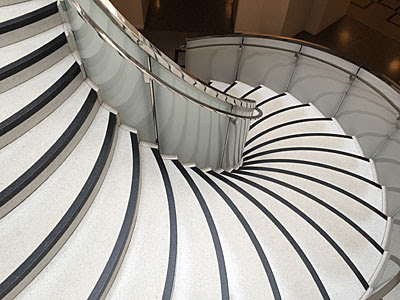
Get your Uber to drop you off at the entrance by the river if you want to be wowed, because beneath the main rotunda there's a staircase to die for. This twists down into the basement with vibrant white treads edged in black, like a retro Viennetta, so if you can't snapthat to win Instagram hearts from your best chums then you're doing it all wrong.
An oil company has kindly sponsored a lot of the rooms, bringing a strong brand presence to the Tate Britain experience. Their main contribution is a feature called 500 years of art, most of which was completed by dead people. There are no advertising slogans, which seems a lost opportunity, but a lot of the landscapes look like prime fracking territory.
The main purpose of Tate Britain appears to be to sell small white rectangles of card depicting colourful images. There are stacks of these in the shop, with a variety of designs, and all at a very reasonable price. These designs are then displayed elsewhere in the building, blown up much larger than full size, and this helps to see the intricate detail the illustrators have hidden away in every piece.
Some of the designs look quite rushed, especially the most recently completed, created by people we'd generally never heard of. But the older ones are a lot more lifelike, the selfies of their day, and some of the tresses and beards from the 16th century crowd look exactly like folk you might meet in Broadway Market today.
One of the wings is devoted to a bloke called Joe Turner, who apparently was a dab hand with a brush. Anywhere else you might expect to pay £18 to see a collection of his works, but amazingly here you can walk in off the street for free. If that's not your bag, rest assured there is an exclusive zone on the ground floor where £18 allows you to share floorspace with the other culture vultures, devouring pre-Raphaelite movers and shakers.
The Tate's core offering is pre-digital, so only a tiny number of the later exhibits actually move. But you can take as many photos as you like, and punters do, so feel free to share or even Periscope your personal journey as you walk around. Better still there's a bespoke app which brings the individual works to life, so perhaps you could simply download that and not bother coming to see the real thing at all.
If you love a party, and who doesn't, you'll enjoy the so-called dancing in the central gallery. Three performers have been drafted in to perform in tights until the end of October, if your limited attention span can cope with that. It'd be easier with a negroni in hand, and perhaps a bowl of ramen, but alas Tate Britain has yet to set up a streetfood area despite the obvious availability of space.
Hunt around the basement and you will find a cafe, thank god, because culture can be insufferable on an empty stomach. Splash out on a goats’ cheese quiche, or maybe a salad flecked with Pinney’s of Orford smoked salmon, washed down with the best of British craft beers or a hand-curated bottle of wine, before enjoying a bijou selection of freshly made cakes from the in-house pastry kitchen. Now that's art!
So give Tate Britain a try, assuming you're ever in the area. We think it has potential staying power on the London scene, not least as a useful meeting place for friends in damp weather. And remember, London's secret attractions are often more than worthy of our attention, if only we could be bothered to remember they exist.
For the first time in five years, London has a new station. It's actually an old station, closed in 1985, but this turns out to have been a long-term error and so LeaBridge has been reopened. We have leftover Olympic cash to thank - Hackney council had £5m of transport funding going spare - which helped to get the platforms upgraded and step-free access added. No new track was needed, so it's an easy win, but also a rare success and to be greatly applauded.
Lea Bridge station lies about halfway between Stratford and Tottenham Hale, where the railway crosses the Lea Bridge Road. Its opening fills a large hole in the passenger rail network, with the nearest existing station at Clapton, one mile away. I've done a bit of calculating on a map and I reckon Lea Bridge is now the closest station for anyone living within an area of 3½ square kilometres, which is pretty good going for a brand new transport link. But this is by no means the most densely packed part of inner London. Most of the land to the west of the railway line is either river or marshland - specifically Walthamstow Marshes, Leyton Marshes and Hackney Marshes. Rather more people live to the east, in a series of terraced streets on the outposts of Leyton, and bus passengers streaming down from Walthamstow now also have an easier connection to Westfield.
Train services at Lea Bridge should have kicked off on Sunday morning, except there were planned engineering works on the line so the tracks didn't reopen until the evening. If nothing else this made it much easier to be present for the first train, which was scheduled to arrive at 8.18pm, hence a dusk rather than a dawn start. Quite a few People Who Like Trains were aboard, on a journey with a number of teething troubles.
At Tottenham Hale, the public address system wasn't able to cope with the introduction of a new station. Although both Lea Bridge and Stratford popped up on the display, the disembodied voice skipped a beat, announcing "calling at and Stratford" instead. Aboard the train, things were considerably less helpful. "This train is for Stratford only", said both the automated announcement and the scrolling display, which would have been true for every previous train, but not this one. "The next stop is Stratford where this train terminates", it continued, in a similarly unhelpful vein. I think the driver contradicted the misinformation, but so quietly that nobody heard, so several passengers were confused when the train reached the new station and they rose to alight, thinking they'd reached Stratford.
And the first train arrived late. It'd been held briefly at Coppermill Junction, a not entirely abnormal occurrence, arriving at Lea Bridge two minutes later than scheduled. Awkwardly the second train, in the opposite direction, was somehow two minutes early, making it the first train instead. The welcoming committee was therefore waiting on the wrong platform, which wasn't ideal, but there were only a few seconds in it so welcomed the intended first train instead.
A large group gathered by the front of the train, comprising those who'd been waiting and those who'd alighted specially. There was no time for a speech, no hurrah for the efforts of those who'd striven to get Lea Bridge reopened, but there was a sort of plaque, and a man had turned up with a guitar to play the train in, just as he'd played out the last service three decades back. This palaver delayed the train a little longer, but nobody minded, apart from the everyday passengers on the train who must have been wondering what the hell was going on and why they were lingering in this godforsaken spot. It's not such a godforsaken spot any more, with half-hourly trains to Stratford and the upper Lea Valley timetabled henceforth.
Once the first pair of trains had departed, there was plenty of time to look around. This wouldn't have been possible a few hours earlier, with workmen swarming over the station adding finishing touches and unpeeling the signs. But now finally the barriers were down, the lifts were operational, and if you fancied you could stick your card in the machine and buy a ticket from Lea Bridge on its opening day.
Before it was closed in 1985, the main entrance to Lea Bridge station was up on Lea Bridge Road. Not any more. The old entrance is boarded off, and a confinedfootbridge runs immediately behind the blue screen. I assume someone did a health and safety audit and decided the pavement on the bridge was too narrow to allow passenger egress. It's annoying, though, particularly for anyone using Platform 2 for whom the only access is up and over the footbridge, past the old entrance and back down. Those on platform 1, that's for trains heading towards Stratford, have it rather easier. A broad exit has been created partway down, with a long ramp between two short sets of steps, leading onto Argall Way. Though fundamentally necessary these days, I wasn't entirely surprised when the two cyclists present departed the station by lifting their bikes up the steps rather than waste time on the hairpin.
There are no obvious bike racks outside the station, but there is a locked glass shed trimmed with orange - one of Waltham Forest's trademark cycle hubs. You need a special fob to get in, which makes things very secure, but also impossible for non-residents to turn up and leave a bike. The immediate area is also blessed with bike-friendly improvements as part of the borough's Mini-Holland scheme, including a broad segregated cycle lane being laid down alongside Lea Bridge Road, and another already present up Argall Way. This is the location of the local industrial estate, a considerable affair, from the largest factory of which the intense smell of baking sweetly drifts.
Paradoxically Lea Bridge station does not appear on the map of London rail services pinned up by the ticket machines - presumably there'll be an update soon. Neither does it appear on the map of Abellio Greater Anglia services in the poster frame alongside - presumably they'll do a new one eventually. Meanwhile the timetabled service appears quite complicated, especially heading north. Trains from Platform 2 are generally heading to Bishop's Stortford, but might be heading to Hertford East during the evening rush hour, and are definitely heading there if it's a Sunday, while the first train on a Saturday goes all the way to Cambridge. Southbound it's more straightforward, the destination is always Stratford, except for the last train which continues to Liverpool Street, except on Sundays. Best check before travelling to be sure.
You'll find Lea Bridge station useful if you ever visit the Lea Valley Ice Centre, or the Lea Valley Riding School, or fancy a spin round the Waterworks Nature Reserve. But mostly it'll be invaluable to those who live nearby, or sort-of nearby, and now have a much faster means of escape. Inevitably this means pressure to build more flats, indeed there are already plans for three tower blocks immediately opposite the station, and more will follow. New transport links bring opportunity as well as convenience, and inevitably deliver change. Expect a more formal opening ceremony this morning, indeed the new Mayor may even turn up, even though he had nothing to do with the procurement. What I do know for certain is that the man with the guitar will be back, and so will the trains, as Lea Bridge stamps itself firmly on the map.
The town of Westerham hits well above its weight in national heroes. Winston Churchill moved into Chartwell House in 1922, and shared the rest of his life between 10 Downing Street and his Kentish abode. But the town boasts one home-grown hero, once considered of equal stature, whose actions shaped the North American continent. James Wolfe was born at the Old Vicarage in 1727, and died 32 years later at the Battle of Quebec, his posthumous victory the stuff of legend in many a schoolboy textbook. Both Winston and James have statues around Westerham Green, and both of their houses are owned by the National Trust. I'd been to the former's, so I decided it was time to visit the latter's, courtesy of the 246 bus from Bromley.
The Wolfe family lived in a house called Spiers, since renamed Quebec House, at the eastern end of the town on the banks of the River Darent. Tudor in origin, it was extended to create a townhouse more suitable to Georgian gentry, three storeys tall with brick-chimneyed gables. Normally the National Trust welcome their visitors via the Coach House, but that's in serious danger of subsiding into the river so is currently closed for refurbishment, and entrance is instead via the Wolfes' front door. Arrive after one o'clock and you have the run of the building and can explore each room at your leisure. But arrive earlier in the afternoon and the only option is a guided tour, which I have to say proved an excellent way to focus on the house and its story without people forever wandering by.
The house was saved for the nation, twice, with the intention of creating a repository for all things Wolfe. Canadians in particular have been very keen to retain a tangible link to James's childhood, before he upped sticks and took a commission in the army aged just 14. Thus the tale of his greatest campaign is told in some depth, one I'd not heard since I was at school, leading a British invasion force up the St Lawrence river and attempting to vanquish the city of Quebec before the mouth iced up again in autumn. A three month siege culminated when James sneaked his army and two cannons up an unexpected cliff overnight, and some disciplined tactics in the ensuing battle saw the French army defeated. Both commanders were shot in the fracas, but the death of this young martyr inspired decades of patriotic fervour back in Britain.
One famous painting depicting Wolfe's death proved particularly inspirational, and the house's collection includes dozens of copies, from oils to engravings and from ceramics to tapestry. Also here are Wolfe's dressing gown, or at least the 18th century equivalent, and the box his sweetheart gave him before he sailed, and his canteen (a combined desk and trunk with compartments for papers and cutlery). Some of the treasures come via childhood friend George who lived at Squerryes Court, the manor house at the other end of town, now a rather more upmarket attraction. And the rest of the family get a look in too - James's father also being a veteran soldier, while his mother's handwritten recipe book has survived, and volunteers bake stuff from it in her kitchen every Sunday.
The most impressive room is probably the first floor drawing room, with games table, tea service and small piano as examples of typically genteel entertainments. The wood panelled staircase is also quite something, including a brass rubbing from Wolfe's burial vault in St Alfege's, Greenwich (which is where his parents had moved to after Westerham). I spent an hour in the house, then stepped outside to enjoy the immaculate garden. If you like an NT cuppa be aware that the cafe is normally in the coach house so is closed, but there decent alternatives in the town centre up the road. Just avoid Mondays and Tuesdays because then the entire house is closed (and this year it's weekends only until the start of August).
Westerham is really nice, by the way. A historic linear town at the foot of the North Downs, its meandering high street is lined by a variety of characterful inns, shops and cottages. I turned up on the day of the Fair On The Green, a triangular fete organised by the local Rotary club, and typical of many an amateur celebration across the country. Tombolas and plant stalls intermingled with hook-a-duck and home baked cakes, while on the central stage (if you can call it that) the Sea Scouts paraded very slowly up and down. I resisted the burgers cooked by a scout troop beneath James Wolfe's statue, instead soaking up the surreal sight of Punch and Judy taking place alongside the frowning bronze form of Winston Churchill.
And then I went for a hike. An excellent information board on Westerham Green hinted at a four mileChartwell Walk, strongly recommended by the local ramblers' association, so I looked up the instructions on my phone and followed that. The local ramblers' association weren't wrong. The route headed off upriver, then up into deserted woods past an ivy-clad folly, across quiet lanes and down into the car park at Chartwell. I'm a National Trust member so I popped in briefly to enjoy Winston's house and garden, and his splendid views down across the Weald [8 photos]. And then back to Westerham via a different but equally deserted woodland route, concluding with an unexpectedly exhilarating panorama across the rooftops towards the North Downs. You can get the 246 all the way to Chartwell on a Sunday, but I really enjoyed my solo stroll, no more than an hour each way.
WALK LONDON The London Loop[section 10]
Hatton Cross to Hayes and Harlington (4 miles)
It's been some time since I led you along the London Loop, the capital's outer strategic walk, but not for want of trying. This runs up the River Crane, from Heathrow to the M4, isn't the most scenic journey you'll ever make. It's also one of the briefest sections of the Loop, though I somehow walked almost twice as far while attempting to complete it. Section 10 has its moments but, unless you're a completist, feel free to skip. [map][10 photos]
Step out of Hatton Crossstation and Heathrow slaps you right in the face. It's one of the first buildings beyond the end of the southern runway, not quite on the direct line but so close that planes roar past with unexpected ferocity. Traffic swirls around this airport outpost, much of it employees driving to work or buses scuttling between hotels and terminals. The walk begins unpromisingly alongside the busy dual carriageway, then veers off fractionally alongside a row of blossoming horse chestnuts to follow the (private) Eastern Perimeter Road. Cargo terminals and car parks eventually make way for fly-tipped hedges and some elegantly-textured concrete work courtesy of the Piccadilly line. This emerges here from shallow tunnel to pass very low over the River Crane, before dipping back underground on the other side.
I first tried tackling this section of the Loop back in February, when I got all this way only to find the very first bit of path flooded and impassable. Frustrated I decided to return later in the year, assuming any winter drainage issues would be sorted, so you can imagine my despair on turning up in May to find the flooding just as bad. A small lake rippled some distance along the path, and the first bench rose like a forlorn stepping stone across the mire. I'd have got through in wellies, but in heavy duty walking boots I was stuffed, which was annoying, because the detour was at least a mile and a half. But I was determined to get to the other side of the breach, else my eventual circuit of the capital would be incomplete, which meant a long trudge around the British Airways Flight Training Centre and through the mundane backstreets of Cranford.
After a protracted detour, much of which I'd have to immediately retrace, I finally reached a large puddle which wasn't quite the puddle I'd been stopped by in the first place. The Crane has form in this respect, as there are as many as four oxbow lakes lurking within a relatively short stretch of undergrowth, though rather hard to distinguish at this time of year. I enjoyed the fresh verdant solitude, interrupted only by a jet engine wheezing a short distance away on the other side of the main cargo terminal. A murder of crows covered the playing field where the footpath terminated, forcing Loopers through an estate of diamond-tiled semis with thick double glazing, now immediately in line with the airport's northernmost runway.
Peripheral Heathrow is perhaps the ugliest part of London, as boxy hotels rub up against lacklustre housing, and building sites conspire to create more of the same. Best then not to linger on the A4 Bath Road, and to nip across Cranford Bridge (erected 1776, rebuilt and widened 1915) to return to the river valley. This is accessed via Berkeley Meadows, a damp patch named after the area's former landowners, currently teeming with dandelions in flower and in fluff. A deep artificial curve in the grass added for overspill purposes was filled with standing water - unquestionably scenic, but ominous given what lay ahead.
The Loop is poorly signed at the entrance to Cranford Park - it's the left-hand plank-bridge you want, then the right-hand track by the river. And here again the mud began, and the large puddles, and benches you'd not reach in everyday footwear. The park is vast and historic, its meadows speckled with buttercups, but unexpectedly squelchy underfoot if you linger too close to the river, as the Loop chooses to do. Reluctantly I took a minor detour towards the heart of the Green Flag expanse, where a local man was flying his model aircraft with some aplomb, while above the treeline the real thing appeared at approximately one minute intervals.
St Dunstan's church is a highlight of the walk, once under the ownership of the Knights Templar, and its flint tower at least partly medieval. On my visit the churchyard was blessed by gently falling cherry blossom, although I completely missed the plaque to comedian Tony Hancock (whose ashes were scattered here), learning of its existence only much later on an information board while walking out of the park. Perhaps even more impressive are the clock-topped remains of the 18th century stableblock alongside, formerly operated by the Berkeley Hunt, who now chase scents around the fields of Gloucestershire. By contrast the park's Visitor Centre looks a tumbledown wreck, courtesy of an arson attack two years ago, but a much improved replacement is proposed.
Careful screening ensures that the M4 lies entirely out of sight, despite the sliproads to junction 3 running
immediately behind the church. Instead a drab box-subway runs underneath, allowing parishioners from the north to attend services, and the rush of traffic can be discerned somewhere overhead. On the far side the path branches off along a thin strip between woodland and the backs of houses, where tabby cats prowl, before opening out into a meadowy clearing. I should have ignored the Loop's signs and tracked the Hillingdon Trail down to the river, for a last bit of Crane, instead following a hawthorn-lined corridor straight out of the park.
The Crane public house on the corner is now the Yellow Chilli Lounge, Hygiene Rating Zero. The brick Electricity Substation across the road is capacious enough to support the local industrial estate. Nobody walks to the Tesco Superstore by the busy roundabout - the car is king. The arterial road rises up dramatically to cross the canal, affording scenic views of the ex-Nestlé factory. And a chunky stacked ramp leads relentlessly down, and down, to eventually meet the towpath. The Loop's paperwork recommends a brief detour to the left to view Bull's Bridge, a white-arched hump where the Paddington Arm meets the Grand Union. They're right to do so too, even if my attempts to take adecent photo were made much harder by the positioning of a decrepit information board in front and a man swigging cheap cider underneath.
The canal will be the backdrop to the Loop almost all the way from here until the end of section 12. For now there's just a short stretch to the next pub, running alongside the aforementioned Nestlé factory (which no longer smells of coffee) and underneath the Great Western Mainline. Whilst most of the tracks are supported by modern metal, the first span is considerably older and made of wood, its joists cracked on the surface like a distressed antique. Ahead lie a series of ellipsoid flats, the first vanguard of a rash coming to Hayes now that Crossrail is opening the place up. Other than the Old Crown there's not much to enjoy, but the station is thankfully not far away.
Despite what some of you seem to think, I have no aversion to "off-topic" comments.
What makes me sigh is a long sequence of them, as two or three of my more earnest commenters debate something they think interesting, barely tangential to the theme of the post, overshadowing any relevant points the rest of you might make. It doesn't happen often, thankfully, but it annoys me, and I sometimes then make the mistake of telling you this.
It's a mistake because it makes many of you think your voice isn't welcome, which it is, but you no longer contribute. And it's a mistake because it doesn't actually get the tiny minority responsible to mute themselves, when appropriate, and they misconstrue my frustration as "a wee bit pretentious". It's really quite difficult to get the balance right.
I need to remember that most of you aren't reading the comments anyway, and that only I see every one of them as they ping in.
I remember the day when you didn't moan about what people commented about on your blog, DG.
You have a super, intelligent, engaging blog which is blessed with people that clearly repeatedly like to come back and regularly comment.
So what if the comments stray off topic, or are in reply about some of the comments themselves?
This is what I would call a discussion, a conversation! And it's so sad that in recent months you've become so grumpy that you do moan about what people comment about, rather than be happy with the fact that people feel inclined to comment. Not many blogs nowadays have such a loyal following and readership.
TimF | 12.05.16 - 6:51 p.m.
--------
As someone else said to me recently, comments here are now much more of a "my train's longer than your train" variety, and much less fun, or discursive, than they used to be.
But, if comments/commentators are chastised/deleted/'ridiculed', that's unfortunately what happens. Most of those who don't like this modus operandi have long gone, I suspect, which is why I was just dropping in my analysis of the situation, as someone who stuck around, despite feeling uncomfortable about the situation.
As ever, though, the blog writer has a right to their own 'rules' (and to the consequences thereof).
BBC Entertain(formerly BBC1) 6.00 Whittingdale's Law The Director General introduces another night of distinctive programming 6.05 Strictly Come Knitting A group of top celebrities join Tess Daly in tonight's exciting needle match 7.00 Songs of Praise Which competitor will sing the best Kumbayah this week? 7.30 Game of Thrones Preview for the popular drama series premièring later tonight on Sky Atlantic 7.40 Foreign Affairs Committee Update Simultaneous broadcast with BBC Parliament 8.10 A Reminder Britain's Got Talent is on ITV right now! 8.15 National Lottery In It To Win It Gameshow in which one licence fee payer is invited to steal the annual salary of a BBC presenter (hosted by Graham Norton) 9.00 An Apology We're very sorry that last week's Casualty proved too popular in the ratings 9.05 Casualty Nurse Tabitha has to deal with a snagged fingernail while Dr Khan prescribes statins 10.00 Approved News at Ten Wholly unbiased critique of the government's latest excellent policies 10.25 Party Political Broadcast On behalf of the highest bidder 10.30 Pobol y Cwm Except Wales 11.00 Match Of The Day Highlights from the Southern Combination Football League and the Isthmian Chess Ladder 11.55 Weather and Closedown Sponsored by Aviva Flood Insurance
BBC Educate(formerly BBC2 and CBeebies) 6.00 In The Disney Night Garden Live from Toys R Us, Basildon 6.20 Bedtime Story Read by Ronald McDonald 6.30 The Sky At Night What's on Rupert Murdoch's channels this evening? 7.00 Spring Watch A documentary history of 17th century timepieces 7.30 Top Gear A documentary history of 19th century bonnets 8.00 The Great British Washing Up With Mary Berry 8.30 No Repeats Policy Rather than show you a classic favourite, enjoy this blank screen 9.00 Big Board - Live Eviction One of the BBC's ruling committee is ousted for being too pinko 10.00 Right to Reply Ofcom tell us what they're going to fine us for this week 10.30 What The Daily Mail Says Nigel Farage and Katie Hopkins review the day's paper 11.00 Netflix and Chill Millennials tell us how they never watch TV any more, so why should they care?
BBC Inform(formerly BBC News) 6.00 News Headlines 6.02 The Amazing Ronco Salad Slicer Infomercial 7.00 News Headlines 7.02 Have You Had PPI? Infomercial 8.00 News Headlines
etc
BBC Quality(formerly BBC4) 2am - 4am only
BBC Extinct(formerly BBC3) Ha, gotcha!
BBC Radio Subway(formerly BBC Radio 1) 6.00 Top Hits UK The same 10 songs on repeat, intertwined with adverts 8.00 UK Top Hits The same 10 songs on repeat, intertwined with adverts 10.00 Top UK Hits The same 10 songs on repeat, intertwined with adverts
BBC Radio Harvester(formerly BBC Radio 2, BBC Radio 6Music and BBC Local Radio) 6.00 Pat Sharp Drivetime travel news, including at 6.45 An Actual Record 8.00 Pick Of The Pops Recalling the charts from this week in 1924 and 1947 10.00 Dr Fox's Record Vault Featuring Gary Glitter and Sir Cliff Richard
BBC Radio Prezzo(formerly BBC Radio 3) 6.00 That Nice Bolero Your favourite classic tunes 8.00 That Theme From That Advert Our favourite classic tunes 10.00 Ooh I Liked That When Pavarotti Did It Everybody's favourite classic tunes
BBC Radio Wagamama(formerly BBC Radio 4) 6.00 PM Boris Johnson addresses the nation 6.30 Just A Minute The comedy budget doesn't go far these days 6.31 The News Quiz Embittered ranters are given free rein to criticise the biased BBC 7.00 The Archers Pat goes fox hunting while Bridge Farm embraces the free market 7.15 Desert Island Discs Tony Hall is cast away 8.00 The Evening Play "Auntie's Last Stand" 9.00 Gardeners' Question Time Homebase or B&Q? 9.30 A Book At Bedtime The Culture Secretary reads from his classic BBC White Paper 9.45 Simulcast Sorry, we've run out of money for today, so time to join Talksport for an evening of phone-ins and betting updates
BBC Skeleton Service(formerly BBC Online) A few foreign news stories, TV listings for all satellite channels, and absolutely no recipes
BBC Subscription(formerly BBC iPlayer) Individual programmes from the last 30 days are available for licence payers to hire for a very reasonable fee
The Miglia Quadrato is probably London's most peculiar treasure hunt. It takes place once a year inside the boundaries of the City of London. Competitors drive everywhere - this is essentially a car rally. There are sixty clues to find, and precisely five hours to find them in. To minimise traffic hassle the event kicks off at midnight and finishes as dawn is breaking over the rooftops. It's organised by the United Hospitals and University of London Motor Club, or UHULMC for short. It was first run in 1957, when the Suez Crisis inspired a motoring event using minimal petrol. This year's happened during the early hours of Sunday morning, while you were fast asleep. It's not a cryptic battle, more a navigational and observational challenge. And didn't that sound like fun, so I joined one of the teams, stayed up all night and took part.
NOTE: This is an event run under Regulation 5(B) of the Motor Vehicles (Competitions and Trials (England)) Regulations 1969. PLEASE remember to compete QUIETLY and inconspicuously, PARK SENSIBLY - and watch those one way streets.
The Miglia Quadrato is a proper old-school competition, as becomes evident when you sign up - all entries must be by post. A raft of instructions and regulations are then despatched, mainly to ensure that the event goes ahead safely and smoothly, and without causing any complaints which might prevent future MQs from taking place. Use of mobile phones is strictly prohibited, the use of GPS viewed with scorn, and rubber soled shoes and a good torch deemed essential. By the time you've ploughed through several pdfs of rules, security requirements and travel advisory you might be feeling slightly intimidated by the complexity of what's to come. But turn up prepared, with all due paperwork completed, and an exhilarating night awaits.
Cars start filling Finsbury Circus, the designated start and finish point, by 11pm on Saturday evening. It's possible to complete the Miglia Quadrato in your family hatchback, but many competitors choose to turn up in something special, simply to add to the spectacle and challenge. Amongst the vehicles parked up in 2016 were a DeLorean, a Rolls, a Jag, an Austin Metro, a Morris one-ton truck and a vintage fire engine, the latter pair now regular participants carrying students from Imperial College. A very friendly attitude prevails, this is no place for cut-throat scheming, but some long-standing teams exhibit a competitive edge and have been already out around the city practising for the big night.
At midnight precisely the clues are handed out - 20 easy, 20 medium and 20 hard - and teams rush back to their vehicles to begin the challenge. The first step is to translate a series of eight figure grid references into locations in the City, this using an large scale Ordnance Survey map of the area and a small cardboard square called a romer. Done correctly this narrows down the search area for each clue to a 10m square, hence it's well worth investing time up front to avoid going on a wild goose chase later. Here tactics kick in. Do you mark a few and rush off, completing the rest on the move, or mark the lot before planning the most efficient route? The less experienced are strongly advised to focus on the easier clues first, with the "difficult"s left to those who've done this before and have some idea how the organisers' minds work.
Once a location has been reached, the hunt begins. Each clue includes a question to be answered or phrase to be completed, for example "SITE OF which CHURCH?" or "... WITH ____ FACES", the capital letters signifying wording to be identified in situ. Usually this is on a plaque somewhere or on a wall, but could be on an item of street furniture, and the harder the clue the more likely it is to require a torch, squinting or crouching to spot. If the required phrase isn't immediately obvious a lot of rushing around can be involved, hunting round nooks and down alleyways, and remembering to look all the way up as well as down. After ten minutes you can begin to doubt your own map-reading skills, but are you sure you've checked absolutely everywhere within the grid square... oh thank God, there it is at the bottom of the pillar box.
Sometimes you know you're in the right place when you see flashlights on arrival, or when another team turns up and starts hunting too. It can then become a collective challenge, even unintentionally, with the correct answer easily leaked if yelled to teammates while others are listening in. Alternatively just watch to identify the last wall a team was searching before they suddenly left, and head over, and there should be the answer you require. But even with sixty clues and sixty teams taking part, it's often the case that nobody else turns up at all, and then you're properly on your own with only your wits and observational skills to help you.
The City in the early hours of a Sunday morning can be a surprisingly busy place. Up round Spitalfields the night-time crowds ebb only slowly away, and even in the heart of the financial district you're never far from a tottering girl in a cocktail dress. But elsewhere, blimey it can be quiet, particularly when a map is directing you up a sidestreet less well-trodden even in daylight. There you are, just you and your team, criss-crossing the cobbles and pointing torches at buildings... it's just as well the City of London Police are fully aware of what's going on, else your aimless inquisitive behaviour could look very suspicious indeed.
It soon becomes apparent that the most important factor contributing to success in the Miglia Quadrato is a working knowledge of the City's one-way system. A web of seemingly perverse traffic regulations exists across the Square Mile, blocking off streets, banning turns and often diverting you far from your intended destination. The Ring of Steel was deliberately designed to make travel around the city difficult, and succeeds, and it's inordinately frustrating to know precisely where you want to go but to be prevented by an endless sequence of one-way arrows and no right turns. Even though parking restrictions can be treated with rare disdain, it often seemed as if the challenge would be much easier on foot, rather than forever reversing down narrow alleyways or accidentally ending up on the wrong side of the river.
The five hours whizz by, despite the fact you ought to be asleep. Clues need to be tackled at a rate of one every five minutes if you're going to get them all right... which nobody ever has, incidentally. It's time-consuming trying to locate a year etched on the bottom of one of five flowerbeds, or squinting up at a date on a coat of arms and trying to angle your flashlight so it illuminates rather than blurs. Another challenge is the lack of facilities in the City. There is a 24 hour petrol station if you know where to look, and have failed to fill up first, but it's the lack of public conveniences that really bites when your bladder conspires to reach bursting point with absolutely nowhere to go.
It's important to be back at the finish by 5am - there's a penalty point for every minute that you're late. This means an increasing crescendo of arrivals as the clock ticks round, and one team member hops out to hand in their route card for marking. But it's still important to stay awake - I watched one unfortunate vehicle accidentally rear-shunt another at this point, and much concerned scrutiny of bumpers took place. If you hang around for another half an hour the marshals tally up the scores and post up the results on a big piece of paper. This year's top team achieved an amazing 57 out of 60, although the average score was only 29, and I'm afraid my team didn't even manage that.
Assuming next year's Miglia Quadrato goes ahead, you have a year to find a willing team and appropriate vehicle. There's also an "on foot" version called the Londinium Pedo, generally held in early autumn (and in daylight), should your body clock be more suited. No, there isn't a website for all this - Ian Visits has the details of the email address needed to get the information to get the form to post off to take part. But it is a proper retro-challenge, and enormously fun, and above all an annual labour of love on the part of the organisers. Long may the Miglia Quadrato continue.
Every so not-very often, the planet Mercury passes between the Earth and the Sun. It only does this about 13 times each century, and only for a few hours, and even then the weather might be poor enough to obscure the lot. If you're lucky, and have access to a telescope with the appropriate filter, what you see is a tiny black dot scuttling slowly across the face of the Sun. Yesterdaywe gotlucky.
The sky was blue with a few streaks of white at noon as the Flamsteed Astronomy Society set up their equipment. This was considerably better than the forecast had suggested, but the Society are a bunch of optimists so had made the decision to turn up anyway, and were rewarded with almost ideal conditions. A wide range of tubular instruments was lined up across the courtyard, some long and thick, others rather shorter and more compact, with a volunteer or two watching over each one. Most wore hats, generally of the broad-brimmed kind, hinting strongly that they'd done this kind of standing around for a long time in the Sun before. There was no fuss as twelve minutes past twelve ticked round, just a few fingers raised, as the shadow of Mercury nudged fractionally onto the Sun's disc. A few hundred years ago this would have been a key scientific moment, the timing of first contact essential data in attempting to calculate the scale of the solar system. These days a transit of Mercury is much less important, all the appropriate measurements have been taken, but none the less impressive in the awe and wonder stakes.
A few tourists wandered by towards the cafe, oblivious of the miniature spectacle above their heads. But for any member of the public who was interested, or could be cajoled, the courtyard area was freely accessible and a short queue awaited. I was surprised quite how short, I'd have expected more astronomically-minded attendees in a city of eight million, but that's a Monday lunchtime for you. When my turn came I stepped up to the mark and squinted down the eyepiece to see a blazing red disc with a spot on it. It was a very small spot - the diameter of Mercury is only 1/158th that of the Sun - but crisp and round and pinpoint sharp. And it was also very close to the edge, as befits the start of the transit, in this case right over near the very right hand side, around 3 o'clock. And that was Mercury, a planet generally invisible except around sunrise or sunset, plain as anything in the middle of the day.
Back in 2004 I came to Greenwich to watch the Transit of Venus, again courtesy of the Flamsteed Astronomy Society. Venus is rather bigger, and closer, so the black disc crossing the Sun was visible to the protected eye. Venus's orbit is also rather longer, which means it's even rarer that the planet's oblique orbit crosses our own. Transits of Venus occur in pairs, but a century apart, so the next isn't due until 2117 by which time we'll all be dead. Transits of Mercury are a little more accessible, but it's still awkward if you miss one - the next three visible from London will be in November 2019, November 2032 and November 2039, and the next one almost as good as today's will be in May 2049. And yes, transits of Mercury only ever happen in May or November, more often in the latter, but fractionally larger in the former.
Chasing the transit across town, for a subtly different view, I headed next to a courtyard off Piccadilly. You'll know it better as the entrance to the Royal Academy, but a variety of age-old scientific organisations also have their HQ in rooms around the quadrangle. The Royal Astronomical Society had set up in the sunniest corner, with three different instruments for public view and a small queue curling across the front of the art gallery. The volunteers here were rather more likely to be astrophysics graduates, and the attendees too had more of a scientific bent. The lady in front of me was a serial eclipse chaser, and had spent much of March attempting to reach a remote Micronesian island for totality. She'd even brought her special glasses, but only out of habit, because Mercury's much too small to be seen with the naked eye.
The first piece of transit-watching apparatus was nothing more than a pair of upturned binoculars with a sheet of cardboard across the top and another underneath to act as a screen. The second was essentially a lens shoved through a cardboard box, and the third a proper spotlight-sized refractor. All were susceptible to high level cloud, of which there was now rather more, with Monday's threatened frontal system increasingly evident in the southern sky. Indeed the thickest clump of greying altocumulus appeared to have settled in precisely the worst spot, as if it were sentient or something, and the wrong kind of shadow was in control. But waiting patiently intermittently paid off, at least for those hoping to use the main telescope, and there was the crisp sharp dot once more, but shifted further across the main disc. Tempus fugit.
As a planetary bonus, skygazers were also invited to cross the courtyard to view a Mercury-related exhibition inside the Royal Astronomical Society. This almost-200 years old organisation boasts a charming balconied library upstairs, its walls rammed with books and periodicals, and also a fine collection of vintage volumes. A few of these were laid out on the far table, the earliest recounting (in Latin) the first human observation of a Transit of Mercury in 1631. Alongside, in his actual handwriting, William Herschel's account of the transit of November 1802, a constant battle against thick cloud which made taking measurements almost impossible. Meanwhile downstairs in the lecture theatre a live broadcast of the 2016 event was being screened, oddly rather blurrier than could be seen outside, which might have explained the lack of audience.
Shifting location once more, I headed to almost the highest point in Hampstead to one of London's finest amateur observatories. This perches on top of a reservoir, its grass cover freshly mown, and is accessed via a staircase from a side road. Inside the dome the main telescope had been set up to point directly at the Sun (no simple task when it keeps moving), focused to project the shadow onto a small formica plate. A bit annoyingly this appeared to have a scratch on it, or some other thin mark which wasn't actually present on the surface of the Sun. But there beside it were two dots, one an irregular sunspot and the other the planet we were seeking. Mercury had moved even further across the solar disc by this point, one entire crossing (on this occasion) taking nearly seven and a half hours. And while we watched, swirly cloud permitting, a volunteer imparted knowledge much more fully than at the other venues.
It's a very friendly group of astronomers that meet here, I could tell. Anyone can come and visit when the observatory is open, which tends to be Friday and Saturday evenings, or Sunday lunchtimes, or for special occasions such as this. You never know who you'll meet... Jon Culshaw was there during my visit, not to do an impression of Sir Patrick Moore but to keep tabs on the solar spectacle. Meanwhile back outside the dome a couple of smaller telescopes had been set up, this time with almost no queue for viewing. I took a last opportunity to view Mercury against a yellow background on one, and against a red background on the other, now rapidly approaching its halfway point. But it wouldn't be long before the cloudbase extended across the entire sky, making any attempt to view the second half of the transit almost entirely impossible. Your next opportunity will be Armistice Day 2019, assuming your thoughts aren't elsewhere, and the November sky permits.