The London Underground has had a zonal fare system since the early 1980s, before which fares were based on far you travelled. In 1981 two overlapping central flat fare zones were created, called West End and City, and these were later combined to create zone 1. In 1982 further concentric fare boundaries were set at approximately three mile intervals, initially called zones 2, 3a, 3b and 3c, then 2, 3, 4 and 5.
In October 1990 zone 5 was split to create a new zone 6 around the edge of the capital, and a few tweaks have been made to boundaries since. That's not the subject of today's post. Today's post is about the small number of stations which exist in two zones, the stations on the boundaries.
Zone 1/2: 5 stations
Only four tube stations exist on the zone 1/2 boundary, i.e. on the edge of the West End/City zone defined over 30 years ago. I haven't managed to discover precisely when they gained this 1/2 designation, but all were in place around 20 years ago when the first zonal tube map was produced. The four stations include Notting Hill Gate and Earl's Court out west, Vauxhall and Elephant & Castle to the south, and nothing to the north or east. It's not immediately clear why these four stations were doubled up and not the others on the edge of the central zone. I checked the original central bus zone on a map, and it doesn't match up, so it isn't that.
Only one other station has been added since, and that's Hoxton, which was designated zone 1/2 when it opened on the Overground in 2010. It's only zone 1/2 because the Department of Transport forced TfL to nudge Shoreditch High Street into zone 1 to help pay for the extension, so Hoxton became part of the transition back to zone 2. It's a fairly pointless overlap too, because the only Zone 1 journey you can make from Hoxton is one stop to Shoreditch High Street, and that's walkable in less than ten minutes.
Zone 2/3: 29 stations
Here's where the number of boundary stations explodes, and there are dozens. Nine tube stations have been on the list since the start (Archway, Bromley-By-Bow, Clapham South, East Putney, Hampstead, Manor House, North Acton, Turnham Green and Willesden Green) These are all roughly three miles out from the original inner boundary, and fairly well spaced, but with Bromley-by-Bow the only overlapper to the east. It was joined in 1999 by the new station at North Greenwich, presumably designated zone 2/3 to stimulate Jubilee line journeys in both directions.
Four National Rail stations have always been part of both zones 2 and 3, specifically Clapton, Herne Hill, North Dulwich and Putney. These were joined in 2007 by Willesden Junction, nudged inwards from zone 3 when the Overground began, in order to prevent orbital journeys becoming unduly expensive. Hampstead Heath was rezoned at the same time, but it jumped directly from 3 to 2, because there's no point having a single overlap station at a non-interchange on an individual line.
Meanwhile on the DLR, the entire Lewisham extension straddled the edges of zones 2 and 3 when it opened in 1999 - that's Cutty Sark, Greenwich, Deptford Bridge, Elverson Road and Lewisham. Greenwich and Lewisham had previously been overlap stations for the National Rail network. Around the same time the DLR stations at East India and Pudding Mill Lane were shifted onto the zone 2/3 boundary, a direct reaction to the extension of the Jubilee line - previously both had been zone 3 only.
To round off this long list we come almost up to date, specifically January 2016, and the Mayor's decision to shift the centre of London fractionally east. This meant redesignating stations in the Lower Lea Valley from zone 3 to the zone 2/3 boundary, specifically to encourage growth by making people think they weren't quite as far away as they'd always been. The main beneficiary was Stratford, but West Ham and Canning Town also earned a place, resulting in the last four stations on the Jubilee line all being in both zones 2 and 3. Three intermediate DLR stations also got the upgrade, namely Star Lane, Abbey Road and Stratford High Street, plus the Olympic Park end of the line at Stratford International. And that's 29 stations in all, phew.
Zone 3/4: 11 stations
Just six tube stations lie on the zone 3/4 boundary, and as far as I can tell they've all been there since the start. Out east we have Leytonstone and East Ham, up north we have Hendon Central and Bounds Green, and to the southwest there's Kew Gardens and South Wimbledon. Again it's not immediately obvious why these have been chosen and others haven't, so for example one northern branch of the Northern line has an overlap, while the other jumps from East Finchley in 3 to Finchley Central in 4.
Four National Rail stations have always been on the 3/4 divide, specifically Hendon and Bowes Park to the north, and Manor Park and Woodgrange Park to the east. The latter is now part of the Overground, while Manor Park is currently part of TfL Rail, and will soon join Stratford as the only Crossrail stations to sit astride two zones. Finally there's Crystal Palace, which used to be in zone 4 but was moved to the 3/4 boundary in 2004, well before the Overground arrived.
Zone 4/5: 0 stations
There are no stations on the zone 4/5 boundary, not a single one. Goodness knows why not. For some reason every single station that exists close to the 4/5 dividing line was placed on one side or the other, and none ended up inbetween. "Which London fare zone boundary has no stations on it?" sounds like it should be a pub quiz question.
Zone 5/6: 1 station
But perhaps this is the better pub quiz question. "What's the only station on the zone 5/6 boundary?" You'd never know without scouring a tube map, but there it is on the Piccadilly line, the only outlier, it's Hatton Cross. This station opened well before 1991 when the original zone 5 was split into a 5 and a 6, so there's no obvious reason why it should be an anomaly. But it does mean you can get to almost-Heathrow-Airport by paying a little less than going all the way.
Zone 6/7: 1 station
There's only one of these as well. When London's fare zones were first created there were no stations on the outer boundary, and the far end of the Metropolitan line sat comfortably outside. Special zones A, B, C and D were eventually created to cope with Hertfordshire and Buckinghamshire, later simplified to 7, 8 and 9. The outermost overlap station was created in 1997 when Moor Park was moved from zone A to the edge of zone 6, specifically the 6/A boundary, now the more manageable 6/7. It's the only overlap station not to be in London, and the last of 47 overlap stations on my list. A fascinating set of reasons lie behind their perversely inconsistent spread.
8♠ Willesden Two former boroughs came together to make the London borough of Brent, namely Wembley and Willesden, with Wembley to the west of the river Brent, and Willesden to the east. For today's post I went along to Brent Museum at the new Willesden Library, and explored the exhibits looking for points of interest in the old borough of Willesden, selecting seven I hadn't visited before.
Here's what the museum had to say about each of the seven places, plus what I found when I got there.
7 secrets of the Municipal Borough of Willesden
Quainton Street and Verney Street, Neasden
These railway houses were built in the 1880s in what was then middle of the countryside. The Metropolitan Railway Company moved its workers into these homes, on streets simply called A and B. The streets still exist today and are called Quainton Street (A) and Verney Street (B). Neasden Power station was demolished in 1969.
I love the idea of a street called A and a street called B, and I'm also charmed by the workers' terraced cottages erected along each. The parallel pair were named Neasden Railway Village, home to platelayers, bodymakers and engine fitters, and very conveniently located for what's now Neasden Depot at the end of the road. In 1901 Willesden Council renamed the streets Quainton and Verney (after the stations at the end of the line), and a third road called Aylesbury Street was added in 1904. Additional houses have since been built at the southern end where the power station used to be, and they're nice too, but nothing quite beats the original As and Bs.
15 The Circle, Neasden
Claim to fame: Reggae legend Bob Marley lived at this house in 1972 when he and his band The Wailers were in the UK touring with Jimmy Cliff. They signed with Island Records, based in Kilburn. A blue plaque organised by the Federation of Reggae Music (FORM) commemorates Marley's residence.
The Circle is an odd name for a street that's merely semi-circular, a crescent of sub-prime Metroland semis curving off the North Circular Road just north of Neasden Parade. Number 15 seems less interesting than most, with its featureless paved front garden and exterior superfluously painted red to resemble the brickwork underneath. But yes, there is a plaque which hints at Rastafari glories past, or rather a group of devout dreadlocked men parachuted into the suburbs and striving to get their music noticed. The Wailers moved here from a tiny Bayswater flat, apparently, so were delighted to finally get a kitchen where they could prepare their own food rather than existing on fish and chips and Indian takeaways.
Post Office Research Station, Dollis Hill
The General Post Office Research Station at Dollis Hill provided telecommunication services across the country. TIM the Speaking Clock began life at Dollis Hill in 1936, and in 1957 ERNIE (a machine that generated random numbers for the Premium Bond lottery) was built. Inside this top secret building during World War 2, engineers constructed and tested modules of the Colossus machine - the world's first programmable computer.
I've been here before, to head down into Churchill's secretwartime bunker, but not taken a proper look at the more important building alongside. PM Ramsay McDonald opened this cutting-edge facility on the ridgetop in 1925, and GPO work continued for precisely 50 years before being relocated to the outskirts of Ipswich. You'll not be surprised to hear that the building is now flats, and posh gated ones too, although the owner of Flat 11 has stuck his mobile number on the gate in case you need to gain access. Another cul-de-sac of less exclusive houses has been squeezed outside the fence, named Flowers Close after Tommy Flowers whose engineering expertise helped give birth to the Computer Age, right here.
Grunwick dispute, Dollis Hill
In 1976 Jayaben Desai walked out of her job at the Grunwick Photo Processing plant in Willesden. She led fellow workers in a strike to be represented by a trade union. On 7th November 1977 over 8000 people protested, and clashes with the police led to 243 of the protesters being injured. The strike lasted two years.
The Grunwickdispute typified industrial relations in the mid 1970s, an angry clash that grew louder, and brought the plight of immigrant women to the fore. Jayaben and two colleagues eventually resorted to a hunger strike, but failed to break the will of management, and subsequent laws on secondary picketing helped weaken the entire trade union movement. The Grunwick factory finally closed in 2011, overtaken by the rise of digital cameras, and three blocks of flats are now crammed into the site, in blocks named after photographers Addis, Arnaux and Belden. Jayaben Desai is remembered on a small plaque up Grunwick Close, close to the southern entrance to Dollis Hill station, and her GMB gold medal can be seen in Brent Museum.
Our Lady of Willesden, Harlesden
From 1475 to 1538, pilgrims travelled to Brent to visit the shrine of Our Lady of Willesden; the church is now known as St Mary's Willesden. Pilgrimages were taken to visit a statue thought to be a Black Madonna and the Holy Well at the Shrine of Our Lady of Willesden.
Willesden's Marian shrine became extremely popular with Londoners before the Reformation, it being a much easier trek than Canterbury, and Sir Thomas More was a regular visitor. The statue was removed, and reputedly burnt and the parentchurch (at the foot of Neasden Lane) duly became Anglican. As Willesden became more urbanised a Roman Catholicchurch was eventually built a mile to the south, in Harlesden, and a newstatue of the Virgin Mary was installed (carved from oak from the original churchyard). This is now a National Shrine of Our Lady, as a large painted sign beside the west door attests, and every May the image is shouldered in procession around local streets.
McVities factory, Harlesden
McVities and Price built this biscuit factory on Waxlow Road in Harlesden in 1902. By 1919 they were the largest employer in Willesden with 1150 workers. Chocolate digestives, Jaffa Cakes and Penguins were on the production line at the factory, and still are today. The company later merged with Macfarlane Lang to become United Biscuits.
On a good day you can smell the whiff of digestives on the platforms at Harlesden station, although the blue McVitiesfactory is best seen from the train on the West Coast Main Line. The main entrance is on Waxlow Road, the northernmost extent of the Park Royal industrial estate, where large lorries emblazoned with biscuits and Hula Hoops swing out bearing baked treats. I'd never walked down to the end of this commercial dead end before, where clipped hedges make way for faceless frontage and modern units, and the whiff of processed Chinese food now mingles. Heinz used to have a huge factory at the far end churning out 57 varieties, plus their own College of Food Technology, but that was demolished in 2000, and the Royal Mail's Western Delivery Office now occupies the site.
Gaumont State Cinema, Kilburn
Built in Art Deco style, the name State is said to have come from the huge 120ft tower, reminiscent of the Empire State Building in New York. It was the biggest cinema of its time in Britain, with 4004 seats. Gracie Fields, Larry Adler and George Formby played at the opening ceremony on 20th December 1937.
Visible for miles around, yet seemingly quite narrow when seen from the High Road, only the lofty tower gives a hint of the mega-auditorium which lies behind. As well as a cinematographic programme, the venue also hosted major music concerts (Louis Armstrong, the Beatles and Bowie all played here), but poor economies of scale led to closure of the main screen in 1980. Bingo took over, first Top Rank then Mecca, and for the last ten years the building has been owned by an evangelical church who pack out the seats every Sunday. Members of the public interested in local history are invited to drop in every Wednesday from noon.
As the General Election approaches, only six candidates have put their names forward for the Bethnal Green and Bow constituency, fighting for the honour of being its last MP. In alphabetical order, here's the choice I face locally.
• Rushanara Ali(Labour) - The sitting MP (until Parliament was prorogued), Rushanara took back the seat for Labour in 2010 after George Galloway buggered off elsewhere. She's Britain's first MP of Bangladeshi origin, and grew up round here (although she currently lives in the West Ham constituency). In 2014 she resigned as a shadow minister over Iraq, in 2015 she nominated Jeremy Corbyn for the Labour party leadership, in 2016 she called on him to step down, and earlier this year she defied the party whip over the triggering of Article 50. Thus far she is the only candidate whose leaflet has been poked through my letterbox. [website][Twitter]
• Charlotte Chirico(Conservative) - Just before nominations closed, the local Conservative party put out a brief statement announcing Charlie as their candidate - "a lawyer and a Councillor, sitting on numerous boards including the Children and Young Person's Board". What they didn't mention is that she's a councillor in Merton, and lives in Merton, and has presumably been airlifted in by Central Office to learn the ropes in a seat she has no hope of winning. Thus far she has no online presence and no operational Twitter account, although she has stood in front of the Burdett-Coutts fountain in Victoria Park wearing a blue rosette.
• Ian de Wulverton(UKIP) - Ian has General Election form, in that he stood for UKIP in Ealing North in 2010 and polled 685 votes. He's also a local councillor for somewhere else in London, namely Heaton ward in Havering, where he took office for UKIP (at the third attempt) in 2014. He might be the same student nurse who Socialist Worker reported waving union banners from the top of the London Eye in 2000 in a protest about low pay and conditions, or there might be another Ian de Wulverton in London politics, you never know.
• William Dyer(Liberal Democrat) - It's been a busy April for William, who a) handed in his dissertation at Queen Mary University, b) took up a job at Lib Dem party HQ as Membership Development Manager, c) discovered that Theresa May was calling an election and he was now the parliamentary candidate for Bethnal Green and Bow. William's interests are listed on Twitter as "museums, politics and the BIG GOD", and he lives in Bow, although he has been seen out canvassing more than once on behalf of Simon Hughes across the river. [Twitter][Instagram]
• Ajmal Masroor(Independent) - Ajmal's website describes him as an "Author, Broadcaster and Relationship Counsellor", and mentions that he grew up in Shadwell. Less prominently he's an imam who leads Friday prayers at various mosques, lives in Haringey, and has been banned (pre-Trump administration) from entering America. His list of 8 policy pledges mentions the local council much more often than it does Parliament, but 'Independent' can be cover for all sorts of things when you stand in Tower Hamlets. Ajmal previously stood here as a Liberal Democrat in the 2010 General Election, when he came second. [website][Twitter]
• Alistair Polson(Green) - Along with Rushanara, Alistair's the only other candidate who was on the ballot paper at the last election, quadrupling the Green party vote and ending up in a respectable third place. He's also a criminal defence barrister with a human rights background, lives locally, and is the most active of the half dozen on Twitter. The local Greens have a crowdfunding site up and running until tomorrow, and are hoping to raise enough to pay for a couple of nominations and some election publications. [Twitter]
» Wherever you are in the country, you can find out more about your General Election candidates at whocanivotefor.co.uk, and follow them on Twitter at mpsontwitter.co.uk/list.
» I've also made a special Twitter list of the Bethnal Green and Bow candidates here, if you're local and would like to subscribe.
You don't see the chalkboard being left outside the churchyard gate.
You don't see the volunteers opening up the food bank for another week.
You don't see the donations being brought in by thoughtful members of the public.
You don't see the first time visitor walk down the path and tentatively approach the door.
You don't see the parent who's been trying to feed her children from an empty cupboard.
You don't see the sporadic stream of householders, hostellers and low income strugglers.
You don't see the pensioner emerging with his bag of ten personally-selected items.
You don't see the benefits claimant gifted tins, pasta, nappies and a friendly ear.
You don't see the family back home who won't go hungry again this evening.
Tallest of a cluster of buildings in the middle of the common, standing tall with a set of recently-repaired sails, Wimbledon Windmill was built in 1817. It's of an unusual type too, originally a hollow-post mill, in this case an octagonal brick base supporting a conical tower with an iron shaft at its centre. Operations continued until 1864, after which the machinery was removed and the interior converted into living accommodation for six families. Since 1976 it's been a museum, and a surprisingly good one too, with the usual £2 entry fee waived this year because of the bicentenary.
The museum contains a seriously impressive collection of models, illustrating all the significant types of English windmill (using local examples wherever possible). Several of the sails turn at the push of a button, which is good news if you're a small child with a low attention threshold, and the timeline runs right up to modern wing rotors and aero generators. There's also a small room brimming with wooden tools gifted by a retired Norfolk carpenter, including numerous planes, the odd auger and a single snail brace countersink.
Upstairs the display gets a bit more Wimbledon-specific, including some cutaways, a lot of milling equipment and an evocative recreation of one of the Victorian living rooms. A central cabinet celebrates Robert Baden Powell, who was staying in the adjacent Mill House when he wrote Scouting for Boys in 1908, as a plaque on the exterior confirms. As a finale a steep ladder ascends into the tower to a wooden platform where a large cast iron brakewheel can be seen, as well as two further out-of-bounds ladders climbing precipitously to the top.
It's amazing quite how much has been crammed inside the former windmill, and how diversely informative it is, so do be sure to thank the museum's founder and curator if you're lucky enough to meet him inside perched by his desk. You might also like to know that the small shop just inside the entrance sells not just mill-related stuff but also a selection of cuddly Wombles, because that's exactly what a shop in the centre of Wimbledon Common needs. The museum is open every Sunday, and on Saturday afternoons, until the end of October, and bicentenary year is evidently the perfect time to visit.
Shirley (on the east side of Croydon) is home to one of London's handful of surviving windmills... and one of the last to be built in England before mechanisation took over. It's very much a 19th century windmill, having first operated in 1808 and ceased in 1892, with a complete rebuild halfway through. Prior to 1854 it was a post mill, which meant the whole building turned, and since 1854 it's been a tower mill, which means only the cap does. They'll explain all this if you come along - they have wooden models of the two types they wheel out onto the lawn.
Shirley Windmill lurks up a cul-de-sac in the most incongruous of locations, a modern housing estate. You walk up into what looks like Brookside Close, and there at its centre is this windmill in the middle of a buttercup lawn. This suburban-rural hybrid goes mostly unnoticed, as much as any tall be-sailed building can, but on seven days a year The Friends of Shirley Windmill put their cones out, open up their tearoom, and allow the inquisitive public up to the top.
Every visit inside a windmill is somehow the same, and yet very different, depending on the clutter and the state of the machinery. Shirley's 17m-high tower has five floors, and four ladders to negotiate, with tours starting beneath the cap and working down. A giant wheel with 172 applewood teeth meshes against the central iron cog, which would be turned by the windshaft if only the sails were operational, which at Shirley they're not. The Friends have restored their mill to almost-functional, but decided not to go the whole hog because the resultant health and safety requirements would likely place this Dust Floor out of bounds.
Lower levels feature grain bins, chutes and hoppers, plus the obligatory pair of millstones so that guides can explain the groovy grinding process. One feature that sets Shirley above other windmill visits is the quality of its models, from scaled-down stonecases to rotating furrows, plus a fair bit of Meccano because one of the volunteers is a big fan. I'd often wondered precisely how the fantail rotates a windmill's cap as the wind changes direction, and another model demonstrated this particular bit of physics using a rotatable modified blowdrier. If there's a budding small engineer in your family, a visit to Shirley will intrigue and inspire.
As well as National Mills Weekend, the windmill is also opened up for free hour-long tours on the first Sunday of the month from June to October, and for Open House too. A tiny Visitors Centre explains more of the building's background and sells historical souvenirs, along with tea and particularly generous slices of iced cherry sponge. If you're vaguely local you might even consider signing up as a Friend, a merry and very sociable band from what I saw, and custodians of a fantastic agricultural relic.
One significant creative revolution in the workplace over the last decade has been the relentless advance of what's called "tone of voice". Led by brand-focused colleagues, employees are implored to word all their communications with corporate guidelines in mind, so as to reinforce core values in all forms of stakeholder engagement. In worst case scenarios personnel may also be invited to enrol in a day of Tone of Voice training, where minions read from scripts imploring the adoption of transparently on-brand phrasing going forward. I am well glad to be out of that.
London's online media outlets invariably embrace a characteristic tone of voice. Often that tone of voice is chirpy and concise, especially in puff pieces promoting goods and services, with excitable language and a very positive slant. Here's an example.
"Who needs the bare necessities when there are giant ‘Jungle Book’ cakes in the world? That’s right: a huge Kipling (Rudyard, not Mr)-inspired cake will be on display at The Mall in Walthamstow this weekend, featuring all the iconic characters in sponge form."
I like to call this tone of voice Evangelical Consumerism. Its practitioners pen upbeat hymns of praise for the purchasable experience, affirming the creed that Anything You Can Buy Is Exciting. It may be crass hype, but it's precisely what you'd expect to see in pseudo-advertorial, so nothing out of the ordinary.
"If you were having palpitations a week or so ago when the supermarkets were struck by a houmous shortage (#middleclassproblems), you can make up for lost time this weekend. Because Saturday May 13 is ‘International Hummus Day’, a worldwide celebration of chickpeas smushed to perfection."
But more recently I've noticed a new tone of voice that sets my teeth on edge, in which the author pretends to be one of the readership, and lays down a definitive seemingly-shared point of view. Here's an example.
"Labouring the point perhaps, but London LOVES gin. This is a given. It’s classy, complex and, given the inevitable slosh of tonic mixer, medicinal. It’s basically good for you, and come summer we’ll be drinking it daily."
A key signifier of this new approach is use of the word "we", as in "we all think this don't, we?"
"Hands up if you're a 'bit of a foodie'? You? All of you? Wonderful. Well, that means you're as excited about the opening of Highbury's Westerns Laundry as we are (and yes, it used to be a laundrette)."
I've decided to call this tone of voice Sidekick Empathy. Sadly there's a lot of it about.
"So we love a retro Rice Crispies fix in the morning. But rice brunch? That’s a new one on us."
"It’s no secret that mobile internet coverage in London can be shocking. We’ve all had to hang out of our bedroom window or walk down the street to try and pick up 4G at some point, right?"
"You know what most yoga classes are missing? Beer. Yeah, you heard me. You might expect to round off your yoga class with a green smoothie or vegan energy ball, but that’s all about to change thanks to the arrival of beer yoga in London."
Pretending to be one of the 'in' crowd plays well with a resonant audience, inspiring readers with the stated lifestyle choice to think "yes, that's exactly what I think, so what should I be buying?"
It’s an age-old quandary: you want to down a bottle’s worth of Berlusconi’s tears (that’s prosecco, FYI) to yourself, but you’re damned if you’re sloshing back that many calories in half an hour with summer just around the corner.
But Sidekick Empathy is also a risky strategy, simultaneously excluding those with alternative viewpoints, and potentially turning off as many as it turns on.
"Love stuffing your face with fried chicken? Of course you do. Want to win a year’s worth of the good stuff from the team behind five-star-rated rulers of the roost Chick ‘n’ Sours? YUH-HUH!"
Food and drink stories are often given the Sidekick Empathy treatment, because they're marketing's bread and butter these days. But other aspects of modern life also get a look in, as the creepy journalist again claims to know exactly what you're thinking.
"Remember when the Piccadilly line was in absolute chaos at the end of last year? Yeah, we’re still not over it either."
"Let’s face it, dogs are great. Whether they’re fetching you a stick or begging for a treat, there’s no better companion to spend the day with. But if you’ve ever struggled to find things to do with your canine companion in London, a new dog-friendly guide book is hoping to change that."
I should say that all of these are genuine examples lifted from one particular well-known London-based magazine/website. Moreover they're drawn from a range of their contributors, suggesting that the prevalence of this new tone of voice is no accident.
"Love a kimchi hotdog? Us too! So we've gone and nabbed the kimchi hotdog recipe from flash celeb hangout Le Caprice."
Note how often a question is asked, to which there is a 'correct' answer seemingly shared by all right-thinking folk, and if you have the misfortune to think otherwise you're a loser.
"Pão de Queijo. ‘What’s that?’ I hear you cry. A wheat-free Brazilian cheese bread, duh: a staple snack found across the country, made from cassava flour and cheese, a crunchy outside giving way to a cloud-like interior. Sounds ace, right? Right."
At its worst, Sidekick Empathy can be quintessentially appalling.
"There are few things we enjoy in life more than good, old-fashioned melted cheese, so it was about time we went to visit Grill My Cheese at Leather Lane Market. They're cooking up some seriously gourmet cheesy goodness — you'd brie mad not to try it. Like this (who wouldn't?)?"
Who wouldn't want to slap the smug 'journalist' who penned that particular paragraph? Or employ some other less violent form of rebuke, obviously... and until I added that extra clarification, I was just as guilty myself.
"‘Cut me open,’ you announce dramatically to your gal pals, ‘and I bleed prosecco.’ You may know the ailment well, when the fizz becomes your life force. When you’re all about that bubble. Once you’ve popped, you literally can’t stop."
If you genuinely are the person described in the last extract, you have become one of capitalism's victims rather than one of its successes. Ditto the home delivery addict described here.
"You know the scene: it’s 1am, and your ‘I’ll just have one’ post-work drink has beautifully snowballed into a full-on, ‘back at ours’ paaaarrrrrrtaaaay. But there’s one thing standing between you and your night of hedonism: you’ve made it home only to discover that your flat is dry. There’s not even a dusty bottle of value vodka lurking in the back of the cupboard."
Forewarned, you'll hopefully now be more aware of this emergent tone of voice, and keep your eyes peeled so you don't fall under Sidekick Empathy's devious spell. Because we'd none of us want to be that kind of person, would we...?
J♣ Bermondsey/Southwark The Herbert Commission proposed to combine the former boroughs of Bermondsey and Southwark to create a new borough, which would probably have been called Southwark. In the end they also added Camberwell, and called it Southwark, and the proposed pairing faded from view. But intriguingly the boundary still almost exists as a Parliamentary constituency, namely Bermondsey and Old Southwark - a Labour/Lib Dem marginal lost in the 2015 election by Simon Hughes. He's currently looking to grab it back from Neil Coyle on June 8th, so I've taken a bus ride around the constituency/double-borough to look for clues. What precisely can the view from the top deck of the 381 tell us?
Bermondsey and Old Southwark
I'm starting my electoral bus ride at the first bus stop in Southwark, namely Kings Reach Building, close to the south side of Blackfriars Bridge. Midweek this was also the first stop for a small green minibus on a pioneering 2-day trial (which I might have blogged about, except that one of the company's employees invited me by email, and my long-standing rule is "commercial email = no post"). Instead you'll have to bear with a ride on a standard non-interactive double decker, which meanders around Southwark along a ridiculously contorted route no sane passenger would ever ride to completion. On the plus side, this does mean that the 381 wiggles through all-but-one of the electoral wards in the Bermondsey and Old Southwark constituency and, as I discovered, passes both Labour and Lib Dem campaign HQs.
Cathedral ward: The area just beyond the South Bank is a developer's playground, perhaps best symbolised by the ugly crystalline intrusion currently rising at One Blackfriars. Stamford Street and Southwark Street are lined by shiny modern office blocks and neo-hotels with chain-food bastions underneath, though not yet enough flats to swing an election. But there are several residential street further back, behind the railway viaduct, which the bus shouldn't be venturing into but the 381 is on long-term diversion. Major roadworks outside London Bridge station are seriously messing up eastbound traffic until June 2018, so we have to veer off towards Borough station instead. The pubs and Peabody flats feel more real along here, but nobody has any election posters up, it won't surprise you to hear. Neil Coyle 0, Simon Hughes 0
Chaucer ward: Great Dover Street has a solidly postwar vibe, from the Telephone Exchange to the string of what-flats-used-to-look-like further down. At Peveril House, a standard tower block, residents have been gifted the questionable luxury of a walled garden on a raised plinth overlooking the Bricklayers Arms roundabout. The upper deck's latest occupant sports a bobble hat and is outpouring some East European language into his phone, while the parents on the front seats are chatting in similar tongue while their daughter turns round and waves at herself on CCTV. I still haven't seen an election poster - are they even still a thing? Neil Coyle 0, Simon Hughes 0
East Walworth ward: Only westbound buses skim this council ward, because they go round the far side of the roundabout, but Peckham-bound services don't. This ward contains the former Heygate estate, and nudges up against the Aylesbury, so would once have been the strongest of strong Labour strongholds. As its population churns over, however, I suspect it isn't now, or imminently won't be. Neil Coyle 0, Simon Hughes 0
Grange ward: The bus turns left at the roundabout towards Bermondsey proper, along another road it shouldn't really be following (but for two years is). The George public house resembles UKIP nirvana with its red-cross bunting, nextdoor is an enterprise-friendly start-up called Cool Mountain Kit ("the Vertical Experts"), and then comes... aha, one of Neil Coyle's campaign offices, bedecked in bright Labour colours❁. No visual evidence in poster form is apparent in any other window nearby. Up at Bermondsey Square the weekly antiques market is winding down, while nearby M.Manze's pie and mash shop looks like it'll resist the cappuccinoisation of London to its dying breath. Neil Coyle 1, Simon Hughes 0
Riverside ward: Ducking back beneath the railway Tower Bridge comes into view, side-on. Our driver performs a textbook refusal manoeuvre at the Druid Street bus stop as an elderly passenger arrives fractionally too late, before halting a couple of metres up the road waiting for the lights to change while she seethes silently on the pavement. Tooley Street and Jamaica Road run down the spine of this council ward, where classic council estates rub up against occasional bursts of fresh brick infill. And aha! One balcony is adorned with a Liberal Democrat lozenge❁, the first I've seen, while another has been bashed into a communal garden a couple of blocks down❁... although "Winning here" probably isn't the best subtitle given that last time they didn't. Neil Coyle 1, Simon Hughes 2
Opposite Bermondsey station, in a small precinct overlooking a tiny garden, I spot Neil Coyle's actual campaign HQ❁. Activists are looking somewhat active through the window, but a sign by the door suggests that operations won't be opening up to the public today until 4pm. The adjacent unit is also the base for the local European Member of Parliament, not that he'll be being elected again, nor indeed anybody in his place. High on one flat's balcony I spot a Labour poster dangling in front of a bicycle❁, but that's balanced out by the Lib Dem diamond above Riverside Recruitment nextdoor❁. Scores are currently even. Neil Coyle 3, Simon Hughes 3
Rotherhithe ward: A bus lane aids our journey past Southwark Park to the lip of the Rotherhithe Tunnel, where the 381 starts its wild meanderings. It may only be a quarter of a mile from Rotherhithe station to Canada Water station direct, but our bus will be spending 15 minutes rounding the peninsula instead to act as an essential feeder service for local residents. Shortly past the station one of the older houses has a Labour poster in its upstairs and downstairs windows❁, but most homes hereabouts are rather more modern, and distinctly election-free. Neil Coyle 4, Simon Hughes 3
Surrey Docks ward: to experience true late Eighties architectural zeitgeist, come take a spin round Salter Road. The former Surrey Docks were redeveloped with terraced townhouses and car-friendly cul-de-sacs in mind, and what looks most surprising to the modern eye is how unprofitably lowrise they are. But all the more pleasant for it, with green fringe threaded through, and a regular bus to take you to the shops. Only one resident is revealing their electoral intentions in their front window, and that's another Labour poster plumping for Neil❁. Meanwhile plans are already afoot to replace the printing works at Harmsworth Quays with new development, and the car park enveloping Pizza Hut and the Hollywood Bowl also looks like an anachronistic waste of space. Neil Coyle 5, Simon Hughes 3
Rotherhithe ward: At Canada Water the 381 swings back into a ward previously visited, past a dense core of newer flats by the station, only the most recent of which are in Ubiquitous Late 2010s Brick. We stop at the bus stop outside the front of Tesco 10 minutes after we stopped round the back, before somehow ending up at the other gates to Southwark Park a full 25 minutes after we stopped by the first. A full and varied sample of a diverse electorate have boarded and alighted in the meantime, but nobody else is pledging paper-based allegiance. Neil Coyle 5, Simon Hughes 3
South Bermondsey ward: Crossing beneath the railway one last time, the 381 straggles off into yet another postwar residential hinterland, a reminder of quite how many people are crammed into outer Inner London. Our target is the parade of shops on Southwark Park Road, where I spot Simon Hughes' campaign HQ in a shop unit opposite Poundland❁. A pallet of flyers is stacked up outside, ready for distribution, while party workers are clearly visible inside performing some crucial collective action around a table. Simon's gaff is definitely busier than Neil's, I note. Neil Coyle 5, Simon Hughes 4
The 381 turns left down St James Road, which is a shame because had it turned right it would have passed seven Lib Dem placards in seven different gardens - political campaigning how it used to be. Instead I spot a single rather large orange and black poster across a balcony by the City of London Academy❁, where bad timing means the bus floods with purple blazers worn by excitable pupils too young to vote. Only two more stops and we reach the edge of the constituency, and the edge of the former borough of Bermondsey, at the junction with the Old Kent Road. Neil Coyle 5, Simon Hughes 5
And so it's a tie, according to my extremely unscientific survey from the top deck of the number 381 bus. Maybe it's too early in the election process for residents to have committed to posts or posters advertising their voting intentions, or maybe almost nobody does that any more because of cost, or shame. But my observations match expectations that Bermondsey and Old Southwark will be a knife-edge Labour/Lib Dem marginal, with the Conservatives and other parties as yet nowhere to be seen. In four weeks we'll know who's won... and precisely how irrelevant their opposition victory has turned out to be.
THE NORTH DOWNS WAY[Day 1] Farnham to Guildford(11 miles)
First things first. The North Downs are a long ridge of chalk hills⁑ stretching about 100 miles from Farnham to Dover. The North Downs Way is a long distance National Trail, 153 miles in length, following approximately the same route†. It's walkable in about twelve days‡, this task made easier by the proximity of railway stations on lines from London.
⁑ The South Downs are a similar geological feature, but run about 30 miles to the south.
† At its eastern end (beyond the Medway) there's a choice of two routes, but that's a decision for later.
‡ No specific daily start and finish points are set, so that's a decision for later too.
Farnham is the westernmost town in Surrey, 38 miles from London, as a stone milepost in the high street confirms. The heart of the town is historic, with timbered facades and Georgian market halls, plus a renovated castle close by. It all looked worthy of further exploration, next time I'm out this way, but in this case I set myself the single task of buying a North Downs Way guidebook before I set off. Andrew recommends the official Aurum Guide, although I was after the new A-Z Adventure Atlas because I prefer to follow a strip map rather than a series of "at the bottom of the field turn left through the gate over the stream" instructions, and because it's cheaper. Waterstones didn't have a copy, but thankfully WH Smith did, so off I strode.
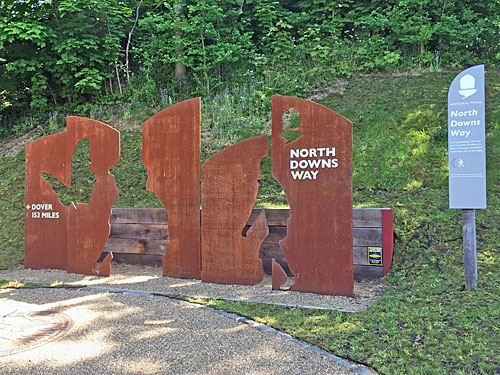
The North Downs Way begins at a most unprepossessing location, specifically a junction on the busy A31 dual carriageway. I'd missed its significance on the walk from the station, but a recently-installedsculptural sign (facing the other way) makes a much more impressive backdrop for your kick-off selfie. I did not take a kick-off selfie. Initially it seems like a slog of road walking lies ahead, but the path soon diverts off into the trees and I didn't see the A31 again, only heard it. The first mile follows the River Wey (North Branch), skirting meadows and climbing the leafy banks. Oddity 1: HELP YOURSELF TO A COPY OF MY BOOK, it said on a mysterious scrawled sign beside a white box. And presumably people had, because the box was empty. Oddity 2: A carved wooden bench in the shape of something which at first looked potentially rude, but was thankfully an orchid.
Beyond the first significant dip, the hamlet of Moor Park turns out to be a Surrey enclave of stockbroker mansions, sprawled across the estate of the former Waverley Abbey. The Greensand Way divides off here and leads to Mother Ludlam's Hole, allegedly a witch's cavern, which is just one of the many things you won't quite see if you stick to the North Downs Way. Instead there's a steady climb through a nature reserve to begin a section of lane-walking. Public footpaths are thin on the ground around the hamlet of The Sands, thanks to large back gardens, the odd farm and an expansive golf course. Here tweed-capped clubbers begin their rounds, business deals are struck, and ramblers watch intermittently from the periphery. Oddity 3: A laminated sign on a tree, reading simply HORSES LOSE, which of course they sometimes do.
The first "whoa" moment comes at a broad dip of open fields stretching off towards distant wooded slopes beyond. The topsoil has just been ploughed, shading the landscape in deep orangey-brown, and looked remarkably dry as spring 2017's drought conditions continue. It's not been a busy path thus far, indeed I was four miles into my walk before I met the first people going the other way, and six before meeting the next, but that's the joys of midweek excursioning for you. Oddity 4: 'The Fairy Tree', a pretend doorway in the bark of a tree, bedecked with beads, baubles, knitted toys and other trinkets.
At long last the North Downs Way breaks out onto a north-facing slope to reveal the amazing landscape feature that is the Hog's Back. This narrow elongated ridge runs for several miles between Farnham and Guildford, with a drop of 50m to either side and an ancient pathway along the top. You'd think this would be the obvious route for the NDW to follow, but instead the A31 got there first, so better to walk in parallel between trees and bluebells than trudge along a lengthy diesel-rich verge.
One recurring feature along the route is a furrowed footpath, following a narrow channel between wooded earthen banks, and hinting at several centuries of former footfall. Elsewhere the path becomes a bridleway or even a byway, notionally open to traffic, not that I'd expect it's frequently so used. Oddity 5: Just before the tiny hamlet of Little Lascombe, a road sign warns non-existent vehicles of "children ahead". REALLY?, someone's scrawled in the dirt.
The only proper village on today's walk is Puttenham, a linear settlement in the lee of the Hog's Back. It's delightful, and thriving, with much front-garden action and building work going on, and narrow pavements that repeatedly switch sides. The local pub is The Good Intent, where Andrew recommends a lunch stop with a giant ploughman's, which has got to be a better option than the Harvester on the main road beyond. Oddity 6: The bus shelter beside The Good Intent is full of local notices but only one bus timetable, dated 2005, for a twice-weekly bus withdrawn in 2011. Oddity 7: A notice in Puttenham's sole phone box proposes closure due to lack of use, and a six week consultation period, although six months later it's still dormantly operational.
Puttenham's golf course seems to go on forever, past the driving range and the exclusive staff car parking spaces, and an honesty box for rare breed eggs. Follow the copious number of signs to the 10th TEE and you can't go far wrong. The sandy lane continues past a string of outlying cottages and villas, some with pristine lawns outside, others with a collection of rusting tractors. My first thought was how idyllic it must be to live here, but then I remembered road access was solely up a mile-long track, and (worse?) the constant threat of scrutiny by National Trail users rambling past.
After dipping beneath the noisy A3 and its slip road, the North Downs Way scores a direct hit on the Watts Gallery and Artists Village, a tourist nugget which celebrates the work of a leading Victorian painter. If you like Arts and Crafts buildings, portraits, sculpture and landscapes you've hit the jackpot, as confirmed by a throng of retired Surrey men and women (mostly women) enjoying the facilities. I could have stopped for the exhibitions or a cream tea, but I suspect this refined facility deserves a longer sojourn, so contented myself with a rifle through the gift shop. Oddity 8: Where the path passes below the A3 slip road, two crosses on the parapet commemorate this being once part of the Pilgrim's Way to Canterbury.
An undulating sandy footpath follows, tracing an eroded gully with shady bluebelled banks. As my adjectives suggest, it's rather pleasant. Eventually the trees clear and it's time for a second-stretch of Hog's-Back-facing, minding the Piccards Farm tractor as you go. The A31 has diverted off the ridgetop by now, but three tall communication masts dominate instead. Consulting my map I decided I'd much rather be walking up there instead, from the Sunnydown Plantation to Henley Fort, but my enforced necessity to remain on the North Downs Way kept me at a distance.
A final farmtrack descends into the valley, past spray-numbered lambs and shuttered outbuildings. At the main road the signs are ambiguous, but don't climb St Catherine's Hill to an outcrop above the river, follow the steeply-descending lane down an ancient holloway. A ferry once crossed the Wey here, long since replaced by a footbridge... which is where the second day of my North Downs Way will begin. In the meantime the towpath walk to Guildford station wasn't far, but was beautiful... and busier by far than all eleven previous miles.
If I were writing a CV, which I'm not, I might describe myself as a completist. I'd describe myself as lots of other things too, but one thing I do like to do is to finish things. Not everything, because some things are best left well alone, but if I have a grand sequential project to complete, I finish it off.
The crowning proof of my completist nature is my diary, which I've been writing nightly since I was 11, and has now reached its 41st volume. That's 14739 days without a gap, if you're counting, which obviously I am. When I have a wild evening I catch up the following day, or make notes if necessary, but over 40 years I've never gone "ah stuff it, I won't do Wednesday", and left it blank. If I were trying to get you to give me a job, which I'm not, this is a key personal achievement I might mention.
My blog is also pretty completist, in that a post always appears at breakfast time. Admittedly that's not quite every day, because there are a few gaps, most usually around Christmas or holiday time. But I am now invariably driven to present you with something each morning, even if it's a bit weak, because the completist in me won't accept a blank day skipped. Think of it as a useful motivational driver, which helps me to inform and entertain you, hopefully.
Within the blog, I've also set up various themed projects to help generate content for me to write up. A visit to the highest point in every London borough, an A-Z of London museums, a bus ride all the way around the edge of London, that kind of thing. These are all sequential undertakings which require considerable input, and once I've committed to part 1 I then have to follow up and do the rest. It generally works, anyway.
I've walked the entirety of the London Loop, and written about each section, with one exception I'll be mopping up this year. I've picked every London borough at random out of a jamjar, and written up my visit up in numerous meaty chunks... then done the same for all the districts around the edge of London too. Actually I've got one more of the latter to go, which I'll be doing shortly, but then that particular seam of inspiration dries up too. It doesn't do to have nothing on the boil.
I am working through all 52 proposed London boroughs in my 'Herbert Dip' series, at a rate of one a week, and there are still 33 of those to go. That'll keep me busy, but I do have a lot more days to fill these days. Another completable project wouldn't hurt.
I thought I'd walk the Capital Ring again. That's good because I've written about it all before, which means this time I can simply walk round without needing to write it up again. It is nice sometimes to go out and and do something without the weight of writing it up later.
And yesterday I decided I'd walk the North Downs Way. I've walked bits before and they were gorgeous, but it's a mighty task to walk all 153 miles to Dover, so not something to be undertaken lightly. It'll take about a dozen days to walk the lot, but these days I can pick and choose my dates, heading out at intermittent intervals when the weather's fine. I kicked off in Farnham, trekked to Guildford, and the walk was splendid. I shall have to get round to writing it up for you soon. But write it up I shall, I've started so I'll finish, because I am a completist.
He's twiceheld the record for visiting every London Underground station in the shortest possible time. He's driven across America to visit a place in each mainland state with the same name as a London Underground station. And now he's turned his sights to visiting all the National Rail stations in Great Britain, all 2563 of them.
The project's called All The Stations, and kicked off in Penzance at the weekend, with approximately three more months of touring the country still to go. The Rail Delivery Group are supporting the project, along with a substantial total crowd-funded from the public via Kickstarter, without which none of this would be happening. The plan requires roving couple Geoff and Vicki to travel on trains scheduled to stop at all the stations, even if they don't get off, and to record the shenanigans as they go. It is the ultimate in railway-related completism.
Ultimately there'll be a big long video compilation of the entire journey to watch, but in the meantime the team are publishing several videos a week relating daily adventures, the first of which went live at 10am yesterday. There'll be another at 10am this morning. I mention this because a lot of you like railways, and travelling, but you don't have to like railways to find this interesting.
There is a website with all the details, including a map showing all the stations All the Stations has been to so far. There's a YouTube channel to subscribe to, where well over fifty ten-minute-ish videos will appear at frequent intervals. It's also possible to follow the journey closer to real time on Twitter, on Facebook and on Instagram... which thus far have confirmed that Cornwall and Devon are gorgeous, that railway staff work damned hard, and that trains generally, but not always, keep to time.
You too could buy an All Line Rover and tour the railway network at will, but you probably don't have the time to visit All The Stations, so why not live vicariously via two people who do? How fantastic to be able to see the entirety of Great Britain by train. It really does pay to be a completist.
It's not usually the done thing to walk amongst the remains of the dead. Across the Channel, however, the remains of over six million Parisians are open daily for respectful perusal. What's more the Catacombes de Paris only allow 200 living people inside at a time, so unsurprisingly there are queues.
The queue for the catacombs curls round the Place at Denfert Rochereau, and even if it doesn't look particularly long it moves very slowly. Pre-booked tours are allowed to jump the line, to the detriment of others, so sometimes even the intermittent shuffling forward pauses. My two hour purgatory was enlivened by the sudden appearance of a slew of gendarmes (sealing off the centre of the square for no obvious reason), and by chatting with a delightful Canadian mother (who reassured me from a previous visit that the wait was well worth it).
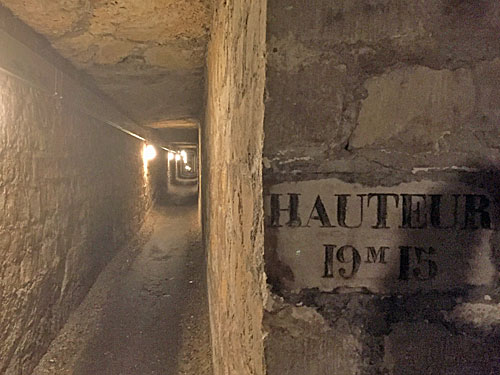
When you do eventually step inside the surface building there's only one ticket window, where the entrance price isn't as good value as it was a year ago, and then you set off down 130 spiral steps. Visitors need to be reasonably fit and able, not least because what follows is a walk of over a mile along a winding underground passage. Initially it's not even overly exciting, bar a few ornate dates chipped into the wall.
The history of the catacombs is displayed just past the foot of the stairs, and updated further on. From the 13th century onwards numerous limestone quarries were dug under what would later become the suburbs of Paris, and these had a nasty habit of collapsing. From 1786 to 1814 the strengthened tunnels were used to relocate the contents of the city's overflowing cemeteries, with nightly processions of bones piled high on horse-drawn carts, and public visits began in 1850.
Beyond the exhibition space is the portal to the ossuary proper, with the warning message ARRÊTE! C'EST İCİ L'EMPİRE DE LA MORT. There's also a very peculiar graphic which I deciphered as "Please do not touch the skulls", not that I was ever intending to. Prepare yourself, because what lies beyond is what's left of umpteen generations of Parisians, artfully stacked.
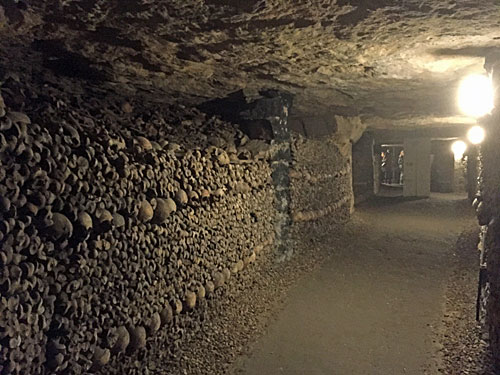
The initial display has instant impact. Each wall is packed, not quite up to the ceiling, with thousands of bones and the occasional skull. What's more most of the visiblebones are laid perpendicular to view, knobbly joints to the fore, reinforcing quite how many dead souls are represented by the tableau. The skulls are proportionately fewer in number and appear to have been inserted to make patterns, sometimes a line, sometimes a cross, and on one occasion a heart.
Each of Paris's old cemeteries has been piled up separately, presumably so that mourners would know where to find the remains of their departed. In each case the name of the cemetery and the year of reinterment is given on a plaque or memorial, the style of which differs each time, often with a quotation in Latin or Frenchi. And there are dozens of these funereal clusters, with yet another at each turn, or through each archway, or round each bend.
The sluggishness of the initial queue really pays off now, as you're free to wander through this amazing space without any sense of overcrowding. You can stop and contemplate the enormity of what you're seeing, reflecting on collective lives passed, from medieval peasants to the victims of the French Revolution. Or you can take lots of photos. Most visitors take lots of photos, occasionally even a series of skull-selfies, because it's not often you get to stand unsupervised in front of millions of bones.
Eventually, after more twists and turns than you'd originally have anticipated, the tour exits la Tombe-Issoire via 83 more steps up to the surface. A guard will check your bag to ensure you're not making off with any consecrated souvenirs, and you emerge via the gift shop, some considerable distance from where you entered. I found visiting the catacombs a sobering experience, and quite unique, agreeing with that Canadian woman that the wait really had been worth it.
Just maybe don't make it the centrepiece of a day trip to Paris, because that's three hours gone, and the rest of the city is so full of life.
Over 400 events are taking place this June, notionally across the capital, with this Dangleway Dinner being North Greenwich's contribution. It's being organised by chef Jimmy Garcia, whose smiling face appeared in some promotional puff in yesterday's paper, and follows up on a previous mid-air dining experience two years ago. Cablecar supremo Danny Price was well impressed.
Next month's paying guests will begin their gourmet journey at the North Greenwich terminal, where a glass of champagne will be served with a trio of canapes.
New Haven hand-dived scallops, blood orange, crispy Cecina, apple gel, apple sticks, foraged sea herbs, pickled candied beetroot, horseradish snow in a frozen shell.
I'm assuming that's New Haven, Connecticut, rather than Newhaven, East Sussex. Hand-dived is a new adjective on me, if somewhat unnecessary. Foraged sea herbs sounds like a posh phrase for seaweed. As for horseradish snow, that's a flaky garnish made by freezing a buttermilk infusion, in case you were wondering.
The main course is eaten at a table jammed into one of the pods, with the journey across the Thames slowed to 18 minutes rather than the usual 10.
Chicken & pancetta balentine, chicken drummer, crispy skin shard, mini fondant potato, onion cream, spinach puree, trumpet del mort, caramelised baby onions, red wine jus, baby carrots.
I'm not entirely certain what Chicken balentine is, but that's how Jimmy's menu spells it. The potato concerns me, because not only is it mini in size but there appears to be only one. Trumpet del mort is an edible mushroom, more correctly designated de la rather than del. An awful lot of that meal appears to be sauce.
Dessert is taken in the terminal at Royal Victoria. Dessert appears to be the most flamboyant part of the meal.
Small edible chocolate plant pots filled with Oreo and white chocolate cheese cake. Soil is made up of a layer of Oreo cheese cake and chocolate soil with edible flowers, crystallised mint and basil leaves and edible chocolate pebbles, meringue mushrooms and toad stools. Salted caramel poured from a watering can.
Every dining experience needs an Instagrammable platter, and this is certainly that. Jimmy's chefs will be assembling something special out of chocolate and sugar, and the punters will probably spend longer photographing it than eating it. "Here darling, you hold the watering can at a jaunty angle while I snap away". Salted caramel is quite 2016 though, isn't it?
To wrap things up there are petit fours and an after-dinner cocktail, which is the excuse for another cablecar ride back to North Greenwich. Here diners are promised one last treat...
A selection of handmade mini donuts, made to order with your favourite toppings.
This does sound like the kind of thing you'd find fried at a fairground, although it's possible the toppings will be really niche.
Amongst the smallprint, we learn that "Any bookings of 2 will be seated in a car with another booking of 2", so couples shouldn't expect to enjoy any intimate dangle-time. Also, "Booking of over 4 will be seated in separate cars", so larger parties might want to think again.
If you're wondering how much all this costs, a ticket to the four course feast has been priced at £75, plus a £4.50 booking charge hidden on the second page of the online reservation system. What's more tickets are only being sold in multiples of 2, so the minimum outlay for a twin package is £159. If you were wondering whether there's an audience willing to pay this much for cordon bleu in a cablecar, rest assured that the Evening Standard knows how to reach them, and the event sold out completely last night.
Jimmy's exclusive pop-up experience takes place from 7.30pm on Thursday 8th June, but if you were thinking of riding the cablecar as usual that evening don't worry. Only 17 pods will be laid out with cut glass and crockery, and the remainder will be available for normal punters to ride... if you fancy a gawp. Bring your own fried chicken and a packet of biscuits and you could enjoy an aerial banquet for less than a tenner, plus exactly the same view. See you there?

Geoff Marshall is a completist.