This letter is to let you know that yes, we know you exist.
Sorry, when you saw the envelope you probably though it was your invitation to get the vaccine. It's not that. You're a lot further down the list, apologies.
Wait to be contacted
We'll let you know when it's your turn, don't worry. Another letter will arrive looking very much like this one. What we don't want you to do is get in touch and ask when it's going to be your turn. That would just clog up our system with unnecessary paperwork and delay things. So instead we've got in touch by letter to tell you not to get in touch with us, and hopefully that'll speed things up instead.
Please note that if we don't have your address then we won't have sent you a letter. Also if the address we have is incorrect then this letter will not have arrived. NHS databases are ropey at best so it's perfectly possible we have you down as living at an old address, or that someone mistranscribed your contact details from an index card handwritten in 1993. It is therefore crucial that you get in touch with us immediately if this letter has not arrived.
Please note that you cannot pick which of the two vaccines you receive. We won't be telling you which one it is before you turn up to ensure you don't turn down your opportunity beforehand. Do not wait for the Pfizer vaccine because the Oxford vaccine is less efficacious. Do not wait for the Oxford vaccine because the Pfizer vaccine is foreign. It's complicated enough trying to sort the supply chain as it is, what with the need for refrigeration and glass vials and everything, so you'll get the one you're given.
Attend both appointments
It is very important that you turn up for your second dose as well as your first. The vaccine is only fully effective after you've been jabbed twice. One dose definitely doesn't cut it.
Please note that we won't be telling you when your second appointment is. It might be in three weeks as the WHO recommends or it might be in three months because that's The British Way. By extending the gap between doses beyond the recommended duration we can inoculate twice as many people, thereby making the UK's statistics look much better than countries where they're doing this properly. No medical evidence exists to show that this approach works, but equally no medical evidence exists to show it doesn't. What's important is making as many people as possible as optimistic as possible as quickly possible, even if it turns out this fails to slow transmission.
Please note that we will not be providing you with a card or token confirming that your course of vaccine is complete. There are no plans to issue a special badge or wristband absolving the wearer from social distancing legislation. If a police officer spots you coughing with friends on a bus while not wearing a face covering the excuse "but I've been vaccinated" won't cut it. The NHS has enough problems with databases as it is, so don't expect us to be able to keep track of who has or hasn't been done.
Go where you're sent
Please note that you cannot request where your vaccination centre should be. We might send you to a draughty sports hall 20 miles from home, a community centre in a neighbouring town or your local pharmacy. It would be too burdensome to send everyone a letter with a list of options in advance so we haven't. Instead we've assumed everyone has a car, like we did with drive-in test centres, and can drop everything to attend any appointment anywhere. We're just throwing names into available slots, to be honest, because there simply isn't time for fine tuning.
Please note that if you fail to attend your given appointment we may not offer you a new one for several weeks. You have the right to wait until your local doctor's surgery eventually gets in touch and calls you in, because that'd be convenient, familiar and cosy. However we have no idea when your surgery will be receiving supplies because that's an entirely different department, which is why we prefer job lot bookings on a regional basis. Skip your designated two-hour round trip at your peril. You can always get a taxi.
Be patient
Please wait your turn. We cannot tell you in advance when we'll finally get round to inviting you for vaccination. You may think you're in a high priority group but we might disagree, either because our records are incorrect or because you have an inflated view of your own self-worth. A lot of septuagenarians with underlying health conditions need to be jabbed before we'll be dropping your name into our digital brantub.
If you don't want to wait your turn, please note that it doesn't work like that. The vaccine is only available through the NHS at no cost, much to the annoyance of BUPA and other private health insurance companies. If however you'd like a black market jab tomorrow please get in touch with a suitable backhander and we'll refer you to a list of approved suppliers operated by friends of government ministers.
Remain vigilant
Please note that one dose of the vaccine is insufficient for your life to return to normal. It takes a few weeks to develop an immune resistance so you should not hug the nurse after she has administered your injection, nor high five your driver on your way home. Do not feel tempted to nip round and meet with family indoors until an extra fortnight is up, and in fact not even then.
Please note that two doses of the vaccine are insufficient for your life to return to normal. It takes a few more weeks to develop maximum immune resistance so you should not whip off your face covering in the frozen foods aisle or organise a picnic with similarly-vaccinated friends. Do not feel tempted to plan a major gathering or book a holiday until an extra fortnight is up, and in fact not even then.
Be realistic
Please note that vaccination is not a magic bullet. You may feel on top of the world after you've had it but that won't be enough to keep the virus at bay. Indeed we currently have no definitive idea what the way out of this health crisis will be. Mass immunisation will help enormously but we don't know if it'll be sufficient, nor whether our gamble in spreading the two doses three months apart will pay off.
It may be that vaccination prevents deaths but not transmission. It may be that infection rates fall but refuse to fade away. It may be that so many people refuse to be vaccinated that herd immunity is never reached. It may be that new variants evolve faster than we can reformulate the vaccine. It may be that the vaccination programme merely enables a new normal rather than the old one. This is a virological experiment on a national scale, the outcome of which remains entirely uncertain.
This isn't about protecting you, it's about protecting wider society. You might be one of the small percentage who still get nasty symptoms, in which case we're very sorry, but if we can reduce all infections by a similar measure then the NHS might pull through. In the meantime we're sending you this letter as a reminder that we haven't forgotten you and to bring a little hope.
My eighth random ward, Walbrook, is named after a stream that once ran through the heart of the City. Walbrook lies right at the centre of things, at Bank Junction where as many as nine roads meet. What gives the ward its peculiar shape is that only five of the intervening wedges lie within Walbrook - Mansion House and the Bank of England included - and the other four will have to be documented elsewhere.[9 photos][pdf map]
This is the ward where the Lord Mayor lives, or at least has his official residence. Mansion House was built in the mid 18th century in Palladian style, and still impresses. Its main entrance is on the first floor balcony, past some whopping lanterns, while a minor tradesmen's entrance provides access at ground level. A more practical front door exists just around the corner, outside which I spotted a pair of bootscrapers and the Lord Mayor's Lexus. Fans of blue police callboxes should be advised that the original here is no longer operational (Please Use Nearby Payphone). Also if you walk along the alleyway round the back of the building beware if you hear a klaxon sound because that means the metal fire escape is about to lower itself on top of you.
The building that dominates the ward, however, is the fortress-like home of the Bank of England. This occupies an entire City block between Lothbury and Threadneedle Street as well as a substantial amount of storage underground. The Bank took root here in 1734 and was famously rebuilt by Sir John Soane at the turn of the 19th century. Alas it was infamously rebuilt by Sir Herbert Baker between 1921 and 1942, replacing Soane's masterpiece with "a hotch-potch, a pasticcio, a patch-work of symbolical odds-and-ends". One of the most striking features is a total absence of windows around the curtain wall, as befits a national gold reserve the Governor would rather nobody broke into. Doors are in very short supply too, especially on the west and south flanks, and where they do exist tend to be mighty bronze portals with ornate symbolic decoration. In one recess a speaking tube is labelled 'For Night Service Only', 'To Deliver Letters Etc. Ring Bell And Await Instructions'. The only concession to the public is a cut-through passageway at TivoliCorner, freely-accessible, but if you look up through the circular skylight expect to see two CCTV cameras looking down at you.
Unsurprisingly this is a favoured spot for other banks to have clustered. The Midland Bank had its headquarters across the road at 1 Princes Street, which became surplus to requirements when HSBC took over and relocated to Docklands so the building now contains a super-luxurious hotel called The Ned. Nat West are nextdoor in another splendid Lutyens creation, incorporating a proper high street branch in case you still want to withdraw some coinage. At the other end of the street is One Lothbury, now home to the City flagship of the Bank of China because times change. Meanwhile the 26-storey tower two blocks east of the Bank of England used to be home to the Stock Exchange between 1972 and 2004, and has since been reclad in shiny glass.
Financial agglomeration dominates Walbrook to such an extent that the ward lacks a network of characterful back alleys. Promising starts turn into unwelcoming service roads, or lead you round the back of office buildings much younger than their preserved frontage. Pope's Head Alley has morphed into a steel and glass corridor overlooked by emblematic beehives (and yes, a Pope's head), while historic Change Alley has become something much drabber. The only cut-through of merit is St Olave's Court off Old Jewry where a half-demolished Wren church conceals the offices of a maritime law firm, but I wouldn't go out of your way just for that.
Another easily missed minor street is St Swithin's Lane, a turning off King William Street, where the Rothschild financial dynasty is based. Banker Nathan moved into New Court in 1809, so was expertly poised with a supply of gold when the Bank of England suffered a liquidity crisis a few years later. New Court has been rebuilt four times since, the latest (2011) iteration presenting a steel colonnade to the street behind which lies a strictly anonymous glass facade. Old masters hang in the windows behind gold tickertape drapes, reflecting the fact that the price of gold was set here for the best part of a century. Step up to the podium and you can look down into the garden of St Stephen Walbrook, presently trapped behind a low glass wall.
The church is one of Wren's finest with an altarpiece by Henry Moore. When originally founded in 1428 it lay on the banks of the Walbrook stream, but that's been lost longer than most lost rivers and the church now fronts a street of the same name. Most of the eastern side is now occupied by a ribbed office block (resembling a either a wobbly black jelly or a metal armadillo) called the Walbrook Building. The architects squeezed in a Little Waitrose, a gym and a restaurant in an attempt to activate the perimeter, but all of these are currently closed. They also planned to display the London Stone here...
...but heritage inertia kept it further up the road opposite the entrance to Cannon Street station. The previous incarnation of this building was a grotty W H Smith with the Stone trapped behind an intrusive grille, but the latest financial office has sleek white frontage and a protective chamber it's much easier to photograph. All you need to know about this chunk of oolitic limestone is on the website www.londonstone.org.uk, as the information panels to either side confirm in text and in Braille.
Let's finish with a look at some of the City of London heritage plaques I found dotted around the ward while I was exploring, of which Walbrook seems to have more than its fair share.
» Elizabeth Fry had already moved out to East Ham before starting her compassionate work at Newgate Prison.
» The first postmark was called a 'Bishop mark' because it was introduced by Postmaster General Henry Bishop.
» Poet Thomas Hood had a head start in the literary world because his father was a bookseller on Poultry.
» St. Bartholomew-by-the-Exchange was demolished when the City Corporation widened Threadneedle Street.
» Mansion House now covers the site of Stocks Market, for centuries the City's largest food & produce market.
» Mary was only allowed to become an accountant after the passing of the Sex Disqualification Act in 1919.
» Cardinal Newman became the fifth City-born saint when he was canonised by the Pope in October 2019.
» Anti-Semitism in the late 13th century drove Jews from their City ghetto and forced their relocation overseas.
» Jonathan's Coffee House in (Ex)Change Alley became the location of the City's first ever Stock Exchange.
For today's post you'll need a personalised buzzword bingo card. Download yours here.
destination
DNA
unique
theatre
artisan
flagship
style-led
vibrant
unrivalled
hub
fabric
experiential
grit
dramatic
crucible
woven
spirit
canvas
focussed
character
indelible
bespoke
innovation
blend
collide
Keep your eyes peeled as today's post progresses, and if you manage to tick off the entire list get in touch and claim your prize.
Welcome to Borough Yards, 116,000 sq.ft of style-led shopping and experiential innovation.
You'll find it alongside Borough Market, under the railway arches leading towards Cannon Street station, in the space previously occupied by the wine-based Vinopolis attraction. That closed in 2015 because it failed to make money, so a new consortium are having a go with a fresh retail-focussed approach.
It's not the capital’s most exciting cultural and retail-focussed regeneration, that's just one of the exaggerations on the development's website. Who knows what the most exciting is, just be reassured it isn't this. Other lies include the suggestion that the district's welcome is unrivalled, the allegation that a lost medieval street system is being revived and the claim that Borough is connected to everything.
The developers have carved out a pedestrianised thoroughfare inbetween Park Street and Stoney Street, partly alongside the railway viaduct and partly underneath it. They've decided to call the new 'street' Dirty Lane because this provides memorable context, although the original Dirty Lane was never on this site and is now lost beneath Borough Market.
They've also invented a small piazza called Soap Yard, because sometimes what sounds good in a brainstorming session is better than what was originally here.
It'll be good to have the railway arches opened up and well used, expanding the number of things to see and do in the immediate vicinity of Borough Market. And while it's true that you may not be especially excited by a cluster of fashion brands and refreshment opportunities, this is what passes for entertainment amongst a significant portion of the population. Flat Iron Square and Vinegar Yard already cater for a similar clientele locally, so who's to say there isn't space for one more hospitality sink?
Sometimes you just want to find the marketing team responsible and lock them away until they calm down a bit.
That is right up there with the worst sloganeering I've ever seen. Creating a buzz around something that doesn't yet exist always runs the risk of sounding like hype, and Borough Yards hits it out of the park.
Planning permission for Borough Yards was granted in 2016. The site was originally due to open last year, although peering through the railings it's still very much a building site in there. The project's currently at the 'finding tenants' stage, which'll be why one of the arches has been transformed into a sales office with comfy sofas, potted trees, colour brochures and a scale model of the development.
In case you're struggling to read the hoarding at the back, it does indeed say Retail, Dining, Community, Wit & Grit. If that's triggered a full set of buzzwords on your bingo card, be sure to claim your prize. If it's merely induced a headache, you are not alone.
Sometimes even brand conceptualisers go that one step too far. This lot are based in New York, which maybe explains a lot. And in case you're having a rotten 2021 imagine how the investors at Borough Yards must be feeling, praying that visitors to the South Bank will still have wallets in need of milking by the time their souped-up shopping mall is eventually ready. Just off Clink Street, in cathedral-like spaces where retail, community and culture collide.
TfL's annual fare rise was announced on Friday. It's very late, but everything's running late at the moment which is why the increase that normally happens at the start of January has been delayed until the start of March.
This is the first rise in London tube and bus fares since January 2016. That was Boris's final increase, after which Sadiq promised to freeze TfL fares for four years, and so he has. In fact he'll have managed 62 months, which is either excellent or wilfully negligent depending on your point of view. His intention was to go into the 2020 Mayoral election with TfL fares the same as when he was elected, but subsequent events have delayed that election by a year. Conveniently he'll now be able to blame the government for the 2021 fare rise, even though this is the year they were always due to start going up again.
To put that 2.6% in context, fares rose 7% in 2011, 7% in 2012, 3% in 2014, 2.5% in 2015 and 1% in 2016, then 0% since, because some Mayors are happy to put fares up and some aren't.
Here are some of the new fares in historical perspective, with Conservative years in blue and Labour years in red.
Cost of a single central London tube journey
2011
2012
2013
2014
2015
2016
2017
2018
2019
2020
2021
Oyster
£1.90
£2.00
£2.10
£2.20
£2.30
£2.40
£2.40
£2.40
£2.40
£2.40
£2.40
Cash
£4.00
£4.30
£4.50
£4.70
£4.80
£4.90
£4.90
£4.90
£4.90
£4.90
£5.50
Unexpectedly the Zone 1 Oyster tube fare remains at £2.40. According to the press release this is to "support the wider economic recovery of London, including tourism, as those visiting the capital and travelling exclusively within Zone 1 will not see any fare rises". Lucky tourists, eh? But this has long been one of Europe's worst value metro fares, mile for mile, so leaving it unchanged should amend the imbalance slightly. Fare rise 2011→2021: 26% Fare rise 2016→2021: 0%
Meanwhile anyone still paying by cash continues to pay significantly more, as TfL try ever harder to persuade people to switch to contactless. "Fewer than 1% of Tube journeys are now made with Tube cash fares", we are told. Fare rise 2011→2021: 38% Fare rise 2016→2021: 12%
Cost of a tube journey from Green Park to Heathrow
2011
2012
2013
2014
2015
2016
2017
2018
2019
2020
2021
Oyster (peak)
£4.50
£4.80
£5.00
£5.00
£5.10
£5.10
£5.10
£5.10
£5.10
£5.10
£5.30
Oyster (offpk)
£2.70
£2.90
£3.00
£3.00
£3.10
£3.10
£3.10
£3.10
£3.10
£3.10
£3.30
Cash
£5.00
£5.30
£5.50
£5.70
£6.00
£6.00
£6.00
£6.00
£6.00
£6.00
£6.00
The Z1-6 fare has only risen 10p since 2013, so March's 20p jump is significant. But for this journey to Heathrow a fare of £5.30 (peak) or £3.30 (offpeak) is an absolute bargain, given that TfL Rail fares will be £11.10 and £10.40 respectively. The Piccadilly line remains less than half the price of other airport options. Fare rise 2011→2021: 18% Fare rise 2016→2021: 4%
One important change from March is that "Non-Zone 1 off-peak fares move from a flat £1.50 to three price points". Previously if you avoided zone 1 you knew you were going to be charged £1.50, whereas now it could be £1.50, £1.60 or £1.70 depending on how many zones you pass through. Anyone passing through three or more zones pays the maximum.
Tube (off-peak), journey does not include Z1
1 zone
was £1.50, will be £1.50
2 zones
was £1.50, will be £1.60
3, 4 or 5 zones
was £1.50, will be £1.70
The extra 20p for longer journeys equates to a fare rise of 13%, which is one of the largest increases in the fares package. That's bad news for Londoners making regular off-peak journeys across the suburbs, and not something the Mayor will be broadcasting loudly.
Cost of a single central London bus journey
2011
2012
2013
2014
2015
2016
2017
2018
2019
2020
2021
Oyster
£1.20
£1.30
£1.35
£1.40
£1.45
£1.50
£1.50
£1.50
£1.50
£1.50
£1.55
Mayors are often kinder to bus passengers because they include the poorest amongst the electorate, hence the 5p fare increase is the smallest increment possible. But this uptick introduces an intriguing anomaly - a one zone tube ride (e.g Whitechapel to Stratford) will now be 5p cheaper than taking the bus. I think that's the first time in recent memory that the cheapest way to travel a short distance may not be the bus. Fare rise 2011→2021: 19% Fare rise 2016→2021: 3%
The Hopper fare remains, so chains of longer bus journeys will still cost the same as a single ride, i.e. £1.55. The daily cap for those who only ride buses rises from £4.50 to £4.65, i.e still three times the single fare.
Cost of an annual Z1-3 Travelcard
2011
2012
2013
2014
2015
2016
2017
2018
2019
2020
2021
£1288
£1368
£1424
£1472
£1508
£1520
£1548
£1600
£1648
£1696
£1740
Here's where the long-term price rises are. No matter what the Mayor decides, Travelcards rise in price along with National Rail fares which are set by the government. This year's increase for a Z1-3 Travelcard is 2.6%, one percent ahead of inflation, and it's been increasing by a similar measure for years. Travelcard users are paying a third more than they were a decade ago, whereas pay as you go tube and bus users have had a much better deal. Fare rise 2011→2021: 35% Fare rise 2016→2021: 14%
But the biggest news is that fare rises are back, which'll be a jolt to anyone who's been used to their journey costing the same since 2016. The Mayor blames the government, the government blames the Mayor, and the real perpetrator is a microscopic virus which has caused the capital's economy to implode. In a way it's amazing that fares are rising so little, given the collapse in revenue from non-existent passengers, but a world-class transport network still has to be paid for somehow.
• every UK adult to be offered vaccine by autumn
• London hospitals halt urgent surgery
• flexing the rules 'could be fatal'
• PM seen cycling seven miles from home
• seven regional vaccination hubs open
• London's Nightingale hospital reopens
• mail deliveries much reduced in several areas
• 2020 saw most excess deaths since WW2
• supermarkets to enforce rules on face coverings
• row about inadequate free school meal parcels
• Scotland tightens lockdown restrictions
• France advances curfew from 8pm to 6pm
• vaccination pilot in high street pharmacies
• new variant prompts ban on travel from Brazil
• trial shows blood plasma treatment doesn't work
• government to close all travel corridors
• Pfizer slows vaccine deliveries
• R has fallen slightly, but still above 1
• expect several new variants this year
• India begins vaccination drive
Worldwide deaths: 1,920,000 → 2,020,000 Worldwide cases: 89,000,000 → 94,000,000 UK deaths: 80,868 → 88,590 UK cases: 3,017,409 → 3,357,361 Vaccinations: 2,286,572 → 3,559,179 FTSE: down 2% (6873 → 6735)
Yesterday was Pudding Mill Lane station's 25th birthday. Unfortunately lockdown prevented the Silver Jubilee celebration that would inevitably have taken place, but rest assured I popped down and sang Happy Birthday on your behalf, and took some cake. Unfortunately I sang it to the wrong station because the 1996 version was demolished in 2014, but it's the thought that counts.
A brief history of Pudding Mill Lane station
20th June 1839: The Eastern Counties Railway opens alongside the future site of PML station. Stratford gets a station but there's no point opening a halt amid the Bow Marshes. During construction a pudding-shaped windmill beside the Pudding Mill River is demolished. 31st August 1987: The Docklands Light Railway opens between Stratford and the Isle of Dogs. No station is provided at Pudding Mill Lane but the location is safeguarded for future development. A passing loop will be added later. 15th January 1996: Pudding Mill Lane station opens, on the cheap, to serve a few adjacent industrial estates. Access to the island platform is via a claustrophobic central staircase. Usage is not expected to be high. 6th July 2005: The IOC selects London to host the Olympic Games in 2012. Tiny Pudding Mill Lane will be the closest station to the stadium. The adjacent industrial estates are instantly doomed. 13th July 2012: Pudding Mill Lane station closes temporarily, two weeks before the Olympics, because it could never have coped with the passenger numbers. 13th September 2012: The station reopens following the Paralympics, but its days are numbered. A replacement is already under construction a few metres to the south. 18th April 2014: The original PML, born 1996, closes forever. It had the misfortune of being on the direct alignment of Crossrail, at precisely the point where trains will emerge from tunnels on the approach to Stratford. 28th April 2014: The current Pudding Mill Lane station opens, a large glass box on a freshly-constructed double-track viaduct. It's now the largest station on the DLR. 4th August 2016: West Ham play their first match at London Stadium. Police are initially reticent to allow supporters to use the station, but will eventually change their minds. 11th December 2022: Estimated date on which passengers will finally be able to travel on Crossrail between Stratford and Whitechapel, passing through the original site of Pudding Mill Lane station.
» If you'd like to see what the old Pudding Mill Lane station looked like, Ian Visits wrote a post about it and I took 30 photographs on its last day.
» If you'd like to see what the new Pudding Mill Lane station looks like, Ian Visits wrote a post about it and I took 30 photographs on its first day.
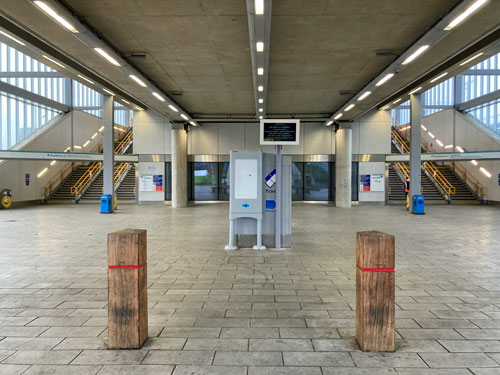
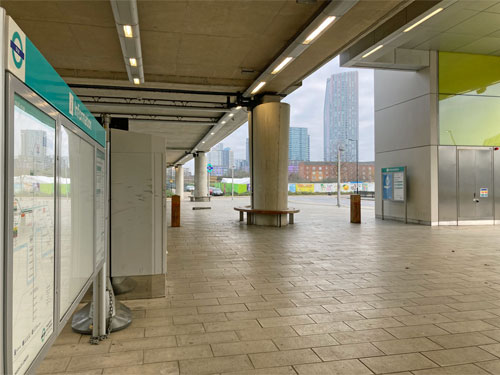
The old Pudding Mill Lane station is mourned only by trainspotters who loved the mainline vantage point provided by the open platform. The new one is state of the art but in an oddly tedious way, having been built to withstand a future that's not yet arrived. The platforms are much wider than necessary for the handful of passengers who normally use them. The staircases are broad enough to cope with large crowds that almost never materialise. The concourse under the tracks echoes with inactivity. The retail unit built to take a coffee shop has never had a tenant. The piazza beyond awaits a community yet to appear. There is a reason why Pudding Mill Lane is the second least used station on the entire DLR network.
And it's been even quieter during lockdown. My daily exercise often takes me past on my way into the Olympic Park and normally there's absolutely nobody else here. I don't think I've seen a bike in the bike rack since March, other than an abandoned one missing a wheel. The two bins of Metro newspapers are always topped up but never empty, so I guess at least 50 copies end up in the recycling daily. I saw two passengers arrive yesterday morning and almost recoiled from the shock.
As 2020 went by I got an increasing feeling that TfL had abandoned the place. The electronic rainbow board that listed disruptions abruptly disappeared, or broke and was covered over. A chained-up poster announcing weekend line closures in October lingered until the last week in December. The tube map poster vanished several months ago leaving a large white space on the information board. I know someone must come round occasionally to update the other posters because these do change in line with official government restrictions. And someone definitely turned up in August to remove the cash option from the ticket machine, although the nearest Oyster ticket stop is half a mile's walk away, should anyone ever be caught short.
Unsurprisingly the blank piazza outside is a favourite with bored youth. Sometimes it's a pair of skateboarders practising tricks under the shelter of the viaduct. Sometimes it's acrobatic cyclists taking advantage of a large paved expanse. Occasionally it's been dozens of teenagers gathered to show off their biking skills before abandoning fried chicken wrappers and cans of Red Bull on the benches. And on one particularly memorable occasion it was a congregation of 200 feral kids egging each other on to perform massive wheelies with menaces before scarpering in all directions when a police van turned the corner.
Perhaps the oddest thing about Pudding Mill Lane is that nobody lives nearby. Normally when you open a new station the developers move in and take advantage, knocking up flats left right and centre, but nobody whatsoever lives within a 200m radius. Large areas of post-Olympic hardstanding remain empty, one used as an occasional car park and another for a temporary container hotel. Even now this 1500-home neighbourhood is still only at the masterplan stage, with a first planning application due to be submitted later this year. By 2030 this should be a much-needed mass of densely-packed residential blocks, assuming people still want to live in the capital. In the meantime Pudding Mill Lane is still a staff-free halt in the middle of nowhere, just as it was when it opened 25 years ago.
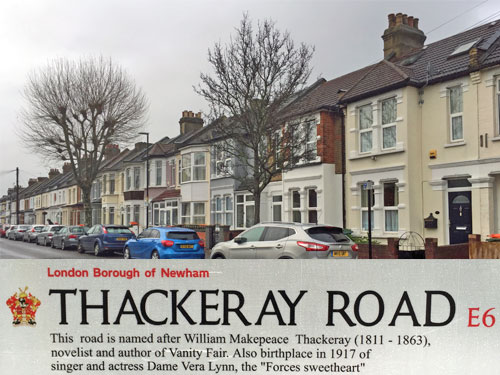
This is Thackeray Road, East Ham, one of a ladder of a dozen Victorian terraced streets off Barking Road. It's also the birthplace of Forces' Sweetheart Dame Vera Lynn. Newham council have attempted to make this known.
This is one of a trio of street signs installed in 2017 to mark Dame Vera's 100th birthday. Newham have a habit of commemorating famous citizens on street signs, including mathematician Alan Turing opposite Westfield, meteorologist Luke Howard in Plaistow and six speedway riders on the site of a former circuit in Custom House. Strict geographical accuracy is not always required.
The Thackeray Road sign is odd because it starts by referencing author William Makepeace Thackeray, a man who spent no significant time in the locality, leaving the top drawer local icon as an afterthought. It also stands in place of the more usual marker, which is a plaque of some kind on the appropriate house so that people can pay their respects properly. In this case that's 3 Thackeray Road, specifically the ground floor flat where Vera Margaret Welch was born to a plumber and a dressmaker in March 1917. The current residents must be very pleased not to have centenarian groupies hanging around outside.
In 1921 the family moved three streets east to Ladysmith Road. Both ends are marked with a special street sign, this time highlighting Dame Vera alone, but the family home at number 38 is again anonymous. The third commemorative location is two miles away at Vera Lynn Close, a cul-de-sac in Forest Gate with no historical connection whatsoever. These signs are lovely things but I can't help thinking a pinpointed marker on the front of a house might be preferable. In a borough with only two (two!) blue plaques, Newham's famous sons and daughters deserve better.
I saw the kingfisher in the Olympic Park again this week. It was here, in the reeds just to the south of the cycle circuit bridge. I've updated my sightings map with the location.
The kingfisher normally appears on the east bank, in my experience, so the best chance of a view is from the riverside path opposite. In this case it was nipping briefly out of the reeds and then back in again, repeatedly, and so making its way gradually downriver. The bird appeared a few times during the few minutes I was watching. It looked smaller than I remembered, which might be because it was a different bird or might be because my memory is dimensionally inadequate. But its presence left a grin on my face which continued for the rest of my walk.
I should say that this was the eighth time I'd walked along the riverside since my last sighting on Christmas Eve and followed seven abject failures. Spotting a kingfisher remains a rare event so you probably won't be lucky you turn up on spec. But a number of blog readers confirm they've now seen it, in much the same place, and generally at quiet times when not many other people are around.
The one bird you can pretty much guarantee seeing in the Olympic Park is a heron. The wetland bowl in the northern half of the park is perfect for them, it seems, providing excellent access to a variety of tasty aquatic treats. I invariably see one or two somewhere by the water's edge, watching the water intently, perhaps before swooping off with enormous wings outstretched. I've also got quite blasé about seeing little egrets, and cormorants remain ten a penny.
It wasn't flying free or hovering high above, it was firmly tied to the gauntlet of a lady in a black raincoat. Initially I wondered if she was just taking it for a walk, but the more I watched them the more I decided there was more to it than that. I first saw them striding down the riverside path opposite Kingfisher Central, but was surprised when they then broke off up a slope through some trees where no proper path exists. Their progress looked deliberate rather than casual, and this steady pace continued as they crossed the footbridge and descended to the bank on the opposite side.
Occasionally the bird of prey flapped its wings and rang its bells in a "look at me" manner, but most of the time it perched contentedly on the lady's covered fist. I suspect the pair are part of a paid-for service to frighten away the pigeons, of which there are too many, but that's not something I've seen in a public park before, only in places like Trafalgar Square. I hope this avian deterrent doesn't have the unintended consequence of scaring off the local kingfisher.
Thanks for letting us know the largest English town you haven't been to.
Collectively it's Liverpool, but you have to dig deeper into the data to make proper sense of it.
120 of you provided an answer to the question, cheers, and 16 said Liverpool was the largest place they'd never visited. It is on the coast, i.e. somewhere you'd normally only visit on purpose rather than pass through, which may be why some of you have missed it. Equally Liverpool's an iconic World Heritage City packed with interest, unlike say Birmingham which only stumped 8 of you, which makes its omission all the more surprising.
n.b. This doesn't mean 16 of you haven't been to Liverpool (because if you hadn't been to Birmingham you wouldn't have got this far down the list).
n.b. It also doesn't mean Liverpool is the least visited English city. I bet far more of you have never been to Bradford, but that was further down the list and half of you never got that far.
Importantly this was a self-selecting survey open to a global audience, so foreign visitors could (and did) skew the upper reaches of the statistics. Also we mustn't assume that everyone is a sightseeing nomad with a budget to match, nor has had the opportunity to scour the country over several decades. I'd have given a very different response to this question twenty years ago.
Here's how your responses tallied for England's fourteen largest cities. Three-quarters of you stumbled within this range.
1
London
0
2
Birmingham
8
3
Liverpool
16
4
Bristol
9
5
Manchester
2
6
Sheffield
12
7
Leeds
5
8
Leicester
6
9
Coventry
5
10
Bradford
9
11
Nottingham
1
12
Kingston upon Hull
10
13
Newcastle upon Tyne
0
14
Stoke-on-Trent
4
» Everyone's been to London.
» England's second city, however, is less of a draw.
» Bristol stopped a lot of you, and Sheffield even more. Both are fantastic cities and I would strongly recommend a visit.
» Manchester performed strongly, as befits a cultural behemoth.
» Bradford halted several of you, even those who'd been to neighbouring Leeds.
» Hull's peripheral location strikes again!
» Well done to Newcastle, the first zero after London.
» Stoke-on-Trent tripped up 11% of all those who got that far.
After Stoke only two other towns stopped as many as four of you. One was Northampton in 21st place and the other was Bolton in 29th. These aren't typical tourist towns, nor anywhere you'd normally head on a whim, but are none the less fascinating for that. I still reflect on my day trip to Stoke which completely changed my view of the place.
Nine of you got further down the list than I did. I stopped at Sunderland (32nd) and one of you stopped at Warrington one rung lower. Poole (37th) and Telford (39th) halted a few football fans who regularly travel to away matches. Philip got as far as Blackpool (43rd) helped by "a career in retail". Paul swept all the way down to Sutton Coldfield (66th) courtesy of "being a bus spotter when younger". Colin's interest in transport incredibly got him to St Albans (90th), while Jo W was very put out to discover she'd never been to Redditch (98th). But our winner is Man of Kent who's been to every single one of the 100 largest towns in England, travelling so widely that he fell off the bottom of the ONS's official list.
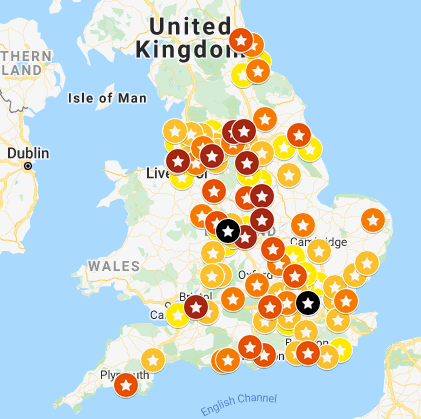
I was so intrigued by the geographical distribution of the 100 largest towns and cities that I knocked up a Google map. Here's a thumbnail, and if you click on it you'll get the full zoomable scrollable experience.
The two black blobs are the two cities with over a million inhabitants, that's London and Birmingham. The nine dark brown blobs are all the other cities with a population over 300,000. With the sole exception of Bristol they're all in the North and the Midlands, approximately following a big arc around the Peak District. The lighter the colour the lower the population, down to the 26 yellow blobs with a population between 75,000 and 100,000.
Lancashire and Yorkshire have the greatest concentration of blobs, while the coast does particularly well in the south and the east. Such is London's primacy that it's surrounded by light-coloured blobs rather than darker ones. But my eye is really drawn to the areas with no blobs at all. Once you pass Bristol and Bournemouth the southwest really only has Plymouth and Exeter. Norwich is the only large settlement across much of East Anglia and the Fens. North of York there's nothing other than a cluster of big towns in Tyne and Wear.
England is a fascinatingly diverse country with so much in reach, whether your taste is urban or rural, historic or modern, upland or coastal. If and when you get the opportunity, I heartily recommend exploring as much of it as you possibly can. Don't be the blinkered one saying "I haven't been to most of those cities, because, why would I want to?"
After almost a year of not going very far, and with an eye on one day being able to travel again, I wondered where's the largest town I haven't been to?
To be explicit, that's the largest English town or city by population that I've never set foot in. Travelling through (or standing on a station platform) doesn't count.
My first task was to find a definitive ranking of English towns and cities by population. I thought this was going to be difficult but no, the Office for National Statistics has a portal called Nomis which offers free access to up-to-date data. I selected a) major towns and cities, b) all ages c) all genders, and within seconds I was downloading the spreadsheet I needed. The list that follows is based on built-up areas, not necessarily administrative boundaries or wider city regions.
No problem so far, I've been to all ten. I've also blogged about all of them, which is why each city links to an old post. One I live in and five I've been to numerous times, as befits the country's great cultural centres. But Sheffield's had just three visits, Leicester and Bristol two apiece and Bradford only one. You may already have spotted a city you haven't been to, in which case you can stop there, you have a winner. I need to carry on.
I've been to all these too, mostly several times. Stoke on Trent was a one-off day trip but once is enough to tick a city off. Nottingham's linked post consists of a single photograph, so I really ought to go back and try harder, but again it totally counts. The first dodgy city on my list is Southampton which I have only slightly visited. I changed trains there once and deliberately wandered out of a side exit onto the pavement for a few seconds so I could say I'd been, because in my rules visiting the station doesn't count. Southampton really should be top of my list for a post-lockdown safari... but I have technically been, so let's move on.
These are all multi-visits, for me at least, apart from Swindon and Bolton which are single trips. They've also all been blogged, other than Peterborough which I somehow haven't been back to since the 1980s. You may very well have seen a town or city you haven't been to by now, in which case make a note of what it is. But it turns out I have indeed been to the top 30 English towns and cities, hurrah. It all goes it goes wrong for me at 32...
Sunderland is the largest English city I haven't been to. In this case I haven't even travelled through it and seen it out of the window, which is a proper fail. That's why today's exercise is important, because I don't have a mental picture of Sunderland based on primary evidence, only what I've seen on TV or read about elsewhere. Warrington I have at least seen from a train speeding through, but Huddersfield is another personal non-event. That's three in a row I've missed, so very much where my run ends.
Shame, I was doing well again there until Oldham tripped me up. I meant to go to Oldham on my last trip to Manchester but it was raining so much that I gave it a miss. Another one for the to-do list.
In case you're still playing, here's the next 50.
51
Maidstone
61
Stockport
71
Woking
81
Halifax
91
Harlow
52
Chelmsford
62
Rotherham
72
Hemel H'std
82
Birkenhead
92
Guildford
53
Basildon
63
Gillingham
73
Worcester
83
Nuneaton
93
Bracknell
54
Cheltenham
64
Solihull
74
Salford
84
Hartlepool
94
Dudley
55
Doncaster
65
Wakefield
75
Barnsley
85
Chesterfield
95
Stockton
56
Worthing
66
Sutton C'fld
76
Stevenage
86
Wigan
96
Scunthorpe
57
Eastbourne
67
Lincoln
77
Southport
87
Weston-s-M
97
Burnley
58
Basingstoke
68
H Wycombe
78
Hastings
88
Grimsby
98
Redditch
59
Rochdale
69
St Helens
79
Bedford
89
Chester
99
Mansfield
60
Crawley
70
Bath
80
Darlington
90
St Albans
100
Chatham
I'm quite pleased that I've been to 90% of the top 50 English towns and cities and 84% of the top 100. That's a pretty good record all told, in terms of developing a personal understanding of how the country fits together.
But let's keep this simple by asking...
What's the largest English town you haven't been to?
Mine's Sunderland, what's yours?
Special comments box → comments
Even if you checked out relatively early on, I hope you found the list of towns by population interesting in itself. If nothing else you might get some ideas for where to explore next, once you get the chance.
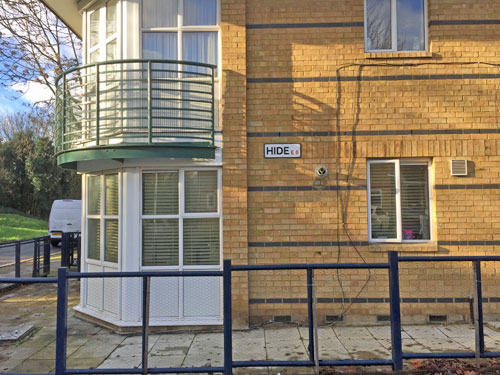
It's Hide, this brief unremarkable residential street in Beckton.
One side of Hide is a terrace of seven yellowbrick townhouses, each with a strip of grass and a single parking space out front. The other side is a continuous block of flats, mostly two storeys high, overlooked by a handful of trees. It's very Beckton, an anonymous modern street for families who fancy a small back garden. The only unusual thing is that it boasts the capital's briefest address - 1 Hide, London, E6 6ZA.
I stumbled on it while walking home from the far end of the Royal Docks, just before the big Asda. If you know where the DLR curves back on itself between Gallions Reach and Beckton stations, that's where Hide is, within that sweeping curve. I normally walk along the main road but this time I decided to walk behind the hedge to the housing estate beyond and there it was. I spotted the briefest of street signs on the wall and wondered whether this might be the shortest street name in London, and did some research, and yes it is.
This is the Winsor Park estate, built in the mid 1990s on one of the less contaminated parts of Beckton Gas Works. It includes a primary school and a small hospital, plus an irregular grid of residential streets with equally peculiar names. The two roads around the perimeter are called Covelees Wall and Newark Knok, while in the centre you'll find Cow Leaze, Horse Leaze and Tunnan Leys. Here are the remaining streets ordered by the number of letters in their names.
4
5
6
7
8
9
11
Hide
Ashen
Oxleas
Peverel Sudbury Warwall
Beaufort Downings
Bradymead Stonewall
Wheatfields
Not only does the Winsor Park Estate include the shortest street name in London but it contains the second shortest too, which is Ashen. That's got to look odd on an envelope. The list also includes a six letter name and then three sevens... although I'm less excited by those because I live on Bow Road and that's seven letters too.
One word street names are quite rare, and tend to be either quite old or quite new. Central London has Aldgate, Holborn, Poultry and Cheapside, for example, which date way back. Outer London has the odd Crossway, Meadway, Parkway and the like. Meanwhile Milton Keynes has streets including Simnel, Dodkin, Lloyds, Chervil and Tandra, and Basildon has Oldwyk, Knights, Teagles, Mynchens and Trindehay, because new town planners weren't averse to something wild.
Which got me wondering... what were the planners of the Winsor Park estate thinking? How did they come up with a selection of names including Hide and Ashen? The answer finally revealed itself in a comment on a malfunctioning Londonist article about single-named roads, left six years after the original post was published. Thanks Stephen (and thanks Rob for asking the question Stephen answered).
I think I've found Howard's source material, which is A History of the County of Essex: Volume 6, specifically the chapter on Agriculture in West Ham. This is odd because Beckton was in East Ham, not West Ham, and was originally marshland rather than open fields. A lot of these one-word Beckton streets are therefore named after features on the other side of Newham, nearer the Lea than the Roding, but Howard Bloch presumably knew what he was doing.
• Peverel was Ranulph Peverel, joint owner of the manor of Ham at the time of the Domesday Book.
• Sudbury was the medieval manor, somewhere near Plaistow, formed from Peverel's land.
• The manor of Sudbury owned fields including the Hide, Half Hide, Hole Hide and Bradymead.
• Ashen field, Downings field and Newerk Knok were smaller fields called 'dayworks'.
• Cow Leaze and Horse Leaze were large fields southeast of Plaistow, as was Wheatfield.
• Covelee's Wall ran alongside the River Lea near Canning Town
• Warwall was part of the river defence near Stratford Langthorne Abbey, near West Ham station.
• Oxleas was a field further north in Stratford.
In short, London's shortest street name is derived from a minor medieval field called the Hide, precise location unknown but probably a couple of miles away from Beckton. It not the excellent reason I was hoping for, but it'll have to do.
Hide isn't the very shortest street name in the country. It ties for second place with at least three others, which are Side in central Newcastle, Ross in County Durham and Cher in Minehead. All are beaten by a lane called Rye in the centre of Puriton, a Somerset village close to junction 23 of the M5. Rye runs past the parish church and a small village green which was once part of Rye Common, hence the name. But four letters for Hide is still impressively short and, for London, very much as short as it gets.