As part of the London Festival of Architecture there was a one-off opportunity to visit a unique site at the mouth of Bow Creek - not Trinity Buoy Wharf but the derelict post-industrial wasteland on the opposite bank. It's a site with historic links to shipbuilding, maritime catastrophe and top-level football, also Dame Helen Mirren, mega-nightclubbing and a new DLR station. It's the Ironworks, originally home to the Thames Ironworks and Shipbuilding Co (1857-1913), and how amazing to get the chance to look inside. [15 photos]
The entrance to this decrepit wonderland is immediately alongside the northern entrance to the Silvertown Tunnel. This landscaped maelstrom of swirling traffic is crisscrossed by pedestrian crossings almost nobody yet needs, but that's forward planning for you. On the riverward side a straight stretch of DLR viaduct has been safeguarded as the future site of Thames Wharf station, a halt on the Woolwich branch. It's been on the drawing board for years, indeed it was already in the dot matrix system in 2011, but remains unfunded and won't be built until there are flats nearby to serve. Ian Visits has more details and photos from the front, and I can now add a photo from round the back because the security guard unlocked the gate beneath the viaduct and welcomed us inside.
Here we met Nick Hartwright, site owner and socialentrepreneur, jauntily booted like he'd just stepped out of a Britpop video. He's the CEO of Projekt, a company that repurposes redundant buildings for creative purposes, and the more they look like a derelict shell or a Brutalist lump the better. His portfolio includes the Silver Building at Silvertown, the roofspace above Smithfield Market, an arts hotel in Wood Green and the former council offices in Bracknell town centre. The Ironworks have been on his books for almost a decade, the rationale being that it's better to get some temporary use out of the site rather than let some housing developer hog the land for years without building on it.
The road into the site is called Scarab Close, perhaps a deliberate nod to the mucky recycling of the waste management industries that most recently lurked here. If you ever rode the cablecar in its earliest years you'll have looked down and seen huge corrugated sheds piled with overflowing salvaged metal, most since cleared away to create space for the Silvertown Tunnel worksite. But the farthest reclamation shed is still standing, its interior empty behind a screen of flapping canvas strips and seemingly not part of the upcoming Ironworks project. It's also a relative newcomer built across the footprint of two dozen railway tracks curving in towards the dockhead, this because repurposing has long been part of the waterfront experience.
Through further gates you reach a scrappy courtyard dotted with portakabins. Its surface is now all irregular concrete but this was once the site of two dry docks, one long and one even longer, where the Thames Ironworks and Shipbuilding Co built their ships. One of the first of these was HMS Warrior in 1860, the first iron-hulled armoured frigate and at time of launch the world's largest warship. But the most infamous launch was that of HMS Albion in 1898, attended by huge crowds and the future Queen Mary who inauspiciously failed to smash her bottle of champagne three times. As the great ship plunged down the slipway a large wave washed over a pontoon packed with spectators and 34 spectators drowned, their cries initially drowned out by loyal cheers. It's still one of London's worst ever maritime disasters and incredibly the whole thing was filmed, thankfully focusing on the ship rather than the watery carnage.
Although both dry docks are now filled in, the last few metres of the longest survives as a brief steep slope emerging between sheer brick walls. The most evocative leftover is the top of a list of Roman numerals marking tidal height, approximately XXII to XXVII, alongside a small recessed bearing from the original dock gates. A single mooring post lingers closer to the mouth of Bow Creek, and beside it a black plastic chair where I suspect a bored security guard sometimes sits and checks their phone or smokes a fag. The real treat here is being able to look down the Thames from the outside of this giant bend and seeing the Isle of Dogs one way, the Dangleway the other and the Millennium Dome bang opposite.
It's very nearly the same view you get from Trinity Buoy Wharf which is the other side of Bow Creek. But the unique sight is of Trinity Buoy Wharf itself, its lighthouse and container stacks fringed by three historic ships including the SS Robin. Admittedly it's all somewhat overshadowed these days by the Toytown upthrust of Goodluck Hope, a residential Ballymore aberration, but the actual tip still oozes quirky character. I've stood over there several times and looked across the mouth of the Lea at this inert post-industrial wasteland but never once did I think I'd ever get inside for a semi-free wander. I did however get brambles stuck in my orange jacket while I was trying to take this photo, also do keep your eyes peeled for loose strands of barbed wire.
If you're wondering why on earth a social entrepreneur would have his eyes on this desolate site, the answer's just round the corner. It's a 78,000 square foot warehouse, a four-bay shell with nothing inside bar several steel pillars to keep the roof up. It's a vast echoeyspace so ideal for holding loud musical events, thus it's just been announced that six electronic bleepfests will take place here in October. No specifics have yet been released other than that the venue can hold 7000 people so expect quite the rave up. Remote warehouses are getting harder to find since the demise of the Drumsheds in Enfield and Printworks in Rotherhithe, so the promoters plan to take full advantage of there being zero homes within a 200m radius.
Nick expounded on his plans while we gawped down to the far endof the shed across beneath two acres of furrowed roof. The Paramount TV series Mobland filmed its first two series here, one of which has yet to be screened, and they'll be back again in the winter to film a third. An international fashion brand has expressed an interest in hiring the shed during London Fashion Week because who wouldn't love a catwalk of pouting models contrasted against a dystopian void with authentically discoloured walls. An international sports brand intends to start a 10K run here in the autumn with participants running to the far end of the City Airport runway and back. I suspect the fact a London Festival of Architecture tour was allowed inside in the first place is all part of the Ironworks starting to open up.
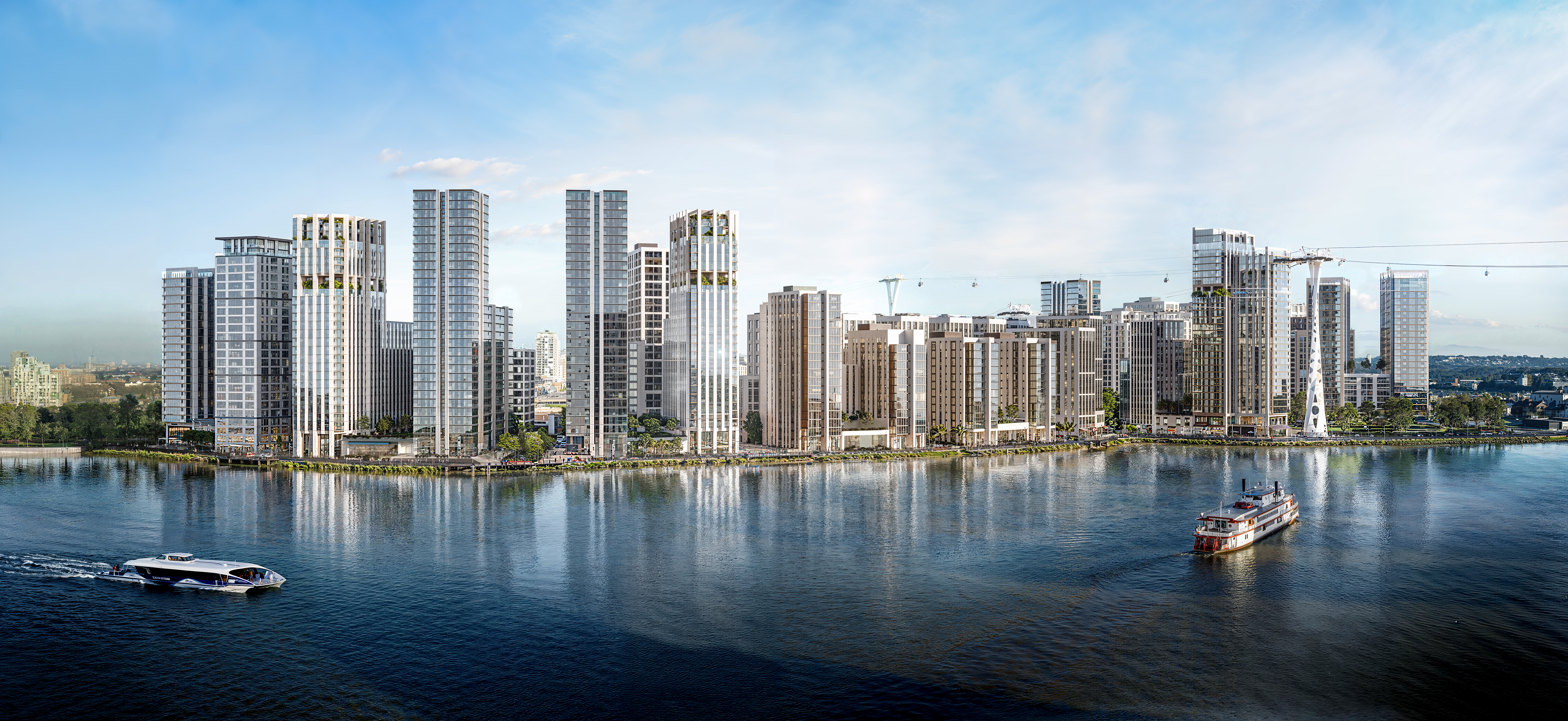
The ultimate destiny for all of this is of course as flats. Plans are advanced for a riverfront neighbourhood called Thameside West packing almost 5000 flats along this stretch, because ultimately it's the only landuse that makes commercial sense. The artist's impression I've seen depicts an execrably bland wall of glass towers entirely erasing the dockland heritage underneath, 80% funded by a developer based in the UAE. On the positive side it'll open up the waterfront with a public path all the way from here to Canning Town, finally completing the Lea Valley Walk. But until anyone gets this pipedream off the ground the Ironworks will continue to innovate on a long-term temporary basis, and if you ever get the chance to slip inside then do.
n.b. the Helen Mirren connection is because she appears in the TV series Mobland. n.b. the football connection is because West Ham FC (the Irons) have their roots in a team started by employees of the Thames Ironworks and Shipbuilding Co in 1895. n.b.15 photos on Flickr