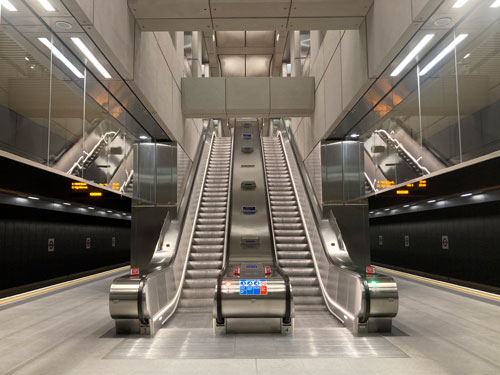
The other new tube station on the Northern line extension is a bit smaller, a bit simpler and a bit more useful for existing residents. It's also in a different borough, which was helpful because it meant TfL could ask for funding from two different councils. The area last had a station in 1848 when the London & South Western extended to a new terminus at Waterloo, and is still dominated by a railway viaduct. It's Nine Elms, and suddenly it's nine minutes from Leicester Square.
Nine years ago this was an underused corner of Sainsbury's car park, ripe for redevelopment and infrastructural refill. The supermarket promptly expanded into another part of the site, hiding its car park underneath, leaving room for civil engineers to carve out a deep box where the trolley store and a burglar alarm factory used to be. For a couple of years you could look down from a passing bus into an enormous trench supported by concrete beams, until they capped it off with a couple of understated boxes and today it's a portal into the 272nd Underground station.
As at Battersea Power Station station the trains arrive either side of a broad island platform, but here there's a lot more island than platform. This is a result of there only being one set of escalators, not two, which leaves a lot more circulation space between the tracks. If escalator counting is your thing, know that Nine Elms has one bank of three and BPS has two banks of two. At the heart of the subterranean expanse is a shiny information arch where you can consult the new version of the tube map (or in case of fire, grab an extinguisher). Inexplicably the two tube maps posted up elsewhere on the platforms are the old version which doesn't include the extension, so could never have been relevant.
You've not much reason to go right to the far end of the platforms unless you need the lift. Nine Elms has just the one, but it does go direct to street level so escaping from the station is much quicker than at Battersea. Poke your nose into the other extremities and you'll find emergency stairs and several doors labelled 'Intervention route to track'. Although it might be interesting to discover what lurks beyond the fire doors, best hope you never find out.
Two things Nine Elms has a lot more of than Battersea Power Station are seats and adverts, for connected reasons. Passengers can expect to wait awhile on the platforms here before a train arrives (currently up to 12 minutes), so TfL have kindly provided somewhere to sit and something to look at. The whole outer wall is postered, unlike BPS which has none, while a few bright digital screens grace four of the pillars. Those coming down the escalators also get to stare at a large unmissable video screen, although on launch day it was only promoting the company that supplied it. According to TfL's most recent blogpost, it's hoped that "advertisers wanting to target affluent residents and shoppers in zone one" will choose to use it.
The gateline is broad and leads swiftly into a ticket hall, then straight out into the street. For those who hang around there's not much to see, partly because the intended artwork got cancelled to save money. But there is a bank of ticket machines on one side and a little office on the other where the staff hang out, plus some large roundels splashed across the glass above each exit. I was particularly exasperated to see a 'Please stay hydrated in hot weather' sign in one corner, given that temperatures hadn't exceeded 20°C since the extension opened and it was the penultimate day of summer and ffs the health and safety pedants are obsessed.
Nine Elms isn't architecturally impressive from outside, more a long porch along the glassy end of a very large grey box. A second featureless cuboid covers the emergency exit at the far end, this even drabber - isolated and adrift amid a blank piazza. It's all because the new station is designed to be built on top of, in this case with a trio of towers containing 479 flats, 40% of them affordable. The percentage is only that high because the current Mayor controls what gets built on TfL's land, whereas the luxury highrises nearer the river got nodded through by the previous incumbent.
What's reassuring about Nine Elms is that it's faced on two sides by some very ordinary pre-existing residential areas. On the other side of Pascal Street is Apple Blossom Court, a sheltered housing scheme, plus a loop of postwar flats around Bramley Crescent. Across Wandsworth Road are the Vauxhall Estate (built by the Church of England) and the Wyvil Estate (a significant cluster of very 1960s blocks). And between them runs Wilcox Road, one of the outposts of Lambeth's Little Portugal, with its characterful parade of independent shops and cafes. It's such a shame that people who come to ride the extension are much more likely to end up in an overpriced Nine Elms eaterie than here enjoying a friendly pavement coffee accompanied by a Portuguese custard tart.
One of the biggest changes hereabouts this week isn't the new station but the arch that's been opened up beneath the railway viaduct. Previously the Thames-side Nine Elms strip was very much cut off from this side of the tracks but now the two sides are connected, purely so that those on the rich side can catch a train. It also means that Nine Elms residents are no longer stuck with Waitrose, they can easily walk through to Sainsbury's, while Waitrose has become directly accessible to those living on the less well-off side. The route follows a temporary slalom across the very eastern end of New Covent Garden Market, its hoardings attractively decorated with pictures of fruit, before negotiating a rainbow crossing and disappearing into the new arch. The workmen giving it a final touch-up on Monday were very keen that I came back after dark to see how they'd illuminated it.
This unassuming walkway is the first publicly accessible breach through half a mile of viaduct in decades. It's not just the new underground railway that's connected Wandsworth to Lambeth, its arrival has made a significant change at ground level too.
Normally they turf you off the train at Kennington, but the trains with the brand new destination on the front now go further. After the doors close they enter the loop where services once reversed, then suddenly break out into fresh broader concrete tunnels where the track noise sounds altogether different. It's over a mile to the first station, a concrete cavern which has transformed the land beneath Sainsbury's car park into an outpost of Zone 1. The final part of the journey is quicker, eventually crossing a broad scissor junction which feeds the train into the correct terminating platform. Welcome to Battersea Power Station station, born Monday 20th September 2021.
It's very much not your normal Northern line station, all stooped and curved, more a large rectangular box scooped out of the ground with trains at the bottom. The tracks run to either side, with connecting concourses at both ends and plenty of room for the escalators up the middle. The inner walls are shiny steel, each platform roof a stripe of ribbed timber and the outer walls matt black so as not to distract the eye. It reminded me a bit of Canary Wharf (but without the platform edge doors) and a bit of Heathrow Terminal 5 (though with more money thrown at the aesthetics).
On Day One the station was awash with people come to see what all the fuss was about, notably Freedom Pass holders and infrastructure enthusiasts. Some wandered round briefly, then headed up and out to explore the neighbourhood. Others undertook a full circuit before poking their nose into every cross passage and lift lobby in case they'd missed something. A few set up tripods or crouched patiently on the floor, attempting to get exactly the right camera shot without any pesky passengers wrecking it, something that'll undoubtedly be easier next week. And a lone member of staff sat in his cabin at the inbound end, seemingly watching over us all.
The outer walls are free from adverts and the platforms mostly free of seats, for connected reasons. A train will usually be waiting to take fresh passengers away, so they can sit in that, and at no point will the surface behind be clearly visible. At present the station sees only half a dozen trains an hour, max, with a brief period inbetween when neither platform is occupied and the litterpicker takes a breather. Several doors lead to hideyholes for staff, including one for Cleaners, a Mess, a Train staff toilet and the BPS Train staff tea point. If the roundels look crowded it's because Battersea Power Station is the longest station name on the tube network.
It doesn't matter which set of escalators you take because both lead to the centre of the mezzanine. This is vast with mighty pillars supporting a sawtooth roof, and includes a rectangular gash through which activity on the platforms can be glimpsed. Only those heading for a lift need make their way around the rim. The gateline is a dozen slots wide, easily large enough to cope with future hordes returning from as yet unfinished shops and offices. And occasionally the walls change colour. This is Sunset, Sunrise, Sunset by Alexandre da Cunha, two 100m long kinetic sculptures made from a sequence of rotating billboards which periodically spill a fresh shade from one end to the other. Top marks for its apparent simplicity.
Beyond the barriers are the key components of a 2020s station - five ticket machines, a rack of maps and a departures indicator. Don't expect to find public toilets but there are a number of retail units awaiting tenants, because that's inadequately funded public services for you. You might also bump into armed police keeping a close eye on things, or maybe that was a Day One exclusive. Eventually there'll be a second exit feeding directly into the heart of the Power Station development but for now signs direct you left towards the lesser heights of Battersea Park Road. Keep walking past the place that doesn't yet sell coffee, and then it's up and out.
The final escalators pierce the surface beneath a jagged skylit roof. Imagine a yellow sheet dropped on top of a smaller glass box at a jaunty angle and you'll get the picture. One day this'll be a busy street corner with a multi-towered backdrop, but for now it's just a hoardinged piazza with a few planters acting as passive security barriers. It was buzzing yesterday as crowds flocked in to see the new station and maybe grab a selfie outside. More serious photographers stepped back into the cycle lane for the ideal shot capturing both station and chimneys - a view that'll be sequentially disappearing as time goes by.
The one thing it's currently difficult to do from Battersea Power Station station is walk to Battersea Power Station. The developers have posted up a glossy map detailing all the posh refreshment options by the riverside but failed to mention how to get there, and those who mistakenly choose to walk clockwise rather than anti-clockwise face a much longer hike. It's almost as if the line has been opened a couple of years prematurely because as yet there's nothing convenient to visit, nor any tenants in the strange wiggly flats who might wish to travel to the West End. Instead it's the lucky residents of the Savona Estate opposite and the Patmore Estate behind who've been gifted an ultra-convenient A-list tube connection most other social housing backwaters can only dream of.
Battersea Power Station station's not yet what you expect it's going to be, and all the better for it.