London Open House: It's four years ago this week since I first moved to London, and events like Open House remind me just how little of the capital I've so far seen. It's always a joy to discover a new treat, and thankfully there must many more delights I have yet to experience. Here are details of the final three of the nine visits I crammed in this weekend [and my photos are here]
Crossness Pumping Station: There are always queues on Open House weekend, but I wasn't expecting to find them at an old sewage works on the Thames marshes in deepest Bexley. The old dear driving the ageing minibus from Abbey Wood station had never seen the like either. We'd endured a rattly journey past Thamesmead and down a godforsaken approach road, before being dropped off outside an unexpectedly ornate brick building in the middle of almost nowhere. The smell of effluent filled the air, which made the snaking queue of locals and curious centre-of-towners all the more surprising. The stench was coming from the modern sewage works just along the river but we were here to see its Victorian predecessor - the pioneering and palatial Crossness Pumping Station.
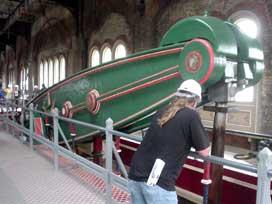
You'll remember from last month's journey down the River Fleet that London's sewage problem was finally solved in the 1860s by master engineer Joseph Bazalgette. Crossness was his crowning glory, the ultimate destination of all the icky brown waste in South London which was piped here so that it could could be stored in huge subterranean reservoirs before being pumped out into the Thames on the ebb tide. And to do the pumping Bazalgette constructed four huge beam engines, each able to lift more than a thousand gallons of sewage in one stroke. The scale of the operation is phenomenal, with 47 ton iron beams rising and falling with the rotation of enormous flywheels spinning beneath. Only one engine has so far been restored, by a group of willing volunteers who clearly love nothing more than the allure of steam and sooty hands. They've done a particularly good job on the decorative ironwork around the central 'Octagon', although even the rustiest corners of the building still retain a genuine industrial charm.
Crossness proved a fascinating building to explore, not just the main hall but also down into the dark pipe-filled bowels and up the winding staircase to the broad ironwork floor at beam level. We were only afforded a glimpse of the dilapidated Triple Expansion Engine House nextdoor, which still waits for an injection of Heritage Lottery Fund cash and for restoration. Meanwhile outside in the old boiler room (safety helmets off) a Museum of Sanitation is being established. Look - a row of old porcelain toilet pedestals! See - a collection of 19th century bedpans! Lo - a roll of Izal medicated toilet tissue! All a little twee perhaps, but the importance of this building to the long-term health of South London should not be overestimated. (full details on the highly informative and well-illustrated Crossness website)
TrinityBuoyWharf: It may sound ludicrous but London does indeed have its own lighthouse, situated on the thin strip of land where the river Lea enters the Thames, just to the north of the Millennium Dome. The lighthouse was never used to warn of underwater hazards but was instead kitted out by Trinity House back in Victorian times as a testing ground for their latest lighthouse technology. The site today is surprisingly inaccessible given its proximity to Docklands, with road access hidden away down a shabby industrial backstreet in the southeast corner of Tower Hamlets. There are great views of the Dome and the Thames from the top of the lighthouse, the interior artily filled by the computer generated ringing of Tibetan 'singing bowls' performing a 1000-year sound symphony (honest).
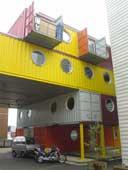
The rest of the wharf site is a strange mix of old and new, and oddly enchanting. An old red lightship is tied up a few yards from a genuine aluminium American diner. Brightly coloured metal containers have been piled up to create low cost office and studio space in a pioneering (keyword: sustainable) project called Container City, which us weekend visitors got to peer inside. Few central London office blocks can beat its low cost riverside panorama. And out at the end of Jubilee Pier I was surprised to be allowed access to the Vic 56 - an 85 foot long WW2 steamboat. There was no gangplank so I had to clamber aboard over the side of both the pier and the boat - rather inexpertly and inelegantly I thought. But it was a treat to wander the decks of this partly restored ship, clambering over ropes and climbing to the wheelhouse, and to meet and talk to the present owners. Seaworthy at least as far as Harwich, apparently, and no shortage of volunteers wanting to hide themselves away in the grimy engine room and stoke the steam engines.
Bank of England: There's only one bank to which we all belong but from which we can never draw money. All the more strange then to be allowed access to the Bank of England first thing on a Sunday morning. I had my rucksack searched by a top hatted security gent in a pink frock coat, and was then taken on a tour of (some of) this mighty fortress's interior by a softly spoken bank worker. As you'd expect the decor is magnificent, from fine crafted Derbyshire limestone walls to painstakingly beautiful mosaics underfoot. Corridors stretch off into the distance, a cantilever staircase rises seven storeys into the sky, and three floors of basement and vaults are hidden underfoot. We trudged through the Governor's office (he has a cheap black plastic government-issue pencil stand on his desk containing just one yellow highlighter pen) and on up the stairs to the room where the Bank of England decide the UK interest rate each month. Every wall and ceiling screamed opulence, especially in the facsimile Court Room, although we were assured that most of the bank's offices were rather more utilitarian. Our tour ended in the Bank of England's mini museum, where I took the opportunity to handle a genuine (and surprisingly heavy) gold bar - worth either 28 pounds or a hundred thousand pounds depending on whether you're weighing it or buying it. The queue was at least two hours long by the time I got back outside - bloody typical even for a top bank, I thought.
London Open House: Details below of three more properties I visited over the weekend. Still to come tomorrow, the room where they decide UK interest rates, a Victorian sewage cathedral and London's only lighthouse. [and see my photos here]
BBC Broadcasting House: The original BBC Broadcasting House was built in 1932, an Art Deco masterpiece at the top of Regent Street [explore the interior here]. Wartime news broadcasts, Listen with Mother and Desert Island Discs - they all came from here, as have millions more hours of BBC radio broadcasts. Now the building is undergoing refurbishment as part of a multi-million pound construction project (don't worry, none of it is coming out of the licence fee), due for final completion in 2010. To the east of old Broadcasting House a new building is being erected on the ruins of Egton House, and between the two there'll be a new public piazza where it's hoped concerts will be staged. On the roof of the east wing a glass cone sculpture [photo] has just been erected as a memorial to journalists and crew killed while on assignment. A laser beam installed inside will fire a beam of light high into the London sky at key moments of national importance (such as the death of a monarch or the start of the Ten O'Clock News). It's like the Batsignal made real, and it's due to be switched on for the first time next year.
As part of London Open House I was lucky enough to get a space on one of the very limited tours that took place this weekend, so I've been inside to see the old and the new. The Art Deco entrance foyer has been sympathetically restored, complete with Latin inscription to "the temple of the arts and muses" and a glowing white reception desk. We were taken inside up a narrow utilitarian 1932 staircase to the BBC Board of Governors' council chamber which, like the whole of the building, had been gutted and restored (now with sprung wood floor to conceal multimedia cabling). On the floor above we entered the holy of public broadcasting holies - the Director General's Office. It's empty at the moment, and will be until the whole building project is complete, but I felt quite at home in the DG's lair. On to a more modern facilty in the heart of the building - the new Radio 4 drama studio. The original studio suffered from vibrations every time a Bakerloo line train passed underneath, so the new facility has been very carefully sprung and soundproofed. There are front doors with knockers and bells for that authentic radio sound effect, as well as two sets of stairs, a bedroom and even a kitchen sink. Finally on to the new open-plan offices on the top floor and out onto the balcony at the front of Broadcasting House. We stood beside the big clock beneath the tall white 'radio mast' and enjoyed a most impressive view south over All Souls' church towards Regent Street [photo]. The whole tour, though brief, was a fascinating insight behind the scenes of a national landmark just before the broadcasters move back in. And I'm sure it'll be lovely when it's finished. (full details on the BBC's very detailed New Broadcasting House website)
Alexandra Palace: The BBC's other key acquisition in the 1930s was a failed amusement centre located high atop Muswell Hill in North London. Alexandra Palace had first opened to the public in 1873, and then promptly burnt to the ground 16 days later. The replacement building wasn't much more successful, long term, and so was vacant when the BBC came looking for a base for their inaugural high-definition television service. A competition was held between John Logie Baird and Marconi-EMI to see who had the better broadcasting technology, so two studios were built at either end of the building to give them both an equal chance. The world's first public television broadcast was made from the Baird studios on 2nd November 1936. Programmes were shown for just two hours a day (except on Sundays) and could only be received by the very few with appropriate receiving equipment living within 25 miles or so of the site. Eventually the 405-line EMI system won out, until the service was interrupted for six years by World War Two during which time the TV mast was used to jam German navigation signals instead. BBC TV production moved to Lime Grove in the Fifties but television news continued here until the Seventies at which point those bearded Open University types moved in. Then in 1980 Alexandra Palace was hit by another catastrophic fire, the BBC cancelled its lease and the studios fell into disrepair. (highly recommended histories of Ally Pally here, here and here)
Saturday's studio tour was hosted by the Alexandra Palace Television Society, whose dream it is to restore this unique slice of broadcasting heritage to some sort of working operation. These very keen amateurs have assembled a fine collection of historical televisual ephemera, from an old BBC television camera to 70-years worth of old TV sets. As part of their presentation we got to watch a video of the cinema newsreel that reported the opening transmission of the new television service in 1936. A Thirties glamourpuss sang a scarily over-the-top song in praise of television (X-Factor it wasn't), and the realisation that she had sung on the very spot where we were sitting sent a chill down my spine.
After an all-too-brief a look round the exhibits our next stop was back in the main building. Here the main attraction is now a municipal ice rink, and I don't think I've ever seen quite so many cocky adolescent girls in fluffy hooded jackets and snarling sportswear-attired boys as I did in the lengthy snaking queue. We headed instead to the old Victorian Theatre. Nothing quite prepared us for the experience as we emerged from the foyer into a cavernous dark space that had once been an auditorium. The theatre had never quite been a success, not least because acoustics and lines of sight were poor, and several decades of neglect made for a very sorry sight indeed. Naturally there's a charitable band of volunteers dedicated to restoring the rotting boards and crumbling ceiling, although I couldn't help thinking they were in danger of spending several years and several hundreds of thousands of pounds on rescuing a theatre that couldn't possibly stand on its own two feet financially. Still, good luck to them, and if you ever get the opportunity to peer inside, do.
19 Princelet Street: Tucked away in a quiet street between Spitalfields and Brick Lane lies a unique 18th century silk weaver's house, now an extraordinary museum. Over the years this house has been occupied by generations of immigrants, first Huguenots fleeing from France and later Jews who built a Victorian synagogue in the back garden. Astonishingly the house and synagogue still stand - but only just, and £3 million is needed to stave off the threat of decay and possible collapse. The exhibition inside depicts the history of East End immigration, right up to modern Bangladeshi and Somali arrivals, using the symbolism of piled-up suitcases. Impressively the majority of the displays throughout have been contributed by local Tower Hamlets schoolchildren, most of whom are immigrants themselves. It's genuinely inspiring stuff, putting across powerful messages with simplicity and clarity. No wonder there were queues outside all weekend (thanks for keeping me company, Ben). Due to the house's fragile nature the museum is only open for a handful of days each year, but I'd urge you to visit this hidden treasure at the next available opportunity. (make a virtual visit to 19 Princelet Street here)
London Open House: It's that weekend again, the one where hundreds of London properties open their normally-closed doors to the public (but no Gherkin this year). There are probably too many buildings open, to be honest, because you'd need more than one lifetime to get round them all. But I managed five yesterday from across the capital, and I'm off out again today to visit some more (so I'm in a bit of a rush). Here's where I've been so far, and I'll come back tomorrow and tell you a bit more about the top two.
• BBC Broadcasting House: currently closed during a hu-uuge rebuilding project. I've stood on the roof, I've stood in the new Radio 4 drama studio, and I've even stood in the DG's office. Which was kind of appropriate. (more tomorrow)
• AlexandraPalace: I can't tell you how spooky it was to watch a video of the world's very first television programme in the same studio (on the very spot) where that broadcast was recorded. (more tomorrow)
• Wellcome Trust, Gibbs Building: This year-old office space on the Euston Road won the RIBA 2005 Prize for its architecture, and from the inside you can see why. There's a huge central atrium, there are several floors of glass-walled open workspaces and, most impressively, there's a stunning seven-storey sculpture (called Bleigiessen) made from a hundred thousand glass beads threaded on thin wires in a sort of danglyglobbyshape that glows and shimmers. See photo left. Lovely.
• Kingsley Hall: A few hundred yards down the road from me, in Bromley-by-Bow, there's a community centre with a unique history. I've written about the place before (full history here) but I'd never previously ventured inside. Mahatma Gandhi stayed here for several weeks in 1931 on his only visit to London, advancing the case for Indian home rule (and meeting local people), while psychologist RD Laing took over the centre in the 60s for a not terribly successful schizophrenia project. The current beardy centre manager showed a leftish group of us around, from the pool tables on the first floor to Gandhi's tiny cell on the roof. I was most impressed by the commitment of all those here to peace and to the community, and it's a place I'm proud to have as a neighbour. (more information here)
• A13 Artscape: Of all the things I could have done yesterday afternoon, I chose to take a minibus tour down the A13 through Barking and Dagenham. You might think that I was mad. I was certainly the only person on the tour (although I was told that the noon tour had been packed). But I wanted to see a pioneering urban art project which has engineered new landscapes and landmarks alongside what it has to be said is one of London's dreariest arterial roads. My guide in the minibus was the borough's Head of Arts Services, so she was duly passionate about a couple of subways, a lot of fencing and some lights on sticks. And, by the end of the tour, so was I. The various projects along the road are both innovative and functional, from the airport-style lights of Holding Pattern to the towering tarmac cones on the Goresbrook roundabout. The upgraded subways heal the scar cut across underprivileged communities by the A13, and carefully chosen fencing and tree-planting will give the road a new kind of rhythm. Four million quid has transformed dreary and unsafe locations into welcoming public spaces of which the borough are rightly enormously proud. The rest of London would do well to follow their lead. (official website here)

Crossness Pumping Station: There are always queues on Open House weekend, but I wasn't expecting to find them at an old sewage works on the Thames marshes in deepest Bexley. The old dear driving the ageing minibus from Abbey Wood station had never seen the like either. We'd endured a rattly journey past Thamesmead and down a godforsaken approach road, before being dropped off outside an unexpectedly ornate brick building in the middle of almost nowhere. The smell of effluent filled the air, which made the snaking queue of locals and curious centre-of-towners all the more surprising. The stench was coming from the modern sewage works just along the river but we were here to see its Victorian predecessor - the pioneering and palatial Crossness Pumping Station.
The scale of the operation is phenomenal, with 47 ton iron beams rising and falling with the rotation of enormous flywheels spinning beneath. Only one engine has so far been restored, by a group of willing volunteers who clearly love nothing more than the allure of steam and sooty hands. They've done a particularly good job on the decorative ironwork around the central 'Octagon', although even the rustiest corners of the building still retain a genuine industrial charm.
Trinity Buoy Wharf: It may sound ludicrous but London does indeed have its own lighthouse, situated on the thin strip of land where the river Lea enters the Thames, just to the north of the Millennium Dome. The lighthouse was never used to warn of underwater hazards but was instead kitted out by Trinity House back in Victorian times as a testing ground for their latest lighthouse technology. The site today is surprisingly inaccessible given its proximity to Docklands, with road access hidden away down a shabby industrial backstreet in the southeast corner of Tower Hamlets. There are great views of the Dome and the Thames from the top of the lighthouse, the interior artily filled by the computer generated ringing of Tibetan 'singing bowls' performing a 1000-year sound symphony (honest).
The rest of the wharf site is a strange mix of old and new, and oddly enchanting. An old red lightship is tied up a few yards from a genuine aluminium American diner. Brightly coloured metal containers have been piled up to create low cost office and studio space in a pioneering (keyword: sustainable) project called Container City, which us weekend visitors got to peer inside. Few central London office blocks can beat its low cost riverside panorama. And out at the end of Jubilee Pier I was surprised to be allowed access to the Vic 56 - an 85 foot long WW2 steamboat. There was no gangplank so I had to clamber aboard over the side of both the pier and the boat - rather inexpertly and inelegantly I thought. But it was a treat to wander the decks of this partly restored ship, clambering over ropes and climbing to the wheelhouse, and to meet and talk to the present owners. Seaworthy at least as far as Harwich, apparently, and no shortage of volunteers wanting to hide themselves away in the grimy engine room and stoke the steam engines.
BBC Broadcasting House: The original BBC Broadcasting House was built in 1932, an Art Deco masterpiece at the top of Regent Street [explore the interior here]. Wartime news broadcasts, Listen with Mother and Desert Island Discs - they all came from here, as have millions more hours of BBC radio broadcasts. Now the building is undergoing refurbishment as part of a multi-million pound construction project (don't worry, none of it is coming out of the licence fee), due for final completion in 2010. To the east of old Broadcasting House a new building is being erected on the ruins of Egton House, and between the two there'll be a new public piazza where it's hoped concerts will be staged. On the roof of the east wing a glass cone sculpture [photo] has just been erected as a memorial to journalists and crew killed while on assignment. A laser beam installed inside will fire a beam of light high into the London sky at key moments of national importance (such as the death of a monarch or the start of the Ten O'Clock News). It's like the Batsignal made real, and it's due to be switched on for the first time next year.
Alexandra Palace: The BBC's other key acquisition in the 1930s was a failed amusement centre located high atop Muswell Hill in North London. Alexandra Palace had first opened to the public in 1873, and then promptly burnt to the ground 16 days later. The replacement building wasn't much more successful, long term, and so was vacant when the BBC came looking for a base for their inaugural high-definition television service. A competition was held between John Logie Baird and Marconi-EMI to see who had the better broadcasting technology, so two studios were built at either end of the building to give them both an equal chance. The world's first public television broadcast was made from the Baird studios on 2nd November 1936. Programmes were shown for just two hours a day (except on Sundays) and could only be received by the very few with appropriate receiving equipment living within 25 miles or so of the site. Eventually the 405-line EMI system won out, until the service was interrupted for six years by World War Two during which time the TV mast was used to jam German navigation signals instead. BBC TV production moved to Lime Grove in the Fifties but television news continued here until the Seventies at which point those bearded Open University types moved in. Then in 1980 Alexandra Palace was hit by another catastrophic fire, the BBC cancelled its lease and the studios fell into disrepair.
• Wellcome Trust, Gibbs Building: This year-old office space on the Euston Road won the RIBA 2005 Prize for its architecture, and from the inside you can see why. There's a huge central atrium, there are several floors of glass-walled open workspaces and, most impressively, there's a stunning seven-storey sculpture (called Bleigiessen) made from a hundred thousand glass beads threaded on thin wires in a sort of dangly globby shape that glows and shimmers. See photo left. Lovely.


 The scale of the operation is phenomenal, with 47 ton
 The rest of the wharf site is a strange mix of old and new, and oddly enchanting. An old red