London Open House (catchup): There are 700 potential buildings to visit on Open House weekend, so even when you think you've visited a lot you've barely scratched the surface. I managed 13 altogether, spread out across the capital. Here's a rundown of those I've failed to mention thus far.
Barnardo's Village: When I was little, and every penny counted, I used to have a Dr Barnardo's collecting box in the shape of a cottage. It was given to me by a nice old lady who lived up the road, and every year she'd invite all the box-owning boys and girls in the village to a big party in her back garden. I always felt slightly guilty attending because I knew how few pennies were inside my box, and that my share of the sandwiches and squash on the table beneath the tulip tree had probably cost considerably more. Yesterday I went along to Barnardo's HQ in Barkingside, out on the loopy bit of the Central line, and discovered that these cottages are based on real life buildings that played a major part in the charity's work. More to the point, my old collecting box is rare enough that it would now be worth more empty that it ever was full. If only I'd have known, I could have eaten those sausage rolls and jelly with a clear conscience.
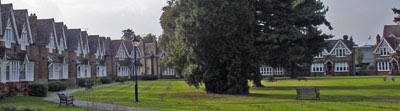
Dr Barnardo's initial work with ragged children had concentrated solely on boys, but a wedding gift of Essex land in 1873 allowed him to establish a home for girls as well. He created a Girls' Village of 14 cottages set around a rural green, each housing about 20 girls looked after by a supervisor called 'Mother'. Girls were trained in washing, cleaning and embroidery, all the sorts of skills that might get them a job as a household servant when they were older. The village grew with the addition of further cottages around a second green, until more than 1300 girls were being housed, fed and educated on site. It took until the 1930s for boys to be admitted, ending the practice of splitting brothers and sisters on separate sites. It wasn't until the 60s that institutional care was frowned upon and the village emptied of residents. One of the greens was developed as a (criminally hideous) residential school for disabled children, and another area sold off to the council (now, perhaps unsurprisingly, home to a Tesco supermarket).
The Barnardo village in Barkingside isn't usually accessible to the public, but for Open House we were shown an Ever Open Door. One cottage has been restored as a heritage exhibit, with charity memorabilia and a reproduction of the good doctor's office inside. There was also access to the Children's Church, normal-sized on the outside but with child-height pews on the inside. "Suffer the little children to come unto me and forbid them not" reads the inscription on the arch over the chancel, and this might well have been Dr B's motto. I doubt there'd have been volunteers selling squash and biscuits at the back in his day, let alone Christmas cards, pens and mugs. I followed a most informative tour round the perimeter of the green, viewing the modern housing association infill and trying to block out views of the 60s monstrosity office block in the old apple orchard. And we ended up beneath the clock tower at the bronze memorial marking the spot where Barnardo's ashes were scattered in 1905. His heart will be forever here on the edge of the London suburbs, amongst his girls, and deserving of our thanks.
plus... » Bevis Marks Synagogue: Another Sunday, another synagogue. I'm getting the hang of covering my head now, but the skull cap they provided kept trying to slide off so I had to hold myself upright to avoid unintentional offence. Considerably more photogenic than Nelson Street which I visited last week, but conspicuously unwilling to allow photographs. [exterior photo] » Christ Church Spitalfields: Hawksmoor's triumphant Baroque box, permitted to fall derelict but recently restored to former glories and reopened in 2004. The congregation's on the evangelical side, and they were just clearing off when I arrived on Sunday which may explain the two toddlers whizzing round the nave on scooters. But what a place in which to worship. [interior photo] » Kirkaldy Testing Museum: The centrepiece of the museum is a Victorian curiosity - a 47ft long metal device for testing the stresses and strains of metals. It works on hydraulics, and so attracts (extremely keen) enthusiasts of a mechanical bent who like wearing overalls and getting greasy. The museum's small but rammed, and opens on the first Sunday of every month. Ian can tell you more. » The Linnean Society: Serious natural historians, tucked away in a side wing near the Royal Academy, as they have been for centuries. Darwin first announced his theories of natural selection at a meeting of the Society in 1858. And they have a lovelylibrary. » Old Turkish Baths: Looks like a mini minaretted temple on the outside, accidentally discarded between two office blocks near Bishopsgate. Enter inside, down the steps, and it's a pizza restaurant. A damned ornate fame-obsessed pizzeria, but a pizzeria all the same. [exterior][interior] » Blue Fin Building: Yet another new office block, home to IPC Media, in the shadow of Tate Modern on Southwark Street. "Sorry, we're closed." Damn. [exterior photo] » Greenwich Yacht Club: No, completely missed this one. How the hell am I supposed to get (promptly) from the East End to the North Greenwich Peninsula when the Jubilee line's shut, the East London line's shut and the only bus under the Thames refuses to pick me up because it's full. Damned frustrating. Yeah, should have gone by boat.
London Open House (day 2): A perfect sun-dappled architectural weekend continues. I've been dashing around the capital again, lime green brochure in hand, although thwarted on more than one occasion by TfL's ubiquitous engineering works. A selection of Sunday reports are below, and I've saved a few more to post tomorrow.
One Bishops Square: Every Open House catalogue contains, if you know where to look, free access to some brand new shiny City office block whose owners are keen to show off their cutting edge interior to the general public. This year, admittedly just outside the Square Mile, the proud parents are Allen & Overy in Spitalfields. I think they're a bank - the glossy leaflet they handed us failed to mention this, so maybe the Brand Manager will get the sack tomorrow morning. Instead our visit was all about the architecture, in a wholly jealous 'I wish my workplace looked like this' sort of way. Deep glassy atria contain unexpected features like a shower of illuminated balls or a cascade of fluttering fabric flowers. Viewed from the glass lift, the flowers open and close to the rhythm of your descent. You might recognise the animated figure striding across the basement walls - that's your fractured image filmed earlier at the top of the escalator. There's a state-of-the-art gym, which they must be very proud of because our self-guided tour took an unnecesary diversion looping past whole avenues of rubber-handled cardio treadmills. From the first floor meeting rooms managers can look directly down into Spitalfields Market, a reminder that acres of heritage retail was eradicated to give these bankers their fresh new home. But the best view is from the spacious roof terraces - one on the sixthfloor, another on the tenth - where clients can be opulently dined and secretaries can enjoy a full-on Gherkin with their coffee. Had the credit crunch not intervened, all our City fringes might have been destined to be consumed beneath towering temples to capitalism such as this.
Queen Mary College, Institute of Cell & Molecular Science: If university science labs conjure up visions of acid-pocked benches in musty halls, think again. Queen Mary's took a completely different approach with their most recent research facility, a wacky vibrant building full of light, shape and colour. It's tucked away behind the Royal London Hospital in Whitechapel, which might be why so few other visitors managed to find it this afternoon. But, wow. First point of call was the Perrin Lecture Theatre, which might have been quite normal were it not bright green throughout (bar ten randomly selected seats upholstered in red) and lit by flying saucer lights. Next across the bridge linking the two halves of the building - in today's bright sun, a tunnel of dazzling pinky orange. And on the far side a vast hall with room-sized organicpods floating in the centre, the shape of nuclei and headless insects. Look down to the open basement and you'll see the benches where QM students toil to discover stuff, like a scientific bazaar selling experimental equipment arranged in neat blue-capped rows. You get the feeling that working here might just be fun, and it's easy to see why the Blizard Building won a RIBA award in 2006.
Hoover Building: If There's nothing worse than travelling way out into the suburbs to an iconic Open House location only to find no banner, no volunteer and no sign of activity. Every OH minute is precious, and Zone 4 isn't a good place to waste them. I've been to this Art Deco treasure several times before, even bought teabags in the supermarket at the rear, but never managed to get inside the building proper. Thankfully, bang on ten o'clock, the chained front door swung open and we were invited within. The shiny angular lights and lift fittings delighted us all, until our guide informed us that almost all the decor we'd see was nothing but a carefully crafted fake. Hoover executives worked in these offices for 50 years, but the current lease is held by cigarette manufacturer Gallagher who dutifully refurbished the shell of the building in the 90s and then promptly moved out. What remains are epic stairwells, branded doors and echoing workspaces, all of them a curious mixture of modern and modernist. This was the canteen... this was the vacuum cleaner design studio... this was the boss's office. Even the ladies in our party appreciated the almost-original fittings in the gents toilets, including two central tub-like sinks. And it was great to get out onto the 2nd floor balcony and walk behind the giant lettering above the entrance, looking down over the gardens and the busy A40. Behind this magnificent frontage a timewarped warren of rooms awaits a fresh caring tenant.
London Open House (day 1): Blimey, what magnificent late summer weather for a stroll around town looking at buildings. Lots of buildings, as it turned out. I even managed a walk through the middle of HMTreasury (past the coffee bars where scores of civil servants must have been fretting this week over a snatched latte), which isn't something you can do every weekend. Same again tomorrow?
William Booth College: If you're training to become a Salvation Army Officer, you'll spend two years here in the southern suburb of Denmark Hill. The college was designed by Sir Giles Gilbert Scott, and is built throughout in typical Twenties austere brick. There's a main Assembly Hall where ceremonial flags are paraded, and in which the faithful meet before a Blood & Fire emblem. But the most noticeable feature is the 190 foot tower which dominates the local skyline. For Open House, visitors were allowed to climb to the top. First up three floors in one of the oldest operational lifts in London (they filmed Poirot here, it's that old). And then a succession of red spiral staircases, the first 58 steps to the mobile mast gallery and the final 58 to the very top. From way up here, on a gorgeous sunny day like today, there's a fantastic view in all directions. From the City round to Canary Wharf, and Crystal Palace round to Battersea Power Station, all with ordinary modern estates in the foreground. Join the Sally Army and you might be able to sneak up here for an after dark panorama, or even to watch the New Year fireworks. Well worth the tottery ascent, and another unique Open House experience.
Royal Institution: Behind a pillared facade up a Mayfair sidestreet, an astonishingly high number of major scientific discoveries have been made. Here ten chemical elements were first identified, the first electric generator was powered up and the first laser beam was fired. You can see many of these pioneering experimental gizmos in a new museum in the basement of this just-reopened building. It's not yet quite complete, but the illuminated periodic table is ready for you to bash in time to Tom Lehrer's song The Elements. Upstairs is the Lecture Theatre, as viewed every year at Christmas on the TV. I got to sit on the newly refurbished pink seats and look down on the famous bench at which so many discoveries were first demonstrated. There's plenty for visitors to see scattered through the corridors and libraries, and a busy programme of upcoming events to herald the Institution's rebirth. Expect to hear a lot more from Albermarle Street in the future.
Marlborough House: This is one of those grand houses overlooking The Mall, the posh villas originally built by nobles but later snapped up the Royal Family. Not surprisingly the Duke of Marlborough built this one. His wife the Duchess supervised the interior design, shamelessly butchering a set of ceiling murals from the Queen's House in Greenwich by shrinking them down to fit her own central saloon. There are two main staircases, both fabulously decorated with oil paintings of the Duke's famous wartime victories. The house later passed on to the future Edward VII and his wife Alexandra. Hunt round the back of the garden and you might find gravestones to Caesar (Eddie's beloved fox terrier) and Bonny ('favourite rabbit' of the Princess of Wales). For the last 50 years the house has been at the disposal of the Commonwealth Secretariat, and world statesmen meet here every now and again to discuss matters of trade and sustainability and global stuff. Everyone has a seat crammed round the long oval table in the Red Drawing Room, arranged not by importance but in alphabetical order (the UK falls between Uganda and the United Republic of Tanzania). A most elegant setting for such international relations.
Lambeth Palace: It's always tough to decide where to visit first on an Open House morning, and when to arrive. The ideal building is a rarely open architectural big hitter, and the ideal time is before the day's mammoth queues descend. I plumped for the Archbishop's pad on the Thames Embankment, and turned up an hour before opening time to ensure I was on the second tour and not still waiting round the corner at noon. We got a 50 minute look round, starting in the Crypt Chapel (which used to flood when the river was wider). There's a surprisingly spacious courtyard at the heart of the building, and a far bigger ornamental garden beyond. Outside the Great Hall is a 16th century fig tree, and inside is a spectacular hammerbeam roof carved with Moorish busts above the library. We were treated to tales of murdered archbishops, but didn't catch sight of the present incumbent (even though he was in the building somewhere). And finally to the main chapel, to sit on a bishop's chair beneath modern muralled vaulting. The complex is now too small to host the once a decade Lambeth Conference, but remains grand and reverential inside.

Barnardo's Village: When I was little, and every penny counted, I used to have a Dr Barnardo's collecting box in the shape of a cottage. It was given to me by a nice old lady who lived up the road, and every year she'd invite all the box-owning boys and girls in the village to a big party in her back garden. I always felt slightly guilty attending because I knew how few pennies were inside my box, and that my share of the sandwiches and squash on the table beneath the tulip tree had probably cost considerably more. Yesterday I went along to Barnardo's HQ in Barkingside, out on the loopy bit of the Central line, and discovered that these cottages are based on real life buildings that played a major part in the charity's work. More to the point, my old collecting box is rare enough that it would now be worth more empty that it ever was full. If only I'd have known, I could have eaten those sausage rolls and jelly with a clear conscience.
One Bishops Square: Every Open House catalogue contains, if you know where to look, free access to some brand new shiny City office block whose owners are keen to show off their cutting edge interior to the general public. This year, admittedly just outside the Square Mile, the proud parents are Allen & Overy in Spitalfields. I think they're a bank - the glossy leaflet they handed us failed to mention this, so maybe the Brand Manager will get the sack tomorrow morning. Instead our visit was all about the architecture, in a wholly jealous 'I wish my workplace looked like this' sort of way. Deep glassy atria contain unexpected features like a shower of illuminated balls or a cascade of fluttering fabric flowers. Viewed from the glass lift, the flowers open and close to the rhythm of your descent. You might recognise the animated figure striding across the basement walls - that's your fractured image filmed earlier at the top of the escalator. There's a state-of-the-art gym, which they must be very proud of because our self-guided tour took an unnecesary diversion looping past whole avenues of rubber-handled cardio treadmills. From the first floor meeting rooms managers can look directly down into Spitalfields Market, a reminder that acres of heritage retail was eradicated to give these bankers their fresh new home. But the best view is from the spacious roof terraces - one on the sixth floor, another on the tenth - where clients can be opulently dined and secretaries can enjoy a full-on Gherkin with their coffee. Had the credit crunch not intervened, all our City fringes might have been destined to be consumed beneath towering temples to capitalism such as this.
Queen Mary College, Institute of Cell & Molecular Science: If university science labs conjure up visions of acid-pocked benches in musty halls, think again. Queen Mary's took a completely different approach with their most recent research facility, a wacky vibrant building full of light, shape and colour. It's tucked away behind the Royal London Hospital in Whitechapel, which might be why so few other visitors managed to find it this afternoon. But, wow. First point of call was the Perrin Lecture Theatre, which might have been quite normal were it not bright green throughout (bar ten randomly selected seats upholstered in red) and lit by flying saucer lights. Next across the bridge linking the two halves of the building - in today's bright sun, a tunnel of dazzling pinky orange. And on the far side a vast hall with room-sized organic pods floating in the centre, the shape of nuclei and headless insects. Look down to the open basement and you'll see the benches where QM students toil to discover stuff, like a scientific bazaar selling experimental equipment arranged in neat blue-capped rows. You get the feeling that working here might just be fun, and it's easy to see why the Blizard Building won a RIBA award in 2006.
Hoover Building: If There's nothing worse than travelling way out into the suburbs to an iconic Open House location only to find no banner, no volunteer and no sign of activity. Every OH minute is precious, and Zone 4 isn't a good place to waste them. I've been to this Art Deco treasure several times before, even bought teabags in the supermarket at the rear, but never managed to get inside the building proper. Thankfully, bang on ten o'clock, the chained front door swung open and we were invited within. The shiny angular lights and lift fittings delighted us all, until our guide informed us that almost all the decor we'd see was nothing but a carefully crafted fake. Hoover executives worked in these offices for 50 years, but the current lease is held by cigarette manufacturer Gallagher who dutifully refurbished the shell of the building in the 90s and then promptly moved out. What remains are epic stairwells, branded doors and echoing workspaces, all of them a curious mixture of modern and modernist. This was the canteen... this was the vacuum cleaner design studio... this was the boss's office. Even the ladies in our party appreciated the almost-original fittings in the gents toilets, including two central tub-like sinks. And it was great to get out onto the 2nd floor balcony and walk behind the giant lettering above the entrance, looking down over the gardens and the busy A40. Behind this magnificent frontage a timewarped warren of rooms awaits a fresh caring tenant.
William Booth College: If you're training to become a Salvation Army Officer, you'll spend two years here in the southern suburb of Denmark Hill. The college was designed by Sir Giles Gilbert Scott, and is built throughout in typical Twenties austere brick. There's a main Assembly Hall where ceremonial flags are paraded, and in which the faithful meet before a Blood & Fire emblem. But the most noticeable feature is the 190 foot tower which dominates the local skyline. For Open House, visitors were allowed to climb to the top. First up three floors in one of the oldest operational lifts in London (they filmed Poirot here, it's that old). And then a succession of red spiral staircases, the first 58 steps to the mobile mast gallery and the final 58 to the very top. From way up here, on a gorgeous sunny day like today, there's a fantastic view in all directions. From the City round to Canary Wharf, and Crystal Palace round to Battersea Power Station, all with ordinary modern estates in the foreground. Join the Sally Army and you might be able to sneak up here for an after dark panorama, or even to watch the New Year fireworks. Well worth the tottery ascent, and another unique Open House experience.
Royal Institution: Behind a pillared facade up a Mayfair sidestreet, an astonishingly high number of major scientific discoveries have been made. Here ten chemical elements were first identified, the first electric generator was powered up and the first laser beam was fired. You can see many of these pioneering experimental gizmos in a new museum in the basement of this just-reopened building. It's not yet quite complete, but the illuminated periodic table is ready for you to bash in time to Tom Lehrer's song The Elements. Upstairs is the Lecture Theatre, as viewed every year at Christmas on the TV. I got to sit on the newly refurbished pink seats and look down on the famous bench at which so many discoveries were first demonstrated. There's plenty for visitors to see scattered through the corridors and libraries, and a busy programme of upcoming events to herald the Institution's rebirth. Expect to hear a lot more from Albermarle Street in the future.
Marlborough House: This is one of those grand houses overlooking The Mall, the posh villas originally built by nobles but later snapped up the Royal Family. Not surprisingly the Duke of Marlborough built this one. His wife the Duchess supervised the interior design, shamelessly butchering a set of ceiling murals from the Queen's House in Greenwich by shrinking them down to fit her own central saloon. There are two main staircases, both fabulously decorated with oil paintings of the Duke's famous wartime victories. The house later passed on to the future Edward VII and his wife Alexandra. Hunt round the back of the garden and you might find gravestones to Caesar (Eddie's beloved fox terrier) and Bonny ('favourite rabbit' of the Princess of Wales). For the last 50 years the house has been at the disposal of the Commonwealth Secretariat, and world statesmen meet here every now and again to discuss matters of trade and sustainability and global stuff. Everyone has a seat crammed round the long oval table in the Red Drawing Room, arranged not by importance but in alphabetical order (the UK falls between Uganda and the United Republic of Tanzania). A most elegant setting for such international relations.
Lambeth Palace: It's always tough to decide where to visit first on an Open House morning, and when to arrive. The ideal building is a rarely open architectural big hitter, and the ideal time is before the day's mammoth queues descend. I plumped for the Archbishop's pad on the Thames Embankment, and turned up an hour before opening time to ensure I was on the second tour and not still waiting round the corner at noon. We got a 50 minute look round, starting in the Crypt Chapel (which used to flood when the river was wider). There's a surprisingly spacious courtyard at the heart of the building, and a far bigger ornamental garden beyond. Outside the Great Hall is a 16th century fig tree, and inside is a spectacular hammerbeam roof carved with Moorish busts above the library. We were treated to tales of murdered archbishops, but didn't catch sight of the present incumbent (even though he was in the building somewhere). And finally to the main chapel, to sit on a bishop's chair beneath modern muralled vaulting. The complex is now too small to host the once a decade Lambeth Conference, but remains grand and reverential inside.