Every year there's one building in the Open House programme that makes me go "wow, they're actually opening that up this year?!" In 2004 it was the Gherkin, in 2005 Broadcasting House, in 2013 Beckton Sewage Works, in 2015 Millennium Mills and this year Bow Baptist Church. I'd walked past it thousands of times but never been inside, and Open House 2020 provided an unexpected opportunity.
There's been a Baptist church here since 1785, initially a frail structure in the meadows by Bow Bridge whose pastor baptised new members in the River Lea. A sturdier meeting house was erected in 1801 at the current location, facing the village green at the foot of Old Ford Lane by the windmill, with seats for 600 worshippers. A third chapel was needed by 1866, "a building of majestic proportions and perfect acoustics", this time with capacity for 1000 and a vast Sunday schoolroom tucked away in the basement. I know all this because the church website majors in history as well as faith, including a reproduction of the 150th anniversary pamphlet packed with much heritage detail.
The Victorian chapel was bombed in 1940 which meant a fourth building was required, an austere confection in brick, although this didn't get completed until 1956. And it would still be here today if only land hereabouts hadn't become so valuable recently. The neighbouring plot overlooking McDonalds got turned into lofty residential towers a while back, and the developers had a word and suggested incorporating the chapel into their plans. A church only really needs a ground floor so how about rebuilding it with flats on top, all community housing of course... and so in 2012 was born Bow Baptist Church number 5.
All I've ever been able to distinguish from the road is a boxy foundation with one large reinforced glass window. It is at least a very attractive window, given how simple it is - a grid of squares with pastel-coloured infill forming the shape of a cross. Having now been inside the building, I can confirm that this window is also pretty much the sole piece of decoration in the interior. Baptist worship is far more about people than unnecessary artefacts, so a white-walled room laid out with chairs, a lectern and a buried pool will suffice. The chapel no longer seats 1000, because these days it doesn't need to, but they had 30 in on Sunday morning which in these distanced times isn't bad going.
What was particularly impressive is how much extra capacity has been stashed away on the ground floor behind the main room. A separate (subdividable) hall permits a wealth of activities including a popular Mother and Toddler group. The Sunday School is no longer confined to a basement, instead sharing a wood-panelled room with the weekly Youth Group. A kitchen has of course been provided at the back - one of the boons of a modern building - but also a shower room which permits an unexpected extra activity. One night a week the church hosts rough sleepers, or did before the pandemic forced alternative arrangements, with volunteers serving up food, shelter and the opportunity for a welcome wash.
Your local church probably has a similar programme of unpaid good works, indeed I suspect if I ever had the opportunity to tour the mosque in the converted pub across the road I'd discover something similar. But it's always good to discover what's really going on in your community, rather than repeatedly walking past a spangled window oblivious to all that's being coordinated within.
In 2020 the ideal Open House venue is a) outdoors b) architect-led c) within walking distance of home d) low-key enough that fewer than six people will turn up e) Instagram-friendly. Welcome to Aberfeldy Street.
The Aberfeldy Estate is a large triangle of postwar housing in Poplar bounded on two sides by the A12 and A13, and on the hypotenuse by Bow Creek. Easily overlooked, it's one of the most deprived corners of Tower Hamlets and for years has had a dubious reputation. Unsurprisingly redevelopment is afoot. The local housing association is replacingits stock in partnership with a construction company, sequentially demolishing 300 residential units in order to build 1200 more. Phases 1 and 2 are pretty much complete, replacing the A13 flank with a wall of cappuccino-friendly apartments. Aberfeldy Street will be phase 4.
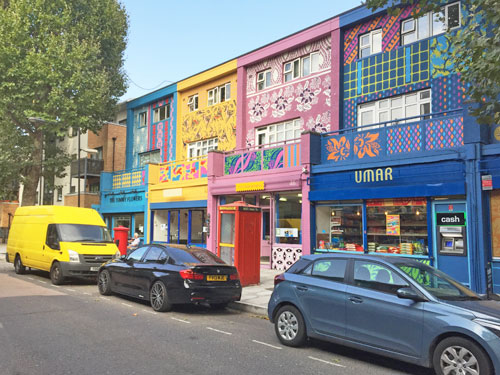
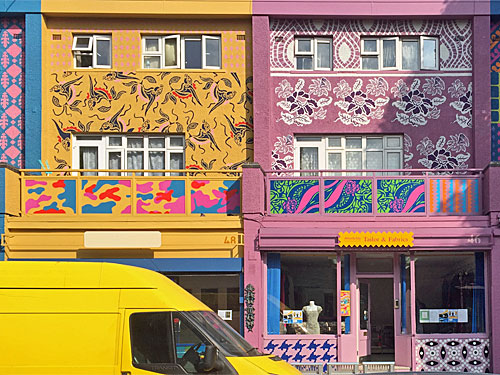
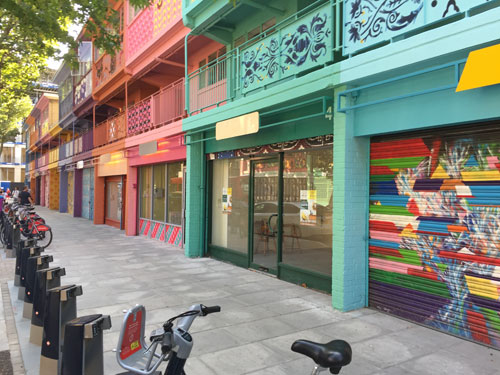
It might seem strange to paint a high street pretty colours shortly before you knock it down, but there is method to the madness. Aberfeldy Street has long been somewhat drab, a brief shopping parade to satisfy the needs of local residents, peaking with a Londis supermarket, a chicken shop and a pub. What it couldn't do is satisfy the aspirations of moneyed incomers, so the plan has been to brighten up the fronts of 26 retail units and refurbish a few to boost the attractiveness of the area. The whole thing's been funded for less than the market price of a single apartment, and created over a few months by a team of architects engaging with the existing community. And it looks cracking.
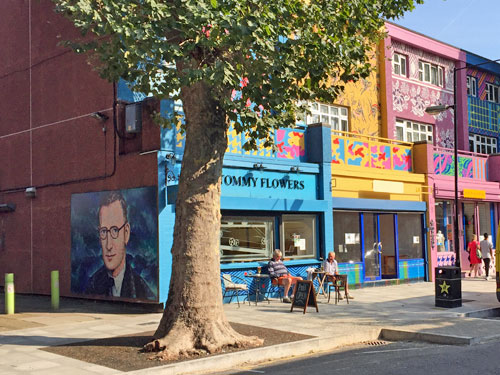
The design concept references a Bangladeshi tradition of recycling garments, with each individual facade based on a different swatch of fabric. Most of these fabrics were sourced by members of the community, while others were lifted direct from the architect's wardrobe. Once scanned and processed this created a diverse patchwork to be applied to the fronts of the shops and the flats above them, the biggest decision being which design to place where. Over 800 litres of paint were used, in 200 different colours, with the entire street-sized mural applied in approximately six weeks. You can see lots of close-up images (and watch a fly-through video) here.
The end result looks anything but traditional, perhaps more Mediterranean or even Latin American, as the two brightly painted parades face off against each other. Walls, balconies and shutters combine to create a riot of colour, aided and abetted if the sun happens to be shining on one or other side of the street.
The supermarket now looks cheery, the tailor's shop bright and welcoming, and the Chinese takeaway requires a double take. The chemist has scrubbed up well, the mosque has a particularly colourful pattern which helps it stand out, and even the dusty old workshop rented by the old bloke who should have retired by now has a delightfully individual frontage. The Tommy Flowers pub was already a shade of dazzling blue, with its mural of the bespectacled computingpioneer who grew up two streets away painted down one side, it's just that the rest of the street has now surpassed it.
And yet.
Spending some time in Aberfeldy Street on a Saturday afternoon it was fascinating to see who wasn't here. The Bangladeshi grocers was busy, but only with people walking over from the undeveloped side of the estate. The punters gassing outside the pub included a late middle-aged couple so blunt that if they appeared on EastEnders you'd assume they were caricatures. Barely a single vehicle drove down the street in the course of half an hour, other than the lowly 309 bus squeezing its way through without stopping. The barber took a break from a loud conversation with two mates to head inside and shave a customer. A couple of teenagers walked up the street clutching the obligatory box of chicken. But of the residents of the new development around the corner I saw not a sign.
Aberfeldy Street barely gets a mention in the marketing brochure written to attract Nespresso-friendly professional couples to this corner of E14. The gym gets a double page spread, as does the 24/7 concierge, plus the promise of an on-site deli "for daily essentials and organic groceries". Londis definitely won't cut it for residents being nudged towards "Canary Wharf for Marks & Spencer Simply Food and Waitrose", or urged to "head into the West End for shopping and champagne afternoon tea." If the newly-repainted high street makes it into the next iteration of the publication it'll only be because it looks pretty, not because it's aspirational... it doesn't even boast a cafe where you could pick up a decent cup of coffee.
The repaint of Aberfeldy Street, glorious though it is, is only a temporary 'meanwhile' project with a lifespan of maybe five years. The next phase of the estate's redevelopment will be to build a new retail area, slightly to the south, after which the existing parade of shops can be safely demolished. Whether the existing traders of Aberfeldy Street, many of whom currently benefit from paying low or no rent, will be able to transfer across remains to be seen. Looking at the artist's impression, with bland units buried beneath stacks of brick balconies, I have my doubts.
At present, even in its rainbow state, Aberfeldy Street is serving traditional estate residents rather than the incomers. The danger is that the next retail hub will serve mainly the new lot, having been shifted onto their turf, with a consequent focus on hospitality fripperies rather than affordable services. The hope must be that the brightly repainted street proves so popular that nobody can bear to see it die.
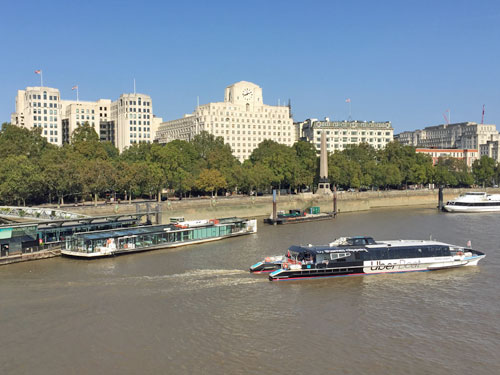
This year sees the 20th anniversary of Transport for London, a brand introduced in 2000 when the Greater London Authority was created. It's not an especially exciting anniversary but some years any excuse will do. For Open House TfL chose to celebrate by organising a self-guided walk routed via a number of key transport locations in the centre of town. It seemed an especially appropriate event to attend given that this year is my 20th Open House... plus it was outdoors, non-virtual and didn't require booking, and there weren't many other places to go this year.
It wasn't quite clear what you were letting yourself in for before you turned up, the Open House listings being as obtuse as they often are...
... but in the end it turned out to be a 2½ mile walk undertaken at your own pace, ticking off five transport nodes around a looping circuit. Cheery staff were waiting at each stop with an information sheet, and if you collected all the information sheets you got a prize at the end. Think of it as TfL orienteering. Here's how it worked out...
1) Palestra
Palestra is TfL's main office block, otherwise known as the tall building opposite Southwark station with the jutting-out top. Normally it holds thousands of staff, but times are not normal so the furniture's been rejigged to cater for rather fewer, but times are not normal so nobody's due back at their desks before next month. Nobody's back at the other office blocks in North Greenwich and Stratford either, so best not think about the rent currently being paid out on empty buildings (not that TfL will be the only ones with this particular problem). Just look up at the colourful Will Alsop architecture, grab your information sheet and move on. Palestrafact: 'Palestra' derives from the Greek for arena and is a reference to the boxing gym that once occupied the site.
"Here's your map" said the member of staff outside Palestra. The problem was it wasn't a map, more of a line diagram, which given the organisation who'd designed it perhaps wasn't surprising. But this meant the next location was only ever listed by name, with no visual or digital clues whatsoever. I got over-confident at this point, believing myself to be a London expert, and headed off convinced I knew where 'Waterloo Bus Garage' might be. Perhaps they meant bus station, I thought. They did not, and I walked quite a long way off course having not spotted the earlier checkpoint someone had hoped would be obvious.
2) Waterloo Bus Garage
Waterloo, it turns out, has a bus garage. It's had one since 1951, established to serve the Festival of Britain, but it's hidden behind a high fence and all the buses inside are single deckers so basically who knew. The two routes based here are the 507 and 521, the high-capacity, high-frequency 'Red Arrow' routes designed to disperse commuters across central London. They can't be dispersing anywhere near as many commuters as usual at present. TfL are very proud of their electric credentials, hence we were stopping off here with nothing to see rather than at the visually more impressive station across the road. The best thing I learned was of the existence of The Bus Cafe, ostensibly a works canteen but one to which the public are invited for a cuppa, fry-up or West African fish dish at hugely reasonable prices. Open weekdays only. File away this important information for later use. Waterloobusgaragefact: One of the photos on the fact sheet was captioned 'This Routemaster was used to provide tours of London for visitors arriving for the Festival of Britain in 1951', but I didn't want to be the one to point out that the first Routemaster didn't enter service until 1956 and the vehicle in the photo was actually an RT.
3) Embankment station/pier
This check-in point was outside the station, not the pier, which was fine because we'd just trooped across the Golden Jubilee Bridge to get there. We'd also battled the crowds on Waterloo Road and the hubbub alongside the Royal Festival Hall, and should probably have walked through the mainline station too but I didn't fancy trying that. I did at one point question the sanity of traipsing through some of the busiest parts of post-lockdown London, it being no ghost town any more, but the promise of a prize at the end drove me to plough on. Embankment had the only non-chatty staff on the tour, so I can't tell you anything new other than what was on the information sheet. Embankmentfact: Twice as many journeys start or finish at Embankment station each year (20m) as are made on the entirety of the TfL river services network (10m).
4) Temple station
In good news we got to admire the outside of Temple station as built in Portland Stone in 1911, as opposed to being forced to confront the northern end of the Garden Bridge which, in an alternative timeline, had been due to be completed by now. In less good news Temple station is closed this weekend, so we couldn't have enjoyed a one-stop trip on the tube and enjoyed "the red detailing on the top and bottom of the support columns" even if we'd wanted to. At least the lovely vitreous enamel geographic tube map from 1932 is always visible outside (a proper Journey Planner is available inside the ticket hall, as the heritage panel attests). Templefact: The Temple cab shelter has a 'CSF' monogram, for Cabman's Shelter Fund, which built the structure.
5) Blackfriars station
This checkpoint was just inside the station, so I wondered what the current rules were regarding face coverings and ticket halls and whether British Transport Police would rush out and caution me if I asked for an information sheet, but thankfully nothing untoward happened. This particular stop merited two information sheets, one covering the station and intersecting cycleways, the other cycle hire and the history of London buses. The tour's organiser had done well to include quite so many TfL modes of transport in a single short loop, but alas the Overground, trams, Crossrail and Dangleway missed out this year. Blackfriarsfact: The subway entrances, which no longer provide an entrance to the station, were opened in 1925. Another sealed-off entrance, opened in 1977, once led down to the Victoria Embankment.
6) Palestra (again)
Brandishing my complete collection of information sheets permitted me to claim my prize - a tote bag with a rather snazzy rainbow-lines-and-roundel design. It also finally gave me somewhere to put my information sheets as I headed off to my next Open House venue. I felt a bit guilty claiming my freebie having given TfL less than £10 of my money over the last six months, but rules are rules. I shall store it with all my other freebie tote bags which are supposed to be good for the environment but which I have never used. It's probably not a good sign for TfL's finances that my next venue was two trains away but I chose to walk five miles instead rather than board any of their services.
My thanks to whoever organised 20 years of TfL, though, for a well-planned diversion around once-familiar areas of central London. I even went south of the river for the first time since March. It was good to be back, however briefly.
• care homes warned of rise in infections
• 2nd lockdown in Israel leads to resignations
• UK tests being sent abroad for analysis
• Rule of Six comes into effect
• Labour leader self-isolating
• no tests available in top 10 hotspot areas
• unemployment up, redundancies accelerating
• Home Secretary attempts to define 'mingling'
• entire Irish cabinet self-isolates
• inflation tumbles to 0.2%
• Rhondda goes into isolation/lockdown
• 'very serious situation in Europe' (WHO)
• new restrictions across NE England
• test demand 'significantly outstripping' capacity
• national 'circuit break' restrictions discussed
• London's New Year fireworks cancelled
• new restrictions across NW England
• UK now seeing "inevitable" second wave (PM)
• everyday interactions need to be "dialled back"
• PM plans hefty fines for breaking self-isolation
Worldwide deaths: 920,000 → 950,000 Worldwide cases: 28,600,000 → 30,600,000 UK deaths: 41,623 → 41,759 UK cases: 365,174 → 390,358 FTSE: down ½% (6032 → 6007)
Last year I thought I'd do Open House differently. I thought I'd volunteer.
In a normal year it takes 1500 volunteers to keep Open House weekend up and running. All you need to do is sign up on the website, enter a handful of details and pick a slot.
Volunteers can choose to be either a Guide or a Steward, the former leading people round and telling them about the building, the latter more of a reassuring and helpful presence. Being a Guide requires a certain level of swotting up beforehand, which I'm sure I would have been capable of, but I preferred an easy life so went for the Stewarding option instead.
Volunteering sessions tend to last half a day, typically 10-1.30pm or 1.30pm-5 (but slots vary according to actual opening times). Essentially you're committing to spending at least 25% of Open House weekend in a single location, but at least you get to choose that location yourself from a very long list.
I ummed and ahhed for a very long time before choosing a middle-of-the-spectrum building in a not especially overloaded part of town. I made sure it was large enough that I'd be one of several stewards on duty, not the schmuck with sole responsibility for advice and hospitality. This may or may not have been a good choice. Open House duly despatched a confirmation email giving contact details for the lady who'd be the duty manager on the day in case I needed to tell her anything, and all seemed well.
A free Open House guide rapidly arrived in the post. This was excellent payback, indeed a proper perk, given that the guide plus postage and packing now costs in the region of a tenner. Included in the package was a green Open House badge to wear which would confirm my official status. It also meant I'd be allowed to jump queues across the weekend, pre-booked venues excepted, becoming one of those annoying people who pushes past after you've been waiting in line for hours.
Another perk of being an Open House volunteer is that everyone gets invited to a party on the Sunday evening. An email was circulated giving details of the party venue in Spitalfields, plus a link to register on Eventbrite, with the major caveat that only 300 places were available. I was out when the email arrived and by the time I logged in all the tickets had been reserved, so the Open House Closing Party was immediately out of bounds. Admittedly I wouldn't have wanted to go, I hate parties with hundreds of unknown people, but I never got the option anyway.
At the end of August Open House sent an email asking if anyone was interested in doing a double shift. Several buildings remained in need of volunteer help and perhaps we'd like to trawl through these extra slots and sign up. A week before Open House weekend they sent another email listing 50 venues in need of help, but checking the website revealed the total to be rather higher than that. Many locations would function perfectly well with fewer people, but those with only one volunteer due to be on duty might not. I didn't fancy giving up more of my weekend so decided against.
With just two days to go my chosen building's duty manager contacted me by email and told me not to come. "Unfortunately we’re over capacity for volunteers," she said, "so your help is no longer required." I'm not sure quite how that could have happened, but fine, it left me free to volunteer at a different property.
I logged back into the website to pick again, but the system didn't know I'd been released from my duties so refused to allow me to rebook. I could have volunteered on the other day of the weekend, but I had plans for that wasn't so willing to switch dates. I clicked on 'cancel' to revoke my volunteering slot but again the system refused. It's too close to the actual event, it said, you need to email us instead. So I emailed and waited, and waited, but nobody replied.
The day before Open House weekend I received another automated email confirming my original booking, with the caveat "If you have any problems or queries, please get in touch so we can help." I did indeed have problems and queries. This time a different email address had been provided so I replied to that, only to receive an Out of Office reply which said "the Open House team are out and about checking on the events taking place across London. This email will not be being monitored regularly." Communication, I decided, was not one of the team's strengths.
I heard nothing else so went out and enjoyed the whole of Open House weekend as a participant. It meant some serious replanning because I suddenly had four hours free I wasn't expecting, and I didn't really maximise the opportunity. I could have used my badge to visit all the popular sites and queue-jump, but decided that wouldn't be fair so my magic pass stayed firmly in my pocket all day.
I did of course pop in on my chosen venue, briefly, but without letting on. One of the successful volunteers handed me a leaflet and directed me inside, while all the others sat on a sofa relaxing and having a cosy chat. Two of them were still having that cosy chat when I went to leave. I can see now that my volunteering slot would have been a total waste of time, offering limited opportunities to be usefully hands-on, and that the building was totally overstaffed even without me. It pays to choose your Open House volunteering slot with care.
On Monday afternoon Open House sent me an email thanking me for my contribution. It also said they'd had a lovely volunteer closing party last night, with Ivan's cupcakes a particular highlight, and hoped I enjoyed myself.
As far as Open House are concerned they think I did a wonderful job for them in 2019, whereas in fact my opportunity had been cancelled and nobody was interested when I informed them. I had been wondering how to respond when they sent a further email in summer 2020 inviting me back... but in the end the opportunity never arose.
Open House weekend is very different this year. Much of the programme is virtual, several of the self-guided walks can be walked at any time and a bank of short films is being uploaded at nine o'clock this morning. But several properties will still be opening physically and remain reliant on volunteers. If you've successfully negotiated the system this year and are pinning on your green badge as we speak, London offers its collective thanks.